
A Topographical Dictionary of Scotland. Originally published by S Lewis, London, 1846.
This free content was digitised by double rekeying. All rights reserved.
'Saddell - Selkirkshire', in A Topographical Dictionary of Scotland, (London, 1846) pp. 445-461. British History Online https://www.british-history.ac.uk/topographical-dict/scotland/pp445-461 [accessed 12 April 2024]
In this section
S
Saddell and Skipness
SADDELL and SKIPNESS, a parish, in the district of Cantyre, county of Argyll; containing 1813 inhabitants, of whom 846 are in Saddell, and 967 in Skipness, respectively 19 and 32 miles (N. by E.) from Campbelltown. The name of the first of these places has been at different times written in ancient documents Saundle, Sandel, and Sandale, signifying in the Scandinavian language "a sandy plain." The term Skipness, in the same language, means "a ship-point," and was used in reference to the place on account of its having been a central station for the rendezvous of the northern fleets, during the period of their attacks upon this coast. The two districts, the former having been disjoined from Killean, and the latter from Kilcalmonell, were united in 1753. An abbey of considerable note was founded in Saddell about the year 1160, by Somerled, Lord of the Isles, who, in 1158, with a fleet of fifty-three ships had seized Cantyre and the Western Isles, then belonging to the crown of Man, and made himself an independent chief. This religious house, which was finished and endowed by Reginald, his son and successor, was for monks of the Cistercian order, and was situated in a beautifully secluded spot in the midst of majestic trees, which still overshadow its ruins. Its church was in the form of a cross, the extremities respectively pointing to the four cardinal points; the length from east to west was about 136 feet by twenty-four, and that of the transepts from north to south, seventy-eight feet by twenty-four. Other buildings were appended, giving to the whole a quadrangular form. The parish is bounded on the east by the sound of Kilbrandon, which separates it from the Island of Arran; and on the south by Campbelltown. It is of a long irregular figure, stretching twenty-five miles in extreme length, and three in average breadth, and comprising considerable portions of well-cultivated arable ground, with some good pastures, and large tracts of moor, heath, and mountain. The line of coast is very circuitous, and diversified with numerous creeks, promontories, and bays; the last are often spacious, though rocky at the entrance, and generally embrace a fine expanse of water having a good sandy beach. The headlands are in general low, and of various forms, but all projecting towards the south-east. In the neighbouring waters, in every direction, cod, ling, mackerel, haddock, whiting, and other kinds of fish, are to be found in great abundance, though mostly neglected by the natives.
The surface of the interior is also much diversified, and displays a great variety of undulations, numerous hills covered with heath, and dreary mountains and moors, with several spacious valleys. Some of the last, near the sea, are ornamented with interesting mansions surrounded by verdant inclosures, tasteful gardens and shrubberies, and well laid out grounds. The highest mountain is Benintuirk, rising 2170 feet above the level of the sea, and commanding beautiful views which embrace the Isle of Arran, the Frith of Clyde, the Craig of Ailsa, and the Irish Channel, with many other more distant objects. The most attractive prospect, however, though much less extensive, is from the southern quarter, whence may be surveyed a mixed landscape of the first order, combining numerous striking features of both Highland and Lowland scenery with great effect. The valleys have each their own streams, generally well stocked with trout, and which, after marking with their respective channels the sides of the mountains, slowly wind their way, in many places through secluded hollows and recesses, till they lose themselves in the waters of the ocean. Most of the moors are spangled with silvery lakes, which also abound with trout; and the lakes and marshes originate several rivers, some of them stocked with par and good-sized salmon. The chief streams in the parish are the Skipness, Claonaig, Crossaig, Sunadale, Torrisdale, Saddell, and Carradale, the last a fine angling stream, and in much repute.
The soil on the higher grounds is a light earth with an admixture of gravel, but along the streams, a kind of alluvial slimy compost; the subsoil in most places is rock, clay, or gravel, but near the sea, pure white sand. The meadows consist principally of moss, or of a deep rich loam resting on clay. The husbandry till recently was very indifferent, the body of the people having united other avocations with that of farming; but the most improved system has been now introduced by some of the landholders, with extensive draining, in consequence of which great advances have been made. The farms vary in extent from 250 to 1500 acres, and the rent of arable land averages 17s. 6d. per acre. The predominating rock is mica-slate; but quartz is also abundant, running generally parallel with the former, though sometimes crossing it at right angles. Large detached blocks of granite are also to be seen, of a very hard texture; and in a quarry at Carradale have been found fine specimens of obsidian, a species of lava which, though almost black in the mass, when cut into thin pieces exhibits the hue of dark green glass. The natural wood, which is scattered in different places, comprises oak, ash, hazel, birch, and alder; fine old foresttrees occur in some of the plantations, and Scotch fir and larch are in many parts abundant and in a thriving condition. The rateable annual value of Saddell and Skipness is £5251.
The population has partially declined of late years, owing in some measure to the breaking up of the cottar system, and the consolidation of small farms. The parish is principally agricultural and pastoral; but many hands which are employed in husbandry give also a large part of their time to fishing, especially those who dwell on the coast; and about sixty-five boats, chiefly for taking herrings at a distance, belong to the place, usually carrying three men each. Cod and ling are also sometimes caught; and salmon both at Carradale and Skipness, with much success: lobsters are abundant, and of excellent quality. The parish is ecclesiastically in the presbytery of Cantyre and synod of Argyll, and in the patronage of the Duke of Argyll: the minister's stipend is £150, of which more than a third is paid by the exchequer; with a manse, and a glebe of twenty acres, valued at about £30 per annum. There are two parish churches, thirteen miles apart, one situated at Carradale, and in good repair, and the other at Claonaig, which is in a dilapidated state: they accommodate respectively 354 and 288 persons. Two parochial schools are also maintained, affording instruction in the ordinary branches; the masters each receive a salary of £25. 13. 4., with a house, grass for a cow, and £4 fees: these schools were not established until 1822. The most interesting relic of antiquity is the ruin of the celebrated monastery of Saddell, which however has nearly disappeared, the materials having been quarried out of late years for various uses. The castle of Skipness is an ancient and venerable pile of square form, with a court, the outer wall comprehending a space of 450 feet; and at Saddell, also, is a castle of the same figure, of considerable size, and formerly surrounded by water. Along the coast are ruins of several forts, generally situated on the headlands; and a few tumuli are to be seen. The churchyard is remarkable for the number of singularly curious inscriptions and figures carved upon the gravestones, and as the place of sepulture of many persons celebrated in former times. The Rev. Donald Mc Nicol, a great scholar and antiquary, and author of the Review of Dr. Johnson's Tour to the Hebrides, was minister of the parish in 1753.
Sagay
SAGAY, an isle, in the parish of Harris, county of Inverness. It is one of the numerous group of isles in the sound of Harris, and is of very small extent, and uninhabited.
St. Boswell's.
ST. BOSWELL'S.—See Boswell's, St. And all places having a similar distinguishing prefix will be found under the proper name.
Salen
SALEN, lately a quoad sacra parish, partly in the parish of Kilninian and Kilmore, and partly in that of Torosay, district of Mull, county of Argyll, 8 miles (S. E. by S.) from Tobermory; containing 775 inhabitants. This place, formerly only a missionary station in Torosay, was severed from that parish for ecclesiastical purposes, and, together with part of Kilninian and Kilmore, erected into a quoad sacra parish, by act of the General Assembly. A religious establishment appears to have been founded here at a very early period, which became a cell to the monastery of Iona; and St. Columba is said to have preached occasionally at this place, from which circumstance a rivulet near the ruins of the convent not far from the village, still retains the name of the Preacher's burn. The district is bounded on the north by the bay of Aros, in the sound of Mull, and on the south-west by Loch-na-Gaul; and is intersected by the road to Knock, which separates that portion of it within the parish of Kilninian and Kilmore from that which is in Torosay. The bay of Aros, though wild, is marked with features beautifully picturesque, and derives much interest from the remains of an ancient castle for many years the baronial residence of the Macdonalds, lords of the Isles, situated on the summit of a rocky eminence overlooking the bay. The small village of Salen is neatly built, and pleasantly seated on the south bank of the water of Aros, over which a bridge has been constructed on the new line of road leading from Tobermory to Knock, at the head of Loch-na-Gaul: the surrounding scenery is pleasingly diversified. The ecclesiastical affairs are under the superintendence of the presbytery of Mull and synod of Argyll. The church, originally built about the year 1770, for the missionary station, was transferred on the erection of the parish to the parliamentary commissioners, by whom it was considerably enlarged: the minister has a stipend of £120 from the exchequer, with a manse built by government in 1828, and a glebe comprising two acres of land; patron, the Crown.
Saline
SALINE, a parish, in the district of Dunfermline, county of Fife, 6 miles (N.W.) from Dunfermline; containing 1057 inhabitants, of whom 358 are in the village. This place is supposed to have derived its name, signifying in the Gaelic language "a hill or mountain," from the hills within its limits, of which one is of considerable height. The parish is situated at the western extremity of the county, and is about seven miles in length from east to west, and about six miles in extreme breadth, comprising an area of 5000 acres, divided among various proprietors. The surface towards the north and east is diversified with hills, the highest of which has an elevation of nearly 500 feet above the level of the sea; but the western portion of the parish is generally level. The land near the village is moderately fertile; in other parts the soil is thin, resting on a tilly bottom, and there are large tracts of moss affording only an abundant supply of peat. Those lands which were marshy have been recently much improved by draining. The system of agriculture has been greatly advanced, and the crops of all kinds are now favourable; the farmbuildings are substantial and commodious, and all the more recent improvements in implements of husbandry have been adopted. The substratum abounds with coal, lime, and ironstone; the coal is of good quality, and there are some mines in operation, but the principal collieries of the district are at Blairingone, in the neighbouring parish of Fossoway. There are extensive limeworks, also, at the extremity of the parish; and the ironstone is good, and now wrought to a very great extent. The rateable annual value of Saline is £6692. The seats are, Upper and Lower Kinnedars, Bandrum, Balgonar, Kirklands, Rhynds, and Oakley, all handsome mansions pleasantly situated. The village is on the road to Auchterarder; it is neatly built, and has a rural appearance. It is divided into two nearly equal parts by a stream flowing through it; that part called the New Town is rapidly increasing in extent. The ecclesiastical affairs are under the superintendence of the presbytery of Dunfermline and synod of Fife. The minister's stipend is £156. 17. 2., of which one-half is paid from the exchequer; with a manse, and a glebe valued at £15 per annum: patron, the Crown. The church is a plain structure situated in the village. The parochial school is attended by about eighty children; the master has a salary of £34. 4. 4., with a house and garden, and the fees average £40 per annum. The members of the Free Church have a place of worship. There are some vestiges of two ancient towers, and also two Roman camps.
Sallysburgh
SALLYSBURGH, a village, in the parish of Bertram-Shotts, Middle ward of the county of Lanark, 4 miles (N. W. by W.) from Shotts; containing 196 inhabitants. It is one of the four principal villages in the parish, and is situated on the high road from Glasgow, through Holytown, to Edinburgh. This village also bears the name of Beardy-Row.
Saltburn
SALTBURN, a village, in the parish of Rosskeen, county of Ross and Cromarty; containing 329 inhabitants. The population is chiefly agricultural. A Gaelic school was established here in 1823 by the Edinburgh Gaelic Society, by whom it is wholly maintained; the master is allowed a salary of £20, but no fees are charged.
Saltcoats
SALTCOATS, a sea-port town, and lately an ecclesiastical district, partly in the parish of Stevenston, but chiefly in that of Ardrossan, district of Cunninghame, county of Ayr, 6 miles (W. by N.) from Irvine, and 32 (S. W.) from Glasgow; containing 4238 inhabitants, of whom 2806 are in that part within the parish of Ardrossan. This town, which is irregularly built, is chiefly inhabited by seafaring men connected with the shipping of the harbours of Ardrossan and Saltcoats; by weavers; and the various artificers connected with the business of the port. The harbour is in that portion of the town which is in the parish of Stevenston, and it has contributed greatly to the increase of the population. A great number of the inhabitants are employed in weaving for the manufacturers of Glasgow and Paisley; the articles are chiefly lappets, gauzes, trimmings, shawls, and silks, in the manufacture of which more than 450 looms are constantly at work. A large number of females, also, are engaged in working muslins in different patterns, for which this part of the country is celebrated, and which by way of eminence are designated the Ayrshire muslin. Many persons from the Highlands and from Ireland have settled at this place, who are employed in general trades; and several families, unconnected with business, have built handsome houses here as a favourite residence for the benefit of sea-bathing, for which its proximity to Ardrossan renders it very convenient. The principal building is the town-house, a well-built edifice two stories in height, and surrounded by a lofty spire. The ground-floor is occupied by shops, a room for the town library and reading-room, and a committee-room; the upper story contains a spacious apartment which is appropriated to the monthly meetings of the magistrates of the district, who here hold a court of petty sessions, and in the intervals is used as a news-room and for other general purposes. Attached is a small lock-up house for the temporary confinement of petty offenders. A handsome building has also been erected for the branch of the Western Bank of Scotland established within the last few years. Fishing is carried on here to a considerable extent; salmon are found in the Frith, and sent in large quantities to the neighbouring towns, to Glasgow, Paisley, and Kilmarnock, and to Liverpool by steam-packets, which sail regularly from the harbour of Ardrossan. From fifteen to twenty boats, likewise, are employed in the herring-fishery, for which purpose they frequent the lochs in the north and west Highlands; herrings are also taken in tolerable numbers in the bay, and some boats go to the coasts of Barra and other islands for ling and cod. A fair is held on the last Thursday in May, for cattle, pigs, shoes, and other articles of merchandise; a post-office is established here, which has a good delivery; and facility of communication is maintained by roads in every direction, and by packets and steam-boats that sail at stated times. The Ardrossan and Johnstone railway, which now forms a part or branch of the Ayrshire railway, passes through this place, to which it proceeds from the west side of the harbour of Ardrossan, and unites with the main line at the town of Kilwinning. The district was separated for ecclesiastical purposes from Ardrossan by an act of the General Assembly; and was in the presbytery of Irvine and synod of Glasgow and Ayr: the stipend of the minister was £80, arising from seatrents and collections. The church, built in 1836, is a neat edifice containing 720 sittings. There are several meeting-houses, and a mechanics' institute. A public library is supported by subscription, which has an extensive collection of books on general literature; and a savings' bank has been for some time established.—See Ardrossan.
Salton
SALTON, a parish, in the county of Haddington; containing, with the villages of East and West Salton, 770 inhabitants, of whom 261 are in the village of East Salton, and 167 in the village of West Salton, respectively 6 miles (S. W. by S.) and 7 (S. W.) from Haddington. This place, which is of considerable antiquity, is supposed to have derived its name from Nicholas de Soulis, who was proprietor of some land here in the 13th century, and from whom it was called Soulistown, since corrupted by abbreviation into Salton. The earliest authentic notice of the place occurs in the 12th century, when it formed part of the possessions of the family of the De Morvilles, constables of the kingdom, of whom Henry de Morville in the year 1190 granted the lands of Herdmanston, a portion of the manor, to his sheriff, Henry de St. Clair, ancestor of the present proprietor. The De Morvilles, having taken part with the English in espousing the cause of Baliol, during the disputed succession to the Scottish crown, were, on the accession of Robert de Bruce, deprived of their estates, which were bestowed on the family of St. Clair. Great part of the manor subsequently became the property of the Abernethy family, one of whose descendants, in the middle of the 15th century, was raised to the peerage by the title of Lord Saltoun; the lands were afterwards purchased from that family by Sir Andrew Fletcher, created Lord Innerpeffer, and ancestor of Andrew Fletcher, Esq., the present proprietor. The parish is about three miles and a half in length, varies from two to three miles in breadth, and is bounded on the west by the river Tyne, which separates it from the parish of Pencaitland; it comprises about 3220 acres, of which 2600 are arable, 420 woodland and plantations, and 200 in permanent pasture. The surface rises gradually from the river towards the south and east to a considerable elevation, of which the highest point, called the Skimmer Hill, and nearly in the centre of the parish, is 600 feet above the level of the sea: from this point the lands slope southward to the Salton river. The scenery is strikingly diversified, displaying in some parts the most luxuriant fertility, enriched by stately timber and flourishing plantations, and in others a pleasing variety of hill and dale; some of the farms are inclosed by hedges of thorn interspersed with wild roses, and are separated by good roads bordered on each side with rows of trees. The Salton water, which skirts the parish for nearly three miles previously to its junction with the Tyne, abounds with trout of excellent quality, and, in its winding course through the grounds of Salton park, is crossed by two handsome bridges of stone.
The soil is various, but principally a strong deep clay; on the higher grounds, of a lighter quality, and in parts intermixed with sand; in some places, a loam of great fertility; and on the slope of the hill descending to the bank of the Tyne, a mixture of clay and loam remarkably productive. The farms vary in extent from 120 to 600 acres; the system of agriculture is in a highly improved state, and the five-shift course of husbandry generally prevalent. The crops are, grain of all kinds, potatoes, and turnips, which last are but of comparatively recent introduction; bone-dust and rape manure are used extensively, and with so much benefit as nearly to supersede lime. The farm-buildings are substantial and well arranged, the lands inclosed, and the fences, partly stone dykes and partly hedges of thorn, kept in good condition: the furrow-draining is effected by drains in some parts constructed of stone, but generally of tiles. A society for the encouragement of agriculture, instituted by the late General Fletcher, has merged into the East Lothian United Agricultural Society, who hold a meeting annually at Salton, for the distribution of premiums. The woods are of fir, birch, and oak, with some elm, beech, and larch, which are well adapted to the soil; the plantations are of Scotch fir, with larch and spruce. The substratum is principally limestone, in which various species of fossil shells are found imbedded; and between the strata are veins of freestone and whinstone. It is generally believed that seams of coal lie under the limestone; but from the proximity of collieries in the vicinity, affording an abundant supply at a very moderate cost, no attempt has hitherto been made to ascertain the fact. There are two limestone quarries extensively wrought; and adjoining each is a kiln constructed on the best principles, for burning the produce into lime. On the lands of Salton is also a quarry of freestone, chiefly worked for the tenants of that estate; the stone is of good quality for building, but of a reddish colour. The rateable annual value of the parish is £5031.
Salton Hall, the seat of Mr. Fletcher, to whom nearly four-fifths of the lands in the parish belong, is an ancient castellated mansion formerly strongly fortified, but partly modernised and greatly improved and embellished by the present family. It is surrounded by an extensive park, well wooded, and comprising many fine specimens of stately timber; the lawns, pleasure-grounds, and gardens are tastefully laid out, and embellished with the winding waters of the Salton river. The house contains numerous stately apartments, and is enriched with a well-assorted library of more than 5000 volumes. Herdmanston, the property of Lord Sinclair, and lately the residence of the Honourable Adam Gillies, one of the senators of the College of Justice, is a handsome mansion of considerable antiquity, and still retains many of its original features. It was also a fortification of great strength; parts of the battlements and some of its turrets are still remaining, and the fosse with which it was surrounded, though nearly filled up, may yet be traced. The village of East Salton is situated nearly in the centre of the parish, and on the brow of the hill, commanding an extensive view of the finest and most richly cultivated portions of East Lothian, with the sea, the coast of Fife, and the adjacent country; it is neatly built, and inhabited by persons employed in agriculture and in the various trades that are carried on for the supply of the parish. The weaving of Holland cloth, on its introduction into Britain by the lady of Henry Fletcher of Salton, who had visited Holland for that purpose, attended by two experienced mechanics disguised as servants, was established here in 1750, and conducted for a time on a very extensive scale, supplying the whole of Scotland. In the same year the British Linen Company formed their first bleachfield, under the patronage of Lord Milton; and various other manufactories were established here, all of which have long ceased to exist. The only manufacture worth notice now carried on is that of bricks and tiles for roofing and draining, established in 1834 by the present proprietor on his own lands. The village maintains facility of intercourse with the neighbouring market-towns of Haddington and Dalkeith, by means of good roads, of which the road from Edinburgh to Dunse passes for three miles through the parish; and at West Salton is a post-office, which has a daily delivery. The village of West Salton is a mile to the west of East Salton, and nearly on the margin of the Salton water; it has a bridge over the river, and in its general character and appearance, though situated on much lower ground, differs but little from East Salton.
The parish is in the presbytery of Haddington and synod of Lothian and Tweeddale, and patronage of Mr. Fletcher: the minister's stipend is £271. 6. 10., with a manse, and the glebe is valued at £15 per annum. The church, situated in the village of East Salton, is an ancient structure enlarged and almost rebuilt in 1805; it is in the later English style, with a square embattled tower surmounted by a handsome spire erected at the expense of General Fletcher, and is adapted for a congregation of 400 persons. The parochial school, also at East Salton, affords a liberal education to about seventy scholars; the master has a salary of £34. 4. a year, £20 fees, and £6 from Bishop Burnet's augmentation fund, with a house and garden. There is likewise a school in the village of West Salton, of which the master has a salary of £20 from Bishop Burnet's fund, with £20 fees, and a house and an acre and a half of land given by General Fletcher, who also erected a spacious schoolroom. A library in the manse for the use of the minister, originated by a Mr. Norman Leslie, has been greatly augmented by an appropriation of part of Burnet's fund; and there are a good library for the use of the Sunday scholars, and a branch of the East Lothian Itinerating Library. In the south-west portion of the parish are the remains of an ancient camp of elliptical form, consisting of two concentric intrenchments; the inner area is about 500 feet in circumference, and between it and the exterior is a fosse ten feet in breadth, now nearly filled. It is supposed to be either of Pictish or Danish origin. Within the park of Herdmanston are the remains of a chapel erected by John de St. Clair in the 13th century; it is now used as a burial-place by the Sinclair family, and in it are two tombs inscribed to William de St. Clair and Sibilla, his wife. A little to the north are some slight remains of the ancient castle, consisting of one arch, on the key-stone of which is the date of its erection. William Dunbar, the poet, has been generally thought to have been a native of this place, but on very questionable authority. Patrick Scougal, afterwards Bishop of Aberdeen, was incumbent for about five years till 1664; and Henry Scougal, his son, author of The Life of God in the Soul of Man, and professor of divinity in King's College, Aberdeen, in which office he died, in the twenty-eighth year of his age, was born here in 1660. Gilbert Burnet, Bishop of Sarum, was presented by the crown, in 1665, to the incumbency of this parish, which he held till 1669, when he was appointed professor of theology in the university of Glasgow: he died in 1715. Andrew Fletcher, distinguished for his opposition to the Union of Scotland; and his nephew, Andrew, Lord Milton, chief justice, were both natives of Salton.
Samphrey
SAMPHREY, an isle, in the parish of Mid and South Yell, county of Shetland; containing 36 inhabitants. It is a small island lying in Yell sound, about a mile and a half southward from Biga island.
Samuelston
SAMUELSTON, a village, in the parish of Gladsmuir, county of Haddington; containing 215 inhabitants. This village, which is situated on the north bank of the river Tyne, consists of irregularly built and widely detached houses, and is chiefly inhabited by persons employed in agricultural pursuits, and in the various trades requisite for the supply of the parish. The inhabitants formerly carried on an extensive trade in meal; and though it has been greatly diminished, there are still two corn-mills in operation, to one of which is attached a saw-mill for cutting palings and other purposes. A school for about thirty children has been established in the village; the master has a house and garden rent-free, in addition to the fees, which are, however, very inconsiderable.
Sand
SAND, an isle, in the parish and district of Small Isles, county of Argyll. This is a small islet, constituting the south-east side of the harbour of Canna, and is separated from Canna island by a strait that is nearly dry at every ebbing of the tide; it is suitable both for cultivation and pasture, and is inhabited by a few persons.
Sanda
SANDA, an island, in the parish of Southend, district of Cantyre, county of Argyll; containing 11 inhabitants. This is a small island, lying near the outer extremity of the peninsula of Cantyre, and measuring about a mile and a half in length and half a mile in breadth; its name is of Scandinavian origin, and signifies "Sand Island." It possesses a good natural harbour, although between the island and the main land the sea is extremely turbulent and dangerous, and for two or three months in the year the place cannot be approached by a small boat. Sanda was a common station for the Scandinavian fleets during the contests so long carried on for the possession of Cantyre and the neighbouring islands. There yet exist here the ruins of an old chapel dedicated to St. Columba. On the east side of the island are two islets covered with excellent pasture; and about a league to the south is a dangerous sunken rock, a mile in circumference, called Paterson's rock.—See Southend.
Sanda
SANDA, an island, in the county of Orkney, 16 miles (N. E. by N.) from Kirkwall; containing 1892 inhabitants. This island, which is situated between the island of North Ronaldshay and that of Stronsay, the latter lying to the south, is bounded on the west by the Atlantic Ocean, and on the north and east by North Ronaldshay Frith, which is about seven miles broad. It is twelve miles in length, and of extremely irregular form, varying from half a mile to nearly three miles in breadth. The coasts are indented on all sides with numerous spacious bays, of which the principal are the bay of Osterwick on the north, and that of Kettletoft on the south; and numerous bold headlands project into the friths, of which the most prominent are, Whitemill and Taftsness to the north, the Start and Tressness to the east, and Elsness and Spurness to the south. The island comprises the two parishes of Cross and Lady, which are described under their respective heads.
Sandend
SANDEND, a fishing village, in the parish of Fordyce, county of Banff, 2 miles (W. by N.) from Portsoy; containing 252 inhabitants. This small village, which takes its name from its sandy beach, is situated on the western shore of a small but secure bay of its own name, in the Moray Frith, and which is sheltered on the east by the boldly projecting headland of Redhyth. The inhabitants are chiefly employed in the lime quarries near the village, which are in extensive operation, and in the cod and herring fisheries off the coast, in which latter they employ seven boats, each having a crew of four men. The fisheries are generally attended with success, and great numbers of herrings are cured, and sent to the different markets, especially to Portsoy, whence they are shipped to various parts of the Baltic by the vessels which arrive at that port with cargoes of bones. In successful seasons these fisheries are very lucrative; and most of the individuals engaged in them realise during the season a clear profit of about £30 each: every crew of four men pays to the proprietor a rent of £4. 3. 4., for which they are supplied with a new boat once in seven years.
Sandford
SANDFORD, a village, in the parish of Stonehouse, Middle ward of the county of Lanark, 1½ mile (S. E.) from Strathaven; containing 116 inhabitants. This village is situated in the extreme south-west part of the parish, and on the borders of the parish of Avondale, which is here separated from Stonehouse by the Kype water. The population is partly engaged in manufactures and handicraft trades. Of five schools in the parish, two are in this village.
Sandhead
SANDHEAD, a village, in the parish of Stoneykirk, county of Wigton, 2 miles (S. S. E.) from the village of Stoneykirk; containing 140 inhabitants. This small village is situated on the western shore of the bay of Luce, and chiefly inhabited by persons engaged in the fisheries, which are carried on to a moderate extent. The fish caught are principally cod, which are to be found in abundance, especially in the Irish Channel; and various kinds of shell-fish are thrown on the sands; but of neither description is more taken than is sufficient for the supply of the inhabitants of the district. The bay of Sandhead is capacious, easy of access, and affords safe accommodation for the vessels engaged in the fishery, and good anchorage for sloops, which bring cargoes of lime and coal from Whitehaven, Glasgow, and Liverpool. A post-office under the office at Stranraer has been established in the village, and there are some small inns for the accommodation of travellers.
Sandness and Walls
SANDNESS and WALLS.—See Walls and Sandness.
Sandra
SANDRA, or Sanderay, an isle, in the parish of Barra, county of Inverness; containing 14 inhabitants. It is an isle of the Hebrides, situated in the sound of the same name, about five miles south-east of Barra; and is two miles in length and of equal breadth. On the east coast of the island is a Danish dun.
Sandsting and Aithsting
SANDSTING and AITHSTING, a parish, in the county of Shetland, 12 miles (W. N. W.) from Lerwick; containing, with the islands of Little Papa and Vementry, 2478 inhabitants. These ancient parishes, now united, are said to derive their names respectively from two necks of land called Ting or Taing, on which courts of justice were formerly held; the one situated near Sand, and originating the name of Sand's-ting; and the other near Aith, giving the name of Aith's-ting. The parish lies in about the middle of the Mainland, and is bounded on the south and south-west by the Atlantic Ocean, and on the north by the Minn, or Swarbach's Minn, a large arm of the sea by which it is separated from the island of Muckle Roe. It is about ten miles in length and eight in breadth, comprising 1000 acres of cultivated land, exclusive of large tracts of pasture and peat-moss. The shore of that part washed by the ocean is bold and rugged, and marked by several curious natural caves, frequented by seals and wild-fowl; and the land in every part, both on the north and south, is intersected with voes, forming numerous well-secured natural harbours, of which those of Gruting, Olla, and Airs of Selivoe are the principal, and afford excellent anchorage for vessels of heavy burthen. On the south of the parish are the two voes of Skeld; and at a little distance, in the same direction, are the entrances into Selivoe and Sandvoe. Selivoe is remarkable for the unruffled tranquillity of its waters, and the firmness of its anchorage, consisting of a strong, blue, tenacious clay; but Sandvoe, being much exposed, and having only a very loose bottom, is considered an insecure and dangerous station. In addition to these, are Sandsound voe, which runs for upwards of five miles inland; West Burrafirth, on the north of Aithsting; and Brindister voe, all, with the exception of Burrafirth, commodious harbours having good anchorage; and there are several others, of which Aith's voe is the chief, an inland harbour of great extent, and affording tolerable accommodation for shipping. Among the various islands and holms belonging to the parish, the smaller of which are used only for the grazing of a few cows or sheep in summer time, Vementry and Little Papa, both inhabited, hold the most conspicuous place. The former is of considerable extent, covered partly with heather and partly with verdant sward, and is depastured by about 400 sheep chiefly of the white-faced breed, besides numerous black-cattle; Little Papa, which is of smaller size, and its pasture of inferior quality, is also grazed by several head of black-cattle and by about 200 sheep, which are a cross of the white and black faced kinds.
The surface of the interior, of which no part is distant more than a mile from the sea, is chiefly marked by a succession of knolls or inconsiderable elevations, there being no remarkable hills, nor any lengthened tract of low ground. These eminences are covered with heather, interspersed with green patches; and there are numerous springs and lochs, the latter amounting to no less than 140, and some of them large, and containing a good stock of very fine trout. The land under cultivation is in general contiguous to the shore. In some places the soil is sandy, in some clayey, and in others a light brown earth; but its prominent character is that of moss, which runs very deep, and affords the inhabitants a never-failing supply of excellent fuel, and in which are often found imbedded, at a great depth, fragments of birch and other wood. The ordinary crops are, bear, oats, and potatoes; the last are the leading article, and occupy about one-fourth of the ground under tillage. Cabbages, turnips, and carrots thrive very well, especially the last; and in the horticultural department, gooseberries and currants, strawberries, rhubarb, mint, and all kinds of culinary vegetables and herbs, arrive at perfection. The farms are generally of about three or four acres only, and are under spade husbandry, but two or three ploughs being in use; and the harrows, which are entirely of wood, and of the most simple construction, are each drawn over the ground by a man or woman by means of ropes. The land, as in most of those Shetland parishes where agriculture is in a rude state, consists of in-field and out-field, and is, as it is here called, run-rig, being but very scantily protected in any part by fences. Manure formed of sea-weed, earth, and a mixture of cows' dung, is applied to all the lands with the exception of those appropriated to the growth of potatoes, the inhabitants supposing it to be injurious to this root. The cottages of the tenants are of the meanest possible description; but the inmates appear to be reconciled to them by use. Large numbers of sheep are reared, mostly of the native breed, but now frequently crossed with the black and white faced; the black-cattle and ponies are numerous; and there is a small, bristly, yet excellent breed of pigs, one or two of which are generally kept by each family. The parish contains about fifty mills turned by water, and an almost unlimited number of hand-mills.
The rocks comprehend gneiss, limestone, blue and red granite, felspar, and several other varieties; and at a small distance from Tresta, a layer of porcelain earth of a whitish hue is found. Near Innersand, chromate of iron was quarried some years since; but the profit not being sufficient, the operations have been discontinued. There are a few trees which thrive well in favoured situations, such as the alder and mountain-ash; and the holms in some of the fresh-water lochs exhibit good specimens of the hazel, brier, honeysuckle, and willow; but the excessive moisture of the climate, together with the sea-spray, the long-continued rains and storms, and the depredations of the cattle when pressed for forage, forbid the hope of any thing like a regular plantation in the locality. There are three good mansions; Sand House, built in 1754; Garder House, built about 1760; and Reawick, a plain structure of recent date. Fishing here, as in the rest of the islands, engages much attention: the taking of ling commences in May or June; that of cod, beginning about the same time, is carried on in sloops of from twenty to forty tons' burthen; and the herring-fishing generally succeeds the others, and continues six weeks. Besides these kinds, tusk, saith, and other varieties are taken; and in most of the friths, haddock, whiting, flounder, halibut, skate, and mackerel are plentiful, with sillocks and piltocks; also shell-fish of every description. A fair is held at Whitsuntide, and another at Martinmas, for cattle and horses; the fish cured in the parish is sent by some to Leith, and by others further south.
Ecclesiastically
ECCLESIASTICALLY the parish is in the presbytery of Lerwick and synod of Shetland, and in the patronage of the Earl of Zetland. The minister's stipend is £158, of which a fourth is received from the exchequer; with a manse, built in 1817, which is in a very dilapidated state, and a glebe valued at £9 per annum. The church was built in 1780, and reseated in 1824, and contains sittings for 437 persons. Previously to its erection there was a church in each of the two districts; and the present edifice was raised in a central situation, for the more regular performance of divine service; but it is found inconvenient for general attendance, many of the inhabitants being separated by a marshy tract seven miles across, and others by two arms of the sea. There is a meeting-house for Independents, and another for Wesleyans. The parochial school, the premises for which were built in 1803, at the cost of £105, affords instruction in reading, writing, arithmetic, and book-keeping; the master has a salary of £26, with a dwelling, and the fees. There are also two schools supported by the Society for Propagating Christian Knowledge, who grant the teachers salaries of £15 each; and one Assembly's school, of which the master has a salary of £21. An institution called "the Shetland Fishermen's Fund," was established in 1810, for the relief of aged and decayed fishermen, and the widows of fishermen; it is managed by twelve directors, and has been of much benefit to the parish among the objects for whom the charity was designed. The parish contains numerous barrows or tumuli, the supposed places of sepulture of the ancient Scandinavians; and several forts built on high ground for watch-towers and other purposes. There are also five burying-places, at one of which, situated at Sand, a mile distant from Kirk-holm, is still the chancel of a church which tradition reports to have been constructed by the crew of one of the ships of the Spanish Armada that was wrecked here in 1588, out of gratitude for the kindness of the inhabitants. The sufferers had at first taken refuge and fortified themselves in Kirk-holm; and remains of their works are yet visible on the isle.
Sandwick
SANDWICK, a parish, in the county of Orkney, 14 miles (W. N. W.) from Kirkwall; containing 1033 inhabitants. This parish, which derives its name from the sandy bay whereon it is situated, was originally included in that of Stromness; it is bounded on the north by the parish of Birsay, on the east by that of Harray and the loch of Stenness, on the south by the parish of Stromness, and on the west by the Atlantic Ocean. It is about six miles in extreme length and nearly four miles in mean breadth, comprising an area of 10,720 acres, of which 2294 are arable, 3224 pasture, and the remainder undivided common and waste. The surface is diversified with hills, which form a prominent range towards the western boundary, and of which those of Vestrafiold and Yonbell to the north, and Gyran and Lingafiold to the south, stretch from the sea, diminishing in height towards the east, and sloping gradually to the shore of the lake. The coast, which is about four miles in length, is precipitously steep, rising in some parts to a perpendicular height of 300 feet above the level of the ocean; the sea has washed away the softer portions of the rock, and formed numerous caverns, separated by the harder portions, which have the appearance of isolated columns. The rocks are frequented by pigeons and various kinds of wild-fowl; and the views from the eminences on the shore combine scenes of romantic grandeur and milder beauty, commanding the Atlantic, and the most fertile and most highly cultivated of the Orkney islands. The soil differs greatly in different parts of the parish; to the east of the bay, for some distance, it is a loose sand shifting with the wind; in other parts a yellow clay, and in the valleys a rich black loam alternated with clay. The principal crops are oats and bear, with some potatoes. The system of husbandry, except in a few instances, is in a very backward state, the chief improvements hitherto introduced being confined to the breed of horses, and the use of good agricultural implements; the farm houses and offices are indifferent; and from the short duration of the leases, the tenants of the smaller farms have little incentive to better them. The cattle are of the breed common to the isles, and hardly any attention has been paid to its improvement.
There is no timber; but within the last few years some plantations of common and mountain ash, plane, elm, willow, and other trees, have been made, which appear to thrive. The rocks are principally granite, sandstone flag, sandstone, and trap. Slates of various kinds, and of different degrees of thickness, are quarried for roofing: a dark kind of limestone is also found here, which is burnt for lime; and a hard description of sandstone lying near the granite is generally used for millstones. Many of the strata contain fossil fish and plants of different sorts. The principal manufacture is that of straw plat, which affords employment to most of the younger female population; the manufacture of kelp is likewise carried on, but to no great extent, not more than seven or eight tons being made annually. Cod, haddock, skate, and herrings are obtained from the Atlantic in sufficient number for the supply of the inhabitants, and also lobsters of which many are sent to the London market: trout are found in Loch Stenness. A fair for cattle is held in June, near the eastern boundary of the parish. There is no village; letters are delivered through the Stromness post-office, and some facilities of communication are afforded by a well-constructed road which passes for two miles through the parish. The ecclesiastical affairs are under the superintendence of the presbytery of Cairston and synod of Orkney. The minister's stipend, including £8. 6. 8. for communion elements, is £158. 6. 8., of which £6. 5. 6. are paid from the exchequer; with a manse built in 1833, and a glebe valued at £12 per annum: patron, the Earl of Zetland. The church, erected in 1836, partly on the foundation of an ancient structure, is inconveniently situated on the sea-shore; it is a neat edifice containing 564 sittings. There are places of worship for members of the United Secession, and a body of the Independents. The parochial school is well attended; the master has a salary of £34. 4. 4., with a house and garden, but the fees are very inconsiderable, averaging not more than one shilling per quarter for each scholar. A parochial library has been established, which at present contains nearly 400 volumes. On the western coast are some remains of the ancient castle of Snusgar: in the township of Yeskenaby are remains of a small church with a cemetery. Near the base of the hill of Lingafiold is a cromlech; and there is likewise a second within the parish, which also abounds with tumuli and barrows, whereof many have been opened, and found to contain pieces of burnt bone, urns, and other relics. One of the barrows, opened by the present minister, was about fifty yards in circumference and seven and a half feet in height, formed of a moist adhesive clay, and covered by a large flag-stone, on the removal of which the grave appeared as perfect as when first made.
Sandwick
SANDWICK, an isle, in the parish of Yell, county of Shetland. It is a very small isle, situated in the sound of Yell, and a short distance from the western coast of the island of that name. Between it and the Mainland of Shetland is the isle of Stour-holm.
Sandwick and Cunningsburgh
SANDWICK and CUNNINGSBURGH, a quoad sacra parish, in the parish of Dunrossness, county of Orkney and Shetland, 9 miles (S. by W.) from Lerwick; containing 2167 inhabitants. This place comprises the ancient parishes of Sandwick and Cunningsburgh, annexed at an early period to Dunrossness, from which they were separated for ecclesiastical purposes, by act of the General Assembly, in 1833, and erected into one quoad sacra parish. The district occupies that portion of the southern peninsula of Shetland which extends from Dunrossness Proper, on the south, to the parish of Quarff, on the north; and is bounded on the east by the North Sea, and on the west by the sound of Cliff. It is nearly eleven miles in extreme length, and varies from two miles and a half to almost six miles in breadth, comprising about 20,000 acres, of which not more than 1200 are arable, and the remainder moorland pasture, moss, and waste. The surface is diversified only with hills of moderate height, chiefly covered with moss; and the scenery, from the want of timber and plantations, is somewhat destitute of interest. The shores are bold and rugged; and between the headlands of Haly Ness, on the north, and No Ness, on the south, is the small island of Mousa, off the eastern coast of Sandwick. On this island are some very perfect remains of an ancient Scandinavian fortress or Pictish castle, a circular tower fifty feet in diameter and forty-two feet in height; the walls are about ten feet in thickness, with an intermediate space between the outward and inner surfaces. It is situated close to the shore; and on the opposite shore of the main land are the ruins of a similar fortress, around which are the foundations of several small houses. There are no rivers in the parish, with the exception of a streamlet near Channerwick, and a small stream which flows from Cliff sound, and falls into the sea near the hamlet of Cunningsburgh, at the head of Sandwick bay. The soil of the arable land is tolerably fertile, but nothing that can properly be called a system of husbandry has been introduced. The parish is generally inhabited by persons engaged in the fisheries off the coast, and to whose cottages, which are scattered in clusters, are attached small portions of land in the cultivation of which they employ themselves during the intervals of the fishing-season, for the maintenance of their families. The mosses afford abundance of peat for fuel: almost in the immediate vicinity of the several cottages are tracts of moss, on which the people have a right of cutting turf. Some few families, however, make use of coal, obtained chiefly from the north of England.
The hills and rocks are of the secondary sandstone formation, and the substrata mainly whinstone and slate. Stone of good quality for building, and a greyslate which is well adapted for roofing, are quarried to a moderate extent; limestone is also found in abundance, and kilns for burning it have been erected at Cunningsburgh. Towards the close of the last century, a vein of copper was discovered at Sand Lodge, and was wrought for some time by a company from England; but not being found sufficiently productive to remunerate the working of it, it was soon after abandoned, and the mine has not been re-opened. The fish taken here are, ling, tusk, saith or coal-fish, cod, skate, halibut, haddock, flounders, and other kinds of white-fish; and during the season, which usually commences about the beginning of August and continues till the end of September, the inhabitants are engaged in the herring-fishery, for which a considerable number of large boats have been fitted up at a great expense. The herring-fishery is moderately successful; and in favourable seasons, several thousand barrels of fish have been taken by the boats belonging to the parish, for the accommodation of which a very convenient harbour has been formed. The fish caught here are purchased by the merchants of Lerwick, the nearest market-town, and are sent thence by vessels to the various markets on the English and Irish coasts. The only gentleman's seat in the parish is Sand Lodge, a neat modern mansion situated on the shore, and to which several additions have been recently made by the proprietor. There is no village properly so called, and the facilities of inland communication are very inconsiderable; a turnpike-road from Lerwick to Dunrossness was commenced a few years since, but was discontinued for want of funds. The ecclesiastical affairs are under the superintendence of the presbytery of Lerwick and synod of Shetland. The minister's stipend is £120, paid from the exchequer, with a manse built by government, a garden, and an acre of uninclosed land; patron, the Crown. The church, erected by the heritors in 1807, at a cost of £700, is a neat substantial structure situated on a level green at the head of Sandwick bay, and contains nearly 600 sittings. There are also places of worship for Wesleyans and Independents. The parochial school is attended by about sixty children; the master has a salary of £25. 13. 4., with a house, an allowance of £2. 2. in lieu of garden, and the fees, averaging £8 annually. A school is supported by the Society for Propagating Christian Knowledge; and there are also two small subscription libraries, one in Sandwick, the other at Cunningsburgh.
Sandyhills
SANDYHILLS, a village, in the late ecclesiastical district of Shettleston, parish of Barony, county of Lanark, and within the jurisdiction of the city of Glasgow; 3 miles (E.) from Glasgow. It is situated in the south-eastern part of the parish, and on the high road that conducts from Glasgow to Airdrie; the population consists of persons who are employed in the collieries in the vicinity, in hand-loom weaving, and in agriculture.
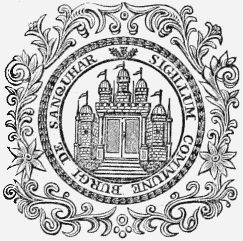
Burgh Seal.
Sanquhar
SANQUHAR, a royal burgh and a parish, in the county of Dumfries, 12 miles (N. W.) from Thornhill, and 57 (S. W. by S.) from Edinburgh; containing, with the villages of Wanlockhead, and Crawickmill, and the hamlets of Crawickbridge and Windyedge, 3577 inhabitants, of whom 1638 are in the burgh. This place, which is of great antiquity, appears at a very early period to have formed part of the possessions of a younger branch of the Ross family, lords of the Isles, from whom it passed, by marriage with the daughter of the last lord, to William, son of Thomas, Lord Crichton, in the reign of Robert Bruce. The barony was subsequently purchased from the Crichton family by Sir William Douglas, of Drumlanrig, and is now the property of the Duke of Buccleuch, who derives the inferior title of Earl of Sanquhar from this place. The town is pleasantly situated at a short distance from the river Nith, on the high road from Dumfries to Ayr, and consists principally of one spacious street nearly a mile in length. A public library was established in 1800; it contains nearly 1900 volumes, and is supported by subscription. There is also a Freemasons' lodge. One of the chief branches of trade is the weaving of cotton for the Glasgow manufacturers, who supply the yarn; this affords employment to about 100 men; and the tambouring of muslin is also pursued to a considerable extent, about 400 of the female population being engaged in it. The knitting of stockings, formerly very extensive, and carried to a high degree of perfection, is almost discontinued. An extensive carpet-manufacture has been established at the village of Crawickmill, in which are numerous looms of the most approved construction, with the requisite machinery for preparing, dyeing, and spinning the yarn. In this establishment, in which more than 200 persons are employed, about eighty tons of wool and 20,000 pounds of English worsted yarns are annually consumed, producing an immense quantity of carpeting. A few of the carpets are sold in the immediate neighbourhood, and some are sent to the London market; but the greater number are exported to North and South America, to Hamburgh, and St. Petersburgh. The Crawickmill Company once had also an establishment in the town for the weaving of tartans, of which about 20,000 yards were annually made, valued at £1333. Four fairs are held, one every quarter, and four annual markets; the former for general business, and the sale of shoes, onions, and other articles; and the latter for cattle.
The town was erected into a royal burgh by charter of James VI., granted to Robert Crichton, Lord of Sanquhar, in 1596, and under which the government is vested in a provost, three bailies, a dean of guild, a treasurer, and eleven councillors. There are five incorporated trades, the weavers, tailors, hammermen, shoemakers, and squaremen; but none of them possess any exclusive privileges. The magistrates exercise the usual civil and criminal jurisdiction. The town-hall, situated at the end of the High-street, was built at the sole expense of the Duke of Queensberry, and is a neat structure with a tower; there is also a lock-up house at Sanquhar, in which offenders are occasionally confined for a short time, previously to their commitment to the county gaol. The burgh is associated with those of Annan, Dumfries, Kirkcudbright, and Lochmaben, in returning a member to the imperial parliament; the number of registered voters is sixty-six. A savings' bank, in which the sums deposited now amount to £5000, was opened in the town in 1819. Facility of communication is afforded by good turnpike and other roads, which intersect the parish, and are kept in excellent order; and by bridges over the Nith and the other streams. A post-office, from which letters are delivered twice a day, has been established; and the mails from Carlisle to Glasgow, and from Glasgow to Carlisle, pass regularly through the town.
The parish is about eighteen miles in length, and of varying breadth, comprising an area of 38,880 acres, of which 5513 are arable, 735 woodland and plantations, and the remainder hill pasture, moorland, and waste. The surface, which is of very irregular form, is bounded on the north-east and south-west by hills of considerable elevation, of which Lowther on the north-east, connected by a chain of heights with the Hartfell mountains, towers 3130 feet above the level of the sea; while Black-Larg hill on the south-west, near the junction of the counties of Ayr and Galloway, is 2890 feet in height. The lands are divided into two nearly equal portions by the river Nith, which intersects the parish from south-east to north-west, and on both sides of which extends a fine vale more than five miles in length, whence the grounds have a gradual acclivity. The Nith flows with a serpentine course, receiving in its progress the Crawick and Minnick on the north-east, and the Euchan and Killoe on the south-west, with numerous smaller streams. The soil in the valley is generally dry and gravelly, but in some parts a rich loam; at a greater distance from the river, on both sides, it is chiefly clay and moss, deep, and well adapted for pasture. The crops are, oats, barley, potatoes, and turnips. The system of husbandry has been improved; draining is extensively practised, and the lands have been well inclosed; the farm-houses are mostly commodious, and great attention is paid to the rearing and management of live-stock. The cattle are usually of the native breed; and the sheep, of which more than 20,000 are annually reared in the pastures, are, with the exception of about 2000 of the Cheviot, and a few of the Leicestershire, all of the black-faced breed. There are 280 acres of natural wood along the banks of the rivers, consisting of oak, birch, and hazel; and on the lands of Eliock are above 450 acres of plantations of oak, ash, mountain-ash, elm, birch, beech, hazel, Swedish maple, larch, spruce, silver-fir, balm of Gilead, and Scotch fir; all under excellent management and in a very thriving state. The principal substrata are, limestone, whinstone, and greywacke; and the chief minerals, coal and lead-ore. The limestone, which is found only between the town of Sanquhar and the village of Wanlockhead, has been wrought, but not with any great success. The coal is found in great abundance in the valley of the Nith, and at present three mines belonging to the Duke of Buccleuch are in operation, employing about sixty men; the coal is of good quality. There is also a seam, the property of the burgh, in which twenty men are employed. The lead-ore is extensively wrought at the village of Wanlockhead, which is described under its own head. The rateable annual value of the parish is £9599. Eliock House, the seat of James Veitch, Esq., about two miles from the town, is an ancient mansion, and supposed to have been the birth-place of the Admirable Crichton.
The ecclesiastical affairs are under the superintendence of the presbytery of Penpont and synod of Dumfries. The minister's stipend is £264. 19. 2., with a manse, and a glebe valued at £30 per annum; patron, the Duke of Buccleuch. The church, erected in 1824, is an elegant structure in the later English style of architecture, and contains 1000 sittings, of which sixty are free. A chapel, or preaching station, in connexion with the Established Church, was built at Wanlockhead in 1755, by the mining company, for the benefit of the persons employed in the mines; it contains 250 sittings, and the minister has a stipend of £65, paid by the Duke of Buccleuch, with a house, and a small portion of land. There are places of worship for members of the Free Church, the United Secession, the Reformed Synod, and Baptists. The parochial schoolmaster has a salary of £34. 4. 4., with a house and garden, and the fees average £90 per annum; he has also the interest of £100 bequeathed by the late Rev. David Martin, a native of the parish, and a clergyman of the Church of England. The Crichton school, of which the master has a salary of £58, was erected within the last seven years, at a cost of £3000, including the site and the endowment for the master. A school is also supported by the mining company in the village of Wanlockhead. The remains of the ancient castle of Sanquhar are situated on an eminence in the vicinity of the town, and form an interesting and picturesque ruin; it was for some time in the possession of the English during the reign of Edward I., but was retaken by Sir William Douglas, who put the garrison to the sword. The Rev. Andrew Thomson, an eminent divine, and minister of St. George's church, in the city of Edinburgh, who died in 1831, was a native of this parish.
Sarclet
SARCLET, a village, in the parish of Wick, county of Caithness, 5 miles (S.) from Wick; containing 138 inhabitants. This village, which is inhabited chiefly by fishermen, is situated on a gently-rising ground in the south-eastern part of the parish, overlooking a small cove in the Moray Frith, which, at a considerable expense, has been formed into a good harbour for fishing-boats.
Saucher
SAUCHER, a hamlet, in the parish of Collace, county of Perth, ½ a mile (N. W.) from the village of Collace; containing 68 inhabitants. In the neighbourhood of the hamlet are the celebrated hills of Dunsinnan.
Sauchiebog
SAUCHIEBOG, a village, in the parish of Cambuslang, Middle ward of the county of Lanark; containing 108 inhabitants. This is one of thirteen small villages within the parish, of which the population is employed in the collieries of the district, and, from their proximity to Glasgow, in the manufactures of that city. In this village are about thirty dwelling-houses, chiefly occupied by weavers.
Scalloway
SCALLOWAY, a village, in the district of Tingwall, parish of Tingwall, Whiteness, and Weesdale, county of Shetland, 6 miles (S. by W.) from Lerwick; containing 405 inhabitants. This place, the name of which is said to signify "the harbour by the mansion-houses," was in ancient times the capital of Shetland, a burgh, and the occasional residence of the earls of Orkney and Shetland, as well as of nearly all the persons of consideration belonging to the islands. After the cession of Shetland to the crown of Scotland, the principal court of law, which under the crown of Denmark had been held in a small island in the loch of Tingwall, was removed to Scalloway, and the Foud or chief magistrate himself resided here. But the most memorable facts connected with the history of the place, relate to the government and tyranny of Earl Patrick Stewart, who, in 1600, obtained from the crown a grant of the Shetland Isles, and erected a splendid castle at Scalloway, the ruins of which are still imposing. Here he took up his residence, and so cruelly oppressed the inhabitants by laying on them numberless intolerable burthens, and by other abuse of his unlimited authority, which placed their lives at his disposal, that the parliament, about the year 1612, in consequence of an appeal from the inhabitants, revoked his charter, and annexed the lordship to the crown; and the earl, two years afterwards, was executed for high treason. The village is situated at the south-western extremity of the Tingwall district, at the foot of a valley consisting of one of the finest and most fertile tracts in the country, having a rich soil incumbent on a stratum of valuable grey limestone. East of Scalloway stands the ancient castle, on the margin of one of the best harbours in the locality, called Scalloway Voe: the building was occupied in the time of Cromwell as barracks by his soldiery, who are said to have introduced the cultivation of the cabbage, with other improvements. Mr. Scott, the chief proprietor, has a residence and garden in the village, where there are several other good family houses; but it is principally distinguished as a fishing-station, and has risen to a condition of much prosperity within the last few years, chiefly through the attention paid to the taking of herrings, about 15,000 barrels of which were shipped in a recent year. A church has been lately erected for the benefit of the village and neighbourhood; and there is a small place of worship for Independents; also a school supported by the Society for Propagating Christian Knowledge.
Scalpa
SCALPA, an island, in the parish of Strath, Isle of Skye, county of Inverness; containing 90 inhabitants. This is an island of the Hebrides, lying in the sound between the Isle of Skye and the main land; it is a high, bluff, and rocky island, about five miles in length and from two to three in breadth. The shores are low, and formed of a blackish-coloured argillaceous sandstone. In the highest part of the isle is a petrified rock of moss, in which are varieties of shells; and in many of the higher grounds are found great quantities of shells, several feet beneath the surface. The channel called the sound of Scalpa, separating the island from Strath, is about three-quarters of a mile broad.
Scalpa
SCALPA, a village, in the parish of Kirkwall and St. Ola, Island of Pomona, county of Orkney, 1½ mile (S.) from Kirkwall. This is a small village, giving name to a safe and commodious bay, and is the usual place of landing from the coast of Caithness. This bay, called Scalpa Flow, is a beautiful piece of water, being, as it were, a small Mediterranean of about fifty miles in circumference, and surrounded by twelve different islands, through which are various outlets to the Pentland Frith, the German Sea, and Atlantic Ocean. In times of war, Scalpa Flow is the great thoroughfare for vessels coming north; and it abounds with numerous safe roadsteads and good harbours for vessels of large size, such as Holm sound, Floxa sound, the bay of Howton, St. Margaret's Hope, and other places, where is excellent anchorage with sufficient depth of water, even for ships of the largest class. The principal entrance to the Flow from the east is through Holm sound, and from the west through Hoymouth. The tide, on entering, is remarkably rapid, but it soon subsides and becomes scarcely perceptible; the course of the flood is, with little variation, from east to west; and on one part of the coast, where the current is intercepted by a reef of rocks, it runs nine hours in one direction, and three in the direction opposite. The smacks employed throughout the season in fishing, and carrying lobsters to the London market, all rendezvous in one or other of the harbours encircling the Flow. The sea-banks near the village offer, in fine weather, the most pleasant walks to the inhabitants of the neighbouring town of Kirkwall.
Scalpay
SCALPAY, an island, in the parish of Harris, district of Lewis, county of Inverness; containing 31 inhabitants. This is a nearly circular island, lying at the entrance to East Loch Tarbert, and separated from the main land of Harris by the narrow strait of Scalpay sound. Its dimensions are not easily ascertained, owing to its parts being scarcely coherent, from a singular intervention of lakes and of arms of the sea jutting through it in various directions; the two extreme points from east to west may, however, be computed about three miles distant. The surface is low, and covered for the most part with heath. On the eastern extremity is a lighthouse, erected in 1788; and near the western extremity are two of the best harbours in the Hebrides, much resorted to by foreign shipping. The island is called by mariners the Isle of Glass.
Scarba
SCARBA, an island, in the parish of Jura and Colonsay, district of Islay, county of Argyll. This island, which is separated from the northern extremity of the isle of Jura by the gulph of Coryvreckan, is about three miles in length and nearly of equal breadth, comprising an area of eight square miles. The surface is mountainous and rocky, and, towards the west, rises from the Atlantic in abrupt and rugged precipices many hundred feet in height; the east side is indented by a beautiful semicircular bay, from which the shore ascends in rapid acclivities, interspersed with rocks, and crowned with considerable tracts of birch and alder, presenting a strikingly romantic appearance. The gulph of Coryvreckan, which is about a mile and three-quarters in breadth, has in stormy weather a terrific aspect; exposed to all the fury of the Atlantic on the west, it forms a dangerous whirlpool fatal to small vessels at all times, and frequently to vessels of large burthen.
Scarp
SCARP, an isle, in the parish of Harris, district of Lewis, county of Inverness; containing 129 inhabitants. This is a high conical rocky isle, consisting of a solid mountain, of which the diameter is about three miles. It lies on the western side of Harris, at the entrance of Loch Resort, and is separated from the main land of the parish by a narrow sound to which it gives name, somewhat less than a mile broad at high water.
Scarvy
SCARVY, an isle, in the parish of Harris, county of Inverness. It is one of a cluster of small isles in the sound of Harris, lying a little south of the islands of Groay and Gillisay, which belong to the group.
Scone
SCONE, a parish, in the county of Perth, 2 miles (N.) from Perth; containing 2422 inhabitants, of whom 1364 are in the village of New Scone, and 56 in that of Old Scone. This place is supposed to have derived its name, signifying in the British language "an ascent," from the situation of its ancient castle on an acclivity rising gradually from the shore of the river Tay to a considerable height. It appears to have been at a very early period the residence of the kings of Scotland, and the place of their coronation, for which occasions the celebrated stone, from an inscription of prophetic import called the Stone of Destiny, is said to have been placed here by Kenneth Mc Alpine, King of the Scots, who finally subdued the Picts, and united both nations into one kingdom. A very ancient establishment of the Culdees flourished at this place, which attained the appellation of the royal city, till the time of Alexander I., when it was superseded by a priory of canons regular of the order of St. Augustine, to whom, according to the chronicles of Melrose, the Culdees resigned their church in 1115. Alexander had begun to erect a castle and a palace at this place, but was obstructed in his prosecution of that purpose by a rebellion of his subjects of the counties of Mearns and Moray, over whom, however, after much peril, he obtained a complete victory, and in gratitude for his success founded the Abbey of Scone, in which the inaugural stone was preserved, and many of his successors were crowned. After the death of Alexander III., Edward I. of England, availing himself of an assumed superiority over the kingdom of Scotland, put an end to the contest of the different aspirants to the throne by nominating John Baliol, who took the oath of fealty, and was crowned in the abbey in 1292. A parliament was held here in 1294, in which some measures were resolved on that excited the jealousy of Edward, who, entering Scotland with a powerful army, demanded the surrender of the principal fortresses, and, on his return into England in 1296, took away with him the coronation stone from the abbey of Scone, and placed it in Westminster Abbey, where it forms the seat of the chair of Edward the Confessor, used at the coronation of the English sovereigns.
The abbey, which was dedicated to the Holy Trinity and St. Michael, continued to flourish till the Reformation, when, after all its ornaments had been destroyed, it was, together with the palace, burned by a furious mob from Dundee, in resentment for the loss of one of their party who had been killed by a shot discharged from the palace during their work of demolition. The revenues of the abbey at this time were estimated at £1140, exclusive of considerable payments in grain. The lands and other possessions belonged afterwards to the Earl of Gowrie, on whose attainder they reverted to the crown; and in 1604 they were erected into a temporal lordship, and granted by James VI. to Sir David Murray, Lord Scone and Viscount Stormont, and ancestor of the Stormont or Mansfield family, the present proprietors. The coronation of Charles II., on his visit to Scotland subsequently to his restoration, took place here in 1651, in the church built probably by the Gowrie family, and subsequently enlarged by the first lord Stormont: after the ceremony, His Majesty returned to the seat of (the third) lord Stormont, which formed his palace on the occasion. Of this palace the Pretender took possession during his visit in 1715, previously to his flight to Dundee on the approach of the royal army; as also did Prince Charles, on his visit in 1745.
After the destruction of the abbey the town fell rapidly into decay. Some of the conventual buildings, however, were occasionally occupied by the attendants of James VI., who resorted to it for the diversion of hunting; and a building for some time retained the appellation of the Earl of Errol's stables, from its being occupied on those occasions by the earl, who attended the king as hereditary grand constable. There are still remaining an ancient gateway, and part of the wall that surrounded the old palace; to the east of which is the Cross, almost the only memorial of the original town, a pillar thirteen feet high, slightly ornamented, and rising from an octagonal pedestal, to which is an ascent by a flight of steps. The only object of interest in the old town is the splendid mansion of the Earl of Mansfield, called indifferently the Abbey or Palace of Scone, erected in 1808, on the site of a former mansion built partly by the Earl of Gowrie after the destruction of the palace, and partly by the first lord Stormont, but never fully completed, and which was taken down in 1803. The present palace is a spacious and elegant structure in the later English style of architecture, erected by the late earl, and containing a superb suite of apartments fitted up in a style of sumptuous magnificence. The drawing-room is a splendid apartment, commanding one of the richest prospects to be found in the county; the dining-room, music-gallery, and library are also noble apartments, enriched with ornaments of every variety, and a valuable collection of paintings by the chief masters, with several family portraits. The windows of the grand hall are embellished with stained glass, in which are emblazoned the armorial bearings of the family; and in various parts are disposed marble busts, elegant and costly vases, cabinets of gems, and rare antiques.
The mansion is beautifully situated on a spacious lawn, sloping to the river Tay, and is surrounded with an extensive and richly-wooded park, with pleasure-grounds embellished with plantations, and gardens tastefully laid out. Among the most ancient of the trees are, an ash planted by James VI., and a sycamore by Mary, Queen of Scots. About fifty yards from the palace are the only remains of the church erected after the destruction of the abbey, consisting of an aisle built most probably by the first viscount Stormont, to whom there is an elegant marble monument, on which he is represented in armour, kneeling before an altar, with an armed figure on each side, one supposed to represent the Marquess of Tullibardine, and the other the Earl Marischal; all most beautifully sculptured in alabaster. The chief approach to the house is by a drive through the park, over a bridge recently built across a deep ravine at no great distance from the terrace-gate on the south; there is also an ancient gateway leading to it from the east. Among the remains of antiquity carefully preserved in the palace are, an elegant velvet bed embroidered by Mary, Queen of Scots, during her captivity at Lochleven, and the bed and furniture of the chamber in which King Charles slept at the time of his coronation. Her present Majesty, Queen Victoria, attended by Prince Albert, honoured the Earl of Mansfield with a visit in September, 1842, and, after passing the night of the 6th here, returned on the day following to Dunkeld. Previous to her departure, a deputation from the magistrates of Perth waited upon Her Majesty, requesting the royal signature in the guildry books of the city, in which Her Majesty and Prince Albert accordingly inscribed their names.
The parish, which is bounded on the west and south-west by the river Tay, comprises an area of nearly 6000 acres, whereof about 2500 are arable, and the remainder meadow and pasture, with some extensive plantations, and a moderate portion of waste land. The surface rises gradually from the banks of the river to a considerable elevation, commanding many richly-varied and extensive views; and the scenery, which is generally of a pleasing and interesting character, is in many places beautifully picturesque. The streams that flow through the parish are small. The Annaty, however, in its course has several falls for giving motion to machinery; and there is also a canal from the Tay, which turns several mills, and affords an abundant supply of water for some bleach-works. The soil is in parts light and gravelly, but near the banks of the river, a strong rich clay; the crops are, wheat, barley, oats, potatoes, and turnips. Considerable improvements have taken place in the system of agriculture; the lands have been drained, and in many places properly inclosed; the farm buildings and offices are substantial and well arranged, and every attention is paid to the management of the dairies. The plantations are chiefly oak, larch, and Scotch fir, intermixed with hard-woods, and are generally in a thriving condition. The substratum is mostly of the sandstone formation, intersected with dykes of trap, which afford excellent materials for the roads: nodules of compact limestone are occasionally found in the sandstone quarries, of which those at Lethendy are extensively wrought; and in the softer beds occur small pieces of jasper. The rateable annual value of the parish is £9600.
The village of New Scone, which has been almost entirely built within the present century, on lands belonging chiefly to the Earl of Mansfield and to Andrew Murray, Esq., is situated on the turnpike-road from Perth to Cupar-Angus, along which it extends for a considerable distance, consisting of houses neatly but irregularly built. It has a post-office subject to the office of Perth, and a small library is supported by subscription. About 300 of the inhabitants are occupied in hand-loom weaving. At Stormontfield, on the banks of the Tay, in the north-west of the parish, is an extensive bleachfield belonging to John Maxton, Esq., in which about thirty families are constantly employed, for whose residence comfortable cottages have been erected: there is also a school, built by the late Earl of Mansfield, for the instruction of their children. These works are abundantly supplied with water by the canal, and are conducted with every due regard to the comfort of the persons employed. The fisheries on the Tay have much diminished during the last twenty years, within which period the annual rent has fallen from £1100 to £100; the fish taken are, salmon, grilse, sea-trout, yellow-trout, pike, perch, and eels.
The ecclesiastical affairs are under the superintendence of the presbytery of Perth and synod of Perth and Stirling. The minister's stipend is £267. 11. 2., with a manse, and a glebe valued at £55 per annum; patron, the Crown. The church, erected in 1784 in the village of Old Scone, was taken down, and rebuilt with the same materials in the present village in 1804: and an aisle was added to it in 1834; it is a neat structure, containing 638 sittings. There is a place of worship for members of the United Secession. The parochial school is attended by about 150 children, and is well conducted; the master has a salary of £34. 4. 4., with a house and garden, and the fees average £20 annually. The master of the school at Stormontfield receives an allowance of £4 from the Earl of Mansfield, and £2 from the proprietor of the works, in addition to the fees; and there are also some female schools in the village. In the immediate vicinity of the present palace have been found at various times some remnants of the ancient abbey, and numerous stone coffins. In 1841 some workmen discovered part of a cell, in tolerable preservation, from ten to twelve feet in diameter, and surrounded with stone seats fifteen inches in breadth. There are also portions of the eastern gateway, flanked on each side by a round tower, and from which are traces of the walls leading to the monastery: above the gateway is a tablet on which are sculptured the royal arms. The parish gives the title of Lord Scone to the Earl of Mansfield, a descendant of William, the first earl, lord chief justice of the Court of King's Bench, who is supposed to have been a native of this place. David Douglas, the eminent botanist, who died while making botanical researches in the Sandwich Islands, in 1834, was born here.
Scoonie
SCOONIE, a parish, in the district of Kirkcaldy, county of Fife, 9 miles (N. E.) from Kirkcaldy; containing, with the town of Leven, 2836 inhabitants. This place, which is of considerable antiquity, and of which the church at a very early period was granted by Malduin, bishop of St. Andrew's, to the Culdees of Lochleven, was formerly in part the property of the family of Gibson, who held the lands of Durie. Of their descendants, Lord Durie was one of the commissioners sent in 1652 to treat with the English parliament on the projected union of the two kingdoms; and another of the family sat in the first Scottish parliament after the restoration of Charles II. to the throne. The parish is situated on the Frith of Forth; it extends for four miles in length from north to south, and two miles in breadth from east to west, and comprises about 4000 acres, of which 3250 are arable, 250 woodland and plantations, and 350 pasture and waste. The surface is gently undulating, rising from the south to the north till it attains an elevation of about 700 feet above the level of the sea: from the higher grounds is an extensive prospect of the Frith and the country on the southern shore, embracing numerous objects of romantic appearance and much beautifully varied scenery. The river Leven, which washes Scoonie on the west, has its source in the loch of that name, and, after flowing through a luxuriant valley, and receiving many streams in its course, falls into the bay of Largo near the town of Leven. The river abounds with trout, pike, and eels; and near its mouth was formerly a lucrative salmon-fishery, which, from some alterations that prevented the fish from ascending the river, and owing to certain deleterious substances from some bleach-works in the town mingling with its waters at this place, has been destroyed, and for many years totally discontinued. There are few good springs in the parish, and only one deserving of notice, "the boiling well." The general scenery is agreeably diversified; the surrounding country is richly cultivated, and the plantations on the demesnes of the principal seats add much to its embellishment. The soil of the parish is fertile; and the system of husbandry, which consists of successive rotations of white and green crops, is in a high state of improvement. The crops are, wheat, barley, oats, potatoes, and turnips, of which large quantities are grown; and considerable exports of grain and potatoes are made from Leven for distant markets. Great attention is paid to the rearing of cattle, which are generally of the black Fifeshire breed; and formerly great numbers were sent in a lean state to London, but at present they are all fattened in the parish, and mostly sent to Edinburgh and Glasgow, with only a few occasionally to London by the Dundee steamers. Several oxen of the Old Fifeshire kind bred in the parish have gained the prizes at the Highland Society's cattle-shows. Few sheep are reared; but many are purchased by the farmers at the neighbouring fairs, and fed on turnips during the winter. The farm-buildings are generally commodious, and some, of recent erection, are very superior; threshing-mills are attached to most of the farms, one of which is driven by steam; and the latest improvements in agricultural implements have been adopted. Much progress has been made in draining; and from the advanced state of agriculture, and the vicinity of the town and port of Leven, which affords a facility of disposing of the produce, the lands have greatly increased in value. The rateable annual value of the parish now amounts to £8988.
The substratum is chiefly whinstone, of inferior quality, and consequently not quarried to any extent; the materials for building are generally brought from the quarries of Inverkeithing and Blair. Strata of coal are found in various parts, especially on the lands of Durie. The mines were formerly wrought on a larger scale, and great quantities were shipped from Leven to Holland and other continental ports; the quality is very superior, and it was once in such high repute that the best description of Scottish coal is still called Durie coal. Upon the death of the proprietor in 1802, the works were for a time discontinued: and coal, even for the supply of the parish, was sometimes brought from the pits of Wemyss and Kilmux. There is a bed of ochre four feet in thickness on the lands of Durie, which has been wrought for many years, and of which great quantities are exported. Several mills are in operation for spinning flax and tow, one for crushing bones for manure, and one for grinding ochre; and about 150 persons are employed in weaving with hand-looms at their own dwellings. The chief seats are, Durie, the property of C. M. Christie, Esq., a handsome mansion erected in 1762, and situated in an extensive demesne embellished with thriving plantations; Kilmux, the residence of J. B. Fernie, Esq., erected in 1832, in grounds tastefully laid out, and sheltered with some fine trees; and Montrave, a handsome mansion erected in 1836, and also pleasantly situated in improved grounds. Scoonie is within the presbytery of Kirkcaldy and synod of Fife, and in the patronage of the Crown: the minister's stipend is £257. 19. 5., with a manse, and the glebe is valued at £50 per annum. The old church, situated about a quarter of a mile from Leven, has been for some time a ruin, and the only part of it which is still preserved forms the family vault of the proprietor of Durie. The present church, erected in 1776 near the town, and repaired and enlarged in 1823, is a neat and well-arranged edifice adapted for a congregation of 996 persons. There are places of worship for Independents, the Free Church, and Relief Church. The parochial school affords a liberal education, and is well attended; the master has a salary of £34, with £70 fees, a very good dwelling-house, and an allowance of £2 for deficiency of garden-ground. A society for religious purposes, under the management of a committee of ladies, distributes about £20 per annum in promotion of its object; and there is also a ladies' charitable society, which distributes about £24 per annum. Several friendly societies existed formerly; but from injudicious management few of them were able to become permanent establishments. Numerous stone coffins, supposed to have been deposited after a severe conflict between the Scots and the Danes, have been dug up in various parts of the parish; and within the last thirty years, a cairn on the summit of a hill, about forty yards square at the base, was opened, and found to contain twenty stone coffins, rudely formed of slabs placed on their edges and covered with a superincumbent slab of stone. In two of the coffins were small urns of clay, rudely ornamented, and five of them contained each a larger urn, fourteen inches in diameter and twenty-four inches high; great numbers of human bones were scattered about, and in one of the smallest coffins were found beads of charred wood. The urns were all in an inverted position, with their mouths resting upon a square slab of stone. Mr. Jerome Stone, an eminent linguist, was born in this parish in 1727; he died in 1757, leaving an unfinished work entitled An Enquiry into the Original of the Nation and Language of the Ancient Scots, and a finished manuscript of an allegory entitled The Immortality of Authors.
Scoonie-Burn
SCOONIE-BURN, a hamlet of the town of Leven, in the parish of Scoonie, county of Fife; containing 30 inhabitants.
Scotland-Well
SCOTLAND-WELL, a village, in the parish of Portmoak, county of Kinross, 5 miles (E. S. E.) from Milnathort; containing 274 inhabitants. It is an ancient village, situated on the road from Milnathort to Leslie, and about a mile eastward from Loch Leven. In the vicinity is Bishop's hill, where are numbers of copious springs of excellent water, of which one, the easternmost, is remarkably exuberant; these springs obtained the name, it is said, from Cromwell, of Fontes Scotiæ, whence the present designation of the village. An hospital was founded at this place by William Malvoisine, who died in 1238, and was given to the Red Friars by his immediate successor; it was a receptacle for religious pilgrims, and the friars collected alms for the relief of such Christians as were slaves in Turkey. The ruins of the hospital, and of a chapel, are still to be seen.
Scourie
SCOURIE, a village, in the parish of Eddrachillis, county of Sutherland, 2 miles (N. N. W.) from the village of Eddrachillis; containing 108 inhabitants. This place is situated on the western coast of the county, and on a safe and commodious bay, to which it gives name; it has a good inn and a post-office, and contains the parochial school, and a savings' bank. The road from the Dornoch Frith, through Sutherland, terminates here. About the middle of the 16th century, a branch of the Mackay family planted themselves at Scourie, under the designation of the "Mackays of Scourie." Of this branch was Lieutenant-general Hugh Mackay, the celebrated commander-in-chief in the time of William and Mary; he fought against Dundee at the battle of Killiecrankie, and although the fortunes of the day proved adverse, he showed great military skill in his retreat, and retrieved his military reputation by his subsequent successes in Ireland. He was to have been rewarded with a peerage, under the title of Earl of Scourie, but this intention was frustrated by the alleged intrigue of his rival, Mackenzie of Cromarty. This distinguished soldier closed his career in 1692, shortly after the siege of Namur, where he commanded the British division of the allied army.
Scrogiehill
SCROGIEHILL, a hamlet, in the parish of Methven, county of Perth; containing 118 inhabitants. This is an inconsiderable place, of which the population is employed in agriculture.
Seatown of Delnies
SEATOWN of DELNIES, a hamlet, in the parish and county of Nairn, 3½ miles (W.) from the town of Nairn; containing 80 inhabitants. This is a small place situated on the coast of the Moray Frith; the lands around it consist of the estates of East and West Delnies. The coast road from Fort-George to Nairn passes at a short distance from the hamlet.
Seil
SEIL, an isle, in the parish of Kilbrandon, county of Argyll. This is an isle of the Hebrides, about two miles in length and three in breadth, and separated from the island of Easdale by a strait a few hundred feet broad, and from the main land by a narrow pass over which is a bridge. It is in general flat, yet not altogether without hills, from the higher of which is a fine view of the numerous small isles scattered over the ocean in these parts, with the distant mountains of Mull and Jura. Here are several slate-quarries, but those of the island of Easdale are more valuable.

Burgh Seal.
Selkirk
SELKIRK, a burgh, market-town, and parish, partly in the district of Hawick, county of Roxburgh, and partly in the county of Selkirk, of which it is the chief town, 22 miles (S. E. by E.) from Peebles, and 38 (S. E. by S.) from Edinburgh; containing 3484 inhabitants, of whom 2500 are in the burgh, and the remainder in the rural districts of the parish. This place, which is of considerable antiquity, derives its name, in the Celtic tongue signifying "the Church in the forest," from the ancient state of the surrounding district, which was thickly covered with wood and appropriated as a royal chase. From its proximity to the border, it was frequently the scene of hostile incursions, and intricately involved in all the ferocious and sanguinary wars of the rival kingdoms, during the mutual efforts of their monarchs to obtain the ascendancy. In the 12th century it appears to have been regarded as a place of importance; and David I. founded near the site of the present town a monastery, which was, however, subsequently for greater security removed to Kelso. The castle seems to have been a fortress of considerable note, and is enumerated by Edward II., King of England, as one of the strongholds in possession of his party. The inhabitants furnished a quota of one hundred men who accompanied James IV. to the battle of Flodden Field; and such was their zealous attachment to their sovereign, and such their heroic courage, that only four of their number returned from that fatal conflict, in which the rest of the body fell. The survivors brought with them a standard taken from the enemy, part of which is still preserved in the hall of the company of weavers, by one of whom it was captured. The town was subsequently burnt by the English during one of the wars of the border, to compensate for which injury, a grant of one thousand acres of the adjoining lands was made by the crown to the citizens and their posterity for ever. At Philiphaugh, within a mile of the town, a battle took place between the forces of the Marquess of Montrose and a body of Covenanters under General Leslie, in which the former were defeated; and a field on the Yarrow, where it is said the latter put many of their prisoners to death after the battle, is still called the Slain Men's Lee.
The town is pleasantly situated on a rising ground commanding a fine view of the river Ettrick, over which is a neat bridge; and is well built, containing several streets with many handsome houses, inhabited by persons employed in trade and the manufactures carried on in the neighbourhood. The streets are lighted with gas, and cleansed by the corporation; and the inhabitants are amply supplied with water. A public library is supported by subscription, in which is an extensive collection of standard works; a mechanics' institution, in which lectures are delivered on various branches of science, has also an extensive library; and a news-room has been established, which is well furnished with newspapers and periodicals. A new line of road has been opened, forming an easier approach from Galashiels, by which the environs have been greatly improved in appearance, and which is one of the most pleasant drives in this part of the country, embracing many fine views and much interesting scenery. The woollen manufacture is carried on here to a considerable extent, there being three large mills affording employment to 500 persons; and several of the inhabitants are engaged in stocking-weaving: there are also a tannery, some gasworks, a fulling-mill, and some extensive corn-mills. The post-office has two deliveries daily; and every facility of intercourse with the neighbouring towns is afforded by roads kept in excellent order. The market is on Wednesday, and very much business is transacted: fairs are held on the first Wednesday in March, the 5th of April, the 15th of July, the 31st of October, and the 19th of December. The date of the earliest charter of incorporation is, from the loss of the original records, not precisely known; but the town is noticed as a royal Burgh in a charter of William the Lion, and the various privileges and immunities enjoyed by the inhabitants during previous reigns are fully set forth and confirmed by charter of James V., granted in the year 1535, during his minority, and renewed, with a gift of lands, by the monarch after he had attained his majority. All the charters were ratified by an act of the Scottish parliament, obtained in favour of the burgh in 1633. The government is vested in two bailies, a treasurer, and a council of twenty-nine burgesses, assisted by a town-clerk, procurator-fiscal, and other officers, all of whom are appointed by the council: no provost has been chosen for many years. The bailies and council are now elected under the authority, and subject to the provisions, of the act of the 3rd and 4th of William IV. The freedom may be obtained by six years' apprenticeship to a freeman of the fleshers' or the shoemakers' company, or four years' apprenticeship to a freeman of any of the other companies, of which there are three duly incorporated, viz., the hammermen, weavers, and tailors. All the companies retain and enforce their exclusive privileges; and the freedom may also be obtained by purchase, for which the fee paid by a stranger varies from £5 to £15, according to the company he joins. The bailies are ex officio justices of the peace within the burgh and county, and have power to hold courts for the determination of civil pleas, and for the trial of criminal offences, which are chiefly confined to cases of assault or petty thefts. A court is also held by the dean of guild, assisted by the junior bailie and a deputation of the town-council, for the adjudication of infringements of the privileges of the burgh. In the bailies' court, one civil action and three criminal causes were tried in a recent year; and in the court of the dean of guild, two cases of infringement were decided. The town-hall is a handsome and well-arranged building, with a lofty and elegant spire rising to the height of 110 feet, and forming a conspicuous object in the view of Selkirk; it contains the requisite halls and court-rooms for the transaction of the public business of the burgh and of the county. There is likewise in the town a prison which is both well adapted for classification and for the security of prisoners.
The parish is bounded on the north by the river Tweed, and is of very irregular form, comprising several detached portions, of which some are in the county of Roxburgh; it is about seven miles and a half in length, and of unequal breadth, and, including the detached portions, comprises 6300 acres, of which 3000 are arable, 1000 woodland and plantations, and 2300 meadow and pasture. The surface, which is generally elevated, is diversified by numerous hills; the principal are the Three Brethren Cairn and the Peat, which are situated between the Ettrick and the Tweed, the former having an elevation of 1978, and the latter of 1964, feet above the level of the sea. The scenery is richly varied; and though the old forests have disappeared, there are some extensive and beautiful plantations, which contribute greatly to its embellishment. The rivers are, the Ettrick, the Tweed, and the Yarrow, which intersect the parish from west to east, and in their course, flowing between wooded banks, display much picturesque and truly romantic scenery. The soil is generally of a light and dry quality, and the chief crops are, oats, barley, wheat, potatoes, and turnips: the system of agriculture is in a highly improved state. The lands are well drained, and inclosed partly with dykes of stone and hedges of thorn; the farm houses and offices are handsomely built and commodiously arranged; and all the more recent improvements in implements have been adopted. Considerable attention is paid to the live-stock, which have been much improved by the influence of a pastoral society established under the patronage of Lord Napier: the sheep are principally of the white-faced breed, which thrives well in these pastures. The plantations, chiefly of oak, pine, birch, and fir, are well managed, and the annual thinnings afford a supply of timber for various uses. In the rural districts of the parish the general fuel is peat, and in the town and immediate vicinity, coal, brought from Mid Lothian. The principal substrata are greywacke, and greywacke and clay-slate, but no quarries are wrought to any extent. Bowhill, a seat of the Duke of Buccleuch, is a magnificent mansion situated in an extensive and richly-wooded demesne; Haining, Yair, Philiphaugh, Broadmeadows, and Sunderland Hall, are also handsome modern mansions in grounds embellished with thriving plantations. The rateable annual value of the parish is £14,703 for the Selkirkshire portion, and £989 for the Roxburghshire portion.
Selkirk is the seat of the presbytery of Selkirk, synod of Merse and Teviotdale, and is in the patronage of the Duke of Roxburghe: the minister's stipend is £275. 5. 9., with a manse, and the glebe is valued at £21 per annum. The church, built in 1784, and thoroughly repaired in 1829, is a plain neat edifice adapted for a congregation of 800 persons; it is situated in the centre of the town, and at an inconvenient distance from some parts of the parish. There are places of worship for members of the Free Church and the United Secession. The parochial school affords a liberal and extensive course of instruction to about seventy scholars, and has long maintained an eminent degree of reputation; the master has a salary of £50 per annum, including an allowance in lieu of house and garden, and the fees average about £80. The burgh school, of which the master is appointed by the magistrates, affords instruction to about sixty scholars, and is supported by the corporation, who pay the master a salary of £30 per annum, and maintain the school buildings, from the common fund; the course comprises the English language, writing, arithmetic, mathematics, and drawing. There was once a female school under the patronage of the corporation, who allowed the mistress £30; and a school at Newark is supported by the Duke of Buccleuch, who gives the master £15 per annum, with a house and coal. A parochial library is established, which has a good collection of volumes; and there are a missionary and a friendly society in the town, and a savings' bank for some years established, which has tended to diminish the number of applications to the poor's fund. At Newark are the remains of the ancient castle, previously noticed, and formerly the residence of Anne, Duchess of Buccleuch and Monmouth, after the decapitation of her husband in the reign of James VI.; it is the property of the Duke of Buccleuch. At Oakwood are the remains of another, the property of the Scotts, of Harden, celebrated as the abode of the noted wizard, Michael Scott, of whom many legendary traditions are still current. About two miles to the west of Philiphaugh may be traced the lines of an intrenchment thrown up by the Marquess of Montrose, on an eminence overhanging the Yarrow; and the house in the town in which he spent the night previous to the battle is still pointed out. Coins, apparently Roman, have been found at various times, but in a state of almost complete obliteration; and skulls of the wild ox, and a Roman spear, were dug up some years since in a moss. Of the eminent characters connected with this place were, Andrew Pringle, Lord Alemoor, lord of session in the last century, celebrated for his learning and eloquence; Mungo Park, the African traveller, who was born at Fowlshiels, where one of his brothers at present resides; and Sir Walter Scott, who was for many years sheriff of the county, and of whom a statue was lately erected in the market-place by the inhabitants. Selkirk gives the title of earl to a branch of the family of Douglas.
Selkirkshire
SELKIRKSHIRE, an inland county, in the south of Scotland, bounded on the north by the counties of Peebles and Edinburgh, on the south by Dumfries-shire, on the east by Roxburghshire, and on the west by Peebleshire. It lies between 55° 22' and 55° 43' (N. Lat.) and 2° 50' and 3° 20' (W. Long.), and is twenty-seven miles in length from south-west to north-east, and sixteen miles in breadth; comprising an area of 263 square miles, or 168,320 acres; and containing 1522 houses, of which 1446 are inhabited; and a population of 7990, of whom 3972 are males, and 4018 females. The county was anciently inhabited by the Gadeni and Ottadini, and, like that of Roxburgh, with which in its early history it is identified, formed part of the forest of Ettrick, the favourite resort of the Scottish sovereigns for the purpose of hunting. In many of the royal charters the county is styled "the Forest;" and on the bank of the Yarrow are the remains of an ancient castle, which was the hunting-seat of the kings, and the residence of the keeper of the forest, who was also constable of the royal castle of Selkirk. The lands were included among the possessions of the abbey of Melrose, and are now held by charter from the crown; about two-thirds are the property of the Duke of Buccleuch, and the remainder is divided among numerous freeholders. The county is within the synod of Merse and Teviotdale, and comprises the whole of the parishes of Yarrow and Ettrick, about eleven-twelfths of the parish of Selkirk, and smaller portions of six other parishes; it contains the royal burgh of Selkirk, which is the county-town, the greater part of the market-town of Galashiels, and numerous small hamlets of which none can be considered as villages. Under the act of the 2nd of William IV., the county returns one member to the imperial parliament; and the number of persons qualified to vote is 605.
The surface is mountainous, and the lowest portions of the land have an elevation of 300 feet above the level of the sea. The chief mountains are, Blackhouse, Windlestrae-law, Minchmoor, and Ettrick-pen, which range from 2200 to 2400 feet in height; and Lawkneis, Wardlaw, Hangingshaw-law, the Three Brethren, Black-Andrew and Peat-law, which have an elevation varying from 1964 to 1990 feet. Several hills from 1000 to 1800 feet in height afford good pasturage for sheep. The principal valleys are those of Ettrick and Yarrow, with portions of the vales of Tweed and Gala; and the chief rivers are those from which the four vales take their names. The Tweed, in its course from Peebleshire, intersects the northern portion of the county for nearly ten miles, and, previously to its entering Roxburghshire, receives the Ettrick and Gala. The Ettrick has its source in Ettrick-pen, divides the county nearly into two equal parts, and, after a course of thirty miles from south-west to north-east, falls into the Tweed. The Yarrow, issuing from St. Mary's loch, flows in a north-east direction into the Ettrick near Selkirk; and the Gala, after forming the north-east boundary of the county for about four miles, falls into the Tweed near Galashiels. The only lakes are St. Mary's loch and Loch Lowes, separated from each other by a narrow strip of land about one hundred yards in length; the former is about three miles in length and half a mile broad, and the latter little more than three-quarters of a mile in length and a quarter of a mile in breadth. Their banks are richly wooded, and the scenery derives a beautifully romantic character from the mountains by which they are encompassed. Of the lands, about 10,000 acres are arable, 2300 woodland and plantations, 1250 garden and pleasure grounds, and the remainder mountain pasture, principally for sheep, which are of the white-faced breed. The soil of the arable land is rich, producing abundant crops of excellent wheat even on the slopes of the hills, at an elevation of 700 feet above the level of the sea. There are no minerals; the substratum is principally whinstone alternated with considerable portions of granite. The principal manufactures are those of woollen cloth and of stockings: the first of these is chiefly carried on at Galashiels, and has been greatly improved and extended within the last few years; the stockings are mostly for the home trade, but the manufacture is tolerably extensive. There are also two tanneries, and several establishments for making agricultural implements. Facility of communication is afforded by excellent turnpike and other roads which intersect the county in various directions. The rateable annual value of Selkirkshire, as assessed to the income-tax, is £49,766, of which £38,714 are returned for lands, and the remainder for houses. There are some remains of the forts erected by the original inhabitants on the heights; and about a mile to the west of Galashiels, are vestiges of the great ditch called the Catrail, twenty-three feet wide, with ramparts on each side from nine to ten feet in height. It passes through the county, over the south part of Minchmoor, and crosses the Tweed at Sunderland.