A History of the County of Hertford: Volume 3. Originally published by Victoria County History, London, 1912.
This free content was digitised by double rekeying. All rights reserved.
'Parishes: Aston', in A History of the County of Hertford: Volume 3, ed. William Page (London, 1912), British History Online https://www.british-history.ac.uk/vch/herts/vol3/pp54-58 [accessed 2 May 2025].
'Parishes: Aston', in A History of the County of Hertford: Volume 3. Edited by William Page (London, 1912), British History Online, accessed May 2, 2025, https://www.british-history.ac.uk/vch/herts/vol3/pp54-58.
"Parishes: Aston". A History of the County of Hertford: Volume 3. Ed. William Page (London, 1912), British History Online. Web. 2 May 2025. https://www.british-history.ac.uk/vch/herts/vol3/pp54-58.
In this section
ASTON
Easttun, Estone (xi cent.); Aschton, Estona (xiii cent.).
The parish of Aston has an acreage of 2,070 acres, of which 1,007¾ are arable land, 648¾ acres permanent grass and 122¼ acres wood. (fn. 1) The height of the parish above the ordnance datum is for the most part from 200 ft. to 300 ft., but rises in the centre to over 300 ft., the highest point (315 ft.) being by the church. The River Beane forms the eastern boundary of the parish and separates it from Benington. A branch road from the Great North Road to Benington passes across the centre of the parish and through the village, where a network of lanes branch off to north and south. The village lies in the centre of the parish, with the church of St. Mary and the manor-house on the west. In the north of the parish is the hamlet of Aston End. In the south-east is Frogmore Hall, a modern red brick house surrounded by a park, the property of Mr. G. B. Hudson, M.A., D.L., J.P., formerly M.P. for the Hitchin division of Hertfordshire, and now the residence of Major H. F. Low. Aston House, with a small park, is the residence of Mr. F. W. ImbertTerry, and Barelegh that of Lady Jane van Koughnet.
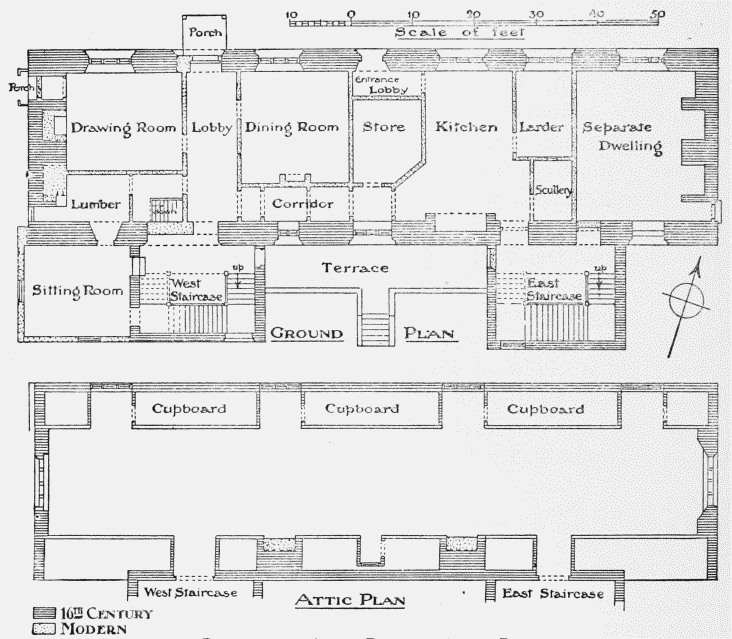
Ground and Attic Plan of Aston Bury
Aston Bury, the ancient moated manor-house, is supposed to have been built by Sir Philip Boteler about 1540–5. Until recently it has been used as a farm-house, but has now been restored and is the residence of the present lord of the manor, Mr. Vernon A. Malcolmson, and his wife, the Hon. Mrs. Malcolmson. The house is built of brick. Thin 2-in. bricks, rising about 10½ in to every four courses, are used throughout; the north front, however, up to the string over the windows of the ground floor, and parts of the back, are faced with flints, no stone being visible except a built-up arch on the outside, next the hall fireplace. In plan it is a parallelogram, 114 ft. long by 32 ft. wide, running east and west. On the north front is the main entrance, and on the south front are two projecting wings, one near either end and each containing a fine oak staircase. All the window openings and angle quoins are of brick. Above the upper floor windows on the north front runs a heavy moulded brick cornice, cut off abruptly without returns at each end of the building. Above the cornice is the long tiled roof, broken by four curved gables, in which are windows which light the attic room. The ends of the main building have curved gables, broken by a pair of chimneys on either side of each gable. One pair of chimneys has been twice rebuilt, once in the 18th century and again recently, this time in exact imitation of the other three, which are fine examples of cut and moulded brickwork, having octagonal moulded bases, circular shafts, richly diapered or twisted, and octagonal capitals at the top. A large attic window occupies the upper part of each gable, and in the west gable are two tiny windows at the first-floor level, lighting the spaces between the projecting chimney breasts inside the rooms and the flank walls. The projecting staircase wings at the back are carried up to the same height as the main walls, and between them are two groups of chimneys similar to those already described, one having three shafts, the other four.
The main entrance is in the centre of the north front, and has a moulded square-headed doorway, with a massive oak moulded door frame, and iron-studded door. The front windows are recessed in moulded brickwork. The ground-floor windows have square brick heads, having a very slight camber; but, as the bricks are not radiated to a centre, the weight seems to be taken by the stout oak window frame and mullions. The upper floor windows have flat arches with properly radiating joints, pointing probably to a somewhat later date.
Internally the building has a ground floor, with basement under, an upper floor and one long apartment in the roof. A chapel which stood at the east end of the building was pulled down many years ago. The hall would measure about 36 ft. by 25 ft., having a large fourcentred arched fireplace 8 ft. wide in the centre of the south wall. Beside the fireplace is a doorway leading into the east staircase. East of the hall is another large apartment. The hall and the room to the east take up the eastern half of the building, and the western half contains a panelled room with a large open fireplace and the original kitchen with an old iron-studded door. The doorway near the west end of the north front is modern, and occupies the position of a built-up window; the porch is made up of old woodwork.
The doorway between the hall and the east staircase has a wooden frame with moulded capitals and bases, over which is a four-centred arch with carved spandrels, the carving being of the usual flat 16th-century type. In two of the spandrels, however, are shields of arms; on the east side are the arms of the Botelers and on the west side are the arms of Drury (Argent on a chief vert a tau cross between two molets or). These arms also appear on a brass in Watton Church. Sir Philip Boteler of Woodhall married Elizabeth daughter of Sir Robert Drury, kt., of Halstead, and, as is shown in the descent of the manor, acquired Aston in 1540 and died in 1545.
The basement cellars are not of much interest; they are only partly below ground and have had windows on both the north and south sides. The massive timbers of the ground floor may be seen, as there is no vaulting or ceiling.
There are a few original partitions on the first floor, into which some 16th-century panelling has been introduced. But the room in the attic story is worthy of notice. It is almost wholly in the roof and is a long apartment running the full length of the building. It measures 108 ft. long by 17 ft. wide. It is lighted at each end by a large mullioned window in the gable, and has besides four windows on the north front set in the curved brick gables before described. These windows are deeply recessed from the room. On the south side of the apartment are two built-up fireplaces with moulded and stopped jambs, the inner moulding being carried over the opening with a flat four-centred arch, the outer moulding running square over it. It is almost identical with the fireplaces at Mackerye End, Hammond's Farm, Pirton, and other old houses in the county. The ceiling of this apartment is of plaster, almost semicircular, and a moulded cornice of oak, presumably the roof purlin, is carried the whole length of each side at the springing level of the arch. Advantage has been taken of the slope of the roof to form a series of cupboards on the south side, entered from the window recesses. Access is gained to the room by short passages from both east and west staircases.
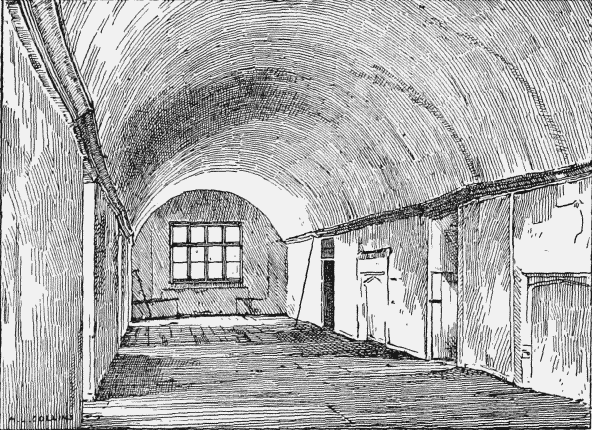
Aston Bury: Attic Gallery
The two fine oak staircases are the principal internal features of the house, that on the east, which is entered directly from the hall, being the richer of the two. In each case there are straight flights of steps on three sides of the staircase, with landings at the angles, the fourth side having landings at each floor. Both stairs rise from the ground floor to the attics, and the east stair is continued down to the basement.
The parish lies on a subsoil of chalk. There are three chalk-pits in the north of the parish. The nearest railway station is Knebworth, on the Great Northern main line, about three miles to the southwest.
The inclosure award, made in 1858, is in the custody of the clerk of the peace. (fn. 2)
MANOR
Previous to the Norman Conquest the manor of ASTON was held by three of the men of Stigand Archbishop of Canterbury, whose names are not known. After the Conquest is formed part of the demesne lands of Odo Bishop of Bayeux, and was assessed at 10 hides. (fn. 3) Odo forfeited in 1088 and Aston remained for some time in the possession of the Crown, until Henry I gave it to his queen Adelaide. After his death Adelaide, who married secondly William de Albini Earl of Arundel in 1138, (fn. 4) gave the manor of Aston to the Abbot and monks of St. Mary of Reading for the good of the soul of King Henry her husband. (fn. 5) This grant was afterwards confirmed by Henry II, (fn. 6) Richard I, John, and Henry III, (fn. 7) and the abbey of Reading continued to hold it 'by service of praying for the King, his progenitors and successors' (fn. 8) until the Dissolution. After the attainder of Hugh Cooke, the last abbot, all the possessions of the monastery were seized by the king, Nicholas Bristowe being appointed steward in 1540. (fn. 9) In the same year the manor of Aston was granted to Sir Philip Boteler of Watton Woodhall, to be held in chief for the tenth part of a knight's fee and rent of 77s. 11d. (fn. 10) This Sir Philip had been one of the Knights of the Body to King Henry VIII in 1516, (fn. 11) and was Sheriff of Hertfordshire in 1524–6, 1530, 1532 and 1538–40. (fn. 12) In 1530 he was one of the commissioners for Hertfordshire to inquire concerning the possessions of Wolsey. (fn. 13) In 1537 he was present at the christening of Prince Edward, (fn. 14) afterwards Edward VI, and in 1539–40 was among the knights appointed to meet Anne of Cleves, (fn. 15) on which occasion he was one of those who 'stood from the park pales upon the heath (Blackheath) to the meeting-place' (at Shooter's Hill). (fn. 16) In 1544 his name was enrolled as supplying men for the rearguard in the army against France, (fn. 17) and later in the same year he was appointed to levy recruits. (fn. 18) He died in 1545. (fn. 19) From this date Aston descended in the same manner as Watton Woodhall (q.v.) until 1778, when John Palmer Boteler sold Aston to Sir Thomas Rumbold. (fn. 20) The latter died in 1791, and in 1794 the manor was sold by trustees to Paul Bendfield, (fn. 21) who in turn sold it to Edmund Darby in 1801. (fn. 22) After the death of Edmund Darby in 1831 Aston was sold to Ann Walmsley of Hoddesdon, who left it by will to her great-nephew Donat John Hoste O' Brien, who was lord of the manor in 1877. (fn. 23) His successor, Captain William Edward Freeman O'Brien, sold Aston in 1907 to Mr. Vernon A. Malcolmson and his wife the Hon. Mrs. Malcolmson, granddaughter of the second Earl of Leicester. (fn. 24)
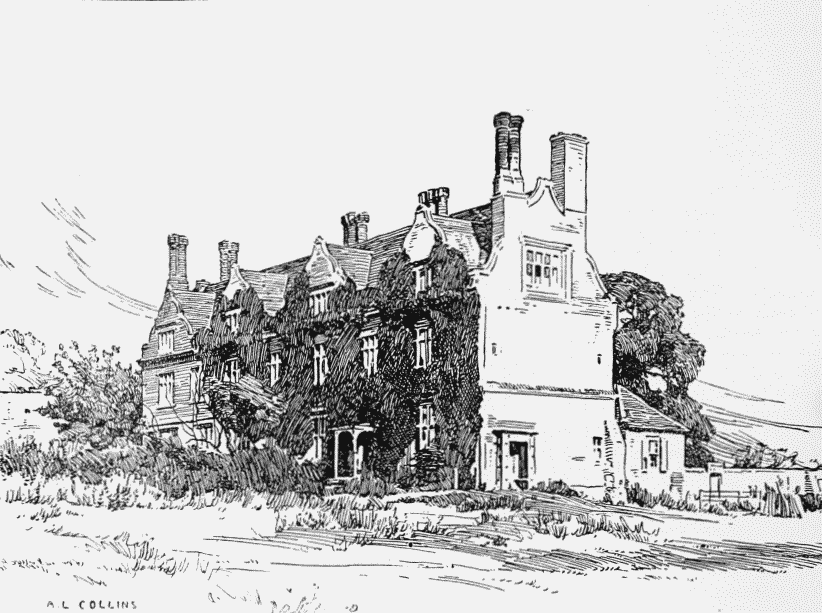
Boteler of Woodhall. Gules a fesse checky argent and sable between six crosslets or.
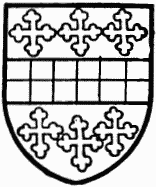
Aston Bury from the North-west
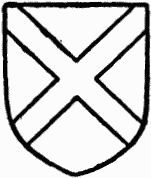
St. Alban's Abbey. Azure a saltire or.
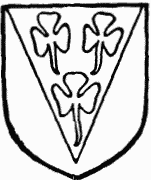
Nodes of Shephall. Sable a pile argent with three trefoils sable thereon.
In 1287 the Abbot of Reading claimed view of frankpledge and free warren in Aston, (fn. 25) but in the reign of Edward I he claimed in addition, in all his Hertfordshire lands, sac and soc, toll and team, infangentheof, utfangentheof, gallows, tumbrel, and chattels of felons and fugitives, also freedom from suit at the hundred court, from paying danegeld, shiregeld and other dues (fn. 26); so doubtless these privileges applied to Aston.
Certain lands in Aston were granted before 1065 by Wulf, 'a certain Dane, a very powerful minister' of King Edward the Confessor, to St. Alban's Abbey. (fn. 27) After the Dissolution the lands of St. Alban's Abbey in Aston were granted with the manor of Shephall to George Nodes. (fn. 28) In 1570 they were in the possession of Charles Nodes, (fn. 29) his nephew, (fn. 30) and presumably descended with the manor of Shephall.
In 1564 a messuage in Aston, at the church gate, and a cottage called the Almshouse, with land called Hoobarnetts Croft, Grynsie Croft and Gallowfield, part of the manor of Aston, were granted by Sir John Boteler to John Kent in free socage. (fn. 31) The latter died in 1592 and was succeeded by his son Thomas, (fn. 32) who died in 1635, leaving a son also named Thomas. (fn. 33)
CHURCH
St. Mary The Virgin
The parish church of ST. MARY THE VIRGIN, (fn. 34) consisting of a chancel, nave, west tower, north aisle, north vestry and south porch, stands on high ground to the west of the village. It is built of flint with stone dressings and the roofs are covered with lead. The tower and nave have embattled parapets. The chancel and nave date from about 1230, and probably represent the whole of the original church. It was not until the end of the 14th or the beginning of the 15th century that the west tower was added. Towards the end of the 15th century new windows were inserted, the church was re-roofed and various repairs were executed. Further alterations took place in the 16th century, and in 1850 the church was restored. Finally, in 1883, restoration again took place, and the north vestry, north aisle and south porch were added.
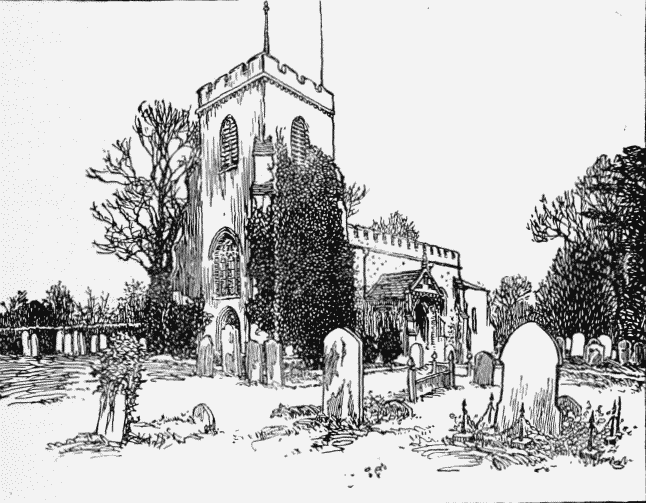
Aston Church from the South-west
The chancel has a modern east window of three lights, trefoiled, with tracery above. In the north wall, which is pierced by a wide opening into the modern north vestry, are the jambs and rear arch of a 13th-century lancet window. There is also on this side, at the west, a modern single light with a four-centred head. On the south side are two square-headed 16th-century two-light windows, much restored and repaired with cement; between them is a modern door with a two-centred head. At the south-east end of the wall is a large double piscina with a single drain and divided by a central pillar. The heads are trefoiled, and the date is early in the 13th century.
The roof of the chancel, as also that of the nave, is of the 15th century, low pitched, with moulded trusses, with carved bosses at the intersections of the trusses with the purlins. The screen is a good example of early 16th-century woodwork, with tracery in the heads. The capitals of the chancel arch have been much mutilated to admit of the fitting of the screen, and the arch probably dates from the first years of the 16th century.
In the nave very few original details can be traced; the north arcade is of course contemporary with the building of the aisle in 1883, and the south windows are also modern. The walls, however, are probably of the 13th century. A lofty four-centred arch opens from the nave to the tower, and is original. The west window is also original, and is of three lights, with tracery above, much restored, and repaired with cement. In this window is a little white and gold 15th-century glass. The modern south porch is approached by a two-centred doorway, and has east and west windows of two lights in square heads. Its entrance arch is two-centred with shafted jambs; it is faced with flint and stone in quarries, and has a gable with a stone coping and cross.
The tower is of two stages with diagonal buttresses, and has a 15th-century west door, much repaired. The bell-chamber is lighted by four louvres with two-centred heads.
The communion table is of the 17th century, and the pulpit is octagonal, of panelled oak, of about 1630. There is a brass on the floor of the nave of John Kent and his wife, with an inscription and the date 1592.
The bells number six, and include a second and third by Miles Graye, dated 1629. The fifth is also of 1629, but recast in 1840.
The plate includes a cup, a cover paten and a paten of 1571, and a cup of 1612.
The registers are in two books: (i) baptisms and burials from 1558 to 1812, and marriages from 1558 to 1753; (ii) marriages from 1754 to 1812.
In 1505 Sir John Smith, the parson of Aston, left 26s. 8d. towards the making of a tabernacle for the image of St. Margaret in the church, (fn. 35) and in 1524 John Kent left 40/. for the same purpose. (fn. 36) An altar of St. Katherine is mentioned, with that of the Blessed Virgin, in 1484. (fn. 37)
ADVOWSON
The invocation of Aston Church seems to have been changed about the end of the 15th century, for in 1430 and apparently in 1490 it is referred to as St. James, (fn. 38) but in 1505 and after as our Lady. (fn. 39) The presentation to the church seems to have always belonged to the lord of the manor. It was confirmed to the monastery of Reading by William Earl of Arundel, Queen Adelaide's husband, (fn. 40) and by Henry II (fn. 41) and Edward III. (fn. 42) The church was never appropriated, and the living is a rectory. The abbey continued to hold the advowson until the Dissolution. (fn. 43) In 1540 it was granted together with the manor to Sir Philip Boteler, (fn. 44) and followed the same descent until 1801, when it was sold after the death of Paul Bendfield to Alexander Ellice of Bath, (fn. 45) who presented to the living in 1804. (fn. 46) His son William Ellice (fn. 47) presented in 1809. (fn. 48) John Corfield made presentation in 1815, (fn. 49) and was still patron in 1822 (fn. 50); but this was probably only an alienation for a term of years, as the Rev. James Ellice presented.in 1829. (fn. 51) The latter held the advowson until 1849, when the Rev. George Augustus Oddie became patron, (fn. 52) and remained so until 1890. For the next five years the presentation was held by Mr. John Oddie and five others, (fn. 53) who were succeeded in 1895 by the Rev. George Venables Oddie, the present patron and incumbent. (fn. 54)
A portion of the tithes, granted in 1253 to the abbey of Colchester, (fn. 55) is recorded in the Taxation of Pope Nicholas in 1291, (fn. 56) and in the assessment for a feudal aid in 1428. (fn. 57) In both these entries the portion of Reading is valued at £1, and that of Colchester at £2 6s. 8d.
A terrier of the parsonage made in 1638 states that there was then 'a dwelling house with an orchard, a garden, a courtyard: and an outyeard with 2 barnes, 2 stables, one hayhouse, a Cart house, a Dove coate, 2 smal garners: a woodhouse, a woodyard, a henhouse, with an old outhouse.' (fn. 58)
A meeting-place for Protestant Dissenters was certified at Aston at various dates between 1697 and 1834. (fn. 59) There is now an undenominational missionroom.
CHARITIES
It appears from the parliamentary returns of 1786 that a sum of £80 was given for the poor by a donor unknown. The gift, with accumulations, is now represented by £104 15s. consols with the official trustees. The annual dividends, amounting to £2 12s. 4d., are applied in the distribution of fuel or clothing by the rector and churchwardens.
The official trustees also hold a sum of £65 12s. 4d. consols, arising from the sale of the Calvinistic Baptist chapel at Aston End. The annual dividends, amounting to £1 12s. 8d., are applied towards the support and maintenance of the chapel at Stevenage.