A History of the County of Hertford: Volume 3. Originally published by Victoria County History, London, 1912.
This free content was digitised by double rekeying. All rights reserved.
'Parishes: Stevenage', in A History of the County of Hertford: Volume 3, ed. William Page (London, 1912), British History Online https://www.british-history.ac.uk/vch/herts/vol3/pp139-148 [accessed 3 May 2025].
'Parishes: Stevenage', in A History of the County of Hertford: Volume 3. Edited by William Page (London, 1912), British History Online, accessed May 3, 2025, https://www.british-history.ac.uk/vch/herts/vol3/pp139-148.
"Parishes: Stevenage". A History of the County of Hertford: Volume 3. Ed. William Page (London, 1912), British History Online. Web. 3 May 2025. https://www.british-history.ac.uk/vch/herts/vol3/pp139-148.
In this section
STEVENAGE
Stithenaece, Stigenace (xi cent.); Stitenache, Styvenach, Stiveneth (xiii cent.); Stivenhatch, Stevenach (xiv to xvi cent.).
The parish of Stevenage has an area of 4,545 acres, of which 3,200½ acres are arable land, 916 acres permanent grass and 325½ acres wood. (fn. 1)
The parish is for the most part a little over 300 ft. above the ordnance datum, a slight depression in the south being the only part below this level. In the north-east the ground rises to 470 ft., and reaches an altitude of just over 400 ft. in two isolated points on the western border of the parish. The Great North Road runs through the centre of the parish. About three-quarters of a mile south of Stevenage, lying beside the road, are six tumuli, known as the Six Hills, which point to the antiquity of this road. The Great North Road forms the main street of the town. At the northern end of the town it forks, one branch going slightly westwards to Hitchin and the other northwards to Graveley and Baldock. At the same point Julian's Road turns west to Fisher's Green. The church of the Holy Trinity is situated at the south end of the High Street; a road running behind it in a northeasterly direction leads to the older church of St. Nicholas and passes on to Chesfield Park, a branch road from it turning east up Almond's Hill to the hamlet of Pin Green. From the church of St. Nicholas a road runs west into the Baldock Road, passing the Bury, the Rectory and Woodfield, the residence of Rear-Admiral Sir Thomas Butler Fellowes, K.C.B., J.P.
Stevenage Bury adjoins the north side of the churchyard. For a long time it was used as a farmhouse, but is now occupied as a private residence by Mr. Algernon Gipps. It has undergone considerable alterations at different times, and a porch and groundfloor extension has been added to the front. The old part of the building is timber framed, covered with plaster externally, the plasterwork still showing traces of flush panels filled with curved basketwork pattern. There are two short wings flanking the back and a small projecting staircase between them. So far as can be traced now, the old entrance faced the superstructure of the chimney, a small lobby being formed as at other old early 17th-century houses in the county, the hall, now the dining-room, being in the centre of the building to the left of the entrance and the drawing-room or parlour in the wing to the right. The kitchen offices occupy the other wing. There is a built-up window, with oak mullions, in a room over the drawing room, but all the other windows are modern. In a cellar under the kitchen parts of the walls are of flint and parts of thin bricks. Adjoining the house is a square timber-framed building of two stories, with a tiled pyramidal roof, which may at one time have been a dove-house.
Part of Chesfield Park, the residence of Mr. Poyntz-Stewart, is included in the north of the parish. The hamlet of Fisher's Green lies in the north-west, with Symond's Green about three-quarters of a mile south. Broomin Green is a short distance west of the south end of the town, with Norton Green still further south. Almost opposite Broomin Green, on the other side of the Great North Road, is Bedwell Plash. In the extreme east of the parish is Chells, with Chells Green on the borders of Walkern parish. The old manor-house is now used as a farm-house and has been much restored, but the fabric of the building dates from the early 17th century. It is a timber-framed house resting on brick foundations, and in plan resembles the letter H. The principal front, which extends to about 62 ft., faces the south-west and is flanked by steep gables overhanging at the level of the first floor and again at the eaves. The wings extend out at the back of the house. The roof is tiled and the walls are now plastered externally, and all the chimneys, doors and windows are comparatively modern. The entrance doorway on the south-west side now opens into the drawing room, which has lately been extended, but it formerly opened into the hall, which occupied the whole of the central part of the building and which had a large fireplace at the end. This fireplace has recently been transformed into an inglenook and the old arch removed. The hall, now the dining room, has been further reduced by forming a passage-way at the back of the house. The old backdoorway to the courtyard still remains with its old plank door, but both are quite plain. As this doorway faces the wide mass of brickwork inclosing the hall fireplace, it would not enter the hall direct, but would have the usual small lobby. At the back of the hall fireplace is a very narrow stair, evidently original, leading to the upper floor. This is lighted by a very small window in the front. Access is gained to this stair both from the hall and from the north-west wing, and there is no indication of any larger stair having existed, though a modern one has been placed in the other wing beside a modern entrance. The kitchen still retains its old fireplace, but it is quite plain. On the side of the upper room next the courtyard are the remains of an old three-light window having moulded oak mullions. This window is now blocked up. Most of the rooms on the upper floor still retain their original wide oak flooring.
Pin Green lies rather more than a mile west from Chells. Sishes, near Pin Green, is the residence of Mr. Julius Bertram. Whitney Wood, on the Hitchin road, is the residence of Mrs. Barclay. In Whomerley Wood are slight remains of a homestead moat.

Stevenage Bury: Back View
Stevenage is a good example of the development of the Teutonic type of settlement which is so frequently met with in Hertfordshire. The old church of St. Nicholas and the 'Bury,' with a few cottages lying about half a mile off the Great North Road, evidently formed the site of the original Saxon village, consisting of an agricultural community which desired to be in the midst of its territories. Probably before the Conquest, but at all events before the grant of a market and fair in 1281, a settlement on the road-side was established, where at the fork of the road was the natural position for the market. The road-side settlement seems to have prospered, and by the end of the 14th century we have the names of streets such as 'Pilgryms,' (fn. 2) and a little later 'Lycchenstret,' 'Baldokstret,' (fn. 3) 'Laschmerstret,' and 'Pavylane,' (fn. 4) which indicates a town of some size. It is clear from the number of presentments relating to innkeepers on the manor rolls (fn. 5) that by the beginning of the 15th century it had become the resort of travellers on the Great North Road. Possibly on account of this prosperity and the increasing size of the town we find that about 1405 a number of London tradesmen purchased, probably as building speculations, small plots of land here. Richard Foster of London (fn. 6) had a messuage and 6 acres of land; John Sylam, citizen and pewterer of London, had 4 acres 'built upon'; William Rendre of London had land in Churchfield called 'Pyedelacre'; William Waldern, citizen and grocer, John Hamond, citizen and barber, William Marchford, citizen and mercer, Edward Grymston, citizen and vintner, and others, all of London, purchased small freeholds. (fn. 7) There is, however, no evidence that Stevenage was ever anything more than a manorial market town, though the gild of the Holy Trinity, established probably in the early part of the 15th century with a gildhall or brotherhood house, may have had some powers in the management of the affairs of the town. Early in the 16th century we can tell from the evidence of architectural remains that the road-side town extended from the point where the Great North Road forks, or a little northward, to the old workhouse, an interesting timber and plaster building, originally a dwelling-house, which stands opposite the modern church of Holy Trinity.

Chells Farm from the North
Although a great part of the town was burnt in a fire which occurred on 10 July 1807, (fn. 8) there still remain many interesting specimens of 17th-century timber and plaster houses with tiled roofs, principally in the High Street. The grammar school, the history of which will be found elsewhere, (fn. 9) stands at the north end of the bowling green. It was enlarged and considerably altered in 1905, but there survives a small rectangular building consisting of one room, probably of the foundation of 1561. It was originally of timber and brick, but is now largely refaced with brick. On the east side of the High Street opposite the green is a 17th-century timber and brick house refronted, with an original chimney stack; a little southward are a 17th-century inn and cottages. Towards the south end of the street is a two-storied gabled shop, the upper story of which is covered with basket-work pargeting in panels. The Castle Inn, with the cottage adjoining, originally formed one building, probably of the latter part of the 16th century. They have basket-work pargeting in the upper story and gables. On the west side of the street are several other instances of the use of basketwork pargeting in 17th-century houses; many of them, however, are now refaced in front with brick. The inns called the 'White Lion' and the 'Red Lion' have timber coach entrances, but much of the old 17th-century timber and plaster work has been renewed in brick. In the yard of the latter are the remains of a 16th-century building with a projecting upper story. South of the 'Red Lion' is a 17th-century house, partly used as a shop. It has a gable at each end and a dormer window between; the upper part is of pargeted timber and the lower of brick, plastered. It has an octagonal brick shaft on a moulded base.
The main line of the Great Northern railway runs through the parish parallel to the Great North Road.
The subsoil of the parish is chalk, and there are many chalk-pits in various parts.
The inclosure award was made in 1854, and is in the custody of the clerk of the peace. (fn. 10)
MANORS
Stevenage
The manor of STEVENAGE was granted to the abbey of St. Peter at Westminster by Edward the Confessor about 1062, (fn. 11) and was entered among the possessions of the abbot in 1086, when it was assessed at 8 hides. (fn. 12) Stevenage Manor remained in the hands of the Abbots of Westminster (fn. 13) until January 1539–40, when the monastery and its possessions were surrendered to the Crown. (fn. 14) At the end of 1540, however, the bishopric of Westminster was created and endowed with the lands which had belonged to the monastery, (fn. 15) and Stevenage pertained to the bishopric (fn. 16) until its surrender to Edward VI in 1550, (fn. 17) when this manor was presumably given to Bishop Ridley of London, together with the greater part of the Westminster lands. (fn. 18) It was confirmed to the bishopric of London by Mary in 1554, (fn. 19) and then remained in the possession of the Bishops of London (fn. 20) until the Commonwealth. Upon the sale of lands pertaining to bishoprics it was bought in 1649 by Thomas Ayres. (fn. 21) The latter was still holding it in 1657–9. (fn. 22) At the Restoration Stevenage was restored to the bishopric of London, and remained in the possession of that see until 1868, when it was transferred to the Ecclesiastical Commissioners, (fn. 23) who are the present lords of the manor.
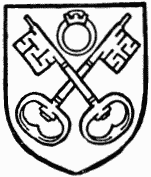
Westminster Abbey. Gules St. Peter's keys or with St. Edward's ring or in the chief.

Main Road, Stevenage, showing 17th-century House
A fair was granted to the Abbot of Westminster at Stevenage in 1281, to be held on the vigil, feast, and morrow of St. John the Baptist (fn. 24) (23–25 June), and was confirmed by Henry VI in 1448. (fn. 25) In 1624 the Bishop of London was granted three fairs, to be held on Ascension Day, St. Swithun's Day (15 July), and on the Friday following. (fn. 26) In 1792 fairs were held for nine days before Easter, nine days before Whit Sunday, and on the first Friday in September. (fn. 27) In 1821 the September fair was held on the 22nd of that month, (fn. 28) and it is now held on the 22nd and 23rd. (fn. 29)
A market was granted to the abbot in 1281, to be held on Mondays, (fn. 30) and was confirmed in 1448. (fn. 31) In 1624 the day was altered to Friday, (fn. 32) on which day it was held as late as 1792. (fn. 33) In 1821 it is said to have been held on Wednesday, (fn. 34) but it has since been discontinued.
A warren is mentioned as belonging to the lord of the manor in 1393, when John Wheler and others were accused of hunting in it and taking partridges and pheasants. (fn. 35) It is mentioned again in 1408, when William Rendre of London was granted the 'custody and profit of the warren for hunting and chasing hares and rabbits.' (fn. 36)
In 1287 the Abbot of Westminster claimed in Stevenage view of frankpledge, return of writs, amendment of the assize of bread and ale, infangentheof, utfangentheof, gallows, tumbrel and pillory. (fn. 37) The view of frankpledge extended into the tithings of Holwell, Cadewell, Watton, Datchworth, Tewin and Stevenage. (fn. 38) In the 13th century and early 14th century the abbot held five courts yearly for Stevenage and its dependencies—two in the autumn, two in early spring, and one in summer. In 1271–2 the profits amounted to 43s. 3d., and in 1320–1 to 69s. 2d. (fn. 39) From the middle of the 14th century four yearly courts seem to have been usual. These were at first held at the feasts of St. Andrew (30 November), St. Denis (9 October), St. Matthew (21 September), and at Pentecost, but a little later the first two were changed to St. Lucy (13 December) and the Annunciation (25 March). At the end of the 14th or beginning of the 15th century the number of courts varied, one being held at the feast of the Conception (8 December). The average value of the courts in the 14th century seems to have been about £3, but it dropped during the next century, the profits in 1499–1500 only amounting to 28s. 7d. (fn. 40)
In 1409 it was presented at the view of frankpledge that the lord was bound to have within his liberty a pillory and a cucking-stool and that they were not there to the damage of the community. The bailiff was therefore ordered to supply them. (fn. 41) In 1542 it was ordered that the stocks should be amended and 'le kucking-stole and le pillarye' newly made. (fn. 42)
In 1310 the king had a prison at Stevenage within the liberty of the Abbot of Westminster. In that year an order was issued for the justices of gaol delivery to release from the prison one Andrew Baron 'and to lead him back to the church of Stevenage whither he had fled for sanctuary for larceny, certain malefactors having withdrawn him from the church and taken him to the said prison.' (fn. 43)
Halfhide
The manor of HALFHIDE, of which the overlordship is not known, first appears in 1408–9, when it was held by John Chertsey of Broxbourne, who in that year released his right in it to William Skrene, (fn. 44) probably for the purpose of a settlement. Edmund Chertsey, son or grandson of John Chertsey, (fn. 45) died before 1475, leaving a son William (fn. 46); Eleanor his widow, however, conveyed the manor to John Northwood and others, probably trustees in a sale, in 1478–9. (fn. 47) In the first half of the next century Halfhide came into the possession of Matthew Ward and Alice his wife, who in 1553 conveyed it to John Lord Mordaunt. (fn. 48) The latter was succeeded in 1561 by his son John, whose son and heir Lewis inherited Halfhide with the rest of his father's estates in 1571, (fn. 49) and sold the manor in 1601 to Rowland Lytton and Sir Henry Wallop. (fn. 50) Sir Henry Wallop conveyed his moiety to Rowland Lytton in 1610, (fn. 51) and it descended in his family in the same way as the manor of Knebworth. (fn. 52)
Free warren in Halfhide was granted to William Lytton in 1616 (fn. 53) and is mentioned with free fishery in 1811. The present farm-house called Halfhide lies in the neighbouring parish of Shephall.
Homeleys
The manor of HOMELEYS probably took its name from the family of Ivo de Homeley (Homlie),who held land in Stevenage in 1275, 140 acres of which were then held of him by Laurence de Brok. (fn. 54) It appears to have been held of the Abbot of Westminster of the manor of Stevenage. (fn. 55) In 1305 Robert de Depedene, who was holding the manor in right of his wife Isabel, conveyed it to William de Chilterne. (fn. 56) In the reign of Edward III it seems to have been held by Alice Homeley, whose predecessor had been Robert de Sutton. (fn. 57) Probably it was among the possessions of John Chertsey of Broxbourne at the beginning of the 15th century, for his successor Edmund Chertsey gave Homeleys to Thomas Skrene, with remainder in tail to William Skrene, brother of Thomas, with remainder to the heirs of Edmund Chertsey. (fn. 58) Upon the death of Thomas Skrene without issue in 1466 the manor passed to John Skrene, grandson of his brother William. (fn. 59) John died in 1474 without heirs, whereupon Homeleys reverted to William son and heir of Edmund Chertsey. (fn. 60) After this date Homeleys followed the same descent as the manor of Halfhide. (fn. 61)
Free warren in Homeleys was granted to William Lytton in 1616. (fn. 62)
Bromesend
The manor or tenement of BROMESEND was held of the Abbot of Westminster of his manor of Stevenage for rent and suit of court. (fn. 63) It seems to have taken its name from the family of Brome, who appear in Stevenage in the 14th century. Roger atte Brome held a messuage and half virgate in the reign of Edward II, and was living in 1325, (fn. 64) after which he was succeeded by Robert atte Brome, who held it in the time of Edward III. Anabill Brome, who had held 2 acres in Chalkdellfeld before Robert's time, (fn. 65) was doubtless one of the same family. In the 15th century Bromesend came into the possession of the Chertseys, and was given by Edmund Chertsey to Thomas Skrene, (fn. 66) together with the manor of Homeleys, with which it subsequently descended. (fn. 67)
Free warren in Bromesend was granted to William Lytton in 1616. (fn. 68)
Chells
—In the reign of Edward the Confessor a hide and a half in 'Escelveia,' which had once belonged to Welwyn, were held by Alwin, with the exception of 10 acres and a toft which belonged to Alwin Dode, a man of Aluric the Little. (fn. 69) Half a hide in 'Scelva' was held by Aluric, a man of Aluric of Benington, (fn. 70) and a half virgate belonged to Aluric Busch, who at that time was one of Swen's men and of King Edward's soke. (fn. 71) By 1086 Alwin's hide and a half had come into the hands of Peter de Valognes, of whom they were held by Godfrey. (fn. 72) The half hide was held of Robert Gernon by the William who held Letchworth and other lands, (fn. 73) while the half virgate had been retained by Aluric Busch, but was held of Geoffrey de Bech. (fn. 74) The Scelva or Escelveia of these holdings has been identified with Chells (Chelse, xv and xvi cent.), a manor in this parish. (fn. 75) The overlordship of Chells, however, does not seem to have been held by the descendants of any of these three, for in 1295 the manor was held for a sixth of a fee of Roger le Strange. (fn. 76) This Roger, who was the son of Hamon le Strange, married Maud widow of Roger Mowbray and coheiress of William de Beauchamp, (fn. 77) so that this fee may have been previously held by any of the three families of Le Strange, Mowbray, or Beauchamp. It seems probable, however, that Roger le Strange held it in right of his wife Maud, for upon his death without children in 1311 (fn. 78) it evidently passed to Roger de Mowbray son of Maud by her first husband, since Chells was held in 1359 of John de Mowbray, great-grandson of Maud. (fn. 79) The tenure does not therefore confirm the identification of Chells with the Scelva of 1086.

Pateshull. Argent a fesse wavy between three crescents sable.
Under Roger Le Strange the manor appears in the tenure of the family of Pateshull. The earliest known member of the family is Simon de Pateshull, chief justice of the Common Pleas, who died about 1217, (fn. 80) and had a son John. (fn. 81) The first, however, who is known to have held Chells is Simon de Pateshull, son of this John, (fn. 82) a well-known judge, who died seised of the manor about 1295, and was succeeded by his son John. (fn. 83) John's son (fn. 84) and successor William de Pateshull died in 1359, leaving as his heirs his three sisters: Sibyl wife of Roger de Beauchamp, Alice wife of Thomas Wake and Catherine wife of Robert de Todenham; and also Roger son of a fourth sister Maud and her husband Walter de Fauconberg. (fn. 85) Chells was assigned to Alice and Thomas Wake, who in 1373 conveyed it to their son Thomas and his wife Maud. (fn. 86) Maud survived her husband and held the manor until her death in 1425, when it passed to her grandson Thomas Wake. (fn. 87) There is then a gap in the records of the manor. This Thomas is known to have died in 1458 and to have been succeeded by his son Thomas. (fn. 88) It was perhaps the latter who conveyed Chells to John Norreys, who died seised of it in 1521. (fn. 89) John Norreys was also lord of the manor of Boxbury, which manor his son and successor John Norreys sold to Philip Boteler in 1526. (fn. 90) Probably Chells was conveyed to the Botelers about the same time, for it was settled by Sir Philip on his son John, (fn. 91) and appears in his possession in 1562. (fn. 92) After that date it follows the same descent as the manor of Boxbury (fn. 93) in Walkern, with which it was henceforward associated.
Brooks
The manor of BROOKS (Brokes, Brokys) took its name from the family of Brok, who held land in Stevenage in the 13th century. Laurence de Brok, son of Adam de Brok, (fn. 94) died about 1275 seised of considerable possessions in Stevenage, of which 300 acres with a capital messuage were held of the Abbot of St. Albans, 200 acres with a windmill of the Abbot of Westminster, 140 acres of Ivo de Homeley and 100 acres of Robert de Graveley. (fn. 95) Some or all of these portions were probably known as 'Brooks,' for the manor is mentioned by that name in a deed of the same year by which it was conveyed to Laurence's son and heir Hugh. (fn. 96) Hugh de Brok was succeeded before 1294 by his son, another Laurence, (fn. 97) whose widow Ellen was holding his lands in 1330, with reversion to her son Ralph. (fn. 98) Ralph's heirs, who succeeded before 1346, (fn. 99) were his three daughters Joan, Ellen and Agnes, the eldest of whom died without issue. His lands were therefore divided between Ellen and Agnes. Agnes had a daughter Joan, (fn. 100) who was perhaps identical with Joan the wife of Robert Corbet, who was holding Brooks with her husband in 1400. (fn. 101) There is no further record of the manor until towards the end of the 15th century, by which time it had come into the possession of Edmund Node. (fn. 102) His wife Joan survived him, and enfeoffed her second son William to the use of herself and her heirs, with the condition that he made an estate to his elder brother, who was also called William. He, however, refused to do this, and between 1493 and 1500 his mother brought a suit against him to compel him to give up the manor. (fn. 103) William Node was holding Brooks in 1521, (fn. 104) and seems to have been succeeded by another William, who in 1564 sold the manor to Robert Ivory. (fn. 105) The latter conveyed it in the same year to John Bagshawe. (fn. 106) In 1608 it was purchased from Edmund Bagshawe, probably the son of John, by William Field, (fn. 107) who in 1614 sold it in his turn to Ralph Radcliffe of Hitchin Priory (fn. 108) (q.v.). Brooks has since descended in the Radcliffe family, (fn. 109) and is now in the possession of Mr. Francis A. Delmé-Radcliffe, J.P.

Radcliffe of Hitchin. Argent a crosslet gules between two bends engrailed sable with a label azure over all.
Ellen widow of Laurence de Brok was granted free warren in her lands in Stevenage in 1330. (fn. 110)
Cannix, Canwykes, or Broxbournes
CANNIX, CANWYKES, or BROXBOURNES, was named from its early tenants, and was held of the manor of Stevenage by military service. (fn. 111) It seems to have been identical with the messuage and virgate held of the Abbot of Westminster in 1315 by John de Broxbourne. (fn. 112) His son Richard held the property during the reign of Edward III. It is then described as being at 'Srewentenwode.' The same Richard also held a third of a fee in 'Kechenbrech' which had formerly belonged to Laurence de Brok, and for which he paid 24s. (fn. 113) Nothing more is heard of the estate until about 1509, when William Canwyke paid a relief of 40s. for certain land in Stevenage called ' Broxborne' which he had received from Petronilla his mother. (fn. 114) In 1510 Samuel and Clemence Canwyke sold the 'manor' to William Lytton of Knebworth, who died seised of it in 1517. (fn. 115) At the death of his son Robert Lytton in 1550 it was divided among his three daughters, Ellen the wife of John Brockett, Elizabeth wife of Thomas Lyttel, and Anne, who married John Burlace. (fn. 116) It seems to have been divided later among the five daughters of Ellen and John Brockett, for a fifth of Cannix was held in 1599 and 1623 by Sir Richard Spencer and Helen daughter of Ellen and John Brockett, (fn. 117) and in 1604 another fifth appears in the possession of Alexander Cave and Anne, another daughter. (fn. 118) Eventually, however, the whole returned to the male line of the Lyttons and descended in the same manner as Knebworth (fn. 119) (q.v.). It is mentioned in 1811, (fn. 120) after which its identity was probably lost among the other lands held by the Lyttons in Stevenage. Cannocks Wood in the southwest of the parish perhaps preserves its name.
In 1308 John de Broxbourn obtained a licence for an oratory in his 'manor of Stevenage,' (fn. 121) probably at Cannix.
CHURCH
The parish church of ST. NICHOLAS consists of a chancel, nave, north and south aisles, and north and south chapels in line with the aisles, west tower, north vestry, south transept and south porch. (fn. 122) It is probably built of flint, but the walls are covered with cement. The flat roofs are covered with lead, and the tower has a tall octagonal leaded spire. The tower, nave and chancel and aisles have embattled parapets.
The earliest portion of the existing church is the tower, which was built in the first half of the 12th century, and appears to have formed the tower and west porch combined of the original church, which probably consisted of a chancel, nave and tower. Early in the 13th century it is probable that the whole church except the tower was rebuilt and aisles added. The present nave is of this date. The chancel now standing was built about 1330, and the aisles were widened to their present dimensions at the same time. A doorway in the east wall of the tower above the low-pitched roof seems to indicate that the roof of the 14th century was of a pitch high enough to inclose it. The present roof with the clearstory is of the 15th century, when the nave arcades were rebuilt from the capitals upwards, the pillars with their bases being of the earlier date. The bell chamber of the tower was also added or rebuilt in the 15th century. The south porch, if not actually modern, has been wholly restored, and the south transept is modern.
The chancel has a modern east window of four lights with tracery in 15th-century style. In the north wall is a window of the 14th century, now blocked up, with three lights under a square head. The inner jambs have an edge-roll and the low rear arch is two-centred with an internal hood mould. The south window is like it, but is open and has been repaired externally with cement.
The arcades between the chancel and the north and south chapels are of two bays and are of the 14th century. The middle pillar on each side is octagonal, but, while the responds of the north arcade are semi-octagonal, those of the south arcade are semicircular. The bases and capitals of both pillars and all the responds are moulded. The two-centred arches are of two chamfered orders.
In the chancel is a piscina now cemented over which may be old; against the east wall behind the altar is the upper part of a 15th-century traceried screen, painted over, of which the lower part stands at the entrance to the chancel. The three sedilia on the south side, of cement, are modern. There is no chancel arch.
The north chapel has an east window of four lights with tracery of the 14th century. It has an inner edge-roll like those in the chancel, and has been much repaired with cement. The north wall has two 14th-century windows of two lights with pointed heads and labels, and a third window which is modern but a copy of the other two. The first window is blocked externally, but the tracery is visible inside. The second is altogether blocked, only the outline being visible externally. The south chapel has an east window and two south windows like those in the north chapel and of the same date. Those in the south wall differ from the rest in having their inner jambs and arches moulded with an undercut edge-roll and in having moulded labels; they are repaired with cement externally. Between the two windows is a pointed doorway also of the 14th century. There is a piscina in this chapel, probably contemporary, which has a cinquefoiled head and a trefoiled basin.
The nave has north and south arcades of four bays, with octagonal pillars and moulded bases of the 13th century, but the capitals and pointed arches of two hollow-chamfered orders were inserted early in the 15th century. The bases, and the labels of the western bays, are mutilated, the latter for the fitting of a gallery. The clearstory of the 15th century has square-headed windows from which the tracery is gone.
The north aisle has three windows in the north wall, the easternmost being of four lights in a square head. It is probably a 15th-century insertion, but the tracery is modern; the second is a two-light window, with tracery in a pointed head, and is probably of the 14th century, but here again the tracery is modern. The third is similar, of the 14th century, and is repaired externally. Close to the west extremity of the wall is a doorway of 14th-century date, restored. The west window is modern.
The south aisle has a modern archway in the south, opening into the transept, and west of it a 14th-century window of two lights, like those in the south chapel; near the west wall is a pointed doorway of the 14th century, which has been repaired; the west window is modern.

Plan of Stevenage Church
The west tower opens to the nave by a 12th-century arch with shafted jambs on the west side, roughly carved capitals, and a semicircular head with an edgeroll. The east side of the arch is plain. The tower is of two stages without external division. It is of the 12th century, but the diagonal angle buttresses were added probably in the 15th century. It has an embattled parapet and a leaded spire. The west doorway is of the 12th century, but has been much repaired with cement. The jambs have shafts with rude bases, capitals and abaci. The arch, which is semicircular, is of two orders, the outer having an edge-roll. The north and south walls have small round-headed windows of original date, high up, and above the tower arch is a round-headed doorway which formerly gave access to the 12th-century roof. Over this again is a pointed doorway, which from its position would seem to have opened to the 14th-century roof, but is now outside, above the present roof. On each side of this doorway is a small circular opening in the bell-chamber wall. The three remaining sides at this level have repaired 15th-century windows of two lights in a pointed head.
No date can be assigned to the south porch, owing to its complete restoration.
The roofs of the chancel and nave are of the 15th century, of a low pitch, with traceried trusses. The lean-to roofs of the nave and aisles, which are of the same date, are nearly flat; that of the north aisle has been repaired. At the feet of the principal cross-ribs of the chancel roof are carved angels; the other parts of the church have wood corbels, some of them carved.
The font is of early 13th-century date, and has a square bowl, carved with foliage, and standing on a circular stem with small round detached angle-shafts having moulded bases and capitals.
There are three stalls in the chancel, and three in the tower, with carved misericordes, dating from the end of the 14th or the beginning of the 15th century.
In the chancel is a brass of Stephen Hellard, rector, of about 1500, with the figure of the priest in a cope, and an inscription. The date is not filled in, but he died in 1506. In the north aisle are the indents of a man and his two wives, with their sons and daughters, and of an inscription, of mid-15th-century type; and in the nave is a slab with the indent of a floreated cross, apparently of the 14th century.
In the north aisle is a (formerly) recumbent effigy of a lady. Her hands are raised in prayer, and an angel and a priest support her elbows. The date appears to be late 13th or early 14th century. The effigy is much mutilated, the part below the knees being wanting, and the fragment is now set upright, to the east of the north door. In the chancel is a mural monument to William Pratt, 1629.
There are six bells: the treble by John Briant, 1797, the second dated 1670, by an unknown founder, and the remainder by John Briant, dated 1783, 1795, 1783, and 1783 respectively. The fifth bell has been recast.
The plate consists of a silver cup and cover paten of 1634 and a paten and flagon of 1683.
The registers, beginning in 1564, are contained in seven books, as follows: (i) baptisms 1542 to 1599, burials 1545 to 1598, marriages 1539 to 1598; (ii) baptisms 1565 to 1649; (iii) baptisms 1653 to 1726, burials 1653 to 1726, marriages 1661 to 1726; (iv) baptisms 1726 to 1761, burials 1726 to 1755, marriages 1726 to 1753; (v) baptisms 1762 to 1812, burials 1756 to 1812; (vi) marriages 1754 to 1765; (vii) marriages 1766 to 1812.
ADVOWSON
The advowson of the church belonged to the Abbot of Westminster. In the 13th century the incumbent paid a pension of 50s. to the abbey. (fn. 123) The church belonged subsequently to the Bishop of Westminster until the surrender of that bishopric to Edward VI in 1550. (fn. 124) In that year the advowson and rectory were granted by the king to Sir William Herbert, K.G., (fn. 125) who was created Earl of Pembroke in 1551 and died in March 1569–70. (fn. 126) His son Henry sold the advowson in 1575 to Edward Wilson, (fn. 127) who is said to have conveyed it in the same year to Thomas Clerke. Thomas had a son John, (fn. 128) to whom he conveyed the advowson in 1580, (fn. 129) John having previously obtained a release of the same from Edward and William Clerke, (fn. 130) perhaps his brothers. He died in 1595, leaving four sons, of whom Thomas was the eldest. (fn. 131) The advowson is said to have been subsequently acquired by the families of Smith and Chester. (fn. 132) In 1664 presentation was made by Francis Flexmere and Allan Read, merchant tailors, (fn. 133) and in 1678 by James Goulston, (fn. 134) who perhaps obtained it for one turn from Stafford Leventhorpe, who owned the rectory about that time. (fn. 135) Thomas Duckett presented in 1689, (fn. 136) about which time the advowson and rectory came into the hands of Joseph Bentham, D.D., who presented in 1719. (fn. 137) The latter sold the advowson in 1720 to Charles Baron, (fn. 138) who presented with George Whorton and Jacob Jefferey in 1723, (fn. 139) and is said to have sold the rectory and advowson to Nicholas Cholwell in 1724. (fn. 140) The latter presented in 1725, and he or his son, with Rowland Ingram, in 1733. (fn. 141) Ann Ingram, widow, presented in 1737, (fn. 142) probably for one turn, after which Nicholas Cholwell the younger is said to have sold the rectory and advowson in 1761 to William Baker, (fn. 143) who possessed the advowson in 1762, (fn. 144) and whose son was holding it in 1821. (fn. 145) His grandson William Robert Baker sold it in 1869 to John Allen, (fn. 146) who held it until 1899, when it was acquired by the Rev. Canon Allen. It was transferred to the Bishop of St. Albans in 1906. (fn. 147)
A fraternity of the Holy Trinity in the church of St. Nicholas at Stevenage is mentioned in 1446. (fn. 148) Bequests were also made to it in 1483 and 1497. (fn. 149) In 1558 the Brotherhood House with 6 acres of ground belonging was granted to Sir George Howard. (fn. 150) There was a light to the Virgin in the church mentioned in 1512. (fn. 151)
The church of the HOLY TRINITY, which was erected in 1861, is served from that of St. Nicholas.
Meeting-places for Protestant Dissenters in Stevenage were certified from 1698. In 1814 a chapel was opened in connexion with the Academy at Wymondley (fn. 152) (q.v.). At the present time there are in the parish chapels of the Wesleyans, Baptists and Strict Baptists.
CHARITIES
Educational Charities.
—For the grammar school, endowed by will of the Rev. Thomas Alleyn, 1558, and the English or Pettits School, founded in 1562, see article on 'Schools.' (fn. 153)
The National school, comprised in deed, 1834, is endowed with £106 7s. 8d. consols, by will of Miss Charlotte Amelia Hinde Whittington, proved in 1867; £21 10s. 4d. consols, by will of Miss Susanna Smyth, proved in 1867; and £321 5s. 9d. consols, by will of George Smyth, proved in 1868.
The several sums of stock are held by the official trustees, producing in the aggregate £11 4s. 4d. yearly.
The Consolidated Charities are regulated by a scheme of the Charity Commissioners, 26 March 1909, as varied by scheme of 26 April 1910. They comprise the charities of—
1. The almshouses founded by Stephen Hellard, priest and rector, by deed, 20 November, 17 Henry VII (1501), whereby certain lands and a newly-built messuage, to be called 'All Christian Souls' House,' were conveyed to the uses of donor's last will, bearing date 20 December 1501. The trust property now consists of eight almshouses in Back Lane and 13 a. 3 r. 13 p. of land with messuage let at £14 a year.
2. George Clerke, will, 1556, being a rent-charge of £2 10s. issuing out of Boxbury Tithe, parish of Walkern.
3. Robert Gynne, by will, 1604, consisting of a rentcharge of £1 issuing out of Ditchmore Mead, another rent-charge of £1 10s. out of Maidenhead in Stevenage, £13 14s. 8d. consols, and the right of the poor to receive 10 bushels of good grain (commonly called Misleyne or Maslin) charged on Fisher's Green Farm.
4. John Elmer, will, 1622, formerly consisting of a messuage or inn in Ware, called the 'Black Swan,' which has been sold, the share of Stevenage being represented by £414 7s. 3d. consols.
5. Edward Swallow, will, 1629, being a rentcharge of £1 issuing out of land at Cottered.
6. Rev. Richard Cholwell, a former rector, by deed, 1773, formerly a poor-house, now occupied by the premises of the Stevenage Gas Company at a rental of £18 a year.
7. Miss Charlotte Amelia Hinde Whittington, for poor, by will proved 1867, trust fund, £319 3s. consols.
8. Susanna Smyth, for poor, by will proved 1868, trust fund, £162 3s. 3d. consols; and
9. George Smyth, for poor, by will proved 1871, trust fund, £762 18s. 10d. consols.
The several sums of stock, amounting in the aggregate to £1,672 7s. consols, are held by the official trustees, producing an annual income of £41 16s.
The scheme provides that the full number of almspeople shall be eight in number and that every almsperson shall be in receipt of a properly secured income of not less than 5s. a week, either from the charities or other sources, a yearly sum of not more than £58 10s. out of the net income of the charities to be applied for this purpose. The residue of the income is directed to be applied for the benefit of the poor generally, including donations to a dispensary, hospital, &c, or any provident club; also in contributions towards the provision of nurses, and also to the extent of £10 a year in the distribution of articles in kind and in medical aid in sickness.
Charity of Rev. Thomas Alleyn for four poor men. (fn. 154) —The sum of £5 6s. 8d. is received from Trinity College, Cambridge, and duly applied.
In 1668 the Rev. Thomas Chapman by his will devised certain messuages and lands in Stevenage, subject to the payment of £8 per annum, to buy cloth and bread for the poor of this parish, Ashwell, St. Paul's Warden and Norton. The property charged has been sold, and, being difficult of identification, the payments have ceased to be made.
'The Eadon Fund' consists of £113 9s. 6d. Tasmanian Government 3 per cent. inscribed stock, arising under the will of Elinor Maria Frederica Eadon, proved at London 4 January 1902. The stock is held by the official trustees, and the annual dividend, amounting to £3 8s., is in pursuance of a scheme, 30 November 1909, applicable in apprenticing a boy who is a baptized member of the Church of England, the income to accumulate until sufficient for the purpose.