A History of the County of Hertford: Volume 3. Originally published by Victoria County History, London, 1912.
This free content was digitised by double rekeying. All rights reserved.
'Parishes: Therfield', in A History of the County of Hertford: Volume 3, ed. William Page (London, 1912), British History Online https://www.british-history.ac.uk/vch/herts/vol3/pp276-284 [accessed 11 May 2025].
'Parishes: Therfield', in A History of the County of Hertford: Volume 3. Edited by William Page (London, 1912), British History Online, accessed May 11, 2025, https://www.british-history.ac.uk/vch/herts/vol3/pp276-284.
"Parishes: Therfield". A History of the County of Hertford: Volume 3. Ed. William Page (London, 1912), British History Online. Web. 11 May 2025. https://www.british-history.ac.uk/vch/herts/vol3/pp276-284.
In this section
THERFIELD
Furreuuelde (xi cent.); Tirefeld (xii cent.); Terfeud, Tertefeud, Trefeud, Tirefeld, Therefeud, Tiresfeld (xiii cent.); Theresfelde, Torfeld (xvi cent.); Tharfield (xvii cent.).
Therfield is a parish of about 4,704 acres in the north of the county, stretching from the Cambridgeshire border some 4½ miles towards the south. It lies on a ridge of the Chilterns which slopes somewhat abruptly to the north and more gradually to the south. The highest part of this ridge is more than 500 ft. above the ordnance datum, while the low ground on the northern border has a height of about 235 ft., and in the south the ground slopes down to 365 ft. The Icknield Way marks the northern border of the parish and the straight line of Ermine Street forms the parish boundary on the east.
A by-road leads direct from the Icknield Way to Therfield village, which stands on the highest part of the ridge. The village, called locally the 'town,' (fn. 1) is small and built irregularly about an open green, the rectory and the church standing a little way back on the south-west.
To the north-west of the church there can be traced a fortified village with a mount and baileys, defended by a dry ditch. There is evidence of an inner ditch, and of a larger inclosure on the south.
The rectory lies to the south-east of the church. Its main building, which is of brick, appears from the registers to have been rebuilt about 1769, the library having been added in 1800. (fn. 2) On the east side is a building of two stories which dates from the 15th century, and which was probably a wing of the old building, foundations of a similar wing having been discovered on the west side of the main building. (fn. 3) The old wing is built of flint rubble covered with cement, and with clunch dressings; the roofs are tiled.
The ground stage of this wing consisted originally of one long room, running north and south, 30 ft. 8 in. by 11 ft. 3 in. (fn. 4); at either end, on its eastern side, was a projecting wing, that on the north being 11 ft. 3 in. by 7 ft., that on the south 12 ft. 6 in. by 12 ft. Some time during the 17th century, probably in the time of Charles II, the south wall on the ground story of the north wing was removed, and a beam put in to carry the wall above, and the east wall continued to the south wing, thus forming the two wings into one rectangular block. Projecting southwards from the south wing is a one-story building of the same date, 21 ft. by 8 ft. 8 in., beyond which are brick outbuildings and a brew-house of the 17th century; in the yard is an old deep well.
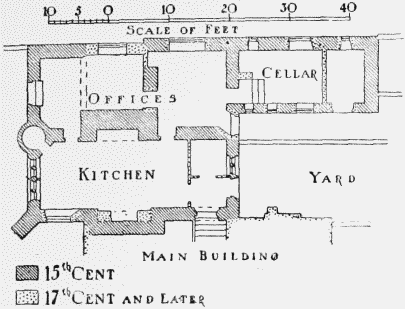
Plan of Therfield Rectory
The principal room on the ground floor, which is now used as a kitchen, and may have been originally so used, has been reduced by a modern lobby at the south end, from which an original doorway with two-centred arch and moulded jambs gives access to the modern building. In the centre of the west wall of the kitchen is a fireplace, 9 ft. wide with straight lintel, now partly blocked; on the opposite wall is a wide round-arched recess, on either side of which is a low doorway with two-centred arch and moulded jambs, opening into the north and south wings respectively. At either end of the original room or kitchen is a four-light window with pointed cinquefoiled arches under a square head, with moulded label and head stops; the jambs and mullions are moulded, and a heavy mullion divides each pair of lights; the window at the south end has had one pair of lights cut down to form a doorway. In the north-east angle is the doorway to the turret stair to the upper floor, but the stair itself is gone; a portion of the circular stairway projects on the outer face of the wall. The north wing, now used as a scullery, had formerly a two-light window in its north wall, but this has been made into a doorway, only the outer moulding being retained. The 17th-century wall connecting the two wings is of brick, about 22 in. thick, the old walls adjoining being 2 ft. 6 in.
The south wing is entered from the enlarged north wing by a 17th-century opening under a four-centred arch, the original north doorway to the wing having been blocked by the east wall erected at that period. The window in the east wall of the wing is not original. A doorway of late date has been cut through the south wall to give access to the yard. The one-story building to the south has, on either side, a small circular quatrefoiled window of clunch; all the other windows are modern.
Above the north wing is a small room fitted up as a chapel, with traces of a pointed window in the east wall, now partly blocked and occupied by a sash window. In the north wall are two 15th-century windows, one of two lights, the other a single light, both now blocked. The chapel is lined with oak bolection moulded panelling of the time of Charles II; the door to the adjoining room on the south, which was part of the 17th-century extension, has its upper panels filled with the original squares of clear glass; this adjoining room has woodwork of the same period as that in the chapel, and the brass door handles and locks are cut and pierced with patterns.
Externally, the old portion, which projects about 10 ft. in front of the main rectory building, is covered by a roof, gabled at each end, running its whole length; over the east wall of the chapel is a smaller gable, the roof running into the main roof at right angles. On the upper floor in the room over the kitchen are two-light windows in the north and west walls, similar in detail to the north window of the kitchen underneath; the window in the west wall of the kitchen is modern. In the north gable is a small quatrefoiled opening set in a triangular moulded frame of clunch, and on the apex of the gable are small cusped gablets. The outer portion of the circular staircase on the north front is finished, under the springing of the gable, by a plain low pyramidal roof; there are some narrow loop lights in it, now blocked. Some heraldic painted glass, formerly in the old building, has been removed to the church.
At the foot of the sloping garden, on the south side of the house, is an old fish pond.
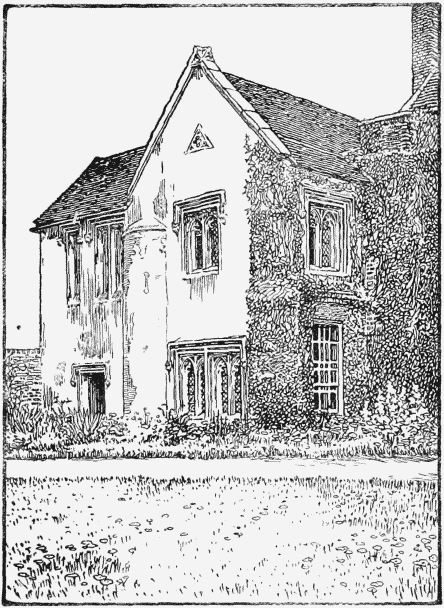
Therfield Rectory: 15th-century East Wing from the North-West
In the village itself are one or two 17th-century houses, notably The Limes, the residence of Mrs. Hale, widow of the late rector, a house now used as the village reading-room, and, to the east of the church, a timber and plaster house with thatched roof divided into two cottages. The Elms, further north, is a twostoried house, partly of brick plastered and partly of timber and plaster. It dates from the early part of the 16th century, and has additions probably made at the beginning of the 18th century. It contains some original fireplaces and other fittings.
To the north-west of the village is Tuthill Farm, composed of several cottages, which at one time apparently formed a single 17th-century house. Barley Barn at Tuthill Farm was licensed as a place of worship for Protestant Dissenters in 1779. (fn. 5) Dissenters had a certified place of worship in the village from 1691 onwards, and generally met in buildings belonging to the family of Fordham, (fn. 6) who occupied the demesne lands of Therfield Manor. (fn. 7) The present Congregational Chapel, a little southeast of The Elms, dates from 1836, and a manse was established in 1854. (fn. 8) Schools were endowed about the year 1854. (fn. 9)
The parish is thinly populated, but there are a few outlying farms and cottages, and in the extreme south-east the village of Buckland has extended across the Ermine Street into Therfield. There are several homestead moats in outlying parts of the parish. These are at the manor-house of Mardley Bury near Reed End, and at the manor-farm called Hoddenhoo in the extreme south of the parish. (fn. 10) Bull Moat, in the south-east, is in Buckland village. Another moat lies opposite to Five Houses Farm, in the west. The name 'Fivehowses' occurs on the 17th-century Court Rolls. (fn. 11)
A notable feature of the parish is the large open common covered with short turf which extends along the whole of the northern border, and has an average breadth of half a mile. The surface of this common is undulating and forms a series of low hills. Five tumuli lie together in a single group, to the south of which is the only long barrow remaining in Hertfordshire. There are other round tumuli in the same neighbourhood. One barrow at Money Hill, now demolished, probably dated from the Bronze Period. (fn. 12) From the higher grounds there are extensive views of the Cambridgeshire plain, and on a favourable day the towers of Ely Cathedral and King's College Chapel, Cambridge, may be seen clearly. This common is generally known as Royston Heath, taking its name from the market town of Royston, part of which was formerly in Therfield parish. (fn. 13) The heath was a favourite hunting ground of James I while residing at Royston (q.v.), and is now a public recreation ground with golf links and rifle range, under the care of a body of conservators. There is a right of sheep feeding, but no other animals may be grazed. A portion of the heath is let for training racehorses. The southern edge is fringed with belts of wood, chiefly beech and larch. Similar woods occur in other parts of the parish, within which there are 113 acres of woodland.
There are several small greens. Hay Green and Washing Ditch Green to the south-east of the village and Collins Green in the west of the parish are mentioned in 16th-century Court Rolls. (fn. 14) The pound is situated at Hay Green near Haywood Lane. Chapel Green lies a mile to the south of the village. The open arable fields were inclosed in 1849, (fn. 15) the heath and greens in 1893. (fn. 16)
The soil is chalk, and the land is for the most part arable, but grass covers over 600 acres. The people are entirely agricultural, and turkey breeding is a source of considerable profit. There is a disused chalk-pit immediately to the north of the village.
Among estates released to the abbey of Ramsey in the 13th century were lands in 'Wellemadestot' and on 'le Watelrydie.' (fn. 17) The field called 'Eyhtacres' abutted on 'Sepwykestrate' (fn. 18); and certain common pasture lay 'beyond Theuestrat' partly at 'Pynttesheggis,' partly on 'Astoneshel' and partly on 'Ordmarashel,' (fn. 19) which last abutted on the road to Buntingford (i.e. Ermine Street). (fn. 20) Other placenames which occur on the 16th-century Court Rolls are Rowkes nest (cf. the modern Rooksnest Farm), Moneycrofte, (fn. 21) Myldaynefeld, Gillarkes, and Snaylhorne peece. (fn. 22)
Among the outlying farms are Wing Hall, overlooking the heath, and Slate Hall in the occupation of Mr. Albert Drage.
A fair formerly held on the third Monday and Tuesday in July was abolished in 1873. (fn. 23)
MANORS
Therfield
Certain land, afterwards part of the manor of THERFIELD, was bought by Ethelric Bishop of Dorchester early in the 11th century (1016–34.), and presented by him to the abbey of Ramsey. (fn. 24) It was said that the bishop purchased it from an unpopular Dane who feared that the villagers would murder him. (fn. 25) Thomas of Therfield evidently confirmed this land to the abbey in the time of Abbot Robert. (fn. 26) They were confirmed in their possession of this land by Edward the Confessor, (fn. 27) William I (fn. 28) and 'other kings,' (fn. 29) and by Edward III. (fn. 30)
In 1086 the abbot's holding at Therfield was assessed at 10 hides 1 virgate, and the manor was said to be and to have been (i.e. before the Conquest) the demesne of Ramsey Abbey. (fn. 31) Nevertheless the men of the Hundred Court declared in 1274–5 that this manor was ancient demesne of the Crown, but that they knew nothing of its alienation. (fn. 32) Apparently there was no foundation for their statement. (fn. 33) The manor was kept in hand by the abbot and convent (fn. 34) until the dissolution of the monastery in 1539. (fn. 35) The service due to the Crown was that of four knights' fees. (fn. 36)
The 'farm' due from the manor of Therfield to the abbey was sufficient to sustain the monks for a whole fortnight. (fn. 37) It was rendered in October, February, April, and August. (fn. 38) It included flour, meal, malt, peas, cheese, bacon, honey, butter, herrings, eggs, hens and geese, sheep and lambs, and beef, in addition to a money payment. (fn. 39)
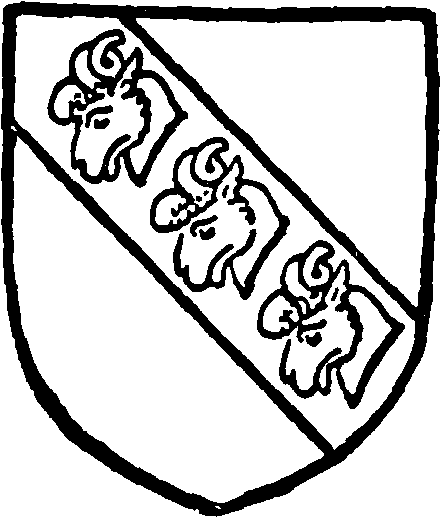
Ramsey Abbey. Or a bend azure with three rams' heads argent thereon having horns or.
It is recorded that Abbot Walter (1133–60) alienated portions of the demesne lands to his sister's son Ralph of Therfield, kt. (fn. 40) In 1386 the abbot added to the manor lands to the value of £20 in part satisfaction of a licence to acquire property to the value of £60 (fn. 41) which had been granted to the abbey by Edward II at the instance of his wife Isabel.
Among the records of this manor is a late 13th-century custumal. (fn. 42) The villein tenants were tallaged by the monks of Ramsey at £4, which was rated according to the property of each tenant, and was assigned to the cellarer by Abbot Hugh Folliot (1216–31). (fn. 43) They had numerous carrying services to Ramsey, Cambridge, Ware and London, and it is interesting to notice that the tenants were already beginning to compound for these and other services.
After the dissolution of Ramsey Abbey, Therfield Manor was seized by Henry VIII, and remained in his hands until 14 January 1540–1, when he gave it to his queen, Katherine Howard, as part of her jointure. (fn. 44) After her execution in February 1542 the manor reverted to the king, (fn. 45) and in June 1544 he granted it in frankalmoign to the Dean and Chapter of St. Paul's in exchange for certain manors in Essex and Middlesex. (fn. 46)
The first court of the dean and chapter was held in July 1544. (fn. 47) In 1642 the cathedral was closed and the Mayor and Aldermen of London were appointed sequestrators of the property of the dean and chapter. (fn. 48) Therfield Manor was purchased from the trustees for the sale of the lands of deans and chapters in March 1649–50 by Samuel Pennoyer of London. (fn. 49) After the death of Pennoyer his widow Rose succeeded to the property and held courts in April 1655. (fn. 50) In the same year she evidently married Samuel Disbrowe, who was still holding in her right in 1657. (fn. 51) The manor was recovered by the Dean and Chapter of St. Paul's at the Restoration with their other confiscated estates. (fn. 52) They remained lords of the manor until 1872, when all their estates, including Therfield, were vested in the Ecclesiastical Commissioners. (fn. 53)
In 1542 Thomas Benett was tenant of the manorhouse, styled the 'manor or Bery Stede.' (fn. 54) It was afterwards held at will by John Wenham the elder, who surrendered it to the use of his brother John Wenham the younger in 1552. (fn. 55) The dean and chapter reserved right of accommodation for their receiver, steward and bailiff, when they should hold courts, and also a room for the use of the bailiff at the time of his rent-collecting. (fn. 56) In 1578 John Wenham conveyed his rights in the 'Bury Stede' to John Wood, who held it at his death in 1587. He left as heir his son John, aged three years. (fn. 57)
In the 17th century the site of the manor was let to members of the family of Fordham, (fn. 58) who have resided in the parish ever since. (fn. 59) Mr. F. J. Fordham of Royston is the present owner of Park Farm, which is in the occupation of his son, Mr. H. J. Fordham.
The Abbots of Ramsey had extensive liberties within their manors including Therfield. Under a confirmatory charter of Edward the Confessor they claimed soc and sac, toll, 'mundbryche, feardwite, fihtwite, blodwite, mischenninge, fritsocne, hamsocne, forstalle, forhpheang, withpheang, heangwite, gridbriche, uthleap, infangentheof, scipbriche, tol and team.' (fn. 60) William I added the right of gallows, and it is said of infangtheof. (fn. 61) King John granted view of frankpledge, amendment of the assize of bread and ale, tumbril and free warren. (fn. 62) To these privileges Henry III added freedom from scot or geld and exemption from the shire and hundred courts, (fn. 63) which the abbot's tenants at Therfield were wont to attend until about 1267. (fn. 64) The abbot proved his claim to all the above liberties within the manor of Therfield in 1287. (fn. 65)
Hay
The manor of HAY (la Haye, xiv cent.; Heye or Haye, xvi cent.) was held of the main manor of Therfield. (fn. 66) Its early history is obscure; it may be identical with the place called 'Haia' associated with 'Bradenach,' co. Huntingdon, and mentioned in a 12th-century account of the increase in the lands of Ramsey Abbey. (fn. 67)
In the 14th century it was in the possession of the family of Scrope of Masham. Sir Geoffrey Scrope, kt., founder of that family and justice of the Common Pleas, was associated with Hertfordshire through his marriage with Laura daughter of Sir Gerard Furnival of Munden Furnival (fn. 68) (q.v.). In 1338 Thomas of Brancaster granted the manor of Hay to Sir Geoffrey Scope in return for 100 marks silver, and shortly afterwards Sir Geoffrey granted a life-interest to Thomas. (fn. 69) The latter is included among the tenants of Ramsey Abbey in Therfield who owed suit at Broughton. (fn. 70) The manor apparently reverted to Sir Geoffrey Scrope within a few years, for he held at his death before 1341 a tenement in Therfield with pleas of court and a capital messuage. (fn. 71) In or before the time of his son and heir Sir Henry Scrope, kt., of Masham, a sub-enfeoffment was possibly made to the family of Sir John Scrope, (fn. 72) a younger son of Sir Richard Scrope of Bolton, and great-nephew of Sir Geoffrey. (fn. 73) The rights of the Scropes of Masham as mesne lords had evidently lapsed by 1561. (fn. 74)
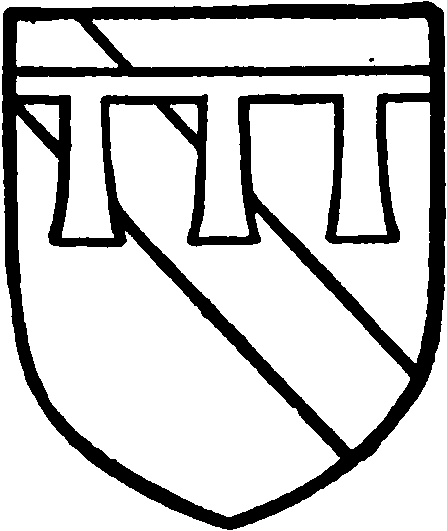
Scrope of Masham. Azure a bend or and a label argent.
The tenant, Sir John Scrope, was succeeded by two daughters Joan and Elizabeth, (fn. 75) who married respectively Sir Richard Hastings, kt., and Thomas Clarell of Aldwark, co. Yorks. (fn. 76) Apparently Elizabeth Clarell succeeded in time to the whole of Hay, (fn. 77) for in 1474 it was evidently inherited in entirety by her daughter Elizabeth wife of Sir Richard Fitz William, kt. In that year a settlement was made on Sir Richard and Elizabeth for their lives with remainder to Sir Richard's third son Edward. (fn. 78) Probably a further settlement was made later, for the manor descended to Thomas Fitz William, (fn. 79) Sir Richard's eldest son, who was slain at Flodden Field in 1513. (fn. 80) His young son and heir William Fitz William died under age 26 August 1515, and was succeeded by his two sisters, Alice wife of James Foljambe and Margaret wife of Godfrey Foljambe. (fn. 81) Godfrey and Margaret Foljambe sold one moiety of the manor to Robert Pakenham of Streatham, (fn. 82) from whom it was purchased in February 1549–50 by the tenant, John Berners of Therfield. (fn. 83) Thomas Berners apparently united the two moieties by purchasing the second from George Gill in 1562. (fn. 84) Gill had acquired this moiety from Sir Godfrey Foljambe, kt., (fn. 85) probably the eldest son of James and Alice Foljambe. (fn. 86)
John Berners, gent., resided in Therfield about 1641, (fn. 87) and probably retained this manor, but the subsequent history of the estate is unknown.
Hay Farm lies on the high ground to the east of the village, presumably on the site of the capital messuage held by Sir Geoffrey Scrope. (fn. 88) A windmill belonged to the manor in the 14th century. (fn. 89)
Gledseys or Butlers
GLEDSEYS, known also as BUTLERS, (fn. 90) was held of the main manor of Therfield (fn. 91) apparently by service of one-fourth of a knight's fee. (fn. 92) Abbot William of Ramsey (1267–85) assigned to the almoner of the abbey a tenement lately acquired from John of Gledsey. (fn. 93) About 1278 Joan wife of John of Gledsey demanded of Robert of Gledsey the custody of one quarter of a knight's fee in Therfield, the heir to which was still a minor. (fn. 94) Elias of Gledsey owed suit to the Abbot of Ramsey at Broughton early in the 14th century. (fn. 95) This Elias was witness to a lease of land in Therfield in 1333. (fn. 96) The tenement called Gledseys was occupied by John Butler in 1444. (fn. 97)
In the time of Henry VIII the Hyde family were in possession of this manor. (fn. 98) In 1544 John Hyde and Margaret his wife and Thomas their son conveyed it to John Gill and Margaret his wife. (fn. 99) John Gill was succeeded in 1546 by his son George. (fn. 100) The latter assigned this manor to his wife Anne as a portion of her jointure, (fn. 101) and died in 1568, leaving a son John as heir. (fn. 102) John Gill died in 1600 and the manor passed to his son George, (fn. 103) who sold it in 1607 to William Clerke. (fn. 104) In 1638 William Clerke, gent., was ordered in the court of the main manor to keep his flocks for Gledseys and Five Houses within the ancient bounds. (fn. 105) He was apparently succeeded by his son Thomas Clerke, (fn. 106) whose property was divided among his four daughters, Hester wife of Henry Meade, Elizabeth wife of Thomas (fn. 107) Sanford, Susan Clerke and Sarah wife of John Higham. (fn. 108) The Highams were dealing with their fourth of 'Butler's' manor in 1666. (fn. 109) By 1676 a part of the estate of Thomas Clerke in Therfield had been acquired from the four co-heirs by John Green of Thorpe. (fn. 110) After the death of Susan Clerke her sisters divided her portion of Gledseys Manor between them. Sanford held one-third in right of his wife and purchased another third. He was succeeded by his son John Sanford, who was in possession of two-thirds of the manor about 1700. (fn. 111) The remaining third was purchased by Ralph Baldwin, gent., whose son Ralph Baldwin inherited it in 1694. (fn. 112) The 'manor' of Gledseys was subsequently sold by Mr. B. Wortham to the late Mr. Phillips, who bequeathed it to the father of the present owner, Captain J. H. J. Phillips. (fn. 113)
The lands of Gledsey Manor extend into Buckland parish. (fn. 114)
Hoddenhoo or Hoddenhoo Newhall
The manor of HODDENHOO or HODDENHOO NEWHALL was among the possessions of Royston Priory at its dissolution. (fn. 115) In 1086 Hoddenhoo was within the hundred of Edwinstree, (fn. 116) and the greater part of the manorial lands lie in Buckland parish, (fn. 117) but the manor-house of Hoddenhoo is within the boundaries of Therfield parish.
In the Domesday Survey Hoddenhoo is returned in two portions. The one consisting of 1 hide and half a virgate had been held before the Conquest by a sokeman of Earl Algar and three sokemen of Archbishop Stigand. In 1086 it was held of Odo Bishop of Bayeux by Osbern, tenant also of Buckland and of land in Throcking. (fn. 118) Possibly, therefore, this was the land in Hoddenhoo given with land in Throcking to the priory of Holy Trinity, Aldgate, by Roger son of Brian and his wife Maud and confirmed to the priory by Henry III in February 1226–7. (fn. 119)
The second portion consisted of a hide and a virgate held before the Conquest by two sokemen of Earl Algar. Tetbald held it of Hardwin Scales (de Scalers) in 1086. (fn. 120)
It is uncertain how Royston Priory acquired the 'manor of Newhall and Hoddenhoo in Buckland,' (fn. 121) which by process of exhaustion appears to be identical with Tetbald's holding. Probably it was given to the priory between 1189 and 1291, for it is not named in the confirmatory charter of Richard I of the former date, (fn. 122) and the priory had lands in Buckland worth £3 8s. at the latter date. (fn. 123)
In January 1512–13 the site of the manor was let on a sixty years' lease, and Laurence Pleydon was lessee in 1536, when the property of the priory had been surrendered to the Crown. (fn. 124) The courts were apparently held at Buckland. (fn. 125) In December 1540 Robert Chester, gentleman usher of the Chamber, received a grant of all the possessions late of Royston Priory including the manor of Newhall and Hoddenhoo. (fn. 126) He sold this manor to John Gill and his wife Margaret about the following Easter. (fn. 127) It remained with his direct descendants (fn. 128) at least until the death of Sir George Gill, kt., in 1619. (fn. 129)
Early in the year 1662 the lord was Ralph Freeman (fn. 130) (lord also of the manor of Aspenden). He had been preceded by John Putnam, (fn. 131) and the manor descended to his son Ralph Freeman. (fn. 132) Apparently a settlement was made on his son Ralph about 1700. (fn. 133) The latter's son William Freeman was dealing with the manor in 1730. (fn. 134) Dr. Ralph Freeman, his brother, succeeded in 1749. (fn. 135) It descended with his manor of Hamels in Standon to Philip third Earl of Hardwicke, and is now the property of the Hon. John Henry Savile, grandson of Lady Anne Yorke, eldest daughter of the Earl of Hardwicke mentioned above.
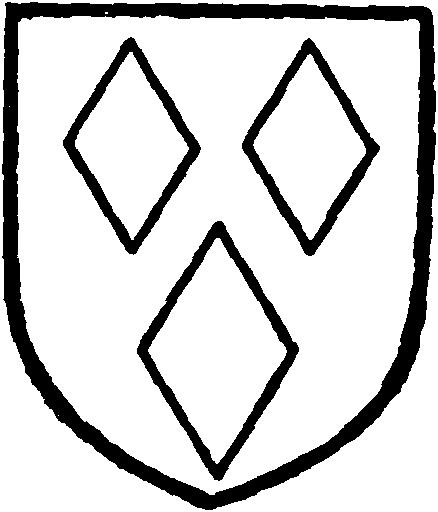
Freeman of Aspenden. Azure three lozenges argent.
West Reed or Alan De Rede
The manor of WEST REED or ALAN DE REDE, sometimes called MARDLET BURY, was held by the Priors of Royston. (fn. 136) The house at Mardley Bury with a carucate of arable land and certain meadow, pasture and rent was acquired by the priory in 1302 from Adam de Twynham. (fn. 137) The 'manor' of West Reed, 'formerly called Alan de Rede,' (fn. 138) held by the priory at the Dissolution, is in all probability identical with the tenement in the 'vill' of West Reed which a certain Alan de Rede held of the Earl of Gloucester rendering suit at the earl's court of Popeshall (fn. 139) (in the neighbouring parish of Buckland). Alan de Rede died about 1314 and left a son and heir Henry. (fn. 140) The priory of Royston had already in 1251 acquired from Elias son of Richard of West Reed a messuage and 51½ acres of land in West Reed. (fn. 141) How the priory obtained the manor of Alan de Rede is unknown. In 1358 Thomas Palfreyman of Royston, chaplain, alienated 80 acres of land in West Reed and Royston to the priory. (fn. 142) The estates seized by the Crown upon the surrender of the priory included the manor of West Reed with rents in Therfield and West Reed including the rent of Mardley Bury Close. (fn. 143)
In 1540 Henry VIII granted 'the manor of West Reed called Alan de Rede' with all the property of the late priory to Robert Chester. (fn. 144) Shortly afterwards this manor was purchased from Chester by John Bowles of Wallington and his son and heirapparent Thomas. (fn. 145) John Bowles died seised of it in 1543, but his son Thomas was evidently already dead, for John's heir was his grandson Thomas son of Richard Bowles. (fn. 146) Thomas Bowles 'the younger' of Standon sold the manor of West Reed alias 'Alan de Rede' with its appurtenances in West and East Reed and Therfield (evidently including Mardley Bury) to William Hyde of Sandon about 1556. (fn. 147) In 1563 William Hyde conveyed the manor to Thomas Turner of West Reed in Therfield, yeoman, and John his son. (fn. 148) This Thomas Turner had learned to sing at Royston Priory and lived more than ninety-five years. (fn. 149) In March 1606–7 he was styled 'of Reed End in Therfield.' (fn. 150) William Turner is said to have sold the manor in 1630 to John Willymot. (fn. 151) His son John bequeathed it to his wife Anne, daughter of James Willymot of Kelshall, and she was holding it in 1700. (fn. 152) In 1714 it was acquired by John Fisher, and in 1721 it was the property of the Hon. Peregrine Bertie the younger and his wife Elizabeth. (fn. 153) In 1753 it was in the possession of Peregrine Bertie, (fn. 154) and Catherine Dorothy Bertie, Elizabeth Bertie and Mary wife of Samuel Lichigaray joined in a conveyance of it in 1783. (fn. 155) George Sutton was dealing with the manor in 1788. (fn. 156) It was bought in 1790 by James Free, (fn. 157) and from his grandson Clerke Free it was purchased by the Rev. Charles Moss, rector of Therfield and afterwards Bishop of Oxford. In 1839 his executors sold to the Hon. William Herbert, from whom the manor was purchased in 1853 by Thomas Henry Usborne of Staplehurst, co. Kent. (fn. 158) He was succeeded by his son Captain Thomas Starling Usborne, who bequeathed it to his three daughters. Two-thirds of the estate together with the manorial rights were purchased from them by the present owner, the Rev. George Archer. (fn. 159)
A farm-house and homestead moat still remain at Mardley Bury. The site of the house of 'Alan de Rede' is more difficult to locate. It certainly lay in West Reed, if it is to be identified with the manorhouse of the priory of Royston at West Reed, and some, at least, of the 'fields' of West Reed were within the parish of Therfield. (fn. 160) They probably extended as far as 'Reed End.'
In 1275 it was returned that the men of West Reed had withdrawn their suit due to the honour of Richmond. (fn. 161) These were possibly the men of that hide in Reed which Alward had held of Count Alan in 1086. (fn. 162) The land had formerly been held by Turbern, one of Eddeva's men. (fn. 163) The fact that castle ward was due to the honour of Richmond from the collector of the rents of the Prior of Royston in West Reed and elsewhere (fn. 164) tends to prove that this hide was among the lands acquired by the priory in West Reed.
Before the time of the Domesday Survey Alric the priest held of the Abbot of Ramsey 3 virgates of land in Therfield. (fn. 165) These had passed by 1086 to Wigar, a tenant under Hardwin Scales. (fn. 166) The overlordship thus diverted from the abbey was still in the possession of the Scales family in 1303, (fn. 167) and was possibly attached to their neighbouring manor of Reed (q.v.). The tenant in 1303 was a certain John of Oclee. (fn. 168)
Rectory
Manorial rights belong to the RECTORY. It was said in 1547 that courts leet and view of frankpledge were usually held at the rectory. (fn. 169) The rectory manor was let on lease with the parsonage in 1553. (fn. 170) The late incumbent, the Rev. J. G. Hale, was accustomed to hold courts yearly in the 'Court Room' of the rectory. (fn. 171) In 1336 Wymar de Corton conveyed a toft in Therfield to the parson for the enlargement of the rectory. (fn. 172)
CHURCH
The church of ST. MARY THE VIRGIN, which consists of chancel, nave with north and south aisles, and west tower, was rebuilt in 1878, some of the old material being re-used. The windows in the chancel, all but the one in the east wall, are from the old church, (fn. 173) and in the modern roof are some carved figures of angels and bosses of the 15th century. The porch was added in 1906, and the tower, of which only the first story was built, was completed by the rector, the Rev. F. R. Blatch, in 1911.
In the south wall of the chancel the early 14thcentury double piscina has been reset; it has moulded arches on shafted jambs with moulded capitals and bases. The sedilia adjoining, though chiefly of modern work, have some old stone in them. In the north chancel wall is an arched recess containing an ancient stone coffin.
In the vestry are many fragments of stone carving dating from the 13th to the 16th century, corbels, parts of tombs, including a curious effigy of a man lying with his head at right angles to his body and his legs crossed; in his right hand is a drawn sword; at the end of the stone are two small female figures, standing; on the end of the stone is a shield charged with a cross.
On the window sills in the chancel are some fragments of carvings, and underneath the tower are some carved oak figures of angels from the old roof.
There are some fragments of 15th-century heraldic glass in the church, until lately in the old rectory.
The octagonal font belongs to the late 14th century; the basin is plain, with mouldings underneath, and mouldings to the base.
Underneath the tower is a large mural monument of cedar wood, flanked by carved figures, to Ann wife of Francis Turner, a former rector; she died 1677. The carved figure of Time is intact, but the skeleton, Death, is broken.
There are six bells: the treble by W. & P. Whitman, 1689 (recast in 1911); second and third (recast in 1911) by Miles Graye, 1626 and 1656 respectively; fourth by John Dier, 1597; fifth inscribed 'Praies the Lord,' 1608; and tenor by John Waylett, 1707.
The communion plate consists of cup and two patens without hall mark, a small cup with handle, the hall mark erased, and a large silver-gilt flagon, 1667, the gift of Dr. Barwick, Dean of St. Paul's and rector of Therfield.
The registers are in six books: (i) baptisms from 1538 to 1662, burials 1539 to 1662, marriages 1538 to 1661; (ii) baptisms from 1662 to 1750, burials 1662 to 1681, marriages 1662 to 1749; (iii) burials from 1678 to 1750; (iv) baptisms and burials from 1750 to 1812, marriages 1750 to 1753; (v) and (vi) marriages from 1754 to 1796 and 1796 to 1812 respectively. There are some considerable gaps in book i.
ADVOWSON
The earliest definite record of the church is a papal bull of 1178 confirming the abbey of Ramsey in possession of it. (fn. 174) The successive abbots retained the right of patronage until the Dissolution, (fn. 175) after which the advowson was granted with the manor to the Dean and Chapter of St. Paul's. (fn. 176) They have retained the advowson to the present day. (fn. 177)
In 1392 the Abbot of Ramsey had licence to unite the church of Therfield with Shillington Church, co. Beds., notwithstanding that the advowsons of these churches were parcel of the respective manors of Shillington and Therfield. (fn. 178) The arrangement, if ever it was carried into effect, does not appear to have been permanent. A licence to appropriate Therfield Church was obtained by the Dean and Chapter of St. Paul's in 1547 upon condition that a perpetual vicar should be appointed to fulfil in all respects the office of rector, and that he should pay to the Bishop of Lincoln and Archdeacon of Huntingdon for procurations and synodals of the church of Therfield 11s. 6d., and should support all other burdens of the church excepting only the repairs of the chancel, for which the dean and chapter were to be responsible. (fn. 179) It was also stipulated that a suitable residence and an income of £20 should be provided for the vicar. It appears that the proposed ordination of a vicarage was never carried into effect. (fn. 180) The living is now a rectory in the gift of the Dean and Chapter of St. Paul's.
A pension of 4 marks was paid by this church to the monastery of Ramsey (fn. 181) and devoted to the office of sacrist. (fn. 182) Confirmations of this pension were made by Pope Honorius III in 1225 (fn. 183) and by Pope Gregory IX in 1233, (fn. 184) by Richard Bishop of Lincoln in 1262, (fn. 185) by St. Hugh Bishop of Lincoln (1189–95), (fn. 186) and it was included in a general confirmation by Walter Archbishop of Canterbury of gifts to Ramsey Abbey in 1319. (fn. 187) William Burham, rector of Therfield, who was deprived for marriage about 1554, (fn. 188) refused to pay this pension. (fn. 189) Thomas Hewlet and another incumbent in the 16th century declared that the living was free of any such charge. (fn. 190)
Several men of note have been rectors of Therfield. Among these was John Yonge, Master of the Rolls and diplomatist, whose well-known monument stood in the Rolls Chapel, now the Record Office Museum. He was made Prebendary of Holborn in St. Paul's Cathedral in 1511, and three years later was presented to the rectory here. In the 16th and 17th centuries William Alabaster, a Prebendary of St. Paul's, Francis Turner, Bishop of Norwich, William Holder, a noted divine, and William Sherlock, Dean of St. Paul's, were successively appointed to this living. In 1604 John Overall, Bishop of Norwich, was rector, but the church was served by a curate. (fn. 191)
William Burham, the rector, deprived about 1554, had 'let to farm all the Rectory premises except one chamber in the west end of the parsonage house' to Andrew Meverell for six years. In August of the next year John Sapcote, a lessee of Burham's successor, John Whiting, clerk, entered upon the parsonagehouse. It appears that Sapcote was occupying the rectory in 1561, (fn. 192) but Burham let to another lessee, Robert Newport. (fn. 193) The end of this dispute is unknown.
Elyn Colle, by will dated 1494, left £3 6s. 8d. for a new rood loft in the church within two years of her decease, (fn. 194) and in 1511 a bequest was made by William Chapman for the painting of this rood loft. (fn. 195) In 1503 Edward Shouldam, clerk, made provision for a priest to say mass in the church of Therfield. (fn. 196) In 1506 Richard Bentley left an offering to the altar of the chapel of SS. John and James, where he desired to be buried. (fn. 197) There were also altars of St. John the Baptist and St. Katherine, (fn. 198) and lights of our Lady of Pity, (fn. 199) St. Nicholas and St. Katherine. (fn. 200)
A devotional gild which paid 12d. yearly to Ramsey Abbey at the feast of St. Benedict was in existence not later than 1130. (fn. 201) Two obits in Therfield Church were suppressed by Edward VI. One was given by John Bateman, and was of the value of 5s. yearly. This was to be paid out of the rent of some 29 acres of land which he gave to the use of the poor. (fn. 202) The other was worth 8s. yearly, and arose from 8 acres of land given by John Chapman for that purpose. (fn. 203)
CHARITIES
The School House charity, comprised in an indenture of 12 December 1670, in which it is recited that the house had from time out of mind belonged to the inhabitants and had been used as a dwelling-house for a schoolmaster, is regulated by a scheme of the Charity Commission dated 18 August 1905. The property consists of a cottage and 10 poles of land let for £5 yearly, and the scheme directs that the income shall be applied for the benefit of the poor. The income is distributed in sums of about 2s. 6d. each.
The Bateman charity, the date of the foundation of which is unknown, but comprised in a deed of 8 April 1644, is regulated by a scheme of the Charity Commission 3 January 1899. The endowment consists of 37 a. 2 r. 16 p. of land in Therfield and 2 roods in Kelshall producing £34 12s. yearly. The net income is applied in the purchase and distribution of coal to the poor.
In 1772 John Clerke by his will gave £2 yearly issuing out of a field called Moneycroft to be distributed in bread to the poor every three years. The last distribution was made in 1909.