A History of the County of Hertford: Volume 3. Originally published by Victoria County History, London, 1912.
This free content was digitised by double rekeying. All rights reserved.
'Parishes: Hunsdon', in A History of the County of Hertford: Volume 3, ed. William Page (London, 1912), British History Online https://www.british-history.ac.uk/vch/herts/vol3/pp323-332 [accessed 9 May 2025].
'Parishes: Hunsdon', in A History of the County of Hertford: Volume 3. Edited by William Page (London, 1912), British History Online, accessed May 9, 2025, https://www.british-history.ac.uk/vch/herts/vol3/pp323-332.
"Parishes: Hunsdon". A History of the County of Hertford: Volume 3. Ed. William Page (London, 1912), British History Online. Web. 9 May 2025. https://www.british-history.ac.uk/vch/herts/vol3/pp323-332.
In this section
HUNSDON
Hunesdone (xi cent.); Honesdon, Hamesdun, Hunnesdon (xiii cent.); Hunsdon (xiv cent.).
Hunsdon parish lies on the high ground which divides the valleys of the Rivers Ash and Stort, having a southward slope from a height of about 266 ft. in the extreme north of the parish down to the latter valley, where the land is little more than 100 ft. above sea level. The area of the parish is 1,971 acres, nearly half of which is arable, about a third pasture and only a small portion woodland. (fn. 1) The soil is very varied, the subsoil chalk or gravelly loam. There is no line of railway in the parish, the nearest station being Roydon in Essex, on the Great Eastern railway, rather less than a quarter of a mile from the south-western boundary of Hunsdon parish.
The church lies close to Hunsdon House and the village is about a mile to the north on the road to Widford. There are a few houses along the road between the church and the village called Acorn Street, one of which is Nine Ashes, the property and residence of Mr. Samuel Shott Death. In the village are several 17th-century cottages of timber and plaster with tiled roofs. The Wheatsheaf Inn, now converted into two cottages, is an interesting timber and plaster gabled building with a tiled roof. Within there is a large fireplace bearing the date 1681 or 1687. The pound is at the cross roads near to Hunsdon Mill, which is on the River Stort in the south of the parish.

Plan of Hunsdon House
Hunsdon House, which is possibly on the site of the earlier manor-house, is said to have been built by Sir William Oldhall in 1447. In 1447, however, the Duke of York seems to have been holding the manor, and in May of that year received licence 'to build within his manor of Hunsdon a tower of stones, with lime and sand, and to embattle the same.' (fn. 2) Oldhall is not known to have been in possession until February 1448. He may have begun building directly after that date, but the house was apparently unfinished in 1453, for Oldhall having forfeited, a certain Walter Burgh, a servant of the king, then received a grant of 'stones called brick in Hunsdon and Eastwick late pertaining to William Oldhall,' (fn. 3) which looks as if the latter had been in the midst of building. The house seems to have come into the possession of Henry VIII with the manor before 1527, when he granted the custody of it to Henry Norris, squire of the body. (fn. 4) The place was a favourite one with Henry VIII, who carried on extensive buildings here. In February 1534 the 'master surveyor of the King's works at Hunsdon' reported on the expenditure of £2,900 applied to this purpose: 'for "parelles" of freestone for the chimneys in the King's watching chamber, palett chamber, privy chamber, and in the other chamber beneath the same; for lime, plaster, "rigge tyles," corner tiles, paving tiles and plain tiles; for timber, and for wood bought by the acre; for wainscoats, laths, pails, tile pins, hooks, hinges, locks, clasps, keys ... new glass bought of Galyon Hone and "sett with symond," etc.' (fn. 5) In June 1528 the king appears to have fled here from the sweating sickness. Thomas Hennege writes from Hunsdon to Wolsey: 'Laud be Jesu, the King's grace is very merry since he came to this house, for there was none fell sick of the sweat since he came hither, and ever after dinner he shooteth to supper time'; but the postscript adds: 'This night as the King went to bed, word came of the death of William Carey.' (fn. 6) After the divorce of Katherine of Aragon, the Princess Mary was sent to Hunsdon (February 1536), and there are a number of letters of hers extant written from Hunsdon, both to her father and to Cromwell, on the subject of her reconciliation with the king. (fn. 7) Writing to Charles V on the subject of the princess's escape, Chapuys says of Hunsdon: 'The house where she is at present is much more inconvenient for the enterprise . . . there are a great many houses and people in the village where she now is.' (fn. 8) It was while in the service of the princess at Hunsdon (1538–40) that Lady Elizabeth Fitzgerald—'the fair Geraldine'—first met her admirer Henry Howard Earl of Surrey. (fn. 9) Prince Edward also spent much of his infancy and youth at Hunsdon, whence it was written of him on one occasion: 'My lord Prince is in good health and merry. Would to God the king ... had seen him last night. The minstrels played, and his Grace danced and played so wantonly that he could not stand still.' (fn. 10) After the accession of the prince to the throne as Edward VI the Princess Mary spent much of her time here. In 1559, however, Hunsdon House ceased to be a royal residence, for Queen Elizabeth granted it with the manor (q.v.) to Sir Henry Carey. In 1576 Queen Elizabeth and the Countess of Warwick stood godmothers to Elizabeth daughter of Sir George Carey, who was baptized at Hunsdon on 7 June. When Emmanuel son of Thomas Scrope (afterwards Lord Scrope) was baptized there on 26 August 1584 the queen again stood godmother. Henceforward manor and house followed the same descent, both being purchased by James S. Walker of Hunsdonbury in 1858. Mr. Walker then sold the manor to Mr. Charles Phelips, but the house (in 1861) to Mr. James Wyllie, in whose family it remained until 1882, when it was purchased by Mr. Spencer Charrington. It is now the property of the latter's son, Mr. Edmund Knowles Charrington, and is the residence of his sister Mrs. Montgomerie.
The house consists of a large rectangular block with a low modern wing at the west end containing the domestic offices. The house is built of brick with embattled parapet and a flat roof. Judging from the dimensions given by William of Worcester, (fn. 11) the original building must have been a very extensive structure; none of these dimensions, however, agree with the present house. After the manor came to the Crown (see below) Henry VIII made considerable additions (fn. 12); about 1743 the wings are said to have been pulled down, (fn. 13) and in 1805 Mr. Nicolson Calvert pulled a great part of the old house down and reconstructed most of what remained. (fn. 14) Mrs. Calvert writes 16 April 1806 (fn. 15) : 'I hear there is hardly a bit of old Hunsdon House left standing . . . it will be nearly a new house.'
The oldest parts of the existing house are the cellars under the east end; they probably date from the 16th century. The largest cellar, which measures 48 ft. 6 in. by 18 ft. 6 in., runs transversely across the building, and appears to have formed a wing of a former house, as it projects northwards 8 ft. beyond the original north wall, which still remains visible in the basement, the present north wall standing about 9 ft. outside it; the lower part of a small hexagonal turret or closet still remains at the angle of the old walls. The cellar itself has a barrel vault of brick; the walls and vault are constructed of thin bricks. The turret, which has no trace of a stair, is entered by a low doorway with a four-centred arch. The adjoining cellars on the west are of the same date; one has a doorway with a fourcentred arch, and in the original north wall is a window, now blocked. All the cellarage at the west end has been rebuilt with modern bricks. Mrs. Calvert writes 6 August 1805 (fn. 16) : 'We have completed cellars and we think of adding to and repairing the old building'; this, she writes later, was eventually done.

Hunsdon House From The South-East
The interior of the ground and upper stories is entirely a reconstruction of 1805, the only evidence of an earlier date being a 17th-century carved oak mantelpiece in the entrance hall; a stone fireplace with a four-centred arch and three blank shields under a carved wood mantel are probably all of 1805. The external walls are built chiefly of old thin bricks, but a large part appears to have been rebuilt and an embattled front added to the attic story in 1805; all the windows are modern. At each of the four angles of the house is a large diagonal buttress with keel-shaped face, carried up above the parapet and finished with a slated pinnacle; the upper parts are modern, but the buttresses are built of thin bricks; some of them have probably been rebuilt. The whole of the external brickwork has been covered with a thick coat of red colour-wash and 'tuck-pointed.' The main entrance is in a projection at the east end; the doorway, which has wide moulded jambs and fourcentred arch, all executed in cement, is probably modern. In the garden wall to the west of the house is an octagonal summer-house, all of modern brickwork. West of the house are modern stables and a large brick gateway with embattled parapet, which forms the entrance to the courtyard of the house; the gateway is modern, but some old bricks have been re-used in the upper part. A wooden lintel, now built in over the gateway between the garden and the stable yard, is inscribed 'H. H. 1593.' A moat which formerly surrounded the old house has been filled up.
In 1728 Salmon wrote that 'Robert Chester hath within a few years built a seat in this parish, and inclosed it with a park. (fn. 17) This was Briggens Park, situated in the south-western corner of the parish, on the banks of the River Stort, which Robert Chester had bought from the Feildes of Stanstead Abbots. (fn. 18) The house built by Chester occupied the site of two older messuages called Over Bredons and Nether Bredons or Great Briggens and Little Briggens. (fn. 19) Robert Chester died in 1732, (fn. 20) having left Briggens Park to his sister Jane Chester provided that she kept up the park, gardens and deer. Jane Chester died in 1736, (fn. 21) and was succeeded by her brother Henry (or by his son Henry), who in 1740 sold the property to Thomas Blackmore of Covent Garden. (fn. 22) He was succeeded in 1763 by his nephew Thomas Blackmore, who left a son Thomas and several daughters, one of whom, Mary, in 1792 married Rev. Charles Phelips, fourth son of Edward Phelips of Montacute. The death of Thomas Blackmore in 1824 resulted in Briggens Park passing into the hands of their son Charles Phelips. The latter died in 1870, when the estate was inherited by his son Charles James Phelips. Charles James Phelips died without issue in 1903, and Briggens Park fell to his nephew Gerald Edward Farquharson Phelips, whose trustees sold it with the manor in 1907 to the Hon. Herbert Cokayne Gibbs, the present owner, who resides there. (fn. 23) The house built by Chester forms the centre of the present house, and some of the 2-in. brick foundations of the older houses have recently been discovered. (fn. 24)

Hunsdon House from the North-east
Hunsdonbury is now the property of Mr. E. Thomas, who bought it from Mr. John Henry Buxton in 1911. The latter purchased it in 1889 from Mr. Salisbury Baxendale. (fn. 25) It originally formed part of the estate of the Calverts, who resided there after 1840, and later passed to Mr. Walker, (fn. 26) who also lived there. (fn. 27) About half a mile south of the church is Brickhouse Farm, a 17th-century house built of 2-in. bricks.
Olives Farm is a moated house on the extreme west of the parish. It is of timber and plaster, with tiled roofs, and dates back to the 17th century, though it has considerable later additions.
Fillett's Farm, situated in the northwest of the parish, was in the 16th century in the possession of Sir Wimund Carew, whose son Thomas Carew sold it in 1551 to William Grave (fn. 28) of Stanstead Abbots. In 1575 Thomas Grave conveyed it to Edward Baesh. (fn. 29) Caddingtons is the name of another old house, which in the 15th century belonged to the Shelley family of Hunsdon. (fn. 30) In 1542 the king made John Carey keeper of the messuage called Caryngtons alias Cadyngtons. (fn. 31)
MANOR
At the time of the Domesday Survey the manor of HUNSDON formed part of the lands of Hugh de Beauchamp, who had succeeded Ralph Taillebois (Tulgebos or Tailgebosch) in estates both in Hertfordshire and Bedfordshire. The manor comprised 4 hides, of which I had been taken by Ralph from the manor of Stanstead Abbots and attached to Hunsdon. (fn. 32) The Beauchamps continued to hold Hunsdon as part of their Bedford barony, Simon de Beauchamp in the 12th century granting certain tithes of this manor to Newnham Priory. (fn. 33) John de Beauchamp, the last feudal baron of Bedford, fell fighting against the king at the battle of Evesham (1265), and Hunsdon went to Maud, one of his sisters and co-heirs, wife of Roger de Mowbray. (fn. 34) Her great-grandson John, third Lord Mowbray, is found as overlord of Hunsdon in 1358, (fn. 35) and the fourth Lord Mowbray is similarly described in 1367. (fn. 36) John, eighth Lord Mowbray, is so found in 1419 under his title of Earl Marshal of England. (fn. 37) Anne, only daughter and heir of the tenth Lord Mowbray, married Richard, younger brother of Edward V. Richard was murdered in the Tower in 1483, his child-wife having died some three years previously, and such rights of overlordship in Hunsdon as survived fell to the Crown.

Beauchamp of Bedford. Quarterly or and gules a bend sable.

Mowbray. Gules a lion argent.
The tenant in demesne at the time of the Domesday Survey was the daughter of Ralph Taillebois, who had succeeded Lewin, a thegn of Earl Harold, at the Conquest. (fn. 38) No under-tenant is known after this date until 1248, in which year Vitalis Engayne died seised of this manor, holding of the Beauchamps. (fn. 39) This Vitalis, son of Richard Engayne, is found earlier in the century holding the manor of Upminster in Essex. (fn. 40) His son and heir Henry (fn. 41) received a grant of free warren in the demesne lands of Hunsdon in 1253, (fn. 42) and died seised of the manor in 1271. (fn. 43) Henry's brother and heir John died similarly seised in 1296. (fn. 44) John Engayne, his son and heir, is found holding Hunsdon in the early years of the 14th century, (fn. 45) and Nicholas his son and successor made a settlement of the manor in 1318. (fn. 46) Nicholas Engayne was succeeded by his son John, a knight, who married Joan the daughter of Robert Peverel and died in 1358. (fn. 47) Thomas, their son and heir, died 'in parts beyond the sea' about 1367, when the Engayne inheritance was divided amongst his three sisters and co-heirs. (fn. 48)

Engayne. Gules a fesse dancetty between six crosslets or.
Hunsdon fell to Joyce the wife of John Goldington, the latter dying some time previous to 1383, (fn. 49) when she was still living. John Goldington, son of Joyce and John, died seised of this manor in 1419, leaving Thomas his son and heir a minor. (fn. 50) Thomas must have died very shortly after, for in 1423 John Hinxworth of Ashwell was holding Hunsdon as the kinsman and heir of John Goldington, when he released all right in it to John Tyrell of Essex and others. (fn. 51) John Tyrell was still holding in 1428, (fn. 52) after which the immediate descent is not clear.
In 1445 view of frankpledge, waifs and strays, and other rights within the manor of Hunsdon were granted to William Estfeld, kt. (fn. 53) Possibly he was a trustee for Richard Duke of York, who was evidently lord of this manor in the autumn of 1445, (fn. 54) and who in May 1447 received royal licence to hold it to himself and heirs. (fn. 55) It was probably from him that Sir William Oldhall, kt., his chamberlain, obtained Hunsdon, either by grant or by purchase. Oldhall is described as 'of Hunsdon' in February 1448, (fn. 56) and 'late of Hunsdon' in April 1450. (fn. 57) He forfeited for complicity in the rebellion of Jack Cade, which took place in that year, and was formally attainted in Parliament in June 1453. (fn. 58) In May 1453 the manor of Hunsdon, with all appurtenances, was granted by the king to York's rival, Edmund Duke of Somerset. (fn. 59) In 1454 the York party returned to power and Somerset was imprisoned. It was not, however, until after the complete triumph of the Yorkists at the first battle of St. Albans, when Somerset was slain (May 1455), that Oldhall's attainder was reversed in Parliament (November 1455). (fn. 60) The fortunes of the Wars of the Roses brought about a second attainder for Oldhall in the autumn of 1459. In January 1459–60 his possessions were granted to Humphrey Duke of Buckingham, (fn. 61) but in February they were taken into the king's hands. (fn. 62) The accession of Edward IV a year later nullified this attainder, and Oldhall presumably held Hunsdon until his death, which took place before the end of 1460. (fn. 63) In his will, dated 15 November 1460, Oldhall left Hunsdon to his executors, to be sold by them for the payment of legacies. (fn. 64) The Archbishop of Canterbury, one of the executors, transferred the manor to trustees, who conveyed it to Laurence, Bishop of Durham, and others. (fn. 65) It seems that the latter were acting for the king, Edward IV, who was clearly in possession by 1476. (fn. 66)
Richard III, at some time during his brief reign (June 1483-August 1485) granted Hunsdon to Sir William Stanley, kt., whose wavering support to the throne he was most anxious to secure. (fn. 67) Stanley afterwards maintained that Richard's substantial grants to him had been in exchange for 'other manors, lands and tenements of great value,' but the truth of this statement remains unproved. His execution in 1495 for complicity in the rising of Perkin Warbeck caused Hunsdon once more to revert to the Crown. In 1503 Henry VII made a life grant of this manor to his mother Margaret Countess of Richmond and her husband the Earl of Derby, elder brother of the late Sir William Stanley. (fn. 68) The earl died in 1504 and the countess in 1509. (fn. 69) On 1 February 1514 Hunsdon was granted to Thomas Howard, Earl of Surrey and Treasurer of England, on his creation as Duke of Norfolk. (fn. 70) The duke died in 1524. His son and heir Thomas Duke of Norfolk conveyed the manor in 1526 to Sir Henry Wyatt and others (fn. 71) evidently in trust for the king, who in 1529 granted it to Henry Norris, reserving the house and parks. (fn. 72) In 1531 the grant to Thomas Duke of Norfolk was recited and the manor was confirmed to the duke, his successor, (fn. 73) but this was probably only a formality, as in 1532 the manor was still in the king's hands. (fn. 74) On 15 January 1532 an Act of Parliament was passed whereby the manor became the honour of Hunsdon, to which various lands in Hertfordshire were attached. (fn. 75) In the same year Henry VIII granted an annuity out of this honour to Anne Boleyn on her creation as Marchioness of Pembroke, (fn. 76) but the manor remained under the control of his bailiffs or stewards. (fn. 77) In 1548 Edward VI granted Hunsdon Manor to the Princess Mary 'for her life, or until she is otherwise provided for,' this being in accordance with the will of their late father Henry VIII. (fn. 78) Mary, after she became queen, annexed the honour in 1558 to the duchy of Lancaster. (fn. 79)

Carly, Lord Hunsdon. Argent a bend sable with three roses argent thereon.
In March 1558–9 (six months after her accession) Queen Elizabeth granted this manor, with house and lands, &c., to her cousin Sir Henry Carey, kt., and his heirs male, (fn. 80) she having already (January 1558–9) created him Lord Hunsdon. Carey died in 1596, (fn. 81) and was succeeded by his son George Lord Hunsdon, who died in 1603, leaving as heir his brother John, then over fifty years of age. (fn. 82) A neighbour wrote in 1616: 'Seven men are to be hanged for a robbery of £700 in the house of Lord Hunsdon, who is building a monument in Hunsdon Church for himself and family.' (fn. 83) John, third Lord Hunsdon, died in 1617, (fn. 84) and the manor was inherited by his son Henry, the fourth baron, (fn. 85) created Viscount Rochford in 1621 and Earl of Dover in 1628. He was Speaker of the House of Lords in 1641, and played a prominent part on the Royalist side in the Great Civil War. On the triumph of the Parliamentarians, Carey was accounted a 'delinquent, or malignant, or cavalier,' and his estates sequestrated. (fn. 86) He must have compounded for them before the sale of Hunsdon by him in March 1653 to William Willoughby, afterwards sixth Lord Willough by of Parham. (fn. 87) Lord Willoughby made a settlement of Hunsdon Manor on himself and his wife Anne in 1666. (fn. 88) In 1671 he sold Hunsdon Manor to Matthew Bluck, (fn. 89) who was succeeded by his son and heir of the same name. (fn. 90) He was still holding in 1728, (fn. 91) and in 1743 a Matthew Bluck suffered a recovery of this manor. (fn. 92) Clutterbuck, writing in 1823, says that this was the occasion of the purchase of Hunsdon by Mr. Josias Nicolson of Clapham. (fn. 93) The latter's daughter and heir Christian married Felix Calvert of Furneux Pelham, their son Nicolson Calvert inheriting Hunsdon at his mother's death in 1759. He suffered a recovery of this manor in 1789, (fn. 94) and died in 1793. His nephew and heir Nicolson Calvert made a settlement of Hunsdon in 1806, (fn. 95) and was holding in 1823. (fn. 96) In 1858 Edmund Calvert, son of Nicolson, sold the manor to James S. Walker, who in turn sold it to Charles Phelips of Briggens Park in this parish. (fn. 97) On the latter's death in 1870 Hunsdon Manor descended to his son Charles James Phelips. He died in 1903, when his nephew Mr. Gerald F. Phelips succeeded, who in 1907 transferred the manor with the Briggens estate to the Hon. H. C. Gibbs. The existing rolls of the manor date from 1675.
PARKS
Henry Engayne, lord of the manor of Hunsdon, received a grant of free warren in the demesne lands of the manor in 1253. (fn. 98) A park was inclosed shortly afterwards, for in 1296 a commission was appointed 'touching the persons who entered the park of John Engayne at Hunsdon, hunted therein, and carried away deer.' (fn. 99) In 1445 it was reported that Richard Duke of York might safely 'inclose a way (100 virgates long and 16 ft. wide) called Jermynslane leading from Eastwick to Hunsdon, in his park of Hunsdon, making another road on the south of the park.' (fn. 100) The park also occurs in the life-grant of Hunsdon to the Countess of Richmond in 1503. It was, however, not included in the grant in tail-male to the Duke of Norfolk in 1514, (fn. 101) but was retained by the Crown. In 1529 there were three royal parks at Hunsdon: the 'old,' the 'new,' and 'Goodmanneshyde.' (fn. 102) Probably one of these was the same as 'Wyntrey Park,' where the king killed two stags in July 1532. (fn. 103) In the following month Stephen Gardiner wrote to Wolsey from Hunsdon: 'I have been hunting from morn till night by the king's commandment.' (fn. 104) The three parks of Hunsdon were granted with the manor to Sir Henry Carey in 1559 and continued with his successors. Henry Earl of Dover enlarged the park by the purchase of certain lands called the Spring, formerly Chauncy's Lands, in the parish of Eastwick. Other lands within the parks were the Brick Hills, the Nursery, Eastwick Lawn and Edward's Downs. The parks were disparked before 1684, when the boundaries were given as follows: Eastwick Hall and lands called Germans on the north-west, Hunsdon Mill Lane on the south, Hunsdon House on the south-west, Eastwick Woods on the north-east. (fn. 105)
A mill is included in the description of Hunsdon given in the Domesday Survey and 'a water mill worth 20s.' in an extent of 1297. (fn. 106) In 1508 the mill conveyed with the manor is called Wadesmill, (fn. 107) and another reference also occurs to 'Wardes Mill' in Hunsdon. (fn. 108) In 1607 two mills are included in the manor. (fn. 109) Probably one of these was in the parish of Eastwick, as the two properties were in the same hands at this date. Subsequently the Hunsdon Mill passed to the owners of Eastwick, and was sold with that estate by Henry Gore to John Plumer in 1701. (fn. 110) Situated in the south of the parish on the River Stort, it stands within a quarter of a mile of the boundary between Hunsdon and Eastwick parishes. The mill has been destroyed, but the house now forms part of the Briggens estate.
CHURCH
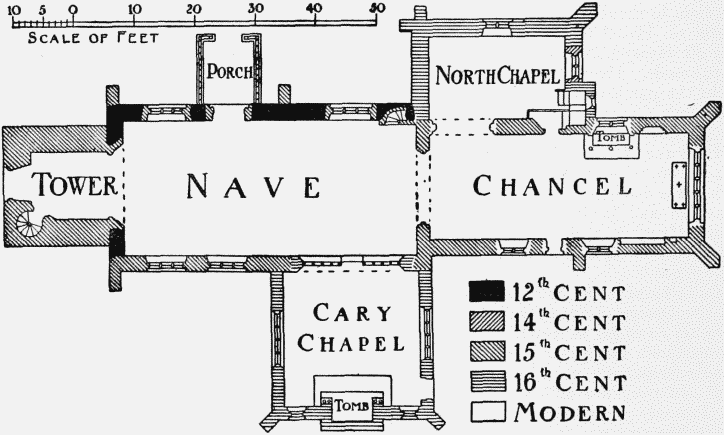
The church stands close to Hunsdon House, nearly a mile south of the village. Its dedication is uncertain, but is attributed to ST. DUNSTAN. It consists of chancel 43 ft. by 17 ft. 6 in., north chapel 22 ft. 6 in. by 13 ft. 6 in., nave 48 ft. 6 in. by 22 ft. 6 in., south transept or chapel 23 ft. by 22 ft. 6 in., west tower 12 ft. 9 in. by 11 ft., timber north porch; all the dimensions taken internally. The walls are of flint rubble with stone dressings, the south chapel being built of brick; the roofs are tiled; much of the stonework has been renewed and the building generally repaired. This church possesses some exceptionally good details of fittings of the 16th and 17th centuries.
The walling of the nave belongs probably to an earlier period than the rest of the building, but the indications are too slight to fix the date; the west tower and north porch belong to the early part of the 15th century; the chancel was rebuilt in the latter part of the 15th century; the north chapel was added about the middle of the 16th century, and the south chapel was built by Lord Hunsdon about 1616.
The chancel has a large five-light window in the east wall, one two-light window in the north, and two with a doorway between in the south wall; some of the jamb stones in the windows are original, the rest is modern stonework. The north doorway into the chapel has a four-centred arch with splayed jambs; the arch opening into this chapel, which is used as an organ chamber and vestry, is modern. In the south chancel wall is a piscina with hollow splayed jambs and pointed arch; adjoining it is a plain recess with a wooden seat. The chancel arch of two plain chamfered orders dates from the latter part of the 15th century.
The floor of the north chapel was raised about 4 ft. 8 in. in the 18th century for the construction of a vault beneath, and a small gabled projection at the east end was built to contain the short stair up from the chancel. The east window is of two cinquefoiled lights with a sexfoil opening in the head, and is of late 14th-century date, reset in this wall; the jambs have been repaired with cement. In the north wall is a window of two cinquefoiled lights chiefly of modern stonework. The plain collarbeam roof is probably original.
In the north wall of the nave are two three-light windows with cinquefoiled arches and tracery above, also a door with moulded arch and jambs and traceried spandrels; all these are of the 15th century, but the stonework has been much renewed. At the east end of the north wall are the lower and upper doors to the rood-loft set in a projecting portion of the wall. In the south wall is a wide arch of three moulded orders plastered, opening into the south transept or chapel. West of it are two three-light windows of modern stonework, the westernmost of which occupies the position of the old south doorway, done away with about 1830. (fn. 111) There are some old moulded timbers in the roof.
In the east and west walls of the south chapel is a five-light mullioned and traceried window of plastered brickwork and a four-centred doorway in the east; in the south wall are two single-light windows with four-centred arches; they are all of early 17th-century date.
The upper part of the north porch is of open timber-work; the entrance has a pointed-arched opening flanked on either side by an opening with a cusped head; the barge-board has plain cuspings; the open sides have square bars at short intervals set diagonally; it is of early 15th-century work.
The early 15th-century tower, which is unbuttressed, is in three stages; the tower arch is of two orders, the inner order resting upon jambs with capitals and bases; above the arch may be seen the line of an earlier steep roof to the nave; the west doorway is of two moulded orders, the inner order forming a pointed arch, the outer being carried square over it; in the spandrels are shields, all repaired; above is a window of two cinquefoiled lights with cusped opening in the head. On the north and west faces of the second stage are two-light windows, and at the belfry stage on each face is a window of two trefoiled lights with cusped opening above. Above the embattled parapet is a slender spire covered with shingles. In the south-west angle of the tower is the circular newel stair to the belfry. The font, of clunch, is the original one recut, and is probably of 15th-century date. Under the chancel arch is the lower part only of the 15th-century rood screen with traceried panels.
Plan of Hunsdon Church
Under the arch to the south chapel is a fine oak screen of about 1610. The lower part has moulded panels separated by fluted pilasters above which is a rail of richly carved arabesque patterns; the upper part consists of a series of open panels with round arches set in square frames separated by Ionic carved and fluted pillars, and having a moulded entablature with richly carved frieze; over the cornice, in the centre, in an open scroll-work setting is a shield containing the arms of the Careys and allied families.
The communion table and rails in the chancel are of early 17th-century date, and near the door is a plain 17th-century poor-box.
The pulpit is hexagonal and of small dimensions; it has two tiers of plain moulded panels with a carved frieze above and a carved sounding-board over; it is of early 17th-century date.
In the chancel windows and in some of the nave windows are fragments of 15th-century glass, containing figures of six of the Apostles, white rose of York, fetterlocks, and Bowyers' flotes.
On the north side of the chancel is a recess with a depressed arch, having cusped and panelled sides and arch, and shields of arms to Francis Poynz, 1528. On the same side is a large canopied tomb to Sir Thomas Foster, with a recumbent effigy clothed in the judges' robes; he died in 1612. In front of the tomb is a richly worked railing of wrought-iron. The Fosters were a branch of the Northumberland family.
On the south side of the south chapel is a large monument to John Carey, third Lord Hunsdon, and his wife, the founder of the chapel erected by him during their lives about 1616; it is of marble and alabaster, with Corinthian columns and moulded entablature supporting an arched canopy, under which are the recumbent effigies of the knight and his wife; the dates of their death are omitted.
Two large early 18th-century monuments to the Calverts of Hunsdon House and to Robert Chester of Briggens were moved from the north wall of the chancel to the north chapel, and thence in 1911 to the nave.
In the nave is a brass to James Gray, park-keeper, who died 1591. The figures represent a hunter who has just shot an arrow into a stag, being himself killed by an arrow in the hand of Death, represented by a skeleton. Another brass on the north wall of the chancel is to Margaret Shelley, 1495; the figure is dressed in a shroud, and above is a representation of the Holy Trinity; portions of the brass are missing.
There are eight bells: the treble, second and third by Mears & Stainbank, 1883; the fourth inscribed 'Jesus be our spede, 1630,' by Robert Oldfeild; the fifth recast in 1883; the sixth, by J. Briant, 1787; the seventh, dated 1668, and the eighth, 1652, both by Anthony Bartlett.
The communion plate consists of cup and cover paten, 1660, and modern chalice, paten and flagon.
The registers are in five books, as follows: (i) baptisms 1546 to 1675, burials 1546 to 1679, marriages 1546 to 1674; (ii) baptisms and burials 1679 to 1730, marriages 1680 to 1729; (iii) baptisms and burials 1734 to 1812, marriages 1734 to 1753; (iv) and (v) marriages 1754 to 1772 and 1772 to 1812.
ADVOWSON
A priest is included among the tenants of Hunsdon Manor recorded in the Domesday Survey, and the church is mentioned in the taxation of Pope Nicholas (1291). (fn. 112) At this date Merton Priory possessed an annual pension of £8 from Hunsdon Church, (fn. 113) and in 1350 we find the lord of Hunsdon Manor (John Engayne) suing the Prior of Merton for the right of presentation to the living. (fn. 114) There is no record of the termination of the suit, but Merton continued to present until the Dissolution. The copy of a patent granting the advowson of Hunsdon Church to the Prior and convent of Merton Abbey is said to have been in the possession of Thomas Cromwell, (fn. 115) but no further trace of this patent has been found. The advowson seems to have passed to Sir Henry Carey with the manor, (fn. 116) and henceforward followed the same descent. (fn. 117) After the death of Mr. Charles James Phelips in 1903 Hunsdon advowson was sold to Mr. John Henry Buxton, the present patron.

Hunsdon Church from the North-west
CHARITIES
The Poor's Land and Stock Charities are regulated by a scheme of the Charity Commissioners 17 January 1906. They comprise the charities of: 1. George, Lord Hunsdon, founded by will proved in P.C.C. 27 September 1603, under which he gave a sum of money which was invested in land for the benefit of the poor of Eastwick and Hunsdon.
2 Henry, Lord Hunsdon, founded by indenture dated 1 February 1615. The endowment of these two charities originally consisted of four pieces of land known respectively as Godfrey's Piece, Puke's Piece, the Town Lands and Oldburys, which were sold in 1905 and the proceeds invested in stock. The endowment for the parish of Hunsdon consists of £448 North-Eastern Railway 4 per cent. Guaranteed Stock, producing £17 18s. 4d. yearly, and £30 13s. 11d. consols, producing 15s. 4d. yearly. (See also under parish of Eastwick.)
3. Robert Chester, founded by will dated in 1730. The endowment originally consisted of land called Mallons, containing about 12 acres, which was sold in 1900 and the proceeds invested in £190 4s. 7d. consols, producing £4 15s. yearly.
4. The Pound Piece, containing about 30 poles, which was sold in 1902 and the proceeds invested in £14 7s. 6d. consols, producing 7s. yearly.
The net income of the united charities is applied in pensions for the aged poor.
The several sums of stock are held by the official trustees, who also hold £163 6s. 9d. consols arising from sale of glebe lands.