A History of the County of Hertford: Volume 3. Originally published by Victoria County History, London, 1912.
This free content was digitised by double rekeying. All rights reserved.
'Parishes: Bengeo', in A History of the County of Hertford: Volume 3, ed. William Page (London, 1912), British History Online https://www.british-history.ac.uk/vch/herts/vol3/pp423-427 [accessed 30 April 2025].
'Parishes: Bengeo', in A History of the County of Hertford: Volume 3. Edited by William Page (London, 1912), British History Online, accessed April 30, 2025, https://www.british-history.ac.uk/vch/herts/vol3/pp423-427.
"Parishes: Bengeo". A History of the County of Hertford: Volume 3. Ed. William Page (London, 1912), British History Online. Web. 30 April 2025. https://www.british-history.ac.uk/vch/herts/vol3/pp423-427.
In this section
BENGEO
Belingehou (xi cent.); Beneggho, Beningho (xiii cent.); Bengeho (xv cent.); Benjow (xvi cent.).
The parish of Bengeo lies north of Hertford and west of the parish of Ware, from which it is separated by the River Rib. Under the provisions of the Local Government Act of 1894 the old parish of Bengeo was divided into two parts. The northern or rural parish has an area of 2,778½ acres, consisting mainly of arable land, which forms about two-thirds of the whole area, and a few scattered woods. The greater part of the parish has an elevation of over 200 ft., but there is lower-lying land in the eastern part near the River Rib which is liable to flood. The soil is gravel, the subsoil clay, and the chief crops are wheat, barley and turnips. The district is thinly populated, the population being concentrated for the most part in the hamlets of Tonwell and Chapmore End. A road from Hertford passes through the parish, dividing into two branches; one branch leading north-east crosses the road from Ware to Stevenage, which also passes through Bengeo, the other branch continues in a northerly direction.
The southern or urban parish of Bengeo is bounded on the east by the River Beane. It has an area of 275 acres and lies on either side of the road from Hertford, of which borough it forms part. The church of St. Leonard stands in the eastern corner of Bengeo urban parish near the junction of the Beane with the Lea; near it is Bengeo Hall, the old manor-house, and their position suggests that the earliest settlement grew up near the water-ways, at some distance from the high road. Bengeo Hall was bought on the sale of the Byde property in 1846 by Admiral Thomas le Marchant Gosselin, who had already occupied it for some time previously, and it is now the property and residence of his grandson Mr. H. R. H. Gosselin-Grimshawe, J.P. In front of the house are two stones with initials K.B. and T.P.B. (probably Katherine Byde and Thomas Plumer Byde), and the date 1745, which seem to have been inserted into an earlier building. St. Leonard's, on the south side of the church, was formerly the vicarage. It was acquired by W. R. Best in 1849, and sold by him in 1863 to Miss Charlotte Gosselin, from whom it descended in 1892 to her nephew Mr. H. R. H. Gosselin-Grimshawe, the present owner. It is a 17th-century house of two stories and an attic with additions and alterations of the 19th century. Near St. Leonards are some cottages and a field called 'The Vineyard.' The field is described in 1767 as having lately been used as a vineyard by Thomas Dimsdale, the owner, who is said to have planted the vines. (fn. 1)
The modern parish church of Holy Trinity lies further west in the more thickly populated part of the parish. Tonwell, a hamlet on the road from Ware to Stevenage, has a chapel of ease built with the adjoining school by Mr. Abel Smith in 1857. Chapmore End, another hamlet, lies south-west of Tonwell. Near Chapmore End is the Lammas land belonging to the parish; it consists of 20 a. 3 r. 28 p. and yields £30 a year, which is divided amongst the householders. Waterford, a hamlet in the north-western part of Bengeo rural parish, was formed into an ecclesiastical parish in 1908.
There is a homestead moat at Bengeo Temple.
An inclosure award was made for Bengeo, Sacombe and Stapleford in 1852. (fn. 2)
MANORS
Bengeo
The manor of BENGEO appears to have been the manor in this parish that was held by Hugh de Beauchamp at the time of the Domesday Survey. (fn. 3) In 1092 the monks of Bermondsey received a grant of lands which they afterwards sold in order to buy the 'manor of Richmond in Bengeo' for 160 marks, (fn. 4) and as, according to Dugdale, this manor was bought from Payn de Beauchamp, (fn. 5) it was probably the same as that previously held by Hugh de Beauchamp. In 1204 the Prior of Bermondsey paid 5 marks for having inquisition as to what lands were in his demesne in Bengeo when he delivered the land of Bengeo at farm to Ralph de Quenhay, who was said to have alienated those demesnes. (fn. 6)
During the 13th century the family of Tany (see Temple Chelsin below) established a claim to the manor; perhaps it was mortgaged or leased to them by the monks, to whom they afterwards made a formal grant of it apparently merely for purposes of settlement on one of their own family, for in 1272 Reginald and Richard de Tany gave the manor of Bengeo or Richmond to the monks of Bermondsey, (fn. 7) and in 1276 Richard and Margery de Tany quitclaimed the manor to Luke de Tany as his by right of the gift of Henry, late Prior of Bermondsey, whilst John Prior of Bermondsey, who had succeeded Henry in 1276, (fn. 8) acknowledged Luke's claim, the monks of Bermondsey retaining only the advowson of the church. (fn. 9) There is no evidence to show whether Luke de Tany had more than a life interest in the manor. He died in 1283. (fn. 10) In 1290 Edward I granted to the monks of Bermondsey the manor of Richmond with other manors and lands which had come into the king's hands by reason of the felony committed by Adam de Stratton, to whom the manors in question had been demised at farm. (fn. 11) Dugdale says that the manors were demised a second time to Adam de Stratton, forfeited in 1302, and again restored to the convent, which obtained a further confirmation of them from Edward II and continued in possession of them until the Dissolution. (fn. 12) As far as Bengeo was concerned, however, the descent after 1290 shows that the monks had alienated all except the advowson.
In 1303–4 John son of John Fitz Simon died seised of the manor of Bengeo. It is described in the inquisition as held of John Engayn. (fn. 13) The overlordship was therefore evidently attached to the manor of Hunsdon, which in 1272 Henry Engayn held of the heirs of Sir William de Beauchamp of Bedford. (fn. 14) The Fitz Simons held the manor for several generations, the descent being identical with that of Almshoe in Ippollitts, Hitchin Hundred (q.v.). Eventually Elizabeth, the Fitz Simon heiress, married Thomas Brockett, (fn. 15) and he held the manor—which is described as held of William Hussey as of the manor of Hunsdon—jointly with his wife and in her right. Thomas Brockett died in 1477; his wife survived him, and his brother Edward Brcckett was his heir. (fn. 16)
The manor was probably sold by the Brocketts to Sir William Say, as he died seised of it in 1529. His property was inherited by his daughter Mary Countess of Essex, and by his granddaughter Gertrude, daughter of Elizabeth Lady Mountjoy, (fn. 17) who married the Marquess of Exeter. On the attainder of Gertrude in July 1539 the manor of Bengeo was forfeited to the Crown, (fn. 18) and in 1546 it was granted to Nicholas Throckmorton, (fn. 19) who in 1555 conveyed it to William Sharnbrook. (fn. 20) The latter died in 1563, leaving a son and heir Nicholas as well as younger sons. (fn. 21) The manor of Bengeo probably formed part of the provision for the widow and younger sons, for in 1571 Joan Sharnbrook, widow, and John Sharnbrook released all their right in the manor to Robert Spencer and Frances his wife, (fn. 22) and in 1594 it was sold by John Spencer to Thomas Fanshawe (fn. 23) of Ware Park, in Ware, Braughing Hundred. From this point the descent is the same as that of Ware. Mr. William Francis Parker of Ware Park is the present lord of the manor.
Temple Chelsin
The manor of TEMPLE CHELSIN (Chelse, xiii cent.) was evidently one of the manors held by Geoffrey de Bech in Bengeo in 1086, (fn. 24) for the overlords in the 13th century, the Tanys, held under the lords of Bourne, who had succeeded Geoffrey de Bech elsewhere. (fn. 25) In 1210–12 Richard de Tany held two fees in Eastwick and Bengeo of the honour of Bourne. (fn. 26) By the middle of the 13th century the manor was held by the Knights Templars, who received a grant of free warren in their demesne lands in 1253. (fn. 27) From a fine levied in 1269 it appears that the Tanys had previously enfeoffed the Abbot of Warden of the manor, to hold by a rent of £12; the abbot had enfeoffed Simon Fitz Adam of Almshoe, to hold by the same rent, whilst the latter in his turn had enfeoffed the Master of the Knights Templars to hold also by a rent of £12. By the fine of 1269 the rent was released to Imbert de Peraud, Master of the Knights Templars, (fn. 28) who was henceforth to hold the manor of the king by the service of half a knight's fee. It is possibly this transaction that is spoken of in the Hundred Rolls as the sale of Chelsin to the Templars by Peter de Tany, the father's name being mentioned instead of that of the son. (fn. 29) In 1278 and 1287 the Templars claimed, with other liberties, view of frankpledge, amendment of assize of bread and ale, and gallows in their demesne lands in Chelsin. (fn. 30) In 1313 a mandate was issued in compliance with the decision of Pope Clement V and of the Council of Vienne for the delivery of the English possessions of the Templars to the Hospital of St. John of Jerusalem. (fn. 31)
At the time of the Dissolution the manor was held at farm of the Hospitallers by Nicholas Thurgood, under a lease made in 1524 for forty years. (fn. 32) In 1542 it was granted by Henry VIII to Sir Ralph Sadleir, one of the king's chief secretaries. (fn. 33) Sir Ralph Sadleir died in 1587, leaving the manor to his son Henry, with remainder to his son Thomas and heirs, (fn. 34) and in 1595 Henry Sadleir sold the manor to Sir Philip Boteler. (fn. 35) When the latter died in 1606 the manor passed to his grandson and heir Robert Boteler, (fn. 36) who was succeeded in 1622 by his daughter Jane, then three years old. (fn. 37) In 1637 a warrant was issued to the judges of the Common Pleas to admit Jane, who had married John Belasis, to levy fines and suffer recoveries, by her guardian, of Temple Chelsin and other manors, for the payment of the debts of her father and mother. (fn. 38) John Lord Belasis sold the manor, probably about 1650, (fn. 39) to Sir John Gore, from whom it passed by sale in 1688 to trustees for Sir Thomas Rolt, (fn. 40) who had been President of the East India Company at Surat. (fn. 41) From Sir Thomas Rolt the manor descended to Edward Rolt, his son, and from the latter to Thomas Rolt, who possessed it in 1728. (fn. 42) The elder son and daughter of Thomas Rolt died unmarried, and he was succeeded by his younger daughter Mary, who married Timothy Caswall. On the death of Mary's son George Caswall in 1825 the estate was sold to Samuel Smith, from whom it has descended to Mr. Abel Henry Smith, (fn. 43) the present lord.
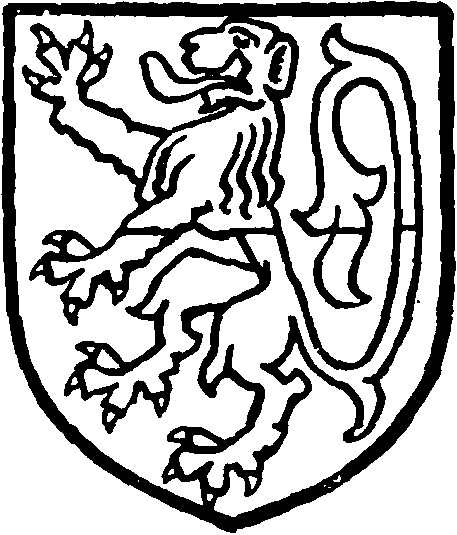
Sadleir. Or a lion parted fessewise azure and gules.
The manor-house, now a farm-house standing off the road to Ware, is a 17th-century building of timber and plaster.
Chelsin alias Smeremongers
The manor of CHELSIN alias SMEREMONGERS appears first in the 15th century; in 1469 John Shelley, citizen and mercer of London, received licence to grant the manor of Chelsin, held in chief, to John Say and others to hold to the use of John Shelley and heirs. (fn. 44) A settlement was again made in 1483, when the manor was granted to trustees for the use of John Shelley, the son, and Elizabeth his wife, and their heirs. (fn. 45) John Shelley, the son, died in January 1526–7, leaving a son and heir William Shelley, who was a justice of the Common Pleas, (fn. 46) and was knighted in 1529. (fn. 47) By the will of the latter, which was proved in February 1548–9, the manor of Chelsin was left for life to Thomas, (fn. 48) his fifth son. (fn. 49) The reversion of the manor after the death of Thomas belonged to John Shelley, the eldest brother of Thomas, who by his will proved in 1551 left it to be held by his executors until the majority of his son William Shelley. (fn. 50) The Shelleys, however, appear to have forfeited the manor, for in 1573, when it was leased to John Bedingfield, it was described as being in the Crown by the forfeiture of Thomas Shelley. (fn. 51) After this there is no trace of the manor until 1625, when Robert Hemming, yeoman, died seised of the manor of Chelsin alias Smeremongers held of the Crown in socage, his heir being his son Samuel. (fn. 52) The latter died in 1639, leaving an heir John Hemming. The descent of the manor from this point is very obscure. By 1698 it had apparently passed to George Nodes. (fn. 53) Eventually by 1802 the manor of Chelsin or Smeremongers, passing with Temple Chelsin, was held by George Caswall. (fn. 54)
Revel's Hall
The manor of REVEL'S HALL first appears mentioned as a manor at the end of the 15th century. It probably formed part of Geoffrey de Bech's lands in Bengeo at the time of the Domesday Survey. (fn. 55) Geoffrey de Bech seems to have been succeeded here by Ralph the Butler (Pincerna), who at the end of the reign of Henry I granted two knights' fees, consisting of the manor of Cockenhatch and lands in Hailey (Heilet) and Bengeo, which were held under him by the family of Burun, to Aubrey de Vere. The latter was to hold the knights' fees in demesne until Robert de Burun paid him £32, after which Robert was to hold of Aubrey and Aubrey of Ralph. (fn. 56) The knights' fees are described as being formerly held by Roger de Burun, (fn. 57) and it is possible that the latter was the son of the Roger who held 5½ virgates of Geoffrey de Bech in Bengeo in 1086. (fn. 58) The materials giving evidence of the descent of these knights' fees are scanty. Roger de Burun, grandson of Robert, was holding land in Bengeo in 1206, when he made an agreement about 1 carucate of land with Thomas de Herlawe. (fn. 59) It is probable that ultimately the Buruns granted their holding in Bengeo to the Revels, from whom the manor afterwards took its name, for before 1194 Robert de Burun had granted certain lands in Cockenhatch to William son of Andrew de Revel. (fn. 60) The Revels were holding land in Bengeo in 1303, when Geoffrey Revel was returned for half a fee in Bengeo held of the Earl of Oxford. (fn. 61) There is no evidence to show how long the Revels held it or who succeeded them, but in 1495 Thomas Babthorpe died seised of the manor of Revels in Bengeo in demesne, and it was taken into the king's hands, (fn. 62) probably on account of the minority of the heir. It was evidently restored to the family of Babthorpe, as it appears to have passed from Nicholas Babthorpe to William Caldwell, (fn. 63) whose daughter and heir Joan conveyed it in marriage to Sir George Knighton. Their son John Knighton succeeded on his father's death in 1613. He gave the manor to his sister's daughter Mary, who married Henry Gardiner. Mary Gardiner, who survived both her sons and held a court in 1658, was succeeded by her daughter Mary wife of Henry Dunster. Mary survived her husband and was lady of the manor in 1700. (fn. 64) On her death the manor passed to her son Giles, who, dying without issue, left it to his nephew Henry Dunster, possessor of the manor in 1728. (fn. 65) It remained with the family of Dunster (fn. 66) until the death of Edward Dunster in 1791, when it was sold to Thomas Hope Byde. Afterwards it came by purchase together with the principal manor to William Parker of Ware Park. (fn. 67)
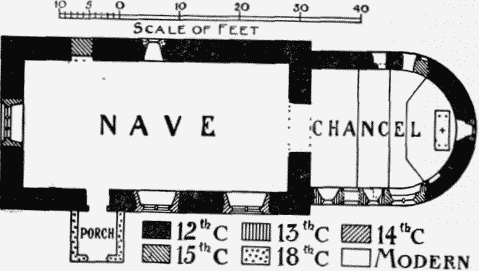
Plan of Bengeo Church
Revel's Hall, the farm-house north-east of St. Leonard's Church, probably marks the site of the old manor-house. The present house is a 17th-century timber-framed building with additions on the south side.
CHURCH
The ancient church of ST. LEONARD consists of a chancel measuring internally 24 ft. by 19 ft. 6 in., with round apsidal east end, nave 44 ft. by 21 ft., west bellcote and south porch. It is built of flint with stone dressings; the nave is coated with plaster and the roofs are tiled.
The church is of early 12th-century date; windows have been inserted in later periods and a south porch was added in the 18th century; the bellcote is modern. The interior of the nave is now dismantled and the chancel arch boarded up; the chancel is still used for services.
The east window of the chancel is a single light with splayed inner jambs of 12th-century date, and splayed light with square head of the 13 th century. In the north wall is a single original light, now blocked. In the south wall are three windows; the most easterly is a window of two cinquefoiled lights under a square head, and is of 15th-century date, but the inner jambs belong to an earlier window; the inner sill has been cut down to form a sedile. The next window is a single pointed light of 13th-century date, and the third is a single light with square head of the same period. In the same wall is a blocked doorway of the 15th-century, with four-centred arch. Much of the external stonework of windows and doorway has been renewed. Next the east window on the south is a rough recess about 2 ft. 3 in. wide, which may have been used as a locker; adjoining the two-light window is a small piscina with cusped head, but it is fragmentary; further west is a larger piscina with pointed arch and hollow-chamfered edge. The portion of stone now forming the sill allows the old grooved water drain to be seen. On the north side of the chancel are two roughly cut openings through the wall, now concealed by sliding doors in the internal panelling; these are about 2 ft. in width and 2 ft. 6 in. apart; they are about 4 ft. 6 in. in height and appear to have been cemented inside. It has been suggested that one of these openings (the other appears to have been only a recess) was cut to enable an anchorite to obtain access to the church from a cell outside. The chancel arch is semicircular, with a span of about 8 ft.; it has a large edge-roll on the west side and is square on the east. The west jambs have engaged shafts with carved capitals and moulded bases. It is of 12th-century date. Portions of the jambs have been cut away. The roof of the chancel is modern.
In the north wall of the nave is a single-light window with 12th-century inner jambs and arch and brick exterior. There is a north doorway, now blocked. In the south wall is a window of two trefoiled lights with tracery under a square head, of late 14th-century date, repaired with cement; the other window is also of two lights, but has been renewed in cement. The south doorway is of 12th-century date, with an inner round arch and a flat lintel on the outside, and moulded imposts; the brick south porch is of 18th-century date. In the west wall is a window of three cinquefoiled lights under a square head; it is of 15th-century date and has been repaired with cement. The open collar-beam roof over the nave appears to be old, but the timber bellcote is modern. The south doorway has an old oak door which may date from the 14th century. On the jambs of the west window on the south side of the chancel are some faint remains of distemper paintings of figure subjects in which the figure of a bishop can possibly be discerned, and on the east wall of the nave are other indications of figures, one of which is crowned; on the chancel walls is a red chequer pattern under which is a much older masonry pattern. Under the communion table are a number of 14th-century tiles, much worn.
There is one bell, dated 1636, by Robert Oldfeild.
The plate consists of a cup and paten, 1626, a flagon, two chalices, and two patens, 1862.
The registers before 1812 are as follows: (i) baptisms 1538 to 1696, burials 1547 to 1696, marriages 1539 to 1696; (ii) baptisms 1696 to 1782, marriages 1696 to 1754; (iii) burials 1678 to 1812; (iv) baptisms 1783 to 1812; (v) marriages 1754 to 1797; (vi) marriages 1797 to 1812.
The modern church of HOLY TRINITY was erected in 1855 of squared rubble with ashlar dressings, and consists of a chancel with organ chamber and vestry, nave with aisles, and western tower.
ADVOWSON
A priest is mentioned in the Domesday Survey as holding land of Geoffrey de Bech. (fn. 68) In 1156 the church of Bengeo was granted to the monks of Bermondsey by Reginald de Tany. The grant was confirmed by Henry II in 1159 and by Richard de Tany in 1272. (fn. 69) The monks of Bermondsey retained the rectory and advowson of the vicarage until the Dissolution. (fn. 70) They may, however, have mortgaged part, for in 1268 a fine was levied, by which Richard Michelefeld and Alexandra his wife acknowledged the advowson of a fourth part of the church of Bengeo to be the right of Michael Testard. (fn. 71) The king presented in 1338 and 1378, when the temporalities of the priory were in the hands of the Crown by reason of the war with France. (fn. 72) In 1553 Edward VI granted the rectory and church of Bengeo to Edward Walter of London, (fn. 73) and in 1563 they were sold by Henry Walter to George Horsey, (fn. 74) whose son Sir Ralph Horsey sold them to Henry Fanshawe in 1596, (fn. 75) from which date they followed the descent of the manor of Bengeo (fn. 76) until the sale of the Byde property in 1845. They were then bought by Mr. Abel Smith, whose son Mr. Abel Smith endowed the vicarage with the great tithes in 1848. (fn. 77) The living was declared a rectory in 1867. Mr. Abel Henry Smith is the present patron.
Meeting-places for Protestant Dissenters were certified in 1810, 1812, 1813, 1817 and 1831. (fn. 78)
CHARITIES
Mrs. Clarke, as stated in the Parliamentary Returns of 1786, gave land for the poor. The charity is known locally as Shaw's Charity. The land is 4½ acres in extent and is let at £9 a year, which is distributed in bread.
In 1870 Captain William Rayner Best bequeathed £200, now represented by £215 6s. 2d. consols, in the names of trustees, the annual dividends amounting to £5 7s. 6d. to be applied, subject to the repair of tomb, in the distribution of money or articles in kind.
The almshouses, the origin of which is unknown, consist of six almshouses occupied by six poor widows without children.
The Lammas lands consist of 20 a. at Chapmore End let in allotments, producing in 1908 about £33 a year, which was divided in sums of 1s. 3d. among 577 recipients.