A History of the County of Hertford: Volume 3. Originally published by Victoria County History, London, 1912.
This free content was digitised by double rekeying. All rights reserved.
'Parishes: Little Berkhampstead', in A History of the County of Hertford: Volume 3, ed. William Page (London, 1912), British History Online https://www.british-history.ac.uk/vch/herts/vol3/pp427-430 [accessed 30 April 2025].
'Parishes: Little Berkhampstead', in A History of the County of Hertford: Volume 3. Edited by William Page (London, 1912), British History Online, accessed April 30, 2025, https://www.british-history.ac.uk/vch/herts/vol3/pp427-430.
"Parishes: Little Berkhampstead". A History of the County of Hertford: Volume 3. Ed. William Page (London, 1912), British History Online. Web. 30 April 2025. https://www.british-history.ac.uk/vch/herts/vol3/pp427-430.
In this section
LITTLE BERKHAMPSTEAD
Berchehamstede (xi cent.).
The parish of Little Berkhampstead is bounded on the north by the River Lea, which separates it from the parish of Hertingfordbury. The area of the parish is 1,581 acres of land and 6 acres of water. The soil is of clay and gravel, the subsoil clay and chalk, and the chief crops are grass and wheat. The village, standing at a height of nearly 400 ft., is situated on a road which runs north to the Lea and south to Tyler's Causeway, which forms part of the southern boundary of the parish, and is continued as the road to Cheshunt. The church lies at the north end of the village, and a little further along the road is the old manor-house of the Welds. The house is a timber and plaster building of the early part of the 17th century, with a tiled roof. It has an open timber porch on the east side and a bay window with moulded wooden transoms and mullions on the north. Most of the internal details are modern, but part of the original hall ceiling still exists decorated with roses and other flowers in low relief. The house is the property of Mr. A. Hale, and is now used as a cyclists' resort. The modern house called the Manor House, further north, is the residence of Mr. Cornelius Hanbury.
On the north side of Berkhampstead Lane and close to the church and village are the rectory and Little Berkhampstead House. The latter was formerly the property of Owen Lloyd, stationer, of Temple Bar, who died in 1756, and left it to his nephew Samuel Gibbons. It was acquired early in the last century by Thomas Daniell, grandfather of the present owner, Mr. A. E. Daniell. Pondfield, the residence of Mr. Percival Bosanquet, stands in a park about half a mile north-east of the church. At the southern end of the village stands the Village Hall, which was built in 1888, and south of the hall is the school.
About a quarter of a mile east of the church is The Gage (formerly the Gaze or Gaze Place), a late 16th-century house, much altered subsequently. It is of brick and timber with tiled roofs and contains some late 17th-century panelling. In the grounds on high land is a circular tower built mainly of 17th-century bricks in 1789 by John Stratton as an observatory. The house belonged to John Bentley at the end of the 17th century. It was acquired by John Stratton in 1780, and is now the property of his grandson Colonel J. H. Stratton. At Woodcock Lodge Farm are the remains of a homestead moat. This house belonged in the early 17th century to William Smithsby, groom of the Privy Chamber to Charles I. He sold it to William Priestley of Camfield (see Essendon), in whose family it remained until the death of Meliora Priestley, (fn. 1) widow, in 1761. It afterwards came into the possession of William Baker of Bayfordbury.
Little Berkhampstead is said to have been the birthplace of Thomas Ken, Bishop of Bath and Wells, who was born in 1637. (fn. 2)
Epping Green, a hamlet, lies 1 mile south of the village, and another hamlet, Howe Green (probably Le Hoo of the 15th century), lies a mile to the north. Epping House, to the west of Epping Green, was the property of William Horne, attorney-general, who died in 1860. It now belongs to Mr. B. H. Henderson. (fn. 3)
An inclosure award was made in 1842. (fn. 4) Ashfield, Sprowsefield and Mill Field were the principal common fields.
MANOR
Hardwin de Scales held LITTLE BERKHAMPSTEAD at the time of the Domesday Survey, when it gelded at 5 hides. Before the Conquest 2 hides of the manor were held by Semar, a priest, 2 hides by a certain widow, Levefa, and 1 hide by Uluric. According to the testimony of the shire-moot these lands were of the 'alms' of King Edward and his royal ancestors. (fn. 5) The manor descended in the Scales family to Geoffrey de Scales, (fn. 6) who in 1223 granted it to Falkes de Breauté and his heirs to hold by the service of rendering one pair of gilt spurs or 6d. at Easter, for all service except foreign service. (fn. 7) Falkes de Breauté forfeited his possessions to the Crown in 1224, (fn. 8) and the houses in Little Berkhampstead which had belonged to him were removed to the castle of Hertford. (fn. 9) The manor, which should have been restored to the Scales family, was apparently kept by the king, who in 1225 gave orders that the old court, chapel, brewhouse and 'marescalcia' were still to be left at Little Berkhampstead for John Marshall, to whom he had granted Falkes's lands in Little Berkhampstead during pleasure. In 1226, however, the sheriff was ordered to move the 'domus marescalciae' from Little Berkhampstead to the castle of Hertford whenever the carriage of it should cause least inconvenience to the neighbourhood. (fn. 10) The manor was granted by the king in 1226 to Nicholas de Moels (fn. 11) during pleasure, a grant afterwards changed into one in fee. (fn. 12) His son Roger held it in 1278 (fn. 13) and received a grant of free warren in 1290. (fn. 14) Roger, who died before July 1295, was succeeded by his son John, (fn. 15) summoned to Parliament as Lord Moels. Extents of the manor at this date mention a water-mill. On the death of John in 1310 the manor went to his son Nicholas, (fn. 16) who, by a fine with Philip de Courtenay in 1313, settled it on himself and his wife Margaret and their heirs. (fn. 17) When Nicholas Lord Moels died before 12 March 1315– 16 his heir was his brother Roger. (fn. 18) Roger de Moels died without issue in 1325, and was succeeded by his brother John, (fn. 19) who in 1328 obtained a licence to exchange some of his other lands for the life interest of Margaret, his sister-in-law, in the manor of Little Berkhampstead. (fn. 20) As John had no male heir, on his death in 1337 the barony of Moels fell into abeyance and his lands were divided between his daughters Muriel and Isabel. Isabel, who had married William de Botreaux, received Little Berkhampstead in 1347 as part of her share of the inheritance. (fn. 21)
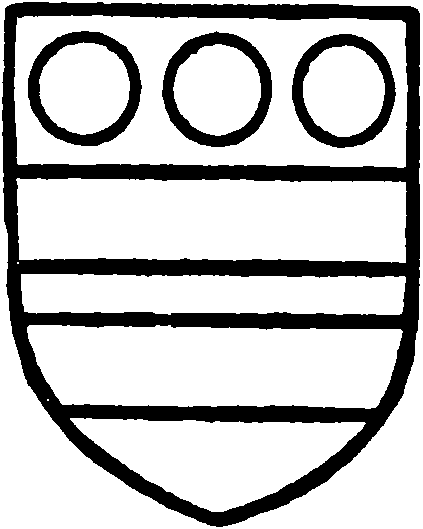
Moels, Lord Moels. Argent two bars gules with three roundels gules in the chief.
William Lord Botreaux, son of Isabel, was under age when his father died in 1349, (fn. 22) and his estates remained in wardship until 1359. (fn. 23) He leased the manor in 1375 to Edmund de Hyndon for the term of the latter's life, (fn. 24) and in 1384 to William Framelyngham, citizen and skinner of London, for twenty years. (fn. 25) William Lord Botreaux died in 1391 and was succeeded by his son William, (fn. 26) who survived him less than a year, leaving a son, another William, under age. (fn. 27) By 1402 the manor had passed, probably by sale, to John Norbury, (fn. 28) who had already in 1388 acquired the manor of Bedwell with lands and tenements in Little Berkhampstead, (fn. 29) and who in 1406 received a grant of free warren and licence to make a park in these manors. (fn. 30)
From 1402 the manor of Little Berkhampstead must have followed the descent of Bedwell in Essendon (q.v.), as it formed part of the possessions of the Marquess of Exeter which were granted to Sir Anthony Denny in 1547. (fn. 31) In 1600 it was sold by Sir Edward Denny, grandson of Sir Anthony, to Humphrey Weld, citizen and alderman of London. (fn. 32) From Sir Humphrey Weld it passed in 1610 to his son John (afterwards Sir John) Weld, (fn. 33) and the latter, dying in 1623, left it to his son Humphrey, who was a minor. (fn. 34) Humphrey suffered a recovery of the manor in 1639. (fn. 35) In 1645 it was sold by Frances Weld, widow of Sir John Weld, to Phineas Andrews, a London merchant. (fn. 36) In 1655 Phineas Andrews sold the manor to George Nevill (fn. 37) of Staple Inn, London, who died in 1679, leaving as heir a daughter Elizabeth, the wife of Cromwell Fleetwood. (fn. 38) She died without issue in 1692, (fn. 39) when the manor passed to her cousin John Nevill's son George, (fn. 40) who sold it in 1713 to Sir John Dimsdale. (fn. 41) He died in 1726 and his widow was owner of the manor in 1728. (fn. 42) As Sir John Dimsdale left no issue, the heir under his will was his cousin Thomas Dimsdale, (fn. 43) who in 1768 was made a baron of the Russian Empire. He died in 1800, leaving the manor to his second son Nathaniel, who had received a title similar to his father's. Nathaniel, dying unmarried in 1811, left the manor to his sister Anne Dimsdale, who was the possessor in 1817. (fn. 44) When she died unmarried in 1832 the manor went by will to her nephew Thomas Robert fourth Baron Dimsdale, on whose death without male issue in 1865 it passed to his wife. On her death in 1874 it was vested in her sons-in-law, ViceAdmiral Sir Walter Tarleton, K.C.B., and Colonel David Henry Mackinnon, as trustees for her four daughters, Lucinda widow of Major George Darby Griffith, Ann widow of the Rev. Henry Dawson, Finette Esther wife of Sir Walter Tarleton, and Caroline Mrs. Mackinnon. (fn. 45) The present lords of the manor are Mr. A. M. Mackinnon and Mr. A. H. Tarleton.
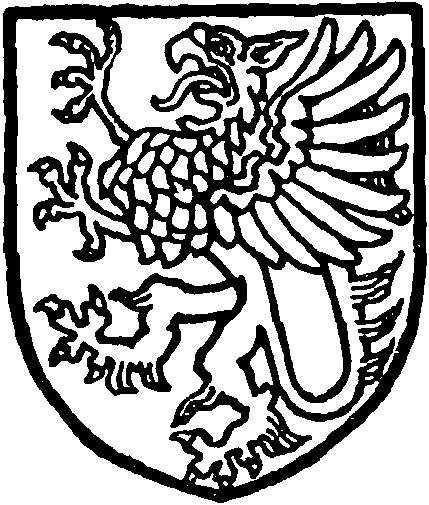
Botreaux, Lord Botreaux. Argent a griffon gules.
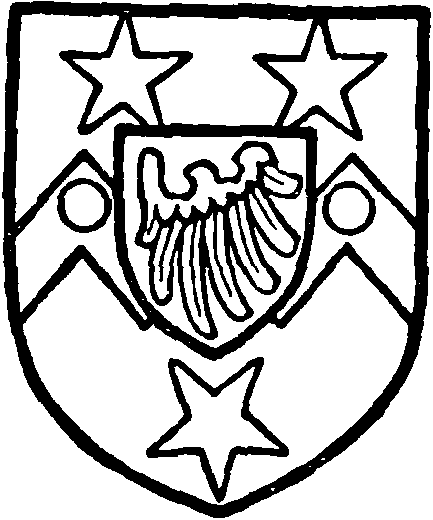
Dimsdale. Argent a fesse dancetty azure with three bezants thereon between three molets sable and an augmentation of a scutcheon or with an eagle's wing sable thereon.
CHURCH
The church of ST. ANDREW stands about the centre of the village, and consists of chancel 22 ft. by 16 ft., north chapel 13 ft. by 11ft. 6 in., nave 39 ft. 6 in. by 20 ft., north aisle 24 ft. by 15 ft., south porch and wooden bell-cote; all the measurements are internal. The walls are faced with Kentish rag.
The church is said to have been rebuilt about 1647 on the site of an older building, but the only remains of that date are parts of the east and west walls, the rest of the church being modern. In the chancel are some late 17th-century floor-slabs to the families of Pendred, Nevill and Fleetwood.
There are three bells: the first, by John Waylett, dated 1718; the second inscribed 'Ave Maria gracia plena dominus tecum benedicta tu in mulieribus' in Lombardic lettering; the third, dated 1621, cast by Robert Oldfeild.
The communion plate consists of a cup of 1565, a cover paten of 1576, another paten, 1721, an almsdish with handles (silver), 1791, a plated flagon (Sheffield), c. 1790, and two pewter almsdishes, c. 1720.
The registers before 1812 are as follows: (i) baptisms, burials and marriages 1647 to 1708; (ii) baptisms 1712 to 1762, burials 1721 to 1762, marriages 1714 to 1747; (iii) baptisms and burials 1769 to 1812; (iv) marriages 1756 to 1812.
ADVOWSON
Hugh de Scales, lord of the manor in the 12th century, gave the church of Little Berkhampstead to the priory of Lewes, and the grant was confirmed by Henry his son and Hugh his grandson. (fn. 46) In 1397 the king presented 'by reason of his wardship of the land and heir of William Botreaux, kt., tenant-in-chief,' (fn. 47) and he also presented in 1399 (fn. 48) and again in 1444, (fn. 49) but by what title does not appear. In 1538 the advowson of the church of Little Berkhampstead was granted to Thomas Cromwell with the priory of Lewes. (fn. 50) In 1612 Robert Earl of Salisbury died seised of the advowson, (fn. 51) and the advowson was retained by his descendants, (fn. 52) the Marquess of Salisbury holding the patronage at the present day.
A house was licensed as a Presbyterian meetingplace in Little Berkhampstead in 1672, and one at Epping Green was certified as a place of worship for Protestant Dissenters in 1810. (fn. 53)
CHARITIES
In 1730 Maurice Hunt, by will, bequeathed £600 in trust for the use of the poor. The legacy is now represented by £558 5s. consols with the official trustees, producing £13 19s. yearly, which, in pursuance of a decree of the Court of Chancery, is distributable in November among the poor. In 1911 twenty-four persons received gifts of money varying from 10s. to 20s.