A History of the County of Hertford: Volume 3. Originally published by Victoria County History, London, 1912.
This free content was digitised by double rekeying. All rights reserved.
'Parishes: Broxbourne with Hoddesdon', in A History of the County of Hertford: Volume 3, ed. William Page (London, 1912), British History Online https://www.british-history.ac.uk/vch/herts/vol3/pp430-440 [accessed 30 April 2025].
'Parishes: Broxbourne with Hoddesdon', in A History of the County of Hertford: Volume 3. Edited by William Page (London, 1912), British History Online, accessed April 30, 2025, https://www.british-history.ac.uk/vch/herts/vol3/pp430-440.
"Parishes: Broxbourne with Hoddesdon". A History of the County of Hertford: Volume 3. Ed. William Page (London, 1912), British History Online. Web. 30 April 2025. https://www.british-history.ac.uk/vch/herts/vol3/pp430-440.
In this section
BROXBOURNE WITH HODDESDON
Brochesborne (xi cent.); Brokesburn.
The civil parish of Broxbourne, (fn. 1) which has an area of 1,932 acres, contains 509 acres of arable land, 658 acres of permanent grass and 686 acres of wood. (fn. 2) The ground slopes downward from the west of the parish, which lies at more than 300 ft. above the ordnance datum, to the east, where the elevation is less than 100 ft., on the banks of the River Lea, which forms the boundary between Broxbourne and Nazeing, the neighbouring parish in Essex. The Spital Brook, which runs into the Lea on the east of the parish, forms the boundary between the civil parishes of Broxbourne and Hoddesdon for a little way before the junction. The main road from London to Ware and the north passes through the eastern end of the parish and forms the main street of the village of Broxbourne. In this street are a few old houses, notably The Gables at the south end of the village, which is a two-storied house dating from the early part of the 17th century. It is a timber-framed house now covered with plaster, with a modern front. The chimney-stack and one fireplace are probably original. The Bull Inn, in the middle of the village on the west side of High Street, is also a 17th-century timber and plaster house. Opposite the Bull Inn are the Monson Almshouses erected in 1728. They are contained in a plain two-storied building of brick, with sash-windows, and a crowning cornice of moulded brick. Over the entrance doorway is the following inscription:—
'This Building is Erected at the Sole | charge of Dame Laetitia Monson | Relict of Sr William Monson Bart | and was Daughter of John Lord Poulett | of Hinton St George in the County of Somersett, which Gift is for the Relief | and Benefitt of poore Widows of the | Parish of Broxborne in Hartfordshire | in the year of our Lord 1728.'
Above on a lozenge are the arms of Monson impaling Poulett.
The Cedars in the High Street, although an 18th-century house, contains an early 17th-century staircase. From the main street Pound Lane and Mill Lane run eastward, the latter passing the church of St. Augustine and the vicarage, and leading to the Broxbourne mill, which is picturesquely situated on the old stream of the River Lea. To the west two lanes turn off. The lower leads to Baas manor-house, an early 17th-century brick and plastered timber building now divided into two tenements, Cold Hall and Cold Hall Green, and the higher to Broxborne Bury, the seat of the lord of the manor. Broxborne Bury is a 16th-century house of red brick and stone with roofs partly tiled, slated and leaded. It was probably built by John Cock, who received a grant of the manor in 1544. In the following century an addition was made to the west side of the house, and in the 19th century it was much altered and largely rebuilt. Some of the chimney-stacks appear to be original, and there is a fireplace on the first floor, which is also of the 16th century. The windows are of the 18th century or modern.
The western half of the parish is largely covered by beautiful woods, chiefly of oak, beech and hornbeam.
The Great Eastern railway runs through the parish parallel to the main street and between it and the river. The station is situated at the end of Pound Lane and Station Road. It is doubtless due to the railway that the new quarter of the town to the north of the church, consisting mainly of villa residences and practically continuous with the southern extension of Hoddesdon, has grown up within the last fifty years.
The subsoil of the parish is London Clay, with the exception of a narrow strip of Alluvium on the banks of the Lea. The chalk is not far below the clay on the lower lands. There is a disused gravel-pit east of Broxborne Bury Park.
The inclosure award was made in 1843 and 1850, and is in the custody of the clerk of the peace. (fn. 3)
The civil parish of Hoddesdon, formed from those of Broxbourne and Great Amwell, has an area of 2,685 acres, which on 1 January 1895 was divided into the parishes of Hoddesdon Urban, 1,575 acres, and Hoddesdon Rural, 1,110 acres. (fn. 4) The combined parishes contain 563½ acres of arable land, 912½ acres of permanent grass, and 724 acres of wood. (fn. 5)
The elevation of the western half of the parish is over 200 ft. above the ordnance datum, with the exception of a small area by the Spital Brook, where it falls to 170 ft. In the east the ground slopes downward towards the Lea, which forms the eastern boundary of the parish. The town of Hoddesdon continues up the main road from Broxbourne, and is hardly separated from that village. About the middle of the town the road divides into Amwell Street and Burford Street, both running north to Ware, the Clock House being situated at the junction in the open space in front of the Maidenhead Inn. Amwell Street, on the west side of which there are some 17th-century cottages, passes the church of St. Paul and the vicarage, and meets the road from Hertford a little further north. Burford Street, which is part of the Stanstead Road, has two roads branching off to the east, Rye Road leading to the suburb of Rye Park, and Essex Road, the more southerly of the two, which crosses the New River, passes Geddings and goes on to the Lea. South of the town hall two roads run west from the High Street, Lord Street (formerly Lord's Lane), the most northerly, leading past High Leigh, the residence of Mr. Robert Barclay, J.P. Opposite Lord's Lane was the old market cross which stood at least until the end of the 17th century. A little south of the cross was the market-house, built about 1634. The market-place occupied the space between the cross and the present clock-house. The market-house was pulled down in 1833, and the market soon after ceased to be held. The cattle market now held on a site to the south of the old cross was founded in 1886. (fn. 6) Eastwards from the High Street Conduit Lane runs down to Lynch mill pond, from which the stream called the Lynch flows to the Lea. Lynch mill pond is mentioned in 1569 as 'a pond anciently called "le Lince" where is now built a water mill.' (fn. 7) The Wollans Brook, which flows through Box Wood and the north of the parish, falls into the Lea.
In the High Street are many old houses. Rawdon House, now St. Monica's Priory, a convent of the canonesses of the Augustinian order, on the east side was built by Sir Marmaduke Rawdon in 1622, as appears from a stone over the porch and many rainwater heads bearing this date and the initials M.R. The house is a large red brick rectangular building with stone dressings and a tiled roof, to which a wing was added in 1880. It is of two stories with an attic and has a porch and bay windows, both of two stories, in front, and a central tower, in which is the staircase, at the back. The hall has a ceiling ornamented with fleurs de lis, roses, &c., and a fireplace with plaster figures. There are a fine oak staircase with heraldic figures and some good old doors and panelling, but many of the original fittings were sold by the canonesses, three of the fireplaces being purchased by Sir Charles Wittewronge and set up at Rothamsted House, Harpenden. A little to the north of St. Monica's Priory on the same side of the road is Stanboroughs House, now the Conservative club, the main part of which was built about 1600 of timber and plaster work and a wing of brick added in 1637, according to a date upon the rain-water heads. A good deal of the woodwork within is original, including a fine oak staircase in the added wing and some oak panelling and doors. On the same side of the road is Hogges Hall, originally built probably in the 15th century. The exterior of the house is modern, but some of the internal details, including the timber ceiling of the hall and a wooden doorway, are of the 15th century. There is also some 16th and 17th-century panelling which is not in its original position.
On the west side of the road is the Grange (once an inn called the 'Cock'), a brick house of two stories, built in 1657, but almost rebuilt in the 18th century. It contains some 17th century panelling and an overmantel of the same period, together with three doors of the early part of that century.
There have always been many inns in the town. The 'Black Lion' (now the 'Salisbury Arms') was held in the 16th century of the manor of Geddings. (fn. 8) Henry Barrell or Burwell, serjeant-at-arms and tenant of the 'Black Lion,' died in 1562, leaving a widow Jane, who afterwards married Christopher Lyster. His son Henry Barrell entered upon the tenement at his father's death, but died in 1566 and was succeeded by his brother George. (fn. 9) Another inn called the 'George' was held before 1464 by Richard Riche (fn. 10) and remained in his family until 1528, when it was sold by Thomas son of Thomas and Rachel Riche to Sir Thomas Baldry, alderman, and John Garwey, mercer of London. (fn. 11) In the 17th century it was held by George Taylor and afterwards by John Marshall. In 1702 it was sold by Matthew Clarke to Edward Browne. (fn. 12) The Golden Lion Inn stands on the west side of the High Street and is a two-storied house of plastered timber and brick with an overhanging story built in the early part of the 17th century, but much altered at a later date. The Old Swan Inn is a similar house built in the latter part of the 17th century, and the Griffin Hotel contains some woodwork possibly of the same century. Another inn called the 'Bull,' the front of which appears to date from the 18th century, projects over the pathway, the two upper floors being carried on Ionic columns. Near the southern end of High Street is some good Georgian work. A house on the east side three stories in height, with a moulded brick string-course and cornice, has a good Doric doorcase with elaborate fretwork in the metope of the frieze containing in Roman characters the date 1746.
At Connals Farm is the stone conduit-head presented to the town by Sir Marmaduke Rawdon in the early part of the 17th century. It formerly stood at the town well in the High Street, and represents the three-quarter length figure of a woman carrying a pitcher. The old 'Thatched House,' immortalized by Izaak Walton, stood on the site of the brewery offices of Messrs. Christie & Co., adjoining the brewery in the High Street. The clock-house itself stands on the site of the ancient chapel of St. Catherine. In it is hung a bell, probably from that chapel, which was cast by Thomas Bullisdon at the beginning of the 16th century and bears the inscription 'Sancta A[nn]a ora pro nobis.' (fn. 13)
In the west of the parish, which is thickly wooded, runs the Ermine Street, a Roman way, which crosses the Spital Brook and passes through the Hoddesdon Woods. There is a tumulus at Hoddesdonbury on the south side of the road. The hospital of St. Laud and St. Anthony, of which the first record seems to be in the 14th century, has left its name in Spital Brook, near which it stood. The hospital (which survived the Dissolution) fell into decay towards the end of the 16th century, and the Spital House was then adapted for the use of the free grammar school founded by Queen Elizabeth by charter of 4 January 1559–60. By the same charter the queen incorporated the town of Hoddesdon under the style of a bailiff and warden of the town and school, and eight assistants, and granted the tolls of the market and of two fairs to the corporation. The school, however, was apparently discontinued before 1595, and nothing further is heard of the corporation. (fn. 14)
The Great Eastern railway passes through the east of the parish and Rye House station is in the extreme north-east.
The subsoil of the parish is chiefly London Clay on chalk, but in the east this gives place to Woolwich and Reading Beds, beyond which is a strip of Alluvium by the Lea. In the north-east a wedge of Chalk separates the two latter. There are many gravel-pits in the parish.
The inclosure award was made in 1855, and Lampits Field was inclosed in 1841. Both awards are in the custody of the clerk of the peace. (fn. 15) The chief common fields were Lowefeld, Westfeld, Middlefeld (or Ditchfeld), Estfeld (or Ryefeld), Lampitfeld, and Southfeld. The chief common meadows were Dole Mead, Ditch Mead, Chaldwell Mead and South Mead. (fn. 16)
Other place-names that occur in Broxbourne and Hoddesdon are Phelippesholm, Flodgate Bridge, Huttescroft, Beggeres-grene, Gosewellehelle, Algoresholme, Loffeld (xiii cent.); Hathell, le Newelonde, Coppethorne (xiv cent.); Pikottes, Sawells, Sampsons, Broderedyng, Longhedge and Stockinges (xv and xvi cent.); Tunefield, Harfield, Cockabury Stable (xvii cent.); Morsforlong, Sparewynesmade, Lawefeld, Godewelleacre, Blakemad, Safoghel and Curstmarsh.
MANORS
Broxbourne
The manor of BROXBOURNE was held in the time of Edward the Confessor by Stigand, Archbishop of Canterbury, whose reeve held half a hide of it as a sokeman. In 1086 it was held by Adeliza wife of Hugh de Grantmesnil, and was assessed at 5½ hides. (fn. 17) Ivo de Grantmesnil, son and heir of Hugh, (fn. 18) gave Broxbourne to the abbey of Bermondsey, but as a consequence of his having previously mortgaged his estates to Robert Count of Meulan and first Earl of Leicester to defray the expenses of his journey to the Holy Land and dying on the way, Robert is said to have taken possession of Broxbourne with the consent of the monks of Bermondsey. (fn. 19) Robert died in 1118, and Waleran, his eldest son, took his father's Norman lands and became Count of Meulan, while Robert, the second son, became Earl of Leicester and inherited the English estates. (fn. 20) Robert Earl of Leicester, son of the latter, married in 1168 Parnell or Petronilla, the heiress of the Grantmesnils and apparently granddaughter of Ivo, (fn. 21) shortly after which Robert and Parnell, with the consent of their sons William and Robert, gave the manor of Broxbourne to the Knights Hospitallers. (fn. 22) King John confirmed this grant in 1199, (fn. 23) and the manor remained in the hands of the Hospitallers until the dissolution of their order in 1540. (fn. 24) In 1331 the king confirmed a charter of the late prior, Thomas Larcher, by which he granted the manor, reserving the lordship and royalty of his tenants there, to Edward de St. John for life, at a rent of 10 marks for the first five years and of 5 marks for the rest of the term. (fn. 25) In 1539 it was leased to John Sargeante, dyer, of London, for twenty-nine years. (fn. 26)
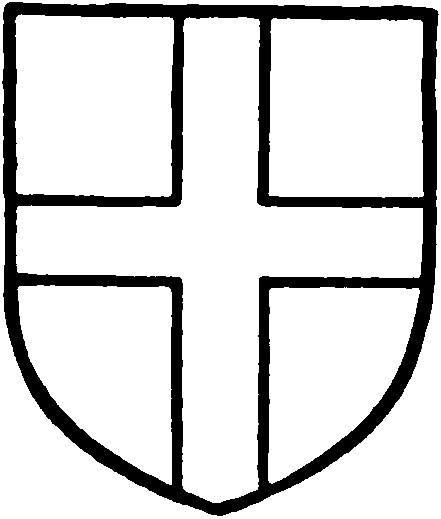
The Knights Hospitallers. Gules a cross argent.
In 1544 Broxbourne Manor, with woods of 70 acres called Broxbourne Wood, Broderedyng, and Longehedge, was granted to John Cock, (fn. 27) who died seised of it in 1557, leaving it to his wife Anne as jointure, after whose death it passed to his son Henry. (fn. 28) Sir Henry Cock died in March 1609–10, leaving two daughters, Frances, the wife of Sir Edmund Lucy, and Elizabeth, who married first Robert West and secondly Sir Robert Oxenbridge. (fn. 29) Broxbourne was apportioned to Elizabeth, who married thirdly Sir Richard Lucy about 1617, and died in 1645. (fn. 30) Sir Richard survived her and continued to hold the manor until his death in 1667, when it passed to Ursula Oxenbridge, daughter of Elizabeth Cock by her second husband. (fn. 31) Ursula was the wife of Sir John Monson, bart., K.B., who died in 1683, and was succeeded by his grandson Henry. (fn. 32) Sir Henry Monson died childless in 1718 and his brother William died in March 1726–7, when Broxbourne passed to his nephew John, son of a third brother George. (fn. 33) This Sir John Monson was created Lord Monson of Burton in 1728 and lived until 1748. (fn. 34) His son John died in 1774, (fn. 35) and his grandson, also named John, joined with his mother Theodosia Dowager Lady Monson in selling the manor of Broxbourne in 1790 to Jacob Bosanquet. (fn. 36) The latter was succeeded in 1830 by his son George Jacob Bosanquet, whose daughter and only child Cecily married Horace James Smith, second son of Samuel George Smith of Sacombe. (fn. 37) Upon becoming lord of the manor of Broxbourne in right of his wife in 1866 Mr. Horace Smith assumed the surname of Bosanquet. (fn. 38) He died in 1908 and was succeeded by his son Mr. George Smith-Bosanquet, who is the present possessor.
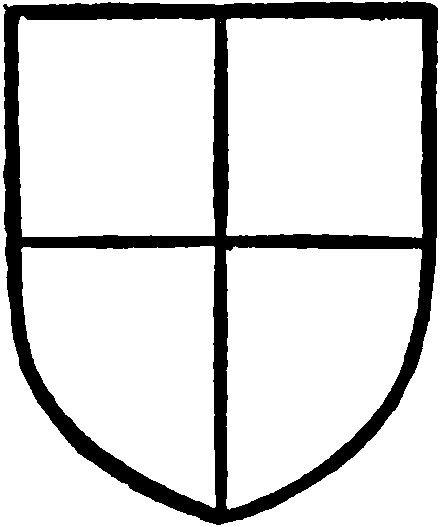
Cock of Broxbourne. Quarterly gules and argent.
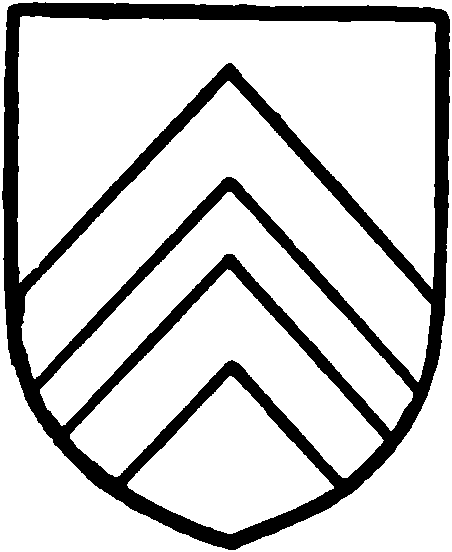
Monson, Lord Monson. Or two cheverons gules.
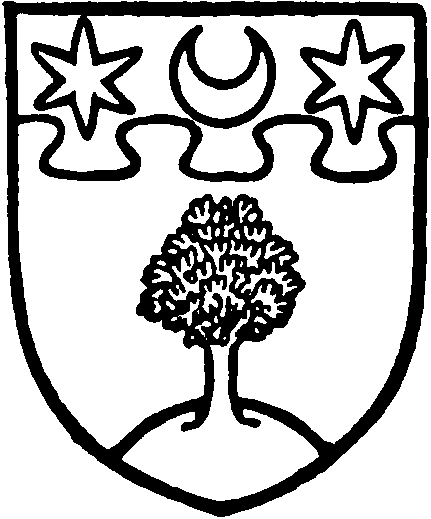
Bosanquet. Or a tree on a mount vert and a chief wavy gules with a crescent between two six-pointed molets argent therein.
Broxbourne possessed a mill in 1086, (fn. 39) which passed with the estate of the Knights Hospitallers. The mills were granted with the manor in 1544 to John Cock, together with 'le lokk' upon the River Lea, through which water was carried from the river to the mills. (fn. 40) John Cock in the same year granted the lock and the mills to William Garnett and Agnes, (fn. 41) and in 1550 the mills were granted as 'parcel of the lands of William Garnett' to Ralph Sadleir and Laurence Wennyngton and the heirs of Ralph, being then or late in the tenure of Richard Stansfeld. (fn. 42) William Garnett, however, died seised of them in 1559, leaving a son William. (fn. 43) At the end of the 16th century the mills and lock were held by Robert Garnett, who died in 1600 or shortly after, leaving his property to his daughter Elizabeth, who was then the wife of Abraham Hartwell. She soon afterwards married Robert Bennett, and died in 1610, when she was succeeded by John Hartwell, her son by her first husband. (fn. 44) John Hartwell died in 1644 seised of two water-mills called Broxbourne Mills and two other mills, and also the lock, all of which passed to his cousin Henry Hartwell, son of Abraham Hartwell's brother Alexander. (fn. 45) In 1671 the vicar of the parish sued the occupier of the water-mills, then Thomas Pryor, for his tithe. This had been fixed at one peck of the best wheat meal weekly, for which a former vicar in 1662–3 had compounded for £4 a year. It was then stated that there were three water corn-mills under one roof. (fn. 46)
In 1547 'the sewer called a Weyre, and a fishery called the Weyre, and one island called the Islande and the shrubbery and wood,' and two meadows in Broxbourne and Nazeing (the neighbouring parish of Essex) were granted to Sir William Herbert and his heirs, having been part of the possessions of the Knights Hospitallers. (fn. 47) This weir and fishery with the island were subsequently held by Elizabeth Bennett, the heiress of the Garnetts, (fn. 48) and descended with the mills. (fn. 49)
In 1670 Sir John Monson obtained a licence to make a park of 320 acres, and to 'enjoy franchise and liberty of free chace and free warren within the same,' and to store it with deer and coneys. (fn. 50) It is mentioned in 1751, but is said to have been disparked in the time of the last Lord Monson who held Broxbourne, and to have been converted partly into a grazing farm and partly cultivated. (fn. 51) A park of about 330 acres still surrounds the Bury.
Besides the manor of Broxbourne there were in 1086 several holdings in Hoddesdon, whose assessment made a total of about 10 hides. (fn. 52) Of these one holding assessed at 2 hides and 3 virgates was in the hands of Alan Count of Britanny and formed a berewick of his manor of Cheshunt, and another consisting of 1 hide, was held of Geoffrey de Mandeville (fn. 53) by a certain Ralph.
Baas
The manor of BAAS was formed out of lands held of both these fees. (fn. 54) Early in the 13th century this manor seems to have been in the tenure of John de Burgh, and he enfeoffed of it Henry de Baa or Ba (Bathonia), (fn. 55) from whom it takes its name. The manor was recovered against Henry by the king as an escheat on the ground that Henry was a Norman, but in 1257 it was confirmed to him and his wife Aline. (fn. 56) Aline, widow of Henry de Baa, died about 1274 seised of a messuage, 120 acres of arable land, 3½ acres of meadow, 10 acres of pasture, 8 acres of wood, 19s. 4d. rent of assize, and a fishpond in Broxbourne, held of the Earl of Hereford (representing Geoffrey de Mandeville) by scutage for a quarter of a knight's fee and of the Count of Britanny by a rent of 20d., with small services to other lords. (fn. 57) Henry left a son and heir John, who conveyed the manor to John Pykard and Joan his wife, niece of John Baa. (fn. 58) In 1297 John Pykard, keeper of the king's forests in the county of Huntingdon, exchanged the manor with Richard Chertsey. (fn. 59) John Chertsey is recorded as the holder of a quarter of a fee in Broxbourne in 1303, (fn. 60) and in 1394–5 the 'manor of Bas' was settled on John Chertsey and Isabel his wife. (fn. 61) In 1402–3 it was held by Richard Spice, who seems to have been the second husband of this Isabel, for he leased the manor to John Chertsey (apparently the son and heir of the above-mentioned John) 'for the term of the life of Isabel wife of the said Richard.' (fn. 62) After the death of Isabel the manor evidently came to John Chertsey and descended to his son, also John, for in 1418 'John, son and heir of John Chertsey,' conveyed Baas to Robert Hackeston and John Neweton. (fn. 63)
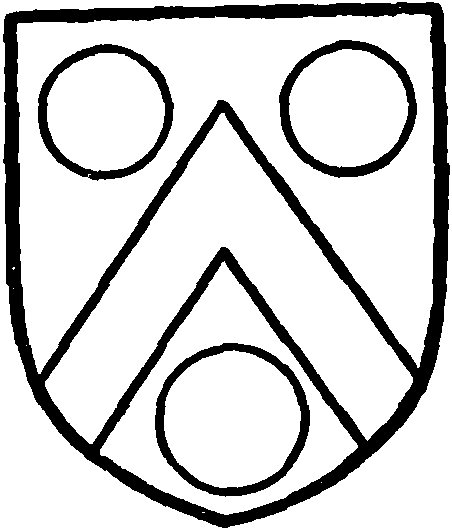
Baa. Gules a cheveron between three roundels argent.
The manor seems to have remained in the hands of trustees for some time. In 1426–7 one William Rotse surrendered his right in the manor to William Lochard and others, (fn. 64) and in 1430–1 Edmund Chertsey, son and heir of John Chertsey, released his right to Nicholas Dixon and others. (fn. 65) Probably these transactions were for the purpose of a mortgage to Thomas Gloucester, for the latter held courts at Baas from 1433 onwards, (fn. 66) although it does not seem to have been formally conveyed to him until 1438. It was then surrendered by William Chertsey and Lettice his wife. (fn. 67) Ten years later it was conveyed to John Say by John Edward and Joan his wife, (fn. 68) brother and sister-in-law of Thomas Gloucester. Sir John Say died seised of Baas in 1478 and was succeeded by his son William, (fn. 69) after whose death in 1529 it passed to his daughter Mary and her husband Henry Earl of Essex, (fn. 70) and thence to their daughter Anne, the wife of William Lord Parr, created Marquess of Northampton in 1547. (fn. 71) The marquess was attainted in 1553 and his lands forfeited. (fn. 72) Queen Mary granted the manor to the Earl of Arundel and others in 1553, to hold during pleasure, apparently to the use of Anne Marchioness of Northampton. (fn. 73) Elizabeth granted it in 1569 to Sir William Cecil, (fn. 74) who also obtained releases of title from Anne Parr (fn. 75) and other heirs of Sir William Say. (fn. 76) From that time Baas descended in the Cecil family (fn. 77) and eventually became amalgamated with the manor of Hoddesdonbury. It is mentioned separately as late as 1820. (fn. 78) Courts held at Baas are recorded from 1404 onwards. (fn. 79)
Hoddesdonbury
The manor of HODDESDONBURY seems to have been also formed of lands held of the fees of Mandeville and Richmond. Those held of the latter fee owed a service of a quarter of a knight's fee to the Earls of Richmond, 1s. 6d. rent for the ward of the castle of Richmond and the service of inclosing 11 perches of hedge belonging to Cheshunt Park. (fn. 80) The Mandeville fee descended to the Earls of Hereford through Maud, heiress of the Mandevilles, who married Henry de Bohun Earl of Hereford, who died in 1220. (fn. 81) A half fee in Hoddesdon remained in the hands of the Bohuns (fn. 82) until the death of the last Humphrey de Bohun in January 1372–3, (fn. 83) when it passed to his elder daughter Eleanor, who married Thomas of Woodstock Duke of Gloucester and died in 1399. (fn. 84) Eleanor left three daughters: Joan, who also died in 1399, (fn. 85) Isabel, who became a nun in 1402, and Anna, who married first Thomas Earl of Stafford and secondly his brother Edmund Earl of Stafford, (fn. 86) and inherited her sister's lands. At the death of Edmund in 1403 (fn. 87) a redistribution of the estates took place between the heirs of Eleanor and Mary, daughters of Humphrey de Bohun, and Hoddesdonbury fell to Mary's son and heir Henry, who ascended the throne as Henry V. The overlordship thus became vested in the Crown, and the view of frankpledge at Hoddesdon was granted by Henry VI to his mother Katharine in dower in 1422. (fn. 88) The rolls of the courts of the honour of Mandeville, parcel of the duchy of Lancaster, held there in 1539 and later are preserved at the Record Office. (fn. 89)
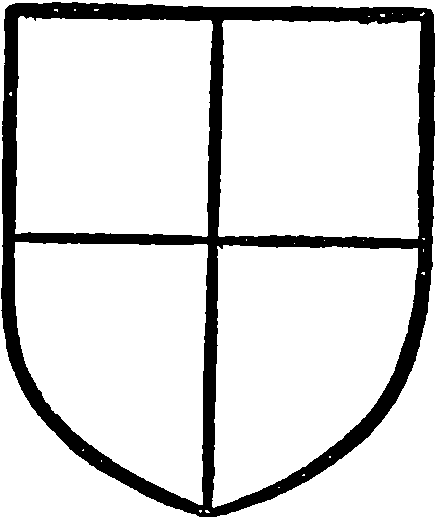
Mandeville. Quarterly or and gules.
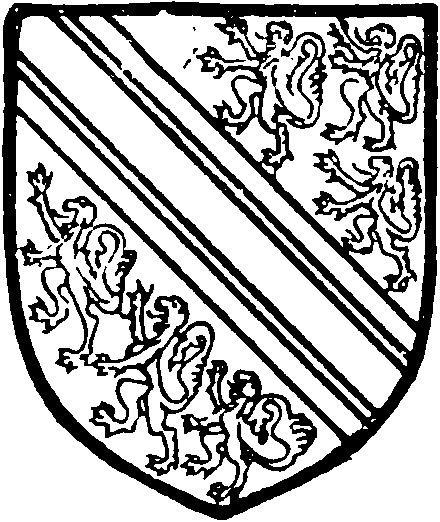
Bohun. Azure a bend or cotised argent between six lions or.
The sub-tenant of the Mandeville fee at Hoddesdon before the Conquest was Godid, and in 1086 it was held of Geoffrey de Mandeville by Ralph. (fn. 90) The next sub-tenants of whom there is record are the Bassingburn family, who probably acquired the manor towards the end of the 12th century. The first to be mentioned in Hoddesdon are Humphrey de Bassingburn and his mother Aubrey, who appear in 1242. (fn. 91) This Aubrey was probably identical with Aubrey the wife of John de Bassingburn, who was holding the manor of Woodhall in Hatfield in 1198. (fn. 92) Humphrey was apparently succeeded by another John de Bassingburn, (fn. 93) perhaps his brother John, who is mentioned in 1243. (fn. 94) John died about 1276, (fn. 95) and was succeeded by Stephen de Bassingburn, whose son John was in possession by 1301–2. (fn. 96) About 1323 Agnes de Bassingburn, mother of this John, died seised of Hoddesdon Manor, which she held for the term of her life 'from the inheritance of Agnes, daughter of John, son of the deceased Agnes.' (fn. 97) The granddaughter Agnes, who was aged five in 1323, may have been assigned the manor by her father, but in this case must have died young, for Stephen de Bassingburn, son of John, was holding Hoddesdon in 1333. Joan, widow of John de Bassingburn, was then holding a third in dower. (fn. 98)
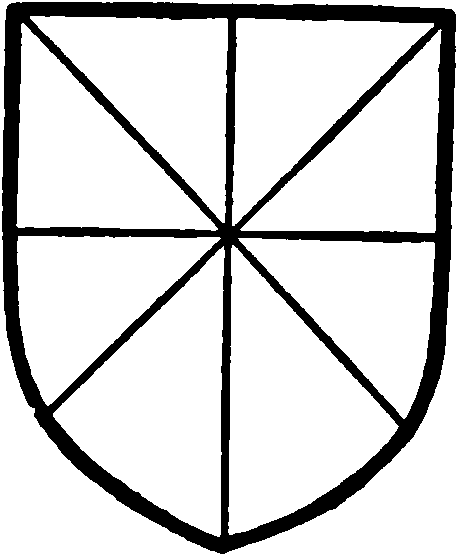
Bassingburn. Gyronny or and gules.
Later in the same century the manor was held by Thomas de Bassingburn. He was holding Astwick (in Hatfield) in 1370, and presumably Hoddesdon at the same time, for he is mentioned later as having held it. (fn. 99) He died before 1397, leaving an infant son John, whose wardship he had sold to Alexander Besford for 100 marks. The wardship was duly delivered to Alexander by Thomas Arundel, Archbishop of York, and Edward Earl of Rutland, but he afterwards entered into an agreement to deliver the child up to Ralph Hamelyn and Ralph son of Richard upon payment of 200 marks. A little later, however, in spite of this, Alexander granted the wardship of the infant John to Robert Whytington and others. The two Ralphs gave up the child to Robert's servants, but afterwards Ralph Hamelyn 'chased the servants and took away the child by force.' (fn. 100) In 1457 apparently another John de Bassingburn and Katherine his wife conveyed the manor of Hoddesdonbury to trustees, (fn. 101) probably for the purpose of a settlement, for John de Bassingburn was lord of the manor in 1477, and two of the same feoffees granted it to John's son Thomas Bassingburn and his wife Katherine in 1493. (fn. 102) In the following year Thomas Bassingburn conveyed Hoddesdonbury to Sir William Say, (fn. 103) his wife's brother. At the death of Sir William Say in 1529 the manor descended to his daughter Mary and her husband Henry Earl of Essex, (fn. 104) whose daughter and heir Anne Bourchier married William Parr, afterwards Marquess of Northampton. (fn. 105) Sir William Parr was attainted in 1553 and his lands forfeited to the Crown. The reversion of Hoddesdonbury after the expiration of a grant made in favour of Anne was granted by Queen Elizabeth in 1566 to Robert Earl of Leicester, (fn. 106) who in the following year conveyed it to Sir William Cecil, afterwards Lord Burghley, who obtained releases from the Marchioness of Northampton and other possible heirs of Sir John Say. (fn. 107) From him it passed to his second son Robert Cecil, (fn. 108) who was created Earl of Salisbury in 1605; it has since descended in that family, (fn. 109) the Marquess of Salisbury being the present lord of the manor.
Stephen de Bassingburn claimed a park in Hoddesdon in 1277 of ancient custom. (fn. 110) Hoddesdon Park Wood probably marks the site of it. Stephen de Bassingburn also claimed by charter of King John free warren, gallows, and waif. (fn. 111)
In 1533 Henry Earl of Essex petitioned for a licence to change the day of the fair at Hoddesdon, which, he said, would be 'a great ease for the inhabitants.' This evidently referred to the fair originally granted to Richard de Boxe in Hoddesdon in 1253 (see below). The date, that of the vigil, feast and morrow of St. Martin (in winter), 11 November, was changed to the vigil, day and morrow of the Translation of St. Martin in summer (3–5 July). (fn. 112) The charter of Queen Elizabeth granted two fairs to the corporation, one beginning on the vigil of St. Martin in winter (11 November) and the other on the vigil of St. Peter (29 June). (fn. 113) In 1792 the fair was held on 29 June as a toy fair, (fn. 114) and a pleasure fair is still held on 29 and 30 June. A market, to be held on Thursdays, originally granted to Richard de Boxe, (fn. 115) was also confirmed to Henry Earl of Essex at the same time as the fair. By Queen Elizabeth's charter the tolls (the ownership of which was said to be unknown) were granted to the corporation. The market is now held on Wednesdays.
In 1086 the manor received twenty-two eels from the weir. (fn. 116) A water-mill which it was hardly possible to use except in winter is mentioned in 1323. (fn. 117) In 1277 Stephen de Bassingburn was expected to provide a bridge in Rutholm, 16 ft. by 6 ft. (fn. 118) In 1656 it was presented that the town of Hoddesdon was destitute of stocks, and that the parishioners of Broxbourne ought to provide them. (fn. 119)
Another manor of Hoddesdon may perhaps be identical with a hide in Hoddesdon held before the Conquest by Asgar the Staller, later by Ingelric, and in 1086 by Count Eustace of Boulogne. (fn. 120) The sub-tenant of Asgar the Staller in this hide was Godid, but it was given soon after the Conquest to the canons of St. Martin-le-Grand, London, probably by Ingelric, their founder, predecessor of Count Eustace, of whom the canons held it in 1086. (fn. 121) It had been confirmed to them by William the Conqueror in the second year of his reign. (fn. 122) The church still had demesne lands in Hoddesdon in 1290, when the dean, William de Luda, had licence to stock his park there from the forest of Essex, (fn. 123) but probably most of their lands had been already granted in sub-fee, for in 1287 (fn. 124) certain privileges exercised by the canons in their lands were claimed by John le Sarmonner, who was apparently holding under them. The hide was confirmed to them as late as 1422–3, and at the end of the 15th century suit was still owed to the leet of St. Martin by tenants in Hoddesdon. (fn. 125)
The earliest sub-tenants of the manor apparently were a family of Boxe, who took their name from Boxe in Walkern and Stevenage and who held that manor. Alan de Boxe, nephew of a Hugh de Boxe, is mentioned as holding land in Hoddesdon in 1198. (fn. 126) In 1253 Richard de Boxe had a grant of free warren in his demesne lands of Boxe (i.e. Boxe in Walkern) and Hoddesdon and a weekly market on Thursdays at Hoddesdon and a yearly fair on the vigil, feast and morrow of St. Martin (11 November). (fn. 127) In 1256 he had licence to inclose and build on a space of ground between the two high roads and the cross of Hoddesdon. (fn. 128) He was apparently succeeded by John le Summoner or Sarmonner, who is mentioned in Hoddesdon in 1276, (fn. 129) and in 1287 claimed view of frankpledge and assize of bread and ale at Hoddesdon as among the liberties belonging to the Dean and canons of St. Martin's, London (see above). He was living in 1290, (fn. 130) but before 1303 his lands seem to have been divided between heirs. These were apparently Thomas Langton and Richard de St. Edmund, then both minors. (fn. 131) In 1307 Mabel widow of Thomas de Langton conveyed her share of the manor to Robert de Langton, clerk, probably for a settlement. (fn. 132) This part of the manor continued as the manor of Langtons, whilst the part of Richard de St. Edmund, which seems to have descended to an heiress Margery wife of Ralph de Foxton, (fn. 133) became known as Foxtons.
Langtons
The part of the manor known as LANGTONS descended to John de Langton, (fn. 134) who was son of Robert de Langton, and may have been nephew of Thomas and Mabel. (fn. 135) From John de Langton it descended to his daughter and heir Alice wife of Sir Robert Corbet, whose only child Agnes married John Halle, citizen and goldsmith of London. In 1429 John and Agnes conveyed one year's rent of 60s. from lands in Hoddesdon called 'Langtonnesland' to Richard Benyngton and William Burton. (fn. 136) In the same year the 'manor' of Langtons was acquired by Thomas Gloucester, who held courts there from that year until about 1442. (fn. 137) It then came into the hands of John Edward, brother of Thomas Gloucester, and Joan his wife, and they conveyed it in 1448 to Sir John Say, (fn. 138) who in 1468 obtained an inspeximus of the grant of free warren and the market and fair granted to Richard de Boxe. (fn. 139) He died seised of it in 1478. (fn. 140) His son and heir Sir William Say became lord of the manor of Hoddesdonbury, (fn. 141) in which this small estate seems to have afterwards become absorbed.
Foxtons
The quarter fee of FOXTONS, held in 1325 by Ralph de Foxton in right of Margery his wife, (fn. 142) had come into the same hands as Langtons by 1380, (fn. 143) and follows the same descent. (fn. 144)
Boxes
The manor of BOXES was a part of the holding of the Boxe family, which seems to have become separated from the larger holdings in the divisions of the 14th century. In 1376 a messuage and 30 acres called 'Le Boxes' with rents and services in Hoddesdon were held by Simon son of Imbert. (fn. 145) After his death these tenements were acquired by the Langtons (fn. 146) and thenceforth descended with their manor. (fn. 147) In the inquisition on William Say in 1529 it is mentioned as the manor of Boxes. (fn. 148)
Marions
MARIONS formed part of the lands of the Knights Hospitallers, (fn. 149) to whom a rent was payable from the manor. Under the Hospitallers the manor was held in the 15th century by John Edward and Joan his wife, who conveyed it to Sir John Say in 1448, together with Langtons and Foxtons and other manors, (fn. 150) whose descent it follows. Maryons Manor House stood west of the high road above Spital Brook. (fn. 151)
Halle or Halles
The 'manor' of HALLE or HALLES was another holding in Hoddesdon which by the 14th century had given its name to a family of Halle. Richard and John atte Halle were holding lands in Hoddesdon of the manor of Great Amwell at the end of the 14th century. (fn. 152) There is a rental of the manor made in the reign of Henry VI. (fn. 153) In 1448 it was in the possession of John Edward and Joan his wife. They conveyed it in that year to Sir John Say, (fn. 154) and it followed the same descent as the above manors. (fn. 155)
Geddings
The manor of GEDDINGS probably formed part of the berewick of Hoddesdon, which was originally appurtenant to the manor of Hatfield Broadoak in Essex, (fn. 156) and which in 1086 seems to have been included in the manor of Great Amwell, then held by Ralph de Limesi. (fn. 157) With that manor (q.v.) it came into the possession of the Abbot of Westminster. Lands in Hoddesdon were held under the abbot in the 13th century by a family of Gedding. William de Gedding is mentioned at Hoddesdon during the abbacy of Richard of Ware, (fn. 158) who held that office from 1258 to 1283. (fn. 159) A Richard de Gedding is mentioned in Hertfordshire in 1287. In 1327 Edmund de Gedding received a grant of free warren in his demesne lands of Amwell and Hoddesdon. (fn. 160) He died before 1331, when the wardship of Robert de Gedding, son and heir of Edmund, was granted by the Abbot of Westminster to Richard and William of Hailey. (fn. 161) In 1332 Beatrice widow of Edmund de Gedding was assigned in dower one-third of a messuage in Hoddesdon. (fn. 162) Robert son of Robert de Gedding was returned as holding a fourth of the vill of Amwell by half a knight's fee in the latter part of the 14th century, (fn. 163) and this must have included his lands in Hoddesdon. In 1378 Reynbroun de Gedding, son of Robert, conveyed a messuage, 300 acres of arable, 25 acres of meadow, 6 acres of pasture and 40 acres of wood and 100s. rent in Hoddesdon to Philip de Melreth, clerk, and his heirs. (fn. 164) In the next century these lands were in the possession of Edward Chertsey, who in 1430–1 granted them as the manor of Geddings to Nicholas Dixon and others, (fn. 165) after which the manor follows the same descent as the manor of Baas (q.v.).
Bernardes or Barnetts
The reputed manor or tenement of BERNARDES or BARNETTS belonged about the middle of the 16th century to the family of Castell. Thomas son of Dorothy Castell mortgaged Bernardes about 1559 to Henry Brograve, who sold the property to William Frankland of London. (fn. 166) In 1582 William and Hugh Frankland (for this family see Thele Manor in Stanstead St. Margaret's) conveyed the 'manor,' then called Barnetts, to Bernard Dewhurst and Thomas Bennett. (fn. 167) Within the next ten years the two latter sold it to Sir William Cecil, lord of the manor of Geddings, (fn. 168) after which it follows the same descent as that manor. (fn. 169)
Hoddesdon
Before the Conquest nearly 6 hides in HODDESDON (Odesdone, Dodesdone) were held by Gode of Queen Edith, wife of Harold, as two manors. (fn. 170) In 1086 the larger of these, assessed at 3¾ hides, was held by Edward the Sheriff of Salisbury. (fn. 171) The other, of the extent of 2 hides, was held of the king by Peter, a burgess. The latter was evidently identical with the Peter of St. Olave, Southwark, who in 1096 gave his lands at Hoddesdon to the monks of Bermondsey. (fn. 172)
About 1180 these lands or part of them seem to have been held by Robert de Hurtford in chief, for in that year he is entered as owing 2 marks for 3 hides in Hoddesdon, (fn. 173) and in the following year the same amount for 2 hides, of which he had 'not yet had right.' (fn. 174) He died three years later without having obtained it. (fn. 175) In 1210–12 Simon son of Gilbert held a quarter fee in Hoddesdon of the king in chief, (fn. 176) which perhaps represents this estate.
Rectory Manor
The RECTORY MANOR of Broxbourne was held with the church by the Bishops of London, (fn. 177) who seem to have generally farmed it out. (fn. 178) In 1651 the rectory and glebe lands were sold by the trustees for the sale of bishops' lands to Edmund Lewin and his heirs for £522. (fn. 179) The Bishop of London regained it at the Restoration, and in 1728 it was leased to the lord of the manor, (fn. 180) and was probably acquired by him together with the advowson in 1868.
CHURCHES
St. Augustine
The church of ST. AUGUSTINE stands a little to the east of the village. It consists of chancel 35 ft. by 17ft., north and south chapels, each 34 ft. by 10 ft., nave 68ft. 6 in. by 17ft., north and south aisles, each 69ft. by 10 ft., vestry, with upper room, adjoining the north chapel, south porch and west tower, all internal dimensions.
The church was entirely rebuilt and enlarged in the 15th century, and no detail now remains of the former nave and chancel, which appear to have been added to from time to time. The north aisle was the earliest addition, then the two east bays of the south aisle and the west bay of the south chapel; shortly afterwards the south aisle was extended westwards the full length of the nave and the south chapel eastwards to the east wall of the chancel; the west tower was erected about the close of the 15th century, the north chapel and vestry are dated 1522, and the south porch was added in the early 17th century.
The walls are of flint rubble, except the north chapel and vestry, which are faced without and within with squared limestone ashlar. The nave and chancel roofs are tiled, the others lead-covered.
In the east wall of the chancel is a 15th-century window of three cinquefoiled lights with traceried head; hidden behind the table of the Commandments on the north side of the window are some remains of the splayed jamb of an earlier window; on each side of the chancel is an arcade of two bays with arches of two moulded orders and jambs of four engaged shafts with moulded capitals and bases.
The north chapel east window is of three cinquefoiled lights with traceried head under a four-centred arch; in the north wall are two similar windows with the door to the vestry between them. The doorway has a splayed four-centred arch and jambs, and retains its original oak door and ironwork. In the east wall of the vestry are two small recesses under four-centred arches; in each of the north and west walls is a small two-light window under a square head; in the chamber over the vestry are two similar windows; a third window, now blocked, opened into the church. The north chapel and vestry, both built in 1522, have an ornamental parapet carried round outside on which is carved the inscription 'Pray for the welfayr of Syr Wylyam Say knyght wych fodyd yis chapel in honor a ye trenete the yere of our Lord God 1522.' Stags' heads and traceried panels with the arms of Say are carried at intervals above the parapet; the upper parts of the panelled and crocketed buttresses are set diagonally.
The south chapel has a two-light window with traceried head in the east wall and two traceried windows of three lights under four-centred arches in the south wall; the junction between the earlier and later 15th-century work can be seen outside. In the south wall between the windows is a large recess for a tomb under a four-centred arch, with moulded jambs and arch. In the same wall is a piscina belonging to the earlier portion of the chapel, partially destroyed by the later tomb recess; the jambs of the piscina are moulded and have a ballflower ornament. The four bays on either side of the nave are continuations of the arcades between chancel and chapels, and their detail is similar, though they are somewhat earlier in date. At the east end of the north wall of the north aisle is a semi-octagonal stair turret projecting on the outside leading to the rood-loft and roof over the aisle; the doorway to the rood-loft is blocked. In the north wall of the aisle are four windows, each of two cinquefoiled lights with traceried head under a pointed arch; the external stonework has been renewed. In the west wall is a splayed loop light. In the south wall of the south aisle are four windows similar to those in the north aisle; there is no window in the west wall. The south doorway has continuously moulded jambs and four-centred arch. In the east jamb of the doorway, in the porch, are remains of a roughly executed stoup, and in the south aisle, a little to the east of the doorway, is a plain recess, probably for a stoup. The south porch has a semicircular arched doorway with flanking pilasters and pediment over, and above is a shield charged with arms.
The roofs over the chancel and chapels have flat panelled ceilings of early 16th-century date; those over the nave and aisles are of the 15th century, but have been much restored. Over the east end of the nave is a painted inscription recording that the ceiling and decoration of the chancel roof was done by John Bryce.
The west tower is of three stages and is buttressed; at the south-west angle is a turret staircase; both tower and turret are finished with embattled parapets. The four-centred tower arch is of two moulded orders; the jambs have engaged shafts with moulded capitals and bases. The west doorway has a two-centred arch under a square head with traceried spandrels. The west window is of four cinquefoiled lights with tracery under a two-centred arch; the stonework is much decayed. On the north and south faces of the second stage of the tower are narrow trefoiled lights with square heads; on the west is a clock face. The belfry windows are of two cinquefoiled lights under square heads.
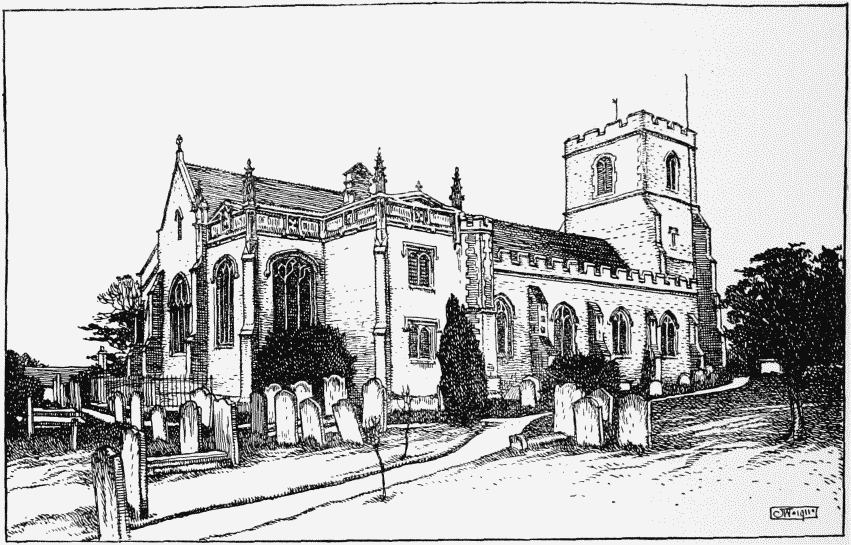
Broxbourne Church from the North-east
The font has an octagonal bowl of Purbeck marble, on each face of which are two plain sunk panels with round heads; the bowl rests ory a circular shaft with eight smaller ones under the angles of the octagon; the shafts have moulded bases and stand on a plain octagonal plinth; it is of late 12th-century date. In the chamber over the north vestry are two oak chests, one belonging to the 14th, the other to the 17th century. In the south-east window of the south chapel is some 15th-century heraldic glass.

Say of Broxbourne. Party azure and gules three cheverons or voided party gules and azure.
On the south side of the chancel is the Purbeck marble altar-tomb of Sir John Say and his wife, dated 1473. The sides of the plinth are panelled and traceried panels, three of which contain shields which retain some of their original colouring. On the moulded slab are fine brasses of the knight and the lady; the knight is in plate armour with surcoat charged with his arms, the figure is now headless. The lady wears a sideless surcoat and a mantle charged with her arms. The figures are elaborately engraved and retain much of the original coloured enamelling. Two shields still remain with the arms of Say, and a brass inscription, parts of which are missing, runs round the margin. On the north side of the chancel is the altar-tomb of Sir William Say, the builder of the north chapel; it is of early 16th-century date. The plinth is ornamented with square moulded and cusped panels set diagonally, in which are shields bearing indents of missing brass figures. On the plinth is a slab of Purbeck marble. Above the tomb, supported on octagonal columns, is a canopy, the soffit carved with pendants and fan vaulting; under the east end is a slab with indents of a knight and a lady. In the south chapel is the tomb of Sir Henry Cock and his wife, 1609, with recumbent effigies, in alabaster, under a semicircular canopy with panelled soffit over which is the achievement of arms; on the plinth below are the kneeling figures of two daughters and their children. In the chancel is a mural monument to William Gamble alias Bowyer, 1646, with inscription and arms. In the north chapel is a mural monument to Sir R. Skeffington, 1646, and another to John Baylie, 1609. There are several 17th-century floor slabs to members of the Monson and Rawdon families; in the south aisle is a tablet in memory of John Loudon McAdam, the great road maker, who was buried at Moffat in 1836.
On the chancel floor is the brass of a priest in chasuble and holding a chalice; it is without inscription, but is of late 15th-century date; another of a priest in cassock and amice is also without inscription. At the corners are symbols of the Evangelists, and part of an inscribed scroll remains; it belongs to the early 16th century. In the nave are indents of a knight and a lady; a portion of the knight's figure remains. In the centre of the nave is a shield, vair bordered crusilly, and dated 1630; also the brass of a knight clad in armour and holding a mace, said to be that of John Barrell, serjeant-at-arms to Henry VIII. This brass was recovered from Roding in Essex in 1892.
There are eight bells: the treble, second, third and sixth are dated 1903; the fourth, fifth and seventh by Robert Oldfeild, 1615, and the eighth by John Hodson, 1670.
The communion plate consists of cup and cover paten, 1606, a paten, 1633, a cup and cover paten, 1824, and two flagons.
The registers before 1812 are as follows: (i) baptisms, burials and marriages from 1688 to 1741; (ii) baptisms and burials from 1741 to 1812, marriages 1741 to 1754; (iii) marriages from 1754 to 1812.
St. Paul
The church of ST. PAUL, Hoddesdon, near the centre of the town, was built in 1732 and repaired in 1822 and 1849; in 1865 the building was enlarged by the addition of a chancel with north and south chapels or aisles; in 1888 the brick tower and spire were added. It now consists of chancel 35 ft. 6 in. by 21 ft., north and south chapels or aisles, each 34 ft. by 19 ft., nave 61 ft. 6 in. by 31 ft., vestry and semi-detached tower, east of the south nave wall; all the dimensions are internal. The church is built of brick with stone dressings. There are eight bells in the tower hung in 1901. The plate consists of three chalices, two patens and a flagon, all modern.
ADVOWSONS
The advowson of the church of St. Augustine originally belonged to the lords of the manor of Broxbourne and was granted together with that manor to the Knights Hospitallers by Robert Earl of Leicester. (fn. 181) In 1190, however, Garner of Naples, Prior of the Hospitallers, granted the church of Broxbourne to the Bishop of London for a yearly payment of 4 marks. (fn. 182) The advowson remained in the hands of the Bishops of London until 1852, when it was transferred to the Bishop of Rochester. (fn. 183) In 1868 it was acquired by Mr. Smith-Bosanquer, lord of the manor, (fn. 184) and is now in the hands of trustees.
Sir John Say left 200 marks in 1478 for a priest to sing mass for his soul for twenty years, (fn. 185) and his son Sir William Say built the chapel of our Lady within the parish church of Broxbourne as a chantry for his family (see above). He also left to the chapel a chalice of silver gilt and 'a payer of cruets of silver parcel gilt with other ornaments as shall be necessary for the chapel.' The salary of the priest belonging to the chapel was to be paid out of Sir William's lordship of Bengeo. (fn. 186) In 1578 it was reported that until about thirty-three years before two priests had been accustomed to sing mass in 'Sir William Saye's chapel,' and received £10 a year for it. It was also stated that until thirty-five or thirty-six years before 'there was usually set up a hearse in the midst of the church, furnished with lights and torches, and bells were rung.' (fn. 187)
There was a chapel at Hoddesdon in the 14th century which seems to have been appurtenant to the manor of Hoddesdon. It was the subject of a dispute in 1242–3 between Alexander de Swereford, Treasurer of St. Paul's, and Humphrey and John de Bassingburn. (fn. 188) Alexander acknowledged the right of the Bassingburns to the advowson, and Humphrey and John granted that the chapel should be moved back to its former situation by the side of the road which led to the court of Alexander de Swereford and near to the court of Humphrey de Bassingburn. Humphrey and John also agreed to supply a chaplain to celebrate service daily for their souls and that of Alexander and of their ancestors, and they confirmed all lands previously belonging to the chapel. (fn. 189) This chapel seems to have fallen into disuse, for in 1336 William de la Marche obtained licence to build a chapel in honour of St. Catherine on a 'void place' in Hoddesdon, 30 ft. by 20 ft., and to alienate it in mortmain when built to a chaplain or religious man. (fn. 190) In the time of Henry IV witnesses declared that the chapel lay in the parish of Great Amwell, (fn. 191) and in 1650 it was said to be partly in Amwell and partly in Broxbourne. It was then suggested that it could be conveniently constituted a parish church for Hoddesdon (fn. 192); the suggestion, however, was not carried out. At the end of the 17th century the chapel was pulled down, with the exception of the clock-tower, which remained until about 1836. (fn. 193)
In 1844 the parish of St. Paul, Hoddesdon, was formed as a consolidated chapelry out of Broxbourne and Great Amwell. (fn. 194) The living is a vicarage, and the patronage goes with that of Broxbourne. (fn. 195) There is a mission church at Rye Park, served from the parish church.
The priory of St. Monica at Hoddesdon is now used as a convent of the order of Canonesses Regular of St. Augustine. (fn. 196) There are also Congregational, Wesleyan, and Baptist chapels there, as well as meeting places of the Society of Friends (fn. 197) and Plymouth Brethren. Meeting-places for Protestant Dissenters were certified in Broxbourne in 1813, and at Hoddesdon in 1689, 1691, 1692, 1704 and 1821. (fn. 198)
CHARITIES
Broxbourne: The Free school, founded in 1667 by will of Sir Richard Lucy, bart. (fn. 199)
The Girls' school at Baas Hill. (fn. 200)
The following eleemosynary charities are regulated by scheme of the Charity Commissioners 3 October 1899. They comprise the charities of:
(1) Lady Lucy, gift about 1676, consisting of 4 a. or. 29 p., situate at Roydon, of the annual letting value of £6.
(2) Roger Marsh, deed, 1635, being a rentcharge of £2 4s. 5d. issuing out of Hailey Hall estates in Great Amwell.
(3) William Purvey, will, proved in 1617, being a rent-charge of 3s. 4d. out of Wormley Bury estates.
(4) George Swaine, will, proved in 1829; trust fund £125 consols, with the official trustees, producing £3 2s. 4d. yearly; and
(5) William Thorowgood, will, proved 25 February 1603, being a yearly sum of £1 4s. issuing out of Hoddesdon vicarage.
In 1909 the income was applied as to £1 in surgical aid, £5 towards coal and clothing clubs, £2 in money gifts and the balance in the distribution of calico and bread.
The ecclesiastical charity of William Thorowgood consists of £107 13s. 5d. consols, in the names of the Rev. John Salwey and two others, producing £2 13s. 8d. yearly, representing the redemption of an annuity of £2 to the vicar for preaching six sermons, and an annuity of 16s. for repairing the windows in the church.
The almshouses erected by Dame Letitia Monson for six poor widows, and endowed by her will, dated in 1729, are regulated by a scheme of the Charity Commissioners 6 January 1888. The present endowment consists of £2,663 6s. 9d. Bank of England stock, which produced in 1909 £254 10s. 11d., and a sum of £519 10s. 9d. consols, producing £12 19s. 8d. yearly; the former sum of stock is standing in the name of the Paymaster-General in the High Court of Justice, and the latter is held by the official trustees.
In 1909–10 the sum of £163 16s. was paid to nine inmates, £7 4s. 9d. for gowns, £34 9s. for wood and coal, 5s. to the vicar for gloves and £10 for prayers and services.
The charity of Catherine Augusta Baroness of Sternberg, founded by will, proved in 1859, consists of £504 16s. 1d. consols, with the official trustees, producing £12 12s. 4d. yearly, which is in pursuance of a scheme of the Charity Commissioners 10 February 1882, applied for the benefit of the poor by the district visitors.
The Cecilia Smith-Bosanquet Memorial Trust, founded by deed 15 December 1904, for providing a nurse for the sick poor, is endowed with £2,500 New South Wales 3½ per cent. stock, with the official trustees, producing £87 10s. yearly. The official trustees also hold a sum of £100 2½ per cent. stock, arising from the sale in 1891 of land known as the Clock Half-acre, the income of which is applicable for the winding, &c., of the church clock.
Hoddesdon: The following eleemosynary charities are regulated by scheme of the Charity Commissioners 3 October 1899. They comprise the charities of:
(1) Lynch Mill Corner, founded by an agreement, dated 21 April 1679, in consideration of the inclosure of certain Lammas land, being a yearly sum of £2 15s.
(2) Roger Marsh, by deed, 1635, being a rentcharge of £4 8s. 11d. issuing out of Hailey Hall estates in Great Amwell.
(3) William Purvey, will, proved in 1617, being a rent-charge of 10s. out of Wormley Bury estates.
(4) George Swaine, will, proved in 1829, trust fund, £375 consols, with the official trustees, producing £9 7s. 4d. yearly.
(5) William Thorowgood, will, proved 25 February 1603, being a yearly sum of £4 issuing out of the land now occupied by Hoddesdon vicarage, for distribution of bread.
(6) William Thorowgood, for distribution of beef and bread, consisting of a rent-charge of £4 4s. issuing out of Balls Park, near Hertford.
(7) Unknown donor—but stated in the Parliamentary returns of 1786 to have been given by Lady Oxendon in 1635—being a yearly sum of £1 6s. 8d. issuing out of the Grange, Hoddesdon.
In 1909 the sum of £4 was paid to the clothing and coal clubs, £1 to the dispensary and £25 applied in the distribution of meat and bread to 220 recipients.
In 1818 Easter Jones purchased land and erected a school thereon for girls, and endowed the same with £1,000 consols.
The income of a sum of £450 consols, the gift of — Game, is also applicable for educational purposes.
The Priscilla Manser Fund consists of £508 12s. Local Loans 3 per cent. stock and £400 East Indian Railway 3 per cent. stock, in the names of Robert Barclay and four others, producing £27 5s. yearly.
In 1907 £11 14s. was paid to three inmates of the homes, and the balance added to the fund for their upkeep.
Samuel Dunn's Charity for the organist is endowed with a piece of meadow land near Hoddesdon, let at £4 a year.
In 1910 William Alfred Pryor, by his will, proved at London 12 October, left £50, now represented by £60 Great Northern Railway 3 per cent. stock, the annual dividends, amounting to £1 16s., to be applied for the benefit of the poor of the Congregational church.
Hoddesdon, St. Catherine: In 1885 George Ringrose, by his will, proved at London 25 September, left a legacy, now represented by £90 11s. 4d. consols, with the official trustees, the annual dividends, amounting to £2 5s., to be distributed to the poor in coal, bread, or money.