A History of the County of Hertford: Volume 3. Originally published by Victoria County History, London, 1912.
This free content was digitised by double rekeying. All rights reserved.
'Parishes: Tewin', in A History of the County of Hertford: Volume 3, ed. William Page (London, 1912), British History Online https://www.british-history.ac.uk/vch/herts/vol3/pp480-487 [accessed 1 May 2025].
'Parishes: Tewin', in A History of the County of Hertford: Volume 3. Edited by William Page (London, 1912), British History Online, accessed May 1, 2025, https://www.british-history.ac.uk/vch/herts/vol3/pp480-487.
"Parishes: Tewin". A History of the County of Hertford: Volume 3. Ed. William Page (London, 1912), British History Online. Web. 1 May 2025. https://www.british-history.ac.uk/vch/herts/vol3/pp480-487.
In this section
TEWIN
Tewinge (xi cent.); Thewinge, Tywyng (xiii cent.); Tewinge, Tuyng (xvi cent.).
The parish of Tewin has an area of 2,694 acres, of which 1,305 acres are arable land and 537 acres permanent grass. (fn. 1) The valley of the Maran or Mimram crosses the centre of the parish from west to east. The ground there is about 170 ft. above the ordnance datum, and rises to the south to 266 ft. and towards the north to 400 ft. The main road from Hitchin to Hertford runs parallel to the river, and to the north of this on the high ground the village is situated, connected with it by a branch road. The village of Tewin is in two parts, the most southerly portion, known as Lower Green, being grouped round a triangular green where three roads meet. On the west side of the green is the parish room, and on the south are the post office and the school. The cottages surrounding the green are of the 18th and 19th centuries. The Rose and Crown Inn is a small brick building of mid-18th-century date retaining internally some plain panelling. The rectory and church are situated still further south towards the river. The rectory is a brick house of 18th-century date. On the east side is part of a former house which dates from the 17th century; it is timber-framed and covered with plaster; part of the chimney stack is original; the roofs are tiled. There is some 17th-century panelling in one of the upper rooms, and in the kitchen is a wide fireplace with a recess on one side. Adjoining the house is a 17th-century barn, timber-framed and weatherboarded, the roof of which is thatched. The stable, which is built of timber and brick, appears to date from the same period. The other portion of the village, known as Upper Green, lies a short distance north of the main part, where the road forks to right and left. That to the left leads to Burnham Green (in Datchworth), while the right-hand road leads past Tewin Hill to Queenhoo Hall, the residence of Sir Clement Lloyd Hill, K.C.B., K.C.M.G., M.P, in the north-east of the parish.
To the south of the village at Archer's Green the river is fordable. Further east a new bridge has lately replaced the old wooden one which carried the path leading to Marden Hill, now the residence of Sir Henry J. Lowndes Graham, M.A., K.C.B., and Lady Margaret Graham.
A road also turns south from the main road to Attimore Hall, in the south-west of the parish. Tewinbury, a farm-house rebuilt of brick in the first half of the 19th century, lies a short distance south of the church. Tewin Water, lying further to the west and surrounded by a park, is the residence of Mr. Otto Beit.
The subsoil of the parish is chiefly chalk, with a little London Clay and Woolwich and Reading Beds in the north. There are many disused chalk-pits in the parish and an old sand-pit not far from the rectory.
The nearest railway station is Welwyn, 2 miles north-west, on the Great Northern main line.
Place-names which occur in Tewin are Muspratts, Westlie Wood, Post Lane, Gore Croft, Wadling, Swannell Grove, Punchehed Coppyes, Phipkins Mare, Bushylees, Rayfield and the Bratches.
MANORS
Tewin
In the time of King Edward the Confessor TEWIN was held by Aldene, a thegn of the king. After the Conquest, according to the statement of Aldene himself, King William regranted the manor to him and his mother 'for the soul of his son Richard.' (fn. 2) This was William's second son, 'who was cut off in the New Forest by a sudden and mysterious stroke while the wearied stag was fleeing for its life before him.' (fn. 3) Peter de Valognes the sheriff, however, maintained in 1086 that he held the manor of the gift of the king, and Aldene is recorded as holding it of him. It was then assessed at 5½ hides. (fn. 4)
The overlordship of Tewin descended in the Valognes family, and, being apportioned about 1240 to the youngest of the co-heirs Isabel Comyn, followed the descent of the manor of Sacombe in Broadwater Hundred (fn. 5) (q.v.).
By 1166 the lands of Aldene had become divided into two half-fees held respectively by Godfrey and Brian de Tewin. (fn. 6) Godfrey de Tewin's half-fee, which seems to be the manor of Tewin, descended to his son Richard before 1211, (fn. 7) and to Godfrey de Tewin, son of Richard, (fn. 8) by 1246. (fn. 9) This Godfrey de Tewin granted his lands or a part of them to Alexander de Swereford, baron of the Exchequer and treasurer of St. Paul's, apparently that he might grant them to the Prior and convent of St. Bartholomew, Smithfield. Godfrey confirmed them to the prior upon the death of Alexander, (fn. 10) and died leaving two sons, John, who was mesne lord of the manor in 1279 (fn. 11) and left a widow Amabel, and Guy, to whom the lands held by Amabel in dower reverted at her death. (fn. 12) This mesne overlordship seems to have died out on the death of Guy, for in 1303 the half-fee was held immediately of John Comyn by John Godefrei, Prior of St. Bartholomew, Roger de Louth, John de la Penne, and John the chaplain (Capellanus). (fn. 13) In 1347 the portion of Roger de Louth was conveyed to the prior by Richard de Burton and Roger de Creton. (fn. 14) In 1428 the half-fee was held by the prior and his coparceners. (fn. 15)
The manor of Tewin was entered among the possessions of the monastery in 1540, the farm of it amounting to £20. (fn. 16) Upon the dissolution of the priory in that year the manor was granted for life to Robert Fuller, the late prior, (fn. 17) who evidently did not long survive, for in 1544 it was granted in fee to John Cock of Broxbourne. (fn. 18) John, however, in the same year conveyed Tewin to his brother-in-law Thomas Wrothe and Mary his wife. (fn. 19) Sir Thomas Wrothe died in 1572–3, leaving the manor to his widow Mary for life, with successive remainders to his son Robert and his younger sons. Robert died in 1606, having settled Tewin upon his son Robert upon his marriage with Mary daughter of Robert Lord Sydney of Penshurst. (fn. 20) Robert the younger was succeeded before 1617 by John Wrothe, (fn. 21) who sold the manor in 1620 to Beckingham Butler. (fn. 22) The latter mortgaged the capital messuage in 1622 to John Manyngham, who died in the same year, leaving a son Richard. (fn. 23) The Butlers are said to have conveyed the manor soon after to Richard Hale, who sold it to William second Earl of Salisbury. (fn. 24) From the latter it descended to his younger son William, who was holding it with his son Robert in 1687. (fn. 25) Robert's son William (fn. 26) sold Tewin to James Fleet, who was in possession in 1728 (fn. 27) and died in 1733. (fn. 28) He left the manor and capital messuage of Tewin Water, which he had 'repaired and beautyfyed' (after the death of his wife), to his great-nephew John Bull, with remainder to his brothers. (fn. 29) In 1746 the manor was held by Edmund Bull, (fn. 30) presumably one of these brothers. Later the reversion of the manor was sold to George third Earl Cowper, (fn. 31) in whose family it has since remained, (fn. 32) Katrine Cecilia Countess Cowper, widow of the seventh earl, being the present lady of the manor.
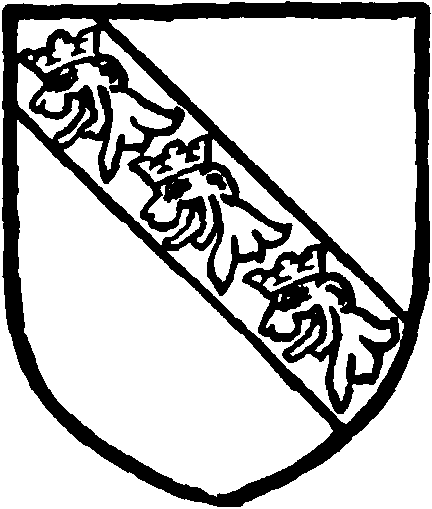
Wrothe. Argent a bend sable with three lions' heads razed argent having golden crowns.
In 1278 the Prior of St. Bartholomew, Smithfield, claimed in Tewin, as in his other lands, sac and soc, thol and theam, flemenesfrith, frithsoken, mundbriche, miskennig, utlop (utlagh ?), wesgeldethef and hamsoken in breach of the peace, arson and bloodshed. He also claimed to be quit of tolls, sheriff's aid and shire and hundred courts, and to have view of frankpledge. (fn. 33) In 1287 he claimed and was allowed utfangentheof, infangentheof, flemenesfrith, gallows, amendment of the assize of bread and ale, and view of frankpledge. (fn. 34) Court leet and view of frankpledge were included in the grant to John Cock in 1544. (fn. 35) In 1086 there was one mill in Tewin, (fn. 36) which was later given with the manor to St. Bartholomew, Smithfield. (fn. 37) In 1368 two are mentioned, perhaps both under the same roof, for they were called 'la Solo.' (fn. 38) They were granted with the manor to John Cock in 1544. (fn. 39) The mill, which was on the River Mimram, was pulled down in 1911.
The half-fee held of Robert de Valognes in 1166 by Brian de Tewin (fn. 40) presumably descended to his son Ralph before 1211. (fn. 41) Later it seems to have been held by Eudo de Hameley. (fn. 42) If this is the halffee in Tewin which afterwards appears among the possessions of Aymer de Valence, (fn. 43) it must have been assigned by Henry de Maule, co-heir of the Valognes barony, to Agnes de Valence with the manor of Hertingfordbury. After the death of Aymer de Valence this half-fee was assigned in 1326 to David de Strabolgi and his wife Joan, (fn. 44) niece and co-heir of Aymer de Valence. David de Strabolgi, grandson of the above, died seised of it in 1375, leaving no male heirs. (fn. 45) Some time before 1323 this estate had been given to the priory of St. Mary at Little Wymondley, (fn. 46) who held it of Aymer de Valence and the Strabolgis. It remained in the possession of Wymondley until the middle of the 16th century, and in 1520 was leased by them for fifty years to Roger Wrenne, a weaver of Tewin, and Christine his wife. (fn. 47) At the dissolution of the priory the reversion of this lease was granted to James Needham, (fn. 48) together with the site of the priory. In 1537–8 the value of the property was £3 17s. 4d. (fn. 49)
A quarter-fee in Tewin, which again may represent the holding of Brian de Tewin, was held in 1303 by Robert de Kersebroc. (fn. 50) It had perhaps been previously possessed by John de Kersebroc, who is mentioned in Tewin at the beginning of the 13th century. (fn. 51) Robert de Kersebroc had a son Henry who was living in 1331, (fn. 52) but nothing more is known of his family.
In the 14th century another manor of Tewin appears which was held of the lords of Walkern (Broadwater Hundred). This in 1365 was divided between Elizabeth the wife of William Chelmersford (fn. 53) and Joan the wife of John Cook, (fn. 54) and by them was granted to John Spendlove and Joan his wife for the term of Joan's life. (fn. 55) In 1377 the reversion of the manor after the death of Joan was conveyed by trustees to the Prior and convent of St. Bartholomew, Smithfield, (fn. 56) and appears in their possession as a quarter-fee in 1428. (fn. 57) It presumably became united with the main manor of Tewin already in their hands.
Marden
The manor of MARDEN (Muridene, Meryden, Merden) was probably identical with the land at 'Cyrictiwa' or Tewin which was held about 1050 by Tova, widow of Wihtric. Tova at that time made an agreement with Leofstan, Abbot of St. Albans, by which she and her son Godwin were to hold the land for their lives, paying yearly to the abbot at the feast of St. Peter ad Vincula (1 August) one sextar, 32 ounces of honey, and that after the death of both the monastery of St. Albans was to take possession 'without contradiction.' (fn. 58) It remained with St. Albans (fn. 59) until 1529, when it came to the Crown by the conviction of Thomas Wolsey Cardinal of York, then Abbot of St. Albans, under the Statute of Praemunire. (fn. 60) He was, however, pardoned in 1530 and his possessions restored. (fn. 61) The abbey was surrendered in 1539, and in 1540 the manor of Marden was granted to William Cavendish and Margaret his wife. (fn. 62) Later it came into the possession of Edward North, whose son Edward succeeded his father in 1606. (fn. 63) Edward the younger died in 1653. (fn. 64) His son Hugh, who built a house at Marden Hill, (fn. 65) left two daughters—Mary, who married Arthur Sparke, and Sarah, who married Marmaduke Rawdon. (fn. 66) These sisters, who were holding the manor in 1672, (fn. 67) are said to have sold it to Edmund Field, after which it was acquired by Edward Warren, who was holding it in 1700, (fn. 68) and whose son Richard succeeded before 1728. (fn. 69) The latter died in 1768 and was succeeded by his son Arthur, (fn. 70) who is said to have sold Marden in 1785 to Robert Macky, (fn. 71) who was holding it with his wife Elizabeth in 1810. (fn. 72) He sold it soon after to Richard Flower, (fn. 73) from whom it was acquired in 1817 by Claude George Thornton. (fn. 74) The latter died in 1866 and his son George Smith Thornton in 1867, when Marden came to Godfrey Henry Thornton, son of the last-named, who was-holding it in 1877. (fn. 75) It has since been acquired by the Earls Cowper, the Countess Cowper being the present owner.
Queenhoo Hall
The reputed manor of QUEENHOO HALL (Queenhawe, Quenehagh) lay partly in the parish of Bramfield in Cashio Hundred and perhaps originally formed part of the manor of Bramfield. There is no mention of the tenure until 1609, when it was said to be held of the king as of his castle of Hertford by fealty in socage. (fn. 76)
The first mention of Queenhoo occurs in 1223–4, when William Kilvington of Stebenhithe surrendered to Richard Hamme of Havering all right in the lordship called 'Queenhawe.' (fn. 77) Before 1281 it had come into the possession of Ralph de Ardern and Catherine his wife, for in that year they granted 9 marks rent in Queenhoo 'of their own fee' to Westminster Abbey. (fn. 78) This rent, held of the abbey, came soon after into the hands of the Goldingtons and descended with the manor of Thele. (fn. 79) Lands in Queenhoo were held at the beginning of the 13th century by Geoffrey de la Lee, who received a grant of free warren there in 1310, (fn. 80) and in 1376 Walter de la Lee granted 'land called Quynehawes' to Richard Ravensere and others. (fn. 81) These lands were, perhaps, only appurtenances of the neighbouring manor of Waterford held by this family.
In 1502 the manor of Queenhoo was conveyed by Henry Hammys and Elizabeth his wife to Sir Reginald Bray and others. (fn. 82) Sir Reginald died before 1510, and his lands descended to his niece Margery wife of Sir William Sandys, afterwards Lord Sandys. (fn. 83) In that year Margery and her husband were holding Queenhoo together with Reginald's widow. (fn. 84) In 1536, however, Margery and Lord Sandys conveyed it to John Malt, (fn. 85) merchant tailor of London, who died before 1552, leaving two daughters and co-heirs. One of these, Bridget, the wife of John Scutte, sold her moiety in that year to John Forster, (fn. 86) who died seised of it in 1558. (fn. 87) His son and heir Humphrey conveyed it in 1567 to Edward Skegges. (fn. 88) The other moiety of Queenhoo came into the possession of Sir Edward Bray and Mary his wife, who was probably the other daughter of John Malt. In 1569 they conveyed it also to Edward Skegges, (fn. 89) who thus became possessed of the whole manor. Joan Skegges, his widow, (fn. 90) and John Mathew, apparently her son by another husband, (fn. 91) sold it in 1584 to John Smyth. His son and successor James leased it in 1589 to Aphabell Partriche, goldsmith of London, for thirty years at a yearly rent of £21. Aphabell sold his interest to Julian Cotton in trust for Henry Butler, a younger son of Henry Butler of Bramfield, to whom James Smyth had sold the reversion of the property. (fn. 92) Sir Henry Butler died seised of it in 1609 and was succeeded by his son John (fn. 93) first Lord Butler of Brantfield (Bramfield). John Butler's lands passed to his son William, (fn. 94) an idiot, whose heirs were his five sisters, Audrey Lady Dunsmore, Lady Eleanor Drake, Jane Duchess of Marlborough (afterwards wife of William Ashburnham), Olive Porter, and Anne Countess of Newport, and Thomas Howard, his nephew, son of a sixth sister. (fn. 95) In 1637 the manor was divided among the six claimants (fn. 96) and remained so at least until 1668, (fn. 97) but eventually the whole estate was vested in the descendants of Audrey, the elder sister, who married Francis Lord Dunsmore, in 1644 created Earl of Chichester. (fn. 98) Their daughter married George Villiers Viscount Grandison, who was holding the whole of Queenhoo in 1684. (fn. 99) His grandson John Earl Grandison was holding it in 1728. (fn. 100) Later it came with Bramfield (q.v.) to the Smith family of Watton Woodhall. Mr. Abel Henry Smith is the present owner.
Queenhoo Hall stands on high ground about a mile and a half north-east of Tewin Church, commanding extensive views over the valley towards the south. It is a small house of red brick, very little altered, and there are no indications that it has ever been larger. It was built probably about 1550 or a little later, possibly by Edward Skegges. The principal front faces south-east and is about 57 ft. in length. At either end is a small rectangular projecting bay, with gable over, carried up to the same height as the wide main gables; the bays therefore stand well above the eaves of the main roof. The lower story of the south-western bay acts as a porch, through which access is gained to the parlour, now the drawing-room. The main entrance is a little out of the centre of the south-east front and has a straight brick lintel resting on a heavy oak door-frame. Each bay is finished at the top with a gable, having a moulded saddle-back coping of brick, with brick finials at the apex and base of the gable. These finials have circular moulded bases, with a brick or terra-cotta shaft above, cut with a honeycomb pattern. All the windows have moulded mullions covered with cement, those on the two lower stories having transoms. The roofs are tiled. There are three chimney-stacks on the back wall, all being finished with square detached shafts of brick, set diagonally, without any moulded work, and apparently dating from the first half of the 17th century. Between the upper floor windows in the principal front and in the lower parts of the end gables is a diamond-pattern ornament formed in blue bricks, similar to that on the front of Dean Incent's school at Berkhampstead, a building erected in 1544. An old brick wall surrounds the small garden in front of the house.
Hanging on the front and back walls were two cast-lead sundials, now removed, which were evidently not in their original positions. The dial at the back was circular, about 12 in. in diameter, with the sun's face surrounded by rays in the centre, a very extended nose acting as the gnomon, the hours in Roman numerals round the margin, and at the top the date 1812 inscribed under what appears to be 'welcome sunshine synce 12.' The sundial on the front measured about 18 in. by 14 in.; at the top was a representation of a coach and horses. below which was the inscription 'Time is flying, the coach is going,' and another, now indecipherable.
The main entrance door opens into a passage leading through the house to the staircase at the back. To the left of the passage, through a modern partition, is the old hall, now used as the dining room, and beyond the hall is the drawing room or parlour; both these rooms have the original stone fireplaces with moulded jambs and four-centred arches. A modern external doorway with a small porch has been formed on the north-west side of the hall. To the right of the central passage is the kitchen, with a fireplace 8 ft. 6 in. wide. There is an old external door to the kitchen and a cellar under the kitchen. The stair occupies a projecting wing at the back of the building, and is an interesting example of the transition between the old solid newel stair and the later open well stair. The staircase is about 15 ft. square internally, the stair being constructed of oak, with winders at the angles. The central newel is 2 ft. 6 in. square, but instead of being solid is constructed of timber framing, the interior being divided vertically into a series of small cupboards or recesses at different heights of the stair. The first floor had originally three rooms corresponding to those below, and the fireplaces are over those on the ground floor; a modern passage has, however, been formed out of the room over the hall to connect the two end rooms, but the built-up fireplace still remains in the passage. The bedroom over the kitchen has an old stone fireplace, with a four-centred moulded arch very similar to many others in the county, but in this instance all the mouldings follow the arch, the square above being marked by a slight sinking, and instead of the usual ornamented stop there is a single splay. The old fireplaces in the passage and in the bedroom over the drawing room are of the more usual type, having the inner and the outer mouldings and the ornamental stops. They have, however, the peculiarity that instead of the arches being formed by four segments of circles the mouldings are in four straight lines, the usual proportions of a four-centred arch being retained. Over the last-named fireplace is an interesting distemper painting very much decayed. The picture is about 5 ft. 6 in. wide by 3 ft. 3 in. high and appears to represent a scene in some mystery play. On the right is a large figure of a man clothed in a long tunic, above which is a shorter garment like an ephod, and a girdle is tied about his waist. He has a mitre on his head and in his right hand he holds a censer. Opposite to him and kneeling with folded arms is another large figure with flowing beard, wearing a long robe over which is a cape and round his neck is a lace collar. Behind him are a number of indistinct figures, some wearing ruffs round their necks. Between the two principal figures, but further in the background, is a standing figure apparently naked except for a cloth round his loins; his right hand rests on what looks like a large viola. Behind him is a smaller figure with arms extended above his head. There are traces of colour remaining, chiefly greens and reds.
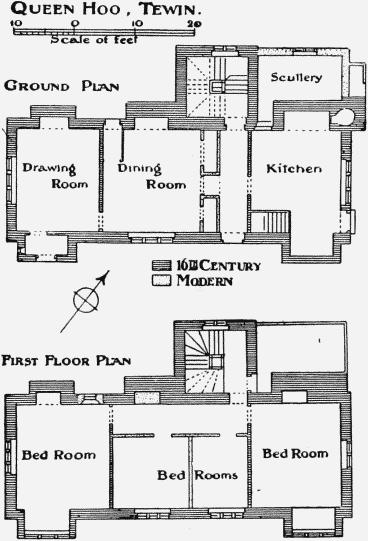
Queen Hoo: Ground plan
Tewin House
The capital messuage called TEWIN HOUSE was bought from the lord of the manor of Tewin by Thomas Montford, who died possessed of it in 1632, leaving a son John. (fn. 101) The latter died in 1651, (fn. 102) leaving a widow Joan and three daughters, Anne Layfield, Elizabeth Francklyn and Mary Rainsford. (fn. 103) Tewin House is said to have come to Mary Rainsford, who sold it to Sir George Butler. (fn. 104) At the death of the latter without issue in 1657 (fn. 105) the property passed to his nephew Francis Butler, (fn. 106) who died in 1690, leaving two daughters, to the elder of whom, Isabella wife of Charles Hutchinson, Tewin House came. Isabella and Charles are said to have sold it to William Gore, at whose death in 1709 it passed to his grandson Henry. (fn. 107) Henry Gore conveyed it in 1715 to Gen. the Hon. Joseph Sabine, (fn. 108) who died in 1739 and was succeeded by his eldest son John. (fn. 109) John's son Joseph Sabine is said to have sold Tewin House to Robert Macky, who sold it to Charles Schreiber. (fn. 110) He died possessed of it in 1800, and his son William sold it in 1804 to Peter fifth Earl Cowper. (fn. 111) The earl pulled down the house, and the property became absorbed in the main manor.
Free fishery in the river of Tewin was included with the property. (fn. 112)
Two and a half hides in 'Theunge' held before and after the Conquest by the Abbot of Westminster are entered under Broadwater Hundred in the Domesday Survey, but seem to have been in this parish. They formed a 'hardwich' of Stevenage, (fn. 113) to which manor they remained appurtenant. (fn. 114)
CHURCH
The church of ST. PETER stands about a quarter of a mile to the south-west of the village; it consists of a chancel 28 ft. 6 in. by 15 ft., north vestry, nave 36 ft. 6 in, by 18 ft. 6 in., south aisle 38 ft. 6 in. by 7 ft., south porch 12 ft. by 9 ft., and west tower 12 ft. square. These measurements are all internal. The walls are built of flint rubble covered with cement and have stone dressings; the roofs are tiled.
The nave, and probably the chancel, were erected in the late 11th or early 12th century. Early in the 13th century the chancel was altered and possibly partly rebuilt; later in the same century or early in the next the south aisle was added and clearstory windows inserted above the arcade. (fn. 115) The west tower was built about the end of the 15th century and the south porch added in the 16th century. The church was repaired during the 19th century, and in 1902 it was carefully restored; a number of ancient features were brought to light and a modern vestry was erected on the north side of the chancel.
In the east wall of the chancel is a late 15th-century window of three cinquefoiled lights, most of which is of modern stonework. The only opening in the north wall is the modern doorway to the vestry. In the south wall are two early 13th-century lancet windows, with deeply splayed jambs and chamfered rear-arch. West of these is a window of two cinquefoiled lights with a square head, of late 15th-century date. At the east end of the wall is a piscina with splayed edge and pointed trefoiled head, with a scroll-moulded label, probably of late 13th or early 14th-century date; the projecting basin has been cut away. In the same wall is a blocked modern doorway. The chancel arch is of two chamfered orders which die upon splayed jambs.
In the north wall of the nave close to the east end is the eastern jamb and part of the rear-arch of an early blocked window; west of this are two late 15th-century windows, each of two cinquefoiled lights under a square head; between them, high up in the wall, is a narrow round-headed window, now blocked, of late 11th or early 12th-century date. The north doorway with single splayed edge is almost entirely of modern stonework; above is a small square window probably inserted to light a gallery erected in 1864, now removed. On the south side of the nave is an arcade of three bays of the 13th century. The arches are of two splayed orders; the piers are octagonal with moulded capitals and damaged bases; the chamfers have been omitted on the south side of the western bay of the arcade. On the north-west face of the eastern pier is a small pointed niche with a hole in the stonework underneath, probably for a bracket to support a light. Over the piers are two blocked clearstory windows contemporary with the arcade; they are circular on the outside and have roundheaded rear arches inside; they are now covered by the aisle roof, which is a continuation of that over the nave. In the south wall of the aisle are two 13th-century lancet windows; in the east wall is a window of two cinquefoiled lights under a square head, of late 15th-century date. The south doorway has moulded jambs and arch of mid-14th-century date, with label stops outside much defaced. On the eastern jamb of the doorway outside is an oval recess, formerly the stoup. The south porch is built of timber and brick and is of 16th-century date; a large 18th-century monument to General Joseph Sabine, Governor of Gibraltar, and one of Marlborough's generals, blocks the original entrance, but a modern doorway has been opened in the west side.
In the west wall of the aisle, high up, is a small square-headed window of 18th-century date. The nave roof is of 15th-century date; the rafters are plastered underneath, but the moulded tie-beams are exposed.
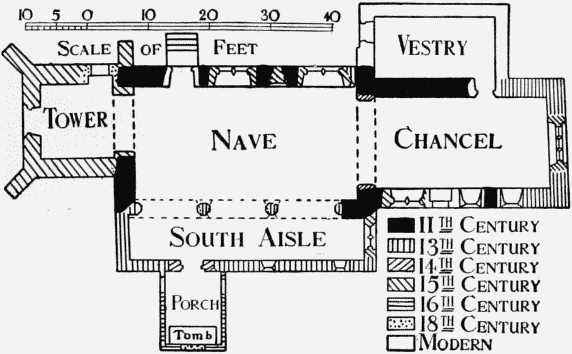
Plan of Tewin Church
The west tower is of two stages, with diagonal buttresses on the west; the centre line of the tower is about 3 ft. 6 in. north of that of the nave, the two north walls being nearly in a line. The tower arch is of two splayed orders which die upon square jambs. The west doorway is modern. In the north wall is a blocked 18th-century door. Over the west doorway is a single pointed light. The belfry stage has windows of two cinquefoiled lights; the parapet is embattled, and above is a low timber spire.
The communion table appears to be of late 17th-century date. In the chancel is a slab of Purbeck marble inscribed 'Orate pro anima Walteri de Louthe.' He was instituted rector of the church early in the 14th century. There are several 17th-century slabs in the chancel to members of the Butler family of Queenhoo Hall. In the south aisle is a small brass, with figure, inscription and arms, to Thomas Pygott, 1610.
There are five bells: the treble by John Briant, 1799; the second, third, fourth and fifth by Anthony Chandler, 1673, the third being inscribed 'Praise the Lord. A.C. 1673.'
The communion plate consists of a cup of 1564, paten, 1662, large paten, 1687, flagon, 1688, and almsdish, 1702.
The registers before 1812 are as follows: (i) baptisms and marriages from 1559 to 1718, burials 1559 to 1717; (ii) baptisms and burials from 1718 to 1812, marriages from 1719 to 1727; (iii) marriages from 1755 to 1775; (iv) marriages from 1776 to 1812.
ADVOWSON
The advowson belonged to the lord of the manor from an early date. In 1211 it was the subject of a dispute between Richard son of Godfrey de Tewin and Ralph son of Brian de Tewin, respective holders of half-fees in Tewin. Richard was successful in making good his claim. (fn. 116) Before 1246 the advowson was given by Alexander de Swereford to the monastery of St. Bartholomew, Smithfield, and was confirmed to them by Godfrey and his son John. (fn. 117) It remained with St. Bartholomew until its dissolution, and afterwards continued with the manor of Tewin (fn. 118) until it was sold by John Wrothe and others to Thomas Montford of Tewin House, who died seised of it in 1632. (fn. 119) It then continued in the possession of the owners of Tewin House and came to Sir Francis Butler, (fn. 120) whose daughter Isabella Hutchinson sold it to Jesus College, Cambridge, (fn. 121) who presented in 1728, (fn. 122) and in whose possession it has since remained. (fn. 123) In 1638 the glebe lands amounted to 40 acres. (fn. 124)

Tewin Church from the South-east
In 1330 Roger de Louthe alienated in mortmain various lands in the parish of St. Andrew, Hertford, to the Prior and convent of St. Mary, Little Wymondley, to find a chaplain to sing mass daily in the church of Tewin for the good estate of the souls of Roger and Joan his wife and their ancestors. (fn. 125)
Meeting-places for Protestant Dissenters in the parish were certified in 1706, 1707 and 1772. (fn. 126)
CHARITIES
Tewin School (fn. 127) : The property demised by will of Dr. Yarborough, 1773, for the benefit of the parish clerk and a schoolmaster was sold in 1896 in consideration of a yearly rent-charge of £8 8s. upon property in Bishop's Hatfield, which was redeemed in 1904 by the transfer to the official trustees of £336 consols, of which £252 consols was set aside as the endowment of 'Dr. Yarborough's Educational Foundation,' producing £6 6s. yearly, and £84 consols, producing £2 2s. for the parish clerk. In 1783 Lady Cathcart by deed gave £166 13s. 4d. East India 3 per cent. annuities for providing coals for the school. These endowments are now attached to the endowed school founded under the will of Henry Cowper in 1838, which is endowed with government stocks producing £62 a year or thereabouts.
In 1610, as stated in the Parliamentary returns of 1786, — Piggott by his will gave a stall in the market-place to the poor. The charity is now represented by £133 6s. 8d. consols with the official trustees, producing £3 6s. 8d. yearly, which is distributed biennially in money doles to about eighty recipients.
Dr. Layfield's Charity, founded by will of the Rev. Charles Layfield, D.D., dated 10 February 1710, for apprenticing in Tewin and four other parishes, is endowed as to this parish with a sum of £273 9s. 3d. consols with the official trustees, producing £6 16s. 8d. yearly. In 1907–8 a premium of £9 was paid for apprenticing.
Charity of Sir Francis Butler.— See under Bishop's Hatfield. This parish is entitled to nominate one poor widow for the benefit of this charity.
In 1748 Margaret Sabine by deed poll gave £200, now represented by £191 5s. consols with the official trustees. The annual dividends, amounting to £4 15s. 4d., are applicable — subject to keeping in repair the tomb of donor's husband—in clothing poor boys. The income is accumulated and applied from time to time in supplying boys with suits of clothes and boots.
Almshouses—as appears from an old parish register, dated in 1717—were built out of the poor's money on the Lower Green, of which £30 was given by will of William Gore and £20 by Dr. Fulk Tudor, the rector. The almshouses were converted into the parish workhouse.
In 1841 Henry Cowper, by his will proved in the P.C.C. 4 January, founded a Sunday Savings Bank, the endowment of which now consists of £1,807 8s. 8d. consols with the official trustees, producing £59 18s. 4d. yearly. The income is applied in augmenting the savings of poor married persons, poor widows or widowers. Subscriptions of not less than 6d. and not more than 2s. a week to be paid every Sunday, the bonus being one-fourth of the amount subscribed.
In 1909 there were thirty-six depositors, the amount deposited was £180 10s., and the bonus paid £45 2s. 6d.