A History of the County of Hertford: Volume 3. Originally published by Victoria County History, London, 1912.
This free content was digitised by double rekeying. All rights reserved.
'Parishes: Wormley', in A History of the County of Hertford: Volume 3, ed. William Page (London, 1912), British History Online https://www.british-history.ac.uk/vch/herts/vol3/pp487-490 [accessed 30 April 2025].
'Parishes: Wormley', in A History of the County of Hertford: Volume 3. Edited by William Page (London, 1912), British History Online, accessed April 30, 2025, https://www.british-history.ac.uk/vch/herts/vol3/pp487-490.
"Parishes: Wormley". A History of the County of Hertford: Volume 3. Ed. William Page (London, 1912), British History Online. Web. 30 April 2025. https://www.british-history.ac.uk/vch/herts/vol3/pp487-490.
In this section
WORMLEY
Wormley (Wurmelea, Wermelai, xicent.; Wermele, xiii and xvi cent.) is a long, narrow parish stretching east and west and wooded at its western end. On the east it is bounded by the River Lea. The New River flows through the eastern end of the parish, and east of the river and parallel with it is the main road leading from London to Hoddesdon. The parish is 946 acres in area, and the proportion of arable is about one-sixth of the total area. (fn. 1) The soil is loam, the subsoil sandy loam, and the chief crops are wheat, oats, barley and roots.
The original settlement lies almost surrounded by Wormley Bury Park, about half a mile off the high road from London to Hoddesdon. It now consists of the church and Wormley Bury, the Manor House, the seat of Mr. Henry North Grant Bushby, J.P. (built by Mr. Bushby in 1908), the Bury Farm, Hill House, occupying the site of an older house called Fernbeds, the rectory and one or two farms and cottages. Wormley Bury is a three-storied brick house with an Ionic portico on the principal or north front, built by Abraham Hume in 1767. It was decorated by Adam and Angelica Kauffmann. Probably at an early date the village migrated to the high road along which it now lies. On the west side of the road is a 17th-century house called the Manor Farm House. It is timber framed, coated with roughcast, and is of two stories with attics. The public elementary school, which was built in 1864 and enlarged in 1877 and 1899, stands in the village.
West End, a hamlet consisting of a farm (called Manor Farm, but modern) and some cottages, lies about 1 mile to the west of the Manor House. Here is Westlea, the residence of Lady Georgiana Peel.
An inclosure award was made in 1858 and amended in 1859. (fn. 2)
MANOR
WORMLEY was one of the manors which were granted by Harold son of Godwin to the canons of Waltham Holy Cross. (fn. 3) At the time of the Domesday Survey, when it gelded at 5 hides, it was still held by the canons of Waltham. Two other manors are mentioned in the Survey; Wormley, 1½ hides, which Wimund held of Earl Alan and which had been previously held by Alsi, one of Eddeva's men, who could sell it. This land is described as belonging to Cheshunt. The remaining manor, 2½ hides, was held by Alwin Dodesone of the king. It had been formerly held by Ulward, one of Asgar the Staller's men, who could sell it, and it was sold for 3 marks of gold after King William came. This manor may have been identical with the 2½ hides in Wormley which were granted to Westminster Abbey by Edward the Confessor, (fn. 4) and which are not mentioned amongst the possessions of the abbey in the Survey. The other estate perhaps became absorbed in the Waltham manor, or it may have been attached to the manor of Beaumont Hall in Cheshunt which had appurtenances in Wormley. This manor was held by the monastery of Waltham until the Dissolution. In the reign of Henry II, when the secular canons were expelled by Pope Alexander III, the king granted Wormley with the church to the regulars of the Augustinian order who replaced them, and the grant was confirmed by Richard I. (fn. 5) In 1220 the canons of Waltham constructed a conduit for carrying water from Wormley to the monastery. (fn. 6) The Quo Warranto returns of 1278 show that the abbots of Waltham, under the charters of Henry II, Richard I and Henry III, claimed the following privileges in Wormley and their other lands in Hertfordshire: sac, soc, thol, theam, infangentheof, utfangentheof, flemenesfrith, grithbriche, forstal, hamsokene, blodwyte, ordeal and oreste, view of frankpledge and return of writs, and liberty from shire and hundred courts and all payments. (fn. 7) In 1287 the abbots further claimed in their manor of Wormley gallows and right of assize of bread and ale. (fn. 8) For 1 carucate in Wormley the Abbot of Waltham was obliged to make three bridges, one in Chaumberleynesholm (in Wormley) and two in Melholm (in Wormley ?). (fn. 9) A grant of free warren was made to the convent in 1253. (fn. 10)
In 1541 the manor of Wormley, with the advowson of the rectory and parish church, was granted, as part of the possessions of Waltham Holy Cross, to Edward North, Treasurer of the Court of Augmentations, (fn. 11) who in the same year received licence to alienate it to William Woodliffe, mercer, of London. (fn. 12) William Woodliffe had two daughters: Ann, who married John Purvey, and Angelette, (fn. 13) who married Walter Tooke. (fn. 14) On the death of their father in 1548 they appear to have been co-heirs, Angelette receiving half the manor in 1553. (fn. 15) John Purvey, who survived his wife, died in 1583, and at his death was seised of the manor-house of Wormley with right of alternate presentation to the church. (fn. 16) He was succeeded by his son William Purvey, who appears to have been in possession of the whole manor by 1597. (fn. 17) William Purvey died without issue in 1617, having settled the manor and manor-house of Wormley, with right of alternate presentation to the rectory, on his wife Dorothy, sister of Edward Lord Denny, who survived him. (fn. 18) Ralph Tooke, son and heir of Angelette, is mentioned in the inquisition as his heir. Dorothy Purvey re-married, her second husband being George Purefoy of Wadley, Berks., (fn. 19) and in 1621 the manor and advowson of Wormley passed to John Tooke, brother of Ralph, (fn. 20) and his heirs. (fn. 21) Courts were being held in the name of Ralph and John Tooke in 1633. On the death of John Tooke in 1634 the manor was left to his brother Thomas Tooke for sixty years for performance of John's will, with remainder to the male heirs of Ralph Tooke. (fn. 22) Ralph died without issue, (fn. 23) and the manor appears then to have gone to his remaining brothers, George and Thomas Tooke. (fn. 24) George Tooke sold his moiety of the manor to Richard Woollaston, who died in 1691, leaving a son John, who survived him for a year only. John Woollaston was succeeded by his eldest son Richard. (fn. 25) In 1669 Thomas Tooke devised his moiety of the manor to trustees for the payment of his debts, and after his death it was sold successively to William Hastings, Elizabeth Reynolds, and, finally, to Thomas Winford, who bought it in 1684 or earlier. (fn. 26) In 1692 Thomas Winford conveyed to Richard Woollaston his moiety of the manor, (fn. 27) with the exception of the manor-house of Wormley Bury, with appurtenances, which he sold to William Wallis of Holborn in 1697. (fn. 28) In this way Richard Woollaston became lord of the whole manor.
Richard Woollaston conveyed the manor to William Fellowes, whose eldest son Coulston Fellowes was the possessor in 1728 (fn. 29); from the latter the manor passed in 1733 by sale to John Deane, (fn. 30) who in 1739 sold it to Alexander Hume. The latter, dying in 1765, left the manor to his youngest brother, Abraham Hume, (fn. 31) who was made a baronet in 1769 (fn. 32) and was succeeded in 1772 by his son Abraham Hume. (fn. 33) The second baronet died in 1838, leaving no issue, his two daughters, Amelia Baroness Farnborough and Sophia Baroness Brownlow, having died during their father's lifetime. (fn. 34) The manor came to Viscount Alford and the Hon. Charles Henry Cust, children of Lady Brownlow. In 1853 they jointly sold the manor to Henry John Grant, on whose death in 1861 it came to his widow, Mary Grant. (fn. 35) In 1880, under the will of Henry John Grant, the manor passed to his cousin Henry Jeffreys Bushby, father of the present lord of the manor, Mr. Henry North Grant Bushby. The latter, who succeeded his father in 1903, is on the side of his mother Lady Frances, second daughters of Francis sixth Earl of Guildford, the tenth in direct descent from Sir Edward North, to whom the manor was granted by Henry VIII. (fn. 36)
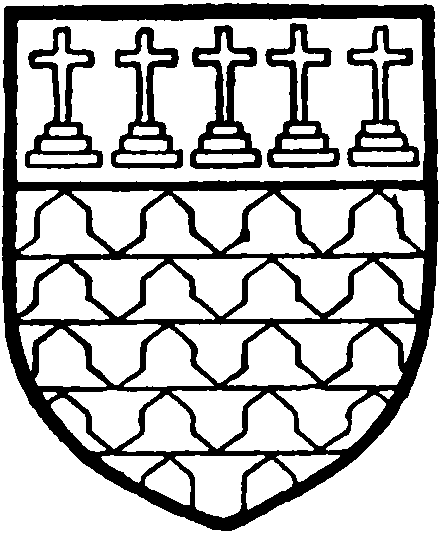
Bushby of Wormley. Vair a chief gules with five passion crosses argent therein.
The manor of OATES, which first appears in 1611, was held of the manor of Baas and followed the descent of Broxbourne (fn. 37) (q.v.).
CHURCH
The church of ST. LAWRENCE consists of a chancel 35 ft. by 19 ft., nave 48 ft. by 21 ft., south aisle 47 ft. by 11 ft. 6 in., small vestry and wooden south porch; all the dimensions are internal. The walls are of rubble flint with stone dressings, and are covered with cement all but the aisle; the roofs are tiled. The nave is of early 12th-century date. The chancel, which has undergone extensive alterations and has no old detail, is practically modern. During the 19th century the west wall of the nave was rebuilt and a bellcote erected, the chancel arch was rebuilt and a south aisle and a small vestry added. In 1911 a larger vestry was built on the south of the chancel.
In the east wall of the chancel is a group of three lancet windows; in each of the north and south walls are two lancets. All the windows are modern, as is also the chancel arch.
In the north-east angle of the nave is the doorway, partly blocked, and stair to the former roodloft. In the north wall are two 15th-century windows; one is a single trefoiled light under a square head, the other has two cinquefoiled lights: these windows have been repaired. Further west is a narrow 12th-century window with round head and deeply splayed jambs; the splayed sill appears to have been lowered. The north doorway has a roundheaded arch of two orders with edge-rolls; the shafts and scalloped capitals are restorations. The window of three cinquefoiled lights in the west wall is modern, as are also the south arcade and aisle. In the south wall have been reset the inner jambs of a 12th-century window and also portions of a single splayed pointed south doorway, which is mainly of 13th-century date. The nave roof retains its 15th-century moulded and embattled tie-beams and other timbers. The hexagonal panelled pulpit is of early 17th-century date.
The font has a large cylindrical bowl of the 12th century; it has four large and four small rectangular panels surrounded by a cable moulding. In the centre of each of the larger panels is a leaf ornament; the smaller are carved with bands of leaf ornament. The upper part of the font has a border of leaves, the base is modern.
Over the communion table is a painting of the 'Last Supper,' attributed to Jacopo Palma; it was presented to the church in 1797 by Sir Abraham Hume, and came from a convent of regular canons in a village near Verona which had been suppressed. (fn. 38)
In the chancel is a large marble monument to William Purvey, 1617, and Dorothy his wife, with recumbent effigies; over them is a canopy flanked by pilasters; on the cornice are the arms. On the front of the tomb is the kneeling figure of a lady. There are some 17th-century slabs to members of the Sheere and Tooke families.
In the chancel is a brass to John Cok, yeoman, with figures of the man, the lower part of which is missing, his wife and nine sons. Above is a small representation of the Trinity, and beneath is a strip of brass with trees and a dog pursuing a hare, and a cock. There are remains of a marginal inscription, the date is about 1470. There are also a brass to Edmond Howton, with the figures of his wife Anne, five sons, and part of an inscription, 1479; a brass of a man, his wife, eight sons and four daughters, with shield of arms of Tooke impaling Woodliffe, with no date, but of about 1590; an inscription only to John Cleve, rector of Wormley, died 1404.
The two bells without date or founder's stamp are apparently modern.
The communion plate consists of a flagon, 1625, a pewter almsdish, 1699, a cup and paten, 1873, and another paten.
The registers before 1812 are as follows: (i) baptisms from 1674 to 1783, burials 1676 to 1783, marriages 1685 to 1753; (ii) baptisms from 1783 to 1812; (iii) burials from 1783 to 1812; (iv) marriages from 1754 to 1812.
A meeting-place for Protestant Dissenters in the parish was certified in 1838. (fn. 39)
ADVOWSON
The church of Wormley with the manor was in the possession of the monks of Waltham Holy Cross in the reign of Henry II, (fn. 40) and it appears to have been retained by the monastery until the Dissolution. In 1541 the advowson of the rectory was granted with the manor to Sir Edward North. (fn. 41) From this time the advowson followed the descent of the manor until 1853, the representatives of the co-heirs of William Woodliffe exercising alternately the right of presentation. (fn. 42) The advowson was not included in the sale of the manor in 1853, but was afterwards sold to Horace James Smith-Bosanquet. He conveyed it in 1881 to Henry Jeffreys Bushby, and it thus became re-united to the manor. (fn. 43)
The old chapel or oratory which was known as 'the Chapel of St. Laurence in the Busshe of Wormley' lay apparently in the parish of Cheshunt. (fn. 44)
CHARITIES
In 1670 Thomas Tooke by his will directed (inter alia) that land producing £3 a year should be purchased, the rent to be applied in providing coats, petticoats and stockings for six poorest boys and girls, and the residue to the most aged men and women. The endowment consists of 6 a. 2 r. of land at Cheshunt, let at £18 a year, which is duly applied.
It is stated in the Parliamentary returns of 1786 that an unknown donor gave land for the poor. The property consists of an acre of land now called 'Searangle Corner' in Cheshunt let at £3 a year.
Charities of Richard Tooke and others: By a decree of the Court of Chancery made 5 November 1684 (36 Charles II) in a cause between Thomas Gentle, complainant, and Nicholas Bigg and another, defendants, stating that several sums had been given by several persons to the poor of the parish, it was ordered that an estate at Great Parndon in the county of Essex, containing 15 acres, should be purchased for the use of the poor of Wormley. The land is let at £16 a year.
In 1710 Sir Benjamin Maddox, bart., by deed conveyed to trustees 16 acres of land called Oakells in Codecote upon trust that out of the rents £6 yearly should be paid to the rector of Wormley and the residue be paid to the poor. The land is let at £11 a year. This and the two preceding charities are administered together. In 1909 boots were distributed to eighteen men and twenty-four women, also 90 yards of flannel and 120 yards of calico.
In 1688 Richard Woollaston by a codicil to his will directed that lands to the value of £100 a year should be settled for providing £20 a year for clothing in the parish of Woolmer, £30 a year in the parish of Whitchurch, and £50 a year in six parishes in Leicestershire.
This charity was the subject of proceedings in Chancery at the instance of the Attorney-General against Jonathan Woollaston, the personal representative of John Woollaston, the executor, and others, and in the result, under an order of the Court 26 August 1704, certain lands in the county of Essex were purchased of the value of £100 a year to be applied for the benefit of the parishes referred to and in the like proportions.
The property now consists of freehold land at Latchingdon, Essex, and ground rents in Berlin Road and Bromley Road, Catford, in the metropolitan borough of Lewisham, producing £180 a year or thereabouts.
In 1909–10 the sum of £32 was applied in Wormley in suits, serge, flannel and calico to poor, distressed people.
In 1660 Josiah Berners by his will gave £5 yearly out of Wormley Bury Estate for apprenticing. The sum of £1 is deducted for land tax; the sum of £4 a year and the annual dividends on a sum of £344 3s. 8d. consols, amounting to £8 12s., is applied in apprenticing. In 1909 one premium of £20 was paid.
In 1764 Rebecca Ward by her will bequeathed £150, now represented, with accumulations, by £318 14s. consols, producing £7 19s. 4d. yearly, which is applicable in the distribution of beef on old Michaelmas Day to the poor. About 720 lb. of beef are distributed annually. The two sums of stock are standing in the names of James John Deller and two others, who also hold a sum of £118 13s. 7d. consols, derived under the will of Sir Abraham Hume, proved in 1838. The annual dividends of £2 19s. 4d. are distributed in coal.
In 1613 William Purvey by his will gave £20 yearly to the rector for preaching twenty sermons. The charge is payable out of the manor of Wormley.
The recreation grounds consist of 1 acre acquired under an order of the Inclosure Commissioners, 1871, in exchange for two parcels of land awarded to the churchwardens and overseers in 1858.
In 1880 Mrs. Mary Grant, by her will proved at London 7 December, left £200, less legacy duty, now represented by £181 16s. 4d. consols, with the official trustees, the annual dividends, amounting to £4 10s. 10d., to be applied for the benefit of the schools established in 1863, and for the maintenance therein of the Established Church.