A History of the County of Hertford: Volume 3. Originally published by Victoria County History, London, 1912.
This free content was digitised by double rekeying. All rights reserved.
'The borough of Hertford: Castle, honour, manors, church and charities', in A History of the County of Hertford: Volume 3, ed. William Page (London, 1912), British History Online https://www.british-history.ac.uk/vch/herts/vol3/pp501-511 [accessed 30 April 2025].
'The borough of Hertford: Castle, honour, manors, church and charities', in A History of the County of Hertford: Volume 3. Edited by William Page (London, 1912), British History Online, accessed April 30, 2025, https://www.british-history.ac.uk/vch/herts/vol3/pp501-511.
"The borough of Hertford: Castle, honour, manors, church and charities". A History of the County of Hertford: Volume 3. Ed. William Page (London, 1912), British History Online. Web. 30 April 2025. https://www.british-history.ac.uk/vch/herts/vol3/pp501-511.
In this section
CASTLE, HONOUR AND MANOR
The vill or manor of HERTFORD was demesne of the Crown and was granted by William I as the 'lordship of Hertford,' (fn. 1) together with the mills of Hertford and the manor of Bayford, to Peter de Valognes, Sheriff of Hertfordshire. (fn. 2) A confirmation of the two mills of Hertford cum suo alio feodo with multure and works (operatione) of the burgesses, was made to Valognes by Henry I, (fn. 3) and the Empress Maud confirmed the manors of Essendon and Bayford and the mills of Hertford to Roger de Valognes, son of Peter. (fn. 4) These two latter grants probably did not include the lordship. (fn. 5) The grant to Roger seems to have been for life only, for in 1154–5 Henry de Essex, the sheriff, was accounting for the manor of Bayford (fn. 6) as well as for the farm of the borough of Hertford. (fn. 7) The terms 'manor,' 'borough' and 'vill' are used interchangeably at this date when the whole of the lordship is meant. (fn. 8)
In 1249 Henry III granted the vill of Hertford to William de Valence for life. (fn. 9) On the death of William in May 1296 the vill reverted to the king. (fn. 10) He entrusted it to a succession of farmers, (fn. 11) who were continued until Edward I gave it to Queen Margaret. (fn. 12) The queen transferred it to Aymer de Valence, who obtained a royal confirmation in 1309 and in 1317 a grant of Hertford in fee. (fn. 13) His widow surrendered it ten years later and gave up all claim to it. (fn. 14) The vill and honour were assigned at once to Queen Isabel in increase of her dower, (fn. 15) and after her fall she received a re-grant. (fn. 16) In 1360 Edward III granted Hertford to John of Gaunt, then Earl of Richmond, (fn. 17) a gift which was confirmed by Edward III in 1376 (fn. 18) and by Richard II in 1377. (fn. 19) The manor and vill descended with the duchy of Lancaster (fn. 20) into the hands of Henry IV, and after his death were held in dower by Queen Joan. (fn. 21) In the reign of Henry VI they were granted to the dowager Queen Katherine, (fn. 22) and later to Henry's queen, Margaret. (fn. 23) Edward IV granted them to Queen Elizabeth Woodville, (fn. 24) who held her first court at Michaelmas 1465. (fn. 25) In 1553 Edward VI granted the manor and castle of Hertford to Princess Mary for her life. (fn. 26) Prince Charles received a grant of the castle and manor in October 1609 (fn. 27); and after his accession he granted them in 1630 to William Earl of Salisbury, (fn. 28) whose successors have since held the manor. (fn. 29)

Valence. Burelly argent and azure an orle of martlets gules

John of Gaunt. The royal arms of EDWARD III with the difference of a label ermine

Duchy Of Lancaster. ENGLAND with a label azure.

Katherine of France and Margaret of France. Azure three fleurs de lis or.

Elizabeth Woodville. Argent a fesse and a quarter gules
These grants of the manor include the king's rights over the borough. An extent of the manor taken in 1331 begins with 'the castle of Hertford and the borough there held of the king in chief.' (fn. 30) The profits include the fishery belonging to the borough, the fluctus aquae from Hertford to Waltham, the meadows called King's Meads, the two watermills, the rent called hawgavel (see above), the custom called 'aletol,' the profits of the market and the tolls at Ware, Thele and Hatfield, the fairs and the court leet. (fn. 31) The 'issues of the manor' are first distinguished about the middle of the 15th century, (fn. 32) probably for convenience in accounting. The grant to the Earl of Salisbury included the fishery of the demesne water of Hertford, the meadow called Castle Mead, ten osier beds in the river and the tolls appurtenant to the castle and honour. (fn. 33) The water-mills (which were then held on lease) were excepted, (fn. 34) also the tolls of the market and fair, of which a grant had been made to the mayor by James I.

Cecil, Marquess of Salisbury. Barry of ten pieces argent and azure six scutcheons argent with a lion sable in each with the difference of a crescent.
The soil and fishing of the Beane 'from the east end of Paper Mill Mead to Goodes Pool and in the waters called Black Ditch, Manifold Ditch and the other ditches to the east of Chadwell Mead' were granted to the mayor and burgesses by Charles I in 1627. (fn. 35) Of the paper mill Cussans says 'the site of the mill was probably near the old waterworks, for the channel through which the water flows to the River Beane is still known as Paper-mill Ditch.' (fn. 36) A paper-mill is mentioned in 1498, and was probably the earliest set up in England (see Sele Mill in St. Andrew Rural). (fn. 37)
The court held at Hertford in the 14th and 15th centuries did the work of a manorial court while choosing burgesses and guarding burgess right. (fn. 38) There was no distinction between the jurisdictional area of town and manor. The charters of Elizabeth and James gave the borough a weekly court of record, (fn. 39) with which the older courts were probably fused. This explanation at least fits the contemporary statement 'that there are certain courts leet and baron held, and the mayor has used to be instead of the (lord's) bailiff time out of mind' (fn. 40) (1621). After 1630 these manorial courts were held for the 'manor and castle' by the officials of the Earl of Salisbury, (fn. 41) in accordance with the theory that a manor must have courts leet and baron. There is record of these courts as late as 1773. (fn. 42)
The castle of Hertford is situated on the flat, low-lying land on the south bank of the River Lea. (fn. 43) It seems to have been one of the castles thrown up after the Conquest to form a ring of defence round London. The earthwork defences consisted of a double ditch on three sides, the space between them widening considerably on the south-west to form an outer ward. The ditches communicated at either end with the main course of the Lea, which sufficiently defended the north-west face. There was also a small artificial mound which still exists at the extreme northern angle of the curtain wall, but there is no evidence that this was ever surrounded by a separate moat. The masonry parts of the castle under the name of the castle of Hertford and the king's houses in it, which would probably include the keep, the curtain wall and the houses in the bailey, were apparently begun by Henry II in 1170. (fn. 44) They were under the charge of Henry the Chaplain or Henry the Deacon, William the Parker, Wigar, Azur, and Robert Crassus, the three last of whom were burgesses of Hertford. (fn. 45) Large sums of money were paid out by the sheriff on the building operations during the years 1171, (fn. 46) 1172, (fn. 47) 1173, (fn. 48) and 1174. (fn. 49) In 1173 the work was so far advanced that the castle was fully provisioned against the insurrection of young Henry, the king's eldest son, (fn. 50) and in the following year occurs the last payment for building operations for some years, so that the work was evidently then completed. This is confirmed by the fact that the castle was in this year garrisoned by knights and sergeants. (fn. 51) Lesser sums, probably for repairs, were paid in 1182 (fn. 52) and 1183. (fn. 53) A shell keep similar to that at Berkhampstead evidently crowned the mound already referred to. With the exception of portions on the southern side the ditches are now all filled in and levelled, but their extreme limit outwardly is marked by St. Andrew's parish boundary, and the total area of the castle site is about 7¾ acres.
The existing remains belong entirely to the inner ward, which was in form an irregular pentagon surrounded by a curtain. This wall, built of flint rubble, much patched and re-faced with red brick, is still standing on the eastern and southern sides. It varies greatly in thickness from 5 ft. to 6 ft. upwards, and with the exception of the parapet is standing to its full height. It terminates at the southern angle in a small octagonal tower (internally 12 ft. in diameter), partially ruined, and evidently built to defend the postern which adjoins it on the east. The postern has a pointed arch quite devoid of ornament and dating from the 13th century. The curtain is probably somewhat earlier in date. In the centre of the western face stands the Tudor gate-house, a rectangular structure of red brick with octagonal projecting turrets at the four corners, that on the south-east being carried up above the roof. This building forms the northern half of the house known as Hertford Castle and has been much altered in the 18th century, when the southern wing was added on the line of the curtain wall. The windows are all of that date, as is the pseudo-Gothic corbelling and embattled parapet. Traces of the western or outer arch of the gate-house are to be seen behind the modern porch, and above it is a sunk stone panel bearing a coat of arms (said to be that of the Tudors, but now too much decayed to be identified) with supporters, and surmounted by a crown. The inner or eastern arch of the gate-house is now transformed into a window.
The internal arrangements of the castle are preserved in an Elizabethan plan at the Public Record Office, prepared by Henry Hawthorne about 1582 or 1592, when the courts of law were temporarily moved to Hertford owing to the prevalence of the Plague in London. The plan is unfortunately mutilated and what remains is in two fragments, (fn. 54) but the main apartments are shown grouped round a central courtyard with the great hall on the eastern side. With the exception of the fireplace backs and chimneys the walls are shown so thin as to imply a timber-framed building carried on dwarf walls, traces of which have from time to time come to light under the present lawn and garden. The hall was an aisled building of three bays with screens and two porches at the northern end and a square oriel and a fireplace at the southern. On the plan it bears a close resemblance to the great hall at Ashby Castle (Leicestershire). The offices at the northern end are by no means clear, and the only apartment with a fireplace large enough for the kitchen is that marked Court of Requests. (fn. 55) To the south of the hall is a square courtyard, surrounded on three sides by an open timber cloister, and with a small oratory projecting into the court at the south-east angle. The great chapel probably occupied the first floor of one of the wings shown projecting eastward from the main building. The great angle bastion on the curtain wall has now completely disappeared. It was, however, still standing in 1772, and is shown in a view in Grose's Antiquities. (fn. 56) On plan it formed the segment of a circle about 60 ft. in external diameter. The brick wall built across the gorge is still in part standing and is of the time of Henry VIII. On the outer face are traces of the newel stair with a sunk brick handrail. The second fragment of the MS. plan shows the bakehouse and other buildings in connexion with another angle bastion, in this case open at the gorge. It seems impossible to place it anywhere else but on the site of the earlier keep, in which case the keep ditch, if it ever existed, must have been filled in and the keep itself destroyed late in the Middle Ages.

Hertford Castle:The Gate-house
These plans and the existing remains are explained and illustrated by documentary evidence. The residential part of the castle had been built before 1199, when a sum of £5 was spent in repairing the hall, and the chapel is mentioned in 1202. (fn. 57) No doubt the castle suffered severely in the siege at the end of the reign of John, which would account for a sum of £10 from the farm of the vill being assigned to the constable for the repair of the gate in 1225. (fn. 58) In April of the same year a mandate was issued to the sheriff to pull down the houses which had belonged to Falkes de Breauté (fn. 59) at Little Berkhampstead, and to build them up again in the castle of Hertford. (fn. 60) The old hall, the old chapel, the brewery, and the marshalsea (marescalcia) were left at Little Berkhampstead, but in July of the following year the king ordered that the domus marescalcie should also be brought to Hertford and built up there. (fn. 61) In 1300 the hall, chamber, wardrobe, kitchen and paling were repaired, in 1301 the bakehouse and other houses, the walls and bridge, and in 1302 the houses, bridges, outer gates and the chamber over the gate. (fn. 62)
From the 14th to the 17th centuries there are a series of surveys of the castle. The earliest of these, dated 1327, (fn. 63) is a survey of the defects with the estimated cost of their repair. Mention is made of (1) a certain chamber without the outer bridge in the entry of the castle and a certain other chamber adjoining the outer gate; (2) the middle bridge with a certain chamber adjoining the outer gate of the same bridge; (3) a certain bakehouse against the same gate and a granary adjoining the bakehouse; (4) the great chamber called the King's Chamber with two chapels adjoining the same, the kitchen and the lesser hall; (5) the great hall of the king with two chimneys adjoining the same and two garderobes; (6) a certain chamber without the postern and the drawbridge beyond the same postern; (7) the stone wall in the circuit with the tower of the same castle and the two chimneys of the two chambers aforesaid; (8) the wooden stockade next the outer ditch, 'which is in many places prostrate on the ground.'
The next two surveys are couched in general terms and give little information as to the buildings of the castle. That of 1522–3, (fn. 64) however, mentions that there is 'a fayre river runnynge alonge by the Northside of the said Castell and the water of the same Ryver serveth for and to all the houses of Office within the same Castell and arere a very litle garden grounde, but there is a fayre courtyarde and large which is almost finished rounde aboute with fayre [houses].'
The survey of 1558–9 (fn. 65) refers only to the general dilapidation of the buildings, 'as well in timber work as in tiling, glazing and leading, dawbing, sealing and ironwork,' and computes the cost of repairs at £80.
Thirty years later the castle buildings were again in a bad state of repair, and a fourth survey (fn. 66) (dated 1587–8) indicates that many of the apartments required entire rebuilding. Mention is here made of the privy kitchen, the serving place with the scullery, the bakehouse, the rooms over the pantry, the passage between the court and the bakehouse, the shed towards the kitchen, timber for the chapel end, the lodging where my Lord Treasurer did lie in the term, the bridge towards St. Andrews, the house in the castle yard next the water with the chimney and the west gable end, the old gate-house in the castle yard. Many of these buildings may be identified on the Elizabethan plan and the majority of them appear to have been of timber. The 'Castle Yard' was evidently the inner bailey and the 'bridge towards St. Andrews' is distinctly indicated on Speed's view.
The greater part of the buildings were pulled down early in the reign of James I. In a survey of the extent of the castle dated 1609–10 (fn. 67) it is stated that 'there are standing upon part of the site of the said castle one fair gatehouse of brick, one tower of brick and the old walls of the said castle and also three old houses without the walls.' The site contained 7 acres and 3 roods, part called the 'Castle yard' being fenced with stone and part unfenced called the 'Castle ditches'; 'the utter bryme of the utter ditch' being bounded by the king's highway called Castle Street on the south and east. With the exception of the three old houses and the tower of brick, evidently the south-east bastion, this survey represents fairly accurately the still existing remains of the castle.
The most important period in the history of the castle was the Civil War in the reign of King John. Hertford and Berkhampstead were both taken by the barons in 1215 and were held until the following year. The defection from Louis of France then began and was followed by the surrender of the castles. (fn. 68) At the end of the same year Hertford was besieged by Louis. The castle seems to have been bravely defended by the constable Walter de Godarvile, but after a siege of nearly a month it surrendered, (fn. 69) probably having no further supply of provisions.
The castle was used as an occasional residence by most of the kings of England whilst it remained a royal castle. (fn. 70) After the grant in dower made to Queen Isabel in 1327 (see above) she stayed at the castle from time to time and died there on 22 August 1358. (fn. 71) The next year King John of France was lodged there during his captivity in England. (fn. 72) John of Gaunt received a grant of the castle at the same time as the manor (see above) in 1360, and bought large stores of timber from his neighbours, who did not dare to refuse him, in order to fortify it. According to the chronicler Walsingham, one of his grievances when he retired from court in 1377 was that the king had taken possession of the castle of Hertford, where he had meant to spend most of his time. (fn. 73) The castle was, however, confirmed to him by a grant of the same year. (fn. 74) It seems to have been chiefly between 1396 and 1399 that he used it as a residence. (fn. 75) The castle came again to the Crown on the accession of Henry IV, and in 1428 was appointed one of the summer residences of the Crown. (fn. 76) In 1424 there is mention of the Bishop of Durham surrendering the great seal in 'the great chamber in the castle of Hertford.' (fn. 77)
In the itineraries of Henry VIII Hertford Castle appears with the royal houses of Hunsdon and Hatfield. (fn. 78) The Princess Mary was staying there when Wriothesley brought her a proposal of marriage from Philip Duke of Bavaria, nephew of the Count Palatine, in December 1539. (fn. 79) Prince Edward was at the castle at the time of Henry's death. The news of this event was for a time kept secret from the public, but the Earl of Hertford (afterwards Duke of Somerset) and Sir Anthony Browne hastened to Hertford, took Prince Edward secretly to Enfield, and there told him and the Princess Elizabeth of the prince's accession to the throne. (fn. 80)
In 1563, 1581 and 1592 the law courts were removed to Hertford Castle owing to the Plague in London. (fn. 81) Queen Elizabeth stayed at Hertford on several occasions, (fn. 82) but James I does not seem to have been there, and in the next reign the castle ceased to be a royal one, being included with the manor in the grant to the Earl of Salisbury (see above).
Gaol delivery for the county took place at Hertford Castle. (fn. 83)
Down to the end of the 12th century the constableship of the castle seems to have been held by the sheriff of the county. The grant to Peter de Valognes, sheriff under William I, of the 'lordship of Hertford' was evidently considered later to include the constableship, for the enrolment of the charter among the 'cartae antiquae' is headed 'Charter of Robert Fitz Walter,' (fn. 84) and it was evidently one of the charters which Robert Fitz Walter (who married Gunnora, the Valognes heir) showed to the king in order to prove his right to the constableship. (fn. 85) There is evidence that Geoffrey Fitz Peter, who was sheriff from 1190 to 1192, held the constableship, (fn. 86) and he continued to hold it until August 1202, when he received a mandate to deliver the castle to Robert Fitz Walter, who apparently claimed it in right of his wife. (fn. 87) In the same year, however, Richard de Montfitchet made fine with the king for the custody of the county and of the castle of Hertford. (fn. 88) In 1212 John Fitz Hugh was custodian and in August of that year was ordered to give up the custody to John de Bassingbourn, leaving behind the wines and other supplies bought with the king's money. (fn. 89) During the temporary peace following the signing of Magna Carta Robert Fitz Walter, who had been serving as marshal of the barons' army, obtained another grant of the custody in succession to John de Bassingbourn. (fn. 90) This was in June 1215, but in August of the same year war broke out again, and Robert Fitz Walter went over to France to offer the crown to Louis. The castle had meanwhile been taken by the barons, who held it until 1216 (see above). After its surrender to the king, John appointed Walter de Godarvile, a follower of Falkes de Breauté, governor, (fn. 91) and he was holding it during the siege by Louis. (fn. 92) Whilst it was in Louis' hands Robert Fitz Walter put in a claim to the custody which he claimed by 'ancient right,' but Louis, according to the chronicler, refused on the somewhat ungenerous plea that Englishmen who had been traitors to their own king were not worthy of any office of importance. (fn. 93)
During the next reign a constant succession appears in the appointment of constables. Before December 1223 the custody had been held by Falkes de Breauté; in that month it was granted to William de Eynesford. (fn. 94) On 7 January 1224 it was granted to Stephen de Segrave, (fn. 95) on 22 January of the same year to Richard de Argentein, the sheriff, (fn. 96) who held it until August 1228. (fn. 97) At the latter date it was granted to Raymond de Burgh, before 23 January 1230 to William de Culworth, on that date to Raymond de Burgh again, (fn. 98) on 3 July 1230 to William de Culworth, the sheriff, (fn. 99) and on 25 September 1230 to John de Burgh, (fn. 100) from whom apparently it passed to Hugh de Burgh, for he in 1232 was ordered to deliver it to Stephen de Segrave. (fn. 101) In May 1234 it was held by Robert Passelewe, who was then superseded by William de Culworth, (fn. 102) sheriff in that year, and he held it until the appointment of the next sheriff, Peter de Tany, in May 1236. (fn. 103) In 1242 Richard de Montfitchet was appointed sheriff and custodian of the castle, (fn. 104) holding the office until 1246. (fn. 105) In 1247 the king's brother William de Valence had a grant of the custody of the castle and mills, (fn. 106) to which the vill was added a few days later (fn. 107); this was converted into a life grant in 1249. (fn. 108) From this date the castle descended with the vill or manor (q.v.).
MANORS
Limesy Fee (Priory Manor)
The LIMESY FEE afterwards the PRIORY MANOR was the property of Hertford Priory. In 1086 Ralph de Limesy was holding lands in Hertfordshire and elsewhere which had been held by Earl Harold, and among these apparently was an estate at Hertford appurtenant to the manor of Hatfield Broadoak in Essex. (fn. 109) Ralph de Limesy founded the priory of St. Mary of Hertford as a cell to St. Albans and endowed it with a hide of land at Hertford and a church which he had built there. (fn. 110) The place where the friary stood was known as Limesy Fee and was outside the area and jurisdiction of the borough. (fn. 111)

Denny. Gules a saltire argent between twelve crosses formy or.
After the Dissolution the manor and site of the priory were granted to Anthony Denny in February 1537–8. (fn. 112) They descended in the Denny family (fn. 113) until 1587, when Edward Denny and Margaret his wife conveyed them to Henry Colthurst. (fn. 114) They seem to have been conveyed to Martin Trott probably about 1590. (fn. 115) Trott sold them to Richard Willis in 1617, (fn. 116) who died seised in 1625, (fn. 117) leaving a son Thomas underage. (fn. 118) In 1637 Thomas Willis sold the manor to John Harrison of London, (fn. 119) and it descended with Balls Park in Little Amwell (q.v.) until the latter was sold to Sir G. F. Faudel-Phillips, bart. Hertford Priory is still in the possession of Marquess Townshend. In 1624 there are mentioned as appurtenant to this manor the water-mill called Lyckermill or Dickermill and the close called 'the churchyard of St. John the Evangelist or the Mill Close.' (fn. 120)

Townshend. Azure a cheveron ermine between three scallops argent.
Bourne Fee
The origin of the BOURNE FEE in Hertford is probably to be found in the property of Geoffrey de Bech, who in 1086 had three houses there. (fn. 121) Like the manors of Eastwick (in Braughing Hundred) and Bengeo this probably came to Baldwin de Clare, lord of Bourne, and through his daughter Emma to the Wakes. Later we find the court of the honour of Bourne (Broune, Brunne) being held at Hertford, to which the neighbouring tenants of the Wakes owed suit. (fn. 122)

Wake. Or two bars gules with three roundels gules in the chief.
Another court held at Hertford was the court of the HONOUR OF MANDEVILLE. In 1086 Geoffrey de Mandeville had property at Hertford which had been held by Asgar the Staller, and he had also seven houses which rendered no dues except geld. (fn. 123) Humphrey de Bohun, Earl of Hereford and Essex, successor of Geoffrey de Mandeville, was presented in the reign of Edward I for withdrawing his suit from the borough. (fn. 124) In the 13th century and later one of the courts of the honour (called the court of knights) (fn. 125) was held at Hertford, (fn. 126) and to this we find a Middlesex tenant of the earl's doing suit in 1297. (fn. 127)
Valognes Fee
The VALOGNES FEE in Hertford can also be traced back to 1086, when Peter de Valognes (who was farming the borough) held two churches and a house which he had bought of Ulwi of Hatfield. (fn. 128) Roger de Valognes, son of Peter, received a grant of the mills of Hertford (see above) and 'the service of Alban de Hairon and all other lands and tenements as his father held them.' (fn. 129) In the reign of Edward I Christine de Maune, one of the Valognes heirs, was presented for withdrawing her suit at the borough court. (fn. 130) The Valognes family held the manor of Hertingfordbury which in 1086 had been held by Ralph Baniard, and it is probable that Ralph Baniard's Domesday holding of two houses in Hertford also came to them with that manor. In the 13th century the advowson of the hospital of St. Mary Magdalene is found descending with the manor of Hertingfordbury, (fn. 131) and it seems probable that the Valognes' lands in Hertfordshire were given to that monastery. The hospital of St. Mary Magdalene was taken over by the Crossed Friars of the order of Holy Trinity, (fn. 132) and after the Dissolution the messuage called 'Le Trinitie' was granted to Anthony Denny. (fn. 133) In 1577 Edward Denny alienated to John Spurling the close of pasture called Trinity Close on which Trinity House stood, 8 acres of arable land adjoining, 'Friers Grove' containing 8 acres and another grove of 6 acres. (fn. 134)

Mandeville. Quarterly or and gules.

Bohun. Azure a bend or cotised argent between six lions or.
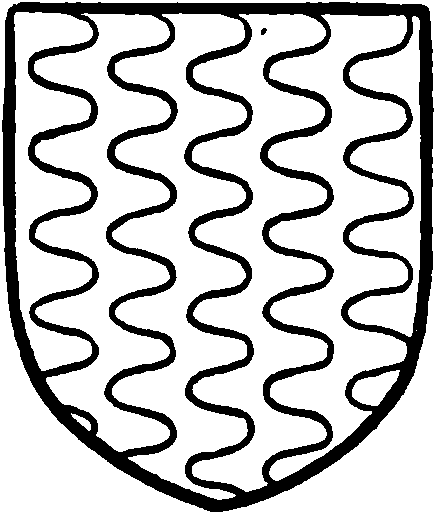
Valognes. Paly wavy argent and gules.
CHURCHES
St. Andrew
The church of ST. ANDREW was erected on the site of the former church in 1869 (fn. 135); it consists of an apsidal chancel, nave with aisles, north and south transepts and west tower. It is built of flint with stone dressings in the style of the early 14th century.
The north doorway is part of the old church, and is of late 15th-century date, with moulded arch under a square head, and with quatrefoils in the spandrels; the labels have stops carved with angels holding shields.' On the west side of the doorway are the remains of a stoup.
Under the communion table in the north chapel is an old stone altar slab, discovered on the site of the former church of St. Mary the Great in 1888; the slab measures 3 ft. 5 in. by 2 ft. 2 in. and is about 5 in. thick. It bears five incised crosses, and in the centre is a rectangular cavity about 3 in. by 2 in. and 1½ in. deep, probably to contain relics. The communion table in the chapel has twisted legs and may be late 17th-century work.
On the nave floor is a brass inscription to Bridget Whitgifte, wife of Robert Collingwood, one of the sons of Sir Cuthbert Collingwood, kt., 1610. There is a floor slab to Arthur Sparke, 1665, with arms.

Plan of St. John's Church, Hertford
There is a ring of eight bells: the first, second and fourth of 1782, the fifth and eighth of 1797, and the sixth and seventh of 1793, are all by John Briant of Hertford; the third is by Mears & Stainbank, 1876.
There is an early Spanish chalice and a paten given by Canon Wigram in 1879, and an 18th-century chalice and paten given by Mr. Charles Butler in 1880.
The registers previous to 1812 are as follows: (i) baptisms 1560 to 1653, burials and marriages 1561 to 1653; (ii) baptisms 1653 to 1723, burials 1653 to 1721, marriages 1653 to 1724; (iii) baptisms 1724 to 1791, burials 1724 to 1796, marriages 1724 to 1753; (iiib) baptisms 1791 to 1811, burials 1797 to 1812; (iv) marriages 1755 to 1782; (v) marriages 1782 to 1812.
All Saints
The church of ALL SAINTS was erected in 1895 on the site of the former church, which was burnt down in 1891; it consists of chancel, north organ chamber and vestry, south chapel, nave with aisles, north transept and west tower. It is built of squared Runcorn sandstone and has a tiled roof.
The old church consisted of chancel, nave, north and south aisles, north and south transepts, and west tower. (fn. 136) The only fittings which escaped destruction were two brasses, now placed in the modern church. In the north transept are the feet only of a man's figure and inscription in Norman French to John Hunger, master cook to Katherine wife of Henry V, 1435; the other is an inscription only to Thomas Boole, 1456.
The bells were ten in number, the first and second by John Briant of Hertford, 1791, and the remaining eight by Pack & Chapman, 1771. They have been recast by Mears & Stainbank.
The communion plate consists of flagon, dated 1680; cup and cover paten, 1696; paten, 1725; large paten without hall mark; two chalices, 1874, and two modern spoons.
The registers previous to 1812 are as follows: (i) baptisms 1559 to 1641, burials 1559 to 1648, marriages 1560 to 1652; (ii) baptisms and burials 1653 to 1675, marriages 1653 to 1674; (iii) all entries 1675 to 1729; (iv) baptisms and burials 1730 to 1779, marriages 1730 to 1754; (v) marriages 1754 to 1837; (vi) baptisms 1780 to 1844; (vii) burials 1780 to 1858.
Christ Church
CHRIST CHURCH, in Port Vale, was built in 1868 by Mr. Abel Smith. It is a cruciform building of stone, in 13th-century style, consisting of chancel, nave of three bays, aisles and transepts, south porch and west bell turret. The parish was created in 1869. (fn. 137) The living is a vicarage, and the patron is Mr. Abel H. Smith.
St. Mary
Of the church of ST. MARY very few records have survived. In 1428 there were less than ten inhabitants in the parish. (fn. 138) The church (fn. 139) adjoined the Old Cross; it appears to have fallen into ruins in the 16th century. (fn. 140) During the excavations for the public library in 1888 many of the old stones were found (fn. 141); some of these were used in the construction of a memorial fountain near the library, and consist of the greater part of a window of clunch of 13th-century date. The arch is moulded, and the jambs are shafted, with moulded capitals and bases. Both arch and jambs are enriched with the dog-tooth ornament. Other fragments are preserved in the library.
A messuage called St. Mary Churchyard was included in the grant of the manor to the Earl of Salisbury in 1630. (fn. 142)
The other parish churches originally in Hertford, namely, St. John the Evangelist (fn. 143) and St. Nicholas, have disappeared. ST. JOHN'S was built before the beginning of the 13th century, (fn. 144) and seems to have been pulled down before 1624, when the churchyard formed the mill close of Lyckermill. (fn. 145) It is said to have been rebuilt by Thomas Willis, the patron, in 1629, (fn. 146) and to have been demolished about fifty years later, after the parish was united to All Saints. (fn. 147) The church stood at the east end of the town, to the north of the present buildings of Christ's Hospital, upon the site now occupied (1912) by the timber yard of Messrs. Ewen & Tomlinson. The foundations (which have since been covered in) were excavated during the course of building operations in 1893, and reveal the ground plans both of the original church and of the smaller church erected upon its site in the 17th century. The former was a large cruciform building, having an aisleless nave measuring internally about 87 ft. by 29 ft., north and south transepts, each 30 ft. 4 in. by 20 ft., and a chancel 24 ft. in width, the eastern foundations of which cannot now be traced. At the angle formed by the west wall of the south transept with the south wall of the nave are signs of the existence of a stairturret. The thickness of the walls, about 4 ft., indicate that the remains are at least as early as the 12th century. Several tiles of the 13th and 14th centuries were found on the site. One of these, of the later date, has a vigorously drawn hart upon it.
St. Nicholas
The church of ST. NICHOLAS existed in 1291, when the Prior of Wilford (Kent) had a pension of £1 in it. (fn. 148) The advowson of the rectory belonged to the alien priory of Wilford, (fn. 149) and hence came to the Crown. (fn. 150) St. Nicholas was parochial, but the extent of the parish is unknown. In 1428 it had less than ten inhabitants (householders). (fn. 151) In 1487 there is a will of John Lombard of London, by which he wished to be buried in the parish church of St. Nicholas, Hertford. (fn. 152) The living had been united to that of St. Andrew by 1535, (fn. 153) so that probably the church was then already disused. (fn. 154) The building is described by Chauncy as standing 'near St. Nicholas Street, at the west end of Back Street, towards the mills in the back yard to the Maidenhead Inn, where the ruins of the church are yet to be seen.' (fn. 155) Moulded stones are occasionally found on the north side of Maidenhead Street where the church stood.

Tile From St. John's Church Hertford
In the grant of the manor to the Earl of Salisbury in 1630 the ruined and decayed church with the cemetery called St. Nicholas is mentioned. (fn. 156)
ADVOWSONS
St. Andrew's Church is first mentioned by name in 1208, when King John granted it to Master Adam of Essex, his clerk, for life. (fn. 157) The grant mentions a perpetual vicarage, which never reappears. (fn. 158) The advowson of the rectory descended with the manor until the alienation of the latter to the Earl of Salisbury. It still belongs to the Crown in right of the duchy of Lancaster. (fn. 159)
The church of All Saints was probably one of those held by Peter de Valognes in 1086, (fn. 160) for Robert de Valognes gave it to Waltham Abbey. (fn. 161) The gift was confirmed by Richard I in December 1189, when the invocation is first mentioned. (fn. 162) The church was confirmed to the abbey in 1227, (fn. 163) and a vicarage ordained at the beginning of the 13th century. (fn. 164) The convent granted two turns of the presentation to Richard Heyham just before the Dissolution, (fn. 165) after which the king gave the rectory and advowson of the vicarage to Thomas Knighton. (fn. 166) Knighton's widow brought it to John Alleyn, who held it in 1545, (fn. 167) and on her death in 1551 it descended to her nephew, Andrew Baynton. (fn. 168) His heir Anne (fn. 169) seems to have married William Anstee, with whom she conveyed it to Richard Roberts in 1580, (fn. 170) possibly in trust for Christopher Aleyn, who died seised in 1588, and whose heir, Edmund Aleyn, (fn. 171) transferred it to Stephen Soame in 1589. (fn. 172) Sir William Soame, son of Stephen, conveyed the rectory in 1626 to certain feoffees, (fn. 173) who may have been trustees for Gabriel Barber, who bought the advowson for the purpose of uniting the living with that of St. John's and endowing it with the impropriate tithes. The king was to be patron of All Saints, presenting alternately with the patron of St. John's. (fn. 174) The arrangement was annulled by the House of Lords before 1649, the patronage being then claimed by the heirs of Mr. Barber (fn. 175); but it must have been re-asserted, perhaps at the Restoration. (fn. 176) The alternate presentations from 1709 to the present day have been made by the Crown. (fn. 177)
A Fraternity of St. John celebrated in the church of All Saints, and had a chaplain there in 1495. (fn. 178) After the dissolution of the brotherhood its property passed to the Crown. In 1575 a 'ruinous house' in the north of All Saints' churchyard, which had been given for an obit and lamp, and the site of another house called the Guildhall or church house were granted to John Herbert and Andrew Palmer. (fn. 179)
Ralph de Limesy founded the priory of Hertford and endowed it with the church which he had built there. (fn. 180) It seems probable that this was the church of St. John, which was situated on the priory estate to the north of Christ's Hospital. (fn. 181) The church of St. John belonged to the monks at the beginning of the 13th century, when a vicarage was endowed. (fn. 182) It seems to be the church which served the parish known as the 'parochia de Monachorum' or Monkenchurch (fn. 183) or the parish of the priory, (fn. 184) and to be the parish church within the priory mentioned in 1497. (fn. 185) After the Dissolution the rectory and advowson of the vicarage of the church of St. John the Evangelist were granted in 1538 to Antony Denny (fn. 186) and descended with the priory manor (q.v.).
In 1640 the vicarage was united to that of All Saints, (fn. 187) and it was proposed by Sir John Harrison to endow it with the impropriate tithes. Sir John Harrison was to have alternate presentation with the king. (fn. 188) Apparently the endowment did not stand, for the rectory appears to have descended with the advowson. (fn. 189) This with the priory manor is now in possession of Marquess Townshend.
CHARITIES
The poor's estate comprises the charities of John Browne, Alderman Card, the King's Mead, Standon Green End Farm, the Herbage Money, and the charity of Ann Dimsdale, which were formerly under the administration of trustees for the poor created under a decree of commissioners for charitable uses 13 September 1708.
In 1909 the gross income amounted to £290, or thereabouts, of which £70 was derived from the rent of 101 acres known as the Green End Farm, Standon, co. Herts., £112 from rent of the post office, £23 from the King's Mead, and £83 10s. from other land. A fixed payment of £1 a year is also received from Balls Park and £2 1s. 10d. from the Lea Conservancy Board.
In 1889 the 'Talbot Arms' was sold for £1,000, and part of the Dimsdale Arms Inn for £300, and the proceeds invested in stock with the official trustees, which was subsequently sold out for effecting improvements in the property and towards the cost of building the post office. The official trustees now (1910) hold £460 16s. 3d. consols, which is accumulating for the purpose of replacing a sum of £315 3s. 11d. consols, also £305 17s. 5d. consols for the replacement of £1,289 11s. 5d. consols by annual instalments of £29, and £21 5s. 5d. consols to replace £74 11s. 7d. consols by annual instalments of £4 5s. In addition to these repayments a sum of £42 9s. was in 1909 applied towards the repayment of a loan from a building society, and a sum of £172 19s. 6d. was apportioned out of the income of the charity for the benefit of the poor, as follows: £76 16s. for the poor of St. John's, £55 5s. 6d. for St. Andrew's, £19 15s. for All Saints, and £21 3s. for the district of Brickendon.
Residence for a Wesleyan minister, comprised in deed 7 December 1896. In 1908, with the sanction of the Charity Commissioners, the residence was sold for £510, and the balance, after payment of liabilities, was invested in £104 2s. 3d. consols with the official trustees.
Educational Charities.
—The grammar school was founded in 1616 by Richard Hale. (fn. 190)
The Greencoat school was founded in 1760 by Gabriel Newton, including the gifts of George Butteris, Lady Grimstone, Mrs. Skinner, and Benjamin Cherry. (fn. 191) This school was afterwards merged with the Cowper Testimonial School.
By will of 1649 Mary Pettyt, widow, gave two tenements near Cowbridge for as many poor widows. These were exchanged in 1824 for other houses in St. Andrew's Street occupied by eight poor widows nominated by the churchwardens of St. Andrew's.
The charity of Sir John Harrison, kt., will, 1669, augmented by his son, Richard Harrison, consists of certain fee-farm rents purchased with a sum of £108 13s. 4d. and conveyed by deed 14 March 1676. The properties charged having been subdivided, difficulties arose in obtaining payment of the several charges, and a sum of £5 only appears to be now received which is regularly distributed in bread among the poor of All Saints and St. John's. The official trustees also hold a sum of £17 10s. consols, producing 8s. 8d. yearly, arising from investment of balance of arrears of fee-farm rent of £2 11s. 2d. charged on the rectory and manor of Abbots Langley.
In 1625 Roger Daniel by his will (among other bequests) devised an annuity of £10, of which £5 was payable for a monthly sermon, £4 for fourteen poorest householders of All Saints and six of the parish of St. Andrew, 12s. for bread and drink for poor prisoners in the 'Maine Gaol,' and 8s. for a breakfast for the administering trustees. The annuity of £10 is duly received from the Merchant Taylors' Company, London—£5 is paid to the vicar for a monthly lecture, £4 for twenty poor widows, the 12s. for prisoners is paid into the Post Office Savings Bank, the amount of which exceeds £20, and the 8s. breakfast money is carried to the general church account.
Endowments for organist.
—In 1698 Mrs. Elizabeth Cranmer, by will, left £200, which was laid out in the purchase of a rent-charge of £8 issuing out of land at Springfield near Chelmsford.
In 1724 Robert Dimsdale, M.D., by his will, devised a rent-charge of £15 issuing out of a house in the market-place, Hertford. The annuities are duly paid to the organist, who also receives under the will of Miss Dionisia Battell, 1730, the sum of £30 a year, the rent of a house in Fore Street, Hertford, formerly known as the 'Blue Anchor.'
Thomas Noble, by his will dated 14 August 1662, devised a messuage in the parish of All Saints, at a place there called Bayley Hall Style, for the use of the poor. These premises are situated in Castle Street, producing £65 a year or thereabouts, which together with a rent-charge of £15 a year issuing out of an estate at Bennington derived under the will of the same donor is distributed among the poor of All Saints.
In 1909 a sum of £19 15s. was likewise applied for the benefit of the poor of All Saints in respect of the poor's estate for the borough.
In 1817 Charles Saunders by will bequeathed £500 consols, the dividends to be distributed in bread.
In 1844 Thomas Cheek by will bequeathed £200 consols, the dividends to be distributed in bread on Christmas Eve to the poor of All Saints and St. Andrew's, or either of them.
In 1872 John Davies, M.D., by will proved at London, left £53 17s. 6d. consols, the dividends to be applied for any charitable purpose the trustees should think fit. The annual dividends, amounting together to £18 16s. 8d., are distributed by the vicar and churchwardens chiefly in bread.
In 1854 six almshouses in All Saints parish were built by Marquess Townshend for poor widows and others.
In 1875 Miss Hannah Smith, by will, bequeathed a legacy represented by £275 10s. 3d. consols, the annual dividends amounting to £6 17s. 8d.—subject to repair of tomb in cemetery for sixty years after death of testatrix—in augmentation of the income of Herts. County Infirmary, at the expiration of the term the stock to be transferred to that institution.
In 1885 George Ringrose, by will, left a sum of money, now represented by £187 11s. consols, the annual dividends of £4 13s. 4d. to be distributed in coals, bread, or money to the poor.
In 1897 Henry Rayment, by will proved at London, left a sum of money, represented by £176 18s. 11d. consols, the annual dividends, amounting to £4 8s. 4d, to be divided on 8 February among three poor widows.
The several sums of stock are held by the official trustees.