Old and New London: Volume 1. Originally published by Cassell, Petter & Galpin, London, 1878.
This free content was digitised by double rekeying. Public Domain.
Walter Thornbury, 'Fleet Street: Northern tributaries - Shoe Lane and Bell Yard', in Old and New London: Volume 1(London, 1878), British History Online https://www.british-history.ac.uk/old-new-london/vol1/pp70-75 [accessed 30 April 2025].
Walter Thornbury, 'Fleet Street: Northern tributaries - Shoe Lane and Bell Yard', in Old and New London: Volume 1(London, 1878), British History Online, accessed April 30, 2025, https://www.british-history.ac.uk/old-new-london/vol1/pp70-75.
Walter Thornbury. "Fleet Street: Northern tributaries - Shoe Lane and Bell Yard". Old and New London: Volume 1. (London, 1878), British History Online. Web. 30 April 2025. https://www.british-history.ac.uk/old-new-london/vol1/pp70-75.
In this section
CHAPTER VI.
Fleet Street (Northern Tributaries—Shoe Lane And Bell Yard).
The Kit-Kat Club—The Toast for the Year—Little Lady Mary—Drunken John Sly—Garth's Patients—Club removed to Barn Elms—Steele at the "Trumpet"—Rogues' Lane—Murder—Beggars' Haunts—Thieves' Dens—Coiners—Theodore Hooke in Hemp's Sponglng—house—Pope in Bell Yard—Minor Celebrities—Apollo Court.
Opposite Child's Bank, and almost within sound of the jingle of its gold, once stood Shire Lane, afterwards known as Lower Serle's Place. It latterly became a dingy, disreputable defile, where lawyers' clerks and the hangers-on of the law-courts were often allured and sometimes robbed; yet it had been in its day a place of great repute. In this lane the Kit-Kat, the great club of Queen Anne's reign, held its sittings, at the "Cat and Fiddle," the shop of a pastrycook named Christopher Kat. The house, according to local antiquaries, afterwards became the "Trumpet," a tavern mentioned by Steele in the Tatler, and latterly known as the "Duke of York." The Kit-Kats were originally Whig patriots, who, at the end of King William's reign, met in this out-ofthe-way place to devise measures to secure the Protestant succession and keep out the pestilent Stuarts. Latterly they assembled for simple enjoyment; and there have been grave disputes as to whether the club took its name from the punning sign, the "Cat and Kit," or from the favourite pies which Christopher Kat had christened; and as this question will probably last the antiquaries another two centuries, we leave it alone. According to some verses by Arbuthnot, the chosen friend of Pope and Swift, the question was mooted even in his time, as if the very founders of the club had forgotten. Some think that the club really began with a weekly dinner given by Jacob Tonson, the great bookseller of Gray's Inn Lane, to his chief authors and patrons. This Tonson, one of the patriarchs of English booksellers, who published Dryden's "Virgil," purchased a share of Milton's works, and first made Shakespeare's works cheap enough to be accessible to the many, was secretary to the club from the commencement. An average of thirtynine poets, wits, noblemen, and gentlemen formed the staple of the association. The noblemen were perhaps rather too numerous for that republican equality that should prevail in the best intellectual society; yet above all the dukes shine out Steele and Addison, the two great luminaries of the club. Among the Kit-Kat dukes was the great Marlborough; among the earls the poetic Dorset, the patron of Dryden and Prior; among the lords the wise Halifax; among the baronets bluff Sir Robert Walpole. Of the poets and wits there were Congreve, the most courtly of dramatists; Garth, the poetical physician—"well-natured Garth," as Pope somewhat awkwardly calls him; and Vanbrugh, the writer of admirable comedies. Dryden could hardly have seriously belonged to a Whig club; Pope was inadmissible as a Catholic, and Prior as a renegade. Latterly objectionable men pushed in, worst of all, Lord Mohun, a disreputable debauchee and duellist, afterwards run through by the Duke of Hamilton in Hyde Park, the duke himself perishing in the encounter. When Mohun, in a drunken pet, broke a gilded emblem off a club chair, respectable old Tonson predicted the downfall of the society, and said with a sigh, "The man who would do that would cut a man's throat." Sir Godfrey Kneller, the great Court painter of the reigns of William and Anne, was a member; and he painted for his friend Tonson the portraits of forty-two gentlemen of the Kit-Kat, including Dryden, who died a year after it started. The forty-two portraits, painted three-quarter size (hence called Kit-Kat), to suit the walls of Tonson's villa at Barn Elms, still exist, and are treasured by Mr. R. W. Baker, a representative of the Tonson family, at Hertingfordbury, in Hertfordshire. Among the lesser men of this distinguished club we must include Pope's friends, the "knowing Walsh" and "Granville the polite."
As at the "Devil," "the tribe of Ben" must
have often discussed the downfall of Lord Bacon,
the poisoning of Overbury, the war in the Palatinate, and the murder of Buckingham; so in
Shire Lane, opposite, the talk must have run on
Marlborough's victories, Jacobite plots, and the
South-Sea Bubble; Addison must have discussed
Swift, and Steele condemned the littleness of Pope.
It was the custom of this aristocratic club every year
to elect some reigning beauty as a toast. To the
queen of the year the gallant members wrote
epigrammatic verses, which were etched with a
diamond on the club glasses. The most celebrated of these toasts were the four daughters of
the Duke of Marlborough—Lady Godolphin, Lady
Sunderland (generally known as "the Little
Whig"), Lady Bridgewater, and Lady Monthermer.
Swift's friend, Mrs. Long, was another; and so
was a niece of Sir Isaac Newton. The verses
seem flat and dead now, like flowers found between the leaves of an old book; but in their
time no doubt they had their special bloom and
frangrance. The most tolerable are those written
by Lord Halifax on "the Little Whig":—
"All nature's charms in Sunderland appear,
Bright as her eyes and as her reason clear;
Yet still their force, to man not safely known,
Seems undiscovered to herself alone."
Yet how poor after all is this laboured compliment in comparison to a sentence of Steele's on
some lady of rank whose virtues he honoured,—
"that even to have known her was in itself a
liberal education."
But few stories connected with the Kit-Kat meetings are to be dug out of books, though no doubt many snatches of the best conversation are embalmed in the Spectator and the Tatler. Yet Lady Mary Wortley Montagu, whom Pope first admired and then reviled, tells one pleasant incident of her childhood that connects her with the great club.
One evening when toasts were being chosen, her father, Evelyn Pierpoint, Duke of Kingston, took it into his head to nominate Lady Mary, then a child only eight years of age. She was prettier, he vowed, than any beauty on the list. "You shall see her," cried the duke, and instantly sent a chaise for her. Presently she came ushered in, dressed in her best, and was elected by acclamation. The Whig gentlemen drank the little lady's health up-standing and, feasting her with sweetmeats and passing her round with kisses, at once inscribed her name with a diamond on a drinkingglass. "Pleasure," she says, "was too poor a word to express my sensations. They amounted to ecstasy. Never again throughout my whole life did I pass so happy an evening."
It used to be said that it took so much wine to
raise Addison to his best mood, that Steele generally got drunk before that golden hour arrived.
Steele, that warm-hearted careless fellow in whom
Thackeray so delighted, certainly shone at the KitKat; and an anecdote still extant shows him to
us with all his amiable weaknesses. On the night
of that great Whig festival—the celebration of King
William's anniversary—Steele and Addison brought
Dr. Hoadley, the Bishop of Bangor, with them, and
solemnly drank "the immortal memory." Presently John Sly, an eccentric hatter and enthusiastic politician, crawled into the room on his
knees, in the old Cavalier fashion, and drank the
Orange toast in a tankard of foaming October. No
one laughed at the tipsy hatter; but Steele, kindly
even when in liquor, kept whispering to the
rather shocked prelate, "Do laugh; it is humanity
to laugh." The bishop soon put on his hat and
withdrew, and Steele by and by subsided under the
table. Picked up and crammed into a sedan-chair,
he insisted, late as it was, in going to the Bishop of
Bangor's to apologise. Eventually he was coaxed
home and got upstairs, but then, in a gush of
politeness, he insisted on seeing the chairmen out;
after which he retired with self-complacency to
bed. The next morning, in spite of headache the
most racking, Steele sent the tolerant bishop the
following exquisite couplet, which covered a multitude of such sins:—
"Virtue with so much ease on Bangor sits,
All faults he pardons, though he none commits."
One night when amiable Garth lingered over the Kit-Kat wine, though patients were pining for him, Steele reproved the epicurean doctor. "Nay, nay, Dick," said Garth, pulling out a list of fifteen, "it's no great matter after all, for nine of them have such bad constitutions that not all the physicians in the world could save them; and the other six have such good constitutions that all the physicians in the world could not kill them."
Three o'clock in the morning seems to have been no uncommon hour for the Kit-Kat to break up, and a Tory lampooner says that at this club the youth of Anne's reign learned "To sleep away the days and drink away the nights."
The club latterly held its meetings at Tonson's villa at Barn Elms (previously the residence of Cowley), or at the "Upper Flask" tavern, on Hampstead Heath. The club died out before 1727 (George II.); for Vanbrugh, writing to Tonson, says,—"Both Lord Carlisle and Cobham expressed a great desire of having one meeting next winter, not as a club, but as old friends that have been of a club—and the best club that ever met." In 1709 we find the Kit-Kat subscribing 400 guineas for the encouragement of good comedies. Altogether such a body of men must have had great influence on the literature of the age, for, in spite of the bitterness of party, there was some generous esprit de corps then, and the Whig wits and poets were a power, and were backed by rank and wealth.
Whether the "Trumpet" (formerly half-way up on the left-hand side ascending from Temple Bar) was the citadel of the Kit-Kats or not, Steele introduces it as the scene of two of the best of his Tatler papers. It was there, in October, 1709, that he received his deputation of Staffordshire county gentlemen, delightful old fogies, standing much on form and precedence. There he prepares tea for Sir Harry Quickset, Bart.; Sir Giles Wheelbarrow; Thomas Rentfree, Esq., J.P.; Andrew Windmill, Esq., the Steward, with boots and whip; and Mr. Nicholas Doubt, of the Inner Temple, Sir Harry's mischievous young nephew. After much dispute about precedence, the sturdy old fellows are taken by Steele to "Dick's" Coffee-house for a morning draught; and safely, after some danger, effect the passage of Fleet Street, Steele rallying them at the Temple Gate. In Sir Harry we fancy we see a faint sketch of the more dignified Sir Roger de Coverley, which Addison afterwards so exquisitely elaborated.
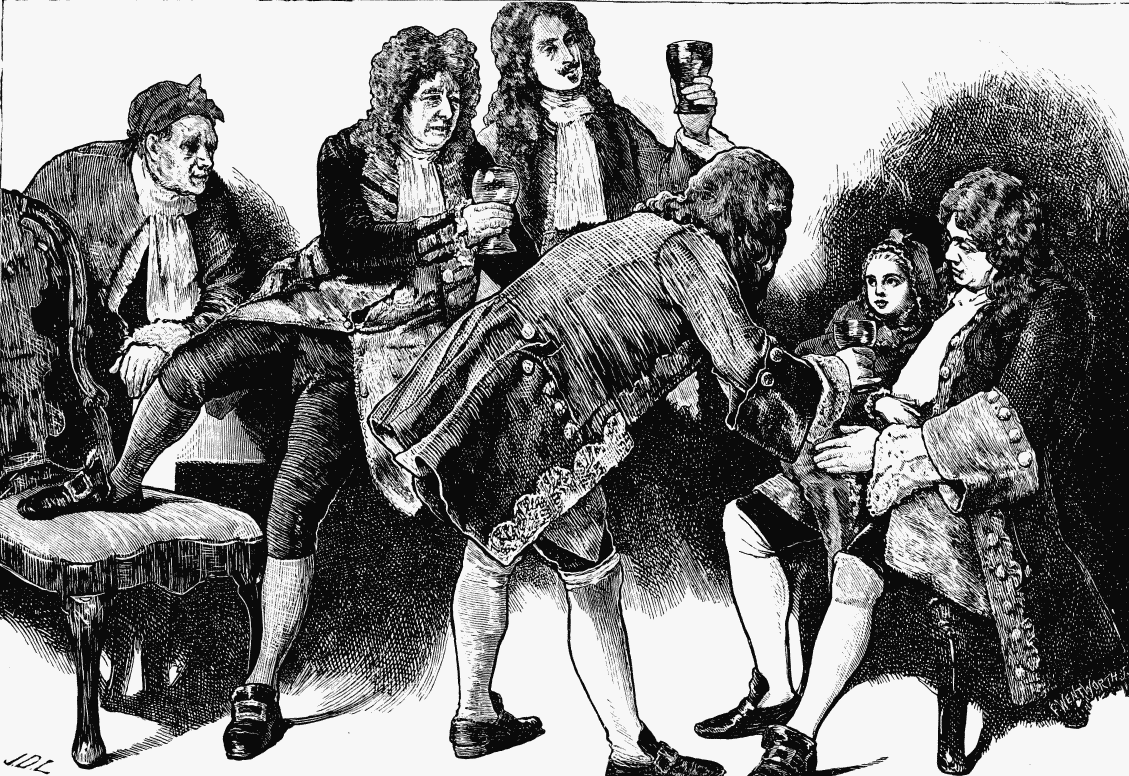
LADY MARY WORTLEY MONTAGU AND THE KIT-KATS (see page 71).
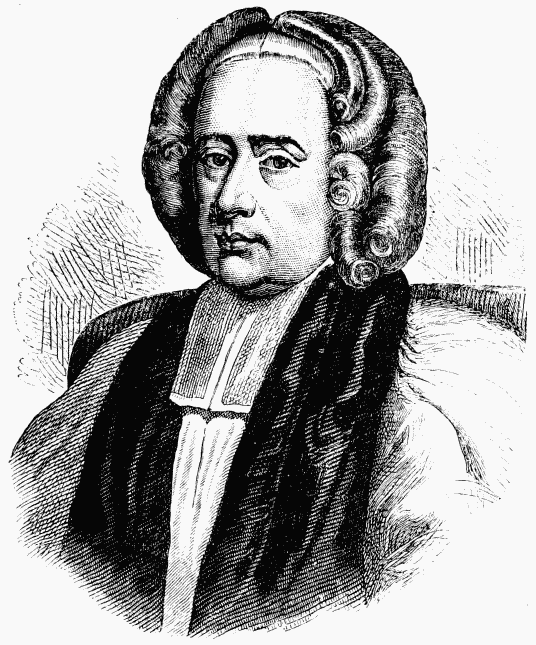
BISHOP BUTLER (see page 77).
At the "Trumpet" Steele also introduces us to a delightful club of old citizens that met every evening precisely at six. The humours of the fifteen Trumpeters are painted with the breadth and vigour of Hogarth's best manner. With a delightful humour Steele sketches Sir Geoffrey Notch, the president, who had spent all his money on horses, dogs, and gamecocks, and who looked on all thriving persons as pitiful upstarts. Then comes Major Matchlock, who thought nothing of any battle since Marston Moor, and who usually began his story of Naseby at three-quarters past six. Dick Reptile was a silent man, with a nephew whom he often reproved. The wit of the club, an old Temple bencher, never left the room till he had quoted ten distiches from "Hudibras" and told long stories of a certain extinct man about town named Jack Ogle. Old Reptile was extremely attentive to all that was said, though he had heard the same stories every night for twenty years, and upon all occasions winked oracularly to his nephew to particularly mind what passed. About ten the innocent twaddle closed by a man coming in with a lantern to light home old Bickerstaff. They were simple and happy times that Steele describes with such kindly humour; and the London of his days must have been full of such quiet, homely haunts.
Mr. R. Wells, of Colne Park, Halstead, kindly informs us that as late as the year 1765 there was a club that still kept up the name of Kit-Kat. The members in 1765 included, among others, Lord Sandwich (Jemmy Twitcher, as he was generally called), Mr. Beard, Lord Weymouth, Lord Bolingbroke, the Duke of Queensbury, Lord Caresford, Mr. Cadogan, the Marquis of Caracciollo, Mr. Seymour, and Sir George Armytage. One of the most active managers of the club was Richard Phelps (who, we believe, afterwards was secretary to Pitt). Among letters and receipts preserved by Mr. Wells, is one from Thomas Pingo, jeweller, of the "Golden Head," on the "Paved Stones," Gray's Inn Lane, for gold medals, probably to be worn by the members.
Even in the reign of James I. Shire Lane was christened Rogues' Lane, and, in spite of all the dukes and lords of the Kit-Kat, it never grew very respectable. In 1724, that incomparable young rascal, Jack Sheppard, used to frequent the "Bible" public-house—a printers' house of call—at No. 13. There was a trap in one of the rooms by which Jack could drop into a subterraneous passage leading to Bell Yard. Tyburn gibbet cured Jack of this trick. In 1738 the lane went on even worse, for there Thomas Carr (a low attorney, of Elm Court) and Elizabeth Adams robbed and murdered a gentleman named Quarrington at the "Angel and Crown" Tavern, and the miscreants were hung at Tyburn. Hogarth painted a portrait of the woman. One night, many years ago, a man was robbed, thrown downstairs, and killed, in one of the dens in Shire Lane. There was snow on the ground, and about two o'clock, when the watchmen grew drowsy and were a long while between their rounds, the frightened murderers carried the stiffened body up the lane and placed it bolt upright, near a dim oil lamp, at a neighbour's door. There the watchmen found it; but there was no clue to guide them, for nearly every house in the lane was infamous. Years after, two ruffianly fellows who were confined in the King's Bench were heard accusing each other of the murder in Shire Lane, and justice pounced upon her prey.
One thieves' house, known as the "Retreat," led, Mr. Diprose says, by a back way into Crown Court; and other dens had a passage into No. 242, Strand. Nos. 9, 10, and 11 were known as Cadgers' Hall, and were much frequented by beggars, and bushols of bread, thrown aside by the professional mendicants, were found there by the police.
The "Sun" Tavern, afterwards the "Temple Bar Stores," had been a great resort for the Tom and Jerry frolics of the Regency; and the "Anti-Gallican" Tavern was a haunt of low sporting men, being kept by Harry Lee, father of the first and original "tiger," invented and made fashionable by the notorious Lord Barrymore. During the Chartist times violent meetings were held at a club in Shire Lane. A good story is told of one of these. A detective in disguise attended an illegal meeting, leaving his comrades ready below. All at once a frantic hatter rose, denounced the detective as a spy, and proposed off-hand to pitch him out of window. Permitted by the more peaceable to depart, the policeman scuttled downstairs as fast as he could, and, not being recognised in his disguise, was instantly knocked down by his friends' prompt truncheons.
In Ship Yard, close to Shire Lane, once stood a block of disreputable, tumble-down houses, used by coiners, and known as the "Smashing Lumber." Every room had a secret trap, and from the workshop above a shaft reached the cellars to hurry away by means of a basket and. pulley all the apparatus at the first alarm. The first man made his fortune, but the new police soon ransacked the den and broke up the business.
In August, 1823, Theodore Hook, the witty and the heartless, was brought to a sponging-house kept by a sheriff's officer named Hemp, at the upper end of Shire Lane, being under arrest for a Crown debt of £12,000, due to the Crown for defalcations during his careless consulship at the Mauritius. He was editor of John Bull at the time, and continued while in this horrid den to write his "Sayings and Doings," and to pour forth for royal pay his usual scurrilous lampoons at all who supported poor, persecuted Queen Caroline. Dr. Maginn, who had just come over from Cork to practise Toryism, was his constant visitor, and Hemp's barred door no doubt often shook at their reckless laughter. Hook at length left Shire Lane for the Rules of the Bench (Temple Place) in April, 1824. Previously to his arrest he had been living in retirement at lodgings, in Somer's Town, with a poor girl whom he had seduced. Here he renewed the mad scenes of his thoughtless youth with Terry, Matthews, and wonderful old Tom Hill; and here he resumed (but not at these revels) his former acquaintanceship with that mischievous obstructive, Wilson Croker. After he left Shire Lane and the Rules of the Bench he went to Putney.
In spite of all bad proclivities, Shire Lane had its fits of respectability. In 1603 there was living there Sir Arthur Atie, Knt., in early life secretary to the great Earl of Leicester, and afterwards attendant on his step-son, the luckless Earl of Essex. Elias Ashmole, the great antiquary and student in alchemy and astrology, also honoured this lane, but he gathered in the Temple those great collections of books and coins, some of which perished by fire, and some of which he afterwards gave to the University of Oxford, where they were placed in a building called, in memory of the illustrious collector, the Ashmolean Museum.
To Mr. Noble's research we are indebted for the knowledge that in 1767 Mr. Hoole, the translator of Tasso, was living in Shire Lane, and from thence wrote to Dr. Percy, who was collecting his "Ancient Ballads," to ask him Dr. Wharton's address. Hoole was at that time writing a dramatic piece called Cyrus, for Covent Garden Theatre. He seems to have been an amiable man but a feeble poet, was an esteemed friend of Dr. Johnson, and had a situation in the East India House.
Another illustrious tenant of Shire Lane was James Perry, the proprietor of the Morning Chronicle, who died, as it was reported, worth £130,000. That lively memoir-writer, Taylor, of the Sun, who wrote "Monsieur Tonson," describes Perry as living in the narrow part of Shire Lane, opposite a passage which led to the stairs from Boswell Court. He lodged with Mr. Lunan, a bookbinder, who had married his sister, who subsequently became the wife of that great Greek scholar, thirsty Dr. Porson. Perry had begun life as the editor of the Gazeteer, but being dismissed by a Tory proprietor, and on the Morning Chronicle being abandoned by Woodfall, some friends of Perry's bought the derelict for £210, and he and Gray, a friend of Barett, became the joint-proprietors of the concern. Their printer, Mr. Lambert, lived in Shire Lane, and here the partners, too, lived for three or four years, when they removed to the corner-house of Lancaster Court, Strand.
Bell Yard can boast of but few associations; yet Pope often visited the dingy passage, because there for some years resided his old friend Fortescue, then a barrister, but afterwards a judge and Master of the Rolls. To Fortescue Pope dedicated his "Imitation of the First Satire of Horace," published in 1733. It contains what the late Mr. Rogers, the banker and poet, used to consider the best line Pope ever wrote, and it is certainly almost perfect,— "Bare the mean heart that lurks behind a star."
In that delightful collection of Pope's "Table Talk," called "Spence's Anecdotes," we find that a chance remark of Lord Bolingbroke, on taking up a "Horace" in Pope's sick-room, led to those fine "Imitations of Horace" which we now possess. The "First Satire" consists of an imaginary conversation between Pope and Fortescue, who advises him to write no more dangerous invectives against vice or folly. It was Fortescue who assisted Pope in writing the humorous law-report of "Stradling versus Stiles," in "Scriblerus." The intricate case is this, and is worthy of Anstey himself: Sir John Swale, of Swale's Hall, in Swale Dale, by the river Swale, knight, made his last will and testament, in which, among other bequests, was this: "Out of the kind love and respect that I bear my muchhonoured and good friend, Mr. Matthew Stradling, gent., I do bequeath unto the said Matthew Stradling, gent., all my black and white horses." Now the testator had six black horses, six white, and six pied horses. The debate, therefore, was whether the said Matthew Stradling should have the said pied horses, by virtue of the said bequest. The case, after much debate, is suddenly terminated by a motion in arrest of judgment that the pied horses were mares, and thereupon an inspection was prayed. This, it must be confessed, is admirable fooling. If the Scriblerus Club had carried out their plan of bantering the follies of the followers of every branch of knowledge, Fortescue would no doubt have selected the law as his special butt. "This friend of Pope," says Mr. Carruthers, "was consulted by the poet about all his affairs, as well as those of Martha Blount, and, as may be gathered, he gave him advice without a fee. The intercourse between the poet and his 'learned counsel' was cordial and sincere; and of the letters that passed between them sixty-eight have been published, ranging from 1714 to the last year of Pope's life. They are short, unaffected letters— more truly letters than any others in the series." Fortescue was promoted to the bench of the Exchequer in 1735, from thence to the Common Pleas in 1738, and in 1741 was made Master of the Rolls. Pope's letters are often addressed to "his counsel learned in the law, at his house at the upper end of Bell Yard, near unto Lincoln's Inn." In March, 1736, he writes of "that filthy old place, Bell Yard, which I want them and you to quit."
Apollo Court, next Bell Yard, has little about it worthy of notice beyond the fact that it derived its name from the great club-room at the "Devil" Tavern, that once stood on the opposite side of Fleet Street, and the jovialities of which we have already chronicled.