Old and New London: Volume 1. Originally published by Cassell, Petter & Galpin, London, 1878.
This free content was digitised by double rekeying. Public Domain.
Walter Thornbury, 'Fleet Street: Tributaries - Shoe Lane', in Old and New London: Volume 1(London, 1878), British History Online https://www.british-history.ac.uk/old-new-london/vol1/pp123-135 [accessed 5 May 2025].
Walter Thornbury, 'Fleet Street: Tributaries - Shoe Lane', in Old and New London: Volume 1(London, 1878), British History Online, accessed May 5, 2025, https://www.british-history.ac.uk/old-new-london/vol1/pp123-135.
Walter Thornbury. "Fleet Street: Tributaries - Shoe Lane". Old and New London: Volume 1. (London, 1878), British History Online. Web. 5 May 2025. https://www.british-history.ac.uk/old-new-london/vol1/pp123-135.
In this section
CHAPTER XI.
FLEET STREET TRIBUTARIES—SHOE LANE.
The First Lucifers—Perkins' Steam Gun—A Link between Shakespeare and Shoe Lane—Florio and his Labours—"Cogers' Hall"—Famous "Cogers"—A Saturday Night's Debate—Gunpowder Alley—Richard Lovelace, the Cavalier Poet—"To Althea, from Prison"—Lilly the Astrologer, and his Knaveries—A Search for Treasure with Davy Ramsay—Hogarth in Harp Alley—The "Society of Sign Painters"—Hudson, the Song Writer—"Jack Robinson"—The Bishop's Residence—Bangor House—A Strange Story of Unstamped Newspapers—Chatterton's Death—Curious Legend of his Burial—A well-timed Joke.
At the east corner of Peterborough Court (says Mr. Timbs) was one of the earliest shops for the instantaneous light apparatus, "Hertner's Eupyrion" (phosphorus and oxymuriate matches, to be dipped in sulphuric acid and asbestos), the costly predecessor of the lucifer match. Nearly opposite were the works of Jacob Perkins, the engineer of the steam gun exhibited at the Adelaide Gallery, Strand, and which the Duke of Wellington truly foretold would never be advantageously employed in battle.
One golden thread of association links Shakespeare to Shoe Lane. Slight and frail is the thread, yet it has a double strand. In this narrow sideaisle of Fleet Street, in 1624, lived John Florio, the compiler of our first Italian dictionary. Now it is more than probable that our great poet knew this industrious Italian, as we shall presently show. Florio was a Waldensian teacher, no doubt driven to England by religious persecution. He taught French and Italian with success at Oxford, and finally was appointed tutor to that generousminded, hopeful, and unfortunate Prince Henry, son of James I. Florio's "Worlde of Wordes" (a most copious and exact dictionary in Italian and English) was printed in 1598, and published by Arnold Hatfield for Edward Church, and "sold at his shop over against the north door of Paul's Church." It is dedicated to "The Right Honourable Patrons of Virtue, Patterns of Honour, Roger Earle of Rutland, Henrie Earle of Southampton, and Lucie Countess of Bedford." In the dedication, worthy of the fantastic author of "Euphues" himself, the author says:—"My hope springs out of three stems—your Honours' naturall benignitie; your able emploiment of such servitours; and the towardly like-lie-hood of this springall to do you honest service. The first, to vouchsafe all; the second, to accept this; the third, to applie it selfe to the first and second. Of the first, your birth, your place, and your custome; of the second, your studies, your conceits, and your exercise; of the thirde, my endeavours, my proceedings, and my project giues assurance. Your birth, highly noble, more than gentle; your place, above others, as in degree, so in height of bountie, and other vertues; your custome, never wearie of well doing; your studies much in all, most in Italian excellence; your conceits, by understanding others to worke above them in your owne; your exercise, to reade what the world's best writers have written, and to speake as they write. My endeavour, to apprehend the best, if not all; my proceedings, to impart my best, first to your Honours, then to all that emploie me; my proiect in this volume to comprehend the best and all, in truth, I acknowledge an entyre debt, not only of my best knowledge, but of all, yea, of more than I know or can, to your bounteous lordship, most noble, most vertuous, and most Honorable Earle of Southampton, in whose paie and patronage I haue liued some yeeres; to whom I owe and vowe the yeeres I haue to live. . . . . Good parts imparted are not empaired; your springs are first to serue yourself, yet may yeelde your neighbours sweete water; your taper is to light you first, and yet it may light your neighbour's candle. . . . . Accepting, therefore, of the childe, I hope your Honors' wish as well to the Father, who to your Honors' all deuoted wisheth meede of your merits, renowne of your vertues, and health of your persons, humblie with gracious leave kissing your thrice-honored hands, protesteth to continue euer your Honors' most humble and bounden in true seruice, John Florio."
And now to connect Florio with Shakespeare. The industrious Savoyard, besides his dictionary—of great use at a time when the tour to Italy was a necessary completion of a rich gallant's education—translated the essays of that delightful old Gascon egotist, Montaigne. Now in a copy of Florio's "Montaigne" there was found some years ago one of the very few genuine Shakespeare signatures. Moreover, as Florio speaks of the Earl of Southampton as his steady patron, we may fairly presume that the great poet, who must have been constantly at Southampton's house, often met there the old Italian master. May not the bard in those conversations have perhaps gathered some hints for the details of Cymbeline, Romeo and Juliet, Othello, or The Two Gentlemen of Verona, and had his attention turned by the old scholar to fresh chapters of Italian story?
No chronicle of Shoe Lane would be complete without some mention of the "Cogers' Discussion Hall," formerly at No. 10. This useful debating society—a great resort for local politicians—was founded by Mr. Daniel Mason as long ago as 1755, and among its most eminent members it glories in the names of John Wilkes, Judge Keogh, Daniel O'Connell, and the eloquent Curran. The word "Coger" does not imply codger, or a drinker of cogs, but comes from cogito, to cogitate. The Grand, Vice-Grand, and secretary were elected on the night of every 14th of June by show of hands. The room was open to strangers, but the members had the right to speak first. The society was Republican in the best sense, for side by side with master tradesmen, shopmen, and mechanics, reporters and young barristers gravely sipped their grog, and abstractedly emitted wreathing columns of tobacco-smoke from their pipes. Mr. J. Parkinson has sketched the little parliament very pleasantly in the columns of a contemporary.
"A long low room," says the writer, "like the saloon of a large steamer. Wainscoat dimmed and ornaments tarnished by tobacco-smoke and the lingering dews of steaming compounds. A room with large niches at each end, like shrines for fullgrown saints, one niche containing 'My Grand' in a framework of shabby gold, the other 'My Grand's Deputy' in a bordering more substantial. More than one hundred listeners are wating patiently for My Grand's utterances this Saturday night, and are whiling away the time philosophically with bibulous and nicotian refreshment. The narrow tables of the long room are filled with students and performers, and quite a little crowd is congregated at the door and in a room adjacent until places can be found for them in the presence-chamber. 'Established 1755' is inscribed on the ornamental signboard above us, and 'Instituted 1756' on another signboard near. Dingy portraits of departed Grands and Deputies decorate the walls. Punctually at nine My Grand opens the proceedings amid profound silence. The deputy buries himself in his newspaper, and maintains as profound a calm as the Speaker 'in another place.' The most perfect order is preserved. The Speaker or deputy, who seems to know all about it, rolls silently in his chair: he is a fat dark man, with a small and rather sleepy eye, such as I have seen come to the surface and wink lazily at the fashionable people clustered round a certain tank in the Zoological Gardens. He re-folds his newspaper from time to time until deep in the advertisements. The waiters silently remove empty tumblers and tankards, and replace them full. But My Grand commands profound attention from the room, and a neighbour, who afterwards proved a perfect Boanerges in debate, whispered to us concerning his vast attainments and high literary position.
"This chieftain of the Thoughtful Men is, we learn, the leading contributor to a newspaper of large circulation, and, under his signature of 'Locksley Hall,' rouses the sons of toil to a sense of the dignity and rights of labour, and exposes the profligacy and corruption of the rich to the extent of a column and a quarter every week. A shrewd, hard-headed man of business, with a perfect knowledge of what he had to do, and with a humorous twinkle of the eye, My Grand went steadily through his work, and gave the Thoughtful Men his epitome of the week's intelligence. It seemed clear that the Cogers had either not read the newspapers, or liked to be told what they already knew. They listened with every token of interest to facts which had been published for days, and it seemed difficult to understand how a debate could be carried on when the text admitted so little dispute. But we sadly underrated the capacity of the orators near us. The sound of My Grand's last sentence had not died out when a fresh-coloured, rather aristocratic-looking elderly man, whose white hair was carefully combed and smoothed, and whose appearance and manner suggested a very different arena to the one he waged battle in now, claimed the attention of the Thoughtful ones. Addressing 'Mee Grand' in the rich and unctuous tones which a Scotchman and Englishman might try for in vain, this orator proceeded, with every profession of respect, to contradict most of the chief's statements, to ridicule his logic, and to compliment him with much irony on his overwhelming goodness to the society 'to which I have the honour to belong. Full of that hard northern logic' (much emphasis on 'northern,' which was warmly accepted as a hit by the room)—'that hard northern logic which demonstrates everything to its own satisfaction; abounding in that talent which makes you, sir, a leader in politics, a guide in theology, and generally an instructor of the people; yet even you, sir, are perhaps, if I may say so, somewhat deficient in the lighter graces of pathos and humour. Your speech, sir, has commanded the attention of the room. Its close accuracy of style, its exactitude of expression, its consistent argument, and its generally transcendant ability will exercise, I doubt not, an influence which will extend far beyond this chamber, filled as this chamber is by gentlemen of intellect and education, men of the time, who both think and feel, and who make their feelings and their thoughts felt by others. Still, sir,' and the orator smiles the smile of ineffable superiority, 'grateful as the members of the society you have so kindly alluded to ought to be for your countenance and patronage, it needed not' (turning to the Thoughtful Men generally, with a sarcastic smile)—'it needed not even Mee Grand's encomiums to endear this society to its people, and to strengthen their belief in its efficacy in time of trouble, its power to help, to relieve, and to assuage. No, Mee Grand, an authoritee whose dictum even you will accept without dispute—mee Lord Macaulee—that great historian whose undying pages record those struggles and trials of constitutionalism in which the Cogers have borne no mean part—me Lord Macaulee mentions, with a respect and reverence not exceeded by Mee Grand's utterances of to-night' (more smiles of mock humility to the room) 'that great association which claims me as an unworthy son. We could, therefore, have dispensed with the recognition given us by Mee Grand; we could afford to wait our time until the nations of the earth are fused by one common wish for each other's benefit, when the principles of Cogerism are spread over the civilised world, when justice reigns supreme, and loving-kindness takes the place of jealousy and hate.' We looked round the room while these fervid words were being triumphantly rolled forth, and were struck with the calm impassiveness of the listeners. There seemed to be no partisanship either for the speaker or the Grand. Once, when the former was more than usually emphatic in his denunciations, a tall pale man, with a Shakespeare forehead, rose suddenly, with a determined air, as if about to fiercely interrupt; but it turned out he only wanted to catch the waiter's eye, and this done, he pointed silently to his empty glass, and remarked, in a hoarse whisper, 'Without sugar, as before.'"
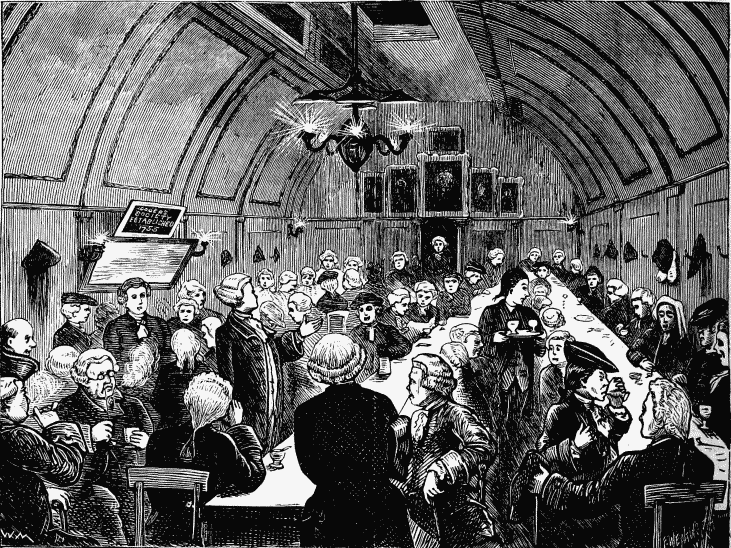
COGERS' HALL (see page 124).
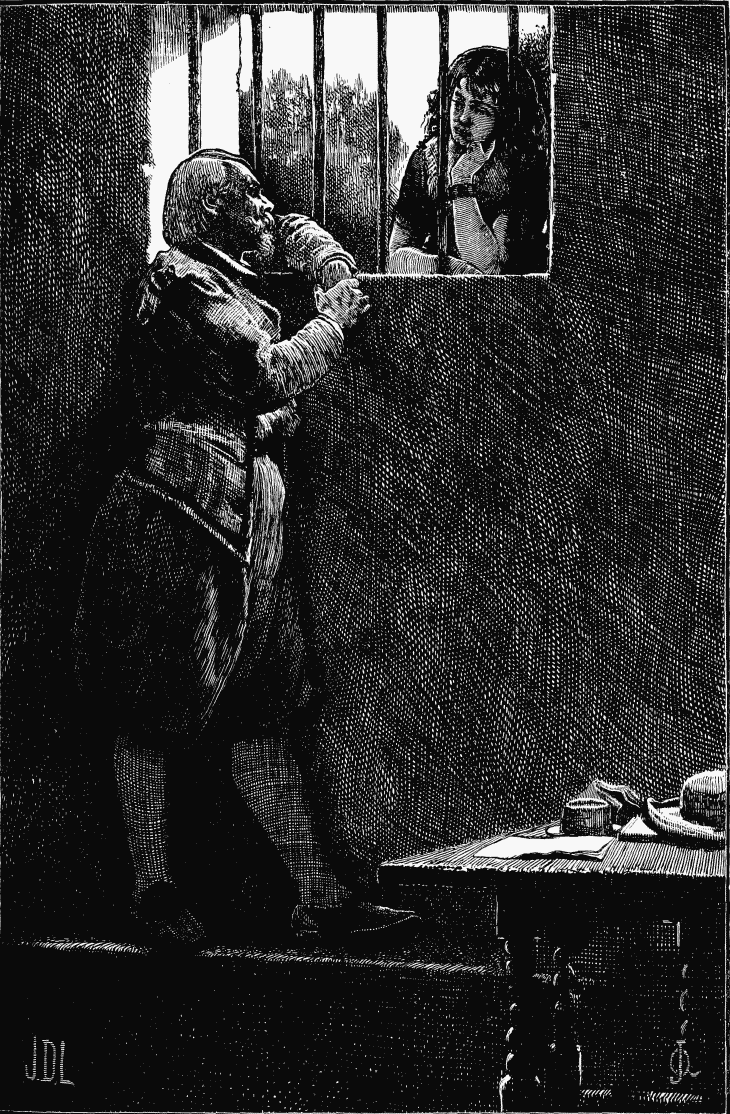
LOVELACE IN PRISON (see page 128).
Gunpowder Alley, a side-twig of Shoe Lane, leads
us to the death-bed of an unhappy poet, poor
Richard Lovelace, the Cavalier, who, dying here
two years before the "blessed" Restoration, in a
very mean lodging, was buried at the west end of
St. Bride's Church. The son of a knight, and
brought up at Oxford, Anthony Wood describes
the gallant and hopeful lad at sixteen, when presented at the Court of Charles I., as "the most
amiable and beautiful youth that eye ever beheld.
A person, also, of innate modesty, virtue, and
courtly deportment, which made him then, but
specially after, when he retired to the great city,
much admired and adored by the female sex."
Presenting a daring petition from Kent in favour
of the king, the Cavalier poet was thrown into
prison by the Long Parliament, and was released
only to waste his fortune in Royalist plots. He
served in the French army, raised a regiment for
Louis XIII., and was left for dead at Dunkirk.
On his return to England, he found Lucy Sacheverell—his "Lucretia," the lady of his love—married, his death having been reported. All went
ill. He was again imprisoned, grew penniless,
had to borrow, and fell into a consumption from
despair for love and loyalty. "Having consumed
all his estate," says Anthony Wood, "he grew very
melancholy, which at length brought him into a
consumption; became very poor in body and purse,
was the object of charity, went in ragged clothes
(whereas when he was in his glory he wore cloth of
gold and silver), and mostly lodged in obscure and
dirty places, more befitting the worst of beggars
than poorest of servants." There is a doubt, however, as to whether Lovelace died in such abject
poverty, poor, dependent, and unhappy as he might
have been. Lovelace's verse is often strained,
affected, and wanting in judgment; but at times
he mounts a bright-winged Pegasus, and with plume
and feather flying, tosses his hand up, gay and
chivalrous as Rupert's bravest. His verses to Lucy
Sacheverell, on leaving her for the French camp, are
worthy of Montrose himself. The last two lines—
"I could not love thee, dear, so much,
Lov'd I not honour more"—
contain the thirty-nine articles of a soldier's faith.
And what Wildrake could have sung in the Gate
House or the Compter more gaily of liberty than
Lovelace, when he wrote,—
"Stone walls do not a prison make,
Nor iron bars a cage;
Minds innocent and quiet take
That for a hermitage.
If I have freedom in my love,
And in my soul am free,
Angels alone, that soar above,
Enjoy such liberty"?
Whenever we read the verse that begins,—
"When love, with unconfinèd wings,
Hovers within my gates,
And my divine Althea brings,
To whisper at my grates,"
the scene rises before us—we see a fair pale face,
with its aureole of golden hair gleaming between the
rusty bars of the prison door, and the worn visage
of the wounded Cavalier turning towards it as the
flower turns to the sun. And surely Master Wildrake
himself, with his glass of sack half-way to his mouth,
never put it down to sing a finer Royalist stave
than Lovelace's "To Althea, from Prison,"—
"When, linnet-like, confined, I
With shriller note shall sing
The mercy, sweetness, majesty,
And glories of my king;
When I shall voice aloud how good
He is, how great should be,
Th' enlarged winds that curl the flood
Know no such liberty."
In the Cromwell times there resided in Gunpowder Alley, probably to the scorn of poor dying Lovelace, that remarkable cheat and early medium, Lilly the astrologer, the Sidrophel of "Hudibras." This rascal, who supplied the King and Parliament alternately with equally veracious predictions, was in youth apprenticed to a mantua-maker in the Strand, and on his master's death married his widow. Lilly studied astrology under one Evans, an ex-clergyman, who told fortunes in Gunpowder Alley. Besotted by the perusal of Cornelius Agrippa and other such trash, Lilly, found fools plenty, and the stars, though potent in their spheres, unable to contradict his lies. This artful cheat was consulted as to the most propitious day and hour for Charles's escape from Carisbrook, and was even sent for by the Puritan generals to encourage their men before Colchester. Lilly was a spy of the Parlia ment, yet at the Restoration professed to disclose the fact that Cornet Joyce had beheaded Charles. Whenever his predictions or his divining-rod failed, he always attributed his failures, as the modern spiritualists, the successors of the old wizards, still conveniently do, to want of faith in the spectators. By means of his own shrewdness, rather than by stellar influence, Lilly obtained many useful friends, among whom we may specially particularise the King of Sweden, Lenthal the Puritan Speaker, Bulstrode, Whitelocke (Cromwell's Minister), and the learned but credulous Elias Ashmole. Lilly's Almanac, the predecessor of Moore's and Zadkiel's, was carried on by him for six-and-thirty years. He claimed to be a special protégé of an angel called Salmonæus, and to have a more than bowing acquaintance with Salmael and Malchidael, the guardian angels of England. Among his works are his autobiography, and his "Observations on the Life and Death of Charles, late King of England." The rest of his effusions are pretentious, mystical, muddle-headed rubbish, half nonsense half knavery, as "The White King's Prophecy," "Supernatural Light," "The Starry Messenger," and "Annus Tenebrosus, or the Black Year." The rogue's starry mantle descended on his adopted son, a tailor, whom he named Merlin, junior. The credulity of the atheistical times of Charles II. is only equalled by that of our own day.
Lilly himself, in his amusing, half-knavish autobiography, has described his first introduction to the Welsh astrologer of Gunpowder Alley:—
"It happened," he says, "on one Sunday, 1632, as myself and a justice of peace's clerk were, before service, discoursing of many things, he chanced to say that such a person was a great scholar—nay, so learned that he could make an almanac, which to me then was strange; one speech begot another, till, at last, he said he could bring me acquainted with one Evans, in Gunpowder Alley, who had formerly lived in Staffordshire, that was an excellent wise man, and studied the black art. The same week after we went to see Mr. Evans. When we came to his house, he, having been drunk the night before, was upon his bed, if it be lawful to call that a bed whereon he then lay. He roused up himself, and after some compliments he was content to instruct me in astrology. I attended his best opportunities for seven or eight weeks, in which time I could set a figure perfectly. Books he had not any, except Haly, 'De Judiciis Astrorum,' and Orriganus's 'Ephemerides;' so that as often as I entered his house I thought I was in the wilderness. Now, something of the man. He was by birth a Welshman, a master of arts, and in sacred orders. He had formerly had a cure of souls in Staffordshire, but now was come to try his fortunes at London, being in a manner enforced to fly, for some offences very scandalous committed by him in those parts where he had lately lived; for he gave judgment upon things lost, the only shame of astrology. He was the most saturnine person my eye ever beheld, either before I practised or since; of a middle stature, broad forehead, beetle-browed, thick shoulders, flat-nosed, full lips, down-looked, black, curling, stiff hair, splay-footed. To give him his right, he had the most piercing judgment naturally upon a figure of theft, and many other questions, that I ever met withal; yet for money he would willingly give contrary judgments; was much addicted to debauchery, and then very abusive and quarrelsome; seldom without a black eye or one mischief or other. This is the same Evans who made so many antimonial cups, upon the sale whereof he chiefly subsisted. He understood Latin very well, the Greek tongue not all; he had some arts above and beyond astrology, for he was well versed in the nature of spirits, and had many times used the circular way of invocating, as in the time of our familiarity he told me."
One of Lilly's most impudent attempts to avail himself of demoniacal assistance was when he dug for treasure (like Scott's Dousterswivel) with David Ramsay (Scott again), one stormy night, in the cloisters at Westminster.
"Davy Ramsay," says the arch rogue, "his majesty's clockmaker, had been informed that there was a great quantity of treasure buried in the cloisters of Westminster Abbey; he acquaints Dean Williams therewith, who was also then Bishop of Lincoln; the dean gave him liberty to search after it, with this proviso, that if any was discovered his church should have a share of it. Davy Ramsay finds out one John Scott, (fn. 1) who pretended the use of the Mosaical rods, to assist him therein. I was desired to join with him, unto which I consented. One winter's night Davy Ramsay, (fn. 2) with several gentlemen, myself, and Scott, entered the cloisters; upon the west side of the cloisters the rods turned one over another, an argument that the treasure was there. The labourers digged at least six feet deep, and then we met with a coffin, but in regard it was not heavy, we did not open, which we afterwards much repented. From the cloisters we went into the abbey church, where upon a sudden (there being no wind when we began) so fierce, so high, so blustering and loud a wind did rise, that we verily believed the west-end of the church would have fallen upon us; our rods would not move at all; the candles and torches, all but one, were extinguished, or burned very dimly. John Scott, my partner, was amazed, looked pale, knew not what to think or do, until I gave directions and command to dismiss the demons, which when done all was quiet again, and each man returned unto his lodging late, about twelve o'clock at night. I could never since be induced to join with any in such-like actions.
"The true miscarriage of the business was by reason of so many people being present at the operation, for there was about thirty—some laughing, others deriding us; so that if we had not dismissed the demons, I believe most part of the abbey church had been blown down. Secrecy and intelligent operators, with a strong confidence and knowledge of what they are doing, are best for this work."
In the last century, when every shop had its sign and London streets were so many out-ofdoor picture-galleries, a Dutchman named Vandertrout opened a manufactory of these pictorial advertisements in Harp Alley, Shoe Lane, a dirty passage now laid open to the sun and air on the east side of the new transverse street running from Ludgate Hill to Holborn. In ridicule of the spurious black, treacly old masters then profusely offered for sale by the picture-dealers of the day, Hogarth and Bonnell Thornton opened an exhibition of shop-signs. In Nicholls and Stevens' "Life of Hogarth" there is a full and racy account of this sarcastic exhibition:—"At the entrance of the large passage-room was written, 'N.B. That the merit of the modern masters may be fairly examined into, it has been thought proper to place some admired works of the most eminent old masters in this room, and along the passage through the yard.' Among these are 'A Barge' in still life, by Vandertrout. He cannot be properly called an English artist; but not being sufficiently encouraged in his own country, he left Holland with William the Third, and was the first artist who settled in Harp Alley. An original half-length of Camden, the great historian and antiquary, in his herald's coat; by Vandertrout. As this artist was originally colour-grinder to Hans Holbein, it is conjectured there are some of that great master's touches in this piece. 'Nobody, alias Somebody,' a character. (The figure of an officer, all head, arms, legs, and thighs. This piece has a very odd effect, being so drolly executed that you do not miss the body.) 'Somebody, alias Nobody,' a caricature, its companion; both these by Hagarty. (A rosy figure, with a little head and a huge body, whose belly sways over almost quite down to his shoe-buckles. By the staff in his hand, it appears to be intended to represent a constable. It might else have been intended for an eminent justice of peace.) 'A Perspective View of Billingsgate, or Lectures on Elocution;' and 'The True Robin Hood Society, a Conversation or Lectures on Elocution,' its companion; these two by Barnsley. (These two strike at a famous lecturer on elocution and the reverend projector of a rhetorical academy, are admirably conceived and executed, and—the latter more especially—almost worthy the hand of Hogarth. They are full of a variety of droll figures, and seem, indeed, to be the work of a great master struggling to suppress his superiority of genius, and endeavouring to paint down to the common style and manner of sign-painting.)
"At the entrance to the grand room:—'The Society of Sign Painters take this opportunity of refuting a most malicious suggestion that their exhibition is designed as a ridicule on the exhibitions of the Society for the Encouragement of Arts, &c., and of the artists. They intend theirs only as an appendix or (in the style of painters) a companion to the other. There is nothing in their collection which will be understood by any candid person as a reflection on anybody, or any body of men. They are not in the least prompted by any mean jealousy to depreciate the merit of their brother artists. Animated by the same public spirit, their sole view is to convince foreigners, as well as their own blinded countrymen, that however inferior this nation may be unjustly deemed in other branches of the polite arts, the palm for sign-painting must be ceded to us, the Dutch themselves not excepted.' Projected in 1762 by Mr. Bonnel Thornton, of festive memory; but I am informed that he contributed no otherwise towards this display than by a few touches of chalk. Among the heads of distinguished personages, finding those of the King of Prussia and the Empress of Hungary, he changed the cast of their eyes, so as to make them leer significantly at each other. Note.—These (which in the catalogue are called an original portrait of the present Emperor of Prussia and ditto of the Empress Queen of Hungary, its antagonist) were two old signs of the "Saracen's Head" and Queen Anne. Under the first was written 'The Zarr,' and under the other 'The Empress Quean.' They were lolling their tongues out at each other; and over their heads ran a wooden label, inscribed, 'The present state of Europe.'
"In 1762 was published, in quarto, undated, 'A Catalogue of the Original Paintings, Busts, and Carved Figures, &c. &c., now Exhibiting by the Society of Sign-painters, at the Large Room, the upper end of Bow Street, Covent Garden, nearly opposite the Playhouse.'"
At 98, Shoe Lane lived, now some fifty years ago,
a tobacconist named Hudson, a great humorist, a
fellow of infinite fancy, and the writer of half the
comic songs that once amused festive London.
Hudson afterwards, we believe, kept the "Kean's
Head" tavern, in Russell Court, Drury Lane, and
about 1830 had a shop of some kind or other in
Museum Street, Bloomsbury. Hudson was one of
those professional song-writers and vocalists who
used to be engaged to sing at such supper-rooms
and theatrical houses as Offley's, in Henrietta Street
(north-west end), Covent Garden; the "Coal Hole,"
in the Strand; and the "Cider Cellars," Maiden
Lane. Sitting among the company, Hudson used
to get up at the call of the chairman and "chant"
one of his lively and really witty songs. The platform belongs to "Evans's" and a later period.
Hudson was at his best long after Captain Morris's
day, and at the time when Moore's melodies were
popular. Many of the melodies Hudson parodied
very happily, and with considerable tact and taste.
Many of Hudson's songs, such as "Jack Robinson"
(infinitely funnier than most of Dibdin's), became
coined into catch-words and street sayings of the
day. "Before you could say Jack Robinson" is
a phrase, still current, derived from this highly
droll song. The verse in which Jack Robinson's
"engaged" apologises for her infidelity is as good
as anything that James Smith ever wrote. To the
returned sailor,—
"Says the lady, says she, 'I've changed my state.'
'Why, you don't mean,' says Jack, 'that you've got a mate?
You know you promised me.' Says she, 'I couldn't wait,
For no tidings could I gain of you, Jack Robinson.
And somebody one day came to me and said
That somebody else had somewhere read,
In some newspaper, that you was somewhere dead.'—
'I've not been dead at all,' says Jack Robinson."
Another song, "The Spider and the Fly," is still
often sung; and "Going to Coronation" is by
no means forgotten in Yorkshire. "There was a
Man in the West Countrie" figures in most current
collections of songs. Hudson particularly excelled
in stage-Irishman songs, which were then popular;
and some of these, particularly one that ends with
the refrain, "My brogue and my blarney and
bothering ways," have real humour in them. Many
of these Irish songs were written for and sung by
the late Mr. Fitzwilliam, the comedian, as others of
Hudson's songs were by Mr. Rayner. Collectors of
comic ditties will not readily forget "Walker, the
Twopenny Postman," or "The Dogs'-meat Man"—rough caricatures of low life, unstained by the
vulgarity of many of the modern music-hall ditties.
In the motto to one of his collections of poems,
Hudson borrows from Churchill an excuse for the
rough, humorous effusions that he scattered broadcast over the town,—
"When the mad fit comes on, I seize the pen,
Rough as they run, the rapid thoughts set down;
Rough as they run, discharge them on the town.
Hence rude, unfinished brats, before their time,
Are born into this idle world of rhyme;
And the poor slattern muse is brought to bed,
With all her imperfections on her head."
We subjoin a very good specimen of Hudson's
songs, from his once very popular "Coronation of
William and Adelaide" (1830), which, we think,
will be allowed to fully justify our praise of the
author:—
"And when we got to town, quite tired,
The bells all rung, the guns they fired,
The people looking all bemired,
In one conglomeration.
Soldiers red, policemen blue,
Horse-guards, foot-guards, and blackguards too,
Beef-eaters, dukes, and Lord knows who,
To see the coronation.
While Dolly bridled up, so proud,
At us the people laughed aloud;
Dobbin stood in thickest crowd,
Wi' quiet resignation.
To move again he warn't inclined;
'Here's a chap !' says one behind,
'He's brought an old horse, lame and blind,
To see the coronation.'
Dolly cried, 'Oh ! dear, oh ! dear,
I wish I never had come here,
To suffer every jibe and jeer,
In such a situation.'
While so busy, she and I
To get a little ease did try,
By goles ! the king and queen went by,
And all the coronation.
I struggled hard, and Dolly cried;
And tho' to help myself I tried,
We both were carried with the tide,
Against our inclination.
'The reign's begun !' folks cried; "tis true;'
'Sure,' said Dolly, 'I think so too;
'The rain's begun, for I'm wet thro',
All through the coronation.'
We bade good-bye to Lunnun town;
The king and queen they gain'd a crown;
Dolly spoilt her bran-new gown,
To her mortification.
I'll drink our king and queen wi' glee,
In home-brewed ale, and so will she;
But Doll and I ne'er want to see
Another coronation."
Our English bishops, who had not the same taste as the Cistercians in selecting pleasant places for their habitations, seem during the Middle Ages to have much affected the neighbourhood of Fleet Street. Ely Place still marks the residence of one rich prelate. In Chichester Rents we have already met with the humble successors of the netmaker of Galilee. In a siding on the north-west side of Shoe Lane the Bishops of Bangor lived, with their spluttering and choleric Welsh retinue, as early as 1378. Recent improvements have laid open the miserable "close" called Bangor Court, that once glowed with the reflections of scarlet hoods and jewelled copes; and a schoolhouse of bastard Tudor architecture, with sham turrets and flimsy mullioned windows, now occupies the site of the proud Christian prelate's palace. Bishop Dolben, who died in 1633 (Charles I.), was the last Welsh bishop who deigned to reside in a neighbourhood from which wealth and fashion was fast ebbing. Brayley says that a part of the old episcopal garden, where the ecclesiastical subjects of centuries had been discussed by shaven men and frocked scholars, still existed in 1759 (George II.); and, indeed, as Mr. Jesse records, even as late as 1828 (George IV.) a portion of the old mansion, once redolent with the stupefying incense of the semipagan Church, still lingered. Bangor House, according to Mr. J. T. Smith, is mentioned in the patent rolls as early as Edward III. The lawyers' barbarous dog-Latin of the old-deed describe, "unum messuag, unum placeam terræ, ac unam gardniam, cum aliis edificis," in Shoe Lane, London. In 1647 (Charles I.) Sir John Birkstead purchased of the Parliamentary trustees the bishop's lands, that had probably been confiscated, to build streets upon the site. But Sir John went on paving the old place, and never built at all. Cromwell's Act of 1657, to check the increase of London, entailed a special exemption in his favour. At the Restoration, the land returned to its Welsh bishop; but it had degenerated—the palace was divided into several residences, and mean buildings sprang up like fungi around it. A drawing of Malcolm's, early in the century, shows us its two Tudor windows. Latterly it became divided into wretched rooms, and two or three hundred poor people, chiefly Irish, herded in them. The house was entirely pulled down in the autumn of 1828.
Mr. Grant, that veteran of the press, tells a capital story, in his "History of the Newspaper Press," of one of the early vendors of unstamped newspapers in Shoe Lane:—
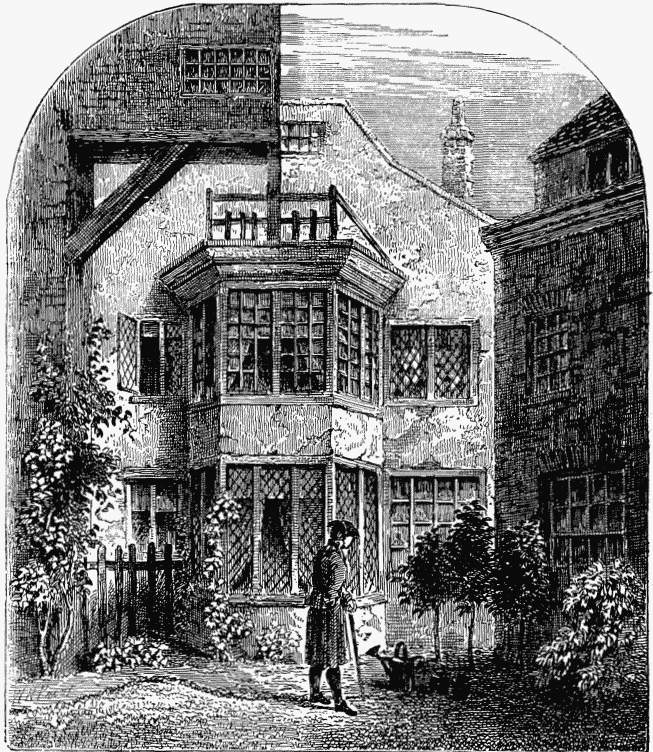
BANGOR HOUSE, 1818 (see page 131).
"Cleave's Police Gazette,"says Mr. Grant, "consisted chiefly of reports of police cases. It certainly was a newspaper to all intents and purposes, and was ultimately so declared to be in a court of law by a jury. But in the meantime, while the action was pending, the police had instructions to arrest Mr. John Cleave, the proprietor, and seize all the copies of the paper as they came out of his office in Shoe Lane. He contrived for a time to elude their vigilance; and in order to prevent the seizure of his paper, he resorted to an expedient which was equally ingenious and laughable. Close by his little shop in Shoe Lane there was an undertaker, whose business, as might be inferred from the neighbourhood, as well as from his personal appearance and the homeliness of his shop, was exclusively among the lower and poorer classes of the community. With him Mr. Cleave made an arrangement to construct several coffins of the plainest and cheapest kind, for purposes which were fully explained. The 'undertaker,' whose ultra-republican principles were in perfect unison with those of Mr. Cleave, not only heartily undertook the work, but did so on terms so moderate that he would not ask for nor accept any profit. He, indeed, could imagine no higher nor holier duty than that of assisting in the dissemination of a paper which boldly and energetically preached the extinction of the aristocracy and the perfect equality in social position, and in property too, of all classes of the community. Accordingly the coffins, with a rudeness in make and material which were in perfect keeping with the purpose to which they were to be applied, were got ready; and Mr. Cleave, in the dead of night, got them filled with thousands of his Gazettes. It had been arranged beforehand that particular houses in various parts of the town should be in readiness to receive them with blinds down, as if some relative had been dead, and was about to be borne away to the house appointed for all living. The deal coffin was opened, and the contents were taken out, tied up in a parcel so as to conceal from the prying curiosity of any chance person that they were Cleave's Police Gazettes, and then sent off to the railway stations most convenient for their transmission to the provinces. The coffins after this were returned in the middle of next night to the 'undertaker's' in Shoe Lane, there to be in readiness to render a similar service to Mr. Cleave and the cause of red Republicanism when the next Gazette appeared.
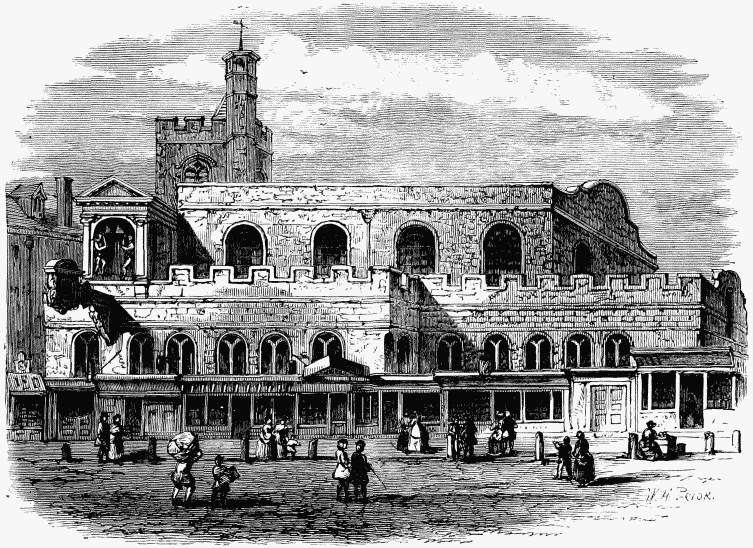
OLD ST. DUNSTAN'S CHURCH (see page 135).
"In this way Mr. Cleave contrived for some time to elude the vigilance of the police and to sell about 50,000 copies weekly of each impression of his paper. But the expedient, ingenious and eminently successful as it was for a time, failed at last. The people in Shoe Lane and the neighbourhood began to be surprised and alarmed at the number of funerals, as they believed them to be, which the departure of so many coffins from the 'undertaker's' necessarily implied. The very natural conclusion to which they came was, that this supposed sudden and extensive number of deaths could only be accounted for on the assumption that some fatal epidemic had visited the neighbourhood, and there made itself a local habitation. The parochial authorities, responding to the prevailing alarm, questioned the 'undertaker' friend and fellowlabourer of Mr. Cleave as to the causes of his sudden and extensive accession of business in the coffinmaking way; and the result of the close questions put to him was the discovery of the whole affair. It need hardly be added that an immediate and complete collapse took place in Mr. Cleave's business, so far as his Police Gazette was concerned. Not another number of the publication ever made its appearance, while the coffin-trade of the 'undertaker' all at once returned to its normal proportions."
This stratagem of Cleave's was rivalled a few years ago by M. Herzen's clever plan of sending great numbers of his treasonable and forbidden paper, the Kolokol, to Russia, soldered up in sardine-boxes. No Government, in fact, can ever baffle determined and ingenious smugglers.
One especially sad association attaches to Shoe Lane, and that is the burial in the workhouse graveyard (the site of the late Farringdon Market) of that unhappy child of genius, Chatterton the poet. In August, 1770, the poor lad, who had come from Bristol full of hope and ambition to make his fortune in London by his pen, broken-hearted and maddened by disappointment, destroyed himself in his mean garret-lodging in Brooke Street, Holborn, by swallowing arsenic. Mr. John Dix, his very unscrupulous biographer, has noted down a curious legend about the possible removal of the poet's corpse from London to Bristol, which, doubtful as it is, is at least interesting as a possibility:—
"I found," says Mr. Dix, "that Mrs. Stockwell, of Peter Street, wife of Mr. Stockwell, a basketmaker, was the person who had communicated to Sir R. Wilmot her grounds for believing Chatterton to have been so interred; and on my requesting her to repeat to me what she knew of that affair, she commenced by informing me that at ten years of age she was a scholar of Mrs. Chatterton, his mother, where she was taught plain work, and remained with her until she was near twenty years of age; that she slept with her, and found her kind and motherly, insomuch that there were many things which in moments of affliction Mrs. C. communicated to her, that she would not have wished to have been generally known; and among others, she often repeated how happy she was that her unfortunate son lay buried in Redcliff, through the kind attention of a friend or relation in London, who, after the body had been cased in a parish shell, had it properly secured and sent to her by the waggon; that when it arrived it was opened, and the corpse found to be black and half putrid (having been burst with the motion of the carriage, or from some other cause), so that it became necessary to inter it speedily; and that it was early interred by Phillips, the sexton, who was of her family. That the effect of the loss of her son was a nervous disorder, which never quitted her, and she was often seen weeping at the bitter remembrance of her misfortune. She described the poet as having been sharp-tempered, but that it was soon over; and she often said he had cost her many uneasy hours, from the apprehension she entertained of his going mad, as he was accustomed to remain fixed for above an hour at a time quite motionless, and then he would snatch up a pen and write incessantly; but he was always, she added, affectionate. . . . .
"In addition to this, Mrs. Stockwell told the writer that the grave was on the right-hand side of the lime-tree, middle paved walk, in Redcliff Churchyard, about twenty feet from the father's grave, which is, she says, in the paved walk, and where now Mrs. Chatterton and Mrs. Newton, her daughter, also lie. Also, that Mrs. Chatterton gave a person leave to bury his child over her son's coffin, and was much vexed to find that he afterwards put the stone over it, which, when Chatterton was buried, had been taken up for the purpose of digging the grave, and set against the church-wall; that afterwards, when Mr. Hutchinson's or Mr. Taylor's wife died, they buried her also in the same grave, and put this stone over with a new inscription. (Query, did he erase the first, or turn the stone ?— as this might lead to a discovery of the spot.) . . . .
"Being referred to Mrs. Jane Phillips, of Rolls Alley, Rolls Lane, Great Gardens, Temple Parish (who is sister to that Richard Phillips who was sexton at Redcliff Church in the year 1772), she informed me that his widow and a daughter were living in Cathay; the widow is sexton, a Mr. Perrin, of Colston's Parade, acting for her. She remembers Chatterton having been at his father's school, and that he always called Richard Phillips, her brother, 'uncle,' and was much liked by him. He liked him for his spirit, and there can be no doubt he would have risked the privately burying him on that account. When she heard he was gone to London she was sorry to hear it, for all loved him, and thought he could get no good there.
"Soon after his death her brother, R. Phillips, told her that poor Chatterton had killed himself; on which she said she would go to Madame Chatterton's, to know the rights of it; but that he forbade her, and said, if she did so he should be sorry he had told her. She, however, did go, and asking if it was true that he was dead, Mrs. Chatterton began to weep bitterly, saying, 'My son indeed is dead!' and when she asked her where he was buried, she replied, 'Ask me nothing; he is dead and buried.'
Poppin's Court (No. 109) marks the site of the ancient hostel (hotel) of the Abbots of Cirencester—though what they did there, when they ought to have been on their knees in their own far-away Gloucestershire abbey, history does not choose to record. The sign of their inn was the "Poppingaye" (popinjay, parrot), and in 1602 (last year of Elizabeth) the alley was called Poppingay Alley. That excellent man Van Mildert (then a poor curate, living in Ely Place, afterwards Bishop of Durham—a prelate remarkable for this above all his many other Christian virtues, that he was not proud) was once driven into this alley with a young barrister friend by a noisy illumination-night crowd. The street boys began firing a volley of squibs at the young curate, who found all hope of escape barred, and dreaded the pickpockets, who take rapid advantage of such temporary embarrassments; but his good-natured exclamation, "Ah! here you are, popping away in Poppin's Court!" so pleased the crowd that they at once laughingly opened a passage for him. "Sic me servavit, Apollo," he used afterwards to add when telling the story.