
Old and New London: Volume 1. Originally published by Cassell, Petter & Galpin, London, 1878.
This free content was digitised by double rekeying. All rights reserved.
'Blackfriars', in Old and New London: Volume 1, (London, 1878) pp. 200-219. British History Online https://www.british-history.ac.uk/old-new-london/vol1/pp200-219 [accessed 24 April 2024]
In this section
CHAPTER XVIII.
BLACKFRIARS.
Three Norman Fortresses on the Thames' Bank—The Black Parliament—The Trial of Katherine of Arragon—Shakespeare a Blackfriars Manager —The Blackfriars Puritans—The Jesuit Sermon at Hunsdon House—Fatal Accident—Extraordinary Escapes—Queen Elizabeth at Lord Herbert's Marriage—Old Blackfriars Bridge—Johnson and Mylne—Laying of the Stone—The Inscription—A Toll Riot—Failure of the Bridge—The New Bridge—Bridge Street—Sir Richard Phillips and his Works—Painters in Blackfriars—The King's Printing Office— Printing House Square—The Times and its History—Walter's Enterprise—War with the Dispatch—The gigantic Swindling Scheme exposed by the Times—Apothecaries' Hall—Quarrel with the College of Physicians.
On the river-side, between St. Paul's and Whitefriars, there stood, in the Middle Ages, three Norman fortresses. Castle Baynard and the old tower of Mountfiquet were two of them. Baynard Castle, granted to the Earls of Clare and afterwards rebuilt by Humphrey Duke of Gloucester, was the palace in which the Duke of Buckingham offered the crown to his wily confederate, Richard the Crookback. In Queen Elizabeth's time it was granted to the Earls of Pembroke, who lived there in splendour till the Great Fire melted their gold, calcined their jewels, and drove them into the fashionable flood that was already moving westward. Mountfiquet Castle was pulled down in 1276, when Hubert de Berg, Earl of Kent, transplanted a colony of Black Dominican friars from Holborn, near Lincoln's Inn, to the river-side, south of Ludgate Hill. Yet so conservative is even Time in England, that a recent correspondent of Notes and Queries points out a piece of mediæval walling and the fragment of a buttress, still standing, at the foot of the Times Office, in Printing House Square, which seem to have formed part of the stronghold of the Mountfiquets. This interesting relic is on the left hand of Queen Victoria Street, going up from the bridge, just where there was formerly a picturesque but dangerous descent by a flight of break-neck stone steps. At the right-hand side of the same street stands an old rubble chalk wall, even older. It is just past the new house of the Bible Society, and seems to have formed part of the old City wall, which at first ended at Baynard Castle. The rampart advanced to Mountfiquet, and, lastly, to please and protect the Dominicans, was pushed forward outside Ludgate to the Fleet, which served as a moat, the Old Bailey being an advanced work.
King Edward I. and Queen Eleanor heaped many gifts on these sable friars. Charles V. of France was lodged at their monastery when he visited England, but his nobles resided in Henry's newly-built palace of Bridewell, a gallery being thrown over the Fleet and driven through the City wall, to serve as a communication between the two mansions. Henry held the "Black Parliament" in this monastery, and here Cardinal Campeggio presided at the trial which ended with the tyrant's divorce from the ill-used Katherine of Arragon. In the same house the Parliament also sat that condemned Wolsey, and sent him to beg "a little earth for charity" of the monks of Leicester. The rapacious king laid his rough hand on the treasures of the house in 1538, and Edward VI. sold the hall and prior's lodgings to Sir Francis Bryan, a courtier, afterwards granting Sir Francis Cawarden, Master of the Revels, the whole house and precincts of the Preacher Friars, the yearly value being then valued at nineteen pounds. The holy brothers were dispersed to beg or thieve, and the church was pulled down, but the mischievous right of sanctuary continued.
And now we come to the event which connects the old monastic ground with the name of the great genius of England. James Burbage (afterwards Shakespeare's friend and fellow actor), and other servants of the Earl of Leicester, tormented out of the City by the angry edicts of over-scrupulous Lord Mayors, took shelter in the Precinct, and there, in 1578, erected a playhouse (Playhouse Yard). Every attempt was in vain made to crush the intruders. About the year 1586, according to the best authorities, the young Shakespeare came to London and joined the company at the Blackfriars Theatre. Only three years later we find the new arrival— and this is one of the unsolvable mysteries of Shakespeare's life—one of sixteen sharers in the prosperous though persecuted theatre. It is true that Mr. Halliwell has lately discovered that he was not exactly a proprietor, but only an actor, receiving a share of the profits of the house, exclusive of the galleries (the boxes and dress circle of those days), but this is, after all, only a lessening of the difficulty; and it is almost as remarkable that a young, unknown Warwickshire poet should receive such profits as it is that he should have held a sixteenth of the whole property. Without the generous patronage of such patrons as the Earl of Southampton or Lord Brooke, how could the young actor have thriven? He was only twenty-six, and may have written "Venus and Adonis" or "Lucrece;" yet the first of these poems was not published till 1593. He may already, it is true, have adapted one or two tolerably successful historical plays, and, as Mr. Collier thinks, might have written The Comedy of Errors, Love's Labour's Lost, or The Two Gentlemen of Verona. One thing is certain, that in 1587 five companies of players, including the Blackfriars Company, performed at Stratford, and in his native town Mr. Collier thinks Shakespeare first proved himself useful to his new comrades.
In 1589 the Lord Mayor closed two theatres for ridiculing the Puritans. Burbage and his friends, alarmed at this, petitioned the Privy Council, and pleaded that they had never introduced into their plays matters of state or religion. The Blackfriars company, in 1593, began to build a summer theatre, the Globe, in Southwark; and Mr. Collier, remembering that this was the very year "Venus and Adonis" was published, attributes some great gift of the Earl of Southampton to Shakespeare to have immediately followed this poem, which was dedicated to him. By 1594 the poet had written King Richard II. and King Richard III., and Burbage's son Richard had made himself famous as the first representative of the crook-backed king. In 1596 we find Shakespeare and his partners (only eight now) petitioning the Privy Council to allow them to repair and enlarge their theatre, which the Puritans of Blackfriars wanted to close. The Council allowed the repairs, but forbade the enlargement. At this time Shakespeare was living near the Bear Garden, Southwark, to be close to the Globe. He was now evidently a thriving, "warm" man, for in 1597 he purchased for £60 New Place, one of the best houses in Stratford. In 1613 we find Shakespeare purchasing a plot of ground not far from Blackfriars Theatre, and abutting on a street leading down to Puddle Wharf, "right against the king's majesty's wardrobe;" but he had retired to Stratford, and given up London and the stage before this. The deed of this sale was sold in 1841 for £162 5s.
In 1608 the Lord Mayor and aldermen of London made a final attempt to crush the Blackfriars players, but failing to prove to the Lord Chancellor that the City had ever exercised any authority within the precinct and liberty of Blackfriars, their cause fell to the ground. The Corporation then opened a negotiation for purchase with Burbage, Shakespeare, and the other (now nine) shareholders. The players asked about £7,000, Shakespeare's four shares being valued at £1,433 6s. 8d., including the wardrobe and properties, estimated at £500. The poet's income at this time Mr. Collier estimates at £400 a year. The Blackfriars Theatre was pulled down in Cromwell's time (1655), and houses built in its room.
Randolph, the dramatist, a pupil of Ben Jonson's,
ridicules, in The Muses' Looking-Glass, that strange
"morality" play of his, the Puritan feather-sellers
of Blackfriars, whom Ben Jonson also taunts;
Randolph's pretty Puritan, Mrs. Flowerdew, says
of the ungodly of Blackfriars:—
"Indeed, it sometimes pricks my conscience,
I come to sell 'em pins and looking-glasses."
To which her friend, Mr. Bird, replies, with the sly
sanctity of Tartuffe:—
"I have this custom, too, for my feathers;
'Tis fit that we, which are sincere professors,
Should gain by infidels."
Ben Jonson, that smiter of all such hypocrites, wrote Volpone at his house in Blackfriars, where he laid the scene of The Alchymist. The Friars were fashionable, however, in spite of the players, for Vandyke lived in the precinct for nine years (he died in 1641); and the wicked Earl and Countess of Somerset resided in the same locality when they poisoned their former favourite, Sir Thomas Overbury. As late as 1735, Mr. Peter Cunningham says, there was an attempt to assert precinct privileges, but years before sheriffs had arrested in the Friars.
In 1623 Blackfriars was the scene of a most fatal and extraordinary accident. It occurred in the chief house of the Friary, then a district declining fast in respectability. Hunsdon House derived its name from Queen Elizabeth's favourite cousin, the Lord Chamberlain, Henry Carey, Baron Hunsdon, and was at the time occupied by Count de Tillier, the French ambassador. About three o'clock on Sunday, October 26th, a large Roman Catholic congregation of about three hundred persons, worshipping to a certain degree in stealth, not without fear from the Puritan feathermakers of the theatrical neighbourhood, had assembled in a long garret on the third and uppermost storey. Master Drury, a Jesuit prelate of celebrity, had drawn together this crowd of timid people. The garret, looking over the gateway, was approached by a passage having a door opening into the street, and also by a corridor from the ambassador's withdrawing-room. The garret was about seventeen feet wide and forty feet long, with a vestry for a priest partitioned off at one end. In the middle of the garret, and near the wall, stood a raised table and chair for the preacher. The gentry sat on chairs and stools facing the pulpit, the rest stood behind, crowding as far as the head of the stairs. At the appointed hour Master Drurv. the priest, came from the inner room in white robe and scarlet stole, an attendant carrying a book and an hour-glass, by which to measure his sermon. He knelt down at the chair for about an Ave Maria, but uttered no audible prayer. He then took the Jesuits' Testament, and read for the text the Gospel for the day, which was, according to the Gregorian Calendar, the twenty-first Sunday after Pentecost—"Therefore is the kingdom of heaven like unto a man being a king that would make an account of his servants. And when he began to make account there was one presented unto him that owed him ten thousand talents." Having read the text, the Jesuit preacher sat down, and putting on his head a red quilt cap, with a white linen one beneath it, commenced his sermon. He had spoken for about half an hour when the calamity happened. The great weight of the crowd in the old room suddenly snapped the main summer beam of the floor, which instantly crashed in and fell into the room below. The main beams there also snapped and broke through to the ambassador's drawing-room over the gate-house, a distance of twenty-two feet. Only a part, however, of the gallery floor, immediately over Father Rudgate's chamber, a small room used for secret mass, gave way. The rest of the floor, being less crowded, stood firm, and the people on it, having no other means of escape, drew their knives and cut a way through a plaster wall into a neighbouring room.
A contemporary pamphleteer, who visited the ruins and wrote fresh from the first outburst of sympathy, says: "What ear without tingling can bear the doleful and confused cries of such a troop of men, women, and children, all falling suddenly in the same pit, and apprehending with one horror the same ruin? What eye can behold without inundation of tears such a spectacle of men overwhelmed with breaches of mighty timber, buried in rubbish and smothered with dust? What heart without evaporating in sighs can ponder the burden of deepest sorrows and lamentations of parents, children, husbands, wives, kinsmen, friends, for their dearest pledges and chiefest comforts? This world all bereft and swept away with one blast of the same dismal tempest."
The news of the accident fast echoing through London, Serjeant Finch, the Recorder, and the Lord Mayor and aldermen at once provided for the safety of the ambassador's family, who were naturally shaking in their shoes, and shutting up the gates to keep off the curious and thievish crowd, set guards at all the Blackfriars passages. Workmen were employed to remove the débris and rescue the sufferers who were still alive. The pamphleteer, again rousing himself to the occasion, and turning on his tears, says:—"At the opening hereof what a chaos! what fearful objects! what lamentable representations! Here some buried, some dismembered, some only parts of men; here some wounded and weltering in their own and others' blood; others putting forth their fainting hands and crying out for help. Here some gasping and panting for breath; others stifled for want of air. So the most of them being thus covered with dust, their death was a kind of burial." All that night and part of the next day the workmen spent in removing the bodies, and the inquest was then held. It was found that the main beams were only ten inches square, and had two mortise-holes, where the girders were inserted, facing each other, so that only three inches of solid timber were left. The main beam of the lower room, about thirteen inches square, without mortise-holes, broke obliquely near the end. No wall gave way, and the roof and ceiling of the garret remained entire. Father Drury perished, as did also Father Rudgate, who was in his own apartment, underneath. Lady Webb, of Southwark, Lady Blackstone's daughter, from Scroope's Court, Mr. Fowell, a Warwickshire gentleman, and many tradesmen, servants, and artisans—ninety-five in all—perished. Some of the escapes seemed almost miraculous. Mistress Lucie Penruddock fell between Lady Webb and a servant, who were both killed, yet was saved by her chair falling over her head. Lady Webb's daughter was found alive near her dead mother, and a girl named Elizabeth Sanders was also saved by the dead who fell and covered her. A Protestant scholar, though one of the very undermost, escaped by the timbers arching over him and some of them slanting against the wall. He tore a way out through the laths of the ceiling by main strength, then crept between two joists to a hole where he saw light, and was drawn through a door by one of the ambassador's family. He at once returned to rescue others. There was a girl of ten who cried to him, "Oh, my mother!—oh, my sister!— they are down under the timber." He told her to be patient, and by God's grace they would be quickly got forth. The child replied, "This will be a great scandal to our religion." One of the men that fell said to a fellow-sufferer, "Oh, what advantage our adversaries will take at this!" The other replied, "If it be God's will this should befall us, what can we say to it?" One gentleman was saved by keeping near the stairs, while his friend, who had pushed near the pulpit, perished.
Many of those who were saved died in a few hours after their extrication. The bodies of Lady Webb, Mistress Udall, and Lady Blackstone's daughter, were carried to Ely House, Holborn, and there buried in the back courtyard. In the fore courtyard, by the French ambassador's house, a huge grave, eighteen feet long and twelve feet broad, was dug, and forty-four corpses piled within it. In another pit, twelve feet long and eight feet broad, in the ambassador's garden, they buried fifteen more. Others were interred in St. Andrew's, St. Bride's, and Blackfriars churches. The list of the killed and wounded is curious, from its topographical allusions. Amongst other entries, we find "John Halifax, a water-bearer" (in the old times of street conduits the water-bearer was an important person); "a son of Mr. Flood, the scrivener, in Holborn; a man of Sir Ives Pemberton; Thomas Brisket, his wife, son, and maid, in Montague Close; Richard Fitzgarret, of Gray's Inn, gentleman; Davie, an Irishman, in Angell Alley, Gray's Inn, gentleman; Sarah Watson, daughter of Master Watson, chirurgeon; Master Grimes, near the 'Horse Shoe' tavern, in Drury Lane; John Bevan, at the 'Seven Stars', in Drury Lane; Francis Man, Thieving Lane, Westminster," &c. As might have been expected, the fanatics of both parties had much to say about this terrible accident. The Catholics declared that the Protestants, knowing this to be a chief place of meeting for men of their faith, had secretly drawn out the pins, or sawn the supporting timbers partly asunder. The Protestants, on the other hand, lustily declared that the planks would not bear such a weight of Romish sin, and that God was displeased with their pulpits and altars, their doctrine and sacrifice. One zealot remembered that, at the return of Prince Charles from the madcap expedition to Spain, a Catholic had lamented, or was said to have lamented, the street bonfires, as there would be never a fagot left to burn the heretics. "If it had been a Protestant chapel," the Puritans cried, "the Jesuits would have called the calamity an omen of the speedy downfall of heresy." A Catholic writer replied "with a word of comfort," and pronounced the accident to be a presage of good fortune to Catholics and of the overthrow of error and heresy. This zealous, but not well-informed, writer compared Father Drury's death with that of Zuinglius, who fell in battle, and with that of Calvin, "who, being in despair, and calling upon the devil, gave up his wicked soul, swearing, cursing, and blaspheming." So intolerance, we see, is neither specially Protestant nor Catholic, but of every party. "The Fatal Vespers," as that terrible day at Blackfriars was afterwards called, were long remembered with a shudder by Catholic England.
In a curious old pamphlet entitled "Something Written by Occasion of that Fatall and Memorable Accident in the Blacke-friers, on Sonday, being the 26th October, 1623, stilo antiquo, and the 5th November, stilo novo, or Romano," the author relates a singular escape of one of the listeners. "When all things were ready," he says, "and the prayer finished, the Jesuite tooke for his text the gospell of the day, being (as I take it) the 22nd Sunday after Trinity, and extracted out of the 18th of Matthew, beginning at the 21st verse, to the end. The story concerns forgiveness of sinnes, and describeth the wicked cruelty of the unjust steward, whom his maister remitted, though he owed him 10,000 talents, but he would not forgive his fellow a 100 pence, whereupon he was called to a new reckoning, and cast into prison, and then the particular words are, which he insisted upon, the 34th verse: 'So his master was wroth, and delivered him to the jaylor, till he should pay all that was due to him.' For the generall, he urged many good doctrines and cases; for the particular, he modelled out that fantasie of purgatory, which he followed with a full crie of pennance, satisfaction, paying of money, and such like.
"While this exercise was in hand, a gentleman brought up his friend to see the place, and bee partaker of the sermon, who all the time he was going up stairs cried out, 'Whither doe I goe? I protest my heart trembles;' and when he came into the roome, the priest being very loud, he whispered his friend in the eare that he was afraid, for, as he supposed, the room did shake under him; at which his friend, between smiling and anger, left him, and went close to the wall behind the preacher's chaire. The gentleman durst not stirre from the staires, and came not full two yards in the roome, when on a sudden there was a kinde of murmuring amongst the people, and some were heard to say, 'The roome shakes;' which words being taken up one of another, the whole company rose up with a strong suddainnesse, and some of the women screeched. I cannot compare it better than to many passengers in a boat in a tempest, who are commanded to sit still and let the waterman alone with managing the oares, but some unruly people rising overthrowes them all. So was this company served; for the people thus affrighted started up with extraordinary quicknesse, and at an instant the maine summer beame broke in sunder, being mortised in the wall some five foot from the same; and so the whole roofe or floore fell at once, with all the people that stood thronging on it, and with the violent impetuosity drove downe the nether roome quite to the ground, so that they fell twenty-four foot high, and were most of them buried and bruised betweene the rubbish and the timber; and though some were questionlesse smothered, yet for the most part they were hurt and bled, and being taken forth the next day, and laid all along in the gallery, presented to the lookers-on a wofull spectacle of fourscore and seventeen dead persons, besides eight or nine which perished since, unable to recover themselves.
"They that kept themselves close to the walls, or remained by the windows, or held by the rafters, or settled themselves by the stayres, or were driven away by fear and suspition, sauved themselves without further hurt; but such as seemed more devoute, and thronged neere the preacher, perished in a moment with himselfe and other priests and Jesuites; and this was the summe of that unhappy disaster."
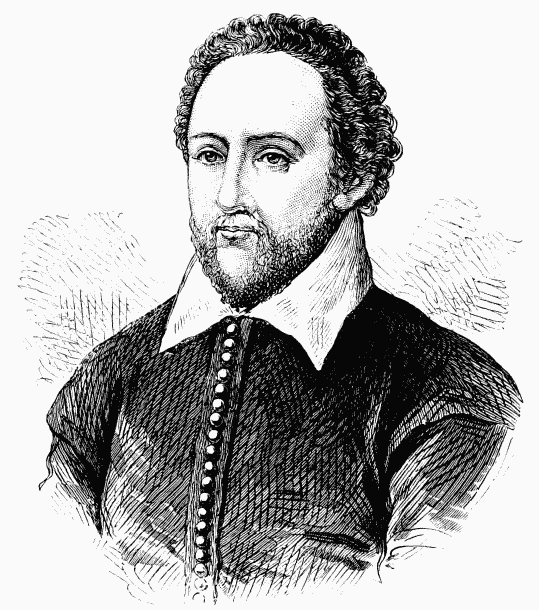
RICHARD BURBAGE, FROM THE ORIGINAL PORTRAIT IN DULWICH COLLEGE (see page 201).
In earlier days Blackfriars had been a locality much inhabited by fashionable people, especially about the time of Queen Elizabeth. Pennant quotes from the Sydney Papers a curious account of a grand festivity at the house of Lord Herbert, which the Queen honoured by her attendance. The account is worth inserting, if only for the sake of a characteristic bit of temper which the Queen exhibited on the occasion.
"Lord Herbert, son of William, fourth Earl of Worcester," says Pennant, "had a house in Blackfriars, which Queen Elizabeth, in 1600, honoured with her presence, on occasion of his nuptials with the daughter and heiress of John, Lord Russell, son of Francis, Earl of Bedford. The queen was met at the water-side by the bride, and carried to her house in a lectica by six knights. Her majesty dined there, and supped in the same neighbourhood with Lord Cobham, where there was 'a memorable maske of eight ladies, and a strange dawnce new invented. Their attire is this: each hath a skirt of cloth of silver, a manteli of coruscian taffete, cast under the arme, and their haire loose about their shoulders, curiously knotted and interlaced. Mrs. Fitton leade. These eight ladys maskers choose eight ladies more to dawnce the measures. Mrs. Fitton went to the queen and woed her dawnce. Her majesty (the love of Essex rankling in her heart) asked what she was? "Affection," she said. "Affection!" said the queen; "affection is false; yet her majestie rose up and dawnced.' At this time the queen was sixty. Surely, as Mr. Walpole observed, it was at that period as natural for her as to be in love! I must not forget that in her passage from the bride's to Lord Cobham's she went through the house of Dr. Puddin, and was presented by the doctor with a fan."
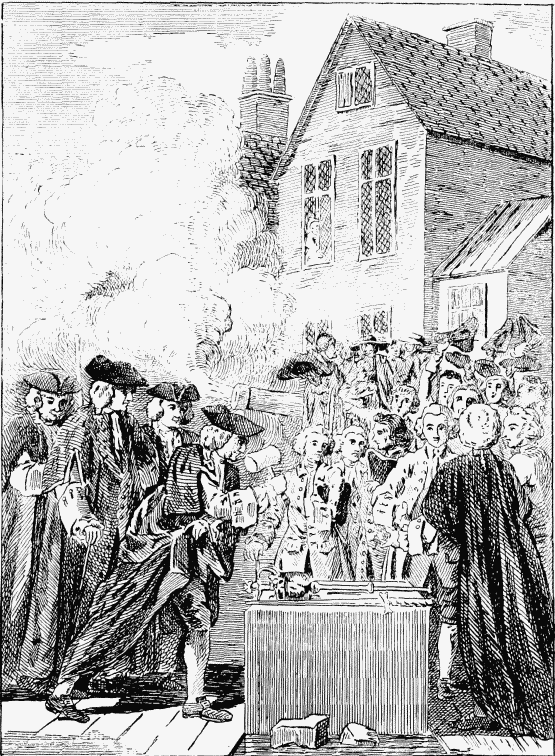
LAYING THE FOUNDATION-STONE OF BLACKFRIARS BRIDGE, 1760, FROM A CONTEMPORARY PRINT (see page 206).
Old Blackfriars Bridge, pulled down a few years since, was begun in 1760, and first opened on Sunday, November 19, 1769. It was built from the design of Robert Mylne, a clever young Scotch engineer, whose family had been master masons to the kings of Scotland for five hundred years. Mylne had just returned from a professional tour in Italy, where he had followed in the footsteps of Vitruvius, and gained the first prize at the Academy of St. Luke. He arrived in London friendless and unknown, and at once entered into competition with twenty other architects for the new bridge. Among these rivals was Smeaton, the great engineer (a protegé of Lord Bute's), and Dr. Johnson's friend, Gwynn, well known for his admirable work on London improvements. The committee were, however, just enough to be unanimous in favouring the young unknown Scotchman, and he carried off the prize. Directly it was known that Mylne's arches were to be elliptical, every one unacquainted with the subject began to write in favour of the semi-circular arch. Among the champions Dr. Johnson was, if not the most ignorant, the most rash. He wrote three letters to the printer of the Gazetteer, praising Gwynn's plans and denouncing the Scotch conqueror. Gwynn had "coached" the learned Doctor in a very unsatisfactory way. In his early days the giant of Bolt Court had been accustomed to get up subjects rapidly, but the science of architecture was not so easily digested. The Doctor contended "that the first excellence of a bridge built for commerce over a large river is strength." So far so good; but he then went on to try and show that the pointed arch is necessarily weak, and here he himself broke down. He allowed that there was an elliptical bridge at Florence, but he said carts were not allowed to go over it, which proved its fragility. He also condemned a proposed castiron parapet, in imitation of one at Rome, as too poor and trifling for a great design. He allowed that a certain arch of Perault's was elliptical, but then he contended that it had to be held together by iron clamps. He allowed that Mr. Mylne had gained the prize at Rome, but the competitors, the arrogant despot of London clubs asserted, were only boys; and, moreover, architecture had sunk so low at Rome, that even the Pantheon had been deformed by petty decorations. In his third letter the Doctor grew more scientific, and even more confused. He was very angry with Mr. Mylne's friends for asserting that though a semi-ellipse might be weaker than a semicircle, it had quite strength enough to support a bridge. "I again venture to declare," he wrote—"I again venture to declare, in defiance of all this contemptuous superiority" (how arrogant men hate other people's arrogance!), "that a straight line will bear no weight. Not even the science of Vasari will make that form strong which the laws of nature have condemned to weakness. By the position that a straight line will bear nothing is meant that it receives no strength from straightness; for that many bodies laid in straight lines will support weight by the cohesion of their parts, every one has found who has seen dishes on a shelf, or a thief upon the gallows. It is not denied that stones may be so crushed together by enormous pressure on each side, that a heavy mass may be safely laid upon them; but the strength must be derived merely from the lateral resistance, and the line so loaded will be itself part of the load. The semielliptical arch has one recommendation yet unexamined. We are told that it is difficult of execution."
In the face of this noisy newspaper thunder, Mylne went on, and produced one of the most beautiful bridges in England for £152,640 3s. 10d., actually £163 less than the original estimate—an admirable example for all architects, present and to come. The bridge, which had eight arches, and was 995 yards from wharf to wharf, was erected in ten years and three quarters. Mylne received £500 a year and ten per cent. on the expenditure. His claims, however, were disputed, and not allowed by the grateful City till 1776. The bridge-tolls were bought by Government in 1785, and the passage then became free. It was afterwards lowered, and the open parapet, condemned by Johnson, removed. It was supposed that Mylne's mode of centreing was a secret, but in contempt of all quackery he deposited exact models of his system in the British Museum. He was afterwards made surveyor of St. Paul's Cathedral, and in 1811 was interred near the tomb of Wren. He was a despot amongst his workmen, and ruled them with a rod of iron. However, the foundations of this bridge were never safely built, and latterly the piers began visibly to subside. The semi-circular arches would have been far stronger.
The foundation-stone of Blackfriars Bridge was
laid by Sir Thomas Chitty, Lord Mayor, on the
31st of October, 1760. Horace Walpole, always
Whiggish, describing the event, says:— "The Lord
Mayor laid the first stone of the new bridge yesterday. There is an inscription on it in honour of
Mr. Pitt, which has a very Roman air, though very
unclassically expressed. They talk of the contagion of his public spirit; I believe they had not got
rid of their panic about mad dogs." Several gold,
silver, and copper coins of the reign of George II.
(just dead) were placed under the stone, with a
silver medal presented to Mr. Mylne by the
Academy of St. Luke's, and upon two plates of tin
—Bonnel Thornton said they should have been
lead—was engraved a very shaky Latin inscription, thus rendered into English:—
On the last day of October, in the year 1760,
And in the beginning of the most auspicious reign of
George the Third,
Sir Thomas Chitty, Knight, Lord Mayor,
laid the first stone of this Bridge,
undertaken by the Common Council of London
(amidst the rage of an extensive war)
for the public accommodation
and ornament of the City;
Robert Mylne being the architect.
And that there might remain to posterity
a morument of this city's affection to the man
who, by the strength of his genius,
the steadiness of his mind,
and a certain kind of happy contagion of his
Probity and Spirit
(under the Divine favour
and fortunate auspices of George the Second)
recovered, augmented, and secured
the British Empire
in Asia, Africa, and America,
and restored the ancient reputation
and influence of his country
amongst the nations of Europe;
the citizens of London have unanimously voted this
Bridge to be inscribed with the name of
William Pitt.
On this pretentious and unlucky inscription, that
reckless wit, Bonnel Thornton, instantly wrote a
squib, under the obvious pseudonym of the "Rev.
Busby Birch." In these critical and political
remarks (which he entitled "City Latin") the gay
scoffer professed in his preface to prove "almost
every word and every letter to be erroneous and
contrary to the practice of both ancients and
moderns in this kind of writing," and appended a
plan or pattern for a new inscription. The clever
little lampoon soon ran to three editions. The
ordinary of Newgate, my lord's chaplain, or the
masters of Merchant Taylors', Paul's, or Charterhouse schools, who produced the wonderful pontine inscription, must have winced under the blows
of this jester's bladderful of peas. Thornton
laughed most at the awkward phrase implying that
Mr. Pitt had caught the happy contagion of his own
probity and spirit. He said that "Gulielmi Pitt"
should have been "Gulielmi Fossæ." Lastly, he
proposed, for a more curt and suitable inscription,
the simple words—
"Guil. Fossæ,
Patri Patriæ D.D.D. (i.e., Datur, Dicatur, Dedicatur)."
Party feeling, as usual at those times, was rife.
Mylne was a friend of Paterson, the City solicitor,
an apt scribbler and a friend of Lord Bute, who no
doubt favoured his young countryman. For, being
a Scotchman, Johnson no doubt took pleasure in
opposing him, and for the same reason Churchill,
in his bitter poem on the Cock Lane ghost, after
ridiculing Johnson's credulity, goes out of his way
to sneer at Mylne:—
"What of that bridge which, void of sense,
But well supplied with impudence,
Englishmen, knowing not the Guild,
Thought they might have the claim to build;
Till Paterson, as white as milk,
As smooth as oil, as soft as silk,
In solemn manner had decreed
That, on the other side the Tweed,
Art, born and bred and fully grown,
Was with one Mylne, a man unknown?
But grace, preferment, and renown
Deserving, just arrived in town;
One Mylne, an artist, perfect quite,
Both in his own and country's right,
As fit to make a bridge as he,
With glorious Patavinity,
To build inscriptions, worthy found
To lie for ever underground."
In 1766 it was opened for foot passengers, the completed portion being connected with the shore by a temporary wooden structure; two years later it was made passable for horses, and in 1769 it was fully opened. An unpopular toll of one halfpenny on week-days for every person, and of one penny on Sundays, was exacted. The result of this was that while the Gordon Riots were raging, in 1780, the too zealous Protestants, forgetting for a time the poor tormented Papists, attacked and burned down the toll-gates, stole the money, and destroyed all the account-books. Several rascals' lives were lost, and one rioter, being struck with a bullet, ran howling for thirty or forty yards, and then dropped down dead. Nevertheless, the iniquitous toll continued until 1785, when it was redeemed by Government.
The bridge, according to the order of Common Council, was first named Pitt Bridge, and the adjacent streets (in honour of the great earl) Chatham Place, William Street, and Earl Street. But the first name of the bridge soon dropped off, and the monastic locality asserted its prior right. This is the more remarkable (as Mr. Timbs judiciously observes), because with another Thames bridge the reverse change took place. Waterloo Bridge was first called Strand Bridge, but it was soon dedicated by the people to the memory of the most famous of British victories.
The £152, 640 that the bridge cost does not include the £5,830 spent in altering and filling up the Fleet Ditch, or the £2, 167 the cost of the temporary wooden bridge. The piers, of bad Portland stone, were decorated by some columns of unequal sizes, and the line of parapet was low and curved. The approaches to the bridge were also designed by Mylne, who built himself a house at the corner of Little Bridge Street. The walls of the rooms were adorned with classical medallions, and on the exterior was the date (1780), with Mylne's crest, and the initials "R. M." Dr. Johnson became a friend of Mylne's, and dined with him at this residence at least on one occasion. The house afterwards became the "York Hotel," and, according to Mr. Timbs, was taken down in 1863.
The Bridge repairs (between 1833 and 1840), by Walker and Burgess, engineers, at an expense of £74,000, produced a loss to the contractors; and the removal of the cornice and balustrade spoiled the bridge, from whence old Richard Wilson, the landscape-painter, used to come and admire the grand view of St. Paul's. The bridge seemed to be as unlucky as if it had incurred Dr. Johnson's curse. In 1843 the Chamberlain reported to the Common Council that the sum of £100,960 had been already expended in repairing Mylne's faulty work, besides the £800 spent in procuring a local Act (4 William IV.). According to a subsequent report, £10,200 had been spent in six years in repairing one arch alone. From 1851 to 1859 the expenditure had been at the rate of £600 a year. Boswell, indeed, with all his zealous partiality for the Scotch architect, had allowed that the best Portland stone belonged to Government quarries, and from this Parliamentary interest had debarred Mylne.
The tardy Common Council was at last forced, in common decency, to build a new bridge. The architect began by building a temporary structure of great strength. It consisted of two storeys— the lower for carriages, the upper for pedestrians— and stretching 990 feet from wharf to wharf. The lower piles were driven ten feet into the bed of the river, and braced with horizontal and diagonal bracings. The demolition began with vigour in 1864. In four months only, the navigators' brawny arms had removed twenty thousand tons of earth, stone, and rubble above the turning of the arches, and the pulling down those enemies of Dr. Johnson commenced by the removal of the key-stone of the second arch on the Surrey side. The masonry of the arches proved to be rather thinner than it appeared to be, and was stuffed with river ballast, mixed with bones and small old-fashioned pipes. The bridge had taken nearly ten years to build; it was entirely demolished in less than a year, and rebuilt in two. In some cases the work of removal and re-construction went on harmoniously and simultaneously side by side. Ingenious steam cranes travelled upon rails laid on the upper scaffold beams, and lifted the blocks of stone with playful ease and speed. In December, 1864, the men worked in the evenings, by the aid of naphtha lamps.
According to a report printed in the Times, Blackfriars Bridge had suffered from the removal of London Bridge, which served as a mill-dam, to restrain the speed and scour of the river.
Twelve designs had been sent in at the competition, and, singularly enough, among the competitors was a Mr. Mylne, grandson of Johnson's foe. The design of Mr. Page was first selected, as the handsomest and cheapest. It consisted of only three arches. Ultimately Mr. Joseph Cubitt won the prize. Cubitt's bridge has five arches, the centre one eighty-nine feet span; the style, Venetian Gothic; the cost, £265,000. The piers are grey, the columns red, granite; the bases and capitals are of carved Portland stone; the bases, balustrades, and roads of somewhat over-ornamented iron.
The Quarterly Review, of April, 1872, contains the following bitter criticisms of the new double bridge:—"With Blackfriars Bridge," says the writer, "we find the public thoroughly well pleased, though the design is really a wonder of depravity. Polished granite columns of amazing thickness, with carved capitals of stupendous weight, all made to give shop-room for an apple-woman, or a convenient platform for a suicide. The parapet is a fiddlefaddle of pretty cast-iron arcading, out of scale with the columns, incongruous with the capitals, and quite unsuited for a work that should be simply grand in its usefulness; and at each corner of the bridge is a huge block of masonry, àpropos of nothing, a well-known evidence of desperate imbecility."
Bridge Street is too new for many traditions. Its chief hero is that active-minded and somewhat shallow speculator, Sir Richard Phillips, the bookseller and projector. An interesting memoir by Mr. Timbs, his intimate friend, furnishes us with many curious facts, and shows how the publisher of Bridge Street impinged on many of the most illustrious of his contemporaries, and how in a way he pushed forward the good work which afterwards owed so much to Mr. Charles Knight. Phillips, born in London in 1767, was educated in Soho Square, and afterwards at Chiswick, where he remembered often seeing Hogarth's widow and Dr. Griffith, of the Monthly Review (Goldsmith's tyrant), attending church. He was brought up to be a brewer, but in 1788 settled as a schoolmaster, first at Chester and afterwards at Leicester. At Leicester he opened a bookseller's shop, started a newspaper (the Leicester Herald), and established a philosophical society. Obnoxious as a Radical, he was at last entrapped for selling Tom Paine's "Rights of Man," and was sent to gaol for eighteen months, where he was visited by Lord Moira, the Duke of Norfolk, and other advanced men of the day. His house being burned down, he removed to London, and projected a Sunday newspaper, but eventually Mr. Bell stole the idea and started the Messenger. In 1795 this restless and energetic man commenced the Monthly Magazine. Before this he had already been a hosier, a tutor, and a speculator in canals. The politico-literary magazine was advertised by circulars sent to eminent men of the opposition in commercial parcels, to save the enormous postage of those unregenerate days. Dr. Aiken, the literary editor, afterwards started a rival magazine, called the Athenœum. The Gentleman's Magazine never rose to a circulation above 10,000, which soon sank to 3,000. Phillips's magazine sold about 3,750. With all these multifarious pursuits, Phillips was an antiquary—purchasing Wolsey's skull for a shilling, a portion of his stone coffin, that had been turned into a horse-trough at the "White Horse" inn, Leicester; and Rufus's stirrup, from a descendant of the charcoal-burner who drove the body of the slain king to Winchester.
As a pushing publisher Phillips soon distinguished himself, for the Liberals came to him, and he had quite enough sense to discover if a book was good. He produced many capital volumes of Ana, on the French system, and memoirs of Foote, Monk, Lewes, Wilkes, and Lady Mary Wortley Montagu. He published Holcroft's "Travels," Godwin's best novels, and Miss Owenson's (Lady Morgan's) first work, "The Novice of St. Dominick." In 1807, when he removed to New Bridge Street, he served the office of sheriff; was knighted on presenting an address, and effected many reforms in the prisons and lockup houses. In his useful "Letter to the Livery of London" he computes the number of writs then annually issued at 24,000; the sheriffs' expenses at £2,000. He also did his best to repress the cruelties of the mob to poor wretches in the pillory. He was a steady friend of Alderman Waithman, and was with him in the carriage at the funeral of Queen Caroline, in 1821, when a bullet from a soldier's carbine passed through the carriage window near Hyde Park. In 1809 Phillips had some reverses, and breaking up his publishing-office in Bridge Street, devoted himself to the profitable reform of school-books, publishing them under the names of Goldsmith, Mavor, and Blair.
This active-minded man was the first to assert that Dr. Wilmot wrote "Junius," and to start the celebrated scandal about George III. and the young Quakeress, Hannah Lightfoot, daughter of a linendraper, at the corner of Market Street, St. James's. She afterwards, it is said, married a grocer, named Axford, on Ludgate Hill, was then carried off by the prince, and bore him three sons, who in time became generals. The story is perhaps traceable to Dr. Wilmot, whose daughter married the Duke of Cumberland. Phillips found time to attack the Newtonian theory of gravitation, to advocate a memorial to Shakespeare, to compile a book containing a million of facts, to write on Divine philosophy, and to suggest (as he asserted) to Mr. Brougham, in 1825, the first idea of the Society for Useful Knowledge. Almost ruined by the failures during the panic in 1826, he retired to Brighton, and there pushed forward his books and his interrogative system of education. Sir Richard's greatest mistakes, he used to say, had been the rejection of Byron's early poems, of "Waverley," of Bloomfield's "Farmer's Boy," and O'Meara's "Napoleon in Exile." He always stoutly maintained his claim to the suggestion of the "Percy Anecdotes." Phillips died in 1840. Superficial as he was, and commercial as were his literary aims, we nevertheless cannot refuse him the praise awarded in his epitaph:—"He advocated civil liberty, general benevolence, ascendancy of justice, and the improvement of the human race."
The old monastic ground of the Black Friars seems to have been beloved by painters, for, as we have seen, Vandyke lived luxuriously here, and was frequently visited by Charles I. and his Court. Cornelius Jansen, the great portrait-painter of James's Court, arranged his black draperies and ground his fine carnations in the same locality; and at the same time Isaac Oliver, the exquisite Court miniature-painter, dwelt in the same place. It was to him Lady Ayres, to the rage of her jealous husband, came for a portrait of Lord Herbert of Cherbury, an imprudence that very nearly led to the assassination of the poet-lord, who believed himself so specially favoured of Heaven.
The king's printing-office for proclamations, &c., used to be in Printing-house Square, but was removed in 1770; and we must not forget that where a Norman fortress once rose to oppress the weak, to guard the spoils of robbers, and to protect the oppressor, the Times printing-office now stands, to diffuse its ceaseless floods of knowledge, to spread its resistless ægis over the poor and the oppressed, and ever to use its vast power to extend liberty and crush injustice, whatever shape the Proteus assumes, whether it sits upon a throne or lurks in a swindler's office.
This great paper was started in the year 1785, by Mr. John Walter, under the name of the Daily Universal Register. It was first called the Times, January 1, 1788, when the following prospectus appeared:—
"The Universal Register has been a name as injurious to the logographic newspaper as Tristram was to Mr. Shandy's son; but old Shandy forgot he might have rectified by confirmation the mistake of the parson at baptism, and with the touch of a bishop changed Tristram into Trismegistus. The Universal Register, from the day of its first appearance to the day of its confirmation, had, like Tristram, suffered from innumerable casualties, both laughable and serious, arising from its name, which in its introduction was immediately curtailed of its fair proportions by all who called for it, the word 'Universal' being universally omitted, and the word 'Register' only retained. 'Boy, bring me the Register.' The waiter answers, 'Sir, we have no library; but you may see it in the "New Exchange" coffee-house.' 'Then I will see it there,' answers the disappointed politician; and he goes to the 'New Exchange' coffee-house, and calls for the Register, upon which the waiter tells him he cannot have it, as he is not a subscriber, or presents him with the Court and City Register, the Old Annual Register, or the New Annual Register, or, if the house be within the purlieus of Covent Garden or the hundreds of Drury, slips into the politician's hand Harris's Register of Ladies.
"For these and other reasons the printer of the Universal Register has added to its original name that of the Times, which, being a monosyllable, bids defiance to the corruptions and mutilations of the language.
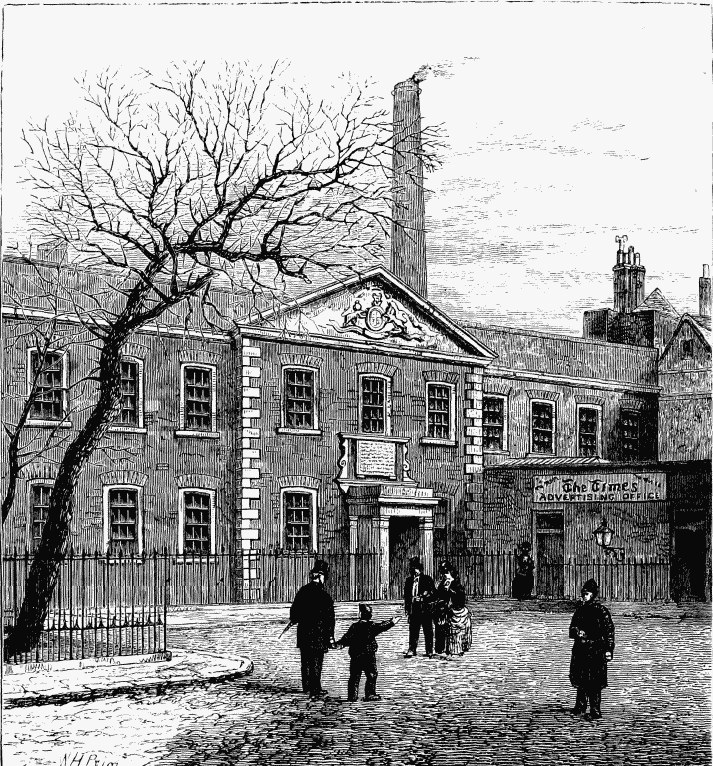
PRINTING HOUSE SQUARE AND THE "TIMES" OFFICE (see page 209).
"The Times! what a monstrous name! Granted —for the Times is a many-headed monster, that speaks with a hundred tongues, and displays a thousand characters; and in the course of its transitions in life, assumes innumerable shapes and humours.
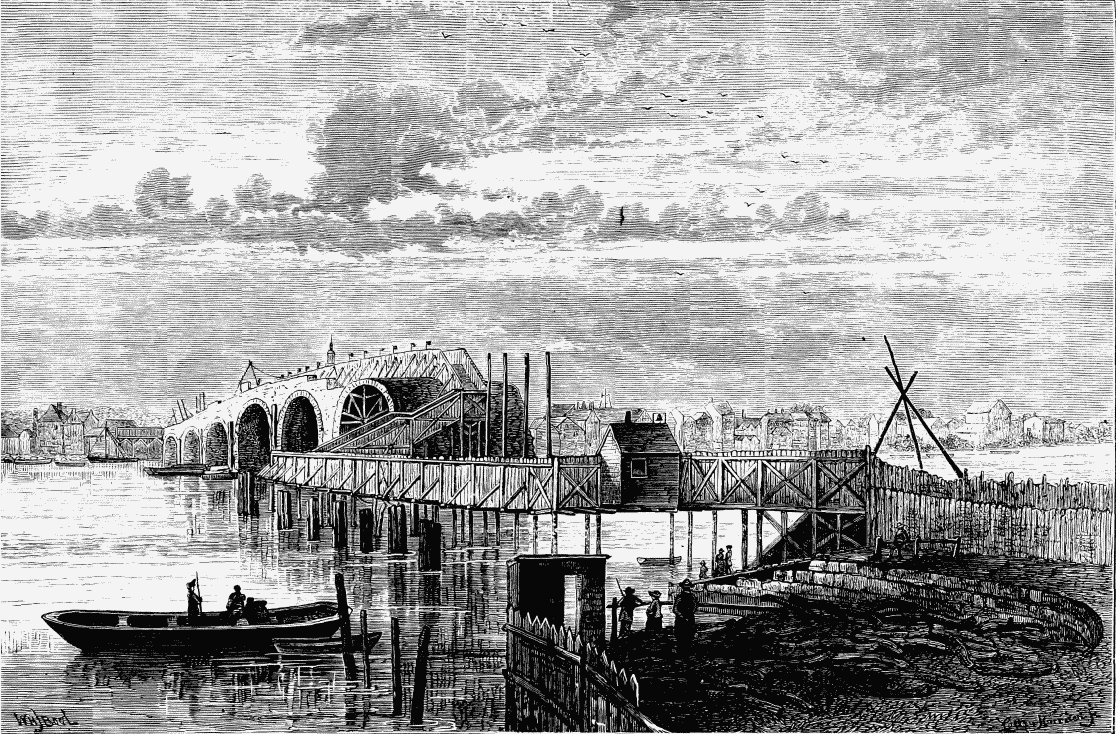
BLACKFRARS OLD BRIDGE DURING ITS CONSTRUCTION, SHOWING THE TEMPORARY FOOT BRIDGE, FROM A PRINT OF 1775 (see page 207).
"The critical reader will observe, we personify our new name; but as we give it no distinction of sex, and though it will be active in its vocation, yet we apply to it the neuter gender.
"The Times, being formed of and possessing qualities of opposite and heterogeneous natures, cannot be classed either in the animal or vegetable genus, but, like the polypus, is doubtful; and in the discussion, description, and illustration, will employ the pens of the most celebrated literati.
"The heads of the Times, as has already been said, are many; these will, however, not always appear at the same time, but casually, as public or private affairs may call them forth.
"The principal or leading heads are—the literary, political, commercial, philosophical, critical, theatrical, fashionable, humorous, witty, &c., each of which is supplied with a competent share of intellect for the pursuit of their several functions, an endowment which is not in all cases to be found, even in the heads of the State, the heads of the Church, the heads of the law, the heads of the navy, the heads of the army, and, though last not least, the great heads of the universities.
"The political head of the Times—like that of Janus, the Roman deity—is double-faced. With one countenance it will smile continually on the friends of Old England, and with the other will frown incessantly on her enemies.
"The alteration we have made in our paper is not without precedents. The World has parted with half its caput mortuum and a moiety of its brains; the Herald has cutoff one half of its head and has lost its original humour; the Post, it is true, retains its whole head and its old features; and as to the other public prints, they appear as having neither heads nor tails.
"On the Parliamentary head, every communication that ability and industry can produce may be expected. To this great national object the Times will be most sedulously attentive, most accurately correct, and strictly impartial in its reports."
Both the Times and its predecessor were printed
"logographically," Mr. Walter having obtained a
patent for his peculiar system. The plan consisted
in abridging the compositors' labour by casting
all the more frequently recurring words in metal.
It was, in fact, a system of partial stereotyping.
The English language, said the sanguine inventor,
contained above 90,000 words. This number
Walter had reduced to about 5,000. The projector was assailed by the wits, who declared that
his orders to the type-founders ran,— "Send me a
hundredweight, in separate pounds, of heat, cold,
wet, dry, murder, fire, dreadful robbery, atrocious
outrage, fearful calamity, and alarming explosion."
But nothing could daunt or stop Walter. One
eccentricity of the Daily Register was that on redletter days the title was printed in red ink, and
the character of the day stated under the date-line.
For instance, on Friday, August 11, 1786, there
is a red heading, and underneath the words—
"Princess of Brunswick born.
Holiday at the Bank, Excise offices, and the Exchequer."
The first number of the Times is not so large as the Morning Herald or Morning Chronicle of the same date, but larger than the London Chronicle, and of the same size as the Public Advertiser. (Knight Hunt.)
The first Walter lived in rough times, and suffered from the political storms that then prevailed. He was several times imprisoned for articles against great people, and it has been asserted that he stood in the pillory in 1790 for a libel against the Duke of York. This is not, however, true; but it is a fact that he was sentenced to such a punishment, and remained sixteen months in Newgate, till released at the intercession of the Prince of Wales. The first Walter died in 1812. The second Mr. Walter, who came to the helm in 1803, was the real founder of the future greatness of the Times; and he, too, had his rubs. In 1804 he offended the Government by denouncing the foolish Catamaran expedition. For this the Government meanly deprived his family of the printing for the Customs, and also withdrew their advertisements. During the war of 1805 the Government stopped all the foreign papers sent to the Times. Walter, stopped by no obstacle, at once contrived other means to secure early news, and had the triumph of announcing the capitulation of Flushing forty-eight hours before the intelligence had arrived through any other channel.
There were no reviews of books in the Times till long after it was started, but it paid great attention to the drama from its commencement. There were no leading articles for several years, yet in the very first year the Times displays threefold as many advertisements as its contemporaries. For many years Mr. Walter, with his usual sagacity and energy, endeavoured to mature some plan for printing the Times by steam. As early as 1804 a compositor named Martyn had invented a machine for the purpose of superseding the hand-press, which took hours struggling over the three or four thousand copies of the Times. The pressmen threatened destruction to the new machine, and it had to be smuggled piecemeal into the premises, while Martyn sheltered himself under various disguises to escape the vengeance of the workmen. On the eve of success, however, Walter's father lost courage, stopped the supplies, and the project was for the time abandoned. In 1814 Walter, however, returned to the charge. Kœnig and Barnes put their machinery in premises adjoining the Times office, to avoid the violence of the pressmen. At one time the two inventors are said to have abandoned their machinery in despair, but a clerical friend of Walter examined the difficulty and removed it. The night came at last when the great experiment was to be made. The unconscious pressmen were kept waiting in the next office for news from the Continent. At six o'clock in the morning Mr. Walter entered the press-room, with a wet paper in his hand, and astonished the men by telling them that the Times had just been printed by steam. If they attempted violence, he said, there was a force ready to suppress it; but if they were peaceable their wages should be continued until employment was found for them. He could now print 1,100 sheets an hour. By-and-by Kœnig's machine proved too complicated, and Messrs. Applegarth and Cowper invented a cylindrical one, that printed 8,000 an hour. Then came Hoe's process, which is now said to print at the rate of from 18,000 to 22,000 copies an hour (Grant). The various improvements in steam-printing have altogether cost the Times, according to general report, not less than £80,000.
About 1813 Dr. Stoddart, the brother-in-law
of Hazlitt (afterwards Sir John Stoddart, a judge
in Malta), edited the Times with ability, till his
almost insane hatred of Bonaparte, "the Corsican
fiend," as he called him, led to his secession in
1815 or 1816. Stoddart was the "Doctor Slop"
whom Tom Moore derided in his gay little Whig
lampoons. The next editor was Thomas Barnes,
a better scholar and a far abler man. He had
been a contemporary of Lamb at Christ's Hospital,
and a rival of Blomfield, afterwards Bishop of
London. While a student in the Temple he
wrote the Times a series of political letters in the
manner of "Junius," and was at once placed as a
reporter in the gallery of the House. Under his
editorship Walter secured some of his ablest contributors, including that Captain Stirling, "The Thunderer," whom Carlyle has sketched so happily.
Stirling was an Irishman, who had fought with the
Royal troops at Vinegar Hill, then joined the line,
and afterwards turned gentleman farmer in the Isle
of Bute. He began writing for the Times about
1815, and, it is said, eventually received £2,000 a
year as a writer of dashing and effective leaders.
Lord Brougham also, it is said, wrote occasional
articles, Tom Moore was even offered £100 a
month if he would contribute, and Southey declined
an offer of £2,000 a year for editing the Times.
Macaulay in his day wrote many brilliant squibs in
the Times; amongst them one containing the line:
"Ye diners out, from whom we guard our spoons,"
and another on the subject of Wat Banks's candidateship for Cambridge. Barnes died in 1841.
Horace Twiss, the biographer of Lord Eldon and
nephew of Mrs. Siddons, also helped the Times
forward by his admirable Parliamentary summaries,
the first the Times had attempted. This able man
died suddenly in 1848, while speaking at a meeting
of the Rock Assurance Society at Radley's Hotel,
Bridge Street.
One of the longest wars the Times ever carried on was that against Alderman Harmer. It was Harmer's turn, in due order of rotation, to become Lord Mayor. A strong feeling had arisen against Harmer because, as the avowed proprietor of the Weekly Dispatch, he inserted certain letters of the late Mr. Williams ("Publicola"), which were said to have had the effect of preventing Mr. Walter's return for Southwark (see page 59). The Times upon this wrote twelve powerful leaders against Harmer, which at once decided the question. This was a great assertion of power, and raised the Times in the estimation of all England. For these twelve articles, originally intended for letters, the writer (says Mr. Grant) received £200. But in 1841 the extraordinary social influence of this giant paper was even still more shown. Mr. O'Reilly, their Paris correspondent, obtained a clue to a vast scheme of fraud concocting in Paris by a gang of fourteen accomplished swindlers, who had already netted £10,700 of the million for which they had planned. At the risk of assassination, O'Reilly exposed the scheme in the Times, dating the exposé Brussels, in order to throw the swindlers on the wrong scent.
At a public meeting of merchants, bankers, and others held in the Egyptian Hall, Mansion House, October 1,1841, the Lord Mayor (Thomas Johnson) in the chair, it was unanimously resolved to thank the proprietors of the Times for the services they had rendered in having exposed the most remarkable and extensively fraudulent conspiracy (the famous "Bogle" swindle) ever brought to light in the mercantile world, and to record in some substantial manner the sense of obligation conferred by the proprietors of the Times on the commercial world.
The proprietors of the Times declining to receive the £2,625 subscribed by the London merchants to recompense them for doing their duty, it was resolved, in 1842, to set apart the funds for the endowment of two scholarships, one at Christ's Hospital, and one at the City of London School. In both schools a commemorative tablet was put up, as well as one at the Royal Exchange and the Times printing-office.
At various periods the Times has had to endure violent attacks in the House of Commons, and many strenuous efforts to restrain its vast powers. In 1819 John Payne Collier, one of their Parliamentary reporters, and better known as one of the greatest of Shakesperian critics, was committed into the custody of the Serjeant-at-Arms for a report in which he had attacked Canning. The Times, however, had some powerful friends in the House; and in 1821 we find Mr. Hume complaining that the Government advertisements were systematically withheld from the Times. In 1831 Sir R. H. Inglis complained that the Times had been guilty of a breach of privilege, in asserting that there were borough nominees and lackeys in the House. Sir Charles Wetherell, that titled, incomparable old Tory, joined in the attack, which Burdett chivalrously cantered forward to repel. Sir Henry Hardinge wanted the paper prosecuted, but Lord John Russell, Orator Hunt, and O'Connell, however, moved the previous question, and the great debate on the Reform Bill then proceeded. The same year the House of Lords flew at the great paper. The Earl of Limerick had been called "an absentee, and a thing with human pretensions." The Marquis of Londonderry joined in the attack. The next day Mr. Lawson, printer of the Times, was examined and worried by the House; and Lord Wynford moved that Mr. Lawson, as printer of a scandalous libel, should be fined £100, and committed to Newgate till the fine be paid. The next day Mr. Lawson handed in an apology, but Lord Brougham generously rose and denied the power of the House to imprison and fine without a trial by jury. The Tory lords spoke angrily; the Earl of Limerick called the press a tyrant that ruled all things, and crushed everything under its feet; and the Marquis of Londonderry complained of the coarse and virulent libels against Queen Adelaide, for her supposed opposition to Reform.
In 1833 O'Connell attributed dishonest motives to the London reporter who had suppressed his speeches, and the reporters in the Times expressed their resolution not to report any more of his speeches unless he retracted. O'Connell then moved in the House that the printer of the Times be summoned to the bar for printing their resolution, but his motion was rejected. In 1838 Mr. Lawson was fined £200 for accusing Sir John Conroy, treasurer of the household of the Duchess of Kent, of peculation. In 1840 an angry member brought a breach of privilege motion against the Times, and advised every one who was attacked in that paper to horsewhip the editor.
In January, 1829, the Times came out with a double sheet, consisting of eight pages, or fortyeight columns. In 1830 it paid £70,000 advertisement duty. In 1800 its sale had been below that of the Morning Chronicle, Post, Herald, and Advertiser.
The Times, according to Mr. Grant, in one day of 1870, received no less than £1,500 for advertisements. On June 22, 1862, it produced a paper containing no less than twenty-four pages, or 144 columns. In 1854 the Times had a circulation of 51,000 copies; in 1860, 60,000. For special numbers its sale is enormous. The biography of Prince Albert sold 90,000 copies; the marriage of the Prince of Wales, 110,000 copies. The income of the Times from advertisements alone has been calculated at £260,000. A writer in a Philadelphia paper of 1867 estimates the paper consumed weekly by the Times at seventy tons; the ink at two tons. There are employed in the office ten stereotypers, sixteen firemen and engineers, ninety machine-men, six men who prepare the paper for printing, and seven to transfer the papers to the news-agents. The new Walter press prints 22,000 to 24,000 impressions an hour, or 12,000 perfect sheets printed on both sides. It prints from a roll of paper threequarters of a mile long, and cuts the sheets and piles them without help. It is a self-feeder, and requires only a man and two boys to guide its operations. A copy of the Times has been known to contain 4,000 advertisements; and for every daily copy it is computed that the compositors mass together not less than 2,500,000 separate types.
The number of persons engaged in daily working for the Times is put at nearly 350.
In the annals of this paper we must not forget the energy that, in 1834, established a system of home expresses, that enabled them to give the earliest intelligence before any other paper; and at an expense of £200 brought a report of Lord Durham's speech at Glasgow to London at the then unprecedented rate of fifteen miles an hour; nor should we forget their noble disinterestedness during the railway mania of 1845, when, although they were receiving more than £3,000 a week for railway advertisements, they warned the country unceasingly of the misery and ruin that must inevitably follow. The Times proprietors are known to pay the highest sums for articles, and to be uniformly generous in pensioning men who have spent their lives in its service.
The late Mr. Walter, even when M.P. for Berkshire and Nottingham, never forgot Printing-house Square when the debate, however late, had closed. One afternoon, says Mr. Grant, he came to the office and found the compositors gone to dinner. Just at that moment a parcel, marked "immediate and important," arrived. It was news of vast importance. He at once slipped off his coat, and set up the news with his own hands; a pressman was at his post, and by the time the men returned a second edition was actually printed and published. But his foresight and energy was most conspicuously shown in 1845, when the jealousy of the French Government had thrown obstacles in the way of the Times' couriers, who brought their Indian despatches from Marseilles. What were seas and deserts to Walter? He at once took counsel with Lieutenant Waghorn, who had opened up the overland route to India, and proposed to try a new route by Trieste. The result was that Waghorn reached London two days before the regular mail—the usual mail aided by the French Government. The Morning Herald was at first forty-eight hours before the Times, but after that the Times got a fortnight ahead; and although the Trieste route was abandoned, the Times, eventually, was left alone as a troublesome and invincible adversary.
Apothecaries' Hall, the grave stone and brick building, in Water Lane, Blackfriars, was erected in 1670 (Charles II.), as the dispensary and hall of the Company of Apothecaries, incorporated by a charter of James I., at the suit of Gideon Delaune, the king's own apothecary. Drugs in the Middle Ages were sold by grocers and pepperers, or by the doctors themselves, who, early in James's reign, formed one company with the apothecaries; but the ill-assorted union lasted only eleven years, for the apothecaries were then fast becoming doctors themselves.
Garth, in his "Dispensary," describes, in the
Hogarthian manner, the topographical position of
Apothecaries' Hall:—
"Nigh where Fleet Ditch descends in sable streams,
To wash the sooty Naiads in the Thames,
There stands a structure on a rising hill,
Where tyros take their freedom out to kill."
Gradually the apothecaries, refusing to be merely
"the doctors' tools," began to encroach more and
more on the doctors' province, and to prescribe for
and even cure the poor. In 1687 (James II.) open
war broke out. First Dryden, then Pope, fought on
the side of the doctors against the humbler men,
whom they were taught to consider as mere greedy
mechanics and empirics. Dryden first let fly his
mighty shaft:—
"The apothecary tribe is wholly blind;
From files a random recipe they take,
And many deaths from one prescription make.
Garth, generous as his muse, prescribes and gives;
The shopman sells, and by destruction lives."
Pope followed with a smaller but keener arrow:—
"So modern 'pothecaries, taught the art
By doctors' bills to play the doctor's part,
Bold in the practice of mistaken rules,
Prescribe, apply, and call their masters fools."
The origin of the memorable affray between the College of Physicians and the Company of Apothecaries is admirably told by Mr. Jeaffreson, in his "Book of Doctors." The younger physicians, impatient at beholding the increasing prosperity and influence of the apothecaries, and the older ones indignant at seeing a class of men they had despised creeping into their quarters, and craftily laying hold of a portion of their monopoly, concocted a scheme to reinstate themselves in public favour. Without a doubt, many of the physicians who countenanced this scheme gave it their support from purely charitable motives; but it cannot be questioned that, as a body, the dispensarians were only actuated in their humanitarian exertions by a desire to lower the apothecaries and raise themselves in the eyes of the world. In 1687 the physicians, at a college meeting, voted "that all members of the college, whether fellows, candidates, or licentiates, should give their advice gratis to all their sick neighbouring poor, when desired, within the city of London, or seven miles round." The poor folk carried their prescriptions to the apothecaries, to learn that the trade charge for dispensing them was beyond their means. The physicians asserted that the demands of the drugvendors were extortionate, and were not reduced to meet the finances of the applicants, to the end that the undertakings of benevolence might prove abortive. This was, of course, absurd. The apothecaries knew their own interests better than to oppose a system which at least rendered drugconsuming fashionable with the lower orders. Perhaps they regarded the poor as their peculiar property as a field of practice, and felt insulted at having the same humble people for whom they had pompously prescribed, and put up boluses at twopence apiece, now entering their shops with papers dictating what the twopenny bolus was to be composed of. But the charge preferred against them was groundless. Indeed, a numerous body of the apothecaries expressly offered to sell medicines "to the poor within their respective parishes at such rates as the committee of physicians should think reasonable."
But this would not suit the game of the physicians. "A proposal was started by a committee of the college that the college should furnish the medicines of the poor, and perfect alone that charity which the apothecaries refused to concur in; and, after divers methods ineffectually tried, and much time wasted in endeavouring to bring the apothecaries to terms of reason in relation to the poor, an instrument was subscribed by divers charitably-disposed members of the college, now in numbers about fifty, wherein they obliged themselves to pay ten pounds apiece towards the preparing and delivering medicines at their intrinsic value."
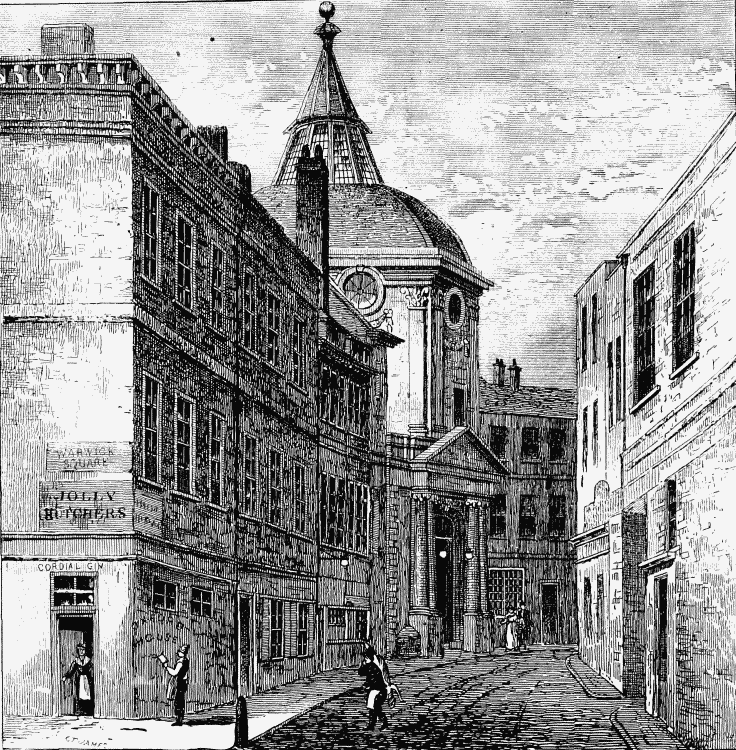
THE COLLEGE OF PHYSICIANS, WARWICK LANE (see page 216).
Such was the version of the affair given by the college apologists. The plan was acted upon, and a dispensary was eventually established (some nine years after the vote of 1687) at the College of Physicians, Warwick Lane, where medicines were vended to the poor at cost price. This measure of the college was impolitic and unjustifiable. It was unjust to that important division of the trade who were ready to vend the medicines at rates to be paid by the college authorities, for it took altogether out of their hands the small amount of profit which they, as dealers, could have realised on those terms. It was also an eminently unwise course. The College sank to the level of the Apothecaries' Hall, becoming an emporium for the sale of medicines. It was all very well to say that no profit was made on such sale, the censorious world would not believe it. The apothecaries and their friends denied that such was the fact, and vowed that the benevolent dispensarians were bent only on underselling and ruining them.
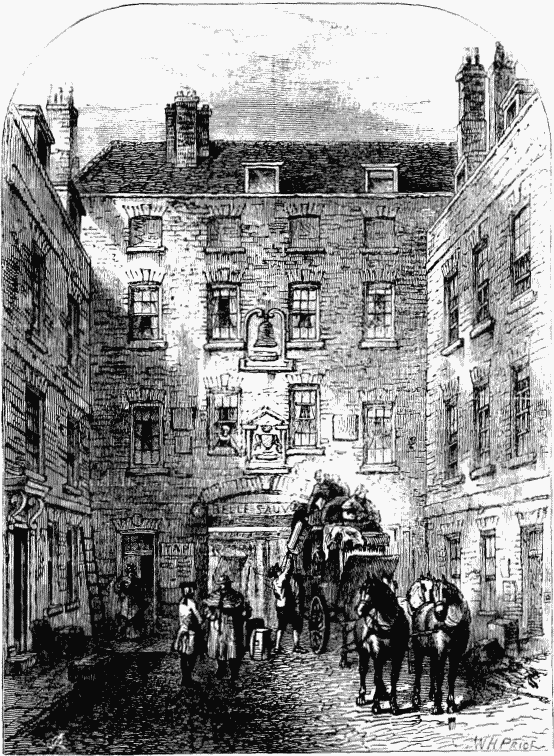
OUTER COURT OF LA BELLE SAUVAGE IN 1828, FROM AN ORIGINAL DRAWING IN MR. GARDNER'S COLLECTION (See page 221).
Again, the movement introduced dissensions within the walls of the college. Many of the first physicians, with the conservatism of success, did not care to offend the apothecaries, who were continually calling them in and paying them fees. They therefore joined in the cry against the dispensary. The profession was split up into two parties—Dispensarians and Anti-Dispensarians. The apothecaries combined, and agreed not to recommend the Dispensarians. The Anti-Dispensarians repaid this ill service by refusing to meet Dispensarians in consultation. Sir Thomas Millington, the President of the College, Hans Sloane, John Woodward, Sir Edmund King, and Sir Samuel Garth, were amongst the latter. Of these the last named was the man who rendered the most efficient service to his party. For a time Garth's great poem, "The Dispensary," covered the apothecaries and Anti-Dispensarians with ridicule. It rapidly passed through numerous editions. To say that of all the books, pamphlets, and broadsheets thrown out by the combatants on both sides, it is by far the one of the greatest merit, would be scant justice, when it might almost be said that it is the only one of them that can now be read by a gentleman without a sense of annoyance and disgust. There is no point of view from which the medical profession appears in a more humiliating and contemptible light than that which the literature of this memorable squabble presents to the student. Charges of ignorance, dishonesty, and extortion were preferred on both sides. And the Dispensarian physicians did not hesitate to taunt their brethren of the opposite camp with playing corruptly into the hands of the apothecaries —prescribing enormous and unnecessary quantities of medicine, so that the drug-vendors might make heavy bills, and, as a consequence, recommend in all directions such complacent superiors to be called in. Garth's, unfair and violent though it is, nowhere offends against decency. As a work of art it cannot be ranked high, and is now deservedly forgotten, although it has many good lines and some felicitous satire. Garth lived to see the apothecaries gradually emancipate themselves from the ignominious regulations to which they consented when their vocation was first separated from the grocery trade. Four years after his death they obtained legal acknowledgment of their right to dispense and sell medicines without the prescription of a physician; and six years later the law again decided in their favour with regard to the physicians' right of examining and condemning their drugs. In 1721, Mr. Rose, an apothecary, on being prosecuted by the college for prescribing as well as compounding medicines, carried the matter into the House of Lords, and obtained a favourable decision; and from 1727, in which year Mr. Goodwin, an apothecary, obtained in a court of law a considerable sum for an illegal seizure of his wares (by Drs. Arbuthnot, Bale, and Levit), the physicians may be said to have discontinued to exercise their privileges of inspection.
In his elaborate poem Garth cruelly caricatures
the apothecaries of his day:—
"Long has he been of that amphibious fry,
Bold to prescribe, and busy to apply;
His shop the gazing vulgar's eyes employs,
With foreign trinkets and domestic toys.
Here mummies lay, most reverently stale,
And there the tortoise hung her coat of mail;
Not far from some huge shark's devouring head
The flying-fish their finny pinions spread.
Aloft in rows large poppy-heads were strung,
And near, a scaly alligator hung.
In this place drugs in musty heaps decay'd,
In that dried bladders and false teeth were laid.
"An inner room receives the num'rous shoals
Of such as pay to be reputed fools;
Globes stand by globes, volumes on volumes lie,
And planetary schemes amuse the eye.
The sage in velvet chair here lolls at ease,
To promise future health for present fees;
Then, as from tripod, solemn shams reveals,
And what the stars know nothing of foretells.
Our manufactures now they merely sell,
And their true value treacherously tell;
Nay, they discover, too, their spite is such,
That health, than crowns more valued, cost not much;
Whilst we must steer our conduct by these rules,
To cheat as tradesmen, or to starve as fools."
Before finally leaving Blackfriars, let us gather up a few reminiscences of the King's and Queen's printers who here first worked their inky presses.
Queen Anne, by patent in 1713, constituted Benjamin Tooke, of Fleet Street, and John Barber (afterwards Alderman Barber), Queen's printers for thirty years. This Barber, a high Tory and suspected Jacobite, was Swift's printer and warm friend. A remarkable story is told of Barber's dexterity in his profession. Being threatened with a prosecution by the House of Lords, for an offensive paragraph in a pamphlet which he had printed, and being warned of his danger by Lord Bolingbroke, he called in all the copies from the publishers, cancelled the leaf which contained the obnoxious passage, and returned them to the booksellers with a new paragraph supplied by Lord Bolingbroke; so that when the pamphlet was produced before the House, and the passage referred to, it was found unexceptionable. He added greatly to his wealth by the South Sea Scheme, which he had prudence enough to secure in time, and purchased an estate at East Sheen with part of his gain. In principles he was a Jacobite; and in his travels to Italy, whither he went for the recovery of his health, he was introduced to the Pretender, which exposed him to some danger on his return to England; for, immediately on his arrival, he was taken into custody by a King's messenger, but was released without punishment. After his success in the South Sea Scheme, he was elected Alderman of Castle Baynard Ward, 1722; sheriff, 1730; and, in 1732–3, Lord Mayor of London.
John Baskett subsequently purchased both shares of the patent, but his printing-offices in Blackfriars (now Printing House Square) were soon afterwards destroyed by fire. In 1739 George II. granted a fresh patent to Baskett for sixty years, with the privilege of supplying Parliament with stationery. Half this lease Baskett sold to Charles Eyre, who eventually appointed William Strahan his printer. Strahan soon after brought in Mr. Eyre, and in 1770 erected extensive premises in Printer Street, New Street Square, between Gough Square and Fetter Lane, near the present offices of Mr. Spottiswoode, one of whose family married Mr. Strahan's daughter. Strahan died a year after his old friend, Dr. Johnson, at his house in New Street, leaving £1,000 to the Stationers' Company, which his son Andrew augmented with £2,000 more. This son died in 1831, aged eighty-three.
William Strahan, the son of a Scotch Customhouse officer, had come up to London a poor printers' boy, and worked his way to wealth and social distinction. He was associated with Cadell in the purchase of copyrights, on the death of Cadell's partner and former master, Andrew Millar, who died circa 1768. The names of Strahan and Cadell appeared on the title-pages of the great works of Gibbon, Robertson, Adam Smith, and Blackstone. In 1776 Hume wrote to Strahan, "There will be no books of reputation now to be printed in London, but through your hands and Mr. Cadell's." Gibbon's history was a vast success. The first edition of 1,000 went off in a few days. This produced £490, of which Gibbon received £326 13s. 4d. The great history was finished in 1788, by the publication of the fourth quarto volume. It appeared on the author's fifty-first birthday, and the double festival was celebrated by a dinner at Mr. Cadell's, when complimentary verses from that wretched poet, Hayley, made the great man with the button-hole mouth blush or feign to blush. That was a proud day for Gibbon, and a proud day for Messrs. Cadell and Strahan.
The first Strahan, Johnson's friend, was M.P. for Malmesbury and Wootton Bassett (1775–84), and his taking to a carriage was the subject of a recorded conversation between Boswell and Johnson, who gloried in his friend's success. It was Strahan who, with Johnston and Dodsley, purchased, in 1759, for £100, the first edition of Johnson's "Rasselas, Prince of Abyssinia," that sententious story, which Johnson wrote in a week, to defray the expenses of his mother's funeral.
Boswell has recorded several conversations between Dr. Johnson and Strahan. Strahan, at the doctor's return from the Hebrides, asked him, with a firm tone of voice, what he thought of his country. "That it is a very vile country, to be sure, sir," returned for answer Dr. Johnson. "Well, sir," replied the other, somewhat mortified, "God made it." "Certainly he did," answered Dr. Johnson again; "but we must always remember that he made it for Scotchmen, and—comparisons are odious, Mr. Strahan—but God made hell."
Boswell has also a pretty anecdote relating to one of the doctor's visits to Strahan's printingoffice, which shows the "Great Bear" in a very amiable light, and the scene altogether is not unworthy of the artist's pencil.
"Mr. Strahan," says Boswell, "had taken a poor boy from the country as an apprentice, upon Johnson's recommendation. Johnson having inquired after him, said, 'Mr. Strahan, let me have five guineas on account, and I'll give this boy one. Nay, if a man recommends a boy, and does nothing for him, it is a sad work. Call him down.' I followed him into the court-yard, behind Mr. Strahan's house, and there I had a proof of what I heard him profess—that he talked alike to all. 'Some people will tell you that they let themselves down to the capacity of their hearers. I never do that. I speak uniformly in as intelligible a manner as I can.' 'Well, my boy, how do you go on?' 'Pretty well, sir; but they are afraid I'm not strong enough for some parts of the business.' Johnson: 'Why, I shall be sorry for it; for when you consider with how little mental power and corporal labour a printer can get a guinea a week, it is a very desirable occupation for you. Do you hear? Take all the pains you can; and if this does not do, we must think of some other way of life for you. There's a guinea.' Here was one of the many instances of his active benevolence. At the same time the slow and sonorous solemnity with which, while he bent himself down, he addressed a little thick, short-legged boy, contrasted with the boy's awkwardness and awe, could not but excite some ludicrous emotions."
In Ireland Yard, on the west side of St. Andrew's Hill, and in the parish of St. Anne, Blackfriars, stood the house which Shakespeare bought, in the year 1612, and which he bequeathed by will to his daughter, Susanna Hall. In the deed of conveyance to the poet, the house is described as "abutting upon a street leading down to Puddle Wharf, and now or late in the tenure or occupation of one William Ireland" (hence, we suppose, Ireland Yard), "part of which said tenement is erected over a great gate leading to a capital messuage, which some time was in the tenure of William Blackwell, Esq., deceased, and since that in the tenure or occupation of the Right Honourable Henry, now Earl of Northumberland." The original deed of conveyance is shown in the City of London Library, at Guildhall, under a handsome glass case.
The street leading down to Puddle Wharf is called St. Andrew's Hill, from the Church of St. Andrew's-in-the-Wardrobe. The proper name (says Cunningham) is Puddle Dock Hill.