Old and New London: Volume 1. Originally published by Cassell, Petter & Galpin, London, 1878.
This free content was digitised by double rekeying. Public Domain.
Walter Thornbury, 'Ludgate Hill', in Old and New London: Volume 1(London, 1878), British History Online https://www.british-history.ac.uk/old-new-london/vol1/pp220-233 [accessed 30 April 2025].
Walter Thornbury, 'Ludgate Hill', in Old and New London: Volume 1(London, 1878), British History Online, accessed April 30, 2025, https://www.british-history.ac.uk/old-new-london/vol1/pp220-233.
Walter Thornbury. "Ludgate Hill". Old and New London: Volume 1. (London, 1878), British History Online. Web. 30 April 2025. https://www.british-history.ac.uk/old-new-london/vol1/pp220-233.
In this section
CHAPTER XIX.
LUDGATE HILL.
An Ugly Bridge and "Ye Belle Savage"—A Radical Publisher—The Principal Gate of London—From a Fortress to a Prison—"Remember the Poor Prisoners"—Relics of Early Times—St. Martin's, Ludgate—The London Coffee House—Celebrated Goldsmiths on Ludgate Hill— Mrs. Rundell's Cookery Book—Stationers' Hall—Old Burgavenny House and its History—Early Days of the Stationers' Company—The Almanacks—An Awkward Misprint—The Hall and its Decorations—The St. Cecilia Festivals—Dryden's "St. Cecilia's Day" and "Alexander's Feast"—Handel's Setting of them—A Modest Poet—Funeral Feasts and Political Banquets—The Company's Plate—Their Charities—The Pictures at Stationers' Hall—The Company's Arms—Famous Masters.
Of all the eyesores of modern London, surely the most hideous is the Ludgate Hill Viaduct— that enormous flat iron that lies across the chest of Ludgate Hill like a bar of metal on the breast of a wretch in a torture-chamber. Let us hope that a time will come when all designs for City improvements will be compelled to endure the scrutiny and win the approval of a committee of taste. The useful and the beautiful must not for ever be divorced. The railway bridge lies flat across the street, only eighteen feet above the roadway, and is a miracle of clumsy and stubborn ugliness, entirely spoiling the approach to one of the finest buildings in London. The five girders of wrought iron cross the street, here only forty-two feet wide, and the span is sixty feet, in order to allow of future enlargement of the street. Absurd lattice-work, decorative brackets, bronze armorial medallions, and gas lanterns and standards, form a combination that only the unsettled and imitative art of the ruthless nineteenth century could have put together. Think of what the Egyptians in the times of the Pharaohs did with granite! and observe what we Englishmen of the present day do with iron. Observe this vulgar daubing of brown paint and barbaric gilding, and think of what the Moors did with colour in the courts of the Alhambra! A viaduct was necessary, we allow, but such a viaduct even the architect of the National Gallery would have shuddered at. The difficulties, we however allow, were great. The London, Chatham, and Dover, eager for dividends, was bent on wedding the Metropolitan Railway near Smithfield; but how could the hands of the affianced couple be joined? If there was no viaduct, there must be a tunnel. Now, the bank of the river being a very short distance from Smithfield, a very steep and dangerous gradient would have been required to effect the junction. Moreover, had the line been carried under Ludgate Hill, there must have been a slight detour to ease the ascent, the cost of which detour would have been enormous. The tunnel proposed would have involved the destruction of a few trifles —such, for instance, as Apothecaries' Hall, the churchyard adjoining, the Times printing office— besides doing injury to the foundations of St. Martin's Church, the Old Bailey Sessions House, and Newgate. Moreover, no station would have been possible between the Thames and Smithfield. The puzzled inhabitants, therefore, ended in despair by giving evidence in favour of the viaduct. The stolid hammermen went to work, and the iron nightmare was set up in all its Babylonian hideousness.
The enormous sum of upwards of £10,000 was awarded as the Metropolitan Board's quota for removing the hoarding, for widening the pavement a few feet under the railway bridge over Ludgate Hill, and for rounding off the corner.
An incredible quantity of ink has been shed about the origin of the sign of the "Belle Sauvage" inn, and even now the controversy is scarcely settled. Mr. Riley records that in 1380 (Richard II.) a certain William Lawton was sentenced to an uncomfortable hour in the pillory for trying to obtain, by means of a forged letter, twenty shillings from William Savage, Fleet Street, in the parish of St. Bridget. This at least shows that Savage was the name of a citizen of the locality. In 1453 (Henry VI.) a clause roll quoted by Mr. Lysons notices the bequest of John French to his mother, Joan French, widow, of "Savage's Inn," otherwise called the "Bell in the Hoop," in the parish of St. Bride's. Stow (Elizabeth) mentions a Mrs. Savage as having given the inn to the Cutlers' Company, which, however, the books of that company disprove. This, anyhow, is certain, that in 1568 (Elizabeth) a John Craythorne gave the reversion of the "Belle Sauvage" to the Cutlers' Company, on condition that two exhibitions to the university and certain sums to poor prisoners be paid by them out of the estate. A portrait of Craythorne's wife still hangs in Cutler's Hall. In 1584 the inn was described as "Ye Belle Savage." In 1648 and 1672 the landlords' tokens exhibited (says Mr. Noble) an Indian woman holding a bow and arrow. The sign in Queen Anne's time was a savage man standing by a bell. The question, therefore, is, whether the name of the inn was originally derived from Isabel (Bel) Savage, the landlady, or the sign of the bell and savage; or whether it was, as the Spectator cleverly suggests, from La Belle Sauvage, "the beautiful savage," which is a derivation very generally received. There is an old French romance formerly popular in this country, the heroine of which was known as La Belle Sauvage; and it is possible that Mrs. Isabel Savage, the ancient landlady, might have become in time confused with the heroine of the old romance.
In the ante-Shakespearean days our early actors performed in inn-yards, the court-yard representing the pit, the upper and lower galleries the boxes and gallery of the modern theatre. The "Belle Sauvage," says Mr. Collier, was a favourite place for these performances. There was also a school of defence, or fencing school, here in Queen Elizabeth's time; so many a hot Tybalt and fiery Mercutio have here crossed rapiers, and many a silk button has been reft from gay doublets by the quick passadoes of the young swordsmen who ruffled it in the Strand. This quondam inn was also the place where Banks, the showman (so often mentioned by Nash and others in Elizabethan pamphlets and lampoons), exhibited his wonderful trained horse "Marocco," the animal which once ascended the tower of St. Paul's, and who on another occasion, at his master's bidding, delighted the mob by selecting Tarleton, the low comedian, as the greatest fool present. Banks eventually took his horse, which was shod with silver, to Rome, and the priests, frightened at the circus tricks, burnt both "Marocco" and his master for witchcraft. At No. 11 in this yard—now such a little world of industry, although it no longer rings with the stage-coach horn—lived in his obscurer days that great carver in wood, Grinling Gibbons, whose genius Evelyn first brought under the notice of Charles II. Horace Walpole says that, as a sort of advertisement, Gibbons carved an exquisite pot of flowers in wood, which stood on his window-sill, and shook surprisingly with the motion of the coaches that passed beneath. No man (says Walpole) before Gibbons had "ever given to wood the loose and airy lightness of flowers, or linked together the various productions of the elements with a free disorder natural to each species." His chef d'œuvre of skill was an imitation point-lace cravat, which he carved at Chatsworth for the Duke of Devonshire. Petworth is also garlanded with Gibbons' fruit, flowers, and dead game.
Belle Sauvage Yard no longer re-echoes with the guard's rejoicing horn, and the old coaching interest is now only represented by a railway parcel office huddled up in the left-hand corner. The old galleries are gone over which pretty chambermaids leant and waved their dusters in farewell greeting to the handsome guards or smart coachmen. Industries of a very different character have now turned the old yard into a busy hive. It is not for us to dilate upon the firm whose operations are carried on here, but it may interest the reader to know that the very sheet he is now perusing was printed on the site of the old coaching inn, and published very near the old tap-room of La Belle Sauvage; for where coach-wheels once rolled and clattered, only printing-press wheels now revolve.
The old inn-yard is now very much altered in plan from what it was in former days. Originally it consisted of two courts. Into the outer one of these the present archway from Ludgate Hill led. It at one period certainly had contained private houses, in one of which Grinling Gibbons had lived. The inn stood round an inner court, entered by a second archway which stood about half-way up the present yard. Over the archway facing the outer court was the sign of "The Bell," and all round the interior ran those covered galleries, so prominent a feature in old London inns.
Near the "Belle Sauvage" resided that proud cobbler mentioned by Steele, who has recorded his eccentricities. This man had bought a wooden figure of a beau of the period, who stood before him in a bending position, and humbly presented him with his awl, wax, bristles, or whatever else his tyrannical master chose to place in his hand.
To No. 45 (south side), Ludgate Hill, that strange, independent man, Lamb's friend, William Hone, the Radical publisher, came from Ship Court, Old Bailey, where he had published those blasphemous "Parodies," for which he was three times tried and acquitted, to the vexation of Lord Ellenborough. Here, having sown his seditious wild oats and broken free from the lawyers, Hone continued his occasional clever political satires, sometimes suggested by bitter Hazlitt and illustrated by George Cruikshank's inexhaustible fancy. Here Hone devised those delightful miscellanies, the "Every-Day Book" and "Year Book," into which Lamb and many young poets threw all their humour and power. The books were commercially not very successful, but they have delighted generations, and will delight generations to come. Mr. Timbs, who saw much of Hone, describes him as sitting in a second-floor back room, surrounded by rare books and black-letter volumes. His conversion from materialism to Christianity was apparently sudden, though the process of change had no doubt long been maturing. The story of his conversion is thus related by Mr. Timbs:—"Hone was once called to a house, in a certain street in a part of the world of London entirely unknown to him. As he walked he reflected on the entirely unknown region. He arrived at the house, and was shown into a room to wait. All at once, on looking round, to his astonishment and almost horror, every object he saw seemed familiar to him. He said to himself, 'What is this? I was never here before, and yet I have seen all this before, and as a proof I have I now remember a very peculiar knot behind the shutters.' He opened the shutters, and found the very knot. 'Now, then,' he thought, 'here is something I cannot explain on any principle—there must be some power beyond matter.'" The argument that so happily convinced Hone does not seem to us in itself as very convincing. Hone's recognition of the room was but some confused memory of an analogous place. Knots are not uncommon in deal shutters, and the discovery of the knot in the particular place was a mere coincidence. But, considering that Hone was a selfeducated man, and, like many sceptics, was incredulous only with regard to Christianity, and even believed he once saw an apparition in Ludgate Hill, who can be surprised?
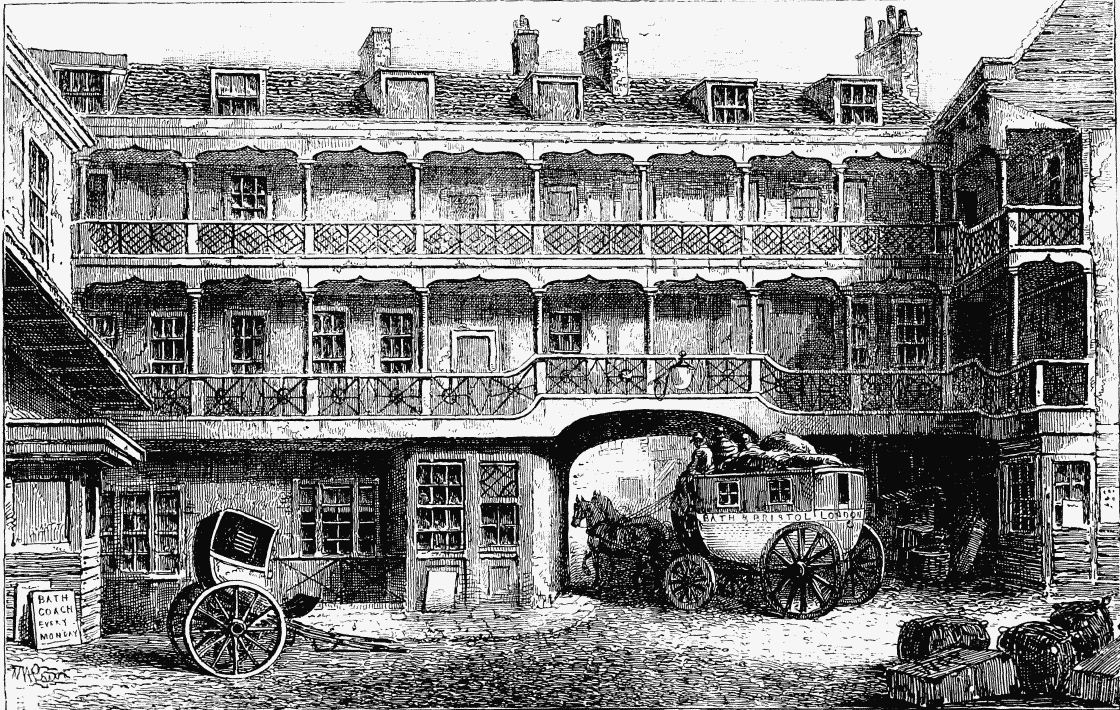
THE INNER COURT OF THE BELLE SAUVAGE. FROM AN ORIGINAL DRAWING IN MR. CRACE'S COLLECTION.
At No. 7, opposite Hone's, "The Percy Anecdotes," that well-chosen and fortunate selection of every sort of story, were first published.
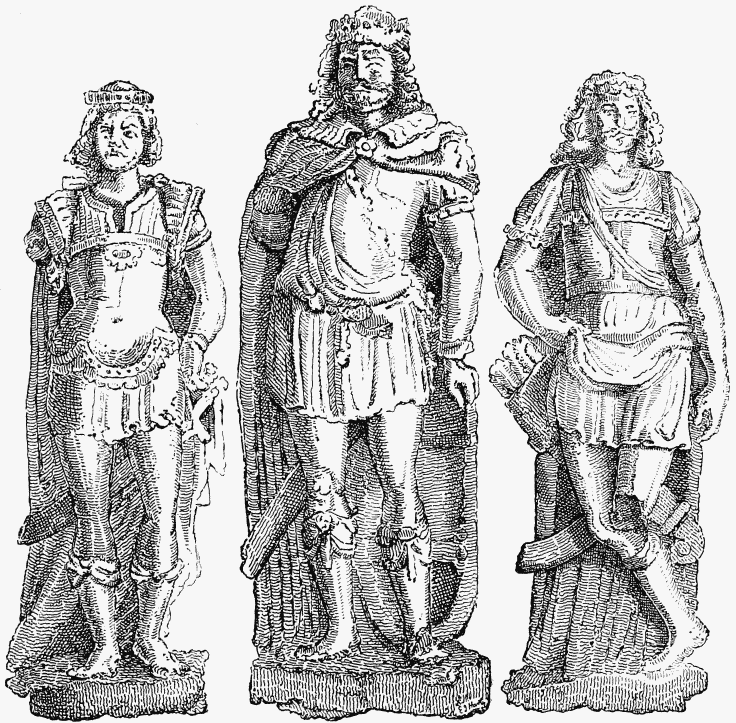
THE MUTILATED STATUES FROM LUD GATE, 1798 (see page 226).
Lud Gate, which Stow in his "Survey" designates the sixth and principal gate of London, taken down in 1760 at the solicitation of the chief inhabitants of Farringdon Without and Farringdon Within, stood between the present London Tavern and the church of St. Martin. According to old Geoffry of Monmouth's fabulous history of England, this entrance to London was first built by King Lud, a British monarch, sixty-six years before Christ. Our later antiquaries, ruthless as to legends, however romantic, consider its original name to have been the Flood or Fleet Gate, which is far more feasible. Lud Gate was either repaired or rebuilt in the year 1215, when the armed barons, under Robert Fitzwalter, repulsed at Northampton, were welcomed to London, and there awaited King John's concession of the Magna Charta. While in the metropolis these greedy and fanatical barons spent their time in spoiling the houses of the rich Jews, and used the stones in strengthening the walls and gates of the City. That this tradition is true was proved in 1586, when (as Stow says) all the gate was rebuilt. Embedded among other stones was found one on which was engraved, in Hebrew characters, the words "This is the ward of Rabbi Moses, the son of the honourable Rabbi Isaac." This stone was probably the sign of one of the Jewish houses pulled down by Fitzwalter, Magnaville, and the Earl of Gloucester, perhaps for the express purpose of obtaining ready materials for strengthening the bulwarks of London. In 1260 (Henry III.) Lud Gate was repaired, and beautified with images of King Lud and other monarchs. In the reign of Edward VI. the citizens, zealous against everything that approached idolatry, smote off the heads of Lud and his family; but Queen Mary, partial to all images, afterwards replaced the heads on the old bodies.
In 1554 King Lud and his sons looked down on a street seething with angry men, and saw blood shed upon the hill leading to St. Paul's. Sir Thomas Wyat, a Kentish gentleman, urged by the Earl of Devon, and led on by the almost universal dread of Queen Mary's marriage with the bigoted Philip of Spain, assembled 1,500 armed men at Rochester Castle, and, aided by 500 Londoners, who deserted to him, raised the standard of insurrection. Five vessels of the fleet joined him, and with seven pieces of artillery, captured from the Duke of Norfolk, he marched upon London. Soon followed by 15,000 men, eager to save the Princess Elizabeth, Wyat marched through Dartford to Greenwich and Deptford. With a force now dwindled to 7,000 men, Wyat attacked London Bridge. Driven from there by the Tower guns, he marched to Kingston, crossed the river, resolving to beat back the Queen's troops at Brentford, and attempt to enter the City by Lud Gate, which some of the Protestant citizens had offered to throw open to him. The Queen, with true Tudor courage, refused to leave St. James's, and in a council of war it was agreed to throw a strong force into Lud Gate, and, permitting Wyat's advance up Fleet Street, to enclose him like a wild boar in the toils. At nine on a February morning, 1554, Wyat reached Hyde Park Corner, was cannonaded at Hay Hill, and further on towards Charing Cross he and some three or four hundred men were cut off from his other followers. Rushing on with a standard through Piccadilly, Wyat reached Lud Gate. There (says Stow) he knocked, calling out, "I am Wyat; the Queen has granted all my petitions."
But the only reply from the strongly-guarded gate was the rough, stern voice of Lord William Howard—"Avaunt, traitor; thou shalt have no entrance here."
No friends appearing, and the Royal troops closing upon him, Wyat said, "I have kept my promise," and retiring, silent and desponding, sat down to rest on a stall opposite the gate of the "Belle Sauvage." Roused by the shouts and sounds of fighting, he fought his way back, with forty of his staunchest followers, to Temple Bar, which was held by a squadron of horse. There the Norroy King-of-Arms exhorted him to spare blood and yield himself a prisoner. Wyat then surrendered himself to Sir Maurice Berkeley, who just then happened to ride by, ignorant of the affray, and, seated behind Sir Maurice, he was taken to St. James's. On April 11th Wyat perished on the scaffold at Tower Hill. This rash rebellion also led to the immediate execution of the innocent and unhappy Lady Jane Grey and her husband, Guilford Dudley, endangered the life of the Princess Elizabeth, and hastened the Queen's marriage with Philip, which took place at Winchester, July 25th of the same year.
In the reign of Elizabeth (1586), the old gate, being "sore decayed," was pulled down, and was newly built, with images of Lud and others on the east side, and a "picture of the lion-hearted queen" on the west, the cost of the whole being over £1,500.
Lud Gate became a free debtors' prison the first
year of Richard II., and was enlarged in 1463
(Edward IV.) by that "well-disposed, blessed, and
devout woman," the widow of Stephen Forster,
fishmonger, Mayor of London in 1454. Of this
benefactress of Lud Gate, Maitland (1739) has the
following legend. Forster himself, according to
this story, in his younger days had once been
a pining prisoner in Lud Gate. Being one day at
the begging grate, a rich widow asked how much
would release him. He said, "Twenty pounds."
She paid it, and took him into her service, where,
by his indefatigable application to business, he so
gained her affections that she married him, and he
earned so great riches by commerce that she concurred with him to make his former prison more
commodious, and to endow a new chapel, where,
on a wall, there was this inscription on a brass
plate:—
"Devout souls that pass this way,
For Stephen Forster, late Lord Mayor, heartily pray,
And Dame Agnes, his spouse, to God consecrate,
That of pity this house made for Londoners in Lud Gate;
So that for lodging and water prisoners here nought pay,
As their keepers shall all answer at dreadful doomsday."
This legend of Lud Gate is also the foundation of
Rowley's comedy of A Woman Never Vext; or, The
Widow of Cornhill, which has in our times been
revived, with alterations, by Mr. Planché. In the first
scene of the fifth act occurs the following passage:—
"Mrs. S. Forster. But why remove the prisoners from
Ludgate?
"Stephen Forster. To take the prison down and build it
new,
With leads to walk on, chambers large and fair;
For when myself lay there the noxious air
Choked up my spirits. None but captives, wife,
Can know what captives feel."
Stow, however, seems to deny this story, and suggests that it arose from some mistake. The stone with the inscription was preserved by Stow when the gate was rebuilt, together with Forster's arms, "three broad arrow-heads," and was fixed over the entry to the prison. The enlargement of the prison on the south-east side formed a quadrant thirty-eight feet long and twenty-nine feet wide. There were prisoners' rooms above it, with a leaden roof, where the debtors could walk, and both lodging and water were free of charge.
Strype says the prisoners in Ludgate were chiefly merchants and tradesmen, who had been driven to want by losses at sea. When King Philip came to London after his marriage with Mary in 1554 thirty prisoners in Lud Gate, who were in gaol for £10,000, compounded for at £2,000, presented the king a well-penned Latin speech, written by "the curious pen" of Roger Ascham, praying the king to redress their miseries, and by his royal generosity to free them, inasmuch as the place was not sceleratorum carcer, sed miserorum custodia (not a dungeon for the wicked, but a place of detention for the wretched).
Marmaduke Johnson, a poor debtor in Lud Gate the year before the Restoration, wrote a curious account of the prison, which Strype printed. The officials in "King Lud's House" seem to have been—1, a reader of Divine service; 2, the upper steward, called the master of the box; 3, the under steward; 4, seven assistants—that is, one for every day of the week; 5, a running assistant; 6, two churchwardens; 7, a scavenger; 8, a chamberlain; 9, a runner; 10, the cryers at the grate, six in number, who by turns kept up the ceaseless cry to the passers-by of "Remember the poor prisoners!" The officers' charge (says Johnson) for taking a debtor to Ludgate was sometimes three, four, or five shillings, though their just due is but twopence; for entering name and address, fourteen pence to the turnkey; a lodging is one penny, twopence, or threepence; for sheets to the chamberlain, eighteenpence; to chamber-fellows a garnish of four shillings (for non-payment of this his clothes were taken away, or "mobbed," as it was called, till he did pay); and the next day a due of sixteen pence to one of the stewards, which was called table money. At his discharge the several fees were as follows:—Two shillings the master's fee; fourteen pence for the turning of the key; twelve pence for every action that lay against him. For leave to go out with a keeper upon security (as formerly in the Queen's Bench) the prisoners paid for the first time four shillings and tenpence, and two shillings every day afterwards. The exorbitant prison fees of three shillings a day swallowed up all the prison bequests, and the miserable debtors had to rely on better means from the Lord Mayor's table, the light bread seized by the clerk of the markets, and presents of under-sized and illegal fish from the water-bailiffs.
A curious handbill of the year 1664, preserved by Mr. Collier, and containing the petition of 180 poor Ludgate prisoners, seems to have been a circular taken round by the alms-seekers of the prison, who perambulated the streets with baskets at their backs and a sealed money-box in their hands. "We most humbly beseech you," says the handbill, "even for God's cause, to relieve us with your charitable benevolence, and to put into this bearer's box—the same being sealed with the house seal, as it is figured upon this petition."
A quarto tract, entitled "Prison Thoughts," by
Thomas Browning, citizen and cook of London, a
prisoner in Lud Gate, "where poor citizens are confined and starve amidst copies of their freedom,"
was published in that prison, by the author, in
1682. It is written both in prose and verse, and
probably gave origin to Dr. Dodd's more elaborate
work on the same subject. The following is a
specimen of the poetry:—
"ON PATIENCE.
"Patience is the poor man's walk,
Patience is the dumb man's talk,
Patience is the lame man's thighs,
Patience is the blind man's eyes,
Patience is the poor man's ditty,
Patience is the exil'd man's city,
Patience is the sick man's bed of down,
Patience is the wise man's crown,
Patience is the live man's story,
Patience is the dead man's glory.
"When your troubles do controul,
In Patience then possess your soul."
In the Spectator (Queen Anne) a writer says: "Passing under Lud Gate the other day, I heard a voice bawling for charity which I thought I had heard somewhere before. Coming near to the grate, the prisoner called me by my name, and desired I would throw something into the box."
The prison at Lud Gate was gutted by the Great Fire of 1666, and in 1760, the year of George III.'s accession, the gate, impeding traffic, was taken down, and the materials sold for £148. The prisoners were removed to the London Workhouse, in Bishopsgate Street, a part whereof was fitted up for that purpose, and Lud Gate prisoners continued to be received there until the year 1794, when they were removed to the prison of Lud Gate, adjoining the compter in Giltspur Street.
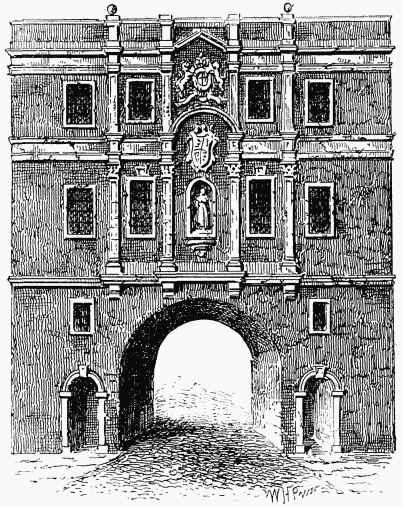
OLD LUD GATE, FROM A PRINT PUBLISHED ABOUT 1750 (see page 223).
When old Lud Gate was pulled down, Lud and his worthy sons were given by the City to Sir Francis Gosling, who intended to set them up at the east end of St. Dunstan's. Nevertheless the royal effigies, of very rude workmanship, were sent to end their days in the parish bone-house; a better fate, however, awaited them, for the late Marquis of Hertford eventually purchased them, and they are now, with St. Dunstan's clock, in Hertford Villa, Regent's Park. The statue of Elizabeth was placed in a niche in the outer wall of old St. Dunstan's Church, and it still adorns the new church, as we have before mentioned in our chapter on Fleet Street.
In 1792 an interesting discovery was made in St. Martin's Court, Ludgate Hill. Workmen came upon the remains of a small barbican, or watchtower, part of the old City wall of 1276; and in a line with the Old Bailey they found another outwork. A fragment of it in a court is now built up. A fire which took place on the premises of Messrs. Kay, Ludgate Hill, May 1,1792, disclosed these interesting ruins, probably left by the builders after the fire of 1666 as a foundation for new buildings. The tower projected four feet from the wall into the City ditch, and measured twenty-two feet from top to bottom. The stones were of different sizes, the largest and the corner rudely squared. They had been bound together with cement of hot lime, so that wedges had to be used to split the blocks asunder. Small square holes in the sides of the tower seemed to have been used either to receive floor timbers, or as peep-holes for the sentries. The adjacent part of the City wall was about eight feet thick, and of rude workmanship, consisting of irregular-sized stones, chalk, and flint. The only bricks seen in this part of the wall were on the south side, bounding Stonecutters' Alley. On the east half of Chatham Place, Blackfriars Bridge, stood the tower built by order of Edward I., at the end of a continuation of the City wall, running from Lud Gate behind the houses in Fleet Ditch to the Thames. A rare plan of London, by Hollar (says Mr. J. T. Smith), marks this tower. Roman monuments have been so frequently dug up near St. Martin's Church, that there is no doubt that a Roman extra-mural cemetery once existed here; in the same locality, in 1800, a sepulchral monument was dug up, dedicated to Claudina Mertina, by her husband, a Roman soldier. A fragment of a statue of Hercules and a female head were also found, and were preserved at the "London" Coffee House.
Ludgate Hill and Street is probably the greatest thoroughfare in London. Through Ludgate Hill and Street there have passed in twelve hours 8,752 vehicles, 13,025 horses, and 105,352 persons.
St. Martin's, Ludgate, though one of Wren's
churches, is not a romantic building; yet it has
its legends. Robert of Gloucester, a rhyming
chronicler, describes it as built by Cadwallo, a
British prince, in the seventh century:—
"A chirch of Sent Martyn livying he let rere,
In whyche yet man should Goddy's seruys do,
And singe for his soule, and al Christine also."
The church seems to have been rebuilt in 1437 (Henry VI.). From the parish books, which commence in 1410, we find the old church to have had several chapels, and to have been well furnished with plate, paintings, and vestments, and to have had two projecting porches on the south side, next Ludgate Hill. The right of presentation to St. Martin's belonged to the Abbot of Westminster, but Queen Mary granted it to the Bishop of London. The following curious epitaph in St. Martin's, found also elsewhere, has been beautifully paraphrased by the Quaker poet, Bernard Barton:—
Strype says of St. Martin's—"It is very comely, and ascended up by stone steps, well finished within; and hath a most curious spire steeple, of excellent workmanship, pleasant to behold." The new church stands farther back than the old. The little black spire that adorns the tower rises from a small bulb of a cupola, round which runs a light gallery. Between the street and the body of the church Wren, always ingenious, contrived an ambulatory the whole depth of the tower, to deaden the sound of passing traffic. The church is a cube, the length 57 feet, the breadth 66 feet; the spire, 168 feet high, is dwarfed by St. Paul's. The church cost in erection £5,378 18s. 8d.
The composite pillars, organ balcony, and oaken
altar-piece are tasteless and pagan. The font was
the gift of Thomas Morley, in 1673, and is encircled by a favourite old Greek palindrome, that
is, a puzzle sentence that reads equally well backwards or forwards—
"Tripson anomeema me monan opsin."
(Cleanse thy sins, not merely thy outward self.)
This inscription, according to Mr. G. Godwin ("Churches of London"), is also found on the font in the basilica of St. Sophia, Constantinople. In the vestry-room, approached by a flight of stairs at the north-east angle of the church, there is a carved seat (date 1690) and several chests, covered with curious indented ornaments.
On this church, and other satellites of St. Paul's,
a poet has written—
"So, like a bishop upon dainties fed,
St. Paul's lifts up his sacerdotal head;
While his lean curates, slim and lank to view,
Around him point their steeples to the blue."
Coleridge used to compare a Mr. H—, who was always putting himself forward to interpret Fox's sentiments, to the steeple of St. Martin's, which is constantly getting in the way when you wish to see the dome of St. Paul's.
One great man, at least, has been connected with this church, where the Knights Templars were put to trial, and that was good old Purchas, the editor and enlarger of "Hakluyt's Voyages." He was rector of this parish. Hakluyt was a prebendary of Westminster, who, with a passion for geographical research, though he himself never ventured farther than Paris, had devoted his life, encouraged by Drake and Raleigh, in collecting from old libraries and the lips of venturous merchants and sea-captains travels in various countries. The manuscript remains were bought by Purchas, who, with a veneration worthy of that heroic and chivalrous age, wove them into his "Pilgrims" (five vols., folio), which are a treasury of travel, exploit, and curious adventures. It has been said that Purchas ruined himself by this publication, and that he died in prison. This is not, however, true. He seems to have impoverished himself chiefly by taking upon himself the care and cost of his brother and brother-in-law's children. He appears to have been a single-minded man, with a thorough devotion to geographic study. Charles I. promised him a deanery, but Purchas did not live to enjoy it.
There is an architectural tradition that Wren purposely designed the spire of St. Martin's, Ludgate, small and slender, to give a greater dignity to the dome of St. Paul's.
The London Coffee House, 24 to 26, Ludgate Hill, a place of celebrity in its day, was first opened in May, 1731. The proprietor, James Ashley, in his advertisement announcing the opening, professes cheap prices, especially for punch. The usual price of a quart of arrack was then eight shillings, and six shillings for a quart of rum made into punch. This new punch house, Dorchester beer, and Welsh ale warehouse, on the contrary, professed to charge six shillings for a quart of arrack made into punch; while a quart of rum or brandy made into punch was to be four shillings, and half a quartern fourpence halfpenny, and gentlemen were to have punch as quickly made as a gill of wine could be drawn. After Roney and Ellis, the house, according to Mr. Timbs, was taken by Messrs. Leech and Dallimore. Mr. Leech was the father of one of the most admirable caricaturists of modern times. Then came Mr. Lovegrove, from the "Horn," Doctors' Commons. In 1856 Mr. Robert Clarke took possession, and was the last tenant, the house being closed in 1867, and purchased by the Corporation for £38,000. Several lodges of Freemasons and sundry clubs were wont to assemble here periodically—among them "The Sons of Industry," to which many of the influential tradesmen of the wards of Farringdon have been long attached. Here, too, in the large hall, the juries from the Central Criminal Court were lodged during the night when important cases lasted more than one day. During the Exeter Hall May meetings the London Coffee House was frequently resorted to as a favourite place of meeting. It was also noted for its publishers' sales of stocks and copyrights. It was within the rules of the Fleet Prison. At the bar of the London Coffee House was sold Rowley's British Cephalic Snuff. A singular incident occurred here many years since. Mr. Brayley, the topographer, was present at a party, when Mr. Broadhurst, the famous tenor, by singing a high note caused a wine-glass on the table to break, the bowl being separated from the stem.
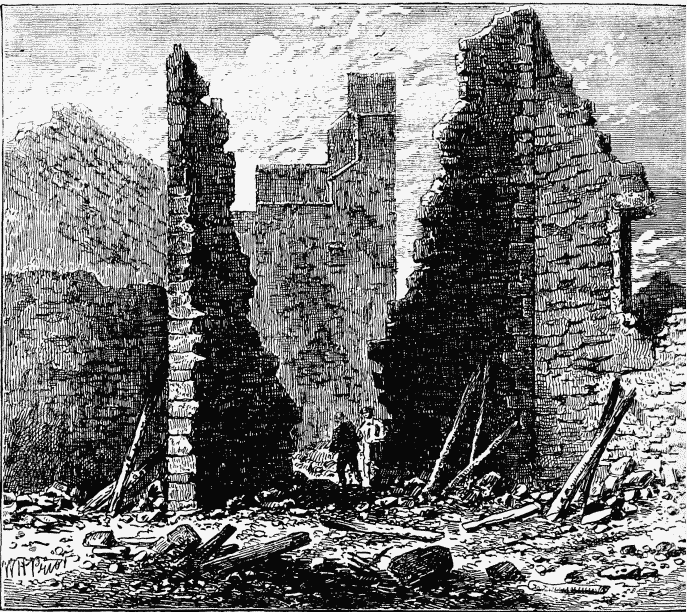
RUINS OF THE BARBICAN ON LUDGATE HILL (see page 226).
At No. 32 (north side) for many years Messrs. Rundell and Bridge, the celebrated goldsmiths and diamond merchants, carried on their business. Here Flaxman's chef d'œuvre, the Shield of Achilles, in silver gilt, was executed; also the crown worn by that august monarch, George IV. at his coronation, for the loan of the jewels of which £7,000 was charged, and among the elaborate luxuries a gigantic silver wine-cooler (now at Windsor), that took two years in chasing. Two men could be seated inside that great cup, and on grand occasions it has been filled with wine and served round to the guests. Two golden salmon, leaning against each other, was the sign of this old shop, now removed. Mrs. Rundell met a great want of her day by writing her well-known book, "The Art of Cookery," published in 1806, and which has gone through countless editions. Up to 1833 she had received no remuneration for it, but she ultimately obtained 2,000 guineas. People had no idea of cooking in those days; and she laments in her preface the scarcity of good melted butter, good toast and water, and good coffee. Her directions were sensible and clear; and she studied economical cooking, which great cooks like Ude and Francatelli despised. It is not every one who can afford to prepare for a good dish by stewing down half-a-dozen hams.
The hall of the Stationers' Company hides itself with the modesty of an author in Stationers' Hall Court, Ludgate Hill, close abutting on Paternoster Row, a congenial neighbourhood. This hall of the master, and keeper, and wardens, and commonalty of the mystery or art of the Stationers of the City of London stands on the site of Burgavenny House, which the Stationers modified and re-erected in the third and fourth years of Philip and Mary—the dangerous period when the company was first incorporated. The old house had been, in the reign of Edward III., the palace of John, Duke of Bretagne and Earl of Richmond. It was afterwards occupied by the Earls of Pembroke. In Elizabeth's reign it belonged to Lord Abergavenny, whose daughter married Sir Thomas Vane. In 1611 (James I.) the Stationers' Company purchased it and took complete possession. The house was swept away in the Great Fire of 1666, when the Stationers—the greatest sufferers on that occasion—lost property to the amount of £200,000.
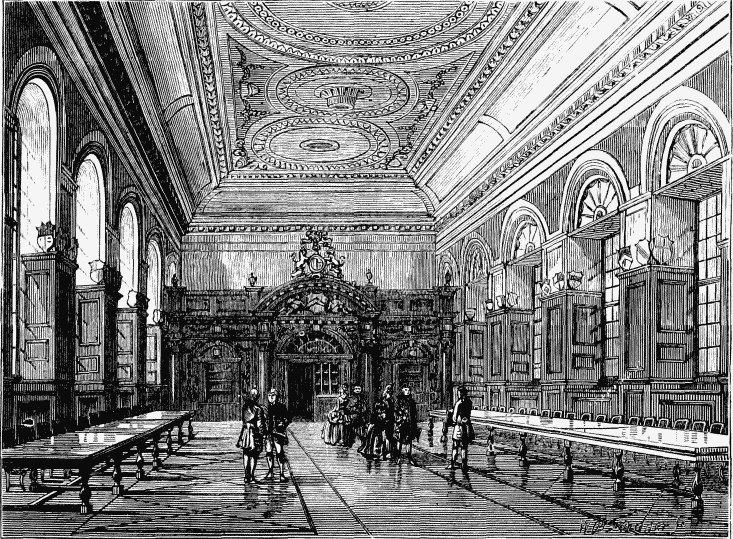
INTERIOR OF STATIONERS' HALL (see page 230).
The fraternity of the Stationers of London (says Mr. John Gough Nichols, F.S.A., who has written a most valuable and interesting historical notice of the Worshipful Company) is first mentioned in the fourth year of Henry IV., when their bye-laws were approved by the City authorities, and they are then described as "writers (transcribers), lymners of books and dyverse things for the Church and other uses." In early times all special books were protected by special letters patent, so that the early registers of Stationers' Hall chiefly comprise books of entertainment, sermons, pamphlets, and ballads.
Mary originally incorporated the society in order to put a stop to heretical writings, and gave the Company power to search in any shop, house, chamber, or building of printer, binder, or seller, for books published contrary to statutes, acts, and proclamations. King James, in the first year of his reign, by letters-patent, granted the Stationers' Company the exclusive privilege of printing Almanacs, Primers, Psalters, the A B C, the "Little Catechism," and Nowell's Catechism.
The Stationers' Company, for two important centuries in English history (says Mr. Cunningham), had pretty well the monopoly of learning. Printers were obliged to serve their time to a member of the Company; and almost every publication, from a Bible to a ballad, was required to be "entered at Stationers' Hall." The service is now unnecessary, but Parliament still requires, under the recent Copyright Act, that the proprietor of every published work should register his claim in the books of the Stationers' Company, and pay a fee of five shillings. The number of the freemen of the Company is between 1,000 and 1,100, and of the livery, or leading persons, about 450. The capital of the Company amounts to upwards of £40,000, divided into shares, varying in value from £40 to £400 each. The great treasure of the Stationers' Company is its series of registers of works entered for publication. This valuable collection of entries commences in 1557, and, though often consulted and quoted, was never properly understood till Mr. J. Payne Collier published two carefully-edited volumes of extracts from its earlier pages.
The celebrated Bible of the year 1632, with the important word "not" omitted in the seventh commandment—"Thou shalt not commit adultery"—was printed by the Stationers' Company. Archbishop Laud made a Star-Chamber matter of the omission, and a heavy fine was laid upon the Company for their neglect. And in another later edition, in Psalm xiv. the text ran, "The fool hath said in his heart, There is a God." For the omission of the important word "no" the printer was fined £3,000. Several other errors have occurred, but the wonder is that they have not been more frequent.
The only publications which the Company continues to issue are a Latin gradus and almanacks, of which it had at one time the entire monopoly. Almanack-day at Stationers' Hall (every 22nd of November, at three o'clock) is a sight worth seeing, from the bustle of the porters anxious to get off with early supplies. The Stationers' Company's almanacks are now by no means the best of the day. Mr. Charles Knight, who worked so strenuously and so successfully for the spread of popular education, first struck a blow at the absurd monopoly of almanack printing. So much behind the age is this privileged Company, that it actually still continues to publish Moore's quack almanack, with the nonsensical old astrological tables, describing the moon's influence on various parts or the human body. One year it is said they had the courage to leave out this farrago, with the hieroglyphics originally stolen by Lilly from monkish manuscripts, and from Lilly stolen by Moore. The result was that most of the copies were returned on their hands. They have not since dared to oppose the stolid force of vulgar ignorance. They still publish Wing's sheet almanack, though Wing was an impostor and fortune-teller, who died eight years after the Restoration. All this is very unworthy of a privileged company, with an invested capital of £40,000, and does not much help forward the enlightenment of the poorer classes. This Company is entitled, for the supposed security of the copyright, to two copies of every work, however costly, published in the United Kingdom, a mischievous tax, which restrains the publication of many valuable but expensive works.
The first Stationers' Hall was in Milk Street. In 1553 they removed to St. Peter's College, near St. Paul's Deanery, where the chantry priests of St. Paul's had previously resided. The present hall closely resembles the hall at Bridewell, having a row of oval windows above the lower range, which were fitted up by Mr. Mylne in 1800, when the chamber was cased with Portland stone and the lower windows lengthened.
The great window at the upper end of the hall was erected in 1801, at the expense of Mr. Alderman Cadell. It includes some older glass blazoned with the arms and crest of the company, the two emblematic figures of Religion and Learning being designed by Smirke. Like most ancient halls, it has a raised dais, or haut place, which is occupied by the Court table at the two great dinners in August and November. On the wall, above the wainscoting that has glowed red with the reflection of many a bumper of generous wine, are hung in decorous state the pavises or shields of arms of members of the court, which in civic processions are usually borne by a body of pensioners, the number of whom, when the Lord Mayor is a member of the Company, corresponds with the years of that august dignitary's age. In the old water-show these escutcheons decorated the sides of the Company's barge when they accompanied the Lord Mayor to Westminster, and called at the landing of Lambeth Palace to pay their respects to the representative of their former ecclesiastical censors. On this occasion the Archbishop usually sent out the thirsty Stationers a hamper of wine, while the rowers of the barge had bread and cheese and ale to their hearts' content. It is still the custom (says Mr. Nichols) to forward the Archbishop annually a set of the Company's almanacks, and some also to the Lord Chancellor and the Master of the Rolls. Formerly the twelve judges and various other persons received the same compliment. Alas for the mutation of other things than almanacs, however; for in 1850 the Company's barge, being sold, was taken to Oxford, where it may still be seen on the Isis, the property of one of the College boat clubs. At the upper end of the hall is a court cupboard or buffet for the display of the Company's plate, and at the lower end, on either side of the doorway, is a similar recess. The entrance-screen of the hall, guarded by allegorical figures, and crowned by the royal arms (with the inescutcheon of Nassau—William III.), is richly adorned with carvings.
Stationers' Hall was in 1677 used for Divine service by the parish of St. Martin's, Ludgate, and towards the end of the seventeenth century an annual musical festival was instituted on the 22nd of November, in commemoration of Saint Cecilia, and as an excuse for some good music. A splendid entertainment was provided in the hall, preceded by a grand concert of vocal and instrumental music, which was attended by people of the first rank. The special attraction was always an ode to Saint Cecilia, set by Purcell, Blow, or some other eminent composer of the day. Dryden's and Pope's odes are almost too well known to need mention; but Addison, Yalden, Shadwell, and even D'Urfey, tried their hands on praises of the same musical saint.
After several odes by the mediocre satirist,
Oldham, and that poor verse-maker, Nahum Tate,
who scribbled upon King David's tomb, came
Dryden. The music to the first ode, says Scott,
was first written by Percival Clarke, who killed
himself in a fit of lovers' melancholy in 1707. It
was then reset by Draghi, the Italian composer,
and in 1711 was again set by Clayton for one of
Sir Richard Steele's public concerts. The first ode
(1687) contains those fine lines:—
"From harmony, rom heavenly harmony,
This universal frame began;
From harmony to harmony,
Through all the compass of the notes it ran,
The diapason closing full in man."
Of the composition of this ode, for which Dryden received £40, and which was afterwards eclipsed by the glories of its successor, the following interesting anecdote is told:—
"Mr. St. John, afterwards Lord Bolingbroke, happening to pay a morning visit to Dryden, whom he always respected, found him in an unusual agitation of spirits, even to a trembling. On inquiring the cause, 'I have been up all night,' replied the old bard. 'My musical friends made me promise to write them an ode for their feast of St. Cecilia. I have been so struck with the subject which occurred to me, that I could not leave it till I had completed it. Here it is, finished at one sitting.' And immediately he showed him the ode."
Dryden's second ode, "Alexander's Feast; or,
the Power of Music," was written for the St.
Cecilian Feast at Stationers' Hall in 1697. This
ode ends with those fine and often-quoted lines on
the fair saint:—
"Let old Timotheus yield the prize,
Or both divide the crown;
He raised a mortal to the skies,
She drew an angel down."
Handel, in 1736, set this ode, and reproduced it at Covent Garden, with deserved success. Not often do such a poet and such a musician meet at the same anvil. The great German also set the former ode, which is known as "The Ode on St. Cecilia's Day." Dryden himself told Tonson that he thought with the town that this ode was the best of all his poetry; and he said to a young flatterer at Will's, with honest pride—"You are right, young gentleman; a nobler never was produced, nor ever will."
Many magnificent funerals have been marshalled in the Stationers' Hall; it has also been used for several great political banquets. In September, 1831, the Reform members of the House of Commons gave a dinner to the Chancellor of the Exchequer (Lord Althorp) and to Lord John Russell—Mr. Abercromby (afterwards Speaker) presiding. In May, 1842, the Duke of Wellington presided over a dinner for the Infant Orphan Asylum, and in June, 1847, a dinner for the King's College Hospital was given under Sir Robert Peel's presidency. In the great kitchen below the hall, Mr. Nichols, who is an honorary member of the Company, says there have been sometimes seen at the same time as many as eighteen haunches of venison, besides a dozen necks and other joints; for these companies are as hospitable as they are rich.
The funeral feast of Thomas Sutton, of the Charterhouse, was given May 28th, 1612, in Stationers' Hall, the procession having started from Doctor Law's, in Paternoster Row. For the repast were provided "32 neats' tongues, 40 stone of beef, 24 marrow-bones, 1 lamb, 46 capons, 32 geese, 4 pheasants, 12 pheasants' pullets, 12 godwits, 24 rabbits, 6 hearnshaws, 43 turkey-chickens, 48 roast chickens, 18 house pigeons, 72 field pigeons, 36 quails, 48 ducklings, 160 eggs, 3 salmon, 4 congers, 10 turbots, 2 dories, 24 lobsters, 4 mullets, a firkin and keg of sturgeon, 3 barrels of pickled oysters, 6 gammon of bacon, 4 Westphalia gammons, 16 fried tongues, 16 chicken pies, 16 pasties, 16 made dishes of rice, 16 neats'-tongue pies, 16 custards, 16 dishes of bait, 16 mince pies, 16 orange pies, 16 gooseberry tarts, 8 redcare pies, 6 dishes of whitebait, and 6 grand salads."
To the west of the hall is the handsome courtroom, where the meetings of the Company are held. The wainscoting, &c., were renewed in the year 1757, and an octagonal card-room was added by Mr. Mylne in 1828. On the opposite side of the hall is the stock-room, adorned by beautiful carvings of the school of Grinling Gibbons. Here the commercial committees of the Company usually meet.
The nine painted storeys which stood in the old hall, above the wainscot in the council parlour, probably crackled to dust in the Great Fire, which also rolled up and took away the portraits of John Cawood, printer to Philip and Mary, and his master, John Raynes. This same John Cawood seems to have been specially munificent in his donations to the Company, for he gave two new stained-glass windows to the hall; also a hearsecover, of cloth and gold, powdered with blue velvet and bordered with black velvet, embroidered and stained with blue, yellow, red, and green, besides considerable plate.
The Company's curious collection of plate is carefully described by Mr. Nichols. In 1581 it seems every master on quitting the chair was required to give a piece of plate, weighing fourteen ounces at least; and every upper or under warden a piece of plate of at least three ounces. In this accumulative manner the Worshipful Company soon became possessed of a glittering store of "salts," gilt bowls, college pots, snuffers, cups, and flagons. Their greatest trophy seems to have been a large silver-gilt bowl, given in 1626 by a Mr. Hulet (Owlett), weighing sixty ounces, and shaped like an owl, in allusion to the donor's name. In the early Civil War, when the Company had to pledge their plate to meet the heavy loans exacted by Charles the Martyr from a good many of his unfortunate subjects, the cherished Owlett was specially excepted. Among other memorials in the possession of the Company was a silver college cup bought in memory of Mr. John Sweeting, who, dying in 1659 (the year before the Restoration), founded by will the pleasant annual venison dinner of the Company in August.
It is supposed that all the great cupboards of plate were lost in the fire of 1666, for there is no piece now existing (says Mr. Nichols) of an earlier date than 1676. It has been the custom also from time to time to melt down obsolete plate into newer forms and more useful vessels. Thus salvers and salt-cellars were in 1720–21 turned into monteaths, or bowls, filled with water, to keep the wine-glasses cool; and in 1844 a handsome rosewater dish was made out of a silver bowl, and an old tea-urn and coffee-urn. This custom is rather too much like Saturn devouring his own children, and has led to the destruction of many curious old relics. The massive old plate now remaining is chiefly of the reign of Charles II. High among these presents tower the quaint silver candlesticks bequeathed by Mr. Richard Royston, twice Master of the Stationers' Company, who died in 1686, and had been bookseller to three kings—James I., Charles I., and Charles II. The ponderous snuffers and snuffer-box are gone. There were also three other pairs of candlesticks, given by Mr. Nathanael Cole, who had been clerk of the Company, at his death in 1760. A small two-handled cup was bequeathed in 1771 by that worthy old printer, William Bowyer, as a memorial of the Company's munificence to his father after his loss by fire in 1712–13.
The Stationers are very charitable. Their funds spring chiefly from £1,150 bequeathed to them by Mr. John Norton, the printer to the learned Queen Elizabeth in Latin, Greek, and Hebrew, alderman of London in the reign of James I., and thrice Master of this Company. The money laid out by Norton's wish in the purchase of estates in fee-simple in Wood Street has grown and grown. One hundred and fifty pounds out of this bequest the old printer left to the minister and churchwardens of St. Faith, in order to have distributed weekly to twelve poor persons—six appointed by the parish, and six by the Stationers' Company— twopence each and a penny loaf, the vantage loaf (the thirteenth allowed by the baker) to be the clerk's; ten shillings to be paid for an annual sermon on Ash Wednesday at St. Faith's; the residue to be laid out in cakes, wine, and ale for the Company of Stationers, either before or after the sermon. The liverymen still (according to Mr. Nichols) enjoy this annual dole of well-spiced and substantial buns. The sum of £1,000 was left for the generous purpose of advancing small loans to struggling young men in business. In 1861, however, the Company, under the direction of the Court of Chancery, devoted the sum to the founding of a commercial school in Bolt Court for the sons of liverymen and freemen of the Company, and £8,500 were spent in purchasing Mr. Bensley's premises and Dr. Johnson's old house. The doctor's usual sitting-room is now occupied by the head master. The school itself is built on the site formerly occupied by Johnson's garden. The boys pay a quarterage not exceeding £2. The school has four exhibitions.
The pictures at Stationers' Hall are worthy of mention. In the stock-room are portraits, after Kneller, of Prior and Steele, which formerly belonged to Harley, Earl of Oxford, Swift's great patron. The best picture in the room is a portrait by an unknown painter of Tycho Wing, the astronomer, holding a celestial globe. Tycho was the son of Vincent Wing, the first author of the almanacks still published under his name, and who died in 1668. There are also portraits of that worthy old printer, Samuel Richardson and his wife; Archbishop Tillotson, by Kneller; Bishop Hoadley, prelate of the Order of the Garter; Robert Nelson, the author of the "Fasts and Festivals," who died in 1714–15, by Kneller; and one of William Bowyer, the Whitefriars printer, with a posthumous bust beneath it of his son, the printer of the votes of the House of Commons. There was formerly a brass plate beneath this bust expressing the son's gratitude to the Company for their munificence to his father after the fire which destroyed his printing-office.
In the court-room hangs a portrait of John Boydell, who was Lord Mayor of London in the year 1791. This picture, by Graham, was formerly surrounded by allegorical figures of Justice, Prudence, Industry, and Commerce; but they have been cut out to reduce the canvas to Kit-cat size. There is a portrait, by Owen, of Lord Mayor Domville, Master of the Stationers' Company, in the actual robe he wore when he rode before the Prince Regent and the Allies in 1814 to the Guildhall banquet and the Peace thanksgiving. In the card-room is an early picture, by West, of King Alfred dividing his loaf with the pilgrim— a representation, by the way, of a purely imaginary occurrence—in fact, the old legend is that it was really St. Cuthbert who executed this generous partition. There are also portraits of the two Strahans, Masters in 1774 and 1816; one of Alderman Cadell, Master in 1798, by Sir William Beechey; and one of John Nicholls, Master of the Company in 1804, after a portrait by Jackson. In the hall, over the gallery, is a picture, by Graham, of Mary Queen of Scots escaping from the Castle of Lochleven. It was engraved by Dawe, afterwards a Royal Academician, when he was only fourteen years of age.
The arms of the Company appear from a Herald visitation of 1634 to have been azure on a chevron, an eagle volant, with a diadem between two red roses, with leaves vert, between three books clasped gold; in chief, issuing out of a cloud, the sunbeams gold, a holy spirit, the wings displayed silver, with a diadem gold. In later times the books have been blazoned as Bibles. In a "tricking" in the volume before mentioned, in the College of Arms, St. John the Evangelist stands behind the shield in the attitude of benediction, and bearing in his left hand a cross with a serpent rising from it (much more suitable for the scriveners or law writers, by the bye). On one side of the shield stands the Evangelist's emblematic eagle, holding an inkhorn in his beak. The Company never received any grant of arms or supporters, but about the year 1790 two angels seem to have been used as supporters. About 1788 the motto "Verbum Domini manet in eternum." (The word of the Lord endureth for ever) began to be adopted, and in the same year the crest of an eagle was used. On the silver badge of the Company's porter the supporters are naked winged boys, and the eagle on the chevron is turned into a dove holding an olivebranch. Some of the buildings of the present hall are still let to Paternoster Row booksellers as ware-houses.
The list of masters of this Company includes Sir John Key, Bart. ("Don Key"), Lord Mayor in 1831–1832. In 1712 Thomas Parkhurst, who had been Master of the Worshipful Company in 1683, left £37 to purchase Bibles and Psalters, to be annually given to the poor; hence the old custom of giving Bibles to apprentices bound at Stationers' Hall.
This is the first of the many City companies of which we shall have by turns to make mention in the course of this work. Though no longer useful as a guild to protect a trade which now needs no fostering, we have seen that it still retains some of its mediæval virtues. It is hospitable and charitable as ever, if not so given to grand funeral services and ecclesiastical ceremonials. Its privileges have grown out of date and obsolete, but they harm no one but authors, and to the wrongs of authors both Governments and Parliaments have been from time immemorial systematically indifferent.