Old and New London: Volume 1. Originally published by Cassell, Petter & Galpin, London, 1878.
This free content was digitised by double rekeying. Public Domain.
Walter Thornbury, 'St Paul's: The new church', in Old and New London: Volume 1(London, 1878), British History Online https://www.british-history.ac.uk/old-new-london/vol1/pp249-262 [accessed 30 April 2025].
Walter Thornbury, 'St Paul's: The new church', in Old and New London: Volume 1(London, 1878), British History Online, accessed April 30, 2025, https://www.british-history.ac.uk/old-new-london/vol1/pp249-262.
Walter Thornbury. "St Paul's: The new church". Old and New London: Volume 1. (London, 1878), British History Online. Web. 30 April 2025. https://www.british-history.ac.uk/old-new-london/vol1/pp249-262.
In this section
CHAPTER XXI.
ST. PAUL'S (continued).
The Rebuilding of St. Paul's—III Treatment of its Architect—Cost of the Present Fabric—Royal Vistors—The First Grave in St. Paul's—Monuments in St. Paul's—Nelson's, Funeral—Military Heroes in St. Paul's—The Duke of Wellington's Funeral—Other Creat Men in St. Paul's—Proposals for the Completion and Decoration of the Building—Dimensions of St. Paul's—Plan of Construction—The Dome, Ball, and Cross—Mr. Horner and his Observatory—Two Narrow Escapes—Sir James Thornhill—Peregrine Falcons on St. Paul's—Nooks and Corners of the Cathedral—The Library. Model Room, and Clock—The Great Bell—A Lucky Error—Curious Story of a Monomaniac—The Poets and the Cathedral—The Festivals of the Charity Schools and of the Sons of the Clergy.
Towards the rebuilding of St. Paul's Cathedral, Charles II., generous as usual in promises, offered an annual contribution of £1,000; but this, however, never seems to have been paid. It, no doubt, went to pay Nell Gwynne's losses at the gambling-table, or to feed the Duchess of Portsmouth's lap-dogs. Some £1,700 in fines, however, were set apart for the new building. The Primate Sheldon gave £2,000. Many of the bishops contributed largely, and there were parochial collections all over England. But the bulk of the money was obtained from the City duty on coals, which (as Dean Milman remarks) in time had their revenge in destroying the stonework of the Cathedral. It was only by a fortunate accident that Wren became the builder; for Charles II., whose tastes and vices were all French, had in vain invited over Perrault, the designer of one of the fronts of the Louvre.
The great architect, Wren, was the son of a Dean of Windsor, and nephew of a Bishop of Norwich whom Cromwell had imprisoned for his Romish tendencies. From a boy Wren had shown a genius for scientific discovery. He distinguished himself in almost every branch of knowledge, and to his fruitful brain we are indebted for some fiftytwo suggestive discoveries. He now. hoped to rebuild London on a magnificent scale; but it was not to be. Even in the plans for the new cathedral Wren was from the beginning thwarted and impeded. Ignorance, envy, jealousy, and selfishness met him at every line he drew. He made two designs—the first a Greek, the second a Latin cross. The Greek cross the clergy considered as unsuitable for a cathedral. The model for it was long preserved in the Trophy Room of St. Paul's, where, either from neglect or the zeal of relic-hunters, the western portico was lost. It is now at South Kensington, and is still imperfect. The interior of the first design is by many considered superior to the present interior. The present recesses along the aisles of the nave, tradition says, were insisted on by James II., who thought they would be useful as side chapels when masses were once more introduced.
The first stone was laid by Wren on the 21st June, 1675, but there was no public ceremonial. Soon after the great geometrician had drawn the circle for the beautiful dome, he sent a workman for a stone to mark the exact centre. The man returned with a fragment of a tombstone, on which was the one ominous word (as every one observed) "Resurgam!" The ruins of old St. Paul's were stubborn. In trying to blow up the tower, a passer-by was killed, and Wren, with his usual ingenuity, resorted successfully to the old Roman battering-ram, which soon cleared a way. "I build for eternity," said Wren, with the true confidence of genius, as he searched for a firm foundation. Below the Norman, Saxon, and Roman graves he dug and probed till he could find the most reliable stratum. Below the loam was sand; under the sand a layer of fresh-water shells; under these were sand, gravel, and London clay. At the north-east corner of the dome Wren was vexed by coming upon a pit dug by the Roman potters in search of clay. He, however, began from the solid earth a strong pier of masonry, and above turned a short arch to the former foundation. He also slanted the new building more to the north-east than its predecessor, in order to widen the street south of St. Paul's.
Well begun is half done. The Cathedral grew fast, and in two-and-twenty years from the laying of the first stone the choir was opened for Divine service. The master mason who helped to lay the first stone assisted in fixing the last in the lantern. A great day was chosen for the opening of St. Paul's. December 2nd, 1697, was the thanksgiving day for the Peace of Ryswick—the treaty which humbled France, and seated William firmly and permanently on the English throne. The king, much against his will, was persuaded to stay at home by his courtiers, who dreaded armed Jacobites among the 300,000 people who would throng the streets. Worthy Bishop Compton, who, dressed as a trooper, had guarded the Princess Anne in her flight from her father, preached that inspiring day on the text, "I was glad when they said unto me, Let us go into the house of the Lord." From then till now the daily voice of prayer and praise has never ceased in St. Paul's.
Queen Anne, during her eventful reign, went seven times to St. Paul's in solemn procession, to commemorate victories over France or Spain. The first of these (1702) was a jubilee for Marlborough's triumph in the Low Countries, and Rooke's destruction of the Spanish fleet at Vigo. The Queen sat on a raised and canopied throne; the Duke of Marlborough, as Groom of the Stole, on a stool behind her. The Lords and Commons, who had arrived in procession, were arranged in the choir. The brave old Whig Bishop of Exeter, Sir Jonathan Trelawney ("and shall Trelawney die?"), preached the sermon. Guns at the Tower, on the river, and in St. James's Park, fired off the Te Deum, and when the Queen started and returned. In 1704, the victory of Blenheim was celebrated; in 1705, the forcing of the French lines at Tirlemont; in 1706, the battle of Ramillies and Lord Peterborough's successes in Spain; in 1707, more triumphs; in 1708, the battle of Oudenarde; and last of all, in 1713, the Peace of Utrecht, when the Queen was unable to attend. On this last day the charity children of London (4,000 in number) first attended outside the church.
St. Paul's was already, to all intents and purposes, completed. The dome was ringed with its golden gallery, and crowned with its glittering cross. In 1710, Wren's son and the body of Freemasons had laid the highest stone of the lantern of the cupola, and now commenced the bitterest mortifications of Wren's life. The commissioners had dwindled down to Dean Godolphin and six or seven civilians from Doctors' Commons. Wren's old friends were dead. His foes compelled him to pile the organ on the screen, though he had intended it to be under the north-east arch of the choir, where it now is. Wren wished to use mosaic for internal decoration; they pronounced it too costly, and they took the painting of the cupola out of Wren's hands and gave it to Hogarth's father-in-law, Sir James Thornhill. They complained of wilful delay in the work, and accused Wren or his assistant of corruption; they also withheld part of his salary till the work was completed. Wren covered the cupola with lead, at a cost of £2,500; the committee were for copper, at £3,050. About the iron railing for the churchyard there was also wrangling. Wren wished a low fence, to leave the vestibule and the steps free and open. The commissioners thought Wren's design mean and weak, and chose the present heavy and cumbrous iron-work, which breaks up the view of the west front.
The new organ, by Father Bernard Smith, which cost £2,000, was shorn of its full size by Wren, perhaps in vexation at its misplacement. The paltry statue of Queen Anne, in the churchyard, was by Bird, and cost £1,130, exclusive of the marble, which the Queen provided. The carvings in the choir, by Grinling Gibbons, cost £1,337 7s. 5d. On some of the exterior sculpture Cibber worked.
In 1718 a violent pamphlet appeared, written, it was supposed, by one of the commissioners. It accused Wren's head workmen of pilfering timber and cracking the bells. Wren proved the charges to be malicious and untrue. The commissioners now insisted on adding a stone balustrade all round St. Paul's, in spite of Wren's protests. He condemned the addition as "contrary to the principles of architecture, and as breaking into the harmony of the whole design;" but, he said, "ladies think nothing well without an edging."
The next year, the commissioners went a step further. Wren, then eighty-six years old, and in the forty-ninth year of office, was dismissed without apology from his post of Surveyor of Public Works. The German Court, hostile to all who had served the Stuarts, appointed in his place a poor pretender, named Benson. This charlatan—now only remembered by a line in the "Dunciad," which ridicules the singular vanity of a man who erected a monument to Milton, in Westminster Abbey, and crowded the marble with his own titles—was afterwards dismissed from his surveyorship with ignominy, but had yet influence enough at Court to escape prosecution and obtain several valuable sinecures. Wren retired to his house at Hampton Court, and there sought consolation in philosophical and religious studies. Once a year, says Horace Walpole, the good old man was carried to St. Paul's, to contemplate the glorious chef-d'æuvre of his genius, Steele, in the Tatler, refers to Wren s vexations, and attributes them to his modesty and bashfulness.
The total sum expended on the building of St. Paul's Cathedral, according to Dean Milman, was £736, 752 2s. 3¼d.; a small residue from the coal duty was all that was left for future repairs. To this Dean Clark added about £500, part of the profits arising from an Essex estate (the gift of an old Saxon king), leased from the Dean and Chapter. The charge of the fabric was vested not in the Dean and Chapter, but in the Archbishop of Canterbury, the Bishop of London, and the Lord Mayor for the time being. These trustees elect the surveyor and audit the accounts.
On the accession of George I. (1715), the new king, princes, and princesses went in state to St. Paul's. Seventy years elapsed before an English king again entered Wren's cathedral. In April, 1789, George III. came to thank God for his temporary recovery from insanity. Queen Charlotte, the Prince of Wales, and the Duke of York were present, and both Houses of Parliament. Bishop Porteous preached the sermon, and 6,000 charity children joined in the service. In 1797, King George came again to attend a thanksgiving for Lord Duncan's and Lord Howe's naval victories; French, Spanish, and Dutch flags waved above the procession, and Sir Horatio Nelson was there among other heroes.
The first grave sunk in St. Paul's was fittingly that of Wren, its builder. He lies in the place of honour, the extreme east of the crypt. The black marble slab is railed in, and the light from a small window-grating falls upon the venerated name. Sir Christopher died in 1723, aged ninety-one. The fine inscription, "Si monumentum requiris, circumspice," written probably by his son, or Mylne, the builder of Blackfriars Bridge, was formerly in front of the organ-gallery, but is now placed over the north-western entrance.
The clergy of St. Paul's were for a long time jealous of allowing any monument in the cathedral. Dean Newton wished for a tomb, but it was afterwards erected in St. Mary-le-Bow. A better man than the vain, place-hunting dean was the first honoured. The earliest statue admitted was that of the benevolent Howard, who had mitigated suffering and sorrow in all the prisons of Europe; he stands at the corner of the dome facing that half-stripped athlete, Dr. Johnson, and the two are generally taken by country visitors for St. Peter and St. Paul. He who with Goldsmith had wandered through the Abbey, wondering if one day their names might not be recorded there, found a grave in Westminster, and, thanks to Reynolds, the first place of honour. Sir Joshua himself, as one of our greatest painters, took the third place, that Hogarth should have occupied; and the fourth was awarded to that great Oriental scholar, Sir William Jones. The clerical opposition was now broken through, for the world felt that the Abbey was full enough, and that St. Paul's required adorning.
Henceforward St. Paul's was chiefly set apart for naval and military heroes whom the city could best appreciate, while the poets, great writers, and statesmen were honoured in the Abbey, and laid among the old historic dead. From the beginning our sculptors resorted to pagan emblems and pagan allégorical figures; the result is that St. Paul's resembles a Pantheon of the Lower Empire, and is a hospital of third-rate art. The first naval conqueror so honoured was Rodney; Rossi received £6,000 for his cold and clumsy design: Lord Howe's statue followed; and next that of Lord Duncan, the hero of Camperdown. It is a simple statue by Westmacott, with a seaman and his wife and child on the pedestal. For Earl St. Vincent, Bailey produced a colossal statue and the usual scribbling, History and a trumpeting Victory.
Then came Nelson's brothers in arms—men of lesser mark; but the nation was grateful, and the Government was anxious to justify its wars by its victories. St. Paul's was growing less particular, and now opened its arms to the best men it could get. Many of Nelson's captains preceded him on the red road to death—Westcott, who fell at Aboukir; Mosse and Riou, who fell before Copenhagen (a far from stainless victory). Riou was the brave man whom Campbell immortalised in his fiery "Battle of the Baltic." Riou lies
"Full many a fathom deep,
By thy wild and stormy steep,
Elsinore."
Then at last, in 1806, came a hero worthy, indeed, of such a cathedral—Nelson himself. At what a moment had Nelson expired! At the close of a victory that had annihilated the fleets of France and Spain, and secured to Britain the empire of the seas. The whole nation that day shed tears of "pride and of sorrow." The Prince of Wales and all his brothers led the procession of nearly 8,000 soldiers, and the chief mourner was Admiral Parker (the Mutiny of the Nore Parker). Nelson's coffin was formed out of a mast of the L'Orient—a vessel blown up at the battle of the Nile, and presented to Nelson by his friend, the captain of the Swiftsure. The sarcophagus, singularly enough, had been designed by Michael Angelo's contemporary, Torreguiano, for Wolsey, in the days of his most insatiable pride, and had remained ever since in Wolsey's chapel at Windsor; Nelson's flag was to have been placed over the coffin, but as it was about to be lowered, the sailors who had borne it, as if by an irresistible impulse, stepped forward and tore it in pieces, for relics. Dean Milman, who, as a youth, was present, says, "I heard, or fancied I heard, the low wail of the sailors who encircled the remains of their admiral." Nelson's trusty companion, Lord Collingwood, who led the vanguard at Trafalgar, sleeps near his old captain, and Lord Northesk, who led the rear-guard, is buried opposite. A brass plate on the pavement under the dome marks the spot of Nelson's tomb. The monument to Nelson, inconveniently placed at the opening of the choir, is by one of our greatest sculptors—Flaxman. It is hardly worthy of the occasion, and the figures on the pedestal are puerile. Lord Lyons is the last admiral whose monument has been erected in St. Paul's.
The military heroes have been contributed by various wars, just and unjust, successful and the reverse. There is that tough old veteran, Lord Heathfield, who drove off two angry nations from the scorched rock of Gibraltar; Sir Isaac Brock, who fell near Niagara; Sir Ralph Abercromby, who perished in Egypt; and Sir John Moore, who played so well a losing game at Corunna. Cohorts of Wellington's soldiers too lie in St. Paul's—brave men, who sacrificed their lives at Talavera, Vimiera, Ciudad Rodrigo, Salamanca, Vittoria, and Bayonne. Nor has our proud and just nation disdained to honour even equally gallant men who were defeated. There are monuments in St. Paul's to the vanquished at Bergen-op-Zoom, New Orleans, and Baltimore.
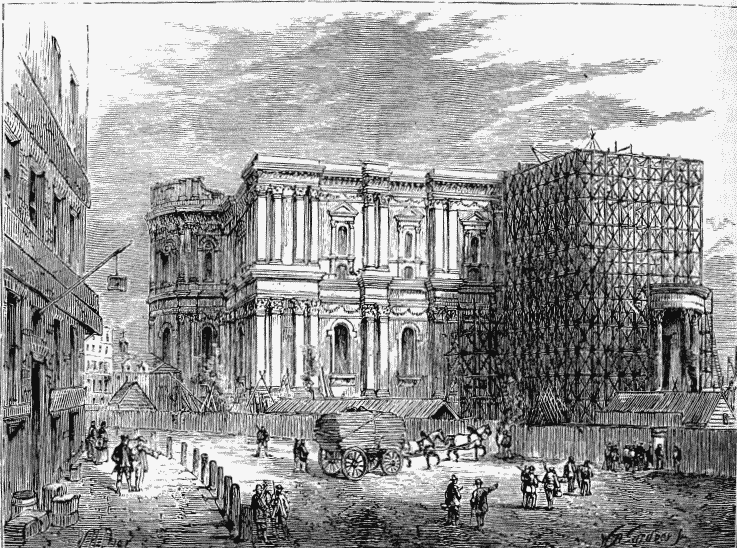
THE REBUILDING OF ST. PAUL'S. FROM AN ORIGINAL DRAWING IN THE POSSESSION OF J. G. CRACE, ESQ.
That climax of victory, Waterloo, brought Ponsonby and Picton to St. Paul's. Picton lies in the vestibule of the Wellington chapel. Thirty-seven years after Waterloo, in the fulness of his years, Wellington was deservedly honoured by a tomb in St. Paul's. It was impossible to lay him beside Nelson, so the eastern chapel of the crypt was appropriated for his sarcophagus. From 12,000 to 15,000 persons were present. The impressive funeral procession, with the representatives of the various regiments, and the solemn bursts of the "Dead March of Saul" at measured intervals, can never be forgotten by those who were present. The pall was borne by the general officers who had fought by the side of Wellington, and the cathedral was illuminated for the occasion. The service was read by Dean Milman, who had been, as we have before mentioned, a spectator of Nelson's funeral. So perfectly adapted for sound is St. Paul's, that though the walls were muffled with black cloth, the Dean's voice could be heard distinctly, even up in the western gallery. The sarcophagus which holds Wellington's ashes is of massive and imperishable Cornish porphyry, grand from its perfect simplicity, and worthy of the man who, without gasconade or theatrical display, trod stedfastly the path of duty.
After Nelson and Wellington, the lesser names seem to dwindle down. Yet among the great, pure, and good, we may mention, there are some Crimean memorials. There also is the monument of Cornwallis, that good Governor-General of India; those of the two Napiers, the historian and the conqueror of Scinde, true knights both; that of Elphinstone, who twice refused the dignity of Governor-General of India; and that of the saviour of our Indian empire, Sir Henry Lawrence. Nor should we forget the monuments of two Indian bishops—the scholarly Middleton, and the excellent and lovable Heber. There is an unsatisfactory statue of Turner, by Bailey; and monuments to Dr. Babington, a London physician, and Sir Astley Cooper, the great surgeon. The ambitious monument to Viscount Melbourne, the Queen's first prime minister, by Baron Marochetti, stands in one of the alcoves of the nave; great gates of black marble represent the entrance to a tomb, guarded by two angels of white marble at the portals. More worthy than the gay Melbourne of the honour of a monument in such a place, is the historian Hallam, a calm, sometimes cold, but always impartial writer.
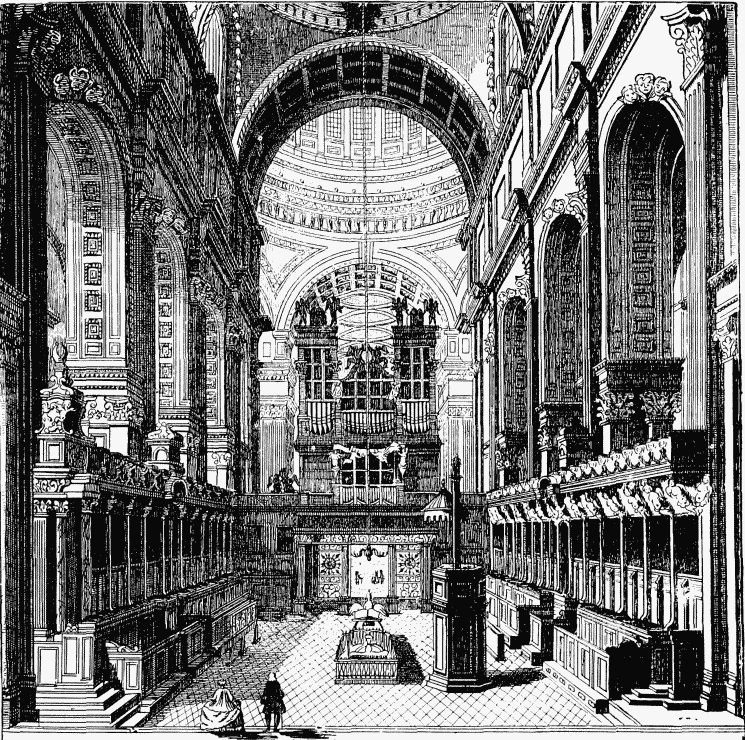
THE CHOIR OF ST. PAUL'S BEFORE THE REMOVAL OF THE SCREEN, from an engraving published in 1754.
In the crypt near Wren lie many of our most celebrated English artists. Sir Joshua Reynolds died in 1792. His pall was borne by peers, and upwards of a hundred carriages followed his hearse. Near him lies his successor as president, West, the Quaker painter; courtly Lawrence; Barry, whom Reynolds detested; rough, clever Opie; Dance; and eccentric Fuseli. In this goodly company, also, sleeps a greater than all of these—Joseph Mallord William Turner, the first landscape painter of the world. He had requested, when dying, to be buried as near to his old master, Reynolds, as possible. It is said that Turner, soured with the world, had threatened to make his shroud out of his grand picture of "The Building of Carthage." In this consecrated spot also rests Robert Mylne, the builder of Blackfriars Bridge, and Mr. Charles Robert Cockerell, the eminent architect.
Only one robbery has occurred in modern times in St. Paul's. In December, 1810, the plate repository of the cathedral was broken open by thieves, with the connivance of, as is supposed, some official, and 1,761 ounces of plate, valued at above £2,000, were stolen. The thieves broke open nine doors to get at the treasure, which was never afterwards heard of. The spoil included the chased silver-gilt covers of the large (1640) Bible, chalices, plates, tankards, and candlesticks.
The cathedral, left colourless and blank by Wren, has never yet been finished. The Protestant choir remains in one corner, like a dry, shrivelled nut in a large shell. Like the proud snail in the fable, that took possession of the lobster-shell and starved there, we remained for more than a century complacently content with our unfurnished house. At length our tardy zeal awoke. In 1858 the Bishop of London wrote to the Dean and Chapter, urging a series of Sunday evening services, for the benefit of the floating masses of Londoners. Dean Milman replied, at once warming to the proposal, and suggested the decoration and completion of St. Paul's. The earnest appeal for "the noblest church, in its style, of Christian Europe, the masterpiece of Wren, the glory and pride of London," was at once responded to. A committee of the leading merchants and bankers was formed, including those great authorities, Sir Charles Barry, Mr. Cockerell, Mr. Tite, and Mr. Penrose. They at once resolved to gladden the eye with colour, without disturbing the solemn and harmonious simplicity. Paintings, mosaics, marble and gilding were requisite; the dome was to be relieved of Thornhill's lifeless grisailles; and above all, stainedglass windows were pronounced indispensable.
The dome had originally been filled by Thornhill with eight scenes from the life of St. Paul. He received for them the not very munificent but quite adequate sum of 40s. per square yard. They soon began to show symptoms of decay, and Mr. Parris, the painter, invented an apparatus by which they could easily be repaired, but no funds could then be found; yet when the paintings fell off in flakes, much money and labour was expended on the restoration, which has now proved useless. Mr. Penrose has shown that so ignorant was Sir James of perspective, that his painted architecture has actually the effect of making Wren's thirty-two pilasters seem to lean forward.
Much has already been done in St. Paul's. Two out of the eight large spandrel pictures round the dome are already executed. There are eventually to be four evangelists and four major prophets. Above the gilt rails of the whispering gallery an inscription on a mosaic and gold ground has been placed. A marble memorial pulpit has been put up. The screen has been removed, and the organ, greatly enlarged and improved, has been divided into two parts, which have been placed on either side of the choir, above the stalls; the dome is lighted with gas; the golden gallery, ball, and cross have been re-gilt. The great baldachino is still wanting, but nine stained-glass windows have been erected, and among the donors have been the Drapers' and Goldsmiths' Companies; there are also memorial windows to the late Bishop Blomfield and W. Cotton, Esq. The Grocers', Merchant Taylors', Goldsmiths', Mercers, and Fishmongers' Companies have generously gilt the vaults of the choir and the arches adjoining the dome. Some fifty or more windows still require stained glass. The wall panels are to be in various places adorned with inlaid marbles. It is not intended that St. Paul's should try to rival St. Peter's at Rome in exuberance of ornament, but it still requires a good deal of clothing. The great army of sable martyrs in marble have been at last washed white, and the fire-engines might now advantageously be used upon the exterior.
A few figures about the dimensions of St. Paul's will not be uninteresting. The cathedral is 2,292 feet in circumference, and the height from the nave pavement to the top of the cross is 365 feet. The height of St. Peter's at Rome being 432 feet, St. Paul's could stand inside St. Peter's. The western towers are 220 feet high. From east to west, St. Paul's is 500 feet long, while St. Peter's is 669 feet. The cupola is considered by many as more graceful than that of St. Peter's, "though in its connection with the church by an order higher than that below it there is a violation of the laws of the art." The external appearance of St. Paul's rivals, if not excels, that of St. Peter's, but the inside is much inferior. The double portico of St. Paul's has been greatly censured. The commissioners insisted on twelve columns, as emblematical of the twelve apostles, and Wren could not obtain stones of sufficient size; but (as Mr. Gwilt observes) it would have been better to have had joined pillars rather than a Composite heaped on a Corinthian portico. In the tympanum is the Conversion of St. Paul, sculptured in high relief by Bird; on the apex is a colossal figure of St. Paul, and on the right and left are St. Peter and St. James. Over the southern portico is sculptured the Phœnix; over the north are the royal arms and regalia, while on each side stand on guard five statues of the apostles. The ascent to the whispering gallery is by 260 steps, to the outer and highest golden gallery 560 steps, and to the ball 616 steps. The outer golden gallery is at the summit of the dome. The inner golden gallery is at the base of the lantern. Through this the ascent is by ladders to the small dome, immediately below the inverted consoles which support the ball and cross. Ascending through the cross iron-work in the centre, you look into the dark ball, which is said to weigh 5,600 pounds; thence to the cross, which weighs 3,360 pounds, and is 30 feet high. In 1821–2 Mr. Cockerell removed for a time the ball and cross.
From the haunches of the dome, says Mr. Gwilt, 200 feet above the pavement of the church, another cone of brickwork commences, 85 feet high and 94 feet diameter at the bottom. This cone is pierced with apertures, as well for the purpose of diminishing its weight as for distributing the light between it and the outer dome. At the top it is gathered into a dome in the form of a hyperboloid, pierced near the vertex with an aperture 12 feet in diameter. The top of this cone is 285 feet from the pavement, and carries a lantern 55 feet high, terminating in a dome whereon a ball and (Aveline) cross is raised. The last-named cone is provided with corbels, sufficient in number to receive the hammer-beams of the external dome, which is of oak, and its base 220 feet from the pavement, its summit being level with the top of the cone. In form it is nearly hemispherical, and generated by radii 57 feet in length, whose centres are in a horizontal diameter passing through its base. The cone and the interior dome are restrained in their lateral thrust on the supports by four tiers of strong iron chains (weighing 95 cwt. 3 qrs. 23 lbs.), placed in grooves prepared for their reception, and run with lead. The lowest of these is inserted in masonry round their common base, and the other three at different heights on the exterior of the cone. Over the intersection of the nave and transepts for the external work, and for a height of 25 feet above the roof of the church, a cylindrical wall rises, whose diameter is 146 feet. Between it and the lower conical wall is a space, but at intervals they are connected by cross-walls. This cylinder is quite plain, but perforated by two courses of rectangular apertures. On it stands a peristyle of thirty columns of the Corinthian order, 40 feet high, including bases and capitals, with a plain entablature crowned by a balustrade. In this peristyle every fourth intercolumniation is filled up solid, with a niche, and connection is provided between it and the wall of the lower cone. Vertically over the base of that cone, above the peristyle, rises another cylindrical wall, appearing above the balustrade. It is ornamented with pilasters, between which are two tiers of rectangular windows. From this wall the external dome springs. The lantern receives no support from it. It is merely ornamental, differing entirely, in that respect, from the dome of St. Peter's.
In 1822 Mr. Horner passed the summer in the lantern, sketching the metropolis; he afterwards erected an observatory several feet higher than the cross, and made sketches for a panorama on a surface of 1,680 feet of drawing paper. From these sheets was painted a panorama of London and the environs, first exhibited at the Colosseum, in Regent's Park, in 1829. The view from St. Paul's extends for twenty miles round. On the south the horizon is bounded by Leith Hill. In high winds the scaffold used to creak and whistle like a ship labouring in a storm, and once the observatory was torn from its lashings and turned partly over on the edge of the platform. The sight and sounds of awaking London are said to have much impressed the artist.
On entering the cathedral, says Mr. Horner, at three in the morning, the stillness which then prevailed in the streets of this populous city, contrasted with their midday bustle, was only surpassed by the more solemn and sepulchral stillness of the cathedral itself. But not less impressive was the development at that early hour of the immense scene from its lofty summit, whence was frequently beheld "the forest of London," without any indication of animated existence. It was interesting to mark the gradual symptoms of returning life, until the rising sun vivified the whole into activity, bustle, and business. On one occasion the night was passed in the observatory, for the purpose of meeting the first glimpse of day; but the cold was so intense as to preclude any wish to repeat the experiment.
Mr. Horner, in his narrative, mentions a narrow escape of Mr. Gwyn, while engaged in measuring the top of the dome for a sectional drawing he was making of the cathedral. While absorbed in his work Mr. Gwyn slipped down the globular surface of the dome till his foot stopped on a projecting lump of lead. In this awful situation, like a man hanging to the moon, he remained till one of his assistants providentially saw and rescued him.
The following was, if possible, an even narrower escape:—When Sir James Thornhill was painting the cupola of St. Paul's Cathedral, a gentleman of his acquaintance was one day with him on the scaffolding, which, though wide, was not railed; he had just finished the head of one of the apostles, and running back, as is usual with painters, to observe the effect, had almost reached the extremity; the gentleman, seeing his danger, and not having time for words, snatched up a large brush and smeared the face. Sir James ran hastily forward, crying out, "Bless my soul, what have you done?" "I have only saved your life!" responded his friend.
Sir James Thornhill was the son of a reduced Dorsetshire gentleman. His uncle, the well-known physician, Dr. Sydenham, helped to educate him. He travelled to see the old masters, and on his return Queen Anne appointed him to paint the dome of St. Paul's. He was considered to have executed the work, in the eight panels, "in a noble manner." "He afterwards," says Pilkington, "executed several public works—painting, at Hampton Court, the Queen and Prince George of Denmark, allegorically; and in the chapel of All Souls, Oxford, the portrait of the founder, over the altar the ceiling, and figures between the windows. His masterpiece is the refectory and saloon at Greenwich Hospital. He was knighted by George II. He died May 4, 1734, leaving a son, John, who became serjeant painter to the king, and a daughter, who married Hogarth. He was a well-made and pleasant man, and sat in Parliament for some years."
The cathedral was artificially secured from lightning, according to the suggestion of the Royal Society, in 1769. The seven iron scrolls supporting the ball and cross are connected with other rods (used merely as conductors), which unite them with several large bars descending obliquely to the stone-work of the lantern, and connected by an iron ring with four other iron bars to the lead covering of the great cupola, a distance of fortyeight feet; thence the communication is continued by the rain-water pipes, which pass into the earth, thus completing the entire communication from the cross to the ground, partly through iron and partly through lead. On the clock-tower a bar of iron connects the pine-apple on the top with the iron staircase, and thence with the lead on the roof of the church. The bell-tower is similarly protected. By these means the metal used in the building is made available as conductors, the metal employed merely for that purpose being exceedingly small in quantity.
In 1841 the exterior of the dome was repaired by workmen resting upon a shifting iron frame. In 1848 a scaffold and observatory, as shown on page 258, were raised round the cross, and in three months some four thousand observations were made for a new trigonometrical survey of London.
Harting, in his "Birds of Middlesex," mentions the peregrine falcons of St. Paul's. "A pair of these birds," he says, "for many years frequented the top of St. Paul's, where it was supposed they had a nest; and a gentleman with whom I am acquainted has assured me that a friend of his once saw a peregrine strike down a pigeon in London, his attention having been first attracted by seeing a crowd of persons gazing upwards at the hawk as it sailed in circles over the houses." A pair frequenting the buildings at Westminster is referred to in "Annals of an Eventful Life," by G. W. Dasent, D.C.L.
A few nooks and corners of the cathedral have still escaped us. The library in the gallery over the southern aisle was formed by Bishop Compton, and consists of some 7,000 volumes, including some manuscripts from old St. Paul's. The room contains some loosely hung flowers, exquisitely carved in wood by Grinling Gibbons, and the floor is composed of 2,300 pieces of oak, inlaid without nails or pegs. At the end of the gallery is a geometrical staircase of 110 steps, which was constructed by Wren to furnish a private access to the library. In crossing thence to the northern gallery, there is a fine view of the entire vista of the cathedral. The model-room used to contain Wren's first design, and some tattered flags once hung beneath the dome. Wren's noble model, we regret to learn, is "a ruin, after one hundred and forty years of neglect," the funds being insufficient for its repair. A staircase from the southern gallery leads to the south-western campanile tower, in which is the clock-room. The clock, which cost £300, was made by Langley Bradley in 1708. The minute-hands are 9 feet 8 inches long, and weigh 75 pounds each. The pendulum is 16 feet long, and the bob weighs 180 pounds, and yet is suspended by a spring no thicker than a shilling. The clock goes eight days, and strikes the hours on the great bell, the clapper of which weighs 180 pounds. Below the great bell are two smaller bells, on which the clock strikes the quarters. In the northern tower is the bell that tolls for prayers. Mr. E. B. Denison pronounced the St. Paul's bell, although the smallest, as by far the best of the four large bells of England—York, Lincoln, and Oxford being the other three.
The great bell of St. Paul's (about five tons) has a diameter of nine feet, and weighs 11,474 pounds. It was cast from the metal of Great Tom (Ton), a bell that once hung in a clock tower opposite Westminster Hall. It was given away in 1698 by William III., and bought for St. Paul's for £385 17s. 6d. It was re-cast in 1716. The keynote (tonic) of sound of this bell is A flat—perhaps A natural—of the old pitch. It is never tolled but at the death or funeral of any of the Royal Family, the Bishop of London, the Dean, or the Lord Mayor, should he die during his mayoralty.
It was not this bell, but the Westminster Great Tom, which the sentinel on duty during the reign of William III. declared he heard strike thirteen instead of twelve at midnight; and the truth of the fact was deposed to by several persons, and the life of the poor soldier, sentenced to death for having fallen asleep upon his post, was thus saved. The man's name was Hatfield. He died in 1770 in Aldersgate, aged 102 years.
Before the time of the present St. Paul's, and as long ago as the reign of Henry VII., there is on record a well-attested story of a young girl who, going to confess, was importuned by the monk then on his turn there for the purpose of confession in the building; and quickly escaping from him up the stairs of the great clock tower, raised the clapper or hammer of the bell of the clock, just as it had finished striking twelve, and, by means of the roof, eluded her assailant and got away. On accusing him, as soon as she reached her friends and home, she called attention to the fact of the clock having struck thirteen that time; and on those in the immediate neighbourhood of the cathedral being asked if so unusual a thing had been heard, they said it was so. This proved the story, and the monk was degraded.
And here we must insert a curious story of a monomaniac whose madness was associated with St. Paul's. Dr. Pritchard, in an essay on "Somnambulism and Animal Magnetism," in the "Cyclopædia of Medicine," gives the following remarkable case of ecstasis:—
A gentleman about thirty-five years of age, of active habits and good constitution, living in the neighbourhood of London, had complained for about five weeks of a slight headache. He was feverish, inattentive to his occupation, and negligent of his family. He had been cupped, and taken some purgative medicine, when he was visited by Dr. Arnould, of Camberwell. By that gentleman's advice, he was sent to a private asylum, where he remained about two years. His delusions very gradually subsided, and he was afterwards restored to his family. The account which he gave of himself was, almost verbatim, as follows:—One afternoon in the month of May, feeling himself a little unsettled, and not inclined to business, he thought he would take a walk into the City to amuse his mind; and having strolled into St. Paul's Churchyard, he stopped at the shop-window of Carrington and Bowles, and looked at the pictures, among which was one of the cathedral. He had not been long there before a short, gravelooking, elderly gentleman, dressed in dark brown clothes, came up and began to examine the prints, and, occasionally casting a glance at him, very soon entered into conversation with him; and, praising the view of St. Paul's which was exhibited at the window, told him many anecdotes of Sir Christopher Wren, the architect, and asked him at the same time if he had ever ascended to the top of the dome. He replied in the negative. The stranger then inquired if he had dined, and proposed that they should go to an eating-house in the neighbourhood, and said that after dinner he would accompany him up St. Paul's. "It was a glorious afternoon for a view, and he was so familiar with the place that he could point out every object worthy of attention." The kindness of the old gentleman's manner induced him to comply with the invitation, and they went to a tavern in some dark alley, the name of which he did not know. They dined, and very soon left the table and ascended to the ball, just below the cross, which they entered alone. They had not been there many minutes when, while he was gazing on the extensive prospect, and delighted with the splendid scene below him, the grave gentleman pulled out from an inside coat-pocket something resembling a compass, having round the edges some curious figures. Then, having muttered some unintelligible words, he placed it in the centre of the ball. He felt a great trembling and a sort of horror come over him, which was increased by his companion asking him if he should like to see any friend at a distance, and to know what he was at that moment doing, for if so the latter could show him any such person. It happened that his father had been for a long time in bad health, and for some weeks past he had not visited him. A sudden thought came into his mind, so powerful that it overcame his terror, that he should like to see his father. He had no sooner expressed the wish than the exact person of his father was immediately presented to his sight in the mirror, reclining in his armchair and taking his afternoon sleep. Not having fully believed in the power of the stranger to make good his offer, he became overwhelmed with terror at the clearness and truth of the vision presented to him, and he entreated his mysterious companion that they might immediately descend, as he felt very ill. The request was complied with, and on parting under the portico of the northern entrance the stranger said to him, "Remember, you are the slave of the Man of the Mirror!" He returned in the evening to his home, he does not know exactly at what hour; felt himself unquiet, depressed, gloomy, apprehensive, and haunted with thoughts of the stranger. For the last three months he has been conscious of the power of the latter over him. Dr. Arnould adds:—"I inquired in what way his power was exercised. He cast on me a look of suspicion, mingled with confidence, took my arm, and after leading me through two or three rooms, and then into the garden, exclaimed, 'It is of no use; there is no concealment from him, for all places are alike open to him; he sees us and he hears us now.' I asked him where this being was who saw and heard us. He replied, in a voice of deep agitation, 'Have I not told you that he lives in the ball below the cross on the top of St. Paul's, and that he only comes down to take a walk in the churchyard and get his dinner at the house in the dark alley? Since that fatal interview with the necromancer,' he continued, 'for such I believe him to be, he is continually dragging me before him on his mirror, and he not only sees me every moment of the day, but he reads all my thoughts, and I have a dreadful consciousness that no action of my life is free from his inspection, and no place can afford me security from his power.' On my replying that the darkness of the night would afford him protection from these machinations; he said, 'I know what you mean, but you are quite mistaken. I have only told you of the mirror; but in some part of the building which we passed in coming away, he showed me what he called a great bell, and I heard sounds which came from it, and which went to it—sounds of laughter, and of anger, and of pain. There was a dreadful confusion of sounds, and as I listened, with wonder and affright, he said, 'This is my organ of hearing; this great bell is in communication with all other bells within the circle of hieroglyphics, by which every word spoken by those under my command is made audible to me.' Seeing me look surprised at him, he said, 'I have not yet told you all, for he practises his spells by hieroglyphics on walls and houses, and wields his power, like a detestable tyrant, as he is, over the minds of those whom he has enchanted, and who are the objects of his constant spite, within the circle of the hieroglyphics.' I asked him what these hieroglyphics were, and how he perceived them. He replied, 'Signs and symbols which you, in your ignorance of their true meaning, have taken for letters and words, and read, as you have thought, "Day and Martin's and Warren's blacking."' 'Oh! that is all nonsense!' 'They are only the mysterious characters which he traces to mark the boundary of his dominion, and by which he prevents all escape from his tremendous power. How have I toiled and laboured to get beyond the limit of his influence! Once I walked for three days and three nights, till I fell down under a wall, exhausted by fatigue, and dropped asleep; but on awakening I saw the dreadful signs before mine eyes, and I felt myself as completely under his infernal spells at the end as at the beginning of my journey.'"
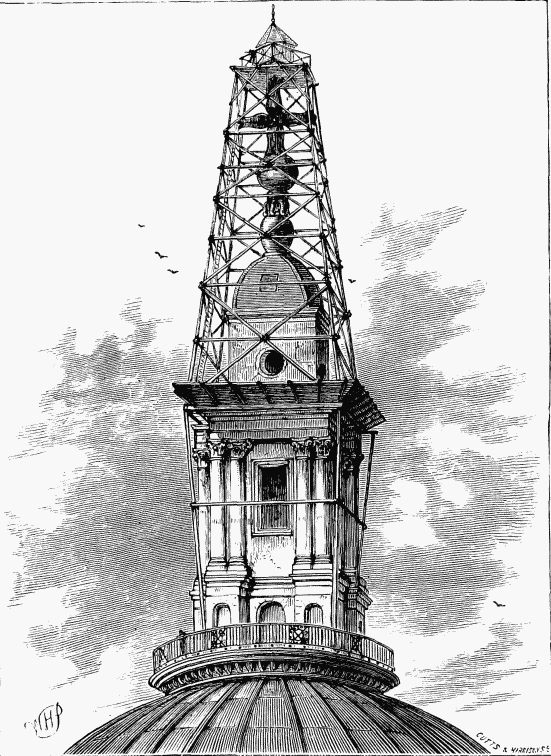
THE SCAFFOLDING AND OBSERVATORY ON ST. PAUL'S IN 1848 (see page 256).
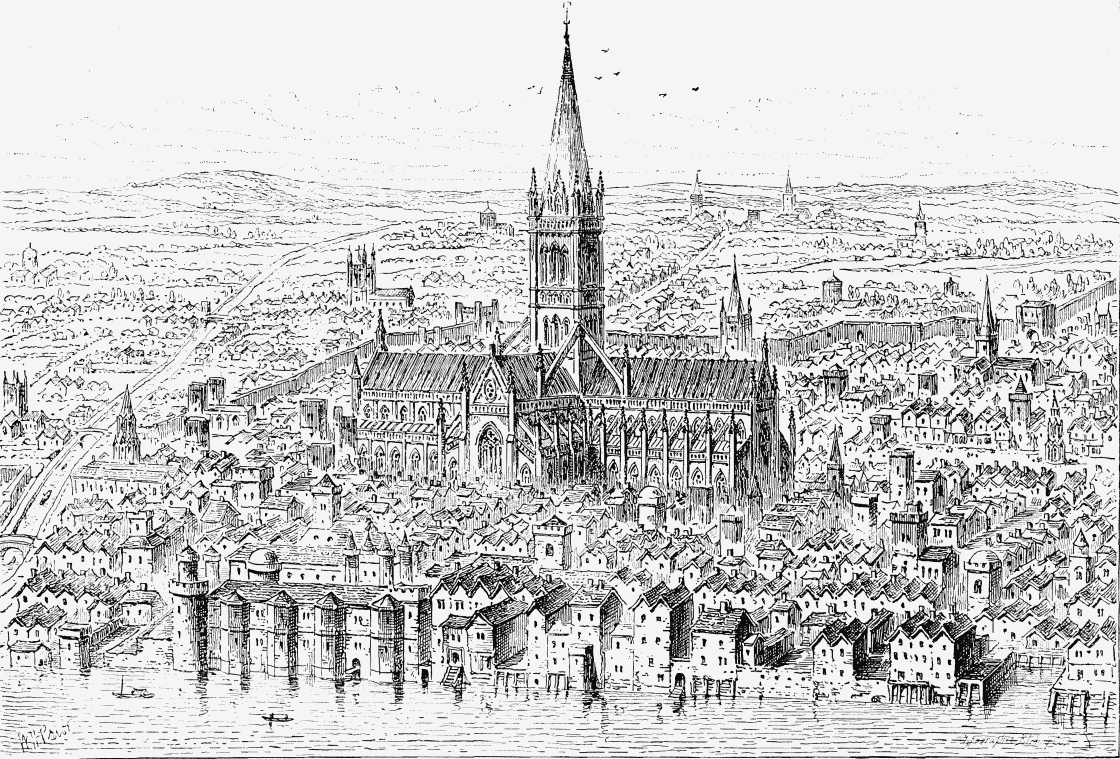
ST. PAUL'S AND THE NEIGHBOURHOOD IN 1540. From a Copy, in the possession of J. G. Crace, Esq., of the earliest known view of London, taken by Van der Wyngarde for Philip II. of Spain.
It is probable that this gentleman had actually ascended to the top of St. Paul's, and that impressions there received, being afterwards renewed in his mind when in a state of vivid excitement, in a dream of ecstatic reverie, became so blended with the creations of fancy as to form one mysterious vision, in which the true and the imaginary were afterwards inseparable. Such, at least, is the best explanation of the phenomena which occurs to us.
In 1855 the fees for seeing St. Paul's completely were 4s. 4d. each person. In 1847 the mere twopences paid to see the forty monuments produced the four vergers the sum of £430 3s. 8d. These exorbitant fees originated in the "stairs-foot money" started by Jennings, the carpenter, in 1707, as a fund for the injured during the building of the cathedral.
The staff of the cathedral consists of the dean, the precentor, the chancellor, the treasurer, the five archdeacons of London, Middlesex, Essex, Colchester, and St. Albans, thirty major canons or prebendaries (four of whom are resident), twelve minor canons, and six vicars-choral, besides the choristers. One of the vicars-choral officiates as organist, and three of the minor canons hold the appointments of sub-dean, librarian, and succentor, or under-precentor.
Three of the most celebrated men connected with St. Paul's in the last century have been Milman, Sydney Smith, and Barham (the author of "Ingoldsby Legends"). Smith and Barham both died in 1845.
Of Sydney Smith's connection with St. Paul's we have many interesting records. One of the first things Lord Grey said on entering Downing Street, to a relation who was with him, was, "Now I shall be able to do something for Sydney Smith," and shortly after he was appointed by the Premier to a prebendal stall at St. Paul's, in exchange for the one he held at Bristol.
Mr. Cockerell, the architect, and superintendent of St. Paul's Cathedral, in a letter printed in Lady Holland's "Memoir," describes the gesta of the canon residentiary; how his early communications with himself (Mr. C.) and all the officers of the chapter were extremely unpleasant; but when the canon had investigated the matter, and there had been "a little collision," nothing could be more candid and kind than his subsequent treatment. He examined the prices of all the materials used in the repairs of the cathedral—as Portland stone, putty, and white lead; every item was taxed, payments were examined, and nothing new could be undertaken without his survey and personal superintendence. He surveyed the pinnacles and heights of the sacred edifice; and once, when it was feared he might stick fast in a narrow opening of the western towers, he declared that "if there were six inches of space there would be room enough for him." The insurance of the magnificent cathedral, Mr. Cockerell tells us, engaged his early attention; St. Paul's was speedily and effectually insured in some of the most substantial offices in London. Not satisfied with this security, he advised the introduction of the mains of the New River into the lower parts of the fabric, and cisterns and movable engines in the roof; and quite justifiable was his joke, that "he would reproduce the Deluge in our cathedral."
He had also the library heated by a stove, so as to be more comfortable to the studious; and the bindings of the books were repaired. Lastly, Mr. Smith materially assisted the progress of a suit in Chancery, by the successful result of which a considerable addition was made to the fabric fund.
It is very gratifying to read these circumstantial records of the practical qualities of Mr. Sydney Smith, as applied to the preservation of our magnificent metropolitan cathedral.
Before we leave Mr. Smith we may record an odd story of Lady B. calling the vergers "virgins." She asked Mr. Smith, one day, if it was true that he walked down St. Paul's with three virgins holding silver pokers before him. He shook his head and looked very grave, and bade her come and see. "Some enemy of the Church," he said, "some Dissenter, had clearly been misleading her."
Let us recapitulate a few of the English poets
who have made special allusions to St. Paul's in
their writings. Denham says of the restoration of
St. Paul's, began by Charles I.:—
"First salutes the place,
Crowned with that sacred pile, so vast, so high,
That whether 'tis a part of earth or sky
Uncertain seems, and may be thought a proud
Aspiring mountain or descending cloud.
Paul's, the late theme of such a muse, whose flight
Has bravely reached and soared above thy height,
Now shalt thou stand, though sword, or time, or fire,
Or zeal more fierce than they, thy fall conspire;
Secure, while thee the best of poets sings,
Preserved from ruin by the best of kings."
Byron, in the Tenth Canto of "Don Juan," treats
St. Paul's contemptuously—sneering, as was his
affectation, at everything, human or divine:—
"A mighty mass of brick, and smoke, and shipping,
Dirty and dusky, but as wide as eye
Could reach, with here and there a sail just skipping
In sight, then lost amidst the forestry
Of masts; a wilderness of steeples peeping
On tiptoe through their sea-coal canopy;
A huge, dim cupola, like a foolscap crown
On a fool's head—and there is London Town!"
Among other English poets who have sung of
St. Paul's, we must not forget Tom Hood, with his
delightfully absurd ode, written on the cross, and
full of most wise folly:—
"The man that pays his pence and goes
Up to thy lofty cross, St. Paul's,
Looks over London's naked nose,
Women and men;
The world is all beneath his ken;
He sits above the ball,
He seems on Mount Olympus' top,
Among the gods, by Jupiter! and lets drop
His eyes from the empyreal clouds
On mortal crowds.
"Seen from these skies,
How small those emmets in our eyes!
Some carry little sticks, and one
His eggs, to warm them in the sun;
Dear, what a hustle
And bustle !
And there's my aunt! I know her by her waist,
So long and thin,
And so pinch'd in,
Just in the pismire taste.
"Oh, what are men ! Beings so small
That, should I fall,
Upon their little heads, I must
Crush them by hundreds into dust.
"And what is life and all its ages!
There's seven stages!
Turnham Green! Chelsea! Putney! Fulham!
Brentford and Kew!
And Tooting, too!
And, oh, what very little nags to pull 'em!
Yet each would seem a horse indeed,
If here at Paul's tip-top we'd got 'em!
Although, like Cinderella's breed,
They're mice at bottom.
Then let me not despise a horse,
Though he looks small from Paul's high cross;
Since he would be, as near the sky,
Fourteen hands high.
"What is this world with London in its lap?
Mogg's map.
The Thames that ebbs and flows in its broad channel?
A tidy kennel !
The bridges stretching from its banks ?
Stone planks.
Oh, me ! Hence could I read an admonition
To mad Ambition!
But that he would not listen to my call,
Though I should stand upon the cross, and ball!"
We can hardly close our account of St. Paul's without referring to that most beautiful and touching of all London sights, the anniversary of the charity schools on the first Thursday in June. About 8,000 children are generally present, ranged in a vast amphitheatre under the dome. Blake, the true but unrecognised predecessor of Wordsworth, has written an exquisite little poem on the scene, and well it deserves it. Such nosegays of little rosy faces can be seen on no other day. Very grand and overwhelming are the beadles of St. Mary Axe and St. Margaret Moses on this tremendous morning, and no young ensign ever bore his colours prouder than do these good-natured dignitaries their maces, staves, and ponderous badges. In endless ranks pour in the children, clothed in all sorts of quaint dresses. Boys in the kneebreeches of Hogarth's school-days, bearing glittering pewter badges on their coats; girls in blue and orange, with quaint little mob-caps white as snow, and long white gloves covering all their little arms. See, at a given signal of an extraordinary fugleman, how they all rise; at another signal how they hustle down. Then at last, when the "Old Hundredth" begins, all the little voices unite as the blending of many waters. Such fresh, happy voices, singing with such innocent, heedful tenderness as would bring tears to the eyes of even stonyhearted old Malthus, bring to the most irreligious thoughts of Him who bade little children come to Him, and would not have them repulsed.
Blake's poem begins—
"'Twas on a Holy Thursday, their innocent faces clean,
Came children walking two and two, in red and blue and
green;
Grey-headed beadles walked before, with wands as white as
snow,
Till into the high dome of Paul's they like Thames' waters
flow.
"Oh, what a multitude they seemed, those flowers of
London town;
Seated in companies they were, with radiance all their own;
The hum of multitudes was there, but multitudes of lambs,
Thousands of little boys and girls, raising their innocent hands.
"Now like a mighty wind they raise to heaven the voice of
song,
Or like harmonious thunderings the seats of heaven among;
Beneath them sit the aged men, wise guardians of the poor;
Then cherish pity, lest you drive an angel from your door."
The anniversary Festival of the Sons of the Clergy,
in the middle of May, when the choirs of Westminster and the Chapel Royal sing selections from
Handel and other great masters, is also a day not
easily to be forgotten, for St. Paul's is excellent for
sound, and the fine music rises like incense to the
dome, and lingers there as "loth to die," arousing
thoughts that, as Wordsworth beautifully says, are in
themselves proofs of our immortality. It is on such
occasions we feel how great a genius reared St.
Paul's, and cry out with the poet—
"He thought not of a perishable home
Who thus could build."