
Old and New London: Volume 1. Originally published by Cassell, Petter & Galpin, London, 1878.
This free content was digitised by double rekeying. All rights reserved.
'Baynard's Castle and Doctors' Commons', in Old and New London: Volume 1, (London, 1878) pp. 281-293. British History Online https://www.british-history.ac.uk/old-new-london/vol1/pp281-293 [accessed 12 April 2024]
In this section
CHAPTER XXIV.
BAYNARD'S CASTLE, DOCTORS' COMMONS, AND HERALDS' COLLEGE.
Baron Fitzwalter and King John—The Duties of the Chief Bannerer of London—An Old-fashioned Punishment for Treason—Shakespearian Allusions to Baynard's Castle—Doctors' Commons and its Five Courts—The Court of Probate Act, 1857—The Court of Arches—The Will Office—Business of the Court—Prerogative Court—Faculty Office—Lord Stowell, the Admiralty Judge—Stories of Him—His Marriage—Sir Herbert Jenner Fust—The Court "Rising"—Dr. Lushington—Marriage Licenses—Old Weller and the "Touters"—Doctors' Commons at the Present Day.
We have already made passing mention of Baynard's Castle, the grim fortress near Blackfriars Bridge, immediately below St. Paul's, where for several centuries after the Conquest, Norman barons held their state, and behind its stone ramparts maintained their petty sovereignty.
This castle took its name from Ralph Baynard, one of those greedy and warlike Normans who came over with the Conqueror, who bestowed on him many marks of favour, among others the substantial gift of the barony of Little Dunmow, in Essex. This chieftain built the castle, which derived its name from him, and, dying in the reign of Rufus, the castle descended to his grandson, Henry Baynard, who in 1111, however, forfeited it to the Crown for taking part with Helias, Earl of Mayne, who endeavoured to wrest his Norman possessions from Henry I. The angry king bestowed the barony and castle of Baynard, with all its honours, on Robert Fitzgerald, son of Gilbert, Earl of Clare, his steward and cup-bearer. Robert's son, Walter, adhered to William de Longchamp, Bishop of Ely, against John, Earl of Moreton, brother of Richard Cœur de Lion. He, however, kept tight hold of the river-side castle, which duly descended to Robert, his son, who in 1213 became castellan and standard-bearer of the city, On this same banneret, in the midst of his pride and prosperity, there fell a great sorrow. The licentious tyrant, John, who spared none who crossed his passions, fell in love with Matilda, Fitz-Walter's fair daughter, and finding neither father nor daughter compliant to his will, John accused the castellan of abetting the discontented barons, and attempted his arrest. But the riverside fortress was convenient for escape, and Fitz-Walter flew to France. Tradition says that in 1214 King John invaded France, but that after a time a truce was made between the two nations for five years. There was a river, or arm of the sea, flowing between the French and English tents, and across this flood an English knight, hungry for a fight, called out to the soldiers of the Fleur de Lis to come over and try a joust or two with him. At once Robert Fitz-Walter, with his visor down, ferried over alone with his barbed horse, and mounted ready for the fray. At the first course he struck John's knight so fiercely with his great spear, that both man and steed came rolling in a clashing heap to the ground. Never was spear better broken; and when the squires had gathered up their discomfited master, and the supposed French knight had recrossed the ferry, King John, who delighted in a well-ridden course, cried out, with his usual oath, "By God's sooth, he were a king indeed who had such a knight!" Then the friends of the banished man seized their opportunity, and came running to the usurper, and knelt down and said, "O king, he is your knight; it was Robert Fitz-Walter who ran that joust." Whereupon John, who could be generous when he could gain anything by it, sent the next day for the good knight, and restored him to his favour, allowed him to rebuild Baynard's Castle, which had been demolished by royal order, and made him, moreover, governor of the Castle of Hertford.
But Fitz-Walter could not forget the grave of his daughter, still green at Dunmow (for Matilda, indomitable in her chastity, had been poisoned by a messenger of John's, who sprinkled a deadly powder over a poached egg—at least, so the legend runs), and soon placed himself at the head of those brave barons who the next year forced the tyrant to sign Magna Charta at Runnymede. He was afterwards chosen general of the barons' army, to keep John to his word, and styled "Marshal of the Army of God and of the Church." He then (not having had knocks enough in England) joined the Crusaders, and was present at the great siege of Damietta. In 1216 (the first year of Henry III.) Fitz-Walter again appears to the front, watchful of English liberty, for his Castle of Hertford having been delivered to Louis of France, the dangerous ally of the barons, he required of the French to leave the same, "because the keeping thereof did by ancient right and title pertain to him." On which Louis, says Stow, prematurely showing his claws, replied scornfully "that Englishmen were not worthy to have such holds in keeping, because they did betray their own lord;" but Louis not long after left England rather suddenly, accelerated no doubt by certain movements of Fitz-Walter and his brother barons.
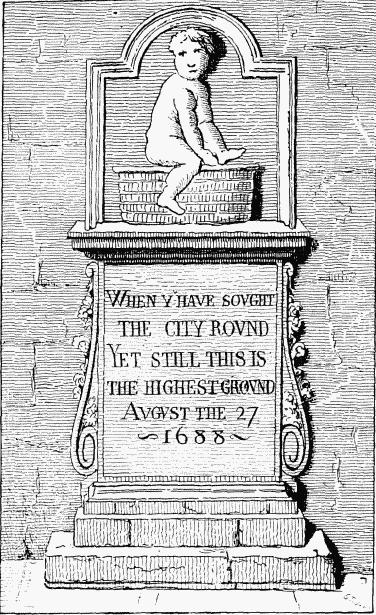
THE FIGURE IN PANIER ALLEY (see page 280).
Fitz-Walter dying, and being buried at Dunmow, the scene of his joys and sorrows, was succeeded by his son Walter, who was summoned to Chester in the forty-third year of Henry III., to repel the fierce and half-savage Welsh from the English frontier. After Walter's death the barony of Baynard was in the wardship of Henry III. during the minority of Robert Fitz-Walter, who in 1303 claimed his right as castellan and banner-bearer of the City of London before John Blandon, or Blount, Mayor of London. The old formularies on which Fitz-Walter founded his claims are quoted by Stow from an old record which is singularly quaint and picturesque. The chief clauses run thus:—
"The said Robert and his heirs are and ought to be chief bannerets of London in fee, for the chastiliary which he and his ancestors had by Castle Baynard in the said city. In time of war the said Robert and his heirs ought to serve the city in manner as followeth—that is, the said Robert ought to come, he being the twentieth man of arms, on horseback, covered with cloth or armour, unto the great west door of St. Paul's, with his banner displayed before him, and when he is so come, mounted and apparelled, the mayor, with his aldermen and sheriffs armed with their arms, shall come out of the said church with a banner in his hand, all on foot, which banner shall be gules, the image of St. Paul gold, the face, hands, feet, and sword of silver; and as soon as the earl seeth the mayor come on foot out of the church, bearing such a banner, he shall alight from his horse and salute the mayor, saying unto him, 'Sir mayor, I am come to do my service which I owe to the city.' And the mayor and aldermen shall reply, 'We give to you as our banneret of fee in this city the banner of this city, to bear and govern, to the honour of this city to your power;' and the earl, taking the banner in his hands, shall go on foot out of the gate; and the mayor and his company following to the door, shall bring a horse to the said Robert, value twenty pounds, which horse shall be saddled with a saddle of the arms of the said earl, and shall be covered with sindals of the said arms. Also, they shall present him a purse of twenty pounds, delivering it to his chamberlain, for his charges that day."
The record goes on to say that when Robert is mounted on his £20 horse, banner in hand, he shall require the mayor to appoint a City Marshal (we have all seen him with his cocked hat and subdued commander-in-chief manner), "and the commons shall then assemble under the banner of St. Paul, Robert bearing the banner to Aldgate, and then delivering it up to some fit person. And if the army have to go out of the city, Robert shall choose two sage persons out of every ward to keep the city in the absence of the army." And these guardians were to be chosen in the priory of the Trinity, near Aldgate. And for every town or castle which the Lord of London besieged, if the siege continued a whole year, the said Robert was to receive for every siege, of the commonalty, one hundred shillings and no more. These were Robert Fitz-Walter's rights in times of war; in times of peace his rights were also clearly defined. His sok or ward in the City began at a wall of St. Paul's canonry, which led down by the brewhouse of St. Paul's to the river Thames, and so to the side of a wall, which was in the water coming down from Fleet Bridge. The ward went on by London Wall, behind the house of the Black Friars, to Ludgate, and it included all the parish of St. Andrew. Any of his sokemen indicted at the Guildhall of any offence not touching the body of the mayor or sheriff, was to be tried in the court of the said Robert.
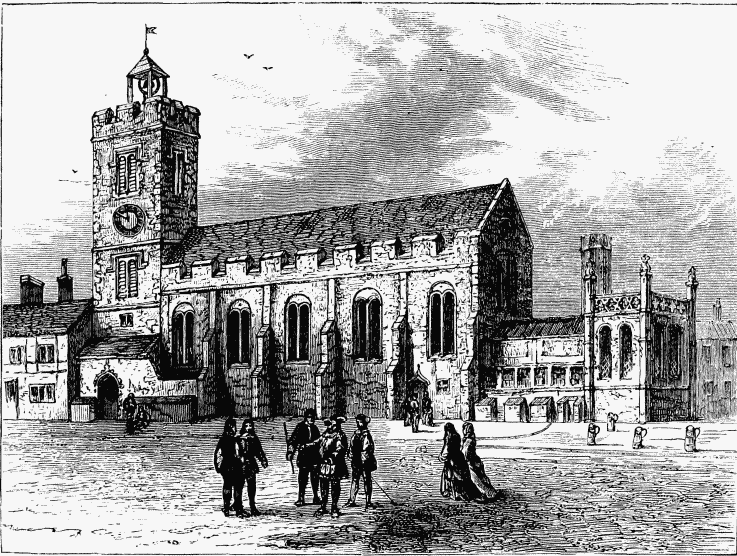
THE CHURCH OF ST. MICHAEL AD BLADUM (see page 280).
"If any, therefore, be taken in his sokemanry, he must have his stocks and imprisonment in his soken, and he shall be brought before the mayor and judgment given him, but it must not be published till he come into the court of the said earl, and in his liberty; and if he have deserved death by treason, he is to be tied to a post in the Thames, at a good wharf, where boats are fastened, two ebbings and two flowings of the water (!) And if he be condemned for a common theft, he ought to be led to the elms, and there suffer his judgment as other thieves. And so the said earl hath honour, that he holdeth a great franchise within the city, that the mayor must do him right; and when he holdeth a great council, he ought to call the said Robert, who should be sworn thereof, against all people, saving the king and his heirs. And when he cometh to the hustings at Guildhall, the mayor ought to rise against him, and sit down near him, so long as he remaineth, all judgments being given by his mouth, according to the records of the said Guildhall; and the waifes that come while he stayeth, he ought to give them to the town bailiff, or to whom he will, by the counsel of the mayor."
This old record seems to us especially quaint and picturesque. The right of banner-bearer to the City of London was evidently a privilege not to be despised by even the proudest Norman baron, however numerous were his men-at-arms, however thick the forest of lances that followed at his back. At the gates of many a refractory Essex or Hertfordshire castle, no doubt, the Fitz-Walters flaunted that great banner, that was emblazoned with the image of St. Paul, with golden face and silver feet; and the horse valued at £20, and the pouch with twenty golden pieces, must by no means have lessened the zeal and pride of the City castellan as he led on his trusty archers, or urged forward the half-stripped, sinewy men, who toiled at the catapult, or bent down the mighty springs of the terrible mangonel. Many a time through Aldgate must the castellan have passed with glittering armour and flaunting plume, eager to earn his hundred shillings by the siege of a rebellious town.
Then Robert was knighted by Edward I., and the family continued in high honour and reputation through many troubles and public calamities. In the reign of Henry VI., when the male branch died out, Anne, the heiress, married into the Ratcliffe family, who revived the title of Fitz-Walter.
It is not known how this castle came to the Crown, but certain it is that on its being consumed by fire in 1428 (Henry VI.), it was rebuilt by Humphrey, the good duke of Gloucester. On his death it was made a royal residence by Henry VI., and by him granted to the Duke of York, his luckless rival, who lodged here with his factious retainers during the lulls in the wars of York and Lancaster. In the year 1460, the Earl of March, lodging in Castle Baynard, was informed that his army and the Earl of Warwick had declared that Henry VI. was no longer worthy to reign, and had chosen him for their king. The carl coquetted, as usurpers often do, with these offers of the crown, declaring his insufficiency for so great a charge, till yielding to the exhortations of the Archbishop of Canterbury and the Bishop of Exeter, he at last consented. On the next day he went to St. Paul's in procession, to hear the Te Deum, and was then conveyed in state to Westminster, and there, in the Hall, invested with the sceptre by the confessor.
At Baynard's Castle, too, that cruel usurper, Richard III., practised the same arts as his predecessor. Shakespeare, who has darkened Richard almost to caricature, has left him the greatest wretch existing in fiction. At Baynard's Castle our great poet makes Richard receive his accomplice Buckingham, who had come from the Guildhall with the Lord Mayor and aldermen to press him to accept the crown; Richard is found by the credulous citizens with a book of prayer in his hand, standing between two bishops. This man, who was already planning the murder of Hastings and the two princes in the Tower, affected religious scruples, and with well-feigned reluctance accepted "the golden yoke of sovereignty."
Thus at Baynard's Castle begins that darker part of the Crookback's career, which led on by crime after crime to the desperate struggle at Bosworth, when, after slaying his rival's standard-bearer, Richard was beaten down by swords and axes, and his crown struck off into a hawthorn bush. The defaced corpse of the usurper, stripped and gory, was, as the old chroniclers tell us, thrown over a horse and carried by a faithful herald to be buried at Leicester. It is in vain that modern writers try to prove that Richard was gentle and accomplished, that this murder attributed to him was profitless and impossible; his name will still remain in history blackened and accursed by charges that the great poet has turned into truth, and which, indeed, are difficult to refute. That Richard might have become a great, and wise, and powerful king, is possible; but that he hesitated to commit crimes to clear his way to the throne, which had so long been struggled for by the Houses of York and Lancaster, truth forbids us for a moment to doubt. He seems to have been one of those dark, wily natures that do not trust even their most intimate accomplices, and to have worked in such darkness that only the angels know what blows he struck, or what murders he planned. One thing is certain, that Henry, Clarence, Hastings, and the princes died in terribly quick succession, and at most convenient moments.
Henry VIII. expended large sums in turning Baynard's Castle from a fortress into a palace. He frequently lodged there in burly majesty, and entertained there the King of Castile, who was driven to England by a tempest. The castle then became the property of the Pembroke family, and here, in July, 1553, the council was held in which it was resolved to proclaim Mary Queen of England, which was at once done at the Cheapside Cross by sound of trumpet.
Queen Elizabeth, who delighted to honour her special favourites, once supped at Baynard's Castle with the earl, and afterwards went on the river to show herself to her loyal subjects. It is particularly mentioned that the queen returned to her palace at ten o'clock.
The Earls of Shrewsbury afterwards occupied the castle, and resided there till it was burnt in the Great Fire. On its site stand the Carron works and the wharf of the Castle Baynard Copper Company.
Adjoining Baynard's Castle once stood a tower built by King Edward II., and bestowed by him on William de Ross, for a rose yearly, paid in lieu of all other services. The tower was in later times called "the Legates' Tower." Westward of this stood Montfichet Castle, and eastward of Baynard's Castle the Tower Royal and the Tower of London, so that the Thames was well guarded from Ludgate to the citadel. All round this neighbourhood, in the Middle Ages, great families clustered. There was Beaumont Inn, near Paul's Wharf, which, on the attainder of Lord Bardolf, Edward IV. bestowed on his favourite, Lord Hastings, whose death Richard III. (as we have seen) planned at his very door. It was afterwards Huntingdon House. Near Trigg Stairs the Abbot of Chertsey had a mansion, afterwards the residence of Lord Sandys. West of Paul's Wharf (Henry VI.) was Scroope's Inn, and near that a house belonging to the Abbey of Fescamp, given by Edward III. to Sir Thomas Burley. In Carter Lane was the mansion of the Priors of Okeborne, in Wiltshire, and not far from the present Puddle Dock was the great mansion of the Lords of Berkley, where, in the reign of Henry VI., the kingmaking Earl of Warwick kept tremendous state, with a thousand swords ready to fly out if he even raised a finger.
And now, leaving barons, usurpers, and plotters, we come to the Dean's Court archway of Doctors' Commons, the portal guarded by ambiguous touters for licences, men in white aprons, who look half like confectioners, and half like disbanded watermen. Here is the college of Doctors of Law, provided for the ecclesiastical lawyers in the early part of Queen Elizabeth's reign by Master Henry Harvey, Master of Trinity Hall, Cambridge, Prebendary of Ely, and Dean of the Arches; according to Sir George Howes, "a reverend, learned, and good man." The house had been inhabited by Lord Mountjoy, and Dr. Harvey obtained a lease of it for one hundred years of the Dean and Chapter of St. Paul's, for the annual rent of five marks. Before this the civilians and canonists had lodged in a small inconvenient house in Paternoster Row, afterwards the "Queen's Head Tavern." Cardinal Wolsey, always magnificent in his schemes, had planned a "fair college of stone" for the ecclesiastical lawyers, the plan of which Sir Robert Cotton possessed. In this college, in 1631, says Buc, the Master of the Revels, lived in commons with the Judge of the High Court of Admiralty, being a doctor of civil law, the Dean of the Arches, the Judges of the Court of Delegates, the Vicar-General, and the Master or Custos of the Prerogative Court of Canterbury.
Doctors' Commons, says Strype, "consists of five courts—three appertaining to the see of Canterbury, one to the see of London, and one to the Lords Commissioners of the Admiralties." The functions of these several courts he thus defines:—
"Here are the courts kept for the practice of civil or ecclesiastical causes. Several offices are also here kept; as the Registrary of the Archbishop of Canterbury, and the Registrary of the Bishop of London.
"The causes whereof the civil and ecclesiastical law take cognisance are those that follow, as they are enumerated in the 'Present State of England:'—Blasphemy, apostacy from Christianity, heresy, schism, ordinations, institutions of clerks to benefices, celebration of Divine service, matrimony, divorces, bastardy, tythes, oblations, obventions, mortuaries, dilapidations, reparation of churches, probate of wills, administrations, simony, incests, fornications, adulteries, solicitation of chastity; pensions, procurations, commutation of penance, right of pews, and other such like, reducible to those matters.
"The courts belonging to the civil and ecclesiastical laws are divers.
"First, the Court of Arches, which is the highest court belonging to the Archbishop of Canterbury. It was a court formerly kept in Bow Church in Cheapside; and the church and tower thereof being arched, the court was from thence called The Arches, and so still is called. Hither are all appeals directed in ecclesiastical matters within the province of Canterbury. To this court belongs a judge who is called The Dean of the Arches, so styled because he hath a jurisdiction over a deanery in London, consisting of thirteen parishes exempt from the jurisdiction of the Bishop of London. This court hath (besides this judge) a registrar or examiner, an actuary, a beadle or crier, and an apparitor; besides advocates and procurators or proctors. These, after they be once admitted by warrant and commission directed from the Archbishop, and by the Dean of the Arches, may then (and not before) exercise as advocates and proctors there, and in any other courts.
"Secondly, the Court of Audience. This was a court likewise of the Archbishop's, which he used to hold in his own house, where he received causes, complaints, and appeals, and had learned civilians living with him, that were auditors of the said causes before the Archbishop gave sentence. This court was kept in later times in St. Paul's. The judge belonging to this court was stiled 'Causarum, negotiorumque Cantuarien, auditor officialis.' It had also other officers, as the other courts.
"Thirdly, the next court for civil causes belonging to the Archbishop is the Prerogative Court, wherein wills and testaments are proved, and all administrations taken, which belongs to the Archbishop by his prerogative, that is, by a special pre-eminence that this see hath in certain causes above ordinary bishops within his province; this takes place where the deceased hath goods to the value of £5 out of the diocese, and being of the diocese of London, to the value of £10. If any contention grow, touching any such wills or administrations, the causes are debated and decided in this court.
"Fourthly, the Court of Faculties and Dispensations, whereby a privilege or special power is granted to a person by favour and indulgence to do that which by law otherwise he could not: as, to marry, without banns first asked in the church three several Sundays or holy days; the son to succeed his father in his benefice; for one to have two or more benefices incompatible; for non-residence, and in other such like cases.
"Fifthly, the Court of Admiralty, which was erected in the reign of Edward III. This court belongs to the Lord High Admiral of England, a high officer that hath the government of the king's navy, and the hearing of all causes relating to merchants and mariners. He takes cognisance of the death or mayhem of any man committed in the great ships riding in great rivers, beneath the bridges of the same next the sea. Also he hath power to arrest ships in great streams for the use of the king, or his wars. And in these things this court is concerned.
"To these I will add the Court of Delegates; to which high court appeals do lie from any of the former courts. This is the highest court for civil causes. It was established by an Act in the 25th Henry VIII., cap. 19, wherein it was enacted, 'That it should be lawful, for lack of justice at or in any of the Archbishop's courts, for the parties grieved to appeal to the King's Majesty in his Court of Chancery; and that, upon any such appeal, a commission under the Great Seal should be directed to such persons as should be named by the king's highness (like as in case of appeal from the Admiralty Court), to determine such appeals, and the cases concerning the same. And no further appeals to be had or made from the said commissioners for the same.' These commissioners are appointed judges only for that turn; and they are commonly of the spiritualty, or bishops; of the common law, as judges of Westminster Hall; as well as those of the civil law. And these are mixed one with another, according to the nature of the cause.
"Lastly, sometimes a Commission of Review is granted by the king under the Broad Seal, to consider and judge again what was decreed in the Court of Delegates. But this is but seldom, and upon great, and such as shall be judged just, causes by the Lord Keeper or High Chancellor. And this done purely by the king's prerogative, since by the Act for Delegates no further appeals were to be laid or made from those commissioners, as was mentioned before."
The Act 20 & 21 Vict., cap. 77, called "The Court of Probate Act, 1857," received the royal assent on the 25th of August, 1857. This is the great act which established the Court of Probate, and abolished the jurisdiction of the courts ecclesiastical.
The following, says Mr. Forster, are some of the benefits resulting from the reform of the Ecclesiastical Courts:—
That reform has reduced the depositaries for wills in this country from nearly 400 to 40.
It has brought complicated testamentary proceedings into a system governed by one vigilant court.
It has relieved the public anxiety respecting "the doom of English wills" by placing them in the custody of responsible men.
It has thrown open the courts of law to the entire legal profession.
It has given the public the right to prove wills or obtain letters of administration without professional assistance.
It has given to literary men an interesting field for research.
It has provided that which ancient Rome is said to have possessed, but which London did not possess—viz., a place of deposit for the wills of living persons.
It has extended the English favourite mode of trial—viz., trial by jury—by admitting jurors to try the validity of wills and questions of divorce.
It has made divorce not a matter of wealth but of justice: the wealthy and the poor alike now only require a clear case and "no collusion."
It has enabled the humblest wife to obtain a "protection order" for her property against an unprincipled husband.
It has afforded persons wanting to establish legitimacy, the validity of marriages, and the right to be deemed natural born subjects, the means of so doing.
Amongst its minor benefits it has enabled persons needing copies of wills which have been proved since January, 1858, in any part of the country, to obtain them from the principal registry of the Court of Probate in Doctors' Commons.
Sir Cresswell Cresswell was appointed Judge of the Probate Court at its commencement. He was likewise the first Judge of the Divorce Court.
The College property—the freehold portion, subject to a yearly rent-charge of £105, and to an annual payment of 5s. 4d., both payable to the Dean and Chapter of St. Paul's—was put up for sale by auction, in one lot, on November 28, 1862. The place has now been demolished, and the materials have been sold, the site being required in forming the new thoroughfare from Earl Street, Blackfriars, to the Mansion House; the roadway passes directly through the College garden.
Chaucer, in his "Canterbury Tales," gives an
unfavourable picture of the old sompnour (or apparitor to the Ecclesiastical Court):—
"A sompnour was ther with us in that place,
Thad hadde a fire-red cherubimes face;
For sausefleme he was, with eyen narwe.
As hote he was, and likerous as a sparwe,
With scalled browes blake, and pilled berd;
Of his visage children were sore aferd.
Ther n'as quiksilver, litarge, ne brimston,
Boras, ceruse, ne oile of Tartre non,
Ne oinement that wolde clense or bite,
That him might helpen of his whelkes white,
Ne of the nobbes sitting on his chekes.
Wel loved he garlike, onions, and lekes,
And for to drinke strong win as rede as blood.
Than wold he speke, and crie as he were wood.
And when that he wel dronken had the win,
Than wold he speken no word but Latin.
A fewe termes coude he, two or three,
That he had lerned out of some decree;
No wonder is, he herd it all the day.
And eke ye knowen wel, how that a jay
Can clepen watte, as well as can the pope.
But who so wolde in other thing him grope,
Than hadde he spent all his philosophie,
Ay, Questio quid juris wold he crie."
In 1585 there were but sixteen or seventeen doctors; in 1694 that swarm had increased to fortyfour. In 1595 there were but five proctors; in 1694 there were forty-three. Yet even in Henry VIII.'s time the proctors were complained of, for being so numerous and clamorous that neither judges nor advocates could be heard. Cranmer, to remedy this evil, attempted to gradually reduce the number to ten, which was petitioned against as insufficient and tending to "delays and prolix suits."
"Doctors' Commons," says Defoe, "was a name very well known in Holland, Denmark, and Sweden, because all ships that were taken during the last wars, belonging to those nations, on suspicion of trading with France, were brought to trial here; which occasioned that sarcastic saying abroad that we have often heard in conversation, that England was a fine country, but a man called Doctors' Commons was a devil, for there was no getting out of his clutches, let one's cause be never so good, without paying a great deal of money."
A writer in Knight's "London" (1843) gives a pleasant sketch of the Court of Arches in that year. The Common Hall, where the Court of Arches, the Prerogative Court, the Consistory Court, and the Admiralty Court all held their sittings, was a comfortable place, with dark polished wainscoting reaching high up the walls, while above hung the richly emblazoned arms of learned doctors dead and gone; the fire burned cheerily in the central stove. The dresses of the unengaged advocates in scarlet and ermine, and of the proctors in ermine and black, were picturesque. The opposing advocates sat in high galleries, and the absence of prisoner's dock and jury-box—nay, even of a public—impressed the stranger with a sense of agreeable novelty.
Apropos of the Court of Arches once held in Bow Church. "The Commissary Court of Surrey," says Mr. Jeaffreson, in his "Book about the Clergy," "still holds sittings in the Church of St. Saviour's, Southwark; and any of my London readers, who are at the small pains to visit that noble church during a sitting of the Commissary's Court, may ascertain for himself that, notwithstanding our reverence for consecrated places, we can still use them as chambers of justice. The court, of course, is a spiritual court, but the great, perhaps the greater, part of the business transacted at its sittings is of an essentially secular kind."
The nature of the business in the Court of Arches may be best shown by the brief summary given in the report for three years—1827, 1828, and 1829. There were 21 matrimonial cases; 1 of defamation; 4 of brawling; 5 church-smiting; 1 church-rate; 1 legacy; 1 tithes; 4 correction. Of these 17 were appeals from the courts, and 21 original suits.
The cases in the Court of Arches were often very trivial. "There was a case," says Dr. Nicholls, "in which the cause had originally commenced in the Archdeacon's Court at Totnes, and thence there had been an appeal to the Court at Exeter, thence to the Arches, and thence to the Delegates; after all, the issue having been simply, which of two persons had the right of hanging his hat on a particular peg." The other is of a sadder cast, and calculated to arouse a just indignation. Our authority is Mr. T. W. Sweet (Report on Eccles. Courts), who states: "In one instance, many years since, a suit was instituted which I thought produced a great deal of inconvenience and distress. It was the case of a person of the name of Russell, whose wife was supposed to have had her character impugned at Yarmouth by a Mr. Bentham. He had no remedy at law for the attack upon the lady's character, and a suit for defamation was instituted in the Commons. It was supposed the suit would be attended with very little expense, but I believe in the end it greatly contributed to ruin the party who instituted it; I think he said his proctor's bill would be £700. It went through several courts, and ultimately, I believe (according to the decision or agreement), each party paid his own costs." It appears from the evidence subsequently given by the proctor, that he very humanely declined pressing him for payment, and never was paid; and yet the case, through the continued anxiety and loss of time incurred for six or seven years (for the suit lasted that time), mainly contributed, it appears, to the party's ruin.
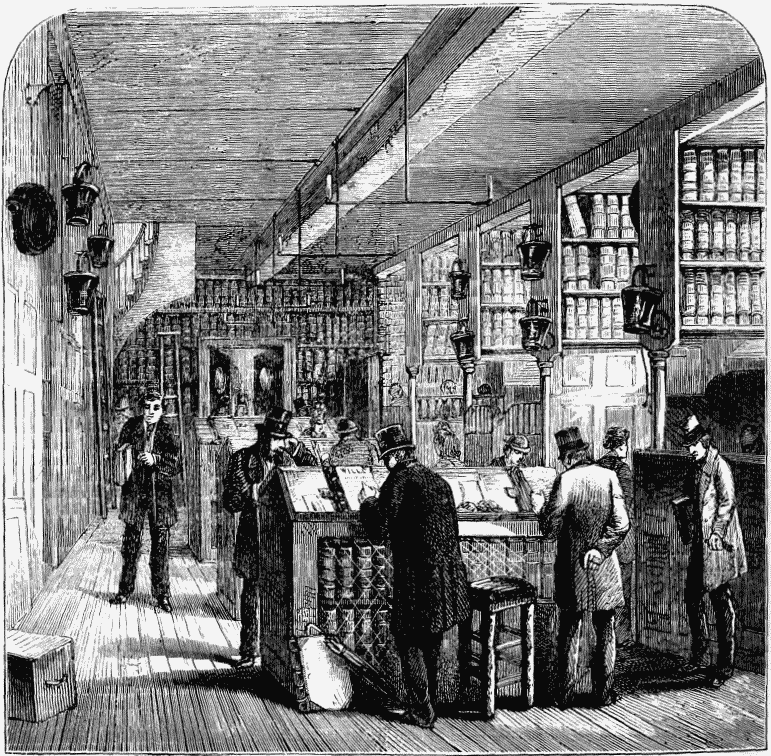
THE PREROGATIVE OFFICE, DOCTORS' COMMONS.
As the law once stood, says a writer in Knight's "London," if a person died possessed of property lying entirely within the diocese where he died, probate or proof of the will is made, or administration taken out, before the bishop or ordinary of that diocese; but if there were goods and chattels only to the amount of £5 (except in the diocese of London, where the amount is £10)—in legal parlance, bona notabilia—within any other diocese, and which is generally the case, then the jurisdiction lies in the Prerogative Court of the Archbishop of the province—that is, either at York or at Doctors' Commons; the latter, we need hardly say, being the Court of the Archbishop of Canterbury. The two Prerogative Courts therefore engross the great proportion of the business of this kind through the country, for although the Ecclesiastical Courts have no power over the bequests of or succession to unmixed real property, if such were left, cases of that nature seldom or never occur. And, as between the two provinces, not only is that of Canterbury much more important and extensive, but since the introduction of the funding system, and the extensive diffusion of such property, nearly all wills of importance belonging even to the Province of York are also proved in Doctors' Commons, on account of the rule of the Bank of England to acknowledge no probate of wills but from thence. To this cause, amongst others, may be attributed the striking fact that the business of this court between the three years ending with 1789, and the three years ending with 1829, had been doubled. Of the vast number of persons affected, or at least interested in this business, we see not only from the crowded rooms, but also from the statement given in the report of the select committee on the Admiralty and other Courts of Doctors' Commons in 1833, where it appears that in one year (1829) the number of searches amounted to 30,000. In the same year extracts were taken from wills in 6,414 cases.
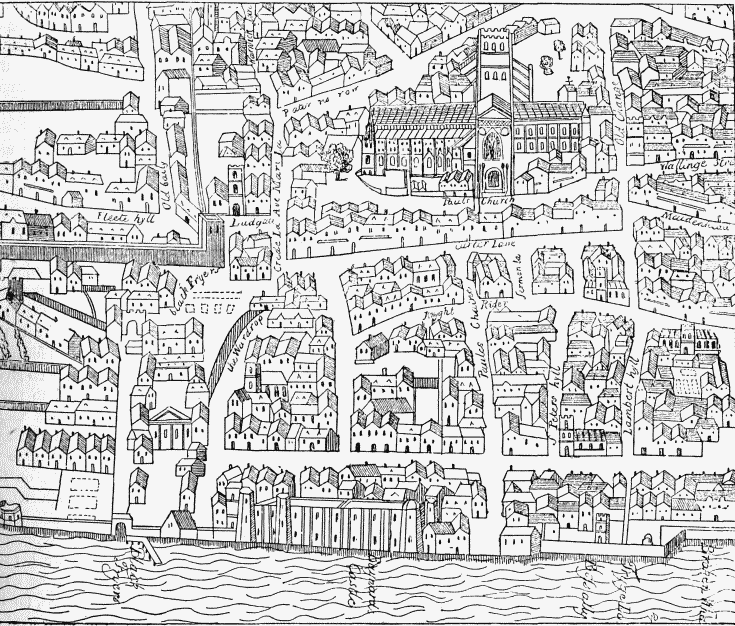
ST. PAUL'S AND NEIGHBOURHOOD. (From Aggas' Plan, 1563.)
On the south side is the entry to the Prerogative Court, and at No. 10 the Faculty Office. They have no marriage licences at the Faculty Office of an earlier date than October, 1632, and up to 1695 they are only imperfectly preserved. There is a MS. index to the licences prior to 1695, for which the charge for a search is 4s. 6d. Since 1695 the licences have been regularly kept, and the fee for searching is a shilling.
The great Admiralty judge of the early part of this century was Dr. Johnson's friend, Lord Stowell, the brother of Lord Eldon.
According to Sir Herbert Jenner Fust, Lord Stowell's decisions during the war have since formed a code of international law, almost universally recognised. In one year alone (1806) he pronounced 2,206 decrees. Lord Stowell (then Dr. Scott) was made Advocate-General in Doctors' Commons in 1788, and Vicar-General or official principal for the Archbishop of Canterbury. Soon after he became Master of the Faculties, and in 1798 was nominated Judge of the High Court of Admiralty, the highest dignity of the Doctors' Commons Courts. During the great French war, it is said Dr. Scott sometimes received as much as £1,000 a case for fees and perquisites in a prize cause. He left at his death personal property exceeding £200,000. He used to say that he admired above all other investments "the sweet simplicity of the Three per Cents.," and when purchasing estate after estate, observed "he liked plenty of elbow-room."
"It was," says Warton, "by visiting Sir Robert Chambers, when a fellow of University, that Johnson became acquainted with Lord Stowell; and when Chambers went to India, Lord Stowell, as he expressed it to me, seemed to succeed to his place in Johnson's friendship."
"Sir William Scott (Lord Stowell)," says Boswell, "told me that when he complained of a headache in the post-chaise, as they were travelling together to Scotland, Johnson treated him in a rough manner—' At your age, sir, I had no headache.'
"Mr. Scott's amiable manners and attachment to our Socrates," says Boswell in Edinburgh, "at once united me to him. He told me that before I came in the doctor had unluckily had a bad specimen of Scottish cleanliness. He then drank no fermented liquor. He asked to have his lemonade made sweeter; upon which the waiter, with his greasy fingers, lifted a lump of sugar and put it into it. The doctor, in indignation, threw it out. Scott said he was afraid he would have knocked the waiter down."
Again Boswell says:—" We dined together with Mr. Scott, now Sir William Scott, his Majesty's Advocate-General, at his chambers in the Temple—nobody else there. The company being so small, Johnson was not in such high spirits as he had been the preceding day, and for a considerable time little was said. At last he burst forth—'Subordination is sadly broken down in this age. No man, now, has the same authority which his father had—except a gaoler. No master has it over his servants; it is diminished in our colleges; nay, in our grammar schools.'"
"Sir William Scott informs me that on the death of the late Lord Lichfield, who was Chancellor of the University of Oxford, he said to Johnson, 'What a pity it is, sir, that you did not follow the profession of the law! You might have been Lord Chancellor of Great Britain, and attained to the dignity of the peerage; and now that the title of Lichfield, your native city, is extinct, you might have had it.' Johnson upon this seemed much agitated, and in an angry tone exclaimed, 'Why will you vex me by suggesting this when it is too late?'"
The strange marriage of Lord Stowell and the Marchioness of Sligo has been excellently described by Mr. Jeaffreson in his "Book of Lawyers."
"On April 10, 1813," says our author, "the decorous Sir William Scott, and Louisa Catherine, widow of John, Marquis of Sligo, and daughter of Admiral Lord Howe, were united in the bonds of holy wedlock, to the infinite amusement of the world of fashion, and to the speedy humiliation of the bridegroom. So incensed was Lord Eldon at his brother's folly that he refused to appear at the wedding; and certainly the chancellor's displeasure was not without reason, for the notorious absurdity of the affair brought ridicule on the whole of the Scott family connection. The happy couple met for the first time in the Old Bailey, when Sir William Scott and Lord Ellenborough presided at the trial of the marchioness's son, the young Marquis of Sligo, who had incurred the anger of the law by luring into his yacht, in Mediterranean waters, two of the king's seamen. Throughout the hearing of that cause célèbre, the Marchioness sat in the fetid court of the Old Bailey, in the hope that her presence might rouse amongst the jury or in the bench feelings favourable to her son. This hope was disappointed. The verdict having been given against the young peer, he was ordered to pay a fine of £5,000, and undergo four months' incarceration in Newgate, and—worse than fine and imprisonment — was compelled to listen to a parental address, from Sir William Scott, on the duties and responsibilities of men of high station. Either under the influence of sincere admiration for the judge, or impelled by desire of vengeance on the man who had presumed to lecture her son in a court of justice, the marchioness wrote a few hasty words of thanks to Sir William Scott, for his salutary exhortation to her boy. She even went so far as to say that she wished the erring marquis could always have so wise a counsellor at his side. This communication was made upon a slip of paper, which the writer sent to the judge by an usher of the court. Sir William read the note as he sat on the bench, and having looked towards the fair scribe, he received from her a glance and a smile that were fruitful of much misery to him. Within four months the courteous Sir William Scott was tied fast to a beautiful, shrill, voluble termagant, who exercised marvellous ingenuity in rendering him wretched and contemptible. Reared in a stately school of old-world politeness, the unhappy man was a model of decorum and urbanity. He took reasonable pride in the perfection of his tone and manner, and the marchioness—whose malice did not lack cleverness—was never more happy than when she was gravely expostulating with him, in the presence of numerous auditors, on his lamentable want of style and gentlemanlike bearing. It is said that, like Coke and Holt under similar circumstances, Sir William preferred the quietude of his chambers to the society of an unruly wife, and that in the cellar of his inn he sought compensation for the indignities and sufferings which he endured at home."
"Sir William Scott," says Mr. Surtees, then "removed from Doctors' Commons to his wife's house in Grafton Street, and, ever economical in his domestic expenses, brought with him his own doorplate, and placed it under the pre-existing plate of Lady Sligo, instead of getting a new door-plate for them both. Immediately after the marriage, Mr. Jekyll, so well known in the earliest part of this century for his puns and humour, happening to observe the position of these plates, condoled with Sir William on having to 'knock under.' There was too much truth in the joke for it to be inwardly relished, and Sir William ordered the plates to be transposed. A few weeks later Jekyll accompanied his friend Scott as far as the door, when the latter observed, 'You see I don't knock under now.' 'Not now,' was the answer received by the antiquated bridegroom; 'now you knock up.'"
There is a good story current of Lord Stowell in Newcastle, that, when advanced in age and rank, he visited the school of his boyhood. An old woman, whose business was to clean out and keep the key of the school-room, conducted him. She knew the name and station of the personage whom she accompanied. She naturally expected some recompense—half-a-crown perhaps—perhaps, since he was so great a man, five shillings. But he lingered over the books, and asked a thousand questions about the fate of his old school-fellows; and as he talked her expectation rose—half-a-guinea—a guinea—nay, possibly (since she had been so long connected with the school in which the great man took so deep an interest) some little annuity! He wished her good-bye kindly, called her a good woman, and slipped a piece of money into her hand—it was a sixpence!
"Lord Stowell," says Mr. Surtees, "was a great eater. As Lord Eldon had for his favourite dish liver and bacon, so his brother had a favourite quite as homely, with which his intimate friends, when he dined with them, would treat him. It was a rich pie, compounded of beef steaks and layers of oysters. Yet the feats which Lord Stowell performed with the knife and fork were eclipsed by those which he would afterwards display with the bottle, and two bottles of port formed with him no uncommon potation. By wine, however, he was never, in advanced life at any rate, seen to be affected. His mode of living suited and improved his constitution, and his strength long increased with his years.
At the western end of Holborn there was a room generally let for exhibitions. At the entrance Lord Stowell presented himself, eager to see the "green monster serpent," which had lately issued cards of invitation to the public. As he was pulling out his purse to pay for his admission, a sharp but honest north-country lad, whose business it was to take the money, recognised him as an old customer, and, knowing his name, thus addressed him: "We can't take your shilling, my lord; 'tis t' old serpent, which you have seen six times before, in other colours; but ye can go in and see her." He entered, saved his money, and enjoyed his seventh visit to the "real original old sea-sarpint."
Of Lord Stowell it has been said by Lord Brougham that "his vast superiority was apparent when, as from an eminence, he was called to survey the whole field of dispute, and to unravel the variegated facts, disentangle the intricate mazes, and array the conflicting reasons, which were calculated to distract or suspend men's judgment." And Brougham adds that "if ever the praise of being luminous could be bestowed upon human compositions, it was upon his."
It would be impossible with the space at our command to give anything like a tithe of the good stories of this celebrated judge. We must pass on to other famous men who have sat on the judicial bench in Doctors' Commons.
Of Sir Herbert Jenner Fust, one of the great ecclesiastical judges of modern times, Mr. Jeaffreson tells a good story:—
"In old Sir Herbert's later days it was no mere pleasantry, or bold figure of speech, to say that the court had risen, for he used to be lifted from his chair and carried bodily from the chamber of justice by two brawny footmen. Of course, as soon as the judge was about to be elevated by his bearers, the bar rose; and, also as a matter of course, the bar continued to stand until the strong porters had conveyed their weighty and venerable burden along the platform behind one of the rows of advocates and out of sight. As the trio worked their laborious way along the platform, there seemed to be some danger that they might blunder and fall through one of the windows into the space behind the court; and at a time when Sir Herbert and Dr. — were at open variance, that waspish advocate had, on one occasion, the bad taste to keep his seat at the rising of the court, and with characteristic malevolence of expression say to the footmen, 'Mind, my men, and take care of that judge of yours; or, by Jove, you'll pitch him out of the window.' It is needless to say that this brutal speech did not raise the speaker in the opinion of the hearers."
Dr. Lushington, recently deceased, aged ninetyone, is another ecclesiastical judge deserving notice. He entered Parliament in 1807, and retired in 1841. He began his political career when the Portland Administration (Perceval, Castlereagh, and Canning) ruled, and was always a steadfast reformer through good and evil report. He was one of the counsel for Queen Caroline, and aided Brougham and Denman in the popular triumph. He worked hard against slavery and for Parliamentary reform, and had not only heard many of Sir Robert Peel and Lord John Russell's earliest speeches, but also those of Mr. Gladstone and Mr. Disraeli. "Though it seemed," says the Daily News, "a little incongruous that questions of faith and ritual in the Church, and those of seizures or accidents at sea, should be adjudicated on by the same person, it was always felt that his decisions were based on ample knowledge of the law and diligent attention to the special circumstances of the individual case. As Dean of Arches he was called to pronounce judgment in some of the most exciting ecclesiastical suits of modern times. When the first prosecutions were directed against the Ritualistic innovators, as they were then called, of St. Barnabas, both sides congratulated themselves that the judgment would be given by so venerable and experienced a judge; and perhaps the dissatisfaction of both sides with the judgment proved its justice. In the prosecution of the Rev. H. B. Wilson and Dr. Rowland Williams, Dr. Lushington again pronounced a judgment which, contrary to popular expectation, was reversed on appeal by the Judicial Committee of the Privy Council."
But how can we leave Doctors' Commons without remembering—as we see the touters for licences, who look like half pie-men, half watermen—Sam Weller's inimitable description of the trap into which his father fell?
"Paul's Church-yard, sir," says Sam to Jingle; "a low archway on the carriage-side; bookseller's at one corner, hot-el on the other, and two porters in the middle as touts for licences."
"Touts for licences!" said the gentleman.
"Touts for licences," replied Sam. "Two coves in white aprons, touches their hats when you walk in—'Licence, sir, licence?' Queer sort them, and their mas'rs, too, sir—Old Bailey proctors—and no mistake."
"What do they do?" inquired the gentleman.
"Do! you, sir! That ain't the worst on't, neither. They puts things into old gen'lm'n's heads as they never dreamed of. My father, sir, was a coachman, a widower he wos, and fat enough for anything—uncommon fat, to be sure. His missus dies, and leaves him four hundred pound. Down he goes to the Commons to see the lawyer, and draw the blunt—very smart—top-boots on—nosegay in his button-hole—broad-brimmed tile—green shawl—quite the gen'lm'n. Goes through the archway, thinking how he should inwest the money; up comes the touter, touches his hat—'Licence, sir, licence?' 'What's that?' says my father. 'Licence, sir,' says he. 'What licence,' says my father. 'Marriage licence,' says the touter. 'Dash my weskit,' says my father, 'I never thought o' that.' 'I thinks you want one, sir,' says the touter. My father pulls up and thinks a bit. 'No,' says he, 'damme, I'm too old, b'sides I'm a many sizes too large,' says he. 'Not a bit on it, sir,' says the touter. 'Think not?' says my father. 'I'm sure not,' says he; 'we married a gen'lm'n twice your size last Monday.' 'Did you, though?' said my father. 'To be sure we did,' says the touter, 'you're a babby to him—this way, sir—this way!' And sure enough my father walks arter him, like a tame monkey behind a horgan, into a little back office, vere a feller sat among dirty papers, and tin boxes, making believe he was busy. 'Pray take a seat, vile I makes out the affidavit, sir,' says the lawyer. 'Thankee, sir,' says my father, and down he sat, and started with all his eyes, and his mouth wide open, at the names on the boxes. 'What's your name, sir?' says the lawyer. 'Tony Weller,' says my father. 'Parish?' says the lawyer. 'Belle Savage,' says my father; for he stopped there wen he drove up, and he know'd nothing about parishes, he didn't. 'And what's the lady's name?' says the lawyer. My father was struck all of a heap. 'Blessed if I know,' says he. 'Not know!' says the lawyer. 'No more nor you do,' says my father; 'can't I put that in arterwards?' 'Impossible!' says the lawyer. 'Wery well,' says my father, after he'd thought a moment, 'put down Mrs. Clarke.' 'What Clarke?' says the lawyer, dipping his pen in the ink. 'Susan Clarke, Markis o' Granby, Dorking,' says my father; 'she'll have me if I ask, I dessay—I never said nothing to her; but she'll have me, I know.' The licence was made out, and she did have him, and what's more she's got him now; and I never had any of the four hundred pound, worse luck. Beg your pardon, sir," said Sam, when he had concluded, "but when I gets on this here grievance, I runs on like a new barrow with the wheel greased."
Doctors' Commons is now a ruin. The spider builds where the proctor once wove his sticky web. The college, rebuilt after the Great Fire, is described by Elmes as an old brick building in the Carolean style, the interior consisting of two quadrangles once occupied by the doctors, a hall for the hearing of causes, a spacious library, a refectory, and other useful apartments. In 1867, when Doctors' Commons was deserted by the proctors, a clever London essayist sketched the ruins very graphically, at the time when the Metropolitan Fire Brigade occupied the lawyers' deserted town:—
"A deserted justice-hall, with dirty mouldering walls, broken doors and windows, shattered floor, and crumbling ceiling. The dust and fog of longforgotten causes lowering everywhere, making the small leaden-framed panes of glass opaque, the dark wainscot grey, coating the dark rafters with a heavy dingy fur, and lading the atmosphere with a close unwholesome smell. Time and neglect have made the once-white ceiling like a huge map, in which black and swollen rivers and tangled mountain ranges are struggling for pre-eminence. Melancholy, decay, and desolation are on all sides. The holy of holies, where the profane vulgar could not tread, but which was sacred to the venerable gowned figures who cozily took it in turns to dispense justice and to plead, is now open to any passer-by. Where the public were permitted to listen is bare and shabby as a well-plucked client. The inner door of long-discoloured baize flaps listlessly on its hinges, and the true law-court little entrance-box it half shuts in is a mere nest for spiders. A large red shaft, with the word 'broken' rudely scrawled on it in chalk, stands where the judgment-seat was formerly; long rows of ugly piping, like so many shiny dirty serpents, occupy the seats of honour round it; staring red vehicles, with odd brass fittings; buckets, helmets, axes, and old uniforms fill up the remainder of the space. A very few years ago this was the snuggest little law-nest in the world; now it is a hospital and store-room for the Metropolitan Fire Brigade. For we are in Doctors' Commons, and lawyers themselves will be startled to learn that the old Arches Court, the old Admiralty Court, the old Prerogative Court, the old Consistory Court, the old harbour for delegates, chancellors, vicars-general, commissaries, prothonotaries, cursitors, seal-keepers, serjeants-at-mace, doctors, deans, apparitors, proctors, and what not, is being applied to such useful purposes now. Let the reader leave the bustle of St. Paul's Churchyard, and, turning under the archway where a noble army of white-aproned touters formerly stood, cross Knightrider Street and enter the Commons. The square itself is a memorial of the mutability of human affairs. Its big sombre houses are closed. The well-known names of the learned doctors who formerly practised in the adjacent courts are still on the doors, but have, in each instance, 'All letters and parcels to be addressed' Belgravia, or to one of the western inns of court, as their accompaniment. The one court in which ecclesiastical, testamentary, and maritime law was tried alternately, and which, as we have seen, is now ending its days shabbily, but usefully, is through the further archway to the left. Here the smack Henry and Betsy would bring its action for salvage against the schooner Mary Jane; here a favoured gentleman was occasionally 'admitted a proctor exercent by virtue of a rescript;' here, as we learnt with awe, proceedings for divorce were 'carried on in pœnam,' and 'the learned judge, without entering into the facts, declared himself quite satisfied with the evidence, and pronounced for the separation;' and here the Dean of Peculiars settled his differences with the eccentrics who, I presume, were under his charge, and to whom he owed his title."
Such are the changes that take place in our Protean city! Already we have seen a palace in Blackfriars turn into a prison, and the old courts of Fleet Street, once mansions of the rich and great, now filled with struggling poor. The great synagogue in the Old Jewry became a tavern; the palace of the Savoy a barracks. These changes it is our special province to record, as to trace them is our peculiar function.
The Prerogative Will Office contains many last wills and testaments of great interest. There is a will written in short-hand, and one on a bed-post; but what are these to that of Shakspeare, three folio sheets, and his signature to each sheet? Why he left only his best bed to his wife long puzzled the antiquaries, but has since been explained. There is (or rather was, for it has now gone to Paris) the will of Napoleon abusing "the oligarch" Wellington, and leaving 10,000 francs to the French officer Cantello, who was accused of a desire to assassinate the "Iron Duke." There are also the wills of Vandyke the painter, who died close by; Inigo Jones, Ben Jonson's rival in the Court masques of James and Charles; Sir Isaac Newton, Dr. Johnson, good old Izaak Walton, and indeed almost everybody who had property in the south.