Old and New London: Volume 1. Originally published by Cassell, Petter & Galpin, London, 1878.
This free content was digitised by double rekeying. Public Domain.
Walter Thornbury, 'Heralds' College', in Old and New London: Volume 1(London, 1878), British History Online https://www.british-history.ac.uk/old-new-london/vol1/pp294-304 [accessed 4 May 2025].
Walter Thornbury, 'Heralds' College', in Old and New London: Volume 1(London, 1878), British History Online, accessed May 4, 2025, https://www.british-history.ac.uk/old-new-london/vol1/pp294-304.
Walter Thornbury. "Heralds' College". Old and New London: Volume 1. (London, 1878), British History Online. Web. 4 May 2025. https://www.british-history.ac.uk/old-new-london/vol1/pp294-304.
In this section
CHAPTER XXV.
HERALDS' COLLEGE.
Early Homes of the Heralds—The Constitution of the Herald's College—Garter King at Arms—Clarencieux and Norroy—The Pursuivants—Duties and Privileges of Heralds—Good, Bad, and Jovial Heralds—A Notable Norroy King at Arms—The Tragic End of Two Famous Heralds—The College of Arms' Library.
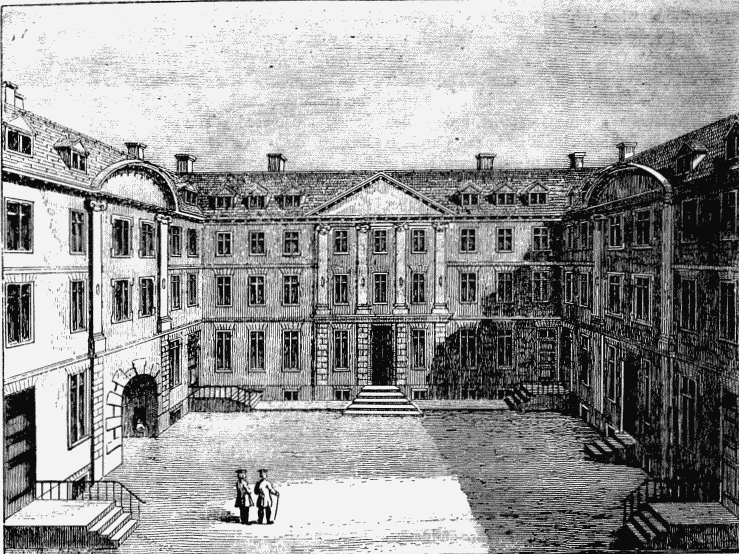
HERALD'S COLLEGE. (From an old Print.)
Turning from the black dome of St. Pauls, and the mean archway of Dean's Court, into a region of gorgeous blazonments, we come to that quiet and grave house, like an old nobleman's, that stands aside from the new street from the Embankment, like an aristocrat shrinking from a crowd. The original Heralds' College, Cold Harbour House, founded by Richard II., stood in Poultney Lane, but the heralds were turned out by Henry VII., who gave their mansion to Bishop Tunstal, whom he had driven from Durham Place. The heralds then retired to Ronceval Priory, at Charing Cross (afterwards Northumberland Place). Queen Mary, however, in 1555 gave Gilbert Dethick, Garter King of Arms, and the other heralds and pursuivants, their present college, formerly Derby House, which had belonged to the first Earl of Derby, who married Lady Margaret, Countess of Richmond, mother to King Henry VII. The grant specified that there the heralds might dwell together, and "at meet times congregate, speak, confer, and agree among themselves, for the good government of the faculty."
The College of Arms, on the east side of St. Bennet's Hill, was swept before the Great Fire of 1666; but all the records and books, except one or two, were preserved. The estimate for the rebuilding was only £5,000, but the City being drained of money, it was attempted to raise the money by subscription; only £700 was so raised, the rest was paid from office fees, Sir William Dugdale building the north-west corner at his own charge, and Sir Henry St. George, Clarencieux, giving £530. This handsome and dignified brick building, completed in 1683, is ornamented with Ionic pilasters, that support an angular pediment, and the "hollow arch of the gateway" was formerly considered a curiosity. The central wainscoted hall is where the Courts of Sessions were at one time held; to the left is the library and search-room, round the top of which runs a gallery; on either side are the apartments of the kings, heralds, and pursuivants.
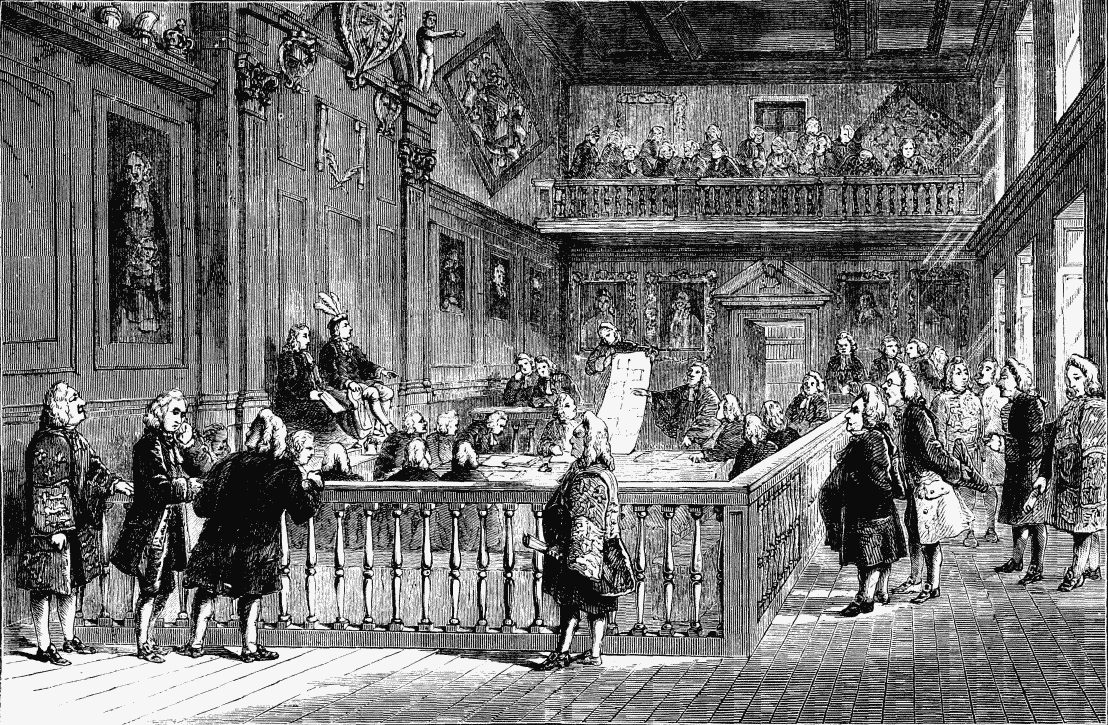
THE LAST HERALDIC COURT. (From an Old Picture in the Heralds' College; the Figures by Rowlandson, Architecture by Wash.)
"This corporation," we are told, "consists of thirteen members—viz., three kings at arms, six heralds at arms, and four pursuivants at arms; they are nominated by the Earl Marshal of England, as ministers subordinate to him in the execution of their offices, and hold their places patent during their good behaviour. They are thus distinguished:—
| Kings at Arms. | Heralds. | Pursuivants. |
| Garter. | Somerset. | Rouge Dragon. |
| Clarencieux. | Richmond. | Blue Mantle. |
| Norroy. | Lancaster. | Portcullis. |
| Windsor. | Rouge Croix. | |
| Chester. | ||
| York. | ||
"However ancient the offices of heralds may be, we have hardly any memory of their titles or names before Edward III. In his reign military glory and heraldry were in high esteem, and the patents of the King of Arms at this day refer to the reign of King Edward III. The king created the two provincials, by the titles of Clarencieux and Norroy; he instituted Windsor and Chester heralds, and Blue Mantle pursuivant, beside several others by foreign titles. From this time we find the officers of arms employed at home and abroad, both in military and civil affairs: military, with our kings and generals in the army, carrying defiances and making truces, or attending tilts, tournaments, and duels; as civil officers, in negotiations, and attending our ambassadors in foreign Courts; at home, waiting upon the king at Court and Parliament, and directing public ceremonies.
"In the fifth year of King Henry V. armorial bearings were put under regulations, and it was declared that no persons should bear coat arms that could not justify their right thereto by prescription or grant; and from this time they were communicated to persons as insignia, gentilitia, and hereditary marks of noblesse. About the same time, or soon after, this victorious prince instituted the office of Garter King of Arms; and at a Chapter of the Kings and Heralds, held at the siege of Rouen in Normandy, on the 5th of January, 1420, they formed themselves into a regular society, with a common seal, receiving Garter as their chief.
"The office of Garter King at Arms was instituted for the service of the Most Noble Order of the Garter; and, for the dignity of that order, he was made sovereign within the office of arms, over all the other officers, subject to the Crown of England, by the name of Garter King at Arms of England. By the constitution of his office he must be a native of England, and a gentleman bearing arms. To him belongs the correction of arms, and all ensigns of arms, usurped or borne unjustly, and the power of granting arms to deserving persons, and supporters to the nobility and Knights of the Bath. It is likewise his office to go next before the sword in solemn processions, none interposing except the marshal; to administer the oath to all the officers of arms; to have a habit like the registrar of the order, baron's service in the Court, lodgings in Windsor Castle; to bear his white rod, with a banner of the ensigns of the order thereon, before the sovereign; also, when any lord shall enter the Parliament chamber, to assign him his place, according to his degree; to carry the ensigns of the order to foreign princes, and to do, or procure to be done, what the sovereign shall enjoin relating to the order, with other duties incident to his office of principal King of Arms. The other two kings are called Provincial kings, who have particular provinces assigned them, which together comprise the whole kingdom of England—that of Clarencieux comprehending all from the river Trent southwards; that of Norroy, or North Roy, all from the river Trent northward. These Kings at Arms are distinguished from each other by their respective badges, which they may wear at all times, either in a gold chain or a ribbon, Garters being blue, and the Provincials purple.
"The six heralds take place according to seniority in office. They are created with the same ceremonies as the kings, taking the oath of an herald, and are invested with a tabard of the Royal arms embroidered upon satin, not so rich as the kings', but better than the pursuivants', with a silver collar of SS.; they are esquires by creation.
"The four pursuivants are also created by the Duke of Norfolk, the Earl Marshal, when they take their oath of a pursuivant, and are invested with a tabard of the Royal arms upon damask. It is the duty of the heralds and pursuivants to attend on the public ceremonials, one of each class together by a monthly rotation.
"These heralds are the king's servants in ordinary, and therefore, in the vacancy of the office of Earl Marshal, have been sworn into their offices by the Lord Chamberlain. Their meetings are termed Chapters, which they hold the first Thursday in every month, or oftener if necessary, wherein all matters are determined by a majority of voices, each king having two voices."
One of the earliest instances of the holding an heraldic court was that in the time of Richard II., when the Scropes and Grosvenors had a dispute about the right to bear certain arms. John of Gaunt and Chaucer were witnesses on this occasion; the latter, who had served in France during the wars of Edward III., and had been taken prisoner, deposing to seeing a certain cognizance displayed during a certain period of the campaign.
The system of heraldic visitations, when the pedigrees of the local gentry were tested, and the arms they bore approved or cancelled, originated in the reign of Henry VIII. The monasteries, with their tombs and tablets and brasses, and their excellent libraries, had been the great repositories of the provincial genealogies, more especially of the abbeys' founders and benefactors. These records were collected and used by the heralds, who thus as it were preserved and carried on the monastic genealogical traditions. These visitations were of great use to noble families in proving their pedigrees, and preventing disputes about property. The visitations continued till 1686 (James II.), but a few returns, says Mr. Noble, were made as late as 1704. Why they ceased in the reign of William of Orange is not known; perhaps the respect for feudal rank decreased as the new dynasty grew more powerful. The result of the cessation of these heraldic assizes, however, is that American gentlemen, whose Puritan ancestors left England during the persecutions of Charles II., are now unable to trace their descent, and the heraldic gap can never be filled up.
Three instances only of the degradation of knights are recorded in three centuries' records of the Court of Honour. The first was that of Sir Andrew Barclay, in 1322; of Sir Ralph Grey, in 1464; and of Sir Francis Michell, in 1621, the last knight being convicted of heinous offences and misdemeanours. On this last occasion the Knights' Marshals' men cut off the offender's sword, took off his spurs and flung them away, and broke his sword over his head, at the same time proclaiming him "an infamous arrant knave."
The Earl Marshal's office—sometimes called the Court of Honour—took cognizance of words supposed to reflect upon the nobility. Sir Richard Grenville was fined heavily for having said that the Duke of Suffolk was a base lord; and Sir George Markham in the enormous sum of £10,000, for saying, when he had horsewhipped the huntsman of Lord Darcy, that he would do the same to his master if he tried to justify his insolence. In 1622 the legality of the court was tried in the Star Chamber by a contumacious herald, who claimed arrears of fees, and to King James's delight the legality of the court was fully established. In 1646 (Charles I.) Mr. Hyde (afterwards Lord Chancellor Clarendon) proposed doing away with the court, vexatious causes multiplying, and very arbitrary authority being exercised. He particularly cited a case of great oppression, in which a rich citizen had been ruined in his estate and imprisoned, for merely calling an heraldic swan a goose. After the Restoration, says Mr. Planché, in Knight's "London," the Duke of Norfolk, hereditary Earl Marshal, hoping to re-establish the court, employed Dr. Plott, the learned but credulous historian of Staffordshire, to collect the materials for a history of the court, which, however, was never completed. The court, which had outlived its age, fell into desuetude, and the last cause heard concerning the right of bearing arms (Blount versus Blunt) was tried in the year 1720 (George I.). In the old arbitrary times the Earl Marshal's men have been known to stop the carriage of a parvenu, and by force deface his illegally assumed arms.
Heralds' fees in the Middle Ages were very high. At the coronation of Richard II. they received £100, and 100 marks at that of the queen. On royal birthdays and on great festivals they also required largess. The natural result of this was that, in the reign of Henry V., William Burgess, Garter King of Arms, was able to entertain the Emperor Sigismund in sumptuous state at his house at Kentish Town.
The escutcheons on the south wall of the college—one bearing the legs of Man, and the other the eagle's claw of the House of Stanley—are not ancient, and were merely put up to heraldically mark the site of old Derby House.
In the Rev. Mark Noble's elaborate "History of the College of Arms" we find some curious stories of worthy and unworthy heralds. Among the evil spirits was Sir William Dethick, Garter King at Arms, who provoked Elizabeth by drawing out treasonable emblazonments for the Duke of Norfolk, and James I. by hinting doubts, as it is supposed, against the right of the Stuarts to the crown. He was at length displaced. He seems to have been an arrogant, stormy, proud man, who used at public ceremonials to buffet the heralds and pursuivants who blundered or offended him. He was buried at St. Paul's, in 1612, near the grave of Edward III.'s herald, Sir Pain Roet, Guienne King at Arms, and Chaucer's father-in-law. Another black sheep was Cook, Clarencieux King at Arms in the reign of Queen Elizabeth, who was accused of granting arms to any one for a large fee, and of stealing forty or fifty heraldic books from the college library. There was also Ralph Brooke, York Herald in the same reign, a malicious and ignorant man, who attempted to confute some of Camden's genealogies in the "Britannia." He broke open and stole some muniments from the office, and finally, for two felonies, was burnt in the hand at Newgate.
To such rascals we must oppose men of talent and scholarship like the great Camden. This grave and learned antiquary was the son of a painter in the Old Bailey, and, as second master of Westminster School, became known to the wisest and most learned men of London, Ben Jonson honouring him as a father, and Burleigh, Bacon, and Lord Broke regarding him as a friend. His "Britannia" is invaluable, and his "Annals of Elizabeth" are full of the heroic and soaring spirit of that great age. Camden's house, at Chislehurst, was that in which the Emperor Napoleon has recently died.
Sir William Le Neve (Charles I.), Clarencieux, was another most learned herald. He is said to have read the king's proclamation at Edgehill with great marks of fear. His estate was sequestered by the Parliament, and he afterwards went mad from loyal and private grief and vexation. In Charles II.'s reign we find the famous antiquary, Elias Ashmole, Windsor Herald for several years. He was the son of a Lichfield saddler, and was brought up as a chorister-boy. That impostor, Lilly, calls him the "greatest virtuoso and curioso" that was ever known or read of in England; for he excelled in music, botany, chemistry, heraldry, astrology, and antiquities. His "History of the Order of the Garter" formed no doubt part of his studies at the College of Arms.
In the same reign as Ashmole, that great and laborious antiquary, Sir William Dugdale, was Garter King of Arms. In early life he became acquainted with Spelman, an antiquary as profound as himself, and with the same mediæval power of work. He fought for King Charles in the Civil Wars. His great work was the "Monasticon Anglicanum," three volumes folio, which disgusted the Puritans and delighted the Catholics. His "History of Warwickshire" was considered a model of county histories, His "Baronage of England" contained many errors. In his visitations he was very severe in defacing fictitious arms.
Francis Sandford, first Rouge Dragon Pursuivant, and then Lancaster Herald (Charles II., James II.), published an excellent "Genealogical History of England," and curious accounts of the funeral of General Monk and the coronation of James II. He was so attached to James that he resigned his office at the Revolution, and died, true to the last, old, poor, and neglected, somewhere in Bloomsbury, in 1693.
Sir John Vanbrugh, the witty dramatist, for building Castle Howard, was made Clarencieux King of Arms, to the great indignation of the heralds, whose pedantry he ridiculed. He afterwards sold his place for £2,000, avowing ignorance of his profession and his constant neglect of his official duties.
In the same reign, to Peter Le Neve (Norroy) we are indebted for the careful preservation of the invaluable "Paxton Letters," of the reigns of Henry VI., Edward IV., and Richard III., purchased and afterwards published by Sir John Fenn.
Another eminent herald was John Anstis, created Garter in 1718 (George I.), after being imprisoned as a Jacobite. He wrote learned works on the Orders of the Garter and the Bath, and left behind him valuable materials—his MS. for the "History of the College of Arms," now preserved in the library.
Francis Grose, that roundabout, jovial friend of Burns, was Richmond Herald for many years, but he resigned his appointment in 1763, to become Adjutant and Paymaster of the Hampshire Militia. Grose was the son of a Swiss jeweller, who had settled in London. His "Views of Antiquities in England and Wales" helped to restore a taste for Gothic art. He died in 1791.
Of Oldys, that eccentric antiquary, who was Norroy King at Arms in the reign of George II.—the Duke of Norfolk having appointed him from the pleasure he felt at the perusal of his "Life of Sir Walter Raleigh"—Grose gives an amusing account:—
"William Oldys, Norroy King at Arms," says Grose, "author of the 'Life of Sir Walter Raleigh,' and several others in the 'Biographia Britannica,' was natural son of a Dr. Oldys, in the Commons, who kept his mother very privately, and probably very meanly, as when he dined at a tavern he used to beg leave to send home part of the remains of any fish or fowl for his cat, which cat was afterwards found out to be Mr. Oldys' mother. His parents dying when he was very young, he soon squandered away his small patrimony, when he became first an attendant in Lord Oxford's library and afterwards librarian. He was a little meanlooking man, of a vulgar address, and, when I knew him, rarely sober in the afternoon, never after supper. His favourite liquor was porter, with a glass of gin between each pot. Dr. Ducarrel told me he used to stint Oldys to three pots of beer whenever he visited him. Oldys seemed to have little classical learning, and knew nothing of the sciences; but for index-reading, title-pages, and the knowledge of scarce English books and editions, he had no equal. This he had probably picked up in Lord Oxford's service, after whose death he was obliged to write for the booksellers for a subsistence. Amongst many other publications, chiefly in the biographical line, he wrote the 'Life of Sir Walter Raleigh,' which got him much reputation. The Duke of Norfolk, in particular, was so pleased with it that he resolved to provide for him, and accordingly gave him the patent of Norroy King at Arms, then vacant. The patronage of that duke occasioned a suspicion of his being a Papist, though I really think without reason; this for a while retarded his appointment. It was underhand propagated by the heralds, who were vexed at having a stranger put in upon them. He was a man of great good-nature, honour, and integrity, particularly in his character as an historian. Nothing, I firmly believe, would ever have biassed him to insert any fact in his writings he did not believe, or to suppress any he did. Of this delicacy he gave an instance at a time when he was in great distress. After the publication of his 'Life of Sir Walter Raleigh,' some booksellers, thinking his name would sell a piece they were publishing, offered him a considerable sum to father it, which he refused with the greatest indignation. He was much addicted to low company; most of his evenings he spent at the 'Bell' in the Old Bailey, a house within the liberties of the Fleet, frequented by persons whom he jocularly called rulers, from their being confined to the rules or limits of that prison. From this house a watchman, whom he kept regularly in pay, used to lead him home before twelve o'clock, in order to save sixpence paid to the porter of the Heralds' office, by all those who came home after that time; sometimes, and not unfrequently, two were necessary. He could not resist the temptation of liquor, even when he was to officiate on solemn occasions; for at the burial of the Princess Caroline he was so intoxicated that he could scarcely walk, but reeled about with a crown 'coronet' on a cushion, to the great scandal of his brethren. His method of composing was somewhat singular. He had a number of small parchment bags inscribed with the names of the persons whose lives he intended to write; into these bags he put every circumstance and anecdote he could collect, and from thence drew up his history. By his excesses he was kept poor, so that he was frequently in distress; and at his death, which happened about five on Wednesday morning, April 15th, 1761, he left little more than was sufficient to bury him. Dr. Taylor, the oculist, son of the famous doctor of that name and profession, claimed administration at the Commons, on account of his being nullius filius—Anglicè, a bastard. He was buried the 19th following, in the north aisle of the Church of St. Benet, Paul's Wharf, towards the upper end of the aisle. He was about seventytwo years old. Amongst his works is a preface to Izaak Walton's 'Angler.'"
The following pretty anacreontic, on a fly drinking out of his cup of ale, which is doubtless well
known, is from the pen of Oldys:—
"Busy, curious, thirsty fly,
Drink with me, and drink as I;
Freely welcome to my cup,
Couldst thou sip and sip it up.
Make the most of life you may;
Life is short, and wears away.
"Both alike are mine and thine,
Hastening quick to their decline;
Thine's a summer, mine no more,
Though repeated to threescore;
Threescore summers, when they're gone,
Will appear as short as one."
The Rev. Mark Noble comments upon Grose's text by saying that this story of the crown must be incorrect, as the coronet at the funeral of a princess is always carried by Clarencieux, and not by Norroy.
In 1794, two eminent heralds, Benjamin Pingo, York Herald, and John Charles Brooke, Somerset Herald, were crushed to death in a crowd at the side door of the Haymarket Theatre. Mr. Brooke had died standing, and was found as if asleep, and with colour still in his cheeks.
Edmund Lodge, Lancaster Herald, who died in 1839, is chiefly known for his interesting series of "Portraits of Illustrious British Personages," accompanied by excellent genealogical and biographical memoirs.
During the Middle Ages heralds were employed to bear letters, defiances, and treaties to foreign princes and persons in authority; to proclaim war, and bear offers of marriage, &c.; and after battles to catalogue the dead, and note their rank by the heraldic bearings on their banners, shields, and tabards. In later times they were allowed to correct false crests, arms, and cognizances, and register noble descents in their archives. They conferred arms on those who proved themselves able to maintain the state of a gentleman, they marshalled great or rich men's funerals, arranged armorial bearings for tombs and stained-glass windows, and laid down the laws of precedence at state ceremonials. Arms, it appears from Mr. Planché, were sold to the "new rich" as early as the reign of King Henry VIII., who wished to make a new race of gentry, in order to lessen the power of the old nobles. The fees varied then from £6 13s. 6d. to £5.
In the old times the heralds' messengers were called knights caligate. After seven years they became knight-riders (our modern Queen's messengers); after seven years more they became pursuivants, and then heralds. In later times, says Mr. Planché, the herald's honourable office was transferred to nominees of the Tory nobility, discarded valets, butlers, or sons of upper servants. Mr. Canning, when Premier, very properly put a stop to this system, and appointed to this post none but young and intelligent men of manners and education.

SWORD, DAGGER, AND RING OF KING JAMES OF SCOTLAND. (Preserved in the Heralds' College.)
Among the many curious volumes of genealogy in the library of the College of Arms—volumes which have been the result of centuries of exploring and patient study—the following are chiefly noticeable:—A book of emblazonment executed for Prince Arthur, the brother of Henry VIII., who died young, and whose widow Henry married; the Warwick Roll, a series of figures of all the Earls of Warwick from the Conquest to the reign of Richard III., executed by Rouse, a celebrated antiquary of Warwick, at the close of the fifteenth century; and a tournament roll of Henry VIII., in which that stalwart monarch is depicted in regal state, with all the "pomp, pride, and circumstance of glorious (mimic) war." In the gallery over the library are to be seen the sword and dagger which belonged to the unfortunate James of Scotland, that chivalrous king who died fighting to the last on the hill at Flodden. The sword-hilt has been enamelled, and still shows traces of gilding which has once been red-wet with the Southron's blood; and the dagger is a strong and serviceable weapon, as no doubt many an English archer and billman that day felt. The heralds also show the plain turquoise ring which tradition says the French queen sent James, begging him to ride a foray in England. Copies of it have been made by the London jewellers. These trophies are heirlooms of the house of Howard, whose bend argent, to use the words of Mr. Planché, received the honourable augmentation of the Scottish lion, in testimony of the prowess displayed by the gallant soldier who commanded the English forces on that memorable occasion. Here is also to be seen a portrait of Talbot, Earl of Shrewsbury (the great warrior), from his tomb in Old St. Paul's; a curious pedigree of the Saxon kings from Adam, illustrated with many beautiful drawings in pen and ink, about the period of Henry VIII., representing the Creation, Adam and Eve in Paradise, the building of Babel, the rebuilding of the Temple, &c. &c.; MSS., consisting chiefly of heralds' visitations, records of grants of arms and royal licences; records of modern pedigrees (i.e., since the discontinuance of the visitations in 1687); a most valuable collection of official funeral certificates; a portion of the Arundel MSS.; the Shrewsbury or Cecil papers, from which Lodge derived his well-known "Illustrations of British History;" notes, &c., made by Glover, Vincent, Philpot, and Dugdale; a volume in the handwriting of the venerable Camden ("Clarencieux"); the collections of Sir Edward Walker, Secretary at War (temp. Charles I.).
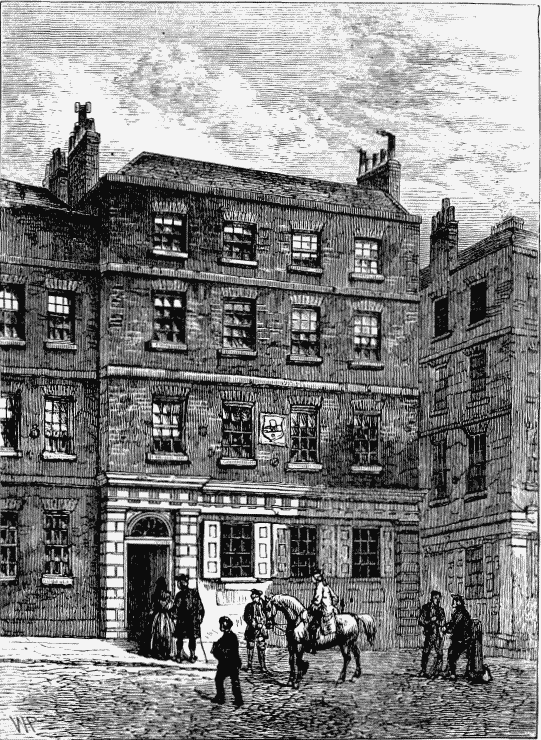
LINACRE'S HOUSE. From a Print in the "Gold-headed Cane" (see page 303).
The Wardrobe, a house long belonging to the Government, in the Blackfriars, was built by Sir John Beauchamp (died 1359), whose tomb in Old St. Paul's was usually taken for the tomb of the good Duke Humphrey. Beauchamp's executors sold it to Edward III., and it was subsequently converted into the office of the Master of the Wardrobe, and the repository for the royal clothes. When Stow drew up his "Survey," Sir John Fortescue was lodged in the house as Master of the Wardrobe. What a royal ragfair this place must have been for rummaging antiquaries, equal to twenty Madame Tussaud's and all the ragged regiments of Westminster Abbey put together!
"There were also kept," says Fuller, "in this place the ancient clothes of our English kings, which they wore on great festivals; so that this Wardrobe was in effect a library for antiquaries, therein to read the mode and fashion of garments in all ages. These King James in the beginning of his reign gave to the Earl of Dunbar, by whom they were sold, re-sold, and re-re-re-sold at as many hands almost as Briareus had, some gaining vast estates thereby." (Fuller's "Worthies.")
We mentioned before that Shakespeare in his will left to his favourite daughter, Susannah, the Warwickshire doctor's wife, a house near the Wardrobe; but the exact words of the document may be worth quoting:—
"I gyve, will, bequeath," says the poet, "and devise unto my daughter, Susannah Hall, all that messuage or tenement, with the appurtenances, wherein one John Robinson dwelleth, situat, lying, and being in the Blackfriars in London, nere the Wardrobe."
After the Great Fire the Wardrobe was removed, first to the Savoy, and afterwards to Buckingham Street, in the Strand. The last master was Ralph, Duke of Montague, on whose death, in 1709, the office, says Cunningham, was, "I believe, abolished."
Swan Alley, near the Wardrobe, reminds us of the Beauchamps, for the swan was the cognizance of the Beauchamp family, long distinguished residents in this part of London.
In the Council Register of the 18th of August, 1618, there may be seen "A List of Buildings and Foundations since 1615." It is therein said that Edward Alleyn, Esq., dwelling at Dulwich (the wellknown player and founder of Dulwich College), had built six tenements of timber upon new foundations, within two years past, in Swan Alley, near the Wardrobe."
In Great Carter Lane stood the old Bell Inn, whence, in 1598, Richard Quyney directs a letter "To my loving good friend and countryman, Mr. Wm. Shackespeare, deliver thees"—the only letter addressed to Shakespeare known to exist. The original was in the possession of Mr. R. B. Wheeler, of Stratford-upon-Avon.
Stow mixes up the old houses near Doctors' Commons with Rosamond's Bower at Woodstock.
"Upon Paul's Wharf Hill," he says, "within a great gate, next to the Doctors' Commons, were many fair tenements, which, in their leases made from the Dean and Chapter, went by the name of Camera Dianæ—i.e., Diana's Chamber, so denominated from a spacious building that in the time of Henry II. stood where they were. In this Camera, an arched and vaulted structure, full of intricate ways and windings, this Henry II. (as some time he did at Woodstock) kept, or was supposed to have kept, that jewel of his heart, Fair Rosamond, she whom there he called Rosamundi, and here by the name of Diana; and from hence had this house that title.
"For a long time there remained some evident testifications of tedious turnings and windings, as also of a passage underground from this house to Castle Baynard; which was, no doubt, the king's way from thence to his Camera Dianæ, or the chamber of his brightest Diana."
St. Anne's, within the precinct of the Blackfriars, was pulled down with the Friars Church by Sir Thomas Cawarden, Master of the Revels; but in the reign of Queen Mary, he being forced to find a church to the inhabitants, allowed them a lodging chamber above a stair, which since that time, to wit in the year 1597, fell down, and was again, by collection therefore made, new built and enlarged in the same year.
The parish register records the burials of Isaac Oliver, the miniature painter (1617), Dick Robinson, the player (1647), Nat. Field, the poet and player (1632–3), William Faithorn, the engraver (1691); and there are the following interesting entries relating to Vandyck, who lived and died in this parish, leaving a sum of money in his will to its poor:—
"Jasper Lanfranch, a Dutchman, from Sir Anthony Vandikes, buried 14th February, 1638."
"Martin Ashent, Sir Anthony Vandike's man, buried 12th March, 1638."
"Justinia, daughter to Sir Anthony Vandyke and his lady, baptised 9th December, 1641."
The child was baptised on the very day her illustrious father died.
A portion of the old burying-ground is still to be seen in Church-entry, Ireland Yard.
"In this parish of St. Benet's, in Thames Street," says Stow, "stood Le Neve Inn, belonging formerly to John de Mountague, Earl of Salisbury, and after to Sir John Beauchamp, Kt., granted to Sir Thomas Erpingham, Kt., of Erpingham in Norfolk, and Warden of the Cinque Ports, Knight of the Garter. By the south end of Adle Street, almost against Puddle Wharf, there is one antient building of stone and timber, builded by the Lords of Berkeley, and therefore called Berkeley's Inn. This house is now all in ruin, and letten out in several tenements; yet the arms of the Lord Berkeley remain in the stone-work of an arched gate; and is between a chevron, crosses ten, three, three, and four."
Richard Beauchamp, Earl of Warwick, was lodged in this house, then called Berkeley's Inn, in the parish of St. Andrew, in the reign of Henry VI.
St. Andrew's Wardrobe Church is situated upon rising ground, on the east side of PuddleDock Hill, in the ward of Castle Baynard. The advowson of this church was anciently in the noble family of Fitzwalter, to which it probably came by virtue of the office of Constable of the Castle of London (that is, Baynard's Castle). That it is not of a modern foundation is evident by its having had Robert Marsh for its rector, before the year 1322. This church was anciently denominated "St. Andrew juxta Baynard's Castle," from its vicinity to that palace.
"Knightrider Street was so called," says Stow, "(as is supposed), of knights riding from thence through the street west to Creed Lane, and so out at Ludgate towards Smithfield, when they were there to tourney, joust, or otherwise to show activities before the king and states of the realm."
Linacre's house in Knightrider Street was given by him to the College of Physicians, and used as their place of meeting till the early part of the seventeenth century.
In his student days Linacre had been patronised by Lorenzo de Medicis, and at Florence, under Demetrius Chalcondylas, who had fled from Constantinople when it was taken by the Turks, he acquired a perfect knowledge of the Greek language. He studied eloquence at Bologna, under Politian, one of the most eloquent Latinists in Europe, and while he was at Rome devoted himself to medicine and the study of natural philosophy, under Hermolaus Barbarus. Linacre was the first Englishman who read Aristotle and Galen in the original Greek. On his return to England, having taken the degree of M.D. at Oxford, he gave lectures in physic, and taught the Greek language in that university. His reputation soon became so high that King Henry VII. called him to court, and entrusted him with the care of the health and education of his son, Prince Arthur. To show the extent of his acquirements, we may mention that he instructed Princess Katharine in the Italian language, and that he published a work on mathematics, which he dedicated to his pupil, Prince Arthur.
His treatise on grammar was warmly praised by Melancthon. This great doctor was successively physician to Henry VII., Henry VIII., Edward VI., and the Princess Mary. He established lectures on physic (says Dr. Macmichael, in his amusing book, "The Gold-headed Cane"), and towards the close of his life he founded the Royal College of Physicians, holding the office of President for seven years. Linacre was a friend of Lily, the grammarian, and was consulted by Erasmus. The College of Physicians first met in 1518 at Linacre's house (now called the Stone House), Knightrider Street, and which still belongs to the society. Between the two centre windows of the first floor are the arms of the college, granted 1546—a hand proper, vested argent, issuing out of clouds, and feeling a pulse; in base, a pomegranate between five demi fleurs-de-lis bordering the edge of the escutcheon. In front of the building was a library, and there were early donations of books, globes, mathematical instruments, minerals, &c. Dissections were first permitted by Queen Elizabeth, in 1564. As soon as the first lectures were founded, in 1583, a spacious anatomical theatre was built adjoining Linacre's house, and here the great Dr. Harvey gave his first course of lectures; but about the time of the accession of Charles I. the College removed to a house of the Dean and Chapter of St. Paul's, at the bottom of Amen Corner, where they planted a botanical garden and built an anatomical theatre. During the civil wars the Parliament levied £5 a week on the College. Eventually sold by the Puritans, the house and gardens were purchased by Dr. Harvey and given to the society. The great Harvey built a museum and library at his own expense, which were opened in 1653, and Harvey, then nearly eighty, relinquished his office of Professor of Anatomy and Surgery. The garden at this time extended as far west as the Old Bailey, and as far south as St. Martin's Church. Harvey's gift consisted of a convocation room and a library, to which Selden contributed some Oriental MS., Elias Ashmole many valuable volumes, the Marquis of Dorchester £100; and Sir Theodore Mayerne, physician to four kings—viz., Henry IV. of France, James I., Charles I., and Charles II.—left his library. The old library was turned into a lecture and reception room, for such visitors as Charles II., who in 1665 attended here the anatomical prælections of Dr. Ent, whom he knighted on the occasion. This building was destroyed by the Great Fire, from which only 112 folio books were saved. The College never rebuilt its premises, and on the site were erected the houses of three residentiaries of St. Paul's. Shortly after a piece of ground was purchased in Warwick Lane, and the new building opened in 1674. A similar grant to that of Linacre's was that of Dr. Lettsom, who in the year 1773 gave the house and library in Bolt Court, which is at the present moment occupied by the Medical Society of London.
The view of Linacre's House, in Knightrider Street, which we give on page 301, is taken from a print in the "Gold-headed Cane," an amusing work to which we have already referred.