
Old and New London: Volume 1. Originally published by Cassell, Petter & Galpin, London, 1878.
This free content was digitised by double rekeying. All rights reserved.
'Cheapside: Shows and pageants', in Old and New London: Volume 1, (London, 1878) pp. 315-332. British History Online https://www.british-history.ac.uk/old-new-london/vol1/pp315-332 [accessed 24 April 2024]
In this section
CHAPTER XXVII.
CHEAPSIDE SHOWS AND PAGEANTS.
A Tournament in Cheapside—The Queen in Danger—The Street in Holiday Attire—The Earliest Civic Show on record—The Water Processions—A Lord Mayor's Show in Queen Elizabeth's Reign—Gossip about Lord Mayors' Shows—Splendid Pageants—Royal Visitors at Lord Mayor's Shows—A Grand Banquet in Guildhall—George III. and the Lord Mayor's Show—The Lord Mayor's State Coach—The Men in Armour—Sir Claudius Hunter and Elliston—Stow and the Midsummer Watch.
We do not hear much in the old chronicles of tournaments and shivered spears in Cheapside, but of gorgeous pageants much. On coronation days, and days when our kings rode from the Tower to Westminster, or from Castle Baynard eastward, Cheapside blossomed at once with flags and banners, rich tapestry hung from every window, and the very gutters ran with wine, so loyal and generous were the citizens of those early days. Costume was bright and splendid in the Middle Ages, and heraldry kept alive the habit of contrasting and mingling colours. Citizens were wealthy, and, moreover, lavish of their wealth.
In these processions and pageants, Cheapside was always the very centre of the show. There velvets and silks trailed; there jewels shone; there spearheads and axe-heads glittered; there breastplates and steel caps gleamed; there proud horses fretted; there bells clashed; there the mob clamoured; there proud, warlike, and beautiful face, showed, uncapped and unveiled, to the seething, jostling people; and there mayor and aldermen grew hottest, bowed most, and puffed out with fullest dignity.
In order to celebrate the birth of the heir of England (the Black Prince, 1330), a great tournament was proclaimed in London. Philippa and all the female nobility were invited to be present. Thirteen knights were engaged on each side, and the tournament was held in Cheapside, between Wood Street and Queen Street; the highway was covered with sand, to prevent the horses' feet from slipping, and a grand temporary wooden tower was erected, for the accommodation of the Queen and her ladies. But scarcely had this fair company entered the tower, when the scaffolding suddenly gave way, and all present fell to the ground with the Queen. Though no one was injured, all were terribly frightened, and great confusion ensued, When the young king saw the peril of his wife, he flew into a tempest of rage, and vowed that the careless carpenters who had constructed the building should instantly be put to death. Whether he would thus far have stretched the prerogative of an English sovereign can never be known (says Miss Strickland), for his angelic partner, scarcely recovered from the terror of her fall, threw herself on her knees before the incensed king, and so effectually pleaded for the pardon of the poor men, that Edward became pacified, and forgave them.
When the young princess, Anne of Bohemia, the first wife of the royal prodigal, Richard II., entered London, a castle with towers was erected at the upper end of Cheapside. On the wooden battlements stood fair maidens, who blew gold leaf on the King, Queen, and retinue, so that the air seemed filled with golden butterflies. This pretty device was much admired. The maidens also threw showers of counterfeit gold coins before the horses' feet of the royal cavalcade, while the two sides of the tower ran fountains of red wine.
On the great occasion when this same Anne, who had by this time supped full of troubles, and by whose entreaties the proud, reckless young king, who had, as it were, excommunicated the City and now forgave it, came again into Chepe, red and white wine poured in fountains from a tower opposite the Great Conduit. The King and Queen were served from golden cups, and at the same place an angel flew down in a cloud, and presented costly golden circlets to Richard and his young wife.
Two days before the opening of Parliament, in 1423, Katherine of Valois, widow of Henry V., entered the city in a chair of state, with her child sitting on her knee. When they arrived at the west door of St. Paul's Cathedral, the Duke Protector lifted the infant king from his chair and set him on his feet, and, with the Duke of Exeter, led him between them up the stairs going into the choir; then, having knelt at the altar for a time, the child was borne into the churchyard, there set upon a fair courser, and so conveyed through Cheapside to his own manor of Kennington.
Time went on, and the weak young king married the fair amazon of France, the revengeful and resolute Margaret of Anjou. At the marriage pageant maidens acted, at the Cheapside conduit, a play representing the five wise and five foolish virgins. Years after, the corpse of the same king passed along the same street; but no huzzas, no rejoicing now. It was on the day after the restoration of Edward IV., when people dared not speak above a breath of what might be happening in the Tower, that the corpse of Henry VI. was borne through Cheapside to St. Paul's, barefaced, on a bier, so that all might see it, though it was surrounded by more brown bills and glaives than torches.
By-and-by, after the fierce retribution of Bosworth, came the Tudors, culminating and ending with Elizabeth.
As Elizabeth of York (Henry VII.'s consort) went from the Tower to Westminster to be crowned, the citizens hung velvets and cloth of gold from the windows in Chepe, and stationed children, dressed like angels, to sing praises to the Queen as she passed by. When the Queen's corpse was conveyed from the Tower, where she died, in Cheapside were stationed thirty-seven virgins, the number corresponding with the Queen's age, all dressed in white, wearing chaplets of white and green, and bearing lighted tapers.
As Anne Boleyn, during her short felicity, proceeded from the Tower to Westminster, on the eve of her coronation, the conduit of Cheapside ran, at one end white wine, and at the other red. At Cheapside Cross stood all the aldermen, from amongst whom advanced Master Walter, the City Recorder, who presented the Queen with a purse, containing a thousand marks of gold, which she very thankfully accepted, with many goodly words. At the Little Conduit of Cheapside was a rich pageant, full of melody and song, where Pallas, Venus, and Juno gave the Queen an apple of gold, divided into three compartments, typifying wisdom, riches, and felicity.
When Queen Elizabeth, young, happy and regal, proceeded through the City the day before her coronation, as she passed through Cheapside, she smiled; and being asked the reason, she replied, "Because I have just heard one say in the crowd, 'I remember old King Harry the Eighth.'" When she came to the grand allegory of Time and Truth, at the Little Conduit, in Cheapside, she asked, who an old man was that sat with his scythe and hour-glass. She was told "Time." "Time?" she repeated; "and Time has brought me here!"
In this pageant she spied that Truth held a Bible, in English, ready for presentation to her; and she bade Sir John Perrot (the knight nearest to her, who held up her canopy, and a kinsman, afterwards beheaded) to step forward and receive it for her; but she was informed such was not the regular manner of presentation, for it was to be let down into her chariot by a silken string. She therefore told Sir John Perrot to stay; and at the proper crisis, some verses being recited by Truth, the book descended, "and the Queen received it in both her hands, kissed it, clasped it to her bosom, and thanked the City for this present, esteemed above all others. She promised to read it diligently, to the great comfort of the bystanders. "All the houses in Cheapside were dressed with banners and streamers, and the richest carpets, stuffs, and cloth of gold tapestried the streets. At the upper end of Chepe, the Recorder presented the Queen, from the City, with a handsome crimson satin purse, containing a thousand marks in gold, which she most graciously pocketed. There were trumpeters at the Standard in Chepe, and the City waits stood at the porch of St. Peter's, Cornhill. The City companies stretched in rows from Fenchurch Street to the Little Conduit in Chepe, behind rails, which were hung with cloth.
On an occasion when James I. and his wife visited
the City, at the Conduit, Cheapside, there was a
grand display of tapestry, gold cloth, and silks; and
before the structure "a handsome apprentice was
appointed, whose part it was to walk backwards
and forwards, as if outside a shop, in his flat cap
and usual dress, addressing the passengers with his
usual cry for custom of, 'What d'ye lack, gentles?
What will you buy? silks, satins, or taff—taf—fetas?' He then broke into premeditated verse:—
" 'But stay, bold tongue! I stand at giddy gaze!
Be dim, mine eyes! What gallant train are here,
That strikes minds mute, puts good wits in a maze?
Oh! 'tis our King, royal King James, I say!
Pass on in peace, and happy be thy way;
Live long on earth, and England's sceptre sway,' " &c.
Henrietta Maria, that pretty, wilful queen of Charles I., accompanied by the Duke of Buckingham and Bassompierre, the French ambassador, went to what the latter calls Shipside, to view the Lord Mayor's procession. She also came to a masquerade at the Temple, in the costume of a City lady. Mistress Bassett, the great lace-woman of Cheapside, went foremost of the Court party at the Temple carnival, and led the Queen by the hand.
But what are royal processions to the Lord Mayor's Show?
The earliest civic show on record, writes Mr. Fairholt, who made a specialty of this subject, took place in 1236, on the passage of Henry III. and Eleanor of Provence through the City to Westminster. They were escorted by the mayor, aldermen, and 360 mounted citizens, apparelled in robes of embroidered silk, and each carrying in their hands a cup of gold or silver, in token of the privilege claimed by the City for the lord mayor to officiate as chief butler at the king's coronation. On the return of Edward I. from the Holy Land the citizens, in the wildness of their loyalty, threw, it is said, handfuls of gold and silver out of window to the crowd. It was on the return of the same king from his Scotch victories that the earliest known City pageant took place. Each guild had its show. The Fishmongers had gilt salmon and sturgeon, drawn by eight horses, and six-and-forty knights riding sea-horses, followed by St. Magnus (it was St. Magnus' day), with 1,000 horsemen.
Mr. Fairholt proved from papers still preserved
by the Grocers' Company that water processions
took place at least nineteen years earlier than the
usual date (1453) set down for their commencement. Sir John Norman is mentioned by the
City poet as the first Lord Mayor that rowed to
Westminster. He had silver oars, and so delighted
the London watermen that they wrote a ballad
about him, of which two lines only still exist—
"Row thy boat, Norman,
Row to thy leman."
In the troublous reign of Henry VI. the Goldsmiths made a special stand for their privileges on Lord Mayor's day. They complained loudly that they had always ridden with the mayor to Westminster and back, and that on their return to Chepe they sit on horseback "above the Cross afore the Goldsmiths' Row; but that on the morrow of the Apostles Simon and Jude, when they came to their stations, they found the Butchers had forestalled them, who would not budge for all the prayers of the wardens of the Goldsmiths, and hence had arisen great variance and strife. "The two guilds submitted to the Lord Mayor's arbitration, whereupon the Mayor ruled that the Goldsmiths should retain possession of their ancient stand.
The first Lord Mayor's pageant described by the old chroniclers is that when Anne Boleyn "came from Greenwich to Westminster on her coronation day, and the Mayor went to serve her as chief butler, according to ancient custom." Hall expressly says that the water procession on that occasion resembled that of Lord Mayor's Day. The Mayor's barge, covered with red cloth (blue except at royal ceremonies), was garnished with goodly banners and streamers, and the sides hung with emblazoned targets. In the barge were "shalms, shagbushes, and divers other instruments, which continually made goodly harmony." Fifty barges, filled with the various companies, followed, marshalled and kept in order by three light wherries with officers. Before the Mayor's barge came another barge, full of ordnance and containing a huge dragon (emblematic of the Rouge Dragon in the Tudor arms), which vomited wild fire; and round about it stood terrible monsters and savages, also vomiting fire, discharging squibs, and making "hideous noises. "By the side of the Mayor's barge was the bachelors' barge, in which were trumpeters and other musicians. The decks of the Mayor's barge, and the sail-yards, and top-castles were hung with flags and rich cloth of gold and silver. At the head and stern were two great banners, with the royal arms in beaten gold. The sides of the barge were hung with flags and banners of the Haberdashers' and Merchant Adventurers' Companies (the Lord Mayor, Sir Stephen Peacock, was a haberdasher). On the outside of the barge shone three dozen illuminated royal escutcheons. On the left hand of this barge came another boat, in which was a pageant. A white falcon, crowned, stood upon a mount, on a golden rock, environed with white and red roses (Anne Boleyn's device), and about the mount sat virgins, "singing and playing sweetly." The Mayor's company, the Haberdashers, came first, then the Mercers, then the Grocers, and so on, the barges being garnished with banners and hung with arras and rich carpets. In 1566–7 the water procession was very costly, and seven hundred pounds of gunpowder were burned. This is the first show of which a detailed account exists, and it is to be found recorded in the books of the Ironmongers' Company.
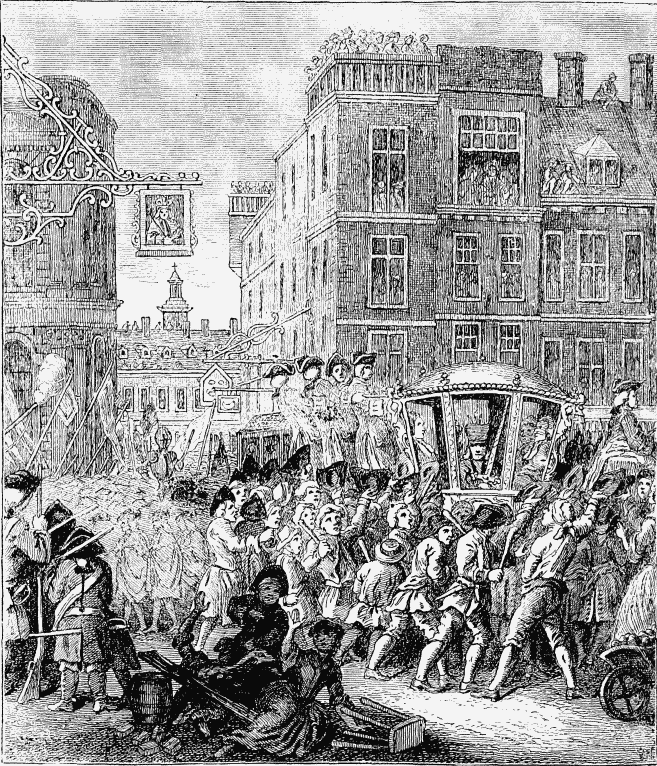
THE LORD MAYOR'S PROCESSION. (From Hogarth's "Industrious Apprentice.") (See page 323.)
A curious and exact description of a Lord Mayor's procession in Elizabeth's reign, written by William Smith, a London haberdasher in 1575, is still extant. The day after Simon and Jude the Mayor went by water to Westminster, attended by the barges of all the companies, duly marshalled and hung with emblazoned shields. On their return they landed at Paul's Wharf, where they took horse, "and in great pomp passed through the great street of the city called Cheapside. "The road was cleared by beadles and men dressed as devils, and wild men, whose clubs discharged squibs. First came two great standards, bearing the arms of the City and of the Lord Mayor's company; then two drums, a flute, and an ensign of the City, followed by seventy or eighty poor men, two by two, in blue gowns with red 'sleeves, each one bearing a pike and a target, with the arms of the Lord Mayor's company. These were succeeded by two more banners, a set of hautboys playing; after these came wyfflers, or clearers of the way, in velvet coats and gold chains, and with white staves in their hands. After the pageant itself paced sixteen trumpeters, more wyfflers to clear the way, and after them the bachelors—sixty, eighty, or one hundred—of the Lord Mayor's company, in long gowns, with crimson satin hoods. These bachelors were to wait on the Mayor. Then followed twelve more trumpeters and the drums and flutes of the City, an ensign of the Mayor's company, the City waits in blue gowns, red sleeves, and silver chains; then the honourable livery, in long robes, each with his hood, half black, half red, on his left shoulder. After them came sheriffs' officers and Mayor's officers, the common serjeant, and the chamberlain. Before the Mayor went the swordbearer in his cap of honour, the sword, in a sheath set with pearls, in his right hand; while on his left came the common cryer, with the great gilt club and a mace on his shoulder. The Mayor wore a long scarlet gown, with black velvet hood and rich gold collar about his neck; and with him rode that fallen dignitary, the ex-Mayor. Then followed all the aldermen, in scarlet gowns and black velvet tippets, those that had been mayors wearing gold chains. The two sheriffs came last of all, in scarlet gowns and gold chains. About one thousand persons sat down to dinner at Guildhall—a feast which cost the Mayor and the two sheriffs £400, whereof the Mayor disbursed £200. Immediately after dinner they went to evening prayer at St. Paul's, the poor men aforementioned carrying torches and targets. The dinner still continues to be eaten, but the service at St. Paul's, as interfering with digestion, was abandoned after the Great Fire. In the evening farewell speeches were made to the Lord Mayor by allegorical personages, and painted posts were set up at his door.
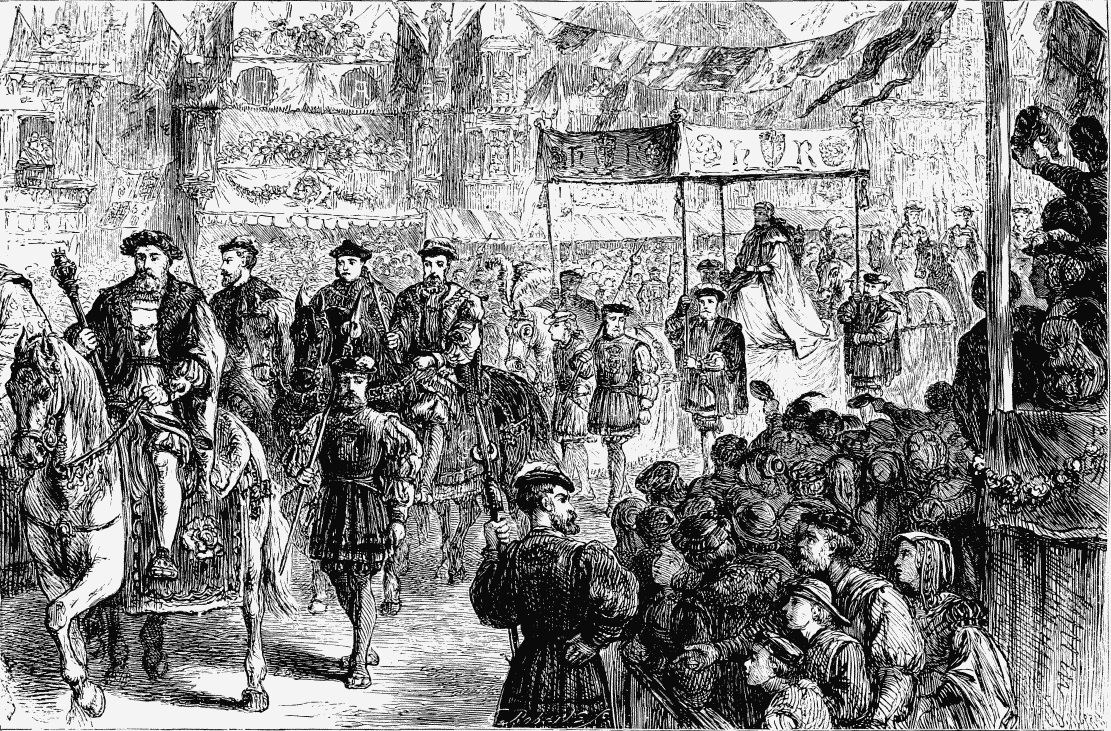
THE MARRIAGE PROCESSION OF ANNE BOLEYN (see page 316).
One of the most gorgeous Lord Mayor's shows was that of 1616 (James I.) devised by Anthony Munday, one of the great band of Shakesperean dramatists, who wrote plays in partnership with Drayton. The drawings for the pageant are still in the possession of the Fishmongers' Company. The new mayor was John Leman, a member of that body (knighted during his mayoralty). The first pageant represented a buss, or Dutch fishing-boat, on wheels. The fishermen in it were busy drawing up nets full of live fish and throwing them to the people. On the mast and at the head of the boat were the insignia of the company—St. Peter's keys and two arms supporting a crown. The second pageant was a gigantic crowned dolphin, ridden by Arion. The third pageant was the king of the Moors riding on a golden leopard, and scattering gold and silver freely round him. He was attended by six tributary kings in gilt armour on horseback, each carrying a dart and gold and silver ingots. This pageant was in honour of the Fishmongers' brethren, the Goldsmiths. The fourth pageant was the usual pictorial pun on the Lord Mayor's name and crest. The car bore a large lemon-tree full of golden fruit, with a pelican in her nest feeding her young (proper). At the top of the tree sat five children, representing the five senses. The boys were dressed as women, each with her emblem—Seeing, by an eagle; Hearing, by a hart; Touch, by a spider; Tasting, by an ape; and Smelling, by a dog. The fifth pageant was Sir William Walworth's bower, which was hung with the shields of all lord mayors who had been Fishmongers. Upon a tomb within the bower was laid the effigy in knightly armour of Sir William, the slayer of Wat Tyler. Five mounted knights attended the car, and a mounted man-at-arms bore Wat Tyler's head upon a dagger. In attendance were six trumpeters and twenty-four halberdiers, arrayed in light blue silk, emblazoned with the Fishmongers' arms on the breast and Walworth's on the back. Then followed an angel with golden wings and crown, riding on horseback, who, on the Lord Mayor's approach, with a golden rod awoke Sir William from his long sleep, and the two then became speakers in the interlude.
The great central pageant was a triumphal car drawn by two mermen and two mermaids. In the highest place sat a guardian angel defending the crown of Richard II., who sat just below her. Under the king sat female personifications of the royal virtues, Truth, Virtue, Honour, Temperance, Fortitude, Zeal, Equity, Conscience, beating down Treason and Mutiny, the two last being enacted "by burly men." In a seat corresponding with the king's sat Justice, and below her Authority, Law, Vigilance, Peace, Plenty, and Discipline.
Shirley, the dramatist (Charles I.) has described the Show in his "Contention for Honour and Riches" (1633). Clod, a sturdy countryman, exclaims, "I am plain Clod; I care not a beanstalk for the best what lack you on you all. No, not the next day after Simon and Jude, when you go a-feasting to Westminster with your galley-foist and your pot-guns, to the very terror of the paper whales; when you land in shoals, and make the understanders in Cheapside wonder to see ships swim on men's shoulders; when the fencers flourish and make the king's liege people fall down and worship the devil and St. Dunstan; when your whifflers are hanged in chains, and Hercules Club spits fire about the pageants, though the poor children catch cold that shone like painted cloth, and are only kept alive with sugarplums; with whom, when the word is given, you march to Guildhall, with every man his spoon in his pocket, where you look upon the giants, and feed like Saracens, till you have no stomach to go to St. Paul's in the afternoon. I have seen your processions, and heard your lions and camels make speeches, instead of grace before and after dinner. I have heard songs, too, or something like 'em; but the porters have had all the burden, who were kept sober at the City charge two days before, to keep time and tune with their feet; for, brag what you will of your charge, all your pomp lies upon their back." In "Honoria and Memoria," 1652, Shirley has again repeated this humorous and graphic description of the land and water pageants of the good citizens of the day; he has, however, abridged the general detail, and added some degree of indelicacy to his satire. He alludes to the wild men that cleared the way, and their fireworks, in these words: "I am not afeard of your green Robin Hoods, that fright with fiery club your pitiful spectators, that take pains to be stifled, and adore the wolves and camels of your company."
Pepys, always curious, always chatty, has, of course, several notices of Lord Mayors' shows; for instance:—
"Oct. 29th, 1660 (Restoration year).— I up early, it being my Lord Mayor's day (Sir Richard Browne), and neglecting my office, I went to the Wardrobe, where I met my Lady Sandwich and all the children; and after drinking of some strange and incomparably good clarett of Mr. Remball's, he and Mr. Townsend did take us, and set the young lords at one Mr. Nevill's, a draper in Paul's Churchyard; and my lady and my Lady Pickering and I to one Mr. Isaacson's, a linendraper at the 'Key,' in Cheapside, where there was a company of fine ladies, and we were very civilly treated, and had a very good place to see the pageants, which were many, and I believe good for such kind of things, but in themselves but poor and absurd. The show being done, we got to Paul's with much ado, and went on foot with my Lady Pickering to her lodging, which was a poor one in Blackfryars, where she never invited me to go in at all, which methought was very strange. Lady Davis is now come to our next lodgings, and she locked up the lead's door from me, which puts me in great disquiet.
"Oct. 29,1663.—Up, it being Lord Mayor's Day (Sir Anthony Bateman). This morning was brought home my new velvet cloak—that is, lined with velvet, a good cloth the outside—the first that ever I had in my life, and I pray God it may not be too soon that I begin to wear it. I thought it better to go without it because of the crowde, and so I did not wear it. At noon I went to Guildhall, and, meeting with Mr. Proby, Sir R. Ford's son, and Lieutenant-Colonel Baron, a City commander, we went up and down to see the tables, where under every salt there was a bill of fare, and at the end of the table the persons proper for the table. Many were the tables, but none in the hall but the mayor's and the lords of the privy council that had napkins or knives, which was very strange. We went into the buttry, and there stayed and talked, and then into the hall again, and there wine was offered and they drunk, I only drinking some hypocras, which do not break my vowe, it being, to the best of my present judgment, only a mixed compound drink, and not any wine. If I am mistaken, God forgive me! But I do hope and think I am not. By-and-by met with Creed, and we with the others went within the several courts, and there saw the tables prepared for the ladies, and judges, and bishops—all great signs of a great dining to come. By-and-by, about one o'clock, before the Lord Mayor come, came into the hall, from the room where they were first led into, the Chancellor, Archbishopp before him, with the Lords of the Council, and other bishopps, and they to dinner. Anon comes the Lord Mayor, who went up to the lords, and then to the other tables, to bid wellcome; and so all to dinner. I sat near Proby, Baron, and Creed, at the merchant strangers' table, where ten good dishes to a messe, with plenty of wine of all sorts, of which I drank none; but it was very unpleasing that we had no napkins nor change of trenchers, and drunk out of earthen pitchers and wooden dishes. It happened that after the lords had half dined, came the French ambassador up to the lords' table, where he was to have sat; he would not sit down nor dine with the Lord Mayor, who was not yet come, nor have a table to himself, which was offered, but, in a discontent, went away again. After I had dined, I and Creed rose and went up and down the house, and up to the ladies' room, and there stayed gazing upon them. But though there were many and fine, both young and old, yet I could not discern one handsome face there, which was very strange. I expected musique, but there was none, but only trumpets and drums, which displeased me. The dinner, it seems, is made by the mayor and two sheriffs for the time being, the Lord Mayor paying one half, and they the other; and the whole, Proby says, is reckoned to come to about seven or eight hundred at most. Being wearied with looking at a company of ugly women, Creed and I went away, and took coach, and through Cheapside, and there saw the pageants, which were very silly. The Queene mends apace, they say, but yet talks idle still."
In 1672 "London Triumphant, or the City in
Jollity and Splendour," was the title of Jordan's
pageant for Sir Robert Hanson, of the Grocers'
Company. The Mayor, just against Bow Church,
was saluted by three pageants; on the two side
stages were placed two griffins (the supporters of
the Grocers' arms), upon which were seated two
negroes, Victory and Gladness attending; while
in the centre or principal stage behind reigned
Apollo, surrounded by Fame, Peace, Justice,
Aurora, Flora, and Ceres. The god addressed
the Mayor in a very high-flown strain of compliment, saying—
"With Oriental eyes I come to see,
And gratulate this great solemnitie.
It hath been often said, so often done,
That all men will worship the rising sun.
(He rises.)
Such are the blessings of his beams. But now
The rising sun, my lord, doth worship you."
(Apollo bows politely to the Lord Mayor.)
Next was displayed a wilderness, with moors planting and labouring, attended by three pipers and several kitchen musicians that played upon tongs, gridirons, keys, "and other such like confused musick." Above all, upon a mound, sat America, "a proper masculine woman, with a tawny face," who delivered a lengthy speech, which concluded the exhibition for that day.
In 1676 the pageant in Cheapside, which dignified Sir Thomas Davies' accession as Lord Mayor, was "a Scythian chariot of triumph," in which sat a fierce Tamburlain, of terrible aspect and morose disposition, who was, however, very civil and complimentary upon the present occasion. He was attended by Discipline, bearing the king's banner, Conduct that of the Mayor, Courage that of the City, while Victory displayed the flag of the Drapers' Company. The lions of the Drapers' arms drew the car, led by "Asian captive princes, in royal robes and crowns of gold, and ridden by two negro princes. "The third pageant was "Fortune's Bower," in which the goddess sat with Prosperity, Gladness, Peace, Plenty, Honour, and Riches. A lamb stood in front, on which rode a boy, "holding the banner of the Virgin." The fourth pageant was a kind of "chase," full of shepherds and others preparing cloth, dancing, tumbling, and curvetting, being intended to represent confusion.
In the show of 1672 two giants, Gogmagog and Corineus, fifteen feet high (whose ancestors were probably destroyed in the Great Fire), appeared in two chariots, "merry, happy, and taking tobacco, to the great admiration and delight of all the spectators." Their predecessors are spoken of by Marston, the dramatist, Stow, and Bishop Corbet. In 1708 (says Mr. Fairholt) the present Guildhall giants were carved by Richard Saunders. In 1837 Alderman Lucas exhibited two wickerwork copies of Gog and Magog, fourteen feet high, their faces on a level with the first-floor windows of Cheapside, and these monstrosities delighted the crowd.
In 1701 (William III.) Sir William Gore, mercer, being Lord Mayor, displayed at his pageant the famous "maiden chariot" of the Mercers' Company. It was drawn by nine white horses, ridden by nine allegorical personages—four representing the four quarters of the world, the other five the retinue of Fame—and all sounding remorselessly on silver trumpets. Fourteen pages, &c., attended the horses, while twenty lictors in silver helmets and forty attendants cleared a way for the procession. The royal virgin in the chariot was attended by Truth and Mercy, besides kettle-drummers and trumpeters. The quaintest thing was that at the Guildhall banquet the virgin, surrounded by all her ladies and pages, dined in state at a separate table.
The last Lord Mayor's pageant of the old school
was in 1702 (Queen Anne), when Sir Samuel Dashwood, vintner, entertained her Majesty at the
Guildhall. Poor Elkanah Settle (Pope's butt)
wrote the libretto, in hopes to revive a festival then
"almost dropping into oblivion." On his return
from Westminster, the Mayor was met at the Blackfriars Stairs by St. Martin, patron of the Vintners,
in rich armour and riding a white steed. The
generous saint was attended by twenty dancing
satyrs, with tambourines; ten halberdiers, with
rustic music; and ten Roman lictors, At St.
Paul's Churchyard the saint made a stand, and,
drawing his sword, cut off half his crimson scarf, and
gave it to some beggars and cripples who importuned him for charity. The pageants were fanciful
enough, and poor Settle must have cudgelled his
dull brains well for it. The first was an Indian
galleon crowded by Bacchanals wreathed with
vines. On the deck of the grape-hung vessel sat
Bacchus himself, "properly drest." The second
pageant was the chariot of Ariadne, drawn by
panthers. Then came St. Martin, as a bishop in a
temple, and next followed "the Vintage," an eightarched structure, with termini of satyrs and ornamented with vines. Within was a bar, with a
beautiful person keeping it, with drawers (waiters),
and gentlemen sitting drinking round a tavern
table. On seeing the Lord Mayor, the bar-keeper
called to the drawers—
"Where are your eyes and ears?
See there what honourable gent appears!
Augusta's great Prætorian lord—but hold!
Give me a goblet of true Orient mould.
And with," &c.
In 1727, the first year of the reign of King George II., the king, queen, and royal family having received a humble invitation from the City to dine at Guildhall, their Majesties, the Princess Royal, and her Royal Highness the Princess Carolina, came into Cheapside about three o'clock in the afternoon, attended by the great officers of the court and a numerous train of the nobility and gentry in their coaches, the streets being lined from Temple Bar by the militia of London, and the balconies adorned with tapestry. Their Majesties and the princesses saw the Lord Mayor's procession from a balcony near Bow Church. Hogarth has introduced a later royal visitor—Frederick, Prince of Wales—in a Cheapside balcony, hung with tapestry, in his "Industrious and Idle Apprentices" (plate xii.). A train-band man in the crowd is firing off a musket to express his delight.
Sir Samuel Fludyer, Lord Mayor of London in the year 1761, the year of the marriage of good King George III., appears to have done things with thoroughness. In a contemporary chronicle we find a very sprightly narrative of Sir Samuel's Lord Mayor's show, in which the king and queen, with "the rest of the royal family," participated—their Majesties, indeed, not getting home from the Guildhall ball until two in the morning. Our sight-seer was an early riser. He found the morning foggy, as is common to this day in London about the 9th of November, but soon the fog cleared away, and the day was brilliantly fine—an exception, he notes, to what had already, in his time, become proverbial that the Lord Mayor's day is almost invariably a bad one. He took boat on the Thames, that he might accompany the procession of state barges on their way to Westminster. He reports "the silent highway" as being quite covered with boats and gilded barges. The barge of the Skinners' Company was distinguished by the outlandish dresses of strange-spotted skins and painted hides worn by the rowers. The barge belonging to the Stationers' Company, after having passed through one of the narrow arches of Westminster Bridge, and tacked about to do honour to the Lord Mayor's landing, touched at Lambeth and took on board, from the archbishop's palace, a hamper of claret—the annual tribute of theology to learning. The tipple must have been good, for our chronicler tells us that it was "constantly reserved for the future regalement of the master, wardens, and court of assistants, and not suffered to be shared by the common crew of liverymen." He did not care to witness the familiar ceremony of swearing in the Lord Mayor in Westminster Hall, but made the best of his way to the Temple Stairs, where it was the custom of the Lord Mayor to land on the conclusion of the aquatic portion of the pageant. There he found some of the City companies already landed, and drawn up in order in Temple Lane, between two rows of the train-bands, "who kept excellent discipline." Other of the companies were wiser in their generation; they did not land prematurely to cool their heels in Temple Lane, while the royal procession was passing along the Strand, but remained on board their barges regaling themselves comfortably. The Lord Mayor encountered good Samaritans in the shape of the master and benchers of the Temple, who invited him to come on shore and lunch with them in the Temple Hall.
Every house from Temple Bar to Guildhall was crowded from top to bottom, and many had scaffoldings besides; carpets and rich hangings were hung out on the fronts all the way along; and our friend notes that the citizens were not mercenary, but "generously accommodated their friends and customers gratis, and entertained them in the most elegant manner, so that though their shops were shut, they might be said to have kept open house."
The royal procession, which set out from St. James's Palace at noon, did not get to Cheapside until near four, when in the short November day it must have been getting dark. Our sight-seer, as the royal family passed his window, counted between twenty and thirty coaches-and-six belonging to them and to their attendants, besides those of the foreign ambassadors, officers of state, and the principal nobility. There preceded their Majesties the Duke of Cumberland, Princess Amelia, the Duke of York, in a new state coach; the Princes William Henry and Frederic, the Princess Dowager of Wales, and the Princesses Augusta and Caroline in one coach, preceded by twelve footmen with black caps, followed by guards and a grand retinue. The king and queen were in separate coaches, and had separate retinues. Our friend in the window of the "Queen's Arms" was in luck's way. From a booth at the eastern end of the churchyard the children of Christ Church Hospital paid their respects to their Majesties, the senior scholar of the grammar school reciting a lengthy and loyal address, after which the boys chanted "God Save the King." At last the royal family got to the house of Mr. Barclay, the Quaker, from the balcony of which, hung with crimson silk damask, they were to see, with what daylight remained, the civic procession that presently followed; but in the interval came Mr. Pitt, in his chariot, accompanied by Earl Temple. The great commoner was then in the zenith of his popularity, and our sight-seer narrates how, "at every step, the mob clung about every part of the vehicle, hung upon the wheels, hugged his footmen, and even kissed his horses. There was an universal huzza, and the gentlemen at the windows and the balconies waved their hats, and the ladies their handkerchiefs."
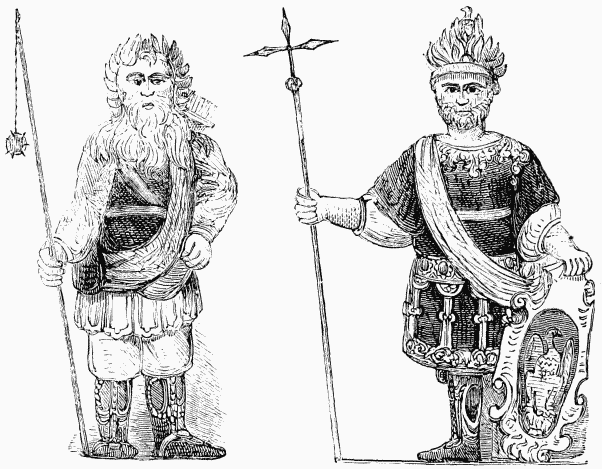
FIGURES OF GOG AND MAGOG SET UP IN GUILDHALL AFTER THE FIRE.
The Lord Mayor's state coach was drawn by six beautiful iron-grey horses, gorgeously caparisoned, and the companies made a grand appearance. Even a century ago, however, degeneracy had set in. Our sight-seer complains that the Armourers' and Braziers', the Skinners' and Fishmongers' Companies were the only companies that had anything like the pageantry exhibited of old on the occasion. The Armourers sported an archer riding erect in his car, having his bow in his left hand, and his quiver and arrows hanging behind his left shoulder; also a man in complete armour. The Skinners were distinguished by seven of their company being dressed in fur, having their skins painted in the form of Indian princes. The pageant of the Fishmongers consisted of a statue of St. Peter finely gilt, a dolphin, two mermaids, and a couple of seahorses; all which duly passed before Georgius Rex as he leaned over the balcony with his Charlotte by his side.
Our chronicler understood well the strategic movements indispensable to the zealous sight-seer. As soon as the Lord Mayor's procession had passed him, he "posted along the back lanes, to avoid the crowd," and got to the Guildhall in advance of the Lord Mayor. He had procured a ticket for the banquet through the interest of a friend, who was one of the committee for managing the entertainment, and also a "mazarine." It is explained that this was a kind of nickname given to the common councilmen, on account of their wearing mazarine blue silk gowns. He learned that the doors of the hall had been first opened at nine in the morning for the admission of ladies into the galleries, who were the friends of the committee men, and who got the best places; and subsequently at twelve for the general reception of all who had a right to come in. What a terrible spell of waiting those fortunate unfortunates comprising the earliest batch must have had! The galleries presented a very brilliant show, and among the company below were all the officers of state, the principal nobility, and the foreign ambassadors. The Lord Mayor arrived at half-past six, and the sheriffs went straight to Mr. Barclay's to conduct the royal family to the hall. The passage from the hall-gate to steps leading to the King's Bench was lined by mazarines with candles in their hands, by aldermen in their red gowns, and gentlemen pensioners with their axes in their hands. At the bottom of the steps stood the Lord Mayor and the Lady Mayoress, with the entertainment committee, to receive the members of the royal family as they arrived. The princes and princesses, as they successively came in, waited in the body of the hall until their Majesties' entrance. On their arrival being announced, the Lord Mayor and the Lady Mayoress, as the chronicler puts it, advanced to the great door of the hall; and at their Majesties' entrance, the Lord Mayor presented the City sword, which being returned, he carried before the King, the Queen following, with the Lady Mayoress behind her. "The music had struck up, but was drowned in the acclamations of the company; in short, all was life and joy; even the giants, Gog and Magog, seemed to be almost animated." The King, at all events, was more than almost animated; he volubly praised the splendour of the scene, and was very gracious to the Lord Mayor on the way to the council chamber, followed by the royal family and the reception committee. This room reached, the Recorder delivered the inevitable addresses, and the wives and daughters of the aldermen were presented. These ladies had the honour of being saluted by his Majesty, and of kissing the Queen's hand, then the sheriffs were knighted, as also was the brother of the Lord Mayor.
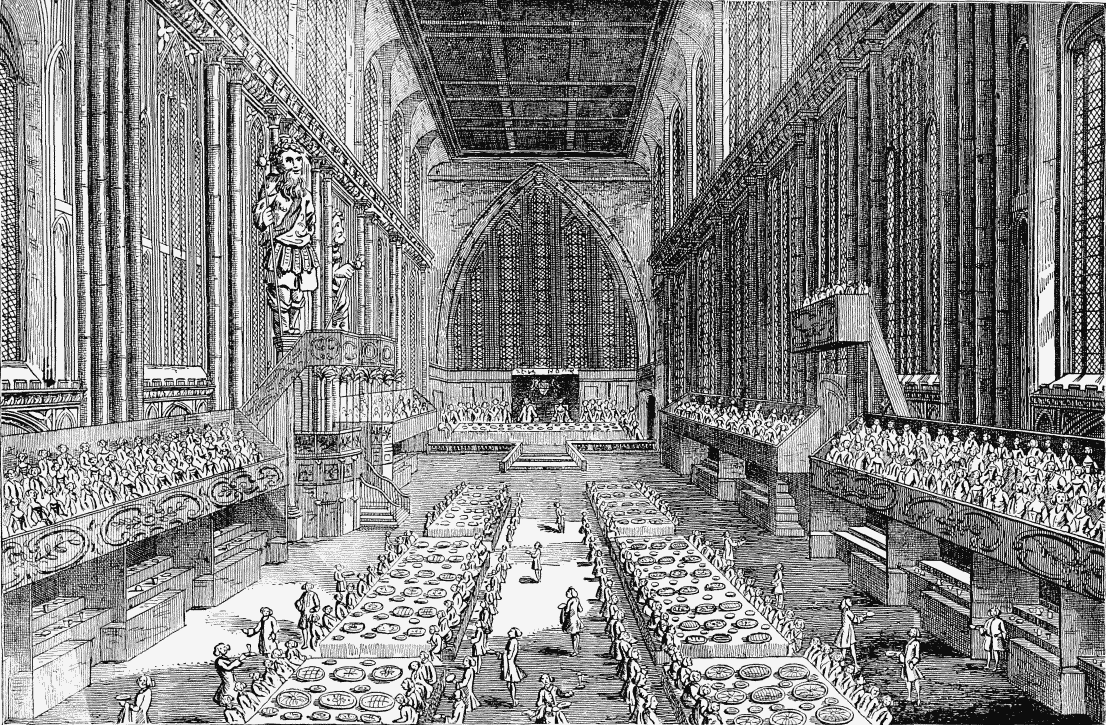
THE ROYAL BANQUET IN GUILDHALL. From a Contemporary Print. (See page 326.)
After half an hour's stay in the council chamber, the royal party returned into the hall, and were conducted to the upper end of it, called the hustings, where a table was provided for them, at which they sat by themselves. There had been, it seems, a knotty little question of etiquette. The ladiesin-waiting on the Queen had claimed the right of custom to dine at the same table with her Majesty, but this was disallowed; so they dined at the table of the Lady Mayoress in the King's Bench. The royal table "was set off with a variety of emblematic ornaments, beyond description elegant," and a superb canopy was placed over their Majesties' heads at the upper end. For the Lord Mayor, aldermen, and their ladies, there was a table on the lower hustings. The privy councillors, ministers of state, and great nobles dined at a table on the right of this; the foreign ministers at one on the left. For the mazarines and the general company there were eight tables laid out in the body of the hall, while the judges, serjeants, and other legal celebrities, dined in the old council chamber, and the attendants of the distinguished visitors were regaled in the Court of Common Pleas.
George and his consort must have got up a fine appetite between noon and nine o'clock, the hour at which the dinner was served. The aldermen on the committee acted as waiters at the royal table. The Lord Mayor stood behind the King, "in quality of chief butler, while the Lady Mayoress waited on her Majesty" in the same capacity, but soon after seats were taken they were graciously sent to their seats. The dinner consisted of three courses, besides the dessert, and the purveyors were Messrs. Horton and Birch, the same house which in the present day supplies most of the civic banquets. The illustration which we give on the previous page is from an old print of the period representing this celebrated festival, and is interesting not merely on account of the scene which it depicts, but also as a view of Guildhall at that period.
The bill of fare at the royal table on this occasion is extant, and as it is worth a little study on the part of modern epicures, we give it here at full length for their benefit:—
FIRST SERVICE.
Venison, turtle soups, fish of every sort, viz., dorys, mullets, turbots, tench, soles, &c., nine dishes.
SECOND SERVICE.
A fine roast, ortolans, teals, quails, ruffs, knotts, peachicks, snipes, partridges, pheasants, &c., nine dishes.
THIRD SERVICE.
Vegetables and made dishes, green peas, green morelles, green truffles, cardoons, artichokes, ducks' tongues, fat livers, &c., eleven dishes.
FOURTH SERVICE.
Curious ornaments in pastry and makes, jellies, blomonges, in variety of shapes, figures, and oolours, nine dishes.
In all, not including the dessert, there were placed on the tables four hundred and fourteen dishes, hot and cold. Wine was varied and copious. In the language of the chronicler, "champagne, burgundy, and other valuable wines were to be had everywhere, and nothing was so scarce as water." When the second course was being laid on, the toasts began. The common crier, standing before the royal table, demanded silence, then proclaimed aloud that their Majesties drank to the health and prosperity of the Lord Mayor, aldermen, and common council of the City of London. Then the common crier, in the name of the civic dignitaries, gave the toast of health, long life, and prosperity to their most gracious Majesties. After dinner there was no tarrying over the wine-cup. The royal party retired at once to the council chamber, "where they had their tea." What became of the rest of the company is not mentioned, but clearly the Guildhall could have been no place for them. That was summarily occupied by an army of carpenters. The tables were struck and carried out. The hustings, where the great folks had dined, and the floor of which had been covered with rich carpeting, was covered afresh, and the whole hall rapidly got ready for the ball, with which the festivities were to conclude. On the return of their majesties, and as soon as they were seated under the canopy, the ball was opened by the Duke of York and the Lady Mayoress. It does not appear that the royal couple took the floor, but "other minuets succeeded by the younger branches of the royal family with ladies of distinction."
About midnight Georgius Rex, beginning probably to get sleepy with all this derangement of his ordinarily methodical way of living, signified his desire to take his departure; but things are not always possible even when kings are in question. Such was the hurry and confusion outside—at least that is the reason assigned by the chronicler—that there was great delay in fetching up the royal carriages to the Guildhall door. Our own impression is that the coachmen were all drunk, not excepting the state coachman himself. Their Majesties waited half an hour before their coach could be brought up, and perhaps, after all the interchange of civilities, went away in a tantrum at the end. It is clear the Princess Dowager of Wales did, for she waited some time in the temporary passage, "nor could she be prevailed on to retire into the hall." There was no procession on the return from the City. The royal people trundled home as they best might, and according as their carriages came to hand. But we are told that on the return journey, past midnight as it was, the crowd in some places was quite as great as it had been in the daytime, and that Mr. Pitt was vociferously cheered all the way to his own door. The King and Queen did not get home to St. James's till two o'clock in the morning, and it is a confirmation of the suggestion that the coachman must have been drunk, that in turning under the gate one of the glasses of their coach was broken by the roof of the sentry-box. As for the festive people left behind in the Guildhall, they kept the ball up till three o'clock, and we are told that "the whole was concluded with the utmost regularity and decorum." Indeed, Sir Samuel Fludyer's Lord Mayor's day appears to have been a triumphant success. His Majesty himself, we are told, was pleased to declare "that to be elegantly entertained he must come into the City." The foreign ministers in general expressed their wonder, and one of them politely said in French, that this entertainment was only fit for one king to give to another.
One of the Barclays has left a pleasant account of this visit of George III. to the City to see the Lord Mayor's Show:—"The Queen's clothes," says the lady, "which were as rich as gold, silver, and silk could make them, was a suit from which fell a train supported by a little page in scarlet and silver. The lustre of her stomacher was inconceivable. The King I think a very personable man. All the princes followed the King's example in complimenting each of us with a kiss. The Queen was upstairs three times, and my little darling, with Patty Barclay and Priscilla Bell, were introduced to her. I was present, and not a little anxious, on account of my girl, who kissed the Queen's hand with so much grace, that I thought the Princess Dowager would have smothered her with kisses. Such a report of her was made to the King, that Miss was sent for, and afforded him great amusement by saying, 'that she loved the king, though she must not love fine things, and her grandpapa would not allow her to make a curtsey." Her sweet face made such an impression on the Duke of York, that I rejoiced she was only five instead of fifteen. When he first met her, he tried to persuade Miss to let him introduce her to the Queen, but she would by no means consent, till I informed her he was a prince, upon which her little female heart relented, and she gave him her hand—a true copy of the sex. The King never sat down, nor did he taste anything during the whole time. Her Majesty drank tea, which was brought her on a silver waiter by brother John, who delivered it to the lady in waiting, and she presented it kneeling. The leave they took of us was such as we might expect from our equals—full of apologies for our trouble for their entertainment, which they were so anxious to have explained, that the Queen came up to us as we stood on one side of the door, and had every word interpreted. My brothers had the honour of assisting the Queen into her coach. Some of us sat up to see them return, and the King and Queen took especial notice of us as they passed. The King ordered twenty-four of his guard to be placed opposite our door all night, lest any of the canopy should be pulled down by the mob, in which" (the canopy, it is to be presumed) "there were 100 yards of silk damask."
"From the above particulars we learn," says Dr. Doran, "that it was customary for our sovereigns to do honour to industry long before the period of the Great Exhibition year, which is erroneously supposed to be the opening of an era when a sort of fraternisation took place between commerce and the Crown. Under the old reign, too, the honour took a homely, but not an undignified, and if still a ceremonious, yet a hearty shape. It may be questioned, if Royalty were to pay a visit to the family of the present Mr. Barclay, whether the monarch would celebrate the brief sojourn by kissing all the daughters of 'Barclay and Perkins.' He might do many things not half so pleasant."
The most important feature of the modern show, says Mr. Fairholt very truly, is the splendidly carved and gilt coach in which the Lord Mayor rides; and the paintings that decorate it may be considered as the relics of the ancient pageants that gave us the living representatives of the virtues and attributes of the chief magistrate here delineated. Cipriani was the artist who executed this series of paintings, in 1757; and they exhibit upon the panel of the right door, Fame presenting the Mayor to the genius of the City; on the left door, the same genius, attended by Britannia, who points with her spear to a shield, inscribed "Henry Fitz-Alwin," 1109." On each side of the doors are painted Truth, with her mirror; Temperance, holding a bridle; Justice, and Fortitude. The front panel exhibits Faith and Hope, pointing to St. Paul's; the back panel Charity, two female figures, typical of Plenty and Riches, casting money and fruits into her lap—while a wrecked sailor and sinking ship fill up the background. By the kind permission of the Lord Mayor we are enabled to give a representation of the ponderous old vehicle, which is still the centre of attraction every 9th of November.
The carved work of the coach is elaborate and beautiful, consisting of Cupids supporting the City arms, &c. The roof was formerly ornamented in the centre with carved work, representing four boys supporting baskets of fruit, &c. These were damaged by coming into collision with an archway leading into Blackwall Hall, about fifty years ago; some of the figures were knocked off, and the group was entirely removed in consequence. This splendid coach was paid for by a subscription of £60 from each of the junior aldermen, and such as had not passed the civic chair—its total cost being £1,065 3s. Subsequently each alderman, when sworn into office, contributed that sum to keep it in repair; for which purpose, also, each Lord Mayor gave £100, which was allowed to him in case the cost of the repairs during his mayoralty rendered it requisite. This arrangement was not, however, complied with for many years; after which the whole expense fell upon the Lord Mayor, and in one year it exceeded £300. This outlay being considered an unjust tax upon the mayor for the time being, the amount over £100 was repaid to him, and the coach became the property of the corporation, the expenses ever since being paid by the Committee for General Purposes. Even so early as twenty years after its construction it was found necessary to repair the coach at an expense of £335; and the average expense of the repairs during seven years of the present century is said to have been as much as £115. Hone justly observes, "All that remains of the Lord Mayor's Show to remind the curiously-informed of its ancient character, is the first part of the procession. These are the poor men of the company to which the Lord Mayor belongs, habited in long gowns and close caps of the company's colour, bearing shields on their arms, but without javelins. So many of these lead the show as there are years in the Lord Mayor's age."
Of a later show "Aleph" gives a pleasant account. "I was about nine years old," he says, "when from a window on Ludgate Hill I watched the ponderous mayor's coach, grand and wide, with six footmen standing on the footboard, rejoicing in bouquets as big as their heads and canes four feet high, dragged slowly up the hill by a team of be-ribboned horses, which, as they snorted along, seemed to be fully conscious of the precious freight in the rear. Cinderella's carriage never could boast so goodly a driver; his full face, of a dusky or purple red, swelled out on each side like the breast of a pouting pigeon; his three-cornered hat was almost hidden by wide gold lace; the flowers in his vest were fullblown and jolly, like himself; his horsewhip covered with blue ribbons, rising and falling at intervals merely for form—such horses were not made to be flogged. Coachee's box was rather a throne than a seat. Then a dozen gorgeous walking footmen on either hand; grave marshalmen, treading gingerly, as if they had corns; and City officers in scarlet, playing at soldiers, but looking anything but soldierly; two trumpeters before and behind, blowing an occasional blast. . . .
"How that old coach swayed to and fro, with its dignified elderly gentlemen and rubicund Lord Mayor, rejoicing in countless turtle feeds—for, reader, it was Sir William Curtis! . . .
"As the ark of copper, plate glass, and enamel crept slowly up the incline, a luckless sweeper-boy (in those days such dwarfed lads were forced to climb chimneys) sidled up to one of the fore horses, and sought to detach a pink bow from his mane. The creature felt his honours diminishing, and turned to snap at the blackee. The sweep screamed, the horse neighed, the mob shouted, and Sir William turned on his pivot cushion to learn what the noise meant; and thus we were enabled to gaze on a Lord Mayor's face. In sooth he was a goodly gentleman, burly, and with three fingers' depth of fat on his portly person, yet every feature evinced kindliness and benevolence of no common order."
The men in armour were from time immemorial important features in the show, and the subjects of many a jest. Hogarth introduces them in one of his series, "Industry and Idleness," and Punch has cast many a missile at those disconsolate warriors, who all but perished under their weight of armour, degenerate race that we are!
The suits of burnished mail, though generally understood to be kindly lent for the occasion by the custodian of the Tower armoury, seem now and then to have been borrowed from the playhouse, possibly for the reason that the imitation accoutrements were more showy and superb than the real.
This was at any rate the case (says Mr. Dutton Cook) in 1812, when Sir Claudius Hunter was Lord Mayor, and Mr. Elliston was manager of the Surrey Theatre. A melodramatic play was in preparation, and for this special object the manager had provided, at some considerable outlay, two magnificent suits of brass and steel armour of the fourteenth century, expressly manufactured for him by Mr. Marriott of Fleet Street. No expense had been spared in rendering this harness as complete and splendid as could be. Forthwith Sir Claudius applied to Elliston for the loan of the new armour to enhance the glories of the civic pageant. The request was acceded to with the proviso that the suit of steel could only be lent in the event of the ensuing 9th of November proving free from damp and fog. No such condition, however, was annexed to the loan of the brass armour; and it was understood that Mr. John Kemble had kindly undertaken to furnish the helmets of the knights with costly plumes, and personally to superintend the arrangement of these decorations. Altogether, it would seem that the mayor stood much indebted to the managers, who, willing to oblige, yet felt that their courtesy was deserving of some sort of public recognition. At least this was Elliston's view of the matter, who read with chagrin sundry newspaper paragraphs, announcing that at the approaching inauguration of Sir Claudius some of the royal armour from the Tower would be exhibited, but ignoring altogether the loan of the matchless suits of steel and brass from the Surrey Theatre. The manager was mortified; he could be generous, but he knew the worth of an advertisement. He expostulated with the future mayor. Sir Claudius replied that he did not desire to conceal the transaction, but rather than it should go forth to the world that so high a functionary as an alderman of London had made a request to a theatrical manager, he thought it advisable to inform the public that Mr. Elliston had offered the use of his property for the procession of the 9th. This was hardly a fair way of stating the case, but at length the following paragraph, drawn up by Elliston, was agreed upon for publication in the newspapers:—"We understand that Mr. Elliston has lent to the Lord Mayor elect the two magnificent suits of armour, one of steel and the other of brass, manufactured by Marriott of Fleet Street, and which cost not less than £600. These very curious specimens of the revival of an art supposed to have been lost will be displayed in the Lord Mayor's procession, and afterwards in Guildhall, with some of the royal armour in the Tower." It would seem also, according to another authority, that the wearers of the armour were members of the Surrey company.
On the 9th Elliston was absent from London, but he received from one left in charge of his interests a particular account of the proceedings of the day:—
"The unhandsome conduct of the Lord Mayor has occasioned me much trouble, and will give you equal displeasure. In the first place, your paragraph never would have appeared at all had I not interfered in the matter; secondly, cropped-tailed hacks had been procured without housings, so that I was compelled to obtain two trumpeters' horses from the Horse Guards, long-tailed animals, and richly caparisoned; thirdly, the helmets which had been delivered at Mr. Kemble's house were not returned until twelve o'clock on the day of action, with three miserable feathers in each, which appeared to have been plucked from the draggle tail of a hunted cock; this I also remedied by sending off at the last moment to the first plumassier for the hire of proper feathers, and the helmets were ultimately decorated with fourteen superb plumes; fourthly, the Lord Mayor's officer, who rode in Henry V. armour, jealous of our stately aspect, attempted to seize one of our horses, on which your rider made as gallant a retort as ever knight in armour could have done, and the assailer was completely foiled."
This was bad enough, but in addition to this the narrator makes further revelation of the behindthe-scenes secrets of a civic pageant sixty years ago. On the arrival of the procession it was found that no accommodation had been arranged for "Mr. Elliston's men," nor were any refreshments proffered them. "For seven hours they were kept within Guildhall, where they seem to have been considered as much removed from the necessities of the flesh as Gog and Magog above their heads." At length the compassion, or perhaps the sense of humour, of certain of the diners was moved by the forlorn situation of the knights in armour, and bumpers of wine were tendered them. The man in steel discreetly declined this hospitable offer, alleging that after so long a fast he feared the wine would affect him injuriously. It was whispered that his harness imprisoned him so completely that eating and drinking were alike impracticable to him. His comrade in brass made light of these objections, gladly took the proffered cup into his gauntleted hands, and "drank the red wine through the helmet barred," as though he had been one of the famous knights of Branksome Tower. It was soon apparent that the man in brass was intoxicated. He became obstreperous; he began to reel and stumble, accoutred as he was, to the hazard of his own bones and to the great dismay of bystanders. It was felt that his fall might entail disaster upon many. Attempts were made to remove him, when he assumed a pugilistic attitude, and resolutely declined to quit the hall. Nor was it possible to enlist against him the services of his brother warrior. The man in steel sided with the man in brass, and the two heroes thus formed a powerful coalition, which was only overcome at last by the onset of numbers. The scene altogether was of a most scandalous, if comical, description. It was some time past midnight when Mr. Marriot, the armourer, arrived at Guildhall, and at length succeeded in releasing the two half-dead warriors from their coats of mail.
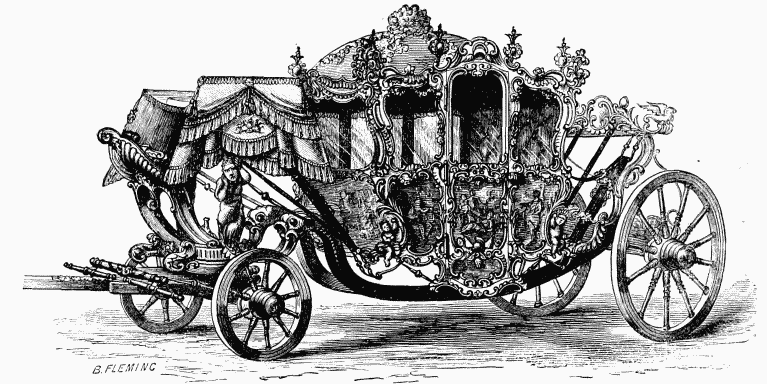
THE LORD MAYOR'S COACH.
After all, these famous suits of armour never returned to the wardrobe of the Surrey Theatre, or gleamed upon its stage. From Guildhall they were taken to Mr. Marriott's workshop. This, with all its contents, was accidentally consumed by fire. But the armourer's trade had taught him chivalry. At his own expense, although he had lost some three thousand pounds by the fire, he provided Elliston with new suits of armour in lieu of those that had been destroyed. To his outlay the Lord Mayor and the City authorities contributed—nothing! although but for the procession of the 9th of November the armour had never been in peril.
The most splendid sight that ever glorified mediæval Cheapside was the Midsummer Marching Watch, a grand City display, the description of which makes even the brown pages of old Stow glow with light and colour, seeming to rouse in the old London chronicler recollections of his youth.
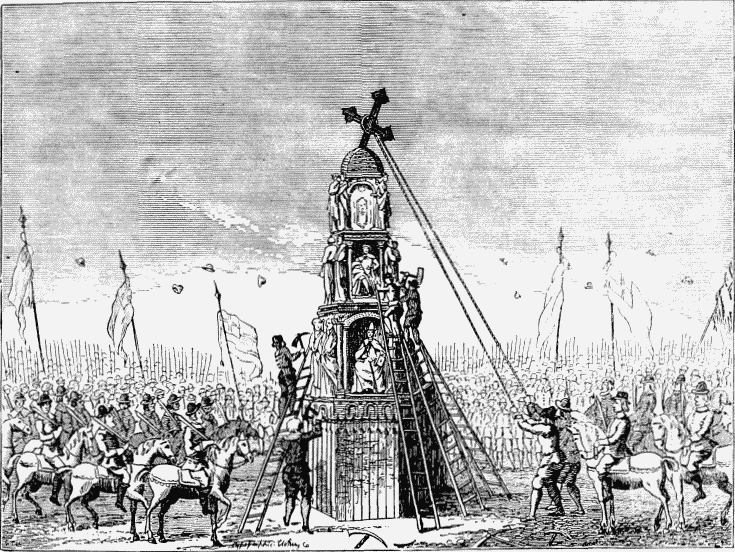
THE DEMOLITION OF CHEAPSIDE CROSS. From an old Print. (See page 334.)
"Besides the standing watches," says Stow, "all in bright harness, in every ward and street in the City and suburbs, there was also a Marching Watch, that passed through the principal streets thereof; to wit, from the Little Conduit, by Paul's Gate, through West Cheap by the Stocks, through Cornhill, by Leaden Hall, to Aldgate; then back down Fenchurch Street, by Grasse Church, about Grasse Church Conduit, and up Grasse Church Street into Cornhill, and through into West Cheap again, and so broke up. The whole way ordered for this Marching Watch extended to 3,200 taylors' yards of assize. For the furniture whereof, with lights, there were appointed 700 cressets, 500 of them being found by the Companies, the other 200 by the Chamber of London. Besides the which lights, every constable in London, in number more than 240, had his cresset; the charge of every cresset was in light two shillings four pence; and every cresset had two men, one to bear or hold it, another to bear a bag with light, and to serve it; so that the poor men pertaining to the cressets taking wages, besides that every one had a strawen hat, with a badge painted, and his breakfast, amounted in number to almost 2,000. The Marching Watch contained in number about 2,000 men, part of them being old soldiers, of skill to be captains, lieutenants, serjeants, corporals, &c.; whifflers, drummers and fifes, standard and ensign bearers, demi-launces on great horses, gunners with handguns, or half hakes, archers in coats of white fustian, signed on the breast and back with the arms of the City, their bows bent in their hands, with sheafs of arrows by their side; pikemen, in bright corslets, burganets, &c.; halbards, the like; the billmen in Almain rivets and aprons of mail, in great number.
"This Midsummer Watch was thus accustomed yearly, time out of mind, until the year 1539, the 31st of Henry VIII.; in which year, on the 8th of May, a great muster was made by the citizens at the Mile's End, all in bright harness, with coats of white silk or cloth, and chains of gold, in three great battels, to the number of 15,000; which passed through London to Westminster, and so through the Sanctuary and round about the Park of St. James, and returned home through Oldborn.
"King Henry, then considering the great charges of the citizens for the furniture of this unusual muster, forbad the Marching Watch provided for at midsummer for that year; which being once laid down, was not raised again till the year 1548, the second of Edward the Sixth, Sir John Gresham then being Maior, who caused the Marching Watch, both on the eve of Saint John Baptist, and of Saint Peter the Apostle, to be revived and set forth, in as comely order as it had been accustomed.
"In the months of June and July, on the vigil of festival days, and on the same festival days in the evenings, after the sun-setting, there were usually made bonefires in the streets, every man bestowing wood or labour towards them. The wealthier sort, also, before their doors, near to the said bonefires, would set out tables on the vigils, furnished with sweet bread and good drink; and on the festival days, with meat and drink, plentifully; whereunto they would invite their neighbours and passengers also, to sit and be merry with them in great familiarity, praising God for his benefits bestowed on them. These were called Bonefires, as well of good amity amongst neighbours, that being before at controversie, were there by the labours of others reconciled, and made of bitter enemies loving friends; as also for the virtue that a great fire hath to purge the infection of the air. On the vigil of Saint John Baptist, and on Saint Peter and Paul, the apostles, every man's door being shadowed with green birch, long fennel, St. John's wort, orpin, white lillies, and such-like, garnished upon with beautiful flowers, had also lamps of glass, with oyl burning in them all the night. Some hung out branches of iron, curiously wrought, containing hundreds of lamps, lighted at once, which made a goodly show, namely, in New Fish Street, Thames Street, &c."