Old and New London: Volume 1. Originally published by Cassell, Petter & Galpin, London, 1878.
This free content was digitised by double rekeying. Public Domain.
Walter Thornbury, 'The Lord Mayors of London', in Old and New London: Volume 1(London, 1878), British History Online https://www.british-history.ac.uk/old-new-london/vol1/pp396-416 [accessed 30 April 2025].
Walter Thornbury, 'The Lord Mayors of London', in Old and New London: Volume 1(London, 1878), British History Online, accessed April 30, 2025, https://www.british-history.ac.uk/old-new-london/vol1/pp396-416.
Walter Thornbury. "The Lord Mayors of London". Old and New London: Volume 1. (London, 1878), British History Online. Web. 30 April 2025. https://www.british-history.ac.uk/old-new-london/vol1/pp396-416.
In this section
CHAPTER XXXIV.
THE LORD MAYORS OF LONDON.
The First Mayor of London—Portrait of him—Presentation to the King—An Outspoken Mayor—Sir N. Farindon—Sir William Walworth—Origin of the prefix "Lord"—Sir Richard Whittington and his Liberality—Institutions founded by him—Sir Simon Eyre and his Table—A Musical Lord Mayor—Henry VIII. and Gresham—Loyalty of the Lord Mayor and Citizens to Queen Mary—Osborne's Leap into the Thames—Sir W. Craven—Brass Crosby—His Committal to the Tower—A Victory for the Citizens.
The modern Lord Mayor is supposed to have had a prototype in the Roman prefect and the Saxon portgrave. The Lord Mayor is only "Lord" and "Right Honourable" by courtesy, and not from his dignity as a Privy Councillor on the demise or abdication of a sovereign.
In 1189, Richard I. elected Henry Fitz Ailwyn, a draper of London, to be first mayor of London, and he served twenty-four years. He is supposed to have been a descendant of Aylwyn Child, who founded the priory at Bermondsey in 1082. He was buried, according to Strype, at St. Mary Bothaw, Walbrook, a church destroyed in the Great Fire; but according to Stow, in the Holy Trinity Priory, Aldgate. There is a doubtful half-length oil-portrait or panel of the venerable Fitz Alwyn over the master's chair in Drapers' Hall, but it has no historical value. But the first formal mayor was Richard Renger (1223), King John granting the right of choosing a mayor to the citizens, provided he was first presented to the king or his justice for approval. Henry III. afterwards allowed the presentation to take place in the king's absence before the Barons of the Exchequer at Westminster, to prevent expense and delay, as the citizens could not be expected to search for the king all over England and France.
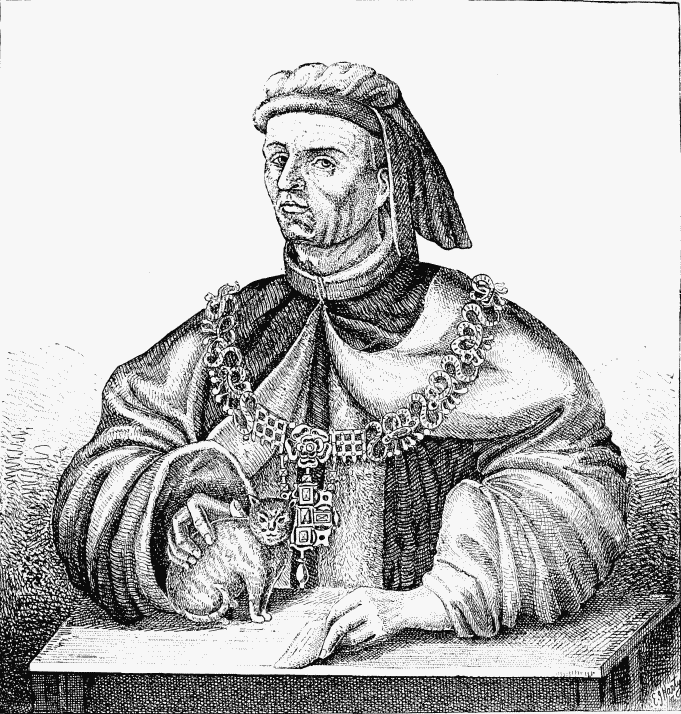
SIR RICHARD WHITTINGTON. (From an old Portrait.)
The presentation to the king, even when he was in England, long remained a great vexation with the London mayors. For instance, in 1240, Gerard Bat, chosen a second time, went to Woodstock Palace to be presented to King Henry III., who refused to appoint him till he (the king) came to London.
Henry III., indeed, seems to have been chronically troubled by the London mayors, for in 1264, on the mayor and aldermen doing fealty to the king in St. Paul's, the mayor, with blunt honesty, dared to say to the weak monarch, "My lord, so long as you unto us will be a good lord and king, we will be faithful and duteous unto you."
These were bold words in a reign when the heading block was always kept ready near a throne. In 1265, the same monarch seized and imprisoned the mayor and chief aldermen for fortifying the City in favour of the barons, and for four years the tvrannical king appointed custodes. The City again recovered its liberties and retained them till 1285 (Edward I.), when Sir Gregory Rokesley refusing to go out of the City to appear before the king's justices at the Tower, the mayoralty was again suspended and custodes appointed till the year 1298, when Henry Wallein was elected mayor. Edward II. also held a tight hand on the mayoralty till he appointed the great goldsmith, Sir Nicholas Farindon, mayor "as long as it pleased him." Farindon gave the title to Farringdon Ward, which had been in his family eighty-two years, the consideration being twenty marks as a fine, and one clove or a slip of gillyflower at the feast of Easter. He was a warden of the Goldsmiths, and was buried at St. Peter-le-Chepe, a church that before the Great Fire stood where the plane-tree now waves at the corner of Wood Street. He left money for a light to burn before our Lady the Virgin in St. Peter-le-Chepe for ever.
The mayoralty of Andrew Aubrey, Grocer (1339), was rather warlike; for the mayor and two of his officers being assaulted in a tumult, two of the ringleaders were beheaded at once in Chepe. In 1356, Henry Picard, mayor of London, was an honoured man, for he had the glory of feasting Edward III. of England, the Black Prince, John King of Austria, the King of Cyprus, and David of Scotland, and afterwards opened his hall to all comers at cards and dice, his wife inviting the court ladies.
Sir William Walworth, a fishmonger, who was mayor in 1374 (Edward III.) and 1380 (Richard II.), was that prompt and choleric man who somewhat basely slew the Kentish rebel, Wat Tyler, when he was invited to a parley by the young king. It was long supposed that the dagger in the City arms was added in commemoration of this foul blow, but Stow has clearly shown that it was intended to represent the sword of St. Paul, the patron saint of the Corporation of London. The manor of Walworth belonged to the family of this mayor, who was buried in the Church of St. Michael, Crooked Lane, the parish where he had resided. Some antiquaries, says Mr. Timbs, think the prefix of "Lord" is traceable to 1378 (1st Richard II.), when there was a general assessment for a war subsidy. The question was where was the mayor to come. "Have him among the earls," was the suggestion; so the right worshipful had to pay £4, about £100 of our present money.
And now we come to a mayor greater even in City story and legend than even Walworth himself, even the renowned Richard Whittington, the hero of our nursery days. He was the son of a Gloucestershire knight, who had fallen into poverty. The industrious son, born in 1350 (Edward III.), on coming to London, was apprenticed to Hugh Fitzwarren, a mercer. Disgusted with the drudgery, he ran away; but while resting by a stone cross at the foot of Highgate Hill, he is said to have heard in the sound of Bow Bells the voice of his good angel, "Turn again, Whittington, thrice Lord Mayor of London." What a charm there is still in the old story! As for the cat that made his fortune by catching all the mice in Barbary, we fear we must throw him overboard, even though Stow tells a true story of a man and a cat that greatly resembles that told of Whittington. Whittington married his master's daughter, and became a wealthy merchant. He supplied the wedding trousseau of the Princess Blanche, eldest daughter of Henry IV., when she married the son of the King of the Romans, and also the pearls and cloth of gold for the marriage of the Princess Philippa. He became the court banker, and lent large sums of money to our lavish monarchs, especially to the chivalrous Henry V. for carrying on the siege of Harfleur, a siege celebrated by Shakespeare. It is said that in his last mayoralty King Henry V. and Queen Catherine dined with him in the City, when Whittington caused a fire to be lighted of precious woods, mixed with cinnamon and other spices; and then taking all the bonds given him by the king for money lent, amounting to no less than £60,000, he threw them into the fire and burnt them, thereby freeing his sovereign from his debts. The king, astonished at such a proceeding, exclaimed, "Surely, never had king such a subject;" to which Whittington, with court gallantry, replied, "Surely, sire, never had subject such a king."
Whittington was really four times mayor—twice in Richard II.'s reign, once in that of Henry IV., and once in that of Henry V. As a mayor Whittington was popular, and his justice and patriotism became proverbial. He vigorously opposed the admission of foreigners into the freedom of the City, and he fined the Brewers' Company £20 for selling bad ale and forestalling the market. His generosity was like a well-spring; and being childless, he spent his life in deeds of charity and generosity. He erected conduits at Cripplegate and Billingsgate; he founded a library at the Grey Friars' Monastery in Newgate Street (now Christ's Hospital); he procured the completion of the "Liber Albus," a book of City customs; and he gave largely towards the Guildhall library. He paved the Guildhall, restored the hospital of St. Bartholomew, and by his will left money to rebuild Newgate, and erect almshouses on College Hill (now removed to Highgate) He died in 1427 (Henry VI.). Nor should we forget that Whittington was also a great architect, and enlarged the nave of Westminster Abbey for his knightly master, Henry V. This large-minded and munificent man resided in a grand mansion in Hart Street, up a gateway a few doors from Mark Lane. A very curious old house in Sweedon's Passage, Grub Street, with an external winding staircase, used to be pointed out as Whittington's; and the splendid old mansion in Hart Street, Crutched Friars, pulled down in 1861, and replaced by offices and warehouses, was said to have cats'-heads for knockers, and cats'-heads (whose eyes seemed always turned on you) carved in the ceilings. The doorways, and the brackets of the long lines of projecting Tudor windows, were beautifully carved with grotesque figures.
In 1418 (Henry V.) Sir William de Sevenoke was mayor. This rich merchant had risen to the top of the tree by cleverness and diligence equal to that of Whittington, but we hear less of his charity. He was a foundling, brought up by charitable persons, and apprenticed to a grocer. He was knighted by Henry VI., and represented the City in Parliament. Dying in 1432, he was buried at St. Martin's, Ludgate.
In 1426 (Henry VI.) Sir John Rainewell, mayor, with a praiseworthy disgust at all dishonesty in trade, detecting Lombard merchants adulterating their wines, ordered 150 butts to be stove in and swilled down the kennels. How he might wash down London now with cheap sherry!
In 1445 (Henry VI.), Sir Simon Eyre. This very worthy mayor left 3,000 marks to the Company of Drapers, for prayers to be read to the market people by a priest in the chapel at Guildhall.
It is related that when it was proposed to Eyre at Guildhall that he should stand for sheriff, he would fain have excused himself, as he did not think his income was sufficient; but he was soon silenced by one of the aldermen observing "that no citizen could be more capable than the man who had openly asserted that he broke his fast every day on a table for which he would not take a thousand pounds." This assertion excited the curiosity of the then Lord Mayor and all present, in consequence of which his lordship and two of the aldermen, having invited themselves, accompanied him home to dinner. On their arrival Mr. Eyre desired his wife to "prepare the little table, and set some refreshment before the guests." This she would fain have refused, but finding he would take no excuse, she seated herself on a low stool, and, spreading a damask napkin over her lap, with a venison pasty thereon, Simon exclaimed to the astonished mayor and his brethren, "Behold the table which I would not take a thousand pounds for!" Soon after this Sir Simon was chosen Lord Mayor, on which occasion, remembering his former promise "at the conduit," he, on the following Shrove Tuesday, gave a pancake feast to all the 'prentices in London; on which occasion they went in procession to the Mansion House, where they met with a cordial reception from Sir Simon and his lady, who did the honours of the table on this memorable day, allowing their guests to want for neither ale nor wine.
In 1453 Sir John Norman was the first mayor who rowed to Westminster. The mayors had hitherto generally accompanied the presentation show on horseback. The Thames watermen, delighted with the innovation so profitable to them, wrote a song in praise of Norman, two lines of which are quoted by Fabyan in his "Chronicles;" and Dr. Rimbault, an eminent musical antiquary, thinks he has found the original tune in John Hilton's "Catch That, Catch Can" (1658).
The deeds of Sir Stephen Forster, Fishmonger, and mayor 1454 (Henry VI.), who by his will left money to rebuild Newgate, we have mentioned elsewhere (p. 224). Sir Godfrey Boleine, Lord Mayor, 1457 (Henry VI.), was grandfather to Thomas, Earl of Wiltshire, the grandfather of Queen Elizabeth. He was a mercer in the Old Jewry, and left by his will £1,000 to the poor householders of London, and £2,000 to the poor householders in Norfolk (his native county), besides large legacies to the London prisons, lazarhouses, and hospitals. Such were the citizens, from whom half our aristocracy has sprung. Sir Godfrey Fielding, a mercer in Milk Street, Lord Mayor in 1452 (Henry VI.), was the ancestor of the Earls of Denbigh, and a privy councillor of the king.
In Edward IV.'s reign, when the Lancastrians, under the bastard Falconbridge, stormed the City in two places, but were eventually bravely repulsed by the citizens, Edward, in gratitude, knighted the mayor, Sir John Stockton, and twelve of the aldermen. In 1479 (the same reign) Bartholomew James (Draper) had Sheriff Bayfield fined £50 (about £1,000 of our money) for kneeling too close to him while at prayers in St. Paul's, and for reviling him when complained of. There was a pestilence raging at the time, and the mayor was afraid of contagion. The money went, we presume, to build ten City conduits, then much wanted. The Lord Mayor in 1462, Sir Thomas Coke (Draper), ancestor of Lord Bacon, Earl Fitzwilliam, the Marquis of Salisbury, and Viscount Cranbourne. being a Lancastrian, suffered much from the rapacious tyranny of Edward IV. The very year he was made Knight of the Bath, Coke was sent to the Bread Street Compter, afterwards to the Bench, and illegally fined £8,000 to the king and £800 to the queen. Two aldermen also had their goods seized, and were fined 4,000 marks. In 1473 this greedy king sent to Sir William Hampton, Lord Mayor, to extort benevolences, or subsidies. The mayor gave £30, the aldermen twenty marks, the poorer persons £10 each. In 1481, King Edward sent the mayor, William Herriot (Draper), for the good he had done to trade, two harts, six bucks, and a tun of wine, for a banquet to the lady mayoress and the aldermen's wives at Drapers' Hall.
At Richard III.'s coronation (1483), the Lord Mayor, Sir Richard Shaw, attended as cup-bearer with great pomp, and the mayor's claim to this honour was formally allowed and put on record. Shaw was a goldsmith, and supplied the usurper with most of his plate. Sir Walter Horn, Lord Mayor in 1487, had been knighted on Bosworth field by Henry VII., for whom he fought against the "ravening Richard." This mayor's real name was Littlesbury (we are told), but Edward IV. had nicknamed him Horn, from his peculiar skill on that instrument. The year Henry VII. landed at Milford Haven two London mayors died. In 1486 (Henry VII.), Sir Henry Colet, father of good Dean Colet, who founded St. Paul's School, was mayor.
Colet chose John Percival (Merchant Taylor), his carver, sheriff, by drinking to him in a cup of wine, according to custom, and Perceval forthwith sat down at the mayor's table. Percival was afterwards mayor in 1498. Henry VII. was remorseless in squeezing money out of the City by every sort of expedient. He fined Alderman Capel £2,700; he made the City buy a confirmation of their charter for £5,000; in 1500 he threw Thomas Knesworth, who had been mayor the year before, and his sheriff, into the Marshalsea, and fined them £1,400; and the year after, he imprisoned Sir Lawrence Aylmer, mayor in the previous year, and extorted money from him. He again amerced Alderman Capel (ancestor of the Earls of Essex) £2,000, and on his bold resistance, threw him into the Tower for life. In 1490 (Henry VII.) John Matthew earned the distinction of being the first, but probably not the last, bachelor Lord Mayor; and a cheerless mayoralty it must have been. In 1502 Sir John Shaw held the Lord Mayor's feast for the first time in the Guildhall; and the same hospitable mayor built the Guildhall kitchen at his own expense.
Henry VIII.'s mayors were worshipful men, and men of renown. To Walworth and Whittington was now to be added the illustrious name of Gresham. Sir Richard Gresham, who was mayor in the year 1537, was the father of the illustrious founder of the Royal Exchange. He was of a Norfolk family, and with his three brothers carried on trade as mercers. He became a Gentleman Usher Extraordinary to Henry VIII., and at the tearing to pieces of the monasteries by that monarch, he obtained, by judicious courtliness, no less than five successive grants of Church lands. He advocated the construction of an Exchange, encouraged freedom of trade, and is said to have invented bills of exchange. In 1525 he was nearly expelled the Common Council for trying, at Wolsey's instigation, to obtain a benevolence from the citizens. It is greatly to Gresham's credit that he helped Wolsey after his fall, and Henry, who with all his faults was magnanimous, liked Gresham none the worse for that. In the interesting "Paxton Letters" (Henry VI.), there are eleven letters of one of Gresham's Norfolk ancestors, dated from London, and the seal a grasshopper. Sir Richard Gresham died 1548 (Edward VI.), at Bethnal Green, and was buried in the church of St. Lawrence Jewry. Gresham's daughter married an ancestor of the Marquis of Bath, and the Duke of Buckingham and Lord Braybrooke are said to be descendants of his brother John, so much has good City blood enriched our proud Norman aristocracy, and so often has the full City purse gone to fill again the exhausted treasury of the old knighthood. In 1545, Sir Martin Bowes (Goldsmith) was mayor, and lent Henry VIII., whose purse was a cullender, the sum of £300. Sir Martin was butler at Elizabeth's coronation, and left the Goldsmiths' Company his gold fee cup, out of which the Queen drank. In our history of the Goldsmiths' Company we have mentioned his portrait in Goldsmiths' Hall. Alderman William Fitzwilliam, in this reign, also nobly stood by his patron, Wolsey, after his fall; for which the King, saying he had too few such servants, knighted him and made him a Privy Councillor. When he died, in the year 1542, he was Knight of the Garter, Lord Keeper of the Privy Seal, and Chancellor of the Duchy of Lancaster. He left £100 to dower poor maidens, and his best "standing cup" to his brethren, the Merchant Taylors. In 1536 the King invited the Lord Mayor, Sir Raphe Warren (an ancestor of Cromwell and Hampden, says Mr. Orridge), the aldermen, and forty of the principal citizens, to the christening of the Princess Elizabeth, at Greenwich; and at the ceremony the scarlet gowns and gold chains made a gallant show.
In Edward VI's reign, the Greshams again came to the front. In 1547, Sir John Gresham, brother of the Sir Richard before mentioned, obtained from Henry VIII. the hospital of St. Mary Bethlehem as an asylum for lunatics.
In this reign the City Corporation lands (as being given by Papists for superstitious uses) were all claimed for the King's use, to the amount of £1,000 per annum. The London Corporation, unable to resist this tyranny, had to retrieve them at the rate of twenty years' purchase. Sir Andrew Judd (Skinner), mayor in 1550, was ancestor of Lord Teynham, Viscount Strangford, Chief Baron Smythe, &c. Among the bequests in his will were "the sandhills at the back side of Holborn," then let for a few pounds a year, now worth nearly £20,000 per annum. In 1553, Sir Thomas White (Merchant Taylor) kept the citizens loyal to Queen Mary during Wyatt's rebellion, the brave Queen coming to Guildhall and personally re-assuring the citizens. White was the son of a poor clothier; at the age of twelve he was apprenticed to a London tailor, who left him £100 to begin the world with, and by thrift and industry he rose to wealth. He was the generous founder of St. John's College, Oxford. According to Webster, the poet, he had been directed in a dream to found a college upon a spot where he should find two bodies of an elm springing from one root. Discovering no such tree at Cambridge, he went to Oxford, and finding a likely tree in Gloucester Hall garden, began at once to enlarge and widen that college; but soon after he found the real tree of his dream, outside the north gate of Oxford, and on that spot he founded St. John's College.
In the reign of Elizabeth, many great-hearted citizens served the office of mayor. Again we shall see how little even the best monarchs of these days understood the word "liberty," and how the constant attacks upon their purses taught the London citizens to appreciate and to defend their rights. In 1559, Sir William Hewet (Clothworker) was mayor, whose income is estimated at £6,000 per annum. Hewet lived on London Bridge, and one day a nurse playing with his little daughter Anne, at one of the broad lattice windows overlooking the Thames, by accident let the child fall. A young apprentice, named Osborne, seeing the accident, leaped from a window into the fierce current below the arches, and saved the infant. Years after, many great courtiers, including the Earl of Shrewsbury, came courting fair Mistress Anne, the rich citizen's heiress. Sir William, her father, said to one and all, "No; Osborne saved her, and Osborne shall have her." And so Osborne did, and became a rich citizen and Lord Mayor in 1583. He is the direct ancestor of the first Duke of Leeds. There is a portrait of the brave apprentice at Kiveton House, in Yorkshire. He dwelt in Philpot Lane, in his father-in-law's house, and was buried at St. Dionis Backchurch, Fenchurch Street.
In 1563 Lord Mayor Lodge got into a terrible scrape with Queen Elizabeth, who brooked no opposition, just or unjust. One of the Queen's insolent purveyors, to insult the mayor, seized twelve capons out of twenty-four destined for the mayor's table. The indignant mayor took six of the twelve fowls, called the purveyor a scurvy knave, and threatened him with the biggest pair of irons in Newgate. In spite of the intercession of Lord Robert Dudley (Leicester) and Secretary Cecil, Lodge was fined and compelled to resign his gown. Lodge was the father of the poet, and engaged in the negro trade. Lodge's successor, Sir Thomas Ramsay, died childless, and his widow left large sums to Christ's Hospital and other charities, and £1,200 to each of five City Companies; also sums for the relief of poor maimed soldiers, poor Cambridge scholars, and for poor maids' marriages.
Sir Rowland Heyward (Clothworker), mayor in 1570. He was an ancestor of the Marquis of Bath, and the father of sixteen children, all of whom are displayed on his monument in St. Alphege, London Wall.
Sir Wolston Dixie, 1585 (Skinner) was the first mayor whose pageant was published. It forms the first chapter of the many volumes relating to pageants collected by that eminent antiquary, the late Mr. Fairholt, and bequeathed by him to the Society of Antiquaries. Dixie assisted in building Peterhouse College, Cambridge. In 1594, Sir John Spencer (Clothworker)—"rich Spencer," as he was called—kept his mayoralty at Crosby Place, Bishopsgate. His only daughter married Lord Compton, who, tradition says, smuggled her away from her father's house in a large flap-topped baker's basket. A curious letter from this imperious lady is extant, in which she only requests an annuity of £2,200, a like sum for her privy purse, £10,000 for jewels, her debts to be paid, horses, coach, and female attendants, and closes by praying her husband, when he becomes an earl, to allow her £1,000 more with double attendance. These young citizen ladies were somewhat exacting. From this lady's husband the Marquis of Northampton is descended. At the funeral of "rich Spencer," 1,000 persons followed in mourning cloaks and gowns. He died worth, Mr. Timbs calculates, above £800,000 in the year of his mayoralty. There was a famine in England in his time, and at his persuasion the City Companies bought corn abroad, and stored it in the Bridge House for the poor.
In 1609, Sir Thomas Campbell (Ironmonger), mayor, the City show was revived by the king's order. In 1611, Sir William Craven (Draper) was mayor. As a poor Yorkshire boy from Wharfedale, he came up to London in a carrier's cart to seek his fortune. He was the father of that brave soldier of Gustavus Adolphus who is supposed to have privately married the widowed Queen of Bohemia, James I.'s daughter. There is a tradition that during an outbreak of the plague in London, Craven took horse and galloped westward till he reached a lonely farmhouse on the Berkshire downs, and there built Ashdown House. The local legend is that four avenues led to the house from the four points of the compass, and that in each of the four walls there was a window, so that if the plague got in at one side it might go out at the other. In 1612, Sir John Swinnerton (Merchant Taylor), mayor, entertained the Count Palatine, who had come over to marry King James's daughter. The Archbishop of Canterbury, the Bishop of London, and many earls and barons were present. The Lord Mayor and his brethren presented the Palsgrave with a large basin and ewer, weighing 234 ounces, and two great gilt loving pots. The bridegroom elect gained great popularity by saluting the Lady Mayoress and her train. The pageant was written by the poet Dekker. In this reign King James, colonising Ulster with Protestants, granted the province with Londonderry and Coleraine to the Corporation, the twelve great and old Companies taking many of the best. In 1613, Sir Thomas Middleton (Goldsmith), Basinghall Street, brother of Sir Hugh Middleton, went in state to see the water enter the New River Head at Islington, to the sound of drums and trumpets and the roar of guns. In 1618, Sir Sebastian Harvey (Ironmonger) was mayor: during his show Sir Walter Raleigh was executed, the time being specially chosen to draw away the sympathisers "from beholding," as Aubrey says, "the tragedy of the gallantest worthy that England ever bred."
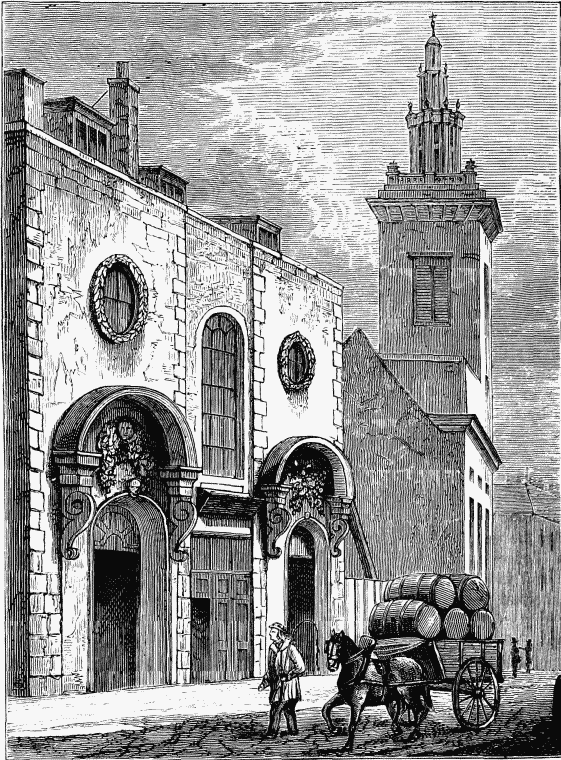
WHITTINGTON'S ALMHOUSES, COLLEGE HILL (see page 398).
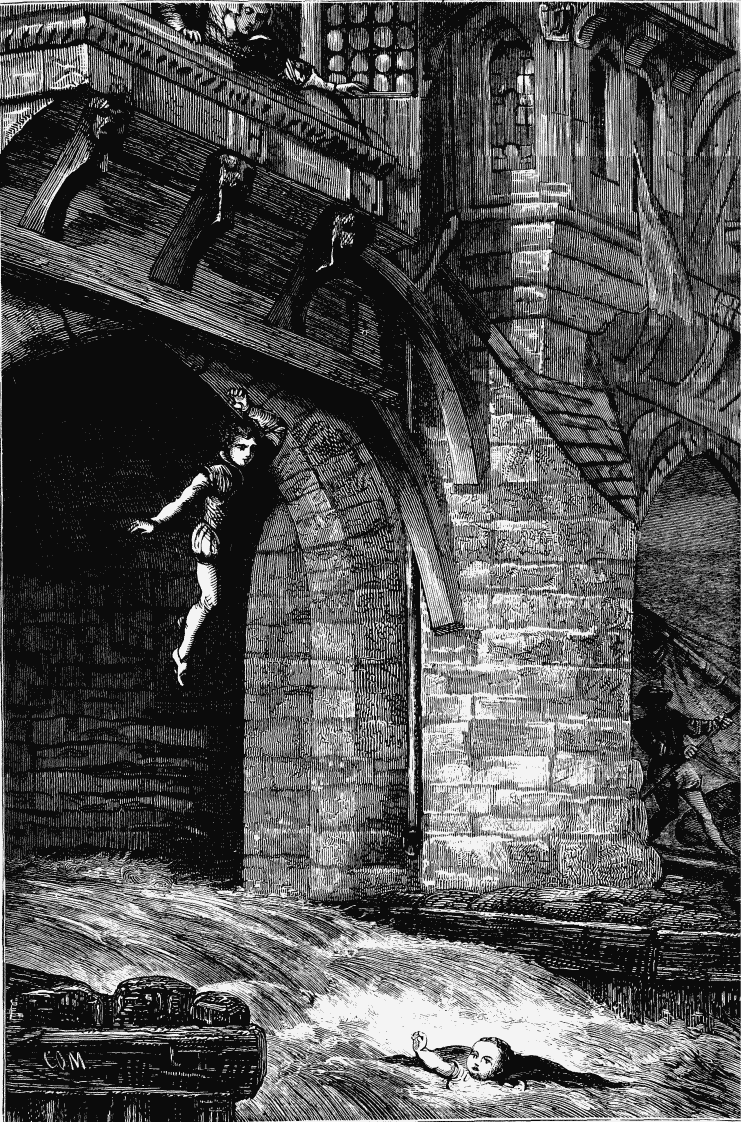
OSBORNE'S LEAP (see page 401).
In 1641 Sir Richard Gurney (Clothworker), and a sturdy Royalist, entertained that promise-breaking king, Charles I., at the Guildhall. The entertainment consisted of 500 dishes. Gurney's master, a silk mercer in Cheapside, left him his shop and £6,000. The Parliament ejected him from the mayoralty and sent him to the Tower, where he lingered for seven years till he died, rather than pay a fine of £5,000, for refusing to publish an Act for the abolition of royalty. He was president of Christ's Hospital. His successor, Sir Isaac Pennington (Fishmonger), was one of the king's judges, who died in the Tower; Sir Thomas Atkins (Mercer), mayor in 1645, sat on the trial of Charles I.; Sir Thomas Adams (Draper), mayor in 1646, was also sent to the Tower for refusing to publish the Abolition of Royalty Act. He founded an Arabic lecture at Cambridge, and a grammarschool at Wem, in Shropshire. Sir John Gayer (Fishmonger), mayor in 1647, was committed to the Tower in 1648 as a Royalist, as also was Sir Abraham Reynardson, mayor in 1649. Sir Thomas Foot (Grocer), mayor in 1650, was knighted by Cromwell; two of his daughters married knights, and two baronets. Earl Onslow is one of his descendants. Sir Christopher Packe (Draper), mayor in 1654, became a member of Cromwell's House of Lords as Lord Packe, and from him Sir Dennis Packe, the Peninsula general, was descended.
Sir Robert Tichborne (Skinner), mayor in 1656, sat on the trial of Charles I., and signed the death warrant. Sir Richard Chiverton (Skinner), mayor in 1657, was the first Cornish mayor of London. He was knighted both by Cromwell and by Charles II., which says something for his political dexterity. Sir John Ireton (Clothworker), mayor in 1658, was brother of General Ireton, Cromwell's son-in-law.
The period of the Commonwealth did not furnish many mayors worth recording here. In 1644, the year of Marston Moor, the City gave a splendid entertainment to both Houses of Parliament, the Earls of Essex, Warwick, and Manchester, the Scotch Commissioners, Cromwell, and the principal officers of the army. They heard a sermon at Christ Church, Newgate Street, and went on foot to Guildhall. The Lord Mayor and aldermen led the procession, and as they passed through Cheapside, some Popish pictures, crucifixes, and relics were burnt on a scaffold. The object of the banquet was to prevent a letter of the king's being read in the Common Hall. On January 7th the Lord Mayor gave a banquet to the House of Commons, Cromwell, and the chief officers, to commemorate the rout of the dangerous Levellers. In 1653, the year Cromwell was chosen Lord Protector, he dined at the Guildhall, and knighted the mayor, John Fowke (Haberdasher).
The reign of Charles II. and the Royalist reaction brought more tyranny and more trouble to the City. The king tried to be as despotic as his father, and resolved to break the Whig love of freedom that prevailed among the citizens. Loyal as some of the citizens seem to have been, King Charles scarcely deserved much favour at their hands. A more reckless tyrant to the City had never sat on the English throne. Because they refused a loan of £100,000 on bad security, the king imprisoned twenty of the principal citizens, and required the City to fit out 100 ships. For a trifling riot in the City (a mere pretext), the mayor and aldermen were amerced in the sum of £6,000. For the pretended mismanagement of their Irish estates, the City was condemned to the loss of their Irish possessions and fined £50,000. Four aldermen were imprisoned for not disclosing the names of friends who refused to advance money to the king; and, finally, to the contempt of all constitutional law, the citizens were forbidden to petition the king for the redress of grievances. Did such a king deserve mercy at the hands of the subjects he had oppressed, and time after time spurned and deceived?
In 1661, the year after the Restoration, Sir John Frederick (Grocer), mayor, revived the old customs of Bartholomew's Fair. The first day there was a wrestling match in Moorfields, the mayor and aldermen being present; the second day, archery, after the usual proclamation and challenges through the City; the third day, a hunt. The Fair people considered the three days a great hindrance and loss to them. Pepys, the delightful chronicler of these times, went to this Lord Mayor's dinner, where he found "most excellent venison; but it made me almost sick, not daring to drink wine."
Amidst the factions and the vulgar citizens of this reign, Sir John Lawrence (Grocer), mayor in 1664, stands out a burning and a shining light. When the dreadful plague was mowing down the terrified people of London in great swathes, this brave man, instead of flying quietly, remained at his house in St. Helen's, Bishopsgate, enforcing wise regulations for the sufferers, and, what is more, himself seeing them executed. He supported during this calamity 40,000 discharged servants. In 1666 (the Great Fire) the mayor, Sir Thomas Bludworth (Vintner), whose daughter married Judge Jeffries, is described by Pepys as quite losing his head during the great catastrophe, and running about exclaiming, "Lord, what can I do?" and holding his head in an exhausted and helpless way.
In 1671 Sir George Waterman (mayor, son of a
Southwark vintner) entertained Charles II. at his
inaugural dinner. In the pageant on this occasion,
there was a forest, with animals, wood nymphs, &c.,
and in front two negroes riding on panthers. Near
Milk Street end was a platform, on which Jacob
Hall, the great rope-dancer of the day, and his
company danced and tumbled. There is a mention
of Hall, perhaps on this occasion, in the "State
Poems:"—
"When Jacob Hall on his high rope shows tricks,
The dragon flutters, the Lord Mayor's horse kicks;
The Cheapside crowds and pageants scarcely know
Which most t' admire—Hall, hobby-horse, or Bow."
In 1674 Sir Robert Vyner (Goldsmith) was mayor, and Charles II., who was frequently entertained by the City, dined with him. "The wine passed too freely, the guests growing noisy, and the mayor too familiar, the king," says a correspondent of Steele's (Spectator, 462), "with a hint to the company to disregard ceremonial, stole off to his coach, which was waiting in Guildhall Yard. But the mayor, grown bold with wine, pursued the 'merry monarch,' and, catching him by the hand, cried out, with a vehement oath, 'Sir, you shall stay and take t' other bottle.' The 'merry monarch' looked kindly at him over his shoulder, and with a smile and graceful air (for I saw him at the time, and do now) repeated the line of the old song, 'He that is drunk is as great as a king,' and immediately turned back and complied with his host's request."
Sir Robert Clayton (Draper), mayor in 1679, was one of the most eminent citizens in Charles II.'s reign. The friend of Algernon Sidney and Lord William Russell, he sat in seven Parliaments as representative of the City; was more than thirty years alderman of Cheap Ward, and ultimately father of the City; the mover of the celebrated Exclusion Bill (seconded by Lord William Russell); and eminent alike as a patriot, a statesman, and a citizen. He projected the Mathematical School at Christ's Hospital, built additions there, helped to rebuild the house, and left the sum of £2,300 towards its funds. He was a director of the Bank of England, and governor of the Irish Society. He was mayor during the pretended Popish Plot, and was afterwards marked out for death by King James, but saved by the intercession (of all men in the world !) of Jeffries. This "prince of citizens," as Evelyn calls him, had been apprenticed to a scrivener. He lived in great splendour in Old Jewry, where Charles and the Duke of York supped with him during his mayoralty. There is a portrait of him, worthy of Kneller, in Drapers' Hall, and another, with carved wood frame by Gibbons, in the Guildhall Library.
In 1681, when the reaction came and the Court party triumphed, gaining a verdict of £100,000 against Alderman Pilkington (Skinner), sheriff, for slandering the Duke of York, Sir Patience Ward (Merchant Taylor), mayor in 1680, was sentenced to the ignominy of the pillory. In 1682 (Sir William Pritchard, Merchant Taylor, mayor), Dudley North, brother of Lord Keeper North, was one of the sheriffs chosen by the Court party to pack juries. He was celebrated for his splendid house in Basinghall Street, and Macaulay tells us " that, in the days of judicial butchery, carts loaded with the legs and arms of quartered Whigs were, to the great discomposure of his lady, 'driven to his door for orders.'"
In 1688 Sir John Shorter (Goldsmith), appointed mayor by James II., met his death in a singular manner. He was on his way to open Bartholomew Fair, by reading the proclamation at the entrance to Cloth Fair, Smithfield. It was the custom for the mayors to call by the way on the Keeper of Newgate, and there partake on horseback of a "cool tankard" of wine, spiced with nutmeg and sweetened with sugar. In receiving the tankard Sir John let the lid flop down, his horse started, he was thrown violently, and died the next day. This custom ceased in the second mayoralty of Sir Matthew Wood, 1817. Sir John was maternal grandfather of Horace Walpole. Sir John Houblon (Grocer), mayor in 1695 (William III.), is supposed by Mr. Orridge to have been a brother of Abraham Houblon, first Governor of the Bank of England, and Lord of the Admiralty, and great-grandfather of the late Viscount Palmerston. Sir Humphrey Edwin (Skinner), mayor in 1697, enraged the Tories by omitting the show on religious grounds, and riding to a conventicle with all the insignia of office, an event ridiculed by Swift in his "Tale of a Tub," and Pinkethman in his comedy of Love without Interest (1699), where he talks of "my lord mayor going to Pinmakers' Hall, to hear a snivelling and separatist divine divide and subdivide into the twoand-thirty points of the compass." In 1700 the Mayor was Sir Thomas Abney (Fishmonger), one of the first Directors of the Bank of England, best known as a pious and consistent man, who for thirty-six years kept Dr. Watts, as his guest and friend, in his mansion at Stoke Newington. "No business or festivity," remarks Mr. Timbs, "was allowed to interrupt Sir Thomas's religious observances. The very day he became Lord Mayor he withdrew from the Guildhall after supper, read prayers at home, and then returned to his guests."
In 1702, Sir Samuel Dashwood (Vintner) entertained Queen Anne at the Guildhall, and his was the last pageant ever publicly performed, one for the show of 1708 being stopped by the death of Prince George of Denmark the day before. "The show," says Mr. J. G. Nicholls, "cost £737 2s., poor Settle receiving £10 for his crambo verses." A daughter of this Dashwood became the wife of the fifth Lord Brooke, and an ancestor of the present Earl of Warwick. Sir John Parsons, mayor in 1704, was a remarkable person; for he gave up his official fees towards the payment of the City debts. It was remarked of Sir Samuel Gerrard, mayor in 1710, that three of his name and family were Lord Mayors in three queens' reigns—Mary, Elizabeth, and Anne. Sir Gilbert Heathcote (mayor in 1711), ancestor of Lord Aveland and Viscount Donne, was the last mayor who rode in his procession on horseback; for after this time, the mayors, abandoning the noble career of horsemanship, retired into their gilt gingerbread coach.
Sir William Humphreys, mayor in 1715 (George I.), was father of the City, and alderman of Cheap for twenty-six years. Of his Lady Mayoress an old story is told relative to the custom of the sovereign kissing the Lady Mayoress upon visiting Guildhall. Queen Anne broke down this observance; but upon the accession of George I., on his first visit to the City, from his known character for gallantry, it was expected that once again a Lady Mayoress was to be kissed by the king on the steps of the Guildhall. But he had no feeling of admiration for English beauty. "It was only," says a writer in the Athenæum, "after repeated assurance that saluting a lady, on her appointment to a confidential post near some persons of the Royal Family, was the sealing, as it were, of her appointment, that he expressed his readiness to kiss Lady Cowper on her nomination as lady of the bedchamber to the Princess of Wales. At his first appearance at Guildhall, the admirer of Madame Kielmansegge respected the new observance established by Queen Anne; yet poor Lady Humphreys, the mayoress, hoped, at all events, to receive the usual tribute from royalty from the lips of the Princess of Wales. But that strong-minded woman, Caroline Dorothea Wilhelmina, steadily looked away from the mayor's consort. She would not do what Queen Anne had not thought worth the doing; and Lady Humphreys, we are sorry to say, stood upon her unstable rights, and displayed a considerable amount of bad temper and worse behaviour. She wore a train of black velvet, then considered one of the privileges of City royalty, and being wronged of one, she resolved to make the best of that which she possessed—bawling, as ladies, mayoresses, and women generally should never do—bawling to her page to hold up her train, and sweeping away therewith before the presence of the amused princess herself. The incident altogether seems to have been too much for the good but irate lady's nerves; and unable or unwilling, when dinner was announced, to carry her stupendous bouquet, emblem of joy and welcome, she flung it to a second page who attended on her state, with a scream of 'Boy, take my bucket!' In her view of things, the sun had set on the glory of mayoralty for ever.
"The king was as much amazed as the princess had been amused; and a well-inspired wag of the Court whispered an assurance which increased his perplexity. It was to the effect that the angry lady was only a mock Lady Mayoress, whom the unmarried Mayor had hired for the occasion, borrowing her for that day only. The assurance was credited for a time, till persons more discreet than the wag convinced the Court party that Lady Humphreys was really no counterfeit. She was no beauty either; and the same party, when they withdrew from the festive scene, were all of one mind, that she must needs be what she seemed, for if the Lord Mayor had been under the necessity of borrowing, he would have borrowed altogether another sort of woman." This is one of the earliest stories connecting the City with an idea of vulgarity and purse pride. The stories commenced with the Court Tories, when the City began to resist Court oppression.
A leap now takes us on in the City chronicles.
In 1727 (the year George I. died), the Royal
Family, the Ministry, besides nobles and foreign
ministers, were entertained by Sir Edward Becher,
mayor (Draper). George II. ordered the sum of
£1,000 to be paid to the sheriffs for the relief of
insolvent debtors. The feast cost £4,890. In
1733 (George II.), John Barber—Swift, Pope, and
Bolingbroke's friend—the Jacobite printer who
defeated a scheme of a general excise, was mayor.
Barber erected the monument to Butler, the poet,
in Westminster Abbey, who, by the way, had
written a very sarcastic "Character of an Alderman." Barber's epitaph on the poet's monument
is in high-flown Latin, which drew from Samuel
Wesley these lines:—
"While Butler, needy wretch! was yet alive,
No generous patron would a dinner give.
See him, when starved to death, and turned to dust,
Presented with a monumental bust.
The poet's fate is here in emblem shown—
He asked for bread, and he received a stone."
In 1739 (George II.) Sir Micajah Perry (Haberdasher) laid the first stone of the Mansion House. Sir Samuel Pennant (mayor in 1750), kinsman of the London historian, died of gaol fever, caught at Newgate, and which at the same time carried off an alderman, two judges, and some disregarded commonalty. The great bell of St. Paul's tolled on the death of the Lord Mayor, according to custom. Sir Christopher Gascoigne (1753), an ancestor of the present Viscount Cranbourne, was the first Lord Mayor who resided at the Mansion House.
In that memorable year (1761) when Sir Samuel Fludyer was elected, King George III. and Queen Charlotte (the young couple newly crowned) came to the City to see the Lord Mayor's Show from Mr. Barclay's window, as we have already described in our account of Cheapside; and the ancient pageant was so far revived that the Fishmongers ventured on a St. Peter, a dolphin, and two mermaids, and the Skinners on Indian princes dressed in furs. Sir Samuel Fludyer was a Cloth Hall factor, and the City's scandalous chronicle says that he originally came up to London attending clothier's pack-horses, from the west country; his second wife was granddaughter of a nobleman, and niece of the Earl of Cardigan. His sons married into the Montagu and Westmoreland families, and his descendants are connected with the Earls Onslow and Brownlow; and he was very kind to young Romilly, his kinsman (afterwards the excellent Sir Samuel). The "City Biography" says Fludyer died from vexation at a reprimand given him by the Lord Chancellor, for having carried on a contraband trade in scarlet cloth, to the prejudice of the East India Company. Sir Samuel was the ground landlord of Fludyer Street, Westminster, cleared away for the new Foreign Office.
In 1762 and again in 1769 that bold citizen, William Beckford, a friend of the great Chatham, was Lord Mayor. He was descended from a Maidenhead tailor, one of whose sons made a fortune in Jamaica. At Westminster School he had acquired the friendship of Lord Mansfield and a rich earl. Beckford united in himself the following apparently incongruous characters. He was an enormously rich Jamaica planter, a merchant, a member of Parliament, a militia officer, a provincial magistrate, a London alderman, a man of pleasure, a man of taste, an orator, and a country gentleman. He opposed Government on all occasions, especially in bringing over Hessian troops, and in carrying on a German war. His great dictum was that under the House of Hanover Englishmen for the first time had been able to be free, and for the first time had determined to be free. He presented to the king a remonstrance against a false return made at the Middlesex election. The king expressed dissatisfaction at the remonstrance, but Beckford presented another, and to the astonishment of the Court, added the following impromptu speech:—
"Permit me, sire, to observe," are said to have been the concluding remarks of the insolent citizen, "that whoever has already dared, or shall hereafter endeavour by false insinuations and suggestions to alienate your Majesty's affections from your loyal subjects in general, and from the City of London in particular, and to withdraw your confidence in, and regard for, your people, is an enemy to your Majesty's person and family, a violator of the public peace, and a betrayer of our happy constitution as it was established at the Glorious and Necessary Revolution." At these words the king's countenance was observed to flush with anger. He still, however, presented a dignified silence; and accordingly the citizens, after having been permitted to kiss the king's hand, were forced to return dissatisfied from the presence-chamber.
This speech, which won Lord Chatham's "admiration, thanks, and affection," and was inscribed on the pedestal of Beckford's statue erected in Guildhall, has been the subject of bitter disputes. Isaac Reed boldly asserts every word was written by Horne Tooke, and that Horne Tooke himself said so. Gifford, with his usual headlong partisanship, says the same; but there is every reason to suppose that the words are those uttered by Beckford with but one slight alteration. Beckford died, a short time after making this speech, of a fever, caught by riding from London to Fonthill, his Wiltshire estate. His son, the novelist and voluptuary, had a long minority, and succeeded at last to a million ready money and £100,000 a year, only to end life a solitary, despised, exiled man. One of his daughters married the Duke of Hamilton.
The Right Hon. Thomas Harley, Lord Mayor in 1768, was a brother of the Earl of Oxford. He turned wine-merchant, and married the daughter of his father's steward, according to the scandalous chronicles in the "City Biography." He is said, in partnership with Mr. Drummond, to have made £600,000 by taking a Government contract to pay the English army in America with foreign gold. He was for many years "the father of the City."
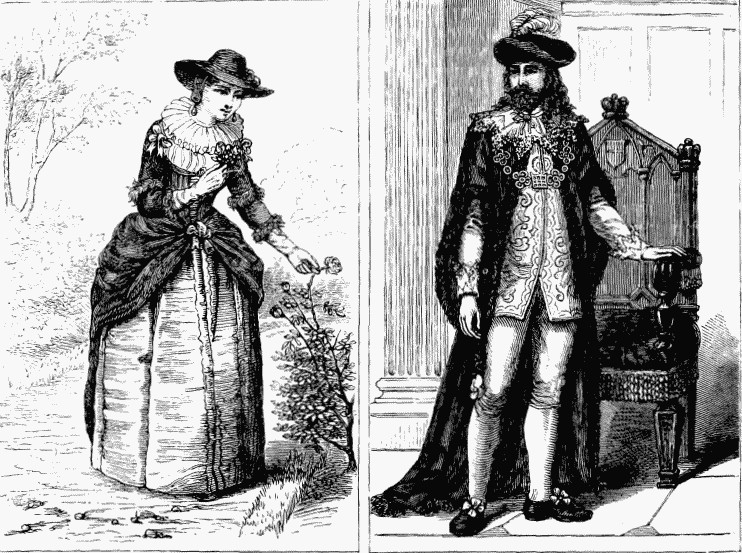
A LORD MAYOR AND HIS LADY (MIDDLE OF SEVENTEENTH CENTURY). From on Old Print.
Harley first rendered himself famous in the City by seizing the boot and petticoat which the mob were burning opposite the Mansion House, in derision of Lord Bute and the princess-dowager, at the time the sheriffs were burning the celebrated North Briton. The mob were throwing the papers about as matter of diversion, and one of the bundles fell, unfortunately, with considerable force, against the front glass of Mr. Sheriff Harley's chariot, which it shattered to pieces. This gave the first alarm; the sheriffs retired into the Mansion House, and a man was taken up and brought there for examination, as a person concerned in the riot. The man appeared to be a mere idle spectator, but the Lord Mayor informed the court that, in order to try the temper of the mob, he had ordered one of his own servants to be dressed in the clothes of the supposed offender, and conveyed to the Poultry Compter, so that if a rescue should be effected, the prisoner would still be in custody, and the real disposition of the people discovered. However, everything was peaceable, and the course of justice was not interrupted, nor did any insult accompany the commitment; whereupon the prisoner was discharged. What followed, in the actual burning of the seditious paper, the Lord Mayor declared (according to the best information), arose from circumstances equally foreign to any illegal or violent designs. For these reasons his lordship concluded by declaring that, with the greatest respect for the sheriffs, and a firm belief that they would have done their duty in spite of any danger, he should put a negative upon giving the thanks of the City upon a matter that was not sufficiently important for a public and solemn acknowledgment, which ought only to follow the most eminent exertions of duty.
In 1770 Brass Crosby (mayor) signalised himself by a patriotic resistance to Court oppression, and the arbitrary proceedings of the House of Commons. He was a Sunderland solicitor, who had married his employer's widow, and settled in London. He married in all three wives, and is said to have received £200,000 by the three. Shortly after Crosby's election, the House of Commons issued warrants against the printers of the Middlesex Journal and the Gazetteer, for presuming to give reports of the debates; but on being brought before Alderman Wilkes, he discharged them. The House then proceeded against the printer of the Evening Post, but Crosby discharged him, and committed the messenger of the House for assault and false imprisonment. Not long after, Crosby appeared at the bar of the House, and defended what he had done; pleading strongly that by an Act of William and Mary no warrant could be executed in the City but by its ministers. Wilkes also had received an order to attend at the bar of the House, but refused to comply with it, on the ground that no notice had been taken in the order of his being a member. The next day the Lord Mayor's clerk attended with the Book of Recognisances, and Lord North having carried a motion that the recognisance be erased, the clerk was compelled to cancel it. Most of the Opposition indignantly rose and left the House, declaring that effacing a record was an act of the greatest despotism; and Junius, in Letter 44, wrote; "By mere violence, and without the shadow of right, they have expunged the record of a judicial proceeding." Soon after this act, on the motion of Welbore Ellis, the mayor was committed to the Tower. The people were furious; Lord North lost his cocked hat, and even Fox had his clothes torn; and the mob obtaining a rope, but for Crosby's entreaties, would have hung the Deputy Sergeant-at-Arms. The question was simply whether the House had the right to despotically arrest and imprison, and to supersede trial by jury. On the 8th of May the session terminated, and the Lord Mayor was released. The City was illuminated at night, and there were great rejoicings. The victory was finally won. The great end of the contest," says Mr. Orridge, "was obtained. From that day to the present the House of Commons has never ventured to assail the liberty of the press, or to prevent the publication of the Parliamentary debates."
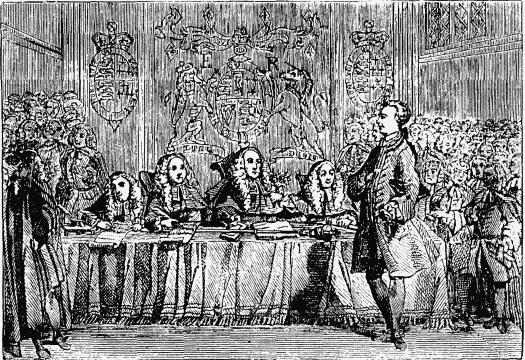
WILKES ON HIS TRIAL (From a Contemporary Paint)
At his inauguration dinner in Guildhall, there was a superabundance of good things; notwithstanding which, a great number of young fellows, after the dinner was over, being heated with liquor, got upon the hustings, and broke all the bottles and glasses within their reach. At this time the Court and Ministry were out of favour in the City; and till the year 1776, when Halifax took as the legend of his mayoralty" Justice is the ornament and protection of liberty," no member of the Government received an invitation to dine at Guildhall.
CHAPTER XXXV.
THE LORD MAYORS OF LONDON (continued).
John Wilkes: his Birth and Parentage—The North Briton—Duel with Martin—His Expulsion—Personal Appearance—Anecdotes of Wilkes— A Reason for making a Speech—Wilkes and the King—The Lord Mayor at the Gordon Riots—"Soap-suds" versus "Bar"—Sir William Curtis and his Kilt—A Gambling Lord Mayor—Sir William Staines, Bricklayer and Lord Mayor—" Patty-pan" Birch—Sir Matthew Wood —Waithman—Sir Peter Laurie and the "Dregs of the People"—Recent Lord Mayors.
In 1774 that clever rascal, John Wilkes, ascended the civic throne. We shall so often meet this unscrupulous demagogue about London, that we will not dwell upon him here at much length. Wilkes was born in Clerkenwell, 1727. His father, Israel Wilkes, was a rich distiller (as his father and grandfather had been), who kept a coach and six, and whose house was a resort of persons of rank, merchants, and men of letters. Young Wilkes grew up a man of pleasure, squandered his wife's fortune in gambling and other fashionable vices, and became a notorious member of the Hell Fire Club at Medmenham Abbey. He now eagerly strove for place, asking Mr. Pitt to find him a post in the Board of Trade, or to send him as ambassador to Constantinople. Finding his efforts useless, he boldly avowed his intention of becoming notorious by assailing Government. In 1763, in his scurrilous paper, the North Britain, he violently abused the Princess Dowager and her favourite Lord Bute, who were supposed to influence the young king, and in the celebrated No. 45 he accused the ministers of putting a lie in the king's mouth. The Governement illegally arresting him by an arbitrary "general warrant," he was committed to the Tower, and at once became the martyr of the people and the idol of the City. Released by Chief-Justice Pratt, he was next proceeded against for an obscene poem, the "Essay on Woman." He fought a duel with Samuel Martin, a brother M.P., who had insulted him, and was expelled the House in 1764. He then went to France in the height of his popularity, having just obtained a verdict in his favour upon the question of the warrant. On his return to England, he daringly stood for the representation of London, and was elected for Middlesex. Riots took place, a man was shot by the soldiers, and Wilkes was committed to the King's Bench prison. After a long contest with the Commons, Wilkes was expelled the House, and being re-elected for Middlesex, the election was declared void.
Eventually Wilkes became Chamberlain of the City, lectured refractory apprentices like a father, and tamed down to an ordinary man of the world, still shameless, ribald, irreligious, but, as Gibbon says, "a good companion with inexhaustible spirits, infinite wit and humour, and a great deal of knowledge." He quietly took his seat for Middlesex in 1782, and eight years afterwards the resolutions against him were erased from the Journals of the House. He died in 1797, at his house in Grosvenor Square. Wilkes' sallow face, sardonic squint, and projecting jaw, are familiar to us from Hogarth's terrible caricature. He generally wore the dress of a colonel of the militia—scarlet and buff, with a cocked hat and rosette, bag wig, and military boots, and O'Keefe describes seeing him walking in from his house at Kensington Gore, disdaining all offers of a coach. Dr. Franklin, when in England, describes the mob stopping carriages, and compelling their inmates to shout "Wilkes and liberty!" For the first fifteen miles out of London on the Winchester road, he says, and on nearly every door or window-shutter, "No. 45" was chalked. By many Tory writers Wilkes is considered latterly to have turned his coat, but he seems to us to have been perfectly consistent to the end. He was always a Whig with aristocratic tastes. When oppression ceased he ceased to protest. Most men grow more Conservative as their minds weaken, but Wilkes was always resolute for liberty.
A few anecdotes of Wilkes are necessary for seasoning to our chapter.
Horne Tooke having challenged Wilkes, who was then sheriff of London and Middlesex, received the following laconic reply: "Sir, I do not think it my business to cut the throat of every desperado that may be tired of his life; but as I am at present High Sheriff of the City of London, it may shortly happen that I shall have an opportunity of attending you in my civil capacity, in which case I will answer for it that you shall have no ground to complain of my endeavours to serve you." This is one of the bitterest retorts ever uttered. Wilkes's notoriety led to his head being painted as a public-house sign, which, however, did not invariably raise the original in estimation. An old lady, in passing a public-house distinguished as above, her companion called her attention to the sign. "Ah!" replied she, "Wilkes swings everywhere but where he ought." Wilkes's squint was proverbial; yet even this natural obliquity he turned to humorous account. When Wilkes challenged Lord Townshend, he said, "Your lordship is one of the handsomest men in the kingdom, and I am one of the ugliest. Yet, give me but half an hour's start, and I will enter the lists against you with any woman you choose to name."
Once, when the house seemed resolved not to hear him, and a friend urged him to desist— "Speak," he said, "I must, for my speech has been in print for the newspapers this half-hour." Fortunately for him, he was gifted with a coolness and effrontery which were only equalled by his intrepidity, all three of which qualities constantly served his turn in the hour of need. As an instance of his audacity, it may be stated that on one occasion he and another person put forth, from a private room in a tavern, a proclamation commencing—"We, the people of England," &c., and concluding—"By order of the meeting." Another amusing instance of his effrontery occurred on the hustings at Brentford, when he and Colonel Luttrell were standing there together as rival candidates for the representation of Middlesex in Parliament. Looking down with great apparent apathy on the sea of human beings, consisting chiefly of his own votaries and friends, which stretched beneath him—"I wonder," he whispered to his opponent, "whether among that crowd the fools or the knaves predominate?" "I will tell them what you say," replied the astonished Luttrell, "and thus put an end to you." Perceiving that Wilkes treated the threat with the most perfect indifference— "Surely," he added, "you don't mean to say you could stand here one hour after I did so?" "Why not?" replied Wilkes; "it is you who would not be alive one instant after." "How so?" inquired Luttrell. "Because," said Wilkes, "I should merely affirm that it was a fabrication, and they would destroy you in the twinkling of an eye."
During his latter days Wilkes not only became a courtier, but was a frequent attendant at the levees of George III. On one of these occasions the King happened to inquire after his old friend "Sergeant Glynn," who had been Wilkes's counsel during his former seditious proceedings. "My friend, sir!" replied Wilkes; "he is no friend of mine; he was a Wilkite, sir, which I never was."
He once dined with George IV. when Prince of Wales, when overhearing the Prince speak in rather disparaging language of his father, with whom he was then notoriously on bad terms, he seized an opportunity of proposing the health of the King. "Why, Wilkes," said the Prince, "how long is it since you became so loyal?" "Ever since, sir," was the reply, "I had the honour of becoming acquainted with your Royal Highness."
Alderman Sawbridge (Framework Knitter), mayor in 1775, on his return from a state visit to Kew with all his retinue, was stopped and stripped by a single highwayman. The sword-bearer did not even attempt to hew down the robber.
In 1780, Alderman Kennet (Vintner) was mayor during the Gordon riots. He had been a waiter and then a wine merchant, was a coarse and ignorant man, and displayed great incompetence during the week the rioters literally held London. When he was summoned to the House, to be examined about the riots, one of the members observed, "If you ring the bell, Kennet will come in, of course." On being asked why he did not at the outset send for the posse comitatus, he replied he did not know where the fellow lived, or else he would. One evening at the Alderman's Club, he was sitting at whist, next Mr. Alderman Pugh, a soap-boiler. "Ring the bell, Soap-suds," said Kennet. "Ring it yourself, Bar," replied Pugh; "you have been twice as much used to it as I have." There is no disgrace in having been a soap-boiler or a wine merchant; the true disgrace is to be ashamed of having carried on an honest business.
Alderman Clarke (Joiner), mayor in 1784, succeeded Wilkes as Chamberlain in 1798, and died aged ninety two, in 1831. This City patriarch was, when a mere boy, introduced to Dr. Johnson by that insufferable man, Sir John Hawkins. He met Dr. Percy, Goldsmith, and Hawkesworth, with the Polyphemus of letters, at the "Mitre." He was a member of the Essex Head Club. "When he was sheriff in 1777," says Mr. Timbs, "he took Dr. Johnson to a judges' dinner at the Old Bailey, the judges being Blackstone and Eyre." The portrait of Chamberlain Clarke, in the Court of Common Council in Guildhall, is by Sir Thomas Lawrence, and cost one hundred guineas. There is also a bust of Mr. Clarke, by Sievier, at the Guildhall, which was paid for by a subscription of the City officers.
Alderman Boydell, mayor in 1790, we have described fully elsewhere. He presided over Cheap Ward for twenty-three years. Nearly opposite his house, 90, Cheapside, is No. 73, which, before the present Mansion House was built, was used occasionally as the Lord Mayor's residence.
Sir James Saunderson (Draper), from whose curious book of official expenses we quote in our chapter on the Mansion House, was mayor in 1792. It was this mayor who sent a posse of officers to disperse a radical meeting held at that "caldron of sedition," Founders' Hall, and among the persons expelled was a young orator named Waithman, afterwards himself a mayor.
1795–6 was made pleasant to the Londoners by the abounding hospitality of Sir William Curtis, a portly baronet, who, while he delighted in a liberal feast and a cheerful glass, evidently thought them of small value unless shared by his friends. Many years afterwards, during the reign of George IV., whose good graces he had secured, he went to Scotland with the king, and made Edinburgh merry by wearing a kilt in public. The wits laughed at his costume, complete even to the little dagger in the stocking, but told him he had forgotten one important thing—the spoon.
In 1797, Sir Benjamin Hamet was fined £1,000 for refusing to serve as mayor.
1799. Alderman Combe, mayor, the brewer, whom some saucy citizens nicknamed "Mash-tub." But he loved gay company. Among the members at Brookes's who indulged in high play was Combe, who is said to have made as much money in this way as he did by brewing. One evening, whilst he filled the office of Lord Mayor, he was busy at a full hazard table at Brookes's, where the wit and dice-box circulated together with great glee, and where Beau Brummel was one of the party. "Come, Mash-tub," said Brummel, who was the caster, "what do you set?" "Twenty-five guineas," answered the alderman. "Well, then," returned the beau, "have at the mare's pony" (twenty-five guineas). The beau continued to throw until he drove home the brewer's twelve ponies running, and then getting up and making him a low bow whilst pocketing the cash, he said, "Thank you, alderman; for the future I shall never drink any porter but yours." "I wish, sir," replied the brewer, "that every other blackguard in London would tell me the same." Combe was succeeded in the mayoralty by Sir William Staines. They were both smokers, and were seen one night at the Mansion House lighting their pipes at the same taper; which reminds us of the two kings of Brentford smelling at one nosegay. (Timbs.)
1800. Sir William Staines, mayor. He began life as a bricklayer's labourer, and by persevering steadily in the pursuit of one object, accumulated a large fortune, and rose to the state coach and the Mansion House. He was Alderman of Cripplegate Ward, where his memory is much respected. In Jacob's Well Passage, in 1786, he built nine houses for the reception of his aged and indigent friends. They are erected on both sides of the court, with nothing to distinguish them from the other dwelling-houses, and without ostentatious display of stone or other inscription to denote the poverty of the inhabitants. The early tenants were aged workmen, tradesmen, &c., several of whom Staines had personally esteemed as his neighbours. One, a peruke-maker, had shaved the worthy alderman during forty years. Staines also built Barbican Chapel, and rebuilt the "Jacob's Well" public-house, noted for dramatic representations. The alderman was an illiterate man, and was a sort of butt amongst his brethren. At one of the Old Bailey dinners, after a sumptuous repast of turtle and venison, Sir William was eating a great quantity of butter with his cheese. "Why, brother," said Wilkes, "you lay it on with a trowel!" A son of Sir William Staines, who worked at his father's business (a builder), fell from a lofty ladder, and was killed; when the father, on being fetched to the spot, broke through the crowd, exclaiming, "See that the poor fellow's watch is safe!" His manners may be judged from the following anecdote. At a City feast, when sheriff, sitting by General Tarleton, he thus addressed him, "Eat away at the pines, General; for we must pay, eat or not eat."
In 1806, Sir James Shaw (Scrivener), afterwards Chamberlain, was a native of Kilmarnock, where a marble statue of him has been erected. He was of the humblest birth, but amassed a fortune as a merchant, and sat in three parliaments for the City. He was extremely charitable, and was one of the first to assist the children of Burns. At one of his mayoralty dinners, seven sons of George III. were guests.
Sir William Domville (Stationer), mayor in 1814, gave the great Guildhall banquet to the Prince Regent and the Allied Sovereigns during the short and fallacious peace before Waterloo. The dinner was served on plate valued at £200,000, and the entire entertainment cost nearly £25,000. The mayor was made baronet for this.
In 1815 reigned Alderman Birch, the celebrated Cornhill confectioner. The business at No. 15, Cornhill was established by Mr. Horton, in the reign of George I. Samuel Birch, born in 1787, was for many years a member of the Common Council, a City orator, an Alderman of the Ward of Candlewick, a poet, a dramatic writer, and Colonel of the City Militia. His pastry was, after all, the best thing he did, though he laid the first stone of the London Institution, and wrote the inscription to Chantrey's statue of George III., now in the Council Chamber, Guildhall. "Mr. Pattypan" was Birch's nickname.
Theodore Hook, or some clever versifier of the day, wrote an amusing skit on the vain, fussy, goodnatured Jack-of-all-trades, beginning—
"Monsieur grown tired of fricassee,
Resolved Old England now to see,
The country where their roasted beef
And puddings large pass all belief."
Wherever this inquisitive foreigner goes he find
Monsieur Birch—
"Guildhall at length in sight appears,
An orator is hailed with cheers.
'Zat orator, vat is hees name?'
'Birch the pastry-cook—the very same.'"
He meets him again as militia colonel, poet,
&c. &c., till he returns to France believing Birch
Emperor of London.
Birch possessed considerable literary taste, and wrote poems and musical dramas, of which "The Adopted Child" remained a stock piece to our own time. The alderman used annually to send, as a present, a Twelfth-cake to the Mansion House. The upper portion of the house in Cornhill has been rebuilt, but the ground-floor remains intact, a curious specimen of the decorated shop-front of the last century; and here are preserved two doorplates, inscribed "Birch, successor to Mr. Horton," which are 140 years old. Alderman Birch died in 1840, having been succeeded in the business in Cornhill in 1836, by Ring and Brymer.
In 1816–17, we come to a mayor of great notoriety, Sir Matthew Wood, a druggist in Falcon Square. He was a Devonshire man, who began life as a druggist's traveller, and distinguished himself by his exertions for poor persecuted Queen Caroline. He served as Lord Mayor two successive years, and represented the City in nine parliaments. His baronetcy was the first title conferred by Queen Victoria, in 1837, as a reward for his political exertions. As a namesake of "Jemmy Wood," the miser banker of Gloucester, he received a princely legacy. The Vice-Chancellor Page Wood (Lord Hatherley) was the mayor's second son.
The following sonnet was contributed by Charles and Mary Lamb to Thelwall's newspaper, The Champion. Lamb's extreme opinions, as here enunciated, were merely assumed to please his friend Thelwall, but there seems a genuine tone in his abuse of Canning. Perhaps it dated from the time when the "player's son" had ridiculed Southey and Coleridge:—
Sonnet to Matthew Wood, Esq., Alderman
and M.P.
"Hold on thy course uncheck'd, heroic Wood!
Regardless what the player's son may prate,
St. Stephen's fool, the zany of debate—
Who nothing generous ever understood.
London's twice prætor! scorn the fool-born jest,
The stage's scum, and refuse of the players—
Stale topics against magistrates and mayors—
City and country both thy worth attest.
Bid him leave off his shallow Eton wit,
More fit to soothe the superficial ear
Of drunken Pitt, and that pickpocket Peer,
When at their sottish orgies they did sit,
Hatching mad counsels from inflated vein,
Till England and the nations reeled with pain."
In 1818–19 Alderman John Atkins was host at the Mansion House. In early life he had been a Customs' tide-waiter, and was not remarkable for polished manners; but he was a shrewd and worthy man, filling the seat of justice with impartiality, and dispensing the hospitality of the City with an open hand.
In 1821 John Thomas Thorpe (Draper), mayor, officiated as chief butler at the coronation feast of George IV. He and twelve assistants presented the king wine in a golden cup, which the king returned as the cupbearer's fees. Being, however, a violent partisan of Queen Caroline, he was not created a baronet.
In 1823 we come to another determined reformer, Alderman Waithman, whom we have already noticed in the chapter on Fleet Street. As a poor lad, he was adopted by his uncle, a Bath linendraper. He began to appear as a politician in 1794. When sheriff in 1821, in quelling a tumult at Knightsbridge, he was in danger from a Life-guardsman's carbine, and at the funeral of Queen Caroline, a carbine bullet passed through his carriage in Hyde Park. Many of his resolutions in the Common Council were, says Mr. Timbs, written by Sir Richard Phillips, the bookseller.
Alderman Garratt (Goldsmith), mayor in 1825, laid the first stone of London Bridge, accompanied by the Duke of York. At the banquet at the Mansion House, 360 guests were entertained in the Egyptian Hall, and nearly 200 of the Artillery Company in the saloon. The Monument was illuminated the same night.
In 1830, Alderman Key, mayor, roused great indignation in the City, by frightening William IV., and preventing his coming to the Guildhall dinner. The show and inauguration dinner were in consequence omitted. In 1831 Key was again mayor, and on the opening of London Bridge was created a baronet.
Sir Peter Laurie, in 1832–3, though certainly possessing a decided opinion on most political questions, which he steadily, and no doubt honestly carried out, frequently incurred criticism on account of his extreme views, and a passion for "putting down" what he imagined social grievances. He lived to a green old age. In manners open, easy, and unassuming; in disposition, friendly and liberal; kind as a master, and unaffectedly hospitable as a host, he gained, as he deserved, "troops of friends," dying lamented and honoured, as he had lived, respected and beloved. (Aleph.)
When Sir Peter Laurie, as Lord Mayor of London, entertained the judges and leaders of the bar, he exclaimed to his guests, in an after-dinner oration:—
"See before you the examples of myself, the chief magistrate of this great empire, and the Chief Justice of England sitting at my right hand; both now in the highest offices of the state, and both sprung from the very dregs of the people!"
Although Lord Tenterden possessed too much natural dignity and truthfulness to blush for his humble origin, he winced at hearing his excellent mother and her worthy husband, the Canterbury wig-maker, thus described as belonging to "the very dregs of the people."
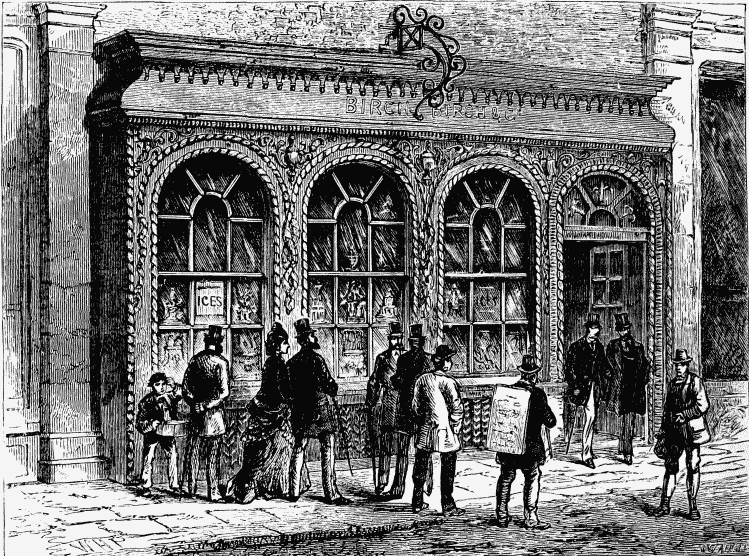
BIRCH'S SHOP, CORNHILL (see page 412).
1837. Alderman Kelly, Lord Mayor at the accession of her Majesty, was born at Chevening, in Kent, and lived, when a youth, with Alexander Hogg, the publisher, in Paternoster Row, for £10 a year wages. He slept under the shop-counter for the security of the premises. He was reported by his master to be "too slow" for the situation. Mr. Hogg, however, thought him "a bidable boy," and he remained. This incident shows upon what apparently trifling circumstances sometimes a man's future prospects depend. Mr. Kelly succeeded Mr. Hogg in the business, became Alderman of the Ward of Farringdon Within, and served as sheriff and mayor, the cost of which exceeded the fees and allowances by the sum of £10,000. He lived upon the same spot sixty years, and died in his eighty-fourth year. He was a man of active benevolence, and reminded one of the pious Lord Mayor, Sir Thomas Abney. He composed some prayers for his own use, which were subsequently printed for private distribution. (Timbs.)
Sir John Cowan (Wax Chandler), mayor in 1838, was created a baronet after having entertained the Queen at his mayoralty dinner.
1839. Sir Chapman Marshall, mayor. He received knighthood when sheriff, in 1831; and at a public dinner of the friends and supporters of the Metropolitan Charity Schools, he addressed the company as follows:—"My Lord Mayor and gentlemen,—I want words to express the emotions of my heart. You see before you a humble individual who has been educated at a parochial school. I came to London in 1803, without a shilling, without a friend. I have not had the benefit of a classical education; but this I will say, my Lord Mayor and gentlemen, that you witness in me what may be done by the earnest application of honest industry; and I trust that my example may induce others to aspire, by the same means, to the distinguished situation which I have now the honour to fill." Self-made men are too fond of such glorifications, and forget how much wealth depends on good fortune and opportunity.
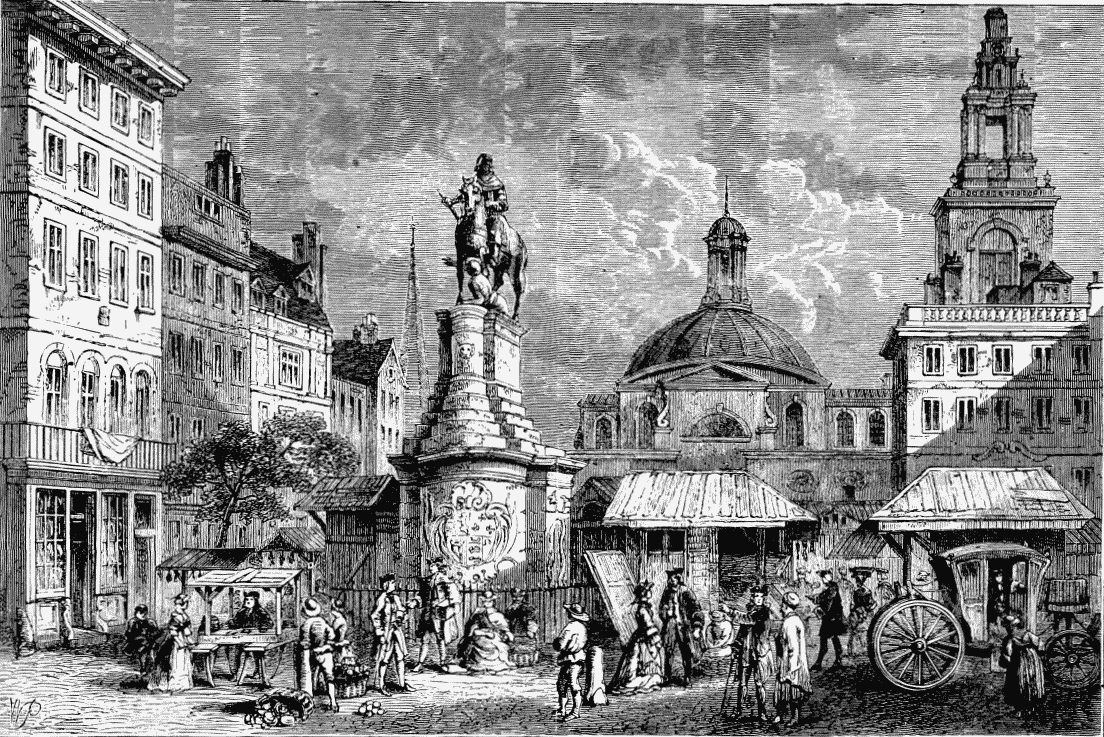
THE STOCKS MARKET, SITE OF THE MANSION HOUSE (From an Old Print.) (See page 416.)
1839. Alderman Wilson, mayor, signalised his year of office by giving, in the Egyptian Hall, a banquet to 117 connections of the Wilson family being above the age of nine years. At this family festival, the usual civic state and ceremonial were maintained, the sword and mace borne, &c.; but after the loving cup had been passed round, the attendants were dismissed, in order that the free family intercourse might not be restricted during the remainder of the evening. A large number of the Wilson family, including the alderman himself, have grown rich in the silk trade. (Timbs.)
In 1842, Sir John Pirie, mayor, the Royal Exchange was commenced. Baronetcy received on the christening of the Prince of Wales. At his inauguration dinner at Guildhall, Sir John said: "I little thought, forty years ago, when I came to London a poor lad from the banks of the Tweed, that I should ever arrive at so great a distinction." In his mayoralty show, Pirie, being a shipowner, added to the procession a model of a large East Indiaman, fully rigged and manned, and drawn in a car by six horses. (Aleph.).
Alderman Farncomb (Tallow-chandler), mayor in 1849, was one of the great promoters of the Great Exhibition of 1851, that Fair of all Nations which was to bring about universal peace, and wrap the globe in English cotton. He gave a grand banquet at the Mansion House to Prince Albert and a host of provincial mayors; and Prince Albert explained his views about his hobby in his usual calm and sensible way.
In 1850 Sir John Musgrove (Clothworker), at the suggestion of Mr. G. Godwin, arranged a show on more than usually æsthetic principles. There was Peace with her olive-branch, the four quarters of the world, with camels, deer, elephants, negroes, beehives, a ship in full sail, an allegorical car, drawn by six horses, with Britannia on a throne and Happiness at her feet; and great was the delight of the mob at the gratuitous splendour.
Alderman Salomons (1855) was the first Jewish Lord Mayor—a laudable proof of the increased toleration of our age. This mayor proved a liberal and active magistrate, who repressed the mischievous and unmeaning Guy Fawkes rejoicings, and through the exertions of the City Solicitor, persuaded the Common Council to at last erase the absurd inscription on the Monument, which attributed the Fire of London to a Roman Catholic conspiracy.
Alderman Rose, mayor in 1862 (Spectaclemaker), an active encourager of the useful and manly volunteer movement, had the honour of entertaining the Prince of Wales and his beautiful Danish bride at a Guildhall banquet, soon after their marriage. The festivities (including £10,000 for a diamond necklace) cost the Corporation some £60,000. The alderman was knighted in 1867. He was (says Mr. Timbs) Alderman of Queenhithe, living in the same row where three mayors of our time have resided.
Alderman Lawrence, mayor in 1863–4. His father and brother were both aldermen, and all three were in turns Sheriff of London and Middlesex. Alderman Phillips (Spectacle-maker), mayor in 1865, was the second Jewish Lord Mayor, and the first Jew admitted into the municipality of London. This gentleman, of Prussian descent, had the honour of entertaining, at the Mansion House, the Prince of Wales and the King and Queen of the Belgians, and was knighted at the close of his mayoralty.