
Old and New London: Volume 1. Originally published by Cassell, Petter & Galpin, London, 1878.
This free content was digitised by double rekeying. All rights reserved.
'Old Jewry', in Old and New London: Volume 1, (London, 1878) pp. 425-435. British History Online https://www.british-history.ac.uk/old-new-london/vol1/pp425-435 [accessed 19 April 2024]
In this section
CHAPTER XXXVII.
OLD JEWRY.
The Old Jewry—Early Settlements of Jews in London and Oxford—Bad Times for the Israelites—Jews Alms—A King in Debt—Rachel weepining for her Children—Jewish Converts—Wholesale Expulsion of the Chosen People from England—The Rich House of a Rich Citizen—The London Institution, formerly in the Old Jewry—Porsoniana—Nonconformists in the Old Jewry—Samuel Chandler, Richard Price, and James Foster—The Grocers' Gompany—Their Sufferings under the Commonwealth—Almost Bankrupt—Again they Flourish—The Grocers' Hall Garden—Fairfax and the Grocers—A Rich and Gencrous Grocer—A Warlike Grocer—Walbrook— Bucklersbury.
The Old Jewry was the Ghetto of mediæval London. The Rev. Moses Margoliouth, in his interesting "History of the Jews in Great Britain," has clearly shown that Jews resided in England during the Saxon times, by an edict published by Elgbright, Archbishop of York, A. D. 470, forbidding Christians to attend the Jewish feasts. It appears the Jews sometimes left lands to the abbeys; and in the laws of Edward the Confessor we find them especially mentioned as under the king's guard and protection.
The Conqueror invited over many Jews from Rouen, who settled themselves chiefly in London, Stamford, and Oxford. In London the Jews had two colonies—one in Old Jewry, near King Offa's old palace; and one in the liberties of the Tower. Rufus, in his cynical way, marked his hatred of the monks by summoning a convocation, where English bishops met Jewish rabbis, and held a religious controversy, Rufus swearing by St. Luke's face that if the rabbis had the best of it, he would turn Jew at once. In this reign the Jews were so powerful at Oxford that they let three halls—Lombard Hall, Moses Hall, and Jacob Hall—to students; and their rabbis instructed even Christian students in their synagogue. Jews took care of vacant benefices for the king. In the reign of Henry I. the Jews began to make proselytes, and monks were sent to several towns to preach against them. Halcyon times! With the reign of Stephen, however, began the storms, and, with the clergy, the usurper persecuted the Jews, exacting a fine of £2,000 from those of London alone for a pretended manslaughter. The absurd story of the Jews murdering young children, to anoint Israelites or to raise devils with their blood, originated in this reign.
Henry II. was equally ruthless, though he did grant Jews cemeteries outside the towns. Up till this time the London Jews had only been allowed to bury in "the Jews' garden," in the parish of St. Giles's, Cripplegate. In spite of frequent fines and banishments, their historian owns that altogether they throve in this reign, and their physicians were held in high repute. With Richard I., chivalrous to all else, began the real miseries of the English Jews. Even on the day of his coronation there was a massacre of the Jews, and many of their houses were burnt. Two thousand Jews were murdered at York, and at Lynn and Stamford they were also plundered. On his return from Palestine Richard established a tribunal for Jews. In the early part of John's reign he treated the moneylenders, whom he wanted to use, with consideration. He granted them a charter, and allowed them to choose their own chief rabbi. He also allowed them to try all their own causes which did not concern pleas of the Crown; and all this justice only cost the English Jews 4,000 marks, for John was poor. His greed soon broke loose. In 1210 he levied on the Jews 66,000 marks, and imprisoned, blinded, and tortured all who did not readily pay. The king's last act of inhumanity was to compel some Jews to torture and put to death a great number of Scotch prisoners who had assisted the barons. Can we wonder that it is still a proverb among the English Jews, "Thank God that there was only one King John?"
The regent of the early part of the reign of Henry III. protected the Jews, and exempted them from the jurisdiction of the ecclesiastical courts, but they were compelled to wear on their breasts two white tablets of linen or parchment, two inches broad and four inches long; and twentyfour burgesses were chosen in every town where they resided, to protect them from the insults of pilgrims; for the clergy still treated them as excommunicated infidels. But even this lull was short—persecution soon again broke out. In the 14th of Henry III. the Crown seized a third part of all their movables, and their new synagogue in the Old Jewry was granted to the brothers of St. Anthony of Vienna, and turned into a church. In the 17th of Henry III. the Jews were again taxed to the amount of 18,000 silver marks. At the same time the king erected an institution in New Street (Chancery Lane) for Jewish converts, as an atonement for his father's cruelty to the persecuted exiles. Four Jews of Norwich having been dragged at horses' tails and hung, on a pretended charge of circumcising a Christian boy, led to new persecution, and the Jews were driven out of Newcastle and Southampton; while to defray the expense of entertaining the Queen's foreign uncles 20,000 marks were exacted from the suffering race. In the 19th year of his reign Henry, driven hard for money, extorted from the rich Jews 10,000 more marks, and several were burned alive for plotting to destroy London by fire. The more absurd the accusation the more eagerly it was believed by a superstitious and frightened rabble. In 1244, Matthew of Paris says, the corpse of a child was found buried in London, on whose arms and legs were traced Hebrew inscriptions. It was supposed that the Jews had crucified this child, in ridicule of the crucifixion of Christ. The converted Jews of New Street were called in to read the Hebrew letters, and the canons of St. Paul's took the child's body, which was supposed to have wrought miracles, and buried it with great ceremony not far from their great altar. In order to defray the expenses of his brother Richard's marriage the poor Jews of London were heavily mulcted, and Aaron of York, a man of boundless wealth, was forced to pay 4,000 marks of silver and 400 of gold. Defaulters were transported to Ireland, a punishment especially dreaded by the Jews. A tax called Jews' alms was also sternly enforced; and we find Lucretia, widow of David, an Oxford Jew, actually compelled to pay £2,590 towards the rebuilding of Westminster Abbey. It was about this time that Abraham, a Jew of Berkhampstead, strangled his wife, who had refused to help him to defile and deface an image of the Virgin, and was thrown into a dungeon of the Tower; but the murderer escaped, by a present of 7,000 marks to the king. Tormented by the king's incessant exactions, the Jews at last implored leave to quit England before their very skins were taken from them. The king broke into a fit of almost ludicrous rage. He had been tender of their welfare, he said to his brother Richard. "Is it to be marvelled at," he cried, "that I covet money? It is a horrible thing to imagine the debts wherein I am held bound. By the head of God, they amount to the sum of two hundred thousand marks; and if I should say three hundred thousand, I should not exceed the bounds of truth. I am deceived on every hand; I am a maimed and abridged king—yea, now only half a king. There is a necessity for me to have money, gotten from what place soever, and from whomsoever."
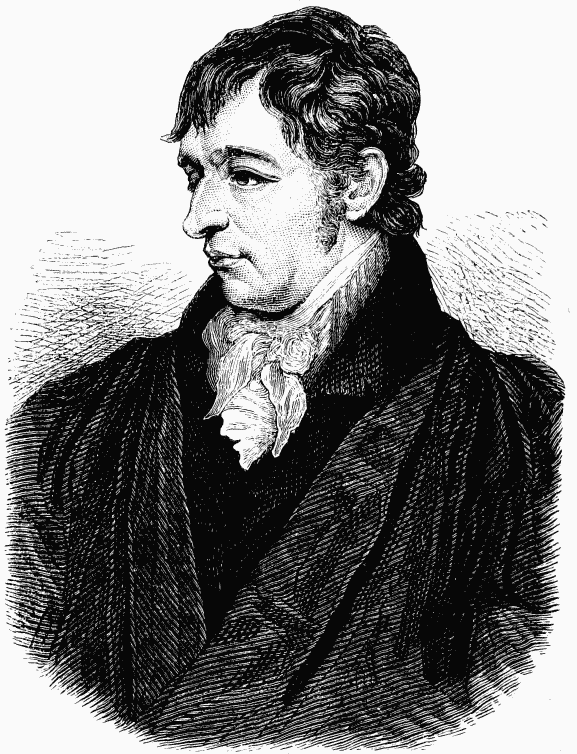
RICHARD PORSON, (From an Authentic Portrait.)
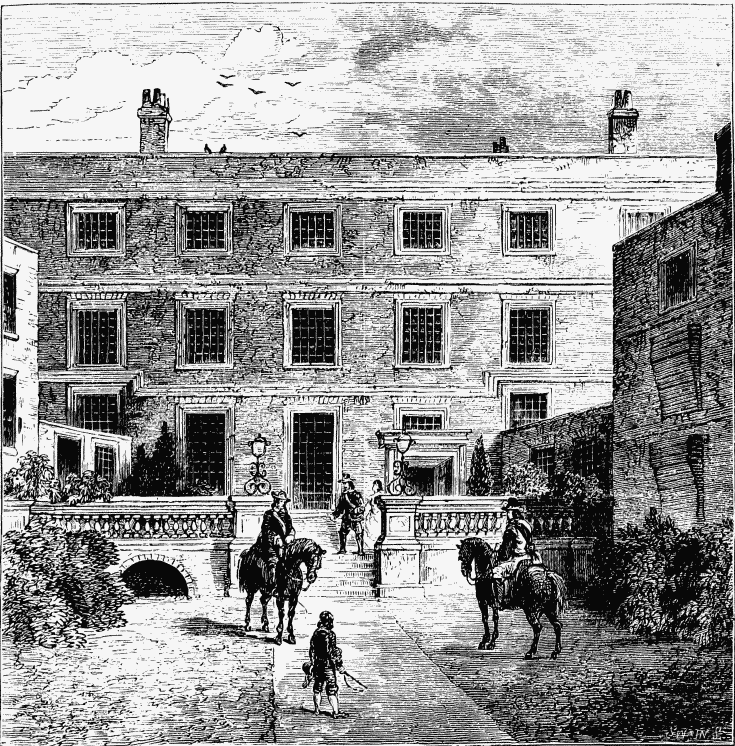
SIR R. CLAYTON'S HOUSE, GARDEN FRONT. (From an Old Print.)
The king, on Richard's promise to obtain him money, sold him the right which he held over the Jews. Soon after this, eighty-six of the richest Jews of London were hung, on a charge of having crucified a Christian child at Lincoln, and twentythree others were thrown into the Tower. Truly Old Jewry must have often heard the voice of Rachel weeping for her children. Their persecutors never grew weary. In a great riot, encouraged by the barons, the great bell of St. Paul's tolled out, 500 Jews were killed in London, and the synagogue burnt, the leader of the mob, John Fitz-John, a baron, running Rabbi Abraham, the richest Jew in London, through with his sword. On the defeat of the king's party at the battle of Lewes, the London mob accusing the Jews of aiding the king, plundered their houses, and all the Israelites would have perished, had they not taken refuge in the Tower. By royal edict the Christians were forbidden to buy flesh of a Jew, and no Jew was allowed to employ Christian nurses, bakers, brewers, or cooks. Towards the close of Henry's life the synagogue in Old Jewry was again taken from the Jews, and given to the Friars Penitent, whose chapel stood hard by, and who complained of the noise of the Jewish congregation; but the king permitted another synagogue to be built in a more suitable place. Henry then ordered the Jews to pay up all arrears of tallages within four months, and half of the sum in seventeen days. The Tower of London was naturally soon full of grey-bearded Jewish debtors.
No wonder, with all these persecutions, that the Chancery Lane house of converts began soon to fill. "On one of the rolls of this reign," says Mr. Margoliouth, probably quoting Prynne's famous diatribe against the Jews, "about 500 names of Jewish converts are registered."From the 50th year of Henry III. to the 2nd of Edward I., the Crown, says Coke, extorted from the English Jews no less than £420,000 15s. 4d.!
Edward I. was more merciful. In a statute, however, which was passed in his third year, he forbade Jews practising usury, required them to wear badges of yellow taffety, as a distinguishing mark of their nationality, and demanded from each of them threepence every Easter. Then began the plunder. The king wanted money to build Carnarvon and Conway castles, to be held as fortresses against the Welsh, whom he had just recently conquered and treated with great cruelty, and the Jews were robbed accordingly. It was not difficult in those days to find an excuse for extortion if the royal exchequer was empty. In the 7th year of Edward no less than 294 Jews were put to death for clipping money, and all they possessed seized by the king. In his 17th year all the Jews in England were imprisoned in one night, as Selden proves by an old Hebrew inscription found at Winchester, and not released till they had paid £20,000 of silver for a ransom. At last, in the year 1290, came the Jews' final expulsion from England, when 15,000 or 16,000 of these tormented exiles left our shores, not to return till Cromwell set the first great example of toleration. Edward allowed the Jews to take with them part of their money and movables, but seized their houses and other possessions. All their outstanding mortgages were forfeited to the Crown, and ships were to be provided for their conveyance to such places within reasonable distance as they might choose. In spite of this, however, many, through the treachery of the sailors, were left behind in England, and were all put to death with great cruelty.
"Whole rolls full of patents relative to Jewish estates," says Mr. Margoliouth, "are still to be seen at the Tower, which estates, together with their rent in fee, permissions, and mortgages, were all seized by the king." Old Jewry, and Jewin Street, Aldersgate, where their burial-ground was, still preserve a dim memory of their residence among us. There used to be a tradition in England that the Jews buried much of their treasure here, in hopes of a speedy return to the land where they had suffered so much, yet where they had thriven. In spite of the edict of banishment a few converted Jews continued to reside in England, and after the Reformation some unconverted Jews ventured to return. Rodrigo Lopez, a physician of Queen Elizabeth's, for instance, was a Jew. He was tortured to death for being accused of designing to poison the Queen.
No. 8, Old Jewry was the house of Sir Robert Clayton, Lord Mayor in the time of Charles II. It was a fine brick mansion, and one of the grandest houses in the street. It is mentioned by Evelyn in the following terms:—"26th September, 1672.—I carried with me to dinner my Lord H. Howard (now to be made Earl of Norwich and Earl Marshal of England) to Sir Robert Clayton's, now Sheriff of London, at his own house, where we had a great feast; it is built, indeed, for a great magistrate, at excessive cost. The cedar dining room is painted with the history of the Giants' war, incomparably done by Mr. Streeter, but the figures are too near the eye," We give on the previous page a view of the garden front of this house, taken from an old print. Sir Robert built the house to keep his shrievalty, which he did with great magnificence. It was for some years the residence of Mr. Samuel Sharp, an eminent surveyor.
In the year 1805 was established, by a proprietary in the City, the London Institution, "for the advancement of literature and the diffusion of useful knowledge." This institution was temporarily located in Sir Robert Clayton's famous old house. Upon the first committee of the institution were Mr. R. Angerstein and Mr. Richard Sharp. Porson, the famous Greek scholar and editor of Euripides, was thought an eligible man to be its principal librarian. He was accordingly appointed to the office by a unanimous resolution of the governors; and Mr. Sharp had the gratification of announcing to the Professor his appointment. His friends rejoiced. Professor Young, of Glasgow, writing to Burney about this time, says:—"Of Devil Dick you say nothing. I see by the newspapers they have given him a post. A handsome salary, I hope, a suite of chambers, coal and candle, &c. Porter and cyder, I trust, are among the et cæteras." His salary was £200 a year, with a suite of rooms. Still, Porson was not just the man for a librarian; for no one could use books more roughly. He had no affectation about books, nor, indeed, affectation of any sort. The late Mr. William Upcott, who urged the publication of Evelyn's diary at Wootton, was fellow-secretary with Porson. The institution removed to King's Arms Yard, Coleman Street, in 1812, and thence in 1819 to the present handsome mansion, erected from the classic design of Mr. W. Brooks, on the north side of Moorfields, now Finsbury Circus.
The library is "one of the most useful and accessible in Great Britain;" and Mr. Watson found in a few of the books Porson's handwriting, consisting of critical remarks and notes. In a copy of the Aldine "Herodotus," he has marked the chapters in the margin in Arabic numerals "with such nicety and regularity," says his biographer, "that the eye of the reader, unless upon the closest examination, takes them for print."
Lord Byron remembered Porson at Cambridge; in the hall where he himself dined, at the ViceChancellor's table, and Porson at the Dean's, he always appeared sober in his demeanour, nor was he guilty, as far as his lordship knew, of any excess or outrage in public; but in an evening, with a party of undergraduates, he would, in fits of intoxication, get into violent disputes with the young men, and arrogantly revile them for not knowing what he thought they might be expected to know. He once went away in disgust, because none of them knew the name of "the Cobbler of Messina." In this condition Byron had seen him at the rooms of William Bankes, the Nubian discoverer, where he would pour forth whole pages of various languages, and distinguish himself especially by his copious floods of Greek.
Lord Byron further tells us that he had seen Sheridan "drunk, with all the world; his intoxication was that of Bacchus, but Porson's that of Silenus. Of all the disgusting brutes, sulky, abusive, and intolerable, Porson was the most bestial, so far as the few times that I saw him went, which were only at William Bankes's rooms. He was tolerated in this state among the young men for his talents, as the Turks think a madman inspired, and bear with him. He used to write, or rather vomit, pages of all languages, and could hiccup Greek like a Helot; and certainly Sparta never shocked her children with a grosser exhibition than this man's intoxication."
The library of the institution appears, however, to have derived little advantage from Porson's supervision of it, beyond the few criticisms which were found in his handwriting in some of the volumes. Owing to his very irregular habits, the great scholar proved but an inefficient librarian; he was irregular in attendance, and was frequently brought home at midnight drunk. The directors had determined to dismiss him, and said they only knew him as their librarian from seeing his name attached to receipts of salary. Indeed, he was already breaking up, and his stupendous memory had begun to fail. On the 19th of September, 1806, he left the Old Jewry to call on his brother-in-law, Perry, in the Strand, and at the corner of Northumberland Street was struck down by a fit of apoplexy. He was carried over to the St. Martin's Lane workhouse, and there slowly recovered consciousness. Mr. Savage, the under-librarian, seeing an advertisement in the British Press, describing a person picked up, having Greek memoranda in his pocket, went to the workhouse and brought Porson home in a hackney coach; he talked about the fire which the night before had destroyed Covent Garden Theatre, and as they rounded St. Paul's, remarked upon the ill treatment Wren had received. On reaching the Old Jewry, and after he had breakfasted, Dr. Adam Clarke called and had a conversation with Porson about a stone with a Greek inscription, brought from Ephesus; he also discussed a Mosaic pavement recently found in Palestrini, and quoted two lines from the Greek Anthologia. Dr. Adam Clarke particularly noticed that he gave the Greek rapidly, but the English with painful slowness, as if the Greek came more naturally. Then, apparently fancying himself under restraint, he walked out, and went into the African or Cole's coffee-house in St. Michael's Alley, Cornhill; there he would have fallen had he not caught hold of one of the brass rods of the boxes. Some wine and some jelly dissolved in brandy and water considerably roused him, but he could hardly speak, and the waiter took him back to the Institution in a coach. He expired exactly as the clock struck twelve, on the night of Sunday, September 25, 1808. He was buried in the Chapel of Trinity College, Cambridge, and eulogies of his talent, written in Greek and Latin verse, were affixed to his pall—an old custom not discontinued till 1822. His books fetched £2,000, and those with manuscript notes were bought by Trinity College. It was said of Porson that he drank everything he could lay his hands upon, even to embrocation and spirits of wine intended for the lamp. Rogers describes him going back into the dining-room after the people had gone, and drinking all that was left in the glasses. He once undertook to learn by heart, in a week, a copy of the Morning Chronicle, and he boasted he could repeat "Roderick Random" from beginning to end.
Mr. Luard describes Porson as being, in personal appearance, tall; his head very fine, with an expansive forehead, over which he plastered his brown hair; he had a long, Roman nose (it ought to have been Greek), and his eyes were remarkably keen and penetrating. In general he was very careless as to his dress, especially when alone in his chamber, or when reading hard; but "when in his gala costume, a smart blue coat, white vest, black satin nether garments, and silk stockings, with a shirt ruffled at the wrists, he looked quite the gentleman."
The street where, in 1261, many Jews were massacred, and where again, in 1264, 500 Jews were slain, was much affected by Nonconformists. There was a Baptist chapel here in the Puritan times; and in Queen Anne's reign the Presbyterians built a spacious church, in Meeting House Court, in 1701. It is described as occupying an area of 2,600 square feet, and being lit with six bow windows. The society, says Mr. Pike, had been formed forty years before, by the son of the excellent Calamy, the persecuted vicar of Aldermanbury, who is said to have died from grief at the Fire of London. John Shower was one of the most celebrated ministers of the Old Jewry Chapel. He wrote a protest against the Occasional Conformity Bill, to which Swift (under the name of his friend Harley) penned a bitter reply. He died in 1715. From 1691 to 1708 the assistant lecturer was Timothy Rogers, son of an ejected Cumberland minister, of whom an interesting story is told. Sir Richard Cradock, a High Church justice, had arrested Mr. Rogers and all his flock, and was about to send them to prison, when the justice's granddaughter, a wilful child of seven, pitying the old preacher, threatened to drown herself if the poor people were punished. The preacher blessed her, and they parted. Years after this child, being in London, dreamed of a certain chapel, preacher, and text, and the next day, going to the Old Jewry, saw Mr. Shower, and recognised him as the preacher of her dream. The lady afterwards told this to Mr. Rogers' son, when the lad turned Dissenter. Like many other of the early Nonconformist preachers, Rogers seems to have been a hypochondriac, who looked upon himself as "a broken vessel, a dead man out of mind," and eventually gave up his profession. Shower's successor, Simon Browne, wrote a volume of "Hymns," compiled a lexicon, and wrote a "Defence of the Christian Revelation," in reply to Woolston and other Freethinkers. Browne was also a victim to delusions, believing that God, in his displeasure, had withdrawn his soul from his body. This state of mind is said by some to have arisen from a nervous shock Browne had once received in finding a highwayman with whom he had grappled dead in his grasp. He believed his mind entirely gone, and his head to resemble a parrot's. At times his thoughts turned to self-destruction. He therefore abandoned his pulpit, and retired to Shepton Mallet to study. His "Defence" is dedicated to Queen Caroline as from "a thing."
Samuel Chandler, a celebrated author and divine, and a friend of Butler and Seeker, and Bowyer the printer, was for forty years another Old Jewry worthy. He lectured against Popery with great success at Salters' Hall, and held a public dispute with a Romish priest at the "Pope's Head," Cornhill. In a funeral sermon on George II., Chandler drew absurd parallels between him and David, which the Grub Street writers made the most of Chandler's deformed sister Mary, a milliner at Bath, wrote verses which Pope commended.
In 1744 Richard Price, afterwards chaplain at Stoke Newington, held the lectureship at the Old Jewry. Price's lecture on "Civil Liberty," apropos of the American war, gained him Franklin's and Priestley's friendship; as his first ethical work had already won Hume's. Burke denounced him as a traitor; while the Corporation of London presented him with the freedom of the City in a gold box, the Congress offered him posts of honour, and the Premier of 1782 would have been glad to have had him as a secretary. The last pastor at the Old Jewry Chapel was Abraham Rees. This indefatigable man enlarged Harris's "Lexicon Technicum," improved by Ephraim Chambers, into the "Encyclopædia" of forty-five quarto volumes, a book now thought redundant and ill-arranged, and the philological parts defective. In 1808 the Old Jewry congregation removed to Jewin Street.
Dr. James Foster, a Dissenting minister eulogised by Pope, carried on the Sunday evening
lecture in Old Jewry for more than twenty years;
it was began in 1728. The clergy, wits, and freethinkers crowded with equal anxiety to hear him of
whom Pope wrote—
"Let modest Foster, if he will, excel
Ten metropolitans in preaching well."
And Pope's friend, Lord Bolingbroke, an avowed
Deist, commended Foster for the false aphorism
—"Where mystery begins religion ends." Dr.
Foster attended Lord Kilmarnock before his execution. He wrote in defence of Christianity in
reply to Tindal, the Freethinker, and died in 1753.
He says in one of his works:—"I value those who
are of different professions from me, more than
those who agree with me in sentiment, if they are
more serious, sober, and charitable." This excellent man was the son of a Northamptonshire
clergyman, who turned Dissenter and became a
fuller at Exeter.
At Grocers' Hall we stop to sketch the history of an ancient company.
The Grocers of London were originally called Pepperers, pepper being the chief staple of their trade. The earlier Grocers were Italians, Genoese, Florentine or Venetian merchants, then supplying all the west of Christendom with Indian and Arabian spices and drugs, and Italian silks, wines, and fruits. The Pepperers are first mentioned as a fraternity among the amerced guilds of Henry II., but had probably clubbed together at an earlier period. They are mentioned in a petition to Parliament as Grocers, says Mr. Herbert, in 1361 (Edward III.), and they themselves adopted the, at first, opprobrious name in 1376, and some years later were incorporated by charter. They then removed from Soper's Lane (now Queen Street) to Bucklersbury, and waxed rich and powerful.
The Grocers met at five several places previous to building a hall; first at the town house of the Abbots of Bury, St. Mary Axe; in 1347 they moved to the house of the Abbot of St. Edmund; in 1348 to the Rynged Hall, near Garlick-hythe; and afterwards to the hotel of the Abbot of St. Cross. In 1383 they flitted to the Cornet's Tower, in Bucklersbury, a place which Edward III. had used for his money exchange. In 1411 they purchased of Lord Fitzwalter the chapel of the Fratres du Sac (Brothers of the Sack) in Old Jewry, which had originally been a Jewish synagogue; and having, some years afterwards, purchased Lord Fitzwalter's house adjoining the chapel, began to build a hall, which was opened in 1428. The Friars' old chapel contained a buttery, pantry, cellar, parlour, kitchen, turret, clerk's house, a garden, and a set of almshouses in the front yard was added. The word "grocer," says Ravenhill, in his "Short Account of the Company of Grocers" (1689), was used to express a trader en gros (wholesale). As early as 1373, the first complement of twenty-one members of this guild was raised to 124; and in 1583, sixteen grocers were aldermen. In 1347, Nicholas Chaucer, a relation of the poet, was admitted as a grocer; and in 1383, John Churchman (Richard II.) obtained for the Grocers the great privilege of the custody, with the City, of the "King's Beam," in Woolwharf, for weighing wool in the port of London, the first step to a London Custom House. The Beam was afterwards removed to Bucklersbury. Henry VIII. took away the keepership of the great Beam from the City, but afterwards restored it. The Corporation still have their weights at the Weigh House, Little Eastcheap, and the porters there are the tackle porters, so called to distinguish them from the ticket porters. In 1450, the Grocers obtained the important right of sharing the office of garbeller of spices with the City. The garbeller had the right to enter any shop or warehouse to view and search for drugs, and to garble and cleanse them. The office gradually fell into desuetude, and is last mentioned in the Company's books in July, 1687, when the City garbeller paid a fine of £50, and 20s. per annum, for leave to hold his office for life. The Grocers seem to have at one time dealt in whale-oil and wool.
During the Civil War the Grocers suffered, like all their brother companies. In 1645, the Parliament exacted £50 per week from them towards the support of troops, £6 for City defences, and £8 for wounded soldiers. The Company had soon to sell £1,000 worth of plate. A further demand for arms, and a sum of £4,500 for the defence of the City, drove them to sell all the rest of their plate, except the value of £300. In 1645, the watchful Committee of Safety, sitting at Haberdashers' Hall, finding the Company indebted £500 to one Richard Greenough, a Cavalier delinquent, compelled them to pay that sum.
No wonder, then, that the Grocers shouted at the Restoration, spent £540 on the coronation pageant, and provided sixty riders at Charles's noisy entrance into London. The same year, Sir John Frederick, being chosen Mayor, and not being, as rule required, a member of one of the twelve Great Companies, left the Barber Chirurgeons, and joined the Grocers, who welcomed him with a great pageant. In 1664, the Grocers took a zealous part with their friends and allies, the Druggists, against the College of Physicians, who were trying to obtain a bill granting them power of search, seizure, fine, and imprisonment. The Plague year no election feast was held. The Great Fire followed, and not only greatly damaged Grocers' Hall, but also consumed the whole of their house property, excepting a few small tenements in Grub Street. They found it necessary to try and raise £20,000 to pay their debts, to sell their melted plate, and to add ninety-four members to the livery. Only succeeding, amid the general distress, in raising £6,000, the Company was almost bankrupt, their hall being seized, and attachments laid on their rent. By a great effort, however, they wore round, called more freemen on the livery, and added in two months eighty-one new members to the Court of Assistants; so that before the Revolution of 1688 they had restored their hall and mowed down most of their rents. Indeed, one of their most brilliant epochs was in 1689, when William III. accepted the office of their sovereign master.
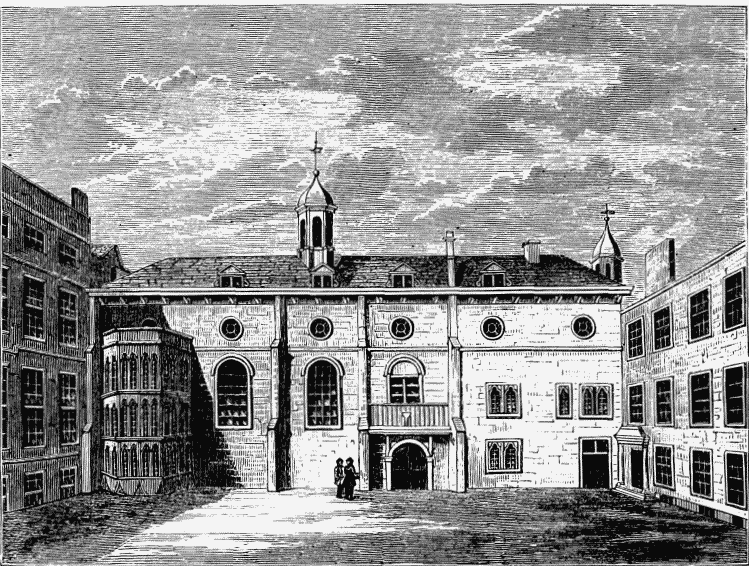
EXTERIOR OF GROCERS' HALL.
Some writers credit the Grocers' Company with the enrolment of five kings, several princes, eight dukes, three earls, and twenty lords. Of these five kings, Mr. Herbert could, however, only trace Charles II. and William III. Their list of honorary members is one emblazoned with many great names, including Sir Philip Sidney (at whose funeral they assisted), Pitt, Lord Chief Justice Tenterden, the Marquis of Cornwallis, George Canning, &c. Of Grocer Mayors, Strype notes sixty-four between 1231 and 1710 alone.
The garden of the Hall must have been a pleasant place in the old times, as it is now. It is mentioned in 1427 as having vines spreading up before the parlour windows. It had also an arbour; and in 1433 it was generously thrown open to the citizens generally, who had petitioned for this privilege. It contained hedge-rows and a bowling alley, with an ancient tower of stone or brick, called "the Turret," at the north-west corner, which had probably formed part of Lord Fitzwalter's mansion. The garden remained unchanged till the new hall was built in 1798, when it was much curtailed, and in 1802 it was nearly cut in half by the enlargement of Princes Street. For ground which had cost the Grocers, in 1433, only £31 17s. 8d., they received from the Bank of England more than £20,000.
The Hall was often lent for dinners, funerals, county feasts, and weddings; and in 1564 the gentlemen of Gray's Inn dined there with the gentlemen of the Middle Temple. This system breeding abuses, was limited in 1610.
In the time of the Commonwealth, Grocers' Hall was the place of meeting for Parliamentary Committees. Among other subjects there discussed, we find the selection of able ministers to regulate Church government, and providing moneys for the army; and in 1641 the Grand Committee of Safety held its sittings in this Hall.
In 1648 the Grocers had to petition General Fairfax not to quarter his troops in the hall of a charitable Company like theirs. In 1649 a grand entertainment was given by the Grocers to Cromwell and Fairfax. After hearing two sermons at Christ's Church, preached by Mr. Goodwin and Dr. Owen, Cromwell, his officers, the Speaker, and the judges, dined together. "No drinking of healths," says a Puritan paper of the time, "nor other uncivill concomitants formerly of such great meetings, nor any other music than the drum and trumpet—a feast, indeed, of Christians and chieftains, whereas others were rather of Chretiens and cormorants." The surplus food was sent to the London prisons, and £40 distributed to the poor. The Aldermen and Council afterwards went to General Fairfax at his house in Queen Street, and, in the name of the City, presented him with a large basin and ewer of beaten gold; while to Cromwell they sent a great present of plate, value £300, and 200 pieces of gold. They afterwards gave a still grander feast to Cromwell in his more glorious time, and one at the Restoration to General Monk. On the latter feast they expended £215, and enrolled "honest George" a brother of the Company.
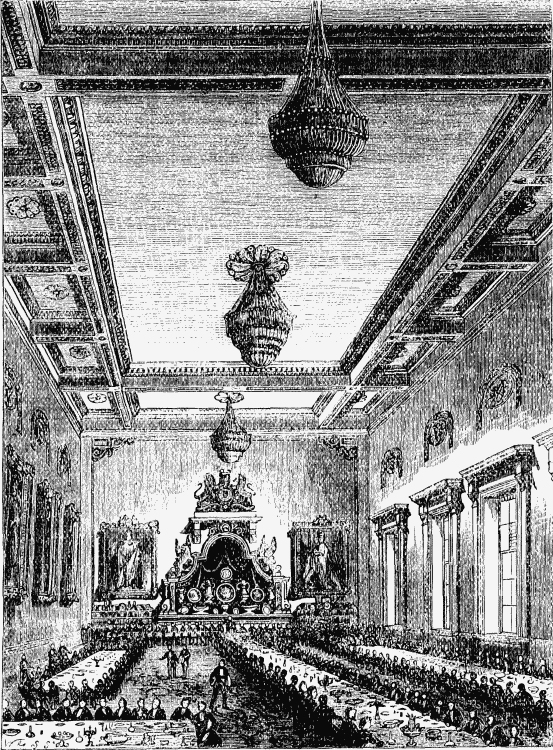
INTERIOR OF GROCERS' HALL.
The Grocers' Hall might never have been rebuilt after the Great Fire, so crippled was the Company, but for the munificence of Sir John Cutler, a rich Grocer, whom Pope (not always regardful of truth) has bitterly satirised.
Sir John rebuilt the parlour and dining-room in 1668–9, and was rewarded by "a strong vote of thanks," and by his statue and picture being placed in the Hall as eternal records of the Company's esteem and gratitude. Two years later Grocers' Hall was granted to the parishioners of St. Mildred as a chapel till their own church could be rebuilt. The garden turret, used as a record office, was fitted up for the clerk's residence, and a meeting place for the court; and, "for better order, decorum, and gravity," pipes and pots were forbidden in the court-room during the meetings.
At Grocers' Hall, "to my great surprise," says vivacious Pennant, "I met again with Sir John Cutler, Grocer, in marble and on canvas. In the first he is represented standing, in a flowing wig, waved rather than curled, a laced cravat, and a furred gown, with the folds not ungraceful; in all, except where the dress is inimical to the sculptor's art, it may be called a good performance. By his portrait we may learn that this worthy wore a black wig, and was a good-looking man. He was created a baronet, November 12th, 1660; so that he certainly had some claim of gratitude with the restored monarch. He died in 1693. His kinsman and executor, Edmund Boulton, Esq., expended £7,666 on his funeral expenses. He served as Master of the Company in 1652 and 1653, in 1688, and again a fourth time."
In 1681 the Hall was renovated at an expense of £500, by Sir John Moore, so as to make it fit for the residence of the Lord Mayor. Moore kept his mayoralty here, paying a rent of £200. It continued to be used by the Lord Mayors till 1735, when the Company, now grown rich, withdrew their permission. In 1694 it was let to the Bank of England, who held their court there till the Bank was built in 1734. The Company's present hall was built in 1802, and repaired in 1827, since which the whole has been restored, the statue of Sir John Cutler moved from its neglected post in the garden, and the arms of the most illustrious Grocers of antiquity set up.
The Grocers' charities are numerous; they give away annually £300 among the poor of the Company, and they have had £4,670 left them to lend to poor members of the community. Before 1770, Boyle says, the Company gave away about £700 a year.
Among the bravest of the Grocers, we must mention Sir John Philpot, Mayor, 1378, who fitted out a fleet that captured John Mercer, a Scotch freebooter, and took fifteen Spanish ships. He afterwards transported an English army to Brittany in his own ships, and released more than 1,000 of our victualling vessels. John Churchman, sheriff in 1385, was the founder of the Custom House. Sir Thomas Knolles, mayor in 1399 and 1410, rebuilt St. Antholin's, Watling Street. Sir Robert Chichele (a relation of Archbishop Chichele), mayor in 1411–12, gave the ground for rebuilding the church of St. Stephen, Walbrook, which his descendant, Sir Thomas (Mayor and Grocer), helped to rebuild after the Great Fire. Sir William Sevenoke was founder of the school and college at Sevenoaks, Kent. Sir John Welles (mayor in 1431), built the Standard in Chepe, helped to build the Guildhall Chapel, built the south aisle of St. Antholin's, and repaired the miry way leading to Westminster (the Strand). Sir Stephen Brown, mayor, 1438, imported cargoes of rye from Dantzic, during a great dearth, and as Fuller quaintly says, "first showed Londoners the way to the barn door." Sir John Crosby (Grocer and Sheriff in 1483), lived in great splendour at Crosby House, in Bishopsgate Street: he gave great sums for civic purposes, and repaired London Wall, London Bridge, and Bishopsgate. Sir Henry Keble (mayor, 1510) was six times Master of the Grocers' Company: he left bequests to the Company, and gave £1,000 to rebuild St. Antholin's, Budge Row. Lawrence Sheriff, Warden 1561, was founder of the great school at Rugby.
"The rivulet or running water," says Maitland, "denominated Walbrook, ran through the middle of the city above ground, till about the middle of the fourteenth century, when it was arched over, since which time it has served as a common sewer, wherein, at the depth of sixteen feet, under St. Mildred's Church steeple, runs a great and rapid stream. At the south-east corner of Grocers' Alley, in the Poultry, stood a beautiful chapel, called Corpus Christi and Sancta Maria, which was founded in the reign of Edward III. by a pious man, for a master and brethren, for whose support he endowed the same with lands, to the amount of twenty pounds per annum."
"It hath been a common speech," says Stow (Elizabeth), "that when Walbrook did lie open, barges were rowed out of the Thames, or towed up so far, and therefore the place hath ever since been called the Old Barge. Also, on the north side of this street, directly over against the said Bucklersbury, was one antient strong tower of stone, at which tower King Edward III., in the eighteenth of his reign, by the name of the King's House, called Cornets Tower, in London, did appoint to be his exchange of money there to be kept. In the twenty-ninth he granted it to Frydus Guynisane and Lindus Bardoile, merchants of London for £20 the year; and in the thirty-second of his reign, he gave it to his college, or Free Chapel of St. Stephen, at Westminster, by the name of his tower, called Cornettes-Tower, at Bucklesbury, in London. This tower of late years was taken down by one Buckle, a grocer, meaning, in place thereof, to have set up and builded a goodly frame of timber; but the said Buckle greedily labouring to pull down the old tower, a piece thereof fell upon him, which so bruised him, that his life was thereby shortened; and another, that married his widow, set up the new prepared frame of timber, and finished the work.
"This whole street, called Bucklesbury, on both sides, throughout, is possessed by grocers, and apothecaries toward the west end thereof. On the south side breaketh out some other short lane, called in records Peneritch Street. It reacheth but to St. Syth's Lane, and St. Syth's Church is the farthest part thereof, for by the west end of the said church beginneth Needlers Lane."
"I have heard," says Pennant, "that Bucklersbury was, in the reign of King William, noted for
the great resort of ladies of fashion, to purchase tea,
fans, and other Indian goods. King William, in
some of his letters, appears to be angry with his
queen for visiting these shops, which, it would
seem, by the following lines of Prior, were sometimes perverted to places of intrigue, for, speaking
of Hans Carvel's wife, the poet says:—
"'The first of all the Town was told,
Where newest Indian things were sold;
So in a morning, without boddice,
Slipt sometimes out to Mrs. Thody's,
To cheapen tea, or buy a skreen;
What else could so much virtue mean?'"
In the time of Queen Elizabeth this street was
inhabited by chemists, druggists, and apothecaries.
Mouffet, in his treatise on foods, calls on them to
decide whether sweet smells correct pestilent air;
and adds, that Bucklersbury being replete with
physic, drugs, and spicery, and being perfumed
in the time of the plague with the pounding
of spices, melting of gum, and making perfumes,
escaped that great plague, whereof such multitudes died, that scarce any house was left unvisited.
Shakespeare mentions Bucklersbury in his Merry Wives of Windsor, written at Queen Elizabeth's request. He makes Falstaff say to Mrs. Ford—
"What made me love thee? Let that persuade thee, there's something extraordinary in thee. Come, I cannot cog, and say thou art this and that, like a many of these lisping hawthorn-buds, that come like women in men's apparel, and smell like Bucklersbury in simple-time; I cannot; but I love thee, none but thee, and thou deservedst it." (Merry Wives of Windsor, act iii., sc. 3.)
The apothecaries' street is also mentioned in Westward Ho ! that dangerous play that brought Ben Jonson into trouble:—
"Mrs. Tenterhook. Go into Bucklersbury, and fetch me two cunces of preserved melons; look there be no tobacco taken in the shop when he weighs it."
And Ben Johnson, in a self-asserting poem to his
bookseller, says:—
"Nor have my title-leaf on post or walls,
Or in cleft sticks advanced to make calls
For termers, or some clerk-like serving man,
Who scarce can spell th' hard names, whose knight
If without these vile arts it will not sell, [less can.
Send it to Bucklersbury, there 'twill well."
That good old Norwich physician, Sir Thomas Browne, also alludes to the herbalists' street in his wonderful "Religio Medico: "—" I know," says he, "most of the plants of my country, and of those about me, yet methinks I do not know so many as when I did but know a hundred, and had scarcely ever simpled further than Cheapside."