Old and New London: Volume 1. Originally published by Cassell, Petter & Galpin, London, 1878.
This free content was digitised by double rekeying. Public Domain.
Walter Thornbury, 'The Mansion House', in Old and New London: Volume 1(London, 1878), British History Online https://www.british-history.ac.uk/old-new-london/vol1/pp435-447 [accessed 1 May 2025].
Walter Thornbury, 'The Mansion House', in Old and New London: Volume 1(London, 1878), British History Online, accessed May 1, 2025, https://www.british-history.ac.uk/old-new-london/vol1/pp435-447.
Walter Thornbury. "The Mansion House". Old and New London: Volume 1. (London, 1878), British History Online. Web. 1 May 2025. https://www.british-history.ac.uk/old-new-london/vol1/pp435-447.
In this section
CHAPTER XXXVIII.
THE MANSION HOUSE.
The Palace of the Lord Mayor—The old Stocks' Market—A Notable Statue of Charles II.—The Mansion House described—The Egyptian Hall— Works of Art in the Mansion House—The Election of the Lord Mayor—Lord Mayor's Day—The Duties of a Lord Mayor—Days of the Year on which the Lord Mayor holds High State—The Patronage of the Lord Mayor—His Powers—The Liecutenancy of the City of London —The Conservancy of the Thames and Medway—The Lord Mayor's Advisers—The Mansion House Household and Expenditure—Theodore Hook—Lord Mayor Scropps—The Lord Mayor's Insignia—The State Barge—The Maria Wood.
The Lord Mayors in old times often dwelt in the neighbourhood of the Old Jewry; but in 1739 Lord Mayor Perry laid the first stone of the present dull and stately Mansion House, and Sir Crisp Gascoigne, 1753, was the first Lord Mayor that resided in it. The architect, Dance, selected the Greek style for the City palace.
The present palace of the Lord Mayor stands on the site of the old Stocks' Market, built for the sale of fish and flesh by Henry Walis, mayor in the 10th year of the reign of Edward I. Before this time a pair of stocks had stood there, and they gave their name to the new market house. Walis had designed this market to help to maintain London Bridge, and the bridge keeper had for a long time power to grant leases for the market shops. In 1312–13, John de Gisors, mayor, gave a congregation of honest men of the commonalty the power of letting the Stocks' Market shops. In the reign of Edward II. the Stocks let for £46 13s. 4d. a year, and was one of the five privileged markets of London. It was rebuilt in the reign of Henry IV., and in the year 1543 there were here twenty-five fishmongers and eighteen butchers. In the reign of Henry VIII. a stone conduit was erected. The market-place was about 230 feet long and 108 feet broad, and on the east side were rows of trees "very pleasant to the inhabitants." On the north side were twenty-two covered fruit stalls, at the south-west corner butchers' stalls, and the rest of the place was taken up by gardeners who sold fruit, roots, herbs and flowers. It is said that that rich scented flower, the stock, derived its name from being sold in this market.
"Up farther north," says Strype, "is the Stocks' Market. As to the present state of which it is converted to a quite contrary use; for instead of fish and flesh sold there before the Fire, are now sold fruits, roots and herbs; for which it is very considerable and much resorted unto, being of note for having the choicest in their kind of all sorts, surpassing all other markets in London." "All these things have we at London," says Shadwell, in his "Bury Fair," 1689; "the produce of the best corn-fields at Greenhithe; hay, straw, and cattle at Smithfield, with horses too. Where is such a garden in Europe as the Stocks' Market? where such a river as the Thames? such ponds and decoys as in Leadenhall market for your fish and fowl?"
"At the north end of the market place," says Strype, admiringly, "by a water conduit pipe, is erected a nobly great statue of King Charles II. on horseback, trampling on slaves, standing on a pedestal with dolphins cut in niches, all of freestone, and encompassed with handsome iron grates. This statue was made and erected at the sole charge of Sir Robert Viner, alderman, knight and baronet, an honourable, worthy, and generous magistrate of this City."
This statue of Charles had a droll origin. It was originally intended for a statue of John Sobieski, the Polish king who saved Vienna from the Turks. In the first year of the Restoration, the enthusiastic Viner purchased the unfinished statue abroad. Sobieski's stern head was removed by Latham, the head of Charles substituted, and the turbaned Turk, on whom Sobieski trampled, became a defeated Cromwell.
"Could Robin Viner have foreseen
The glorious triumphs of his master,
The Wood-Church statue gold had been,
Which now is made of alabaster;
But wise men think, had it been wood,
'Twere for a bankrupt king too good.
"Those that the fabric well consider,
Do of it diversely discourse;
Some pass their censure of the rider,
Others their judgment of the horse;
Most say the steed's a goodly thing,
But all agree 'tis a lewd king."
(The History of Insipids; a Lampoon, 1676, by the Lord
Rochester.)
The statue was set up May 29, 1672, and on that day the Stocks' Market ran with claret. The Stocks' Market was removed in 1737 to Farringdon Street, and was then called Fleet Market. The Sobieski statue was taken down and presented by the City in 1779 to Robert Viner, Esq., a descendant of the convivial mayor who pulled Charles II. back "to take t'other bottle."
"This Mansion House," says Dodsley's "Guide to London," "is very substantially built of Portland stone, and has a portico of six lofty fluted columns, of the Corinthian order, in the front; the same order being continued in pilasters both under the pediment, and on each side. The basement storey is very massive and built in rustic. In the centre of this storey is the door which leads to the kitchens, cellars, and other offices; and on each side rises a flight of steps of very considerable extent, leading up to the portico, in the midst of which is the door which leads to the apartments and offices where business is transacted. The stone balustrade of the stairs is continued along the front of the portico, and the columns, which are wrought in the proportions of Palladio, support a large angular pediment, adorned with a very noble piece in basrelief, representing the dignity and opulence of the City of London, by Mr. Taylor."
The lady crowned with turrets represents London. She is trampling on Envy, who lies struggling on her back. London's left arm rests on a shield, and in her right she holds a wand which mightily resembles a yard measure. On her right side stands a Cupid, holding the cap of Liberty over his shoulder at the end of a staff. A little further lolls the river Thames, who is emptying a large vase, and near him is an anchor and cable. On London's left is Plenty, kneeling and pouring out fruit from a cornucopia, and behind Plenty are two naked boys with bales of goods, as emblems of Commerce. The complaint is that the principal figures are too large, and crowd the rest, who, compelled to grow smaller and smaller, seem sheltering from the rain.
Beneath the portico are two series of windows, and above these there used to be an attic storey for the servants, generally known as "the Mayor's Nest," with square windows, crowned with a balustrade. It is now removed.
The Mansion House is an oblong, has an area in the middle, and at the farthest end of it is situated the grand and lofty Egyptian Hall (so called from some Egyptian details that have now disappeared). This noble banquet-room was designed by the Earl of Burlington, and was intended to resemble an Egyptian chamber described by Vitruvius. It has two side-screens of lofty columns supporting a vaulted roof, and is lit by a large west window. It can dine 400 guests. In the side walls are the niches, filled with sculptured groups or figures, some of the best of them by Foley. "To make it regular in rank," says the author of "London and its Environs" (1761), "the architect has raised a similar building on the front, which is the upper part of a dancing-gallery. This rather hurts than adorns the face of the building." Near the end, at each side, is a window of extraordinary height, placed between complex Corinthian pilasters, and extending to the top of the attic storey. In former times the sides of the Mansion House were darkened by the houses that crowded it, and the front required an area before it. It has been seriously proposed lately to take the Poultry front of the Mansion House away, and place it west, facing Queen Victoria Street. In a London Guide of 1820 the state bed at the Mansion House, which cost three thousand guineas, is spoken of with awe and wonder.
There are, says Timbs, other dining-rooms, as the Venetian Parlour, Wilkes's Parlour, &c. The drawing-room and ball-room are superbly decorated; above the latter is the Justice-room (constructed in 1849), where the Lord Mayor sits daily. In a contiguous apartment was the state bed. There is a fine gallery of portraits and other pictures. The kitchen is a large hall, provided with ranges, each of them large enough to roast an entire ox. The vessels for boiling vegetables are not pots, but tanks. The stewing range is a long, broad iron pavement laid down over a series of furnaces. The spits are huge cages formed of iron bars, and turned by machinery.
At the close of the Exhibition of 1851, the Corporation of London, with a view to encourage art, voted £10,000 to be expended in statuary for the Egyptian Hall. Among the leading works we may mention "Alastor" and "Hermione," by Mr. J. Durham; "Egeria" and "The Elder Brother," in "Comus," by Mr. J. H. Foley; Chaucer's "Griselda," by Mr. Calder Marshall; "The Morning Star," by Mr. G. H. Bailey; and "The Faithful Shepherdess," by Mr. Lucas Durrant. In the saloon is the "Caractacus" of Foley, and the "Sardanapalus" of Mr. Weekes.
The duties of a Lord Mayor have been elaborately and carefully condensed by the late Mr. Fairholt, who had made City ceremonies the study of half his life.
"None," says our authority, "can serve the office of Lord Mayor unless he be an alderman of London, who must previously have served the office of sheriff, though it is not necessary that a sheriff should be an alderman. The sheriffs are elected by the livery of London, the only requisite for the office being, that he is a freeman and liveryman of the City, and that he possesses property sufficient to serve the office of sheriff creditably, in all its ancient splendour and hospitality, to do which generally involves an expenditure of about £3,000. There are fees averaging from £500 to £600 belonging to the office, but these are given to the under-sheriff by all respectable and honourable men, as it is considered very disreputable for the sheriff to take any of them.
"The Lord Mayor has the privilege, on any day between the 14th of April and the 14th of June, of nominating any one or more persons (not exceeding nine in the whole) to be submitted to the Livery on Midsummer Day, for them to elect the two sheriffs for the year ensuing. This is generally done at a public dinner, when the Lord Mayor proposes the healths of such persons as he intends to nominate for sheriffs. It is generally done as a compliment, and considered as an honour; but in those cases where the parties have an objection to serve, it sometimes gives offence, as, upon the Lord Mayor declaring in the Court of Aldermen the names of those he proposes, the mace-bearer immediately waits upon them, and gives them formal notice; when, if they do not intend to serve, they are excused, upon paying, at the next Court of Aldermen, four hundred guineas; but if they allow their names to remain on the list until elected by the livery, the fine is £1,000.
"The Lord Mayor is elected by the Livery of London, in Common Hall assembled (Guildhall), on Michaelmas Day, the 29th of September, previous to which election the Lord Mayor and Corporation attend church in state; and on their return, the names of all the aldermen who have not served the office of Lord Mayor are submitted in rotation by the Recorder, and the show of hands taken upon each; when the sheriffs declare which two names have the largest show of hands, and these two are returned to the Court of Aldermen, who elect one to be the Lord Mayor for the year ensuing. (The office is compulsory to an alderman, but he is excused upon the payment of £1,000.) The one selected is generally the one next in rotation, unless he has not paid twenty shillings in the pound, or there is any blot in his private character, for it does not follow that an alderman having served the office of sheriff must necessarily become Lord Mayor; the selection rests first with the livery, and afterwards with the Court of Aldermen; and in case of bankruptcy, or compounding with his creditors, an alderman is passed over, and even a junior put in his place, until he has paid twenty shillings in the pound to all his creditors. The selection being made from the nominees, the Lord Mayor and aldermen return to the livery, and the Recorder declares upon whom the choice of the aldermen has fallen, when he is publicly called forth, the chain put round his neck, and he returns thanks to the livery for the honour they have conferred upon him. He is now styled the 'Right Honourable the Lord Mayor elect,' and takes rank next to the Lord Mayor, who takes him home in the state carriage to the Mansion House, to dine with the aldermen. This being his first ride in the state coach, a fee of a guinea is presented to the coachman, and half-a-guinea to the postilion; the City trumpeters who attend also receive a gratuity. The attention of the Lord Mayor elect is now entirely directed to the establishment of his household, and he is beset by applications of all sorts, and tradesmen of every grade and kind, until he has filled up his appointments, which must be done by the 8th of November, when he is publicly installed in his office in the Guildhall.

THE MANSION HOUSE KITCHEN.
"The election of mayor is subject to the approbation of the Crown, which is communicated by the Lord Chancellor to the Lord Mayor elect, at an audience in the presence of the Recorder, who presents him to the Lord Chancellor for the purpose of receiving Her Majesty's pleasure and approbation of the man of the City's choice. This ceremony is generally gone through on the first day of Michaelmas term, previous to receiving the judges. The Lord Mayor elect is attended to the Chancellor's private residence by the aldermen, sheriffs, under-sheriffs, the sword-bearers, and all the City officers. In the evening he gives his first state dinner, in robes and full-dressed.
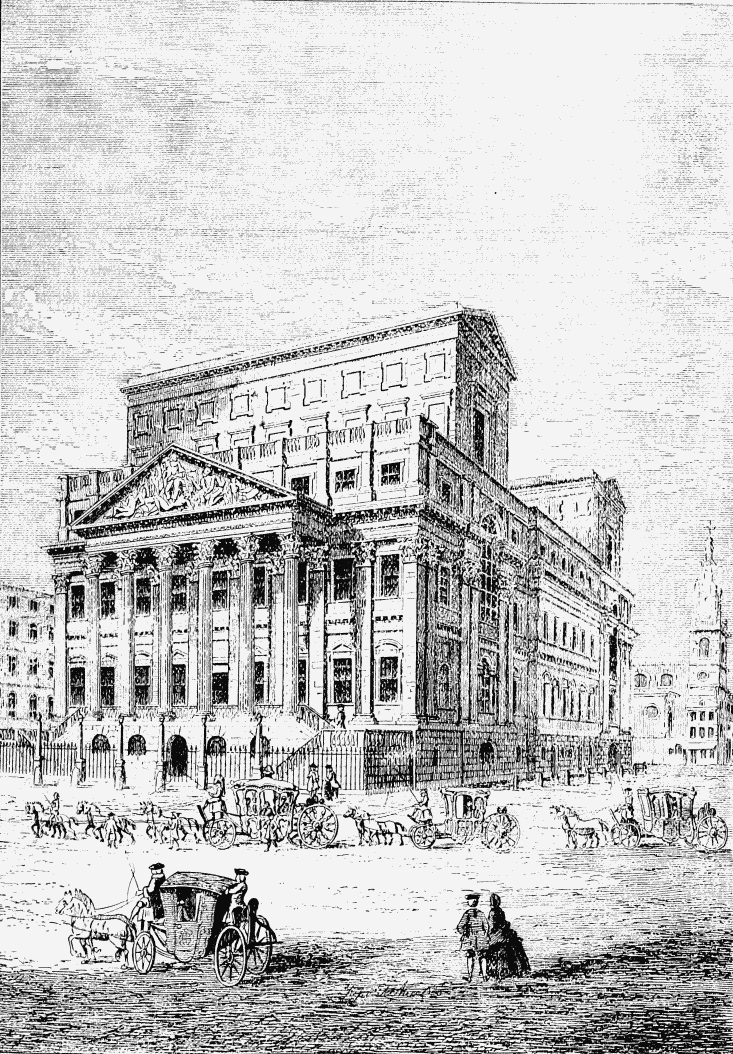
THE MANSION HOUSE IN 1750. (From a Print published for Stow's "Survey.")
"On the 8th of November the Lord Mayor elect is sworn into office publicly in Guildhall, having previously breakfasted with the Lord Mayor at the Mansion House; they are attended at this ceremony, as well as at the breakfast, by the members and officers of the Court of the Livery Company to which they respectively belong, in their gowns. After the swearing in at Guildhall, when the Mayor publicly takes the oaths, accepts the sword, the mace, the sceptre, and the City purse, he proceeds with the late Mayor to the Mansion House, and they conjointly give what is called the 'farewell dinner;' the Lord Mayor elect proceeding to his own private residence in the evening, a few days being allowed for the removal of the late Lord Mayor.
"The next day, being what is popularly known as 'Lord Mayor's day,' and which is observed as a close holiday in the City, the shops are closed, as are also the streets in all the principal thoroughfares, except for the carriages engaged in the procession. He used formerly to go to Westminster Hall by water, in the state barge, attended by the state barges of the City Companies, but now by land, and is again sworn in, in the Court of Exchequer, to uphold and support the Crown, and make a due return of all fines and fees passing through his office during the year. He returns in the same state to Guildhall about three o'clock in the afternoon (having left the Mansion House about twelve o'clock), where, in conjunction with the Sheriffs, he gives a most splendid banquet to the Royal Family, the Judges, Ministers of State, Ambassadors, or such of them as will accept his invitation, the Corporation, and such distinguished foreigners as may be visiting in the country. At this banquet the King and Queen attend the first year after their coronation; it is given at the expense of the City, and it generally costs from eight to ten thousand pounds; but when the City entertained the Prince of Wales, afterwards George IV., and the allied Sovereigns in 1814, it cost twenty thousand pounds. On all other Lord Mayor's days the expense is borne by the Lord Mayor and the Sheriffs, the former paying half, and the latter onefourth each; the Mayor's half generally averaging from twelve to fourteen hundred pounds.
"The next morning the new Lord Mayor enters upon the duties of his office. From ten to twelve he is engaged in giving audience to various applications; at twelve he enters the justice-room, where he is often detained until four in the afternoon, and this is his daily employment. His lordship holds his first Court of Aldermen previous to any other court, to which he goes in full state; the same week he holds his first Court of Common Council also in state. He attends the first sessions of the Central Criminal Court at Justice Hall, in the Old Bailey; being the Chief Commissioner, he takes precedence of all the judges, and sits in a chair in the centre of the Bench, the swordbearer placing the sword of justice behind it; this seat is never occupied in the absence of the Lord Mayor, except by an alderman who has passed the chair. The Court is opened at ten o'clock on Monday; the judges come on Wednesday; the Lord Mayor takes the chair for an hour, and then retires till five o'clock, when he entertains the judges at dinner in the Court-house, which is expected to be done every day during the sitting of the Court, which takes place every month, and lasts about eight days; the Lord Mayor and the sheriffs dividing the expenses of the table between them.
"Plough Monday is the next grand day, when the Lord Mayor receives the inquest of every ward in the City, who make a presentment of the election of all ward officers in the City, who are elected on St. Thomas's Day, December 21st, and also of any nuisances or grievances of which the citizens may have to complain, which are referred to the Court of Aldermen, who sit in judgment on these matters on the next Court day. In former times, on the first Sunday in Epiphany, the Lord Mayor, Aldermen, and Corporation, went in state to the Church of St. Lawrence, Guildhall, and there received the sacrament, but this custom has of late years been omitted.
"If any public fast is ordered by the King, the Lord Mayor and Corporation attend St. Paul's Cathedral in their black robes; and if a thanksgiving, they appear in scarlet. If an address is to be presented to the throne, the whole Corporation go in state, the Lord Mayor wearing his gold gown. (Of these gowns only a certain number are allowed, by Act of Parliament, to public officers as a costly badge of distinction; the Lord Chancellor and the Master of the Rolls are among the privileged persons.) On Easter Monday and Tuesday the Lord Mayor attends Christ Church (of which he is a member), on which occasion the whole of the bluecoat boys, nurses, and beadles, master, clerk, and other officers, walk in procession. The President, freemen, and other officers of the Royal Hospital attend the church to hear the sermon, and a statement of the income and expenditure of each of the hospitals, over which the Mayor has jurisdiction, is read from the pulpit. A public dinner is given at Christ's Hospital on the Monday evening, and a similar one at St. Bartholomew's on the Tuesday. On the Monday evening the Lord Mayor gives the grandest dinner of the year in the Egyptian Hall, at the Mansion House, to 400 persons, at which some of the Royal Family often attend, a ball taking place in the evening. The next day, before going to church, the Lord Mayor gives a purse of fifty guineas, in sixpences, shillings, and half-crowns, to the boys of Christ's Hospital, who pass before him through the Mansion House, each receiving a piece of silver (fresh from the Mint), two plum buns, and a glass of wine. On the first Sunday in term the Lord Mayor and Corporation receive the judges at St. Paul's, and hear a sermon from the Lord Mayor's chaplain, after which his lordship entertains the party at dinner, either on that day or any other, according to his own feeling of the propriety of Sunday dinners.
"In the month of May, when the festival of the Sons of the Clergy is generally held in St. Paul's, the Lord Mayor attends, after which the party dine at Merchant Taylors' Hall. Some of the Royal Family generally attend; always the archbishop and a great body of the clergy. In the same month, the Lord Mayor attends St. Paul's in state, to hear a sermon preached before the Society for the Propagation of the Gospel, at which all the bishops and archbishops attend, with others of the clergy; after which the Lord Mayor gives them a grand dinner; and on another day in the same month, the Archbishop of Canterbury gives a similar state dinner to the Lord Mayor, aldermen, sheriffs, and the bishops, at Lambeth Palace." In June the Lord Mayor used to attend the anniversary of the Charity Schools in St. Paul's in state, and in the evening to preside at the public dinner, but this has of late been discontinued.
"On Midsummer Day, the Lord Mayor holds a common hall for the election of sheriffs for the ensuing year; and on the 3rd of September, the Lord Mayor, aldermen, and sheriffs used to go in state to proclaim Bartholomew Fair, now a thing of the past. They called at the gaol of Newgate on their way, and the governor brought out a cup of wine, from which the Lord Mayor drank.
"On St. Matthias' Day (21st September) the Lord Mayor attends Christ's Hospital, to hear a sermon, when a little Latin oration is made by the two senior scholars, who afterwards carry round a glove, and collect money enough to pay their first year's expenses at college. Then the beadles of the various hospitals of which the Lord Mayor is governor deliver up their staves of office, which are returned if no fault is to be attributed to them; and this is done to denote the Mayor's right to remove them at his will, or upon just cause assigned, although elected by their respective governors."
On the 28th of September, the Lord Mayor swears in the sheriffs at Guildhall, a public breakfast having been first given by them at the hall of the Company to which the senior sheriff belongs. On the 30th of September, the Lord Mayor proceeds with the sheriffs to Westminster, in state; and the sheriffs are again sworn into office before the Barons of the Exchequer. The senior alderman below the chair (the next in rotation for Lord Mayor) cuts some sticks, delivers six horse-shoes, and counts sixty-one hob-nails, as suit and service for some lands held by the City under the Crown. The Barons are then invited to the banquet given by the sheriffs on their return to the City, at which the Lord Mayor presides in state.
"The patronage of the Lord Mayor consists in the appointment of a chaplain, who receives a full set of canonicals, lives and boards in the Mansion House, has a suite of rooms and a servant at command, rides in the state carriage, and attends the Lord Mayor whenever required. He is presented to the King at the first levée, and receives a purse of fifty guineas from the Court of Aldermen, and a like sum from the Court of Common Council, for the sermons he preaches before the Corporation and the judges at St. Paul's the first Sundays in term. The next appointment the Lord Mayor has at his disposal is the Clerk of the Cocket Office, whom he pays out of his own purse. If a harbour master, of whom there are four, dies during the year, the Lord Mayor appoints his successor. The salary is £400 a year, and is paid by the Chamberlain. He also appoints the water-bailiff's assistants, if any vacancy occurs. He presents a boy to Christ's Hospital, in addition to the one he is entitled to present as an alderman; and he has a presentation of an annuity of £21 10s. 5d., under will, to thirteen pensioners, provided a vacancy occurs during his year of office. £4 is given to a poor soldier, and the same sum to a poor sailor.
"The powers of the Lord Mayor over the City, although abridged, like the sovereign power over the State, are still much more extensive than is generally supposed. The rights and privileges of the chief magistrate of the City and its corporation are nearly allied to those of the constitution of the State. The Lord Mayor has the badges of royalty attached to his office—the sceptre, the swords of justice and mercy, and the mace. The gold chain, one of the most ancient honorary distinctions, and which may be traced from the Eastern manner of conferring dignity, is worn by him, among other honorary badges; and, having passed through the office of Lord Mayor, the alderman continues to wear it during his life. He controls the City purse, the Chamberlain delivering it into his hands, together with the sceptre, on the day he is sworn into office. He has the right of precedence in the City before all the Royal Family, which right was disputed by the Prince of Wales, in St. Paul's Cathedral, during the mayoralty of Sir James Shaw, but maintained by him, and approved and confirmed by the King (George III.). The gates of the City are in his custody, and it is usual to close the only one now remaining, Temple Bar, on the approach of the sovereign when on a visit to the City, who knocks and formally requests admission, the Mayor attending in person to grant it, and receive the visit of royalty; and upon proclaiming war or peace, he also proceeds in state to Temple Bar, to admit the heralds. Soldiers cannot march through the City, in any large numbers, without the Mayor's permission, first obtained by the Commander-in-chief.
"The Lieutenancy of the City of London is in commission. The Lord Mayor, being the Chief Commissioner, issues a new commission, whenever he pleases, by application to the Lord Chancellor, through the Secretary of State. He names in the commission all the aldermen and deputies of the City of London, the directors of the Bank, the members for the City, and such of his immediate friends and relations as he pleases. The commission, being under the Great Seal, gives all the parties named therein the right to be styled esquires, and the name once in the commission remains, unless removed for any valid reason.
"The Lord Mayor enjoys the right of private audience with the Crown; and when an audience is wished for, it is usual to make the request through the Remembrancer, but not necessary. When Alderman Wilson was Lord Mayor, he used to apply by letter to the Lord Chamberlain. In attending levees or drawing-rooms, the Lord Mayor has the privilege of the entrée, and, in consideration of the important duties he has to perform in the City, and to save his time, he is allowed to drive direct into the Ambassadors' Court at St. James's, without going round by Constitution Hill. He is summoned as a Privy Councillor on the death of the King; and the Tower pass-word is sent to him regularly, signed by the sovereign.
"He has the uncontrolled conservancy of the river Thames and the waters of the Medway, from London Bridge to Rochester down the river, and from London Bridge to Oxford up the river. He holds Courts of Conservancy whenever he sees it necessary, and summons juries in Kent, from London and Middlesex, who are' compelled to go on the river in boats to view and make presentments. In the mayoralty of Alderman Wilson, these courts were held in the state barge, on the water, at the spot with which the inquiry was connected, for the convenience of the witnesses attending from the villages near. It is usual for him to visit Oxford once in fourteen, and Rochester once in seven years. (fn. 1)
"Alderman Wilson, in 1839, was the last Lord Mayor (says Fairholt, whose book was published in 1843) who visited the western boundary; and he, at the request of the Court of Aldermen, made Windsor the principal seat of the festivities, going no farther than Cliefden, and visiting Magna Charta island on his return. Alderman Pirie was the last who visited the eastern boundary, the whole party staying two days at Rochester. The Lord Mayor is privileged by the City to go these journeys every year, should he see any necessity for it; but the expense is so great (about £1,000) that it is only performed at these distant periods, although Alderman Wilson visited the western boundary in the thirteenth, and Alderman Pirie in the fifth year. A similar short view is taken as far as Twickenham yearly, in the month of July, at a cost of about £150, when the Lord Mayor is attended by the aldermen, the sheriffs, and their ladies, with the same show and attendance as on the more infrequent visits. His lordship has also a committee to assist in the duties of his office, who have a shallop of their own, and take a view up and down the river, as far as they like to go, once or twice a month during summer, at an expense of some hundreds per annum.
"The Lord Mayor may be said to have a veto upon the proceedings of the Courts both of Aldermen and Common Council, as well as upon the Court of Livery in Common Hall assembled, neither of these courts being able to meet unless convened by him; and he can at any time dissolve the court by removing the sword and mace from the table, and declaring the business at an end; but this is considered an ungracious display of power when exercised.
"The Lord Mayor may call upon the Recorder for his advice whenever he may stand in need of it, as well as for that of the Common Serjeant, the four City pleaders, and the City solicitor, from whom he orders prosecutions at the City expense whenever he thinks the public good requires it. The salary of the Recorder is £2,500 per annum, besides fees; the Common Serjeant £1,000, with an income from other sources of £843 per annum. The solicitor is supposed to make £5,000 per annum.
"The Lord Mayor resides in the Mansion House, the first stone of which was laid the 25th of October, 1739. This house, with the furniture, cost £70,985 13s. 2d., the principal part of which was paid from the fines received from persons who wished to be excused from serving the office of sheriff. About £9,000 was paid out of the City's income. The plate cost £11,531 16s. 3d., which has been very considerably added to since by the Lord Mayors for the time being, averaging about £500 per annum.
"Attached to the household is—
"These sums, added to the allowance to the Lord Mayor, and the ground-rent and taxes of the Mansion House (amounting to about £692 12s. 6d. per annum), and other expenses, it is expected, cost the City about £19,038 16s. 10d. per annum. There are also four attorneys of the Mayor's court, who formerly boarded at the Mansion House, but are now allowed £105 per annum in lieu of the table. The plate-butler and the housekeeper have each £5 5s. per annum as a compliment from the City, and in addition to their wages, paid by the Lord Mayor (£45 per annum to the housekeeper, and £1 5s. per week to the plate-butler). The marshal's clothing costs £44 16s. per annum, and that of the marshal's man £13 9s. 6d.
"There is also—
"These sums and others, added to the previous amount, make an annual amount of expense connected with the office of Lord Mayor of £25,034 7s. 1d.
"Most of the last-named officers walk before the Lord Mayor, dressed in black silk gowns, on all state occasions (one acting as his lordship's trainbearer), and dine with the household at a table provided at about 15s. a head, exclusive of wine, which they are allowed without restraint. In the mayoralty of Alderman Atkins, some dispute having arisen with some of the household respecting their tables, the City abolished the daily table, giving each of the officers a sum of money instead, deducting £1,000 a year from the Lord Mayor's allowance, and requiring him only to provide the swordbearer's table on state days."
The estimate made for the expenditure at the Mansion House by the committee of the Corporation, is founded upon the average of many years, but in such mayoralties as Curtis, Pirie, and Wilson, far more must have been spent. It is said that only one Lord Mayor ever saved anything out of his salary.
"Sir James Saunderson, Mayor in 1792–3, left behind him a minute account of the expenses of his year of office, for the edification of his successors. The document is lengthy, but we shall select a few of the more striking items. Paid—Butcher for twelve months, £781 10s. 10d.; one item in this account is for meat given to the prisoners at Ludgate, at a cost of £68 10s. 8d. The wines are, of course, expensive. 1792—Paid, late Lord Mayor's stock, £57 7s. 11d.; hock, 35 dozen, £82 14s. 0d.; champagne, 40 ditto, at 43s., £85 19s. 9d.; claret, 154 ditto, at 34s. 10d. per dozen, £268 12s. 7d.; Burgundy, 30 ditto, £76 5s. 0d., port, 8 pipes, 400 dozen, £416 4s. 0d.; draught ditto, for Lord Mayor's day, £49 4s. 0d.; ditto, ditto, for Easter Monday, £28 4s. 3d.—£493 12s. 3d.; Madeira, 32 dozen, £59 16s. 4d.; sherry, 61 dozen, £67 1s. 0d.; Lisbon, one hogshead, at 34s. per dozen, £62 12s. 0d.; bottles to make good, broke and stole, £97 13s. 6d.; arrack, £8 8s. 0d.; brandy, 25 gallons, £18 11s. 0d.; rum, 6½ ditto, £3 19s. 6d. Total, £1,309 12s. 10d."
"These items of costume are curious:—Lady Mayoress, November 30.—A hoop, £2 16s. 0d.; point ruffles, £12 12s. 0d.; treble blond ditto, £7 7s. 0d.; a fan, £3 3s. 0d.; a cap and lappets, £7 7s. 0d.; a cloak and sundries, £26 17s. 0d.; hair ornaments, £34 0s. 0d.; a cap, £7 18s. 0d.; sundries, £37 9s. 1d. 1793, Jan. 26.—A silk, for 9th Nov., 3½ guineas per yard, £41 6s. 0d.; a petticoat (Madame Beauvais), £35 3s. 6d.; a gold chain, £57 15s. 0d.; silver silk, £13 0s. 0d.; clouded satin, £5 10s. 0d.; a petticoat for Easter, £29 1s. 0d.; millinery, for ditto, £27 17s. 6d.; hair-dressing, £13 2s. 3d. July 6th.—A petticoat, £6 16s. 8d.; millinery, £7 8s. 8d.; mantuamaker, in full, £13 14s. 6d.; milliner, in full, £12 6s. 6d. Total, £416 2s. 0d. The Lord Mayor's dress:—Two wigs, £9 9s. 0d.; a velvet suit, £54 8s. 0d.; other clothes, £117 13s. 4d.; hats and hose, £9 6s. 6d.; a scarlet robe, £14 8s. 6d.; a violet ditto, £12 1s. 6d.; a gold chain, £63 0s. 0d.; steel buckles, £ 5s. 0d.; a steel sword, £6 16s, 6d.; hair-dressing, £16 16s. 11d—£309 2s. 3d. On the page opposite to that containing this record, under the head of 'Ditto Returned,' we read 'Per Valuation, £0 0s. 0d.' Thus, to dress a Lord Mayor costs £309 2s. 0d.; but her Ladyship cannot be duly arrayed at a less cost than £416 2s. 0d. To dress the servants cost £724 5s. 6d."
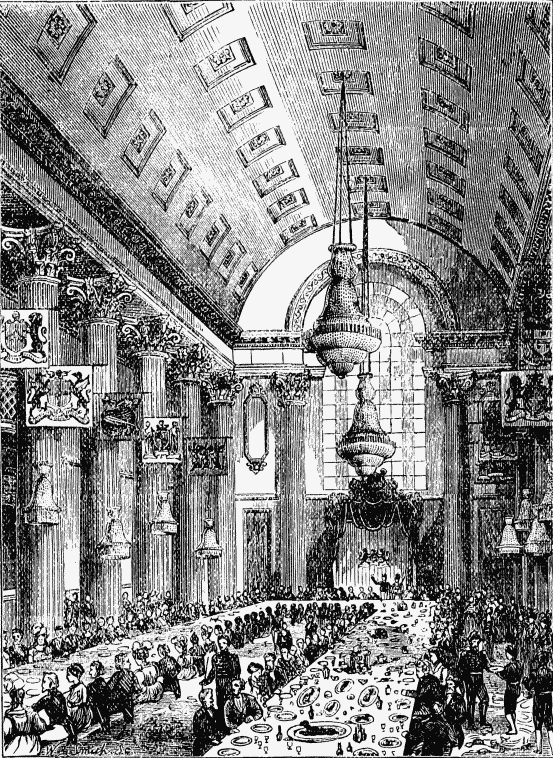
INTERIOR OF THE EGYPTIAN HALL.
Then comes a grand summing-up. "Dr. The whole state of the account, £12,173 4s. 3d." Then follow the receipts per contra:—"At Chamberlain's Office,£3,572 8s. 4d.; Cocket Office£892 5s. 11d.; Bridge House, £60; City Gauger, £250; freedoms, £175; fees on affidavits, £21 16s. 8d.; seals, £67 4s. 9d.; licences, £13 15s.; sheriff's fees, £13 6s. 8d.; corn fees, £15 13s.; venison warrants, £14 4s.; attorneys, Mayor's Court, £26 7s. 9d.; City Remembrancer, £12 12s.; in lieu of baskets, £7 7s.; vote of Common Council, £100; sale of horses and carriages, £450; wine (overplus) removed from Mansion House, £398 18s. 7d. Total received, £6,117 9s. 8d. Cost of mayoralty, as such, and independent of all private expenses, £6,055 14s. 7d"
That clever but unscrupulous tuft-hunter and smart parvenu, Theodore Hook, who talked of Bloomsbury as if it was semi-barbarous, and of citizens (whose wine he drank, and whose hospitality he so often shared) as if they could only eat venison and swallow turtle soup, has left a sketch of the short-lived dignity of a mayor, which exactly represents the absurd caricature of City life that then pleased his West-end readers, half of whom had derived their original wealth from the till. Scropps, the new Lord Mayor, cannot sleep all night for his greatness; the wind down the chimney sounds like the shouts of the people; the cocks crowing in the morn at the back of the house he takes for trumpets sounding his approach; and the ordinary incidental noises in the family he fancies the pop-guns at Stangate announcing his disembarcation at Westminster. Then come his droll mishaps: when he enters the state coach, and throws himself back upon his broad seat, with all imaginable dignity, in the midst of all his ease and elegance, he snaps off the cut-steel hilt of his sword, by accidentally bumping the whole weight of his body right—or rather, wrong—directly upon the top of it.
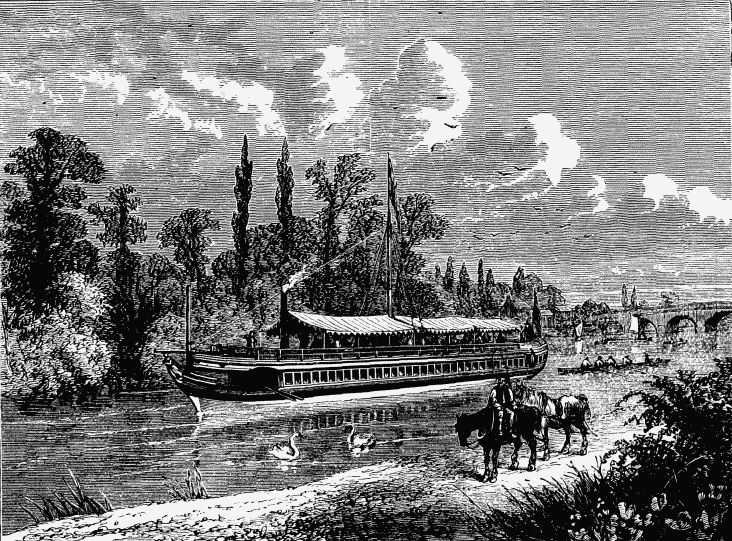
THE "MARIA WOOD." (See page 447.)
"Through fog and glory," says Theodore Hook, "Scropps reached Blackfriars Bridge, took water, and in the barge tasted none of the collation, for all he heard, saw, and swallowed was 'Lord Mayor and 'your lordship,' far sweeter than nectar. At the presentation at Westminster, he saw two of the judges, whom he remembered on the circuit, when he trembled at the sight of them, believing them to be some extraordinary creatures, upon whom all the hair and fur grew naturally.
"Then the Lady Mayoress. There she was— Sally Scropps (her maiden name was Snob). 'There was my own Sally, with a plume of feathers that half filled the coach, and Jenny and Maria and young Sally, all with their backs to my horses, which were pawing with mud, and snorting and smoking like steam-engines, with nostrils like safety. valves, and four of my footmen behind the coach, like bees in a swarm.'"
Perhaps the most effective portion of the paper is the reverse of the picture. My lord and lady and their family had just got settled in the Mansion House, and enjoying their dignity, when the 9th of November came again—the consummation of Scropps' downfall. Again did they go in state to Guildhall; again were they toasted and addressed; again were they handed in and led out, flirted with Cabinet ministers, and danced with ambassadors; and at two o'clock in the morning drove home from the scene of gaiety to the old residence in Budge Row. "Never in the world did pickled herrings or turpentine smell so powerfully as on that night when we re-entered the house. … The passage looked so narrow; the drawing-room looked so small; the staircase seemed so dark; our apartments appeared so low. In the morning we assembled at breakfast. A note lay upon the table, addressed 'Mrs. Scropps, Budge Row.' The girls, one after the other, took it up, read the superscription, and laid it down again. A visitor was announced—a neighbour and kind friend, a man of wealth' and importance. What were his first words? They were the first I had heard from a stranger since my job. 'How are you, Scropps? Done up, eh?'
"Scropps! No obsequiousness, no deference, no respect. No 'My lord, I hope your lordship passed an agreeable night. And how is her ladyship, and her amiable daughters?' No, not a bit of it! 'How's Mrs. S. and the gals?' This was quite natural, all as it had been. But how unlike what it was only the day before! The very servants—who, when amidst the strapping, stall-fed, gold-laced lackeys of the Mansion House, and transferred, with the chairs and tables, from one Lord Mayor to another, dared not speak, nor look, nor say their lives were their own—strutted about the house, and banged the doors, and spoke of their missis as if she had been an old apple-woman.
"So much for domestic miseries. I went out. I was shoved about in Cheapside in the most remorseless manner. My right eye had a narrow escape of being poked out by the tray of a brawny butcher's boy, who, when I civilly remonstrated, turned round and said, 'Vy, I say, who are you, I wonder? Why are you so partiklar about your hysight?' I felt an involuntary shudder. 'To-day,' thought I, 'I am John Ebenezer Scropps. Two days ago I was Lord Mayor!'"
"Our Lord Mayor," says Cobbett, in his sensible way," and his golden coach, and his gold-covered footmen and coachmen, and his golden chain, and his chaplain, and his great sword of state, please the people, and particularly the women and girls; and when they are pleased, the men and boys are pleased. And many a young fellow has been more industrious and attentive from his hope of one day riding in that golden coach."
"On ordinary state occasions," says "Aleph," in the City Press, "the Lord Mayor wears a massive black silk robe, richly embroidered, and his collar and jewel; in the civic courts, a violet silk robe, furred and bordered with black velvet. The wear of the various robes was fixed by a regulation dated 1562. The present authority for the costumes is a printed pamphlet (by order of the Court of Common Council), dated 1789.
"The jewelled collar (date 1534)," says Mr. Timbs, "is of pure gold, composed of a series of links, each formed of a letter S, a united York and Lancaster (or Henry VII.) rose, and a massive knot. The ends of the chain are joined by the portcullis, from the points of which, suspended by a ring of diamonds, hangs the jewel. The entire collar contains twenty-eight SS, fourteen roses, thirteen knots, and measures sixty-four inches. The jewel contains in the centre the City arms, cut in cameo of a delicate blue, on an olive ground. Surrounding this is a garter of bright blue, edged with white and gold, bearing the City motto, 'Domine, dirige nos,' in gold letters. The whole is encircled with a costly border of gold SS, alternating with rosettes of diamonds, set in silver. The jewel is suspended from the collar by a portcullis, but when worn without the collar, is hung by a broad blue ribbon. The investiture is by a massive gold chain, and, when the Lord Mayor is re-elected, by two chains."
Edward III., by his charter (dated 1534), grants the mayors of the City of London "gold, or silver, or silvered" maces, to be carried before them. The present mace, of silver-gilt, is five feet three inches long, and bears on the lower part "W. R." It is surmounted with a royal crown and the imperial arms; and the handle and staff are richly chased.
There are four swords belonging to the City of London. The "Pearl" sword, presented by Queen Elizabeth when she opened the first Royal Exchange, in 1571, and so named from its being richly set with pearls. This sword is carried before the Lord Mayor on all occasions of rejoicing and festivity. The "Sword of State," borne before the Lord Mayor as an emblem of his authority. The "Black" sword, used on fast days, in Lent, and at the death of any of the royal family. And the fourth is that placed before the Lord Mayor's chair at the Central Criminal Court.
The Corporate seal is circular. The second seal, made in the mayoralty of Sir William Walworth, 1381, is much defaced.
"The 'gondola,' known as the 'Lord Mayor's State Barge,'" says "Aleph," "was built in 1807, at a cost of £2,579. Built of English oak, 85 feet long by 13 feet 8 inches broad, she was at all times at liberty to pass through all the locks, and even go up the Thames as far as Oxford. She had eighteen oars and all other fittings complete, and was profusely gilt. But when the Conservancy Act took force, and the Corporation had no longer need of her, she was sold at her moorings at Messrs. Searle's, Surrey side of Westminster Bridge, on Thursday, April 5th, 1860, by Messrs. Pullen and Son, of Cripplegate. The first bid was £20, and she was ultimately knocked down for £105. Where she is or how she has fared we know not. The other barge is that famous one known to all City personages and all civic pleasure parties. It was built during the mayoralty of Sir Matthew Wood, in 1816, and received its name of Maria Wood from the eldest and pet daughter of that 'twice Lord Mayor.' It cost £3,300, and was built by Messrs. Field and White, in consequence of the old barge Crosby (built during the mayoralty of Brass Crosby, 1771) being found past repairing. Maria Wood measures 140 feet long by 19 feet wide, and draws only 2 feet 6 inches of water. The grand saloon, 56 feet long, is capable of dining 140 persons. In 1851 she cost £1,000 repairing. Like her sister, this splendid civic barge was sold at the Auction-mart, facing the Bank of England, by Messrs. Pullen and Son, on Tuesday, May 31, 1859. The sale commenced at £100, next £200, £220, and thence regular bids, till finally it got to £400, when Mr. Alderman Humphrey bid £410, and got the prize. Though no longer civic property, it is yet, I believe, in the hands of those who allow it to be made the scene of many a day of festivity."