
Old and New London: Volume 1. Originally published by Cassell, Petter & Galpin, London, 1878.
This free content was digitised by double rekeying. All rights reserved.
'Saxon London', in Old and New London: Volume 1, (London, 1878) pp. 447-452. British History Online https://www.british-history.ac.uk/old-new-london/vol1/pp447-452 [accessed 25 April 2024]
In this section
CHAPTER XXXIX.
SAXON LONDON.
A Glance at Saxon London—The Three Component Parts of Saxon London—The First Saxon Bridge over the Thames—Edward the Confessor at Westminister—City Residences of the Saxon Kings—Political Position of London in Early Times—The first recorded Great Fire of London —The Early Commercial Dignity of London—The Kings of Norway and Denmark besiege London in vain—A Great Gemotheld in London -Edmund Ironside elected King by the Londoners—Canute besieges them, and is driven off—The Seamen of London—Its Citizens as Electors of Kings.
Our materials for sketching Saxon London are ingularly scanty; yet some faint picture of it we nay perhaps hope to convey.
Our readers must, therefore, divest their minds entirely of all remembrance of that great ocean of houses that has now spread like an inundation from the banks of the winding Thames, surging over the wooded ridges that rise northward, and widening out from Whitechapel eastward to Kenington westward. They must rather recall to their minds some small German town, belted in with a sturdy wall, raised not for ornament, but defence, with corner turrets for archers, and pierced with loops whence the bowmen may drive their arrows at the straining workers of the catapult and mangonels (those Roman war-engines we used against the cruel Danes), and with stone-capped places of shelter along the watchmen's platforms, where the sentinels may shelter themselves during the cold and storm, when tired of peering over the battlements and looking for the crafty enemy Essex-wards or Surrey way. No toy battlements of modern villa or tea-garden are those over which the rough-bearded men, in hoods and leather coats, lean in the summer, watching the citizens disporting themselves in the Moorfields, or in winter sledging over the ice-pools of Finsbury. Not for mere theatrical pageant do they carry those heavy axes and tough spears. Those bossed targets are not for festival show; those buff jackets, covered with metal scales, have been tested before now by Norsemen's ponderous swords and the hatchets of the fierce Jutlanders.
In such castle rooms as antiquaries now visit, the Saxon earls and eldermen quaffed their ale, and drank "wassail" to King Egbert or Ethelwolf. In such dungeons as we now see with a shudder at the Tower, Saxon traitors and Danish prisoners once peaked and pined.
We must imagine Saxon London as having three component parts—fortresses, convents, and huts. The girdle of wall, while it restricted space, would give a feeling of safety and snugness which in our great modern city—which is really a conglomeration, a sort of pudding-stone, of many towns and villages grown together into one shapeless mass— the citizen can never again experience. The streets would in some degree resemble those of Moscow, where, behind fortress, palace, and church, you come upon rows of mere wooden sheds, scarcely better than the log huts of the peasants, or the sombre felt tents of the Turcoman. There would be large vacant spaces, as in St. Petersburg; and the suburbs would rapidly open beyond the walls into wild woodland and pasture, fen, moor, and common. A few dozen fishermen's boats from Kent and Norfolk would be moored by the Tower, if, indeed, any Saxon fort had ever replaced the somewhat hypothetical Roman fortress of tradition; and lower down some hundred or so cumbrous Dutch, French, and German vessels would represent our trade with the almost unknown continent whence we drew wine and furs and the few luxuries of those hardy and thrifty days.
In the narrow streets, the fortress, convent, and but would be exactly represented by the chieftain and his bearded retinue of spearmen, the priest with his train of acolytes, and the herd of halfsavage churls who plodded along with rough carts laden with timber from the Essex forests, or driving herds of swine from the glades of Epping. The churls we picture as grim but hearty folk, stolid, pugnacious, yet honest and promise-keeping, overinclined to strong ale, and not disinclined for a brawl; men who had fought with Danes and wolves, and who were ready to fight them again. The shops must have been mere stalls, and much of the trade itinerant. There would be, no doubt, rudimentary market-places about Cheapside (Chepe is the Saxon word for market); and the lines of some of our chief streets, no doubt, still follow the curves of the original Saxon roads.
The date of the first Saxon bridge over the Thames is extremely uncertain, as our chapter on London Bridge will show; but it is almost as certain as history can be that, soon after the Dane Olaf's invasion of England (994) in Ethelred's reign, with 390 piratical ships, when he plundered Staines and Sandwich, a rough wooden bridge was built, which crossed the Thames from St. Botolph's wharf to the Surrey shore. We must imagine it a clumsy rickety structure, raised on piles with rough-hewn timber planks, and with drawbridges that lifted to allow Saxon vessels to pass. There was certainly a bridge as early as 1006, probably built to stop the passage of the Danish pirate boats. Indeed, Snorro Sturleson, the Icelandic historian, tells us that when the Danes invaded England in 1008, in the reign of Ethelred the Unready (ominous name!), they entrenched themselves in Southwark, and held the fortified bridge, which had penthouses, bulwarks, and shelter-turrets. Ethelred's ally, Olaf, however, determined to drive the Danes from the bridge, adopted a daring expedient to accomplish this object, and, fastening his ships to the piles of the bridge, from which the Danes were raining down stones and beams, dragged it to pieces, upon which, on very fair provocation, Ottar, a Norse bard, broke forth into the following eulogy of King Olaf, the patron saint of Tooley Street:—
"And thou hast overthrown their bridge, O thou storm of the sons of Odin, skilful and foremost in the battle, defender of the earth, and restorer of the exiled Ethelred! It was during the fight which the mighty King fought with the men of England, when King Olaf, the son of Odin, valiantly attacked the bridge at London. Bravely did the swords of the Volsces defend it; but through the trench which the sea-kings guarded thou camest, and the plain of Southwark was crowded with thy tents."
It may seem as strange to us, at this distance of time, to find London Bridge ennobled in a Norse epic, as to find a Sir Something de Birmingham figuring among the bravest knights of Froissart's record; but there the Norse song stands on record, and therein we get a stormy picture of the Thames in the Saxon epoch.
It is supposed that the Saxon kings dwelt in a palace on the site of the Baynard's Castle of the Middle Ages, which stood at the river-side just west of St. Paul's, although there is little proof of the fact. But we get on the sure ground of truth when we find Edward the Confessor, one of the most powerful of the Saxon kings, dwelling in saintly splendour at Westminster, beside the abbey dedicated by his predecessors to St. Peter. The combination of the palace and the monastery was suitable to such a friend of the monks, and to one who saw strange visions, and claimed to be the favoured of Heaven. But beyond and on all sides of the Saxon palace everywhere would be fields —St. James's Park (fields), Hyde Park (fields), Regent's Park (fields), and long woods stretching northward from the present St. John's Wood to the uplands of Epping.
As to the City residences of the Saxon kings, we have little on record; but there is indeed a tradition that in Wood Street, Cheapside, King Athelstane once resided; and that one of the doors of his house opened into Addle Street, Aldermanbury (addle, from the German word edd, noble). But Stow does not mention the tradition, which rests, we fear, on slender evidence.
Whether the Bread Street, Milk Street, and Cornhill markets date from the Saxon times is uncertain. It is not unlikely that they do, yet the earliest mention of them in London chronicles is found several centuries later.
We must be therefore content to search for allusions to London's growth and wealth in Saxon history, and there the allusions are frequent, clear, and interesting.
In the earlier time London fluctuated, according to one of the best authorities on Saxon history, between an independent mercantile commonwealth and a dependency of the Mercian kings. The Norsemen occasionally plundered and held it as a point d'appui for their pirate galleys. Its real epoch of greatness, however ancient its advantage as a port, commences with its re-conquest by Alfred the Great in 886. Henceforward, says that most reliable writer on this period, Mr. Freeman, we find it one of the firmest strongholds of English freedom, and one of the most efficient bulwarks of the realm. There the English character developed the highest civilisation of the country, and there the rich and independent citizens laid the foundations of future liberty.
In 896 the Danes are said to have gone up the Lea, and made a strong work twenty miles above Lundenburgh. This description, says Earle, would be particularly appropriate, if Lundenburgh occupied the site of the Tower. Also one then sees the reason why they should go up the Lea—viz., because their old passage up the Thames was at that time intercepted.
"London," says Earle, in his valuable Saxon Chronicles, "was a flourishing and opulent city, the chief emporium of commerce in the island, and the residence of foreign merchants. Properly it was more an Angle city, the chief city of the Anglian nation of Mercia; but the Danes had settled there in great numbers, and had numerous captives that they had taken in the late wars. Thus the Danish population had a preponderance over the Anglian free population, and the latter were glad to see Alfred come and restore the balance in their favour. It was of the greatest importance to Alfred to secure this city, not only as the capital of Mercia (caput regni Merciorum, Malmesbury), but as the means of doing what Mercia had not done—viz., of making it a barrier to the passage of pirate ships inland. Accordingly, in the year 886, Alfred planted the garrison of London (i.e., not as a town is garrisoned in our day, with men dressed in uniform and lodged in barracks, but) with a military colony of men to whom land was given for their maintenance, and who would live in and about a fortified position under a commanding officer. It appears to me not impossible that this may have been the first military occupation of Tower Hill, but this is a question for the local antiquary."
In 982 (Ethelred II.), London, still a mere cluster of wooden and wattled houses, was almost entirely destroyed by a fire. The new city was, no doubt, rebuilt in a more luxurious manner. "London in 993," says Mr. Freeman, in a very admirable passage, "fills much the same place in England that Paris filled in Northern Gaul a century earlier. The two cities, in their several lands, were the two great fortresses, placed on the two great rivers of the country, the special objects of attack on the part of the invaders, and the special defence of the country against them. Each was, as it were, marked out by great public services to become the capital of the whole kingdom. But Paris became a national capital only because its local count gradually grew into a national king. London, amidst all changes, within and without, has always preserved more or less of her ancient character as a free city. Paris was merely a military bulwark, the dwelling-place of a ducal or a royal sovereign. London, no less important as a military post, had also a greatness which rested on a surer foundation. London, like a few other of our great cities, is one of the ties which connect our Teutonic England with the Celtic and Roman Britain of earlier times. Her British name still remains unchanged by the Teutonic conquerors. Before our first introduction to London as an English city, she had cast away her Roman and imperial title; she was no longer Augusta; she had again assumed her ancient name, and through all changes she had adhered to her ancient character. The commercial fame of London dates from the early days of Roman dominion. The English conquest may have caused a temporary interruption, but it was only temporary. As early as the days of Æthelberht the commerce of London was again renowned. Ælfred had rescued the city from the Dane; he had built a citadel for her defence, the germ of that Tower which was to be first the dwelling-place of kings, and then the scene of the martyrdom of their victims. Among the laws of Æthelstan, none are more remarkable than those which deal with the internal affairs of London, and with the regulation of her earliest commercial corporations. Her institutes speak of a commerce spread over all the lands which bordered on the Western Ocean. Flemings and Frenchmen, men of Ponthieu, of Brabant, and of Lüttich, filled her markets with their wares, and enriched the civic coffers with their toils. Thither, too, came the men of Rouen, whose descendants were, at no distant day, to form a considerable element among her own citizens; and, worthy and favoured above all, came the seafaring men of the old Saxon brother-land, the pioneers of the mighty Hansa of the north, which was in days to come to knit together London and Novgorod in one bond of commerce, and to dictate laws and distribute crowns among the nations by whom London was now threatened. The demand for toll and tribute fell lightly on those whom the English legislation distinguished as the men of the Emperor."
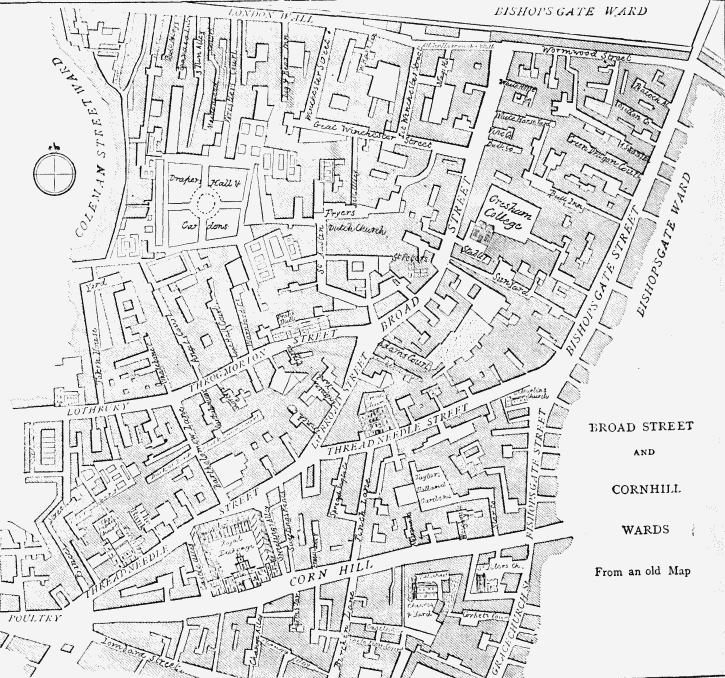
BROAD STREET AND CORNHILL WARDS. (From a Map of 1750.)
In 994, Olaf king of Norway, and Sweyn king of Denmark, summoning their robber chieftains from their fir-woods, fiords, and mountains, sailed up the Thames in ninety-four war vessels, eager to plunder the wealthy London of the Saxons. The brave burghers, trained to handle spear and sword, beat back, however, the hungry foemen from their walls —the rampart that tough Roman hands had reared, and the strong tower which Alfred had seen arise on the eastern bank of the river.
But it was not only to such worldly bulwarks that the defenders of London trusted. On that day, says the chronicler, the Mother of God, "of her mild-heartedness," rescued the Christian city from its foes. An assault on the wall, coupled with an attempt to burn the town, was defeated, with great slaughter of the besiegers; and the two kings sailed away the same day in wrath and sorrow.
During the year 998 a great "gemot" was held at London. Whether any measures were taken to resist the Danes does not appear; but the priests were busy, and Wulfsige, Bishop of the Dorsætas, took measures to substitute monks for canons in his cathedral church at Sherborne; and the king restored to the church of Rochester the lands of which he had robbed it in his youth.
In 1009 the Danes made several vain attempts on London.
In 1013 Sweyn, the Dane, marched upon the much-tormented city of ships; but the hardy citizens were again ready with bow and spear. Whether the bridge still existed then or not is uncertain; as many of the Danes are said to have perished in vainly seeking for the fords. The assaults were as unsuccessful as those of Sweyn and Olaf, nineteen years before, for King Ethelred's right hand was Thorkill, a trusty Dane. "For the fourth time in this reign," says Mr. Freeman, "the invaders were beaten back from the great merchant city. Years after London yielded to Sweyn; then again, in Ethelred's last days, it resisted bravely its enemies; till at last Ethelred, weary of Dane and Saxon, died, and was buried in St. Paul's. The two great factions of Danes and Saxons had now to choose a king.

LORD MAYOR'S WATER PROCESSION.
Canute the Dane was chosen as king at Southampton; but the Londoners were so rich, free, and powerful that they held a rival gemot, and with one voice elected the Saxon atheling Edmund Ironside, who was crowned by Archbishop Lyfing within the city, and very probably at St. Paul's. Canute, enraged at the Londoners, at once sailed for London with his army, and, halting at Greenwich, planned the immediate siege of the rebellious city. The great obstacle to his advance was the fortified bridge that had so often hindered the Danes. Canute, with prompt energy, instantly had a great canal dug on the southern bank, so that his ships might turn the flank of the bridge; and, having overcome this great difficulty, he dug another trench round the northern and western sides of the city. London was now circumvallated, and cut off from all supply of corn and cattle; but the citizen's hearts were staunch, and, baffling every attempt of Canute to sap or escalade, the Dane soon raised the siege. In the meantime, Edmund Ironside was not forgetful of the city that had chosen him as king. After three battles, he compelled the Danes to raise their second siege. In a fourth battle, which took place at Brentford, the Danes were again defeated, though not without considerable losses on the side of the victors, many of the Saxons being drowned in trying to ford the river after their flying enemies. Edmund then returned to Wessex to gather fresh troops, and in his absence Canute for the third time laid siege to London. Again the city held out against every attack, and "Almighty God,"as the pious chroniclers say, "saved the city."
After the division of England between Edmund and Canute had been accomplished, the London citizens made peace with the Danes, and the latter were allowed to winter as friends in the unconquered city; but soon after the partition Edmund Ironside died in London, and thus Canute became the sole king of England.
On the succession of Harold I. (Canute's natural son), says Mr. Freeman, we find a new element, the "lithsmen," the seamen of London. "The great city still retained her voice in the election of kings; but that voice would almost seem to have been transferred to a new class among the population. We hear now not of the citizens, but of the sea-faring men. Every invasion, every foreign settlement of any kind within the kingdom too, in every age, added a new element to the population of London. As a Norman colony settled in London later in the century, so a Danish colony settled there now. Some accounts tell us, doubtless with great exaggeration, that London had now almost become a Danish city (William of Malmesbury, ii. 188); but it is, at all events, quite certain the Danish element in the city was numerous and powerful, and that its voice strongly helped to swell the cry which was raised in favour of Harold."
It seems doubtful how far the London citizens in the Saxon times could claim the right to elect kings. The latest and best historian of this period seems to think that the Londoners had no special privileges in the gemot; but, of course, when the gemot was held in London, the citizens, intelligent and united, had a powerful voice in the decision. Hence it arose that the citizens both of London and Winchester (which had been an old seat of the Saxon kings) "seem," says Mr. Freeman, "to be mentioned as electors of kings as late as the accession of Stephen. (See William of Malmesbury, "Hist. Nov.," i. 11.) Even as late as the year 1461, Edward Earl of March was elected king by a tumultuous assembly of the citizens of London;" and again, at a later period, we find the citizens foremost in the revolution which placed Richard III. on the throne in 1483. These are plainly vestiges of the right which the citizens had more regularly exercised in the elections of Edmund Ironside and of Harold the son of Cnut.
The city of London, there can be no doubt, soon emancipated itself from the jurisdiction of earls like Leofwin, who ruled over the home counties. It acquired, by its own secret power, an unwritten charter of its own, its influence being always important in the wars between kings and their rivals, or kings and their too-powerful nobles. "The king's writs for homage," says a great authority, "in the Saxon times, were addressed to the bishop, the portreeve or portreeves, to the burgh thanes, and sometimes to the whole people."
Thus it may clearly be seen, even from the scanty materials we are able to collect, that London, as far back as the Saxon times, was destined to achieve greatness, political and commercial.