Old and New London: Volume 1. Originally published by Cassell, Petter & Galpin, London, 1878.
This free content was digitised by double rekeying. Public Domain.
Walter Thornbury, 'Threadneedle Street', in Old and New London: Volume 1(London, 1878), British History Online https://www.british-history.ac.uk/old-new-london/vol1/pp531-544 [accessed 30 April 2025].
Walter Thornbury, 'Threadneedle Street', in Old and New London: Volume 1(London, 1878), British History Online, accessed April 30, 2025, https://www.british-history.ac.uk/old-new-london/vol1/pp531-544.
Walter Thornbury. "Threadneedle Street". Old and New London: Volume 1. (London, 1878), British History Online. Web. 30 April 2025. https://www.british-history.ac.uk/old-new-london/vol1/pp531-544.
In this section
CHAPTER XLVI.
THREADNEEDLE STREET.
The Centre of Roman London—St. Benet Fink—The Monks of St. Anthony—The Merchant Taylors—Stow, Antiquary and Tailor—A Magnificent Roll—The Good Deeds of the Merchant Taylors—The Old and the Modern Merchant Taylors' Hall—" Concordia parvæ res crescunt"—Henry VII. enrolled as a Member of the Taylors' Company—A Cavalcade of Archers—The Hall of Commerce in Threadneedle Street—A Painful Reminiscence—The Baltic Coffee-house—St. Anthony's School—The North and South American Coffee-house—The South Sea House—History of the South Sea Bubble—Bubble Companies of the Period—Singular Infatuation of the Public—Bursting of the Bubble—Parliamentary Inquiry into the Company's Affairs—Punishment of the Chief Delinquents—Restoration of Public Credit—The Poets during the Excitement—Charles Lamb's Reverie.
In Threadneedle Street we stand in the centre of Roman London. In 1805 a tesselated pavement, now in the British Museum, was found at Lothbury. The Exchange stands, as we have already mentioned, on a mine of Roman remains. In 1840–41 tesselated pavements were found, about twelve or fourteen feet deep, beneath the old French Protestant Church, with coins of Agrippa, Claudius, Domitian, Marcus Aurelius, and the Constantines, together with fragments of frescoes, and much charcoal and charred barley. These pavements are also preserved in the British Museum. In 1854, in excavating the site of the church of St. Benet Fink, there was found a large deposit of Roman débris, consisting of Roman tiles, glass, and fragments of black, pale, and red Samian pottery.
The church of St. Benet Fink, of which a representation is given at page 468, was so called from one Robert Finck, or Finch, who built a previous church on the same site (destroyed by the Fire of 1666). It was completed by Sir Christopher Wren, in 1673, at the expense of £4,130, but was taken down in 1844. The tower was square, surmounted by a cupola of four sides, with a small turret on the top. There was a large recessed doorway on the north side, of very good design.
The arrangement of the body of the church was very peculiar, we may say unique; and although far from beautiful, afforded a striking instance of Wren's wonderful skill. The plan of the church was a decagon, within which six composite columns in the centre supported six semi-circular vaults. Wren's power of arranging a plan to suit the site was shown in numerous buildings, but in none more forcibly than in this small church.
"St. Benedict's," says Maitland, "is vulgarly Bennet Fink. Though this church is at present a donative, it was anciently a rectory, in the gift of the noble family of Nevil, who probably conferred the name upon the neighbouring hospital of St. Anthony."
Newcourt, who lived near St. Benet Fink, says the monks of the Order of St. Anthony hard by were so importunate in their requests for alms that they would threaten those who refused them with "St. Anthony's fire;" and that timid people were in the habit of presenting them with fat pigs, in order to retain their good-will. Their pigs thus became numerous, and, as they were allowed to roam about for food, led to the proverb, "He will follow you like a St. Anthony's pig." Stow accounts for the number of these pigs in another way, by saying that when pigs were seized in the markets by the City officers, as ill-fed or unwholesome, the monks took possession of them, and tying a bell about their neck, allowed them to stroll about on the dunghills, until they became fit for food, when they were claimed for the convent.
The Merchant Taylors, whose hall is very appropriately situated in Threadneedle Street, had their first licence as "Linen Armourers" granted by Edward I. Their first master, Henry de Ryall, was called their "pilgrim," as one that travelled for the whole company, and their wardens "purveyors of dress." Their first charter is dated I Edward III. Richard II. confirmed his grandfather's grants. From Henry IV. they obtained a confirmatory charter by the name of the "Master and Wardens of the Fraternity of St. John the Baptist of London." Henry VI. gave them the right of search and correction of abuses. The society was incorporated in the reign of Edward IV., who gave them arms; and Henry VII., being a member of the Company, for their greater honour transformed them from Tailors and Linen Armourers to Merchant Taylors, giving them their present acting charter, which afterwards received the confirmation and inspeximus of five sovereigns—Henry VIII., Edward VI., Philip and Mary, Elizabeth, and James I.
There is no doubt (says Herbert) that Merchant Taylors were originally bonâ fide cutters-out and makers-up of clothes, or dealers in and importers of cloth, having tenter-grounds in Moorfields. The ancient London tailors made both men's and women's apparel, also soldiers' quilted surcoats, the padded lining of armour, and probably the trappings of war-horses. In the 27th year of Edward III. the Taylors contributed £20 towards the French wars, and in 1377 they sent six members to the Common Council, a number equalling (says Herbert) the largest guilds, and they were reckoned the seventh company in precedence. In 1483 we find the Merchant Taylors and Skinners disputing for precedence. The Lord Mayor decided they should take precedence alternately; and, further, most wisely and worshipfully decreed that each Company should dine in the other's hall twice a year, on the vigil of Corpus Christi and the feast of St. John Baptist—a laudable custom, which soon restored concord. In 1571 there is a precept from the Mayor ordering that ten men of this Company and ten men of the Vintners' should ward each of the City gates every tenth day. In 1579 the Company was required to provide and train 200 men for arms. In 1586 the master and wardens are threatened by the Mayor for not making the provision of gunpowder required of all the London companies. In 1588 the Company had to furnish thirty-five armed men, as its quota for the Queen's service against the dreaded Spanish Armada.
In 1592 an interesting entry records Stow (a tailor and member of the Company) presenting his famous "Annals" to the house, and receiving in consequence an annuity of £4 per annum, eventually raised to £10. The Company afterwards restored John Stow's monument in the Church of St. Andrew Undershaft. Speed, also a tailor and member of the Company, on the same principle, seems to have presented the society with valuable maps, for which, in 1600, curtains were provided. In 1594 the Company subscribed £50 towards a pest-house, the plague then raging in the City, and the same year contributed £296 10s. towards six ships and a pinnace fitted out for her Majesty's service.
In 1603 the Company contributed £234 towards the £2,500 required from the London companies to welcome James I. and his Danish queen to England. Six triumphal arches were erected between Fenchurch Street and Temple Bar, that in Fleet Street being ninety feet high and fifty broad. Decker and Ben Jonson furnished the speeches and songs for this pageant. June 7, 1607, was one of the grandest days the Company has ever known; for James I. and his son, Prince Henry, dined with the Merchant Taylors. It had been at first proposed to train some boys of Merchant Taylors' School to welcome the king, but Ben Jonson was finally invited to write an entertainment. The king and prince dined separately. The master presented the king with a purse of £100. "Richard Langley shewed him a role, wherein was registered the names of seaven kinges, one queene, seventeene princes and dukes, two dutchesses, one archbishoppe, one and thirtie earles, five countesses, one viscount, fourteene byshoppes, sixtie and sixe barons, two ladies, seaven abbots, seaven priors, and one sub-prior, omitting a great number of knights, esquires, &c., who had been free of that companie." The prince was then made a freeman, and put on the garland. There were twelve lutes (six in one window and six in another).
"In the ayr betweene them" (or swung up above their heads) "was a gallant shippe triumphant, wherein was three menne like saylers, being eminent for voyce and skill, who in their severall songes were assisted and seconded by the cunning lutanists. There was also in the hall the musique of the cittie, and in the upper chamber the children of His Majestie's Chappell sang grace at the King's table; and also whilst the King sate at dinner John Bull, Doctor of Musique, one of the organists of His Majestie's Chapell Royall, being in a cittizen's cap and gowne, cappe and hood (i.e., as a liveryman), played most excellent melodie uppon a small payre of organes, placed there for that purpose onely."
The king seems at this time to have scarcely recovered the alarm of the Gunpowder Plot; for the entries in the Company's books show that there was great searching of rooms and inspection of walls, "to prevent villanie and danger to His Majestie." The cost of this feast was more than £1,000. The king's chamber was made by cutting a hole in the wall of the hall, and building a small room behind it.
In 1607 (James I.), before a Company's dinner, the names of the livery were called, and notice taken of the absent. Then prayer was said, every one kneeling, after which the names of benefactors and their "charitable and godly devices" were read, also the ordinances, and the orders for the grammar-school in St. Laurence Pountney. Then followed the dinner, to which were invited the assistants and the ladies, and old masters' wives and wardens' wives, the preacher, the schoolmaster, the wardens' substitutes, and the humble almsmen of the livery. Sometimes, as in 1645, the whole livery was invited.
The kindness and charity of the Company are strongly shown in an entry of May 23, 1610, when John Churchman, a past master, received a pension of £20 per annum. With true consideration, they allowed him to wear his bedesman's gown without a badge, and did not require him to appear in the hall with the other pensioners. All that was required was that he should attend Divine service and pray for the prosperity of the Company, and share his house with Roger Silverwood, clerk of the Bachellors' Company. Gifts to the Company seem to have been numerous. Thus we have (1604) Richard Dove's gift of twenty gilt spoons, marked with a dove; (1605) a basin and ewer, value £59 12s., gift of Thomas Medlicott; (1614) a standing cup, value 100 marks, from Murphy Corbett; same year, seven pictures for the parlour, from Mr. John Vernon.
In 1640 the Civil War was brewing, and the Mayor ordered the Company to provide (in their garden) forty barrels of powder and 300 hundredweight of metal and bullets. They had at this time in their armoury forty muskets and rests, forty muskets and headpieces, twelve round muskets, forty corselets with headpieces, seventy pikes, 123 swords, and twenty-three halberts. The same year they lent £5,000 towards the maintenance of the king's northern army. In the procession on the return of Charles I. from Scotland, the Merchant Taylors seem to have taken a very conspicuous part. Thirty-four of the gravest, tallest, and most comely of the Company, apparelled in velvet plush or satin, with chains of gold, each with a footman with two staff-torches, met the Lord Mayor and aldermen outside the City wall, near Moorfields, and accompanied them to Guildhall, and afterwards escorted the king from Guildhall to his palace. The footmen wore ribands of the colour of the Company, and pendants with the Company's coatof-arms. The Company's standing extended 252 feet. There stood the livery in their best gowns and hoods, with their banners and streamers. "Eight handsome, tall, and able men" attended the king at dinner. This was the last honour shown the faithless king by the citizens of London.
The next entries are about arms, powder, and fire-engines, the defacing superstitious pictures, and the setting up the arms of the Commonwealth. In 1654 the Company was so impoverished by the frequent forced loans, that they had been obliged to sell part of their rental (£180 per annum); yet at the same date the generous Company seem to have given the poet Ogilvy £13 6s. 8d., he having presented them with bound copies of his translations of Virgil and Æsop into English metre. In 1664 the boys of Merchant Taylors' School acted in the Company's hall Beaumont and Fletcher's comedy of Love's Pilgrimage.
In 1679 the Duke of York, as Captain-general of the Artillery, was entertained by the artillerymen at Merchant Taylors' Hall. It was supposed that the banquet was given to test the duke's popularity and to discomfit the Protestants and exclusionists. After a sermon at Bow Church, the artillerymen (128) mustered at dinner. Many zealous Protestants, rather than dine with a Popish duke, tore up their tickets or gave them to porters and mechanics; and as the duke returned along Cheapside, the people shouted, "No Pope, no Pope! No Papist, no Papist!"
In 1696 the Company ordered a portrait of Mr. Vernon, one of their benefactors, to be hung up in St. Michael's Church, Cornhill. In 1702 they let their hall and rooms to the East India Company for a meeting; and in 1721 they let a room to the South Sea Company for the same purpose. In 1768, when the Lord Mayor visited the King of Denmark, the Company's committee decided, "there should be no breakfast at the hall, nor pipes nor tobacco in the barge. as usual, on Lord Mayor's Day." Mr. Herbert thinks that this is the last instance of a Lord Mayor sending a precept to a City company, though this is by no means certain. In 1778, Mr. Clarkson, an assistant, for having given the Company the picture, still extant, of Henry VII. delivering his charter to the Merchant Taylors, was presented with a silver waiter, value £25.
For the searching and measuring cloth, the Company kept a "silver yard," that weighed thirtysix ounces, and was graven with the Company's arms. With this measure they attended Bartholomew Fair yearly, and an annual dinner took place on the occasion. The livery hoods seem finally, in 1568, to have settled down to scarlet and puce, the gowns to blue. The Merchant Taylors' Company, though not the first in City precedence, ranks more royal and noble personages amongst its members than any other company. At King James's visit, before mentioned, no fewer than twenty-two earls and lords, besides knights, esquires, and foreign ambassadors, were enrolled. Before 1708, the Company had granted the freedom to ten kings, three princes, twenty-seven bishops, twenty-six dukes, forty-seven earls, and sixteen lord mayors. The Company is specially proud of three illustrious members—Sir John Hawkwood, a great leader of Italian Condottieri, who fought for the Dukes of Milan, and was buried with honour in the Duomo at Florence; Sir Ralph Blackwell, the supposed founder of Blackwell Hall, and one of Hawkwood's companions at arms; and Sir William Fitzwilliam, Lord High Admiral to Henry VIII., and Earl of Southampton. He left to the Merchant Taylors his best standing cup, "in friendly remembrance of him for ever." They also boast of Sir William Craven, ancestor of the Earls of Craven, who came up to London a poor Yorkshire lad, and was bound apprentice to a draper. His eldest son fought for Gustavus Adolphus, and is supposed to have secretly married the unfortunate Queen of Bohemia, whom he had so faithfully served.
The hall in Threadneedle Street originally belonged to a worshipful gentleman named Edmund Crepin. The Company moved there in 1331 (Edward III.) from the old hall, which was behind the "Red Lion," in Basing Lane, Cheapside, an executor of the Outwich family leaving them the advowson of St. Martin Outwich, and seventeen shops. The Company built seven almshouses near the hall in the reign of Henry IV. The original mansion of Crepin probably at this time gave way to a new hall, and to which now, for the first time, were attached the almshouses mentioned. Both these piles of building are shown in the ancient plan of St. Martin Outwich, preserved in the church vestry, and which was taken by William Goodman in 1599. The hall, as there drawn, is a high building, consisting of a ground floor and three upper storeys. It has a central pointedarched gate of entrance, and is lighted in front by nine large windows, exclusive of three smaller attic windows, and at the east end by seven. The roof is lofty and pointed, and is surmounted by a louvre or lantern, with a vane. The almshouses form a small range of cottage-like buildings, and are situate between the hall and a second large building, which adjoins the church, and bears some resemblance to an additional hall or chapel. It appears to rise alternately from one to two storeys high.
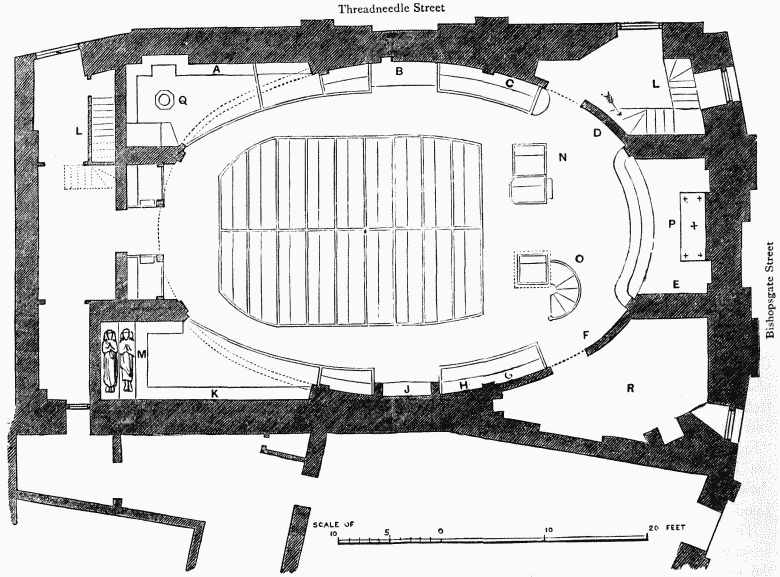
GROUND PLAN OF THE MODERN CHURCH OF ST. MARTIN OUTWICH. (From a measured Drawing by Mr. W.G. Smith, 1873.) A. Monument: Edward Edwards, 1810. B.Ancient Canopied Monument: "Pemberton," no date. C. Monument: Cruickshank, 1826. D. Monument: Simpson, 1849; Ellis, 1838. E. Monument: Ellis, 1855. F. Monument: Simpson, 1837. G. Monument: Rose, 1821. H. Monument: Atkinson, 1847; Ellis, 1838. J. Monument: Richard Stapler. K. Monument: Teesdale, 1804. L, L. Stairs to Gallery above. M. Very Ancient Effigy of Founder, St. Martin de Oteswich. N. Reading Desk. O. Pulpit. P. Altar. Q. Font. R. Vestry.
In 1620 the hall was wainscoted instead of whitewashed; and in 1646 it was paved with red tile, rushes or earthen floors having "been found inconvenient, and oftentimes noisome." At the Great Fire the Company's plate was melted into a lump of two hundred pounds' weight.
In the reign of Edward VI., when there was an inquiry into property devoted to superstitious uses, the Company had been maintaining twenty-three chantry priests.
MARCH OF THE ARCHERS (see page 536).
The modern Merchant Taylors' Hall (says Herbert) is a spacious but irregular edifice of brick. The front exhibits an arched portal, consisting of anarched pediment, supported on columns of the Composite order, with an ornamental niche above; in the pediment are the Company's arms. The hall itself is a spacious and handsome apartment, having at the lower end a stately screen of the Corinthian order, and in the upper part a very large mahogany table thirty feet long. The sides of the hall have numerous emblazoned shields of masters' arms, and behind the master's seat are inscribed in golden letters the names of the different sovereigns, dukes, earls, lords spiritual and temporal, &c., who have been free of this community. In the drawing-room are full-length portraits of King William and Queen Mary, and other sovereigns; and in the court and other rooms are half-lengths of Henry VIII. and Charles II., of tolerable execution, besides various other portraits, amongst which are those of Sir Thomas White, Lord Mayor in 1553, the estimable founder of St. John's College, Cambridge, and Sir Thomas Rowe, Lord Mayor in 1568, and Mr. Clarkson's picture of Henry VII. presenting the Company with their incorporation charter. In this painting the king is represented seated on his throne, and delivering the charter to the Master, Wardens, and Court of Assistants of the Company. His attendants are Archbishop Warham, the Chancellor, and Fox, Bishop of Winchester, Lord Privy Seal, on his right hand; and on his left, Robert Willoughby, Lord Broke, then Lord Steward of the Household. In niches are shown the statues of Edward III. and John of Gaunt, the king's ancestors. In the foreground the clerk of the Company is exhibiting the roll with the names of the kings, &c., who were free of this Company. In the background are represented the banners of the Company and of the City of London. The Yeomen of the Guard, at the entrance of the palace, close the view. On the staircase are likewise pictures of the following Lord Mayors, Merchant Taylors:—Sir William Turner, 1669; Sir P. Ward, 1681; Sir William Pritchard, 1683; and Sir John Salter, 1741.
The interior of the "New Hall, or Taylors' Inne," was adorned with costly tapestry, or arras, representing the history of St. John the Baptist. It had a screen, supporting a silver image of that saint in a tabernacle, or, according to an entry of 1512, "an ymage of St. John gilt, in a tabernacle gilt." The hall windows were painted with armorial bearings;. the floor was regularly strewed with clean rushes; from the ceiling hung silk flags and streamers; and the hall itself was furnished, when needful, with tables on tressels, covered on feast days with splendid table linen, and glittering with plate.
The Merchant Taylors have for their armorial ensigns—Argent, a tent royal between two parliament robes; gules, lined ermine, on a chief azure, a lion of England. Crest—a Holy Lamb, in glory proper. Supporters—two camels, or. Motto—"Concordia parvæ res crescunt."
The stained glass windows of the old St. Martin Outwich, as engraven in Wilkinson's history of that church, contain a representation of the original arms, granted by Clarencieux in 1480. They differ from the present (granted in 1586), the latter having a lion instead of the Holy Lamb (which is in the body of the first arms), and which latter is now their crest.
One of the most splendid sights at this hall in the earlier times would have been (says Herbert), of course, when the Company received the high honour of enrolling King Henry VII. amongst their members; and subsequently to which, "he sat openly among them in a gown of crimson velvet on his shoulders," says Strype, "à la mode de Londres, upon their solemn feast day, in the hall of the said Company."
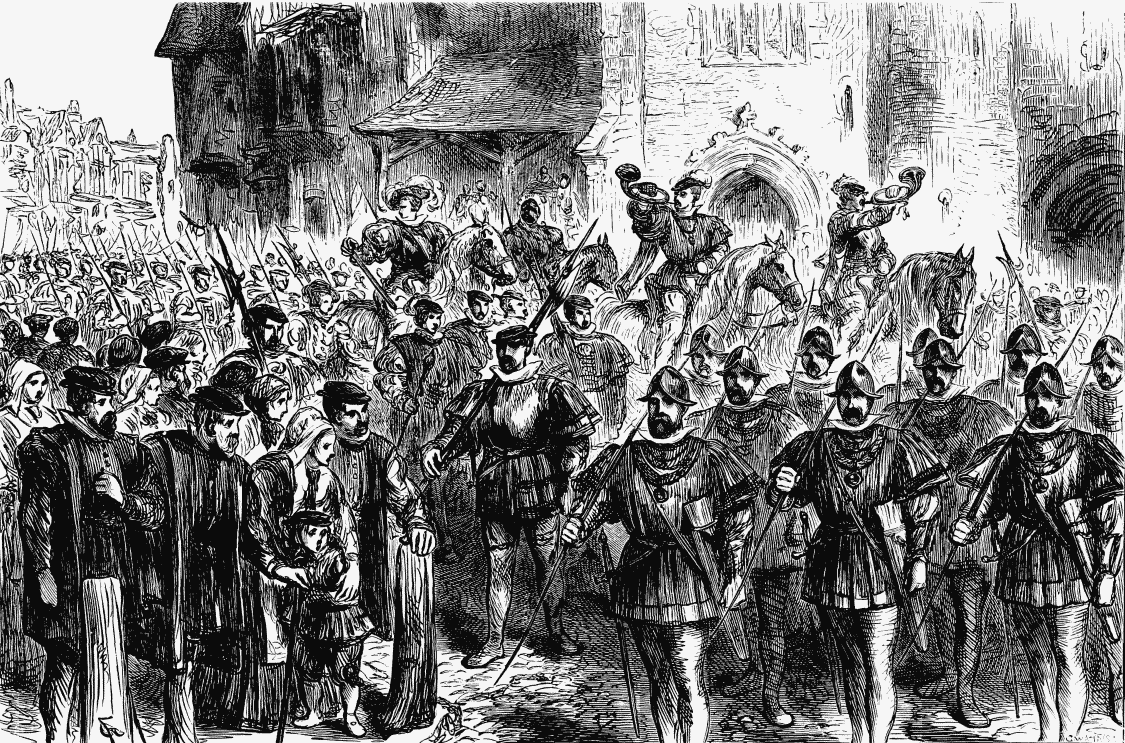
From Merchant Taylors' Hall began the famous cavalcade of the archers, under their leader, as Duke of Shoreditch, in 1530, consisting of 3,000 archers, sumptuously apparelled, 942 whereof wore chains of gold about their necks. This splendid company was guarded by whifflers and billmen, to the number of 4,000, besides pages and footmen, who marched through Broad Street (the residence of the duke their captain). They continued their march through Moorfields, by Finsbury, to Smithfield, where, after having performed their several evolutions, they shot at the target for glory.
The Hall of Commerce, existing some years ago in Threadneedle Street, was begun in 1830 by Mr. Edward Moxhay, a speculative biscuit-baker, on the site of the old French church. Mr. Moxhay had been a shoemaker, but he suddenly started as a rival to the celebrated Leman, in Gracechurch Street. He was an amateur architect of talent, and it was said at the time, probably unjustly, that the building originated in Moxhay's vexation at the Gresham committee rejecting his design for a new Royal Exchange. He opened his great commercial news-room two years before the Exchange was finished, and while merchants were fretting at the delay, intending to make the hall a mercantile centre, to the annihilation of Lloyd's, the Baltic, Garraway's, the Jerusalem, and the North and South American Coffee-houses. £70,000 were laid out. There was a grand bas-relief on the front by Mr. Watson, a young sculptor of promise, and there was an inaugurating banquet. The annual subscription of £5 5s. soon dwindled to £1 10s. 6d. There was a reading-room, and a room where commission agents could exhibit their samples. Wool sales were held there, and there was an auction for railway shares. There were also rooms for meetings of creditors and private arbitrations, and rooms for the deposit of deeds.
A describer of Threadneedle Street in 1845 particularly mentions amongst the few beggars the Creole flower-girls, the decayed ticket-porters, and cripples on go-carts who haunted the neighbourhood, a poor, shrivelled old woman, who sold fruit on a stall at a corner of one of the courts. She was the wife of Daniel Good, the murderer.
The Baltic Coffee House, in Threadneedle Street, used to be the rendezvous of tallow, oil, hemp, and seed merchants; indeed, of all merchants and brokers connected with the Russian trade. There was a time when there was as much gambling in tallow as in Consols, but the breaking down of the Russian monopoly by the increased introduction of South American and Australian tallow has done away with this. Mr. Richard Thornton and Mr. Jeremiah Harman were the two monarchs of the Russian trade forty years ago. The public saleroom was in the upper part of the house. The Baltic was superintended by a committee of management.
That famous free school of the City, St. Anthony's, stood in Threadneedle Street, where the French church afterwards stood, and where the Bank of London now stands. It was originally a Jewish synagogue, granted by Henry V. to the brotherhood of St. Anthony of Vienna. A hospital was afterwards built there for a master, two priests, a schoolmaster, and twelve poor men. The Free School seems to have been built in the reign of Henry VI., who gave five presentations to Eton and five Oxford scholarships, at the rate of ten francs a week each, to the institution. Henry VIII., that arch spoliator, annexed the school to the collegiate church of St. George's, Windsor. The proctors of St. Anthony's used to wander about London collecting "the benevolence of charitable persons towards the building."The school had great credit in Elizabeth's reign, and was a rival of St. Paul's. That inimitable coxcomb, Laneham, in his description of the great visit of Queen Elizabeth to the Earl of Leicester, at Kenilworth Castle, 1575, a book which Sir Walter Scott has largely availed himself of, says—"Yee mervail perchance," saith he, "to see me so bookish, Let me tel you in few words. I went to school, forsooth, both at Polle's and also at St. Antonie's; (was) in the fifth forme, past Esop's Fables, readd Terence, Vos isthœc intro auferte; and began with my Virgil, Tityre tu patulœ. I could say my rules, could construe and pars with the best of them," &c.
In Elizabeth's reign "the Anthony's pigs," as the "Paul's pigeons" used to call the Threadneedle boys, used to have an annual breaking-up day procession, with streamers, flags, and beating drums, from Mile End to Austin Friars. The French or Walloon church established here by Edward VI. seems, in 1652, to have been the scene of constant wrangling among the pastors, as to whether their disputes about celebrating holidays should be settled by "colloquies" of the foreign churches in London; or the French churches of all England. At this school were educated the great Sir Thomas More, and that excellent Archbishop of Canterbury, the zealous Whitgift (the friend of Beza, the Reformer), whose only fault seems to have been his persecutions of the Genevese clergy whom Elizabeth disliked.
Next in importance to Lloyd's for the general information afforded to the public, was certainly the North and South American Coffee House (formerly situated in Threadneedle Street), fronting the thoroughfare leading to the entrance of the Royal Exchange. This establishment was the complete centre for American intelligence. There was in this, as in the whole of the leading City coffeehouses, a subscription room devoted to the use of merchants and others frequenting the house, who, by paying an annual sum, had the right of attendance to read the general news of the day, and make reference to the several files of papers, which were from every quarter of the globe. It was here also that first information could be obtained of the arrival and departure of the fleet of steamers, packets, and masters engaged in the commerce of America, whether in relation to the minor ports of Montreal and Quebec, or the larger ones of Boston, Halifax, and New York. The room the subscribers occupied had a separate entrance to that which was common to the frequenters of the eating and drinking part of the house, and was most comfortably and neatly kept, being well, and in some degree elegantly furnished. The heads of the chief American and Continental firms were on the subscription list; and the representatives of Baring's, Rothschild's, and the other large establishments celebrated for their wealth and extensive mercantile operations, attended the rooms as regularly as 'Change, to see and hear what was going on, and gossip over points of business.
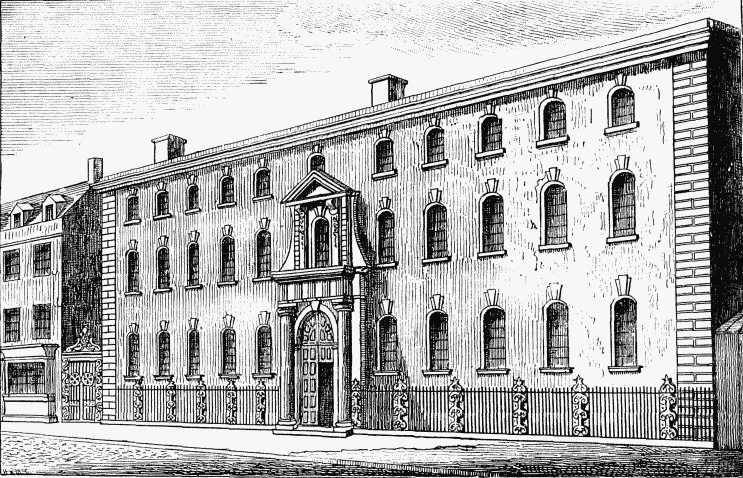
At the north-east extremity of Threadneedle Street is the once famous South Sea House. The back, formerly the Excise Office, afterwards the South Sea Company's office, thence called the Old South Sea House, was consumed by fire in 1826. The building in Threadneedle Street, in which the Company's affairs were formerly transacted, is a magnificent structure of brick and stone, about a quadrangle, supported by stone pillars of the Tuscan order, which form a fine piazza. The front looks into Threadneedle Street, the walls being well built and of great thickness. The several offices were admirably disposed; the great hall for sales, the dining-room, galleries, and chambers were equally beautiful and convenient. Under these were capacious arched vaults, to guard what was valuable from the chances of fire.
The South Sea Company was originated by Swift's friend, Harley, Earl of Oxford, in the year 1711. The new Tory Government was less popular than the Whig one it had displaced, and public credit had fallen. Harley wishing to provide for the discharge of ten millions of the floating debt, guaranteed six per cent, to a company who agreed to take it on themselves. The £600,000 due for the annual interest was raised by duties on wines, silks, tobacco, &c.; and the monopoly of the trade to the South Seas granted to the ambitious new Company, which was incorporated by Act of Parliament.
To the enthusiastic Company the gold of Mexico and the silver of Peru seemed now obtainable by the ship-load. It was reported that Spain was willing to open four ports in Chili and Peru. The negotiations, however, with Philip V. of Spain led to little. The Company obtained only the privilege of supplying the Spanish colonies with negro slaves for thirty years, and sending an annual vessel to trade; but even of this vessel the Spanish king was to have one-fourth of the profits, and a tax of five per cent. on the residue. The first vessel did not sail till 1717, and the year after a rupture with Spain closed the trade.
In 1717, the King alluding to his wish to reduce the National Debt, the South Sea Company at once petitioned Parliament (in rivalry with the Bank) that their capital stock might be increased from ten millions to twelve, and offered to accept five, instead of six per cent. upon the whole amount. Their proposals were accepted.
The success of Law's Mississippi scheme, in 1720, roused the South Sea directory to emulation. They proposed to liquidate the public debt by reducing the various funds into one. January 22, 1720, a committee met on the subject. The South Sea Company offered to melt every kind of stock into a single security. The debt amounted to £30,981,712 at five per cent, for seven years, and afterwards at four per cent, for which they would pay £3,500,000. The Government approved of the scheme, but the Bank of England opposed it, and offered £5,000,000 for the privilege. The South Sea shareholders were not to be outdone, and ultimately increased their terms to £7,500,000. In the end they remained the sole bidders; though some idea prevailed of sharing the advantage between the two companies, till Sir John Blunt exclaimed, "No, sirs, we'll never divide the child!" The preference thus given excited a positive frenzy in town and country. On the 2nd of June their stock rose to 890; it quickly reached 1,000, and several of the principal managers were dubbed baronets for their "great services." Mysterious rumours of vast treasures to be acquired in the South Seas got abroad, and 50 per cent. was boldly promised.
"The scheme," says Smollett, "was first projected by Sir John Blount, who had been bred a scrivener, and was possessed of all the cunning, plausibility, and boldness requisite for such an undertaking. He communicated his plan to Mr. Aislabie, the Chancellor of the Exchequer, and a Secretary of State. He answered every objection, and the project was adopted."
Sir Robert Walpole alone opposed the bill in the House, and with clear-sighted sense (though the stock had risen from 130 to 300 in one day) denounced "the dangerous practice of stock-jobbing, and the general infatuation, which must," he said, "end in general ruin." Rumours of free trade with Spain pushed the shares up to 400, and the bill passed the Commons by a majority of 172 against 55. In the other House, 17 peers were against it, and 83 for it. Then the madness fairly began. Stars and garters mingled with squabbling Jews, and great ladies pawned their jewels in order to gamble in the Alley. The shares sinking a little, they were revived by lying rumours that Gibraltar and Port Mahon were going to be exchanged for Peruvian sea-ports, so that the Company would be allowed to send out whole fleets of ships.
Government, at last alarmed, began too late to
act. On July 18 the King published a proclamation denouncing eighteen petitions for letters patent
and eighty-six bubble companies, of which the following are samples:—
For sinking pits and smelting lead ore in Derbyshire.
For making glass bottles and other glass.
For a wheel for perpetual motion. Capital £1,000,000.
For improving of gardens.
For insuring and increasing children's fortunes.
For entering and loading goods at the Custom House;
and for negotiating business for merchants.
For carrying on a woollen manufacture in the North of
England.
For importing walnut-trees from Virginia. Capital
£2,000,000.
For making Manchester stuffs of thread and cotton.
For making Joppa and Castile soap.
For improving the wrought iron and steel manufactures of
this kingdom. Capital £4,000,000.
For dealing in lace, Hollands, cambrics, lawns, &c.
Capital £2,000,000.
For trading in and improving certain commodities of the
produce of this kingdom, &c. Capital £3,000,000.
For supplying the London markets with cattle.
For making looking-glasses, coach-glasses, &c. Capital
£2,000,000.
For taking up ballast.
For buying and fitting out ships to suppress pirates.
For the importation of timber from Wales. Capital
£2,000,000.
For rock-salt.
For the transmutation of quicksilver into a malleable, fine
metal.
One of the most famous bubbles was "Puckle's Machine Company," for discharging round and square cannon-balls and bullets, and making a total revolution in the art of war. "But the most absurd and preposterous of all," says Charles Mackay, in his "History of the Delusion," "and which showed more completely than any other the utter madness of the people, was one started by an unknown adventurer, entitled, 'A Company for carrying on an undertaking of great advantage, but nobody to know what it is.' Were not the fact stated by scores of credible witnesses, it would be impossible to believe that any person could have been duped by such a project. The man of genius who essayed this bold and successful inroad upon public credulity merely stated in his prospectus that the required capital was £500,000, in 5,000 shares of £100 each, deposit £2 per share. Each subscriber paying his deposit would be entitled to £100 per annum per share. How this immense profit was to be obtained he did not condescend to inform them at the time, but promised that in a month full particulars should be duly announced, and a call made for the remaining £98 of the subscription. Next morning, at nine o'clock, this great man opened an office in Cornhill. Crowds of people beset his door; and when he shut up at three o'clock he found that no less than 1,000 shares had been subscribed for, and the deposits paid. He was thus in five hours the winner of £2,000. He was philosopher enough to be contented with his venture, and set off the same evening for the Continent. He was never heard of again."
Another fraud that was very successful was that of the "Globe Permits," as they were called. They were nothing more than square pieces of playing cards, on which was the impression of a seal, in wax, 'bearing the sign of the "Globe Tavern," in the neighbourhood of Exchange Alley, with the inscription of "Sail-cloth Permits." The possessors enjoyed no other advantage from them than permission to subscribe at some future time to a new sail-cloth manufactory, projected by one who was then known to be a man of fortune, but who was afterwards involved in the peculation and punishment of the South Sea directors. These permits sold for as much as sixty guineas in the Alley.
During the infatuation (says Smollett), luxury, vice, and profligacy increased to a shocking degree; the adventurers, intoxicated by their imaginary wealth, pampered themselves with the rarest dainties and the most costly wines. They purchased the most sumptuous furniture, equipage, and apparel, though with no taste or discernment. Their criminal passions were indulged to a scandalous excess, and their discourse evinced the most disgusting pride, insolence, and ostentation. They affected to scoff at religion and morality, and even to set Heaven at defiance.
A journalist of the time writes: "Our South Sea equipages increase daily; the City ladies buy South Sea jewels, hire South Sea maids, take new country South Sea houses; the gentlemen set up South Sea coaches, and buy South Sea estates. They neither examine the situation, the nature or quality of the soil, or price of the purchase, only the annual rent and title; for the rest, they take all by the lump, and pay forty or fifty years' purchase!"
By the end of May, the whole stock had risen to 550. It then, in four days, made a tremendous leap, and rose to 890. It was now thought impossible that it could rise higher, and many prudent persons sold out to make sure of their spoil. Many of these were noblemen about to accompany the king to Hanover. The buyers were so few on June 3rd, that stock fell at once, like a plummet, from 890 to 640. The directors ordering their agents to still buy, confidence was restored, and the stock rose to 750. By August, the stock culminated at 1,000 per cent., or, as Dr. Mackay observes, "the bubble was then full blown."
The reaction soon commenced. Many government annuitants complained of the directors' partiality in making out the subscription lists. It was soon reported that Sir John Blunt, the chairman, and several directors had sold out. The stock fell all through August, and on September 2nd was quoted at 700 only. Things grew alarming. The directors, to restore confidence, summoned a meeting of the corporation at Merchant Taylors' Hall. Cheapside was blocked by the crowd. Mr. Secretary Craggs urged the necessity of union; and Mr. Hungerford said the Company had done more for the nation than Crown, pulpit, and bench. It had enriched the whole nation. The Duke of Portland gravely expressed his wonder that any one could be dissatisfied. But the public were not to be gulled; that same evening the stock fell to 640, and the next day to 540. It soon got so low as 400. The ebb tide was running fast.
"Thousands of families," wrote Mr. Broderick to Lord Chancellor Middleton, "will be reduced to beggary. The consternation is inexpressible, the rage beyond description." The Bank was pressed to circulate the South Sea bonds, but as the panic increased they fought off. Several goldsmiths and bankers fled. The Sword Blade Company, the chief cashiers of the South Sea Company, stopped payment. King George returned in haste from Hanover, and Parliament was summoned to meet in December.
THE OLD SOUTH SEA HOUSE (see page 538). From a Print of the period
In the first debate the enemies of the South Sea Company were most violent. Lord Molesworth said he should be satisfied to see the contrivers of the scheme tied in sacks and thrown into the Thames. Honest Shippen, whom even Walpole could not bribe, looking fiercely in Mr. Secretary Craggs' face, said "there were other men in high station who were no less guilty than the directors." Mr. Craggs, rising in wrath, declared he was ready to give satisfaction to any one in the House, or out of it, and this unparliamentary language he had afterwards to explain away. Ultimately a second committee was appointed, with power to send for persons, papers, and records. The directors were ordered to lay before the house a full account of all their proceedings, and were forbidden to leave the kingdom for a twelvemonth.
Mr. Walpole laid before a committee of the whole house his scheme for the restoration of public credit, which was, in substance, to ingraft nine millions of South Sea stock into the Bank of England, and the same sum into the East India Company, upon certain conditions. The plan was favourably received by the House. After some few objections it was ordered that proposals should be received from the two great corporations. They were both unwilling to lend their aid, and the plan met with a warm but fruitless opposition at the general courts summoned for the purpose of deliberating upon it. They, however, ultimately agreed upon the terms on which they would consent to circulate the South Sea bonds; and their report being presented to the committee, a bill was then brought in, under the superintendence of Mr. Walpole, and safely carried through both Houses of Parliament.
LONDON STONE. (see page 544.)
In the House of Lords, Lord Stanhope said that every farthing possessed by the criminals, whether directors or not, ought to be confiscated, to make good the public losses.
The wrath of the House of Commons soon fell quick and terrible as lightning on two members of the Ministry, Craggs, and Mr. Aislabie, Chancellor of the Exchequer. It was ordered, on the 21st of January, that all South Sea brokers should lay before the House a full account of all stock bought or sold by them to any officers of the Treasury or Exchequer since Michaelmas, 1719. Aislabie instantly resigned his office, and absented himself from Parliament, and five of the South Sea directors (including Mr.Gibbon, the grandfather of the historian) were ordered into the custody of the Black Rod.
The next excitement was the flight of Knight, the treasurer of the Company, with all his books and implicating documents, and a reward of £2,000 was offered for his apprehension. The same night the Commons ordered the doors of the House to be locked, and the keys laid on the table.
General Ross, one of the members of the Select Committee, then informed the House that there had been already discovered a plot of the deepest villany and fraud that Hell had ever contrived to ruin a nation. Four directors, members of the House—i.e., Sir Robert Chaplin, Sir Theodore Janssen, Mr. Sawbridge, and Mr. F. Eyles—were expelled the House, and taken into the custody of the Serjeant-at-Arms. Sir John Blunt, another director, was also taken into custody. This man, mentioned by Pope in his "Epistle to Lord Bathurst," had been a scrivener, famed for his religious observances and his horror of avarice. He was examined at the bar of the House of Lords, but refused to criminate himself. The Duke of Wharton, vexed at this prudent silence of the criminal, accused Earl Stanhope of encouraging this taciturnity of the witness. The Earl became so excited in his return speech, that it brought on an apoplectic fit, of which he died the next day, to the great grief of his royal master, George I. The Committee of Secrecy stated that in some of the books produced before them, false and fictitious entries had been made; in others there were entries of money, with blanks for the names of the stockholders. There were frequent erasures and alterations, and in some of the books leaves had been torn out. They also found that some books of great importance had been destroyed altogether, and that some had been taken away or secreted. They discovered, moreover, that before the South Sea Act was passed there was an entry in the Company's books of the sum of £1,259,325 upon account of stock stated to have been sold to the amount of £574,500. This stock was all fictitious, and had been disposed of with a view to promote the passing of the bill. It was noted as sold on various days, and at various prices, from 150 to 325 per cent.
Being surprised to see so large an amount disposed of, at a time when the Company were not empowered to increase their capital, the committee determined to investigate most carefully the whole transaction. The governor, sub-governor, and several directors were brought before them and examined rigidly. They found that at the time these entries were made the Company were not in possession of such a quantity of stock, having in their own right only a small quantity, not exceeding £30,000 at the utmost. They further discovered that this amount of stock was to be esteemed as taken or holden by the Company for the benefit of the pretended purchasers, although no mutual agreement was made for its delivery or acceptance at any certain time. No money was paid down, nor any deposit or security whatever given to the Company by the supposed purchasers; so that if the stock had fallen, as might have been expected had the act not passed, they would have sustained no loss. If, on the contrary, the price of stock advanced (as it actually did by the success of the scheme), the difference by the advanced price was to be made good by them. Accordingly, after the passing of the act, the account of stock was made up and adjusted with Mr. Knight, and the pretended purchasers were paid the difference out of the Company's cash. This fictitious stock, which had chiefly been at the disposal of Sir John Blunt, Mr. Gibbon, and Mr. Knight, was distributed among several members of the Government and their connections, by way of bribe, to facilitate the passing of the bill. To the Earl of Sunderland was assigned £50,000 of this stock; to the Duchess of Kendal, £10,000; to the Countess of Platen, £10,000; to her two nieces, £10,000; to Mr. Secretary Craggs, £30,000; to Mr. Charles Stanhope (one of the Secretaries of the Treasury), £10,000; to the Sword Blade Company, £50,000. It also appeared that Mr. Stanhope had received the enormous sum of £250,000, as the difference in the price of some stock, through the hands of Turner, Caswall, and Co., but that his name had been partly erased from their books, and altered to Stangape.
The punishment fell heavy on the chief offenders, who, after all, had only shared in the general lust for gold. Mr. Charles Stanhope, a great gainer, managed to escape by the influence of the Chesterfield family, and the mob threatened vengeance. Aislabie, who had made some £800,000, was expelled the House, sent to the Tower, and compelled to devote his estate to the relief of the sufferers. Sir George Caswall was expelled the House, and ordered to refund £250,000. The day he went to the Tower, the mob lit bonfires and danced round them for joy. When by a general whip of the Whigs the Earl of Sunderland was acquitted, the mob grew menacing again. That same day the elder Craggs died of apoplexy. The report was that he had poisoned himself, but excitement and the death of a son, one of the secretaries of the Treasury, were the real causes. His enormous fortune of a million and a half was scattered among the sufferers. Eventually the directors were fined £2,014,000, each man being allowed a small modicum of his fortune. Sir John Blunt was only allowed £5,000 out of his fortune of £183,000; Sir John Fellows was allowed £10,000 out of £243,000; Sir Theodore Janssen, £50,000 out of £243,000; Sir John Lambert, £5,000 out of £72,000. One director, named Gregsley, was treated with especial severity, because he was reported to have once declared he would feed his carriage-horses off gold; another, because years before he had been mixed up with some harmless but unsuccessful speculation. According to Gibbon the historian, it was the Tory directors who were stripped the most unmercifully.
"The next consideration of the Legislature," says Charles Mackay, "after the punishment of the directors, was to restore public credit. The scheme of Walpole had been found insufficient, and had fallen into disrepute. A computation was made of the whole capital stock of the South Sea Company at the end of the year 1720. It was found to amount to £37,800,000, of which the stock allotted to all the proprietors only reached £24,500,000. The remainder of £13,300,000 belonged to the Company in their corporate capacity, and was the profit they had made by the national delusion. Upwards of £8,000,000 of this was taken from the Company, and divided among the proprietors and subscribers generally, making a dividend of about £33 6s. 8d. per cent. This was a great relief. It was further ordered that such persons as had borrowed money from the South Sea Company upon stock actually transferred and pledged, at the time of borrowing, to or for the use of the Company, should be free from all demands upon payment of ten per cent. of the sums so borrowed. They had lent about £11,000,000 in this manner, at a time when prices were unnaturally raised; and they now received back £1,100,000, when prices had sunk to their ordinary level."
A volume (says another writer) might be collected of anecdotes connected with this fatal speculation. A tradesman at Bath, who had invested his only remaining fortune in this stock, finding it had fallen from 1,000 to 900, left Bath with an intention to sell out; on his arrival in London it had fallen to 250. He thought the price too low, sanguinely hoped that it would re-ascend, still deferred his purpose, and lost his all.
The Duke of Chandos had embarked £300,000 in this project; the Duke of Newcastle strongly advised his selling the whole, or at least a part, with as little delay as possible; but this salutary advice he delayed to take, confidently anticipating the gain of at least half a million, and through rejecting his friend's counsel, he lost the whole. Some were, however, more fortunate. The guardians of Sir Gregory Page Turner, then a minor, had purchased stock for him very low, and sold it out when it had reached its maximum, to the amount of £200,000. With this large sum Sir Gregory built a fine mansion at Blackheath, and purchased 300 acres of land for a park. Two maiden sisters, whose stock had accumulated to £90,000, sold out when the South Sea stock was at 790. The broker whom they employed advised them to re-invest in navy bills, which were at the time at a discount of twenty-five per cent.; they took his advice, and two years afterwards received their money at par.
Even the poets did not escape. Gay (says Dr. Johnson, in his "Lives of the Poets") had a present from young Craggs of some South Sea stock, and once supposed himself to be the master of £20,000. His friends, especially Arbuthnot, persuaded him to sell his share, but he dreamed of dignity and splendour, and could not bear to obstruct his own fortune. He was then importuned to sell as much as would purchase a hundred a year for life, "which," said Fenton, "will make you sure of a clean shirt and a shoulder of mutton every day." This counsel was rejected; the profit and principal were both lost, and Gay sunk so low under the calamity that his life for a time became in danger.
Pope, always eager for money, was also dabbling in the scheme, but it is uncertain whether he made money or lost by it. Lady Mary Wortley Montague was a loser. When Sir Isaac Newton was asked when the bubble would break, he said, with all his calculations he had never learned to calculate the madness of the people.
Prior declared, "I am lost in the South Sea. The roaring of the waves and the madness of the people are justly put together. It is all wilder than St. Anthony's dream, and the bagatelle is more solid than anything that has been endeavoured here this year."
In the full heat of it, the Duchess of Ormond wrote to Swift: "The king adopts the South Sea, and calls it his beloved child; though perhaps, you may say, if he loves it no better than his son, it may not be saying much; but he loves it as much as he loves the Duchess of Kendal, and that is saying a good deal. I wish it may thrive, for some of my friends are deep in it. I wish you were too."
Swift, cold and stern, escaped the madness, and even denounced in the following verses the insanity that had seized the times:—
"There is a gulf where thousands fell, Here all the bold adventurers came; A narrow sound, though deep as hell—Change Alley is the dreadful name.
"Subscribers here by thousands float, And jostle one another down; Each paddling in his leaky boat, And here they fish for gold and drown.
"Now buried in the depths below, Now mounted up to heaven again, They reel and stagger to and fro, At their wit's end, like drunken men."
Budgell, Pope's barking enemy, destroyed himself after his losses in this South Sea scheme, and a well-known man of the day called "Tom of Ten Thousand" lost his reason.
Charles Lamb, in his "Elia," has described the South Sea House in his own delightful way. "Reader," says the poet clerk, "in thy passage from the Bank—where thou hast been receiving thy half-yearly dividends (supposing thou art a lean annuitant like myself)—to the 'Flower Pot,' to secure a place for Dalston, or Shacklewell, or some other shy surburban retreat northerly—didst thou never observe a melancholy-looking, handsome brick and stone edifice, to the left, where Threadneedle Street abuts upon Bishopsgate? I dare say thou hast often admired its magnificent portals, ever gaping wide, and disclosing to view a grave court, with cloisters and pillars, with few or no traces of goers-in or comers-out—a desolation something like Balclutha's. (fn. 1) This was once a house of trade—a centre of busy interests. The throng of merchants was here—the quick pulse of gain—and here some forms of business are still kept up, though the soul has long since fled. Here are still to be seen stately porticoes; imposing staircases; offices roomy as the state apartments in palaces—deserted, or thinly peopled with a few straggling clerks; the still more sacred interiors of court and committee rooms, with venerable faces of beadles, door-keepers; directors seated in form on solemn days (to proclaim a dead dividend), at long worm-eaten tables, that have been mahogany, with tarnished gilt-leather coverings, supporting massy silver inkstands, long since dry; the oaken wainscots hung with pictures of deceased governors and sub-governors, of Queen Anne, and the two first monarchs of the Brunswick dynasty; huge charts, which subsequent discoveries have antiquated; dusty maps of Mexico, dim as dreams; and soundings of the Bay of Panama! The long passages hung with buckets, appended, in idle row to walls, whose substance might defy any, short of the last conflagration; with vast ranges of cellarage under all, where dollars and pieces-of-eight once lay, 'an unsunned heap,' for Mammon to have solaced his solitary heart withal—long since dissipated, or scattered into air at the blast of the breaking of that famous Bubble.
"Peace to the manes of the Bubble! Silence and destitution are upon thy walls, proud house, for a memorial! Situated as thou art in the very heart of stirring and living commerce, amid the fret and fever of speculation—with the Bank, and the 'Change, and the India House about thee, in the hey-day of present prosperity, with their important faces, as it were, insulting thee, their poor neighbour out of business—to the idle and merely contemplative—to such as me, Old House! there is a charm in thy quiet, a cessation, a coolness from business, an indolence almost cloistral, which is delightful! With what reverence have I paced thy great bare rooms and courts at eventide! They spake of the past; the shade of some dead accountant, with visionary pen in ear, would flit by me, stiff as in life."