Old and New London: Volume 2. Originally published by Cassell, Petter & Galpin, London, 1878.
This free content was digitised by double rekeying. Public Domain.
Walter Thornbury, 'Bishopsgate', in Old and New London: Volume 2(London, 1878), British History Online https://www.british-history.ac.uk/old-new-london/vol2/pp152-170 [accessed 2 May 2025].
Walter Thornbury, 'Bishopsgate', in Old and New London: Volume 2(London, 1878), British History Online, accessed May 2, 2025, https://www.british-history.ac.uk/old-new-london/vol2/pp152-170.
Walter Thornbury. "Bishopsgate". Old and New London: Volume 2. (London, 1878), British History Online. Web. 2 May 2025. https://www.british-history.ac.uk/old-new-london/vol2/pp152-170.
In this section
CHAPTER XX.
BISHOPSGATE.
The Old Gate—The "White Hart"—Sir Paul Pindar's House: its Ancient Glories and Present Condition—The Lodge in Half-moon AlleySt. Helen's and the Nuns' Hall—The Tombs—Sir Julius Cæsar—Sir John Crosby—Modern Improvements—The Windows—Crosby Hall and its History—Allusions to it in Shakespeare—Famous Tenants of Crosby Hall—Richard Crookback—Sir Thomas More—Bonvici.
Bishopsgate, according to Stow, was probably built by good Bishop Erkenwald, son of King Offa, and repaired by Bishop William, the Norman, in the reign of the Conqueror. Henry III. confirmed to merchants of the Hanse certain privileges by which they were bound to keep Bishopsgate in repair, and in the reign of Edward IV. we find them rebuilding it. The gate was adorned with the effigies of two bishops, probably Bishop Erkenwald and Bishop William, and with effigies supposed to have represented King Alfred and Alred, Earl of Mercia, to whom Alfred entrusted the care of the gate. It was rebuilt several times. The latest form of it is shown on page 154. The rooms over the gate were, in Strype's time, allotted to one of the Lord Mayor's carvers. Pennant notices an old inn, the "White Hart," not far from this gate, which was standing until a few years back.
The old house where Sir Paul Pindar, a great City merchant of the reign of James I., lived, still exists in Bishopsgate Street, with some traces of its ancient splendour. This Sir Paul was ambassador for James I. to the Grand Legion, and helped to extend English commerce in Turkey. He brought back with him a diamond valued at £30,000, which James wished to buy on credit, but prudent Sir Paul declined this unsatisfactory mode of purchase, and used to lend it to the monarch on gala days. Charles I. afterwards purchased the precious stone. Sir Paul was appointed farmer of the Customs to James I., and frequently supplied the cravings for money both of James and Charles. In the year 1639 Sir Paul was esteemed worth £236,000, exclusive of bad debts. He expended £10,000 in the repairing of St. Paul's Cathedral, yet, nevertheless, died in debt, owing to his generosity to King Charles. The king owed him and the other Commissioners of the Customs £300,000, for the security of which, in 1649, they offered the Parliament £100,000, but the proposition was not entertained. On his death affairs were left in such a perplexed state, that his executor, William Toomer, unable to bear the work and the disappointment, destroyed himself. Mr. J. T. Smith, in his "Topography of London," has a drawing of a room on the first floor of this house. The ceiling was covered with panelled ornamentations, and the chimney-piece, of carved oak and stone, was adorned with a badly-executed basso-relievo of Hercules and Atlas supporting an egg-shaped globe. Below this were tablets of stag hunts. The sides of the chimney-piece were formed by grotesque figures, the whole being a very splendid specimen of Elizabethan decorative art. In 1811 the whole of the ornaments, says Mr. Smith, were barbarously cut away to render the room, as the possessors said, "a little comfortable." The Pindar arms, "a chevron argent, between three lyon's heads, erased ermine crowned or," were found hidden by a piece of tin in the centre of the ceiling. The walls are covered with oak wainscoting, crowned with richly carved cornices. The house, No. 169, is now a public-house, "The Sir Paul Pindar's Head."
"The front towards the street," says Mr. Hugo, "with its gable bay windows, and matchless panelwork, together with a subsequent addition of brick on its northern side, is one of the best specimens of the period now extant. The edifice was commenced in one of the closing years of the reign of Elizabeth, on the return from his residence in Italy of its great and good master. It was originally very spacious, and extended for a considerable distance, both to the south side and to the rear of the present dwelling. The adjoining tenements in Half-moon Street, situated immediately at the back of the building, which faces Bishopsgate Street, though manifesting no external signs of interest, are rich beyond expression in internal ornament. The primary arrangement, indeed, of the mansion is entirely destroyed. Very little of the original internal woodwork remains, and that of the plainest character. But, in several of the rooms on the first floors of the houses just referred to, there still exist some of the most glorious ceilings which our country can furnish. They are generally mutilated, in several instances the half alone remaining, as the rooms have been divided into two or more portions, to suit the needs of later generations. These ceilings are of plaster, and abound in the richest and finest devices. Wreaths of flowers, panels, shields, pateras, bands, roses, ribands, and other forms of ornamentation, are charmingly mingled, and unite in producing the best and happiest effect. One of them, which is all but perfect, consists of a large device in the centre, representing the sacrifice of Isaac, from which a most exquisite design radiates to the very extremities of the room. In general, however, the work consists of various figures placed within multangular compartments of different sizes, that in the centre of the room usually the largest. The projecting ribs, which in their turn enclose the compartments, are themselves furnished with plentiful ornamentation, consisting of bands of oak-leaves and other vegetable forms; and, in several instances, have fine pendants at the points of intersection. The cornices consist of a rich series of highly-ornamented mouldings. Every part, however, is in strict keeping, and none of the details surfeit the taste or weary the eye."
At a little distance, in Half-moon Alley, stood an old structure, now pulled down, ornamented with figures, which is traditionally reported to have been the keeper's lodge in the park attached to Sir Paul's residence; and mulberry-trees, and other park-like vestiges in this neighbourhood, are still within memory.
St. Helen's, Bishopsgate, occupies the site of Roman buildings. The ground in the neighbourhood is intersected with chalk foundations, and in 1836 a Roman tessellated pavement (red, white, and grey) was discovered under a house at the south-west angle of Crosby Square. A similar pavement was found in 1712 on the north side of Little St. Helen's gateway. There is mention of a church priory here, dedicated to the mother of Constantine, as early as 1180, when it was granted to the canons of St. Paul's Cathedral by one Ranulph and Robert his son. About 1210 a priory of Benedictine nuns was founded here by William Fitzwillam, a goldsmith, and dedicated to the Holy Cross and St. Helen. The priory included a hall, hospital, dormitories, cloisters, and offices. The Nuns' Hall, at the north of the present church, was purchased by the Leathersellers' Company, who used it as a common hall till 1799, when it was pulled down to make room for St. Helen's Place.
A crypt extended from the north side of the church under Leathersellers' Hall, and in the wall which separated this crypt from the church were two ranges of oblique apertures, through which mass at the high altar could be viewed. A canopied altar of stone, affixed to the wall, indicates the position of one set of these "nuns' gratings." The priory of St. Helen's was much augmented in 1308 by William Basing, a London sheriff, and when it was surrendered to Henry VIII. its annual revenue was £376 6s. During the Middle Ages the church was divided from east to west by a partition, to separate the nuns from the parishioners; but after the dissolution this was removed. Sir Thomas Gresham, according to Stow, promised this church a steeple in consideration of the ground taken up by his monument.
However, architects praise this church as picturesque, with its two heavy equal aisles, and its pointed arches. There is a transept at the east end, and beyond it a small chapel, dedicated to the Holy Ghost. Against the north wall is a range of seats formerly occupied by the nuns. The church is a composite of various periods. St. Helen's, says Mr. Godwin, contains perhaps more monuments (especially altartombs) than any other parish church in the metropolis, and these give an especial air of antiquity and solemnity to the building. Here is the ugly tomb containing the embalmed body of Francis Bancroft. He caused the tomb to be built for himself in 1726. He is said to have made a fortune of nearly £28,000 by greedy exactions, the whole of which he left to the almshouses and the Drapers' Company. In a small southern transept is a most singular table monument in memory of Sir Julius Cæsar, Privy Counsellor to James I., Chancellor of the Exchequer, and Master of the Rolls, who died about 1636. The epitaph, written by himself, engraved on a large deed, sealed and folded (the string to the seal represented as breaking), purports to be an engagement on the part of the deceased to pay the debt of Nature whenever God shall please and require it. The tomb, the work of Nicholas Stone, cost £110.
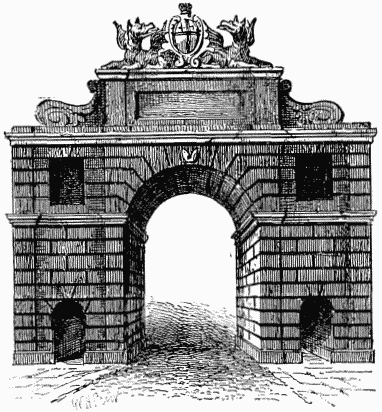
BISHOPSGATE.
On the south side of the chancel, on a stone altar-tomb, are recumbent figures of a knight in armour, and a lady. The knight is Sir John Crosby, who died in the year 1475, the builder of Crosby Hall, who contributed largely to the church. Behind this is a large columned and canopied monument in memory of Sir William Pickering, famous for worth in learning, arts, and warfare. His effigy in armour reclines on a piece of sculptured matting, folded at one end to represent a pillow. Strype says he died in 1542. But the greatest of all the monuments at St. Helen's is that of Sir Thomas Gresham, a large sculptured altar-tomb covered with a marble slab. Another curious monument near Gresham's is that of Matthew Bond, captain of the London Trained Bands in the time of the Armada. He is represented sitting within a tent, with two sentries standing outside, and an attendant bringing up a horse. There were also buried here Sir John Lawrence, the good Lord Mayor who behaved so nobly in the Plague year, and Sir John Spencer, the rich Lord Mayor of Elizabeth's reign, whose daughter ran away with Lord Compton, escaping from her father's house in a baker's basket.
The charity-box in the church vestibule is supported by a curious carved figure of a mendicant. Mr. Godwin, writing in 1839, laments the ill-proportioned turret of St. Helen's, and the carvings of the mongrel Italian style.
The recent restorations and improvements have greatly increased the attractions of St. Helen's, while the magnificent stained-glass windows, that have been added to the sacred edifice, are modern works eminently worthy of the objects of ancient art, and the fine sculptures to be found within the walls. Of these windows one is in the memory of Sir Thomas Gresham, and has been contributed by the Gresham Committee, while two others have been erected at the expense of the family of Mr. McDougall. The magnificent window, in memory of the late Alderman Sir William Copeland, is a most striking work, but is not inferior in interest to the restoration, which was made at the expense of the churchwardens, Mr. Thomas Rolfe, jun., and Mr. George Richardson, of a beautiful window in stained glass, composed of the fragments of the ancient window, which was too dilapidated to remain. Several other fine memorial windows have been added to the building, amongst which are those contributed by the vicar, the Rev. J. E. Cox, and by Mr. W. Williams, of Great St. Helen's, who has taken a deep interest in the work of restoration. Some other splendid examples of stained glass were contributed by Mr. Alderman Wilson and Mr. Deputy Jones; and the fine communion window was presented by Mr. Kirkman Hodgson, M.P., and his brother, Mr. James Stewart Hodgson. The tomb of Sir John Crosby has been renovated, as well as that of Sir John Spencer, which has been restored and removed under the direction of the Marquis of Northampton and Mr. Wodmore, who has himself contributed a window-in memory of Bishop Robinson, and has superintended the entire restoration.
"Not a stone now remains," says Mr. Hugo, "to tell of the old priory of St. Helen's and its glories. A view of the place, as it existed at the close of the last century, which is happily furnished by Wilkinson in his 'Londina,' represents the ruins of edifices whose main portions and features are of the Early English period, and which were probably coeval with the foundation of the priory. These he calls the 'Remains of the Fratry.' He had the advantage of a personal examination of these beautiful memorials. 'The door,' he says, 'leading from the cloister to the Fratry, which the writer of this well remembers to have seen at the late demolition of it, was particularly elegant; the mouldings of the upper part being filled with roses of stone painted scarlet and gilt; the windows of the Fratry itself, also, which were nearly lancet-shaped, were extremely beautiful.' He also gives two views of the beautiful 'crypt,' and one of the hall above it; the former of which is in the Early English style, while the latter has ornamental additions of post-Dissolution times. It appears by his plan that there were at least two 'crypts,' one under the hall and another to the south, under what would be called the withdrawingroom."
Perhaps one of the most interesting old City mansions in London is Crosby Hall, now turned into a restaurant. It is one of the finest examples of Gothic domestic architecture of the Perpendicular period, and is replete with historical associations. It was built about 1470 by Sir John Crosby, grocer and woolstapler, on ground leased from Dame Alice Ashfield, Prioress of the Convent of St. Helen's. For the ground, which had a frontage of 110 feet in the "Kinge's Strete," or "Bisshoppesgate Street," he paid £11 6s. 8d. a year. Stow says he built the house of stone and timber, "very large and beautiful, and the highest at that time in London." Sir John, member of Parliament for London, alderman, warden of the Grocers' Company, and mayor of the Staple of Elans, was one of several brave citizens knighted by Edward IV. for his brave resistance to the attack on the City made by that Lancastrian filibuster, the Bastard of Falconbridge. Sir John died in 1475, four or so years only after the completion of the building. He was buried in the church of St. Helen's, where we have already described his tomb. The effigy is fully armed, and the armour is worn over the alderman's mantle, while round the neck there is a collar of suns and roses, the badge of the House of York, to which that knight had adhered so faithfully.
In 1470 Crosby Hall became a palace, for the widow of Sir John parted with the new City mansion to that dark and wily intriguer, Richard, Duke of Gloucester. "There," says Sir Thomas More, "he lodged himself, and little by little all folks drew unto him, so that the Protector's court was crowded and King Henry's left desolate."
Shakespeare, who was a resident in St. Helen's in 1598 (a fact proved by the parish assessments), has thrice by name referred, in his Richard III., to this old City mansion, as if he found pleasure in immortalising a place familiar to himself. It was in the Council Chamber in Crosby Hall that the mayor, Sir Thomas Billesden, and a deputation of citizens, offered Richard the crown.
It was at the same place that Richard persuaded
Anne to await his return from the funeral of the
murdered King Henry:—
Gloucester. And if thy poor devoted servant may
But beg one favour at thy gracious hand,
Thou dost confirm his happiness for ever.
Anne. What is it?
Gloucester. That it would please thee leave these sad designs
To him that hath more cause to be a mourner,
And presently repair to Crosby House.
Richard III., Act i., Scene 2.
Other allusions also occur, as—
Gloucester. Are you now going to dispatch this deed?
1st Murderer. We are, my lord; and come to have the
warrant,
That we may be admitted where he is.
Gloucester. Well thought upon; I have it here about me
[Gives the warrant.
When you have done, repair to Crosby Place.
Richard III., Act i., Scene 3.
Gloucester. Shall we hear from you, Catesby, ere we sleep ?
Catesby. You shall, my lord.
Gloucester. At Crosby House there shall you find us both.
Richard III., Act iii., Scene 1.
On the 27th of June, 1483, Richard left Crosby Hall for his palace at Westminster.
In 1501 Sir Bartholomew Reed spent his brilliant mayoralty at this house at Crosby Place, and here he entertained the Princess Katherine of Arragon two days before her marriage with Prince Arthur, and not long after the ambassadors of the Emperor Maximilian when they came to condole with Henry VII. on the death of the prince. Sir John Rest, Lord Mayor in 1516, was the next distinguished tenant, at whose show there appeared the grand display of "four giants, one unicorn, one dromedary, one camel, one ass, one dragon, six hobby-horses, and sixteen naked boys."
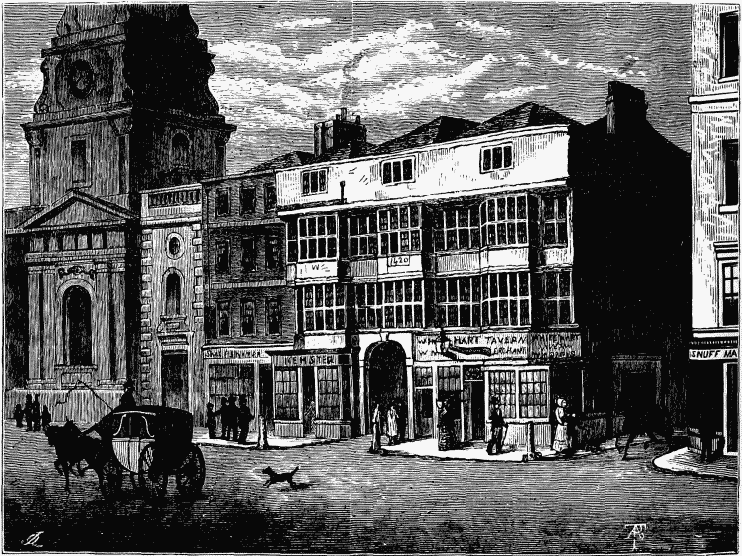
THE "WHITE HART," BISHOPSGATE STREET, IN 1810.
Then came a distinguished tenant, indeed, a man fit to stock it with wisdom for ever, and to purge it of the old stains of Richard's crimes. Between 1516 and 1523, says the Rev. Thomas Hugo, Crosby Hall was inhabited by the great Sir Thomas More, first Under Treasurer, and afterwards Lord High Chancellor of England. Here philosophy and piety met in quiet converse, and Erasmus compares More's house to the Academy of Plato, or rather to a "school and an exercise of the Christian religion;" all its inhabitants, male and female, applying "their leisure to liberal studies and profitable reading, although piety was their first care. No wrangling, no idle word, was heard in it; every one did his duty with alacrity, and not without a temperate cheerfulness." In 1523 Sir Thomas More sold Crosby Hall to his "dear friend" Antonio Bonvici, a merchant of Lucca, the same person to whom, twelve years after, the chancellor sent an affecting farewell letter, written in the Tower with a piece of charcoal the night before his execution. After the dissolution of the Convent of St. Helen Bonvici purchased Crosby Hall and messuages of the king for £207 18s. 4d. In 1549 Bonvici forfeited the property by illegally departing the kingdom, and Henry VIII. granted Crosby Hall to Lord Darcy. Bonvici afterwards returned and resumed possession. By him the mansion was left to Germayne Cyoll, who had married a cousin of Sir Thomas Gresham, who lived opposite Crosby House. The weekly bequest of Cycillia Cyoll, wife of this same Cyoll, is still distributed at St. Helen's Church.
In 1566 Alderman Bond purchased the house for £1,500, and repaired and enlarged it, building, it is said, a turret on the roof. The inscription on Bond's tomb in St. Helen's Church describes him as a merchant adventurer, and most famous in his age for his great adventures by both sea and land. Bond entertained the Spanish ambassador at Crosby Hall, as his sons afterwards did the Danish ambassador.
From the sons of Alderman Bond, Crosby Hall was purchased, in 1594, by Sir John Spencer, for £2,560. This rich citizen kept his mayoralty here in 1594; and during his year of office a masque was performed by the gentlemen students of Gray's Inn and the Temple, in the august presence of Queen Elizabeth. Spencer built a large warehouse close to the hall. It was during this reign that Crosby House was for a time tenanted by the Dowager Countess of Pembroke, "Sydney's sister, Pembroke's mother" (immortalised by Ben Jonson's epitaph); and at her table Shakespeare may have often sat as a welcome guest.
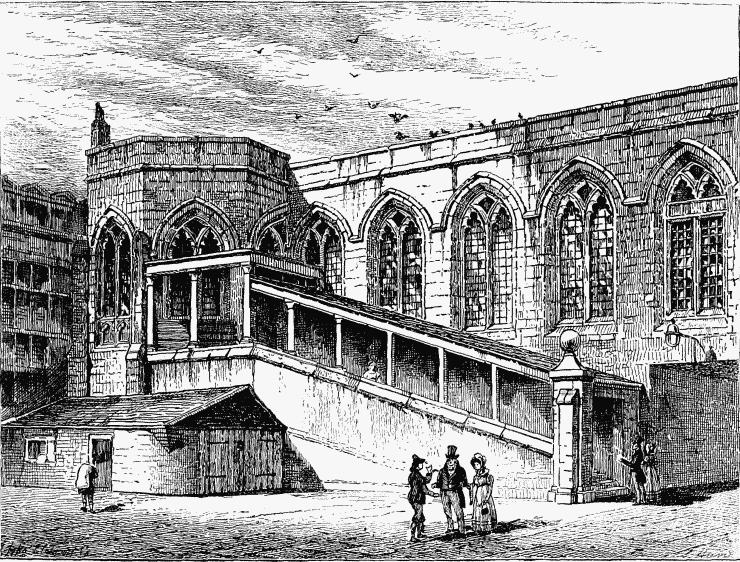
CROSBY HALL IN 1790.
On the death of Sir John, in 1609, the house descended to his son-in-law, Lord Compton, afterwards Earl of Northampton, but whether he resided there is uncertain. The earl's son Spencer was killed, fighting for King Charles, in 1642. The house afterwards became a temporary prison for "malignants," like Gresham College and Lambeth Palace.
In 1672 the great hall of the now neglected house was turned into a Presbyterian chapel. Two years later the dwelling-houses which adjoined the hall, and occupied the present site of Crosby Square, were burnt down, but the hall remained uninjured. While used as a chapel (till 1769), twelve different ministers of eminence occupied the pulpit, the first being Thomas Watson, previously rector of St. Stephen's, Walbrook, and the author of the tract, "Heaven taken by Storm," which is said to have been the means of the sudden conversion of the celebrated Colonel Gardiner. In 1678 a sale was announced at Crosby Hall, of "tapestry, a good chariot, and a black girl of about fifteen." The Withdrawing-room and Thorne-room were let as warehouses to the East India Company. It then was taken by a packer, and much mutilated; and in 1831 the premises were advertised to be let upon a building lease. It was greatly owing to the public spirit of Miss Hackett, a lady who lived near it, that this almost unique example of domestic Gothic architecture was ultimately preserved. In 1831 this lady made strenuous efforts for its conservation, and received valuable assistance from Mr. W. Williams, of Great St. Helen's, and other residents. In 1836 it was reinstated and partially restored by public subscription, after which it was re-opened by the Lord Mayor, W. T. Copeland, Esq., M.P., a banquet in the old English style being held on the occasion. From 1842 to 1860 Crosby Hall was occupied by a literary and scientific institute. It has since been converted into a restaurant.
It is conjectured that this fine old house was originally composed of two quadrangles, separated by the Great Hall, a noble room forty feet high. The oriel of the hall is one of the finest specimens remaining; the timber roof is one of the most glorious which England possesses. The Throneroom and Council-room have suffered much. A fine oriel in one of these has been removed to Buckinghamshire, and both ceilings have been carried off. No original entrance to the hall now remains, except a flat arched doorway communicating with the Council-chamber. The main entrance, Mr. Hugo thinks, was no doubt under the minstrel's gallery, at the south end. In the centre of the oriel ceiling is still to be seen, in high relief, the crest of Sir John Crosby—a ram trippant, argent, armed and hoofed, or.
CHAPTER XXI.
BISHOPSGATE (continued).
Old Houses and Architectural Relics—St. Botolph's Church and its Records—St. Ethelburga—Sir Thomas Gresham's House—Gresham CollegeSir Kenelm Digby—The New College—Jews' Synagogue in Great St. Helen's—The Leathersellers' Hall—The "Bull" Inn—Burbage—Hobson—Milton's Epitaph—Teasel Close and the Trained Bands—Devonshire Square—Fisher's "Folly"—Houndsditch and its Inhabitants—The Old-Clothes Men—Hand Alley—Bevis Marks—The Papey—Old Broad Street—The Excise Office—Sir Astley Cooper-A Roman Pavement Discovered—St. Peter-le-Poer—Austin Friars—Winchester House—Allhallows-in-the-Wall—London Wall—Sion College.
The Ward of Bishopsgate having partially escaped the Great Fire, is still especially rich in old houses. In most cases the gable ends have been removed, and, in many, walls have been built in front of the ground floors up to the projecting storeys; but frequently the backs of the houses present their original structure. Mr. Hugo, writing in the year 1857, has described nearly all places of interest; but many of these have since been modified or pulled down. The houses Nos. 81 to 85 inclusive, in Bishopsgate Street Without, were Elizabethan. On the front of one of these the date, 1590, was formerly visible. In Artillery Lane the same antiquary found houses which, at the back, preserved their Elizabethan character. In No. 19, Widegate Street, there was a fine ceiling of the time of Charles I. The houses adjoining Sir Paul Pindar's, numbered 170 and 171, possessed ceilings of a noble character, and had probably formed part of Sir Paul Pindar's. The lodge in Half-moon Street, now destroyed, had a most noble chimneypiece, probably executed by Inigo Jones, besides wainscoted walls and rich ceilings. No. 26, Bishopsgate Street Without possessed two splendid back rooms, with decorations in the style of Louis XIV., full of flowing lines. In Still Alley, in 1857, there were several Elizabethan houses, since modernised. White Hart Court (though the old inn was gone before) boasted a row of four houses, of beautiful design, in the Inigo Jones manner.
In the house No. 18, at the corner of Devonshire Street, Mr. Hugo discovered, as he imagined, a portion of the Earl of Devonshire's house, or that of Lord John Powlet. It was of the Elizabethan age, and one room contained a rich cornice of masks, fruit, and leaves, connected by ribands. In another there were, over the fireplace, the arms of Henry Wriothesley, Earl of Southampton, and Shakespeare's friend. At the corner of Houndsditch, No. 8, Bishopsgate Street Without, there was an Elizabethan house, and at the opposite corner, No. 7, was a house with fine staircases, and walls and ceilings profusely decorated à la Louis Quatorze. Just beyond, a tablet, surmounted with the figure of a mitre inserted in the wall, a little north of Camomile Street, marks the site of the old Bishops' Gate.
At 66, Bishopsgate Street Within, there was a finely-groined undercroft, of the fourteenth century. At the end of Pea Hen Court, Mr. Hugo, in his antiquarian tour of 1857, records a doorway of James I. In Great St. Helen's Place, the same antiquary found, at No. 2, a good doorway and staircase of Charles I.; and at Nos. 3 and 4, some Elizabethan relics. Nos. 8 and 9 he pronounced to be modern subdivisions of a superb house. On the front was the date, 1646. It was of brick, ornamented with pilasters, and contained a matchless staircase and a fine chimney-piece. Nos. 11 and 12, Great St. Helen's, Mr. Hugo noted as a red brick house, with pilasters of the same material. The simple but artistic doorways he had little hesitation in attributing to Inigo Jones: he supposed them to have been erected about 1633, the year Inigo designed the south entrance of St. Helen's Church.
At No. 3, Crosby Square, Mr. Hugo found a fine doorway (temp. Charles II.), in the style of Wren. This square was built in 1677, on the site of part of Crosby Hall. At Crosby Hall Chambers, No. 25, Bishopsgate Street Within, the street front had lost all ancient peculiarities, except two beautiful festoons of flowers inserted between the windows of the first and second floors.
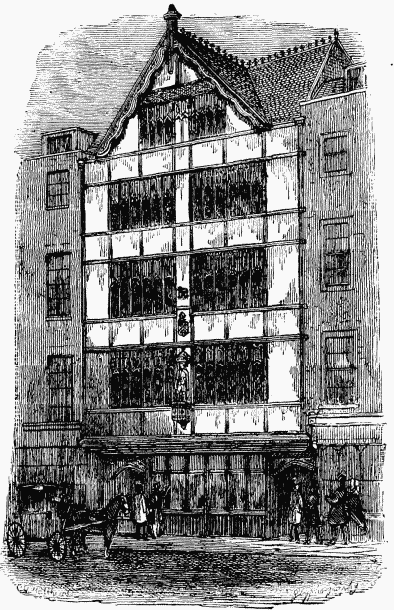
STREET FRONT OF CROSBY HALL.
The church of St. Botolph, Bishopsgate, stands on the banks of the City Ditch, and was rebuilt in 1725–28 by James Gold, an architect otherwise unknown. It contains a monument to the good and illustrious Sir Paul Pindar. The in scription describes him as nine years resident in Turkey, faithful in negotiations foreign and domestic, eminent for piety, charity, loyalty, and prudence; an inhabitant twenty-six years, and a bountiful benefactor to the parish, Sir Paul having leftgreat bequests to London hospitals and other institutions. There is also a tomb, date 1626, of a Persian ambassador. His friends came every day for weeks to his grave, to perform their devotions, till disturbed by the mob. The churchyard of St. Botolph's is adorned with a pretty little fountain.
The registers of the church (says Cunningham) record the baptism of Edward Alleyn, the player (born 1566); the marriage, in 1609, of Archibald Campbell, Earl of Argyll, to Ann Cornwallis, daughter of Sir William Cornwallis; and the burials of the following persons of distinction:—1570, Sept. 13, Edward Allein, poete to the Queene; 1623, Feb. 17, Stephen Gosson, rector of this church, and author of "The School of Abuse; containing a pleasant invective against Poets, Pipers, Plaiers, Jesters, and such-like Caterpillars of a Commonwealth," 4to, 1579; 1628, June 21, William, Earl of Devonshire (from whom Devonshire Square, adjoining, derives its name); 1691, John Riley, the painter.
St. Ethelburga, a church a little beyond St. Helen's, half hidden with shops, escaped the Great Fire, and still retains some Early English masonry. It was named from the daughter of King Ethelbert, and is mentioned as early as the year 1366; the advowson was vested in the prioress and nuns of St. Helen's, and so continued till the dissolution. One of Dryden's rivals, Luke Milbourne, was minister of this church. Pope calls him "the fairest of critics," because he exhibited his own translation of Virgil to be compared with that which he condemned.
The General Post Office, at first fixed at Sherborne Lane, was next removed to Cloak Lane, Dowgate, and then, till the Great Fire, to the Black Swan, Bishopsgate Street.
One of the glories of old Bishopsgate was the mansion built there by Sir Thomas Gresham, in 1563. It consisted (says Mr. Burgon, his best biographer) of a square court, surrounded by a covered piazza, and had spacious offices adjoining. It was girdled by pleasant gardens, and extended from Bishopsgate Street, on the one side, to Broad Street on the other. The first plan of the college which afterwards occupied this house was to have seven professors, who should lecture once a week in succession on divinity, astronomy, music, geometry, law, medicine, and rhetoric. Their salaries, defrayed by the profits of the Royal Exchange, were to be £50 per annum, a sum equal to £400 or £500 at the present day. To the library of this college the Duke of Norfolk, in the latter part of the seventeenth century, presented two thousand volumes from his family library. From the meetings of scientific men at these lectures the Royal Society originated, and was incorporated in 1663 by Charles II. The society afterwards removed to Arundel House, in the Strand. The Gresham College Lectures were commenced in 1597, the year after Lady Gresham's death, when the house became free. They were read in term-time, every day but Sunday, in Latin, at nine a.m., and in English at two p.m.
Aubrey mentions that that strange being, Sir Kenelm Digby, admiral, philosopher, and doctor, after the death of his beautiful wife, retired into Gresham College for two or three years, to avoid envy and scandal. He diverted himself with his chemistry, and the professors' learned talk. He wore, says the gossip, a long morning cloak, a highcrowned hat, and he kept his beard unshorn, and looked like a hermit, as signs of sorrow for his beloved wife, whom he was supposed to have poisoned by accident, by giving her vipers' flesh in broth, to heighten her beauty. In Johnson's time the attendance at the lectures had dwindled to nothing, and we find the terrible doctor telling Boswell, that ready listener, that if the professors had been allowed to take only sixpence a lecture from each scholar, they would have been "emulous to have had many scholars." Gresham College was taken down in 1768, the ground on which it stood made over to the Crown for a perpetual rent of £500 per annum, the lectures being read in a room above the Royal Exchange. A new college was subsequently erected in Gresham Street, and the first lecture read in it November 2, 1843. The music and other practical lectures are still well attended, but the Latin lectures are often adjourned, from there being no audience.
The new college, at the corner of Basinghall Street, is a handsome stone edifice, designed by George Smith. It is in the enriched Roman style, and has a Corinthian entrance portico. Over the entrance are the arms of Gresham, the City of London, and the Mercers' Company, in the last of which a demivirgin, with dishevelled hair, is modestly conspicuous. The interior contains a large library and professors' rooms, and on the first floor a theatre, to hold 500 persons. The building cost upwards of £7,000. The professors' salaries have been raised, to compensate them for their rooms in the old college. In Vertue's print, in Ward's "Lives of the Gresham Professors," 1740, Dr. Woodward and Dr. Mead, Gresham professors, are represented as drawing swords. This refers to an actual quarrel between the two men, when Mead obtained the advantage, and commanded Woodward to beg his life. "No, doctor," said the vanquished man, "that I will not, till I am your patient." But he nevertheless at last wisely yielded, and Vertue has represented him tendering his sword to his conqueror.
One of the largest of the Jews' synagogues in London was built by Davies, in 1838, in Great St. Helen's, Bishopsgate. It is in rich Italian style, with an open loggia of three arches, resting upon Tuscan columns. The sides have Doric piers, and Corinthian columns above, behind which are the ladies' galleries, in the Oriental manner of the Jews, fronted with rich brass-work. There are no pews. The centre floor has a platform, and seats for the principal officers, with four large brass-gilt candelabra. At the south end is "the ark," a lofty semicircular-domed recess, consisting of ItalianDoric pilasters, with verde antico and porphyry shafts, and gilt capitals; and Corinthian columns with sienna shafts, and capitals and entablature in white and gold. In the upper storey the intercolumns are filled with three arched windows of stained glass, arabesque pattern, by Nixon, the centre one having "Jehovah," in Hebrew, and the tables of the Law. The semi-dome is decorated with gilded rosettes on an azure ground; there are rich festoons of fruit and flowers between the capitals of the Corinthian columns, and ornaments on the frieze above, on which is inscribed in Hebrew, "Know in whose presence thou standest." The centre of the lower part is fitted up with recesses for books of the Law, enclosed with polished mahogany doors, and partly concealed by a rich velvet curtain, fringed with gold; there are massive gilt candelabra, and the pavement and steps to the ark are of fine veined Italian marble, partly carpeted. Externally, the ark is flanked with an arched panel, that on the east containing a prayer for the Queen and Royal Family in Hebrew, and the other a similar one in English. Above the ark is a rich fan-painted window, and a corresponding one, though less brilliant, at the north end. The ceiling, which is flat, is decorated with thirty coffers, each containing a large flower aperture, for ventilation. This synagogue appears to have been removed from Leadenhall Street.
Leathersellers' Hall, at the east end of St. Helen's Place, was rebuilt about 1815, on the site of the old hall, which had formed part of the house of the Black Nuns of St. Helen's, taken down in 1799. The original site had been purchased by the Company soon after the surrender of the priory to Henry VIII. The old hall contained a curiouslycarved Elizabethan screen, and an enriched ceiling, with pendants. Beneath the present hall runs the crypt of the Priory of St. Helen's, which we have already described. In the yard belonging to the hall is a curious pump, with a mermaid pressing her breasts, out of which, on festive occasions, wine used formerly to run. It was made by Caius Gabriel Cibber, in 1679, as payment to the Company of his livery fine of £25. The Leathersellers were incorporated by the 21st of Richard II., and by a grant of Henry VII. the wardens were empowered to inspect sheep, lamb, and calf leather throughout the kingdom.
It was at the "Bull" Inn, Bishopsgate Street,
that Shakespeare's friend, Burbage, and his fellows,
obtained a patent from Queen Elizabeth for erecting
a permanent building for theatrical entertainments.
Tarlton, the comedian, often played here. The
old inns of London were the first theatres, as we
have before shown. Anthony Bacon (the brother
of the great Francis), resided in a house in Bishopsgate Street, not far from the "Bull" Inn, to the
great concern of his watchful mother, who not only
dreaded that the plays and interludes acted at the
"Bull" might corrupt his servants, but also objected
on her own son's account to the parish, as being
without a godly clergyman. The "Four Swans,"
just pulled down, was another fine old Bishopsgate
inn, with galleries complete. It was at the "Bull"
that Hobson, the old Cambridge carrier eulogised by
Milton, put up. The Spectator says that there was
a fresco figure of him on the inn walls, with a
hundred-pound bag under his arm, with this inscription on the said bag—
"The fruitful mother of an hundred more."
Milton's lines on this sturdy old driver are full of
kindly regret, and are worth remembering—
"On the University Carrier, who sickened in the time of the Vacancy, being forbid to go to London, by reason of the Plague.
"Here lies old Hobson; Death hath broke his girt,
And here, alas! hath laid him in the dirt;
Or else, the ways being foul, twenty to one,
He's here stuck in a slough, and overthrown.
'Twas such a shifter, that if truth were known,
Death was half glad when he had got him down;
For he had, any time these ten years full,
Dodg'd with him, betwixt Cambridge and the 'Bull;'
And surely Death could never have prevail'd,
Had not his weekly course of carriage fail'd;
But lately finding him so long at home,
And thinking now his journey's end was come,
And that he had ta'en up his latest inn,
In the kind office of a chamberlain,
Show'd him his room, where he must lodge that night,
Pull'd off his boots, and took away the light;
If any ask for him, it shall be said,
'Hobson has supt, and's newly gone to bed.'"
The original portrait and parchment certificate of Mr. Van Harn, a frequenter of the house, were long preserved at the "Bull" Inn. This worthy is said to have drank 35,680 bottles of wine in this hostelry. In 1649 five Puritan troopers were sentenced to death for a mutiny at the "Bull."
The first Bethlehem Hospital was originally a priory of canons, with brothers and sisters, formed in 1246, in Bishopsgate Without, by Simon Fitz Mary, a London sheriff. Henry VIII., at the dissolution, gave it to the City of London, who turned it into an hospital for the insane. Stow speaks vaguely of an insane hospital near Charing Cross, removed by a king of England, who objected to mad people near his palace. The hospital was removed from Bishopsgate to Moorfields, in 1675, at a cost of "nigh £17,000."
The first Artillery Ground was in Teasel Close, now Artillery Lane, Bishopsgate Street Without. Stow describes Teasel Close as a place where teasels (the tæsal of the Anglo-Saxons, Dipsacus fullonum, or fullers' teasel of naturalists) were planted for the clothworkers, afterwards let to the cross-bow makers, to shoot matches at the popinjay. It was in his day closed in with a brick wall, and used as an artillery yard; and there the Tower gunners came every Thursday, to practise their exercise, firing their "brass pieces of great artillery" at earthen butts. The Trained Bands removed to Finsbury in 1622.
Teasel Close was the practice-ground of the old City Trained Band, established in 1585, during the alarm of the expected Spanish Armada. "Certain gallant, active, and forward citizens," says Stow, "voluntarily exercising themselves for the ready use of war, so as within two years there was almost 300 merchants, and others of like quality, very sufficient and skilful to train and teach the common soldiers." The alarm subsiding, the City volunteers again gave way to the grave gunners of the Tower, warriors as guiltless of blood as themselves. In 1610, martial ardour again rising, a new company was formed, and weekly drill practised with renewed energy. Many country gentlemen from the shires used to attend the drills, to learn how to command the country Trained Bands. In the Civil Wars, especially at the battle of Newbury, these London Trained Bands fought with firmness and courage. Lord Clarendon is even proud to confess this. "The London Trained Bands," he says, "and auxiliary regiments (of whose inexperience of danger, or any kind of service beyond the easy practice of their postures in the Artillery Garden, men had till then too cheap in estimation) behaved themselves to wonder, and were in truth the preservation of that army that day. For they stood as a bulwark and rampire to defend the rest; and when their wings of horse were scattered and dispersed, kept their ground so steadily, that though Prince Rupert himself led up the choice horse to charge them, and endured their storm of small shot, he could make no impression upon their stand of pikes, but was forced to wheel about; of so sovereign benefit and use is that readiness, order, and dexterity in the use of their arms, which hath been so much neglected."
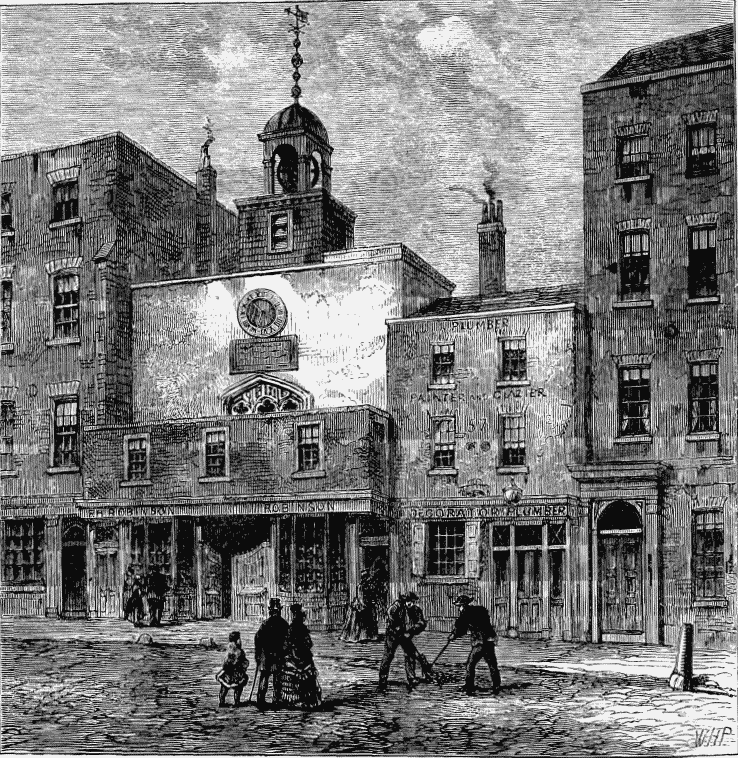
ST. ETHELBURGA'S CHURCH.
Devonshire Square, a humble place now, was
originally the site of a large house with pleasuregardens, bowling-greens, &c., built and laid out by
Jasper Fisher, one of the six clerks in Chancery, a
Justice of the Peace, and a freeman of the Goldsmiths' Company. The house being considered
far too splendid for a mere clerk in Chancery,
much in debt, was nicknamed "Fisher's Folly.
After Fisher's downfall, Edward, Earl of Oxford.
Lord High Chamberlain to Queen Elizabeth, took
it. The Queen lodged here during one of her
visits to the City, and here probably the Earl presented his royal mistress with the first pair of perfumed gloves brought to England. The mansion
afterwards fell to the noble family of Cavendish,
William Cavendish, the second Earl of Devonshire,
dying in it about the year 1628. The family of
Cavendish appear to have been old Bishopsgate
residents, as Thomas Cavendish, Treasurer of the
Exchequer to Henry VIII., buried his lady in
St. Botolph's Church, and by will bequeathed a
legacy for the repair of the building. The Earls of
Devonshire held the house from 1620 to 1670, but
during the Civil Wars, when the sour-faced preachers
were all-powerful, the earl's City mansion became
a conventicle, and resounded with the unctuous
groans of the crop-eared listeners. Butler, in his
"Hudibras," says the Rump Parliament resembled
"No part of the nation
But Fisher's Folly congregation."
About the close of the seventeenth century, when the Penny Post was started, one of the inventors, Mr. Robert Murray, clerk to the Commissioners of the Grand Excise of England, set up a Bank of Credit at Devonshire House, where men depositing their goods and merchandise were furnished with bills of current credit at two-thirds or three-fourths of the value of the said goods.
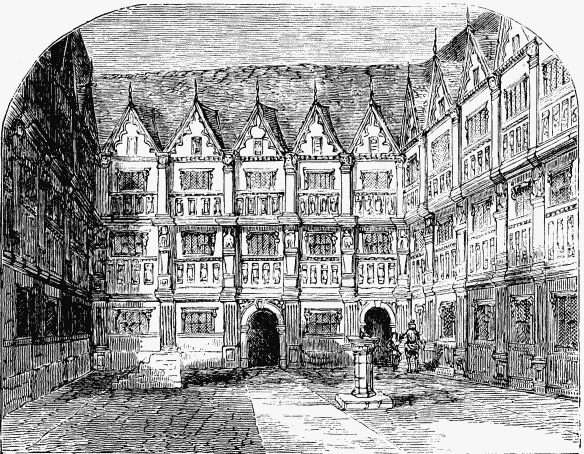
SIR THOMAS GRESHAM'S HOUSE IN BISHOPSGATE STREET.
Hatton, in 1708, calls the square "a pretty though very small square, inhabited by gentry and other merchants;" and Strype describes it as "an airy and creditable place, where the Countess of Devonshire, in my memory, dwelt in great repute for her hospitality."
Houndsditch, which may be called an indirect tributary of Bishopsgate, though not a dignified place, has a legend of its own. Richard of Cirencester says that here the body of Edric, the murderer of his sovereign Edmund Ironside, was contemptuously thrown by Canute, whom he had raised to the throne. When Edric, flushed with his guilty success, came to claim of Canute the promised reward of his crime—the highest situation in London—the Danish king cried, "I like the treason, but detest the traitor. Behead this fellow, and as he claims the promise, place his head on the highest pinnacle of the Tower." Edric was then drawn by his heels from Baynard's Castle, tormented to death by burning torches, his head placed on the turret, and his scorched body thrown into Houndsditch.
Stow speaks of the old City ditch as a filthy place, full of dead dogs, but before his time covered over and enclosed by a mud wall. On the side of the ditch over against this mud wall was a field at one time belonging to the Priory of the Holy Trinity, which being given, at the dissolution, to Sir Thomas Audly, was handed over by him to Magdalen College, Cambridge, of which he was the founder.
Brokers and sellers of disconsolate cast-off apparel
took kindly to this place immediately after the
Reformation, settling in this field of the priory;
while the old dramatists frequently allude to the Jew
brokers and usurers of this district, of the "melancholy" of which Shakespeare has spoken. "Where
got'st thou this coat, I marle?" says Well-bred in
Ben Jonson's Every Man in his Humour; to
which Brainworm answers, "Of a Houndsditch
man, sir; one of the devil's near kinsmen, a broker."
And Beaumont and Fletcher call the place contemptuously Dogsditch:—
"More knavery, and usury,
And foolery, and brokery than Dogsditch."
In the reign of Henry VIII. three brothers named Owens set up in this field a foundry for brass ordnance, and the rest of the place was turned into garden ground. At the end of the reign of Edward VI. pleasant houses for respectable citizens began to be erected.
"This field," says Stow, "as all others about the City, was enclosed, reserving open passage thereinto for such as were disposed. Towards the street were some small cottages of two storeys high, and little garden plots, backward, for poor bedrid people (for in that street dwelt none other), builded by some Prior of the Holy Trinity, to whom that ground belonged.
"In my youth I remember devout people, as well men as women of this City, were accustomed oftentimes, especially on Fridays weekly, to walk that way purposely, and there to bestow their charitable alms, every poor man or woman laying in their bed within their window, which was towards the street, open so low that every man might see them; a clean linen cloth lying in their window, and a pair of beads, to show that there lay a bedrid body, unable but to pray only. This street was first paved in the year 1503."
The favourite localities of the Jew old-clothesmen were Cobb's Yard, Roper's Buildings, and Wentworth Street.
"The Jew old-clothesmen," says Mr. Mayhew, "are generally far more cleanly in their habits than the poorer classes of English people. Their hands they always wash before their meals, and this is done whether the party be a strict Jew or 'Meshumet,' a convert or apostate from Judaism. Neither will the Israelite ever use the same knife to cut his meat that he previously used to spread his butter, and he will not even put his meat upon a plate that has had butter on it; nor will he use for his soup the spoon that has had melted butter in it. This objection to mix butter with meat is carried so far, that, after partaking of the one, Jews will not eat of the other for two hours. The Jews are, generally, when married, most exemplary family men. There are few fonder fathers than they are, and they will starve themselves sooner than their wives or children should want. Whatever their faults may be, they are good fathers, husbands, and sons. Their principal characteristic is their extreme love of money; and, though the strict Jew does not trade himself on the Sabbath, he may not object to employ either one of his tribe, or a Gentile to do so for him.
"The capital required for commencing in the old clothes line is generally about £1. This the Jew frequently borrows, especially after holiday time for then he has generally spent all his earnings, unless he be a provident man. When his stockmoney is exhausted, he goes either to a neighbour or to a publican in the vicinity, and borrows £1 on the Monday morning, 'to strike a light with,' as he calls it, and agrees to return it on the Friday evening, with a shilling interest for the loan. This he always pays back. If he were to sell the coat off his back he would do this, I am told, because to fail in so doing would be to prevent his obtaining any stock-money in the future. With this capital he starts on his rounds about eight in the morning, and I am assured he will frequently begin his work without tasting food rather than break into the borrowed stock-money. Each man has his particular walk, and never interferes with that of his neighbour; indeed, while upon another's beat, he will seldom cry for clothes. Sometimes they go half 'rybeck' together—that is, they will share the profits of the day's business; and when they agree to do this, the one will take one street, and the other another. The lower the neighbourhood the more old clothes are there for sale. At the East-end of the town they like the neighbourhoods frequented by sailors; and there they purchase of the girls and the women the sailors' jackets and trousers. But they buy most of the Petticoat Lane, the Old Clothes Exchange, and the marinestore dealers; for, as the Jew clothes-man never travels the streets by night-time, the parties who then have old clothes to dispose of usually sell them to the marine-store or second-hand dealers over-night, and the Jew buys them in the morning. The first that he does on his rounds is to seek out these shops, and see what he can pick up there. A very great amount of business is done by the Jew clothes-man at the marine-store shops at the West as well as at the East-end of London."
Within a short distance of Houndsditch stood Hand Alley, built on the site of one of the receptacles for the dead during the raging of the great Plague in 1665. "The upper end of Hand Alley, in Bishopsgate Street," writes Defoe, "which was then a green, and was taken in particularly for Bishopsgate parish, though many of the carts out of the City brought their dead thither also, particularly out of the parish of St. Allhallows-inthe-Wall: this place I cannot mention without much regret. It was, as I remember, about two or three years after the Plague was ceased, that Sir Robert Clayton came to be possessed of the ground. It was reported, how true I know not, that it fell to the king for want of heirs, all those who had any right to it being carried off by the pestilence, and that Sir Robert Clayton obtained a grant of it from Charles II. But however he came by it, certain it is the ground was let out to be built upon, or built upon by his order. The first house built upon it was a large fair house, still standing, which faces the street or way now called Hand Alley, which, though called an alley, is as wide as a street. The houses, in the same row with that house northward, are built on the very same ground where the poor people were buried, and the bodies, on opening the ground for the foundations, were dug up; some of them remaining so plain to be seen, that the women's skulls were distinguished by their long hair, and of others the flesh was not quite perished, so that the people began to exclaim loudly against it, and some suggested that it might endanger a return of the contagion. After which the bones and bodies, as they came at them, were carried to another part of the same ground, and thrown all together into a deep pit dug on purpose, which now is to be known in that it is not built on, but is a passage to another house at the upper end of Rose Alley, just against the door of a meeting-house. . . . There lie the bones and remains of near 2,000 bodies, carried by the dead-carts to their graves in that one year."
A turning from Houndsditch, of unsavoury memory, leads to Bevis Marks. Here formerly stood the City mansion and gardens of the abbots of Bury. The corruption of Bury's Marks to Bevis Marks is undoubted, though not obvious. Stow describes it as "one great house, large of rooms, fair courts, and garden plots," some time pertaining to the Bassets, and afterwards to the abbots of Bury. Bury Street, where the old house stood, was remarkable for a synagogue of Portuguese Jews, and a Dissenting chapel, where the good Dr. Watts was for many years pastor.
Towards Camomile Street, close to London Wall, stood the Papey, a religious house belonging to a brotherhood of St. John and St. Charity (our readers will remember Shakespeare talks of "By Gis and by St. Charity"), founded in 1430, by three charity priests. The members were professional mourners, and are often so represented on monuments. The original band consisted of a master, two wardens, chaplains, chantry priests, conducts, and other brothers and sisters. Sir Francis Walsingham, Elizabeth's astute and wily secretary, afterwards inhabited the house.
Old Broad Street, as late as the reign of Charles I., was (says Cunningham) one of the most fashionable streets in London. In Elizabeth's reign, Gilbert Talbot, Earl of Shrewsbury, lived here, and, in Charles's time, Lords Weston and Dover. Here at the same time was a glass-house, where Venice glasses (then so prized) were made by Venetian workmen. Mr. James Howell, author of the "Familiar' Letters" which bear his name, was (says Strype) steward to this house. When Howell, unable to bear the heat of the place, gave up his stewardship, he said, if he had stayed much longer, he should in a short time have melted to nothing among these hot Venetians. The place afterwards became Pinners' Hall, and then a Dissenting chapel. The Pinners, or Pinmakers, were incorporated by Charles I. In February, 1659–60 Monk drew up his forces in Finsbury, dined with the Lord Mayor, had conference with him and the Court of Aldermen, retired to the "Bull's Head," in Cheapside, and quartered at the glass-house, in Broad Street, multitudes of people following him, and congratulating him on his coming into the City, amid shouting, clashing bells, and lighted bonfires.
In Old Broad Street the elder Dance built the Excise Office in 1768, which was removed in 1848 to Somerset House. This Government Office originally stood on the west side of Ironmonger Lane, where was formerly the mansion of Sir J. Frederick, For £500 a year the trustees of the Gresham estates annihilated Gresham College. Dance's building, of stone and brick, was much praised for its simple grandeur. Charles I. seems to have intended to levy excise duties as early as 1626, but the Parliament stopped him. The Parliament, however, to maintain their forces, were compelled to found an Excise Office, in 1643, and ale, beer, cider, and perry were the first articles taxed, together with wine, silks, fur, hats, and lace. There were riots in London about the new system, and the mob burnt down the Excise House in Smithfield. The Excise revenue at first amounted to £1,334,532. The first act after the Restoration was to abolish excise on all articles except ale, &c., which produced an annual revenue of £666,383. The duties on glass and malt were first imposed in William's reign, and the salt duty was then re-imposed. Queen Anne's expensive wars led to duties on paper and soap; and her revenue from excise amounted to £1,738,000 a year. In the reign of George I. the produce of the Excise averaged £2,340,000. Sir Robert Walpole did all he could to extend the Excise, while Pitt carried out all Walpole had attempted. In 1793, no fewer than twenty-nine articles were subject to the Excise laws, and the gross revenue from them amounted to ten millions and a half. In 1797, the number of officers employed in England was 4,777. In the first twenty years after the peace, the reduction of duties led to the dismissal of 847 Excise officers.
One of the most distinguished inhabitants of Broad Street, many years ago, was the great surgeon, Sir Astley Cooper. "He was then," says "Aleph," "attached to Guy's Hospital, having a large class of pupils, and a numerous morning levee of City patients. His house was a capacious corner tenement in Broad Street, on the righthand side of the wide-paved court leading by St. Botolph's Church into Bishopsgate Street. When patients applied they were ushered into a large front room, which would comfortably receive from forty to fifty persons. It was plainly furnished; the floor covered with a Turkey carpet, a goodly muster of lumbering mahogany horse-hair seated chairs, a long table in the centre, with a sprinkling of tattered books and stale periodicals, 'Asperne's Magazine,' and the 'British Critic,' and a dingy, damaged pier-glass over the chimney. Sir Astley Cooper's earnings during the first nine years of his practice progressed thus—First year, 5 guineas; second, £26; third, £64; fourth,£96; fifth, £100; sixth, £200; seventh, £400; eighth, £600; ninth, £1,100. But the time was coming when patients were to stand for hours in his ante-rooms waiting for an interview, and were often dismissed without being admitted to the consulting-room. His man Charles, with infinite dignity, used to say to the disappointed applicants when they reappeared next morning, 'I am not at all sure that we shall be able to attend to you, for we are excessively busy, and our list is full for the day; but if you'll wait, I'll see what can be done for you.'"
The largest sum Sir Astley ever received in one year was £21,000, but for a series of years his income was more than £15,000 per annum. As long as he lived in the City his gains were enormous, though they varied, the state of the money market having a curious effect on his fees. Most of his City patients paid their fee with a cheque, and seldom wrote for less than £5 5s. Mr. Coles, of Mincing Lane, for a long period paid him £600 a year. A City man, who consulted him in Broad Street, and departed without giving any fee, soon after sent a cheque for £63 10s. A West Indian millionaire gave Sir Astley his largest fee. He had undergone successfully a painful operation, and paid his physicians, Lettsom and Nelson, with 300 guineas each. "But you, sir," cried the grateful old man, sitting up in bed, and addressing Cooper, "shall have something better. There, sir, take that!" It was his nightcap, which he flung at the surprised surgeon. "Sir," answered Cooper, "I'll pocket the affront," and on reaching home he found in the cap a draft for 1,000 guineas. When Sir Astley left Broad Street he established himself in Spring Gardens, and there, too, his practice was very considerable, but neither so extensive nor lucrative as that he enjoyed in the City. He died in 1841.
In 1854, on taking down the Excise Office, at about fifteen feet lower than the foundation of Gresham House, was found a pavement twentyeight feet square. It is a geometrical pattern of broad blue lines, forming intersections of octagon and lozenge compartments. The octagon figures are bordered with a cable pattern, shaded with grey, and interlaced with a square border, shaded with red and yellow. In the centres, within a ring, are expanded flowers, shaded in red, yellow, and grey; the double row of leaves radiating from a figure called a truelove-knot, alternately with a figure something like the tiger-lily. Between the octagon figures are square compartments bearing various devices; in the centre of the pavement is Ariadne, or a Bacchante, reclining on the back of a panther; but only the fore-paws, one of the hind-paws, and the tail remain. Over the head of the figure floats a light drapery forming an arch. Another square contains a two-handled vase. In the demi-octagons, at the sides of the pattern, are lunettes; one contains a fan ornament, another a bowl crowned with flowers. The lozenge intersections are variously embellished with leaves, shells, truelove-knots, chequers, and an ornament shaped like a dice-box. At the corners of the pattern are truelove-knots. Surrounding this pattern, in a broad cable-like border, are broad bands of blue and white alternately.
The church of St. Peter le Poor, Old Broad Street, stands near the site of old Paulet House. Stow thinks this may once have been a poor parish, and so gives its name to the saint, "though at this present time there be many fair houses possessed by rich merchants and others." The church being in a ruinous condition, was pulled down in 1788, rebuilt by Jesse Gibson, and consecrated by Bishop Porteus in 1792.
Old Broad Street leads us into the interesting region of Austin Friars, a district rich in antiquities. Here once stood a priory of begging friars, founded, in 1243, by Humphrey Bohun, Earl of Hereford and Essex, and dedicated to St. Augustine, Bishop of Hippo, in Africa. The church was ornamented "with a fine spired steeple, small, high, and straight," which Stow admired. At the dissolution of the monasteries, Henry VIII. granted the friars' house and grounds to William Paulet, first Marquis of Winchester, Comptroller of the Household, and Lord High Treasurer, who made the place his town residence. The church was reserved, and given by Edward VI., to the Dutchmen of London, to have their services in, "for avoiding of all sects of Ana-Baptists, and such like." The decorated windows of the church are still preserved, but the spire and the splendid tombs mentioned by Stow are gone.
"Here," says Mr. Jesse, "lies the pious founder of the priory, Humphrey de Bohun, who stood godfather at the font for Edward I., and who afterwards fought against Henry III., with the leagued barons, at the battle of Evesham. Here were interred the remains of the great Hubert de Burgh, Earl of Kent, the most powerful subject in Europe during the reigns of King John and Henry III., and no less celebrated for his chequered and romantic fortunes. Here rests Edmund, son of Joan Plantagenet, 'the Fair Maid of Kent,' and half-brother to Richard II. Here lies the headless trunk of the gallant Fitzallan, tenth Earl of Arundel, who was executed in Cheapside in 1397. Here also rest the mangled remains of the barons who fell at the battle of Barnet, in 1471, and who were interred together in the body of the church; of John de Vere, twelfth Earl of Oxford, who was beheaded on Tower Hill with his eldest son, Aubrey, in 1461; and, lastly, of the gallant and princely Edward Stafford, Duke of Buckingham—'poor Edward Bohun'—who, having fallen a victim to the vindictive jealousy of Cardinal Wolsey, was beheaded on Tower Hill in 1521."
The Rev. Mr. Hugo says that the old conventual church of Austin Friars had all the magnificence of a cathedral; it consisted of the present nave, 153 feet in length, 183 broad, with ample transepts and choir. There are visible thirty-six monumental slabs; seventeen with one or more small figures, and sixteen with one or more shields and small inscriptions at the foot. These slabs have been used as paving stones; some years ago many more were visible, but they are now concealed by the flooring.
In Austin Friars (1735) Richard Gough the antiquary was born, and here, at No. 18, lived James Smith, one of the authors of the "Rejected Addresses." A second James Smith coming to the place, after he had been many years a resident here, produced so much confusion to both, that the last comer waited on the author and suggested, to prevent future inconvenience, that one or other had better leave, hinting, at the same time, that he should like to stay. "No," said the wit, "I am James the First, you are James the Second; you must abdicate."
Lord Winchester died in 1571, and his son, having sold the monuments at Austin Friars for £100, took the lead off the roof, and made stabling of the church ground. In 1602 a fourth marquis was so poor as to be compelled to part with Austin Friars to John Swinnerton, a London merchant, afterwards Lord Mayor. Fulke Greville (Sir Philip Sidney's friend), who lived in Austin Friars, wrote in alarm at this change to the Countess of Shrewsbury, one of his neighbours. Lady Warwick seems to have been another tenant of the Friary.
In Winchester Street, adjoining Austin Friars, stood Winchester House, built by the first Marquis of Winchester, who also founded Basing House. This nobleman died in 1572, in his ninety-seventh year, having lived under nine sovereigns, and having 103 persons immediately descended from him. When this marquis was asked how he had retained royal favour and power under so many conflicting sovereigns, he replied, "By being a willow, and not an oak." Mr. Jesse visited the house before its demolition, in 1839, and found the old Paulet motto, "Aimez Loyaulte," on many of the stained-glass windows. This was the motto that the Marquis of Winchester, during the gallant defence of Basing House, engraved with a diamond on every window of his mansion. It was in apartments of this house in Austin Friars that Anne Clifford, daughter of the Countess of Cumberland, was married to her first husband, Richard, third Earl of Dorset, on the 25th of February, 1608–9. It was this proud lady (already mentioned by us) who returned the defiant answer to the election agents of Charles II., "Your man shall not stand."
In 1621, the Earl of Strafford (a victim of the sham Popish plot), when representing York, took up his residence in Austin Friars, with his young children and the fair wife whom he lost in the following year, and whom he alluded to in his trial as "a saint in heaven." In Austin Friars died, in 1776, James Heywood, who had been one of the popular writers in the Spectator. He is said to have been originally a wholesale linendraper in Fish Street Hill.
Nearly at the end of Little Winchester Street is the Church of Allhallows-in-the-Wall. It escaped the Great Fire, but, becoming ruinous, was taken down in 1764, and the present church built by the younger Dance. In the chancel is a tablet to the Rev. W. Beloe, the well-known translator of Herodotus, who died in 1817, after having held the rectory of the parish for twenty years. The altar-piece, a copy of Pietro di Cortona's "Ananias restoring Paul to Sight," was the gift of Sir N. Dance. The parish books, commencing 1455, record the benefactions of an anchorite who lived near the church.
London Wall, an adjoining street, is interesting, as indicating the site of that portion of the old City wall that divided the City Liberty from the Manor of Finsbury. The old Bethlehem Hospital, taken down in 1814, was built against the portion of the wall then removed. Hughson says the Roman work was found uncommonly thick, the bricks being double the size of those now used, and the centre filled in with large loose stones. The level of the street has been raised two feet within the last fifty years. The old Roman wall, it will be remembered, ran from the Tower through the Minories to Aldgate, Houndsditch, Bishopsgate, along London Wall, to Fore Street; through Cripplegate and Castle Street to Aldersgate; and through Christ's Hospital, by Newgate and Ludgate, to the Thames.
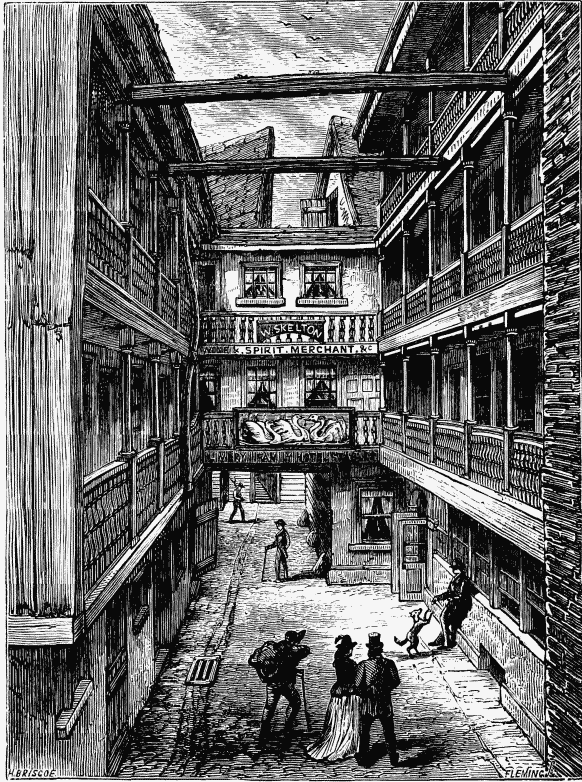
THE FOUR SWANS' INN. (Taken shortly before its demolition.)
In this street stands Sion College, built on the site of the Priory of Elsing Spital. Elsing was a London mercer, who, about 1329, founded an hospital for one hundred blind men on the site of a decayed nunnery. The house was subsequently turned into a priory, consisting of four canons regular, to minister to the blind, Elsing himself being the first prior.
The ground so long consecrated to charity was purchased, in pursuance of the will of Dr. Thomas White, vicar of St. Dunstan's-in-the-West, and in 1623 a college was erected, governed by a president, two deans, and four assistants. Dr. John Simson, rector of St. Olave's, Hart Street, and one of Dr. White's executors, founded a library. It contains the Jesuit books seized in 1679, and half the library of Sir Robert Cooke, the gift of George Lord Berkeley, in the reign of Charles II., but a third of the books were destroyed in the Great Fire. By the Copyright Act of Queen Anne, the library received a gratuitous copy of every work published, till 1836, when the college received instead a Treasury grant of £363 a year. The library contains more than 50,000 volumes, and is open to the public by an order from one of the Fellows. The College contains a curious old picture of the "Decollation of St. John the Baptist," with an inscription in Saxon characters, supposed to have come from Elsing's old priory. There is also a good portrait for costume of "Mrs. James in her Sunday Dress." Her husband, a printer (temp. William and Mary), was a donor to the library.
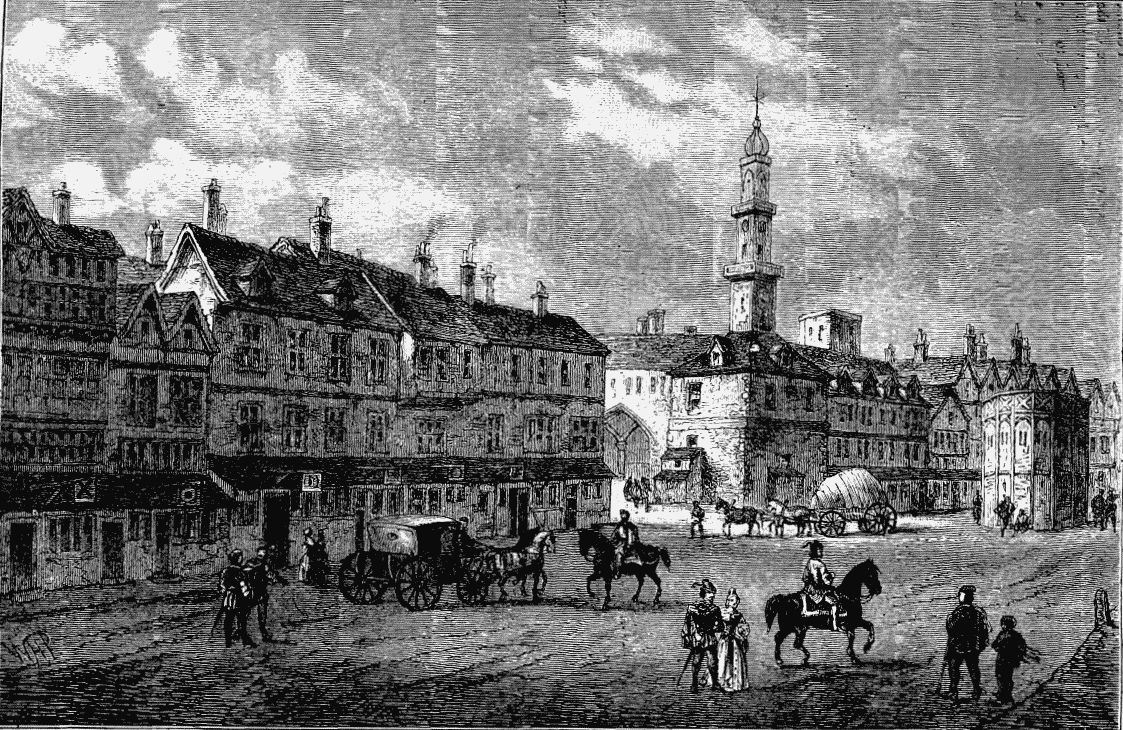
CORNHILL IN 1630. (From a View published by Boydell.)
Defoe, in his "Journey through England," 1722, speaks of Sion College as designed for the use of the clergy in and round London, where expectants could lodge till they were provided with houses in their own parishes. There was also a hospital for ten poor men and ten poor women.