Old and New London: Volume 2. Originally published by Cassell, Petter & Galpin, London, 1878.
This free content was digitised by double rekeying. Public Domain.
Walter Thornbury, 'Moorfields and Finsbury', in Old and New London: Volume 2(London, 1878), British History Online https://www.british-history.ac.uk/old-new-london/vol2/pp196-208 [accessed 30 April 2025].
Walter Thornbury, 'Moorfields and Finsbury', in Old and New London: Volume 2(London, 1878), British History Online, accessed April 30, 2025, https://www.british-history.ac.uk/old-new-london/vol2/pp196-208.
Walter Thornbury. "Moorfields and Finsbury". Old and New London: Volume 2. (London, 1878), British History Online. Web. 30 April 2025. https://www.british-history.ac.uk/old-new-london/vol2/pp196-208.
In this section
CHAPTER XXVI.
MOORFIELDS AND FINSBURY.
The Early Days of Moorfields—Curious Skates—Various Moorfield Scenes—A Fray between Butchers and Bakers—The Carpenters' Company and their Hall—Moorfields at the Time of the Great Fire—The Artillery Ground—The Trained-Bands—The Tabernacle in Moorfields—The Old Bedlam—Miscellaneous Trades in Moorfields—The Hospital of St. Luke—The Present Hospital—Peerless Pool—St. Luke's ChurchFinsbury Fields—An Old-fashioned Medical Quarter of London—Great Change in the Character of the Inhabitants of Finsbury—Bunhill Fields Burial Ground—The Great Plague Pit in Finsbury—Finsbury as an Ecclesiastical Property—Treaties for the Transfer of Bunhill Fields Cemetery to the Dissenters—Negotiations between the City Corporation and the Ecclesiastical Commissioners—Lackington and his History—The London Institution—Finsbury Pavement.
"This Fen or Moor Field,"says Stow, "stretching from the wall of the City betwixt Bishopsgate and the postern called Cripplesgate, to Finsbury, and to Holywell, continued a waste and unprofitable ground a long time, so that the same was all letten for four marks the year in the reign of Edward II.; but in the year 1415, the 3rd of Henry V., Thomas Falconer, Mayor, caused the wall of the City to be broken toward the said moor, and built the postern called Moorgate, for the ease of the citizens to walk that way upon causeys towards Iseldon and Hoxton."
Fitzstephen the monk, who wrote a curious account of London in the reign of Henry II., describes Moorfields as the general place of amusement for London youth. Especially, he says, was the Fen frequented for sliding in winter-time, when it was frozen. He then mentions a primitive substitute for skates. "Others there are," he says, "still more expert in these amusements; they place certain bones—the leg-bones of animals—under the soles of their feet, by tying them round their ankles, and then taking a pole shod with iron into their hands, they push themselves forward by striking it against the ice, and are carried on with a velocity equal to the flight of a bird, or a bolt discharged from a cross-bow." The piece of water on which the citizens of London performed their pastimes is spoken of by Fitzstephen as "the great Fen or Moor which watereth the walls of the City on the north side."
The barren region of Moorfields and Finsbury was first drained (no doubt to the great indignation of the London apprentices) in 1527, laid out in pleasant walks in the reign of James I., and first built on after the Great Fire, when all the City was turned topsy-turvy. Moorfields before this must have been a melancholy region, with raised paths and refuse-heaps, deep black ditches, not inodorous, and detestable open sewers; a walk for thieves and lovers, suicides and philosophers, and as Howes (1631) says, "held impossible to be reformed."
It is described by Peter Cunningham, in a few lines that conceal much research, as a place for cudgel-players and train-band musters, for its madhouse (one of the lions of London), and for its wrestlers, pedestrians, bookstall-keepers, and balladsellers. Ben Jonson makes old Knowell follow his son there, when he has the suspicious appointment in the Old Jewry; and worthy Brainworm has to do his best to screen his young master. In "The Embassy to England in 1626" of Bassompierre, that French ambassador mentions, after dining (the Duke and Earls of Montgomery and Holland having brought him home), taking a fashionable walk in the Moorfields. Sir William Davenant (Charles II.) wittily talks of the laundresses and bleachers of Moorfields, "whose acres of old linen make a show like the fields of Carthagena (the great naval depot of Spain), when the five months' shifts of the whole fleet are washed and spread." In one of Peter Cunningham's series of admirablyselected extracts bearing on London topography, we find chatty Pepys (June, 1661) going to Moorfields to see the northern and western men wrestle. Then comes a fray in Moorfields between the butchers and weavers, described by the same diarist, very characteristic of the old guild jealousies, not even then quite forgotten—"26th July, 1664. Great discourse yesterday of the fray in Moorfields; how the butchers at first did beat the weavers, between whom there hath been ever an old competition for mastery, but at last the weavers rallied, and beat them. At first the butchers knocked down all for weavers that had green or blue aprons, till they were fain to pull them off and put them in their breeches. At last the butchers were fain to pull off their sleeves, that they might not be known, and were soundly beaten out of the field, and some deeply wounded and bruised; till at last the weavers went out triumphing, calling, '£100 for a butcher!'"
In 1671, Shadwell, a close imitator of Ben Jonson and the old school whom Dryden ridiculed, sneers, in his "Humourist," at a French surgeon, originally a barber, whose chief customers were the cudgel-players of Moorfields, and drawers (waiters) whose heads had been broken with quart-pots. In the "Scowrers" (so called after the predecessors of the Mohocks, those London night-roysterers who made even Swift tremble), the same fat poet makes Lady Maggot, a vulgar pretender, talk with contempt of walking with her husband. "Well," says the insolent parvenu, "I shall never teach a citizen manners. I warrant you think you are in Moorfields, seeing haberdashers walking with their whole fireside." Garth alludes to the cheap bookstalls of Moorfields; and long after Gray refers in a letter to Warton to "a penny history that hangs upon the rails in Moorfields;" while Tom Brown (1709, Queen Anne), to illustrate the insolence and forgetfulness of prosperity, describes how a cutler despises a knife-grinder, and "a well-grown Paul's Churchyard bookseller, one of the trade that sells second-hand books under the trees in Moorfields."
Carpenters' Hall, on the southern side of London Wall, is one of the few City Halls which escaped the Great Fire of 1666. It was also, says Timbs, nearly destroyed in a great fire Oct. 6, 1849, when the end walls and windows were burned out, and the staircase and roof much damaged; while the burning building was only separated from Drapers' Hall by the garden and fore-court. The Hall was originally built in 1429. The walls of old London faced it, and beyond were Moorfields, Finsbury, and open ground. The exterior possesses no trace of antiquity. The court-rooms were built in 1664, and the principal staircase and entrance-hall by W. Jupp about 1780; the latter is richly decorated with bas-reliefs of carpentry figures and implements, with heads of Vitruvius, Palladio, Inigo Jones, and Wren, designed by Bacon; and the street archway has also a fine bust of Inigo Jones, by Bacon.
The Great Hall has a rich and beautiful ceiling, put up in 1716, the supporting pillars springing from the corbels of the old arched timber roof. On the western side, surmounted by an embattled oak beam, is a series of four fresco paintings, which were discovered in 1845 by a workman in repairing the hall. The subjects are divided by columns painted in distemper; the ground-work is laths, with a thick layer of brown earth and clay held well together with straw, and a layer of lime, upon which the paintings are executed.
The subjects are:—1. Noah receiving the commands from the Almighty for the construction of the ark; in another portion of the picture are Noah's three sons at work. 2. King Josiah ordering the repair of the Temple (2 Kings xxii.); mentioning carpenters and builders and masons as having no reckoning of money made with them, "because they dealt faithfully." 3. Joseph at work as a carpenter, the Saviour as a boy gathering the chips; Mary spinning with the distaff; the figure of Joseph represents that in Albert Durer's woodcut of the same incident, executed in 1511. 4. Christ teaching in the synagogue; "Is not this the carpenter's son?" Each painting has a black-letter inscription, more or less perfect. The figures are of the school of Holbein; the costumes are temp. Henry VIII. Above the picture, in the spandrel of the arch, are painted the Company's arms, and "Shreeves" and "Robard" of an inscription remain, intimating it to commemorate the benefit of some sheriffs. The southern wall has some decorative Elizabethan work. The eastern window has carved oak mullions and Renaissance bases, and some armorial painted glass, date 1586. There are a few carved wooden panels, besides the series of corbels, some of good workmanship.
About the date of the Carpenters' Company's earliest charter there is considerable uncertainty. Their common seal and grant of arms is dated 1466; and a guild of carpentry is noticed in 1421–2. The earliest entry in the Company's books is dated 1438; they contain many proofs of their power over the trade. Among the pictures are portraits of William Portington, master carpenter to the Crown, temp. Elizabeth and James I.; and John Scott, ordnance carpenter and carriage-maker, temp. Charles II. The Company also possess four very curious caps or crowns (the oldest 1561), still used by the master and wardens. Among their plate are three silver-gilt hanaps (1611, 1612, 1628), which are borne in procession round the hall on election-day. Cakes are presented to the members of the court on Twelfth Day, and ribbon-money to them on Lord Mayor's Day.
Moorfields was crowded after the Great Fire. "The poor inhabitants," writes Evelyn, "were dispersed about St. George's Fields, and Moorfields, as far as Highgate, and several miles in circle; some under tents, some under miserable huts and hovels; many without a rag or any necessary utensils, bed, or board, who from delicateness, riches, and easy accommodations, in stately and well-furnished houses, were now reduced to extremest poverty and misery. In this calamitous condition, I returned with a sad heart to my house, blessing and adoring the distinguishing mercy of God to me and mine, who, in the midst of all this ruin, was like Lot, in my little Zoar, safe and sound."
"Here in Moorfields," says Strype, "is the new Artillery Ground, so called in distinction from another artillery garden near St. Mary Spittal, where formerly the Artillery Company exercised; who, about the latter end of King James I. his reign, were determined to remove thence, and to hold their trainings and practice of arms here; being the third great field from Moorgate, next to the six windmills, which field, Mr. Leat, one of the twenty captains, with great pains, was divers years a-preparing to that purpose. The reason of this, their remove, was, because now their meetings and number consisted of many more soldiers than the old ground could well contain, being sometimes 6,000. Though sometimes, notwithstanding, they went to the old artillery, and continued so to do in my memory."

HALL OF THE CARPENTERS' COMPANY.
It was this company, then known by the name of the Trained-bands, which decided the fate of the great civil war. On every occasion they behaved with the spirit and perseverance of the most veteran troops. They were commanded by Skippon, captain of the Artillery Garden, who had served long in Holland, and raised himself from a common soldier to the rank of captain, and proved himself an excellent officer. From the service he had been in he came over full of prejudice against the Church and State, so was greatly in the confidence of his party. He was totally illiterate, but his speeches to his soldiers had more weight in their ears than the finest oratory. On marching to join the Earl of Essex, this was his speech: "Come, my boys, my brave boys, let us pray heartily and fight heartily; I will run the same fortune and hazards with you. Remember the cause is for God; and for yourselves, your wives, and children. Come, my honest brave boys, pray heartily and fight heartily, and God will bless you."
The Tabernacle, in Moorfields, was built in 1752; previously to which, in 1741, shortly after Whitefield's separation from Wesley, some Calvinistic Dissenters, says Mr. Timbs, raised for Whitefield a large shed near the Foundry, in Moorfields, upon a piece of ground lent for the purpose, until he should return from America. From the temporary nature of the structure it was called the Tabernacle, in allusion to the Tabernacle of the Israelites in the Wilderness; and the name became the designation of the chapels of the Calvinistic Methodists generally. Whitefield's first pulpit here is said to have been a grocer's sugar hogshead, an eccentricity not improbable. Silas Todd describes the Moorfields Tabernacle, about 1740, as "a ruinous place, with an old pantile covering, a few rough deal boards put together to constitute a temporary pulpit, and several other decayed timbers, which composed the whole structure." John Wesley also preached here (the Foundry, as it was called), at five in the morning and seven in the evening. The men and women sat apart; and there were no pews, or difference of benches, or appointed place for any person. At this chapel the first Methodist Society was formed in 1740. "In 1752, the wooden building was taken down, the site was leased by the City of London, and the present chapel was built, with a lantern roof. It is now occupied by Independents, and will hold about 4,000 persons. This chapel was the cradle of Methodism; the preaching-places had hitherto been Moorfields, Mary-le-bone Fields, and Kennington Common." The building here alluded to was pulled down in 1868, and a smaller chapel erected on the site.

OLD BETHLEM HOSPITAL, MOORFIELDS ABOUT 1750.
The old Bedlam, one of the chief lions of Moorfields, was a low, dismal-looking pile; enclosed by heavy gates, and surrounded by squalid houses.
"When I remember Moorfields first," says "Aleph" (i.e., Mr. William Harvey), "it was a large open quadrangular space, shut in by the Pavement to the west, the hospital and its outbuildings to the south, and lines of shops without fronts, occupied chiefly by dealers in old furniture, to the east and north. Most of these shops were covered in by screens of canvas or rough boards, so as to form an apology for a piazza; and, if you were bold enough, in wet weather you might take refuge under them, but it was at the imminent risk of your purse or your handkerchief. As Field Lane was the favourite market for wearing apparel, at a low charge, so these stores afforded an endless choice of decayed upholstery to poorer purchasers: a broken-down four-poster or a rickety tent bedstead might be secured at almost any price, 'No reasonable offer was refused.' It was interesting to inspect the articles exposed for sale: here a cracked mirror in a dingy frame, a set of hair-seated chairs, the horse-hair protruding; a tall, stiff, upright easy chair, without a bottom; a cupboard with one shelf left of three, and with half a door; here a black oak chest, groaning to be scraped, so thick with ancient dust that it might have been the den of some unclean animal in Noah's ark; a washhandstand, with a broken basin; a hall clock-case, with a pendulum, but no dial; and other hopelessly invalided household necessaries, too numerous to mention. These miscellaneous treasures were guarded by swarthy men and women of Israel, who paraded in front of their narrow dominions all the working day; and if you did but pause for an instant, you must expect to be dragged into some hideous Babel of frowsy chattels, and made a purchaser in spite of yourself. Escaping from this uncomfortable mart to the hospital footway, a strange sense of utter desertion came over you; long, gloomy lines of cells, strongly barred, and obscured with the accumulated dust, silent as the grave, unless fancy brought sounds of woe to your ears, rose before you; and there, on each side of the principal entrance, were the wonderful effigies of raving and moping madness, chiselled by the elder Cibber. How those stone faces and eyes glared! How sternly the razor must have swept over those bare heads! How listless and dead were those limbs, bound with inexorable fetters, while the iron of despair had pierced the hearts of the prisoned maniacs! Those terrible presentments of physical anguish were till lately preserved in the entrance of the new hospital, but a rumour went the round of the press that they were about to be removed." This presentiment proved correct, and these two remarkable statues may now (says Mr. Harvey in 1863) be seen in the South Kensington Museum, where they are infinitely less appropriate than in their old home.
"Opposite to Bethlem Hospital, on the north side of Moorfields, stood the hospital of St. Luke, a long plain building, till of late," says Pennant, "appropriated to the same purposes, but totally independent of the former." It was founded on the humane consideration that Bethlem was incapable of receiving all the miserable objects which were offered. A few years before Pennant's writing, in 1790, the patients were removed from the old hospital to a new one, erected under the same name, in Old Street, on the plan of the former, extending in front 493 feet.
In 1753 (says Timbs) pupils were admitted to the hospital; and Dr. Battie, the original physician, allowed medical men to observe his practice. This practice fell into disuse, but was revived in 1843, and an annual course of chemical lectures established, at which pupils selected by the physicians of the different metropolitan hospitals are allowed to attend gratuitously. In 1754 incurable patients were admitted, on payment, to the hospital on Windmill Hill.
"There are few buildings in the metropolis, perhaps in Europe," says Elmes, "that, considering the poverty of the material, common English clamp-bricks, possess such harmony of proportion, with unity and appropriateness of style, as this building. It is as characteristic of its uses as that of Newgate, by the same architect."
This building was commenced in 1782, when green fields could be seen in every direction, and the foundation-stone was laid by the Duke of Montague, July 30; the cost, about £50,000, being defrayed by subscriptions. George Dance, junior, was the architect.
Since the first admission of patients on July 30th, 1751, to the same day 1791, 4,421 were admitted, of which 1,936 were discharged cured, and 1,465 uncured. By a very liberal regulation, uncured patients could be taken in again, on the payment of five shillings a week. This was afterwards increased to seven shillings; so that their friends might, if they pleased, try a second time the force of medicine on their unhappy relations or connections. The number of patients received into the hospital from its opening to April 25, 1809, amounted to 9,042, of whom 3,884 were discharged uncured or as idiots, and 35,911 as cured. Seven hundred died during that period. The old hospital was at last pulled down and replaced by a row of houses.
The hospital was incorporated in 1838, the end infirmaries added in 1841; a chapel in 1842, and open fire-places set in the galleries; when also coercion was abolished, padded rooms were provided for violent patients, and an airing ground set apart for them; wooden doors were substituted for iron gates, and unnecessary guards and bars removed from the windows. In 1843 were added reading-rooms and a library for the patients, with bagatelle and backgammon boards, &c. By Act 9 & 10 Vict, cap. 100, the Commissioners of Lunacy were added to the hospital direction. In 1848, Sir Charles Knightley presented an organ to the chapel, and daily service was first performed. The hospital was next lighted with gas; the drainage, ventilation, and the supply of water improved, by subscription at the Centenary Festival, June 25, 1851.
"On St. Luke's Day (October 18), a large number of the patients are annually entertained with dancing and singing in the great hall in the centre of the hospital, when the officers, nurses, and attendants join the festival. Balls are also given fortnightly."
Since the year 1684, when Bethlem Hospital admitted into its wards seventy-three lunatic patients, and since the establishment of St. Luke's in 1751, about 40,000 insane persons have been treated in these two institutions. Within comparatively few years insanity in England has more than tripled. During the last forty-five years or so, several large asylums have been built in the metropolitan counties: for example, Hanwell, 1831; Earlswood Asylum for Idiots, founded in 1847; and Colney Hatch, 1851. The Lunatic Asylum for the City of London is situated near Dartford. It was erected at the expense of the Corporation of London, and opened in the year 1866, for the reception and treatment of lunatic patients chargeable upon the City of London, and upon the several unions in the City. It contains accommodation for 284 patients.
"Immediately behind this hospital," Pennant remarks, "was Peerless Pool, in name altered from that of Perilous Pond, so called, says old Stow, from the numbers of youths who had been drowned in it in swimming." In our time, says Pennant writing in 1790, it has, at great expense, been converted into the finest and most spacious bathing-place now known; where persons may enjoy the manly and useful exercise with safety. Here is also an excellent covered bath, with a large pond stocked with fish, a small library, a bowling green, and every innocent and rational amusement; so that it is not without reason that the proprietor hath bestowed on it the present name."
The parish of St. Luke was taken out of that of St. Giles, Cripplegate, by an Act of George II.'s reign. The same writer directs the reader's attention to the steeple of the church (built in 1732) which terminates most singularly in a fluted obelisk.
From Moorfields we have not far to go to Finsbury. It was in Finsbury Fields, on his return after his exploits in Scotland, that the great Protector, the Duke of Somerset, was met and congratulated by the Lord Mayor, aldermen, and citizens of London. According to the chronicler, Holinshed, "The mayor and aldermen, with certain of the commons, in their liveries and their hoods, hearing of his approach to the City, the 8th of October (1548), met him in Finsbury Fields, where he took each of them by the hand, and thanked them for their good wills. The Lord Mayor did ride with him till they came to the pond in Smithfield, where his grace left them, and rode to his house of Shene that night, and the next day to the king at Hampton Court."
As the old fashionable medical quarter of London, Finsbury has a peculiar interest. The special localities of doctors used to be Finsbury Square, Finsbury Pavement, Finsbury Place, Finsbury Circus, Broad Street, and St. Helen's Place, which, fifty years since, swarmed with doctors and surgeons, who made larger earnings out of the chiefs and prosperous business folk of the City than the West-end faculty made out of the Court and aristocracy. At the same time young surgeons and doctors occupied small houses in the adjacent courts, just as the young barristers and pleaders housed themselves in modest streets and yards near the Inns of Court. William Eccles, formerly surgeon of the Devonshire Square Hospital, and Royal Free Hospital, a noteable surgeon thirty or forty years since, had his first house in Union Court, Broad Street. His successor (Edward Chance) lived afterwards in the same house; but was about the only surgeon residing in a street which once housed not less than a score of surgeons and physicians. Broad Street and Union Court are now made up of chambers tenanted by stock-brokers and other City agents. The last pre-eminently great physician to practise in the City was Henry Jeaffreson, M.D. (Senior Physician of St. Bartholomew's), who died some years since in Finsbury Square, where he had long made a larger income than any other doctor of his day. Several eminent doctors still live in Finsbury Square and Finsbury Pavement. St. Helen's Place (Bishopsgate) also still houses a few well-to-do doctors. Charterhouse Square was another great place for East-end doctors.
But the migrations of the eminent doctors is not so much due to mere fashion, as to the centralisation and development of commerce, which have raised the rentals of the residential parts of the quarter so prodigiously, that only very wealthy folk could afford to house themselves there. Such a house as Mr. Eccles had in Broad Street at some £210 a year rent and taxes, is now-a-days let as offices and business chambers for £1,000 a year. Hence, the commercial families have moved westward from economy, as well as from disinclination to live in a socially deserted district. The doctors now swarm in Cavendish Square, Harley Street, Wimpole Street, Henrietta Street, Queen Anne Street, Brook Street, Savile Row, and Spring Gardens; and in these days of circular railways and fast cabs, they are as accessible to their unfashionable visitors in such quarters as the old Finsbury doctors were to their outlying patients.
When the doctors and surgeons thus swarmed in the Finsbury district, the City and its adjacent districts were largely inhabited by wealthy families, that have now also migrated westward, as their doctors naturally have.
That Campo Santo of the Dissenters, the Bunhill Fields burial-ground (no longer used for interments), is on the west side of the Artillery Ground, and close to Finsbury Square.
It is generally supposed that the Bunhill Fields Cemetery was the site of the Great Plague pit, so powerfully described (from hearsay) by Defoe. Peter Cunningham, usually so exact, has said so, and every writer since has followed in his wake. That the conjecture is entirely erroneous is admirably shown in the following accurate account by Mr. J. C. Jeaffreson, who has devoted much time to the study of the question:—The burial-ground in Bunhill Fields, said our authority in 1866,' preserves the ashes of Cromwell's favourite minister, Dr. Goodwin, John Owen, the Puritan Vice-Chancellor of Oxford, General Fleetwood, John Bunyan, Daniel Defoe, John Home Tooke, Isaac Watts, Blake, Stothard, Susannah Wesley (the mother of John Wesley), and many other eminent persons. The "great pit in Finsbury," mentioned by Defoe in his "Journal of the Plague in 1665," occupied ground that abuts on the upper end of Goswell Street; whereas Bunhill Fields Cemetery lies within a step of the Artillery Ground, and a stone's throw of Finsbury Square. The precise locality of Defoe's "Pit" can be pointed out by any person familiar with the novelist's "Journal" and the map of London. In the passage of Defoe which describes how John Hayward, the driver of a dead-cart, was on the point of consigning to the gloomy pit a wretched street-musician, who, whilst in a sound sleep, or perhaps stupefied with drink, had been thrown upon a load of corpses, the writer of the "Journal," says, "Accordingly when John Hayward, with his bell and the cart, came along, finding two dead bodies lie upon the stall, they took them up with the instrument they used and threw them into the cart, and all this while the piper slept soundly. From thence they passed along and took in other dead bodies, till, as honest John Hayward told me, they almost buried him alive in the cart. Yet all this while he slept soundly. At length the cart came to the place where the bodies were to be thrown into the ground; which, as I do remember, was at Mountmill; and as the cart usually stopped some time before they were ready to shoot out the melancholy load they had in it—as soon as the cart stopped the fellow awaked, and struggled a little to get his head out from among the dead bodies; when, raising himself up in the cart, he called out, 'Hey! where am I?" Of the locality called Mountmill, the topographer and historian, William Maitland, writing in 1739, observes, in his "London," "At Mountmill, near the upper end of Goswell Street, was situate one of the forts which were erected by order of Parliament, for the security of the City of London in the year 1643. But the same being rendered useless at the end of the Civil War, a windmill was erected thereon; from which it received its present name." The popular impression that Defoe's "great pit in Finsbury" was on the site of the present Bunhill Fields Cemetery is no master for surprise, when it is known that the ground of the Dissenters' graveyard was actually set apart and consecrated, in 1665, for the reception of victims of the plague. That the place was not used for the especial purpose for which it was consecrated, we have Maitland's authority.
"Of the ground thus set apart by the Corporation of London for a graveyard the City merely owned a lease. Lying in the centre of a large tract, which the City had held for 350 years under a succession of leases, granted by successive prebendaries of Finsbury, the civic authorities had a limited right over the spot. The fee-simple of the ground was part of the estate attached to the prebend of Finsbury, one of the prebends of St. Paul's Cathedral; and though prebendaries of Finsbury have repeatedly renewed old leases and granted new leases of the land, the freehold of the estate has never passed out of the hands of the Church. The last lease of the Finsbury estate, made by the Church to the City, was executed in 1769, and is a good instance of the nice little arrangements that were formerly made with Church property. Under the authority of a private Act of Parliament, the then Prebendary Wilson gave a lease of the Finsbury estate to the civic Corporation for ninety-nine years, the said lease being renewable at the expiration of seventy-three years, for fourteen years; whereby the term still to expire would become forty years, and afterwards renewable every fourteen years, in like manner for ever. Hence, under this grant, the City, by duly renewing the lease, could hold for ever ground which is now covered by some of the most valuable residential property in London: (fn. 1) By this same private Act," the writer goes on to say, "the City was empowered to keep three-sixths of the net rents, profits, and annual proceeds arising from the estate during the lease. Two-sixths of the same revenue were reserved to Prebendary Wilson and his assigns, and the remaining one-sixth of the income was retained for the prebendary and his successors. This pleasant little arrangement was sanctioned by legislation in the good old times! As holders of the largest single share of the income, the civic authorities took the entire management of the estate, which has, certainly, prospered in their hands. But though the rent-roll has increased prodigiously under civic management, the rulers of the City—so far as one portion of the estate, i.e., Bunhill Fields Cemetery, is concerned—cannot be said to have acted discreetly, and in one matter affecting the entire property they have been guilty of astounding remissness. Having only a leasehold tenure of the graveyard, they systematically sold the graves in perpetuity, accepting for them money which the buyers of graves would never have thought of paying for ground that might be built upon, or turned into a cattle-market, at the end of a ninety-nine years' lease. Having originally the right to renew the lease on the expiry of seventythree years, the tenants omitted to renew; and, in consequence, through this omission, their interest in the estate would terminate in 1867.
"It should be observed, that in 1801 the Corporation bought the interest in the estate secured to the Wilson family; consequently, since the date of that purchase, the City has received five-sixths of the annual net income derived from the property. In 1842—in which year, by the terms of the agreement, the Corporation could have renewed the lease—the leaseholders negotiated for the purchase of the freehold of the estate, and the Bishop of London introduced a bill into the Upper House for legalising the sale. Having passed the Lords, this Bill encountered defeat in the Commons, where it was rejected as a money bill that ought to have originated in the Lower Chamber. Occupied with this Parliamentary contest, the civic authorities allowed the time to pass without exercising their right to renew the lease; and, in consequence of this remissness, their interests, in 1867, devolved on the Ecclesiastical Commissioners, in whom the estate of the prebendary of Finsbury vested in 1856. On the termination of the civic interest the Commissioners derived from the property about sixty thousand pounds per annum.
"Not only has the City lost its hold over this magnificent Cental, but it finds itself in an awkward discussion with the buyers of graves in Bunhill Fields Cemetery on the one hand, and the Ecclesiastical Commissioners on the other. Apprehensive that the graveyard may be desecrated on the termination of the lease, the Dissenters have, on two occasions, asked the Commissioners to preserve the ground from profanation. On each occasion the Commissioners have expressed a readiness to settle terms. For; £10,000 they will make over to trustees the burial-ground—the freehold of which is computed as worth; £100,000—on condition that, should it be converted to secular uses, their present rights revive. Moreover, the Commissioners have expressed their readiness to preserve the sacred character of the ground, provided the civic authorities pay into the purse of the Commission the sums which they have received for the feesimple of graves which they had no power to sell. Anyhow, for £10,000 the custody of the cemetery may be purchased; and, if no better terms can be made with the Commissioners, it seems clear that the City is morally bound to supply this sum, for the fulfilment of its engagements to the purchasers of graves.
"There are good reasons to believe that the Commissioners will not stand out for the last farthing of the sum just mentioned. In previous arrangements concerning burial-grounds—the graveyard, for instance, which contains John Wesley's bones— they acted in a conciliatory and fair manner; and in the present case special considerations counsel them to take a moderate course. In the first place, the ground was actually consecrated; and an Ecclesiastical Commission could not, without indecency, authorise the disturbance of a consecrated burial-ground. Moreover, the Ecclesiastical Commissioners are morally bound by the action of the City. Throughout the stewardship of the municipal authorities the Church has received a portion of the proceeds of the Finsbury estate. The prebendaries, who have received the one-sixth of the revenue reserved to the prebend, by taking a sixth of the money derived from the sale of graves, may be said to have given ecclesiastical sanction to the defective arrangement; and however irregular the arrangement and the sanction may be, it would not be wise in the Ecclesiastical Commissioners to disregard them. The relations of the City and the Commission in this matter involve some delicate questions. However, as a body that has greatly benefited by the entire transaction, and as a society bound to fulfil its contracts with private persons, the Corporation should effect a settlement of the dispute, even at the sacrifice of £10,000.
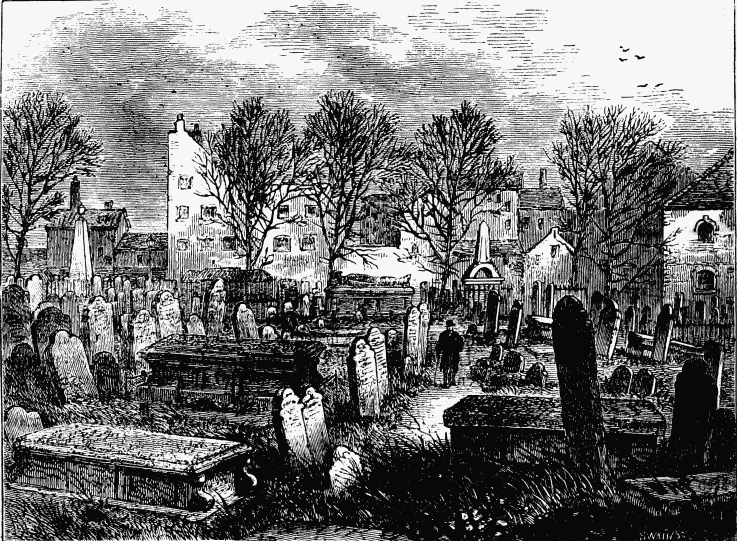
BUNHILL FIELDS BURIAL-GROUND.
"An account of the negotiations for securing Bunhill Fields to the Corporation of London as a place for recreation, and to prevent desecration of the graves of many eminent Englishmen, was eventually presented to the Common Council. The report stated that the Ecclesiastical Commissioners appear to have proposed to accept, for the preservation of the ground, five-sixths of the purchase money paid for vaults, &c., to the Corporation during its current lease. The total receipts were £24,000, i.e., averaging £247 a year. Half this sum had been applied in connection with the prebend of Finsbury; the other was received by the Corporation. Failing agreement about the price to be paid by one of these parties to the other, the negotiations stood over. The latest proposal of the Commissioners was to arbitrate. The committee declined this, and denied the existence of a legal claim on the Corporation on the part of the Commissioners. The report concluded by stating that no useful result would be obtained by further correspondence, and recommended that the Corporation should repeat the offer to preserve the ground for public use and from desecration, plant, and watch it, in failure of performing which the land might revert to the Commissioners; also that they should be authorised to second the efforts of parties who might apply to Parliament or the public for aid to save the graves from speculating builders, and the site for public service. The report was adopted, and referred back to be carried into effect. It was alleged that the Commissioners valued the ground at about £100,000, and asked what the Corporation would give for its preservation. If this be true," said a writer to the Times, "the Commissioners, considering that they represented a party which has already received cash for preserving the graves, were hard driven. The Ecclesiastical Commissioners are probably not so black as they are painted. Would it not serve all ends if the Government introduced a Bill to the House of Commons to permit, or, better still, to enjoin the Commissioners to relax their hold on the ground, be content with the half share of profits already received, and that the onus of maintaining the ground should be placed upon the recipients of the other moiety, who are anxious to receive it? It has been stated officially that the Commissioners already receive £50,000 a year on account of the Finsbury prebend. It appears that in 1655, when the estates of that office were sold, the City bought the fee-simple, and for ten years following paid no rent. At the Restoration the property was taken back, rent demanded and paid, to recover which the Corporation farmed part of the land for interments, which began as early as 1665, or the Great Plague. At one time the City received as much as £700 per annum from this source. In 1852 the ground was closed, and the registers removed to Somerset House. This year (1867) the whole estate reverts to the Ecclesiastical Commissioners, who may feel it their duty so far to violate their natural feelings as to let it for building leases. As literary men, if not equally as cosmopolitans, the late and present Chancellors of the Exchequer ought to unite in exonerating the Ecclesiastical Commissioners from this probably painful sense. It would be disgraceful to the Government if the desecration took place."
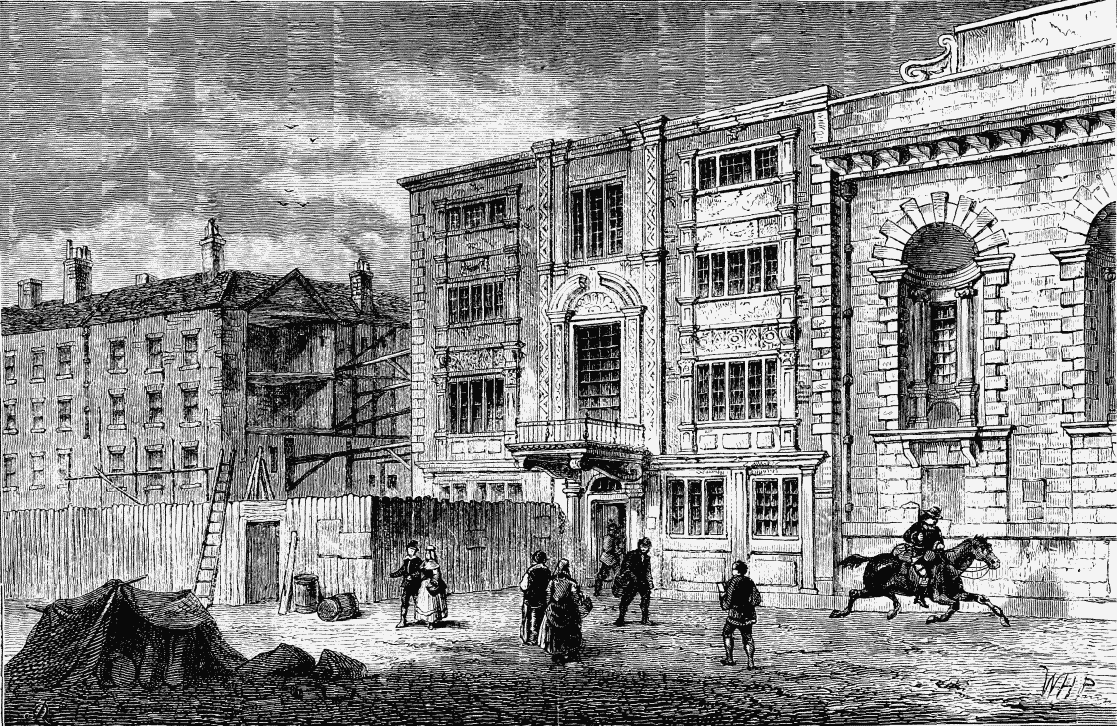
THE OLD POST OFFICE, IN LOMBARD STREET, ABOUT 1800.
This negotiation was eventually completed, and the old cemetery is now a place where meditative men may wander and quietly contemplate the old text, "Dust to dust." The Act for the preservation of the ground as an open space was passed 15th July, 1867, and it was reopened by the Lord Mayor on the 14th of October, 1869. It may be added that a monument to Defoe, the immortal author of "Robinson Crusoe," subscribed by boys and girls, was inaugurated on the 15th of September of the following year.
Lackington, one of the most celebrated of our early cheap booksellers, lived in Chiswell Street, Finsbury, and afterwards at the "Temple of the Muses," Finsbury Place. The shop, into which a coach and six could be driven, was destroyed by fire in 1841. In 1792 Lackington cleared £5,000 by his business, and retired with a fortune in 1798. The following selections from his autobiography show a curious mixture of piety, vanity, and love of business.
"I was born," he says, "at Wellington, in Somersetshire, 31st August (old style), 1746. My father, George Lackington, was a journeyman shoemaker. He displeased his own father by marrying a woman without a shilling, of a mean family, in my grandmother Trott's poor cottage; and that good woman took me to church, unknown to my father, who was (nominally) a Quaker, that being the religion of his ancestors. My father ultimately became a drunkard, but to our mother we are indebted for everything. Never did I hear of a woman who worked and lived so hard as she did to support eleven children. For many years she worked nineteen and twenty hours out of every twenty-four. Whenever she was asked to drink half a pint of ale, she always asked leave to take it home to her husband, who was always so mean and selfish as to drink it. Out of love to us she abstained from all drink save water. Her food was chiefly broth (little more than water and oatmeal), turnips, potatoes, cabbages, carrots. Her children fared somewhat better, but not much. I was put for two or three years to a dame school, kept by an old woman, where I was thought, from being able to repeat several chapters of the New Testament, to be a prodigy of science; but my mother soon became so poor that she could not afford twopence a week for my schooling. Indeed, I was forced to nurse my brothers and sisters, and soon forgot what little I knew. Then I became the captain of all the mischievous boys in the place; so that if an old woman's lanthorn were kicked out of her hand, or drawn up a sign-post, or if anything were fastened to her tail, or if her door were nailed up, I was sure to be accused of the crime whether I were guilty or not. For spiriting the town lads to mock our butcher, who was given to yawning, I had nearly been killed like one of his calves, for he flung his cleaver at me. At ten years old I cried apple pies in the street. I had noticed a famous pieman, and thought I could do it better myself. My mode of crying pies soon made me a street favourite, and the old pie merchant left off trade. You see, friend, I soon began to make a noise in the world. But one day I threw my master's child out of a wheelbarrow, so I went home again, and was set by my father to learn his trade, continuing with him for several years. My fame as a pieman led to my selling almanacks on the market days at Christmas. This was to my mind, and I sorely vexed the vendors of 'Moore,' 'Wing,' and 'Poor Robin.' My next move was to be bound apprentice for seven years to Mr. George and Mrs. Mary Bowdon—yes, to both wife and husband, and an honest, worthy couple they were. They were Anabaptists, and I attended their place of worship; though, for a long while, I had no idea that I had any concern in what the minister preached about. Master had two sons who had been at school, but all they read was the Bible. Master's whole library consisted of a school-size Bible, Watt's Hymns, Foote on Baptism, Culpepper's 'Herbal,' 'The History of the Gentle Craft,' 'Receipts in Physic,' and a 'Ready Reckoner.'
* * * *
"I was soon able to read easy parts of the Bible and Wesley's Hymns; every leisure minute was so employed. I worked from six to ten, yet managed to read six chapters every day, as well as some sermons. My eyes were good, and I could often read by moonlight. I was far gone in enthusiasm, and on a Sunday, being locked in my room to prevent my going to meeting, I opened the Bible and read, 'He has given His angels charge concerning thee, and in their hands shall they bear thee up, lest at any time thou shouldest dash thy foot against a stone.' Wherefore I threw myself out of window. I was carried back to bed, where it was a month before I recovered the use of my limbs. I was ignorant enough to think that the Lord had not used me very well, and resolved not to put so much trust in Him for the future.
* * * *
"For many years I have expended two-thirds of my profits, but never more. Once I beckoned across the way for a pot of porter; then a dinner, roast veal; then with an addition of ham; and then a wind-up of pudding. Once a glass of brandy-andwater was a luxury; raisin wine followed; then good red port; nor was sherry long behind. It was not long before the country was a necessity once a year; lodgings first, then my own mansion; and at length the inconveniences of a stage coach were remedied by a chariot.
* * * *
"My new wife's attachment to books was for tunate. She delighted to be in the shop, and could readily get any article that was asked for. Such constant attention procured me many customers. I wanted a larger stock, but had no capital. Mr. John Dennis, an oilman, of Cannon Street, offered to be my partner, and to advance money in proportion to the stock. We soon laid out the cash in second-hand books, which at once doubled them. In 1779 we published a catalogue of 12,000 volumes. We took £20 the first week."
This partnership was dissolved in 1780. In that year Lackington determined to give no credit, and though he admits he had some difficulties in carrying out the plan, he says it fully answered. His business steadily increased; and the catalogue for 1784 contained 30,000 volumes. He declares he sold at a very small profit, and, ultimately, was able to give a higher price when purchasing than other booksellers. At the trade sales there were often 80,000 volumes sold in an afternoon. It was common to destroy one-half or three-fourths of them in order to keep up the prices. This Lackington did for some time, but soon resolved not to destroy any good books, but to sell them off at a half or a quarter of the publication prices.
"My purchases," says he, "were now very large. I have purchased 6,000 copies of one book, and at one time have had 10,000 copies of Watts's Hymns and as many of his Psalms in my possession. At one trade sale I have purchased books to the amount of £5,000. To remind me of what has led to my prosperity, I have put for a motto on the doors of my carriage, 'Small profits do great things.' I remain in business because I have fifty poor relations, some very young, some old and infirm. I can manage better for them than they can for themselves. I maintain my good old mother, who is still alive at Wellington. I support two aged men and one woman. I also maintain and educate four children. I now sell fully 100,000 volumes annually. I publish two catalogues yearly, and of each 3,000 copies."
His final residence was Budleigh Salterton, Devon, where he built a third chapel, which cost £2,000, appointing one Hawkey, a retired army minister, his chaplain, with a stipend of £150 per annum. Lackington's health declining—he suffered from epileptic fits, and ultimately from apoplexy and paralysis—he died November 22, 1815, aged seventy, and his remains were interred in Budleigh Churchyard.
The London Institution, Finsbury Circus, was established in 1805, and incorporated 1807. The cost of the building was £31,124, and its annual income is about £3,000 per annum, derived from funded property, and six annual payments. The number of volumes is about 70,000, which are available for the holders of a proprietor's share or a nominee of a proprietor, having his medal or ticket. In the winter time, when the lectures are delivered by leading men of science, the theatre is as full as can well be imagined, and is by no means a quiet resting-place; but the reading-room is a treat, and it is pleasant to get away from the City bustle, and take shelter there. Another recommendation of the place is that under the library there is a wellsupplied newspaper room. (Timbs.)
"The Pavement—so called, no doubt," says Aleph, " as the only firm pathway in the neighbourhood—was formerly edged with some fifty or sixty brick houses, with very unpretentious shops attached—bakers, butchers, ale and spirit stores, and the like, with a chapel in the centre; the whole giving no promise of the gay and tempting shop-windows, blazing with gas, so soon to be substituted. Yet most of the buildings are unaltered, even now; only the facia has been 'improved and beautified.'
"How, you will ask, was the centre of old Moorfields employed, in its chrysalis state?: Variously, In the days of Wesley and Whitefield it was the favourite haunt of open-air preachers. Both those remarkable men chose the spot for their London lectures; and they often gathered audiences of a fabulous number—the prints of the period say, of 20,000, 30,000, and even 50,000. They had begun to preach in the churches, but it was alleged the vast crowds made that practice dangerous, and they extemporised pulpits under the blue vault of heaven. The Tabernacle, not far distant, was the result of this movement.
"In 1812, and long after, carpet-beating was the chief use of the dry or sloppy area (according to the season). Poles with ropes stretched across were placed at intervals, and sturdy arms brandishing stout sticks were incessantly assaulting Turkey, Kidderminster, and Brussels floor-covers, and beating out such clouds of dust that as you passed it was expedient to hold your cambric or bandanna over your mouth and nostrils. Then you had, in fairtime, those humble incentives to gambling which for a penny offer the chance of winning a tin box or a wooden apple. Five uprights are stuck in deep holes; you stand a few yards off, supplied with short sticks, and if you can knock away box or apple without its lapsing into the hole, it becomes your property, and the gain may be about twopence. Those days are gone; the open space is filled in with a strange conglomeration of buildings, public and private—the London Institution, a Catholic cathedral, a Scotch church, a seceding ditto, the Ophthalmic Hospital, Finsbury Circus and dwellings of all sizes, accommodating a mixed population, varying in position from extreme poverty to wealth."