Old and New London: Volume 2. Originally published by Cassell, Petter & Galpin, London, 1878.
This free content was digitised by double rekeying. Public Domain.
Walter Thornbury, 'Highbury, Upper Holloway and King's Cross', in Old and New London: Volume 2(London, 1878), British History Online https://www.british-history.ac.uk/old-new-london/vol2/pp273-279 [accessed 30 April 2025].
Walter Thornbury, 'Highbury, Upper Holloway and King's Cross', in Old and New London: Volume 2(London, 1878), British History Online, accessed April 30, 2025, https://www.british-history.ac.uk/old-new-london/vol2/pp273-279.
Walter Thornbury. "Highbury, Upper Holloway and King's Cross". Old and New London: Volume 2. (London, 1878), British History Online. Web. 30 April 2025. https://www.british-history.ac.uk/old-new-london/vol2/pp273-279.
In this section
CHAPTER XXXIV.
HIGHBURY—UPPER HOLLOWAY—KING'S CROSS.
Jack Straw's Castle—A Famous Hunt—A Celebrity of Highbury Place—Highbury Barn and the Highbury Society—Cream Hall—Highbury Independent College—"The Mother Redcap"—The Blount Family—Hornsey Road and "The Devil's House" therein—Turpin, the Highwayman—The Corporation of Stroud Green—Copenhagen Fields—The Corresponding Society—Horne Tooke—Maiden Lane—Battle Bridge—The "King's Cross" Dustheaps and Cinder-sifters—Small-pox Hospital—The Great Northern Railway Station.
In 1271 the prior of the convent of Knights Hospitallers of St. John of Jerusalem, at Clerkenwell, purchased an old manor house here, as a summer residence, and it was afterwards rebuilt higher to the eastward, changing its name from Tolentone to Highbury In the reign of Richard II., when Wat Tyler and his bold Kentish men poured down on London, a detachment under Jack Straw, Wat's lieutenant, who had previously plundered and burnt the Clerkenwell convent, pulled down the house at Highbury. The ruins afterwards became known as "Jack Straw's Castle." It is thought by antiquaries that the prior's moated house had been the prætorium of the summer camp of the Roman garrison of London.
Many of the old conduit heads belonging to the City were at Highbury and its vicinity, one of these supplied the parish of St. Giles's, Cripplegate; and Mr. Lewis mentions another remaining in 1842, in a field opposite No. 14, Highbury Place. It might have been from Highbury that the hunt took place, noted by Strype as occurring in 1562, when the Lord Mayor, aldermen, and many worshipful persons rode to the Conduit Heads, then hunted and killed a hare, and, after dining at the Conduit Head, hunted a fox and killed it, at the end of St. Giles's, Cripplegate, with a great hallooing and blowing of horns at his death; and thence the Lord Mayor, with all his company, rode through London to his place in Lombard Street.
One of the former celebrities of Highbury Place was that well-known chief cashier of the Bank of England, honest old Abraham Newland. For twenty-five years this faithful servant had never slept out of the Bank of England, and his Highbury house was only a pleasant spot where he could rest for a few hours. He resigned his situation in 1807, on which occasion he declined an annuity offered by the Company, but accepted a service of plate, valued at a thousand guineas. He left £200,000, besides £1,000 a year, arising from estates. He made his money chiefly by shares of loans to Government, in which he could safely speculate. He was the son of a Southwark baker.
Another distinguished inhabitant of Highbury was John Nichols, for nearly half a century editor of the Gentleman's Magazine, and partner of William Bowyer, the celebrated printer. His "Anecdotes of Hogarth," and his "History of Leicestershire," were his chief works. He was a friend of Dr. Johnson, and seems to have been an amiable, industrious man, much beloved by his friends. He died suddenly, while going up-stairs to bed, in 1826.
Highbury Barn (built on the site of the barn of the prior's old mansion) was originally a small ale and cake house. It was the old rendezvous of the Highbury Society as far back as the year 1740. This society was established to commemorate the dropping of a Schism Act, cruelly severe on Protestant Dissenters, and which was to have received the Royal sanction the day Queen Anne died.
"The party," says a chronicler of the society, "who walked together from London had a rendezvous in Moorfields at one o'clock, and at Dettingen Bridge (where the house known by the name of the 'Shepherd and Shepherdess' now stands), they chalked the initials of their names on a post, for the information of such as might follow. They then proceeded to Highbury; and, to beguile their way, it was their custom in turn to bowl a ball of ivory at objects in their path. This ball has lately been presented to the society by Mr. William Field. After a slight refreshment, they proceeded to the field for exercise; but in those days of greater economy and simplicity, neither wine, punch, nor tea was introduced, and eightpence was generally the whole individual expense incurred. A particular game, denominated hop-ball, has from time immemorial formed the recreation of the members of this society at their meetings. On a board, which is dated 1734, which they use for the purpose of marking the game, the following motto is engraven:—'Play justly; play moderately; play cheerfully; so shall ye play to a rational purpose.' It is a game not in use elsewhere in the neighbourhood of London, but one something resembling it is practised in the West of England. The ball used in this game, consisting of a ball of worsted stitched over with silk or pack-thread, has from time immemorial been gratuitously furnished by one or another of the members of the society. The following toast has been always given at their annual dinner in August, viz.:— 'The glorious 1st of August, with the immortal memory of King William and his good Queen Mary, not forgetting Corporal John; and a fig for the Bishop of Cork, that bottle-stopper.' John, Duke of Marlborough, was probably intended as the person designated Corporal John." The Highbury Society, says an authority on such subjects, was dissolved about the year 1833.
At a little distance northward of Highbury Barn was another dairy-farm called Cream Hall, where Londoners came, hot and dusty, on shiny summer afternoons, to drink new milk and to eat custards, smoking sillabubs, or cakes dipped in frothing cream. Gradually Highbury farm grew into a tavern and tea-gardens, and the barn was added to the premises, and fitted up as the principal room of the tavern, and there the court baron for the manor was held. Mr. Willoughby, an enterprising proprietor who died in 1785, increased the business, and his successors added a bowlinggreen, a trap ball-ground, and more gardens. A hop-garden and a brewery were also started, and charity and club dinners became frequent here. The barn could accommodate nearly 2,000 persons at once, and 800 people have been seen dining together, with seventy geese roasting for them at one fire. In 1808, the Ancient Freemasons sat down, 500 in number, to dinner; and in 1841, 3,000 licensed victuallers. There is now a theatre and a dancing-room, and all the features of a modern Ranelagh. The Sluice House, Eel Pie House, and Hornsey-wood House were old haunts of anglers and holiday-makers in this neighbourhood.
Highbury Independent College was removed from Hoxton in 1826. The institution began in a house at Mile End, rented, in 1783, by Dr. Addington, for a few students to be trained for the ministry. The present site was purchased for £2,100, by the treasurer, Mr. Wilson, and given to the charity. The building cost upwards of £15,000. "The Congregationalist College at Highbury, an offshoot from the one at Homerton," says Mr. Howitt, "was built in 1825, and opened in September, 1826, under the superintendence of Drs. Harris, Burder, and Halley, for the education of ministers of that persuasion. Amongst the distinguished men whom this college produced are the popular minister of Rowland Hill's Chapel, Blackfriars Road, the Rev. Newman Hall, and Mr. George Macdonald, the distinguished poet, lecturer, and novelist. Mr. Macdonald, however, had previously graduated at the University of Aberdeen, and had there taken his degree of M.A. In 1850 the buildings and property of the College of Highbury were disposed of to the Metropolitan Church of England Training Institution, and the business of the college transferred to New College, St. John's Wood, into which the three Dissenting colleges of Homerton, Coward, and Highbury, were consolidated."
A well-known public-house the "Mother Redcap," at Upper Holloway, is celebrated by Drunken Barnaby in his noted doggerel. The "Half Moon," a house especially celebrated, was once famous for its cheesecakes, which were sold in London by a man on horseback, who shouted "Holloway cheesecakes!"
In an old comedy, called Jacke Drum's Entertainment (4to, 1601), on the introduction of a Whitsun
morris-dance, the following song is given:—
"Skip it and trip it nimbly,
Tickle it, tickle it lustily,
Strike up the tabor for the wenches favour,
Tickle it, tickle it, lustily.
"Let us be seene on Hygate Greene
To dance for the honour of Holloway.
Since we are come hither, let's spare for no leather,
To dance for the honour of Holloway."
Upper Holloway was the residence of the ancient and honourable Blount family, during a considerable part of the seventeenth century. Sir Henry Blount, who went to the Levant in 1634, wrote a curious book of travels, and helped to introduce coffee into England. He is said to have guarded the sons of Charles I. during the battle of Edgehill. His two sons both became authors. Thomas wrote "Remarks on Poetry," and Charles was a Deist, who defended Dryden, attacked every one else, and wrote the life of Apollonius Tyaneus. He shot himself in 1693, in despair at being refused ecclesiastical permission to marry the sister of his deceased wife. The old manor house of the Blounts was standing a few years ago.
Hornsey Road, which in Camden's time was a "sloughy lane" to Whetstone, by way of Crouch End, seventy years ago had only three houses, and no side paths, and was impassable for carriages. It was formerly called Devil's, or Du Val's, Lane, and further back still Tollington Lane. There formerly stood on the east side of this road, near the junction with the Seven Sisters' Road, an old wooden moated house, called "The Devil's House," but really the site of old Tollington House. Tradition fixed this lonely place as the retreat of Duval, the famous French highwayman in the reign of Charles II. After he was hung in 1669, he lay in state at a low tavern in St. Giles's, and was buried in the middle aisle of St. Paul's, Covent Garden, by torchlight. The tradition is evidently erroneous, as the Devil's House in Devil's Lane is mentioned in a survey of Highbury taken in 1611 (James I.) Duval may, however, have affected the neighbourhood, as near a great northern road. The moat used to be crossed by a bridge, and the house in 1767 was a public-house, where Londoners went to fish, and enjoy hot loaves, and milk fresh from the cow. In 1737, after Turpin had shot one of his pursuers near a cave which he haunted in Epping Forest, he seems to have taken to stopping coaches and chaises at Holloway, and in the back lanes round Islington. A gentleman telling him audaciously he had reigned long, Dick replied gaily, "'Tis, no matter for that, I'm not afraid of being taken by you; so don't stand hesitating, but stump up the cole." Nevertheless, the gallows came at last to Dick.
Stroud Green (formerly a common in Highbury
Manor) boasts an old house which once belonged
to the Stapleton family, with the date 1609. It
was afterwards converted into a public-house, and
a hundred and thirty years ago had in front the
following inscription—
"Ye are welcome all
To Stapleton Hall.
About a century ago a society from the "Queen's Arms" Tavern, Newgate Street, used to meet annually in the summer time at Stroud Green, to regale themselves in the open air. They styled themselves "The Lord Mayor, Aldermen, and Corporation of Stroud Green," and the crowd that joined them made the place resemble a fair.
Copenhagen Fields were, it is said, the site of a public-house opened by a Dane, about the time when the King of Denmark paid his visit to his brother-in-law, James I. In Camden's map, 1695, it is called "Coopen Hagen," for the Danes who were then frequenting it had kept up the Danish pronunciation. Eventually, after the Restoration, it became a great tea-house, and a resort for players at skittles and Dutch pins.
The house was much frequented for its teagardens, its fine view of the Hampstead and Highgate heights, and the opportunities it afforded for recreation. Hone was told by a young woman who had been the landlady's assistant that in 1780 a body of the Lord George Gordon rioters passed Copenhagen House with blue banners flying, on their way to attack Caen Wood, the seat of Lord Mansfield, and that the proprietor was so alarmed at this, that at her request Justice Hyde sent a party of soldiers to protect the establishment. Soon after this a robbery at the house was so much talked of, that the visitors began to increase, and additional rooms had to be built. The place then became famous for fives-playing, and here Cavanagh, the famous Irish player, immortalised in a vigorous essay by Hazlitt, won his laurels. In 1819 Hazlitt, who was an enthusiast about this lively game, writes, "Cavanagh used frequently to play matches at Copenhagen House for wagers and dinners. The wall against which they play is the same that supports the kitchen chimney; and when the ball resounded louder than usual, the cooks exclaimed, 'Those are the Irishman's balls,' and the joints trembled on the spit." The next landlord encouraged dog-fighting and bull-baiting, especially on Sunday mornings, and his licence was in consequence refused in 1816.
In the early days of the French Revolution, when the Tories trembled with fear and rage, the fields near Copenhagen House were the scene of those meetings of the London Corresponding Society, which so alarmed the Government. The most threatening of these was held on October 26, 1795, when Thelwall, and other sympathisers with France and liberty, addressed 40,000, and threw out hints that the mob should surround Westminster on the 29th, when the king would go to the House. The hint was attended to, and on that day the king was shot at, but escaped unhurt. In 1794 many members of the Corresponding Society, including Hardy, Thelwall, Holcroft, and Horne Tooke, had been tried for treason in connection with the doings of the society, but were all acquitted.
After Horne Tooke's acquittal, he is reported to have remarked to a friend, that if a certain song, exhibited at the trial of Hardy, had been produced against him, he should have sung it to the jury; that, as there was no treason in the words, they might judge if there was any in the music.
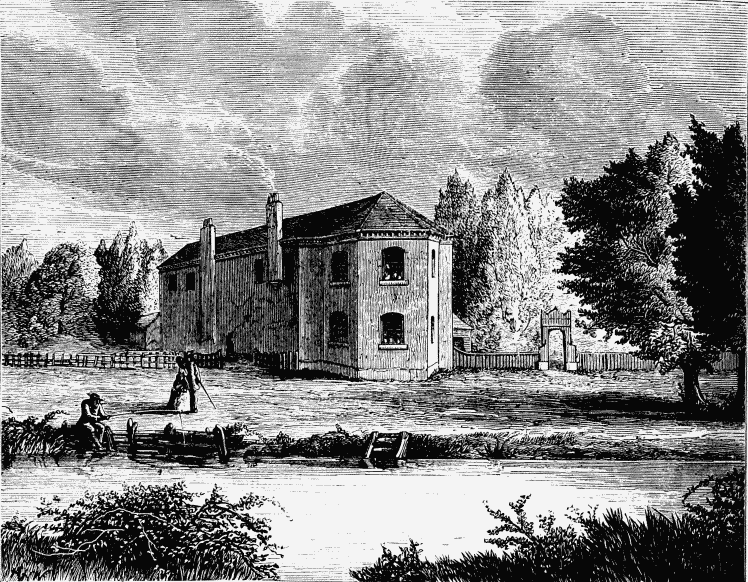
COPENHAGEN HOUSE. (From a View taken about 1800.)
As he was returning from the Old Bailey to Newgate, one cold night, a lady placed a silk handkerchief round his neck, upon which he gaily said, "Take care, madam, what you are about, for I am rather ticklish in that place just now." During his trial for high treason, Tooke is said to have expressed a wish to speak in his own defence, and to have sent a message to Erskine to that effect, saying, "I'll be hanged if I don't!" to which Erskine wrote back, "You'll be hanged if you do."
In April, 1834, an immense number of persons of the trades' unions assembled in the Fields, to form part of a procession of 40,000 men to Whitehall, to present an address to his Majesty (which, however, Lord Melbourne rejected), signed by 260,000 unionists, on behalf of some of their colleagues who had been convicted at Dorchester for administering illegal oaths. Among the leaders appeared prominently Robert Owen, the socialist, and a Radical clergyman in full canonicals, black silk gown and crimson Oxford hood.
Maiden Lane (perhaps Midden or Dunghill Lane), an ancient way leading from Battle Bridge to Highgate, and avoiding the hill, was once the chief road for northern travellers. At present, bone-stores, chemical works, and potteries render it peculiarly unsavoury.
Battle Bridge is so called for two reasons. In the first place, there was formerly a small brick bridge over the Fleet at this spot; and, secondly, because, as London tradition has steadily affirmed, here was fought the great battle between Suetonius Paulinus, the Roman general, and Boadicea, the Queen of the Iceni. It is still doubtful whether the scene of the great battle was so near London, but there is still much to be said in its favour. The arguments pro and con are worth a brief discussion. Tacitus describes the spot, with his usual sharp, clear brevity. "Suetonius," he says, "chose a place with narrow jaws, backed by a forest." Now the valley of the Fleet, between Pentonville and Gray's Inn Lane, backed by the great northern forest of Middlesex, undoubtedly corresponds with this description, but then Tacitus, always clear and vivid, makes no mention of the river Fleet, which would have been most important as a defence for the front and flank of the Roman army, and this raises up serious doubts. The Roman summer camp near Barnsbury Park, opposite Minerva Terrace, in the Thornhill Road, we have already mentioned. There was a praetorium there, a raised breastwork, long visible from the Caledonian Road, a well, and a trench. In 1825 arrow-heads and red-tiled pavements were discovered in this spot.
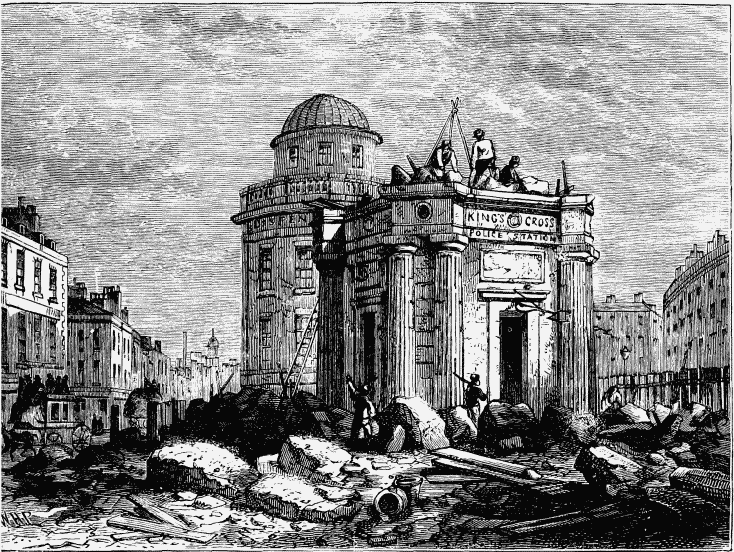
KING'S CROSS. (From a View taken during its demolition in 1845.)
In 1680 John Conyers, an antiquarian apothecary of Fleet Street, discovered in a gravel-pit near the "Sir John Oldcastle," in Coldbath Fields, the skeleton of an elephant, and the shaft and flint head of a British spear. Now it is certain that the Romans in Britain employed elephants, as Polybius expressly tells us, when Julius Caesar forced the passage of the Thames, near Chertsey, an elephant, with archers in a houdah on its back, led the way, and drove the astonished Britons to flight. Another important proof also exists. In 1842 a fragment of a Roman monumental inscription was found built into a cottage on the east side of Maiden Lane. It was part of the tomb of an officer of the twentieth legion, which had been dug up in a field on the west side of the road leading to the Caledonian Asylum. This legion formed part of the army of Claudius which Paulinus led against Boadicea. Mr. Tomlins, however, is inclined to think that a fight took place at Battle Bridge during the early Danish invasions.
The great battle with the Romans, wherever it took place, was an eventful one, and was one of the last great efforts of the Britons. Suetonius, with nearly 10,000 soldiers, waited for the rush of the wild 200,000 half-savage men, who had already sacked and destroyed Colchester, St. Albans, and London. His two legions were in the centre, his light-armed troops at hand, while his cavalry formed his right and left wings. Boadicea and her two daughters, in a war-chariot, was haranguing her troops, while the wives of her soldiers were placed in wagons at the rear end of the army, to view the battle. The Britons rushed to the attack with savage shouts, and songs of victory; the Romans received their charge with showers of javelins, and then advanced in the form of a wedge, the Britons eagerly opening their ranks, to surround and devour them up. The British chariots, armed with scythes, made great havoc among the Romans, till Suetonius ordered his legionaries to aim only at the charioteers. The Britons, however, after a stubborn fight, gave way before the close ranks of disciplined warriors, leaving some 80,000 men upon the field, while the Romans, shoulder to shoulder, are reported to have lost only 400 men. The line of wagons with the women proved a fatal obstruction to the flight of the Britons. The last fact to be recorded about the Romans at Battle Bridge is the discovery, in 1845, under the foundation of a house in Maiden Lane, of an iron urn, full of gold and silver coins of the reign of Constantine.
Gossiping Aubrey mentions that in the spring after the Great Fire of London the ruins were all overgrown with the Neapolitan cress, "which plant," says he, "Thomas Willis (the famous physician) told me he knew before but in one place about town, and that was at Battle Bridge, by the 'Pinder of Wakefield,' and that in no great quantity." In the reign of Edward VI., says Stow, a miller of Battle Bridge was set in the pillory in Chepe, and had his ears cut off, for uttering seditious words against the Duke of Somerset. In 1731, John Everett, a highwayman, was hung at Tyburn, for stopping a coach and robbing some ladies at Battle Bridge. The man had served in Flanders as a sergeant, and had since kept an ale-house in the Old Bailey.
In 1830 Battle Bridge assumed the name of King's Cross, from a ridiculous octagonal structure crowned by an absurd statue of George IV., which was erected at the centre of six roads which there united. The building, ornamented by eight Doric columns, was sixty feet high, and was crowned by a statue of the king eleven feet high. Pugin, in that bantering book, "The Contrasts," ridiculed this effort of art, and contrasted it with the beautiful Gothic market cross at Chichester. The Gothic revival was only just then beginning, and the dark age was still dark enough. The basement was first a police-station, then a public-house with a camera-obscura in the upper storey. The hideous monstrosity was removed in 1845. Battle Bridge, which had been a haunt of thieves and murderers, was first built upon by Mr. Bray and others, on the accession of George IV., when sixty-three houses were erected in Liverpool Street, Derby Street, &c. The locality being notorious, it was proposed to call it St. George's Cross, or Boadicea's Cross, but Mr. Bray at last decreed that King's Cross was to be the name.
Early in the century the great dust-heaps of London (where now stand Argyle, Liverpool, and Manchester Streets) were some of the disgraces of London; and when the present Caledonian Road was fields, near Battle Bridge were heaped hillocks of horse-bones. The Battle Bridge dustmen and cinder-sifters were the pariahs of the metropolis. The mountains of cinders and filth were the débris of years, and were the haunts of innumerable pigs. The Russians, says the late Mr. Pinks, in his excellent "History of Clerkenwell," bought all these ash-heaps, to help to rebuild Moscow after the French invasion. The cinder-ground was eventually sold, in 1826, to the Pandemonium Company for £15,000, who walled in the whole and built the Royal Clarence Theatre at the corner of Liverpool Street. Somewhere near this Golgotha was a piece of waste ground, where half the brewers of the metropolis shot their grains and hop-husks. It became a great resort for young acrobats and clowns, (especially on Sunday mornings), who could here tumble and throw "flip-flaps" to their hearts' content, without fear of fracture or sprain.
In 1864 Mr. Grove, an advertising tailor of Battle Bridge, bought Garrick's villa, at Hampton, for £10,800. In 1826, opposite the great cinder-mountain of Battle Bridge, was St. Chad's Well, a chalybeate spring supposed to be useful in cases of liver attacks, dropsy, and scrofula. About the middle of the last century 800 or 900 persons a morning used to come and drink these waters, and the gardens were laid out for invalids to promenade.
The Great Northern Railway Terminus at King's Cross occupies more than forty-five acres of land. For the site of the passenger station, the Small-pox and Fever Hospital was cleared away. The front towards Pancras Road has two main arches, each 71 feet span, separated by a clock tower 120 feet high. The clock has dials 9 feet in diameter, and the principal bell weighs 29 cwt. Each shed is 800 feet long, 105 feet wide, and 71 feet high to the crown of the semicircular roof, without a tie. The roof is formed of laminated ribs 20 feet apart, and of inch-and-ahalf planks screwed to each other. The granary has six storeys, and will hold 60,000 sacks of corn. On the last storey are water-tanks, holding 150,000 gallons; and the grain is hoisted by hydraulic apparatus. The goods shed is 600 feet in length, and 80 feet wide; and the roof is glazed with cast glass in sheets, 8 feet by 2 feet 6 inches. Under the goods platform is stabling for 300 horses. The shed adjoins the Regent's Canal, which, from thence, enters the Thames at Limehouse. The coal stores will contain 15,200 tons. The buildings are by Lewis and Joseph Cubitt. The railway passes under the Regent's Canal and Maiden Lane, beneath Copenhagen Fields, over the Holloway Road, through tunnels at Hornsey and elsewhere, and over a viaduct at Welwyn, with forty-two arches, 30 feet wide, and 97 feet high (Timbs).