Old and New London: Volume 2. Originally published by Cassell, Petter & Galpin, London, 1878.
This free content was digitised by double rekeying. Public Domain.
Walter Thornbury, 'The Fleet Prison', in Old and New London: Volume 2(London, 1878), British History Online https://www.british-history.ac.uk/old-new-london/vol2/pp404-416 [accessed 30 April 2025].
Walter Thornbury, 'The Fleet Prison', in Old and New London: Volume 2(London, 1878), British History Online, accessed April 30, 2025, https://www.british-history.ac.uk/old-new-london/vol2/pp404-416.
Walter Thornbury. "The Fleet Prison". Old and New London: Volume 2. (London, 1878), British History Online. Web. 30 April 2025. https://www.british-history.ac.uk/old-new-london/vol2/pp404-416.
In this section
CHAPTER XLIX.
THE FLEET PRISON.
An Ancient Debtors' Prison—Grievous Abuses—Star Chamber Offenders in the Fleet—Prynne and Lilburne—James Howell, the Letter-writer —Howard, the Philanthropist, at the Fleet—The Evils of Farming the Fleet—The Cases of Jacob Mendez Solas and Captain Mackpheadris —A Parliamentary Inquiry into the State of the Fleet Prison—Hogarth's Picture on the Subject—The Poet Thomson's Eulogy of Mr. Oglethorpe—The Fleet Prison before and after it was Burnt in, 1780—Code of Laws enforced in the Fleet—The Liberty of the "Rules"—The Gordon Rioters at the Fleet—Weddings in the Fleet—Scandalous Scenes—Mr. Pickwick's Sojourn in the Fleet—Famous Inmates of the Prison.
It is difficult to carry the mind back and imagine this old London prison, carted away in 1846, a building of nearly seven centuries' existence; yet so it was. Stow, to whom a century was a mere trifle, traces it back, in his grave, unpretending way (condensing a week's research in a line), as early as Richard I., who confirmed the custody of his house at Westminster, and his gaol of the Fleet at London, to Osbert, brother of William Longshampe, Chancellor of England. King John, also, says the same writer, handed over the same important, and, as one might perhaps be allowed to think, somewhat incongruous trusts, to the Archdeacon of Wells. The Fleet is proved to have been a debtors' prison as early as 1290, but it does not figure largely in London chronicles. It was probably as disgraceful and loathsome as other prisons of those early days, the gaolers levying fees from the prisoners, and habeas corpus, that Magna Charta of the unfortunate, being as yet unknown.
The Fleet Prison was formerly held in conjunction with the Manor of Leveland, in Kent, and appears in a grant from Archbishop Lanfranc as part of the ancient possessions of the See of Canterbury, soon after the accession of William the Conqueror. That it was burnt by Wat Tyler's men is only another proof of the especial dislike of the mob to such institutions. In Queen Mary's time some of the Protestant martyrs were confined here. Bishop Hooper, for instance, was twice thrust in the Fleet, till the fire at Gloucester could be got ready to burn his opinions out of him. His bed there is described as "a little pad of straw, with a rotten covering."
Strype says that about the year 1586 (Elizabeth) the suffering prisoners of the Fleet petitioned the Lords of the Council on the matter of certain grievous abuses in the management of the prison —abuses that were, indeed, never thoroughly corrected. It was the middleman system that had led to many evils. The warden, wishing to earn his money without trouble, had let the prison to two deputies. These men being poor, and greedy for money, had established an iniquitous system of bribery and extortion, inflicting constant fines and payments, and cruelly punishing all refractory prisoners who ventured to rebel, or even to remonstrate, stopping their exercise, and forbidding them to see their friends. A commission was granted, but nothing satisfactory seems to have come from it, as we find, in 1593, another groan arising from the wretched prisoners of the Fleet, who preferred a bill to Parliament, reciting, in twenty-eight articles, the misdemeanours and even murders of the obnoxious deputy-warden. "The warden's fees in the reign of Elizabeth," says Mr. Timbs, "were—An archbishop, duke, or duchess, for his commitment fee, and the first week's 'dyett,' £21 10s.; a lord, spiritual or temporal, £10 5s. 10d.; a knight, £5; an esquire, £3 6s. 8d.; and even 'a poor man in the wards, that hath a part at the box, to pay for his fee, having no dyett, 7s. 4d.' The warden's charge for licence to a prisoner 'to go abroad' was 20d. per diem."
The fruitless martyrdoms of Mary's reign had not convinced such narrow-minded bigots as Laud of the folly of attempting to convert adversaries by force. The Fleet became the special prison for Star Chamber offenders, including many dogged Puritan lampooners and many generous champions of liberty, and even bishops were crammed into the Fleet for unorthodox conduct. Two of the most historical of the theoretical culprits were Prynne and Lilburne. The former tough old lawyer, for simply denouncing actresses, with a supposed glance at the Queen of Charles I., was taken from the Fleet to the pillory, to have his nostrils slit and his ears cut off—a revenge for which the king paid dearly, and gained an inexorable and pitiless foe. Lilburne, "free-born John," as he was called by the Republicans, was one of the most extraordinary men the dens of the Fleet ever contained, or the Fleet irons ever cramped. For reprinting one of Prynne's violent books, honest John, who afterwards fought bravely in support of his opinions at Edgehili and elsewhere, was whipped at the cart's tail from the Fleet to the pillory at Westminster. Even at the pillory he threw seditious pamphlets to the populace, and when he was gagged, to prevent his indignant orations, he stamped, to express his indignation. That pleasant letter-writer, James Howell, was also a prisoner here, from 1643 to 1647, when his glasshouse schemes failed, and on his return from his business travels in Italy and Spain. In a letter to the Earl of B—— he describes being arrested by five men armed with "swords, pistols, and bills;" and he adds, in his usual cheery way, "as far as I see, I must be at dead anchor in this Fleet a long time, unless some gentle gale blow thence, to make me launch out."
After the abolition of Laud's detestable Star Chamber court, in 1641, the Fleet Prison was reserved for debtors only, and for contempt of the Courts of Chancery, Common Pleas, and Exchequer. The prison was burnt down in the Great Fire, when the prisoners were removed for a time to Caroone House, South Lambeth, the mansion of the Netherlands ambassador in the reigns of Elizabeth and James.
Howard, the philanthropist, visited the Fleet for the first time in April, 1774, and, in his "State of the Prisons in England and Wales," speaks of it five years later, as clean and free from offensive odours. The building was burnt by the rioters in 1780, but was immediately rebuilt on the old plan. The new gaol is thus described by Howard:—
"At the front," he says, "is a narrow court. At each end of the building there is a small projection, or wing. There are four floors—they call them galleries—besides the cellar floor, called 'Bartholomew Fair.' Each gallery consists of a passage in the middle the whole length of the prison, 66 yards; and rooms on each side of it about 14½ feet by 12½ and 9½ feet high; a chimney and window in every room. The passages are narrow (not 7 feet wide) and darkish, having only a window at each end. On the first floor, the hall-gallery, to which you ascend by eight steps, are a chapel, a tap-room, a coffee-room (made out of two rooms for debtors), a room for the turnkey, another for the watchman, and eighteen rooms for prisoners. Besides the coffee-room and tap-room, two of those eighteen rooms, and all the cellar-floor, except a lock-up room to confine the disorderly, and another room for the turnkey, were held by the tapster, John Cartwright, who bought the remainder of the lease at public auction in 1775. The cellar-floor is sixteen steps below the hall-gallery. It consists of the two rooms just now mentioned, the tapster's kitchen, his four large beer and wine cellars, and fifteen rooms for prisoners. These fifteen, and the two before mentioned on the hall-gallery, the tapster lets to prisoners for from 4s. to 8s. a week. On the second floor (that next above the hall-gallery) are twenty-five rooms for prisoners; on the next gallery, twenty-seven. One of them, fronting the staircase, is their committee-room. A room at one end is an infirmary; at the other end, in a large room over the chapel, is a dirty billiard-table, kept by the prisoner who sleeps in that room. On the highest storey are twenty-seven rooms. Some of these upper rooms—viz., those in the wings—are larger than the rest, being over the chapel, the taproom, &c. All the rooms I have mentioned are for Master's Side debtors. The weekly rent of those not held by the tapster is 1s. 3d., unfurnished. They fall to the prisoners in succession; thus, when a room becomes vacant, the first prisoner upon the list of such as have paid their entrance-fees takes possession of it. When the prison was built, the warder gave each prisoner his choice of a room, according to his seniority as prisoner. If all the rooms be occupied, a new comer must hire of some tenant a part of his room, or shift as he can. Prisoners are excluded from all right of succession to the rooms held by the tapster, and let at the high rents aforesaid. The apartments for Common Side debtors are only part of the right wing of the prison. Besides the cellar (which was intended for their kitchen, but is occupied with lumber, and shut up) there are four floors. On each floor is a room about twenty-four or twenty-five feet square, with a fireplace; and on the sides, seven closets or cabins to sleep in. Such of these prisoners as swear in court, or before a commissioner, that they are not worth £5, and cannot subsist without charity, have the donations which are sent to the prison, the begging-box, and the grate. Of them there were at one of my visits sixteen, at some other times not so many."
In 1726, the evils of farming the Fleet having increased to a disgraceful and perfectly unbearable pitch, a Parliamentary investigation took place, and Huggins, the farmer, and Bambridge, a low, greedy fellow, who was his lessee, were tried for murder. The examination of the witnesses led to some ghastly disclosures, which Hogarth, who was present, immortalised in a picture which at once made him celebrated. The following extract from the governor's report discloses infamous cruelty:—
"Jacob Mendez Solas, a Portuguese, was, as far as it appeared to the committee, one of the first prisoners for debt that ever was loaded with irons at the Fleet. The said Bambridge one day called him into the gatehouse of the prison called the Lodge, where he caused him to be seized, fettered, and carried to Corbett's the spunging-house, and there kept for upwards of a week; and when brought back into the prison, Bambridge caused him to be turned into the dungeon called the Strong-room of the Master's Side.
"The place is a vault, like those in which the dead are interred, and wherein the bodies of persons dying in the said prison are usually deposited, till the coroner's inquest hath passed upon them. It has no chimney nor fireplace, nor any light but what comes over the door, or through a hole of about eight inches square. It is neither paved nor boarded; and the rough bricks appear both on the sides and top, being neither wainscoted nor plastered. What adds to the dampness and stench of the place is its being built over the common shore, and adjoining to the sink and dunghill, where all the nastiness of the prison is cast. In this miserable place the poor wretch was kept by the said Bambridge, manacled and shackled, for near two months. At length, on receiving five guineas from Mr. Kemp, a friend of Solas's, Bambridge released the prisoner from his cruel confinement. But though his chains were taken off, his terror still remained, and the unhappy man was prevailed upon by that terror not only to labour gratis for the said Bambridge, but to swear also at random all that he hath required of him. And this committee themselves saw an instance of the deep impression his sufferings had made upon him; for, on his surmising, from something said, that Bambridge was to return again as warden of the Fleet, he fainted, and the blood started out of his mouth and nose.
"Captain John Mackpheadris, who was bred a merchant, is another melancholy instance of the cruel use the said Bambridge hath made of his assumed authority. Mackpheadris was a considerable trader, and in a very flourishing condition, until the year 1720, when, being bound for large sums to the Crown, for a person afterwards ruined by the misfortunes of that year, he was undone. In June, 1727, he was prisoner in the Fleet, and although he had before paid his commitment-fee, the like fee was extorted from him a second time; and he having furnished a room, Bambridge demanded an extravagant price for it, which he refused to pay, and urged that it was unlawful for the warden to demand extravagant rents, and offered to pay what was legally due. Notwithstanding which, the said Bambridge, assisted by the said James Barnes, and other accomplices, broke open his room and took away several things of great value, amongst others, the king's Extent in aid of the prisoner (which was to have been returned in a few days, in order to procure the debt to the Crown, and the prisoner's enlargement), which Bambridge still detains. Not content with this, Bambridge locked the prisoner out of his room, and forced him to lie in the open yard, called the 'Bare.' He sat quietly under his wrongs, and getting some poor materials, built a little hut, to protect himself as well as he could from the injuries of the weather. The said Bambridge, seeing his unconcernedness, said, '—him! he is easy! I will put him into the Strong-room before to-morrow!' and ordered Barnes to pull down his little hut, which was done accordingly. The poor prisoner, being in an ill state of health, and the night rainy, was put to great distress. Some time after this he was (about eleven o'clock at night) assaulted by Bambridge, with several other persons, his accomplices, in a violent manner; and Bambridge, though the prisoner was unarmed, attacked him with his sword, but by good fortune was prevented from killing him; and several other prisoners coming out upon the noise, they carried Mackpheadris for safety into another gentleman's room; soon after which Bambridge, coming with one Savage, and several others, broke open the door, and Bambridge strove with his sword to kill the prisoner, but he again got away, and hid himself in another room. Next morning the said Bambridge entered the prison with a detachment of soldiers, and ordered the prisoner to be dragged to the lodge, and ironed with great irons. On which he, desiring to know for what cause and by what authority he was to be so cruelly used, Bambridge replied, it was by his own authority, and, —him, he would do it, and have his life. The prisoner desired he might be carried before a magistrate, that he might know his crime before he was punished; but Bambridge refused, and put irons upon his legs which were too little, so that in forcing them on his legs were like to have been broken, and the torture was impossible to be endured. Upon which the prisoner, complaining of the grievous pain and straitness of the irons, Bambridge answered, that he did it on purpose to torture him. On which the prisoner replying that by the law of England no man ought to be tortured, Bambridge declared that he would do it first and answer for it afterwards; and caused him to be dragged away to the dungeon, where he lay without a bed, loaded with irons so close riveted, that they kept him in continual torture, and mortified his legs. After long application his irons were changed, and a surgeon directed to dress his legs; but his lameness is not, nor can be, cured. He was kept in this miserable condition for three weeks, by which his sight is greatly prejudiced, and in danger of being lost.
"The prisoner, upon this usage, petitioned the judges; and after several meetings, and a full hearing, the judges reprimanded Mr. Huggins and Bambridge, and declared that a gaoler could not answer the ironing of a man before he was found guilty of a crime, but it being out of term, they could not give the prisoner any relief or satisfaction."
Notwithstanding the judges' remonstrance, Bambridge, cruel and greedy to the last, did not release the captain from his irons till he had wrung from him six guineas, and indicted him for an imaginary assault. But the case of Captain David Sinclair, an old officer of courage and honour, was even a worse one. Bambridge, who disliked his prisoner, had boasted to one of his turnkeys that he would have Sinclair's blood. Selecting the king's birthday, when he thought the captain would be warm with wine, he rushed into Sinclair's room with his escort, armed with musket and bayonet, struck him with his cane, and ordered the men to stab the poor wretch with their bayonets if he resisted being dragged down to the Strong-room. In that damp and dark dungeon Sinclair was confined, till he lost the use of his limbs and also his memory; and when near dying he was taken into a better room, where he was left four days without food. In the case of Mr. John Holder, a Spanish merchant, the prisoner died from an illness produced by horror at the miseries of the Common Side to which he had been consigned.
Bambridge is said to have been the first gaoler of the Fleet who put mere debtors in irons. The old method of punishing drunken and disorderly persons in this prison was the stocks; while those who escaped, or tried to escape, were either set in tubs at the prison gate, or locked in their rooms for several days. This cruel gaoler seems to have defied even habeas corpus, to have stolen charitable bequests, and bribed or frightened the lawyers who came to defend ill-used prisoners. In the case of Sir William Rich, a prisoner who was unable to pay up his arrears for lodging, Barnes, a turnkey, tried to burn him with a red-hot poker; while the warden threatened to fire at him, struck him with a stick, and slashed at him with a hanger. Rich was then loaded with heavy irons, thrown into the dungeon on the Master's Side, and kept there ten days for having, almost unconsciously, in the midst of these cruelties, wounded Bambridge with a shoemaker's knife. For an application to the Court of Common Pleas Sir William had to pay £14, the motion costing him £2 13s. 7d. In another case the prisoner paid, at his entrance into the Fleet, to judges' clerks, tipstaff, and warden, £45 16s.
Although the rascally Huggins and the wretch Bambridge escaped with a fright and a short imprisonment, there is no doubt this Parliamentary inquiry eventually led to reforms in this vilelymanaged prison. A picture by Hogarth of the Fleet Prison Committee was that painter's first real step to popularity. Sir James Thornhill probably obtained his son-in-law permission to sketch the scene, of which Horace Walpole says:—
"The scene is the committee. On the table are the instruments of torture. A prisoner in rags, half-starved, appears before them. The poor man has a good countenance, that adds to the interest. On the other hand is the inhuman gaoler. It is the very figure that Salvator Rosa would have drawn for Iago in the moment of detection. Villainy, fear, and conscience are mixed in yellow and livid on his countenance. His lips are contracted by tremor, his face advances as eager to lie, his legs step back as thinking to make his escape. One hand is thrust precipitately into his bosom, the fingers of the other are catching uncertainly at his button-holes. If this was a portrait, it is the most striking that ever was drawn; if it was not, it is still finer."
The poet Thomson, in his "Seasons," finds an opportunity to culogise Mr. Oglethorpe, whose generous hatred of cruelty led to the formation of the Fleet Committee. With his usual high-toned enthusiasm for what is good, the poet sings:—
"And here can I forget the generous band
Who, touch'd with human woe, redressive search'd
Into the horrors of the gloomy jail,
Unpitied and unheard, where Misery moans,
Where Sickness pines, where Thirst and Hunger burn,
And poor Misfortune feels the lash of vice?
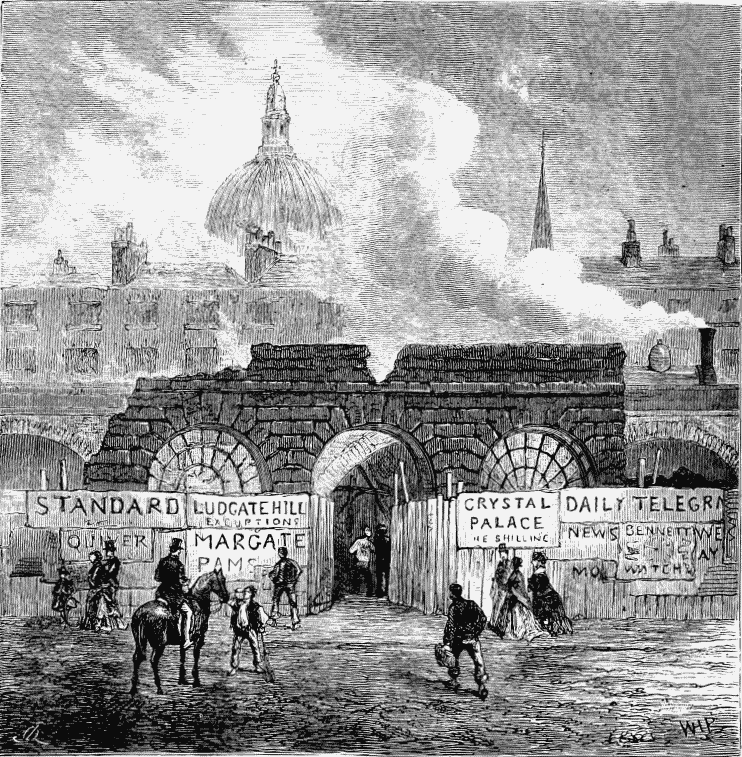
THE LAST REMAINS OF THE FLEET PRISON.
Howard, the philanthropist, describes the Fleet as an ill-managed prison, even in 1776.
"The prisoners," he says, "play in the courtyard at skittles, mississippi, fives, tennis, &c. And not only the prisoners. I saw among them several butchers and others from the market, who are admitted here, as at another public-house. The same may be seen in many other prisons where the gaoler keeps or lets the tap. Besides the inconvenience of this to prisoners, the frequenting a prison lessens the dread of being confined in one. On Monday night there was a wine club; on Thursday night a beer club; each lasting usually till one or two in the morning. I need not say how much riot these occasion, and how the sober prisoners, and those that are sick, are annoyed by them. "Seeing the prison crowded with women and children, I procured an accurate list of them, and found that on (or about) the 6th April, 1776, there were on the Master's Side 213 prisoners, on the Common Side 30, total 243; their wives and children were 475."
The Fleet after the fire of 1780 was rebuilt on the old plan. The floors of the cellar, the hall, and the first storey were stone, and arched with brick. The tapster still had all the cellar-floor. He and several of the prisoners kept dogs. The billiard and mississippi tables were, however, put down, and the little code of laws (referred to by Howard), was abolished.
The "little code of laws," eighteen in number, enacted by the Master-Side debtors, and printed by D. Jones, 1774, established a president, a secretary, and a committee, which was to be chosen every month, and was to consist of three members from each gallery. These were to meet in the committee-room every Thursday, and at other times when summoned by the crier, at command of the president, or of a majority of their own number. They were to raise contributions by assessment; to hear complaints, determine disputes, levy fines, and seize goods for payment. Their sense was to be deemed the sense of the whole house. The president or secretary was to hold the cash, the committee to dispose of it. Their scavenger was to wash the galleries once a week, to water and sweep them every morning before eight, and to light the lamps all over the house. No person was to throw out water, &c. anywhere but at the sinks in the yard. The crier might take of a stranger a penny for calling a prisoner to him, and of a complainant twopence for summoning a special committee. For blasphemy, swearing, riot, drunkenness, &c., the committee was to fine at discretion. For damaging a lamp the fine was a shilling. They were to take from a new comer, on the first Sunday, besides the two shillings, "garnish," to be spent in wine, one shilling and sixpence, to be appropriated to the use of the house. Common-side prisoners were to be confined to their own apartments, and not to associate with these law-makers.
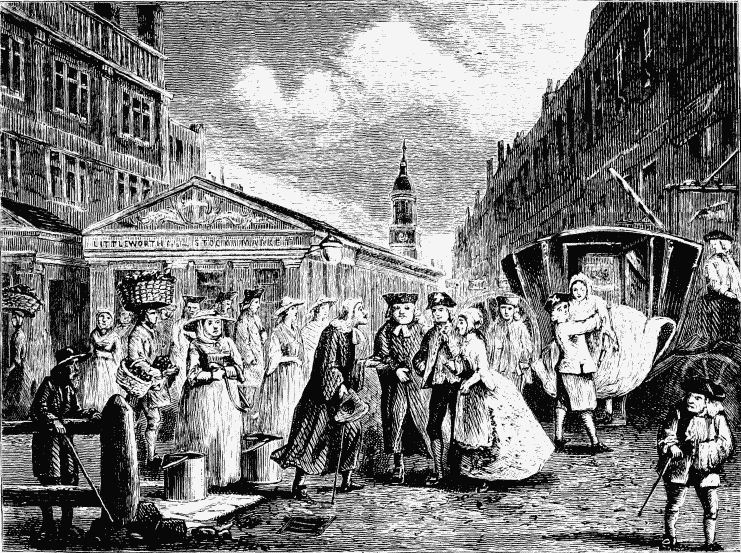
A WEDDING IN THE FLEET. (From a Print of the Early Part of the Eighteenth Century.)
"The liberty of the rules, and the 'day rules' of the Fleet, may be traced," says Mr. Timbs, "to the time of Richard II., when prisoners were allowed to go at large by bail, or with a 'baston' (tipstaff), for nights and days together. This licence was paid at eightpence per day, and twelvepence for his keeper that shall be with him. These were day rules. However, they were confirmed by a rule of court during the reign of James I. The rules wherein prisoners were allowed to lodge were enlarged in 1824, so as to include the churches of St. Bride's and St. Martin's, Ludgate; New Bridge Street, Blackfriars, to the Thames; Dorset Street and Salisbury Square; and part of Fleet Street, Ludgate Hill, and Ludgate Street, to the entrance of St. Paul's Churchyard, the Old Bailey, and the lanes, courts, &c., in the vicinity of the above; the extreme circumference of the liberty being about a mile and a half. Those requiring the rules had to provide sureties for their forthcoming and keeping within the boundaries, and to pay a per-centage on the amount of debts for which they were detained, which also entitled them to the liberty of the day rules, enabling them during term, or the sitting of the courts at Westminster, to go abroad during the day, to transact or arrange their affairs, &c. The Fleet and the Queen's Bench were the only prisons in the kingdom to which these privileges had for centuries been attached." For certain payments favoured prisoners were allowed to be long absent; and Mr. Dickens tells a story of one old resident, whose heaviest punishment was being locked out for the night.
The Fleet was one of the prisons burnt by the insane rioters of Lord George Gordon's mob, in 1780. The polite rioters sent a notice the night before that the work must be done, but delayed it some hours, at the request of their restricted friends. The papers of the time mention only one special occurrence during the fire, and that was the behaviour of a ringleader dressed like a chimney sweep, whom every one seems to have insisted on dubbing a nobleman in disguise; or if not himself a nobleman, says a writer in the Gentleman's Magazine, an agent, at least, entrusted with his purse, to enlist conspirators and promote sedition. This quasi-nobleman had, however, more of foolhardiness than cunning in his composition, for he perched himself upon the tiles of the market-house, over against the Fleet Prison, as a mark for the soldiers to shoot at; and as he was on the opposite side of the roof to that where they were posted, at every discharge he popped up his head and assailed them with tiles, till a ball passing through the roof lodged in his heart and tumbled him down. He had gold in his pockets, it is true, but he had no commission, nor was he any other than a pilfering thief, who had well lined his pockets in what to him was a fair way of trade.
In the seventeenth and early part of the eighteenth centuries couples desiring to be secretly married came to the Fleet and King's Bench prisons, where degraded clergymen could easily be found among the herd of debtors to perform the ceremony.
In Charles I.'s time a chapel in the Tower (in the White Tower) was a favourite place for clandestine marriages. On Archbishop Laud stopping these illegal practices, hurried lovers then betook themselves to one of two churches at the east end of London—St. James's, Duke's Place, or Trinity, in the Minories. A register of marriages preserved at the former church proves that in twenty-seven years from 1664 nearly 40,000 marriages were celebrated. The fee seems to have fluctuated from between two crowns to a guinea.
The Fleet Chapel was used for debtors' marriages till 1686, when the incumbent of St. James's, Duke's Place, Aldgate, being suspended by the Commissioners for Ecclesiastical Causes, made it too popular as a place for secret marriages; and the chapel becoming the haunt of dangerous lookers-on, the degraded clergymen of the prison and neighbourhood began to celebrate secret marriages in rooms of adjoining taverns, or in private houses adjacent to Fleet Street, Ludgate Hill, and the Mint, keeping registers, to give an appearance of legality, and employing touts, to attract and bring in victims.
Mr. J. C. Jeaffreson, in his valuable work, "Brides and Bridals," has taken great pains with this subject of Fleet parsons, and has ransacked all possible books, old or new, for information about them.
"Scanty particulars," he says, "have been preserved of about forty persons who were keepers of marrying-houses. Some of these persons were turnkeys, or subordinate officials, in the Fleet Prison, like Bartholomew Bassett, who was clerk of the Fleet Chapel, and tenant, at the exorbitant rent of £100, of the Fleet cellars, where marriages were solemnised secretly. It was at Bassett's office, or private chapel, that Beau Fielding married his first wife, before he fixed his affections on the Duchess of Cleveland. A few of the forty negotiators in wedlock were women, who had come into possession of a register and marrying business by inheritance. Most of them, however, had in the first instance been simple innkeepers, supplying the public with adulterated liquors before they entered the matrimonial trade.
"Standing in the chief thoroughfares or side-alleys and by-yards of the Fleet quarter, their taverns had signs, some of which still pertain to hostelries of the locality. For instance: 'The Cock,' near Fleet Bridge, and 'The Rainbow' Coffee House, at the corner of Fleet Ditch, were famous marryinghouses, with signs honourably known at the present day to frequenters of Fleet Street taverns. The 'Cock and Acorn,' the 'Fighting Cocks,' the 'Shepherd and Goat,' the 'Golden Lion,' the 'Bishop Blaze,' the 'Two Lawyers,' the 'Wheatsheaf,' the 'Horseshoe and Magpie,' the 'King's Head,' the 'Lamb,' the 'Swan,' the 'Hoop and Bunch of Grapes,' were some of the taverns in or near Fleet Street and Fleet Market, provided with chaplains and chapels, or private rooms, in which marriages were solemnised on every day and night of the year. William Wyatt—brother of the notorious and very successful Fleet parson, Walter Wyatt —was landlord, first of a public-house in Sea Coal Lane, and afterwards of the 'New Market House,' Fleet Lane, in both of which houses he drove a great trade, and flourished under his stately brother's patronage. The 'Hand and Pen' was a sign which proved so attractive to the generality of spouses, that after it had brought success in trade to one house, competitors of the original 'Hand and Pen' public-house adopted it. Joshua Lilley's 'Hand and Pen' stood near Fleet Bridge; Matthias Wilson's 'Hand and Pen' looked out on the Fleet Ditch; John Burnford's 'Hand and Pen' kept open door at the foot of Ludgate Hill; and Mrs. Balls had her 'Hand and Pen' office and registry of marriages within sight of the other three establishments of the same name. When Ben the Bunter married fair Kitty of Kent Street, he went to the 'Hand and Pen,' and was fast bound to his damsel by a stout and florid clergyman, for the moderate fee of half-a-crown."
A collection by some enthusiastic collector on this subject exists at the British Museum; he has illustrated a small poem called "The Humours of the Fleet," with many sketches of the low prison life. The following quotations paint the Fleet parson, and the noisy touts who wrangled for each new arrival, in bold colours:—
"Scarce had the coach discharged its trusty fare,
But gaping crowds surround th' amorous pair;
The busy plyers make a mighty stir,
And whispering cry, 'D'ye want the parson, sir?
Pray step this way—just to the "Pen in Hand,"
The doctor's ready there at your command.'
'This way!' another cries. 'Sir, I declare,
The true and ancient register is here.'
The alarmèd parsons quickly hear the din,
And haste with soothing words to invite 'em in.
In this confusion, jostled to and fro,
The inamoured couple know not where to go,
Till slow advancing from the coach's side,
The experienced matron came (an artful guide);
She led the way without regarding either,
And the first parson spliced 'em both together.
* * * * * *
Where lead my wandering footsteps now?—the Fleet
Presents her tattered sons in Luxury's cause;
Here venerable crape and scarlet cheeks,
With nose of purple hue, high, eminent,
And squinting, leering looks, now strikes the eye.
B—s—p of hell, once in the precincts call'd,
Renown'd for making thoughtless contracts, here
He reigned in bloated majesty,
And passed in sottishness and smoke his time.
Revered by gin's adorers and the tribe
Who pass in brawls, lewd jests, and drink, their days;
Sons of low growling riot and debauch.
Here cleric grave from Oxford ready stands,
Obsequious to conclude the Gordian knot,
Entwin'd beyond all dissolution sure;
A regular this from Cambridge; both alike
In artful stratagem to tye the noose,
While women, 'Do you want the parson?' cry."
A writer (May 29, 1736) gives the following account of what he witnessed during a walk through the Fleet quarter:—"Gentlemen, having frequently heard of the many abominable practices of the Fleet, I had the curiosity, on Sunday, May 23rd, to take a view of the place as I was accidentally passing by. The first thing observed was one J. L., by trade a carpenter (whose brother, it is said, keeps the sign of the B. and G.), cursing and swearing, and raving in the streets, in the time of Divine service, with a mob of people about him, calling one of his fraternity (J. E.), a plyer for weddings, an informing rogue, for informing against one of their ministers for profane cursing and swearing, for which he paid three pounds odd money; the hearing of which pleased me much, since I could find one in that notorious place which had some spark of grace left; as was manifested by the dislike he showed to the person that was guilty of the profanation of God's sacred name. When the riot was dispersed, I walked about some small time, and saw a person exceedingly well dressed in a flowered morning gown, a band, hat, and wig, who appeared so clean that I took him for some worthy divine who might accidentally have come out of the country, and as accidentally be making the same remarks with myself; but upon inquiry, was surprised at being assured that he was one T. C., a watchmaker, who goes in a minister's dress, personating a clergyman, and taking upon him the name of 'Doctor,' to the scandal of the sacred function. He may be seen at any time at the 'Bull and Garter,' or the great 'Hand and Pen,' with these words written, 'The Old and True Register,' near the 'Rainbow' Coffee House. Please to give this a place in your paper, and you will not only oblige one of your constant readers, but may prevent many innocent persons from being ruined. I am, gentlemen, your humble servant, T. L."
The Rev. Alexander Keith, who had been reader at the Rolls Chapel, and afterwards incumbent of a Mayfair proprietary chapel, a great place for illegal marriages, on being suspended, excommunicated, and committed to Fleet Prison for contempt, in 1743, wrote a pamphlet to defend his conduct. The following extract gives some curious examples of the sort of reckless and shameless marriages that were contracted:—
"As I have married many thousands, and, consequently, have on those occasions seen the humour of the lower class of people, I have often asked the married pair how long they have been acquainted. They would reply, some more, some less, but the generality did not exceed the acquaintance of a week, some only of a day—half a day. . . . . Another inconveniency which will arise from this Act will be, that the expense of being married will be so great, that few of the lower class of people can afford it; for I have often heard a Fleet parson say that many have come to be married when they have had but half-a-crown in their pockets, and sixpence to buy a pot of beer, and for which they have pawned some of their clothes. . . . . I remember, once upon a time, I was at a public-house at Radcliff, which was then full of sailors and their girls. There was fiddling, piping, jigging, and eating. At length one of the tars starts up and says, '—— me, Jack, I'll be married just now; I will have my partner!' The joke took, and in less than two hours ten couple set out for the Fleet. I stayed their return. They returned in coaches, five women in each coach; the tars, some running before, others riding on the coach-box, and others behind. The cavalcade being over, the couples went up into an upper room, where they concluded the evening with great jollity. The next time I went that way, I called on my landlord and asked him concerning this marriage adventure. He at first stared at me, but, recollecting, he said those things were so frequent, that he hardly took any notice of them. 'For,' added he, 'it is a common thing, when a fleet comes in, to have two or three hundred marriages in a week's time among the sailors.' . . . . If the present Act, in the form it now stands, should (which I am sure is impossible) be of any service to my country, I shall then have the satisfaction of having been the occasion of it, because the compilers thereof have done it with a pure design of suppressing my chapel, which makes me the most celebrated man in this kingdom, though not the greatest." (Vide Keith's "Observations on the Act for Preventing Clandestine Marriages.")
"One of these comparatively fortunate offenders against the canons," says Mr. Jeaffreson, whom we have before quoted, "was the stately Dr. Gaynam, who lived for many years in Bride Lane, and never walked down Fleet Street in his silk gown and bands without drawing attention to his commanding figure, and handsome though significantly rubicund face. Nothing ever put the doctor out of humour or countenance. He was on several occasions required to bring one of his marriage registers to the Old Bailey, and give evidence in a trial for bigamy; but no gentleman of the long robe ever disturbed the equanimity of the shameless ecclesiastic, who, smiling and bowing courteously to his questioner, answered, 'Video meliora, deteriora sequor,' when an advocate asked him, 'Are you not ashamed to come and own a clandestine marriage in the face of a court of justice?' Even when Walter Chandler beat him with a stick, the doctor took his caning with well-bred composure. The popular nickname of the doctor declared him the bishop of an extremely hot diocese, but his manner and language were never deficient in coolness.
* * * * *
"Mr. John Mottram, who bore for his arms a chevron argent, charged, with three roses between three crosslets, or,' used to marry couples within the walls of the Fleet, not in the chapel of the prison, but 'in a room of the Fleet they called the Lord Mayor's Chapel, which was furnished with chairs, cushions, and proper conveniences.' It is recorded in the Weekly Journal, respecting this establishment for weddings, 'that a coalheaver was generally set to ply at the door, to recommend all couples that had a mind to be marry'd, to the prisoner, who would do it cheaper than anybody.' Mr. Mottram could afford to be moderate in his charges, for he transacted an enormous amount of business. From one of its registers, it appears that he married more than 2,200 couples in a single year. He was a very obliging gentleman, and never declined to put on a certificate of marriage the date that was most agreeable to the feelings of the bride. On the occasion of his trial at the Guildhall, in 1717, before Lord Chief Justice Parker, it appeared that this accommodating spirit had caused him to enrich certificates of his own penmanship with dates prior to the day of his own ordination. Convicted of solemnising marriages unlawfully, Mr. Mottram was fined £200; but this misadventure did not deter him from persevering in his practices."
Lando was another of these rascals. "Whoever thinks meanly," says the author of "Brides and Bridals," "of the Reverend John Lando, whilom Chaplain to His Majesty's ship The Falkland, holds an opinion at variance with that gentleman's estimate of himself; for Mr. Lando used to inform the readers of newspaper advertisements that he was a 'gentleman,' who had 'gloriously distinguished himself in the defence of his king and country,' and that he was 'determined to have everything conducted with the utmost decency and regularity' at his place of business, 'the New Chapel, next to the china shop, near Fleet Bridge, London. His charge for officiating at a wedding, and providing the happy couple with a 'certificate and crown stamp,' was a guinea. He 'was a regular bred clergyman,' in spite of the calumnious insinuations of his rivals; and he was 'above committing those little mean actions that some men impose on people.' In his zeal for the welfare of society, he taught young people Latin and French at his chapel three times a week."
But how can we leave this den of misery and infamy without reminding our readers that some years ago a respectable inhabitant of Goswell Street, through the disgraceful duplicity of a person named Bardell, a lodging-house keeper, and the shameful chicanery of two pettifogging lawyers named Dodson and Fogg, spent many months among the sordid population of the Fleet? Need we say that the stout and respectable gentleman we refer to was no other than the celebrated Mr. Pickwick? On no occasion has Mr. Charles Dickens sketched a part of London with more earnest and truthful care.
"These staircases," says Mr. Dickens, describing what first met Mr. Pickwick's eye when he arrived at the Fleet, "received light from sundry windows placed at some little distance above the floor, and looking into a gravelled area bounded by a high brick wall, with iron chevauxde-frise at the top. This area, it appeared from Mr. Roker's statement, was the racket-ground; and it further appeared, on the testimony of the same gentleman, that there was a smaller area, in that portion of the prison which was nearest Farringdon Street, denominated and called 'the Painted Ground,' from the fact of its walls having once displayed the semblances of various menof-war in full sail, and other artistical effects, achieved in bygone times by some imprisoned draughtsman in his leisure hours.
* * * * * *
"It was getting dark, that is to say, a few gas jets were kindled in this place, which was never light, by way of compliment to the evening, which had set in outside. As it was rather warm, some of the tenants of the numerous little rooms, which opened into the gallery on either hand, had set their doors ajar. Mr. Pickwick peeped into them as he passed along, with great curiosity and interest. Here, four or five great hulking fellows, just visible through a cloud of tobacco-smoke, were engaged in noisy and riotous conversation over half-emptied pots of beer, or playing at all-fours with a very greasy pack of cards. In the adjoining room some solitary tenant might be seen, poring, by the light of a feeble tallow candle, over a bundle of soiled and tattered papers, yellow with dust, and dropping to pieces from age, writing, for the hundredth time, some lengthened statement of his grievances, for the perusal of some great man whose eyes it would never reach, or whose heart it would never touch. In a third, a man, with his wife and a whole crowd of children, might be seen making up a scanty bed on the ground, or upon a few chairs, for the younger ones to pass the night in. And in a fourth, and a fifth, and a sixth, and a seventh, the noise, and the beer, and the tobaccosmoke, and the cards, all came over again in greater force than before.
"In the galleries themselves, and more especially on the staircases, there lingered a great number of people, who came there, some because their rooms were empty and lonesome; others because their rooms were full and hot; the greater part because they were restless and uncomfortable, and not possessed of the secret of exactly knowing what to do with themselves. There were many classes of people here, from the labouring man in his fustian jacket, to the broken-down spendthrift in his shawl dressing-gown, most appropriately out at elbows; but there was the same air about them all—a listless, jail-bird, careless swagger, a vagabondish, who's-afraid sort of bearing—which is wholly indescribable in words; but which any man can understand in one moment if he wish, by just setting foot in the nearest debtor's prison, and looking at the very first group of people he sees there, with the same interest as Mr. Pickwick did.
* * * * * *
"In this frame of mind he turned again into the coffee-room gallery, and walked slowly to and fro. The place was intolerably dirty, and the smell of tobacco-smoke perfectly suffocating. There was a perpetual slamming and banging of doors as the people went in and out, and the noise of their voices and footsteps echoed and re-echoed through the passages constantly. A young woman, with a child in her arms, who seemed scarcely able to crawl, from emaciation and misery, was walking up and down the passage in conversation with her husband, who had no other place to see her in. As they passed Mr. Pickwick, he could hear the female sob; and once she burst into such a passion of grief, that she was compelled to lean against the wall for support, while the man took the child in his arms and tried to soothe her.
A chapter on the Fleet Prison would be incomplete without some notice of the more eminent persons who have been confined there. Among these unhappy illustrious, we may mention the young poet Earl of Surrey, who describes it as "a noisome place, with a pestilent atmosphere." Keys was sent here, for daring to marry Lady Mary Grey, sister of the ill-starred Lady Jane; Dr. Donne, the poet, when a private tutor, for secretly marrying the daughter of his patron, Sir George More, whom he had met at Lord Chancellor Ellesmere's; Nash, the unhappy poet and truculent satirist, for writing The Isle of Dogs, a libellous play; Sir Robert Killigrew (1613), for talking to Sir Thomas Overbury, at his prison-gate at the Tower, on returning from a visit to Sir Walter Raleigh, then also buried alive in the river-side fortress, by James I.; the Dowager Countess of Dorset (1610), for pressing into the Council Chamber, and importuning King James I. Those sturdy martyrs of liberty, Prynne and honest John Lilburne, we have already mentioned. Sir Richard Baker, who wrote the "Chronicle," so much read by country gentlemen in Addison's time, died in the Fleet Prison (1644–5). Sir Richard was sprung from a good old Kentish family, but had become security for an embarrassed father-in-law. Wycherly, the rake and wit, was a prisoner in the Fleet seven years, but it did not tame him much. Francis Sandford, author of a genealogical history of great research, died in the Fleet, in 1693. Penn, the Quaker founder of Pennsylvania, was living in the Rules of the Fleet, in 1707 (Queen Anne). Penn was at this time in debt, from a vexatious lawsuit with the executors of a quondam steward. He died in 1718. That clever impostor, Richard Savage, to be safe from his raging creditors, took lodgings within the Liberties of the Fleet, his almost tired-out friends sending him an eleemosynary guinea every Monday. Parson Ford, a convivial dissolute parson, and a relative of Dr. Johnson, died in the Fleet, in 1731, and his ghost, it was firmly believed, appeared to a waiter, as he was going down to the cellar of the old "Hummums," in Covent Garden. Robert Lloyd, the schoolmaster friend of Churchill, died in the Fleet in 1764; and here ended a reckless life, in 1797, Miss Cornelys, the celebrated keeper of masqueraderooms in Soho Square, in Hogarth's time.
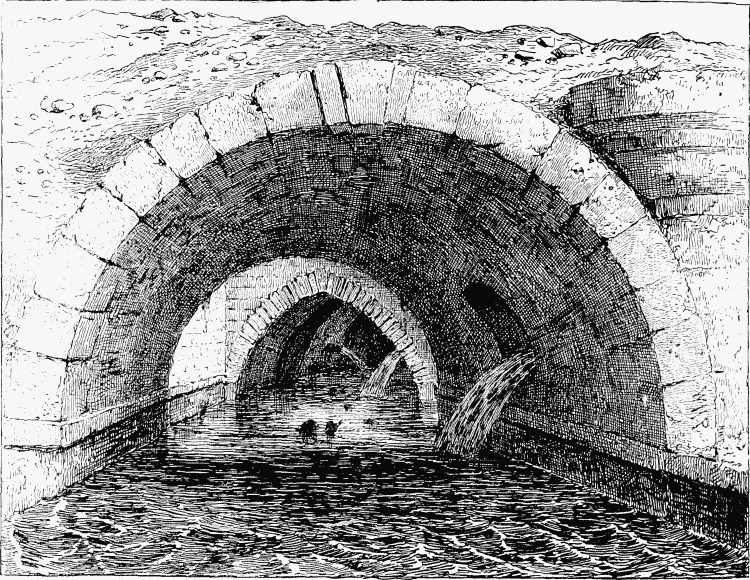
REMAINS OF OLD HOLBORN BRIDGE. (From a Sketch taken during the alterations, 1844)
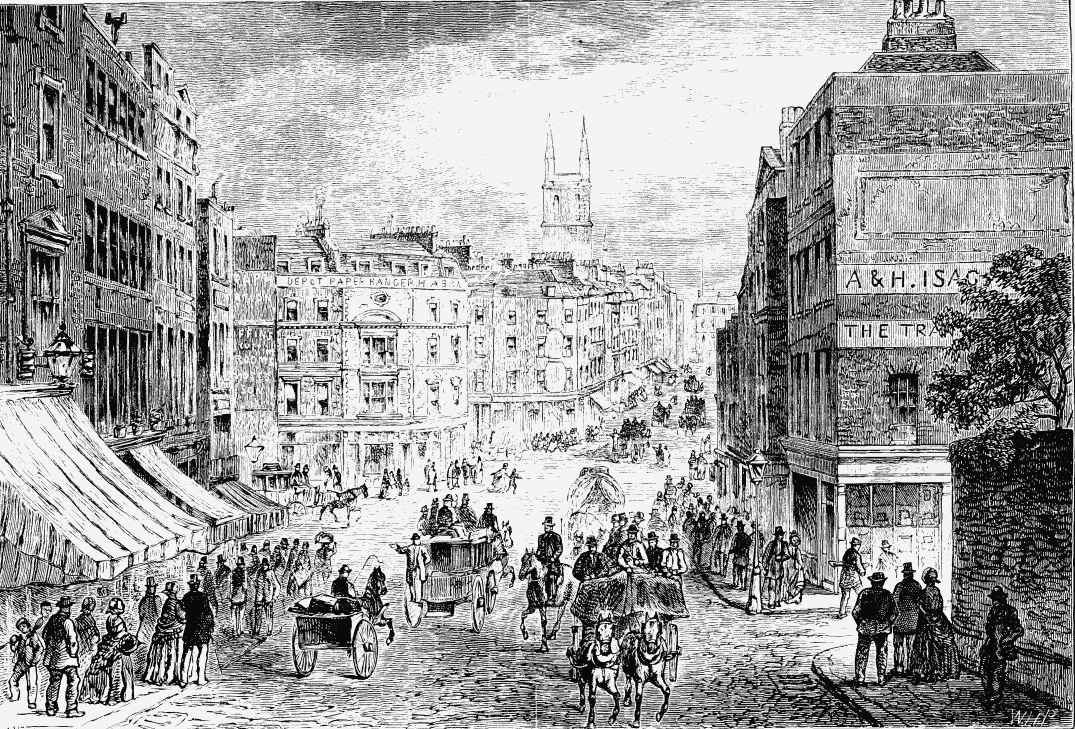
HOLBORN VALLEY AND SNOW HILL PREVIOUS TO THE CONSTRUCTION OF THE VIADUCT.
Among the secret marriages in the Fleet we should not forget Churchill the poet, an abandoned clergyman, and Edward Wortley Montague. In 1821, says Mr. Timbs, a ton's weight of the Fleet register books (between 1686 and 1754) was purchased by Government, and deposited in the Registry Office of the Bishop of London, Godliman Street, Doctors' Commons. These registers can no longer be received in evidence at trials.