
Old and New London: Volume 2. Originally published by Cassell, Petter & Galpin, London, 1878.
This free content was digitised by double rekeying. All rights reserved.
'The Old Bailey', in Old and New London: Volume 2, (London, 1878) pp. 461-477. British History Online https://www.british-history.ac.uk/old-new-london/vol2/pp461-477 [accessed 18 April 2024]
In this section
CHAPTER LIV.
THE OLD BAILEY.
Origin of the Name—The Old Sessions House—Constitution of the Court in Strype's time—The Modern Central Criminal Court—Number of Persons tried here annually—Old Bailey Holidays—Speedy Justice—A Thief's Defence—The Interior of the Old Court—Celebrated Criminals tried here—Trial of the Regicides—Trial of Lord William Russell—The Press-yard—The Black Sessions of 1750—Sprigs of Rue in Court—Old Bailey Dinners—The Gallows in the Old Bailey—The Cart and the New Drop—Execution Statistics—Execution Customs— Memorable Executions—A Dreadful Catastrophe—The Pillory in the Old Bailey—The Surgeons' Hall—A Fatal Experiment—The Dissection of Lord Ferrers—Goldsmith as a Rejected Candidate—Famous Inhabitants—The Little Old Bailey—Sydney House—Green Arbour Court and Breakneck Steps—Goldsmith's Garret—A Region of Washerwomen—Percy's Visit to Goldsmith.
There is some dispute as to the origin of the name "Old Bailey," for while some think it implies the Ballium, or outer space beyond the wall, Maitland refers it to Bail Hill, an eminence where the bail, or bailiff, lived and held his court. Stow thinks the street was called from some old court held there, as, in the year 1356, the tenement and ground upon Houndsditch, between Ludgate on the south and Newgate on the north, was appointed to John Cambridge, fishmonger and Chamberlain of London, "whereby," he says, "it seems that the Chamberlains of London have there kept their courts as now they do by the Guildhall; and to this day the mayor and justices of this City kept their sessions in a part thereof now called the Sessions Hall, both for the City of London and Shire of Middlesex."
Strype describes the Old Sessions House as a fair and stately building, very commodious, and with large galleries on both sides for spectators, "the court-room," he remarks, "being advanced by stone steps from the ground, with rails and banisters, enclosed from the yard before it; and the bail-dock, which fronts the court where the prisoners are kept until brought to their trials, is also inclosed. Over the court-room is a stately diningroom, sustained by ten stone pillars, and over it a platform, headed with rails and banisters. There be five lodging-rooms, and other conveniences, on either side the court. It standeth backwards, so it hath no front toward the street; only the gateway leadeth into the yard before the house, which is spacious. It cost above £6,000 the building." A Court-house was erected here in 1773. It was destroyed in the "No Popery" Riots of 1780, but was rebuilt and enlarged in 1809 by the addition of the site of the old Surgeons' Hall.
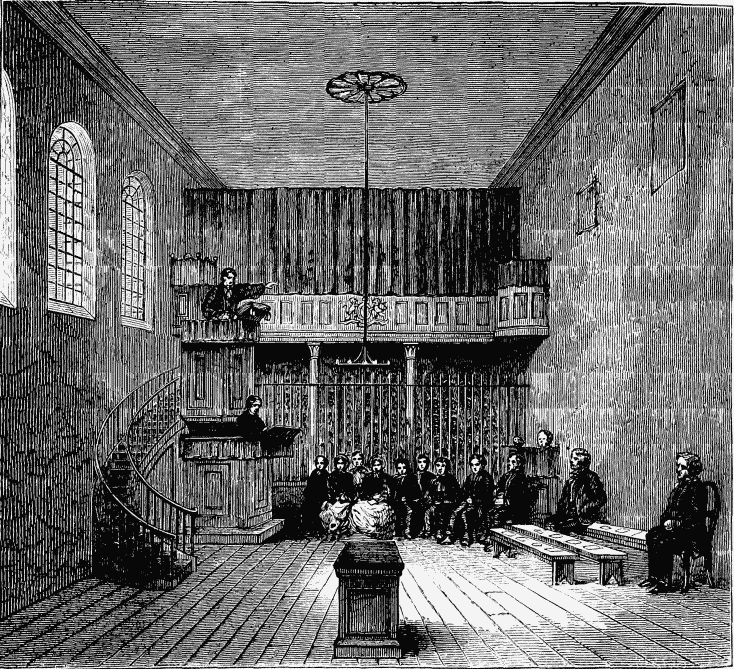
THE CHAPEL IN NEWGATE.
The old constitution of this court for malefactors is given by "R. B.," in Strype (v. 384). "It," he says, "is called the King's Commission on the Peace of Oyer and Terminer, and Gaol Delivery of Newgate, for the City of London and County of Middlesex, which court is held at Justice Hall, in the Old Bailey, commonly called the Sessions House, and generally eight times, or oftener, every year. The judges are the Lord Mayor, the Recorder, and others of his Majesty's Justices of the Peace of the City of London, the two Sheriffs of London being always present; and oftentimes the judges (being always in these commissions) come, and sit to give their assistance. The jurors, for all matters committed in London, are citizens of London, … and the jurors for crimes and misdemeanors committed in Middlesex, are freeholders of the said county."
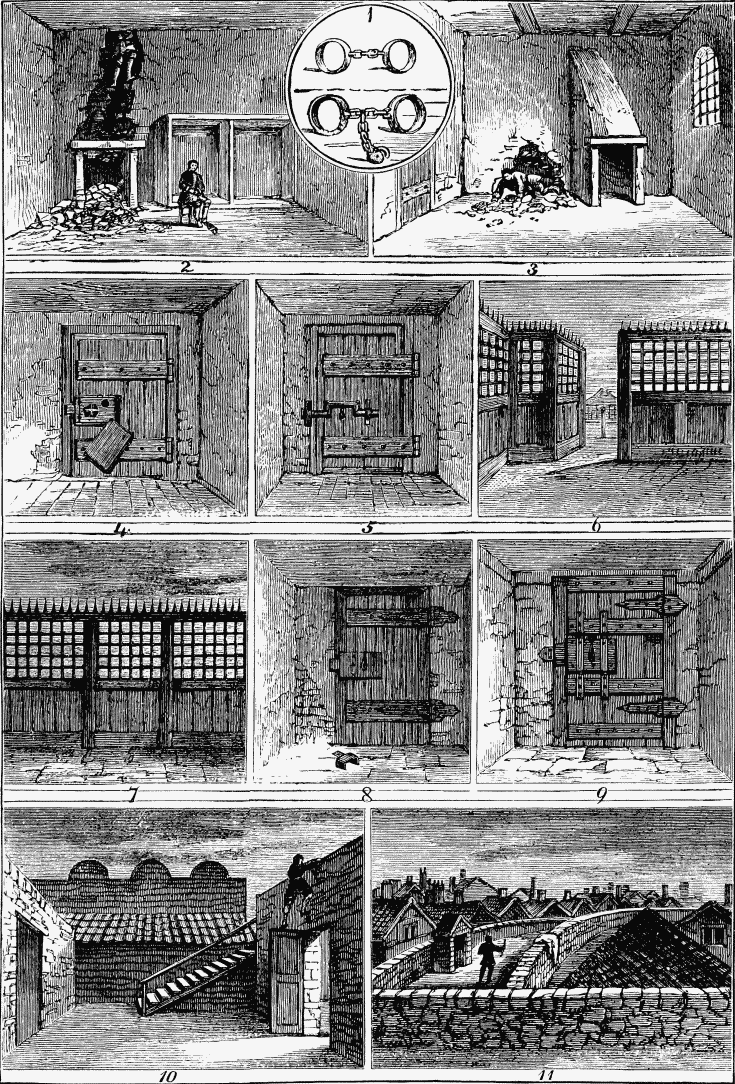
JACK SHEPPARD'S ESCAPES.
1. Handcuffs and Feetlocks, and Padlock to Ground.
2. Cell over the Castle, Jack Sheppard fastened to the floor. Climbing up the
Chimney, where he found a bar of iron.
3. Red Room over the Castle, into which he got out of the Chimnoy.
4. Door of the
Red Room, the lock of which he burst open.
5. Door of the Entry between the Red Room and the Chapel.
6. Door going into the Chapel, which he burst open.
7. Door going out of the Chapel towards the Leads.
8. Door with a Spring 'Lock, which he opened.
9. Door over the same Passage.
10. The Lower Leads.
11. The Higher Leads, the walls of which he
got over, and descended by the staircase off the roof of a turner's house into the street.
Under the general title, "The Central Criminal Court," are joined both what are called the Old Court and the New. The former deals with the more weighty cases—those of deepest dye—and has echoed, without doubt, to more tales of the romance of crime than any other building in the kingdom.
"The judges of the Central Criminal Court," says Mr. Timbs (1868), "are the Lord Mayor (who opens the court), the Sheriffs, the Lord Chancellor (such is the order of the Act), the Judges, the Aldermen, Recorder, Common Serjeant of London, Judge of the Sheriff's Court, or City Commissioner, and any others whom the Crown may appoint as assistants. Of these the Recorder and Common Serjeant are in reality the presiding judges; a judge of the law only assisting when unusual points of the law are involved, or when conviction affects the life of the prisoner. Here are tried crimes of every kind, from treason to the pettiest larceny, and even offences committed on the high seas. The jurisdiction comprises the whole of the metropolis as now defined; with the remainder of Middlesex; the parishes of Richmond and Mortlake, in Surrey; and great part of Essex."
The court is regulated by Act of Parliament 4 and 5 Will. IV., c. 36.
As to the number of persons who are brought here into public notice, Mr. Sheriff Laurie, writing to the Times of November 28th, 1845, says, "I find upon investigation that upwards of two thousand persons annually are placed at the bar of the Old Bailey for trial. About one-third are acquitted, one-third are first offences, and the remaining portion have been convicted of felony before."
Trials are going on at the Old Bailey almost all the year round. Frequent, however, as they are, there are occasional pauses. Justice, it has been said, must nod sometimes, and therefore it is as well to provide for fitting repose elsewhere than on the judgment-seat. The sittings of the Central Criminal Court are held monthly, but as the whole of the month is not occupied in the trial of the prisoners on the calendar, the spare time forms a vacation, and such are the only vacations at the Old Bailey. In consequence of these frequent sittings, trials are often conducted and prisoners rewarded according to their merits, with surprising swiftness. A criminal may be guilty of theft in the morning, be apprehended before night, be committed by a magistrate the next day, and the day after that be tried, convicted, and sentenced at the Old Bailey—a speedy administration of justice, which must be highly gratifying to all concerned.
"The usual defence of a thief, especially at the Old Bailey," says Fielding, writing of the increase of robbers, "is an alibi. To prove this by perjury is a common act of Newgate friendship; and there seldom is any difficulty in procuring such witnesses. I remember a felon, within this twelvemonth, to have been proved to be in Ireland at the time when the robbery was sworn to have been done in London, and acquitted; but he was scarce gone from the bar, when the witness was himself arrested for a robbery committed in London, at that very time when he swore both he and his friend were in Dublin; for which robbery I think he was tried and executed."
The interior of the Old Court, which, naturally
enough, from every point of view is more interesting than that of the New one, has been described
in a lively manner by a writer in Knight's "Cyclopædia of London" (1851). "Passing," he says,
"through a door in the wall which encloses the
area between Newgate and the courts, we find a
flight of steps on our right, leading up into the
Old Court. This is used chiefly for prosecutors and
witnesses. Farther on in the area, another flight
of steps leads to a long passage into a corridor at
the back of the court, with two doors opening into
the latter, by one of which the judges and sheriffs
reach the bench, and by the other, the barristers
their place in the centre at the bottom. Both
doors also lead to seats reserved for visitors. We
enter, pause, and look round. The first sentiment
is one of disappointment. The great and moral
power and pre-eminence of the court makes one,
however idly and unconsciously, anticipate a
grander physical exhibition. What does meet our
gaze is no more than a square hall of sufficient
length, and breadth, and height, lighted up by three
large square windows on the opposite wall, showing
the top of the gloomy walls of Newgate, having on
the left a gallery close to the ceiling, with projecting
boxes, and on the right, the bench, extending the
whole length of the wall, with desks at intervals
for the use of the judges, whilst in the body of the
court are, first, a dock for the prisoners below the
gallery, with stairs descending to the covered passage by which prisoners are conveyed to and from
the prison; then, just in advance of the left-hand
corner of the dock, the circular witness-box, and
in a similarly relative position to the witness-box,
the jury-box, below the windows of the court, an
arrangement that enables the jury to see clearly and
without turning, the faces of the witnesses and of
the prisoners; that enables the witness to identify
the prisoner; and lastly, that enables the judges
on the bench, and the counsel in the centre of the
court below, to keep jury, witnesses, and prisoners
all at once within the same, or nearly the same, line
of view. We need only add to these features of
the place the formidable row of law-books which
occupies the centre of the green-baized table,
around which are the counsel, reminding us of the
passage in the 'Beggars' Opera'—
'The charge is prepared, the lawyers are met,
The judges all ranged, a terrible show;'
the double line of reporters occupying the two
seats below us; the sheriff in attendance for the
day, looking so spruce in his court suit, stepping
noiselessly in and out; and lastly the goodly personage in the blue and furred robes and gold chain,
who sits in the centre on the chief seat, with the
gilded sword of justice suspended over his head
against the crimson-lined wall. Some abstruse
document, apparently, just now engages his attention, for he appears utterly absorbed in it, bending
over his desk. 'It must surely be the Lord Chancellor come to try some great case,' thinks many
an innocent spectator; but he rises, and we perceive it is only an ex-mayor reading the newspaper
of the day. But we forgot: Hazlitt said that a City
apprentice who did not esteem the Lord Mayor
the greatest man in the world, would come some
day to be hanged; and here everybody apparently
is of the same opinion. 'Who, then, is the judge?'
one naturally asks; when, looking more attentively,
we perceive for the first time, beyond the representative of civic majesty, which thus asserts its
rights, some one writing, taking frequent but brief
glances at the prisoners or the witnesses, but never
turning his head in any other direction, speaking to
no one on the bench, unspoken to. That is a judge
of the land, quietly doing the whole business of the
court." The court formerly sat at the early hour
of 7 a.m.
In 1841, both the Old Court and the New Court were ventilated, upon Dr. Reid's plan, from chambers beneath the floors, filled with air filtered from an apartment outside the building, the air being drawn into them by an enormous discharge upon the highest part of the edifice, or propelled into them by a fanner. From the entire building the vitiated air is received in a large chamber in the roof of the Old Court, whence it is discharged by a gigantic iron cowl, fifteen feet in diameter, weighing two tons, and the point of the arrow of the guiding vane weighing 150 pounds. The subterrannean air-tunnels pass through a portion of the old City wall.
It was at the Old Bailey, in 1727, that Richard Savage, the dissolute poet, for whom Dr. Johnson seems to have felt an affection, was tried. The poet was out, one night, drinking and rioting with two gentlemen named Merchant and Gregory, when they agreed to turn in at "Robinson's" Coffee House, near Charing Cross. Merchant, demanding a room in a bullying way, was told there was a fire ready-made in the next partition, where the company were about to leave. The three men at once rushed in, and placed themselves between the fire and the persons who were there, and kicked down a table. A fight ensued, and Savage ran a Mr. James Sinclair through the body. He also wounded a servant-girl who tried to hold him, and broke his way out of the house. He was taken, however, in a back court, where some soldiers had come to his assistance. The next morning the three revellers were carried before the justices, who sent them to the Gate House, and on the death of Mr. Sinclair they were removed to Newgate. They were not, however, chained, and were placed apart from the vulgar herd in the press-yard. It was proved that the fatal stab was given by Savage, and he was consequently found guilty of murder. It is said that his supposed mother, the Countess of Macclesfield, did all she could to bring Savage to the gallows; but the Countess of Hertford, Lord Tyrconnel, and Mrs. Oldfield, the actress, obtained for him at last the king's pardon.
Among other celebrated criminals who have been tried at the Old Bailey and Central Criminal Courts, may be briefly mentioned the following:— Major Strangways, the assassin, in 1659; Colonel Turner and his family, for burglary in Lime Street, 1663; Green, Berry, and Hill, for the murder of Sir Edmundbury Godfrey, 1678; Count Koningsmark and three others for the assassination of Mr. Thynne, 1681; Rowland Walters and others, for the murder of Sir Charles Pym, Bart., 1688; Harrison, for the murder of Dr. Clenche, 1692; Beau Fielding, for bigamy, 1706; Richard Thornhill, Esq., for killing Sir Cholmeley Deering in a duel, 1711; the Marquis di Paleotti, for the murder of his servant in Lisle Street, 1718; Major Oneby, for killing in a duel, 1718 and 1726; Jonathan Wild, the thief-taker, 1725; the infamous Colonel Charteris, 1730; Elizabeth Canning, an inexplicable mystery, 1753; Baretti, for stabbing, 1769; the two Perraus, for forgery, 1776; the Rev. Mr. Hackman, for shooting Miss Reay, 1779; Ryland, the engraver, for forgery, 1783; Barrington, the pickpocket, 1790; Renwick Williams, for stabbing, 1790; Theodore Gardelle, for murder, 1790; Hadfield, for shooting at George III., 1800; Captain Macnamara, for killing Colonel Montgomery in a duel, 1803; Aslett, the Bank clerk, for forgery on the Bank to the extent of £320,000, 1803; Holloway and Haggerty, for murder, 1807; Bellingham, the assassin of Mr. Spencer Percival, 1812; Cashman, the sailor, for riot on Snow Hill (where he was hanged), 1817; Richard Carlile, for blasphemy, 1819 and 1831; St. John Long, the counter-irritation surgeon, for manslaughter, 1830 and 1831; Bishop and Williams, for murder by "burking," 1831; Greenacre, for murder, 1837; G. Oxford, for shooting at the Queen, 1840; Blakesley, for murder in Eastcheap, 1841; Beaumont Smith, for forgery of Exchequer bills, 1841; J. Francis, for an attempt to shoot the Queen, 1842; McNaughten, who shot Mr. Drummond in mistake for Sir R. Peel, 1843; Dalmas, for murder on Battersea Bridge, 1844; Barber, Fletcher, &c., for will-forgeries, 1844; Manning and his wife, for murder, 1849; Palmer, the Rugeley poisoner, whose trial lasted a fortnight, 1856; and seven pirates, convicted of murder on the high seas, within the jurisdiction of the Admiralty of England, 1864.
But besides those criminals, outcasts of society, and notorious for their evil deeds, the Old Bailey has disposed of another class, distinguished by their noble and elevated principles, and famed for their patriotism. Here were tried, in 1660, immediately after the Restoration, those of the judges of Charles I. who were still alive, and, relying on the promised bill of indemnity, had remained in England; and twenty-three years later, in the same reign, a nobleman whose name has become a household word—in connection with his illustrious friend, Sidney—Lord William Russell.
The trial of the regicides commenced on the 9th of October, 1660, before a court of thirty-four commissioners, of whom some were old royalists; others, such as Manchester, Say, Annesley, and Hollis, had been all members of the Long Parliament; and with these sat Monk, Montague, and Cooper, the associates of Cromwell, who, one would think, from motives of delicacy, would have withheld from the tribunal. The prisoners were twenty-nine in number, and included Sir Hardress Waller, Major-General Harrison, Colonel Carew, Cook, Hugh Peters, Scott, Harry Marten, and Scroop, among other scarcely less noticeable names. Waller was first called; he pleaded guilty, and thus escaped the scaffold. Harrison's turn came next. Animated by a fervid spirit of enthusiasm, perfectly free from all alloy of worldly motives, he spoke boldly in his defence. "Maybe I might be a little mistaken," said he, "but I did it all according to the best of my understanding, desiring to make the revealed will of God in His Holy Scriptures as a guide to me. I humbly conceive that what was done was done in the name of the Parliament of England—that what was done was done by their power and authority; and I do humbly conceive it is my duty to offer unto you in the beginning, that this court, or any court below the High Court of Parliament, hath no jurisdiction of their actions." His boldness could not save him; he was sentenced to death, and retired saying he had no reason to be ashamed of the cause in which he had been engaged. Colonel Carew's frame of mind was in tune with that of Harrison, and he also was condemned to death. Harry Marten began a most ingenious and persevering defence by taking exception to the indictment. He declared he was not even mentioned in it! It certainly included a name, Henry Marten, but that was not his—his was Harry Marten. This was overruled, and the trial proceeded. The Solicitor-General having said, "I am sorry to see in you so little repentance," Marten replied, "My lord, if it were possible for that blood to be in the body again, and every drop that was shed in the late wars, I could wish it with all my heart; but, my lord, I hope it is lawful to offer in my defence that which, when I did it, I thought I might do. My lord, there was a House of Commons as I understood it: perhaps your lordship thinks it was not a House of Commons, but it was then the supreme authority of England; it was so reputed both at home and abroad." He then went on to plead that the statute of Henry VIII. exempted from high treason any one acting under a king de facto, though he should not be a king de jure. No arguments would move the Old Bailey judge and jury of that day. Marten also was condemned. As for the other prisoners, all of them were found guilty, but those who had surrendered themselves voluntarily were, with one exception, that of Scroop, respited. Ten were executed. All, it has been remarked, died with the constancy of martyrs, and it is to be observed that not a single man of those who had a share in the death of the late king seems to have voluntarily repented of the deed.
It was at the trial of the regicides that the ridiculous story was first given in evidence by a soldier, who declared that when Harry Marten and Cromwell signed the death-warrant of the king, they wiped their pens on each other's faces.
The trial of Lord William Russell for his alleged connection with the Rye House Plot commenced at the Old Bailey on the 13th of July, 1683. He was charged with conspiring the death of the king, and consulting how to levy war against him. As was the case in the trial of the regicides, there is no doubt that the jury was packed by the sheriffs. Lord Russell desired the postponement of the trial till the afternoon, on account of an error in the list of the jury, and of the non-arrival of some witnesses from the country. The Attorney-General, Sir Robert Sawyer, corruptly assuming his guilt as already proven, answered harshly, "You would not have given the king an hour's notice for saving his life; the trial must proceed." Desiring to take notes of the evidence, the prisoner asked if he might have assistance. "Yes, a servant," said Sir Robert D. Pemberton, Chief Justice of the Common Pleas, who presided, adding, "any of your servants shall assist you in writing anything you please for you." "My lord," was the answer, "my wife is here to do it." No wonder that a thrill ran through the crowd of spectators when they saw the daughter of the excellent and popular Lord Southampton thus bravely aiding her husband in his defence! The incident was not likely to be forgotten, and both painters and poets have long delighted to dwell on the image
"Of that sweet saint who sat by Russell's side."
Every one knows how the trial ended, and how the unfortunate but noble-minded Russell was, on the 21st of July, executed in Lincoln's Inn Fields.
The Press-Yard at the Old Bailey still, by its name, commemorates one of the cruelties of our old statute-book. In all cases where a criminal refused to plead at the bar, in order to preserve his property from being forfeited to the Crown, the peine forte et dure was used. The most celebrated case of the application of this torture was in 1659, when Major Strangways endured it, to save his estate. He and his elder sister had shared a farm peacefully enough, till the sister married a lawyer named Fussell, whom Strangways disliked. He had been, indeed, heard to say that if ever his sister married Fussell, he would be the death of him in his study, or elsewhere. One day Fussell was shot at his lodgings in London, and suspicion fell on Strangways, who consented to the ordeal of touch. At his trial Strangways refused to plead. He wished to bestow his estate on his best friends, and he hoped to escape the ignominy of the gibbet. Lord Chief Justice Glynn then passed the sentence, "That he be put into a mean house, stopped from any light, and be laid upon his back, with his body bare; that his arms be stretched forth with a cord, the one to one side, the other to the other side of the prison, and in like manner his legs be used; and that upon his body be laid as much iron and stone as he can bear, and more. The first day he shall have three morsels of barley bread, and the next he shall drink thrice of the water in the next channel to the prison door, but of no spring or fountain water; and this shall be his punishment till he die."
On the Monday following Strangways was clothed in white from top to toe, and wearing a mourning cloak (for indeed it was his own funeral to which he was going). His friends placed themselves at the corner of the press, and when he gave the word, put on the weights. This was done till he uttered the words, "Lord Jesus, receive my soul," but the weight being too light to produce instant death, those present stood on the board, as a ghastly and last act of friendship. The poor fellow bore this some eight or ten minutes.
After the almost entire abolition of this cruel practice, it was the custom to force the prisoners to plead, if possible, by screwing the thumb with whipcord, a sort of buccaneer form of cruelty. In 1721, Mary Andrews was tortured thus. The first three whipcords broke, but she gave way with the fourth. The same year (for the press was still partially continued) the cord was tried first on a criminal named Nathaniel Hawes, who then was pressed under a weight of 250 pounds, and he consented to plead. According to one writer on the subject, the cord torture was last used about 1734.
A tragic episode in the history of the administration of justice in the Old Bailey was the invasion of the court by the gaol-fever during the sessions of May, 1750. The gaol-fever raged so violently in the neighbouring prison that the effluvia, entering the court, caused the death of the Judge of the Common Pleas, Sir Thomas Abney, Baron Clark, Pennant the historian's "respected kinsman," Sir Samuel Pennant, Lord Mayor, and several members of the Bar and of the jury.
The occasion of this misadventure, and a few particulars concerning it, have been recorded for the benefit of posterity. A Captain Clarke was being tried for killing a Captain Turner, and the court was unusually crowded. About one hundred prisoners were tried, and they were kept all day cooped up in two small rooms 14 feet by 11 feet each way, and only 7 feet high. It was remarked that the Lord Chief Justice and the Recorder, who sat on the Lord Mayor's right hand, caught, while the rest of the bench, on the left, escaped, the infection. This was attributed to the draught, that carried the infected air in that direction. Every precaution was afterwards taken, says Pennant, to keep the court airy; but as several of these fatal accidents had already happened in the kingdom, it was rather surprising "that the neglect of the salutary precautions was continued till the time of this awakening call." The disease again proved fatal to several in 1772.
Upon the first outbreak of the gaol-fever the custom arose of placing rue in front of the dock of the Old Bailey to prevent infection: so it is stated in Lawrence's "Life of Fielding" (1855). At the trial of Manning and his wife for murder, it will be remembered that at the conclusion of a speech by one of the counsel, Mrs. Manning gathered some of "the sprigs of rue placed on the dock," and threw them vehemently over the wigged heads of the "learned" gentlemen.
Over the court-room is a dining-room, where the
judges have long been in the habit of dining when
the court was over—a practice commemorated by
a well-known line—
"And wretches hang that jurymen may dine."
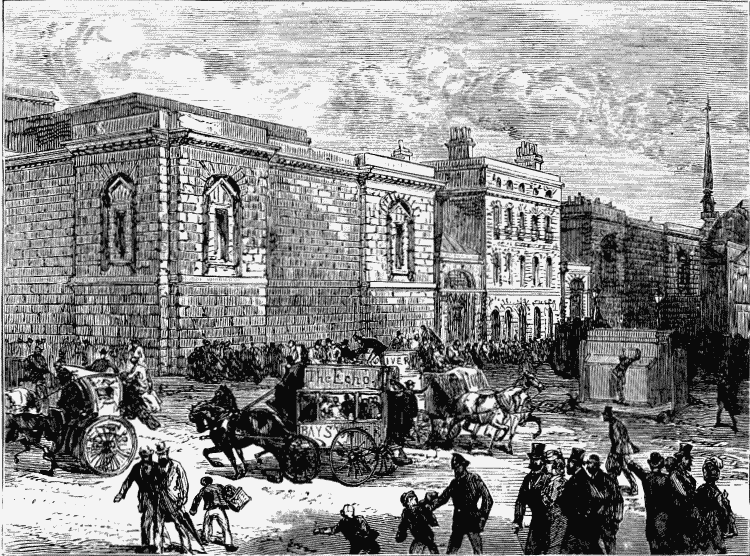
FRONT OF NEWGATE FROM THE OLD BAILEY.
"If we are not misinformed," says an amusing writer in the Quarterly Review for 1836, "the fiat has gone forth already against one class of City dinners, which was altogether peculiar of its kind. We allude to the dinner given by the sheriffs during the Old Bailey sittings to the judges and aldermen in attendance, the Recorder, Common Serjeant, City pleaders, and occasionally a few members of the Bar. The first course was rather miscellaneous, and varied with the season, though marrowpuddings always formed a part of it; the second never varied, and consisted exclusively of beefsteaks. The custom was to serve two dinners (exact duplicates) a day, the first at three o'clock, the second at five. As the judges relieved each other it was impracticable for them to partake of both; but the aldermen often did so, and the chaplain, whose duty it was to preside at the lower end of the table, was never absent from his post. This invaluable public servant persevered from a sheer sense of duty, till he had acquired the habit of eating two dinners a day, and practised it for nearly ten years without any perceptible injury to his health. We had the pleasure of witnessing his performances at one of the five o'clock dinners, and can assert with confidence, that the vigour of his attack on the beef-steaks was wholly unimpaired by the effective execution a friend assured us he had done on them two hours before. The occasion to which we allude was so remarkable for other reasons, that we have the most distinct recollection of the circumstances. It was the first trial of the late St. John Long for rubbing a young lady into her grave. The presiding judges were Mr. Justice Park and Mr. Baron Garrow, who retired to dinner about five, having first desired the jury, amongst whom there was a difference of opinion, to be locked up. The dinner proceeded merrily, the beef-steaks were renewed again and again, and received the solemn sanction of judicial approbation repeatedly. Mr. Adolphus told some of his best stories, and the chaplain was on the point of being challenged for a song, when the court-keeper appeared with a face of consternation, to announce that the jury, after being very noisy for an hour or so, had sunk into a dull, dead lull, which, to the experienced in such matters, augurs the longest period of deliberation which the heads, or rather stomachs, of the jury can endure. The trial had, unfortunately, taken place upon a Saturday, and it became a serious question in what manner the refractory jurymen were to be dealt with. Mr. Baron Garrow proposed waiting till within a few minutes of twelve, and then discharging them. Mr. Justice Park, the senior judge, and a warm admirer of the times when refractory juries were carried round the country in a cart, would hear of no expedient of the kind. He said a judge was not bound to wait beyond a reasonable hour at night, nor to attend before a reasonable hour in the morning; that Sunday was a dies non in law, and that a verdict must be delivered in the presence of the judge. He consequently declared his intention of waiting till what he deemed a reasonable hour—namely, about ten— and then informing the jury that, if they were not agreed, they must be locked up without fire or candle until a reasonable hour (about nine) on the Monday, by which time he trusted they would be unanimous. The effect of such an intimation was not put to the test, for Mr. St. John Long was found guilty about nine. We are sorry to be obliged to add that the worthy chaplain's digestion has at length proved unequal to the double burthen imposed upon it; but the Court of Aldermen, considering him a martyr to their cause, have very properly agreed to grant him an adequate pension for his services."
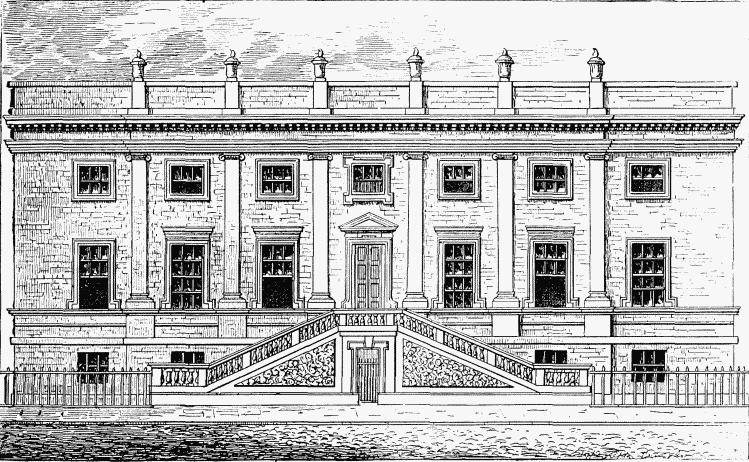
SURGEONS' HALL, OLD BAILEY, 1800.
In 1807–8 the dinners for three sessions, nineteen days, cost Sheriff Phillips and his colleague £35 per day—£665; 145 dozen of wine was consumed at these dinners, costing £450, so that the total of the bill came to £1,115.
And now we take leave of the Central Criminal
Court, according to Garth, in his "Dispensary,"
"—That most celebrated place,
Where angry Justice shows her awful face;
Where little villains must submit to fate,
That great ones may enjoy the world in state."
The Old Bailey—that part of the street opposite to Newgate—became the scene of public executions in 1783, on the 9th of December in which year the first culprit suffered here the extreme penalty of the law. Before that time the public executions ordinarily took place at Tyburn. The gallows of the Old Bailey was built with three cross-beams for as many rows of victims, and between February and December, 1785, ninety-six persons suffered by the "new drop," an ingenious invention which took the place of the cart. On but one occasion the old mode of execution was revived; a triangular gallows was set up in the road, opposite Green Arbour Court, and the cart was drawn from under the criminal's feet.
The front of Newgate continued to be the place of execution in London from 1783 to 1868, when an Act was passed directing executions to take place within the walls of prisons. This Act was the result of a commission on capital punishments, appointed in 1864, which, in their report issued in 1865, recommended, amongst other things, that executions should not be public. The number of executions throughout the country has been gradually decreasing for many years, as our laws have become less severe. In 1820 there were fortythree executions in London; in 1825, seventeen; in 1830, six; in 1835, none; in 1836, none; in 1837, two; in 1838, none; in 1839, two; in 1840, one; in 1842, two; in 1843, none; in 1844, one; in 1845, three; in 1846, two; and from 1847 to 1871 the average has been 1.48 per annum. What a contrast this presents to the stern old times when the law of the gallows and the scaffold kept our forefathers in order! In the reign of Henry VIII. —thirty-eight years—it is said that no fewer than 72,000 criminals were executed in England!
It used to be occasionally the usage to execute the criminal near the scene of his guilt. Those who were punished capitally for the riots of 1780 suffered in those parts of the town in which their crimes were committed; and in 1790 two incendiaries were hanged in Aldersgate Street, at the eastern end of Long Lane, opposite the site of the house to which they had set fire. "Since that period," Mr. Timbs observes, "there have been few executions in London except in front of Newgate. The last deviation from the regular course was in the case of the sailor Cashman, who was hung in 1817, in Skinner Street, opposite the house of Mr. Beckwith, the gunsmith, which he had plundered."
About 1786 was witnessed in the Old Bailey the end of an old practice: the body of the criminal just executed was burned for the last time. A woman was the sufferer in this case. She was hung on a low gibbet, and on life being extinct, fagots were heaped around her and over her head, fire was set to the pile, and the corpse was burned to ashes.
The memorable executions at the Old Bailey include those of Mrs. Phepoe, for murder, December 11, 1797; Holloway and Haggerty, February 23rd, 1807; Bellingham, May 18th, 1812; Joseph Hunton (Quaker), December 8th, 1828; Bishop and Williams, December 5, 1831; John Pegsworth, March 7th, 1837; James Greenacre, May 2, 1837; besides several others already mentioned by us as having undergone trial at the adjoining court of justice.
A dreadful accident took place here at the execution of Holloway and Haggerty, on the 23rd of February, 1807, for the murder of Mr. Steele, on Hounslow Heath, in 1802. Twenty-eight persons were crushed to death. We have already alluded to the circumstances, and to our previous notice the following account of the catastrophe, by a writer in the Annual Register, must be regarded as supplementary:—"On the north side of the Old Bailey, the multitude to see the execution was so immensely great that, in their movements, they were not inaptly compared to the flow and reflow of the waves of the sea, when in troubled motion. In the centre of this vast concourse of people was placed a cart, in which persons were accommodated with standing-places to see the culprits; but, it is supposed from the circumstance of too many being admitted into it, the axle-tree gave way, and by the concussion many persons were killed. Unhappily, the mischief did not stop here. A temporary chasm in the crowd being thus made by the fall of the cart, many persons rushed forward to get upon the body of it, which formed a kind of platform, from which they thought they could get a commanding view over the heads of the persons in front. All those who, from choice or necessity, were nearest to the cart, strove to get upon it; and in their eagerness drove those in front headforemost among the crowd beneath, by whom they were trampled under foot, without the power of relieving them. The latter in turn were in like manner assailed, and shared the same fate. This dreadful scene continued for some time. The shrieks of the dying men, women, and children were terrific beyond description, and could only be equalled by the horror of the event." The most affecting scene of distress was seen at Green Arbour Court, nearly opposite the Debtors' Door.
Offenders frequently stood in the pillory in the Old Bailey, and there, no doubt, were often, as was customary, stoned by the mob, and pelted with rotten eggs, and other equally offensive missiles. The pillory generally consisted of a wooden frame, erected on a scaffolding, with holes and folding boards for the admission of the head and hands of him whom it was desired to render thus publicly infamous. Rushworth says that it was invented for the special benefit of mountebanks and quacks, "who having gotten upon banks and forms to abuse the people, were exalted in the same kind," but it seems to have been freely used for cheats of all description. Bakers for making bread of light weight, and "dairymen for selling mingled butter," were in the olden time "sharply corrected" upon it. So also were fraudulent corn, coal, and cattle dealers, cutters of purses, sellers of sham gold rings, keepers of infamous houses, forgers of letters, bonds, and deeds, counterfeits of papal bulls, users of unstamped measures, and forestallers of the markets. But just as the Old Bailey Court witnessed occasionally the persecution of the innocent, so the pillory had at one time other heroes than cheats, thieves, scandalmongers, and perjurers. "Thanks to Archbishop Laud, and Star Chamber tyrants," says the late Dr. Robert Chambers, "it figured so conspicuously in the political and polemical disputes which heralded the downfall of the monarchy, as to justify a writer of our own time in saying, 'Noble hearts had been tried and tempered in it; daily had been elevated in it mental independence, manly self-reliance, robust, athletic endurance. All from within that has undying worth it had but more plainly exposed to public gaze from without.'" Many a courageous and outspoken thinker will occur to every reader of English history as having been set on this scaffold of infamy, to the lasting disgrace of narrow-minded tyranny.
The last who stood in the pillory of London was Peter James Bossy, tried for perjury, and sentenced to transportation for seven years. Previous to being transported he was to be kept for six months in Newgate, and to stand for one hour in the pillory in the Old Bailey. The pillory part of the sentence was executed on the 24th of June, 1830.
An Act of the British Parliament, dated June 30, 1837, put an end to the use of the pillory in the United Kingdom. In 1815 it had been abolished as a punishment except for perjury.
The Surgeons' Hall stood in the Old Bailey, on the site of the New Sessions House, till 1809. Pennant, in his "London," remarks, in connection with the old Court of Justice, that the erection of the Surgeons' Hall in its neighbourhood was an exceedingly convenient circumstance. "By a sort of second sight," he says, "the Surgeons' Theatre was built near this court of conviction and Newgate, the concluding stage of the lives forfeited to the justice of their country, several years before the fatal tree was removed from Tyburn to its present site. It is a handsome building, ornamented with Ionic pilasters, and with a double flight of steps to the first floor. Beneath is a door for the admission of the bodies of murderers and other felons, who, noxious in their lives, make a sort of reparation to their fellow-creatures by becoming useful after death."
The bodies of murderers, after execution, were dissected in the Surgeons' Theatre, according to an Act passed in 1752, and which was only repealed in the reign of William IV. A curious experiment was performed here, in the beginning of the century, on the body of one Foster, who was executed for the murder of his wife. It was "lately," says a writer in the Annual Register for 1803, "subjected to the galvanic process, by Mr. Aldini (a nephew of Galvani), in presence of Mr. Keate, Mr. Carpue, and several other professional gentlemen. On the first application of the process to the face, the jaw of the deceased criminal began to quiver, and the adjoining muscles were horribly contorted, and one eye actually opened. In a subsequent course of the experiment, the right hand was raised and clenched, and the legs and thighs were set in motion; and it appeared to all the bystanders that the wretched man was on the point of being re stored to life! The object of these experiments was to show the excitability of the human frame when animal electricity is duly applied; and the possibility of its being efficaciously used in cases of drowning, suffocation, or apoplexy, by reviving the action of the lungs, and thereby rekindling the expiring spark of vitality." But the most curious part of the proceedings remains to be told. According to Mr. J. Saunders, in Knight's "London," 1842, when the right arm was raised, as mentioned above, it struck one of the officers of the institution, who died that very afternoon of the shock.
In April, 1760, Laurence Earl Ferrers was tried before the House of Lords, for the murder of his steward, He was found guilty, and sentenced "to be hanged by the neck till he was dead; after which his body was to be delivered to Surgeons' Hall, to be dissected and anatomised." At the latter part of the sentence, we are told, his lordship cried out, "God forbid!" but, soon recollecting himself, added, "God's will be done!" On Monday, the 5th of May, he was hanged at Tyburn, and the body was conveyed, with some state, in his own landau and six, to the Surgeons' Hall, in the Old Bailey, to undergo the remainder of the sentence. A print of the time shows the corpse as it lay here.
It was at this hall that Goldsmith presented himself in a new suit—not paid for—to be examined as to his qualifications for being a surgeon's mate, on the 21st of December, 1758. "The beadle called my name," says Roderick Random, when he found himself in a similiar condition at that place of torture, "with a voice that made me tremble as much as if it had been the sound of the last trumpet. However, there was no remedy: I was conducted into a large hall, where I saw about a dozen of grim faces sitting at a long table, one of whom bade me come forward in such an imperious tone, that I was actually for a minute or two bereft of my senses."
"Whether the same process," says Mr. John Forster, "conducted through a like memorable scene, bereft poor Goldsmith altogether of his, cannot now be ascertained. All that is known is told in a dry extract from the books of the College of Surgeons: 'At a Court of Examiners, held at the Theatre, 21st December, 1758, present'—the names are not given, but there is a long list of the candidates who passed, in the midst of which these occur: 'James Bernard, mate to an hospital. Oliver Goldsmith, not qualified for ditto.'
"A harder sentence," continues Goldsmith's biographer, "a more cruel doom than this, at the time, must have seemed, even the Old Bailey has not often been witness to; yet, far from blaming that worthy court of examiners, should we not rather feel that much praise is due to them? That they did their duty in rejecting the short, thick, dull, ungainly, over-anxious, over-dressed, simple-looking Irishman who presented himself that memorable day, can hardly, I think, be doubted; but unconsciously they also did a great deal more. They found him not qualified to be a surgeon's mate, but left him qualified to heal the wounds and abridge the sufferings of all the world. They found him querulous with adversity, given up to irresolute fears, too much blinded with failures and sorrows to see the divine uses to which they tended still; and from all this their sternly just and awful decision drove him resolutely back. While the door of the Surgeons' Hall was shut upon him that day, the gate of the beautiful mountain was slowly opening."
At what used to be No. 68 of the Old Bailey, "the second door south of Ship Court," lived Jonathan Wild, the famous thief-taker, who had a very intimate acquaintance with the Sessions House.
A description of the Old Bailey would be decidedly incomplete were we to omit giving a sketch of the career of this noted inhabitant. Almost every great man arrives at eminence by zeal and energy, devoted to some particular calling; and it may be worth our pains to look for a little at that which Jonathan made peculiarly his own. His occupation was the restoration of stolen goods, carried on from about the year 1712, through a secret confederacy with all the regular thieves, burglars, and highwaymen of the metropolis, whose depredations he prompted and directed. An Act of Parliament, passed in 1717, tended rather to check the display of his peculiar talents. By this Act persons convicted of receiving or buying goods, knowing them to be stolen, were made liable to transportation for fourteen years; and by another clause, with a particular view to Wild's proceedings, a heavy punishment was awarded to all who trafficked in such goods and divided the money with felons. Wild's ingenuity and audacity, however, long enabled him to elude this new law. He was one of the cleverest of rogues, and it has been well said, in one sense, merited the name of "great," bestowed upon him by Fielding, in whose history of him, although the incidents are fictitious, there is no exaggeration of his talents or courage, any more than of his unscrupulousness and want of all moral principle. The plan upon which he conducted his extensive business operations was this. When thieves made prizes of any sort, they delivered them up to him, instead of carrying them to the pawnbroker, and Wild restored the goods to the owners, for a consideration, by which means large sums were raised, and the thieves remained secure from detection. To manage this, he would apply to persons who had been robbed, and pretend to be greatly concerned at their misfortunes, adding that some suspected goods had been stopped by a friend of his, a broker, who would be willing to give them up; and he did not fail to throw out a hint that the broker merited some reward for his disinterested conduct and his trouble, and to exact a promise that no disagreeable consequences should follow on account of the broker's having omitted to secure the thieves as well as the property. The person whose goods had been carried off was generally not unwilling by this means to save himself the trouble and expense of a prosecution, and the money paid was usually sufficient to remunerate the "broker," as well as his agent.
At last, after he had amassed a considerable sum, he adopted another and a safer plan. He opened an office, to which great numbers resorted, in the hope of obtaining the restitution of their property. His light was by no means hid under a bushel, and he kept it burning with the greatest credit and profit to himself. Let us suppose some one to have had goods stolen of a considerable value. He calls upon Mr. Wild, at his office, and pays half-a-crown for advice, Wild enters his name and address in his books, inquires particularly about the robbery, and sounds his client as to the reward he will give in the event of the restitution being made. "If you call again," he says, "I hope I shall be able to give you some agreeable information." He calls again. Wild says that he has heard about the goods, but the agent he has employed tells him that the robbers pretend that by pawning them they can raise more money than the amount of the reward. Would it not, he suggests, be a good plan to increase the reward? The client consents, and retires. He calls the third time. He has the goods placed in his hands: he pays the reward over to Jonathan, and there is the end of the transaction.
In the course of this business it will readily be perceived that Wild became possessed of the secrets of every notorious thief about London. All the highwaymen, shoplifters, and housebreakers knew that they were under the necessity of complying with whatever he thought fit to demand. Should they oppose his inclination, they were certain, ere long, to be placed within reach of the clutches of justice, and be sacrificed to the injured laws of their country. Wild led two lives, so to speak; one amongst ruffians, and the other as a man of consequence, with laced clothes and a sword, before the public eye; and the latter life was as unlike the former as any two lives could well be.
He professed, in public, to be the most zealous of thief-takers; and to ordinary observation his life and strength seemed devoted to the pursuit and apprehension of felons. At his trial—for his trial came at last—he had a printed paper handed to the jury, entitled, "A List of Persons discovered, apprehended, and convicted of several robberies on the highway, and also for burglary and housebreaking, and also for returning from transportation, by Jonathan Wild;" and it contained the names of thirty-five robbers, twenty-two housebreakers, and ten returned convicts, whom he had been instrumental in getting hanged. This statement was probably true enough. In the records of the trials at the Old Bailey, for many years before it came to his own turn, he repeatedly appeared, figuring in the witness-box, and giving evidence for the prosecution, and in many cases he seems to have taken a leading part in the apprehension of the prisoner.
In carrying on his trade of blood, Wild, of course, was occasionally turned upon by his betrayed and desperate victim. But, when this happened, his brazen-faced effrontery carried everything before it. In a trial, for example, of three unfortunate wretches indicted for several robberies in January, 1723, he gave the following account of his proceedings:—"Some coming (I suppose from the prosecutors) to me about the robbery, I made it my business to search after the prisoners, for I had heard that they used to rob about Hampstead; and I went about it the more willingly, because I had heard they had threatened to shoot me through the head. I offered £10 a head for any person who would discover them; upon which a woman came and told me that the prisoners had been with her husband, to entice him to turn out with them; and if I would promise he should come and go safely he would give me some intelligence. I gave her my promise; and her husband came accordingly, and told me that Levee and Blake, two of the party, were at that time cleaning their pistols at a house in Fetter Lane. I went thither and seized them both." The husband of the woman, it appears, had really taken part in one of the robberies, though he now came forward to convict his associates, having been, no doubt, all along in league with Wild; and Blake (better known to fame as Blueskin) also figured as king's evidence on this occasion, and frankly admitted that he had been out with the prisoners. The three unlucky characters in the dock, while their comrades thus figured in a freer and more pleasant situation, "all," says the account of the trial, vehemently "exclaimed against Jonathan Wild;" but they were found guilty, and had the pleasure of swinging in company on Tyburn-tree a few days afterwards.
But, in all fairness to Jonathan, it must be said that he did not, till the last moment, desert his friends, and that he only sacrificed them for the general good of the concern, and from a bold and comprehensive view of the true policy of trade. Blueskin's turn to be tried, convicted, and hanged, came about a couple of years after the affair just mentioned. Wild was to have been a witness against him; but a day or two before the trial, when he went to pay a visit to his intended victim, Blueskin drew out a clasp-knife, and, in a twinkling, fell upon Jonathan, and cut his throat. The blade was too blunt, however, and the thief-taker received no lasting damage. When the verdict was given, Blueskin addressed the court, and told them of an exceedingly kindly promise his late partner had made him. "On Wednesday last, Jonathan Wild said to Simon Jacobs (another prisoner soon after transported), 'I believe you will not bring £40 this time; I wish Joe (meaning me) was in your case; but I'll do my endeavour to bring you off as a single felon'" (crimes punishable only by transportation, whipping, imprisonment, &c., were denominated single felonies). "And then, turning to me, he said, 'I believe you must die; I'll send you a good book or two, and provide you a coffin, and you shall not be anatomised!'"
The reward of £40, it has been explained, which Wild could not manage to make Jacobs bring "this time," was part of a system established by various Acts of Parliament, which assigned certain money payments to be made to persons apprehending and prosecuting to conviction highway robbers, coiners, and other delinquents.
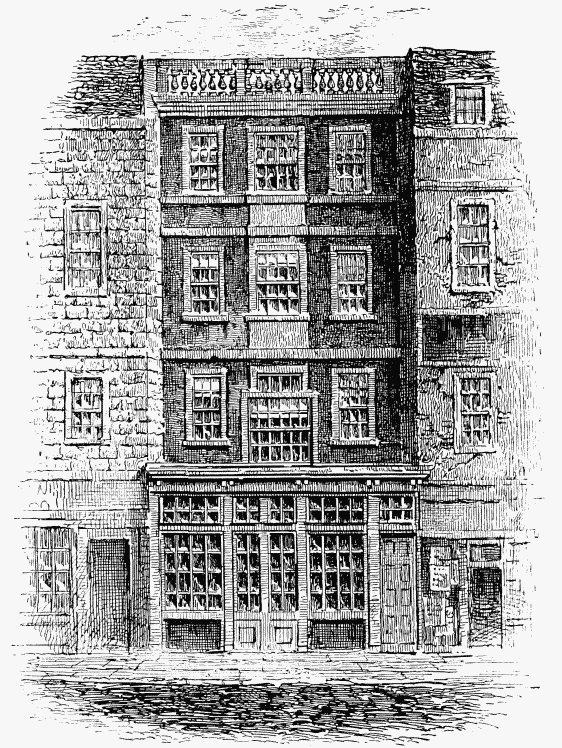
JONATHAN WILD'S HOUSE.
We come now to the end of Wild's career. He was committed to Newgate on the 15th of February, 1725, on a charge of having assisted a criminal in his escape from prison. In the course of a few days he moved to be either admitted to bail or discharged, but a warrant of detainer was produced against him in court, the first of several articles of information affixed to the warrant being, "That for many years past he had been a confederate with great numbers of highwaymen, pickpockets, housebreakers, shoplifters, and other thieves;" and the eleventh and last, that it appeared "he had often sold human blood by procuring false evidence to swear persons into facts of which they were not guilty." On Saturday, the 15th of May, he was brought to trial on two separate indictments. The jury found him guilty, and he was sentenced to be executed at Tyburn on Monday, the 24th of May, 1725. On the morning of the execution the wretched man swallowed a dose of poison, but it failed to end his life, and in a state of half-insensibility he was placed in the cart that was to convey him to the gallows. On the way he was pelted by the populace with stones and dirt, and, altogether, this arch-villain made rather a pitiable exit from this world. At the foot of the gallows he remained so long drowsy in the cart, that the mob called out to the hangman that they would knock him on the head if the hanging was not at once proceeded with. The amiable Jonathan had five wives. His eldest son, soon after his father's execution, sold himself for a servant to the plantations. A skull claiming to be the great thief-taker's was exhibited, some years ago, in St. Giles's, but as it was not fractured in several places, it was probably spurious. Wild boasted in prison of the numerous robbers he had captured, and the wounds he had received from them. The body of this infamous fellow was secretly buried.
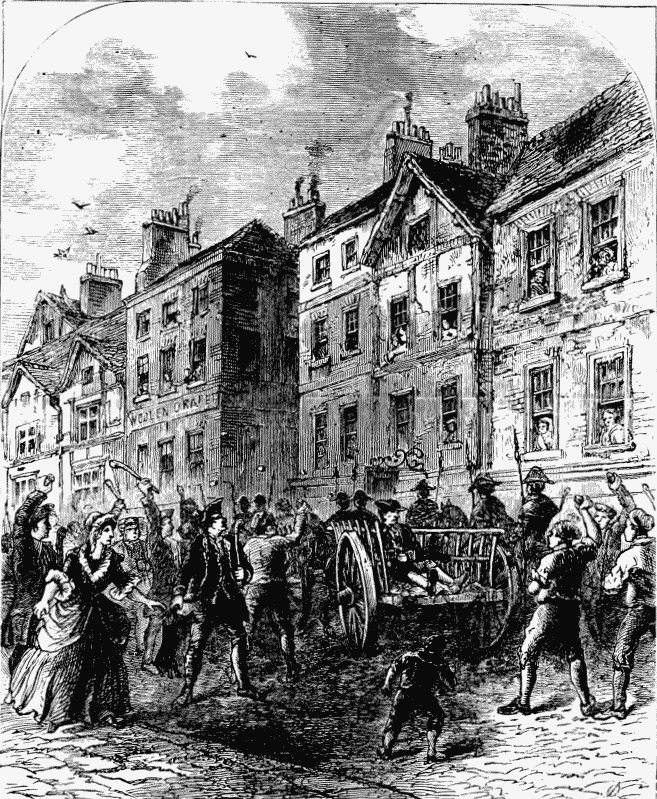
JONATHAN WILD IN THE CART. (From a Contemporary Print.)
Jonathan Wild's skeleton, says Mr. Timbs, in 1868, was some years since in the possession of a surgeon at Windsor. And a relic of him was judged of sufficient interest to be exhibited to the Society of Antiquaries in 1866. It was a musketoon given by Jonathan Wild to Blueskin, which had fallen into the hands of the well-known magistrate, Sir John Fielding, and by him had been given to his half-brother, Henry Fielding.
In 1841 a curious letter was found in the Town Clerk's Office of the City of London, from Jonathan Wild, asking for remuneration for services he had rendered to the cause of justice. In the same letter, written in 1723, he also prayed the Lord Mayor and the Court of Aldermen "to be pleased to admit him into the freedom of this honourable City," in consideration of his valuable services. There is a record that Jonathan Wild's petition was read by the Court of Aldermen, but we do not find evidence that the coveted freedom was awarded to him. Wild's house was long distinguished by the sign of the head of Charles I.
In the Old Bailey stood Sydney House, occupied, in the time of Pennant, by a coachmaker. Once it was the proud mansion of the Sydneys. They occupied it till their removal to Leicester House, at the north-east corner of Leicester Square.
The names of several eminent persons—altogether independent of the "Old Bailey Sessions House"—occur to us as we perambulate this interesting locality. William Camden, the "nourrice of antiquitie," was born in the Old Bailey, in 1550. His father was a paper-stainer here. In Ship Court, on the west side, Hogarth's father, Richard Hogarth, kept a school. He seems to have come early from the North of England, and was employed in London as a teacher and as a corrector of the press. He was a man of some learning; and Chalmers, writing in 1814, mentions that a dictionary in Latin and English, which he compiled for the use of schools, was then extant in manuscript. At No. 67, at the corner of Ship Court, William Hone, in 1817, gave to the world his three celebrated political parodies on the Catechism, the Litany, and the Creed, for which he was three times tried at Guildhall, and acquitted.
Peter Bales, the celebrated penman of the time of Queen Elizabeth, kept a writing-school, in 1590, at the upper end of the Old Bailey, and published his "Writing Schoolmaster" here. In a writing competition he once won a golden pen, of the value of £20, and in addition had the "arms of caligraphy—viz., azure, a pen or—given him as a prize." This clever writer had a steady hand, and wrote with such minuteness, that, remarks D'Israeli, in his "Curiosities of Literature," he astonished the eyes of beholders, by showing them what they could not see. In the Harleian MSS. (530) we have a narrative of "a rare piece of work brought to pass by Peter Bales, an Englishman, and a clerk of the Chancery," which seems, by the description, to have been the whole Bible "in an English walnut no bigger than a hen's egg. The nut," the account goes on to say, "holdeth the book. There are as many leaves in his little book as the great Bible; and he hath written as much in one of his little leaves as in a great leaf of the Bible." It is added that this wonderfully unreadable volume was "seen by thousands."
Prynne's "Histrio-Mastix, the Player's Scourge," was printed "for Michael Sparke, and sold at the 'Blue Bible,' in Green Arbour, in Little Old Bailey, 1633." This Little Old Bailey was a kind of Middle Row in the Old Bailey. It has long been removed.
One of the courts leading out of the Old Bailey was Green Arbour Court, which ran from the upper end of the street into Seacoal Lane. Here were the famous Breakneck Steps referred to by Ward in his "London Spy," when he speaks of "returning down-stairs with as much care and caution of tumbling head foremost as he that goes down Green Arbour Court steps in the middle of winter." This court, now destroyed, was specially interesting as the residence of Oliver Goldsmith, about 1758, a time when the poet was making shift to exist. As to his sojourn here we shall take the liberty of quoting a graphic passage from Mr. John Forster, one of the best of Goldsmith's numerous biographers.
"With part of the money," he says, "received from Hamilton"—the proprietor of the Critical Review, to which the poet was at this time contributing—"he moved into fresh lodgings; took unrivalled possession of a fresh garret, on a first floor. The house was No. 12, Green Arbour Court, Fleet Street, between the Old Bailey and the site of Fleet Market; and stood in the right-hand corner of the court, as the wayfarer approached it from Farringdon Street by the appropriate access of 'Breakneck Steps.' Green Arbour Court is now gone for ever; and of its miserable wretchedness, for a little time replaced by the more decent comforts of a stable, not a vestige remains. The houses, crumbling and tumbling in Goldsmith's day, were fairly rotted down some nineteen years since" (Mr. Forster is writing in 1854), "and it became necessary, for safety sake, to remove what time had spared. But Mr. Washington Irving saw them first, and with reverence had described them for Goldsmith's sake. Through alleys, courts, and blind passages traversing Fleet Market, and thence turning along a narrow street to the bottom of a long steep flight of stone steps, he made good his toilsome way up into Green Arbour Court. He found it a small square of tall and miserable houses, the very intestines of which seemed turned inside out, to judge from the old garments and frippery that fluttered from every window. 'It appeared,' he says, in his 'Tales of a Traveller,' 'to be a region of washerwomen, and lines were stretched about the little square, on which clothes were dangling to dry.' The disputed right to a washtub was going on when he entered; heads in mob-caps were protruded from every window; and the loud clatter of vulgar tongues was assisted by the shrill pipe of swarming children, nestled and cradled in every procreant chamber of the hive. The whole scene, in short, was one of whose unchanged resemblance to the scenes of former days I have since found curious corroboration in a magazine engraving of the place nigh half a century old. (fn. 1) Here were the tall faded houses, with heads out of window at every storey; the dirty neglected children; the bawling slipshod women; in one corner, clothes hanging to dry, and in another the cure of smoky chimneys announced. Without question, the same squalid squalling colony as it then was, it had been in Goldsmith's time. He would compromise with the children for occasional cessation of their noise, by occasional cakes or sweetmeats, or by a tune upon his flute, for which all the court assembled; he would talk pleasantly with the poorest of his neighbours, and was long recollected to have greatly enjoyed the talk of a working watchmaker in the court. Every night he would risk his neck at those steep stone stairs; every day—for his clothes had become too ragged to submit to daylight scrutiny—he would keep within his dirty, naked, unfurnished room, with its single wooden chair and window bench. And that was Goldsmith's home."
It was in this lodging that the poet received a visit from Percy, then busily engaged in collecting material for his famous "Reliques of English Poetry." The grave church dignitary discovered Goldsmith in his wretched room busily writing. There being but one chair it was, out of civility, offered to the visitor, and Goldsmith was himself obliged to sit in the window. Whilst the two were sitting talking together—Percy relates in his memoir—some one was heard to rap gently at the door, and being desired to come in, a poor ragged little girl of very decent behaviour entered, who, dropping a curtsey, said, "My mamma sends her compliments, and begs the favour of you to lend her a pot-full of coals."