Old and New London: Volume 2. Originally published by Cassell, Petter & Galpin, London, 1878.
This free content was digitised by double rekeying. Public Domain.
Walter Thornbury, 'Ely Place', in Old and New London: Volume 2(London, 1878), British History Online https://www.british-history.ac.uk/old-new-london/vol2/pp514-526 [accessed 30 April 2025].
Walter Thornbury, 'Ely Place', in Old and New London: Volume 2(London, 1878), British History Online, accessed April 30, 2025, https://www.british-history.ac.uk/old-new-london/vol2/pp514-526.
Walter Thornbury. "Ely Place". Old and New London: Volume 2. (London, 1878), British History Online. Web. 30 April 2025. https://www.british-history.ac.uk/old-new-london/vol2/pp514-526.
In this section
CHAPTER LVIII.
ELY PLACE.
Ely Place: its Builders and Bishops—Its Demolition—Seventy Years ago—"Time-honoured" Lancaster's Death—A King admonished—The Earl of Sussex in Ely Place—The Hatching of a Conspiracy—Ely Place Garden—The Duke of Gloucester's Dessert of Strawberries— Queen Elizabeth's Handsome Lord Chancellor—A Flowery Lease—A Bishop Extinguished—A Broken Heart—Love-making in Ely Place— "Strange Lady" Hatton shows her Temper—An Hospital and a Prison—Festivities in Ely Place—The Lord Mayor offended—Henry VII. and his Queen—A Five Days' Entertainment—The Last Mystery in England—A Gorgeous Anti-masque—Two Bailiffs baffled, and a Bishop taken in—St. Etheldreda's Chapel—Its Interior—The Marriage of Evelyn's Daughter—A Loyal Clerk.
A little north of St. Andrew's, Holborn, and running parallel to Hatton Garden, stand two rows of houses known as Ely Place. To the public it is one of those unsatisfactory streets which lead nowhere; to the inhabitants it is quiet and pleasant; to the student of Old London it is possessed of all the charms which can be given by five centuries of change and the long residence of the great and noble. The present Ely Place, and a knot of neighbouring tenements, streets, and alleys, occupy the site of the town house, or "hostell," of the Bishops of Ely. And to the history of the old mansion, and its sometimes gay and sometimes sober inmates, we shall devote the following chapter.
The earliest notice of Ely Place belongs to the close of the thirteenth century. John de Kirkeby, Bishop of Ely, died in the year 1290, and left to his successors in the see a messuage and nine cottages in Holborn. His intention was to found a London residence for the Bishops of Ely, suitable to their rank. Previous to this time they had their London residence in the Temple, but things do not seem to have gone smoothly with them there. In 1250 Bishop Balsham was denied entrance there by the master, when Hugh Bigod was Justiciary of England. He insisted, however, on the rights which his predecessors had enjoyed, from the Conquest, of using the hall, chapel, chambers, kitchen, pantry, buttery, and wine-cellar, with free ingress and egress, by land and water, whenever he came to London, and he laid his damages at £200. The master not being able to overthrow the claim, the bishop won the case. But this was not an agreeable way of obtaining town lodgings, so no wonder John de Kirkeby was induced to bequeath the Holborn property for the benefit of his successors. The next bishop, William de Luda, probably built the chapel of St. Etheldreda, and we find him adding a further grant to the bequest of John de Kirkeby, accompanied by the condition that "his next successor should pay one thousand marks for the finding of three chaplains" in the chapel there. The next benefactor to the episcopal residence was John de Hotham, another bishop, who added a vineyard, kitchen-garden, and orchard, and, altogether, seems to have given the finishing touch to the premises; so that Camden speaks of Ely Place as "well beseeming bishops to live in; for which they are beholden to John de Hotham, Bishop of Ely under King Edward III." Other and subsequent prelates did their duty by building, altering, and repairing, and conspicuous amongst these was the well-known Arundel, afterwards Archbishop of Canterbury, who erected a large and handsome "gate-house or front," towards Holborn, in the stone-work of which his arms remained in Stow's time. Thus Ely Place, by the liberality of many successive prelates, came to be one of the most magnificent of metropolitan mansions.
In the reign of Elizabeth, Sir Christopher Hatton was the occupant of Ely Place; and we shall tell in a few words the interesting story of his coming in, and the bishop's going out. Meanwhile—pursuing our rapid notice of the history of the house—let us only say that Sir Christopher died, in Ely Place, in 1591, and was succeeded in his estates by his nephew, Newport, who took the name of Hatton. When he died, his widow, "the Lady Hatton," who married Sir Edward Coke, the famous lawyer, held the property. The Bishops of Ely, upon her death, came in again, though in what appears a confused and unsatisfactory sort of way; and the subsequent history has been thus summarised by Mr. Peter Cunningham:—"Laney, Bishop of Ely, died here in 1674–5, and in Bishop Patrick's time (1691–1707) a piece of ground was made over to the see for the erection of a new chapel, and the Hatton property saddled with a rent-charge of £100 per annum, payable to the see. In this way matters stood till the death, in 1762, of the last Lord Hatton, when the Hatton property in Holborn reverted to the Crown. An amicable arrangement was now effected, the see, in 1772, transferring to the Crown all its right to Ely Place, on an act (12 Geo. III., c. 43) for building and making over to the Bishops of Ely a spacious house in Dover Street, Piccadilly, still in possession of the see, with an annuity of £200 payable for ever."
In Ralph Agas's map of London, in the reign of Elizabeth, we see the vineyard, meadow, kitchengarden, and orchard of Ely Place, extending northward from Holborn to the present Hatton Wall and Vine Street, and east and west from Saffron Hill to nearly the present Leather Lane. Except a cluster of houses—Ely Rents—standing on Holborn Hill, the surrounding ground was about that time entirely open and unbuilt upon. In the names of Saffron Hill, Field Lane, Turnmill and Vine Streets, we get a glimpse of the rural past. In the Sutherland View (1543) the gate-house, banqueting-hall, chapel, &c., of this house are shown.
During the imprisonment of Bishop Wren by the Long Parliament, most of the palatial buildings were taken down, and upon the garden were built Hatton Garden, Great and Little Kirby Streets, Charles Street, Cross Street, and Hatton Wall. The present Ely Place was not built till about 1773. We find a fragment of the old episcopal residence preserved in, and giving its name to, Mitre Court, which leads from Ely Place to Hatton Garden. Here, worked into the wall of a tavern known as "The Mitre," is a bishop's mitre, sculptured in stone, "which probably," Mr. Timbs conjectures, "once adorned Ely Palace, or the precinct gateway.
A writer in Knight's "London" has been at the pains to put together, from existing material, a description of Ely Place as it existed immediately before the bishop's residence was levelled to the ground. "Let us imagine ourselves," he says, "entering the precincts from Holborn. The original gate-house, where the bishop's armed retainers were wont to keep watch and ward in the old style, is now gone, and we enter from Holborn at once upon a small paved court, having on the right various offices, supported by a colonnade, and on the left a wall, dividing the court from the garden.
"Passing from the court, we reach the entrance to the great hall, which extends along in front, and to our left. This fine edifice, measuring about 30 feet in height, 32 in breadth, and 72 in length, was originally built with stone, and the roof covered with lead. The interior, lighted by six fine Gothic windows, was very interesting. It had its ornamental timber roof, its tiled and probably originally chequered floor, its oaken screen at one end, and its dais at the other; and when filled with some of the brilliant and picturesque-looking crowds that have met under its roof, must have presented a magnificent spectacle.
"Beyond the hall, and touching it at the northwest corner, were the cloisters, enclosing a quadrangle nearly square, of great size, and having in the midst a small garden—made, perhaps, after the grant of the principal garden to Hatton. Over the cloisters were long, antique-looking galleries, with the doors and windows of various apartments appearing at the back; in the latter, traces of painted glass—the remnants of former splendour—were still visible. Lastly, at the north-west corner of the cloisters, in a field planted with trees and surrounded with a wall, stood the chapel—now all that remains of what we have described, and of the still more numerous buildings that at one time constituted the palace of the Bishops of Ely."
Having now got an idea of the appearance of Ely Place, and a notion of, at least, the skeleton of its history, we may proceed to add to our information, and to tell of the characters who have lived in it, and the incidents of which it has been the scene.
A famous character in English history—" Old John of Gaunt, time-honoured Lancaster"—resided here at the close of his eventful life. He died here in 1399. How this came to be his residence is unknown: it is conjectured by Cunningham, and with some show of probability, that the bishops occasionally let the house—or rather, perhaps, the greater part of it—to distinguished noblemen. Certainly John of Gaunt stood at this time in need of a town-house, for his palace of the Savoy had been burned to the ground by the insurgents during Wat Tyler's rebellion. Froissart thus speaks of his death:—"So it fell that, about the feast of Christmas, Duke John of Lancaster—who lived in great displeasure, what because the king had banished his son out of the realm for so little cause, and also because of the evil governing of the realm by his nephew, King Richard—(for he saw well, if he long persevered, and were suffered to continue, the realm was likely to be utterly lost)—with these imaginations and others, the duke fell sick,-whereon he died; whose death was greatly sorrowed by all his friends and lovers."
Shakespeare, in his-play of Richard II., Act ii., sc. 1, represents the dying nobleman in Ely House admonishing with his last breath his dissipated nephew, the king:—
"A thousand flatterers sit within thy crown,
Whose compass is no bigger than thy head;
And yet, incaged in so small a vergo,
The waste is no whit lesser than thy land.
Oh, had thy grandsire, with a prophet's eye,
Seen how his son's son should destroy his sons,
From forth thy reach he would have laid thy shame,
Deposing thee before thou wert possessed,
Which art possessed now to depose thyself.
Why, cousin, wert thou regent of the world
It were a shame to let this land by lease:
But, for thy world, enjoying but this land,
Is it not more than shame to shame it so?
Landlord of England art thou, and not king."
Another nobleman who at one time resided in Ely Place was Henry Radclyff, Earl of Sussex. We find him writing to his countess "from Ely Place, in Holborn," to tell her of the death of Henry VIII. And in Ely Place—then the residence of the Earl of Warwick (afterwards Duke of Northumberland—the council met and planned the remarkable conspiracy which resulted in the execution of the Protector Somerset.
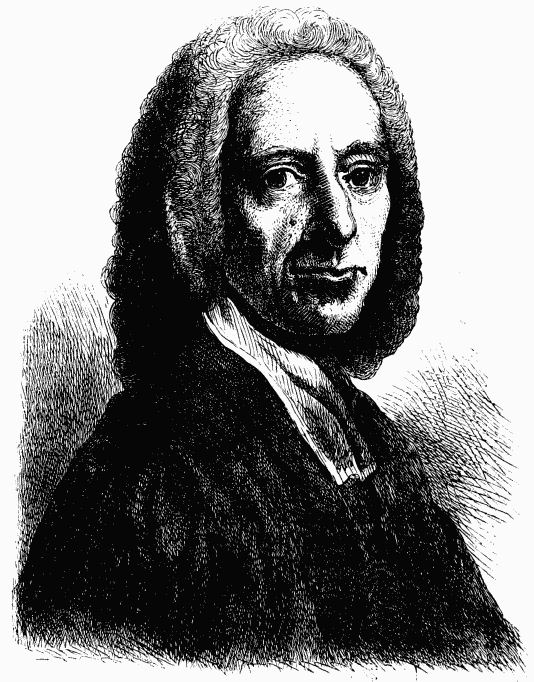
WILLIAM WHISTON.
The pleasant gardens which surrounded Ely House rejoiced in the growth of fine strawberries, and it is in connection with this fruit that the name of Ely Place has been enshrined in the memory of all readers of Shakespeare. No one needs to have recalled the scene in the Tower which ended in the execution of Hastings. Buckingham, Hastings, the Bishop of Ely, and others, are talking together of the coronation of the young King Edward V. The Duke of Gloucester, afterwards Richard III., enters, and after a few words exchanged with Buckingham, turns—possibly to conceal his deep and bloody design—to the bishop:—
"My lord of Ely, when I was last in Holborn,
I saw good strawberries in your garden there;
I do beseech you, send for some of them!
Ely. Marry, I will, my lord, with all my heart."
He goes out, and shortly returning, finds Gloucester gone.
"Ely. Where is my lord the Duke of Gloucester? I have
sent for those strawberries.
Hastings. His grace looks cheerful and smooth this
morning.
There's some conceit or other likes him well,
When that he bids good morrow with such spirit."
Ill-judging Hastings! Little did he guess that a few minutes after he would hear the Lord Protector thundering out, with reference to himself, "Thou'rt a traitor! Off with his head!" After the execution the cold-blooded Gloucester likely enough sat down with relish to a dessert of the bishop's straw berries.
How closely in this scene Shakespeare followed the historical truth we may see in this passage from Holinshed:—"On the Friday (being the 13th of June, 1483) many lords were assembled in the Tower, and there sat in council, devising the honourable solemnity of the king's (the young Edward V.'s) coronation, of which the time appointed then so near approached, that the pageants and subtleties were in making day and night at Westminster, and much victuals killed therefore, that afterwards was cast away. These lords so sitting together, communing of this matter, the Protector (Gloucester) came in amongst them, just about nine of the clock, saluting them courteously, and excusing himself that he had been from them so long, saying merrily that he had been a sleeper that day. After a little talking with them, he said unto the Bishop of Ely, 'My lord, you have very good strawberries at your garden in Holborn; I require you let us have a mess of them.' 'Gladly, my lord,' quoth he. 'Would God I had some better thing as ready to your pleasure as that.' And therewithal, in all haste, he sent his servant for a mess of strawberries."
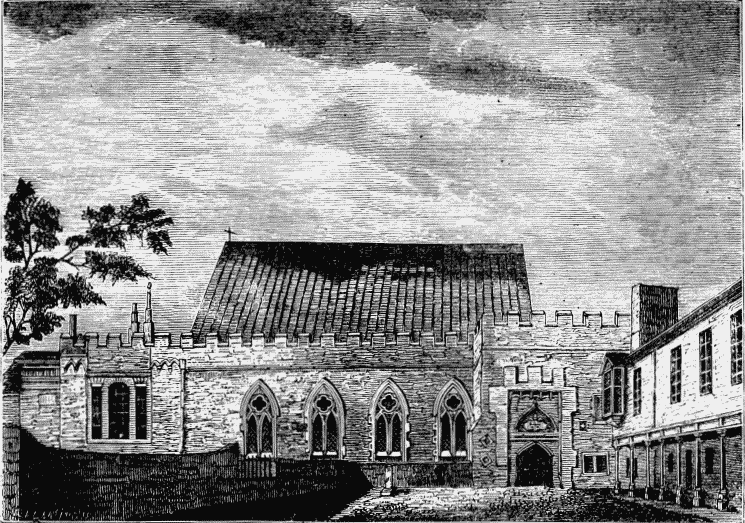
ELY HOUSE—THE HALL. (From Grose's "Antiquities," 1772.)
In the time of Richard III., it may be added, strawberries were an article of ordinary consumption in London. In Lydgate's poem of "London Lyckpeny" we learn as much:—
"Then unto London I did me hie,
Of all the land it beareth the prize;
'Good peaseod!' one began to cry—
'Strawberry ripe! and cherries in the rise.'"
To make clear the connection existing between Lord Chancellor Hatton and Ely Place, to which we alluded at the beginning of this chapter, it will be necessary to give a short sketch of that worthy man who, says Malcolm, was "the cause of infinite loss and trouble to the Bishops of Ely for upwards of an hundred years." He was the youngest of three sons of William Hatton, of Holdenby, a gentleman of good family. In early life he was entered at one of the inns of court, where he studied law, but as a gentleman lawyer only, and not with the view of deriving any advantage from it as a profession. Whilst engaged in this way he had the good fortune to attract the notice of Queen Elizabeth, and became in turn Gentleman Pensioner, Gentleman of the Privy Chamber, Captain of the Guard, Vice-Chamberlain, Member of the Privy Council, and Lord Chancellor. It seems he was possessed of many graces of person, and had great ability as a dancer. Elizabeth's fancy for him grew to such a height, that Leicester did his best to make his rival ridiculous, by offering to introduce to the queen a dancing-master whose abilities far excelled those of Hatton. But his project was not successful. "No," said Elizabeth, "I will not see your man; it is his trade." She abandoned herself to her extravagant passion, and Hatton and she corresponded in the most fond and foolish style, of which there exists plenty of proof on the shelves of the State Paper Office.
But it can hardly be said that by dancing alone he skipped up to position and influence. He had many good mental qualities, and his advancement is one of the numerous proofs the queen gave of her penetration in the choice of great State officers. On his becoming Lord Chancellor, the lawyers were unable to stifle their indignation. Some of the serjeants-at-law even refused to plead before him. But Hatton, though deficient in reading and practice as a lawyer, had common sense enough to hold his place, and at the same time to prove himself qualified for it. In all doubtful cases he was in the habit of consulting one or two learned legal friends, and the result was that his decisions were by no means held in low repute in the courts of law.
In 1576, to oblige Queen Bess, Richard Cox, Bishop of Ely, granted to her Majesty's handsome Lord Chancellor the gate-house of the palace (excepting "two rooms used as prisons for those who were arrested or delivered in execution to the bishop's bailiff, and the lower rooms used for the porter's lodge"), the first courtyard within the gatehouse, the stables, the long gallery, with the rooms above and below it, and some other apartments. Hatton also obtained fourteen acres of ground, and the keeping of the gardens and orchards; and of this pleasant little domain he had a lease of twentyone years. The rent was not a heavy one. A red rose was to be paid for the gate-house and garden, and for the ground ten loads of hay and ten pounds sterling per annum. The grumbling bishop had to make the best of a bad bargain; and the only modification he could obtain in the terms was the insertion of a clause giving him and his successors free access through the gate-house, and the right to walk in the garden, and gather twenty baskets of roses yearly.
Once in possession of this property, Hatton began building and repairing, and soon contrived to expend £1,897 5s. 8d. (about £6,000 of our money), part of which amount, we may as well say here, was borrowed from his royal mistress. As he went on, his views expanded, and, not satisfied with what he had, he petitioned Queen Elizabeth to alienate to him the whole house and gardens. This, in days when sovereigns laid greedy hands on so many acres of rich Church property, was no unusual request, and the queen wrote to the bishop requesting him to demise the lands to her till such time as the see of Ely should reimburse Sir Christopher for the money he had laid out, and was still expending, in the improvement of the property. The bishop wrote an answer befitting the dignity of his position. "In his conscience," he said, "he could not do it, being a piece of sacrilege. When he became Bishop of Ely he had received certain farms, houses, and other things, which former pious princes had judged necessary for that place and calling; that these he had received, by the queen's favour, from his predecessors, and that of these he was to be a steward, not a scatterer; that he could not bring his mind to be so ill a trustee for his successors, nor to violate the pious wills of kings and princes, and, in effect, rescind their last testaments." And he concluded by telling her that he could scarcely justify those princes who transferred things appointed for pious purposes to purposes less pious.
But arguments and moral reflections were thrown away on the queen, and the bishop had to consent to a conveyance of the property to her Majesty, who was to re-convey it to Hatton, but on condition that the whole should be redeemable on the payment of the sum laid out by Sir Christopher.
On the death of Dr. Cox, his successor, Dr. Martin Heton, seemed extremely unwilling to carry out this agreement, and in a fit of fury the queen sat down and wrote him one of her most characteristic epistles:—
"Proud Prelate!—I understand you are backward in complying with your agreement: but I would have you know that I, who made you what you are, can unmake you; and if you do not forthwith fulfil your engagement, by—I will immediately unfrock you. "Elizabeth."
According to some writers, this letter was addressed to Bishop Cox; but it is of no great consequence: the sender is of more interest here than the receiver.
The debt of the Lord Chancellor to the Queen had now reached some forty thousand pounds. His prudence had fallen asleep when he allowed her Majesty to become his principal creditor. She required a settlement of their account, and poor Hatton was unable to produce the necessary funds. It killed him. There is something pathetic in the quaint account which Fuller gives of the close of his prosperous life and fortunes. "It broke his heart," says the biographer of the "Worthies," "that the queen, which seldom gave loans, and never forgave due debts, rigorously demanded the present payment of some arrears which Sir Christopher did not hope to have remitted, and did only desire to have forborne: failing herein in his expectation, it went to his heart, and cast him into a mortal disease. The queen afterwards did endeavour what she could to recover him, bringing, as some say, cordial broths unto him with her own hands; but all would not do. There's no pulley can draw up a heart once cast down, though a queen herself should set her hand thereunto." He died in Ely House in 1591.
The scenes in Ely Place during Hatton's days must often have been gay enough.
"Full oft within the spacious walls,
When he had fifty winters o'er him,
My grave lord-keeper led the brawls—
The seal and maces danced before him.
His bushy beard and shoe-strings green,
His high-crowned hat and satin doublet,
Moved the stout heart of England's queen,
Though Pope and Spaniard could not trouble it."
So Gray, in his "Long Story," wrote of Hatton in his manor house of Stoke Pogis; and in his town residence we can picture him quite as eager as in the country to shake the light fantastic toe, and cutting quite as quaint a figure as there.
It was in Ely House that Sir Edward Coke courted the rich widow, Lady Hatton, relict of the nephew of Sir Christopher, Queen Elizabeth's Lord Chancellor. The lady was young, beautiful, eccentric, and, it would seem, possessed of a most vixenish temper. As she was rich, she had no scarcity of wooers, and among them were two celebrated men, Coke and Bacon. Many a curious scene must Hatton House have witnessed, as those two rivals in law pursued their rivalry in love, and cherished their long-felt enmity towards each other. Bacon's ever-faithful friend, the unfortunate Earl of Essex, pled his cause hard with the enchanting widow and with her mother. To the latter he says, in one of his letters, "If she were my sister or my daughter, I protest I would as confidently resolve to further it as I now persuade you;" and in another epistle he adds, "If my faith be anything, I protest, if I had one as near me as she is to you, I had rather match her with him than with men of far greater titles." However, Sir Edward Coke carried off the prize, such as it was, and bitterly did he afterwards repent it.
That the marriage was not a happy one we have already told when speaking of the entries in the register-books of St. Andrew's Church, Holborn. After her quarrel with her husband, Lady Hatton betook herself again to Ely House, and there she effectually repelled the entrance of Sir Edward. In Howell's "Letters" we catch a sight of her in one of her peculiar humours. He is speaking of Gondomar, the Spanish Ambassador. "He hath waded already very deep," he says, "and ingratiated himself with divers persons of quality, ladies especially: yet he could do no good upon the Lady Hatton; whom he desired lately, that in regard he was her next neighbour [at Ely House], he might have the benefit of her back-gate to go abroad into the fields, but she put him off with a compliment: whereupon, in a private audience lately with the king, among other passages of merriment, he told him that my Lady Hatton was a strange lady, for she would not suffer her husband to come in at her fore-door, nor him to go out at her back-door, and so related the whole business."
The "strange lady," as she is called by Howell, "dyed in London on the 3rd January, 1646, at her house in Holborne."
During the anxious period of the civil war, Ely Place was turned to good account, and made use of both as an hospital and a prison. We may show this by the following extracts from the Journals of the House of Commons:—
"1642–3. Jan. 3. The palace was this day ordered to be converted into a prison, and John Hunt, sergeant-at-arms, appointed keeper during the pleasure of the House. He was at the same time commanded to take care that the gardens, trees, chapel, and its windows, received no injury. A sufficient sum for repairs was granted from the revenues of the see."
"1660. March 1. Ordered, that it be referred to a committee to consider how and in what manner the said widows, orphans, and maimed soldiers at Ely House may be provided for and paid, for the future, with the least prejudice, and most ease to the nation, and how a weekly revenue may be settled for their maintenance; and how the maimed soldiers may be disposed of, so as the nation may be eased of the charge, and how they may be provided of a preaching minister."
"March 13. £1,700 was voted for the above purpose, and for those at the Savoy, and certain members of the committee were named to inquire into the receipts and expenditures of the keepers of the hospitals."
Malcolm gives a lamentable account of the inconvenience and mortification to which the bishops were in succession subjected in consequence of the unfortunate lease given to the Hatton family. He is speaking of the latter part of the seventeenth century:—"The gate-house was taken down, and great part of the dwelling, and their lordships were compelled to enter the apartments reserved for their use by the old back way; several of the cellars, even under the rooms they occupied, were in possession of tenants; and those intermixed with their own, all of which had windows and passages into the cloisters.
"One half of the crypt under the chapel, which had been used for interments, was then frequented as a drinking place, where liquor was retailed; and the intoxication of the people assembled often interrupted the offices of religion above them. Such were the encroachments of the new buildings, that the bishop had his horses brought through the great hall, for want of a more proper entrance."
Some of the most memorable of feasts have been held here, the Bishops of Ely, in the true spirit of hospitality, having apparently been in the habit of lending their hall for the festive gatherings of the newly-elected serjeants of law. No doubt the halls of the Inns of Court were often too small to accommodate the number of guests. We shall notice three of these serjeants' merry-makings. The first took place in Michaelmas Term, 1464, and is noticeable for the fact that the Lord Mayor took great offence at a slight which the learned gentlemen unthinkingly put upon him. He came to the banquet, and found a certain nobleman— Grey of Ruthin, then Lord Treasurer of England —preferred before him, and sitting in the seat of state. That seat, by custom, he held, should have been occupied by himself; so, in high dudgeon, his lordship marched off, with his following of aldermen, to his own house, where he compensated his faithful adherents by a splendid entertainment, including all the delicacies of the season. He was wonderfully displeased, says Stow, at the way in which he had been treated, "and the new serjeants and others were right sorry therefore, and had rather than much good (as they said) it had not so happened."
Another banquet took place in 1495, and on this occasion Henry VII. was present, with his queen. This was one of the occasions, it has been pointed out, when the victor of Bosworth strove to correct a little the effect of his sordid habits, his general seclusion, and his gloomy, inscrutable nature, which altogether prevented him from obtaining the popularity which is agreeable to most monarchs—even to those the least inclined to purchase it at any considerable cost. "The king," says his great historian, Bacon, "to honour the feast, was present with his queen at the dinner, being a prince that was ever ready to grace and countenance the professors of the law; having a little of that, that as he governed his subjects by his laws, so he governed his laws by his lawyers."
But the last feast we shall mention was the most splendid of all. Eleven serjeants had been created in November, 1531, and it was resolved to celebrate the event on an unparalleled scale of magnificence. The entertainment lasted five days, and on the fourth day the proceedings were graced by the presence of Henry VIII. and his queen, Catherine of Aragon; but these two dined "in two chambers," Stow parenthetically observes. At this very time the final measures were in progress for the divorce of the unfortunate queen, and Henry's marriage with Anne Boleyn. Besides these distinguished personages, the foreign ambassadors were there, and they also had a chamber to themselves. In the hall, at the chief table, sat Sir Nicolas Lambard, Lord Mayor of London, and with him were the judges, Barons of the Exchequer, and certain aldermen. The Master of the Rolls and the Master of the Chancery were supported at the board on the south side by many worshipful citizens, and on the north side of the hall there were other aldermen and merchants of the City. The remainder of the company, comprising knights, esquires, and gentlemen, were accommodated in the gallery and the cloisters, and, there being, apparently, a great scarcity of room, even in the chapel.
"It would be tedious," says Stow, to set down all "the preparation of fish, flesh, and other victuals, spent in this feast;" and he hints that no one would believe him if he did. To excite the wonder and the appetite of his readers, however, he gives a few particulars. There were twenty-four "great beefs," or oxen, at 26s. 8d. each, and one at 24s.; one hundred "fat muttons," at 2s. 10d.; fifty-one "great veals," at 4s. 8d.; thirty-four "porks," or boars, at 3s. 3d.; ninety-one pigs, at 6d.; ten dozen "capons of Greece of one poulter (for they had three)," at 1s. 8d.; nine dozen and six "capons of Kent," at 1s.; nineteen dozen "capons course," at 6d.; innumerable pullets, at 2d. and 2½d.; pigeons, at 10d. the dozen; larks, at 5d. the dozen; and fourteen dozen swans at a price not mentioned. And the feast, says the honest historian, "wanted little of a feast at a coronation."
No doubt it was at Ely Place that a ludicrous scene took place between the Bishop of Ely and two bailiffs, about the close of the seventeenth century—the conclusion of an adventure with the celebrated comedian, Joe Haines. Haines (who died in 1701) was always indulging in practical jokes and swindling tricks, and meeting with comical adventures. One day he was arrested by two bailiffs for a debt of twenty pounds, just as the Bishop of Ely was riding by in his carriage. Quoth Joe to the bailiffs, "Gentlemen, here is my cousin, the Bishop of Ely; let me but speak a word to him, and he will pay the debt and costs." The bishop ordered his carriage to stop, whilst Joe—quite a stranger to him—whispered in his ear, "My lord, here are a couple of poor waverers, who have such terrible scruples of conscience that I fear they will hang themselves." "Very well," replied the bishop. So, calling to the bailiffs, he said, "You two men, come to me to-morrow, and I will satisfy you." The bailiffs bowed, and went their way. Joe, tickled in the midriff, and hugging himself with his device, took himself off. The next morning the bailiffs repaired to Ely Place. "Well, my good men," said his lordship, "what are your scruples of conscience?" "Scruples!" replied they, "we have no scruples; we are bailiffs, my lord, who yesterday arrested your cousin, Joe Haines, for twenty pounds. Your lordship promised to satisfy us to-day; and we hope you will be as good as your word." The bishop, to prevent any further scandal to his name, immediately paid all that was owing.
A scene almost without a parallel was once arranged in Ely Place. This was a famous masque, with its attendant anti-masque, which came off during the brilliant part of the reign of the ill-fated Charles I. "Not the least interesting circumstances," it has been observed, "attending the splendid pageant, are the character and position of the men who had the management of the affair, and of him who has made himself its historian." This last was Whitelock, the learned and estimable lawyer, who, during the period preceding, comprising, and following the Commonwealth, enjoyed the respect of all parties, and has left us one of the most valuable records of the momentous events he witnessed and in which he took a part. That his heart was in this masque and anti-masque is evident from the enthusiasm with which he describes both, and the space which he devotes to them in his great work.
The year before this gorgeous display, the irrepressible Mr. Prynne had published his "HistrioMastix," in which he discharged a perfect broadside of abuse against plays and players, masques and masquers, and generally against all kinds of sport and pastime. The Queen Henrietta Maria, not long before, had engaged in some sort of theatrical performance with her maids of honour. The book was therefore offensive to the whole court, and no doubt to this circumstance the writer owed in part the infamous severity of his punishment. But before he took his turn in the pillory, and lost his ears, the members of the four Inns of Court designed a masque, "as an expression of their love and duty to their majesties." It was whispered to them from the court that it would be well taken from them; and some held it the more seasonable, because this action would manifest the difference of their opinion from Mr. Prynne's new learning, and serve to confute his "HistrioMastix" against interludes. It was therefore agreed by the benchers to have the solemnity performed in the most nobly and stately manner that could be invented.
A committee was formed, consisting of two members from each House; among the committee-men being Whitelock himself, Edward Hyde (who afterwards became Lord Clarendon), and the famous Selden. They set to work, and Whitelock's part in the arrangements was to superintend the music. This he did with energy. "I made choice," he says, "of Mr. Simon Ivy, an honest and able musician, of excellent skill in his art, and of Mr. Lawes (a name familiar to every lover of Milton) to compose the airs, lessons, and songs for the masque, and to be master of all the music, under me." He goes on to tell what meetings he had of "English, French, Italian, German, and other masters of music; forty lutes at one time, beside other instruments in concert." At last everything was arranged, and one Candlemas, in the afternoon, "the masquers, horsemen, musicians, dancers, and all that were actors in this business, according to order, met at Ely House, in Holborn; there the grand committee sat all day to order all affairs; and when the evening was come, all things being in full readiness, they began to set forth in this order down Chancery Lane to Whitehall." And here we can picture to ourselves the crowded streets, the enthusiastic spectators, the loyal lawyers, and Prynne and his sympathisers scowling and muttering in the background, all on a sharp evening in February, 1633.
"The first that marched were twenty footmen in scarlet liveries, with silver lace, each one having his sword by his side, a baton in one hand, and a lighted torch in the other; these were the marshal's men, who made way, and were about the marshal, waiting his commands. After them, and sometimes in the midst of them, came the marshal—then Mr. Darrel, afterwards knighted by the king: he was of Lincoln's Inn, an extraordinary handsome proper gentleman. He was mounted upon one of the king's best horses and richest saddles, and his own habit was exceeding rich and glorious, his horsemanship very gallant; and besides his marshal's men, he had two lackeys who carried torches by him, and a page in livery that went by him carrying his cloak. After him followed one hundred gentlemen of the Inns of Court, five-and-twenty chosen out of each house, of the most proper and handsome young gentlemen of the societies. Every one of them was mounted on the best horses, and with the best furniture that the king's stables, and the stables of all the noblemen in town, could afford; and they were forward on this occasion to lend them to the Inns of Court. Every one of these hundred gentlemen was in very rich clothes—scarce anything but gold and silver lace to be seen of them; and each gentleman had a page and two lackeys waiting on him, in his livery, by his horse's side; the lackeys carried torches, and the page his master's cloak. The richness of their apparel and furniture, glittering by the light of a multitude of torches attending on them, with the motion and stirring of their mettled horses, and the many and various gay liveries of their servants, but especially the personal beauty and gallantry of the handsome young gentlemen, made the most glorious and splendid show that ever was beheld in England.
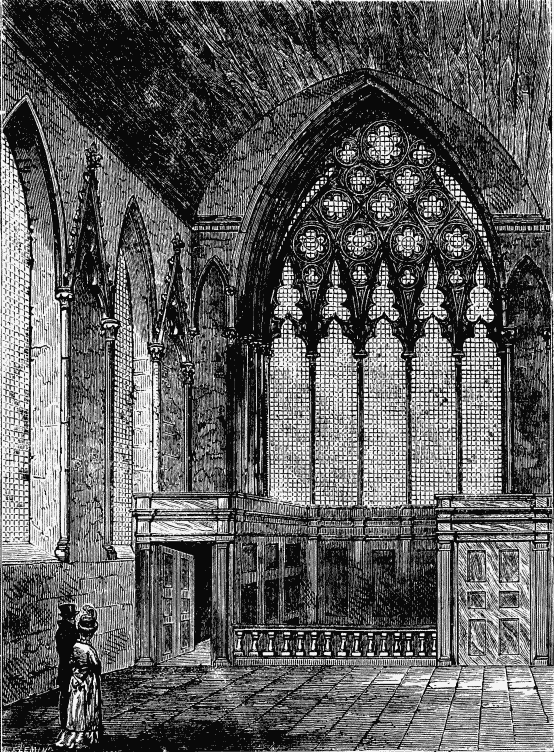
ELY CHAPEL. (From a View by Malcolm.)
"After the horsemen came the anti-masquers, and, as the horsemen had their music—about a dozen of the best trumpeters proper for them, and in their livery—sounding before them—so the first anti-masquers, being of cripples and beggars on horseback, had their music of keys and tongs, and the like, snapping, and yet playing in a concert, before them. These beggars were also mounted, but on the poorest, leanest jades that could be gotten out of the dirt-carts or elsewhere; and the variety and change from such noble music and gallant horses as went before them unto their proper music and pitiful horses, made both of them more pleasing. The habits and properties of these cripples and beggars were most ingeniously fitted (as of all the rest) by the committee's direction, wherein (as in the whole business) Mr. Attorney Noy, Sir John Finch, Sir Edward Herbert, Mr. Selden, those great and eminent persons, and all the rest of the committee, had often meetings, and took extraordinary care and pains in the ordering of this business, and it seemed a pleasure to them.
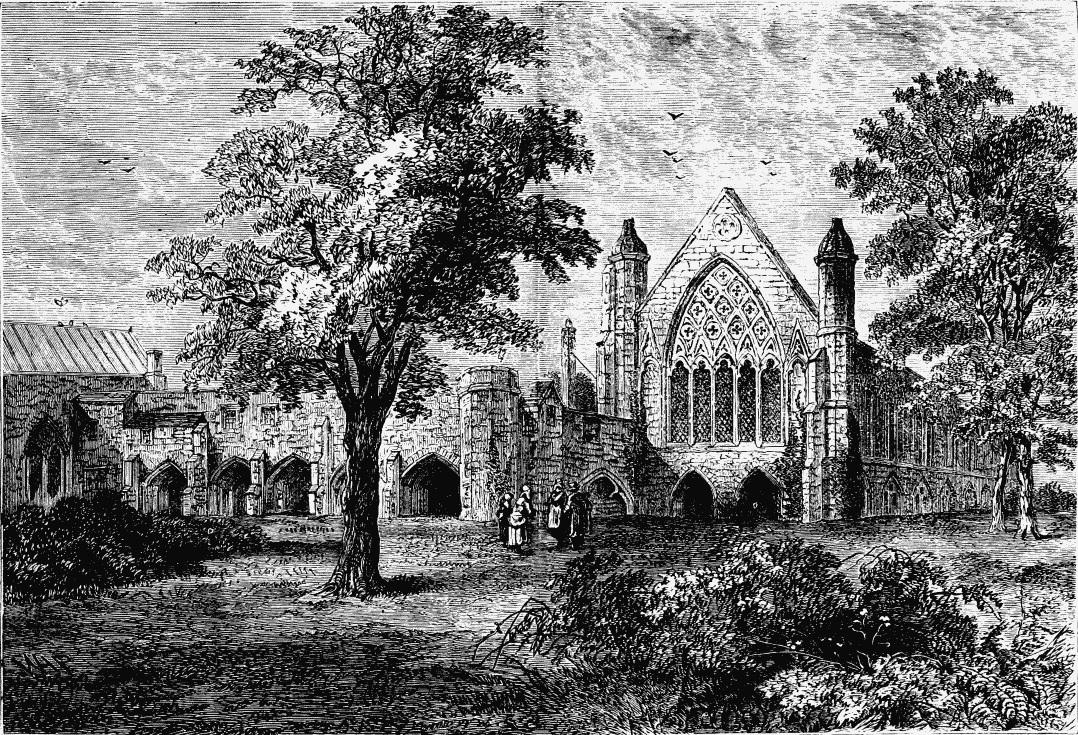
ELY HOUSE. (From a Drawing made in 1772.)
"After the beggars' anti-masque came men on horseback playing upon pipes, whistles, and instruments sounding notes like those of birds of all sorts, and in excellent concert, and were followed by the anti-masque of birds. This was an owl in an ivy-bush, with many several sorts of other birds in a cluster, gazing, as it were, upon her. These were little boys put into covers of the shapes of those birds, rarely fitted, and sitting on small horses, with footmen going by them with torches in their hands; and there were some, besides, to look unto the children; and this was very pleasant to the beholders.
"After this anti-masque came other musicians on horseback, playing upon bagpipes, hornpipes, and such kind of northern music, speaking the following anti-masque of projectors to be of the Scotch and northern quarters; and these, as all the rest, had many footmen, with torches, waiting on them. —First in this anti-masque rode a fellow upon a little horse with a great bit in his mouth, and upon the man's head was a bit, with headstall and reins fastened, and signified a projector, who begged a patent that none in the kingdom might ride their horses but with such bits as they would buy of him. Then came another fellow, with a bunch of carrots upon his head, and a capon on his fist, describing a projector who begged a patent of monopoly as the first inventor of the art to feed capons fat with carrots, and that none but himself might have use of that invention, and have the privilege for fourteen years, according to the statute. Several other projectors were in like manner personated in this anti-masque; and it pleased the spectators the more because by it an information was covertly given to the king of the unfitness and ridiculousness of these projects against the law; and the Attorney Noy, who had most knowledge of them, had a great hand in this anti-masque of projectors."
Other anti-masques followed, and then came chariots with musicians, chariots with heathen gods and goddesses, then more chariots with musicians, "playing upon excellent and loud music," and going immediately before the first grand masquer's chariot. This "was not so large as those that went before, but most curiously framed, carved and painted with an exquisite art, and purposely for this service and occasion." Its colours were silver and crimson: "it was all over painted richly with these colours, even the wheels of it, most artificially laid on, and the carved work of it was as curious for that art, and it made a stately show. It was drawn with four horses, all on breast, and they were covered to their heels all over with cloth of tissue, of the colours of crimson and silver, huge plumes of red and white feathers on their heads and buttocks; the coachman's cap and feather, his long coat, and his very whip and cushion, of the same stuff and colour. In this chariot sat the four grand masquers of Gray's Inn, their habits, doublets, trunk-hose, and caps of most rich cloth of tissue, and wrought as thick with silver spangles as they could be placed; large white silk stockings up to their trunk-hose, and rich sprigs in their caps, themselves proper and beautiful young gentlemen. On each side of the chariot were four footmen, in liveries of the colour of the chariot, carrying huge flambeaux in their hands, which, with the torches, gave such a lustre to the paintings, the spangles, and habits, that hardly anything could be invented to appear more glorious." Similar chariots, similarly occupied, followed from each of the other three Inns of Court, the only difference being in the colours. And in this manner the procession reached Whitehall, where the king, from a window of the Banqueting House—it might possibly be the very one out of which he stepped to the scaffold— saw, with his queen Henrietta Maria, the whole pageant pass before him. The royal spectators were so pleased with the show, that they sent a message to the marshal requesting him to conduct his following round the Tilt Yard opposite, that they might see it a second time. This done, they entered the palace, where the masque, to which all this gorgeous spectacle was but a preliminary, began, and, says Whitelock, it was "incomparably performed, in the dancing, speeches, music, and scenes; the dances, figures, and properties; the voices, instruments, songs, airs, and composures; the words and actions were all of them exact, and none failed in their parts." Henrietta Maria was so charmed, that she resolved to have the whole repeated shortly afterwards. The festivities concluded with dancing, when the queen and her ladies of honour were led out by the principal masquers. The expense of this spectacle was not less than £21,000. Some of the musicians had £100 apiece for their blowing and fiddling.
The last "mystery" represented in England was that of "Christ's Passion," in the reign of James I., which, Prynne tells us, was "performed at Elie House, in Holborne, when Gondomar lay there, on Good Friday, at night, at which there were thousands present."
This incident suggests one or two facts relating to the performance in England of miracle-plays and mysteries. These were founded on the lives of the saints, and on those parts of the Scriptures best represented by the latter term. About the earliest mention of a miracle-play is of the date of 1110, when one was performed in the Abbey of St. Albans. Whether Geoffrey, a learned Norman, who composed this religious drama, then first introduced the custom of acting such pieces, is by no means certain. London had plays representing the working of miracles and the sufferings of the saints about the year 1170; so we learn from the monk Fitz-Stephen. That these exhibitions "were well attended," says Malcolm, in his "Manners and Customs of London," "we cannot doubt for a moment, as there was a double inducement, compounded of curiosity and devotion. Piers Plowman and Chaucer both confirm the fact of the general approbation with which they were received." They were, it is certain, introduced into England from the Continent.
As an interesting specimen of the "mysteries," we may take the play of Noah, preserved in the Towneley collection. It will serve as an example of the corrupt and not very reverent manner in which the events of Scripture history were, during the Middle Ages, communicated to the common people. When Noah carries to his wife the news of the impending Flood, she is introduced abusing him for his credulity, sneering at him as an habitual bearer of bad tidings, and complaining of the hard life she leads with him. He tells her to "hold her tongue," but she only becomes more abusive, till he is provoked to strike her. She returns the blow with interest, and they fall to fighting, till Noah has had enough of it, and runs off as hard as he can to his work. When the ark is finished there is another quarrel, for Noah's wife laughs at the structure, and declares she will never go into it. But the water rises fast, and the danger becomes so great, that she changes her mind and jumps on board, only, however, to pick another quarrel with her husband. They fight again, but this time Noah comes off victorious, and his partner complains of being beaten "blue," whilst their three sons lament over the family discord.
The chapel of Ely Place, still standing, was dedicated to St. Etheldreda. And who was she? She was the daughter of Anna, King of the West Angles, and was born in Suffolk, about the year 630. She took part in the erection of the cathedral of Ely, and in course of time was elected to fill the position of its patron saint. She died, in 679, the abbess of the convent of Ely. Sometimes St. Etheldreda is called by the more homely name of St. Audry; and from this second appellation is derived the familiar adjective tawdry. It is a digression, but we may as well tell how this came about. At the fair of St. Audry, at Ely, in the olden time, a description of cheap necklaces used to be sold, which under the name of tawdry laces, were long very popular. In process of time the epithet tawdry came to be applied to any piece of glittering tinsel or shabby magnificence.
The builder of the chapel is unknown, but Malcolm conjectures that it is to Thomas Arundel that we are indebted for this beautiful but solitary fragment, "now left for the admiration of the antiquary and man of taste—the product of an architect familiar with the rich fancy of the Edwardian style, fully indulged in the grand east window."
"In spite of patchings and modernisings," says Mr. J. Saunders, in 1842, "St. Etheldreda's Chapel retains much of its original aspect. On looking at the exterior, if we shut our eyes to the lower portion, where a part of the window has been cut away, and an entrance made where evidently none was ever intended to exist, we perceive the true stamp of the days when men built the cathedrals— works which no modern art has rivalled, and which yet seemed so easy to them, that the names of the architects have failed to be preserved. And in the interior the effect of the two windows, alike in general appearance, yet differing in every respect in detail, is magnificent, although the storeyed panes, which we may be sure once filled them, are gone. The bold arch of the ceiling, plain and whitewashed though now be its surface, retains so much of the old effect, that, though we miss the fine oak carvings, we do not forget them. The noble row of windows on each side are in a somewhat similar condition. All their exquisite tracery has disappeared, but their number, height, and size tell us what they must have been in the palmy days of Ely Place; and if we are still at a loss, there is fortunately ample evidence remaining in the ornaments which surround the upper portions of the windows in the interior, and divide them from each other. We scarcely remember anything more exquisite in architecture than the fairy workmanship of the delicate, pinnacle-like ornaments which rise between and overtop these windows. Of the original entrances into the chapel one only remains, which is quite unused, and is situated at the south-west corner of the edifice. Stepping through the doorway into a small court that encloses it, we perceive that it has been a very beautiful, deeply-receding, pointed arch, but now so greatly decayed that even the character of its ornaments is but partially discoverable. Here, too, is a piece of the wall of one of the original buildings of the palace—a stupendous piece of brickwork and masonry; and on looking up, one of the octagonal buttresses, with its conical top, which ornamented the angles of the building, is seen. Descending a flight of steps, we find a low window looking into the crypt. . . . It is now filled with casks, and we can but just catch a glimpse of the enormous chestnut posts and girders with which the floor of the chapel is supported."
There are five windows in the length. As for the west and east windows, the former differs from the latter, but it is at present hidden from view by a gallery and a small organ.
The diarist, Evelyn, has two notices of Ely Place chapel which may be worth our attention. The first runs thus:—"November 14th, 1668. In London. Invited to the consecration of that excellent person, the Dean of Ripon, Dr. Wilkins, now made Bishop of Chester. It was at Ely House: the Archbishop of Canterbury, Dr. Cosin (Bishop of Durham), the Bishops of Ely, Salisbury, Rochester, and others, officiating. Dr. Tillotson preached. Then we went to a sumptuous dinner in the hall, where were the Duke of Buckingham, Judges, Secretaries of State, Lord Keeper, Council, noblemen, and innumerable other company, who were honourers of this incomparable man, invariably beloved by all who knew him." The other is of a domestic character, and gives us a pleasant glimpse of the kindly parental feelings of this estimable man:— "27th April, 1693. My daughter Susanna was married to William Draper, Esq., in the chapel of Ely House, by Dr. Tenison, Bishop of Lincoln (since Archbishop). I gave her in portion £4,000. Her jointure is £500 per annum. I pray God Almighty to give her his blessing on this marriage."
The chapel was at one time leased to the National Society for a school-room, after which it remained for a while untenanted; but on the 19th of December, 1843, it was opened for the service of the Established Church in the Welsh language, being the first service of the kind ever attempted in London. In 1874 it was bought by the Roman Catholic Church.
An amusing incident took place in Ely Chapel on the arrival of the news of the defeat of the young Pretender by the Duke of Cumberland, in 1746. The clerk allowed his loyalty to overcome his devotion, and struck up a lively ditty in praise of the reigning family. Cowper thought this worthy of notice in his "Task:"—
"So in the chapel of old Ely House,
When wandering Charles, who meant to be the third,
Had fled from William, and the news was fresh,
The simple clerk, but loyal, did announce,
And eke did roar, right merrily, two staves
Sung to the praise and glory of King George."