Old and New London: Volume 3. Originally published by Cassell, Petter & Galpin, London, 1878.
This free content was digitised by double rekeying. Public Domain.
Walter Thornbury, 'The Strand (northern tributaries): Drury Lane and Clare Market', in Old and New London: Volume 3(London, 1878), British History Online https://www.british-history.ac.uk/old-new-london/vol3/pp36-44 [accessed 2 May 2025].
Walter Thornbury, 'The Strand (northern tributaries): Drury Lane and Clare Market', in Old and New London: Volume 3(London, 1878), British History Online, accessed May 2, 2025, https://www.british-history.ac.uk/old-new-london/vol3/pp36-44.
Walter Thornbury. "The Strand (northern tributaries): Drury Lane and Clare Market". Old and New London: Volume 3. (London, 1878), British History Online. Web. 2 May 2025. https://www.british-history.ac.uk/old-new-london/vol3/pp36-44.
In this section
CHAPTER VI.
THE STRAND (NORTHERN TRIBUTARIES).—DRURY LANE AND CLARE MARKET.
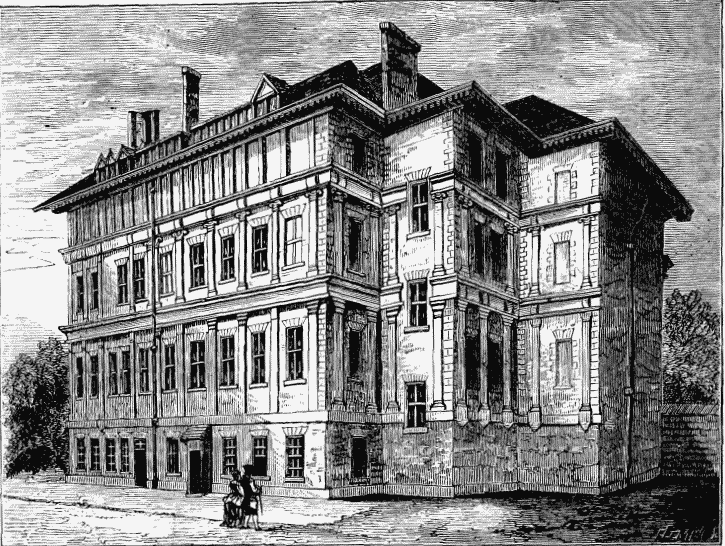
OLD CRAVEN HOUSE (1800).
The Hundred of Drury—Drury House, afterwards called Craven House—The "Queen of Bohemia"—Drury Lane—Eminent Inhabitants—Residence of Nell Gwynne—The "Cock and Magpie"—The "Craven Head" and the Norfolk Giant—Disreputable Character of Drury Lane
in the past Century—Pepys' Visit to the "Cockpit"—Puritan Observances—The Theatre in Vere Street—"Spiriting Away" an Infant—Princes Street—Clare Market—John Henley, the Demagogue—Clare House—Killigrew's Theatre—Mrs. Bracegirdle's Benevolence—The
"Bull's Head" and the Artists' Club—The "Spiller's Head" Tavern—Clare Market Chapel—Denzil Street—Holles Street.
"O may thy virtue guard thee through the roads
of Drury's mazy courts and dark abodes!"—Gay's "Trivia."
"Paltry and proud as drabs in Drury Lane."—Pope.
"On the borders of St. Giles-in-the-Fields," says the London Spy, "is situated that ancient and venerable spot the Hundred of Drury, which, I hear, is the property of two or three parishes more." The character of this region may be inferred from the words which follow: "There are reckoned to be one hundred and seven 'pleasure-houses' within and about this settlement; and a Roman Catholic priest, who has lodged here many years, assures me that to his knowledge the Societies for the Reformation of Morals have taken as much pains, and expended as large sums to reclaim this new Sodom, as would have fitted out a force sufficient to have conquered the Spanish West Indies."
Pennant remarks it as a singular occurrence that
this lane, "of late times so notorious for intrigue,"
should receive its name from a word which, in the
language of Chaucer, had an amorous signification:
"Of bataile and of chevalrie,
Of ladies' love and druerie,
Anon I wot you tell."
Drury House, from which the lane originally took its name, stood at the west end of Wych Street. It was built by Sir William Drury, who is reported to have been not only the head of a great family, but Knight of the Garter. He held a command in the Irish wars in the reign of Elizabeth, and showed great ability as an officer. He unfortunately fell in a duel with a Sir John Burroughes, about a foolish quarrel for precedency. The house deserves to be remembered as the place where the rash friends of the Queen's favourite, the Earl of Essex, devised those wild schemes which led to the ruin of himself and his adherents. The "Account of St. Clement's in 1734," to which we have so often referred, speaks of it as "a very large house, or which may rather be termed several houses. The entrance," adds the writer, "is through a pair of gates, which leadeth into a large yard for the reception of coaches." At the back of the house was a handsome garden. "In the following century," says Allen, in his "History of London," "it was possessed by the heroic Lord Craven, who rebuilt it. It was lately a large brick pile, concealed by other buildings, and turned into a public-house bearing the sign of the 'Queen of Bohemia,' the earl's admired mistress, whose battles he fought, animated at once by love and duty. When on the death of her husband he could aspire to her hand, he is supposed to have succeeded; at all events history says that they were privately married, and that he built for her the fine seat at Hampstead Marshal, in Berkshire, afterwards destroyed by fire." The services rendered by Lord Craven to London, his native city, are worthy of being recorded here. He was so indefatigable in preventing the ravages of fire, that it is said "his horse would smell the outbreak of a fire, and neigh to give the alarm." He and Monk, Duke of Albemarle, stayed in London throughout the visitation of the Great Plague in 1665, and at the hazard of their own lives preserved order in the midst of the horrors of the time. Allen adds that there used to be in Craven Buildings a very good fresco portrait of this hero in armour, mounted on a white horse, and with his truncheon in hand, and on each side an earl's and a baron's coronet, with the letters "W. C." (William Craven). This painting, though several times recoloured in oils, has long since perished; but an engraving of it is preserved in Smith's "Antiquities of London."
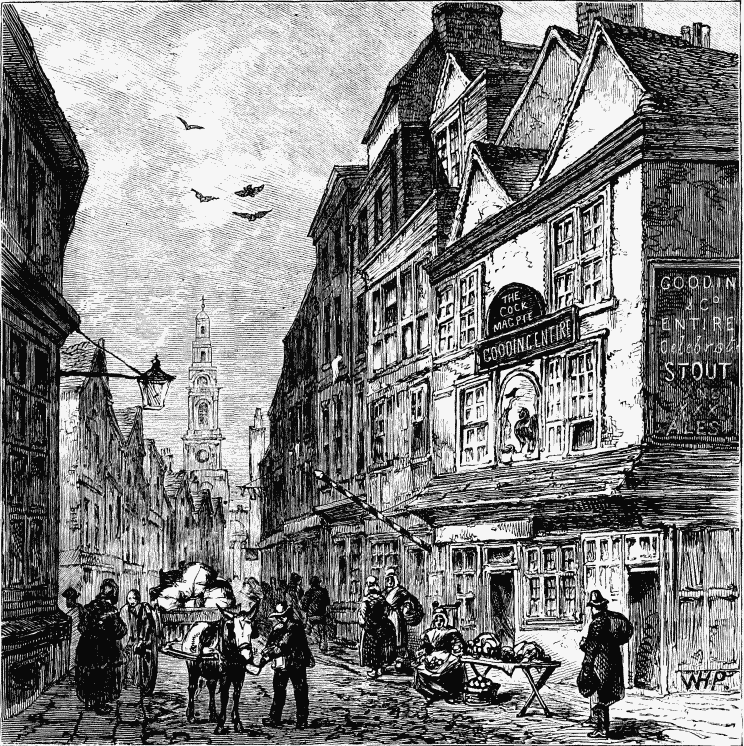
THE "COCK AND MAGPIE," DRURY LANE. (From an Original Sketch in 1840.)
It deserves to be recorded of Sir Robert Drury that he for some time entertained, as a welcome and honoured guest at his mansion in Drury Lane, the amiable and learned Dr. John Donne, afterwards Dean of St. Paul's, when he was young and poor, having contracted marriage with a young lady of high connections, against the will, or at all events without the consent, of her relatives. It is added that he not only gave him and his wife the free use of apartments, but also was "a cherisher of his studies, and such a friend as sympathised with him and his in all their joys and sorrows." Such friends, no doubt, were rare then; as rare, perhaps, as now-a-days; but it is a pleasure to record such an act of genuine friendship.
The exact date of the removal of Lord Craven's family from Drury Lane to their real town residence at Bayswater, where now is Craven Hill, is not known; but it must have been just before the close of the seventeenth century. Craven House itself was taken down early in the present century, and the site is now occupied by the Olympic Theatre, as stated in the last chapter.
Drury Lane was once the "Via de Aldwych," a name still preserved in Wych Street, as already mentioned. Then the great family of the Druries built in it a country house, and the Earls of Craven and Clare followed. It became a Belgravia. Here lived Archibald, the famous and ill-fated Marquis of Argyle. Here, too, close to Cradle Alley, Arthur Annesley, Earl of Anglesey, and Lord Privy Seal under Charles II., had his town house. Here, too, in the heyday of her glory, lived Nell Gwynne, the "pretty Nelly" whom Pepys saw "standing at her lodgings' door in her smock sleeves and bodice, a mighty pretty creature." Here also resided John Lacy, the comedian, and Sir William Alexander, the poet, afterwards Earl of Stirling.
At the same period was residing here a relative of the staid Mr. Evelyn, who, after recording in his "Diary" that he attended the marriage of his niece to the eldest son of Mr. Attorney Montagu, at Southampton Chapel, and eulogising the magnificence of the entertainment, adds, "the bride was bedded at my sister's lodgings in Drury Lane."
It was in Drury Lane, not very far from the steps of the Olympic Theatre, that Lord Mohun made his unsuccessful attempt to carry off the beautiful and much-wooed actress, Mrs. Bracegirdle, as we shall presently show.
By the time of Steele, Drury Lane had changed its character, and its narrow, close, and filthy courts were rising into existence.
All that is now left of Drury Lane is its memory of past glories. The shades of the persons above mentioned, as well as those of the pretty Mrs. Bracegirdle, the fiery Lord Mohun, and of the quarrelsome Carlo Fantom, the Croatian, who challenged his man and killed him, "because the noise of his spurs pleased him not," haunt it still. On the west side is a small burial-ground, unknown to Stow or Strype, to most of the map-makers, and to Peter Cunningham. It lies between Russell Street and Long Acre. For many years it had exhibited a most desolate and miserable aspect; indeed, it had become a sort of "no man's land." During the year 1874, however, the authorities of St. Martin's-in-the-Fields, to whom the ground belongs, at some considerable expense had the graveyard levelled and converted into a garden with walks and shrubberies. A neat brick wall separates the grounds from the public street, and on one side a brick building has been erected, to be used as a mortuary.
Towards the lower end of Drury Lane, nearly opposite to Drury or Craven House, is a quaint old gabled house, with its pents still remaining. A quarter of a century ago it was known as the "Cock and Magpie," but more recently as "Stockley's Cheap Bookshop." It is said that the region to the north, leading up towards St. Giles's, was once known as "Cock and Pie Fields;" but antiquaries are divided on the question as to whether they were so called from the house, or the house from them. Whichever may be the case, it is certain that the "Cock and Magpie" as a sign, is but a travesty of a chivalric legend, which Douce thus explains:—"In the days of ancient chivalry it was the practice to make solemn vows or engagements for the performance of any considerable enterprise. This was usually performed during some great feast or entertainment, at which a roasted peacock, being served up by ladies in a dish of gold or silver, was presented to the knight, who then made his particular vow with great solemnity. When this custom had fallen into disuse, the peacock nevertheless continued to be a favourite dish, and was introduced on the table in a pie, the head, with gilded beak, being proudly elevated above the crust, and the splendid tail expanded. Other birds of smaller value were afterwards introduced in the same manner; and the recollection of the old peacock vows might occasion the less serious, or even the burlesque, imitation of swearing, not only by the bird itself, but also by the pie: hence, probably, came the oath 'By cock and pie,' for the use of which no very great antiquity can be found." From "Cock o' pie" to "Cock and magpie" the transition was easy and obvious.
Opposite to the above is the "Craven Head" Tavern, which, from 1851 to 1855, was kept by Mr. Robert Hales, the "Norfolk Giant." He was born in 1820, near Yarmouth, where his father was a small farmer, and was one of nine children, all far above the ordinary stature. He was exhibited by Barnum, in America, in 1848, and was one of the curiosities of London in the year of the first Great Exhibition. In the April of that year he was presented to the Queen, who gave him a watch and chain; and also to other crowned heads. He stood upwards of eight feet in height. His death occurred in 1863, at the age of forty-eight.
Little Drury Lane is a narrow street, leading down from Drury Lane to St. Mary's Church in the Strand. Its eastern side is composed of a range of houses which have stood apparently more than two centuries and a half.
It will be remembered that in the Tatler (No. 46) Steele gives a picture of the morality of Drury Lane, describing it as a district divided into particular "ladyships," analogous to "lordships" in other parts, "over which matrons of known ability preside." Its character, too, as well in the present as in the past century, is delicately hinted at by Gay, in the lines quoted from "Trivia," at the head of this chapter. The "Dog," a low public-house in this street, was known as the robbers' den; and nothing can confirm more clearly the character of the immediate neighbourhood, to which we have referred, than the fact that Drury Lane was the scene of the "Harlot's Progress," by Hogarth.
In Drury Lane was one of the several "cockpits," or places reserved for cock-fighting, which a century ago or earlier were to be found scattered about London. Mr. John Timbs tells us that one of our oldest theatres was called the "Cock-pit," namely, the "Phœnix" in Drury Lane, and that the site of it is still to be traced in the name of Pit or Pitt Place, an abridgment of "Cock-pit" Place. Samuel Pepys thus describes in his "Diary" a visit to one of these places, not far from Drury Lane:—"December 21. To Shoe Lane to a cock-fighting at a new pit: but Lord! to see the strange variety of people, from Parliament men, to the poorest 'prentices, bakers, brewers, butchers, draymen, and what not; and all these fellows, one with another, cursing and betting. Strange that such poor people, that look as if they had not bread to put in their mouths, shall bet three or four pounds at a time, and lose it, and yet bet as much the next battle, so that one of them will lose £10 or £20 at a meeting! I soon had enough of it."
From Stubs's "Anatomie of Abuses," published in 1585, it is evident that in the good old Tudor times Sunday was the day of all the week especially set apart for this amusement. As early as the reign of Henry II., according to Fitzstephen, cockfighting was the sport of school-boys in and around London on Shrove Tuesday; and from that time, though occasionally forbidden by some of our sovereigns, it has continued to exist among us, as we shall see hereafter.
At the beginning of the eighteenth century it
would seem that Drury Lane had succeeded to a
part at least of the reputation of Grub Street, as
the residence of poor poets and hack rhymsters,
as witness the words of Pope, in his "Dunciad"—
"Cries he who high in Drury Lane,
Lulled by soft zephyrs through the broken pane,
Rhymes ere he wakes, and prints before Term ends,
Obliged by hunger, and request of friends."
And in like spirit wrote Oliver Goldsmith—
'Where the 'Red Lion,' staring o'er the way,
Invites each passing stranger that can pay;
Where Calvert's butt, and Parson's black champagne,
Regale the drabs and bloods of Drury Lane,
There, in a lonely room, from bailiffs snug,
The Muse found Scroggins, stretch'd beneath a rug."
"Their Majesties' servants," as might have been expected, fared but ill during the austere tyranny of the Puritan faction. At the Restoration the survivors of the old actors naturally formed themselves into a company, and Downes tells us that they acted at the Tennis-court, in Vere Street, Clare Market, till a new theatre was built; and Guest is of opinion that both before and after that event they performed at the Cockpit in Drury Lane. The theatre in Vere Street was opened November 8th, 1660, by Killigrew and Davenant, under a patent which allowed women to act the female parts, a practice till then unknown in England.
It was at this theatre that an unknown young lady was performing the character of Roxana, in the Siege of Rhodes, who fell a victim to Aubrey de Vere, the last (and most unworthy) Earl of Oxford of the ancient line. This scion of a noble house, finding that he could secure his prey in no other way, brought to her lodging a sham clergyman and a sham marriage certificate; and she learnt to her cost, when it was too late, that she had no pretension whatever to style herself Countess of Oxford.
It is clear that although the Puritans disapproved of plays pur et simple, they tolerated mixed entertainments of a musical kind. Such an entertainment, we know from Evelyn, was given after the death of Oliver Cromwell, for he writes, in May, 1659:—"I went to see a new opera after the Italian way in recitative music and scenes. … It was prodigious that in a time of such public consternation such a 'vanity' should be kept up or permitted." That this entertainment was something different from a tragedy or comedy is clear from another entry by Evelyn in his "Diary," in January, 1661:—"After divers years since I had seen any play, I went to see acted The Scornful Lady, at a new theatre in Lincoln's Inn Fields."
Mr. Peter Cunningham tells us that Laguerre, whose "sprawling saints" are immortalised by Pope, was a member of a club of virtuosi who used to meet at a house in Drury Lane, and that he painted on its walls a Bacchanalian procession, which he presented to its members. But apparently the habitat of this club was unknown to him.
It was in a low lodging-house in Lincoln Court, one of the gloomiest purlieus on the eastern side of the upper part of Drury Lane, that in 1861 was discovered the infant son of a Mr. and Mrs. Hill—relatives of the Burdett family—which had been "spirited away" from its mother's charge at Rugby by its father. The story is thus told by a writer in Cassell's Magazine of May 24th, 1873:—
"The boy's own father, after falsifying the register of its birth, took it to London, and handed it over to some women whom he met in the street. The police were soon put upon the track of the culprits, who were shown to have received the missing infant from its unnatural parent. The papers took up the matter, which became a 'nine days' wonder,' and in a little time the child was discovered in Lincoln Court, Drury Lane, a place tenanted by the lowest class of Irish. It was in a sadly dirty state, and such clothing as it had on its back was not the same which it wore on leaving Rugby; but in spite of dirt and rags, there was something about the child which marked it off from the beggars' brats among whom it was playing, and its distingué looks led to its recovery. Ultimately the father was acquitted of the charge on which he was arraigned. Both he and Mrs. Hill, however, died shortly afterwards, and the stolen boy is now happily a ward of the Court of Chancery."
The following brief extract from a daily paper in the present year of grace (1874) tells its own sad story:—"On Saturday Mr. Langham held an inquest on the body of Miss Eliza Merrit, aged fifty-six, who, it was said, was the daughter of a Church of England rector, and after struggling amid ill health to earn a living as a governess and by needlework, had ultimately, as the evidence showed, died of want, alone, in a small back room in Drury Lane!"
Drury Lane was inhabited, in the early part of the present century, by a still lower and rougher lot than now, if it be true, as stated on apparently good authority, that Drury Lane had seldom less than six or seven fights going on upon a Sunday morning at the same time.
It should be added here that this street—or, at all events, a part of it—at one time was called Prince's Street; "but the old name triumphed," says Mr. Peter Cunningham, "and Prince's Street was confined to a new row of tenements branching off to the east, and still distinguished by that name."
The thoroughfare known as Clare Market, leading eastwards into Lincoln's Inn Fields, was so called in honour of the Earl of Clare, who lived "in a princely mansion" adjacent. His name is inscribed as a parishioner of St. Clement Danes in the ratebooks of 1617. In Howell's "Londinopolis" of 1657 we read:—"Then is there, towards Drury Lane, a new market, called Clare Market; then is there a street and palace of the same name, built by the Earl of Clare, who lived there in a princely mansion, having a house, a street, and a market both for flesh and fish, all bearing his name." It is thus mentioned by Strype:—"Clare Market, very considerable and well served with provisions, both flesh and fish; for, besides the butchers in the shambles, it is much resorted unto by the country butchers and higglers. The market-days are Wednesdays and Saturdays. The toll belongs to the Duke of Newcastle (Pelham - Holles) as ground landlord thereof."
"This market," says Nightingale, in the tenth
volume of the "Beauties of England and Wales,"
"stands on what was originally called Clement's
Inn Fields. In the year 1657 a Bill was passed
for preventing the increase of buildings, in which
was a clause permitting the Earl of Clare to erect
the market, which bore his title, in these fields, to
be held on Tuesdays, Thursdays, and Saturdays.
The earl, it seems, also erected a chapel of ease to
St. Clement's, which is said to have been converted
to dwelling-houses. That these lands were before
in the possession of Holles we have already shown
under Clement's Inn. Charles I., in 1640, granted
his license to Thomas York, his executors, &c., to
erect as many buildings as they thought proper
upon St. Clement's Inn Fields, the inheritance of
the Earl of Clare, 'to be built on each side of the
causeway, leading from Gibbon's Bowling Alley, at
the coming-out of Lincoln's Inn Fields, to the
Rein Deer Yard, that leadeth unto Drury Lane,
not to exceed, on either side, the number of 120
feet in length or front, and 60 feet in breadth, to
be of stone or brick.' (fn. 1) Charles I. issued another
license in 1642, permitting Gervase Holles, Esq.,
to erect fifteen houses, a chapel, and to make
several streets of the width of thirty, thirty-four,
and forty feet. These streets still retain the names
and titles of their founders, in Clare Street, Denzil
Street, Holles Street, &c." Rein Deer Yard was,
probably, what is now called Bear Yard, and
Gibbon's Bowling Alley was covered by the first
theatre erected by Sir William Davenant, whence
he afterwards removed to Portugal Street. Here,
during the administration of Sir Robert Walpole,
in the reign of George II., John Henley, a disappointed demagogue, stood on a tub and vented his
factious ebullitions, which he distinguished by the
name of oratory. He is alluded to by Pope, in his
"Epistle to Arbuthnot," but not in very quotable
terms. Possessing some abilities, he was also obnoxious to Government by the publication of the
"Hyp Doctor," and other papers on the politics
of the times. A contemporary writer speaks of
him as—
"Preacher at once and Zany of the age."
On Henley's death in 1756, his demise was thus announced in the Gentleman's Magazine:—"Rev. Orator Henley, aged 64."
We learn from the "Harleian Miscellany" that the City had a long lawsuit with Lord Clare for this property, but that at last the City yielded. It appears, also, from the same source, that the success of his lordship in obtaining a charter for his market led to one important result, namely, the establishment of other markets round about the metropolis, some of which are now things of the past, such as Hungerford, Brooke, and Bloomsbury Markets, and that at Petty France, in Westminster, and St. James's and Newport Markets, which are still in existence.
Of the house of Holles, Lord Clare, whose family names are so perpetuated in this vicinity, no remains are left, nor is the precise site of it known. It was a large and stately mansion, shut in with a high wall, and its grounds joined on to the eastern side of those of Craven House. Clare Street is mentioned in Strype's edition of Stow as "a good open place fronting the market," while Clare Market bears the reputation of being "a street well inhabited by tradesmen." No engraving of old Clare House is known to exist, nor is any detailed description of the house to be found. All that we know is that the Earl of Clare, as we are told by Howell, lived in his "palace" here in a "princely manner," to which, we fear, the present aspect of the place presents a very marked contrast.
With the Earl of Clare, and other aristocratic denizens of St. Clement Danes, have passed away "the butchers in the shambles, and country butchers," who used to supply these wealthy households. The merchandise at present exposed for sale in Clare Market consists principally of dried fish, inferior vegetables, and such humble viands, suited to the pockets of the poor inhabitants of the narrow courts and alleys around.
The celebrated actress, Mrs. Bracegirdle, we are told, was in the habit of going often into Clare Market, and of giving money to such poor basketwomen as were out of employ, thereby calling down many blessings on her head.
As Clare Market lay between two great theatres, its butchers and hucksters, as remarked by Mr. Timbs, were the arbiters of the galleries, and the leaders of theatrical rows, as well as the musicians at the marriages of actresses, and the chief mourners at players' funerals. In one of the many publichouses which, as was natural, abounded here, Hogarth, in the days of his apprenticeship, was a frequent boon-companion of Joe Miller.
In Gibbon's Court, Clare Market, was a small theatre, in which Killigrew's company performed for a short time. Pepys speaks of it as a handsome building, "the finest, I believe, that ever was in England." This, however, must have been an exaggeration. It soon passed away, and its remains were long used as slaughter-houses and carpenters' shops. The butchers of Clare Market are now nearly extinct; but Mr. P. Cunningham tells us that so lately as 1850 from 350 to 400 sheep, and from 50 to 200 oxen, were slaughtered there. He adds, "In a yard distinct from the more public portion of the market is the place where the Jews slaughter their cattle, according to a ceremony prescribed by the laws of their religion.
When Cromwell revived the prohibition of his predecessor against the erection of new buildings in and near London, imposing even a fine on its violation, an exception, we are told, was made in favour of the new buildings then scarcely finished, in Clare Market. In consequence of this exemption, unfortunately for the healthiness of the locality, they were not made "of brick or stone," or "upright, and without projecting their upper storeys into the street."
The "Artists' Club," of which Hogarth was a member, used to meet at the "Bull's Head" Tavern in this market. Here also was the "Spiller's Head" Inn, named after James Spiller, a well-known actor, where was held a club principally consisting of artists, authors, and actors connected with the Lincoln's Inn Fields Theatre. It was founded about the year 1690, under the auspices of Colley Cibber, Tom D'Urfey, and many noted characters. Of Spiller, Mr. Diprose tells us, "he was an immense favourite with the butchers of Clare Market, one of whom was so charmed with his performances that he took down the sign of the "Bull and Butcher," and put up "Spiller's Head." The success or failure both of actors and pieces appears in those days to have greatly depended on the verdict of the butchers of Clare Market, whose approval was sometimes recorded by managers in their advertisements!
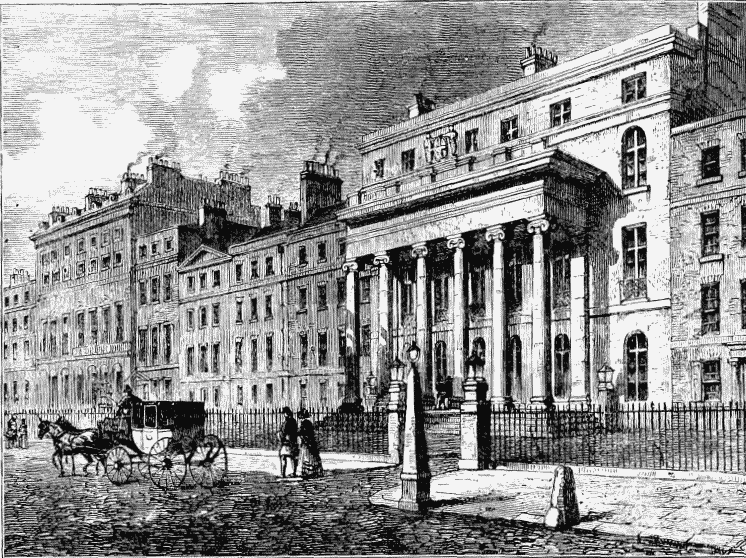
HALL OF THE ROYAL COLLEGE OF SURGEONS.
To the pen of one of these low patrons of the
drama is assigned the following graceful elegy upon
the death of James Spiller in 1729:—
"Down with your marrow-bones and cleavers all,
And on your marrow-bones ye butchers fall;
For prayers from you who never prayed before
Perhaps poor Jemmy may to life restore."
In 1701 there appeared at a place of entertainment in Islington, called "Miles's Music House," afterwards known as "Sadler's Wells Theatre," "a strange sort of monster that does everything like a monkey, mimics man like a jackanapes, but is not a jackanapes; jumps upon tables and into windows on all fours like a cat, but is not a cat; does all things like a beast, but is not a beast; does nothing like a man, but is a man! He has given such wonderful content to the butchers of Clare Market," says a contemporary writer, "that the house is every day as full as the Bear Gardens, and draws the City wives and 'prentices out of London much more than a man hanged in chains."
Clare Market has of late years been much improved by the establishment of a mission chapel and schools in its centre, around which other benevolent and charitable institutions have gradually been grouped, such as a soup-kitchen, a home for needlewomen, and a working men's club.
Adjoining Clare Market are Holles and Denzil Streets, the latter "so called," as we are told by a mural tablet on one of its houses, "by Gilbert, Earl of Clare, in memory of his uncle Denzil, Lord Holles, who died in 1679, a great honour to his name, and the exact paturne of his father's great meritt, John, Earl of Clare." This Lord Holles, it will be remembered, was one of the five members of the House of Commons whose person Charles I. made an ineffectual effort to seize.
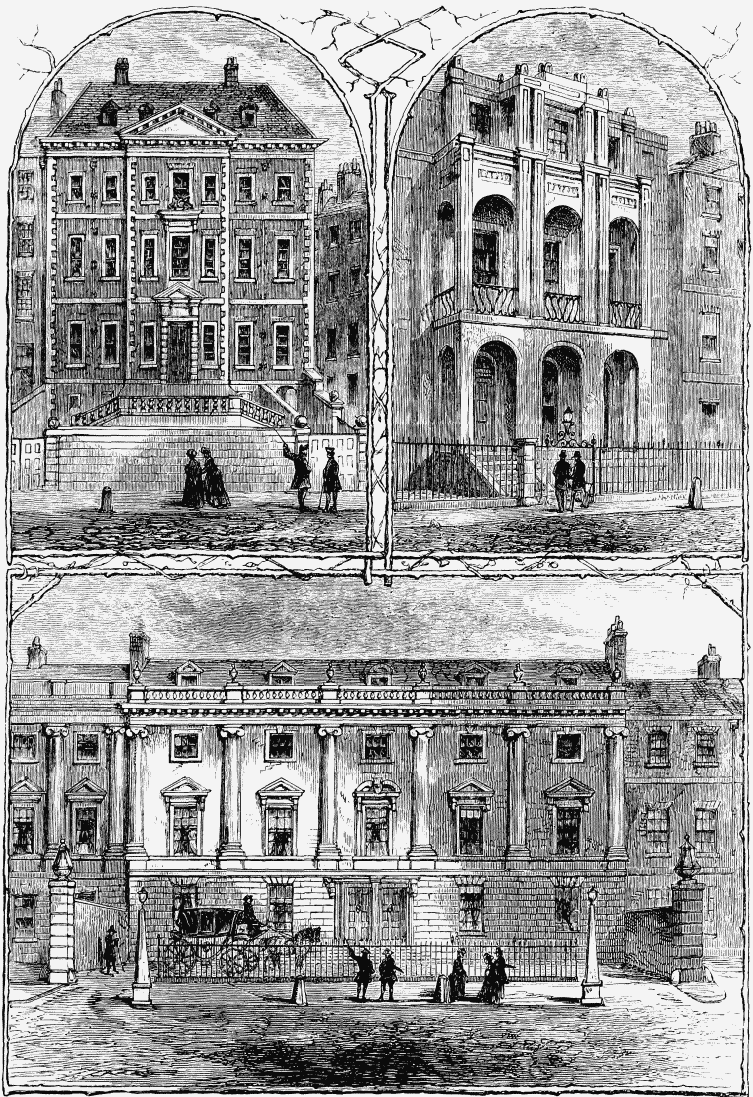
IN LINCOLN'S INN FIELDS.
NEWCASTLE HOUSE. SIR JOHN SOANE'S HOUSE.
DUKE OF ANCASTER'S HOUSE.
Holles Street, which runs into Stanhope Street, was built in 1647, and was called, like its neighbour Denzil Street, after Holles, Earl of Clare.
Of Vere Street, which runs northwards parallel to Stanhope Street, we know little except what Mr. Peter Cunningham has told us, namely, that in 1688 it numbered among its inhabitants Sir Thomas Lyttelton and also the poet Ogilby, who here disposed of his books by a lottery; and that in it stood Gibbon's Tennis Court, subsequently converted into a theatre by Killigrew. Of Stanhope Street, in spite of its grand name, we have no interesting memories to record.