Old and New London: Volume 3. Originally published by Cassell, Petter & Galpin, London, 1878.
This free content was digitised by double rekeying. Public Domain.
Walter Thornbury, 'Lincoln's Inn ', in Old and New London: Volume 3(London, 1878), British History Online https://www.british-history.ac.uk/old-new-london/vol3/pp51-58 [accessed 2 May 2025].
Walter Thornbury, 'Lincoln's Inn ', in Old and New London: Volume 3(London, 1878), British History Online, accessed May 2, 2025, https://www.british-history.ac.uk/old-new-london/vol3/pp51-58.
Walter Thornbury. "Lincoln's Inn ". Old and New London: Volume 3. (London, 1878), British History Online. Web. 2 May 2025. https://www.british-history.ac.uk/old-new-london/vol3/pp51-58.
In this section
CHAPTER VIII.
LINCOLN'S INN.
"The walks of Lincoln's Inn
Under the elms."—Ben Jonson.
Fortescue's definition of "Inns of Court"—The "Revels"—Regulation of the Growth of Beards—"Mootings"—Lincoln's Inn a mansion of Henry
de Lacy, Earl of Lincoln—Description of the Buildings—The Thurloe Papers—Ben Jonson as a Bricklayer—Humorous Translation of
Inscription on "Foundation stone"—Sir Matthew Hale—The Gardens—History of Lincoln's Inn—Sir Thomas More—Illustrious Members
of Lincoln's Inn.
As distinguished from the Inns of Chancery, such as Barnard's and Staple Inns, Lincoln's Inn is an "Inn of Court;" in other words, as defined by Waterhouse, the learned commentator on Fortescue, "one of the Hospitia Majora, such as receive not gudgeons and smelts, but the polypuses and leviathans, the behemoths and the giants of the law." How far this remark may be true, and how far an exaggeration, we must leave it to the lawyers of this and other Courts to determine. Fortescue speaks in glowing terms of the Inns of Court in his own time; and, as a member of Lincoln's Inn, he may be presumed to draw his expressions from what he had seen on this spot. He says: "Of the Inns of Court there are four in number. In the least frequented there are about 200 students. In these greater Inns a student cannot well be maintained under £28 a year (equivalent to at least £500 now). For this reason the students are sons of persons of quality, those of an inferior rank not being able to bear the expenses. There is both in the Inns of Court and the Inns of Chancery a sort of academy or gymnasium, where they learn singing and all kinds of music, and such other accomplishments and diversions (which are called revels) as are suitable to their quality and usually practised at court. Out of term the greater part apply themselves to the study of the law. All vice is discouraged and banished. The greatest nobility of the kingdom often place their children in those Inns of Court, not so much to make the law their study, but to form their manners and to preserve them from the contagion of vice."
Possibly, however, the garrulous old writer has
taken rather too couleur de rose a view of the
domestic virtue taught and practised in his
favourite Inns of Court. One subject, however,
the celebration of "Revels" at certain seasons of
the year within their walls, comes too frequently
under the notice of the student of English history
to be passed by unnoticed here. The idea of the
actual existence of such "Revels" is so much out of
keeping with our practical and prosaic age of stuff
and silk gowns, and barristers' wigs and the gravity
of a judge, that it cannot fail to prove attractive
alike to writers and readers. It is to be feared
that the popular notion concerning them is drawn
by far too exclusively from the lines of Gray,
which are not true to fact:—
"The grave Lord Keeper led the brawls,
The seals and maces danced before him."
It would have been far more true to have spoken
of the "Revels" as plays performed by the
youthful students of each Inn of Court, in the
presence of the grave and reverend seigniors of
the same.
These "Revels," together with almost every other harmless diversion of the kind, with much that was characteristic of our national manners and habits, would seem to have passed out of use during the time of the Puritan tyranny, which is usually styled the Commonwealth. The plays of Æschylus and Sophocles and of William Shakespeare were alike profane and unholy things in the eyes of these sour-visaged "Saints of the Lord," who tore down the Maypoles in our streets and broke the painted windows that adorned our churches, and which the Reformers had spared. It may, however, be said in their excuse that these "Revels," while they lasted, were got up with great extravagance, and that many a parent suffered for his son's outlay on such "private theatricals." But then, though distasteful to the pockets of paterfamilias, it may be said that they must have been "good for trade."
"Lincoln's Inn," says Charles Knight, in his Cyclopædia of London, was never behind the Temple in its masques and Christmas revels; nor were the exercises of dancing and singing merely permitted, but even insisted on, at this Inn; for by an order made on February 6th, in the 7th of James I., it appears that "the underbarristers were by decimation put out of commons for example's sake, because the whole Bar were offended by their not dancing on the Candlemas Day preceding, according to the ancient order of the Society, when the Judges were present; and a threat was added, that if the like fault were repeated they should be fined or disbarred."
Very careful provision would seem to have been made by the council or benchers of the Inn with regard to such minute matters as the apparel of its members, who were bound to dress soberly and to avoid gay colours. On the matter of beards, too, it would seem that they exercised a degree of control which savoured of austerity. For instance, it is on record that the student who wore a beard should pay double for his daily commons and dinner in hall. In the first year of Queen Elizabeth it was ordered "that no fellow of the house should wear a beard of above a fortnight's growth under penalty of loss of commons, and, in case of obstinacy, of final expulsion." Such, however, was the love of long beards, that it triumphed over these sumptuary restrictions, and in November, 1562, all previous orders on the subject were repealed or withdrawn. The long rapier, an appendage of fashion of a still more obnoxious character than the long beard, did not fare equally well. When Elizabeth, whose orders were paramount, ordered watches to be set at each gate of the City to take the measure of every gentleman's sword, and to see that it did not exceed three feet, members of the Inns of Court were obliged to conform, like other citizens, to this standard; and they were further obliged to lay aside their rapiers on entering their several dininghalls, and to content themselves with the daggers which they wore behind.
The life of a law student at the time of which we speak, when, as at Oxford and Cambridge, the students really lived in their "chambers" instead of in lodgings at a distance, and kept up a real bond of fellowship and social intercourse by the common use of a hall and a chapel, must have presented an immense contrast to the usage of our own day. Even down to so late a period as the close of Elizabeth's reign, we are told, the members of Lincoln's Inn resorted once every year in the summer to Kentish Town, where they dined together and indulged in sports, just as now-a-days the employés of some printing establishment drive off to Richmond or the Crystal Palace to celebrate their "wayz-goose." The only remnant of the old social customs which once prevailed is to be found in the fact that there is a dinner served daily in the hall during term-time for those who care to partake of it. But this must have been a reality, and only a part of the daily routine of existence at the time when the collegiate system was not as yet wholly banished from the Inns of Court, when men really lived in their chambers and spent their lives in their Inn, at all events until they took on themselves the responsibility of a wife and a domestic establishment. Nor was their legal education neglected even at the dinner-table; for at each mess it was a rule that there was to be a "moot" daily. We all of us speak of a "mootpoint," but few, perhaps, understand its meaning. The junior member of each mess had to propound to the rest at his table some knotty question of law, which was discussed by each in turn during the dinner. This excellent custom, however, still kept up as it is by members of many religious orders in the Roman Catholic Church, has long since disappeared from the Hall of Lincoln's Inn, although there is extant and probably unrepealed a standing order of the reign of Edward VI., to the effect that every junior at each mess during dinner should "put to the rest a short case of one point which was to be argued thoroughly."
It is obvious that while the lawyer must have an especial, he cannot feel that he has an exclusive, interest in the early history of the Inns of Court, which form so considerable a part of the antiquities of the metropolis. The buildings of Lincoln's Inn for instance, though consecrated to the legal profession for the past five or six hundred years, if they could speak of their earlier years, would tell us of Knights Templars, and of the proud house of De Lacy, Earls of Lincoln, and of more than one bishop who held the Great Seal in the days of the Plantagenets.
If our imagination could carry us back to the thirteenth century, we should notice, as we walked up what now is Chancery Lane, but then was known as New Street, leading from the Temple Bar up to "Old Bourne," the palace of the Bishops of Chichester, the mansion of Henry de Lacy, Earl of Lincoln, and the beautiful church of the Knights Templars, resplendent with the solemn services which were daily celebrated within it. It is from this Earl of Lincoln that what is now "Lincoln's Inn" derives its name; and it is the opinion of the learned antiquary, Francis Thynne, that it was constituted a regular Inn of Court not long after that nobleman's death in 1312. Those of the buildings which still remain, however, are not older than the Tudor times, the old gateway and the hall having been both erected in the reign of Henry VII. The frontage of these old buildings facing Chancery Lane is about 500 feet in length. The gatehouse is a fine specimen of late red brickwork of a Gothic type, and is now almost the only example of that sort of work to be found in London. The principal gateway, and the two flanking towers on either side, still stand in the same condition as when they were first erected, except that their red colour has been dulled by three centuries and a half of dust and smoke; but the windows for the most part have been modernised, much to the loss of picturesque effect. Over the gateway are still to be seen three shields of arms in as many square compartments. The first are those of Lacy, Earl of Lincoln; those in the centre are the royal arms of England; and the third and last are the bearings of the actual builder of the gate, Sir Thomas Lovel, Knight. Beneath these is the date A.D. 1518. These heraldic sculptures were repaired and redecorated in 1815.
It is rumoured that this gateway, which abuts too closely on the narrowest part of Chancery Lane, is destined to be removed at no distant date, in accordance with a plan in progress for rebuilding the suites of chambers on one uniform plan. We should be sorry to lose the venerable but somewhat gloomy edifice, on account of the many illustrious personages with whom its memory is associated, and who must have passed beneath its portals on their way to "chambers"—Sir Thomas More, Lord Keeper Egerton, Dr. Donne, Sir Henry Spelman, Sir Matthew Hale, Sir John Durham, Attorney-General Noy, Rushworth, Lord Thurlow, Lord Shaftesbury, Lord Mansfield, and Lord Erskine.
The red brick buildings adjoining the gateway in Chancery Lane are of a slightly later date than the entrance itself; and it is in all probability to this portion of the structure that quaint old Fuller alludes when he writes of Ben Jonson, that "he helped in the building of the new structure in Lincoln's Inn, and having a trowel in one hand, he had a book in his pocket."
Mr. Peter Cunningham tells us that in the south angle of the great court leading out of Chancery Lane, formerly called the Gatehouse Court, but now Old Buildings, in No. 24, in the apartments on the ground-floor on the left-hand side, Thurloe, the secretary to Oliver Cromwell, had chambers from 1645 to 1659. Cromwell himself must often have darkened by his presence this doorway; and here, by the merest accident, long after Thurloe's death, his papers and correspondence with the Lord Protector and other members of the Roundhead party were discovered, having lain for years concealed behind a false ceiling. Mr. John Timbs, in his "Romance of London," relates a curious anecdote concerning these chambers, to the effect that one evening Oliver Cromwell came thither to talk over with Thurloe a plot for seizing the person of Prince Charles, then at Bruges, and his brothers the Dukes of York and Gloucester, when, finding Thurloe's clerk asleep at his desk, he drew his dagger to kill him, thinking (as was really the case) that he had been overheard, and was with difficulty stopped by his secretary from carrying out his design. The young clerk found means to warn the royal party of their danger, and the plot fell through. If this story be really true, it may safely be asserted that in this very set of chambers English royalty has been saved.
The "Thurloe Papers," it may be added on the self-same authority, were disposed of by the discoverer to Lord Chancellor Somers, who caused them to be bound up in sixty-seven volumes in folio, and they form the principal part of the collections afterwards published by Dr. Birch, and known by the name of the "Thurloe State Papers."
The old hall, as seen through the archway leading into the court from Chancery Lane, with its high-pitched roof externally, has all the appearance of a monastic building, from its buttresses and pointed windows. It is situated in the first court opposite the entrance gate; it was erected in the twenty-second year of King Henry VII., so that it is nearly of the same date with the gateway; its appearance, however, is very different from the dull red brick of the entrance, being covered with an exterior coating of white plaster or stucco. It has undergone alterations at various dates, and in 1819 it was lengthened by ten or twelve feet, and the present unsightly modern ceiling was substituted for the fine open roof of oak, which was removed or concealed. The hall is about 70 feet by 30, and 32 feet high. "It was divided," says Mr. Spilsbury, the Librarian of Lincoln's Inn, "in 1853, by permission of the benchers, in order to form two courts, the one for the Lord Chancellor, and the other for the Lords Justices of Appeal, until suitable accommodation can be provided by the country for the administration of justice." In 1874 the partition was again removed, and the building fitted up so as to form one spacious court for the Lord Chancellor and Lords Justices, when sitting together or alternately. At the upper end, over the seat of the Lord Chancellor, is a picture of Paul before Felix, painted for the society by Hogarth. At the opposite end of the room is a statue of Lord Erskine, by Westmacott. The heraldic achievements in stained glass, with which the windows were formerly enriched, and also those of the panels of the walls, have been removed to the new hall.
Here were held all the "Revels" of the society, in which the benchers themselves indulged. Dancing was especially enjoined, and was thought to conduce to the end of making gentlemen more fit for their books at other times. One of the latest "Revels," at which King Charles II. was present, is noticed both by Evelyn and Pepys in their respective diaries. On a second visit of that monarch to Lincoln's Inn, on the 27th of February, 1671, he was accompanied by his brother, the Duke of York, Prince Rupert, the Duke of Monmouth, and others of the nobility. These illustrious and distinguished personages were admitted members of the Honourable Society, and entered their names in the Admittance Book, where their signatures are preserved." Hogarth's picture, mentioned above, it may be interesting here to remark, was painted at the instigation of Lord Mansfield, as the best way of expending a legacy of £200 left to the benchers.
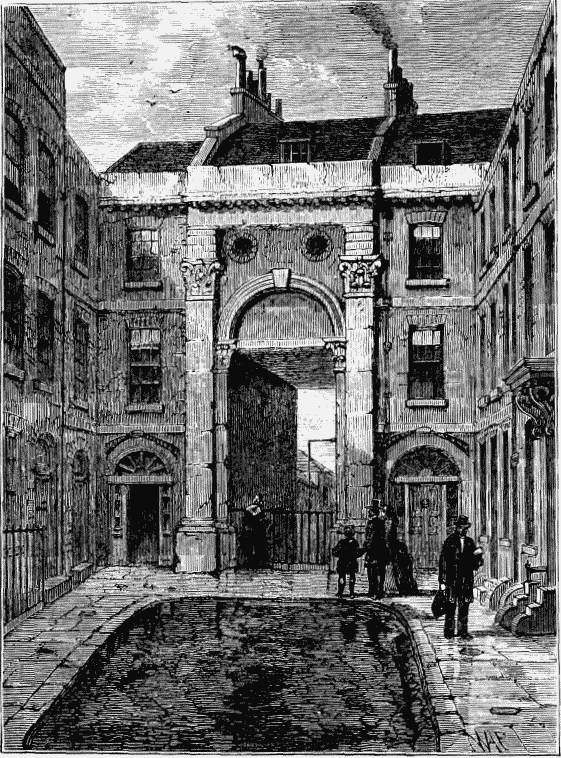
ESSEX WATER GATE, ESSEX STREET, STRAND.
The chapel possesses features of peculiar interest. It has been the opinion of some antiquaries that it is a restoration or reconstruction of a much earlier edifice; but there is evidence which proves conclusively that the present building was erected in the reign of James I., and that the old chapel was standing at the time of the consecration of the new one. It was built from the designs of Inigo Jones, and consecrated in 1623. Ben Jonson is said to have assisted with his trowel in the building of this chapel, as well as of the outer wall already mentioned. Its size is 60 by 40 feet, and it is about 44 feet high. The windows are filled with stained glass of very brilliant colours, and the carved work of the oaken seats is of very chaste design, and superior execution, as specimens of the style prevailing in the reign of James I. The crypt under the chapel, now dwarfed by the gradual raising of the ground, was built, like the cloisters in the Temple, as a place for the students and lawyers "to walk in and talk and confer their learnings." Mr. Peter Cunningham reminds us that the round nave of the Temple Church was formerly used for a like purpose, and Butler and Pepys both allude to the custom. This crypt was long reserved as a burial-place for the benchers of the Inn. In it sleeps the Puritan Baxter, by Thurloe, and near him Alexander Brome, the Cavalier songwriter, and William Prynne, already mentioned, who wrote against the unloveliness of love-locks, and the inscription on whose grave was already blotted out when Wood wrote his "Athenæ Oxonienses."
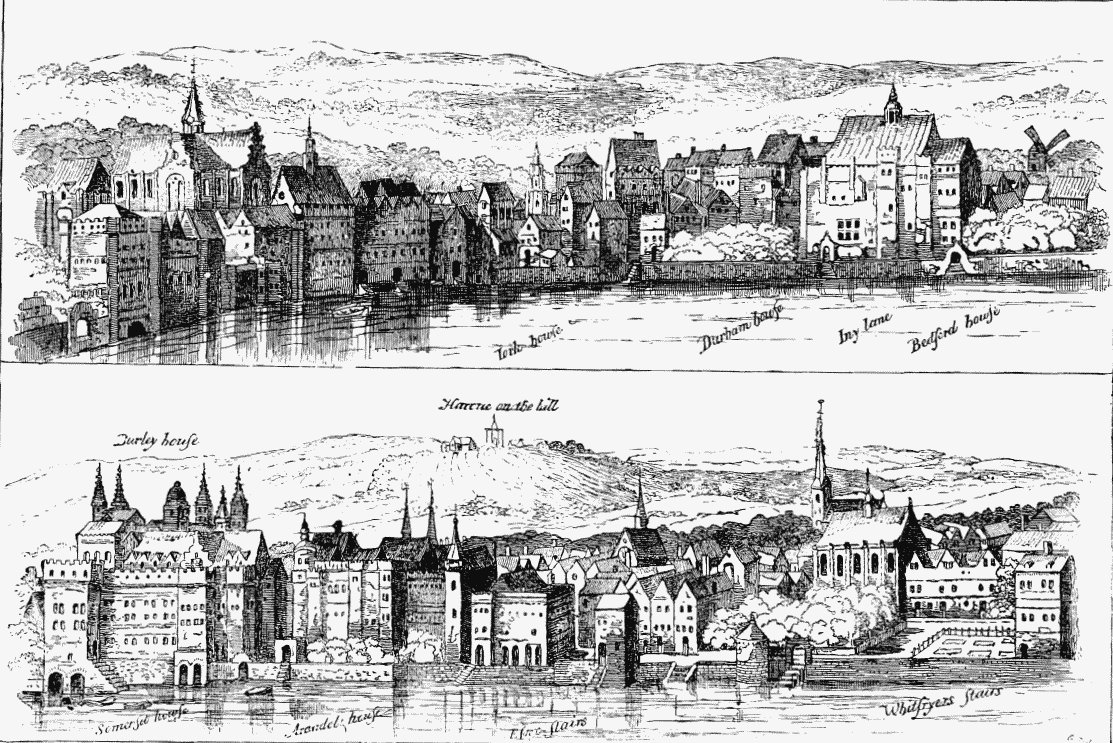
THE STRAND FROM THE THAMES, SIXTEENTH CENTURY.
The present noble hall and library, built of red
brick, with stone dressings, by the late Mr. Philip
Hardwick, R.A., was commenced in 1843. The
first stone of the hall was laid on the 20th of April
in that year by Sir James Lewis Knight-Bruce, the
treasurer of the society. It bears the following
inscription:—
"Stet lapis, arboribus nudo defixus in horto,
Fundamen pulchræ tempus in omne domûs.
Aula vetus lites et legum ænigmata servet,
Ipsa novo exorior nobilitanda coquo.
XXIJ. CAL. MAIJ, MDCCCXLIIJ."
The inscription was humorously translated by the
late Sir George Rose as follows:—
"The trees of yore
Are seen no more:
Unshaded now the garden lies.
May the red bricks,
Which here we fix,
Be lasting as our equities.
The olden dome
With musty tome
Of law and litigation suits:
In this we look
For a better 'cook' (fn. 1)
Than he who wrote the 'Institutes.'"
The library was originally 80 feet in length, but in 1873 it received an addition of 50 feet to its length. The present dimensions are 130 feet by 40 feet, and 44 feet high. The original foundation of this library is of earlier date than any now existing in the metropolis, namely, 1497. At the time of the removal of the books to the present building, in 1845, the number of volumes was about 18,000. It has since gone on increasing, so that the library now contains nearly 40,000 volumes, on law, jurisprudence, history, and other cognate and collateral studies. In addition to the collection of law books, admitted to be the most complete in this country, the shelves of the library are well furnished with books in historical and various other classes of literature. The Reports of Cases in England are extant in a regular series from the reign of Edward II., from whose time to that of Henry VIII. they were taken by the prothonotaries, or chief scribes of the court, at the expense of the Crown, and published annually, whence they are known under the denomination of the "Year Book." Here also is an unique copy of the fourth volume of "Prynne's Records," purchased in 1849 at the sale at Stowe for £335. Here likewise is preserved the collection of legal MSS. and books bequeathed to the Inn by Sir Matthew Hale, "a treasure," he says in his will, "that is not fit for every man's view." The formation of this library was commenced as early as the reign of Henry VII., and the acquisition of books received a great impulse by an order issued in the early part of the reign of James I., to the effect that every person called to the Bar should contribute to it 13s. 4d., and every bencher on his election 20s. In the Council Room of the society is the portrait of Sir Matthew Hale, by Wright.
Stone Buildings—so called from the material of which they are built—lie at the north-eastern extremity of Lincoln's Inn. The range of buildings forms part of a design made in 1780 for rebuilding the whole Inn. The structure is commodious and imposing when viewed from the gardens, or even from Lincoln's Inn Fields, but is in no way in keeping with the architecture of the other buildings in the Inn. The northern entrance is by handsome iron gates in the upper part of Chancery Lane.
The houses in New Square were built in the reign of Charles II. In the open space in the centre of the square there was formerly a Corinthian column, bearing a vertical sun-dial. The houses, which form three sides of the square—as stated, indeed, in a previous chapter—were formerly called Serle's Court, having been erected in 1682 by Henry Serle, one of the benchers of Lincoln's Inn. They are of brick, and are wholly occupied as chambers, many of the most eminent members of the Bar and legal profession holding them. It may be worth while to record here the fact that Sir Samuel Romilly had chambers at Nos. 2 and 6, Sir William Grant at No. 3, and at No. 11 Lord Selborne, whilst as yet only Sir Roundell Palmer. The site upon which New Square is built was originally called Fickett's Field, or Little Lincoln's Inn Field. The garden in the centre was railed and planted in 1845; and in 1867 was erected, within the enclosure, the temporary building for the exhibition of the designs for the New Law Courts.
The gardens of Lincoln's Inn, though not washed like those of the Temple, by the "silver" Thames, and though not possessing equal historical associations with the spot where the White and Red Rose were chosen as the badges of two rival and royal houses, were not and indeed are not without a beauty of their own; and the fine elms which they contain are an ornament to the neighbourhood. They were famous of old, however, but have been much curtailed by the erection of the new hall and library at the south-western angle. There is a fine and broad terrace walk; but "the walk under the elms," celebrated by Ben Jonson, has disappeared. In these gardens, as we learn from the Tatler (No. 100), old Isaac Bickerstaffe delighted to walk, being privileged to do so by his friends amongst the benchers, who had grown old along there with himself. In the time of the old Earls of Lincoln the gardens are said to have been most fruitful, supplying apples, nuts, and cherries in great abundance, as well as flowers and "kitchen herbs," the produce of which, over and above what was needed for his lordship's household, brought in to the steward of the estate a large sum annually.
The readers of Pepys' "Diary" will scarcely need to be reminded here of the following entry, as it has been so often quoted before:—"27 June, 1663. To Lincoln's Inn, and there walked up and down to see the new garden which they are making, and will be very pretty, and so to walk under the chapel by agreement."
As to the past history of Lincoln's Inn, a part of its site was occupied in ancient times by the church and house of a body of "preaching friars," who came to England in 1221, and received much encouragement and great support in London. Hubert de Burgh, the powerful Earl of Kent, who died in 1252, and was buried in their church, left to them his house in Westminster, which was nothing less than the ancient White Hall, afterwards York House, of which we shall have to speak presently. The friars sold it to the Archbishop of York, who left it an heirloom to his successors in the see.
In 1250 the friars of this order held a grand convocation at their house, when no less than 500 churchmen were present. On the first day of their meeting, Henry III. attended their chapter, and sat with them at their table to a dinner which his royal self had provided. Afterwards the queen did the same, and the example was followed by the Bishop of London, the Abbots of Westminster, St. Albans, Waltham, and others. Here the friars continued until 1276, when the Mayor and other influential citizens of London gave them a piece of ground near Baynard's Castle, between Ludgate and the Thames, to build a new monastery and church, which was afterwards known as the "Black Friars." The old house appears to have been the property of William de Haverill, the King's Treasurer, and on his attainder for treason, to have been given by the Crown to Ralph de Nevill, Bishop of Chichester, and Lord Chancellor, who built there a large house which he occupied till his death in 1244. The memory of the bishop is retained in the name of a small court between the Inn and Chancery Lane, still called "Chichester Rents." Having passed through one intermediate owner, it became the residence of Henry de Lacy, Earl of Lincoln, to whom Edward I. made a present also of the old friars' house. The two thus joined together formed a residence for the earl; and hence the place was styled his "Inn," meaning his lodging or house. It is said that the earl introduced law students into his "Inn" as early as the year 1310; but this is at best doubtful. Nor is it clear, nor do historians or antiquaries tell us, how the Bishops of Chichester again became the owners of the "Inn." Such, however, apparently was the case, for they held it until the beginning of the sixteenth century, when Robert Sherborne, bishop of that see, conveyed it to an Essex gentlemen named Sulyard, whose family conveyed it, in 1579, to William Kingsmith and the rest of the benchers for the modest sum of £520.
As the title-deeds of Lincoln's Inn do not go
further back than December, 1535, its early
history is naturally involved in no little obscurity.
The tradition of its establishment in the reign of
Edward III., is highly probable, although no
evidence of a documentary nature can be adduced
to prove it. The first mention of the four Inns of
Court—of which Lincoln's Inn beyond a doubt
was one—occurs in the writings of Fortescue, who
wrote in the latter half of the fifteenth century.
According to the received opinion, Lincoln's Inn
had flourished for a century and a half before
Fortescue wrote; but certainly we meet with no
record of any distinguished student within its
walls at that date. From a record of the same
age with Fortescue, namely, the "Black Book"
of the Inn itself, we find that, whether it was the
oldest of the four Inns of Court or not, at all
events it was the first which instituted a settled
order of government, and made provision for the
needs of legal education. This Black Book commences in 1423, and gives the name of Fortescue
himself as one of its governors or benchers. In
1440 the governors began to be formally sworn on
taking office, and the students on admission were
also required to take an oath of obedience to that
body. In 1464 the Society of Lincoln's Inn made
an important step of progress in their organisation
of legal education, by appointing a "reader" to
give readings in the law to the students during
the vacation of the courts. The first reader whose
name is recorded is William Huddersfield. The
persons chosen as readers were the most eminent
lawyers of the day under the degree of serjeant.
A reader in 1475, and again in 1481, was Sir
Thomas Lovel, who built the gatehouse of the Inn.
The name of John More, the autumn reader for
1489, introduces us to an episode in the history of
the Inn. In 1464 John More was raised from the
office of butler to that of steward. In 1470 his
long and faithful services in those two capacities
were rewarded by his admission to be a member
of the society, and in 1489, and again in 1495, he
held the high and honourable office of reader.
His son John succeeded the father in the office of
butler, and enjoyed the like promotion. The son
of this latter John More was the illustrious Sir
Thomas More, the chancellor and martyr. Of
Sir Thomas More's conduct upon the woolsack it
was said, in the punning style of the day:—
"When More some years had Chancellor been,
No more suits did remain;
The same shall never more be seen,
Till More be there again."
Allen, in his "History of London," remarks of this Inn that "it ranks next to the Temple, which it equals in the number of eminent lawyers that it has produced." Of these it may be sufficient to mention Sir John Fortescue, one of the "fathers of the English law," who held the Great Seal under Henry VI.; that virtuous chancellor, Sir Thomas More; the learned antiquary, Sir Henry Spelman; the great Sir Matthew Hale, and Lord Chancellor Egerton. Prynne, the well-known victim of Star Chamber tyranny, was also a member of this society. For an alleged libel in the "HistrioMastix" he was condemned by that court to pay a fine of £5,000, to lose his ears, to stand in the pillory, and to be imprisoned for life. Nor did the odious sentence end there, for the Chamber, "assuming an authority co-extensive with its vindictiveness," ordered Prynne to be expelled from the University of Oxford and also from the Society of Lincoln's Inn.
The Inns of Court have deservedly been styled "the noblest nurseries of humanity and liberty in the kingdom." They are four in number, viz., the Inner Temple, the Middle Temple, Lincoln's Inn, and Gray's Inn. They are called Inns of Court, because they were anciently held in the Aula Regia, or Court of the King's Palace. They are self-governed by an elective body of benchers, consisting of the most distinguished and successful members of the Bar, a numerous body, comprising between 3,000 and 4,000 barristers. No person is called to the Bar until he is twenty-one years of age and of five years' standing as a student, except he be a member of the Universities of Oxford and Cambridge, in which case he may be called after three years.
At what time students were first admitted into Lincoln's Inn seems to be a doubtful point. Malcolm, on the authority of an old heraldic MS. which styles the Inn "an ancient ally unto the Middle Temple," observes that "there is no mention of any flourishing estate of the students and professors of the common law resident in this college till the reign of Henry VI., when it appears by the rolls and remembrance of that house the same then began to be famous."
Besides the office of reader, which is now held by a clergyman, the Inn has two other offices held by men in holy orders, namely, that of preacher and chaplain. Since 1581, when the first appointment of preacher to the society appears to have been made, many of the most eloquent and distinguished divines of the Church of England have filled the office, amongst whom have been Archbishop Tillotson, Dr. Donne, Thomas Gataker, and Dr. Hurd; Bishops Warburton, Heber, and Maltby; and Archbishop Thomson. In fact, the Preachership of Lincoln's Inn has often been regarded as a "stepping-stone to a bishopric."
Among the most illustrious students, benchers, treasurers, and members of this Inn have been Sir Robert Atkins, Lord Chief Baron of the Exchequer, temp. William III.; Sir John Fortescue; Anthony, first Earl of Shaftesbury; Lord Southampton; Archbishop Tillotson; Sir Arthur Plantagenet, natural son of Edward IV.; Sir Joseph Jekyll; Sir Thomas Egerton, Lord Keeper of the Great Seal, temp. Elizabeth; Sir Thomas More, Chancellor of England, already mentioned; the Earl of Hardwicke; Lord Talbot; Sir Robert Walpole; Sir Matthew Hale, whose gift to the library is noticed above; Lord Mansfield; Lord Walsingham; Dr. Warburton, Bishop of Gloucester; Lord Camden; Lord Henley; William Pitt; Addington, afterwards Lord Sidmouth; Lord Ellenborough, the Chief Justice; the Right Hon. Spencer Percival; Dr. Jackson, Bishop of Oxford; Sir Vicary Gibbs; James Lord Dunfermline; and at least three Lord Chancellors of our own day, Brougham, Cottenham, and Campbell.