Old and New London: Volume 3. Originally published by Cassell, Petter & Galpin, London, 1878.
This free content was digitised by double rekeying. Public Domain.
Walter Thornbury, 'The Strand (southern tributaries)', in Old and New London: Volume 3(London, 1878), British History Online https://www.british-history.ac.uk/old-new-london/vol3/pp63-84 [accessed 30 April 2025].
Walter Thornbury, 'The Strand (southern tributaries)', in Old and New London: Volume 3(London, 1878), British History Online, accessed April 30, 2025, https://www.british-history.ac.uk/old-new-london/vol3/pp63-84.
Walter Thornbury. "The Strand (southern tributaries)". Old and New London: Volume 3. (London, 1878), British History Online. Web. 30 April 2025. https://www.british-history.ac.uk/old-new-london/vol3/pp63-84.
In this section
CHAPTER X.
THE STRAND:—SOUTHERN TRIBUTARIES.
"Westward the tide of Empire makes its way."
Thanet Place—The old "Rose" Tavern—Palsgrave Place—The "Palsgrave's Head"—Andrew Marvell—The London and Westminster JointStock Bank—Messrs. Strahan, Paul, and Bates—Messrs. Twining and Co.'s Bank and Tea-warehouse—"George's Hotel"—Devereux
Court—"Tom's Coffee House"—The "Grecian"—Eldon Chambers.
Extending from Fleet Street as far as the present Essex Street was formerly an Outer Temple, which, with the Inner and Middle Temples, constituted the residences of the Knights Templars. This space is now for the most part occupied by the houses in Thanet Place, Palsgrave Place (both culs de sac), and Devereux Court.
The first of these—Thanet Place—stands as nearly as possible on the site of the old "Rose Tavern," a place of rendezvous for lawyers and wits in the last century. The place consists of ten houses. It was named after the Earls of Thanet, to whom it belonged, and from whom the property passed, in 1780, by purchase to one John Cooke, a bookseller in Paternoster Row. The "Rose Tavern" is described by Strype as being in his day a "well-customed house, with good convenience of rooms and a good garden;" and T. Fairchild, in his "City Gardener," in 1722, tells us that in this garden was "a vine that covers an arbour where the sun very rarely comes, and has had ripe grapes upon it." It makes our mouths water as we come out of Temple Bar on a hot summer afternoon, with the thermometer at 83° in the shade, to hear of grapes growing in the open air close to our left hand even a century and a half ago. The "painted room" at this tavern is mentioned in Horace Walpole's "Letters," but it has long since passed out of memory.
Palsgrave Place, a narrow paved court, about
half-way between Temple Bar and Essex Street,
is named after the Palsgrave Frederick, King of
Bohemia, who in 1612 married the Princess Elizabeth, daughter of James I. Close by was the
tavern known as the "Palsgrave's Head," where
Prior and Montague make the "country mouse
and city mouse" bilk the hackney coachman:—
"But now at Piccadilly they arrive,
And taking coach towards Temple Bar they drive;
But at St. Clement's Church cut out the back,
And slipping through the 'Palsgrave' bilk't poor hack."
Some of the taverns of the seventeenth century appear to have been established over the shops in this locality; for in 1679, according to Mr. Diprose's "Account of St. Clement Danes," "a goldsmith named Crutch carried on business under this tavern, and most of the shops were marked by signs. William Faithorne, an engraver of merit, lived 'at the sign of the Ship, next to the Drake, opposite to the Palsgrave's Head Tavern, without Temple Bar.'" Another house of entertainment or tavern in this neighbourhood, much frequented by members of Parliament and City gallants of the seventeenth century, was "Heycock's Ordinary." Here usually dined Andrew Marvell, some time member for Hull, and famous in his day as a wit and satirist; and here, according to the above authority, he administered a severe castigation to certain members of the House, known to be in the pay of the Crown, for ensuring the subserviency of their votes. "Having ate heartily of boiled beef, with some roasted pigeons and asparagus, he drank his pint of port, and on the coming in of the reckoning took a piece of money out of his pocket, held it between his finger and thumb, and addressing his venal associates, said, 'Gentlemen, who would lett himself out for hire while he can have such a dinner for half-a-crown?'"
Another "scene," in which Andrew Marvell appears as the principal character, may possibly have taken place here. The anecdote has been often related, but will bear repetition:—"The borough of Hull, in the reign of Charles II., chose Andrew Marvell, a young gentleman of little or no fortune, and maintained him in London for the service of the public. His understanding, integrity, and spirit were dreadful to the then infamous administration. Persuaded that he would be theirs for properly asking, they sent his old schoolfellow, the Lord Treasurer Danby, to renew acquaintance with him in his garret. At parting, the Lord Treasurer, out of pure affection, slipped into his hand an order upon the Treasury for £1,000, and then went to his chariot. Marvell, looking at the paper, called out after the Treasurer, 'My lord, I request another moment.' They went up again to the garret, and Jack, the servant-boy, was called. 'Jack, child, what had I for dinner yesterday?' 'Don't you remember, sir? You had the little shoulder of mutton that you ordered me to bring from a woman in the market.' 'Very right, child. What have I for dinner to-day?' 'Don't you know, sir, that you bid me lay the bladebone to broil?' "Tis so; very right, child; go away.' 'My lord, do you hear that? Andrew Marvell's dinner is provided. There's your piece of paper; I want it not. I know the sort of kindness you intended. I live here to serve my constituents. The ministry may seek men for their purpose; I am not one.' "
The house No. 217, Strand, now a branch of
the London and Westminster Joint-Stock Bank,
but which till lately was occupied as a bank by
Messrs. Strahan (originally Snow), Paul, and Bates,
had a history approaching in venerable antiquity
to that of its neighbour, the bank of Messrs.
Child. The name of the firm was originally
Snow and Walton, who carried on business here
as pawnbrokers during the Commonwealth, their
house bearing the sign of the "Golden Anchor."
Their ledgers went back as far as the year 1672.
There was a book in the possession of the late
members of the firm, showing that they were
established as bankers in the reign of Charles II.,
when their accounts were kept in decimals. The
firm came to a disgraceful and disastrous end in
1855, the leading partners of it being tried criminally and convicted of misappropriating the moneys
of their customers, for which they were sentenced
to various terms of imprisonment, a climax which
offers a striking contrast to the reputation enjoyed
by the original owner and founder of the house, a
wealthy goldsmith named Snow, whose memory is
thus immortalised by Gay:—
"Disdain not, Snow, my humble verse to hear;
Stick thy black pen awhile behind thy ear.
O thou whose penetrative wisdom found
The South Sea rocks and shelves when thousands drown'd,
When Credit sank and Commerce gasping lay,
Thou stood'st, nor sent one bill unpaid away;
When not a guinea clinked on Martin's boards,
And Atwel's self was drained of all his hoards,
Thou stood'st—an Indian king in size and hue—
Thy unexhausted store was our Peru."
Adjoining the above house, and opposite to the spot where formerly stood Butcher's Row, are the banking-house and tea-warehouse of Messrs. Twining and Co. The latter was founded about the year 1710 by the great-great-grandfather of the present partners, Mr. Thomas Twining, whose portrait, painted by Hogarth, "Kit-cat size," hangs in the back parlour of the establishment. The house, or houses—for they really are two, though made one practically by internal communication—stand between the Strand and the east side of Devereux Court. The original depôt for the sale of the then scarce and fashionable beverage, tea, stood at the south-west angle of the present premises, on the site of what had been "Tom's Coffee House," directly opposite the "Grecian." A peep into the old books of the firm shows that in the reign of Queen Anne tea was sold by the few houses then in the trade at various prices between twenty and thirty shillings per pound, and that ladies of fashion used to flock to Messrs. Twining's house in Devereux Court, in order to sip the enlivening beverage in very small china cups, for which they paid their shillings, much as nowa-days they sit in their carriages eating ices at the door of Gunter's in Berkeley Square on hot days in June. The bank was gradually engrafted by Messrs. Twining on the old business, after it had been carried on for more than a century from sire to son, and may be said, as a separate institution, to date from the commercial panic of 1825. It is, perhaps, worthy of note that a member of this family, which has been so long and so honourably connected with commerce, was that elegant and accomplished scholar, the Rev. Thomas Twining, the translator of Aristotle's "Poetics" in the days of our grandfathers.
Separated from the above-mentioned establishment by the entrance to Devereux Court is "George's Hotel," which stands on the site of what was once "George's Coffee House"—one which, though not equal in reputation to "Tom's" or the "Grecian," had associations of its own. It is mentioned by Foote in his "Life of Murray," as a place where the wits of the town in 1751 would assemble in the evening; and among its frequenters was the poet Shenstone—he of the "Leasowes"—who tells us that for a subscription of a shilling he could read all the lesser pamphlets of the day. It ceased to be known as a coffee-house about the year 1842, and has since been used as an hotel.
When the new sewers were being constructed in the Strand, a little to the east of St. Clement's Church, in 1802, the workmen found a stone bridge of a single arch, strongly built, and covered to some depth with rubbish and soil. A doubt arises as to whether this could have been an arch turned over a gully or ditch at a time when the fields along the north side of the Strand were furrowed with water-courses, or whether it was actually the Pons Novi Templi passed by the lords and others who went from London to attend the Parliament at Westminster in the reign of Edward III., and the repair of which that monarch called upon the Templars to effect. In the absence of architectural details, or at least a sketch of the bridge, we shall not attempt to decide so knotty a point.
Devereux Court, into which we now pass, is famous as having been the locale of two of the most celebrated coffee-houses—"Tom's" and the "Grecian." It takes its name from Robert Devereux, Earl of Essex, the Parliamentary general, who was born in Essex House (part of which stood upon this spot), and of whom we shall have more to say presently.
Of "Tom's" coffee-house we know that Akenside was a frequenter in the winter evenings, and that Pope here addresses a letter to Fortescue, the "counsel learned in the law." Another of its frequenters was Dr. Birch, the antiquary.
The "Grecian," as we know, was frequented by a goodly company of wits and poets, including Addison, Steele, and Goldsmith, and derived its name from having been kept originally by a Greek from the Levant. As far back as 1664–5, says Mr. Diprose, "he advertised his Turkey coffeeberry, chocolate, sherbet, and tea, good and cheap; and announced his readiness to give gratuitous instruction in the art of preparing the said liquors." And Steele, in the first number of the Tatler, supplies us with an idea of the character of this house, when he tells the public that he "shall date all gallantry from 'White's,' all poetry from 'Wills's,' all foreign and domestic news from 'St. James's,' and all learned articles from the 'Grecian.'" The existence of the rival coffeehouses gave a high literary character to Devereux Court in the seventeenth and eighteenth centuries. The face of the "Spectator" himself was very well known at the "Grecian," "adjacent to the law," and the house was frequented by the Irish and Lancashire Templars, and also by Fellows of the Royal Society. It was Foote's morning lounge, and in a snug and cozy corner here Goldsmith occasionally "wound up his shoemaker's holiday with supper."
In the Spectator (No. 49) Addison describes his feelings at seeing the young Templars lounge at the "Grecian" early in the morning, either dressed for Westminster, and with the assumed air of men with heavy business engagements, or else in gay caps and slippers, as though wishing to display their indolence.
Dr. King relates how two hot-blooded young gentlemen quarrelled one evening at the "Grecian" upon the appropriate subject of the accent of a certain Greek word, and not being able to adjust the matter amicably, stepped out into the court and settled it with their swords, the one falling by the other's hand. The topographer of Leeds, Ralph Thoresby, describes how on one occasion, after a meeting of the Royal Society, he came back to the "Grecian," and spent the rest of the evening there in the company of Sir Isaac Newton.
At the "Grecian" Akenside spent such of his winter evenings as he could spare from "Tom's," as we learn from Sir John Hawkins's "Life of Johnson," "entangled in disputes and altercations, chiefly on subjects of literature and politics, that fixed on his character the stamp of haughtiness and self-conceit, and drew him into disagreeable situations." The "Grecian" ceased to be a coffee-house or tavern about the year 1842, and shortly afterwards it was converted into "chambers." A part of the building, however, now known as "Eldon Chambers," is used as a refreshment-bar. High up, on the front of this house, is a bust of Lord Essex, and beneath it the inscription, "This is Devereux Court, 1676."
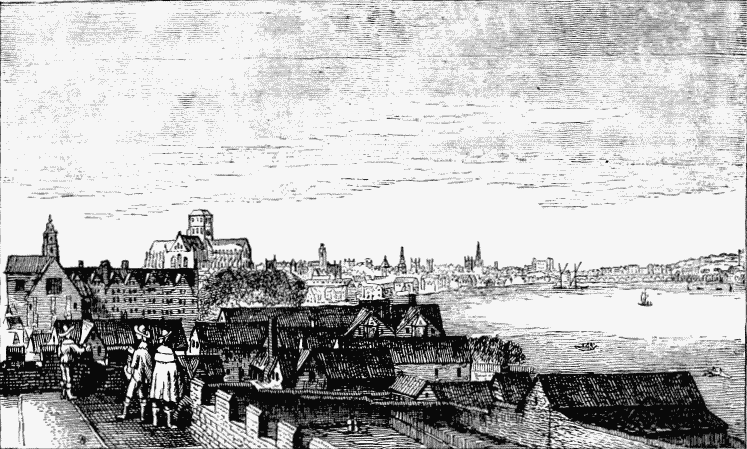
LONDON, FROM THE TOP OF ARUNDEL HOUSE. (From an Etching by Hollar.)
CHAPTER XI.
THE STRAND:—SOUTHERN TRIBUTARIES (continued).
"The glories of our birth and state
Are shadows, not substantial things."—Lovelace.
Exeter House—Attacked by the Populace—Seized by Lord Paget, and Bequeathed to Robert, Earl of Essex—Paterson, the Auctioneer—Essex Street—"Sam's" Club at the "Essex Head"—Anecdote of the Young Pretender—The Robin Hood Society—Charles Dibdin—The Unitarian Chapel—Earliest Inhabitants of Essex Street.
The site now covered by Essex Street and Devereux Court was, as stated above, originally a portion of the Outer Temple, and, as Dugdale supposes, belonged at one time to the "Prior and Canons of the Holy Sepulchre." In the reign of Edward III. it passed into the hands of the Bishops of Exeter, whose town residence was built here. It was called Exeter House, and they occupied it till the time of Henry VI. In 1326, as readers of English history are aware, Queen Isabella, "the she-wolf of France," consort of Edward II., landed from France to chase the Spensers from the side of her husband, and advanced upon London. The king and his civil counsellors fled to the frontiers of Wales; but Walter Stapleton, then Bishop of Exeter, Lord Treasurer of England, held out stoutly for his sovereign in his house, and as custos of London, demanded from the Lord Mayor the keys of the City to prevent any uprising in the disaffected City. And then a scene occurred which would require the pen of a Macaulay to paint in adequate colours. "The watchful populace," says Mr. Diprose, "fearing the Mayor's submission, and roused by Isabella's proclamation, which had been hung on the new cross in Cheapside, rose in arms and took the keys. They ran to Exeter House, then newly erected, fired the gates, and plundered or burnt all the plate, money, jewels, and goods that it contained. The bishop rode to the north door of St. Paul's to take sanctuary; but there the mob tore him from off his horse, stripped him of his armour, and dragging him to Cheapside, proclaimed him a traitor and an enemy of their liberties, and lopping off his head set it on a pole." Bishop Stapleton's remains were buried under a heap of rubbish or sand hard by his own gateway.
At the Reformation the house was seized on by Lord Paget, who called it after his name. The great Earl of Leicester was its next occupant. He changed it to "Leicester House," and bequeathed it to his son-in-law, the unfortunate favourite of Queen Elizabeth, Robert, Earl of Essex, from whom it derived the name under which it was known for many years, and the memory of which is still retained in Essex Street. It will be remembered that it was from this house that he made, towards the end of Elizabeth's reign, his frantic and imprudent sally, in the vain hope of exciting the citizens of London to take up arms against their sovereign. Finding that his star at court was sensibly waning after the death of Lord Burleigh, and the estrangement of his sovereign, he listened to the advice of those who would have had Raleigh, Cecil, and Cobham banished from the Queen's councils. To strengthen his interest in antagonism to the Queen and the Court, he threw open the gates of Essex House to all discontented persons, and especially to those of the Puritan party. In February, 1601, he took part in an overt act of rebellion, assembling his friends, to whom he stated that his life was threatened by Raleigh and Cobham. "In consequence of this news, Lords Sandys and Monteagle, the Earls of Rutland and Southampton, with nearly 300 other gentlemen, assembled at Essex House, where it was divulged that Essex had resolved at once to rid himself of his enemies by forcing his way to the Queen, and informing her of his danger from those who had so long abused their influence with her Majesty. Having shut up within his gates the Lord Keeper, the Lord Chief Justice, and others whom the Queen, aware of what was passing, had sent to inquire into the cause of the tumult, Essex proceeded with his friends to the City, where, crying aloud, 'For the Queen! for the Queen! a plot is laid against my life!' he tried to enlist the citizens in his favour. But notwithstanding his popularity no one took up arms: the cause of the tumult was either unknown or mistaken. At length the Earl endeavoured to return home, but he was met by a party of soldiers near Ludgate, where a tumult ensued, in which he was twice shot through the hat. At last he reached Essex House; but after a short defence he was compelled to surrender, and along with Lord Southampton was committed to the Tower. . . . . He was tried for high treason in Westminster Hall on the 15th of the same month, and executed on the 25th on Tower Hill." His son, the next Earl, the celebrated Parliamentary general, was born here; and in the Cavalier songs of the day the house is often alluded to as "Cuckold's Hall." It was here, according to Whitelocke, that the Earl, after the battle of Newbury, received a deputation from the House of Commons and the citizens of London with the Speaker and the Lord Mayor at their head.

ARUNDEL HOUSE (TO THE SOUTH). (From an Etching by Hellar.)
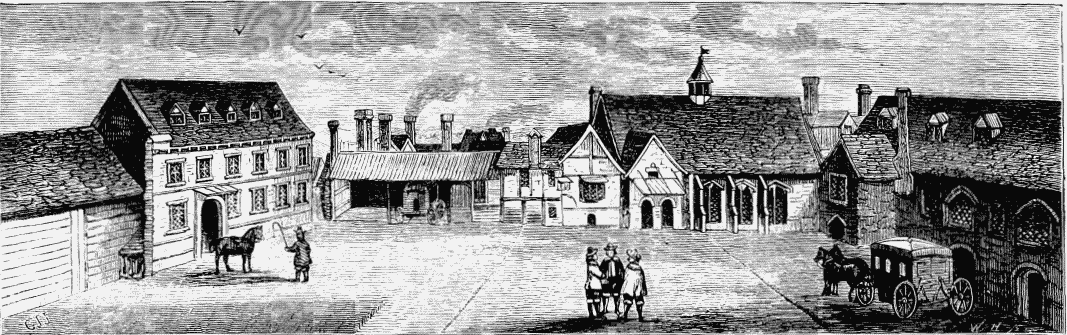
ARUNDEL HOUSE (TO THE NORTH). (From an Etching by Hollar.)
Spenser thus speaks of Essex House in his
"Prothalamium;"—
"Next whereunto there stands a stately place,
Where oft I gayned gifts and goodly grace
Of that great Lord which therein wont to dwell,
Whose want too well now feeds my friendless case."
It is said that Sir N. Throgmorton was poisoned here; and within its walls was lodged, in 1613, the Count Palatine of the Rhine, when he came to London as the accepted suitor of "the Lady Elizabeth," daughter of James I.
It appears that in or about 1640 the great mansion of Essex House was divided, the one half being let by Lord Essex on a long lease to William Seymour, Earl of Hertford, whose name is so well known to history in connection with that of Lady Arabella Stuart. Twenty years later we find Lord Southampton, the Lord Treasurer of Charles II., living here; and the house was tenanted by Sir Orlando Bridgman, the Lord Keeper in 1669, when it is described by Pepys as "large but ugly." Strype tells us that after this it was purchased by a builder, who appears to have converted the site into a good speculation, the houses which he erected in its place being soon occupied by "the quality." Old Essex House was partly demolished about the year 1682, and the street rose on the site of its ruins about two years later.
The other half of the original edifice long retained its name of Essex House, and it is worthy of note that it served as a receptacle for the Cottonian Library in the reigns of Anne and George I. It appears that this part of the house was afterwards inhabited by an auctioneer. It was at Essex House, according to Horace Walpole, that this auctioneer, named Paterson, in 1761, first offered for public sale subjects in painted glass—the art of producing which appears to have been lost—imported by him from Flanders.
It must be owned that the architecture of Essex Street, with its unsightly square-headed archway at the lower end, leading by a flight of stone steps to the Embankment, is by no means attractive or tasteful; but in this respect it resembles its precursor, Essex House, which is described by Pepys as a large but ugly mansion. The property was divided and let after the Restoration, and ultimately the house was pulled down and the materials sold, towards the middle of the reign of George III., from which the present houses date. The arch and the steps at the end of the street are said by John Timbs to have formed the water-gate of old Essex House; if so, we can only say that it presented a sorry contrast to the work of Inigo Jones half a mile further west. In a view of the "Frost Fair" on the Thames in the reign of Charles II., where the royal party are walking on to the ice at the Temple stairs, to witness the sport, this heavy archway is seen in the background, and through it can be descried the gardens and terraces and the eaves of Essex House.
At the "Essex Head" in this street (now No. 40), the year before he died (1783), Dr. Johnson established a club called "Sam's," for the benefit of the landlord, one Samuel Greaves, who had been an old servant of his friends, the Thrales. It was not so select as the Literary Club, but cheaper. Johnson, in writing to Sir Joshua Reynolds, and asking him to join it, says, "The terms are lax and the expenses light; we meet thrice a week, and he who misses forfeits twopence." The rules of this club, as drawn up by Dr. Johnson himself, will be found at length in Boswell's "Life;" and our readers may be amused to learn that the "forfeit" for non-attendance being found too low, was raised to three pence!
It was in Essex Street that Dr. King, as we learn from his "Anecdotes of His Own Time," was privately presented by Lady Primrose, "in her dressing-room," to Prince Charles Edward Stuart, "the Young Pretender," during his short, secret, and stolen visit to London, between the 5th and the 11th of September, 1750. The house of this same lady, in this street, some three years before, curiously enough, had afforded a temporary home to Flora Macdonald, after her release from the mild imprisonment to which she had been subjected by the Government.
In the year 1613 the Robin Hood Society was established at the house of Sir Hugh Middleton in this street. It was removed to the "Robin Hood" Tavern in Butcher Row, when it was presided over by a baker. "Here," Mr. Diprose tells us, "Burke displayed those oratorical powers which afterwards became so transcendent. When, becoming reconciled to the Pitt administration, he went over to the Tory benches, exclaiming, 'I quit the camp,' Sheridan instantly rose and observed, 'As the honourable gentleman had quitted them as a deserter, he hoped he would not return as a spy;' and when the king settled a pension on Burke, Sheridan remarked that 'it was no wonder that Mr. Burke should come to the House of Commons for his bread, when he formerly went to a baker for his eloquence'—meaning the Robin Hood Club." Poor Oliver Goldsmith was a member of this club. The meetings were held on Monday nights, when questions were proposed on which any one present might speak if he did not exceed seven minutes. When these were finished, the "baker," who presided with a hammer in his hand, summed up the arguments.
In 1788 Charles Dibdin, being "tired of dramatic uncertainties," made a start on his own account by turning some rooms in this street into a theatre of his own, from which, however, he soon afterwards moved to a more fashionable neighbourhood further west.
On the west side of Essex Street is a once noted chapel of the Unitarian body, in which in the course of the last hundred years have ministered in succession Theophilus Lindsey, Dr. Disney, Thomas Belsham, and Thomas Madge.
Of the founder of this Unitarian chapel it may be well here to add a few particulars. His name was Theophilus Lindsey, and he was a godson of the Earl of Huntingdon, in whose family his mother had resided. He took his degree at St. John's College, Cambridge, and was presented by a connection of the Huntingdon family, whilst quite a young man, with the chapel in Spital Square. He afterwards became chaplain to Algernon, Duke of Somerset, and after the duke's death was continued in the same post by the Duchess, who sent him abroad with her grandson, the Duke of Northumberland, as tutor. Having held for a few years a living in Dorsetshire, he exchanged it, by the interest of his old friend Lord Huntingdon, for that of Catterick in Yorkshire, where he was promised a bishopric in Ireland on the appointment of Viscount Townshend as Lord Lieutenant. In 1773, on account of scruples which he had long cherished, he resigned his Yorkshire living and removed to London, openly professing himself a convert to Unitarianism. His wife was a stepdaughter of Archdeacon Blackburne, a lady whose principles and views were congenial to his own. He preached his first sermon in this new capacity at Essex House in 1774, and the new chapel was opened shortly after, Benjamin Franklin, with many other eminent men of the time, being present. He acted as pastor of it for nearly twenty years, during the latter part being assisted by Dr. Disney, who had also seceded from the Church of England. He died in November, 1808, at the age of eightyfive, and was buried at Bunhill Fields. Whatever we may think of the creed which he adopted, we can have but one opinion of his honesty and courage, and must admire the man who in a selfish and thoughtless age could sacrifice his worldly prospects to his conscience. The chapel was built on part of the site of the property of Essex House.
Among the earliest inhabitants of Essex Street were Dr. Hugh Chamberlain (the author of several works on banks of credit, on land, security &c.) and Arthur Maynwaring. Here also lived Dr. George Fordyce, a noted epicurean of the eighteenth century. In Jeaffreson's "Book about Doctors," we are told that "during twenty years he dined daily at 'Dolly's' chop-house, and at his meat he always took a jug of strong ale, a quarter of a pint of brandy, and a bottle of port. Having imbibed these refreshing stimulants, he walked back to his house, and gave a lecture to his pupils."
The late Lord Cholmondeley, who died in 1770, and who was not unknown as an antiquary, used to say that one day, when visiting a house in this street, he found, scratched to all appearance with a diamond, on a weather-stained piece of glass in a top room, the following letters, "I. C. U. S. X. & E. R," which he interpreted, "I see you, Essex, and Elizabeth Regina." If he was right in his interpretation, it would seem probable that some inquisitive occupant of this room, overlooking Essex House, had seen the Queen when visiting the Earl, and, like Captain Cuttle, had on the spot "made a note" of it.
CHAPTER XII.
THE STRAND:—SOUTHERN TRIBUTARIES (continued).
"All the blood of the Howards."—Pope.
Milford Lane—The Chapel of the Holy Ghost—The Illustrated London News—Messrs. Woodfall and Kinder's—Arundel House—The Arundel
Collection—Lord Seymour's Dalliance with the Princess Elizabeth—The Duc de Sully at Arundel House—"Old Parr"—Distinguished
Inhabitants of Arundel Street—The "Crown and Anchor" Tavern—The Whittington Club—The Temple Club—Messrs. W. H. Smith and
Son's News Agency.
It may reasonably be supposed that just on the west of Temple Bar the ground five or six centuries ago was marshy and low, and that a brook ran thence into the Thames. This, too, is rendered probable by the name of Milford Lane, which leads down from St. Clement's Church to the river-side; and the supposition is confirmed by the fact that in 1802 the remains of a bridge of stone, eleven feet in length, and covered by rubbish, was found on digging between Temple Bar and the east end of St. Clement's Church, as stated already in a previous chapter. It is suggested by Mr. T. C. Noble, in his "Memorials of Temple Bar," that this was probably the very bridge mentioned in the reign of Edward III. as built by the Templars of that day by command of the king. Towards its lower end the lane winds round to the east, meeting the steps at the bottom of Essex Street. This part of the parish appears to have been always inhabited by the poorer and less "respectable" classes; and it suffered accordingly most severely from the Plague in 1665.
Stow remarks that he could not account for the origin of the name of Milford Lane; but no doubt it comes from a ford—not over the Thames, as Mr. Timbs suggests, but across the little stream which ran there across and under the Strand into the Thames, near which was a mill. Mr. Timbs tells us that the former is shown in a print of the reign of James I., and that he has seen a "token" of the Windmill, near Temple Bar; but this may possibly have been an inn. It is a narrow, crooked, and ill-built thoroughfare, and now contains more stables and warehouses than private dwellings. Yet it was once well tenanted. In it lived Sir Richard Baker, the author of the "Chronicles," which, as most readers of the Spectator will remember, was the favourite work of Sir Roger de Coverley. The rectors of St. Clement Danes for many generations dwelt about half-way down the lane. The site of the old rectory is now occupied by an infant school.
An unwelcome notoriety has been given to this
lane in a poem by Henry Saville, commonly attributed to the witty Earl of Dorset, and beginning—
"In Milford Lane, near to St. Clement's steeple;"
and Gay also mentions it in his "Trivia," in the
following terms:—
"Behold that narrow street which steep descends,
Whose building to the slimy shore extends.
Here Arundel's famed structure rear'd its frame,
The street alone retains an empty name;
There Essex' stately pile adorn'd the shore,
There Cecil, Bedford, Villiers—now no more."
The lane, it should be mentioned here, when it really was a lane, acted as a boundary between the property of Lord Essex on the east, and that of the Earl of Arundel on the west.
In the Strand, it is said by tradition that between Essex Street and Milford Lane was formerly a chapel dedicated to the Holy Ghost; but no prints of it have been preserved, nor is it known when or by whom it was founded, or when it passed away. Mr. Newton, in his "London in the Olden Time," conjectures that it was originally a chapel belonging to the Knights Templars, and that in after time it became the chapel of the Bishop of Exeter's Inn. He identifies its site, as nearly as possible, with the Unitarian chapel in Essex Street already mentioned.
At the top of the lane, on the eastern side, there stood down to about the year 1850 some picturesque wooden houses, with gables and ornamental fronts; but these were pulled down to make room for the erection of Milford House, in which since that date the Illustrated London News has been printed. It is published at the corner of Milford Lane and the Strand, on the other side of the way. This paper—the first of our "illustrated" journals—was started by the late Mr. Herbert Ingram, a native of Boston, in 1841, and by his energy and ability soon grew into a splendid property; but it needs no description here. We should, however, record in this place his melancholy death by drowning in 1860, on one of the American inland lakes. At the opposite corner house was published in 1858 its short-lived rival, the Illustrated News of the World.
At the bottom of this lane is the printing-office of Messrs. Woodfall and Kinder. It was Mr. Woodfall's grandfather who printed the famous "Letters of Junius." "The business," says Mr. John Timbs, "was first established about the year 1720, in Grocers' Hall Court, and in Angel Court, Skinner Street, George Woodfall printed his edition of 'Junius'—the first book printed there."
Between Milford Lane and Strand Lane—a narrow and rather winding thoroughfare leading to the Embankment a few yards to the east of Somerset House—the entire space, about three hundred yards in length and the same in breadth, formed the site of the town residence of the Howards, Earls of Arundel and Dukes of Norfolk. It was a dull, heavy structure, as may be seen from Hollar's print; but its gardens and terraces were as extensive as befitted the dignity of so noble a house and family. The outlines and extent of the estate, as it was in the days of the Stuarts, may be easily gathered from the names subsequently given to the streets which were laid out upon its site, perpetuating the names of Norfolk, Arundel, Howard, and Surrey—names so familiar to the readers of English history under the Tudors, and also to the students of art and antiquity. Hollar's prints, however, do not give a very attractive view of it, for though it covered a considerable space, the buildings themselves were low and mean.
But it did not belong to the Howards in very ancient days, having been before the Reformation the "Inn" or house of the Bishops of Bath and Wells, and known also as Hampton House. In the reign of Henry VIII., or of his successor Edward VI., it was seized and appropriated by royalty, and from royal hands it passed by an easy transition into the hands of Lord Thomas Seymour of Sudley, High Admiral of England, brother of the Protector Somerset, who called it Seymour Place. On the execution of Lord Seymour for treason, the dead lord's house was bought, together with its gardens and lands adjoining, by Henry Fitzalan, Earl of Arundel; and, Strype tells us, for the incredibly small sum of little more than forty pounds. This Lord Arundel, at his death in 1579, was succeeded in his title by his grandson, Philip Howard, son of the Duke of Norfolk, who had been beheaded for taking part with Mary, Queen of Scots; and though Philip Howard died in exile and attainted, his son Thomas contrived to obtain from James I. a reversal of the attainder and a restoration of his coronet.
Under this Earl of Arundel, the house which stood here became not merely a centre, but the very home and centre of art and art-treasures, as the repository of that collection long known as the "Arundelian Marbles," and "of which," to use the words of Mr. Peter Cunningham, "the very ruins are now ornaments to several private cabinets." We learn that the collection, when in its entire state, comprised no less than 37 statues, 128 busts, and 250 inscribed marbles, besides sarcophagi, altars, gems, and fragments of ancient art, all antique, and obtained with great care and discriminating skill in Italy. Besides these, "there really belonged to the collection a variety of other art-treasures which the Earl had purchased in Italy, but which he never could obtain leave to transport to England." However faulty he may be represented by Lord Clarendon, his judgment as a connoisseur in the fine arts will always remain undisputed. Views of the galleries in Arundel House are to be seen in the backgrounds of Van Somer's portraits of the Earl and Countess.
During the Cromwellian wars, Arundel House and its contents, of which, especially at that time, any nobleman might well have been proud, were given back to the Earl of Arundel's grandson, Henry Howard, sixth Duke of Norfolk, who, at the recommendation of John Evelyn and John Selden, the author of "Marmora Arundeliana," gave the marbles to the University of Oxford, which they still adorn, and the library to the Royal Society, which held its meetings for some time at Arundel House.
The Compleat Gentleman, a publication of the seventeenth century, informs the world, and with some truth, that to the Earl's "liberal charges and magnificence this angle of the world oweth the first sight of Greek and Roman statues, with whose admired presence he began to honour the gardens and galleries of Arundel House, and hath ever since continued to transplant old Greece to England." It may be mentioned here that the remainder of the Earl of Arundel's collection was kept for many years at Tart House, the residence of Howard, the unfortunate Lord Stafford, in Pimlico, and was ultimately sold in 1720.
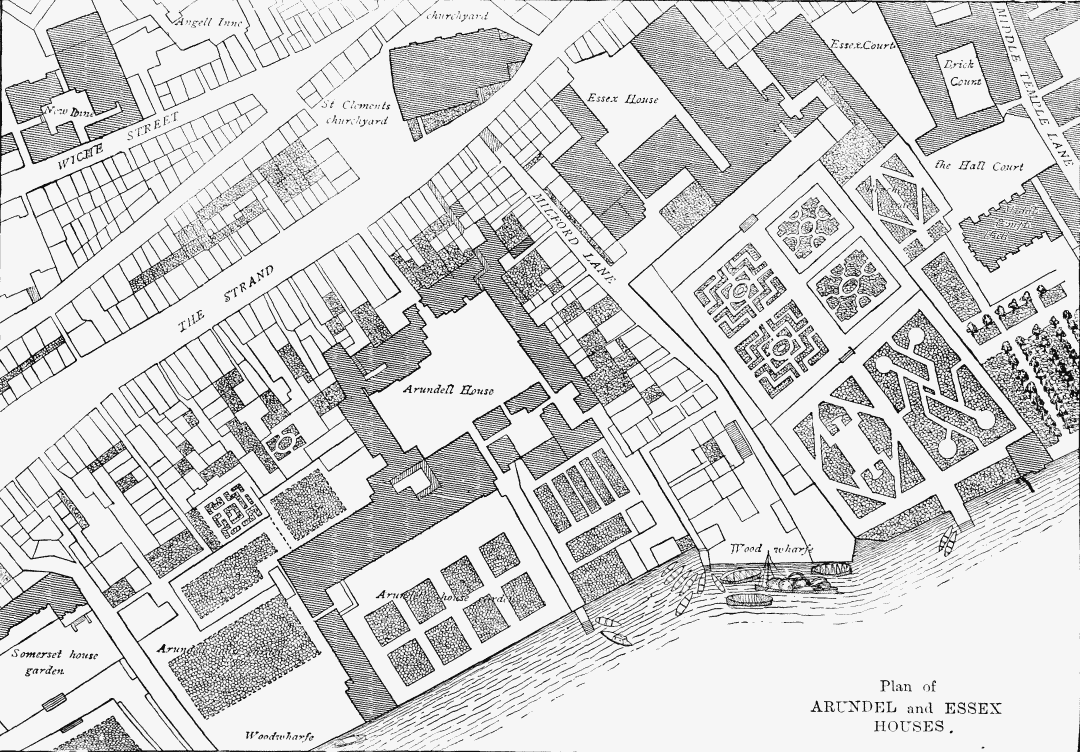
PLAN OF ARUNDEL AND ESSEX HOUSES. (From an original Etching by Hollar, published in Ogilby and Morgan's Twenty-Sheet Plan of London)
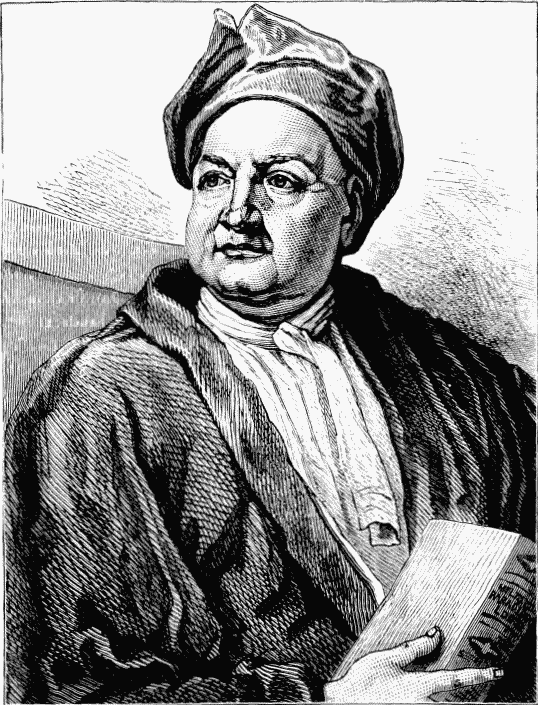
JACOB TONSON. (See page 79.)
"This place," says Pennant, "was one of the scenes of Lord Seymour's indecent dalliance with the Princess Elizabeth, afterwards queen. At first he certainly was not ill received, notwithstanding he had just espoused the unhappy Catherine Parr. Ambition, not lust, actuated this wretched man; his designs on Elizabeth, and consequently on the crown, spurred him on. The instrument of his design was one Thomas Parry, cofferer to the princess, to whom he offered for her Grace's accommodation the use of his house and all its furniture during her stay in London. The queen's death, and her own suspicions on her death-bed, gave just cause for the worst surmises. Seymour's execution, which soon followed, put an end to his projects, and saved Elizabeth and the nation from a tyrant possibly worse than him from whom they had but a few years before been released." The whole of Seymour's infamous conduct respecting the unhappy Queen Dowager is fully detailed in Lord Burleigh's State papers.
Arundel House came to the Duke of Norfolk from the Earl of Arundel by the marriage which united in one line the Fitzalans and the Howards. While tenanted by the Howards, the mansion is described as "a large and old-built house, with a spacious yard for stabling towards the Strand, and with a gate to enclose it, where there was the porter's lodge, and as large a garden towards the Thames."
The house was at one time occupied by the Duc de Sully, who in spite of its humble appearance on the outside, tells us that it was one of the finest and most convenient in London, on account of the number of rooms and apartments on the groundfloor. At Arundel House, too, in its best and palmy days, John Evelyn and his family were frequent visitors. He tells us in his "Diary," under date July, 1662, that he was forced to take home his son John, "who had been much brought up amongst Mr. Howard's children here, for feare of their perverting him to the Catholic religion."
Arundel House, too, is in other ways connected with history. To it the Earl invited Hollar, the artist, who engraved some of his finest plates while enjoying its princely hospitality—among others his (now very scarce) "View of London from the Roof of Arundel House." There also lived for a short time Lord William Howard, the "Belted Will" of border fame. And there also, in November, 1635, died Thomas Parr, known to the world as "Old Parr," having been invited to come thither from his home in Shropshire, in order to become domesticated in the Earl's household, and to be introduced to Charles I., when upwards of a century and a half old. He did not, however, long survive the change; high feeding and the close air of London in a few months brought him to his grave, at the age of 152 years and nine months. His body, as we learn from the Philosophical Transactions, was dissected at the king's command by Harvey, who attributed the old man's death to peripneumonia, brought on by the impurity of a London atmosphere and sudden change in his diet.
Taylor, the water poet, gives us the following
description of Old Parr, when he saw him in
London:—
"His limbs their strength have left,
His teeth all gone but one, his sight bereft,
His sinews shrunk, his blood most chill and cold—
Small solace!—imperfections manifold.
Yet still his spirits possess his mortal trunk,
Nor are his senses in his ruins shrunk;
But that his hearing's quick, his stomach good,
He'll feed well, sleep well, well digest his food.
He will speak merrily, laugh, and be merry,
Drink ale, and now and then a cup of sherry;
Loves company and understanding talk,
And (on both sides held up) will often walk.
And though old age his face with wrinkles fill,
He hath been handsome, and is comely still;
Well fac'd; and though his beard not oft corrected,
Yet neat it grows, not like a beard neglected.
From head to heel his body hath all over
A quick-set, thick-set, natural, hairy cover."
Thomas Parr, according to the inscription on his tomb in Westminster Abbey, was born in Shropshire in 1483; and it is added, "he lived in the reign of ten princes, viz., Edward IV., Edward V., Richard III., Henry VII., Henry VIII., Edward VI., Mary, Elizabeth, James I., and Charles I.; aged 152 years, and was buried here Nov. 15, 1635. He lived at Alberbury, in Shropshire; had an illegitimate child born to him when over 100 years old; and married his second wife, Catherine Milton, at the age of 120. By her he had one child, and after his second marriage he was employed in threshing, and other husbandry work. King Charles, on seeing him, said, 'You have lived longer than other men; now what have you done more than other men?' 'Sir,' he replied, 'I did penance when I was a hundred years old.'" There is a portrait of Old Parr, said to be by Rubens.
"When Arundel House was pulled down," in the seventeenth century, we are told by Allen, "there was a design to build a mansion-house for the family out of the accumulated rents on that part of the gardens which faced the river, and an Act of Parliament was obtained for the purpose; but the design was never carried out." He adds that it was to Arundel House that the Royal Society removed from Gresham College, after the Fire of London, being invited thither by Henry, Duke of Norfolk. They returned to their old home in 1674, soon after which the house was sentenced to be taken down. The Duke, as we are informed by Pennant, had presented his valuable library to the society.
It would seem, from Gay's "Trivia," that for a
long time after the demolition of Arundel House
the eastern part of the Strand lay forsaken and
neglected, though perhaps there may be some little
amount of poetic exaggeration in the following
lines:—
"Where Arundel's famed structure reared its frame,
The street alone retains an empty name;
Where Titian's glowing paint the canvas warm'd,
And Raphael's fair design in canvas charm'd,
Now hangs the bellman's song, and pasted there,
The coloured prints of Overton appear.
Where statues breathed the work of Phidias' hands,
A wooden pump or lonely watch-house stands."
Arundel Street, which was built in 1678 on part of the site of Arundel House, has had in its time some distinguished inhabitants. Amongst others were Simon Harecourt, afterwards Lord High Chancellor; Rymer, the antiquary, author of the celebrated "Fœdera;" John Anstis, Garter King-at-Arms; and the well-known actress, Mrs. Porter.
At the upper end of this street, on the site of the Temple Club, formerly stood the noted "Crown and Anchor" Tavern—so named, no doubt, from the anchor of St. Clement already alluded to—the head-quarters of the Westminster Reformers in the days of Fox and "Old Glory," Sir Francis Burdett. Here, too, were held many of the meetings of the Catholic Association before the passing of the Roman Catholic Relief Act in 1829. The tavern stood as nearly as possible on the site of the buildings in which the Academy of Ancient Music was first instituted in the reign of Queen Anne. The premises extended a considerable way down the street, and at the back of them was a large and spacious room, upwards of eighty feet long, which was used as a banqueting apartment. Upon the occasion of Fox's birthday, in 1798, a great banquet was given here, at which 2,000 Reformers sat down to drink the toast of "The People the Source of Power."
Here the portly form of Dr. Johnson, in company with his friend Boswell, might often be seen; and during the Westminster elections in the last century it became one of the principal houses where the candidates of both sides were wont to address the constituents. It was at the "Crown and Anchor" that Daniel O'Connell first assailed that "venerable champion of civil and religious liberty," Henry Brougham; and it was here, too, that Cobbett fell foul of Sir Francis Burdett, who, we are told, "at once angrily responded by stating that Cobbett owed him a thousand pounds. Cobbett acknowledged receiving the money, but stated that it was a gift, and consequently not a debt." The "King of Clubs" was instituted here early in the present century; its members met every Saturday. One of the chief members was Richard Sharpe, a West India merchant and a well-known Parliamentary speaker during Addington's and Percival's administrations.
The coffee-room of the "Crown and Anchor" had for many years hanging upon its walls a picture which caused some stir among the parishioners of St. Clement Danes early in the last century. It appears that in 1725 the parish was thrown into a state of commotion by an order from Dr. Gibson, then Bishop of London, for the removal of an altarpiece lately painted by Kent, which had cost no small sum, and was supposed to be really a satire on the reigning house of Hanover, by containing scarcely disguised portraits of the wife and children of "The Pretender." The painting, of course, at once became famous, and Hogarth engraved an exact fac-simile of it, as may be seen in Nichol's "Biographical Anecdotes" of that painter. The original, after being removed from the church, was hung up in the coffee-room of this tavern, from which it was subsequently removed into the parish vestry-room.
In 1846 the Whittington Club was instituted at the "Crown and Anchor," under the auspices of Douglas Jerrold and several other gentlemen connected with literature and art. The "Whittington Club and Metropolitan Athenæum," for such was its ambitious name, was founded as a cheap club for men and women of the middle or upper-middle classes, and "with a view to throw open to them those increased physical comforts and faculties for moral and intellectual education, which are the most attractive characteristics of modern London life, but which, in the absence of individual wealth, associated members can alone command." Accordingly, in addition to the usual conveniences in the way of dining, &c., courses of lectures, and classes in chemistry, music, modern languages, and literature, &c., were established, together with weekly re-unions, in which dancing had a place. The subscription was low, £1 1s. or £2 2s. yearly, according to the residence of the member in country or in town; and 10s. 6d. for ladies.
The Whittington Club was named after Richard Whittington, the former "Lord Mayor of great London," and in one of its large rooms hung a picture of "Dick Whittington listening to the sound of Bow Bells," by Newenham, which was given to the club by its founder. The original premises of the "Crown and Anchor" were burnt down in 1854, but they were subsequently rebuilt on the former plan. The Whittington Club, however, languished, and at last came to an end in 1873. The building then underwent considerable alteration, and at the end of the same year was re-opened as the Temple Club. The house, which was erected at a cost of more than £20,000, contains above thirty rooms; what was formerly the hall, a magnificent apartment, capable of seating 1,000 persons, is now the dining-room. One of the principal objects which the founders had in view was to "create the nucleus of a community whose members, uninfluenced by any political bias and unconfined to any literary or scientific pursuit, might enjoy the possession of a neutral ground whereon to reciprocate their ideas with regard to art, literature, and science." The Temple Club already numbers about 3,000 members.
At the opposite corner of Arundel Street, with its principal entrance in the Strand, is that great emporium of modern intelligence, the news-agency of Messrs. Smith and Son, which is, perhaps, the most extraordinary house of business in London, not alone from the rapidity and dexterity of its operations, but the facility and certainty with which business is transacted to such an enormous extent in so short a time. The building is lofty, and covers a large space of ground, and is complete in every department. On the ground-floor is a noble and spacious hall, forming almost the extent of the entire premises, and is surrounded by two galleries. The bustle is at its height about five o'clock in the morning, when vehicles are bringing in the morning papers from the different printing-offices, and are at once folded into oblong packages, wrapped in brown paper covers already addressed, and dispatched in light red carts to the various railway stations for transmission to different parts of the world. Thousands of newspapers are transmitted to their destination in the course of the week from this establishment, and a large staff of clerks are engaged, besides men and boys employed in the packing departments. In addition to this extensive wholesale newspaper business, Messrs. Smith have established a circulating library upon a most extensive scale, from which subscribers can borrow and return, at any of their establishments and agents, all the best and leading books of the day. Printing, advertising, and bookbinding likewise form important items in this vast commercial establishment, and so admirable are the arrangements that each department is complete in itself, and conducted as a separate business; the whole giving employment to something like a thousand hands.
From the Bookseller we learn that Mr. W. H. Smith, the father of the present proprietor, and founder of this gigantic establishment, was born in the year 1792, and "at a very early age undertook the management of a newspaper business at the West-end of the town, removing in a few years to the site of the present premises. At the early part of this century newspapers required two days to go to Manchester, Liverpool, and other great towns far distant from London, for they were only conveyed by the night coaches, which took from twenty to thirty hours to reach their various destinations, so that Monday's newspapers could not be received before Wednesday morning. To obviate this inconvenient delay Mr. Smith started express carts and saddle-horses, so as to overtake the early morning coaches, and thus the day's paper was delivered by the morrow, making a saving of twenty-four hours in the transmission. For some time this admirable project scarcely paid its way, and it seemed almost a failure; but the perseverance of its projector was such that he boldly pursued his course under all its difficulties, and eventually won his way, acquiring the largest newspaper agency trade in London, to which he then devoted himself wholly and solely, giving up entirely the stationery business with which he had previously incorporated it. As time changes all things, so coach travelling was superseded by railway locomotion, and Mr. Smith was not slow in adapting the conduct of his business to suit this wonderful alteration. In 1852 Mr. Smith retired into private life, and for above six years he resided at Bournemouth, doing all the good he could in his new neighbourhood, for his activity was such that he could not be idle. He was, in every sense of the word, an utilitarian. He died in 1865." The son of this gentleman, and the present head of the publishing establishment in the Strand, is Mr. William Henry Smith. He was returned to Parliament as one of the members for Westminster in 1868, and in 1874 was appointed to the office of Financial Secretary of the Treasury.
A rough idea may be formed of the vast extent of the literary agency which is at work in the dissemination of information through newspapers and other publications of a serial kind, one-third of which it is calculated pass through the hands of Messrs. Smith, when we give our readers the following statement copied from the Newspaper Press Directory for the year 1874:—"There are now published in the United Kingdom 1,585 newspapers, distributed as follows:—England—London, 314; Provinces, 915—1,229; Wales, 58; Scotland, 149; Ireland, 131; British Isles, 18. Of these there are—ninety-five daily papers published in England; two ditto Wales; fourteen ditto Scotland; seventeen ditto Ireland; two ditto British Isles." On reference to the edition of this useful Directory for 1854 we find the following interesting facts, viz., that in that year there were published in the United Kingdom 624 journals; of these twenty were issued daily, viz., sixteen in England, one in Scotland, and three in Ireland; but in 1874 there are now established and circulated 1,585 papers, of which no less than 130 are issued daily, showing that the press of the country has very greatly extended during the last twenty years, and more especially so in daily papers; the daily issues standing 130 against 20 in 1854. The magazines now in course of publication, including the quarterly reviews, number 639, of which 242 are of a decidedly religious character, representing the Church of England, Roman Catholics, Wesleyan Methodists, Baptists, Independents, and other Christian communities.
It is not a little singular that a century and a half ago the chief news-mart stood not far from this very place. In proof of this assertion we would quote the following passage from the London Spy published in 1725:—"Now I am in this neighbourhood I know it will be expected that some notice should be taken of Mr. William, the faithful messenger of the Muses, who is constantly administering to the public the advices foreign and domestick, and is early every morning ranging his papers in order, … according to their seniority and credit respectively, upon the counter." The list of these, with which the writer favours us, is strange and well worth a passing note:—The Daily Courant he posts first, as superior in credit to any other, excepting the Gazette, for the affairs abroad. After him the Daily Journal and Daily Post, as the two intelligencers at home. The Post Boy takes the right hand of the Flying Post and Postman, and the weekly journals and pamphlets are piled in the window on one side. Those paying no stamp duties are not permitted to herd among the friends of the Revenue. But this is not all. The Strand, if second, has been for a century second only to Fleet Street in literary interest of this particular kind. At No. 132 an enterprising citizen named Wright established, in 1740, the first of those circulating libraries which, for nearly a century and a half, have afforded so large a market for our novelists. Mr. John Timbs tells us that he was so far successful that he shortly had four rivals in Holborn, Fleet Street, and in his own more immediate neighbourhood; but some of these must have failed, if it be true, as stated by him, that in 1770 there were only four circulating libraries in the entire metropolis. Another literary celebrity, connected with the Strand, was the friend of Pope, old Jacob Tonson, of whom we give a portrait on page 73, and of whom we shall have more to say at the close of the chapter.
A narrow and rather winding lane a few yards to the east of Somerset House, and just opposite to St. Mary's Church, led in former times to the water-side. It was called Strand Lane, and the pier or small landing-place at the bottom of it was known as "Strand Bridge." In it was a row of old tenements formerly known as Golden Buildings, but the name has disappeared. On its western side stood the "Strand Inn." The "landing-place on the bank of the Thames" at this spot is mentioned by Stow, and no doubt was constantly used by the inmates of the Inn. Occasionally, however, it afforded accommodation to other persons; and in the Spectator, No. 454, we read how Addison "landed with ten sail of apricot boats at Strand Bridge, after having put in at Nine Elms and taken in melons, consigned by Mr. Cuffe of that place to Sarah Sewell and Company, at their stall in Covent Garden."
Mr. Newton, in his "London in the Olden Time," says that the bottom of Strand Lane appears to have been an ancient landing-place, communicating directly with Lambeth, and with the Via de Aldewych, which led toward the north-west country.
It is just worth noting here that the term "Strand Bridge" was applied by Stow and others to a bridge in the Strand, by which the roadway just to the west of the Maypole was carried over a brook. In the present century, too, it was the name originally designed for Sir John Rennie's noble structure which subsequently was called Waterloo Bridge.
It is thought by antiquaries that Strand Lane, which is somewhat tortuous, follows pretty nearly the line of a little brook or rivulet which carried off the water from the higher grounds about Catherine Street and Drury Lane, passing under the thoroughfare of the Strand, which, as Stow observes, was carried over it by a bridge. On the left-hand side of this lane, in passing from the Strand, may be noticed a somewhat rural-looking cottage, on which hangs a notice that within is "The old Roman Bath." It will thus be seen that passengers along the Strand in the present day are within some fifty or sixty feet of one of the oldest structures in London, one of its few real and genuine remains which date from the era of the Roman occupation of England, and possibly even as far back as the reigns of Titus or Vespasian, if not of Julius Cæsar himself.
The piece of land in which the bath is situated formed part of the property of a very ancient family, the Danvers (or D'Anvers), of Swithland, in Leicestershire; and although the existence of the bath was evidently unknown to Stow, Maitland, Pennant, and Malcolm, from the absence of any mention of it in their pages, yet, from time immemorial, in the neighbourhood, the fact of its being a Roman bath has been received with implicit credence.
There is apparently a dim tradition existing, to the effect that the bath had been closed up for a long period, and then re-discovered. Of this old bath Mr. Newton observes, in his "London in the Olden Time," that it is "without doubt a veritable Roman structure, as an inspection of the old walls will prove." A descent of four or five steps leads to a lofty vaulted passage, on the left of which is a doorway leading into a vaulted chamber, about sixteen feet in length, the same in height, and about nine feet in width, in the floor of which is the bath itself. This is about thirteen feet long, six broad, and four feet six inches deep. Mr. Charles Knight, in his "London," tells us that "the spring is said to be connected with the neighbouring holy well, which gives name to Holywell Street, and their respective position makes the statement probable. Through the beautiful clear water, which is also as delightful to the taste as refreshing to the eye, appear the sides and bottom of the bath, exhibiting, we are told, the undoubted evidences of the high origin ascribed to it." The walls of the building are formed of layers of brick, of that peculiar flat and neat-looking aspect which certainly seem to imply the impress of Roman hands, divided only by thin layers of stucco; whilst the pavement consists of a layer of similar brick covered with stucco, and rests upon a mass of stucco and rubble. The bricks are nine inches and a half long, four inches and a half broad, and an inch and threequarters thick. At the farther end of the bath is a small projecting strip or ledge of white marble, and beneath it a hollow in the wall slanting down to one corner. These are beyond doubt the remains of a flight of steps which once led down into the water. Mr. Charles Knight adds:—"Immediately opposite the steps was a door connected with a vaulted passage, still existing below; and towards the back of three houses in Surrey Street, and continuing from thence upwards in the direction of the Strand. These vaults have some remarkable features; among others, there is a low arch of a very peculiar form, the rounded top projecting gradually forward beyond the line of its sides, in the house immediately behind the bath." The bath is perpetually supplied from the spring, and discharges at the rate of ten tons per day. The water in this old Roman bath, which is beautifully clear and extremely cold, is now used solely for drinking; there is, however, another bath-room on the right of the passage by which we entered, which is used as a plunging bath, and is open all the year round. This new bath, the proprietor tells us, "was built by the Earl of Essex, in the reign of Queen Elizabeth, 1588." The source of the water which supplies this bath is unknown. It bubbles up through the sandy bottom, and its flow is pretty even, both winter and summer. There are no pipes which supply it; and as it has in no way been affected by the excavations for the Law Courts, nor for the Underground Railway, which runs along the Embankment; it is clearly natural, and not artificial, and sparkles as clear as crystal.
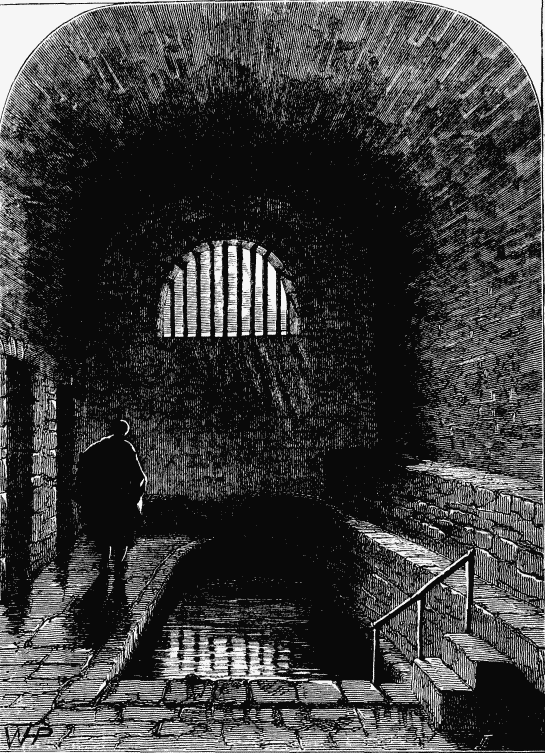
OLD ROMAN BATH, STRAND LANE.
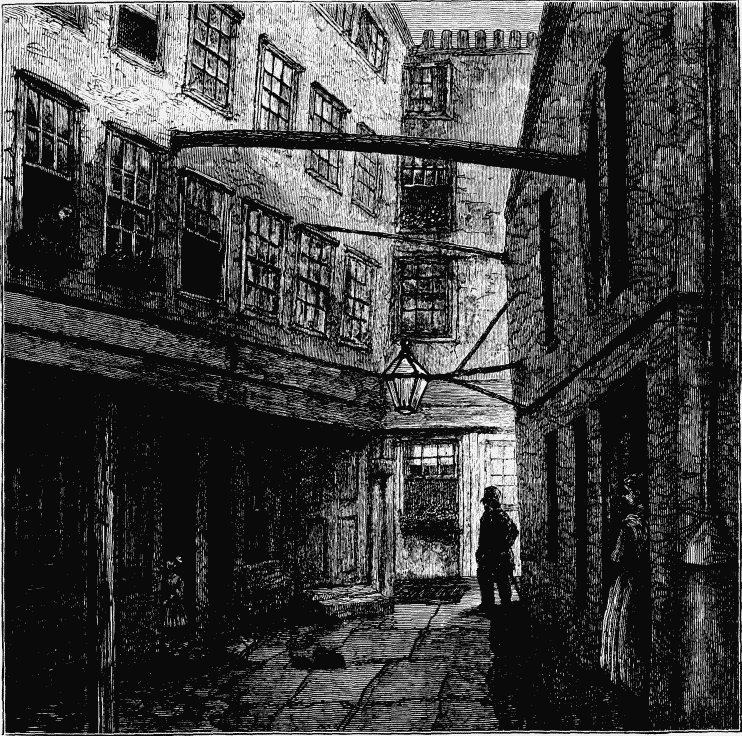
GOLDEN BUILDINGS. (See page 77.)
It may as well be mentioned here, though we have not travelled quite as far westward yet, that at No. 141 in the Strand, between St. Mary's Church and the corner of Wellington Street, on a site now covered by part of Somerset House, was the book-shop of Jacob Tonson, the friend and publisher of Pope, &c. Hither he removed from Gray's Inn Gateway in 1712, and the shop was known by the sign of the "Shakespeare's Head." It is described as being "over against Catherine Street."
The subsequent history of the house occupied by Tonson is thus told by Mr. Peter Cunningham:—"The house (No. 141), since rebuilt, was afterwards occupied by Andrew Millar, the publisher, and friend of Thomson, Fielding, Hume, and Robertson; and, after Millar's death, by Thomas Cadell, his apprentice, the friend and publisher of Gibbon. Thomson's 'Seasons,' Fielding's 'Tom Jones,' and the 'Histories' of Hume, Robertson, and Gibbon, were first published at this house. Millar was a Scotchman, and, true to his country and countrymen, distinguished his house by substituting Buchanan's head for that of Shakspeare as its sign. Could any one save a Scotchman have been guilty of such a deed of Vandalism?"
The name of Jacob Tonson is familiar to every
reader, not only of Pope, but of Horace Walpole,
as the secretary of the "Kit-Cat" Club. The son
of a barber-surgeon in Holborn, he was born about
the year 1656. At fourteen years of age he was
bound apprentice to a bookseller, and on reaching
manhood joined with his brother Richard in partnership. He published extensively for Addison,
Dryden, and Pope; and his edition of Clarke's
"Cæsar," which issued from his shop in 1712
is said to have been the largest and most expensive work which up to that time had been
published in England. It was this Jacob Tonson
who had the portraits of the members of the
"Kit-Cat" Club painted for him in a uniform
size, which still retains the name. On retiring
from business he lived chiefly at Barne Elms, in
the village of Barnes, where his house was for
many years a centre of literary society. He died
in 1736, but his memory survives, having been
kept alive on the title-pages of so many great works
in the eighteenth century, and by the pen of Mr.
Charles Knight, in his "Shadows of the London
Booksellers." In a dialogue between Tonson and
Congreve, published in 1714, in a volume of
poems by Rowe, there is a pleasant description
of Tonson before he was spoiled by grand associates:—
"While, in your early days of reputation,
You for blue garters had not such a passion;
While yet you did not live, as now your trade is,
To drink with noble lords, and toast their ladies,
Thou, Jacob Tonson, were, to my conceiving,
The cheerfullest, best, honest fellow living."
CHAPTER XIII.
THE STRAND:—SOUTHERN TRIBUTARIES (continued).
"Interdum rapere occupat."—Horace.
Sir Thomas Lyttleton and Bishop Burnet—Norfolk Street—Royal Farmers' and General Insurance Company—St. John's House—Conservative Land Society—Eminent Residents in Norfolk Street—Surrey Street—Office for Licensing Hackney Coaches—Voltaire and Will Congreve—Howard Street—Attempted Abduction of Mrs. Bracegirdle, the Actress—Murder of Mr. Mountfort.
Between Arundel Street and Norfolk Street are two houses which are remarkable for the following circumstance:—Sir Thomas Lyttleton, Speaker of the House of Commons in 1698, lived in one of these, and next door to him the father of the celebrated Bishop Burnet. "Here Burnet and Sir Thomas spent much of their time together; and it was the custom of the latter, when he had any great business to transact in Parliament, to talk it over previously with Burnet, who was to act the part of 'devil's advocate,' by bringing forward against it every conceivable argument, true or false." Burnet's house continued to be in the family until the end of the last or early in the present century, when it was possessed by a bookseller named Burnet, a collateral descendant of the bishop.
Norfolk Street, the next street westward from Arundel Street, was built in 1682, on a part of the site of Arundel House and grounds. Most of the houses in this street have of late been used as private hotels; but there are one or two which call for special mention. At No. 3 are the offices of the Royal Farmers' and General Insurance Company.
About half way down on the western side is St. John's House, the home of a sisterhood of ladies belonging to the English Church, who devote their lives to the work of nursing the sick poor, and of training up a body of nurses really fitted for that work. It was founded in 1848, under the modest title of "The Training Institution for Nurses in Hospitals, Families, and the Poor," beginning its work in St. John's, a poor district of St. Pancras. In 1852 the sisterhood removed to Queen Square, Westminster, in order that the sisters might have the double advantage of the religious services of the Abbey and of a more special training in the wards of the Westminster Hospital.
In 1854 the sisterhood supplied some of the nurses who accompanied Miss Nightingale to the Crimea, whither twenty more of their number were dispatched in the following year. In 1856 the sisters removed to Norfolk Street, having entered on the work of nursing the patients in King's College Hospital. The sisters wear a distinctive dress, with a small cross and medal. Besides King's College Hospital, the sisters of St. John's House nurse the patients in Charing Cross Hospital, and those of the Galignani English Hospital at Paris. They also dispense annually about 4,000 diets, which are supplied for the use of convalescent patients by the members of the Order of St. John. In this invaluable institution everything is carried out on the voluntary principle, and although it is styled a "sisterhood," under a superioress, the members are not tied down by any "vows of poverty, monastic obedience, or celibacy;" there is "no cloistered seclusion, but a full, free, and willing devotion to the great cause of Christian charity."
The Conservative Land Society have offices at No. 33, Norfolk Street. The society, which has done good service towards increasing the influence of the Conservative party among the middle classes, was formed in 1852, and such was its progress and prosperity that in 1867 it was found necessary to enlarge the premises by the acquisition of the adjoining house at the corner of Howard Street.
Among the notabilities who have resided in Norfolk Street may be named Dr. Birch, the historian of the Royal Society, and John Hamilton Mortimer, the painter, styled "the English Salvator Rosa." A "Supper at Mortimer's" forms the subject of a chapter in those chatty volumes entitled "Wine and Walnuts," published in 1823. Sir Roger de Coverley is stated by Addison to have put up in this street, before he went to live in Soho Square. Mr. Dowling, a gentleman well known in sporting circles, and some time editor of Bell's Life, lived for many years in this street; as also did Sam Ireland, the father of the author of the Shakespearian forgeries; Albany Wallis, the friend and executor of Garrick; Mountfort, the actor; Mr. William Shippen, the incorruptible M.P.—the only man, according to Sir Robert Walpole, who was proof against a bribe; Penn, the founder of Pennsylvania; and Peter the Great.
We learn from Sir John Hawkins's "Life of Doctor Johnson" that the house occupied by Penn was at the south-western angle of the street, close to the river-side, and he chose the house as one out of which he could slip by water in case of any emergency. It would appear that this house was actually that occupied by Peter the Great, if the following notice in the Postman of January 13, 1698, be correct:—"On Monday night the Czar of Muscovy arrived from Holland, and went directly to the house prepared for him in Norfolk Street, near the water-side." While staying here he was visited by King William III. and by very many other members of the Court and aristocracy.
Surrey Street, built about the same time, is described by Strype as "replenished with good buildings." He draws especial attention to the two houses at the bottom, which "front the Thames," with pleasant, though small, gardens "towards the river," that on the east side belonging to "the Hon. Charles Howard, Esq., brother to Henry, Duke of Norfolk." Towards the Strand, he also tells us that there was a fine large and curious house built by a Mr. Nevinson Fox. In this street, during the last century, was the head office for the licensing of hackney coaches, but this being burnt down, it was transferred to Great Queen Street, Lincoln's Inn Fields.
Voltaire, as we learn from his life, when in London, paid a visit to Will Congreve, who was living in this street, and who also died in it. "On this and on other occasions," says Peter Cunningham, "Congreve affected to be thought a man of fashion rather than of wit, on which Voltaire remarked, with his usual cynicism, that 'if he had been only a gentleman, he should not have come thither to visit him.'" Another celebrated literary character, who lived in Surrey Street, was George Sale, the translator of the Koran; his death took place here in 1736.
Howard Street, which runs at right angles across the centre of Norfolk Street, from Arundel to Surrey Street, consists of houses now almost all let out as "lodgings for single gentlemen," and has never been remarkable for distinguished residents. It was, however, before it had been built twenty years, the scene of a terrible tragedy, the remembrance of which still survives. In it Will Mountfort, one of "his Majesty's servants"—in other words, a player—was murdered on the night of December 9th, 1692. The story is one of interest, and involves some celebrated characters. We tell the tale as told to us by Mr. Peter Cunningham in his "Handbook of London:"—
"A gallant of the town, a Captain Richard Hill, had conceived what Cibber calls a 'tendre,' or passion for Mrs. Bracegirdle, the beautiful actress. He is said to have offered her his hand, and to have been refused. His passion at last became ungovernable, and he at once determined on carrying her off by force. For this purpose he borrowed a suit of night linen of Mrs. Radd, the landlady in whose house in Buckingham Court he lodged, induced his friend Lord Mohun to assist him in his attempt, dodged the fair actress for a whole day at the theatre, stationed a coach near the 'Horseshoe' Tavern, in Drury Lane, to carry her off in, and hired six soldiers to force her into it as she returned from supping with Mr. Page, in Princes Street (off Drury Lane), to her own lodging in the house of a Mrs. Dorothy Brown, in this street. As the beautiful actress came down Drury Lane, about ten at night, accompanied by her mother and brother, and escorted by her friend, Mr. Page, one of the soldiers seized her in his arms, and endeavoured to force her into the coach. Page resisting the attempt, Hill drew his sword, and struck a blow at Page's head, which fell, however, only on his hand. The lady's screams drew a rabble about her, and Hill, finding his endeavours ineffectual, bid the soldiers let her go. Lord Mohun, who was in the coach all this time, now stepped out of it, and with his friend Hill, insisted on seeing the lady home, Mr. Page accompanying them, and remaining with Mrs. Bracegirdle for some time after for her better security.
"Disappointed in their object, Lord Mohun and Captain Hill remained in the street, Hill with his sword drawn, and vowing revenge, as he had done before, to Mrs. Bracegirdle on her way home. Here they sent to the 'Horseshoe' Tavern in Drury Lane, for a bottle of canary, of which they drank in the middle of the street. In the meantime Mrs. Bracegirdle sent her servant to her friend Mr. Mountfort's house in Norfolk Street adjoining, to know if he was at home. The servant returned with an answer that he was not, and was sent again by her mistress to desire Mrs. Mountfort to send to her husband to take care of himself: 'in regard my Lord Mohun and Captain Hill, who (she feared) had no good intention toward him, did wait in the street.
"Mountfort was sought for in several places without success, but Mohun and Hill had not waited long before he turned the corner of Norfolk Street, with, it is said by one witness (Captain Hill's servant), his sword over his arm. It appears in the evidence before the coroner, that he had heard while in Norfolk Street (if not before) of the attempt to carry off Mrs. Bracegirdle, and was also aware that Lord Mohun and Hill were in the street; for Mrs. Brown, the landlady of the house in which Mrs. Bracegirdle lodged, solicited him to keep away. Every precaution was, however, ineffectual. He addressed Lord Mohun (who embraced him, it would appear, very tenderly), and said how sorry he was to find that he (Lord Mohun) would justify the rudeness of Captain Hill, or keep company with such a pitiful fellow, or words to the like effect. 'And then,' says Thomas Leak, the Captain's servant, 'the Captain came forward and said he would justify himself, and went toward the middle of the street, and Mr. Mountfort followed him and drew.' Ann Jones, a servant (it would appear, in Mrs. Bracegirdle's house), declared in evidence that Hill came behind Mountfort and gave him a box on the ear, and bade him draw. It is said they fought. Mountfort certainly fell, with a desperate wound on the right side of the belly, near the short rib, of which he died the next day, assuring Mr. Page, while lying on the floor in his own parlour, as Page declares in evidence, that Hill ran him through the body before he could draw the sword. Lord Mohun affirmed they fought, and that he saw a piece of Mountfort's sword lying on the ground. As Mountfort fell, Hill ran off, and the Duchy watch coming up, Lord Mohun surrendered himself, with his sword still in the scabbard.
"The scene of this sad tragedy was that part of Howard Street lying between Norfolk Street and Surrey Street. Mountfort's house was two doors from the south-west corner. Mountfort was a handsome man, and Hill is said to have attributed his rejection by Mrs. Bracegirdle to her love for Mountfort, an unlikely passion it is thought, as Mountfort was a married man, with a good-looking wife of his own, afterwards Mrs. Verbruggen, and a celebrated actress withal. Mountfort (only thirty-three when he died) lies buried in the adjoining church of St. Clement Danes."
Mrs. Bracegirdle continued to inhabit her old quarters for very many years. "Above forty years since," says Davies, "I saw at Mrs. Bracegirdle's house in Howard Street a picture of Mrs. Barry, by Sir G. Kneller, in the same apartments with the portraits of Betterton and Congreve." The seconder of Captain Hill in this discreditable affair was the Lord Mohun, whose name we shall have occasion to mention again hereafter, when we come to speak of Hyde Park, as having fallen in a duel with the Duke of Hamilton.
Mrs. Bracegirdle, born in 1663, was known as one of the most attractive and fascinating of our earliest actresses, and it is said that every one of her male audience became her lover, or at all events her admirer. Her chastity was remarkable, and her virtue "as impregnable as the rock of Gibraltar." She is called by Dr. Doran "that Diana of the stage before whom Congreve and Lord Lovelace, at the head of a troop of bodkined fops, worshipped in vain."
This troop of fops, it may be added, would sometimes include the Dukes of Devonshire and Dorset and the Earl of Halifax; amongst whom it is said that the latter remarked at a coffee-house one day, "Come, you are always praising the lady's virtue: why then do you not reward the lady who will not sell it?" then and there offering to head a subscription list with £200, pour encourager les autres. "Four times that amount was raised," says Dr. Doran, "and with it the nobles, with their swords in their hands, waited on Mrs. Bracegirdle"—no doubt in Howard Street—"who accepted the testimonial."
Mrs. Bracegirdle was very kind to the poor, and especially to the poorer members of her profession. She is described by Aston as "of a lovely height, with dark brown hair and eyebrows, black sparkling eyes, and a fresh blushing complexion; and whenever she exerted herself, had an involuntary flushing in her breast, neck, and face, having continually a cheerful aspect and a fine set of even white teeth, and never making an exit without leaving the audience in imitation of her pleasant countenance." Colley Cibber tells us that "she inspired the best authors to write for her; and two of them (Rowe and Congreve), when they gave her a lover in a play, seemed palpably to plead their own passions, and make their private court to her in fictitious characters."
But there is a reverse to this exquisite medal. In Spence's "Anecdotes," and in Bellchambers' edition of "Colley Cibber," it is asserted or assumed that this chaste lady was really Congreve's mistress; and Dr. Young seems to hint the same thing, when he says that "Congreve was very intimate with Mrs. Bracegirdle, and lived in the same street with her, his house being very near hers, until his acquaintance with the young Duchess of Marlborough."
This scandal would seem to have been confirmed
by the voice of contemporary testimony. Lord
Macaulay calls her, however, a "cold, vain, interested coquette, who perfectly understood how
much the influence of her own charms was increased
by the fame of a severity which cost her nothing,
and who could venture to flirt with a succession of
admirers in the just confidence that the flame which
she might kindle in them would thaw her own ice."
It was probably in a good-natured banter at the
lady's real proclivities that Nicholas Rowe, in one
of his short poems, exhorts Lord Scarsdale to
"All publicly espouse the dame,
And say, Confound the town."
Thackeray confirms the above account of the attempted seizure of Mrs. Bracegirdle, which, he says, occurred "opposite to my Lord Craven's house in Drury Lane, by the door of which she was to pass on her way from the theatre." He adds, "Mr. Page called for help; the population of Drury Lane rose; it was impossible to effect the capture; and so, bidding the soldiers to go about their business, and the coach to drive off, Hill let go of his prey sulkily, and he waited for other opportunities of revenge." As to her acting, if we may credit C. Dibdin, "she equally delighted in melting tenderness and playful coquetry; . . . . . and even at an advanced age, when she played Angelica in Love for Love, for Betterton's benefit, she retained all her powers of pleasing." She died in 1748.
At one time, as our readers will remember, when it had been resolved to erect the long-expected buildings for the New Law Courts of the future, even after the site between St. Clement's Church and Carey Street had been cleared, it was in contemplation to erect them on the ground which lies between Howard Street and the Thames Embankment; and Mr. G. E. Street, the architect to whom this work has been entrusted, has printed his reasons for preferring the site between the Strand and the river as preferable both æsthetically and also practically. But into these we need not enter, as the subject has passed out of the range of discussion.
In the long run, however, the idea of the Embankment site was negatived by the Art Commissioners, and the Legislature in 1873 fixed definitely and conclusively that the Law Courts of the future are to stand, as we have already said, between the Strand and Carey Street. In fact, the building of them has already made considerable progress. Howard Street, Norfolk Street, Surrey Street, Arundel Street, and Essex Street will therefore be allowed to remain in statu quo, and it is to be hoped that the new Temple of Themis will answer all the purposes for which Mr. Street has designed it.
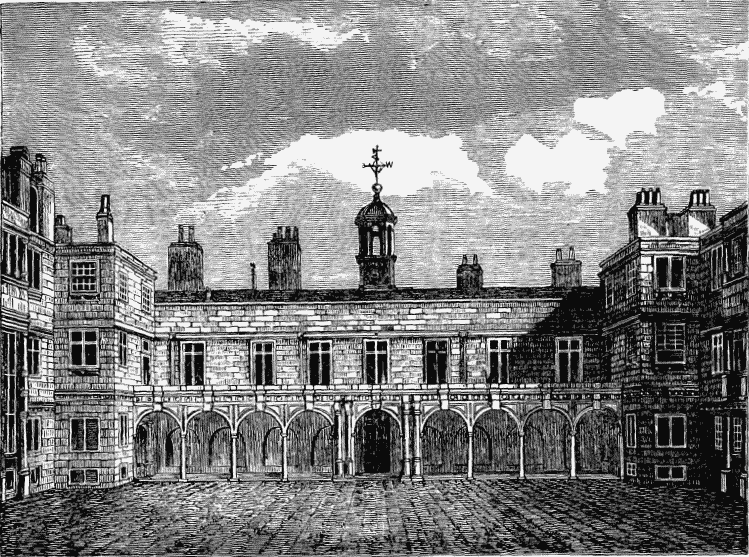
COURT OF OLD SOMERSET HOUSE, FROM THE NORTH.