Old and New London: Volume 3. Originally published by Cassell, Petter & Galpin, London, 1878.
This free content was digitised by double rekeying. Public Domain.
Walter Thornbury, 'Northumberland House and its associations', in Old and New London: Volume 3(London, 1878), British History Online https://www.british-history.ac.uk/old-new-london/vol3/pp135-141 [accessed 30 April 2025].
Walter Thornbury, 'Northumberland House and its associations', in Old and New London: Volume 3(London, 1878), British History Online, accessed April 30, 2025, https://www.british-history.ac.uk/old-new-london/vol3/pp135-141.
Walter Thornbury. "Northumberland House and its associations". Old and New London: Volume 3. (London, 1878), British History Online. Web. 30 April 2025. https://www.british-history.ac.uk/old-new-london/vol3/pp135-141.
In this section
CHAPTER XX.
NORTHUMBERLAND HOUSE AND ITS ASSOCIATIONS.
"Descendunt statuæ, restemque sequuntur."—Juvenal.
Situation and Early Owners—Passes into the Hands of the Howards—Called Northampton House—Name changed to Suffolk House—Again altered to Northumberland House—The "Proud" Duke of Somerset—Sir Hugh Smithson, afterwards Duke of Northumberland—Description of the Building—Anecdote about the Percy Lion—The Gardens—Sale and Demolition of the House.
After having stood for nearly three hundred years, a most conspicuous feature of London, and the most notable house in the most characteristic of streets, the old town mansion of the Percies was levelled with the ground, in the autumn of the year of grace, 1874, in order to form a new thoroughfare from Charing Cross to the Victoria Embankment. Thus one more landmark of old London, one more witness of the life of the past, has been effaced.
Northumberland House, it is true, could not lay claim to much architectural beauty; and it had been so much altered and rebuilt at various times, that it had no very high pretensions to notice on account of its antiquity; yet few places were more familiar to the Londoner and his "country cousins," few fronts gave more character to their neighbourhood. It was a dull, plain building, full of a certain dignity, indeed, but of the unloveliest fashion of a period when men built houses more for living in than being looked at. "The progress of wealth and of luxury," says a writer in the Standard, shortly before its demolition, "has long since dimmed the splendours of what was once the proudest of the London houses of the English nobility. The march of fashion westward had left it isolated amidst an uncongenial neighbourhood of small shops. Commerce had overtaken and overwhelmed it, so that it stood out somewhat abruptly in the full stream of London life, making it too violent a contrast with the surrounding houses, and destroying whatever of felicity there might have been in the situation. In the days when the Strand was but a road between London and Westminster, lined with private houses of the great and noble on either side, and with gardens going down to the river, it might have been an abode fit even for the proud Earls of Northumberland, to whom it descended. But with the Thames Embankment on one side, and Trafalgar Square on the other, with omnibuses perpetually passing its front door, Northumberland House was a standing anachronism, if not an impediment, which was destined to succumb to the influence of time and the Metropolitan Board of Works."
The Percies, it is true, did not build the house, nor was it their first abode in London. Stow mentions two others occupied by this family, before they obtained possession of their Strand tenement, as of many other fair property, by marriage. The first was in the parish of St. Anne's, close to Aldersgate, which in Strype's days had become degraded into a tavern. It was inhabited by Henry Percy (Hotspur) before it was forfeited to Henry IV., who bestowed it upon his wife, Queen Jane, as her "wardrobe." Another Northumberland House was in the parish of St. Katherine Colman, on the south side of Fenchurch Street, the memory of which still survives in Northumberland Alley. This belonged to Henry, the third Earl of Northumberland, in the reign of Henry VI.; and after his time it became converted into a gambling-house, and its gardens into bowling-alleys. A third Northumberland House, occupied by Henry, the ninth earl, was in the Blackfriars, in a house abutting on the property of William Shakespeare.
The Northumberland House which forms the subject of this chapter, was, at the time of its removal, at the close of 1874, the very last relic of all the noble mansions and palaces which, in the seventeenth century, adorned the river-front of the Strand. It may therefore be well to enter into a more elaborate description of it.
It stood, if the antiquary, Pennant, was rightly informed, on the site of a certain chapel, or hospital, of St. Mary, which had been founded in the reign of Henry III., by William, Earl of Pembroke, on a piece of ground which he had given to the priory of Rouncivalle, in Navarre. In the reign of Henry V. the hospital was suppressed, as belonging to an alien monastery, with all the other houses of the kind in the kingdom, but was again restored by Edward IV., to be finally dissolved at the Reformation.
By Henry VIII. the house was granted to a private individual, who is styled Sir Thomas Caverden, but of whom little or nothing is known. It afterwards belonged to Sir Robert Brett, and from his hands it appears to have passed into those of Henry Howard, Earl of Northampton, who, in the time of James I., built here a house, calling it after his own name. He left it to his kinsman, the Earl of Suffolk, known to history as Lord High Treasurer; and by the marriage of Algernon Percy, Earl of Northumberland, with Elizabeth, daughter and heiress of Thomas, Earl of Suffolk, it passed into the hands of the Percies, Earls, and afterwards Dukes, of Northumberland.
From a paper privately printed by the Duke of Northumberland, in 1866, we learn that the site of this house and garden was purchased, with other property, in the beginning of the seventeenth century, from Sir Robert Brett, by Henry Howard, Earl of Northampton, the second son of Henry, Earl of Surrey, "the poet." On this site, the Earl of Northampton built a "sumptuous palace," having for his architects Benard Jansen, a foreigner of some repute in the time of James I., and also Gerard Christmas. The house, which was of brick, was finished in the year 1605, and was then called "Northampton House." The initials of Gerard Christmas were preserved in the letters C. Æ, (Christmas Ædificavit), which used to be in large capitals over the old stone gateway, which was pulled down and replaced by a new front towards the Strand, in the reign of George II. The house at that time consisted of three sides of a quadrangle, the centre fronting the Strand, and open towards the garden and river. The Earl of Northampton died here in 1614. By his will, dated the 14th of June, 1614, he devised this house and garden, with the river-side property, to his nephew, Thomas Howard, first Earl of Suffolk, the second son of Thomas, fourth Duke of Norfolk. This was the Earl of Suffolk who, as Lord Thomas Howard, "being in that memorable engagement of the Spanish Armada, was, at sea, knighted for his good services therein." He was created Earl of Suffolk, and appointed Lord High Treasurer by James I. He completed the quadrangle by building the front towards the garden and the river. (fn. 1) It was then called "Suffolk House;" and it may be mentioned as a proof of the ease with which names are changed in London, that Howell, in his "Londinopolis," speaks of it as "that most stately palace of Suffolk or Northampton House." To this house Suckling refers in his ballad on the marriage of Roger Boyle, Lord Broghill, with the Lady Margaret Howard, daughter of the Earl of Suffolk. The Earl of Suffolk died here in 1626, when the property passed to his son Theophilus, second Earl of Suffolk, and then to his grandson James, third Earl of Suffolk, whose sister, the Lady Elizabeth Howard, married, in 1642, Algernon Percy, Earl of Northumberland. On this marriage the property was, by an indenture dated a few days previously, conveyed by the Earl of Suffolk and his trustees to the trustees of the Earl of Northumberland. The principal apartments were then on the Strand side, but the Earl of Northumberland reconstructed the garden or river front, under the direction of Inigo Jones, and that front then comprised the principal apartments; it is mentioned by Evelyn as being "the new front," when he visited the house in 1658. The house was afterwards called "Northumberland House."
This Earl of Northumberland was the earl who was so celebrated in the times of Charles I. and the Commonwealth, and to whom the care of the royal children was committed by the Parliament. It was in the spring of 1660, after he had taken up his quarters at Whitehall, that "General Monk was invited, with the Earl of Manchester, Hollis, Sir William Waller, Lewis, and other eminent persons, to Northumberland House," by Earl Algernon, and here (says Lord Clarendon), "in secret conference with them, some of those measures were concerted which led to the speedy restoration of the Monarchy."
The menu of the noble family at Northumberland House about this time was curious, if we may judge from an entry in the Earl of Northumberland's Household Book, where we find allowed for "my Lord and Ladie's table," "ij. pecys of salt fische, vj. pecys of salt fische, vj. becormed herryng, iiij. white herryng, or a dish of sproots (sprats)." Surely, a deep draught of Canary or Malvoisie would be needed to wash down so dry a repast!
The Earl of Northumberland last-mentioned died in the year 1688. Joceline, his son and successor, was the last of the old male line, and on his death, in 1670, without sons, Northumberland House became the property of his only daughter, the Lady Elizabeth Percy, (fn. 2) the celebrated heiress of that day, who married the "proud" Duke of Somerset, for, it is said, her third husband. Her first husband, whom she married when only fourteen years of age, was Henry Cavendish, Earl of Ogle (son and heir of Henry, Duke of Newcastle), who assumed the name of Percy. According to Sir Bernard Burke, her ladyship "appears to have been only contracted to Thomas Thynne, Esq., of Longleate, who was assassinated in February, 1681–2;" but she married, in 1682, Charles Seymour, Duke of Somerset, who also assumed, by preliminary engagement, the surname and arms of Percy, "but from that stipulation he was released when her grace attained majority." At Northumberland House the Duke and Duchess lived "in great state and magnificence."
With reference to this nobleman a story is told, which may bear repetition here, to the effect that he was in the habit of driving up to town from his residence at Petworth, in Sussex, in imitation of royalty, in a coach and six. On one occasion, when sitting in his easy chair, after his second or third marriage, the duchess entered the room, and was about to salute him with a kiss. This so wounded the dignity of his Grace, that he is reported to have severely reprimanded the duchess, telling her that even his first wife, the noble heiress of the Percies, would not have thought of taking such liberties with him.
On the death of his Grace, in 1748, the property passed to his son Algernon, who, on the death of his mother, in 1722, had been summoned to Parliament as Baron Percy. His Grace greatly improved the north, or Strand front, and built the gallery, or great room, forming the western wing to the south front. In the cornice or balustrading on the top of the south front he caused to be inserted the letters and date, "A. S. P. N. (Algernon Seymour Princeps Northumbriæ), A.D. 1749." As there was already a Somerset House, the mansion, during the time it was the residence of the Dukes of Northumberland, was still called "Northumberland House." His Grace was created Baron Warkworth of Warkworth Castle, Northumberland, and Earl of Northumberland, in 1749, with remainder, in default of male issue, to Sir Hugh Smithson, Bart., a country gentleman of Stanwick, in Yorkshire, who had married his only daughter, the Lady Elizabeth Seymour.
It was at Northumberland House, about this time, that Oliver Goldsmith, "our gentle poet," when waiting upon the Earl of Northumberland, mistook the earl's servant for the earl, and only discovered his error after the delivery of a neatlyordered address, after which the poor author precipitately fled. His Grace died in 1750, when the property passed to his said daughter, whose husband was afterwards created Duke of Northumberland. This nobleman faced the quadrangle with stone, and added to the gallery wing, built by the Duke of Somerset. He also restored the Strand front and other parts which had been damaged by a great fire there in 1780. From Hugh, first Duke of Northumberland, the property passed to his son Hugh, second duke, and then to his grandsons, Hugh, Algernon, and George, the third, fourth, and fifth dukes successively.
"The noble family of Northumberland," says a writer in the Builder, "have always been famed for their hospitality and humanity. The name of Smithson has obtained fame and an adjectival form in the United States, where the munificence of an Englishman (who claimed some kind of connection with the noble family of Northumberland) has given that country the opportunity of raising a noble institution for the advancement and popularisation of science."
Besides the principal quadrangle, which was to the north, and which the visitor entered at the porter's lodge from the Strand, the building had two wings running down at right angles from the main body of the house towards the river; that on the eastern side being devoted to the accommodation of the domestics, with stabling beyond; whilst the western wing contained the Grand Ball Room, in which royalty must often have been present, at various dates, from the days of Horace Walpole to our own time.
Along the Strand front, as we learn from Evelyn's memoirs, instead of the customary ornamental railings, there ran "a border of capital letters;" and that this was the case is corroborated by an entry in the burial register of St. Martin's Church, where a young man named Appleyard was buried in May, 1618, "slain by a stone falling from my Lord Treasurer's house."
According to a drawing by Hollar in the Pepysian Library at Cambridge, (of which we give a facsimile on page 6), Northampton, or, as it was then called, Suffolk House, is represented as a square, dull, and heavy-looking building, with lofty towers at the four angles, ending in domes of irregular shape. The house is apparently three storeys high, and has a high pitched roof. Each side is pierced with nine heavy-looking windows. The print represents it as it appeared in the early part of the reign of Charles I. The gardens between the house and the Thames are filled with a grove of trees, and alongside the river is a dull, long wall, with stairs leading down to the water.
Evelyn thus records in his "Diary," under date 1658:—"I went to see the Earl of Northumberland's pictures at Suffolk House, whereof that of the 'Venetian Senators'" (better known by its other name of the "Cornaro Family"), "was one of the best of Titian's; and another of Andrea del Sarto, viz. 'a Madonna, Christ, St. John, and an Old Woman,' &c.; a 'St. Catharina' of Da Vinci, with divers portraits of [by] Vandyke; a 'Nativity' of Georgioni; the 'Last of our Blessed Kings' (Charles I.), and the 'Duke of York,' by Lely; a 'Rosarie' by the famous Jesuits of Bruxelles, and severall more… The new front towards the gardens is tolerable, were it not drown'd by a too massie and clomsie pair of stayres of stone, without any neate invention."
There is a fine picture of Northumberland House by Caneletti, showing the small houses and other tenements opposite to it, and the Strand with the sign-boards in front of the houses. A copy of the picture is given on page 139.
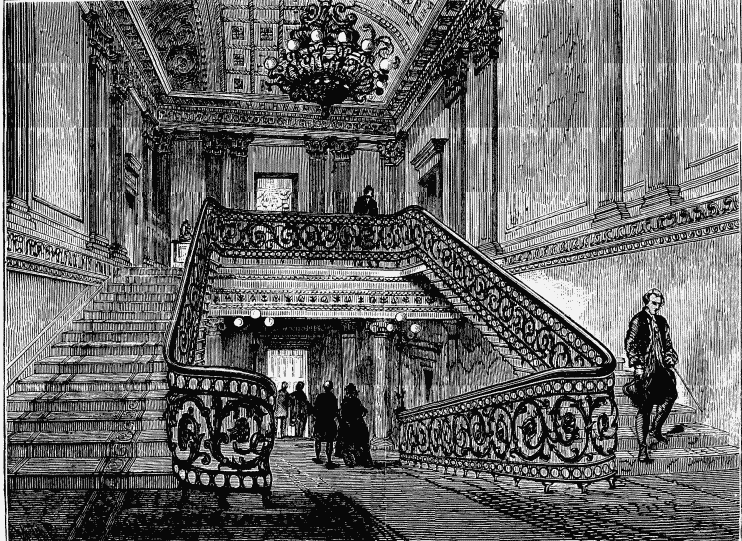
STAIRCASE IN NORTHUMBERLAND HOUSE. (From an Original Sketch.)
"There is a tradition," says Mr. Nightingale, in the "Beauties of England," "that when the Earl of Northampton erected his mansion at the village of Charing, he was ridiculed for having chosen a situation so far distant from his town residence; and, indeed, if we cast our eye over the maps of London, published about that period, we shall not be surprised at the remark."
From 1605, when the house was finished by the Earl of Northampton, almost down to the time of its demolition, so many changes were made in the building at different periods, that, in fact, with the exception of the front, little of the old house remained. Great alterations were made at Northumberland House in the years 1748–1752, which were begun by Algernon, Duke of Somerset, and completed by his son-in-law and daughter, the Earl and Countess of Northumberland. Northumberland House has more than once suffered severely from fire. The following is an account of one that occurred on Saturday, March 18th, 1780:—"It broke out about five in the morning, and raged till eight, in which time it burnt from the east end, where it began, to the west. Among the apartments consumed are those of Dr. Percy, Dean of Carlisle. We are happy to inform our readers that the greatest part of the doctor's invaluable library is fortunately preserved." It was here that the poetical doctor, whilst residing as chaplain, was visited by his brother poet, Oliver Goldsmith.
In the year 1749 the whole building was repaired and altered, the blue lion (the crest of the Percies) being placed in the position in which he was to be seen for 125 years. There is an apocryphal legend in connection with that noble brute, that he was at first placed with his head towards Carlton House and St. James's Palace, but afterwards, on the occasion of some slight received by one of the Dukes of Northumberland, turned round with its face to the Corporation of London. The quarrel being made up after the accession of the Prince Regent as George IV., the lion returned to his original bearings. It was on this occasion, we believe, that "the first gentleman in Europe" remarked that "the king knows nothing and remembers nothing of the quarrels of the Prince of Wales." Pennant, writing in 1806, observes, "It is unfortunate that nothing can be more confined than the situation of this great house. The noble front is pent up by a very narrow part of the Strand, and behind by a mean cluster of houses, coalwharves, and other offensive objects, as far as the banks of the Thames." He congratulates himself, however, on the probability of seeing, in a little time, these nuisances removed, and a terrace arising in their stead, rivalling that of Somerset House. What would the zealous old antiquary have said had he lived to our day, and seen the materials of the palace of the proud house of Percy sold as old building materials under the auctioneer's hammer?
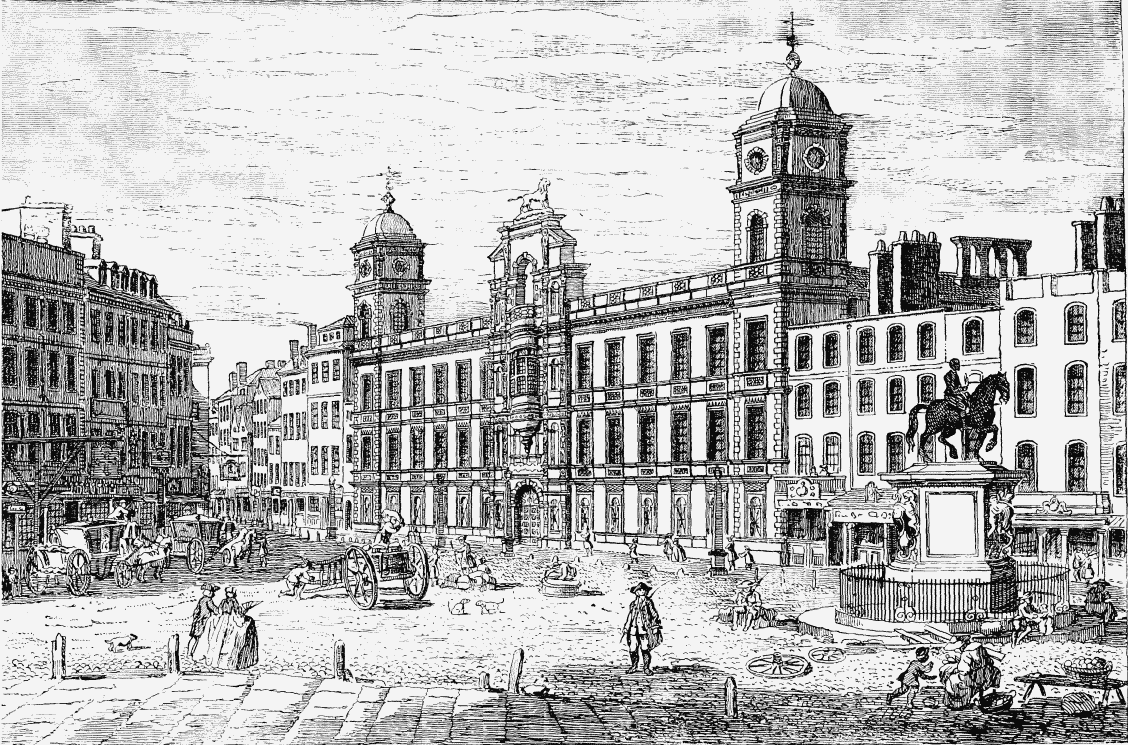
NORTHUMBERLAND HOUSE. (From the View by Canaletti.)
As to its interior, it was a grand, but dull and gloomy house, containing a large number of rooms. Everything in it, pictures, furniture, &c., were massive and costly in the extreme; but the want of light caused it to lack that air of cheerfulness which is so characteristic of the modern Italian style.
The central part of the Strand front, which, in a tablet on the top, bore the date when some alterations in that part of the building were made about the year 1752, might be considered as the most valuable remnant of the original pile. The lion, by which it was surmounted, was cast in lead, and was about twelve feet in length. The vestibule of the interior was eighty-two feet long, and more than twelve in breadth, ornamented with Doric columns. Each end communicated with a staircase, leading to the principal apartments facing the garden and the Thames. They consisted of several spacious rooms fitted up in the most elegant manner, embellished with paintings, among which might be found the well-known "Cornaro Family," by Titian, a work well worthy of its reputation, and for which Algernon, Earl of Northumberland, is stated to have given Vandyck 1,000 guineas, and a wonderful vase, which now has a story of its own; "St. Sebastian Bound," by Guercino; "The Adoration of the Shepherds," by Bassano; and others by wellknown masters. The great feature of the house was the ball-room, or grand gallery, upwards of 100 feet in length, in which were placed large and very fine copies by Mengs, after Raphael's "School of Athens," in the Vatican, of the size of the originals; also the "Assembly of the Gods," and the "Marriage of Cupid and Psyche," in the Farnesina; the "Triumph of Bacchus and Ariadne," from Caracci's picture in the Farnese Palace; and "Apollo driving the Chariot of the Sun," from Reni's fresco in the Villa Rospigliosi, at Rome. These celebrated works, and the decoration of the noble apartment, constituted it one of the landmarks of high art in the metropolis. The grand staircase consisted of a centre flight of thirteen moulded vein marble steps, and two flights of sixteen steps, with centre landing twenty-two feet by six feet, two circular plinths, and a handsome and richly-gilt ormolu scroll balustrade, with moulded Spanish mahogany hand-rail. The mansion contained nearly 150 rooms appropriated for the private uses of the family.
Previously to 1851, those few who obtained admission to the fine apartments of this grand old mansion, did so with considerable difficulty, and few therefore had any idea of what was behind the familiar front; but in that year, when multitudes visited London and the Great Exhibition, the house was thrown open to the public, and thousands availed themselves of the privilege to walk across the courtyard and up the handsome marble staircase, into the noble ball-room and picture-gallery, and inspect the rich treasures which the house contained.
The gardens on the river-front occupied a larger space than might have been suspected, but had long been left unkempt and neglected, forming a little wilderness in close proximity to the busiest thoroughfare in London. Their aspect, when at last the light of publicity was thrown upon them, was somewhat sad and ghastly, the old hawthorns and hazels looking like Dryads of old suddenly exposed to the gaze of an irreverent troop of Satyrs. With their departure, under the ruthless decree of the Board of Works, has disappeared one more green spot from the heart of London.
We may add, that in the privately-printed documents referred to above, the last owner of this noble mansion appeared to have given his sanction for its removal with great reluctance, if we may judge from the tenor of the concluding paragraph, which runs thus:—"The Duke of Northumberland is naturally desirous that this great historical house, commenced by a Howard, continued by a Percy, and completed by a Seymour, which has been the residence of his ancestors for more than two centuries and a half, should continue to be the residence of his descendants; but the Metropolitan Board of Works are desirous that this house, which, with its garden, is one of the landmarks of London, and is probably the oldest residential house in the metropolis, should be destroyed." Arrangements for its sale to the Metropolitan Board of Works, in order to open an entrance to the Thames Embankment, were completed in 1873, the purchase-money agreed upon being £500,000. The sale was concluded definitely in June, 1874. In the following month the lion, which had stood for a century and a quarter, keeping watch and ward over the great entrance, was taken down and removed to Sion House at Isleworth; and the work of demolition was soon afterwards commenced.
In September, 1874, the fine old mansion underwent its final phase of degradation, its materials being brought under the hammer of the auctioneer. The lots consisted of 3,000,000 bricks, the grand marble staircase, the elaborate ornamentation of the hall, dining, and reception rooms, the state decorations which adorned the hall and corridors, and a large quantity of lead stated to be of the weight of 400 tons. In the following month the Strand front also was sold for building materials. The aggregate sum realised by the sale amounted to but little more than £6,500, and of this the grand staircase alone fetched £360.
The destruction of the last of the noble mansions which once adorned the Strand was much regretted by many men of taste and judgment, who were of opinion that its removal was a needless act of Vandalism, as an equally beautiful and suitable entrance could have been made by removing a few of the houses on the west of the mansion, and cutting off the south-west angle of the garden behind.