Old and New London: Volume 3. Originally published by Cassell, Petter & Galpin, London, 1878.
This free content was digitised by double rekeying. Public Domain.
Walter Thornbury, 'Covent Garden Theatre', in Old and New London: Volume 3(London, 1878), British History Online https://www.british-history.ac.uk/old-new-london/vol3/pp227-237 [accessed 1 May 2025].
Walter Thornbury, 'Covent Garden Theatre', in Old and New London: Volume 3(London, 1878), British History Online, accessed May 1, 2025, https://www.british-history.ac.uk/old-new-london/vol3/pp227-237.
Walter Thornbury. "Covent Garden Theatre". Old and New London: Volume 3. (London, 1878), British History Online. Web. 1 May 2025. https://www.british-history.ac.uk/old-new-london/vol3/pp227-237.
In this section
CHAPTER XXIX.
COVENT GARDEN THEATRE.
"The houses twain
Of Covent Garden and of Drury Lane."—Rejected Addresses.
The Building of the Theatre—"Rich's Glory"—The First Performance at Covent Garden—Ladies at the Theatre—Receipts of the House—Performance of Handel's "Messiah"—Royalty flock to the Haymarket, and Horace Walpole's Remarks upon the Subject—First Appear ance of "Peg" Woffington—Death of Rich, and Sale of Covent Garden Theatre—Charles Macklin, the Comedian and Centenarian—Stephen Kemble—Incledon—George Frederick Cooke—John Philip Kemble—"The Young Roscius"—The Theatre burnt in 1808—The Duke of Northumberland's Generosity to Kemble—The Theatre rebuilt and opened—The "O. P." Riots, succeeded by a run of uninterrupted Prosperity—Poetic Effusions upon Actresses wedded to Noblemen.
We have seen that "the new playhouse in Drury Lane" was frequently spoken of as "Covent Garden Theatre," and naturally enough, for the theatre in Bow Street was not built until the year 1731. The latter was a speculation of John Rich, the celebrated harlequin, and patentee of the theatre in Lincoln's Inn Fields, who removed hither with his company in 1732.
Hogarth's caricature of "Rich's Glory; or, His Triumphal Entry into Covent Garden," of which we give a copy on page 223, refers to this removal. The progress of the building was thus commented on in the Daily Advertiser for March 2, 1730:—"We hear the new theatre which is to be built in Covent Garden will be after the model of the opera-house in the Haymarket; and by the draught that has been approved of for the same, it's said it will exceed the opera-house in magnificence of structure."
The same paper for August 4, 1731, states:—"The new theatre building in Covent Garden for Mr. Rich is carrying on with such expedition and diligence (there being a great number of hands employed therein) that it's thought it will be completely finished and ready to receive his audience next winter. Several persons of distinction resort thither daily to view the said work, and seem much pleased at the performance."
The first performance at Covent Garden Theatre was advertised in the following manner:—
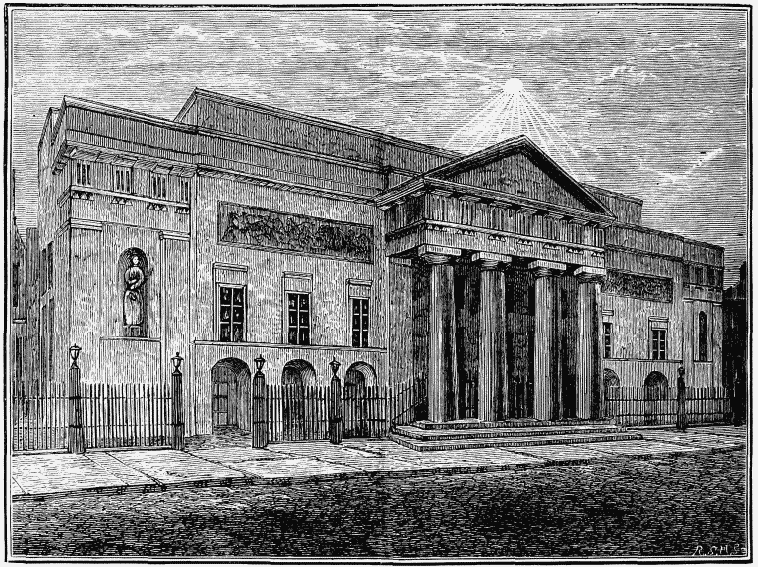
COVENT GARDEN THEATRE: FRONT IN 1850.
"By the Company of Comedians.—At the Theatre Royal in Covent Garden, on Thursday next, being the 7th day of December, 1732, will be revived a comedy called The Way of the World, written by Mr. Congreve. The cloathes, scenes, and decorations entirely new, and, on account of the great demand for places, the pit and boxes, by desire, will be laid together at 5s.; gallery, 2s.; upper gallery, 1s.; and to prevent the scenes being crowded, the stage half-a-guinea. N.B.—All persons who want places are desired to send to the stage-door (the passage from Bow Street leading to it), where attendance will be given and places kept for the following night as usual."
It was doubtless àpropos of some such comedy as the one just mentioned that the Guardian remarks:—"As the playhouse affords us the most occasions of observing upon the behaviour of the face, it may be useful (for the direction of those who would be critics this way) to remark that the virgin ladies usually dispose themselves in front of the boxes, the young married women compose the second row, while the rear is generally made up of mothers of long standing, undesigning maids, and contented widows. Whoever will cast his eye upon them under this view, during the representation of a play, will find me so far in the right, that a double entendre strikes the first row into an affected gravity or careless indolence, the second will venture at a smile, but the third take the conceit entirely and express their mirth in a downright laugh."
Here, as Mr. Timbs reminds us, Rich and Lambert, in 1735, founded the Beefsteak Club; and here, in 1746, Garrick played for the season.
The site of the theatre was leased to Rich for a term of years by the Duke of Bedford, at a yearly rental of £100. It held before the curtain £200, which was at that time reckoned a good receipt. In Shakespeare's day £20 was considered profitable; and "in 1747," says Colley Cibber, in his "Apology," "Mrs. Rich said she was always contented if the receipts reached three figures." In 1750, further to increase the profits, seats were built on the stage sufficient to accommodate a large number of persons; but this arrangement was such an obstruction to the actors that it was abolished by Garrick. At the time of the death of John Rich in 1761, the ground-rent had been raised from £100 to £300 per annum, and the property was estimated at £60,000. In 1792, when the Duke of Bedford, as ground-landlord, granted a new lease, it was at the rate of £940 a year.
It was at Covent Garden that Handel, in 1741, produced his great oratorio, the Messiah. The fashion of the day was against him, though he was supported by the court, the mob, and the poet of common sense, Alexander Pope, who records in his "Dunciad" how, on finding it impossible to hold his own against the Italian faction. Handel quietly withdrew to Ireland for a year or so, till the tide should turn in his favour. "Handel has set up an oratorio," writes Horace Walpole in 1742, "against the operas, and it succeeds." And well was Handel avenged. In a few years the Italian Opera House in the Haymarket went out of fashion, and the nobility set up their own rival house in Lincoln's Inn Fields. "What the Court then patronised," observes Charles Knight, "the aristocracy rejected." As usual, Horace Walpole has a cynical story to tell upon the subject. He writes thus to Mr. Conway, in 1761:—"The late royalties went to the Haymarket when it was the fashion to frequent the other opera in Lincoln's Inn Fields. Lord Chesterfield one night came into the latter, and was asked if he had been at the other house. 'Yes,' said he; 'but there was no one there but the king and queen; and as I thought they might be talking business, I came straight away.'"
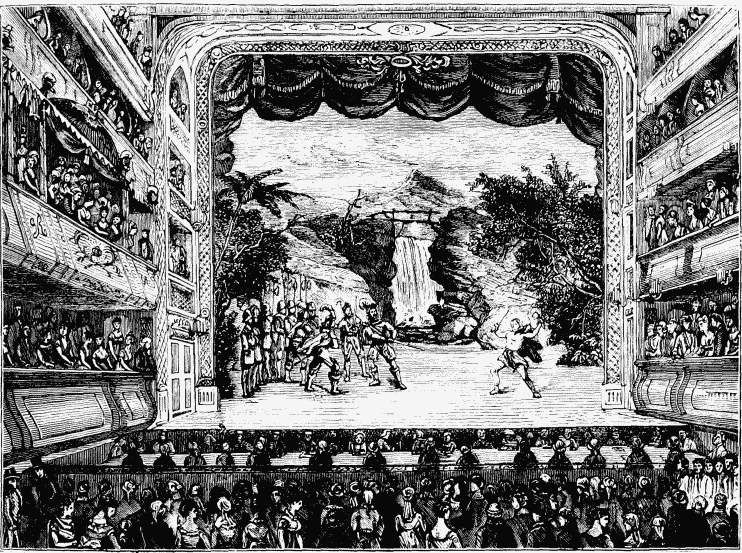
INTERIOR OF COVENT GARDEN THEATRE IN 1804.
It was at Covent Garden that the fascinating
Irish actress, Margaret Woffington, made her first
appearance upon a London and her last upon any
stage. Her choice of a character for her début, in
1738, excited the surprise of the public, being that
of "Sir Harry Wildair;" but so captivating did
she appear in it that Garrick, with whom it had
been a favourite part, gave it up from that time.
Her best rôle was that of "Rosalind," in As You
Like It, to which, in 1757, she was speaking the
epilogue with all the saucy piquancy peculiarly
her own, when she was suddenly stricken with
paralysis, and carried off the stage never to return
to it. According to Dr. Doran, a bitter source of
jealousy existed between "Peg" Woffington and the
beautiful and notorious George Anne Bellamy,
whose "Memoirs," written by herself with an astonishing absence of reserve, were formerly read and
quoted by every lady of fashion. "The charming
Bellamy," says Dr. Doran, "had procured from Paris
two gorgeous dresses wherein to enact 'Statira' in
the Rival Queens. 'Roxana' was played by Woffington, and she was so overcome by malice when
she saw herself eclipsed by the dazzling glories of
the resplendent Bellamy, that she rolled 'Statira'
and her spangled sack in the dust, pommelling her
the while with the handle of her stage dagger, as
she declaimed, Alexander standing by:—
'Nor he, nor heaven shall shield thee from my justice!
Die, sorceress, die! and all my wrongs die with thee!'
Rich lies buried in Hillingdon churchyard, near Uxbridge. A vignette of his tomb, and a fac-simile of his autograph, attached to an agreement with Charles Fleetwood respecting the receipts of Covent Garden Theatre, will be found in "Smith's Historical and Literary Curiosities."
A few years after the death of Rich the theatre, having been sold by his heirs for £60,000, was opened in 1767 by Messrs. Harris, Colman, Powell, and Rutherford. In 1774 Mr. Colman sold his share, and from this time the theatre was virtually under the management of Mr. Harris, who had by far the largest interest in the property. In 1787 it was almost wholly rebuilt, and was further altered and enlarged in 1792.
Covent Garden is rich in names famous in histrionic annals, each of which is a landmark to point out the progress of the drama during the last century and a half. Among the earliest of these is that of Charles Macklin, the comedian and centenarian, who frequently performed on its boards, and unless absent from London on engagements at Dublin, lived constantly almost under its shadow—mostly under its piazza; or hard by, in James Street, Hart Street, or Tavistock Row. Having once retired from the stage in middle life, in the hope of making a fortune by establishing a tavern and coffee-house in Hart Street, he returned to it after the failure of his scheme and his consequent bankruptcy, and for many years, whilst quite an old man, played leading parts with some of the fire of youth. His last appearance at Covent Garden was on May 7th, 1789, he being then eighty-nine years of age, when he attempted the part of "Shylock" for his "benefit," but was unable to proceed with the performance. But in spite of his loss of memory he still lived much abroad as usual, haunting the scene of his former triumphs, telling his stock of anecdotes over and over again, and, evening after evening, frequenting a public-house in Duke's Court, close by, where a large concourse would repair in order to hear the anecdotes of so aged and remarkable a person, who remembered the days of the dramatic giants of an earlier generation. "As the infirmities of age increased on him, he would wander feebly about the neighbourhood of Covent Garden, sometimes looking in at the theatre, though he went thither rather more from the force of habit than from any gratification that he could receive, except, perhaps, from the music between the acts. On these occasions the audience, it is said, would always venerate his age, and compassionate his condition; for on his entrance into the pit, however full the house might be, room was always made for him in his accustomed seat—the centre of the last row next to the orchestra; and when the performance was over he would walk home leisurely by himself across the square of Covent Garden to Tavistock Row, where he lived and where he died, a veritable centenarian, in 1797. His "Memoirs," which originally appeared in the European Magazine, but were subsequently re-published in a volume, furnish us with some curious information respecting society in London and the manners and habits of the gentry and professional classes a century ago.
Macklin does not say much for the morality of Covent Garden and its neighbourhood, or of the taverns and public-houses by which it was surrounded, or of the still lower public-houses near Clare Market, which were the resort of second-rate actors, and theatrical critics of Grub Street or Drury Lane, who "lived from hand to mouth." The ordinaries of the time, it appears, were charged from sixpence to a shilling a head—in the latter case being supplied with two courses, and attended by a superior sort of mixed company; though there were private rooms besides for wits of the higher order, and for such of the nobility as liked to frequent such places, where conviviality was often carried to excess. Macklin says also that the habits and manners of the dramatic as well as of other professions were very different from those which now prevail. The merchant, at that time, scarcely ever lived out of the City, his residence being always attached to his counting-house, and, indeed, his credit being in a great degree dependent on his observance of the established practice. According to Macklin, the first migration of the London merchants to the westward dates only from 1747, when a few of those who had already made large fortunes removed to Hatton Garden. The lawyers, too, he used to tell his hearers, used at that time to live mostly in their inns of court, or else about Westminster Hall; and in like manner the actors "did mostly congregate" around the two great theatres. Thus, as we know, Quin, Booth, and Wilks lived almost constantly in or about Bow Street, Colley Cibber in Charles Street, Billy Howard in Henrietta Street, and Garrick, for a considerable portion of his life, in Southampton Street. The inferior players lodged in and about Vinegar Yard, Little Russell Street, and the lesser courts round the theatres; "so that," says Macklin, "we could all be mustered by beat of drum, could attend rehearsals without any inconvenience, and yet save coach-hire—no inconsiderable part, let me tell you, of a former player's annual expenses. I do not know how the change has been effected, but we are now all looking out for high ground—squares and genteel neighbourhoods—no matter how far distant from the theatre, which should be the great scene of business; as if, forsooth, local situations could give rhythm to the profession, or genteel neighbourhoods instinctively produce good manners." What he would have said on this subject if he had lived on into our own days may be easily inferred from these last remarks of the father of the theatrical world a century ago. But we must return from this digression to the theatre itself, from which we are in danger of wandering with the actors.
Stephen Kemble made his first appearance here, as "Othello," in 1783. Possessed, like all of his family, of considerable dramatic capabilities, his talents were unhappily obscured under a load of personal obesity, which had, however, the advantage of enabling him to enact the part of "Falstaff" (his best character) without stuffing! Charles Incledon—"The Ballad-singer—" as he loved to be termed—made his début as "Dermot," in The Poor Soldier, in 1790. His voice is said to have been the most melodious, as well as powerful, of his time; and his manner of singing such songs as "Blackeyed Susan," "The Soldier tired," and "The Storm," has never since been surpassed. In 1794 Charles Kemble, and in 1797 Mrs. Glover, made their first appearances here. In 1800 George Frederick Cooke achieved a great success as "Richard III."—a performance spoken of as "the best since Garrick." In 1803 John Philip Kemble purchased a sixth part of the property of the Covent Garden patent, transferring his own services, with those of his sister, Mrs. Siddons, and his brother Charles, from Drury Lane to Covent Garden. In 1804 "The Young Roscius," William Henry Betty, at twelve years of age was filling the theatre to overflowing, and a detachment of the Guards was posted outside, with a large body of constables inside, to preserve order amongst the thousands who had assembled hours before the opening of the doors. His salary was at first £50 a night, but, after three performances, was increased to £100; and at sixteen years of age he quitted the profession with a handsome fortune. Twelve years later he returned to the stage; but the performance of his maturer years was not considered to fulfil the promise of his youth; and disappointed at the coldness with which he was received, he again retired into private life. He died in August, 1874, aged eighty-two.
On the morning of the 30th of September, 1808, Covent Garden Theatre was totally destroyed by fire; a calamity which involved a fearful loss of human life—twenty-three firemen being killed by the unexpected fall of a part of the ruins. The splendid organ left by Handel, and the stock of wine belonging to the Beefsteak Club, shared the fate of the whole building. The loss of property was estimated at £150,000, of which £50,000 were covered by insurances.
John Kemble, who had invested his all in the share so recently purchased, met with universal sympathy, which, in some notable instances, did not confine itself to words. The Prince of Wales, afterwards George IV., presented him with £1,000; and the Duke of Northumberland with £10,000, which Kemble declined as a gift, but accepted as a loan, giving the duke his bond for the amount. On the 31st of December, 1808, the Prince of Wales laid the first stone of the new theatre, and the Duke of Northumberland sent Kemble back his bond, enclosed in a letter, saying that, "it being a day of rejoicing, he concluded there would be a bonfire, and he therefore requested that the enclosed obligation might be thrown in, to heighten the flames." The architect was Sir Robert Smirke, and the model selected, the Temple of Minerva in the Acropolis at Athens. The Doric portico in Bow Street, with its four fluted columns, and statues of Tragedy and Comedy, were by Flaxman, and the two long panels in the upper part, with representations in basso-relievo of ancient and modern drama, were by Flaxman and Rossi. Some £50,000 of the cost of the construction was received from the insurance offices, and the remaining £100,000 was raised by subscription shares of £500 each.
On the 18th of September, 1809, the splendid edifice was opened at "new prices," a proceeding which the management considered necessary on account of the enormous cost of the building. These new prices were by no means approved by the public, and led to the well-known "O.P." riots. On the opening night of the new theatre, a cry of "Old prices!" (afterwards diminished to "O.P.") burst from every part of the house. This continued and increased in violence till the 23rd, when rattles, drums, whistles, and cat-calls having completely drowned the voices of the actors, Mr. Kemble, the stage-manager, came forward and said "that a committee of gentlemen had undertaken to examine the finances of the concern, and that until they were prepared with their report the theatre would be closed." "Name them!" was shouted from all sides. Their names were declared. "All shareholders!" bawled a wag from the gallery. In a few days the theatre re-opened; the public paid no attention to the report of the referees, and the tumult was renewed for several weeks with even increased violence. The proprietors sent in hired bruisers to mill the refractory into subjection. This irritated most of their former friends, and amongst the rest the annotator, who accordingly wrote the song of "Heigh-ho, says Kemble," which was caught up by the ballad-singers, and sung under Mr. Kemble's house windows in Great Russell Street. In the end Kemble was obliged to give way, and after a humble apology, which was graciously accepted by a crowded audience, peace and the "old prices" were simultaneously restored.
For many years after this inauspicious commencement Covent Garden enjoyed a run of uninterrupted prosperity, the receipts between 1809 and 1821 averaging £80,000 each season. The largest annual amount taken at the theatre was in the year 1810–11, when the sum of £100,000 was received at the doors! The annual expenses during this period averaged £40,000—an outlay which required a skilful and liberal management to insure the large amounts just mentioned. It will be sufficient to mention the names of the principal performers at Covent Garden between 1809 and 1822 to show how powerful was the dramatic force there assembled:—In tragedy, Messrs. Kemble, Cooke, Macready, Young, &c. &c.; Mrs. Siddons, Miss O'Neill, &c. In comedy, Messrs. Liston, Munden, Charles Mathews, sen., W. Farren, &c.; Mesdames Jordan, Brunton, Foote, C. Kemble, &c. In opera, Messrs. Incledon, Braham, Pyne, and Mesdames Catalani, Bolton, Stephens, and Tree. "Kitty" Stephens made her first appearance here in 1812; Miss O'Neill, in 1814; Macready, in 1816; and Farren, in 1818. Several of these actresses and singers afterwards married noblemen; and the "Memoirs" of the late James Smith, published in 1840, contain various poetic effusions upon those ladies. We will quote a few, which will interest our readers:—
The first, in allusion to Miss Farren, Countess
of Derby, runs thus:—
"Farren, Thalia's dear delight,
Can I forget the fatal night,
Of grief unstain'd by fiction,
(E'en now the recollection damps)
When Wroughton led thee to the lamps,
In graceful valediction?"
Another verse is in honour of Miss Brunton,
Countess of Craven:—
"The Derby prize by Hymen won,
Again the god made bold to run
Beneath Thalia's steerage;
Sent forth a second earl to woo,
And captivating Brunton too,
Exalted to the peerage."
Of Miss Bolton, Lady Thurlow, whose celebrated
part was "Polly" in The Beggar's Opera, the poet
says—
"Thrice vanquished thus on Thespian soil,
Heart-whole from Cupid's toil
I caught a fleeting furlough:
Gay's Newgate Opera charmed me then;
But 'Polly' sang her requiem when
Fair Bolton turned to Thurlow."
Of Miss O'Neill, who made prize of a baronet
in the matrimonial lottery, he writes:—
"These wounds some substitute might heal;
But what bold mortal bade O'Neill
Renounce her tragic station—
Taste, talent, beauty to trepan?
By Heaven ! I wonder how the man
Escaped assassination!"
Appended to these verses is one from another
pen, written some years later, immortalising the
lady who afterwards became Countess of Essex:—
"Last of this dear, delightful list—
Most followed, wondered at, and missed
In Hymen's odds and evens—
Old Essex caged our nightingale,
And finished thy theatric tale,
Enchanting Kitty Stephens."
Miss Foote, although not celebrated in verse by the author of "The Rejected Addresses," was another actress of this period who was elevated from the stage to the peerage. She made her first appearance at Covent Garden, in 1814, as "Amanthis," in Mrs. Inchbald's comedy of The Child of Nature; and became Countess of Harrington in 1831.
Among the many good stories and anecdotes relating to Drury Lane and Covent Garden Theatres to be found in abundance in the anecdote biography of the two last centuries, the following, relating as it does to Miss Farren, may be repeated here:—Lord Derby once applied in the greenroom to Sheridan for the arrears of Lady Derby's (Miss Farren's) salary, averring that he would not leave the room until it was paid. "My dear lord," said Sheridan, "this is too bad; you have taken from us the brightest star in our little world, and now you quarrel with us for a little dust which she has left behind her."
Mrs. Siddons retired from the stage in 1812; her brother, John Kemble, followed her example in 1816, presenting his share of the theatre (one-sixth) to his brother Charles. In 1820 Mr. Harris, who owned seven-twelfths of the property, died, and from this time the fortunes of the theatre declined. Differences arose between Mr. Henry Harris (who had succeeded to his father's share) and Mr. Charles Kemble, resulting in legal proceedings.
In 1822 Mr. Henry Harris resigned his management, and the property was thrown into Chancery. Nevertheless, the Shakespearian play of King John was put upon the stage here in 1823, though Mr. Kemble was doubtful how far any attempt to improve the costume would succeed, being afraid lest he should be considered an "antiquary." But in this matter he listened to the advice of Mr. Planché, and the introduction of appropriate mailarmour and helmets of the thirteenth century was thoroughly appreciated by the public, "receipts of from £400 to £600 nightly soon reimbursed the management for the production; and a complete reformation of dramatic costume became from that moment inevitable upon the English stage."
In spite, however, of these and other undisputed successes," the theatre, in 1829, was seized by the parochial authorities, advertised for sale, and was only rescued by public subscriptions and voluntary contributions of the company. Charles Kemble's administration was not so fortunate as that of his brother, although the last three years of his management were brightened by the triumphs of his daughter, Miss Fanny Kemble, afterwards Mrs. Butler. Here was performed, in January, 1832, Lord Francis Egerton's tragedy of Catharine of Cleves. In 1833 Edmund Kean made his last appearance on these boards. In the same year the two great theatres of Drury Lane and Covent Garden were united under the management of Mr. Bunn, but the union was of short duration. In 1835 Covent Garden was leased to Mr. Osbaldistone, and the experiment tried of reducing the prices. Charles Kemble, Macready, and Miss Helen Faucit were the principal stars under this management, which only lasted two years, when the theatre passed into the hands of Macready. A Shakespearian revival now took place, and The Tempest, Coriolanus, Henry V., and King Lear were produced in a style of gorgeous and appropriate magnificence. The profits were, however, by no means commensurate with the expenses, and within two years Mr. Macready retired from the management a considerable loser.
In 1839 Covent Garden Theatre was taken by Madame Vestris, the most fascinating actress of her time; Mr. Planché, as he tells us in his agreeable "Recollections," acting as superintendent of the decorative department, and introducing great reforms in the matter of costume, and acting also as "reader" of plays submitted to the manager by unknown authors; but in spite of the almost unrivalled attractions afforded by a company which, in addition to the talented lessee and her no less talented husband, Charles Mathews—including Messrs. Harley and Keeley, and Mesdames Nisbet, Humby, and Keeley, &c.—the speculation was a losing one, and was resigned at the end of the third season. About this time Dickens wrote for Covent Garden Theatre, by way of helping the manager, a farce about which the actors could not agree, and which he afterwards turned into his story of "The Lamplighter."
In April, 1842, Mr. Charles Kemble again essayed the direction of the theatre, which opened with the opera of Norma, Miss Adelaide Kemble being the prima donna; but Mr. C. Kemble, in spite of the prestige of his name, and his great success as an actor, was not destined to be fortunate as a manager, and the smallness of the receipts obliged him to withdraw the following November. The Christmas of the same year found the indomitable Mr. Bunn in possession, the entertainment offered being a curious olla-podrida, compounded of Shakespeare, English opera, and pantomime. Mr. Bunn's brief management ended in May, 1843, and the theatre was then let to the Anti-Corn-Law League, who used it for the purpose of a bazaar. Next, M. Jullien installed himself there for a season of winter promenade concerts, which were highly successful; and on March 4th, 1844, the first bal-masqué given in England during the present century took place at Covent Garden, under his auspices. During the spring of the same year Antigone was performed, the theatre being under the direction of M. Laurent. M. Jullien's concerts and bal-masqué again attracted large crowds during the season of 1845–6.
Mr. Planché, in his "Recollections," in contrasting Covent Garden with Drury Lane at this
period, speaks of the former as "strong in comedy,
and superior to its rival in spectacular entertainments." To a certain extent this remark held true
down to a recent date; and in proof of the latter
part of the assertion, it may be said, without fear of
contradiction, that Covent Garden has always been
celebrated for the gorgeousness and brilliancy of
its pantomimes. In fact, so gorgeous were the
spectacular entertainments here, that on one occasion we find Mr. Planché complaining to Mr.
Kemble, the manager, that a thousand pounds
were often lavished on a Christmas pantomime or
an Easter spectacle, whilst the plays of Shakespeare
were put upon the stage with "makeshift scenery,
and old and second-rate dresses." Apropos of the
degeneracy of the drama (proper), and of the
rising taste for "spectacle," Byron writes—
"Gods! on those boards shall Folly rear her head,
Where Garrick trod and Kemble loves to tread."
It was at this time the project was formed of opening a rival opera-house to the one in the Haymarket; and in April, 1847, after undergoing important alterations and additions, Covent Garden Theatre commenced its new career as "The Royal Italian Opera House." The company consisted principally of seceders from Her Majesty's—hitherto the only Italian opera-house in London—and comprised the famous names of Giulia Grisi, Persiani, Mario, Tamburini, and even the great leader of the orchestra—Michael Costa himself. No wonder the alarmed lessee of Her Majesty's made strenuous efforts to prevent the threatened rivalry, in virtue of a privilege having been of old granted to the "King's Theatre" (the name by which it was known previously to her Majesty's accession) "for the exclusive production in perpetuity of Italian opera;" the same document containing a stipulation that "the patents of Drury Lane and Covent Garden should never be used for the purpose of Italian opera." That this exclusive right was no dead letter had been proved by Mr. Bunn in 1835, when the entire company of "The King's Theatre" had performed for one night only in La Gazza Ladra at Drury Lane—a performance immediately followed by a dignified protest from the Lord Chamberlain. A period of a dozen years, however, produces a change both of times and of Lords Chamberlains, and Mr. Lumley found out, as he tells us in his "Reminiscences," that he was under a government which discouraged monopolies of all kinds; and, his opposition notwithstanding, the Royal Italian Opera House, Covent Garden, was duly opened, "without let or hindrance."
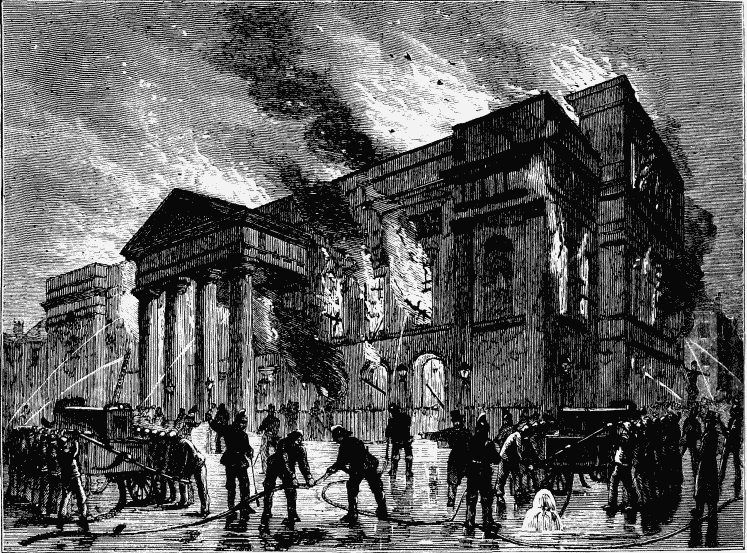
BURNING OF COVENT GARDEN THEATRE IN 1856.
The Era of June 13th, 1847, remarks:—"It has been said that London cannot support two operatic companies; but while the house at the Haymarket was filled to overflowing by the presence of Jenny Lind, that at Covent Garden was crammed to suffocation by Grisi." Yet, although Grisi, so long the popular idol, still held her own, in spite of the Jenny Lind mania, and, supported by Alboni—who made a triumphant début during this year—insured a full house every night, the expenses were frightfully in excess of the receipts. Two years sufficed to involve Mr. Delafield, the lessee, in bankruptcy, although he had commenced his speculation with £100,000. The reconstruction of the interior, by Albano, had cost £40,000; the vocal department, in 1848, cost £33,349, of which Alboni drew £4,000, and Grisi £3,106. The orchestra cost £10,048; the ballet, £8,105; gas and gasmen, £1,927; properties, £1,920; carpenters' work, £1,858; advertisements, £2,376; wardrobes, £3,100; printing, £982; bills of performance, £885; hairdressers, £100; salaries of officials, £2,118; law expenses, £2,100; and fireworks, £27 ! The whole expenditure in 1848 was £78,765; the aggregate receipts, including cloak-room, saloon, &c., £44,008.
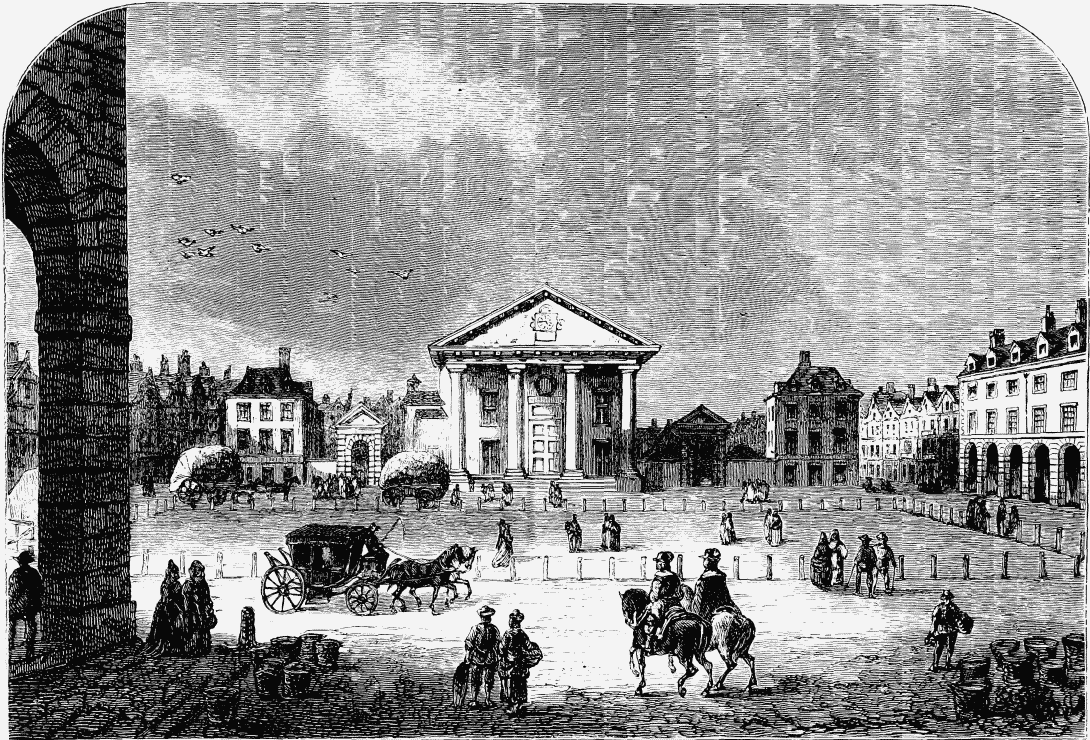
COVENT GARDEN IN 1660.
A curious contrast to this lavish outlay is to be found in the modest charges of a play acted in the year 1511, on the Feast of St. Margaret, of which the expenses were as follow:—
In 1850 Covent Garden passed into the hands of Mr. Gye. At the commencement of 1856 Mr. Gye let the theatre for a few weeks to Professor Anderson, the "Wizard of the North," whose short lease terminated on the 4th of March with a masked ball, for which Mr. Gye's reluctant consent had been extorted, after repeated refusals. It was not, as we have seen, the first or the second time that Covent Garden Theatre had been employed for the same purpose; but Mr. Gye's objections were in this instance unfortunately prophetic. The festivities were just concluding with the performance of the "National Anthem," at five a.m., there being then only about 200 of the vast crowd of revellers left in the building, when the alarm of fire was given, and in a few hours nothing remained of the splendid structure but a heap of smoking ruins. Happily no lives were lost, although little else was saved in the general destruction, except the façade, and Flaxman's statues and bassi-relievi. The origin of the fire was never ascertained. Such a catastrophe, occurring at a period when the preparations and engagements for the coming season were on the point of completion, was calculated to daunt the stoutest heart; but Mr. Gye's courage and fertility of resource were equal even to an emergency like this. He at once engaged the Lyceum for the season, made a manly appeal to the public to support him, and opened his temporary opera-house on the 15th of April to a brilliant and crowded audience. Early in the following year Mr. Gye obtained from the Duke of Bedford a lease of the site for a new theatre, at a rent of £850 for ninety years. This site included not only the ground on which the late theatre stood, but also that occupied by the "Piazza" Hotel, together with other tenements, the whole being equivalent to more than an acre. The funds for the new building were raised by loans; amongst the contributors being the Duke of Bedford, £15,000; Messrs. Lucas, £10,000; Colonel Meyrick, £5,000; Mr. Billings, £5,000; Mr. Maynard, £5,000; Sir E. Majoribanks and Mr. Antrobus, £5,000; besides Sir George Armytage, Mr. E. M. Barry, Mr. Turner, and others.
The yearly interest upon this large capital is necessarily considerable, and the securities contain a proviso that if the interest be in arrear over three months, or the premiums of fire insurance be not paid, the lessee is to be considered as a tenant at a rental of £4,000 per annum.
These preliminaries arranged, the work of rebuilding the theatre commenced, and progressed with extraordinary rapidity, and with every improvement in the way of lighting, ventilation, decoration, comfort, and precaution against fire which modern science and taste could suggest. In contemplating this, one of the largest and most magnificent theatres in Europe, it is difficult to realise that it was begun and completed within the short space of six months.
The edifice occupies a space of ground measuring 219 feet on the south side, next the Floral Hall, 210 feet on the Hart Street side, and 127 feet along the Bow Street end, where there is an enclosed portico projecting about 17 feet. The portico is about one-fifth larger than that of its predecessor, adorned by Corinthian columns 36 feet high, and by the figures and basso-relievos of Flaxman from the old building, which were cleverly adapted to the new one, and have been insured by the Duke of Bedford for £1,000. The area of the stage, exclusive of the bow in advance of the proscenium, measures 90 feet by 88, and the cost of the stagemachinery and various appurtenances was nearly £2,500. There are eight main staircases, besides six minor ones, all of which are fireproof. In addition to the usual entrances there is a private one in Hart Street, with a staircase attached, leading to the royal box, and also a separate entrance and staircase leading to the box of the Duke of Bedford. The architect of this splendid structure was Mr. E. M. Barry; the contractors Messrs. Lucas; and the sum originally calculated, £60,000, but the actual cost has been computed at more than £70,000.
The new theatre is said to be of the same size as La Scala at Milan, which up to that time had the reputation of being the largest theatre in Europe, or perhaps in the world. The interior decorations are of a very chaste and elegant design, being of pale azure and white, relieved with rich gilding.
It was opened on the 15th of May, 1858, by Mr. Harrison, in conjunction with Miss Louisa Pyne, with Meyerbeer's opera of Les Huguenots, which was performed to an overflowing audience, the numbers present on that occasion being 300 in excess of the estimate of a "full house;" and it was under their management that Balfe's celebrated opera of Satanella was produced with the greatest success. It was called by the critics of the time Balfe's "happy inspiration."
It would be a work of supererogation to mention the names of the great artists who within the last twenty years have made their world-wide reputation upon these boards. Who of the present generation needs to be reminded of Adelina Patti, who rose upon the horizon of the musical world in 1861, and has reigned ever since queen of song and of hearts; of Pauline Lucca, equally fascinating and capricious; of the stately Titiens, always in splendid song, the only soprano that recalls to the musical connoisseur the singing of Pasta, Malibran, or Grisi; of that peerless contralto, Trebelli; or of the young Emma Albani; of Santley, Faure, Nicolini, or Tamberlik?
For ten years after the opening of the new theatre in Covent Garden, the lessees of the rival operahouses were fully occupied in endeavouring to solve the vexed question whether two such establishments simultaneously carried on, in opposition to one another, could be made to pay. In 1869 the belligerents, believing that the solution of the problem was to be found only in a coalition of forces, entered into partnership; but difficulties beset them from the very commencement, and the ultimate result was far from satisfactory, and, to begin with, Sir Michael Costa, the dignified chef d'orchestre at Covent Garden, declined to countenance the scheme, and withdrew his august services; Signors Arditi and Li Calsi being thereupon appointed to conduct by turns. Next, differences of opinion (to speak very mildly) arose among the "bright, particular stars" of the amalgamated companies, and terminated with the secession of Mdlles. Nilsson and Di Murska, and Signors Foli, Santley, Arditi, and others. Finally, the general public began to be dissatisfied, for a brisk competition between those who cater for its amusement is always an advantage, and monopoly of any sort invariably ends in mediocrity. Before the conclusion of the year 1870 the fusion had terminated in "confusion worse confounded;" Messrs. Mapleson and Gye had dissolved their brief partnership, and the season of 1871 saw them again engaged in the amicable warfare which would seem to be the normal and natural condition of the two principal theatres of the metropolis.
Adjoining the theatre, on the southern side, is the Floral Hall, erected about the year 1860, somewhat on the plan of the original Crystal Palace in Hyde Park; but of this we shall have more to say in a subsequent chapter.
It may be interesting here to make a note of the fact recorded in Forster's "Life of Dickens," that when he was about twenty years old he applied to Mr. Bartley, the then manager of Covent Garden, for an engagement at that theatre, and that a day was fixed for him to make trial of his powers. When the day came he was laid up with a bad cold, and could not appear; his trial was therefore postponed till the next season. In the meantime he had made himself famous by his pen, and so he took to literature instead. Possibly to that "bad cold" we owe "Pickwick," "Nicholas Nickleby," and "Oliver Twist."
It may be stated here that owing to their being the two patent theatres, Drury Lane and Covent Garden have each at their doors a guard of honour of six soldiers, furnished by the household troops. We have no doubt some of our young friends think they have something to do with the pantomime; but this, we can assure them, is a mistake, for the guard, we believe, is the sole relic of the exclusive "royal patent" under which these two theatres so long existed.
We have thus endeavoured to compress into a few pages an outline of the history of the two leading theatres, and, indeed, for many years, the only theatres of London. But the whole neighbourhood around Covent Garden teems with theatrical reminiscences, for which a volume, in reality, would scarcely suffice. We will, however, endeavour, in the following chapters, to skim lightly over the ground, yet carefully, and as exhaustively as possible, rambling about from street to street, as the bee flits from flower to flower, and sipping here and there from the stores of past history of the Stuart and Hanoverian ages.