Old and New London: Volume 3. Originally published by Cassell, Petter & Galpin, London, 1878.
This free content was digitised by double rekeying. Public Domain.
Walter Thornbury, 'The river Thames: Part 2 of 3', in Old and New London: Volume 3(London, 1878), British History Online https://www.british-history.ac.uk/old-new-london/vol3/pp300-311 [accessed 30 April 2025].
Walter Thornbury, 'The river Thames: Part 2 of 3', in Old and New London: Volume 3(London, 1878), British History Online, accessed April 30, 2025, https://www.british-history.ac.uk/old-new-london/vol3/pp300-311.
Walter Thornbury. "The river Thames: Part 2 of 3". Old and New London: Volume 3. (London, 1878), British History Online. Web. 30 April 2025. https://www.british-history.ac.uk/old-new-london/vol3/pp300-311.
In this section
CHAPTER XXXVIII.
THE RIVER THAMES (continued).
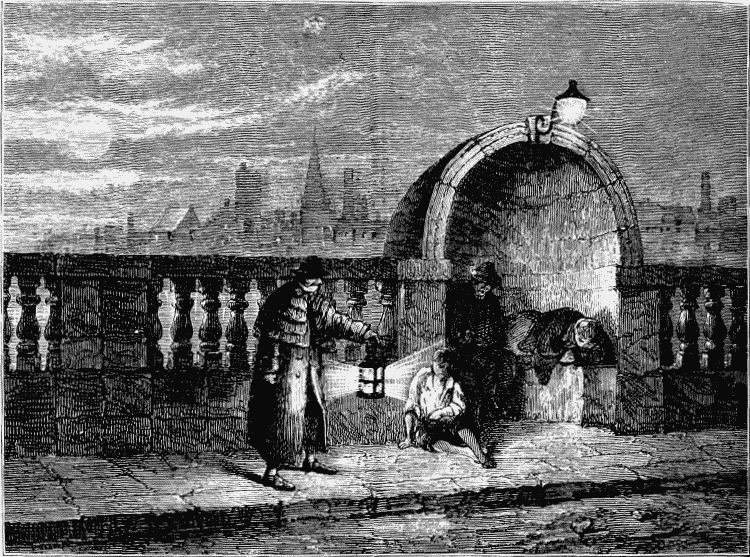
ALCOVES OF OLD WESTMINSTER BRIDGE.
"Such a stream doth run
By lovely London as beneath the sun
There's not the like."—Old Ballad.
Poetic Effusions in Honour of the Thames—"Swan-upping"—River Waifs and Dead-Houses—Watermen and Wherrymen—Authorised Rate of Charges made by Watermen—Doggett's Coat and Badge—Thomas Doggett as an Actor—Miss Benger's Apostrophies of Taylor, the "Water-Poet"—The Thames as the Great Medium of Conveyance—State Processions—Amusements on the Thames—Bathing in the Thames—Condition of the River in 1874—Depredations from Merchant Vessels—Training-vessels for the Royal Navy and Merchant Service—Mercantile Importance of the Thames.
"Of the London and Westminster of Chaucer's time," writes Mr. Matthew Browne in his pleasant work, "Chaucer's England," "there is little which the poet, however forewarned, would recognise if he were to return. The Thames, certainly, he would scarcely know, with its many bridges. The London Bridge of Peter Colechurch, with its crypt and fishpond in one of the piers, and the drawbridge arch over which rushed the insurgent commons of England under Wat Tyler, he would surely miss. And John of Gaunt's London palace of the Savoy which the insurgents burnt; would he know it? or would he know Westminster Abbey? Not Henry the Seventh's chapel, of course; nor Sir Christopher Wren's clumsy towers. Not St. Paul's, which in his days had a spire. . . . . Not the streets; assuredly not the Strand, which in the days of the Plantagenets was really a strand sloping down to the river, with only a house here and there . … He would know the Tower, however, and Lambeth Palace, perhaps, and St. Mary's Overies, where his contemporary, Gower, was married by William of Wykeham."
But even the Thames has seen its changes.
Three hundred years ago the river on both sides
was fringed with trees and flowers to such an
extent that Izaak Walton quotes the compliment
of a German poet of his own time:—
"So many gardens dress'd with curious care
That Thames with royal Tiber may compare."
Indeed, this noble river has been a great theme
for poets of all time, and deservedly. It is called
by Pope the "silver Thames" and the "fruitful
Thame;" by Spenser "the silver-streaming
Thames," and by Herrick "the silver-footed
Thamesis." Sir John Denham's charming lines,
so descriptive of the English beauty of the Thames,
often as they have been quoted, will bear being
repeated here:—
"Oh! could I flow like thee, and make thy stream
My great example as it is my theme!
Though deep, yet clear; though gentle, yet not dull;
Strong without rage; without o'erflowing full."
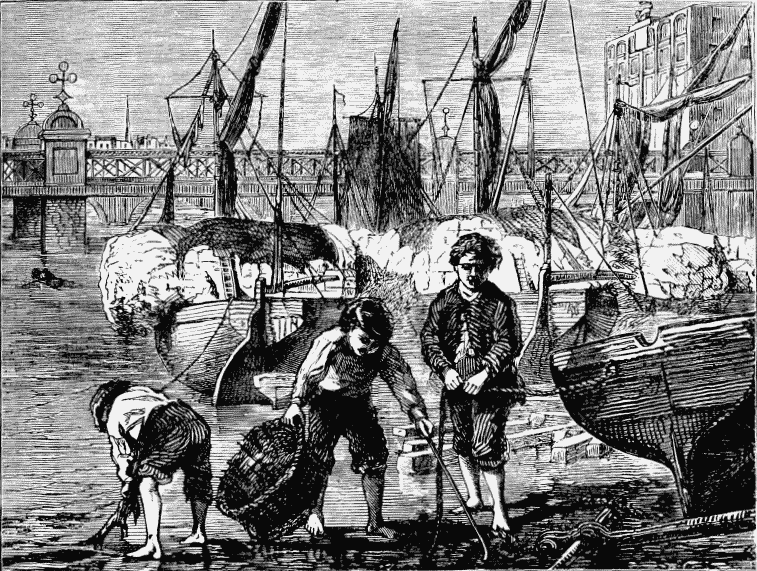
ON THE THAMES AT LOW WATER.
Drayton, too, in a poem published in "England's
Helicon" in 1600, thus eulogises the Thames and
along with it Elizabeth under the fanciful name of
"Beta:"—
"And oh! thou silver Thames, O dearest crystal flood!
Beta alone the phœnix is of all thy watery brood;
The queen of virgins only she,
And thou the queen of floods shalt be.
Range all thy swans, fair Thames, together in a rank,
And place them duly one by one upon thy stately bank."
But it is sadly to be feared that such poets were inspired less by a reverence for Father Thames than by a desire to stand well with the always vain but now aged queen, whom Horace Walpole, with his usual cynicism, describes at this period as being "an old woman with bare neck, black teeth, and false red hair."
The river and the metropolis, both so dear to
Englishmen, are thus fantastically celebrated by
Pope in his "Windsor Forest," from which we
quote the following lines:—
"From his oozy bed
Old Father Thames advanced his reverend head;
His tresses dropp'd with dews, and o'er the stream
His shining horns diffused a golden gleam:
Grav'd on his arm appear'd the moon that guides
His swelling waters and alternate tides:
The figur'd streams in waves of silver roll'd,
And on her banks Augusta rose in gold."
In Drayton's poem, "Polyolbion," published in
1613, in "The Seventeenth Song," we read:—
"When Thames now understood what pains the Mole did
take,
How far the loving nymph adventur'd for his sake;
Although with Medway matcht, yet never could remove
The often-quick'ning sparks of his more ancient love.
So that it comes to pass, when by great Nature's guide
The ocean doth return, and thrusteth in the tide
Up towards the place where first his much-loved Mole
was seen,
He ever since doth flow beyond delightful Shene."
Pope, in his imitation of Spenser, has described
the alleys on the banks of the river in and about
London minutely and vividly, but in lines which
will scarcely bear quotation. And the poet Gray
describes in effect its quiet and peaceful character,
when he asks in one of his letters to Warton,
"Do you think that rivers which have lived in
London and its neighbourhood all their days, will
run roaring and tumbling about like your tramontane torrents in the North?"
The following charming verses on our muchloved river, from the first volume of Once a Week,
based on the quaint expression of Leland, who
speaks of London as "a praty town by Tamise
ripe," are not so well known as they deserve
to be:—
"Of Tamise ripe old Leland tells:
I read, and many a thought up-swells
Of Nature in her gentlest dress,
Of peaceful homes of happiness,
Deep-meadow'd farms, sheep-sprinkled downs,
Fair bridges with their 'praty towns
By Tamise ripe.'
* * * * * * *
"Fair Oxford with her crown of towers,
Fair Eton in her happy bowers,
The 'reach' by Henley broadly spread,
High Windsor, with her royal dead,
And Richmond's lawns and Hampton's glades;
What shore has memories and shades
Like 'Tamise ripe?'
"Not vine-clad Rhine, nor Danube's flood,
Nor sad Ticino, red with blood,
Not ice-born Rhone or laughing Seine,
Nor all the golden streams of Spain;
Far dearer to our English eyes
And bound with English destinies
Is 'Tamise ripe.'
"High up on Danesfield's guarded post
Great Alfred turn'd the heathen host;
Below the vaults of Hurley sent
A tyrant into banishment;
And still more sacred was the deed
Done on the isle by Runnymede
On 'Tamise ripe.'
"And down where commerce stains the tide
Lies London in her dusky pride,
Deep in dim wreaths of smoke enfurl'd,
The wonder of the modern world:
How much to love within the walls
That lie beneath the shade of Paul's
By 'Tamise ripe'!"
The romance of the river Thames, not in its
sylvan, fishing, boating, and "swan-upping" aspect
above bridge, but in its melodramatically maritime
characteristics below bridge, was a theme which
seemed to afford unflagging delight to Charles
Dickens. Thames mud appeared to the great
novelist redolent of mysterious interest, and the
waterside scenes in "The Old Curiosity Shop,"
including the wharf where Mr. Quilp, the dwarf,
broke up his ships, where Mr. Sampson Brass so
nearly broke his shins, and where the immortal
Tom Scott so continuously stood on his head, were
rivalled in graphic vividness thirty years afterwards
by the waterside scenes and characters pictured in
"Our Mutual Friend." But with all this it is certain
that the romance of the river between London
Bridge and Greenwich has been for many years
declining, and that civilisation is all the better for
the disappearance of those picturesque features
described in 1798—not, indeed, in a work of
fiction, but in a most forcible, albeit prosaic
manner by Mr. C. Colquhoun, one of the police
magistrates of the metropolis. The lighter-buzzards, the "light horsemen," the sham "bummarees" and felonious "stevedores," the "teaskippers," "whisky-runners," and "rough-scullers"—in other words, the robbers, pirates, smugglers,
and murderers who formerly infested the Pool and
the Port of London—are now but a feeble folk in
comparison with the great flotilla of river desperadoes denounced by Mr. Colquhoun, whose
work mainly led to the establishment of the
Thames Police. Since then Cuckold's Point and
Execution Dock have fallen out of the chart,
and, with the exception of an annual proportion of
lighter-robbing and tobacco-smuggling, the river
Thames may, in the present day, be considered as
quite respectable.
In Fitzstephen's time the Thames at London was indeed "a fishful river," and we read of the Thames fishermen presenting their tithe of salmon at the high altar of the abbey church of St. Peter, and claiming, on that occasion, the right to sit at the Prior of Westminster's own table. At this period the supply of fish materially contributed to the subsistence of the inhabitants of the metropolis, and the river below the site of the present London Bridge abounded with fish. In 1376–7 a law was passed in Parliament for the saving of salmon and other fry of fish; and in 1381–2 "swannes" that came through the bridge or beneath the bridge were the fees of the Constable of the Tower.
The regulations respecting the keeping of swans on the Thames have always been very strict, and from a very early date the privilege of being allowed to keep them has always been jealously guarded. For example, we find that in the twentysecond year of the reign of Edward IV., 1483, it was ordered that no person not possessing a freehold of the clear yearly value of five marks should be permitted to keep any swans; and in the eleventh year of Henry VII., 1496, it was ordained that any one stealing a swan's egg should have one year's imprisonment, and be fined at the king's will; and stealing, setting snares for, or driving grey or white swans, were punished still more severely. In the time of Henry VIII. no persons having swans could appoint a new swanherd without the licence of the king's swanherd; and every swanherd on the river was bound to attend upon the king's swanherd, on warning, or else pay a fine. The Royal swanherd was obliged to keep a book of swan marks, in which no new ones could be inserted without special licence. Cygnets received the mark found on the parent bird, but if the old swans had no mark at the time of the "upping" (or marking), then the old and young birds were seized for the king, and marked accordingly. No swanherd was allowed to mark a bird, except in the presence of the king's swanherd or his deputy. When the swan made her nest on the bank of the river, instead of on one of the islands, one young bird was given to the owner of the soil, in order to induce him to protect the nest. This was called the ground bird. The Dyers' and Vintners' Companies have for several hundred years enjoyed the privilege of preserving swans on the Thames from London to some miles above Windsor, and they still continue the old custom of going with their friends and guests with the Royal swanherdsman, and their own swanherds and assistants, on the first Monday in August in every year, from Lambeth, on their swan voyage, for the purpose of catching and "upping" (or marking) all the cygnets of the year. The junior warden of the Vintners' Company is called the swan warden; the appointment to the office of Royal swanherd being vested in the Lord Chamberlain for the time being. Eton College has also the privilege of keeping these birds. At one period the Vintners' Company possessed over 500 swans, but the number is now much less, as, since they have ceased to be served up at great banquets and entertainments, the value of them has greatly declined.
A correspondent in a weekly journal has pictured to us in vivid colours the sad story of the "River Waifs and Dead-houses," which we here quote, as a striking contrast to the poetic and romantic views of the Thames given above:—"Very peaceful and beautiful does the river look as we push off from one of the queer old flights of steps to be found at intervals all along the riversides. The light of the afternoon sun is gleaming down through a soft luminous mist, beneath which the face of old Father Thames looks up so smiling and placid that the idea that beneath his heaving bosom he conceals hideous secrets of death and decay, seems well nigh incredible. But he does so, nevertheless. Rarely a day passes but some poor struggling wretch goes down into those mysterious depths beneath that shining, glittering surface, never to rise again, or, if to rise, only to find a brief resting-place in one of the grim, foul little 'dead-houses' —scarcely less repulsive—dotted here and there among the dense population along the shores on either side of the great silent highway.
"Of course they are not all found, but within the London portion of the river Thames—between Chelsea and Barking, that is—there are on an average three or four of these poor waifs of humanity picked up every week.
"Yonder goes one of them, covered over with a cloth, in that small boat, threading its way through the midst of the shipping towards the foot of a long narrow stair, leading up through quaint old blocks of building overhanging the river. Following in the track of it I am soon standing before a tall iron railing, shutting in from the busy world a dreary little patch of ground, planted with old moss-covered gravestones and overrun with weeds. In the middle of this plot stands the dead-house. The depository of the dead must, of course, under any circumstances, be a dismal and unpleasant place to visit; but about many of these river-side houses there is—or one fancies there is—something peculiarly oppressive and dejecting, and any one tempted to entertain the idea of evading the responsibilities and troubles of a troublesome world by a short cut over the parapet of Waterloo Bridge would do well to take a turn round to some of them. If the thought of being brought there, friendless and unknown, bundled unceremoniously down on to a bare floor damp and blood-stained, covered with filthy-looking cloths, and laid in a 'shell,' in which temporarily, perhaps, hundreds of other piteous objects have already awaited identification or consignment to a nameless grave—if the thought of that does not act as a powerful deterrent there must, one would think, be a natural penchant for suicide, with which it would be hopeless to contend. There is something unutterably sad in the idea of such a termination to all the hopes and fears, the struggles and strivings of a human life; and there is something hideously grotesque in the aspect of the grizzled, crinkly-faced old beadle, as he sets about his preparations for the coroner, and chuckles at the evident shrinking of his visitor from the long black box in which, as he rolls up his sleeves, he tells him he has rather a bad subject to deal with. It is clear that he is rather proud of the indifference which long familiarity with the dead has enabled him to acquire, and he evidently enjoys the shock which he conveys in reply to a question as to what it is he is sweeping out into a corner of the ground. 'What's them? Why, somebody's toes,' says the old man; and he adds, with a grim little smile, 'There's 'undreds o' toes down in that corner.'
"The body just brought in has been laid upon the slate shelf which runs along two sides of the building, and in the 'shell' on the floor are the remains of a young man, probably one of a score or so of poor fellows who lost their lives during the two or three days of dense fog some weeks ago, and the bodies of some of whom have ever since been floating about the still awful gloom of the bed of the river. No description of the contents of that shell can be attempted. Without some clear and specific object in doing so—such as we have here—even the mention of it would be unwarrantable. Only those who have seen a human body under such circumstances can form any conception of the duty which somebody has to perform before an inquest can be held, and they only are in a position to understand how inadequate and imperfect are the arrangements of the various metropolitan authorities for dealing with them.
"A story, which under other circumstances would be ludicrous, is told of a military officer who, some time ago, was called on to go to one of these places to identify one of his men who had been accidentally drowned in the summer time, and whose body had been recovered after many days' immersion. The officer had gone through some active service, and made light of the warning of those in charge of the mortuary as to the shock he might possibly receive. He would take just a sip of brandy if, as they said, the smell of the place was so very unpleasant; but as to the sight of a dead body—pooh, nonsense! He had seen too many of them. It had been necessary to place a heavy stone on the lid of the shell containing the poor fellow, and no sooner was this removed and the lid raised than, on the instant, this stout-hearted officer rushed from the place sick and pale as a ghost, and declaring that if his whole regiment were drowned he would never go near another such a sight.
"It is not surprising that the appearance of some of these melancholy objects on the river by night is often sufficient to unnerve men of the most dauntless character, and whose familiarity with them would, it might be supposed, tend to render them comparatively indifferent. Veteran watermen are sometimes found to be the veriest children in dealing with them. There is an 'old stager' now on the river whose courage, under all ordinary circumstances, has been proved in a thousand different ways, but who yet dare not stay by himself for a few moments in charge of one of these stark, silent creatures. He and his comrades one night brought one to shore tied to the boat, which was left in his charge while his companions fetched a 'shell.' They had no sooner disappeared than he made his way to a neighbouring publichouse, ostensibly to get a light for his lantern, but, as the joke goes, to let some of the folks there know that there was something to be seen down at his boat. His little ruse was successful, but his troubles were not quite over. His comrades returned with the shell, and all marched off with the body to the dead-house, which was reached by crossing a churchyard. On their arrival he was sent back to the boat, but with such terror had the sight of that object inspired this burly, really boldhearted man, that he could not for the life of him open the gate of the churchyard, and stood inside fumbling at the handle and shaking with fear until a woman passed, and she, poor soul, took him for a ghost, and when he asked her the time of night took to her heels and ran off in frantic terror.
"It would be reasonable to suppose that with an average of some 150 to 200 of these bodies requiring attention every year there would, at proper intervals along the river-banks, and at no great distance from the river, be found not only mortuaries of the most complete and perfect construction, but every facility for conveying the bodies to them. Such, however, is by no means the case. Till within the past few months, the body of a person found drowned on the lower side of London Bridge should have been deposited in a kind of vault just between the church of St. Magnus the Martyr and the bridge. At the present time, no matter how sickening and dreadful the object found may be, it must be conveyed through the public streets to the mortuary in Golden Lane, a distance considerably over a mile. If found within that part of the river lying between the Equitable Gas Works and Chelsea College, it must be conveyed right away to Mount Street, in the neighbourhood of Hanover Square, a distance certainly not less than two miles. The idea of a corpse—it may be in an advanced stage of decomposition—being dragged from the river, laid in a filthy shell, and carried upon men's shoulders for a distance of two miles, and that, perhaps, in the height of summer, is something most revolting, and altogether discreditable to those who are responsible for it. In other cases the distance is not so great, but the accommodation for properly dealing with the dead is altogether wanting. The only dead-house for the river between Nine Elms and Waterloo Bridge is a kind of toolhouse in one corner of Lambeth churchyard. Lower down the river another little tool-house, standing close under the windows of a row of cottages, is the only mortuary. Even where the places themselves are tolerably satisfactory their situations are, in some instances, most objectionable. There is a new mortuary in Pennyfields, Poplar. It is situated at the bottom of a close and narrow lane, between the workhouse on the one hand, and a densely-populated little street on the other. Often there are five or six bodies lying here at one time, and the surrounding inhabitants speak of the stench as at times something most unbearable.
"The discussion that has lately been going on as to the best method of finally disposing of the dead, is no doubt a very important one; but it is evident that in London at least we have not as yet given anything like sufficient attention to the disposal of the dead during the interval between death and the final solemnity, whatever it may be. This applies not only to the river district, but to all parts of London; but in no other part does it happen that bodies that have been practically buried for weeks or even months are dragged to the light of day, and have to be dealt with as in the case of an ordinary death. In no part, therefore, is it so important that mortuary accommodation of the most complete kind shall be easily accessible, and, it may be added, in no part is it so thoroughly defective. There is, of course, great difficulty in securing open spaces for these structures, and the cost would, in some cases, be very serious if provided on shore. Where this appears to be an insuperable difficulty, however, a very simple and inexpensive solution of it would be to set up a floating mortuary here and there. This would afford fresh air, plenty of water, and ready access. Something ought speedily to be done in this matter, and now that the summer is approaching it appears to be a very suitable time for calling attention to what is undoubtedly a very discreditable state of things for a great city like London."
Of the Thames watermen and wherrymen, a brief mention has been made in the second volume of this work (see pages 51 and 52): we may, however, add here a few more particulars concerning this once celebrated and now almost extinct body of men.
As may easily be imagined, they formed very much of a caste by themselves, and recognised their kinship in the craft by being ambitious of burial, when they died, in the southern side of the churchyard of St. Martin's-in-the-Fields. They were a rough, saucy, and independent lot, if we may judge from allusions to them which occur in the novels, comedies, farces, and popular songs of the last century. Their phraseology, too, was as peculiar as that of the cabmen and omnibus drivers of our own day. Peter Cunningham calls it "the water dialect or mob language," the use of which he reckons as "one of the privileges of the river assumed by the fraternity," a language of which Ned Ward and Tom Brown have both left us specimens, and of which Fielding complains so touchingly in his "Voyage to Lisbon;" and he quotes, in support of his statement, several passages from Ben Jonson, Samuel Pepys, and Wycherley. It will be remembered that in the Spectator (No. 383) Sir Roger de Coverley is "shocked" at the saucy language with which he is greeted by two or three young fellows, whilst taking his pleasure in a boat on the Thames; and Boswell, in his "Life of Johnson," records the fact that once when the learned doctor was in a similar situation, he gave back a wherryman raillery for raillery in terms which we can scarcely quote in these pages.
The Thames watermen received their licences from, and were directly amenable to, the Lord Mayor and the other members of the Thames Conservancy; and their fares were regulated by a published scale of charges a hundred years ago. A copy of the "Rates of Watermen plying on the River Thames, either with oars or skullers," dated 1770, gives a table of charges, showing that a fare could be carried with "oars" for a shilling from London Bridge to Limehouse, Shadwell Dock, or Ratcliff Cross; or from either side above London Bridge to Lambeth or Vauxhall. Eightpence was the charge for the same mode of conveyance from the Temple, Blackfriars, or Paul's Wharf to Lambeth; whilst sixpence would frank a voyager from London Bridge or St. Olave's, Tooley Street, to "Wapping Old Stairs" or Rotherhithe Church; or from Billingsgate and St. Olave's to St. Saviour's Mill, from any stairs below London Bridge and Westminster, or from Whitehall to Lambeth or Vauxhall; whilst any lady or gentleman could be ferried "over the water directly from any place between Vauxhall in the west, and Limehouse in the east, for fourpence." The charges for "skullers" for each of the above-named voyages were exactly half the sums here named. The authorised "rates of oars, down and up the river, as well for the whole fare as for company"—in other words, for a single voyager, or each person forming a party—are curious. From London to Greenwich or Deptford, the charge for a single individual was eighteenpence, to Blackwall two shillings, to Woolwich half-a-crown, to Purfleet or Erith three shillings, to Grays or Greenhithe four shillings, and to Gravesend four and sixpence. When persons made the voyage in parties, each of the company, be the latter large or small, was to be charged about a sixth of the above rates. The same regulations held good "above bridge" also: you could be taken by "oars" to Chelsea, Battersea, or Wandsworth for eighteenpence; to Putney, Fulham, or Barnes for two shillings; to Hammersmith, Chiswick, or Mortlake for half-a-crown; to Brentford, Isleworth, or Richmond for three and sixpence; to Twickenham for four shillings; to Kingston for five; to Hampton Court for six; to Hampton town, Sunbury, or Walton for seven; to Weybridge or Chertsey for ten; to Staines for twelve; and all the way to Windsor for fourteen shillings. If a party was got up for the occasion the charge was a shilling for each individual for any distance beyond Kingston, even as far as Windsor.
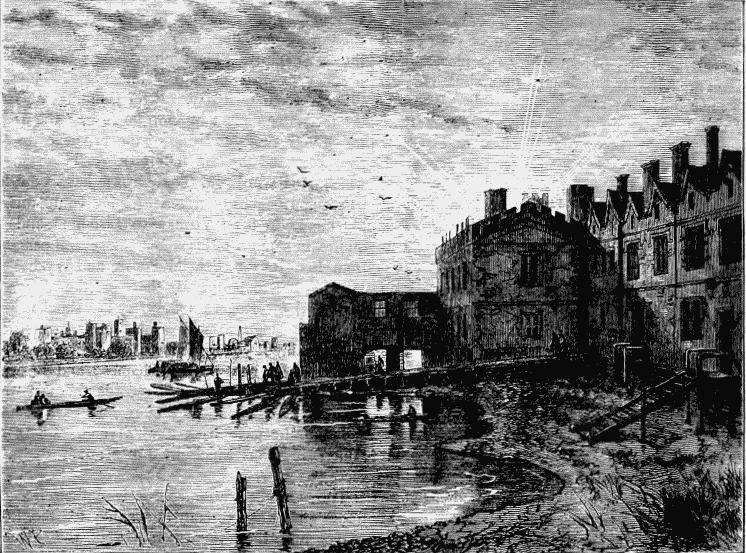
OLD WHITEHALL STAIRS.
To the above list the same little book gives in an appendix the "Rates authorised for carrying goods in the tilt-boat from London to Gravesend." For this passage the charge was for each single person, ninepence; for a hogshead of liquor, two shillings; for a firkin of goods, twopence; for half a firkin, a penny; for a hundredweight of dry goods, fourpence; for a sack of corn, salt, &c., sixpence; for an "ordinary hamper," sixpence; and it is added, for the information of those whom it may concern, that "the hire of the whole tiltboat was £1 2s. 6d." By a "tilt" boat of course is meant a boat with a covering; the term still survives, as we need hardly remind our readers, in the term "tilt" cart. It is interesting to compare these rates of transit by oars and scullers along "the silent highway" of old Father Thames with the fares charged now-a-days to voyagers along the same route in cheap steamers, although the latter have so maliciously doubled their charges between London and Westminster.
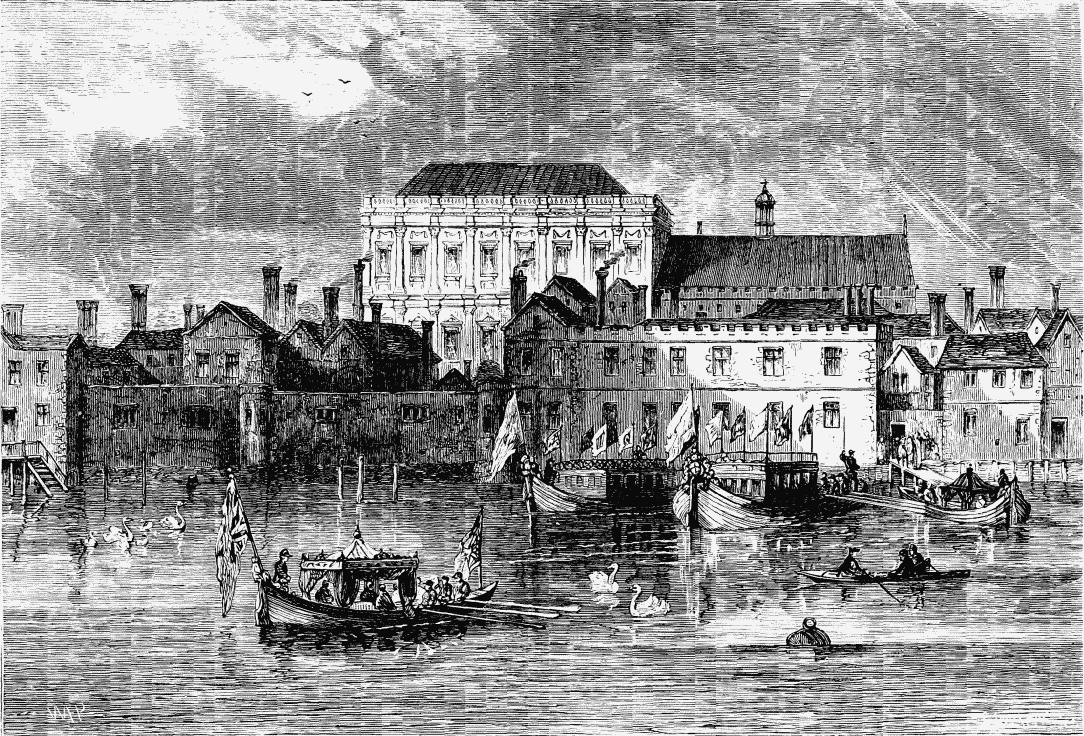
OLD WHITEHALL PALACE FROM THE RIVER.
The olden recreations on "the noble Thames" are of great celebrity. Fitzstephen tells us of the ancient Londoners fighting "battles on Easter holidays on the water, by striking a shield with a lance." There was also a kind of water tournament, in which the combatants, standing on two wherries, rowed and ran against the other, fighting with staves and swords. In Gower's time the sovereign was rowed in his tapestried barge, probably the first royal barge upon the Thames; and upon this great highway Richard II., seeing the good old rhymer, called him on board the royal vessel, and there commanded him to "make a book after his hest," which was the origin of the "Confessio Amantis." At this period a portion of London Bridge was movable, so that vessels of burthen might pass up the river, to unload at Queenhithe and elsewhere; and stairs, watergates, and palaces studded both shores. At this time, too, we are informed, boats conveyed passengers, for the sum of twopence each, from London to Gravesend.
One of the most interesting annual events in
the present day in connection with the Thames
watermen, and perhaps the most popular gala day
now which gladdens the heart of the multitudes,
next to Derby Day at Epsom and the Oxford
and Cambridge boat-race, is the one afforded
by Thomas Doggett, comedian, on the 1st of
August, to commemorate the accession of the
House of Brunswick. "This scene," says Mr.
J. T. Smith in his "Book for a Rainy Day," "is
sure to be picturesque and cheerful should it be
lit up by the glorious sun 'that gems the sea and
every land that blooms.' In 1715, the year after
George I. came to the throne, Doggett, to quicken
the industry and raise a laudable emulation in our
young men of the Thames, whereby they not only
may acquire a knowledge of the river but a skill
in managing the oar with dexterity, gave an orangecoloured coat and silver badge, on which was
sculptured the Hanoverian Horse, to the successful candidate of six young watermen just out of
their apprenticeship, to be rowed for on the 1st
of August, when the current was strongest against
them, starting from the 'Old Swan,' London Bridge,
to the 'Swan' at Chelsea." On the 1st of August,
1722, the year after Doggett's death, pursuant to
the tenor of his will, the prize was first rowed for,
and has been given annually ever since.
"They gripe their oars, and every panting breast
Is raised by turns with hope, by turns with fear depressed."
Charles Dibdin was so amused with the sight of
the contest for Doggett's prize, that in 1774 he
brought out at the Haymarket a ballad opera,
entitled The Waterman: or, the First of August,
the hero in which, "Tom Tug," sings the wellknown song—
"And did you ne'er hear of a jolly young waterman,
Who at Blackfriars Bridge used for to ply?
He feather'd his oars with such skill and dexterity,
Winning each heart and delighting each eye;"
and another when he has resolved to cast away his
cares and be off to sea:—
"Then, farewell, my trim-built wherry,
Oars and coat, and badge, farewell!
Never more at Chelsea ferry
Shall your Thomas take a spell," &c.
However, Tom rowed for Doggett's coat and
badge, which he had an eye upon, in order to
obtain his love if possible by his prowess. She was
seated at the "Swan Inn," Chelsea, and admired
the successful candidate before she discovered him
to be her suitor Thomas, then "blushed an answer
to his wooing tale," and it is to be hoped lived
happily with him for ever afterwards.
The old "Swan Inn" at Chelsea, we may add, was swept away about the year 1873 to make room for the Thames Embankment; but the coat and badge is still rowed for, the destination of the race being the Cadogan Pier at Chelsea. The Fishmongers' Company, of which Thomas Doggett was a member, add a guinea to the prize; and besides this there are several other prizes awarded to the different competitors in the race. The second and third prizes are respectively allotted five-eighths and three-eighths of the interest on £260 17s. 3d., formerly £200 South Sea Stock, left in the will of Sir William Jolliffe, the amounts respectively being £4 17s. 9d. and £2 18s. 9d. The prize for the fourth man is £1 11s. 6d., and for the fifth and sixth men each £1 1s., the last three given by the Fishmongers' Company. There are also different sums occasionally given by private individuals to the winner, or to the first, second, and third in the race. The competition is by six young watermen whose apprenticeships have expired the previous year; each being in a boat by himself with short oars or sculls. The bargemaster of the Fishmongers' Company is ordinarily the umpire; and the race always excites much local interest, being one of those many sports in which the English take much pleasure.
Thomas Doggett is stated to have been a native of Dublin, and to have been born about the middle of the seventeenth century. Colley Cibber, speaking of him, says, "As an actor he was a great observer of Nature; and as a singer he had no competitor." He was the author of the "Country Wake," a comedy published in 1696, and was a patentee of Drury Lane Theatre until 1712. He died in 1721. It may be added that Doggett was not the only actor who took an interest in the Thames watermen, for the proprietors of the old Vauxhall Gardens, and Astley the equestrian, gave wherries to be rowed for; as did also Edmund Kean, the tragedian.
Among the most celebrated of Thames watermen in bygone days was Taylor, "the water poet,"
of whom we have already spoken. Miss Benger
thus apostrophises both the poet and the river at
once:—
"And thou, O Thames, his lonely sighs hast caught.
When one, the rhyming Charon of his day,
Who tugged the oar, yet conned a merry lay,
Full oft unconscious of the freight he bore,
Transferred the musing bard from shore to shore.
Too careless Taylor! hadst thou well divined,
The marvellous man to thy frail skiff consigned,
Thou shouldst have craved one tributary line,
To blend his glorious destiny with thine!
Nor vain the prayer!—who generous homage pays
To genius, wins the second meed of praise."
Down to about the middle of the seventeenth century, when not only coaches, but also sedan chairs, had become pretty general, the Thames had formed the great medium of metropolitan conveyance. Its banks on either side were studded thick, as far as London extended, with the quays and "stairs" of the nobles, and wharves of the commons, while its waters were peopled with every kind of vessel, from the bucentaur-like barge of royalty, to the nutshell skiff or wherry. In 1454, Sir John Norman, Lord Mayor elect, built a magnificent barge for the use and honour of his mayoralty; before his time it was usual for the chief magistrate and his train to go to Westminster Hall on horseback. The companies followed Norman's example, and constructed elegant vessels to accompany their mayors. The watermen were so elated by this circumstance that they caused a commemoration song to be composed on the occasion, beginning, "Row thy boat, Norman," &c.
Down to the time of the discontinuance of the "water pageant" as part of the Lord Mayor's state procession to Westminster, the officials connected with the state barge included the water-bailiff, one of his lordship's esquires, with a salary of £500 a year, a shallop, and eight men; and in the suite were a barge-master and thirty-two City watermen. The watermen, clad in the livery and wearing the silver badge won in the match above mentioned, still take part in the Lord Mayor's Show on the 9th of November; and the trumpeters who formerly heralded his lordship's approach to Westminster from the prow of the gilded barge, now precede his lordship's state carriage on foot in all civic state ceremonies.
The remains of Anne of Bohemia, queen of Henry VII., who died at Richmond, were honoured with a state funeral by water, being brought with great pomp by the river to Westminster. In 1533 the mayor and citizens accompanied Anne Boleyn in their barges from Greenwich to the Tower, preparatory to her coronation at Westminster; and this was the highway along which that unfortunate lady and more than one other of the wives of Henry VIII. made their last journey. Along it also "the seven bishops" were conveyed from Westminster to the Tower in the reign of James II. Mr. Peter Cunningham briefly reminds us that State prisoners committed from the Council Chamber to the Tower or the Fleet were invariably taken by water.
Passing up the Thames on frequent occasions might be seen in mid-stream the royal barge of Queen Elizabeth with her Majesty on board in gayest trim, on her way up the stream along with the tide going to her palace at Westminster, and possibly to land at Whitehall Stairs, or at the Westminster Palace Water Gate, at that time known, as we learn from Ralph Aggas' map, as "The Queen's Stairs."
After the great civil war, however, the royal water processions dwindled into the paltry annual pageant of the Lord Mayor's Show; and even this, we need hardly say, has now died out. The state barge last in use by the Lord Mayor was built in 1816, and named the Maria Wood (from the then Lord Mayor's eldest daughter); it was very capacious, and richly carved and gilt. A few of the City Companies had their own state barges, "to attend my Lord Mayor;" as the Fishmongers, Vintners, Dyers, Stationers, Skinners, and Watermen. The barge belonging to the Goldsmiths' Company was sold in 1850.
The Queen maintains her river state barge, though it has not been used since the year 1849, when she went by water to open the new Coal Exchange; the rowers of the royal barge, however, still wear scarlet state liveries, though, like Othello, they find their "occupation gone." The Lords of the Admiralty have likewise their state barge; but these are seldom or never now brought into use.
The nobility, in imitation of royalty, laid aside their gilded barges; the fashionables who dwelt near the Thames, at St. Katharine's, Bankside, Lambeth Marsh, Westminster, Whitefriars, Coleharbour, and other such convenient localities for a water fête, preferred an inland pic-nic among the gardens or forests, to which their carriages could waft them in an hour or two; while the busy Inns of Court, whose thousands of students and practitioners had hitherto used the facilities of the river alike for business or for pleasure, were now to be found flying along the streets with their books, briefs, and green bags, six in a coach. The Thames, no longer the great highway of London, had become little better than a water conveyance, in the absence of bridges, between the City and the Borough; and the small clusters of ferrymen that now lingered on at the different crossingplaces, looking out hungrily for a chance fare, were but the ghosts of a departed glory, as they uplifted their voices in supplication with, "Boat, your honour! boat, boat!"
The Thames was the usual road, and persons, a century ago, spoke of "taking the water" as we speak of taking a cab or omnibus. To quote an instance from the Somerset House Gazette:—"'You do me great honour, Mr. Handel,' said my great uncle. 'I take this early visit as a great kindness.' 'A delightful morning for the water,' said Colley Cibber. 'Pray, did you come with oars or scullers, Mr. Handel?' asked Pepusch, who had lately been setting the airs to the songs in the Beggar's Opera."
It may interest some readers, however, to learn that when George IV. came to the throne there were still 3,000 wherries plying on the Thames, while the hackney coaches could muster only a sorry 1,200 in the whole of London. As late as the year 1829, if not more recently still, a boat was the usual conveyance from the neighbourhood of Westminster to Vauxhall; and Mr. J. T. Smith, in his "Book for a Rainy Day," tells many anecdotes about the "Thames watermen," whose work was of course at an end as soon as new bridges were built and cheap steamboats put upon the river.
A couple of centuries ago the river was so clear and pure that the noblemen who lived upon its banks along the Strand used to bathe in it constantly. It is on record, for instance, that in the reign of Charles I. such was the practice of Lord Northampton; and Roger North tells us, in his "Lives of the Norths," that his relative, Dudley North, used to swim on the Thames so constantly—and "above bridge," too—that "he could live in the water an afternoon with as much ease as others walk upon land." Horace Walpole, too, tells Lady Craven in one of his letters that Lord Chesterfield waggishly addressed a letter to his friend the Earl of Pembroke, who was fond of swimming in these parts, "To the Earl of Pembroke, in the Thames, over against Whitehall." Lord Byron tells us in one of his letters, in 1807, that he took a swim from Lambeth through Westminster and Blackfriars Bridges down to London Bridge apparently, or even lower, for he reckons the length of his voyage as three miles.
That a very different state of things exists now with regard to the condition or the appearance of the Thames may be inferred when we state that from the report of the Medical Officer of Health, submitted to the Corporation of London towards the close of 1874, it appears that during the month of September of that year 2,083 vessels had been inspected in the river and the docks between Vauxhall and Woolwich, 366 of which required cleansing, 93 sick sailors had been found afloat and referred to the Seamen's Hospital at Greenwich, and of 19 samples of drinking water taken from vessels in various parts of the port for purposes of analysis, seven were found unfit for human consumption. The practice of carrying Asiatic crews on board British ships has revived very much since 1872, and there are now always from 500 to 700 Lascars in this port, some living on board the ships to which they belong, and many taking up their quarters in the House for Asiatics at Limehouse.
Those who do not know what the state of things was in the Thames in the days when shipping discharged in the stream may be astonished to read of the doings little short of piratical which were a part of the established order of things, and prevailed into the reign of George IV., when the opening of the West India Docks enabled at least a portion of the shipping to discharge their cargoes with some safety. In 1798 the depredations from merchant vessels in the river Thames were estimated by Mr. Colquhoun to amount to £506,500 a year. "Scuffle-hunters," long-shore thieves, mudlarks, "Peterboatmen," river pirates, "light horsemen," and last, but not least, the captains and mates of the vessels and the revenue officers themselves preyed upon the shipping, and "one gigantic system of plunder seems to have prevailed throughout." Not only hogsheads of sugar and puncheons of rum, but anchors, cables, and other tackle were carried off by thieves; and mates and revenue officers seem to have had a regular scale of charges for retiring to their berths while robbery of the hold or deck was going on.
"Most of these infamous proceedings," says Mr. W. S. Lindsay, in his work on "Our Mercantile Marine," "were carried on according to a regular system, and in gangs, frequently composed of one or more receivers, together with coopers, watermen, and lumpers, who were all necessary in their different occupations to the accomplishment of the general design of wholesale plunder. They went on board the merchant vessel completely prepared with iron crows, adzes, and other implements to open and again head up the casks; with shovels to take out the sugar, and a number of bags made to contain 100 lb. each. These bags went by the name of 'black strap,' having been previously dyed black to prevent their being conspicuous in the night when stowed in the bottom of a river boat or wherry. In the course of judicial proceedings it has been shown that in the progress of the delivery of a large ship's cargo about ten to fifteen tons of sugar were on an average removed in these nocturnal expeditions, exclusive of what had been obtained by the lumpers during the day, which was frequently excessive and almost uncontrolled whenever night plunder had occurred. This indulgence was generally insisted on and granted to lumpers to prevent their making discoveries of what they called the 'drum hogsheads' found in the hold on going to work in the morning, by which were understood hogsheads out of which from one-sixth to one-fourth of the contents had been stolen the night preceding. In this manner one gang of plunderers was compelled to purchase the connivance of another to the ruinous loss of the merchant."
It was estimated that about 11,000 persons got a dishonest livelihood by taking part in the rascalities which received their first death-blow from the high walls of the West India Docks. On the manifold advantage of the dock and bonded warehouse system, which now extends to every shipping port in the kingdom, it is needless to dilate, though outsiders will thank Mr. Lindsay for the clear and interesting explanation of the course of shipping business as it is now conducted in his work above referred to.
Towards the end of the year 1874 there were upwards of 300 boys on board the Chichester and Arethusa training ships, lying in the Thames, being educated and trained to man the Royal Navy and Merchant Service. These vessels are recruited from the Refuge for Homeless and Destitute Boys in Great Queen Street (see page 212).
The mercantile importance of this noble stream is greater than that of any other river in the world. Its merchantmen visit the most distant parts of the globe; and the productions of every soil and of every clime are wafted home upon its bosom to answer the demands of British commerce. The frozen shores of the Baltic and North America, the sultry regions of both the Indies, and the arid coasts of Africa have alike resounded with its name; and there is not a single country, perhaps, in any quarter of the earth, bordering on the sea, that has not been visited by its sails.