
Old and New London: Volume 3. Originally published by Cassell, Petter & Galpin, London, 1878.
This free content was digitised by double rekeying. All rights reserved.
'Scotland Yard and the Metropolitan Police', in Old and New London: Volume 3, (London, 1878) pp. 329-337. British History Online https://www.british-history.ac.uk/old-new-london/vol3/pp329-337 [accessed 25 April 2024]
In this section
CHAPTER XLI.
SCOTLAND YARD AND THE METROPOLITAN POLICE.
"Stands Scotland where it did?"—Shakespeare.
Situation and Extent—Originally the Residence of the Scottish Kings and Ambassadors when in England—Margaret Queen of Scots entertained here—Decay of the Palace—John Milton and "Beau" Fielding Residents here—Inigo Jones, Sir John Denham, and Sir Christopher Wren—Sir John Vanbrugh and his "Goose Pie"—Sir Joshua Reynolds' Encomiums on Vanbrugh's Merits—Rowe's Poetical Allusion to him—Josiah Wedgwood's Residence—The "Well's" Coffee House—Attack on Lord Herbert of Cherbury—The Palace Court or Marshalsea—The Metropolitan Police Force—Cabs and Hackney Coaches—Sedan Chairs—Care of "Tipplers"—Harrington House—Cox and Co.'s Army Agency—"Man's" Coffee House—Whitehall Place—Middle Scotland Yard—Royal United Service Institution—Government Offices—Fife House—A "canny" Scotch Earl—Whitehall Stairs.
Having finished our "tour of the Thames" by way of the new Embankment, we must ask our readers to throw themselves in imagination back a century or so, and to step with ourselves mentally out of a Thames wherry alongside of the old Palace stairs at Whitehall, at the end abutting on Scotland Yard, which lies immediately on our right as we land. To this spot, most interesting on account of its old associations, it is our intention to devote the present chapter.
Scotland Yard, since 1829, has been chiefly known as the head-quarters of the Metropolitan Police, a force first instituted in that year, under the auspices of Sir Robert Peel. It is bounded on the east by what were once the grounds of Northumberland House, and is now divided into Great and Middle Scotland Yard, the latter division lying close to Whitehall Yard. Both yards together constitute a poor and mean space, irregularly built, and which certainly is no credit to the city of which it forms so important a part. How few of our readers, or of the Metropolitan Police Force themselves, are aware that those mean buildings cover the site of what was once a magnificent palace, built by our Saxon sovereigns for the reception of the kings of Scotland, as often as they visited this country.
Old writers describe the locality as lying a little to the south of Charing Cross, on the eastern side of the highway leading thence to Whitehall, where there stood a "palace with large pleasure-grounds extending to the river;" and where, according to Stow, "great buildings have been, for the receipt of the kings of Scotland, and other estates of that country." The old chronicler speaks of the site as "a large plot of ground enclosed with brick [walls], and called 'Scotland.'" "This property," says Mr. Newton, in his "London in the Olden Time," "was given by the Saxon King Edgar to Kenneth III., King of Scotland, for his residence, upon his annual visit to London to do homage for his kingdom to the Crown of England. It continued afterwards to be the residence of the Scottish kings when they attended the English Parliament as barons of the realm. The last of the Scottish royal family who resided here," he adds, "was Margaret, Queen of Scots, and sister to King Henry VIII., who had her abiding there when she came to England after the death of her husband," James IV., who fell at the battle of Flodden Field. She was here entertained with great splendour by her brother, as soon as he was reconciled to her second marriage with the Earl of Arran; afterwards she lived here as became a widow, in privacy, keeping up little or no semblance of state. A note in Brayley's "Londoniana" states: "The Scottish kings appear to have been anciently regarded as members of the English Parliament; and there are instances among the Tower Records of the issuing of writs to summon their attendance at Westminster. Thus in Pinkerton's 'Iconographia Scotica' is an engraving of Edward I. sitting in Parliament, with Alexander King of Scots on his right, and Llewellyn Prince of Wales on his left; and this is said to have been taken from a copy of an ancient limning formerly in the English College of Arms." It may be added that it was for their fiefs in Cumberland and Westmoreland, and not for their dominions to the north of the Tweed, that the Scottish sovereigns did homage. Besides the Scottish kings, their ambassadors also were lodged here from time to time.
The situation and extent of the mansion and grounds which occupied this site are well known to the antiquary and topographer. Concerning the details of the palace, however, we are much in the dark. There is no print of it in existence, so far as we have been able to discover; and almost all that is known about it prior to the Reformation is that it was allowed to fall into decay by Henry VIII.—most probably on account of the part which James had taken in siding with the French in the wars between the two countries.
In the reign of Elizabeth the palace had become a ruin; and upon the union of the Scottish and English crowns the raison d'être of the palace had ceased to exist. It was therefore dismantled, and partly demolished, its site being devoted to some of the offices of the Government, for which its proximity to Whitehall fitted it admirably.
Here John Milton lived whilst serving the Government of the Commonwealth, and acting as Latin Secretary to Oliver Cromwell, and here he lost an infant son. Here died, in the early part of the last century, that mixture of Hercules and Adonis, the eccentric "Beau Fielding," divorced from the notorious Duchess of Cleveland on the ground of bigamy, as being already the husband of the Dowager Countess of Purbeck. A full account of the career of Beau Fielding will be found in Nos. 50 and 51 of the Tatler, drawn by the pen of Sir Richard Steele.
Part of the remains of the Palace was, for many years, the official residence of the Surveyor of Works to the Crown. "Here," writes Mr. Peter Cunningham, "lived Inigo Jones; here died his successor, Sir John Denham, the poet of Cooper's Hill, and his successor again, Sir Christopher Wren; and here, in a fantastic house, immortalised by Swift in some ludicrous lines, lived Sir John Vanbrugh. The house of the latter was designed and built by himself, from the ruins of Whitehall, destroyed by fire in 1697."
Mr. P. Cunningham, in his "Life of Inigo Jones," tells us an anecdote of the great architect connected with this place, illustrative of the insecurity of the times: "Near his house in Scotland Yard, Inigo Jones, uniting with Nicholas Stone, the sculptor, buried his money in a private place. The Parliament published an order encouraging servants to inform of such concealments, and as four of the workmen were privy to the deposit, Jones and his friends removed it privately, and with their own hands buried it in Lambeth Marsh."
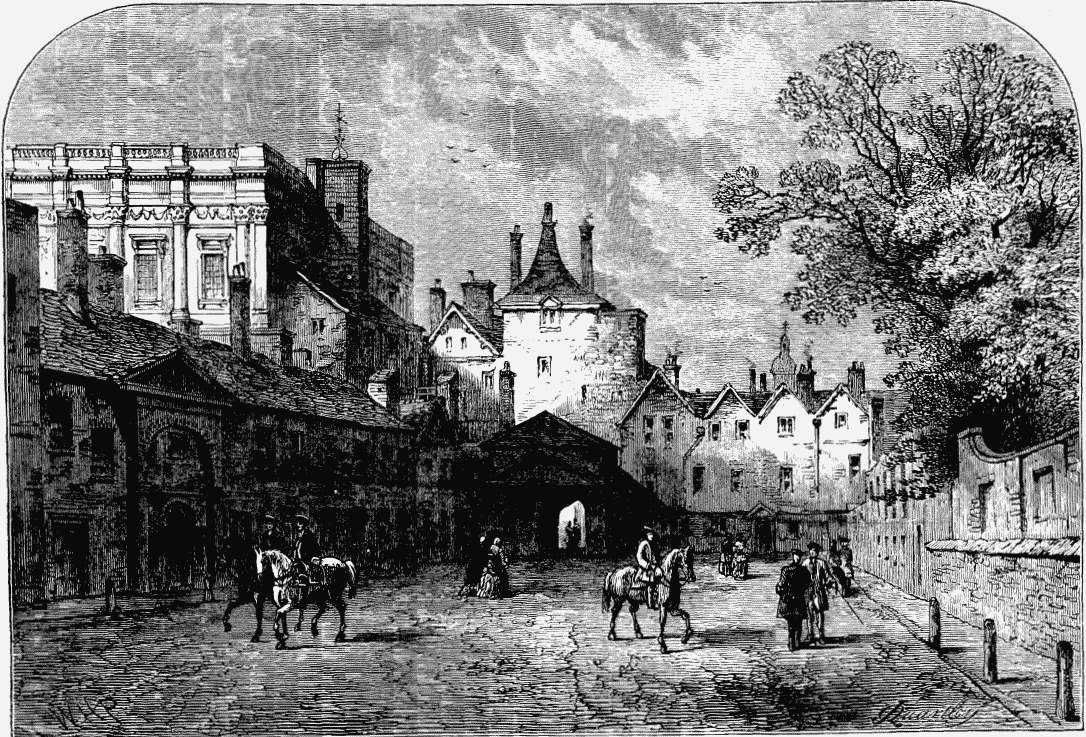
SCOTLAND YARD, ABOUT 1720.
Sir John Vanbrugh, who died in 1726, was celebrated in his day not merely as an architect, but
also as a comic poet and an accomplished man of
letters. He was Comptroller of the Royal Works
and Palaces, and his house between Scotland Yard
and Whitehall, which he built for himself, was remarkable for its tiny dimensions. His friends
called it a "pill-box," and Swift compared it to a
goose-pie. The small size of his own house certainly was a fair object of ridicule when contrasted
with the ponderous dimensions of his palace of
Blenheim, and his other public buildings. The
epitaph on his tomb is witty and well known—
"Lie heavy on him, earth, for he
Laid many a heavy load on thee."
When he was made Clarencieux King-at-Arms Swift
said he might now "build houses." The secret of
this ridicule was that Vanbrugh was a Whig. Sir
Joshua Reynolds has left the following high encomium on his merits as an architect:—"In the
buildings of Vanbrugh, who was a poet as well as
an architect, there is a greater display of imagination than we shall find, perhaps, in any other; and
this is the ground of the effect we feel in many of
his works, notwithstanding the faults with which
many of them are charged. For this purpose Vanbrugh appears to have had recourse to some principles of the Gothic architecture, which, though not
so ancient as the Grecian, is more so to our imagination, with which the artist is more concerned than
with absolute truth. "To speak of Vanbrugh,"
adds Sir Joshua, "in the language of a painter, he
had originality of invention, he understood light
and shadow, and had great skill in composition.
To support his principal object he produced his
second and third groups in masses. He perfectly
understood, in his art, what is the most difficult in
ours, the conduct of the background, by which the
design and invention are set off to the greatest
advantage. What the background is in painting,
in architecture is the real ground on which the
building is erected; and no architect took greater
care that his work should not appear crude and
hard—that is, that it did not abruptly start out of
the ground without expectation or preparation."
"This is a tribute which a painter owes to an architect who composed like a painter, and was defrauded of the due reward of his merit by the wits of his time, who did not understand the principles of composition in poetry better than he, and who knew little or nothing of what he understood perfectly—the general ruling principles of architecture and painting. Vanbrugh's fate was that of the great Perrault. Both were the objects of the petulant sarcasms of factious men of letters, and both have left some of the fairest monuments which to this day decorate their several countries—the façade of the Louvre, Blenheim, and Castle Howard."
It need scarcely be remarked here, in explanation
of the allusion of Sir Joshua Reynolds, that Vanbrugh was almost as celebrated for his comedies as
for his architecture. Rowe thus mentions him:—
"I'm in with Captain Vanbrugh at the present,
A most sweet-mannered gentleman and pleasant;
He writes your comedies, draws schemes and models,
And builds dukes' houses upon very odd hills.
For him, so much I dote on him, that I,
If I was sure to go to heaven, would die."
There was, in 1767–8, at the corner of Scotland Yard, opposite the Admiralty, a large house for which Josiah Wedgwood was in treaty, in order to establish a show-room or gallery of his pottery and porcelain at the West End; but, from some reason or other, the negotiation dropped through.
Here, too, was a celebrated coffee-house named "Well's," as appears from the following advertisement in Salisbury's Flying Post, preserved in the first volume of Malcolm's "Manners and Customs of London:"—"Whereas, six gentlemen (all of the same honourable profession), having been more than ordinarily put to it for a little pocketmoney, did, on the 14th instant, in the evening, near Kentish Town, borrow of two persons (in a coach) a certain sum of money, without staying to give bond for the repayment; and whereas, fancy was taken to the hat, peruke, cravat, sword, and cane of one of the creditors, which were all lent as freely as the money: these are therefore to desire the said six worthies, how fond soever they may be of the other loans, to un-fancy the cane again, and send it to 'Well's' Coffee-house, in Scotland Yard, it being too short for any such proper gentlemen as they are to walk with, and too small for any of their important uses, and, withal, only valuable as having been the gift of a friend."
It was in Scotland Yard that a knight, Sir John Ayres, with the aid of four retainers, in a fit of ungrounded jealousy, waylaid Lord Herbert of Cherbury, whom he attacked with swords and daggers, though he did not succeed in wounding him, as we learn from that noble lord's "Life."
Early in the present century the Palace Court or Marshalsea was held in Scotland Yard. The court had jurisdiction of all civil suits within twelve miles of the palace. The process was short and not expensive, judgment being obtained in three weeks.
In 1829, on the formation of the new police, introduced by Sir Robert Peel to supersede the ancient "Charlies," Scotland Yard was made, as we have said, the principal station of the Metropolitan Force. The area under their jurisdiction (which excludes the City of London proper) extends from Cheshunt in the north to Chipstead in the south, and from Chadwell Heath in the east to Staines in the west. The Metropolitan Police district contains the whole of the county of Middlesex, and the parishes in the counties of Surrey, Hertford, Essex, and Kent of which any part is within twelve miles of Charing Cross, and those also of which any part is not more than fifteen miles in a straight line from Charing Cross, except the City of London and the Liberties. It is also employed in Her Majesty's dockyards and military stations situated beyond the Metropolitan Police district.
In 1874 the Metropolitan Police Force consisted of 9,883 men. Of this number the duties absorbed 38 superintendents, 275 inspectors, 854 sergeants, and 8,089 constables. The proportion of old constables in the Metropolitan Police shows a steady increase, and is a good test of the popularity of the service. In 1864 there were 4,136 men whose service exceeded five years, and in 1874 that number had increased to 5,934; the number of young constables in the year 1864, with an authorised strength of 7,410 men, being very nearly the same as in 1874, when the strength had increased to 9,883. In Scotland Yard there are various other departments besides that connected with the Police Force. Here is the Prisoners' Property Office, and also the office for cab and omnibus licences. If articles are left in a cab they can be applied for at the Police Office in Scotland Yard, whither every cab-driver is bound to take them.
The office for cab licences and regulations, before its removal to Scotland Yard, had been for many years located in Essex Street, in the Strand. We learn from a letter addressed to the Earl of Strafford in 1634, that "The Maypole" in the Strand was the place where the first stand of hackney carriages was established in London; the enterprising gentleman who introduced them to the public was a Captain Bailey—the same, it is supposed, who had served under Raleigh in one of his expeditions to Guiana. The following is an extract from the letter:—"He hath erected, accg to his ability, some four hackney coaches, put his men in livery, and appointed them to stand at 'The Maypole,' in the Strand, giving them instructions at what rates to carry men into several parts of the town, where all day they may be had. Other hackney men seeing this way, they flocked to the same place, and perform their journeys at the same rate, so that sometimes there is twenty of them together, which disperse up and down, so that they and others are to be had everywhere, as watermen are to be had at the waterside. Everybody is much pleased with it, for whereas before coaches could not be had but at great rates, now a man may have one much cheaper." A strange contrast these four hackney coaches of 1634 make to the thousands of hansoms and four-wheeled cabs which now ply for hire in the great metropolis!
The use of hackney coaches was but very trifling in 1626; for among the many monopolies granted by the king was one which gave rise to the use of sedan chairs in London. This grant was made to Sir Sanders Duncombe, who had probably seen them at Sedan, in France, where they were first made; it is expressed in the following terms:—"Whereas the streets of our cities of London and Westminster, and their suburbs, are of late so much encumbered with the unnecessary multitude of coaches that many of our subjects are thereby exposed to great danger, and the necessary use of carts and carriages for provisions thereby much hindered; and Sir Sanders Duncombe's petition, representing that in many parts beyond sea people are much carried in chairs that are covered, whereby few coaches are used among them; wherefore we have granted to him the sole privilege to use, let, or hire a number of the said covered chairs for fourteen years."
This patent was soon followed by a proclamation against hackney coaches, strictly commanding, "That no hackney coach should be used in the City of London, or suburbs thereof, other than by carrying of people to and from their habitations in the country; and that no person should make use of a coach in the City except such persons as could keep four able horses fit for his Majesty's service, which were to be ready when called for under a severe penalty."
That sedan chairs were in use in the East long before they were known in France or in London is clear from the fact that one is introduced in Sir G. Staunton's Embassy to China. And if a classical origin be sought for them, it is on record that Pliny states that his own uncle was accustomed to be carried abroad in a chair.
At the end of the seventeenth, and throughout the greater part of the eighteenth century, the sedan chair was the vehicle almost always employed by "the quality" at the West End in going backwards and forwards between each other's houses, and to Court. Even at the coronation of William III. the peers and peeresses who desire to be present are desired, in the official programme, to come in chairs, carriages and coaches not being allowed on that day to approach the Abbey. At the coronation of George I. and George II. both were allowed.
Hackney coaches, superseding as they did the old "sedans," were, at first, often called "hackney chairs," the word chaise being a sort of equivalent for a "chair," and also for a "carriage." Thus, in his "Book for a Rainy Day," Mr. Smith remarks that in 1766 "hackney chairs were so numerous that their stands extended round Covent Garden, and often down the adjacent streets." Not only was the sedan chair one of the necessary social appliances of the London people in the early part of the present century, but the same may be said of the good old lumbering hackney coach. This genteel vehicle, in the natural order of events, like the heavy stagecoaches, has long ago become a thing of history. It is a sorry thing to reflect upon how the cherished objects of our youth pass away, and are superseded by modern inventions, to be in their turn associated with notions of antiquity in the minds of a generation of beings having new ideas and new habits.
Apropos of cabs and the police—or, rather, parliamentary regulations for the suppression of drunkenness—we may be pardoned for giving the following curious piece of information relating to the "Jarveys" of old, for which we are indebted to Walker's "Original:"—"I will add one more instance of change. A retired hackney-coachman, giving an account of his life to a friend of mine, stated that his principal gains had been derived from cruising at late hours in particular quarters of the town to pick up drunken gentlemen. If they were able to tell their address, he conveyed them straight home; if not, he carried them to certain taverns, where the custom was to secure their property and put them to bed. In the morning he called to take them home, and was generally handsomely rewarded. He said there were other gentlemen who pursued the same course, and they all considered it their policy to be strictly honest. The same calling is said to have been pursued for many years in Paris. The tariff for taking the drunkard home is—or was—ten sous; and his conductor was known as L'Ange Gardien."
Instead of a few dozens of chairs and hackney coaches, the people of London, writes Mr. Diprose, in his "Book about London," "are now daily whisked about the town in upwards of three thousand cabs and twelve hundred omnibuses, besides a fleet of river steamers. These conveyances annually carry more passengers than three times the number of the whole population of the United Kingdom."
Hard by the north side of Scotland Yard, in a blind alley called Craig's Court, opening out of Charing Cross and backing upon what was once the western side of the garden of Northumberland House, is Harrington House, a dull, heavy, and gloomy mansion, belonging to the Earls of Harrington. Here, too, is the establishment of Messrs. Cox and Co., the great army agents; whilst close by, as nearly as possible on the site of what is now Mr. Wyld's map repository, stood the "Northumberland" Coffee-house, one of Sheridan's favourite haunts at the beginning of the present century.
Between Scotland Yard and the river-side in the rear was "Man's," or as it was sometimes styled, "Old Man's" Coffee-house; and another, possibly a rival one, known as "Young Man's." The former is said by Mr. Peter Cunningham to have been so called after the first keeper—one Alexander Man—and to have dated from the reign of Charles II. Defoe, in his "Journey through England," mentions them among the lesser though favourite coffee-houses of the day. "The Scots," he writes, "go generally to the 'British,' and a mixture of all sorts to the 'Smyrna.' There are also other little coffee-houses much frequented in this neighbourhood—'Young Man's' for officers; 'Old Man's' for stock-jobbers, paymasters, and courtiers; and 'Little Man's' for sharpers."
Whitehall Place, which we cross on our way to Middle Scotland Yard, was formed about the year 1820. It is a broad thoroughfare now connecting the Embankment with Whitehall, opposite the Admiralty. Here several of the houses are used as Government offices—such as those of the Woods, Forests, and Land Revenues; the Ecclesiastical Commissioners for England, and Church Estates Commissioners; Parks, Palaces, and Public Buildings; and Commissioners in Lunacy. No. 4 is one of the offices of the Metropolitan Police, of whom we have already spoken. Here, too, are the offices of the Habitual Criminals' Registers and Receivers. The house No. 15, adjoining the entrance to Middle Scotland Yard, was for many years occupied by the Royal Geographical Society, whose rooms are now in Savile Row.
A portion of Middle Scotland Yard is occupied by the United Service Museum, the entrance to which is in Whitehall Yard. This institution was founded in 1831, and contains a splendid collection of arms and accoutrements, and models illustrative of the naval architecture of various nations. Two of the models are particularly worthy of notice—that of "The Field and Battle of Waterloo," by Captain Siborne; and "The South of the Crimea and Siege of Sebastopol," by Colonel Hamilton. A smaller model, but one of equal interest to the above, gives the visitor a clear idea of Nelson's last and greatest victory, the battle of Trafalgar. There is also a Chinese cabinet, and a variety of naval and military curiosities. Here the curious visitor may see, among the articles exhibited, the jaws of a shark enclosing a tin box. The history of this tin box is thus told by Mr. John Timbs:—"A ship on her way to the West Indies fell in with and chased a suspicious-looking craft, which had all the appearance of a slaver. During the pursuit the chased vessel threw something overboard. She was subsequently captured, and taken into Port Royal to be tried as a slaver. In absence of the ship's papers and other proofs, the slaver was not only in a fair way to escape condemnation, but her captain was anticipating the recovery of pecuniary damages against his captor for illegal detention. While the subject was under discussion, a vessel came into port which had followed closely in the track in the chase above described. She had caught a shark; and in its stomach was found a tin box, which contained the slaver's papers. Upon the strength of this evidence the slaver was condemned. The written account is attached to the box." There is here also an extensive and valuable collection of natural history, particularly of insects and reptiles; the animals, which are in good preservation, are chiefly from tropical climates. The mineralogical cabinet, which consists of many thousand species, is very valuable. There is also a collection of Grecian and Roman vases and coins, and general antiquities. In the armoury chamber are many remarkable relics, which associate us with the great and perilous events in the history of our own and other countries. From the savage's war-dress of skin and feathers to the latest improvement in armourplated vessels—from clubs and bows and arrows to the Gatling gun, the development of war material may be traced through almost every stage. Of the Gatling gun, by the way, there is here an actual specimen—not a model—having ten barrels and a range of 1,000 yards, capable of pouring out a torrent of bullets at the rate of seventy a minute by the mere turning of a handle, after the fashion of a barrel-organ. This will be found in an inner room of the institution, the first section of which comprises a vast accumulation of the implements of savage warfare. One interesting relic of a bygone system of naval warfare may be discovered in a piece of clockwork, which formed part of the paraphernalia of an old-fashioned fire-ship. This mechanism was so contrived that at the end of a given time it would set fire to the vessel as it bore down to the enemy. Another means of accomplishing a somewhat similar result, though without any reference to the enemy, is shown in the nest of a family of rats discovered on board the Revenge. These frugal creatures had laid by a store of matches, which ignited and set fire to the nest, the burnt remnant of which shows what a very narrow escape the vessel had from destruction. The gradual development of the lifeboat into its present form is shown in a very interesting series of models running back to a very primitive type, and an old suggestion for lessening the danger of the Goodwin Sands is embodied in the model of a floating refuge. Here, too, are kept the sad relics of the unfortunate expedition to the Arctic regions, conducted by Sir John Franklin, and discovered by Sir Leopold M'Clintock, of H.M.S. Fox, in 1859.
The United Service Institution was established as a central repository for objects of professional art, science, and natural history, and for books and documents relative to those studies, or of general information. The annual subscription is ten shillings, and the sum of six pounds constitutes a member for life. The Museum consists of a commodious suite of rooms, and a library on the ground-floor. Admission free is afforded to soldiers and sailors in uniform, and to the general public by a member's order. Lectures are delivered, and papers read on naval and military subjects, at frequent intervals, by officers and professional men; to these lectures members have the privilege of introducing two friends (ladies or gentlemen) either personally or by ticket.
At No. 3 in Whitehall Yard (now demolished) was the office of the Comptroller-General of the Exchequer, where was formerly held "The Trial of the Pyx," a ceremony of late years performed at the hall of the Goldsmiths' Company, as described in page 357 of the first volume of this work. At No. 6 is the office of the Army Medical Board.
In the course of the last century the greater part of what had been the "Private" or "Privy" Gardens of Whitehall Palace became gradually covered by the houses of favoured nobles, who obtained leases from the Crown at easy rents. "Among the first of these," says Pennant, "on the site of the small-beer cellar [of which a view is preserved in No. 4 of Hollar's prints of Whitehall], is the house of the Earl of Fife." Scotch to the backbone, the noble earl who built it was resolved, it would appear, that even when in London he would never tread on other than Scottish soil; and, therefore, when he embanked the river to form a terrace commanding the water, he ordered that all the gravel necessary to form it should be brought up from his native Fifeshire. Fife House in the last century was rich in curious relics of the past, and must have been well worth a visit. Lord Fife used to show with pride a collection of Gobelin tapestry, which he had brought from Paris, and a small but select gallery of paintings, including a portrait of Charles I. when Prince of Wales, which was painted by Velasquez at Madrid. In one of the walls of this house was an archway of the Tudor style which had a direct communication with the Palace or Privy Stairs at Whitehall.
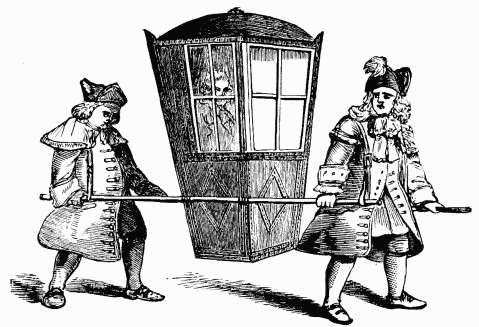
A SEDAN CHAIR.
Fife House was for some years occupied by the Earl of Liverpool during his premiership; and it was within its walls that he breathed his last, in the month of December, 1828. The house was pulled down about the year 1862, to make room for improvements. It had for a few years been used as the receptacle of the collection forming the East India Museum, which was removed hither on the demolition of the East India House in Leadenhall street. The contents of this Museum were afterwards removed to the new India Office in Charles Street. Here, close by, in 1835, lived the Right Honourable James Abercromby, before he became Speaker of the House of Commons; the last Lord Liverpool at the same time occupying Fife House, where his half-brother, the Premier, had died some seven years before.

COACHES: REIGN OF QUEEN ANNE.
Leading from the palace down to the river were two pairs of stairs—the one public, the other known as the "privy" stairs, for the use of the Court. The first was still in use in Pennant's time; "the other," says that writer, "is made up in the old wall adjacent to the house of the Earl of Fife, where the arch of the portal remains entire." Henry and his daughter Elizabeth, as we know, made by water such of their journeys and progresses as they did not make on horseback, though on some occasions they went mounted on a litter carried on men's shoulders. "Coaches," says Pennant, "had been introduced into England by Henry Fitzalan, Earl of Arundel, one of Elizabeth's admirers, but the spirited princess seems to have disdained their use. The author of "An Estimate of the Manners of the Times," published in 1758, asks, with reference to the Sedan chairs, of which we have spoken above, "How would he have been laughed at in the days of Elizabeth, when a great queen rode on horseback to St. Paul's, who should have foretold that in less than two centuries no man of fashion would cross the street at the westend to dinner, without the effeminate covering and conveyance of an easy chair?"
The last occasion on which Her Majesty went by state upon the Thames was in 1849, when she opened the new Coal Exchange in the City. On that occasion she embarked and landed on her return at Whitehall Stairs, as her proud predecessor Elizabeth had often landed before her. Since that year we believe that the royal barge has been allowed to slumber in its dry-dock, and the royal bargemaster and watermen have enjoyed a sinecure.