
Old and New London: Volume 3. Originally published by Cassell, Petter & Galpin, London, 1878.
This free content was digitised by double rekeying. All rights reserved.
'Whitehall: Historical remarks (continued)', in Old and New London: Volume 3, (London, 1878) pp. 369-375. British History Online https://www.british-history.ac.uk/old-new-london/vol3/pp369-375 [accessed 26 April 2024]
In this section
CHAPTER XLVI.
WHITEHALL, AND ITS HISTORICAL REMINISCENCES (continued).
"Non isto vivitur illic
Quo tu rere modo."—Horace.
Whitehall forsaken as a Royal Residence—Partial Restoration of the Palace—The Cock-pit—Cromwell and Sir Roger L'Estrange—Death of Oliver Cromwell—The Ultimate Fate of Cromwell's Body—The Exhumation discussed—Curious Record in an Old Parish Register—George Monk at the Cock-pit—Fashionable Life under the Stuarts—Cock-fighting—Defoe's Account—Its Prevalence in England.
In the "New View of London," published in 1708, we read, "This Palace being in the beginning of January, 1697, demolished by fire, except the Banqueting House and the Holbein Gateway, there has since been no reception of the Court in town but St. James's Palace, … and Whitehall will doubtless be rebuilt in a short time, being designed one of the most famous palaces in Christendom." It was not rebuilt, however; and gradually the royal family removed from Whitehall to St. James's Palace, which thenceforward became known as the head-quarters of the English Court.
On page 355 there will be found a copy of a curious outline print giving a bird's-eye view of Whitehall Palace as it appeared after the fire of 1697. In this engraving a sort of lawn, divided into four parterres, projects into the river; while modern mansions of the classical style have taken the place of the old low semi-Gothic houses which previously figured in the foreground.
It is true that after the Restoration Charles II. had made a partial "restoration" at Whitehall. Horace Walpole, in his "Anecdotes of Painting," mentions, as a mark of Charles's taste, that he erected at Whitehall five curious sun-dials. He also collected again a considerable part of the treasures which had been dissipated, and added suites of apartments for the use of his abandoned favourites. James II., too, was occupying Whitehall at the time of the unexpected invasion by the Dutch. He is reported to have caused the weather-vane, which still remains, to be erected on the roof of the palace, in order that he might judge whether or not the elements were favourable to his enemies.
Whitehall Palace, nevertheless, only now exists as a fragment. "The present Banqueting House is, indeed," says Mr. Edward M. Barry, "not onefortieth part of the original design. Had the latter been carried out, the question of our public offices would probably have been settled for ever, and a modern prime minister would not have had the opportunity of forcing his taste on a reluctant architect."
There were two "cock-pits" in the neighbourhood of this palace; the one on the site of the present Privy Council Office, and the other near the junction of Queen Street and Dartmouth Street with Birdcage Walk. The two are often confounded together, but the former is the one most frequently mentioned in history in connection with distinguished persons. Philip Herbert, Earl of Pembroke, one of two brothers to whom Shakespeare's Works were dedicated, held the Cock-pit apartments at Whitehall under the Crown, and from a window of his apartment saw his sovereign, Charles I., walk from St. James's to the scaffold. At his death in January, 1649–50, Oliver Cromwell took possession of the rooms, and here, as Mr. Peter Cunningham tells us, he addressed his letter to his aged mother, Elizabeth Bourchier, giving an account of the battle of Dunbar. Here he was waited upon by a deputation from the Parliament, desiring him to "magnify himself with the title of king;" and here Milton and Andrew Marvell, his secretaries, and Waller and Dryden, were his frequent guests. Though averse, by principle, to dramatic entertainments, Oliver Cromwell liked the organ, and took John Hingston, the organist of Charles I., into his own employ. He used often to summon him to play before him at the Cock-pit in Whitehall, near which he resided. Hingston, it appears, used to have concerts at his own house, at which Cromwell would often be present. In one of these musical entertainments Sir Roger L'Estrange happened to be a performer. As he did not leave the room when the Protector entered, his cavalier friends gave him the name of "Oliver's Fiddler," and the name was so serious an annoyance to him after the Restoration, that in 1662 he published a pamphlet, entitled "Truth and Loyalty Vindicated," in which he clears himself from the charge of Republican tendencies, and relates the affair just as it happened:—"Concerning the story of the fiddle, this, I suppose, might be the rise of it. Being in St. James's Park I heard an organ touched in a little low room of one Mr. Hingston: I went in, and found a private company of five or six persons; they desired me to take a viole and bear a part. I did so, and that a part too not much to advance the reputation of my cunning. By-and-by, without the least colour of a design or expectation, in came Cromwell. He found us playing, and, as I remember, so he left us."
The great "Lord Protector" died at Whitehall on the 3rd of September, 1658, after a protracted illness, and amidst the raging of a terrific storm. During his last illness Cromwell became so depressed and debilitated that he would allow no barber to come near him; and his beard, instead of being cut in a certain fashion, grew all over his face. After his death the body lay in state at Somerset House, having been carefully embalmed, and was afterwards buried with more than regal honours in Henry VII.'s Chapel in Westminster Abbey. John Evelyn, in his "Diary," under date of October 2nd, tells us how that he "saw the superb funerall of the Lord Protector. He was carried from Somerset House in a velvet bed of State drawn by six horses, houss'd by the same; the pall held up by his new lords; Oliver lying in effigie in royal robes, and crown'd with a crown, sceptre, and globe, like a king. The pendants and guidions were carried by the officers of the army; and the imperial banner, acheivement, &c., by the heraulds in their coates; a rich compareason'd horse, embroider'd all over with gold; a knight of honor arm'd cap-a-pie, and after all, his guards, soldiers, and inumerable mourners. In this equipage they proceeded to Westminster; but it was the joyfullest funeral I ever saw, for there were none that cried but dogs, which the soldiers hooted away with a barbarous noise, drinking and taking tobacco in the streets as they went."
The ultimate fate of Cromwell's body has at different periods given rise to much controversy from the Restoration down to the present time. It is asserted that after the Restoration it was taken out of his grave, together with the bodies of Ireton (Cromwell's son-in-law) and Bradshaw; the latter, as President of the High Court of Justice, having pronounced sentence of death on Charles I. The three bodies are then said to have been taken in carts to the "Red Lion," in Holborn, and on the 30th of January, the anniversary of King Charles's death, to have been removed on sledges to Tyburn, where they were hanged until sunset, and then taken down and beheaded, their bodies buried in a deep pit under the gallows, and their heads stuck upon the top of Westminster Hall, where at that time sentinels walked.
A strong corroboration of the main incidents of this story is to be found in the "Fifty Years' Recollections, Literary and Personal," of the late Mr. Cyrus Redding, and resting on the authority of Horace Smith, one of the authors of "Rejected Addresses," &c. Redding writes under date about 1821 or 1822:—"Horace Smith was acquainted with a medical gentleman who had in his possession the head of Oliver Cromwell, and in order to gratify my curiosity he gave me a note (of introduction) to him. There accompanied the head a memorandum relating to its history. It had been torn from the tomb with the heads of Ireton and Bradshaw after the accession of Charles II., under a feeling of impotent vengeance. All three were fixed over the entrance of Westminster Hall, the other bones of those three distinguished men being interred at Tyburn under the gibbet—an act well befitting the Stuart character. During a stormy night," he adds, "the head in the centre, that of Cromwell, fell to the ground. The sentry on guard beneath having a natural respect for an heroic soldier, no matter of what party, took up the head and placed it under his cloak until he went off duty. He then carried it to the Russells, who were the nearest relations of Cromwell's family, and disposed of it to them. It belonged to a lady, a descendant of the Cromwells, who did not like to keep it in her house. There was a written minute extant along with it. The disappearance of the head (off Westminster Hall) is mentioned in some of the publications of the time. It had been carefully embalmed, as Cromwell's body is known to have been two years before its disinterment. The nostrils were filled with a substance like cotton. The brain had been extracted by dividing the scalp. The membranes within were perfect, but dried up and looked like parchment. The decapitation had evidently been performed after death, as the state of the flesh over the vertebræ of the neck plainly showed. It was hacked, and the severance had evidently been done by a hand not used to the work, for there were several other cuts beside that which actually separated the bone. The beard, of a chestnut colour, seemed to have grown after death. An ashen pole, pointed with iron, had received the head clumsily impaled upon its point, which came out an inch or so above the crown, rusty and time-worn. The wood of the staff and the skin itself had been perforated by the common wood-worm. I wrote to Horace Smith that I had seen the head, and deemed it genuine. Smith replied, 'I am gratified that you were pleased with Cromwell's head, as I was when I saw it, being fully persuaded of its identity.'" It remains, then, on record that two persons, both men of the world and of large experience, and yet so different from each other in character as Horace Smith and Cyrus Redding, were satisfied with the evidence brought before them to prove its being genuine nearly fifty years ago.
In Notes and Queries, September, 1874, p. 205, we read that "Cromwell's body was dug up, his head put on a pike and exposed, and, after passing through several hands, was offered for sale to one of the Russells, who was a lineal descendant of Oliver Cromwell through his daughter, Lady Rich."
According to some authorities, the remains were privately conveyed from Whitehall and interred next to those of Mrs. Claypole, Oliver Cromwell's favourite daughter, in Northamptonshire, in accordance with his own wish, the funeral in Westminster Abbey being a mock ceremonial. According to others, the remains were conveyed to the field of Naseby, and interred at midnight in the very spot where he made his last victorious charge, the field being afterwards ploughed over that his enemies might not discover the spot. Another account, indorsed by Heath, the author of the "Flagellum"—who, by the way, contradicts himself, as he afterwards goes on to describe the exhumation in the abbey and the subsequent gibbeting—is that as the body was decomposed and corrupt to such an extent that it was impossible either to embalm or publicly bury it, it was encased in lead and flung into the Thames at midnight. Oldmixon adds that it was thrown into "the deepest part of the Thames." To say nothing of the intrinsic improbability of these accounts, of the fact that neither Cromwell nor his friends were likely to anticipate any indignity being offered to his remains, of the difficulty of secretly conveying the corpse either to Northamptonshire or to Naseby, of the physical impossibility of decomposition necessitating a hurried burial in the Thames—though this is certainly the best authenticated theory—there is, as we shall see, every reason to believe that he was actually interred near his mother and his daughter in the Abbey. First, there is the fact that none of the leading men of the day had any suspicion that the funeral procession, of which we have many elaborate accounts, was a mock ceremonial. Secondly, Cromwell would naturally desire to lie with his mother and daughter in the national mausoleum among those whom he must have looked on as his royal predecessors. Thirdly, Noble, a trustworthy and sensible historian, distinctly says, in his memoirs of the "Protectorate House of Cromwell," that the body was deposited in Westminster Abbey, under a magnificent hearse of wax, on the spot subsequently occupied by the tomb of the Duke of Buckingham, adding that at the Restoration "they found in a vault at the east end of the middle aisle a magnificent coffin which contained the body of the late Protector, upon whose breast was a copper plate double gilt, which upon one side had the arms of the Commonwealth impaling those of the deceased." Of this Noble gives a fac-simile. He then goes on to say that he saw the receipt of the money paid to one John Lewis, a mason, for exhuming the bodies of Cromwell, Ireton, and Bradshaw. This account is corroborated by the following passage in a work entitled "Oliver Cromwell and his Times," by Thomas Cromwell:—"When the coffin of Cromwell was broken into, a leaden canister was found lying on his breast, and within it a copper gilt plate with the arms of England impaling those of Cromwell," &c. "This copper plate is or was," says a writer in the Gentleman's Magazine for 1867, "in the possession of the Marquis of Ripon. There can be little doubt, therefore," he adds, "that the body of Cromwell was, after his death, veritably interred in the Abbey. It is perfectly certain, moreover, that after the exhumation it was conveyed to Red Lion Square. Noble tells us that the body lay at the Red Lion from Saturday, January 26, 1660, to the Monday following; and the question is, did it ever leave the Red Lion? It is quite conceivable that Cromwell's partisans bribed the officers who were placed to watch the body, and, like the Ephesian matron in Petronius, substituted another body in its place." On the opposite side, however, we have the testimony of those who actually inspected Cromwell's head on the spikes. "Saw the heads of Cromwell, Bradshaw, and Ireton set up at the further end of the hall" (Westminster), writes Pepys; and in the diary of a M. Sainthill, a Spanish ambassador of the time, quoted in Notes and Queries, series 3, vol. iii., we find the following entry: "The odious carcases of Oliver Cromwell, Ireton, and Bradshawe were drawn on sledges to Tyburn, where they were hanged by the neck from the morning until four in the afternoon."
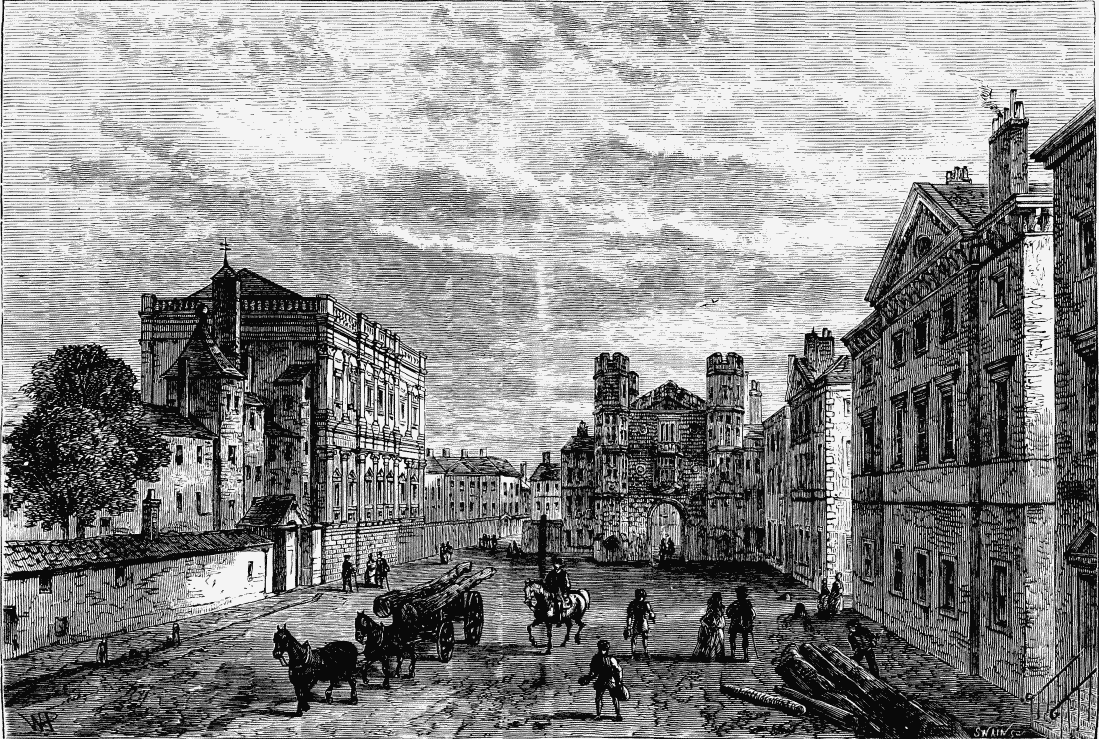
WHITEHALL, LOOKING TOWARDS THE HOLBEIN GATEWAY. (From a View by Maurer, 1753.)

WHITEHALL GARDENS.
With reference to the above subject, it may be added that in the register-book of the parish of Deddington, in Oxfordshire, there is the following somewhat singular entry:—"His Majesty Charles II. came into London 29 day of May, 1660, which was 12 year of his raign, which was brought in without bloodshed, and his father was put to death the 30th January, 1648, by the tyrannical power of Oliver Cromwell, who died September 3d, 1658, and was taken up after he had been buried two years and above, and was hanged at Tiborne, and his head was sett up at Westminster; his body was buried underneath the Tyborne, 1661: which Oliver did governe for some years in England."
It may be remembered that in 1653 Cromwell returned from Westminster to Whitehall, with the keys of the House of Commons in his pocket, after having dissolved the "Long" Parliament, as he subsequently explained to the "Barebones" Parliament assembled in the Council Chamber here.
George Monk, Duke of Albemarle, was the next tenant of the Cock-pit at Whitehall, shortly before the Restoration. These apartments were confirmed to the Duke by Charles II., and he died here in 1670. We have already given our readers a good deal of information respecting the private relations of the Duke in our account of the Strand. Then came to reside here George Villiers, Duke of Buckingham, who died in 1687. After the disastrous fire in Whitehall, in 1697, the Cock-pit was converted into offices for the Privy Council; and in 1710, in the Council Chamber, Guiscard assassinated that noble collector of books and patron of men of letters—Robert Harley, Earl of Oxford. The Cock-pit retained its original name long after the change of its use, for the minutes of the Lords Commissioners of His Majesty's Treasury were dated from the "Cockpit at Whitehall," as late as the year 1780, if not later. The "Picture of London" (1810) refers to the Council Chamber as "commonly called the Cock-pit."
Here is a graphic description of Court life at Whitehall in the gay days of our Stuart kings:—"Hyde Park, in the reign of the second Charles," wrote Grace and Philip Wharton in their "Queens of Society," "was only a country drive, a field, in fact, belonging to a publican. Sometimes the Princess Anne might be seen driving there … in her coach, panelled only, and without glass windows—a luxury introduced by Charles II. There they encountered Lady Castlemaine and Miss Stuart, whose quarrel as to which should first use the famous coach presented by Grammont to the King was the theme of Whitehall. Some times from the groves and alleys of Spring Gardens they emerged perhaps into the broad walks of St. James's Park, between the alleys of which the gay and tilted resorted to cafés, such as those permitted in the gardens of the Tuileries. Sometimes again the Princess Anne, accompanied by the haughty Freeman (Sarah, Duchess of Marlborough) in her hood and mantle, descended White Hall Stairs and took her pleasure in her barge on the then fresh and pure waters of the Thames, beyond which were green fields and shady trees. These were all inexpensive pleasures; and both 'Mrs. Freeman' and 'Mrs. Morley' (the Princess Anne) were economical. The Princess's allowance from the Privy Purse was small, and Lord Churchill's means were moderate. More frequently, however, the two friends sat in the Princess's boudoir, then termed her 'closet,' and in that sanctum discussed passing events with bitterness—the dramatic close of the days of Charles II., who begged pardon of his surrounding courtiers for 'being so long a dying;' the accession and unpopularity of his brother James, and afterwards the event which roused even Anne from her apathy and made her malicious—the birth of the Prince whom we southrons call the Pretender."
Some account of the "diversion" carried on at the Cock-pit in former times, and of cock-fighting in general, may not be out of place here. Fitzstephen, who wrote the life of Archbishop Becket, in the reign of Henry II., is the first of our writers that mentions cock-fighting, describing it as the sport of school-boys on Shrove Tuesday. The Cock-pit, it appears, was the school, and the master was the comptroller and director of the sport. From this time, at least, the diversion, however absurd and even impious, was continued among us. It was followed, though disapproved and prohibited, in the 39th year of Edward III.; also in the reigns of Henry VIII. and Queen Elizabeth. It has been by some called a royal diversion, and, as every one knows, the Cock-pit at Whitehall was erected by a crowned head, for the more magnificent celebration of the sport. It was prohibited, however, by one of the Acts of Oliver Cromwell, March 31, 1654.
British cocks are mentioned by Cæsar; but the first actual notice of cock-fighting, as an established sport of the Londoners, occurs in Fitzstephen, who traces it back to the reign of Henry II. From Edward III. down to the days of the Regency—when the late Lord Lonsdale treated the allied sovereigns in 1814 to an exhibition of it—and, perhaps, we may say even to our own time, it has been a fashionable amusement with a certain set of individuals. Henry VIII., as everybody knows, added a cock-pit to his new palace at Whitehall; and even the learned pedant, James I., if we are correctly informed, used to go to witness the sport twice a week.
"A cock-fight," says Defoe, in his "Journey through England" (1724), "is the very model of an amphitheatre of the ancients. The cocks fight here in the area, as the beasts did formerly among the Romans, and round the circle above sit the spectators in their several rows. It is wonderful to see the courage of these little creatures, who always hold fighting on till one of them drops, and dies on the spot. I was at several of these matches, and never saw a cock run away. However, I must own it to be a remnant of the barbarous customs of this island, and too cruel for my entertainment. There is always a continued noise among the spectators in laying wagers upon every blow each cock gives, who, by the way, I must tell you, wear steel spurs (called gaffles) for their surer execution. And this noise runs, fluctuating backwards and forwards, during each battle, which is a great amusement, and I believe abundance of people get money by taking and laying odds on each stroke, and find their account at the end of the battle, but these are people that must nicely understand it. If an Italian, a German, or a Frenchman should by chance come into these cock-pits, without knowing beforehand what is meant by this clamour, he would certainly conclude the assembly to be all mad, by their continued outcries of 'six to four, ten pounds to a crown,' which is always repeated here, and with great earnestness, every spectator taking part with his favourite cock, as if it were a party cause."
That cock-fighting was the original appropriation of the pit of our theatres has been supposed by some who support their view by such quotations as the following:—
"Let but Beatrice
And Benedict be seen: Lo! in a trice,
The cockpit, galleries, boxes, all are full."
In the Gentleman's Journal, 1692, is given an English epigram, "On a Cock at Rochester," by Sir Charles Sedley, wherein the following lines, which imply, as it would seem, as if the cock had suffered this annual barbarity by way of punishment for St. Peter's crime:—
"May'st thou be punished for St. Peter's crime,
And on Shrove Tuesday perish in thy prime."
Cock-fighting, it would appear, was peculiarly an English amusement in the seventeenth and eighteenth centuries. The characteristics of this brutal sport may be gathered from the remark of a contemporary writer, who, addressing a friend in Paris, tells him that it is worth while to come to England, if it be only to see an election and a cock-pit match. "There is a celestial spirit of anarchy and confusion in these two scenes that words cannot paint."
"Cocks of the game are yet cherished," says Stow, "by divers men for their pleasure, much money being laid on their heads, when they fight in pits, whereof some be costly made for that purpose."
It remains only to add that there were in the seventeenth century, in London and its suburbs, a variety of places where the sport of cock-fighting was practised: the best known were the Royal Cock-pit, in the Birdcage Walk; one in Bainbridge Street, St. Giles'; one "near Gray's Inn Lane;" one in "Pickled-egg Walk;" at the New Vauxhall Gardens, in St. George's-in-the-East, and in Old Gravel Lane, over Blackfriars Bridge. Cock-pits, therefore, in the good old Stuart times, must have been pretty evenly distributed among all classes of the community. The Royal Cock-pit, it will be remembered, afforded to Hogarth characters for what has been epigrammatically and wittily termed "one of his worst subjects, though best plates."
We have said that very little, indeed nothing, of old Whitehall remains. From the twenty-fifth volume of the "Archæologia" we learn that the last portion of it, an embattled doorway of the Tudor date and style, was removed in 1847. Fifteen years or so previously a stone apartment with a groined roof, no doubt a portion of the old palace, was discovered by Mr. Sidney Smirke, F.S.A., in the basement of Cromwell House, in Whitehall Yard; and it seems probable, on referring to Fisher's plan (of which we have given a copy on p. 343), that it formed part of the winecellar. Its identity was established by a doorway, bearing in its spandrils the arms of Wolsey and of the see of York.