Old and New London: Volume 3. Originally published by Cassell, Petter & Galpin, London, 1878.
This free content was digitised by double rekeying. Public Domain.
Walter Thornbury, 'Westminster Abbey: The church building ', in Old and New London: Volume 3(London, 1878), British History Online https://www.british-history.ac.uk/old-new-london/vol3/pp411-431 [accessed 1 May 2025].
Walter Thornbury, 'Westminster Abbey: The church building ', in Old and New London: Volume 3(London, 1878), British History Online, accessed May 1, 2025, https://www.british-history.ac.uk/old-new-london/vol3/pp411-431.
Walter Thornbury. "Westminster Abbey: The church building ". Old and New London: Volume 3. (London, 1878), British History Online. Web. 1 May 2025. https://www.british-history.ac.uk/old-new-london/vol3/pp411-431.
In this section
CHAPTER LI.
WESTMINSTER ABBEY.—A SURVEY OF THE BUILDING.
"How reverend is the face of all this pile,
Whose ancient pillars rear their marble heads
To bear aloft its arch'd and ponderous roof;
By its own weight made steadfast and immovable,
Looking tranquillity. It strikes an awe
And terror on my waking sight: the tombs
And monumental caves of death look cold."—Wordsworth.
Extent of the Abbey Possessions—Exterior Views of the Church—Dimensions of the Building—The West Front and Wren's Gothic Towers—The North Transept and "Solomon's Porch"—The Chapels—General Description of the South Side—Appearance of the Interior from the West Doorway—Churchill's Satirical Poem on the Tombs and Monuments—Pitt's Funeral—The Burial of Charles J. Fox, and his Monument—Vice-Admiral Tyrrell—Congreve, the Dramatist—Mrs. Oldfield—Secretary Craggs—The Poet Wordsworth—Robert Stephenson—Sir Charles Barry—George Peabody—David Livingstone—Sir C. Lyell—Sunday Evening Services.
Other cathedrals may surpass the Abbey of St. Peter's, Westminster, by the grandeur of their architecture; yet its situation and the varied character of its parts, and its completeness as a whole—combined with its national character as the place where our monarchs have been crowned, and where so many of them are buried, surrounded by the statesmen, courtiers, ecclesiastics, poets, and other illustrious persons of five centuries—make it a type of the British Constitution—the union of the Monarchy, the Church, and the State. The first subjects of the Crown interred here—except the members of the monastery itself—were the officers of Edward the Confessor, "thus," as Dean Stanley has touchingly observed, "reunited with him whom they had served in life." The custom was adopted, and the numbers greatly increased in subsequent reigns; and in the time of Elizabeth, the Abbey had become the place of sepulture of the most eminent persons in the empire—"the first-fruits of England's political, naval, and military glory."
Although the charge of the Abbey had been originally committed to a "college of priests," the fact that it contains the remains and memorials of persons of such varied professions, and of so many shades of political and religious opinion—the juxtaposition, as it were, of rivals in life, such as Queen Elizabeth and Mary Queen of Scots, Pitt and Fox, and others—prove that its keepers have in most cases risen to the greatness of their position, and have not been wholly influenced by a sectarian spirit of exclusiveness. Side by side with our sovereigns, Westminster Abbey enshrines the remains of politicians, warriors, judges, actors, philanthropists, physicians, until it has passed into a proverb. "Victory, or Westminster Abbey!" Nelson is reported to have exclaimed, when leading his ship into action, at Trafalgar; though, as a matter of fact, he missed the latter alternative, being buried, as we have seen, in St. Paul's.
As St. Paul's has become the Pantheon for the reception of our naval and military heroes, so the Abbey has gradually become the last resting-place of those who have fought the battle of life in another way—the men who have added renown to their country as statesmen and as men of letters. There are, of course, a few exceptions, for do not Sir Christopher Wren, and Sir Joshua Reynolds, and Cockerell, and Turner, and Landseer lie in St. Paul's? whilst the Abbey covers the ashes of Lords Howe and Ligonier, Admiral Sir Peter Warren, Admiral Sir Cloudesley Shovel, Lieutenant-General Sir Eyre Coote, Vice-Admiral Sir Henry Blackwood, General Lawrence, and others in both branches of the service.
"The Abbey Church," says Mr. Bardwell, the architect, "formerly arose a magnificent apex to a royal palace, surrounded by its own greater and lesser sanctuaries and almonries; its bell-towers (the principal one 72 feet 6 inches square, with walls 20 feet thick), chapels, prisons, gatehouses, boundary-walls, and a train of other buildings, of which we can at the present day scarcely form an idea. In addition to all the land around it, extending from the Thames to Oxford Street, and from Vauxhall Bridge Road to the church of St. Mary-le-Strand, the Abbey possessed 97 towns and villages, 17 hamlets, and 216 manors. Its officers fed hundreds of persons daily, and one of its priests (not the abbot) entertained at his 'pavilion in Tothill,' the king and queen, with so large a party, that seven hundred dishes did not suffice for the first table; and even the Abbey butler, in the reign of Edward III., rebuilt at his own expense the stately gatehouse which gave entrance to Tothill Street."
With the exception of the Chapter House, the Jerusalem Chamber, the cloisters, and one or two fragments of buildings on the southern side, the Abbey Church is now all that remains of the ancient monastic edifice. The general aspect of this structure is grand in the extreme—perhaps not to be surpassed by any Gothic edifice in the kingdom; whilst in its details it presents a rich field of beautiful variety, almost every period of Gothic architecture being illustrated in one part or other.
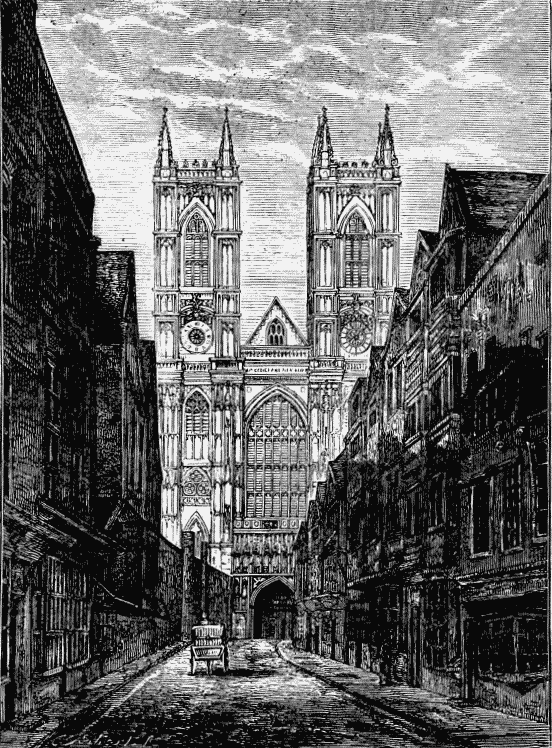
The exterior view of the Abbey is best obtained from a distance, its exquisite proportions being, perhaps, better appreciated when seen from the high ground in the Green Park. For a nearer and more minute survey, the west front is seen to great advantage from Tothill Street, the north transept and aisle from the corner of King Street, and the south side from College Street. St. Margaret's Church, standing immediately beside the Abbey, has the effect of causing the proportions of the larger fabric to stand out in a bold and imposing relief.
The church consists of a nave, choir, aisles, transepts, and sacrarium; and at the east end are Edward the Confessor's, Henry VII.'s, and ten other chapels. Its dimensions are, from east to west, including Henry VII.'s Chapel, 375 feet; across the transepts it measures 200 feet; the height of the nave and choir is 101 feet; height to the roof of the lantern about 140 feet, and the height of the western towers 225 feet.
The west front of the Abbey, it must be owned, is poor enough, when compared with that of most English or foreign cathedrals. In fact, as we are told in the Grub Street Journal for March 6, 1735, it was never really finished at all, being "by Providence reserved for the able hand of the judicious Mr. Hawksmore." The English reader who knows anything of the beautiful symmetry of Gothic architecture will wish that Mr. Hawksmore's "judicious" work had been applied to some other and less noble edifice; and even Chamberlain's statement that the skill of Sir Christopher Wren in the two western towers is "thought to exceed in point of workmanship any part of the ancient building," will hardly be endorsed by the merest tyro in Gothic architecture.
It is generally said that the western towers of the Abbey were completed by Sir Christopher Wren; but this is not true, though he commenced them, in apparent disdain of the rules of pointed architecture. Nevertheless, Sir Christopher would seem to have been opposed to any confusion of style in designing, for in a letter to Dr. Atterbury, Bishop of Rochester, he says, "I shall speedily prepare draughts and models, such as I conceive proper to agree with the original scheme of the architect, without any modern mixtures to show my own inventions." We have given on page 409 a reproduction of a design said to have been prepared by Wren for the completion of the work, which includes as a principal feature a spire rising from the low central tower.
Mr. A. Wood remarks with great justice here: "That many layers of classical cornice should appear on the face of Gothic towers will in time be felt to be a disgrace to our architecture; and we may ourselves, perhaps, see these towers rebuilt, from the roof of the church upwards, with Wren's proportions, but with pure and harmonious detail." Since the time of Sir Christopher the rules of Gothic art have been so deeply and accurately studied and mastered (thanks to the efforts of the Oxford and Cambridge Architectural Societies, and the labours of Pugin and Sir G. Gilbert Scott), that there can be no doubt of the capacity of the present generation to bring to perfection that one portion of this noble structure which has come down to our hands, as a legacy from the so-called 'Dark Ages,' in one respect, and in one only, incomplete."
The principal entrance is at the western end, and, taken as a whole, makes anything but an imposing appearance. The great doorway is of considerable depth, and contracts inwards. The sides are composed of panels, and the roof is intersected with numerous ribs. On each side of the door are pedestals in empty niches, with shields in quatrefoils beneath them. A cornice extends above the doorway, on which are ten canopied niches, separated by small buttresses; these niches are without statues, and their canopies are cones foliaged and pinnacled. Over these there is a cantaliver cornice, of modern date, and above the cornice is a frieze adorned with armorial bearings. Hence arises the great painted window; it has a border of eight pointed enriched panels, and over it a large heavy cornice, with a frieze inscribed "A. R. GEORGII II. VIII. MDCCXXXV." The roof is pointed, and contains a small window, with tracery.
The towers on either side of the west front are strengthened by substantial buttresses, with two ranges of canopied niches on their fronts. The lower windows of the towers are pointed; those above them arches only, filled with quatrefoils and circles. It is from this part that the incongruity of the new design begins in a Tuscan cornice; above this is a Grecian pediment and enrichments over the dial of the clock, and in each face of the topmost storeys is a Gothic window of poor design; the whole being crowned with battlements and pinnacles.
The credit of completing the west front, as it anciently appeared, is due to the abbots Estney and Islip; but it was never entirely finished till the reign of George II. "It is evident," observes Sir Christopher Wren in his architectural report addressed to Bishop Atterbury, "that the two towers were left imperfect, the one much higher than the other, though still too low for bells, which are stifled by the height of the roof above them; they ought certainly to be carried to an equal height, one storey above the ridge of the roof, still continuing the Gothic manner in the stone-work and tracery. Something," he adds, "must be done to strengthen the west window, which is crazy; the pediment is only boarded, but ought undoubtedly to be of stone."
The north side of the church is supported by nine buttresses, each of five gradations, with pointed windows between them; the buttresses are connected with the clerestory of the nave by slender arches, and the wall finishes with battlements.
The great door of the northern transept is an arch sprung from four large pillars on either side, with foliated capitals. The wall is of considerable thickness, and on each side of the great door it is formed into two arches by handsome pillars; the lesser entrances to the aisles are four pillars in depth, with ribbed roofs, having figures of angels at the intersections of the ribs. Above the doorways is a colonnade or range of pierced arches. Four massive buttresses secure the front; those at the angles terminate in octagons, and are connected with the upper part of the walls, over the side-aisles, by strong arches. Between the colonnade and the point of the roof is a beautiful "rose window," which was rebuilt in the year 1722. A great part of the north transept was rebuilt in 1828. "Time was," writes Mr. Charles Knight, "when this front had its statues of the twelve apostles at full length, and a vast number of other saints and martyrs, intermixed with intaglios, devices, and abundance of fretwork; and when, on account of its extreme beauty, it was called 'Solomon's Porch;' and now, even injured as it is, the whole forms a rich and beautiful façade."
The south transept underwent considerable repairs at the beginning of the present century, and the great rose window on that side was rebuilt in the year 1814.
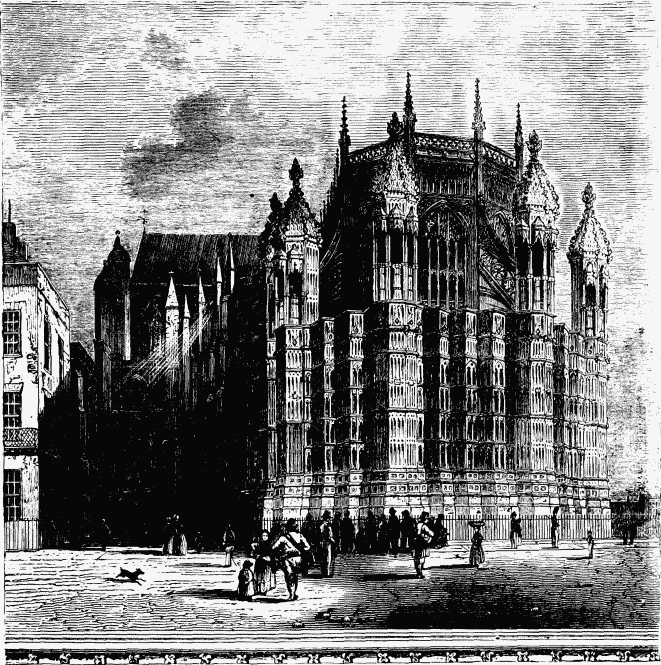
All the chapels that project on the north-east and south-east are, in their designs, like the body of the church; but the chapel of Henry VII., for its elegant outline and lavish ornamentation, is, perhaps, the chief point of attraction to most visitors on a first inspection.
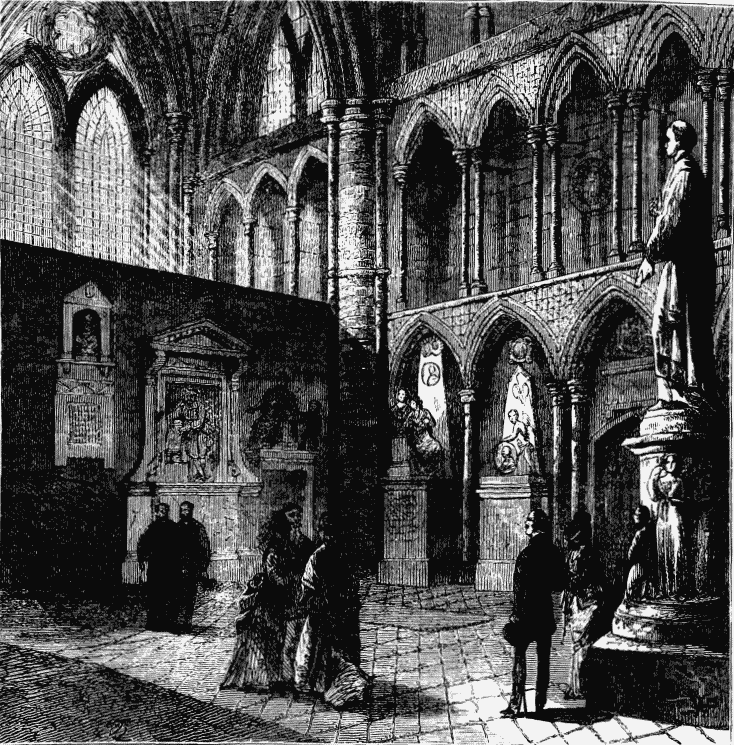
POETS' CORNER, WESTMINSTER ABBEY.
The front of the south transept is far less elegant than that of the north, but this is rendered of little consequence by the confined nature of its situation, the library, chapter-house, and cloisters being so immediately contiguous as to exclude all the lower part from public view. All the exterior walls are embattled, and the roof is covered with lead. The central tower, or rather lantern, has a dwarfish and unfinished aspect; it has two narrow, pointed windows on each side, and the angles are finished octagonally.
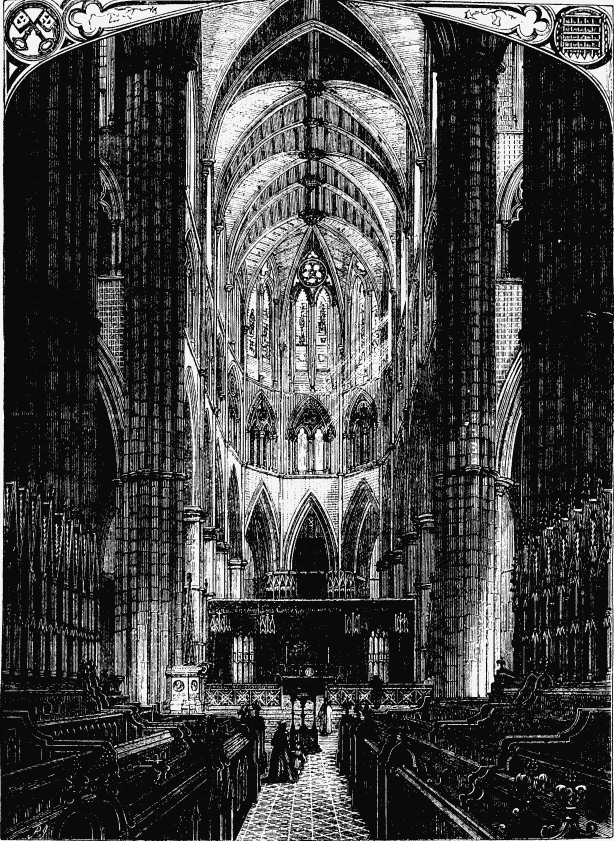
Entering by the great western door, the mind of the visitor is at once filled with awe and astonishment at the sublimity of the scene presented to the eye. The nave and choir are separated from the side-aisles by lofty cloistered columns, supporting pointed arches, above which are the triforium and the clerestory windows, some of which are filled with stained glass, and from the piers between them spring the intersecting arches of the vaulted ceiling. The pillars terminate towards the east by a sweep, thereby enclosing the chapel of Edward the Confessor in a kind of semicircle, and excluding all the rest. The long side-aisles are completely filled with monuments erected to the memory of illustrious personages.
"In what is called the open part of the Abbey," says Mr. Godwin, in his "Essay on Sepulchres," "are to be found the tombs of many of our great literary characters, mixed with those of others who have a very slight claim to such a distinction. In the enclosed part the spectator is much more struck with the capriciousness of the muse of monumental fame. Except the kings down to those of the House of Stuart, he looks in vain for the tombs of almost all the great men that have adorned our annals. Instead of Simon Montfort, Stephen Langton, and Wickliffe, and the Montacutes, and the Nevilles, and Cardinal Wolsey, and Cranmer, and Sir Philip Sidney, and Lord Chancellor Bacon, and multitudes of others that offer themselves to the memory, we find Sir John Pickering, and Sir Bernard Brocas, who lost his head in the cause of Richard II., and Colonel Popham, and Thomas Thynne, who is immortalised for having been shot in his coach, and Mrs. Nightingale. There is good reason for the absence of most, if not all, of the worthies above mentioned."
WESTMINSTER ABBEY: INTERIOR OF THE CHOIR.
We cannot, of course, in these pages give anything like a detailed description of all the monuments that grace—or rather disgrace—the walls of
this sacred edifice: suffice it to say that most of
them are vile, and tasteless, and barbarous bits of
heathen sculpture, utterly out of keeping with the
house of God. On some of these memorials there
is a grim humour and dry sarcasm which, in spite
of the solemn associations around, provokes an
irresistible smile; as, for instance, when we read it
recorded on the tomb of Samuel Butler, the author
of "Hudibras," that it was erected by a Lord
Mayor of London, "that he who was destitute of
all things when alive might not want a monument
when dead." One cannot help remarking of such
a tribute,—
"Sed quæ tarda venit gratia, sera venit."
It was to satirise this heathen and pagan style of monuments in the Abbey that Churchill wrote as follows in the "Foundling Hospital for Wit" (1771):—
"In fam'd cathedral who'd expect
Pallas, a heathen goddess,
To lift her shield come to protect
Lord Stanhope—this most odd is!
"Or to see Hercules, a son
Of Jupiter (as fabled),
There hov'ring o'er an admiral's bust,
As if by him enabled.
"What could they more in times of yore,
Do, heroes to defend?
What could the stage exhibit more
Than make the gods descend?
"Verger or beadle, who thou art
That hast the supervising part,
Fain would I mace thee lay on;
For Dean's Yard boys (fn. 1) with much surprise,
Being thus greatly edified,
May throw their heathen gods aside,
And shortly there, I fear, see rise
In stone the whole Pantheon."
Over the west door, and immediately under the great window, has been turned a stone arch, on which has been erected a monument to the Right Hon. William Pitt. The statue, the workmanship of Sir Richard Westmacott, represents the illustrious statesman habited in the robes of Chancellor of the Exchequer; at the base are figures representing History recording his speeches, and Anarchy writhing in chains. The inscription runs thus:—"This monument is erected by Parliament to William Pitt, son of William Earl of Chatham, in testimony of gratitude for the eminent public services, and of regret for the irreparable loss of that great and disinterested minister. He died January 23, 1806, in the forty-seventh year of his age."
Though a public funeral was voted to Pitt, yet only three hundred spectators were admitted within the walls of the Abbey on the occasion. Cyrus Redding was one of the favoured few: he thus describes the funeral:—"The procession came in at the great west entrance, having crossed the way from the Painted Chamber in the House of Lords, where the body had lain in state. It passed between two lines of Foot Guards. The spectators were ranged on a scaffolding covered with black. Muffled drums, with fifes, announced the entrance of the procession, in which were a number of distinguished persons—princes of the blood, statesmen, and fellow-ministers of the deceased. … Beilby Porteus, Bishop of London, read the service, standing by the side of the vault. The princes were in their royal robes. When the service was over, many advanced to look into the vault. The Dukes of York and Cumberland were among the number, and Lord Hawkesbury (afterwards Liverpool) took a glance, standing on the opposite side to where I and my fair companion were similarly occupied. The procession re-formed and took its leave; we stayed some time longer. The scene was novel. I could not help fixing my eyes, as long as I remained, upon the coffin of Lord Chatham, beneath whose monument we were standing. I thought of the share he had filled in a brilliant part of our history, and the mighty events he had influenced, for he was a great favourite in my youthful reading. The son became lost in the recollection of the father. Lady Chatham and a daughter lay in the same vault, on the verge of which, at the funeral, sat, as the nearest relative to the deceased, Pitt's brother, the late Earl of Chatham, as he was called, a nickname acquired from his going into his office when half the business of the day was over, his nights being devoted to play. He now lies in the same vault, memorable alone for his incapacity in the command of the unfortunate Walcheren expedition. Pitt was colonel of the Cinque Ports Volunteers, and hence his military funeral. The crowd outside the Abbey bandied jokes. They said that he was buried in military array lest his remains should be insulted. Lord Chatham's coffin, so it was reported, was found on its side when the vault was opened. This was attributed by some to the influx of the Thames, which had covered the vault with slime, but could hardly have overturned a heavy leaden coffin."
Not far from the monument of Pitt sleeps his great rival and opponent in the House of Commons, Charles James Fox, a man of whom, with all his personal faults, the nation may well feel proud. Cyrus Redding, in his "Fifty Years' Reminiscences," thus describes the funeral of this distinguished statesman:—"I saw the obsequies of Fox, a walking funeral from the Stable Yard, St. James's, by Pall Mall and Charing Cross, lines of volunteers en haye, keeping the ground. I recollect the Whig Club among the followers, and a large body of the electors of Westminster, with the cabinet council, but no royalty, for which some kind of excuse was made. Literally the tears of the crowd incensed the bier of Fox. The affection displayed by the people was extraordinary; I saw men crying like children." The monument of Fox, which was also the work of Sir R. Westmacott, represents the great statesman on a mattress, falling into the arms of Liberty. Peace (with the olive-branch and dove) is reclining on his knee, whilst in the foreground is an African, kneeling, as if testifying his gratitude for the part which Fox took in the cause of freedom. He died in September, 1806, at the age of fifty-seven.
It is impossible not to be struck with the
proximity of Pitt's monument to that of Fox, and
not to call to mind the touching lines of Sir Walter
Scott on these two eminent statesmen:—
"The mighty chiefs sleep side by side;
Drop upon Fox's grave the tear,
'Twill trickle to his rival's bier."
One of the most curious monuments, perhaps, in the Abbey is that near the cloister door, in the south aisle of the nave. It commemorates ViceAdmiral Richard Tyrrell, commander of the Buckingham, who died in 1766, whilst on his return to England from the Leeward Islands, after an engagement with the French. His body, the inscription informs us, "according to his own desire, was committed to the sea, with proper honours and ceremonies." "To comprehend this monument," says Mr. Malcolm, "the spectator must suppose himself in a diving-bell at the bottom of the sea. When he has shaken off the terrors of his situation he will find on his right hand the Buckingham, of sixty-six guns, jammed in a bed of coral. Directly before him he will perceive a figure pointing to a spot on a globe, either intending to show where the deceased body was committed to the deep, or the latitude where an action, mentioned in the inscription, was fought." The figures introduced into this piece of monumental composition are History, Navigation, and Hibernia; they are represented among the rocks, with the sea above their heads; above all is the Admiral himself, ascending amidst heavy clouds—the latter being highly suggestive of ill-made pancakes.
In the south aisle of the nave is the monument erected to William Congreve, the dramatist, by Henrietta, Duchess of Marlborough, his relations with whom while alive, coupled with the fact of his leaving her a legacy of £10,000, have been made the subject of many scandalous surmises. To this fact Horace Walpole alludes in one of his "Letters:"—"When the younger Duchess (of Marlborough) exposed herself by placing a monument and silly epitaph of her own composing and bad spelling to Congreve in Westminster Abbey, her mother, quoting the words, said, 'I know not what pleasure she might have had in his company, but I am sure it was no honour.'"
Near the monument of Congreve is buried the
celebrated actress, Mrs. Oldfield, if we may believe
her maid, "in a very fine Brussells' lace headdress,
a Holland shift with a tucker and double ruffles of
the same lace, a pair of new kid gloves, and her
body wrapped up in a winding-sheet." It is to
this funeral array that Pope alludes—
" 'Odious! in woollen! 'twould a saint provoke!'
Were the last words that poor Narcissa spoke.
'No; let a charming chintz and Brussels' lace
Wrap my cold limbs, and shade my lifeless face:
One would not, sure, be frightful when one's dead,
And—Betty, give this cheek a little red!' "
The accomplished actress, Mrs. Oldfield, died in
October, 1730. She lies near the tomb of Craggs,
as well as near that of Congreve, not far from the
Consistory Court. It is said by Mr. J. H. Jesse
that, at her burial, a bystander scribbled on paper
and threw into her grave the following epigram:—
"If penance in the Bishop's Court be feared,
Congreve, and Craggs, and Oldfield will be scared
To find that at the Resurrection Day
They all so near the consistory lay."
The Craggs mentioned in this verse was a man
of low extraction, being only a shoemaker's son;
but he nevertheless rose to a high and honourable
position in the State. He was made Secretary for
War in 1717, and soon afterwards a member of the
Privy Council. The epitaph on his monument,
written by Pope, runs as follows:—
"Statesman, yet friend to truth, of soul sincere,
In action faithful, and in honour clear;
Who broke no promise, served no private end,
Who gain'd no title, and who lost no friend.
Ennobled by himself, by all approved,
Praised, wept, and honour'd by the muse he loved."
To any one who knows anything of the history of the South Sea scheme, and of Mr. Secretary Craggs' connection with it, we are afraid these lines will be considered as over-rating his merits. It will be remembered that Craggs died somewhat suddenly and conveniently, professedly of the small-pox, immediately on the bursting of the South Sea bubble.
Close by the south-west corner of the Abbey is a statue of William Wordsworth, placed here by the friends and admirers of the poet. Wordsworth died at Rydal Mount, Westmoreland, in April, 1850. The statue, executed by Thrupp, represents the poet in a meditative attitude; and the quiet and secluded spot in which it is placed, apart from the crowd, and in a peaceful retirement of its own, harmonise with, and are expressive of, the tranquil tenor of his life, and the thoughtful, sublime, and philosophic character of his works. The place which has been thus happily selected for the statue is the Baptistry, in the centre of which is the font. In allusion to this circumstance the following sonnet from Wordsworth's poems ("Ecclesiastical Sonnets," vol. iv., page 269) has been inscribed near the statue:—
HOLY BAPTISM.
"Blest be the Church, that watching o'er the needs
Of infancy, provides a timely shower
Whose virtue changes to a Christian flower,
A growth from sinful Nature's bed of weeds!
Fitliest beneath the sacred roof proceeds
The ministration; while parental Love
Looks on, and grace descendeth from above,
As the high service pledges now, now pleads.
There, should vain thoughts outspread their wings and fly
To meet the coming hours of festal mirth,
The tombs—which hear and answer that brief cry,
The infant's notice of his second birth—
Recall the wandering soul to sympathy,
With what man hopes from heaven yet fears from earth."
The gallery high up in the southern wall, near the Baptistry, was erected for the accommodation of the Royal Family to view the procession of the Knights of the Bath, on the occasions when their installation took place here. The procession entered at Poets' Corner, and proceeded round the west end, and up the north aisle, into Henry VII.'s Chapel, where the ceremony was performed; as we shall notice more particularly in speaking of that part of the building.
Robert Stephenson, the eminent engineer, who died in 1859, is commemorated by a brass figure of life-size, in the floor of the nave, in addition to which is an elaborate painted window illustrative of his fertile genius. Sir Charles Barry, the architect of the new Houses of Parliament, also lies in the centre of the nave; his grave is covered by a slab of black Irish marble, inlaid with brass, bearing his name and the date of his death, and it is appropriately engraved with a representation of the Victoria Tower and the ground-plan of the Houses of Parliament.
In the early spring of the year 1870 the body of Mr. George Peabody, the philanthropist, who bequeathed a large share of his wealth for the purpose of improving the homes of the working classes in this metropolis, was laid in a temporary resting-place in the nave, until arrangements could be made for its transfer to America. A suitable inscription marks the spot where the body rested. "He was a man," to use the apt expression of Mr. Gladstone within a few days after Mr. Peabody's death, "who taught us in this commercial age, which has witnessed the building up of so many colossal fortunes, at once the noblest and most needful of all lessons; he has shown us all how a man can be the master of his wealth instead of being its slave."
In the summer of 1874 a grave was opened in the centre of the nave of the venerable Abbey to receive the body of David Livingstone, the African explorer and missionary. He had died in the centre of that continent nearly a year before, but his body had been embalmed by friendly hands, and was brought back to England in order to receive the honour of a public funeral. A slab with a suitable inscription was placed over his remains about six months afterwards. In the spring of 1875, Sir Charles Lyell, the most famous of geologists, was buried in the north aisle of the nave, the body being followed to the grave by a large concourse of the most eminent scientific men of the day.
The pulpit in the nave is used only for the special Sunday evening services. It is composed of variegated marble, interspersed with rich foliage, and some very tasteful mosaic; around it are the figures of St. Paul, St. Peter, and the four Evangelists, and in front, in a medallion, is a head of the Saviour crowned with thorns. An inscription sets forth that "this pulpit is presented to the Dean and Chapter of Westminster by a few friends in grateful commemoration of the opening of the nave for public worship and preaching, in January, 1858." The Abbey, like most, if not all, of our cathedrals, was for many years very little used except on Sundays, and even then the nave was seldom, if ever, utilised for worship. In 1858, however, the then dean, Archbishop Trench, instituted special services on Sunday evenings in the nave; and his successor, Dean Stanley, has followed up the example. We may add that the House of Peers used to attend service here on "High Days and Holy Days," just as the Commons went to hear sermons in St. Margaret's Church close by.
We may perhaps be pardoned for ending this chapter by recording here the bitter sarcasm contained in Pope's well-known epitaph headed "One who would not be buried in the Abbey:"—
"Heroes and kings, your distance keep! In peace let one poor poet sleep, Who never flattered folks like you! Let Horace blush, and Virgil too."
CHAPTER LII.
WESTMINSTER ABBEY.—THE CHOIR, TRANSEPTS, &c.
"Where through the long-drawn aisle and fretted vault
The pealing organ swells the notes of praise."—Gray's Elegy.
The Choir Screen—Monuments of Earl Stanhope and Sir Isaac Newton—Curious Monument of Thomas Thynne, and the Story of Thynne's Assassination—Admiral Sir Cloudesley Shovel—Major André—Sir Charles Carteret—The "Musicians' Corner"—The Choir—Dr. Busby's Pavement and his Wig—Abbot Ware's Mosaic Pavement—Portrait of Richard II.—The Reredos—Discovery of Fragments of the Original Church—Monuments to Eminent Statesmen—Memorial Windows—Poets' Corner—Ben Jonson—Dryden—Handel—Milton—Gray—Matthew Prior—Old Parr—Charles Dickens—Goldsmith, and Dr. Johnson's Inscription—Spenser—Chaucer—Isaac Barrow—Addison's Reflections on Poets' Corner.
We now pass on eastwards, turning our backs on the great western entrance, on our way to that portion of the sacred edifice which forms the cross, and find ourselves confronted by a screen. This screen, separating the nave from the choir, was designed by Mr. Blore, the architect to the Abbey, and erected in 1831. It serves as the organgallery; the organ itself, however, is so placed between the columns at the sides that the view of the interior from end to end is in no way obstructed. Four pilasters with decorated finials divide the screen into three compartments, the centre for the gate of entrance to the choir from the nave, the other two contain the monuments of Earl Stanhope and Sir Isaac Newton. On each of the pilasters are projecting pedestals, which support the figures of Henry III. and his queen, Edward the Confessor and his queen, and Edward I. and his queen.
Here the body of the great Sir Isaac Newton, having lain in state in the Jerusalem Chamber for two days previously, was deposited in March, 1727. "Every honour," says a cotemporary account, "was paid to his remains; the pall was supported by six peers." The monument was executed by Rysbrack; it represents the great astronomer in a recumbent posture, leaning his right arm on four folio volumes, entitled "Divinity," "Chronology," "Optics," and "Phil. Prin. Math.," and pointing to a scroll supported by winged cherubs. Over him is a large globe, projecting from a pyramid behind, whereon is delineated the course of the comet in 1680, with the signs, constellations, and planets; on the globe is the figure of Astronomy with her book closed, and beneath the principal figure is a bas-relief, representing the various labours in which Sir Isaac Newton chiefly employed his time, such as discovering the causes of gravitation, settling the principles of light and colour, and reducing the coinage to a determined standard. The inscription, which is in Latin, terminates with the exclamation, "How much reason mortals have to pride themselves in the existence of such and so great an ornament to the human race!"
In the south aisle, close by the choir-screen, is a monument to Thomas Thynne, Esq., of Longleat, in the county of Wilts, who was barbarously murdered while riding in his coach, in Pall Mall, in February, 1682, by three hired assassins, at the instigation of an infamous foreigner, Count Koningsmark, from motives of jealousy. The monument is of a very sensational character, considering the place in which it is erected, displaying a representation of the tragic scene, with its surroundings, in bold relief. The coach, the coachman, servants and their wigs, the horses, and the bystanders are apparently drawn to the very life.
The story of Thynne's assassination runs as follows. The murder was stimulated by a desire on the count's part to obtain in marriage the Lady Elizabeth Percy, the rich heiress of the Earl of Northumberland. The lady in her infancy had been betrothed to the Earl of Ogle, only son of the second Duke of Newcastle, but was left a widow before the marriage was consummated. She was soon afterwards married to Mr. Thomas Thynne, who, from his large income, was called "Tom of Ten Thousand;" but being scarcely fifteen years of age, her husband, at the earnest entreaty of her mother, was prevailed upon to allow her to travel another year before entering fully upon her wedded life. During this period she is reported to have become acquainted with Köningsmark, a Hanoverian count. Whether she had ever given him any countenance is uncertain; but having no grounds to hope to obtain her while her husband lived, he plotted his death in the villainous manner above described. Köningsmark, however, did not succeed by this means in gaining the prize, for the lady—alarmed, doubtless, at his blood-stained hands—not long afterwards married the great Duke of Somerset.
WEST FRONT OF WESTMINSTER ABBEY, FROM TOTHILL STREET.
The monument of Admiral Sir Cloudesley Shovel, in the south aisle of the choir, consists of a recumbent figure of the admiral lying under a tent, and beneath it, in bas-relief, is a representation of the wreck of the Association, in which he lost his life. The inscription tells us that "he was deservedly beloved by his country, and esteemed, though dreaded, by the enemy, who had often experienced his conduct and courage. Being shipwrecked on the rocks of Scilly, in his voyage from Toulon, October 22, 1707, at night, in the fifty-seventh year of his age, his fate was lamented by all, but especially by the seafaring part of the nation, to whom he was a generous patron and a worthy example. His body was flung on the shore, and buried with others on the sand; but being soon after taken up was placed under this monument, which his royal mistress had caused to be erected, to commemorate his steady loyalty and extraordinary virtues."
A story is told which illustrates the personal bravery of Sir Cloudesley Shovel. When a boy in the navy, under the patronage of Sir John Narborough, hearing that admiral express an earnest wish that some papers of consequence might be conveyed to the captain of a distant ship in action, he immediately undertook to swim through the line of the enemy's fire with the despatches in his mouth, a feat which he actually performed, reaching the ship in safety.
Occasionally epigrams and witticisms relating to current events have been wafered or pasted on to some of the monuments and statues in the Abbey, though the practice has never reached the dignity of a custom here, as in the case of the well-known Pasquin statue at Rome, which gave rise to the word "pasquinade." One such example, however, we are able to give here from a manuscript, apparently of about 1780, in the possession of a former verger:—
KING HENRY VII.'S CHAPEL.
"The following lines were written and wafered
up against Major André's monument, after its
having been defaced, &c., by knocking off the
hands and heads of some of the figures:—
"'Forbear rash mortals, nor with brutal rage
Deface this noble monumental page;
Let the just marble future ages tell
Britannia mourn'd when her brave hero fell.'"
Major André was buried in the south aisle, and the monument referred to in the above lines was erected at the express command of George III. On it is represented a soldier carrying a flag of truce, and presenting to George Washington a letter which André had addressed to his Excellency the night previous to his execution. It may be added here, in justification of the lines quoted above, that the present is the third head placed on the figure of General Washington, and that several of the others are new, the originals, which are stated to have been exceedingly well executed, having entirely disappeared.
Immediately beneath the organ-loft, in the north aisle, is the tomb of the last representative of the Carteret family—Sir Charles, who died in 1715. The tomb is a sarcophagus of marble, either built into the wall, or so executed as to represent such a position. To the right of the spectator a stout cherub leans on a diagonally disposed narrow slab of marble, probably intended to represent a sunbeam, on which are inscribed the names of several of the family. Above this quaint and ugly tomb, the whole of the wall-space between the soffit of the organ-loft, the door giving access to the stairs, and the end of the same—some nine feet square—is occupied by a new, bright, chromatic decoration. It is divided, by a light scroll-work, into four compartments, each containing the coat of arms of a peer or peeress, with supporters, coronet, and motto. The arms are those of Grace, Countess Granville, who died in 1744; John, Earl Granville, 1763; Martha, Viscountess Lansdown, 1689; and Frances, wife of the above-named Earl John. A short inscription of the name, distinctions, and date of the birth and of the death of each is clearly and distinctly painted beneath each blazon, and on a tablet extending under the whole is the following legend: "All the above lie buried in the vault of their relative, General George Monk, Duke of Albemarle, K.G.; and this record is inscribed by order of their descendant and inheritor, the subdean of this collegiate church, A.D. 1869." The sub-dean is Lord John Thynne.
In the north aisle of the choir are appropriately deposited the remains of several men, who in their time achieved celebrity as musicians or composers, many of whom were organists of this church; among them are Dr. Samuel Arnold, Dr. Burney, Dr. Blow, Dr. Croft, Henry Purcell, and, lastly, Sir William Sterndale Bennett.
We now pass into the choir, remarking only that the style of architecture adopted for its fittings, though of recent date, is a copy of that which prevailed in the reign of Edward III. It was designed by Mr. Blore, and executed in 1848. The dean's and sub-dean's stalls are on either side of the iron gate, in the centre of the screen, and are alike in general design; that of the dean, however, is more elaborately treated in its ornamental details. The canons' stalls have groined canopies springing from slender moulded shafts with carved capitals, and are separated by buttresses terminating in pinnacles. The fronts of the pews and the ornamental accessories of the stalls are carved to represent the foliage of vine, ivy, oak, willow, &c.
The organ formerly stood in the centre of the screen, and consequently obstructed the view down the whole length of the building, but this very objectionable arrangement was altered in the year 1848. It is now divided into three distinct portions, the principal of which are under the arches, at the north and south ends of the screen. Each part of the organ, however, is so connected by a nice mechanical contrivance that they are all brought under the command of the performer.
The marble pavement of the floor, in lozenges of black and white, was given by Dr. Busby, who died in 1695, and whose tomb is in the south transept. Dr. Busby was the celebrated prebendary of Westminster, and master of the school, whose rigid discipline has, to a great extent, caused his name to be handed down to posterity.
But it was not only as a schoolmaster that Dr. Busby's name is celebrated; he has come down to modern times as associated with the wig which bore, and perhaps still bears, his name. But this derivation will hardly stand. A "busby," as our grandfathers used to style the large perukes of their day, half in jest, was but an elongation of the briefer and simpler "buzz"—a frizzled and bushy device for the covering of the head. As all the existing portraits of the reverend doctor represent him with a close cap, or at all events, without a wig, it is probable that the "busby" was so called in sport, lucus a non lucendo.
The sacrarium is reached by an ascent of four or five steps. Here the pavement is an elaborate piece of mosaic. It was the work of Abbot Ware, and was laid in 1260. The lower dais of the altar and sedilia is formed of stones of various colours, and laid in rich and varied patterns; and the steps are of Purbeck marble. On the south side hangs a whole-length portrait of Richard II. This picture hung for many years in the Jerusalem Chamber, and was exhibited at the National Portrait Exhibition at South Kensington. It has been discovered that the original portrait was subsequently covered by successive coatings of paint, so laid on as not only to obscure, but materially to alter the drawing, and to disguise the character of the original picture. This mask of paint was removed in 1866, and the real old picture painted in tempera, and apparently from the life, revealed underneath it in an almost perfect state of preservation. Mr. George Scharf, the Secretary of the National Portrait Gallery, in writing to the Athenœum respecting this interesting discovery, observes:—"Instead of a large, coarse, heavy-toned figure, with very dark, solid shadows, strongly-marked eyebrows, and a confident expression (almost amounting to a stare) about the darkbrown sparkling eyes, we now have a delicate, pale picture; carefully modelled forms, with a placid and almost sad expression of countenance; grey eyes, partially lost under heavy lids; pale yellow eyebrows, and golden-brown hair. These latter points fully agree with the king's profile, in the well-known little tempera Diptytch at Wilton, belonging to the Earl of Pembroke. The long thin nose accords with the bronze effigy of the king in Westminster Abbey; whilst the mouth, hitherto smiling and ruddy, has become delicate, but weak, and drooping in a curve, as if drawn down by sorrowful anticipations even in the midst of pageantry. Upon the face there is a preponderance of shadow, composed of soft brown tones, such as are observable in early Italian paintings of the Umbrian and Sienese schools executed at a corresponding period. Indeed, the general appearance of the picture now forcibly recalls the productions of Simone Memmi, Taddeo Bartoli, Gritto da Fabriano, and Spinello Aretino; but more especially those of their works which have suffered under a similar infliction of coatings of whitewash or plasterings of modern paint. Many alterations seem to have been made by the restorer in various parts of this figure of King Richard, and well-devised folds of drapery quite destroyed through ignorance. The position of the little finger of his left hand, holding the sceptre, was found to have been materially altered. The letters R, surmounted by a crown, strewn over his blue robe, were changed in shape, and the dark spots on his broad ermine cape were distorted from their primitively simple tapering forms into strange twisted masses of heavy black paint. The globe held in his right hand, and covered with some very inappropriate acanthus leaves, was at once found to be false, and beneath it was laid bare a slightly convex disc of plain gold, very highly burnished. This, however, was not an original part of the picture. A plain flat globe with its delicate gilding was found still lower: and it was then ascertained that the head of the sceptre and the crown on his head had in like manner been loaded with gold and polished. Beneath these masses of solid burnished gilding, bearing false forms and ornaments unknown to the fourteenth century, was found the original Gothic work, traced with a free brush in beautiful foliage upon the genuine gold surface lying upon the gesso preparation spread over the panel itself, and constituting a perfectly different crown as well as heading to the sceptre from those hitherto seen. The singular device of a fir cone on the summit of the sceptre has disappeared entirely. The diaper, composed of a raised pattern, decorating the background, coated over with a coarse bronze powder, and not even gilded, was found to be a false addition. It was moulded in composition or cement, possibly as early as the reign of the Tudors. Not only did it stand condemned in itself by clumsiness of workmanship and a reckless fitting together of the component parts, but it was found to have extensively overlaid some of the most beautiful foliage and pieces of ornamentation. The picture is painted on oak, composed of six planks joined vertically, but so admirably bound together as to appear one solid mass. The back is quite plain."
From a MS. note in a copy of the authorised Guide belonging to a former verger, we glean the following particulars with regard to this historical portrait:—"There was formerly placed near the pulpit an ancient portrait of Richard II., sitting in a gilt chair, dressed in a green vest flowered with gold; with gold shoes ornamented with pearls. This piece, which is 6 feet 11 inches in length, and 3 feet 7 inches in breadth, was removed on the new fittingup of the choir, to the Jerusalem Chamber, where the Dean, &c., meet to transact business. The lower part," adds the writer, "is somewhat defaced."
Of this picture Pennant, writing in 1790, observes that "after the test of near four hundred years it is in the highest preservation, and not less remarkable for the elegance of the colouring than for the excellent drawing, considering the early age of the performance. We must allow it has been repainted, but nothing seems altered, if we may collect from the print made by Vertue, excepting a correction of the site of the cross issuing out of the globe. The background is elevated above the figure, of an uneven surface, and gilt. The curious will find in the first volume of Mr. Walpole's 'Anecdotes,' an ingenious conjecture as to the method of painting in that early period, which has given such amazing duration to the labours of its artists."
On the sides of the altar are the curious and interesting monuments of King Sebert; Ann of Cleves, wife of Henry VIII.; Aveling, Countess of Lancaster; Aymer de Valence; and Edmund Crouchback.
The reredos, which was put up in 1867, was designed and executed under the superintendence of Sir G. Gilbert Scott. It is chiefly composed of white and coloured alabaster, combined with a reddish spar. It consists of a façade occupying the whole space between two main pillars, having two doors, one on each side, giving access to the shrine of Edward the Confessor behind. The doorways are arched and richly moulded. On either side of each door is a large canopied niche with pedestal, and containing statues of Moses, St. Peter, St. Luke, and King David; and on the inner side of each large niche are two smaller ones, placed vertically. These niches are all most elaborately enriched with tabernacle work, groined and surrounded with pierced tracery and carved work, and terminated with pinnacles, flying buttresses, and spires, all profusely crocketed and finished. The whole is surmounted with a bold cornice, superbly carved and sculptured with subjects illustrative of the life of our Lord. In the space between the inner niches and above the communion-table is a recess, wherein is placed an elaborate and minutely finished picture of the Last Supper, in Venetian glass mosaic; the picture is 12 feet 6 inches by 5 feet 5 inches in size, and was executed from the cartoon of Mr. Clayton, by Salviati, at Venice.
During the exploration necessitated by laying the new flooring in front of the altar, there were discovered on the north side, about three feet below the pavement, the bases of three piers which formed part of the old abbey of Edward the Confessor. They are of early Norman character, and, from their position, it is presumed that that early structure was nearly equal in size to the present fabric. Means have been adopted by which these remains have been so covered with the pavement that they can be easily uncovered and exposed to view. Dugdale tells us, on the authority of one of the early writers, that the church, as rebuilt by Edward the Confessor, was finished in a few years, and that "it was supported by many pillars and arches." Camden, however, has left us a fuller description, translated from a manuscript of the very period. "The principal area or nave of the church stood on lofty arches of hewn stone, jointed together in the nicest manner, and the vault was covered with a strong double arched roof of stone on both sides. The cross which embraced the choir, and by its transept supported a high tower in the middle, rose first with a low strong arch, and then swelled out with several winding staircases, to the single wall, up to the wooden roof, which was carefully covered with lead."
The solemn office of crowning and enthroning the sovereigns or England takes place in the centre of the sacrarium; and beneath the lantern or central tower, on a raised dais, is placed the throne at which the peers do homage. The details of these interesting ceremonies we have already given (pages 401 to 409).
Passing into the north transept, we are forcibly reminded by many of the monuments we see around us of the truth of the remarks made by a writer in the Literary World: "From St. Stephen's to Westminster Abbey the distance is short, but the road is difficult; and those who have traced it gloriously, led on by genius, and supported by principle, sleep calmly the sleep of death, unmoved by all that could once animate their glowing souls, within a few paces of the scene of their past triumphs. What a contrast between the scene of turmoil and worldly cares before us—the passionstirring harangues and the angry rejoinders—and the awful silence of the house of God, where reposes all that was earthly of those deathless souls!"
Here, almost side by side, rest the ashes of
George Canning, Sir Robert Peel, Lord Palmerston,
Sir G. Cornewall Lewis, Pitt, Fox, and Grattan.
Richard Cobden, who was buried in 1865 at West
Lavington, in Sussex, is here commemorated by a
bust; as is also the late Earl of Aberdeen. The
latter, which is said to be a faithful representation
of the deceased statesman, was executed by Mr.
Matthew Noble. The following is the inscription
on the bust:—
"George Gordon, fourth Earl of Aberdeen, K.T., K.G.
Born January 28, 1784; died December 14, 1860. Ambassador, Secretary of State, Prime Minister."
Near the north doorway is the monument to William Pitt, the first Earl of Chatham, who died on the 11th of May, 1778, a few hours after being seized with a fit whilst speaking in his place as a peer in the House of Lords in reply to the Duke of Richmond on the inexpediency of carrying on the American war.
The statue to the Earl of Chatham was erected
by a special vote of the public money, at the cost
of £6,000. Cowper makes the following allusion
to it in "The Task:"—
"Bacon there
Gives more than female beauty to a stone,
And Chatham's eloquence to marble lips."
The monument was designed by Bacon, who also
erected the cenotaph to the same statesman in
Guildhall. It is, of course, wholly out of keeping
with the architecture of the building or with the
character of a church, but it is a fine specimen of
its kind, and simple in design, though embracing
six figures. In a niche, in the upper part of a
large pyramid, is the statue of the earl. On a
sarcophagus underneath recline Prudence and
Fortitude. A group still lower down consists of
Britannia on a rock with the Ocean and the Earth
at her feet, intended to exhibit Lord Chatham's
wisdom and fortitude. The statue of the earl is
in his parliamentary robes; he is in the action
of speaking, the right hand thrown forward and
elevated, and the whole attitude strongly expressive
of that species of oratory for which his lordship
was so deservedly celebrated. Prudence has her
usual symbols, a serpent twisted round a mirror.
Fortitude is characterised by the shaft of a column,
and is clothed in a lion's skin. The energy of
this figure strongly contrasts the repose and contemplative character of Prudence. Britannia, as
mistress of the sea, holds in her right hand the
trident of Neptune. Ocean is entirely naked,
except that his symbol, the dolphin, is so managed,
that decency is perfectly secured: the action of
Ocean is agitated, and his countenance severe,
which is opposed by the utmost ease in the figure
of the Earth, who is leaning on a terrestrial globe,
her head crowned with fruit, which also lies in
some profusion at the foot of the pyramid. In the
centre of the plinth is the following inscription:—
"Erected by the King and Parliament as a testimony to the virtues and abilities of William Pitt, Earl of Chatham, during whose administration Divine Providence exalted Great Britain to an height of prosperity and glory unknown to any former age."
Close by the statue of Canning are two magnificent monuments to the old Dukes of Newcastle. The first is that of William Cavendish, Duke of Newcastle, and his duchess, Margaret, youngest sister of Lord Lucas. This duchess, as we learn from the inscription, "was a wise, witty, and learned lady, which her many books do well testify; she was a most virtuous, loving, and careful wife, and was with her lord all the time of his banishment and miseries; and when he came home, never parted from him in his solitary retirements." The basement of the tomb is covered with armour, on which is a handsome pedestal; reposing on a mat under a circular pediment lie the figures of the duke and duchess. His Grace held many great offices of state, and died in 1676. The other monument is that of John Holles, Duke of Newcastle, who died in 1711. The monument was executed by Gibbs, and is a beautiful pile of architecture, of the Composite order. The basement, columns, and pediment are composed of richly-variegated marble; at the sides of the base are symbolical statues of Wisdom and Sincerity; angels and cherubs in somewhat meaningless attitudes appear on the upper part of the monument, whilst the armed duke reclines in a very awkward manner upon a sarcophagus, having in one hand a general's truncheon, and in the other a ducal coronet.
The six lancet windows in the north transept are filled with stained glass to the memory of MajorGeneral Sir H. W. Barnard and others who "died in the service of the Queen and their country in India," in 1857 and 1858; and there is also a memorial window in the west aisle of this transept to Brigadier the Hon. Adrian Hope, C.B.
Crossing to the south transept, or, as it is now popularly and most appropriately called, "Poets' Corner," we enter that part of the Abbey which has become the resting-place of the remains of most of England's greatest men in the field of literature and art. Here sleep in peace such celebrities as Chaucer, Dryden, Booth, Drayton, Edmund Spenser, Samuel Butler, Garrick, Camden, Nicholas Rowe, Isaac Casaubon, Handel, Addison, John Gay, Thomas Campbell, Matthew Prior, Cowley, Sir William Davenant, Lord Macaulay, George Grote, and, lastly, Charles Dickens. With such an assemblage around us we can do no more than select a few of the monuments as deserving of special notice.
That to the memory of Garrick represents the great actor throwing aside a curtain, which reveals a medallion of Shakespeare, allegorically indicating the power he possessed of unveiling the beauties of the "bard of all time." Tragedy and Comedy are seen personified, with their appropriate emblems.
Mr. J. T. Smith, in his "Book for a Rainy Day," alluding to the death of Garrick, on the 20th of January, 1780, and his burial in Westminster Abbey, remarks that a facetious friend, with an ill-timed levity, lifted up the latch of Nollekens' studio, and said, "For the information of the sons of Phidias, I beg to observe that David Garrick is now on his way to pay his respects to the gentlemen in Poets' Corner; I left him just as he was quitting the boards of the Adelphi." Mr. Smith then adds: "I begged of my father, who then carved for Mr. Nollekens, to allow me to go to Charing Cross, to see the funeral of Garrick pass. There was a great crowd. I was there in a few minutes, followed him to the Abbey, heard the service, and saw him buried."
William Camden, the eminent antiquary, who died in 1623, is commemorated by a half-length figure, in the dress of his time, holding in his left hand a book, and in his right his gloves, resting on an altar, on the front of which is an inscription setting forth his "indefatigable industry in illustrating our British antiquities, and his candour, sincerity, and pleasant good humour in private life." He was for some time second master of Westminster School, where Ben Jonson—one of the noblest of English dramatists—was his pupil. Here is a marble monument to Jonson, finely executed by Rysbrack; it is ornamented with emblematical figures, "alluding, perhaps," it has been suggested, "to the malice and envy of his contemporaries." A writer in the Athenœum has pointed out that the bust of Ben Jonson shows a sculptural error of the kind referred to in the following verses, taken from "A Choice Collection of Poetry, most carefully collected from Original Manuscripts, by Joseph Yarrow, Comedian, York," and published in the year 1738.
ON BEN JONSON'S BUST.
WITH THE BUTTONS ON THE WRONG SIDE.
"O rare Ben Jenson! what a turn-coat grown?
Thou ne'er wore such 'til thou wast clad in stone;
When Time thy coat, thy only coat impairs,
Thou'lt find a patron in an hundred years;
Let not then this mistake disturb thy sprite,
Another age shall set thy buttons right."
HANDEL'S MONUMENT.
This great dramatist and contemporary of Shakespeare was buried in the north aisle, and on a plain stone over his grave are to be seen the words "O! rare Ben Jonson"—an epitaph perhaps the more forcible for its quaint brevity. The words are said to have been cut by a mason for eighteenpence, paid him by a passer-by, "Jack Young." Mr. R. Bell, in his "Life of Ben Jonson," writes, "The smallness of the surface occupied by the gravestone is explained by the fact that the coffin was deposited in an upright position, possibly . . . . to diminish the fee by economy of space. The tradition that Jonson had been interred in such a manner was generally discredited until the grave was opened a few years ago, when the remains of the poet were found in an erect posture."
Allen, in his "History of London and Westminster," says that the epitaph on Jonson's gravestone was engraved by direction of Sir William Davenant, who has on his own tombstone, in the pavement on the west side of Poets' Corner, "O! rare Sir William Davenant." Sir William Davenant was the son of a vintner, and was born at Oxford in 1605: his mother, who was a woman of admirable wit and sprightly conversation, drew to her house the politest men of that age, and among them Shakespeare is said to have been a frequent visitor. Upon Ben Jonson's death, Davenant succeeded him as Poet Laureate to Charles I., but having, as it is stated, lost his nose by an accident, he was cruelly bantered by the wits of the succeeding reign. He died in 1668.
INTERIOR OF KING HENRY VII.'S CHAPEL.
Shakespeare himself does not lie here, as everybody knows; there is, nevertheless, a monument to him in Poets' Corner. Pericles has told us many centuries ago, that "the whole earth is a monument of men of genius;" and in a like spirit sings Ben Jonson:—
"My Shakespear, rise; I will not lodge thee by
Chaucer or Spenser, or bid Beaumont hie
A little further off to make thee room:
Thou art a monument without a tomb."
The monument to John Dryden was erected by Sheffield, Duke of Buckingham, who had refused to aid the poet in his lifetime, thereby giving point to the satiric assertion of Pope, that—
"He help'd to bury whom he help'd to starve."
Bishop Atterbury thus writes to Pope on this subject:—"What do you think of some such short inscription as this in Latin, which may, in a few words, say all that is to be said of Dryden, and yet nothing more than he deserves?—'Johanni Drydeno, cvi poesis Anglicana vim svam ac veneres debet, et siqva in postervm avgebitvr lavde, est adhvc debitvra, honoris ergo,' &c. To show you that I am as much in earnest in the affair as you yourself, something I will send you too of this kind in English. If your design holds of fixing Dryden's name only below, and his busto above, may not lines like these be grav'd under the name?
'This Sheffield rais'd, to Dryden's ashes just;
Here fix'd his name, and there his laurel'd bust.
What else the Muse in marble might express,
Is known already; praise would make him less.'
Or thus:—
'More needs not; where acknowledg'd merits reign,
Praise is impertinent, and censure vain.'"
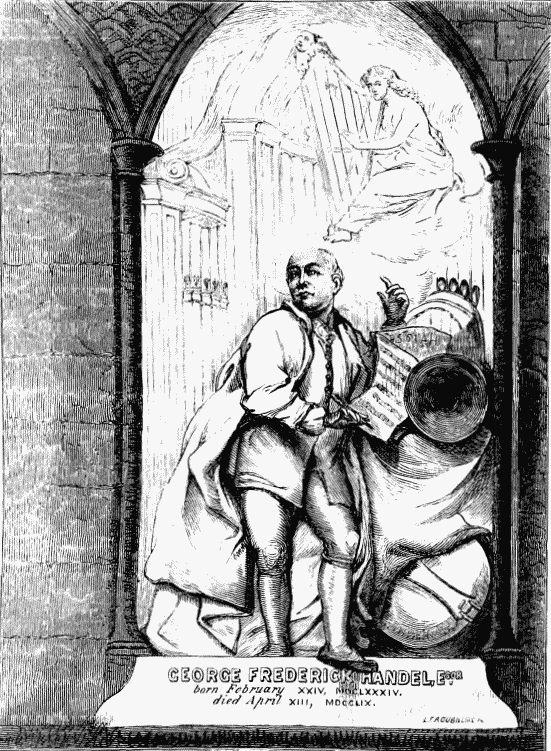
Handel's monument is the last which Roubiliac lived to complete. It is affirmed that the sculptor first became conspicuous, and afterwards finished the exercise of his art, through working on the figure of this extraordinary musician. The statue of Handel upon his monument is considered very elegant and life-like. The left arm is resting on a group of musical instruments, and the attitude is expressive of great attention to the harmony of an angel playing on a harp in the clouds overhead.
Milton and Gray, though both are interred elsewhere, have each a monument here erected to their memory. That to the former was executed by Rysbrack, and has under the bust simply the name "Milton." On the front of the pedestal is the following inscription:—
"In the year of our Lord Christ one thousand seven hundred and thirty-seven, this bust of the author of 'Paradise Lost' was placed here by William Benson, Esq., one of the two auditors of the imprests to his Majesty King George II., formerly Surveyor-General of the Works to his Majesty King George I."
The monument erected to the memory of Gray
consists of an alto-relievo of the Lyric Muse
holding a medallion bust of the poet, and at the
same time pointing a finger to the bust of Milton,
which is immediately above it. The memorial,
which was the work of John Bacon, the sculptor,
bears the following lines:—
"No more the Grecian Muse unrivall'd reigns
To Britain let the nations homage pay;
She felt a Homer's fire in Milton's strains,
A Pindar's rapture in the lyre of Gray.
Died July 30, 1771, aged 54."
The stately monument of Matthew Prior, close by, is a sarcophagus surmounted by a bust and pediment. On one side of the pedestal stands the figure of Thalia, with a flute in her hand, and on the other side History, with her book shut. From the Latin inscription we learn that while Prior "was busied in writing the history of his own times, Death interposed and broke the thread of his discourse and of his life, September 18, 1721, in the fifty-seventh year of his age."
With reference to Prior's funeral Dr. Atterbury thus writes to Pope:—"I had not strength enough to attend Mr. Prior to his grave, else I would have done it, to have showed his friends that I had forgot and forgiven what he wrote on me. He is buried, as he desired, at the feet of Spenser, and I will take care to make good in every respect what I said to him when living, particularly as to the triplet he wrote for his own epitaph, which, while we were in good terms, I promised him should never appear on his tomb while I was Dean of Westminster."
It was Matthew Prior by whom the celebrated
epigram and epitaph in one was written:—
"Nobles and heralds, by your leave,
Here lies what once was Matthew Prior,
The son of Adam and Eve:—
Can Bourbon or Nassau go higher?"
"Old Parr," of whom we have spoken in a previous chapter (page 74), lies in Poets' Corner, near
the door of St. Faith's—or, as it is often called,
St. Blaize's—Chapel. He lived in the reign of ten
sovereigns, did penance for bastardy when above
the age of 100, and died in November, 1635,
aged 152 years. Near to him are the remains
of Richard Brinsley Sheridan, Samuel Johnson,
General Sir Archibald Campbell, John Duke of
Argyll and Greenwich, and—though last, not least—Charles Dickens. His grave is covered by a slab
of black marble, thus inscribed: "Charles Dickens,
born February 7th, 1812, died June 9th, 1870." At
his death passed away "the greatest instructor of
the nineteenth century," and one of whom Caroline
Norton some years previously had written:—
"Not merely thine the tribute praise
Which greets an author's progress here;
Not merely thine the fabled bays
Whose verdure brightens his career;
Thine the pure triumph to have taught
Thy brother-man a gentle part,
In every line of fervent thought
Which gushes from thy generous heart:
For thine are words which rouse up all
The dormant good among us found—
Like drops which from a fountain fall
To bless and fertilise the ground!"
It was at first intended that Charles Dickens should have been buried in Rochester Cathedral, in accordance with the instructions contained in his will; but the voice of the nation was allowed to prevail over his own expressed wish, and very early on Tuesday, the 14th of June, 1870, he was laid to his rest in Poets' Corner. "Next to him lies Richard Cumberland; Mrs. Pritchard's monument looks down upon him, and immediately behind is David Garrick's. Nor is the actor's delightful art more worthily represented than the nobler genius of the author. Facing the grave, and on its right and left, are the monuments of Chaucer, Shakespeare, and Dryden, the three immortals who did most to create and settle the language to which Charles Dickens has given an undying name." So writes his friend, John Forster.
Apropos of this funeral we may add that Mr. B. Jerrold tells us that he met Charles Dickens about a month before his death at Charing Cross, and had a long chat with him about old friends, and Gustave Doré, and London—"a subject which no one ever knew half so well as himself, in all its highways and byways"—and that, on parting, Dickens "turned wearily towards the Abbey." "I never, however, for one moment, dreamed," he adds, "that within a month he would be resting there for ever, buried under flowers cast by loving hands, and that the whole civilised world would be lamenting the loss of the great and good Englishman."
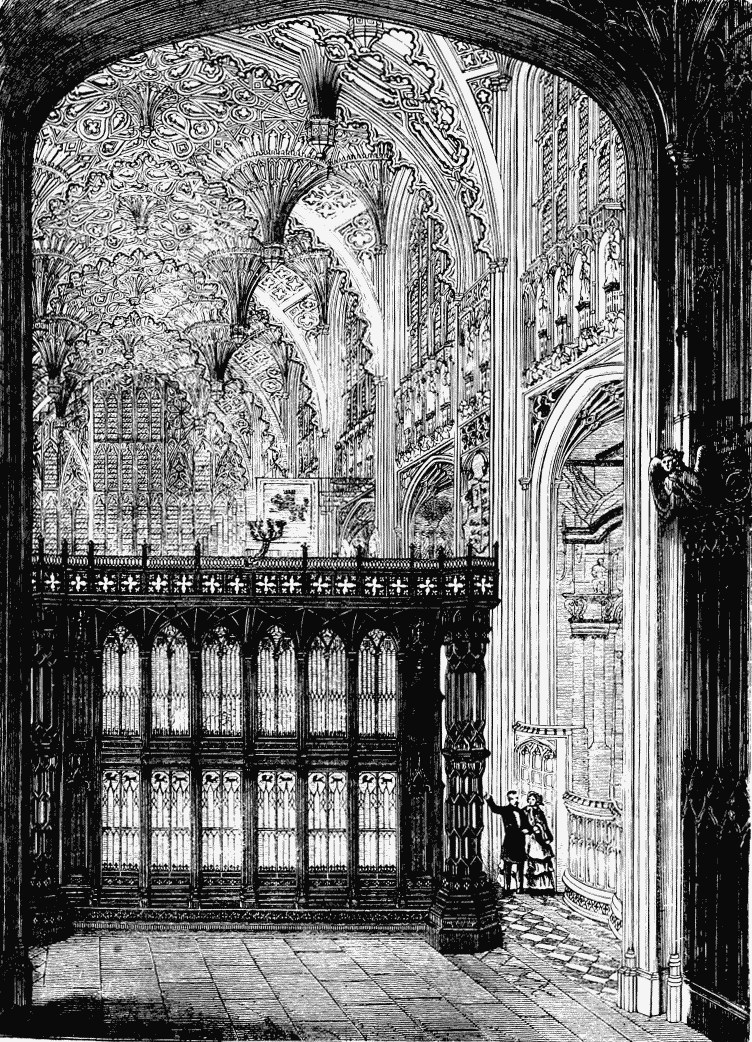
Lord Shelburne, afterwards the first Marquis of Lansdowne, in a letter on sepulchral monuments in general, addressed to the committee for erecting a memorial to John Howard, the philanthropist, expresses a hope that St. Paul's may be preserved from becoming disfigured after the manner of Westminster Abbey by absurd and inappropriate sculpture. "It would be not only invidious," he writes, "but unfair to criticise the several monuments in Westminster Abbey; but let any person of the least feeling, not to mention taste or art, divest his mind of prejudice, and he must find himself more interested in viewing the single statue erected by Mr. Horace Walpole to his mother, Lady Orford, than with any of the piles erected to great men." The monument of Lady Orford is in the south aisle of Henry VII.'s Chapel, which we shall notice in our next chapter.
The fulsome expressions which are to be read upon most of the monuments here are enough to make one wish for a return to the simplicity of the old Roman inscriptions, and to provoke others besides children, as they look around, to ask, "But where are the bad people?" It is a fact that the Dean and Chapter refused to admit the body of Lord Byron into the Abbey; but with that single exception, we fear, the remark of Dr. King in "Anecdotes of his Own Times," is but too true:—"The dean and prebendaries of Westminster sell the sacred ground to any persons who think proper to purchase it; no objection is made to the quality or character of those to whom a monument is to be erected under this holy roof; the peer and the player, the chaste and the unchaste, are here deposited without distinction. But if you examine their characters here engraven on the monumental marble, you will not find one person amongst them all who, when living, had not been endowed with the most eminent qualities both of body and mind. General——,who rose to his high post by such arts as are a disgrace to human nature, appears in Westminster Abbey to have possessed as great talents and as many virtues as Scipio Africanus."
It is to be hoped that, at all events, in recent times, so severe and caustic a remark has not been deserved by the Chapter of Westminster; indeed, we may safely say that the great and celebrated men who lately have been buried in the Abbey were men of whom England and English society may well be proud.
The monument to Goldsmith (who lies buried elsewhere) is of interest, on account of its connection with the name of Dr. Johnson. It was at first intended that this great essayist and master of the English tongue, who wanted but common prudence in order to have made one of the finest of characters, should have been buried in the Abbey, with a magnificent funeral; but the knowledge of his numerous debts unpaid caused the scheme to be withdrawn, and his body was interred in the churchyard of the Temple Church. It was decided, however, that a tablet should be raised to his memory in the Abbey. Sir Joshua Reynolds chose the spot, immediately over the doorway of St. Blaize's Chapel, and close to the memorial of Gay; and Dr. Johnson undertook to write the inscription. Johnson wrote this in Latin, and presented it to his friends for their approval. They wished that it had been written in the tongue which Goldsmith so excelled in writing; but the worthy doctor insisted that he would be no party to putting up English inscriptions in such a place as the Abbey, and by his persistency he gained the day. Thus it is that we have an inscription unintelligible to half at least of those who read and delight in his "Deserted Village" and his "Vicar of Wakefield," most of whom, it may be presumed, would also be interested in knowing what Dr. Johnson thought and said of him. (fn. 2)
Spenser lies here, not far from Chaucer. The
short but beautiful inscription on his monument
runs thus:—
"Here lies, expecting the second coming of our Saviour
Jesus Christ, the body of Edmund Spenser, the prince of
poets in his time, whose divine spirit needs no other witness
than the works which he left behind him."
It is recorded that at his funeral several of his poet brethren attended, and threw into his grave all sorts of epitaphs, elegies, and panegyrics. "'Gentle Willy' (as Spenser himself styles Shakespeare), we may be tolerably sure," says Charles Knight, "was among those mourners."
As for Chaucer, the same author observes with much justice and beauty, "like the fabled swan, he may be said to have literally died singing, for among his works we find 'A Ballad made by Geoffrey Chaucer upon his death-bed, lying in his great anguish.'"
Chaucer was buried in the cloisters of the
Abbey, outside the building itself, but his remains
were removed into the south transept in 1555.
The tomb has been much defaced, but still exhibits
traces of its former magnificence. It is an altartomb within a recess, and is surmounted by an
elaborate canopy. In 1868 a memorial window
was set up immediately above the tomb. The
design is intended to embody his intellectual
labours and his position amongst his contemporaries. At the base are the Canterbury Pilgrims, showing the setting out from London and
the arrival at Canterbury. The medallions above
represent Chaucer receiving a commission, with
others, in 1372, from King Edward III. to the
Doge of Genoa, and his reception by the latter.
At the top the subjects are taken from the poem
entitled "The Floure and the Leafe." On the
right side, dressed in white, are the Lady of the
Leafe, and attendants; on the left side is the Lady
of the Floure, dressed in green. In the tracery
above the portrait of Chaucer occupies the centre,
between that of Edward III. and Philippa his
wife; below them, Gower and John of Gaunt;
and above are Wickliffe and Strode, his contemporaries. At the base of the window is the name
"Geoffrey Chaucer, died A.D. 1400," and four lines
selected from the poem entitled "Balade of Gode
Counsaile:"—
"Flee fro the prees, and dwell with soth-fastnesse,
Suffise unto thy good though it be small;"
* * * * *
"That thee is sent receyve in buxomnesse;
The wrestling for this world asketh a fall."
This window is a brilliant piece of colour, and an
interesting addition to the attractions of the Abbey.
Poets' Corner, however, as our readers will already perhaps have noticed, is not confined to poets alone, but includes those who have courted other muses besides the muse of song. Divines, philosophers, actors, musicians, dramatists, architects, and critics, each and all have found a last resting-place in this part of the Abbey. Here, for instance, lies Dr. Isaac Barrow, whose life justifies the inscription which speaks of him as "a man almost divine and truly great, if greatness be comprised in piety, probity, and faith, the deepest learning, equal modesty and morals, in every respect sanctified and sweet." Dr. Barrow was master of Trinity College, Cambridge: he was so powerful and exhaustive in his sermons, that Charles II. wittily styled him the "unfair" preacher, because he left nothing for others to say on the subjects of his discourses.
Poets' Corner! "We could wish most heartily," writes Charles Knight, "we knew the name of him who first gave this appellation to the south transept of the old Abbey, and thus helped, most probably, to make it what it is, the richest little spot the earth possesses in its connection with the princes of song. Such a man ought himself to have a monument among them. Though he may never have written a line, we could almost venture to assert he must have had a kindred spirit to those who lie buried there, so exquisitely applicable is his phrase, so felicitously illustrative of the poet who, with all his exhaustion of old worlds and creation of new, is generally most deeply attached to some of the smallest corners of that on which he moves. … In a word, we might have sought in vain for any other appellation that would have expressed with equal force the home feeling with which we desire, however unconsciously, to invest this abode of our dead poets, or that would have harmonised so finely with our mingled sentiments of affection and reverence for their memory."
It may be well here to quote the sober and touching reflections of Addison upon this sacred spot:—"When I look upon the tombs of the great, every emotion of envy dies in me; when I read the epitaphs of the beautiful, every inordinate desire goes out; when I meet with the grief of parents upon a tombstone, my heart melts with compassion; when I see the tombs of parents themselves, I consider the vanity of grieving for those whom we must quickly follow. When I see kings lying by those who deposed them, when I consider rival wits placed side by side, or the holy men that divided the world with their contests and disputes, I reflect with sorrow and astonishment on the little competitions, factions, and debates of mankind. When I read the several dates of the tombs, of some that died yesterday, and some six hundred years ago, I consider that great day when we shall all of us be contemporaries and make our appearance together."