Old and New London: Volume 4. Originally published by Cassell, Petter & Galpin, London, 1878.
This free content was digitised by double rekeying. Public Domain.
Edward Walford, 'The city of Westminster: Introduction', in Old and New London: Volume 4(London, 1878), British History Online https://www.british-history.ac.uk/old-new-london/vol4/pp1-13 [accessed 2 May 2025].
Edward Walford, 'The city of Westminster: Introduction', in Old and New London: Volume 4(London, 1878), British History Online, accessed May 2, 2025, https://www.british-history.ac.uk/old-new-london/vol4/pp1-13.
Edward Walford. "The city of Westminster: Introduction". Old and New London: Volume 4. (London, 1878), British History Online. Web. 2 May 2025. https://www.british-history.ac.uk/old-new-london/vol4/pp1-13.
In this section
CHAPTER I.
WESTMINSTER.—A SURVEY OF THE CITY: MILLBANK, AND ITS NEIGHBOURHOOD.
[Decorative illustration, p.1]
"London, thou comprehensive word!
What joy thy streets and squares afford!
And think not thy admirer rallies
If he should add, thy "lanes and allies."
P. Egan, "Tom and Jerry."
Millbank—Inigo Jones and Ben Jonson—Great College Street—Little College Street—Barton and Cowley Streets—Abingdon Street—Thomas Telford, the Engineer—Wood Street—John Carter, F.S.A.—North Street—Elliston, the Actor—Peterborough House—"High Livings"—Annual Procession of Stage Coaches—The Manor of Neyte—The Church of St. John the Evangelist—Lord Grosvenor's Residence—Fanciful Style of Streetnaming—Vine Street—Vineyards in the Olden Times—Horseferry Road—Escape of Queen Mary of Modena—Flight of King James—The Great Seal of England thrown into the Thames—A Lucky Ferryman—Vauxhall Regatta—Works of the Gas Light and Coke Company—The "White Horse and Bower"—Page Street—Millbank Prison—Vauxhall Bridge—Holy Trinity Church—Vauxhall Bridge Road—Residence of Cardinal Manning—A New Cathedral—Vincent Square—Church of St. Mary the Virgin—Rochester Row—Emery Hill's Almshouses—St. Stephen's Church—Tothill Fields Prison—The Old Bridewell—Grey-Coat School—Strutton Ground—Dacre Street.
The old City of Westminster proper, with its venerable Abbey, and its gloomy and narrow streets, once the residence of peers, courtiers, and poets, constitutes perhaps the most interesting district of the great metropolis." So writes Mr. J. H. Jesse, in his pleasant and interesting work on "London." Let us then endeavour to show our readers a few of the chief points of interest which lie around the Abbey. As lately as the reign of Elizabeth, the Middlesex shore opposite to Lambeth was a mere low and marshy tract of land, almost wholly free from buildings, except the Abbey and Palace, and some few public edifices which adjoined them and had grown up under their shadow. The region now known as Millbank was so called from a mill on the bank of the river which occupied the site on which stood Peterborough House, delineated in Hollar's "View of London." This house was pulled down and rebuilt about the year 1735, by the then head of the Grosvenor family, shortly after his marriage with Miss Davis, the heiress of Ebury Manor, by which he acquired the property now known as Belgravia; the Grosvenors continued to occupy it as their town mansion till early in the present century, when they removed to their present house in Upper Grosvenor Street. In St. John's Church, Westminster, between the Abbey and their former home, is one proof of their connection with the parish, in the shape of a panel recording the fact of King George and Queen Charlotte, in 1800, standing there as sponsors at the baptism of "Thomas, second son of Viscount Belgrave," who succeeded whilst still young to the Earldom of Wilton.
But the neighbourhood of which we write has still more ancient associations. Late in life, when he had quarrelled with Inigo Jones, with the Court, and the City, who had been his friends and patrons, we find Ben Jonson living almost under the shadow of Westminster Abbey, "in the house under which you pass," says Aubrey, "to go out of the churchyard into the old Palace." At this time he, whose "mountain belly," "prodigious waist," and stooping back, are familiar to all readers of his works, was suffering from the double misfortune of the palsy and of poverty, from the latter of which he was rescued to some extent by the Earl of Newcastle. Here, probably, he died (his death occurred in August, 1637); and he was buried in the Abbey hard by, where it is a tradition that "Jack Young," happening to pass by, gave a stonemason eighteen pence to carve on the pavement where he lay, the well-known words, "O rare Ben Jonson!"
Immediately to the south of the Abbey precincts is Great College Street, which runs westward from Abingdon Street to Tufton Street. It was formerly known simply as the "Dead Wall," from the wall built by Abbot Litlington round the Infirmary Garden, which once extended, in a semicircular form, from the place where it now ends in College Street, to the Gate House. Gibbon's aunt, Mrs. Porter, "the affectionate guardian of his tender years," lived in College Street, where for some time she kept a boarding-house for the town boys of Westminster School.
Beyond is Little College Street, which, in the reign of Queen Anne, rejoiced in the name of Piper's Ground, and consisted of "a few houses built, the rest lying waste." Wealthy and well-born families, and even bishops, lived about its neighbourhood. From his house in College Court, in May, 1703, Edward Jones, Bishop of St. Asaph, was borne to his grave in the chancel of St. Margaret's Church.
Barton Street and Cowley Street, both of which branch out of College Street, are stated to have been built by Barton Booth, the actor, whom we have mentioned as a Westminster schoolboy under Dr. Busby. To the former street Booth gave his own Christian name, and to the latter that of his favourite poet, who also, as we have already seen, was an "old Westminster." There is a large old house at the end of Cowley Street, having a fine double staircase; indeed, there are fine staircases, and other marks of aristocratic occupation, in many of the houses round about this spot.
Abingdon Street, which forms the connecting link between Old Palace Yard and Millbank, was, at the commencement of the last century, known as Lindsay Lane, down the narrow length of which the lumbersome state carriage and eight heavilycaparisoned horses were driven into the court-yard of Lindsay House (at the south-west end of the thoroughfare), afterwards the residence of the Earl of Abingdon, and subsequently that of the Earl of Carnarvon, in order to be turned round to take up the King when he went to open Parliament.
At No. 24 in this street, in September, 1834, died, at an advanced age, Thomas Telford, the engineer. He was buried in the Abbey.
Wood Street, the thoroughfare extending from the south end of Abingdon Street to Tufton Street, was described, in 1720, as "very narrow, being old boarded hovels, ready to fall." Here resided John Carter, Esq., F.S.A., the distinguished author of "Specimens of Ancient Sculpture and Painting." He first became known to the public by his etchings engraved in the "Sepulchral Monuments," and other valuable antiquarian works. He died in September, 1817. In North Street, which leads from Wood Street to Smith Square, resided Mr. R. W. Elliston, the celebrated actor of his day, and some time manager of Drury Lane and the Olympic Theatres.
Millbank is described by Strype as "a very long place, which beginneth by Lindsay House, or, rather, by the Old Palace Yard, and runneth up into Peterborough (afterwards Grosvenor) House, which is the farthest house. The part from against College Street unto the Horseferry hath a good row of buildings on the east side, next to the Thames, which is most taken up with large woodmongers' yards and brewhouses. The north side is but ordinary, except one or two houses by the end of College Street; and that part beyond the Horseferry hath a very good row of houses, much inhabited by gentry, by reason of the pleasant situation and prospect of the Thames. The Earl of Peterborough's house hath a large court-yard before it, and a fine garden behind it, but its situation is but bleak in the winter, and not overhealthful, as being so near the low meadows on the south and west parts."
Pennant speaks of Millbank not as a "very long place," or a district, but as a single mansion. He says it is "the last dwelling in Westminster," and describes it as "a large house, which took its name from a mill which once occupied its site." He says that it was purchased from the Mordaunts, Earls of Peterborough, by the ancestor of Sir Robert Grosvenor, whose hospitality he had often experienced as a boy. In the plan of London by Hollar, the site is marked as Peterborough House, and was owned by that family till, at least, the middle of the eighteenth century, though occasionally let to wealthy merchants. The wall round the garden, with an outer footpath along the riverside, was not removed till about 1810. The Earl of Wilton, brother of the late marquis, and uncle of the Duke of Westminster, was born here, and baptised, as we have said, in the adjoining church of St. John the Evangelist.
It was whilst living here, in 1735, that Charles, third Earl of Peterborough, married, as his second wife, Mrs. Anastasia Robinson, the celebrated singer. His lordship died the same year, after which the house was rebuilt by the Grosvenor family.
The mansion—or its occupant—at this time became the subject of a joke in Joe Miller's "Jest Book," under the head of "High Living," which will bear re-telling:—"Peterborough House, which is the very last in London, one way, being rebuilt, a gentleman asked another who lived in it. His friend told him Sir Robert Grosvenor. 'I don't know,' said the first, 'what estate Sir Robert has, but he ought to have a very good one; for nobody lives beyond him in the whole town.'"
As Congreve was being rowed in a wherry up the Thames, at Millbank, the boatman remarked that, owing to its bad foundation, Peterborough House had sunk a story. "No, friend," said he; "I rather believe it is a story raised."
Holywell Street, erected on the grounds of Peterborough House, was so called after an estate belonging to Lord Grosvenor, in Flintshire.
The Government contractor, Mr. Vidler, lived in a house which had been built in the middle of Millbank by a Sir John Crosse, and to it, as Mr. Mackenzie Walcott informs us, the mail-coaches, before the unromantic days of railroads, used to be driven in annual procession, upon the King's birthday, from Lombard Street. At noon the cavalcade set out—the horses belonging to the different mails being decked out with new harness, the guards and coachmen decorated with beautiful nosegays, and the postboys in scarlet jackets on horseback in advance. The king's birthday, in 1790, was the occasion of the first of these processions, when sixteen set out with plated harness and hammercloths of scarlet and gold.
In the Clause Rolls, 28 Henry VIII., is a grant wherein is mentioned "the manor of Neyte, with the precinct of water called the Mote of the said manor." Some buildings which afterwards occupied the site were known as the "Neat Houses." Stowe mentions them as "a parcel of houses most seated on the banks of the Thames, and inhabited by gardeners." John, fifth son of Richard, Duke of York, was born at the Manor House of Neyte, in 1448; and Edward VI., in his first year, granted the "House of Neyte" to Sir Anthony Brown. Pepys mentions going to take his amusement in these "Neat gardens;" and, if we may believe the Domestic Intelligencer of August 5th, 1679, "the mother of Nell Gwyn fell into the water near this spot, by accident, and was drowned."
In Smith Square, which lies between Wood Street
and Romney Street, is a singular building, which a
stranger would never be likely to take for a church,
and yet it is a church—that of St. John the Evangelist, and it is one of the fifty churches built in
and about the metropolis in the reign of Queen
Anne. The Act of Parliament under which this
church was built is commemorated by Tickell in
his "Epistles" thus:—
"The pious Town sees fifty churches rise."
Its architect was not Vanbrugh, as is often stated, but a Mr. Archer, who certainly seems to have defied all the rules of architecture, loading the heavy structure with still heavier ornamentation, by building at each of the four angles a stone tower and a pinnacle of ugliness that passes description. In front is a portico supported by Doric columns, and the same order is continued, after a fashion, in pilasters round the building. It has, also, on the north and south sides other porticos, supported by massive stone pillars. Over the communion-table is a painted window, representing the "Descent from the Cross." The author of "A New Review of the Public Buildings," &c., published in 1736, speaks of "the new church with the four towers at Westminster" as an ornament to the city, and deeply regrets that a vista was not opened from Old Palace Yard, so as to bring its "beauty" fairly into view! Some idea of the writer's taste may be formed when our readers learn that he proposed, as a further improvement, to dwarf the said four towers, "cutting them off in the middle, like those of Babel!"
Lord Grosvenor lived at Millbank till the beginning of the present century; his house stood near the river, and had a pretty garden attached to it. Pennant, the antiquary, used to visit his lordship there, as he tells us in his work on London. At that time the locality was a fashionable resort on Sundays, and the bank of the river was edged with pollard oaks, presenting a view almost as rural as that which we now see at Fulham or Putney.
Marsham Street, Earl Street, and Romney Street, in this immediate neighbourhood, were all named after the owner of the property, Charles Marsham, Earl of Romney. Of the same fanciful style of naming streets we have already given an instance in our account of "George," "Villiers," "Duke," and "Buckingham" Streets, close by Charing Cross. Nearly the whole of one side of Earl Street is occupied by the Westminster Brewery, and the other side by Messrs. Hadfield's marble works and gallery of sculpture, which were established here in 1804.
Vine Street—the old name of Romney Street—which we pass on our right, recalls the time when, as was the case also at Smithfield, in Hatton Garden, and in St. Giles's, there was here a flourishing vineyard. "There was a garden," says Stow, "they called the Vine Garden, because perhaps vines anciently were there nourished, and wine made." Under date of 1565, in the Overseers' Book, a rate is made for "the Vyne Garden," and "Myll," next to Bowling Alley. In the first year of Edward VI., as we learn from Brayley's "History," payment was made to "Rich. Wolward, keeper of the King's house at Westminster, j mark to repair the King's vineyard there." In that reign the place appears to have been inclosed with houses and other buildings. "With a parcel of ground called the Mill-bank, valued at 58s., it was given by Edward VI., in the third year of his reign, to Joanna Smith, in consideration of service."
Churchill, the satirist, was born in this street
in the year 1731. He writes:—
"Famed Vine Street,
Where Heaven, the kindest wish of man to grant,
Gave me an old house and a kinder aunt!"
The aunt, however, so far as we know, left him
no memorial of her kindness, in recompense for
the immortality which he has bestowed upon her.
It is enough to make the mouth of one bred in the country to water when one reads of a Vine Street near Piccadilly Circus, and another in the heart of Westminster, and remembers that these names were not given and written up in irony and mockery, but point to the fact that vineyards, most probably the property of the Abbot of Westminster, did once grow on the slopes which existed near the Abbey. As Mr. Matthew Browne remarks in "Chaucer's England:"—"It is not difficult for a man who wanders as far as he can into the heart of the purlieus of Westminster Abbey, to imagine in that old garden there, with the well in the midst, that the Abbot's orchery and vinery are close at hand somewhere, with a pond fringed by fallen leaves blown off the beeches, and peopled with delicious fish—so strong is the sense that comes over you of shade and monastic stillness." It need, however, be no matter of surprise to find that even in Westminster there were vineyards, where wine was squeezed from the juice of grapes grown on the spot. At Beaulieu Abbey, near Southampton, there are fields still known as the Vineyards; and the late Lord Montagu, who died in 1845, had in his cellar brandy made from the vines grown on that estate. In Barnaby Googe's "Four Books of Husbandry," published in 1578, we find several remarks on the former growth of vineyards in England. The author quaintly adds, "There hath, moreover, good experience of late years been made by two noble and honourable barons of this realm—the Lord Cobham and the Lord Willyams—who had both growing about their houses as good wines as are in many parts of France." Stow also mentions an old MS. roll, in his time extant in the Gate House of Windsor Castle, in which was to be seen the yearly account of the charges of the planting of vines that, in the time of Richard II., "grew in great plenty in the Little Park, and also of the wine itself, whereof some part was spent in the King's house." If this was certainly the case at Windsor, there is no reason to doubt that the vine may have grown and flourished in vineyards on the southern slopes that looked down what was St. James's Park; indeed, a plot of ground in that park in the last century was called "the King's Vineyard."
Horseferry Road, which we may be supposed to have reached, leads to that part of the river between Westminster and Lambeth, where was the only horse-ferry allowed on the Thames in London. The ferry was granted by patent to the Archbishop of Canterbury; and the ferry-boat station on the Lambeth side was near the palace-gate. On the opening of Westminster Bridge the ferry practically ceased, and compensation, amounting to upwards of £2,200, was granted to the see of Canterbury; but, as we learn from a work styled "Select Views of London and its Environs," published in 1805, the ferry was still in use in the early part of the present century, though its traffic was sadly diminished. Indeed, it may be said to have continued more or less as a ferry, down to the building of Lambeth Bridge, in 1862. This bridge, which is constructed of iron, on the suspension principle, has three spans of 280 feet. As our readers may perhaps feel interested in learning what were the rates charged at the horse-ferry, we here give them:—For a man and horse, 2s.; horse and chaise, 1s.; coach and two horses, 1s. 6d.; coach and four horses, 2s.; coach and six horses, 2s. 6d.; a laden cart, 2s. 6d.; cart or wagon, 2s. Mr. Mackenzie Walcott tells us that close to the ferry a wooden house was built for a small guard, which was posted here at the time of the Commonwealth.
Here, on the shore of the dark wintry waters, on the 9th of December, 1688, Mary of Modena, the ill-starred consort of James II., having quitted Whitehall for the last time, stepped into the boat that was to convey her across the river to Lambeth. Passing through the Privy Gardens into the street, the Queen with her infant son, his two nurses, and two male attendants, got into a coach, and threading her way through the narrow lanes which surrounded the east and south of the old Abbey precincts, drove to the horse-ferry, where a boat awaited her. "The night was wet and stormy, and so dark," writes St. Victor, in his "Narrative of the Escape of the Queen of England," "that when we got into the boat we could not see each other, though we were closely seated, for the boat was very small." Thus, literally "with only one frail plank between her and eternity," did the Queen cross the swollen waters, her tender infant of six months old in her arms, with no better attendants than his nurses, and having no other escort than the Count de Lauzun and the writer (St. Victor), who confessed that he felt an extreme terror at the peril to which he saw personages of their importance exposed, and that his only reliance was in the mercy of God, "by whose especial providence," he says, "we were preserved, and arrived at our destination. Our passage," he adds, "was rendered very difficult and dangerous by the violence of the wind and the heavy and incessant rain. When we reached the opposite side of the Thames, … the coach was still at the inn." Thither St. Victor ran to hasten it, leaving Lauzun to protect the Queen. Her Majesty meantime withdrew herself and her little company under the walls of Lambeth Old Church, without any other shelter from the wind and bitter cold. The child fortunately slept through it all; the coach was soon found, and the party arrived safely at Gravesend, where a yacht was ready to convey them to the coast of France. History tells us that they reached Calais without further disaster, and that they never set eyes on the shores of England again.
A curious print of the time represents the boat in which the Queen effected her escape as in no little danger, and the two gentlemen as assisting the rowers, who are labouring against wind and tide. The Queen herself is seated by the steersman, enveloped in a large cloak, with a hood drawn over her head: her attitude is expressive of melancholy; and she appears most anxious to conceal the little prince, who is asleep on her bosom, partially shrouded among the ample folds of her drapery. The other two females betray alarm. The engraving is rudely executed, and printed on coarse paper; but the design is not without merit, being bold and original in its conception and full of expression. It was probably intended as an appeal to the sympathies of the humbler classes on behalf of the royal fugitives.
Two evenings after the departure of his Queen and Consort, King James quitted Whitehall, and took at the horse-ferry a little boat with a single pair of oars, with which he crossed over to Vauxhall, where horses awaited him. He took with him the Great Seal of England, doubtless with the idea that he might have to use it when safe in France; but, induced by some motive or other, he threw it into the river while crossing. He effected his escape as far as Feversham, where he was recognised, and whence he was brought back to Whitehall. A few days later, however, the Prince of Orange ordered his Dutch guards from St. James's Palace to enter Whitehall, and the King was compelled to depart. He dropped down the river in his barge as far as Gravesend, whence, as history tells us, he effected his escape to the shores of France. On the last night that he slept at Whitehall, when he was about to retire to bed, "Lord Craven came to tell him that the Dutch guards, horse and foot, were marching through the park in order of battle, in order to take possession of Whitehall. The stout old earl, though in his eightieth year, professed his determination rather to be cut to pieces at his post than to resign his post at Whitehall to the Dutch. But this bloodshed the King forbade, knowing that it would be useless. The English guards reluctantly gave place to the foreigners, by whom they were superseded, and the next day the King left Whitehall for the last time." His subsequent sojourn and his death at St. Germain-en-Lage, near Paris, are matters known to every reader of English history.
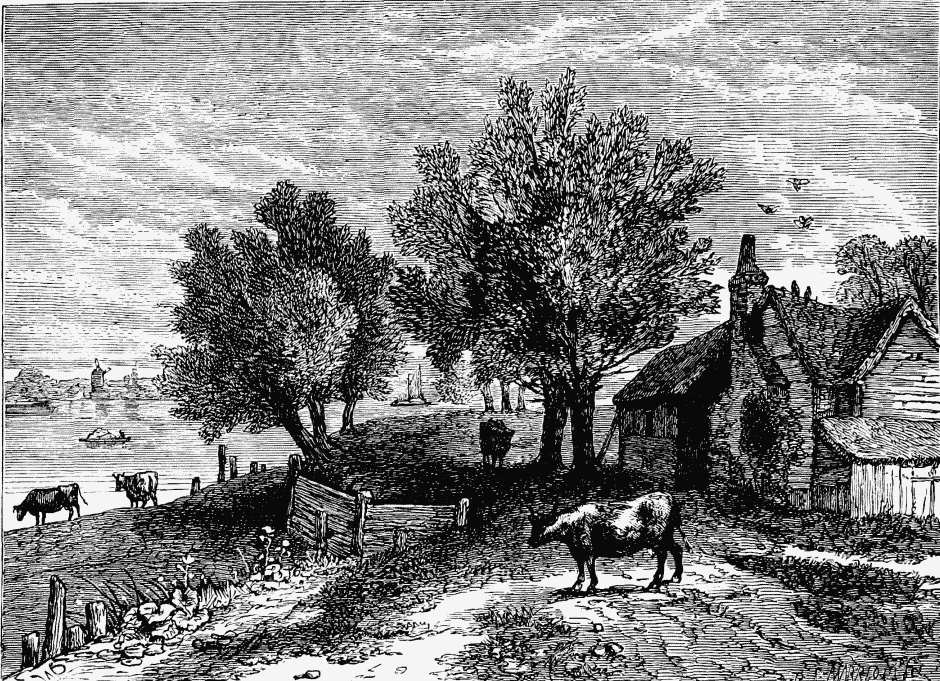
MILLBANK, ABOUT 1800.
The Great Seal, we may add, was afterwards recovered, in a net cast at random by some poor fishermen, who delivered it into the hands of the Lords of the Council.
Mr. Mackenzie Walcott, in his amusing manner, tells us how that, "very early one morning, while the watermen were dreaming of fares when they should have been at the river-side, the Duke of Marlborough with his hounds desired to cross. By good fortune one Wharton chanced to be at hand, and the duke rewarded him by obtaining a grant of the 'Ferry house' for him: the present owner is a descendant of Wharton."
Probably the last person of consequence who crossed the river here was the Princess Augusta of Saxe-Gotha, on Tuesday, April 27, 1736, on her way to be married to the Prince of Wales, the father of George III.
It sounds strange to hear that there was a Horseferry and Vauxhall Regatta as recently as 1840, but it is nevertheless true. In Colburn's "Calendar of Amusements" we read that "the arrangements made by the parochial authorities and others of the parish of St. John's, in getting up this regatta, are deserving of every encomium. The prizes, which bring into competition the watermen of Vauxhall and Westminster Horseferry, are really worth contending for—viz., two excellent wherries, and various sums of money. A steamer is engaged for the accommodation of the subscribers."
The works belonging to the Gas Light and Coke Company, which occupy a considerable space of ground between Peter Street and Horseferry Road, stand partly on the site of what was, at the beginning of the present century, the residence of a market-gardener, known as the "Bower" ale-house and tea-gardens—a name still perpetuated in that of the adjacent public-house—"The White Horse and Bower," in the Horseferry Road. These gasworks (one of the three earliest stations established by the first gas company in the metropolis, which received its charter of incorporation in 1812) owe their origin to the enterprise of a Mr. Winsor, the same who, on the evening of the King's birthday, in 1807, made a brilliant display of gas along the wall between the Mall and St. James's Park. It may be worth while to note here that the general lighting of the metropolis with gas began on Christmas Day, 1814. A branch establishment in connection with these gas-works has since been erected further westward, close by Millbank Prison, and more recently a larger establishment has been opened at North Woolwich, where the works henceforth will mainly be concentrated, so that latterly very little business has been actually carried on here.
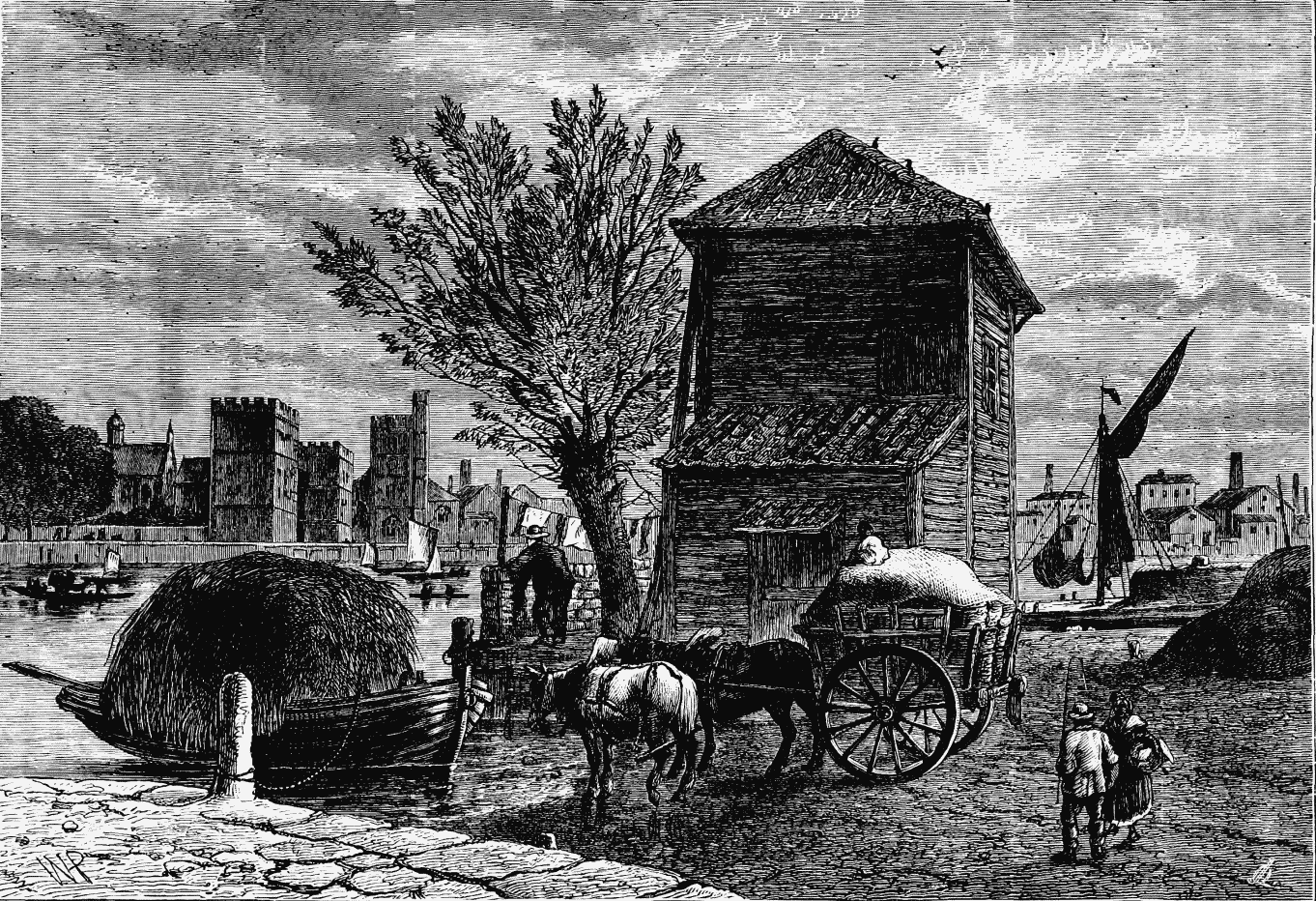
THE OLD HORSEFERRY, ABOUT 1800.
The only other buildings in Horseferry Road which we need mention are the small Roman Catholic Chapel of St. Mary, served by the Jesuit Fathers; a Wesleyan Chapel; the Westminster Training College for Schoolmasters and Practising Schools; and St. Margaret's and St. John's National Schools. The latter schools are handsome, substantial buildings, of modern construction, but erected in the late Tudor-Gothic style of architecture.
Page Street, a clean and broad thoroughfare running parallel with Horseferry Road, presents a striking contrast to most of the streets and lanes which surround it. The graveyard belonging to St. John's Church occupies the greater part of one side; it is railed in from the street, and with its surrounding trees, and level surface of turf, appears like an oasis in the wilderness. It is, perhaps, a pity that it cannot be made available as a recreation-ground for the children of this crowded neighbourhood.
A short distance from Page Street, with its frowning gateway overlooking the river, is Millbank Prison, formerly called the Penitentiary. In 1799 a plan was formed of penitentiary confinement calculated to reform offenders, and an Act of Parliament was drawn up under the direction of Sir William Blackstone, according to the suggestions of Mr. Howard, the prison philanthropist. Fifteen years after another Act was passed for carrying out the design, and a contract was entered into with Mr. Jeremy Bentham, the economist and philanthropist. It was intended as a realisation of a plan which Bentham had put forward on paper, and which he called "The Panopticon, or Inspection House," in recommendation of which scheme he published a work under that title, addressed to Mr. Pitt. The latter, though a strong Tory, entered keenly into the views of the great social reformer, but the obstinacy of George III. prevented any experiment being made in the direction of the "separate system" in London for more than twenty years. Charles Knight tells us that the cost of the site was £12,000, and that of the building has exceeded half a million, or about £500 for each cell. So it seems that felons are rather expensive luxuries for the country.
In the "Picture of London," published in the reign of George III., we read that this prison was established "for the punishment of offenders of secondary turpitude, usually punished by transportation for a term of years, since the disputes began which terminated in the separation from this country of the American States. The plan for colonising New South Wales led to a general system of expatriation to the antipodes; which, as applied to definite periods, was cruel and unjust, because the wretched objects were generally precluded from the power of returning, however short might be the intended period of their punishment! A strong and affecting memorial of the sheriffs of London led, however, to several Parliamentary notices and remonstrances against this indiscriminate mode of transportation, which was, in nearly all cases, in effect, for life; and in consequence, this place of punishment and reform was projected at Millbank, and no culprits are, we understand, in future to be sent to New South Wales, except in those enormous cases that justify irrevocable transportation."
The building stands on ground purchased of the Marquis of Salisbury; and although the Parliamentary grant for its erection was made as far back as 1799, it was not completed till 1821. It is a mass of brickwork, which, in its ground-plan, resembles a wheel, the governor's house occupying a circle in the centre, from which radiate six piles of buildings, terminating externally in circular towers with conical roofs, which give to the prison the aspect of a fortress. The ground on which it stands is raised but little above the river, and was at one time considered unhealthy. It is the largest prison in London, and contains accommodation for about 1,100 prisoners. Every convict sentenced to penal servitude in Great Britain is sent to Millbank for a term previous to the sentence being carried into effect. The external walls form an irregular octagon, and enclose an area of eighteen acres of ground, and within that space the various ranges of buildings are so constructed that the governor, from a room in the centre, is able to view every one of the rows of cells. The circular towers are connected by what may be termed curtains, which has the effect of giving the appearance of a multiplicity of sides to the building. It was first named "The Penitentiary," or "Penitentiary House for London and Middlesex," but in 1843 the name was altered, by Act of Parliament, to "Millbank Prison." Here Arthur Orton, the "claimant" of the Tichborne title and estates—the "unfortunate young nobleman doomed to languish in a prison," in the eyes of certain "fools and fanatics"—spent the first six months of his fourteen years of penal servitude.
A broad esplanade or embankment extends the whole length of the river front of Millbank Prison, and, with a broad and open thoroughfare called Ponsonby Street, leads to the foot of Vauxhall Bridge.
Vauxhall Bridge was at first called "Regent" Bridge, probably from the circumstance that the first stone on the Middlesex side was laid by Lord Dundas, as proxy for the Prince Regent (George IV.). The works were commenced in May, 1811. The first stone of the abutment on the Surrey side was laid in September, 1813, by Prince Charles of Brunswick, eldest son of the Duke of Brunswick, the same who fell soon afterwards on the field of Waterloo. The bridge was finished in August, 1816. It was built from the designs of Mr. James Walker, and cost about £300,000. The iron superstructure, consisting of nine equal arches, each seventyeight feet in span, is supported on eight rusticated stone piers, built on a foundation of wooden framing cased with stone. The length of the bridge is about 800 feet. The proximity of the bridge to the once famous gardens of Vauxhall, and the facility it was likely to afford to visitors, led to the original name being soon changed to Vauxhall. As we have now lost the gardens for ever, it is pleasant—to quote the words of Mr. Charles Knight—"to have some memorial of the spot made so familiar to us by the writings of our great men."
In Bessborough Gardens, at the foot of Vauxhall Bridge, is the beautiful church of the Holy Trinity, which was built at the expense of the Rev. W. H. E. Bentinck, Archdeacon and Prebendary of Westminster, the first stone of which was laid by Mrs. Bentinck, in November, 1849. The ground on which the church is built was given by Mr. Thomas Cubitt, M.P.; and the building—which is in the "Early Decorated" style of architecture of the time of Edward I. and II.—was erected from the designs of Mr. John L. Pearson, at a cost of about £10,000. The church will accommodate about 850 worshippers. It consists of a lofty nave, transepts, chancel, and a vestibule at the north-east corner of the chancel. The tower has a doublelighted belfry, windows and pinnacles at the corner, crocketed at the angle; and on the top of the tower is a spire rising to the height of about 200 feet.
Vauxhall Bridge Road, which extends from the Bridge and Bessborough Gardens to the western end of Victoria Street, may be regarded as forming the termination of Westminster in this direction. A large house on the eastern side of it, formerly built as a club and library for the Guards, was bought about the year 1870, by the Roman Catholic body, in order to form a residence for the "Archbishop of Westminster" for the time being, and shortly afterwards Cardinal Manning took up his abode in it. The rooms are large and lofty, and in spite of some fine pictures of Roman Catholic prelates which grace its walls, the house has anything but a palatial appearance. Not far off, and between Rochester Row and Victoria Street, it is ultimately intended to erect the Westminster Cathedral of the future; but many centuries must elapse before it equals in historic interest the venerable Abbey hard by. Its plan is that of a lofty Gothic structure of the Decorated or Edwardian style, with nave, chancel, transepts, side chapels, tower, and lofty spire.
It may, perhaps, appear strange to think of finding a Regent Street in the purlieus of Westminster; nevertheless there is one, and in passing through it, one may, of course, look in vain for such fashionable establishments as those which meet the eye in the street which most persons know by that name. Crossing Regent Street at right angles is Vincent Street, and by this latter turning we enter Vincent Square, a large space of ground covering about ten acres, which once formed part of Tothill Fields, of which we shall have more to say in our next chapter. In 1810, this plot of land was marked out as a playground for the Westminster scholars, the sum of £3 being paid for a plough and a team of horses to drive deep furrows round the site, and £2 4s. more for the digging of a trench at the north-east end, to prevent carts from passing over it, as it was then open and unfenced. Further sums were paid for levelling the surface for cricket, and for railing the ten acres in, and fixing gates. It was named after the learned Dean Vincent, who then presided over the Abbey Church.
The church of St. Mary the Virgin, in this square, was built from the designs of Mr. Edward Blore, and was consecrated in October, 1837. The Dean and Chapter gave the ground, and also granted a site for schools which have since been erected, for the accommodation of 600 children.
Rochester Row, running parallel with Vincent Square on its north side, is so called after the bishopric of that name, which was held conjointly with the deanery of Westminster by Dolben, Sprat, Atterbury, Bradford, Wilcocks, Pearce, Thomas, and Horsley. George III., it is said, condoled with Dr. Vincent on the separation of the see and the deanery. Many others of the neighbouring streets are named from clergymen connected with Westminster, as Carey and Page Streets, from the head-masters of St. Peter's College; Fynes Street, from Dr. Fynes-Clinton, of St. Margaret's; and Douglas Street, from the Rev. Prebendary Douglas.
On the north side of Rochester Row is a range of neat brick-built cottages, known as Emery Hill's Almshouses. There is a grammar-school attached to them. They were founded in 1708, to provide a home for six poor men and their wives, and for six widows, and also a school for boys.
Opposite this row of almshouses is St. Stephen's Church, which was erected and endowed about the year 1847, by Miss (now Baroness) Burdett-Coutts. It is from the designs of Mr. Benjamin Ferrey. It is built in the Decorated Gothic style of the fourteenth century, with a tower and spire on the northern side, nearly 200 feet high. The church, which is most richly decorated and picturesque, will hold about 1,000 worshippers. On the south side of the west front is a group of schools attached to the church, which afford accommodation for about 400 children; together with a parsonage, or presbytery, a portion of which forms a tower surmounted by a quaint, foreign-looking louvre.
In Francis Street, an out-of-the-way thoroughfare on the north side of Rochester Row, and only a few yards from the new and noble thoroughfare of Victoria Street, is a building of more interest, perhaps, to the criminal classes than to Londoners in general, called Tothill Fields Prison, or Bridewell, as it used to be termed. It stands out of sight, being screened from view on almost every side by new mansions taller than itself, justifying the saying of Jeremy Bentham, to the effect that "if a place could exist of which it could be said that it was in no neighbourhood, that place would be Tothill Fields."
The old Bridewell occupied the plot of ground adjoining the north side of the Green-Coat School site, on the west side of Artillery Place, and leading into Victoria Street; so that, as this same school, or "St. Margaret's Hospital," as it was formerly called, was dedicated as far back as the year 1633, to the relief of the poor fatherless children of St. Margaret's parish, it is probable that the hospital, or "abiding house," for the poor, and its next-door neighbour, the Bridewell, or "house of correction," for the compulsory employment of able-bodied but indolent paupers, were originally joint parish institutions—the one for granting relief to the industrious poor, and the other for punishing the idle. Hence these twin establishments—the one erected under James I., and the other under Charles I.—were probably among the first institutions raised for carrying out the provisions of the first Poor Law, enacted in 1601.
The Bridewell itself, which Sir Richard Steele mentions as existing in Tothill Fields at the beginning of the eighteenth century, was erected nearly a hundred years earlier, namely, in 1618, as may be seen from an inscription let into the wall of the House of Correction. "This ancient prison," says the London chronicles, "was altered and enlarged in the year 1655;" and "in corroboration of the statement," writes the author of "The Great World of London," "we find in the garden surrounding the present building the stone frame, or skeleton, as it were, of the old prison gateway, in shape like the Greek letter II , standing by itself as a memorial at the back of Bridewell." This cromlech-like relic is covered with ivy, and looks at first more like some piece of imitation ruin-work than the remains of a prison portal, for the doorway is so primitive in character (being not more than five feet ten inches high and three feet wide) that it seems hardly bigger than the entrance to a cottage; nevertheless, an inscription painted on the lintel assures us that it was "The Gateway, or Principal Entrance, to Tothill Fields Prison; erected 1665; taken down and removed to this site A.D. 1836." Colonel Despard was imprisoned in the former Bridewell in 1803.
Although originally designed as a Bridewell for vagrants, Tothill Fields was converted, we are told, in the reign of Queen Anne, into a gaol for the confinement of criminals also; and Howard, writing towards the end of the last century (1777), describes it as being "remarkably well managed" at that period, holding up its enlightened and careful keeper, one George Smith, as "a model to other governors." In 1826, however, the erection of a new prison was decided upon, and an Act for that purpose obtained. Then a different site was chosen, and eight acres of land on the western side of the Green-Coat School, and near the Vauxhall Bridge Road, were purchased for £16,000. The designs were furnished by Mr. Robert Abraham, and the building, which cost £186,000, was completed and opened for the reception of prisoners in the year 1834; soon after which the old prison was pulled down, and the relics already described transferred to the new one, as we have said, in 1836.
The new prison, which will accommodate about 900 prisoners in all, is situate on the southern side of Victoria Street. It is a solid and even handsome structure, and one of great extent as well as strength. "Seen from Victoria Street," says one London topographer—though, by the bye, it is in no way visible in that direction—"it resembles a substantial fortress." The main entrance is on the Vauxhall side of the building in Francis Street, and the doorway here is formed of massive granite blocks, and immense iron gates, ornamented above with portcullis work. "Viewed from this point," the author of "London Prisons" describes the exterior (though there is nothing but a huge dead wall and the prison gateway to be seen) as being "the very ideal of a national prison—vast, airy, light, and yet inexorably safe."
The building is said to be one of the finest specimens of brickwork in the metropolis, and consists of three distinct prisons, each constructed alike, on Bentham's "panopticon" plan, in the form of a half-wheel, i.e., with a series of detached wings, radiating, spoke-fashion, from a central lodge, or "argus," as such places were formerly styled. One of such lodges is situate, midway, in each of the three sides of the spacious turfed and planted court-yard; so that the outline of the ground-plan of these three distinct, half-wheel-like prisons resembles the ace of clubs, with the court-yard forming an open square in the centre.
The building is good in its sanitary conditions, and the death-rate is said to be lower than that of most prisons in the kingdom.
On the face of the building is a memorial stone, with the inscription recording the original purpose of its erection:—"Here are several sorts of Work for the Poor of this Parish of St. Margaret, Westminster, as also the County, according to Law, and for such as will beg and live Idle in this City and Liberty of Westminster, Anno 1655." From this it will be seen that it was originally intended as a Bridewell or House of Correction, and a place of "penitentiary amendment" of such vagrants and "sturdy beggars," and "valiant rogues" as objected to work for their living. In fact, it was meant to be a sort of penal establishment in connection with the Poor House, and, like it, maintained at the expense of the City.
Mr. Hepworth Dixon finds fault with this building as ill planned, and a "costly blunder;" and possibly such may be the case. Down to 1850 it had been appropriated to the reception of all classes of convicted prisoners, but from and after that date it has been set apart for convicted female prisoners, and for males below seventeen years old.
Speaking of Tothill Fields Prison, the witty author of the "Town Spy," published in 1725, quaintly remarks: "In the fields of this parish stands a famous factory for hemp, which is wrought with greater industry than ordinary, because the manufacturers enjoy the fruits of their own labour, a number of English gentlemen having here a restraint put upon their liberties."
The names of the various courts and alleys to the south of this prison still serve to keep in remembrance the once rural character of the locality: here is Willow Walk; close by are Pool Place, and Pond Place, and so on. Here, also, are two lofty brick buildings, which will at once attract attention: one is the hospital for the Grenadier Guards, which was erected about the year 1860, on a vacant plot of ground between Rochester Row and Francis Street; the other rejoices in the name of the Guards' Industrial Home. Close by the latter is the large and spacious building already mentioned as the residence of the "Archbishop of Westminster."
At the east end of Rochester Row, facing GreyCoat Place, is the Grey-Coat School, or Hospital, so named from the colour of the clothing worn by its inmates. It was founded in the year 1698, for the education of seventy poor boys and forty poor girls. The hospital presents a considerable frontage towards Grey-Coat Place, from which it is separated by a large court-yard. It is composed of a central building, ornamented with a clock, turret, and bell, above the royal arms of Queen Anne, with the motto "Semper eadem," flanked by a figure on either side, dressed in the former costume of the children. The south side, which looks out upon an open garden and spacious detached play-grounds (the whole surrounded by an extensive wall), contains the school-rooms. Above is a wainscoted dining-hall, used also for the private prayers of the inmates of the hospital. The dormitories occupy the whole attic storey. In the board-room—a noble panelled apartment—are portraits of the royal foundress, Queen Anne; Dr. Compton, Bishop of London; Dr. Smalridge, Bishop of Bristol; and those of other former governors. In July, 1875, the first distribution of prizes to the children was made by the Duke of Buccleuch, who congratulated the children and visitors upon the successful working of the school under the new scheme. The number of children had increased from twentyeight to upwards of one hundred.
In Strutton Ground, not far from Grey-Coat Place, was formerly a house named "the Million Gardens," where, in 1718, tickets were to be purchased for a lottery of plate, as we learn from the Weekly Journal. "The name, in reality," observes Mr. Larwood in his "History of Sign Boards," "refers to the Melon Gardens, a fruit which was often pronounced as 'Million' in the seventeenth and eighteenth centuries."
Strutton (or, as it ought more properly to be called, Stourton) Ground perpetuates the name of the Lords Stourton, whose town-house, surrounded by fair garden-grounds, once stood here. The mansion became afterwards the residence of the Lords Dacre. Opposite to Stourton House, in the days of the Stuarts, stood the residence of Lord Grey de Wilton. Both these houses are shown in Norden's Map of London in 1603.
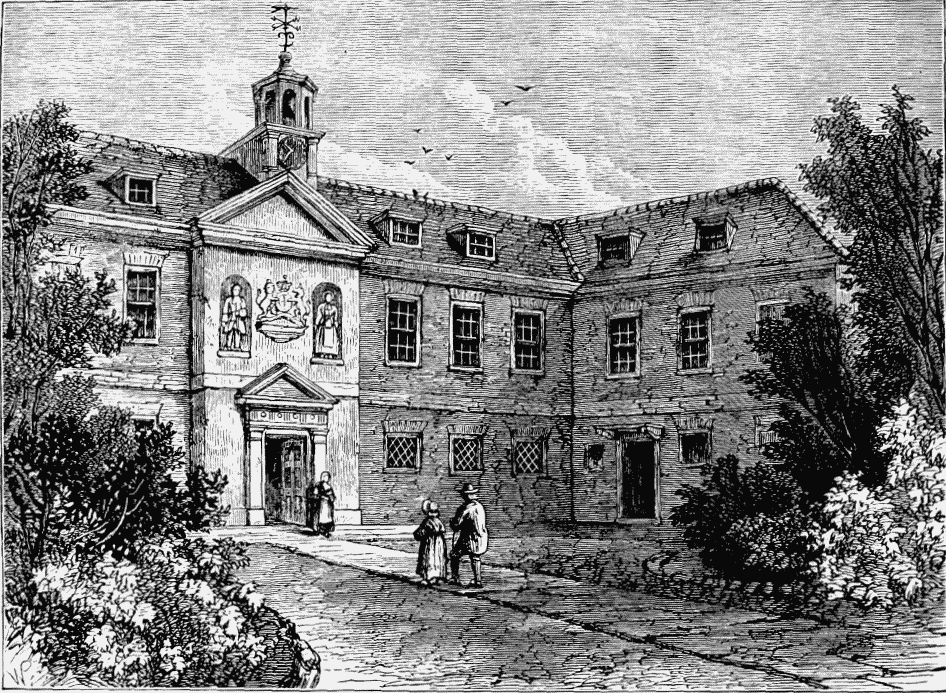
THE GREY-COAT SCHOOL. (From an Original Sketch.)
A little to the north of the district which we have been describing is, or rather was, Tothill Street, for it is now all but swept away. According to honest John Stow, it "runneth" from the west gate of the old Palace at Westminster, which gate, as we know, formerly stood at the entrance to Dean's Yard. "Herein," as Stow informs us, "is a house of the Lord Grey of Wilton; and on the other side, at the entry into Tothill Field, Stourton House, which Giles, the last Lord Dacre, purchased and built anew; whose lady and wife, Anne, left money to build a hospital for twenty poor men and so many children, which hospital," the old historian adds, "her executors have now begun in the field adjoining." This institution is now known as Dacre's Almshouses, or Emmanuel Hospital, and stands in Hopkins' Row, at the back of York Street. The house of the Lords Dacre is, or was in the year 1856, still standing in Dacre Street, leading out of the Broadway, and its gardens occupied the site of what is now termed Strutton Ground—not a very elegant variation of the name Stourton.
In an old map of Westminster, bearing date 1776, the City of Westminster seems limited within its south-western boundary to that ancient causeway, the Horseferry Road. Beyond this, toward Pimlico and Chelsea, spread the open fields, with but here and there scattered buildings. Ponds and marshy ground appear at the western end of Rochester Row, and patches of garden-ground distinguish the cultivated from the generally waste character of the soil. On the site of the present gas-works was Eldrick's Nursery, which supplied the district with fruit and flowering shrubs, as the Abbey vineyard had supplied the monks in the olden time with many a vintage, and the site of which, as we have shown above, might be traced in the thoroughfare till a recent date known as Vine Street.
It will be seen from these remarks that it has been often said the Westminster proper—that trian gular slip of the metropolis which lies between the Thames, St. James's Park, and the Vauxhall Bridge Road—can boast at once of some of the noblest and the meanest structures to be found throughout London; the grand old Abbey contrasting with the filthy and squalid Duck Lane almost as strongly as do the new Houses of Parliament and the Palace of which they form a part with the slums about the Broadway, which well nigh equal the dingy tenements which till lately stood about the Almonry, now almost absorbed into the Westminster Palace Hotel. But such is really the case. In Westminster we have the contrast between rich and poor as marked as in St. Giles's and St. James's; for almost within a stone's throw of the seat of the great Legislature of England there are, or were till recently, more almshouses, more charity schools, and more prisons, more ancient mansions, and more costermongers' hovels, more thieves' dens and low public houses, than in any other part of the metropolis of equal extent.
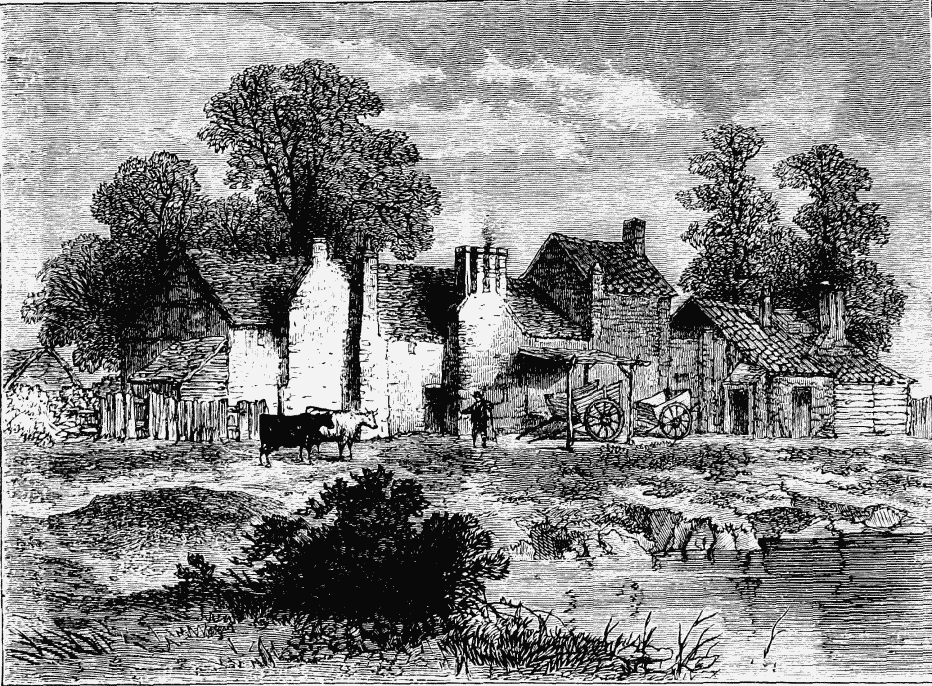
THE "FIVE HOUSES." (From an Engraving published in 1796.)
It has been sarcastically, but perhaps not undeservedly, remarked, that the City of Westminster is, and has long been, the centre of dissipation of the whole empire; and such perhaps it may be, for the region to the north of Pall Mall has been, ever since the institution of "clubs," the headquarters of luxury; while a visit to the purlieus of Westminster proper—to the south of the Abbey and Victoria Street—would serve to convince the most incredulous that dissipation does not belong to the upper classes exclusively. Here, however, as in other parts of the great metropolis, recent years have witnessed vast improvements. The building of Victoria Street, and the demolition of old buildings for the construction of the Metropolitan District Railway, necessitated the removal of some of the worst neighbourhoods of Westminster. Still, in the district bordering on the river, the general aspect of the dwellings is to a great extent unchanged.