Old and New London: Volume 4. Originally published by Cassell, Petter & Galpin, London, 1878.
This free content was digitised by double rekeying. Public Domain.
Edward Walford, 'Westminster: St. James's Park', in Old and New London: Volume 4(London, 1878), British History Online https://www.british-history.ac.uk/old-new-london/vol4/pp47-60 [accessed 1 May 2025].
Edward Walford, 'Westminster: St. James's Park', in Old and New London: Volume 4(London, 1878), British History Online, accessed May 1, 2025, https://www.british-history.ac.uk/old-new-london/vol4/pp47-60.
Edward Walford. "Westminster: St. James's Park". Old and New London: Volume 4. (London, 1878), British History Online. Web. 1 May 2025. https://www.british-history.ac.uk/old-new-london/vol4/pp47-60.
In this section
CHAPTER V.
ST. JAMES'S PARK.
"A spark
That less admires the Palace than the Park."—Pope.
Storey's Gate—Origin of "Birdcage Walk"—The Wellington Barracks—Origin of the Guards—Mr. Harrington's House—Office of the Duchy of Lancaster—St. James's Park in the Reign of Henry VIII.—Rosamond's Pond—Charles II. and his Feathered Pets—Duck Island—Le Notre employed in Laying out and Improving the Park—The Decoy—The King and his Spaniels—William III.'s Summer-house—St. James's as a Deer-park—Le Serre's Description of the Park—Pepys' Account of the Works carried out here by Charles II.—The "Physicke Garden"—Waller's Poetic Description of the Park—The Canal—The Ornithological Society—The Waterfowl—Woodcocks and Snipes—Historical Associations of St. James's Park—Cromwell and Whitelock—Oliver Goldsmith—Peace Rejoicings after the Battle of Waterloo—Albert Smith's Description of St. James's Park and its Frequenters—The Mohawks—The Chinese Bridge—Skating on the "Ornamental Water"—Improvements in the Park by George IV.—The Horse Guards' Parade—Funeral of the Duke of Wellington—Robert Walpole and the Countryman—Dover House.
At the western end of Great George Street, which we have already described, we find ourselves at Storey's Gate, the entrance of St. James's Park. This gate was so called from one Master Edward Storey, the "keeper of the king's birds," whose house stood on the spot. This fact has been doubted; but that Storey's Gate was so named after a real personage is proved by the entry in the registers of Knightsbridge Chapel, in the reign of Charles II., of the marriage of one Thomas Fenwick, "of St. Margaret's, servant to Storey, at ye Park Gate, and Mary Gregory, of ye same."
The birds, which were among the most innocent toys and amusements of the "merry monarch," were kept in aviaries ranged in order along the road which bounds the south side of the Park, and extends to Buckingham Palace, and which is still known by the significative name of "Birdcage Walk." To corroborate this derivation, we may mention here that the carriage-road between Storey's Gate and Buckingham Gate was, until 1828, open only to the Royal Family and to the Hereditary Grand Falconer, the Duke of St. Albans.
About one-half of the south side of Birdcage Walk, extending from Queen Anne's Gate to Buckingham Gate, is occupied by the Wellington Barracks, which consist of lofty and commodious ranges of buildings, for the use of the household troops. The barracks were first occupied by troops in the year before the battle of Waterloo. In the Military Chapel, which was opened in 1838, are preserved the tattered flags and standards which were taken by Marlborough at Blenheim, and formerly hung in the Chapel Royal at Whitehall.
As there were no barracks during the reign of Charles II., and as by the Petition of Right it was declared unlawful to billet soldiers on private families, the alehouses and smaller inns of Westminster were always filled with privates of the regiments of Guards, which, from the first establishment of a standing army have been generally stationed on duty near Whitehall and St. James's. Macaulay thus gives us the history of the origin of the Guards:—"The little army formed by Charles II. was the germ of that great and renowned army which has in the present century marched triumphant into Madrid and Paris, into Canton and Candahar. The Life Guards, who now form two regiments, were then distributed into three troops, each of which consisted of two hundred carabineers, exclusive of officers. This corps, to which the safety of the king and royal family was confided, had a very peculiar character. Even the privates were designated as 'Gentlemen of the Guard.' Many of them were of good families, and had held commissions in the Civil War. Their pay was far higher than that of the most favoured regiment of our time, and would in that age have been thought a respectable provision for the younger son of a country squire. Their fine horses, their rich houses, their cuirasses, and their buff coats, adorned with ribbons, velvet, and gold lace, made a splendid appearance in St. James's Park. A small body of grenadier dragoons, who came from a lower class, and received lower pay, was attached to each troop. Another body of household cavalry distinguished by blue coats and cloaks, and still called the Blues, was generally quartered in the neighbourhood of the capital. Near the capital lay also the corps which is now designated as the First Regiment of Dragoons, but which was then the only regiment of dragoons on the English establishment."
At the commencement of the present century a handsome building of one storey high, in the Chinese style, was, by order of Government, erected on the left angle of the recruiting-house, in the Birdcage Walk, for the purpose of serving as the armoury for the whole brigade of Guards. It consisted of four archways on the basement for the field-pieces, the room over it being for the small arms, and a range of rooms in the back, for cleaning. The two front angles had each a small house, one for a serjeant-major, and the other for a guard-room. This, we may infer, was the beginning of the barracks on this spot.
Near this part, as Aubrey tells us, a Mr. James Harrington had a "versatile timber house." He describes it as "built in Mr. Hart's garden, opposite to St. James's Park." "This eccentric individual," says Aubrey, "fancied that his perspiration turned to flies and bees, ad cætera sobrius. To try the experiment, he would turn this house to the sun and sit towards it; then he had fox-tayles there, to chase away and massacre all the flies and bees." Mr. Harrington is said to have spent the last twenty years of his life in a house in the Little Almonry, near Dean's Yard, of which Aubrey gives us a curious description. "In the upper storey he had a pretty gallery, which looked into the yard, over a court, where he commonly dined and meditated, and smoked his tobacco."
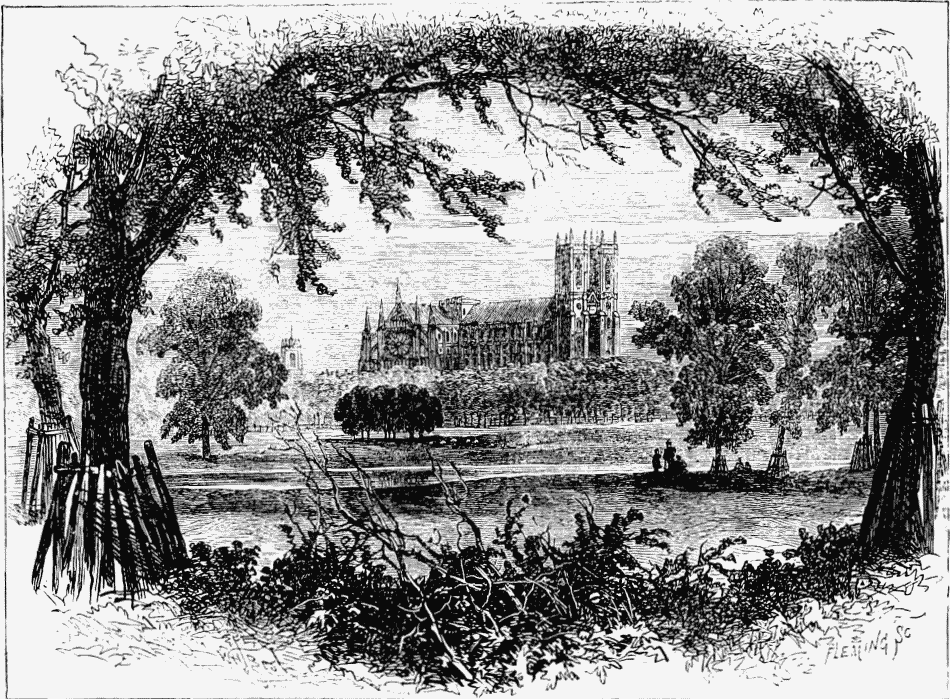
WESTMINSTER ABBEY FROM ST. JAMES'S PARK, ABOUT 1740.
At the western end of Birdcage Walk is the Duchy of Lancaster office, where all business relative to the revenues of the Prince of Wales, in right of that duchy, is transacted.
St. James's Park itself, which we now enter, was originally a low and swampy meadow, belonging to the Hospital for Lepers, which in due course of time was converted, by the royal will and pleasure of "Bluff King Hal," into "our Palace of St. James's."
It was by the order of Henry that the meadow was drained and enclosed, formed into a "nurscry for deer," and made also "an appendage to the Tilt-yard at Whitehall." At first this was but a small enclosure inside four brick walls; but in course of time Henry VIII. added a "chase," which he threw out, like a wide open noose, from his palace at Westminster, forming, where the line of it fell, a large circle, which ran from St. Giles-inthe-Fields, up to Islington, round Highgate and Hornsey and Hampstead Heath, and so back again by Marylebone to St. Giles's and Westminster; and he forbade all his subjects of every degree either to hawk or hunt within those boundaries. Though little more than three centuries and a half have passed away since this royal proclamation was issued, yet almost every mark of it has long since been blotted out. Edward VI. and Mary possessed no share of their "bluff" father's destructiveness, and the whole chase was gradually "disafforested."
Still, however, St. James's Park retains its verdant and rural character, and in it there are spots where the visitor may sit or walk with every trace of the great city around him shut out from his gaze, except the grey old Abbey, against the tall roof of which the trees seem to rest, half burying it in their foliage, just as they must have done three centuries ago.
In the south-west corner, near Birdcage Walk, and opposite to James Street and Buckingham Gate, was formerly a small sheet of water, known as "Rosamond's Pond," to which reference is constantly made in the comedies of the time as a place of assignation for married ladies with fashionable roués. The pond was made to receive the water of a small stream which trickled down from Hyde Park, and it is shown in one or two very scarce prints by Hogarth. It was filled up in 1770, soon after the purchase of Buckingham House by the Crown.
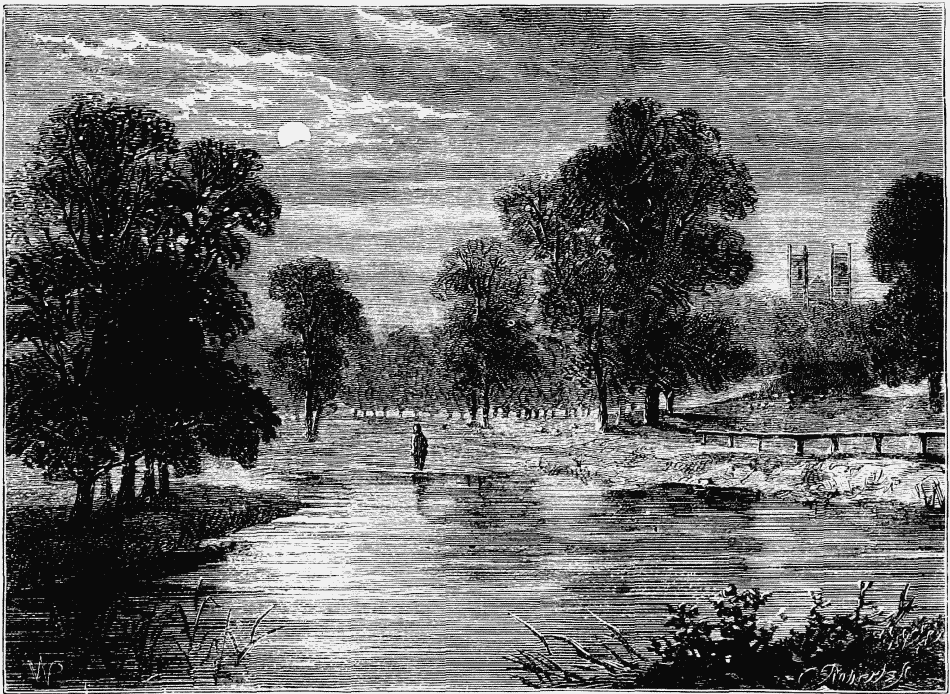
"ROSAMOND'S POND" IN 1758.
It is to its character as recorded above, and as
being, in the words of Bishop Warburton to Hurd.
"long consecrated to disastrous love and elegiac
poetry," that Pope thus mentions it in the Rape
of the Lock:—
"This the blest lover shall for Venus take,
And send up vows from Rosamonda's lake."
The same is the drift of a dialogue in Southerne's
comedy, The Maid's Last Prayer.
"Rosamond's Pond," writes the author of "A New Critical Review of the Public Buildings," &c., "is another scene where fancy and judgment might be employed to the greatest advantage; there is something wild and romantic round the sides of it, of which a genius could make a fine use, if he had the liberty to improve it as he pleased." He adds, "The banks of it ought to be kept in better repair; and if a Venus in the act of rising from the sea with the Graces round her were raised in the midst of it, it would be neither an improper nor an useless decoration." From the same essay we gather that at this date the vineyard close by was in a most scandalously neglected state, and required much labour and art to make it a tasteful addition to the park. As to the Birdcage Walk, the writer calls it "exceeding pleasant, the swell of the ground in the middle having an admirable effect on the vista," and commanding a "simple and agreeable view down to the canal." He urges, however, that variety should be studied in its arrangement, and that the circle of trees should be made the "centre of a beautiful scene;" in which case it would become "one of the most delightful arbours in the world." "Its romantic aspect, the irregularity of the ground, the trees which overshadowed it, and the view of the venerable Abbey, not only rendered it," writes Mr. Jesse, "a favourite resort of the contemplative, but its secluded situation is said to have tempted a greater number of persons, and especially of 'unfortunate' females, to commit suicide than any other place in London."
St. James's Park must have been a rural and pleasant enclosure in the reign of Charles II., when the avenues of trees were first planted along the northern side of the park, where now is the gravel walk known as "The Mall," under the direction of Le Notre, the French landscape gardener, who was also commissioned to lay out and improve the whole; and when the south side was really, as its name still implies, a walk hung with the cages of the king's feathered pets. Its rural character, at that time, may be inferred from the title of Wycherley's successful comedy, Love in a Wood, or St. James's Park, which was first acted in 1672. Close by, at the west end of the water, which was in those days straight, and generally known as the "Canal," was a small decoy and an island, called "Duck Island," over which the celebrated St. Evremond was set as "governor" with a small salary. To this we find Horace Walpole alludes in a tone of pleasant banter when, recording in 1751 the appointment of Lord Pomfret as ranger of St. James's Park, he adds, "By consequence, my Lady [Pomfret] is queen of the Duck Island."
As to the island in the canal, the writer of the "New Critical Review" (1736) speaks of it—with some exaggeration, no doubt—as being on the one side a wilderness and a desert, and on the other "like a paradise in miniature;" he complains that "the water is allowed to grow stagnant and putrid, and that the trees, shrubs, and banks all wanted attention"—remarks which show that whoever at that time was the "ranger" of the park must have had little eye for either beauty or taste. The canal itself appears to have been 100 feet in breadth and 2,800 feet long.
Duck Island was abolished and made into terra firma towards the close of the last century. In fact, "the island," says Pennant in 1790, "is lost in the new improvements."
Pope, who did not approve of Le Notre's stiff
and formal style, censures him for the want of
good sense—in company, it may be observed,
with no less a master than Inigo Jones:—
"Something there is more needful than expense,
And something previous e'en to taste—'tis sense;
Good sense, which only is the gift of Heaven,
And, though no science, fairly worth the seven;
A light which in yourself you must perceive,
Jones and Le Notre have it not to give."
It is difficult to say to what omission Pope here makes special allusion. Le Notre was largely employed by Le Grand Monarque, Louis XIV., who also ennobled him. He died at Paris in the year 1700.
The "decoy" above mentioned consisted of five or six straight pieces of water all running parallel to each other and to the canal itself, with which they communicated by narrow openings.
King Charles appears to have been particularly fond of St. James's Park. We are told he would sit for hours on the benches in the walk, amusing himself with some tame ducks and his dogs, amidst a crowd of people, with whom he would talk and joke. It is fancied by some persons that no dogs are now left of the breed popularly called King Charles's breed, except a few very beautiful black-and-tan spaniels belonging to the late Duke of Norfolk, and which used to run riot over Arundel Castle much in the same way that their canine forefathers were formerly allowed to range about the palace at Whitehall. Charles was foolishly fond of these dogs; he had always many of them in his bedroom and his other apartments; as also so great a number of these pets lounging about the place, that Evelyn declares in his "Diary" that the whole court was made offensive and disagreeable by them.
Hard by, in a grove which rose round and between the miniature canals, a little later was a "tea-house" or rather summer-house, erected by order of William III.; a place where that saturnine king would sometimes spend a summer evening with those of his friends whom he admitted into his confidence.
Although the park comprises less than ninety acres, Charles II. made a strict enclosure of the centre portion, which he surrounded with a ring fence for deer. "This day," writes Samuel Pepys, in his "Diary," under date August 11, 1664, "for a wager before the King, my Lord of Castlehaven, and Lord Arran, a son of my Lord Ormond's, they two alone did run down a stout buck in St. James's Park." During the reigns of Elizabeth and the first two Stuarts, the park was little more than a nursery for deer, and an appendage to the Tilt-yard of Whitehall. In the reign of Charles I. a sort of royal menagerie took the place of the deer with which the "inward park" was stocked in the days of Henry and Elizabeth. It was often called the Inner or Inward Park, and apparently was not freely accessible to the public at large. At all events, Pepys tells us on one occasion in 1660 that when he went to walk there, he "could not get in," and saw "one man basted by the keeper for carrying some people over on his back through the water."
Le Serre, a French writer, in his account of the visit of the Queen-Mother, Mary de Medicis, to her daughter, Henrietta Maria, and Charles I., in the year 1633, mentions several particulars of St. James's Palace, as well as of the park, and the then state of the neighbourhood. The palace he calls the "Castle" of St. James's; and describes it as embattled, or surmounted by crenelles on the outside, and containing several courts within, surrounded by buildings, the apartments of which (at least, those which he saw) were hung with superb tapestry, and royally furnished. "Near its avenue," says he, "is a large meadow, continually green, in which the ladies always walk in the summer. Its great gate has a long street in front, reaching almost out of sight, seemingly joining to the fields, although on one side it is bounded by houses, and on the other by the Royal Tennis Court;" then, after noticing the gardens, and the numerous fine statues in them, he adds, "These are bounded by a great park, with many walks, all covered by the shade of an infinite number of oaks, whose antiquity is extremely agreeable, as they are thereby rendered the more impervious to the rays of the sun. This park is filled with wild animals; but, as it is the ordinary walk of the ladies of the court, their [viz., the ladies'] gentleness has so tamed them, that they all yield to the force of their attractions rather than the pursuit of the hounds."
Pepys, in his gossiping manner, records from time to time the progress of the works carried out here by Charles II. Thus, in his "Diary," September 16, 1660, he writes:—"To the park, where I saw how far they had proceeded in the Pell Mell, and in making a river through the park, which I had never seen before since it was began." Again, a month later, October 11: "To walk in St. James's Park, where we observed the several engines to draw up water, with which sight I was very much pleased. Above all the rest, I liked that which Mr. Greatorex brought, which do carry up the water with a great deal of ease." Further, under date July 27, 1662, we find this entry:—"I to walk in the park, which is now every day more and more pleasant, by the new water upon it."
Evelyn, in his "Diary," in April, 1664, tells us how that he went "to the Physicke Garden in St. James's Parke," and there "first saw orange-trees and other fine trees." The exact position of these gardens is not known now; and as allusions to them are of rare occurrence, in all probability they were allowed to pass away and be forgotten, when a botanic garden on a larger scale was commenced under the highest auspices at Chelsea.
In 1661 we find the courtly Waller thus commemorating the improvements which had then
been recently made in the park:—
"For future shade, young trees upon the banks
Of the new stream appear, in even ranks;
The voice of Orpheus, or Amphion's hand,
In better order could not make them stand.
* * * * * *
All that can, living, feed the greedy eye,
Or dead the palate, here you may descry;
The choicest things that furnish'd Noah's ark,
Or Peter's sheet, inhabiting this park,
All with a border of rich fruit-trees crown'd,
Whose lofty branches hide the lofty mound.
Such spacious ways the various valleys lead,
My doubtful Muse knows not what path to tread.
Yonder the harvest of cold months laid up,
Gives a fresh coolness to the royal cup;
There ice, like crystal, firm and never lost,
Tempers hot July with December's frost;
* * * * * *
Here a well-polished Mall gives us the joy,
To see our Prince his matchless force employ."
The most beautiful parts of St. James's Park are the walks beside the Ornamental Water, which is still called "the canal," in memory of its former unsightly shape. The water is alive with waterfowl, for whose comfort and protection a quiet and secluded island, with the Swiss cottage of the Ornithological Society, is reserved, at the southeastern extremity, nearly on the site of the old "decoy." The waterfowl here are natives of almost every climate in the world, and the Zoological Society itself has scarcely a finer or more varied collection. Those which are not foreign are mostly descendants of the ducks which Charles II. took such pleasure in feeding with his own royal hands. Around the "canal" stand many fine trees, which throw their green shadows into the water, "broken at times by a hundred tiny ripples which have been raised by the paddles of some strange-looking duck, or thrown up by the silverbreasted swans," as Mr. Thomas Miller quaintly remarks in his "Picturesque Sketches of London." It is almost needless to add that the banks of the "canal," and the bridge which spans it, are the haunt of children and their nurses, and the pieces of bread and biscuit which are given daily to the ducks, geese, and swans would well-nigh feed the inmates of a workhouse. At the western end of the lake there is a small island richly clothed with verdure, and also a fountain. The "Swiss cottage" above mentioned was erected in 1841, by means of a grant of £300 from the Lords of the Treasury. It contains a council-room, keeper's apartments, and steam-hatching apparatus; contiguous are feeding-places and decoys, and the aquatic fowl breed on the island, making their own nests among the shrubs and grasses. The waterfowl of the park can, at all events, boast that they have held undisturbed possession of the lake for more than two centuries. Pepys writes, under date of August, 1661:—"To walk in St. James's Park, and saw a great variety of fowls which I never saw before."
In Land and Water of November 6th, 1869, Lord Lansdowne mentions having picked up a snipe, on the 26th of the previous month, under the wall of the Treasury Gardens, on the Horse Guards' Parade. It lay at the foot of a lamp, among some leaves, which had prevented the attention of passers-by being attracted. The spot was out of the line which any one carrying dead game could have taken, and the position in which the bird lay was that in which it might have fallen rather than been dropped. The lamp spoken of is opposite the end of the piece of water in St. James's Park. On examination at the office of Land and Water it was found to be a common jack-snipe. Its bill was fractured across, just at the point where it unites with the skull. It was probably flying at a great pace, and, attracted by the light of the lamp, flew against the iron post, when the force of the concussion killed it on the spot.
In the same publication, in March, 1873, a correspondent writes:—"As I was walking through St. James's Park, about ten a.m. on the 21st inst., a woodcock crossed me, flying rapidly and low, from the direction of the barracks towards Marlborough House. It was well within gun-shot when I first saw it, and as my view of it as it crossed the water was quite unimpeded, I cannot for a moment question the accuracy of my observation, though in the case of such a rara avis I regret that I cannot produce a witness. In sending you this notice I am induced to add a list of the birds which I have noticed in St. James's Park during the past twelvemonth, as likely to interest those who think there are no birds but sparrows in London. They are:—1, sparrow-hawk, seen once flying from the east, in early morning; 2, great tit; 3, cole-tit; 4, blue tit, all occasionally seen; 5, fly-catcher, constant in summer; 6, rook; 7, jackdaw; 8, starling in small flocks when not breeding; 9, missel-thrush, once; 10, fieldfare, a small flock once in late autumn, one foggy morning; 11, song-thrush, constant; 12, blackbird, constant, the males seeming much more numerous than the females; 13, swallow; 14, martin; 15, swift, only once or twice; 16, pied wagtail, not unfrequent, but not apparently constant; 17, skylark, rare, generally flying high, and apparently moving on; 18, chaffinch, not common; 19, sparrow (passer, passim); 20, greenfinch, not common; 21, hedge-sparrow, constant; 22, robin-redbreast, constant; 23, whitethroat, constant in summer on the eastern island, where its song is unmistakable; 24, wren, probably constant; 25, golden-crested wren, once only; 26, wood-pigeon, flying over in flocks in early morning, also once or twice birds probably strayed from Kensington Gardens, where they are common; 27, peewit, once, a flock flying north one foggy morning; 28, woodcock, once. Besides these I may mention the linnet, blackcap, willow-warbler, and wryneck, of which I cannot be quite positive, and last, not least, the Guards' raven, constant while his battalion is in town, on the trees near Buckingham Gate. Perhaps some other Cockney ornithologist will be able to verify and add to the above list."
A good story is told by Mr. W. C. Hazlitt respecting the waterfowl in this park and a young gentleman, a clerk in the Treasury, not over-gifted with brains, who used to feed the ducks with bread as he went daily from his home in Pimlico to the office. One day, having called the birds, as usual, he found that he had no bread in his pockets, and so threw a sixpence into the water, telling them to buy some. On reaching the office, he told the story with perfect simplicity to his fellow-clerks, with one of whom he was engaged to dine the next day. His friend accordingly ordered ducks for dinner, telling the cook to put a sixpence in the stuffing of one of them. The next day came, and with it the dinner, in the course of which the sixpence was found inside one of the birds, and the young man vowed that he would have the poulterer prosecuted for robbing the king, "for," said he, "I assure you, on my honour, that only yesterday I gave this very sixpence to one of the ducks in the park!"
St. James's Park is replete with historical associations, not the least interesting of which is the fact of Charles I. having passed through it on foot on the morning of his execution, from his bedchamber in St. James's Palace to the scaffold at Whitehall. The king, as he passed along on that fatal morning, is said to have pointed to a tree which had been planted by his brother, Prince Henry, near Spring Gardens.
Strype, the historian, gives us a picture of the Princess Elizabeth's life during the reign of her brother, Edward VI., under date March 17th, 1551:—"The Lady Elizabeth, the King's sister, rode through London into St. James's, the King's Palace, with a great company of lords, knights, and gentlemen; and after her a great company of ladies and gentlemen on horseback, about two hundred. On the 19th she came from St. James's through the Park unto the Court (at Whitehall), the way from the Park gate unto the Court being spread with fine sand. She was attended with a very honourable confluence of noble and worshipful persons of both sexes, and received with much ceremony at the Court gate." What would one not have given to have seen the young princess, thus gaily caparisoned, and in all her pride and beauty, before time had ploughed wrinkles on her brow, and ere the strong passions of middle life had stamped her countenance with their tell-tale marks!
Here Cromwell, as he walked with Whitelock, asked the latter, "What if a man should take upon him to be a king?" To which the memorialist replied, "I think that the remedy would be worse than the disease."
It is said that late in life Milton met James II., then Duke of York, whilst taking the air in the park. The duke, addressing him, asked whether the poet's blindness was not to be regarded as a judgment from Heaven upon him for daring to take up his pen against Charles I., his (the duke's) father, and his "own sovereign?" "Be it so, sir," replied Milton; "but what then must we think of the execution of your Royal Highness's father upon a scaffold?" The story may be true or false: at all events it has been often told, and told as having happened here: we may say of it certainly, "Si non e vero, e ben trovato."
It may be added that the Princess Anne escaped twice from Whitehall through St. James's Park, once when she joined her husband and the Prince of Orange, and again when the palace was in flames.
This park was a favourite resort of Oliver Goldsmith. In his "Essays" we read that, "If a man be splenetic, he may every day meet companions on the seats in St. James's Park, with whose groans he may mix his own, and pathetically talk of the weather." The strolling player takes a walk in St. James's Park, "about the hour at which company leave it to go to dinner. There were but few in the walks, and those who stayed seemed by their looks rather more willing to forget that they had an appetite than to gain one."
Between the years 1770 and 1775 some extensive repairs and improvements were made in
the park; but notwithstanding this fact, the "rough
and intolerable" manner in which the walks were
still kept caused much discontent and grumbling
among its more fashionable habitués. Thus, for
instance, in October, 1775, a letter appeared in the
Middlesex Journal, addressed to Lord Orford, the
ranger of the park, complaining bitterly of the disgraceful state of the walks. After some sarcastic
remarks upon the delays of the workmen's wages,
the writer plainly says that the public intend to
petition his Majesty "on the subject of this unbearable grievance," and to "sign their real names;
which," he adds, "my lord, if all the complainants
should do, I presume their number would far
exceed that of any address ever presented." The
writer finally proceeds to give vent to his feelings,
and to entreat his Majesty for some instalment of
reform, in the following lines, which he heads with
the words—
AN ADDRESS TO THE KING.
"'Tis yours, great George, to bless our safe retreats,
And call the Muses to their native seats,
To deck anew the flow'ry sylvan places,
And crown the forest with immortal graces.
Though barb'rous monarchs act a servile strain,
Be thine the blessings of a peaceful reign;
Make James's Park in lofty numbers rise,
And lift her palace nearer to the skies.'
The park, in 1780, was occupied as a camp by several regiments of militia, during the alarm and panic caused by the Gordon riots. A print is extant which shows the long line of tents extending from east to west, from the "decoy" to "Rosamond's Pond," and to the south of the canal, and the king paying to the camp his daily visit.
On the occasion of the visit of the Allied Sovereigns, in 1814, Mr. Redding writes in his "Fifty Years' Recollections," "I stood without the iron palisades of Buckingham Old House. It was a childish affair there. But the illumination of the streets was really fine. Every window was lit up, and the blaze of light, from so great a mass of buildings, was thrown grandly upon the heavens. The park of St. James was prettily arranged with lamps in the trees, like another Vauxhall. A wooden bridge with a sort of tower, over the canal in St. James's Park, was illuminated too brightly. The edifice took fire, and the tower was consumed. One or two persons were killed."
The grand fête, which had long been in preparation, took place on the 1st of August, and an official programme was issued, in which the public were informed that a beautiful Chinese bridge had been thrown over the canal, upon the centre of which had been constructed an elegant and lofty pagoda, consisting of seven pyramidal storeys. "The pagoda to be illuminated with gas lights; and brilliant fireworks, both fixed and missile, to be displayed from every division of the lofty Chinese structure. Copious and splendid girandoles of rockets to be occasionally displayed from the summit, and from other parts of this towering edifice, so covered with squibs. Roman candles, and pots de brin, as to become in appearance one column of brilliant fire. Various smaller temples and columns on the bridge to be vividly illuminated; and fixed fireworks of different devices on the balustrade of the bridge to contribute to heighten the general effect." The fireworks set light to the pagoda and burnt its three upper storeys. The canal was well provided with handsomely decorated boats at the disposal of those who wished to avail themselves of this amusement. The whole margin of the lawn was surrounded with booths for refreshment, open marquees with seats, &c. The Mall and the Birdcage Walk were illuminated with Chinese lanterns.
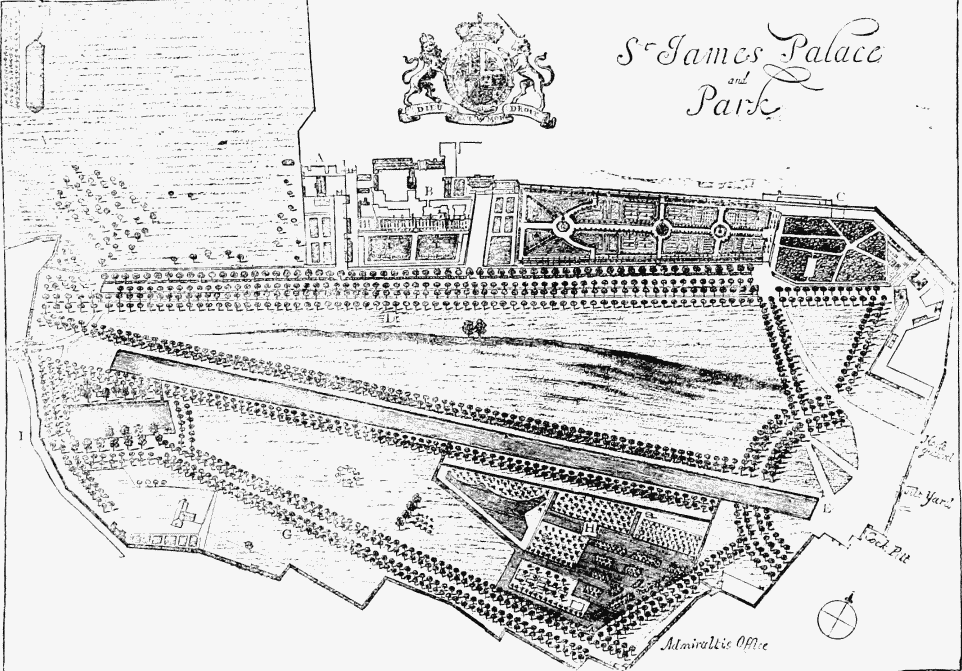
PLAN OF ST. JAMES'S PALACE AND PARK IN THE TIME OF CHARLES II. (From a large Plate by Kuyff.)
A. Cleveland House.
B. St. James's Palace.
C. The Spring Garden.
D. The Mall.
E. The Canal.
F. Rosamond's Pond.
G. Birdcage Walk.
H. Duck Island and the Decoy.
Among the residents in St. James's Park was the eccentric Duke of Montagu, whose name is still remembered in connection with humorous frolics. In passing daily along the Mall he noticed a careworn-looking man, with threadbare clothes, whom he discovered to be an officer on half-pay, with a wife and a large family, whom, for the sake of economy, he had been obliged to send down into Yorkshire. One day the duke sent a message asking him to dine with him next Sunday, and when his guest arrived he told him that he had asked a lady to meet him who had a most tender regard for him. On entering his grace's diningroom he found his wife and children, whom the duke had brought up to London from Yorkshire; and before he left the house the duke's solicitor brought out, and the duke signed, a deed settling on him an annuity of £200 a year. It is a pity that such practical jokes are not more ofter played by wealthy dukes and noble lords.
Here, at one time, used to take his daily walk the jovial and genial wit and poet, Matthew Prior, whom Gay calls, "Dear Prior, beloved by every muse." Swift and Prior were very intimate, and the latter is frequently mentioned in the "Journal to Stella." "Mr. Prior," writes Swift, "walks to make himself fat, and I to keep myself down: we often walk round the park together."
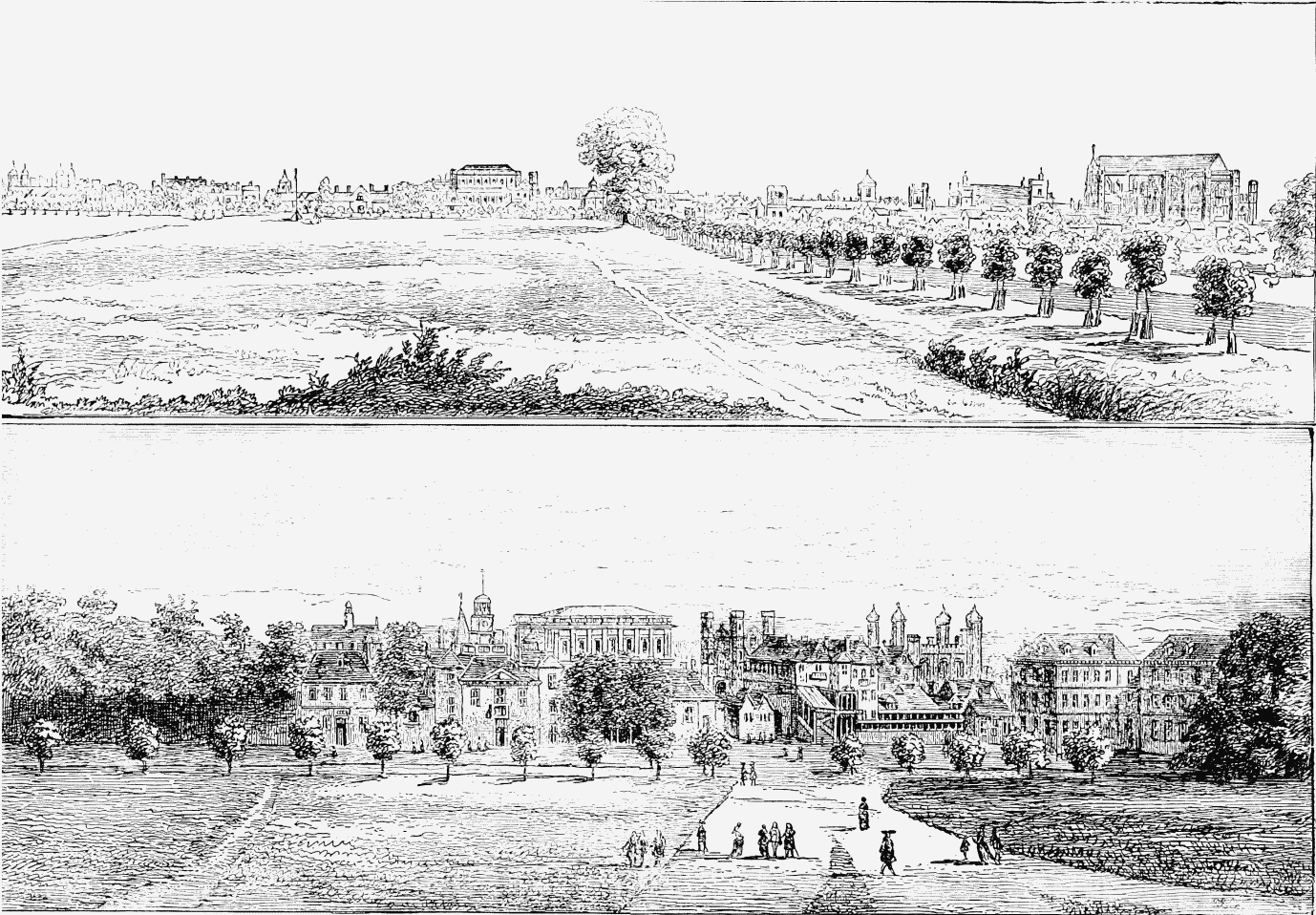
TWO OLD VIEWS IN ST. JAMES'S PARK, ABOUT 1680. (From Engravings by S. Rawle published in 1804 by F. T. Smith.)
Englishmen, as a rule, are not fond of out-door lounging, and, except in the extreme heat of the summer, they prefer taking the air on horseback or on a river steamer, or even on a railway, to sitting still on chairs and gazing leisurely on a green lawn and green trees, as they do in Paris by thousands. But in spite of this national tendency to in-door comforts, the Park of St. James's asserts its attractions so strongly, that at whatever time of the day we visit it, the seats have no lack of occupants; and in the hot days of July and August, when the West-End is emptied of all rank and fashion, thousands of "roughs" and idlers may be seen lying sound asleep on the grass under the shade.
Albert Smith has left us a graphic description of the scenes witnessed daily in the park, both in our own day and in days long gone by, which we here take the liberty of quoting:—"Although we do not find such crowds of idlers in the park at the present day, possibly the types encountered are more distinct. We say at the present day, because formerly the gayest of the gay thronged the walks, including royalty itself, with its attendant suite. Dear old Pepys has left us a mass of little mems thereanent. See where he says, on the 16th of March, 1662, that, while idling there in the park, 'which is now very pleasant,' he 'saw the King and Duke come to see their fowle play.' In 1661, in April, he says, 'To St. James's Park, where I saw the Duke of York playing at pall-mall, the first time that ever I saw the sport.' And later, which is quaintly interesting, he writes: 'Dec. 15. To the duke, and followed him into the park, where, though the ice was broken, he would go slide upon his skaits, which I did not like, but he slides very well.' We can imagine that Pepys was not strong upon skates. The first tumble—and nobody learns to skate without being sorely contused—would have been quite sufficient to have disgusted him with this then novel amusement. We find, however, that the love of feeding the ducks and skating in the park has not diminished. Afterwards, he tells us how he saw the King and Queen, with Lady Castlemaine and Mrs. Stuart cum multis aliis, walking about. He adds: 'All the ladies walked, talking and fiddling with their hats and feathers, and changing and trying one another's heads, and laughing. But it was the finest sight to see, considering their great beauties and dress, that ever I did see in all my life.'
"Evelyn is a little more scandalous. He says, on March 1, 1671:—'I once walked with the King through St. James's Park to the garden, where I both saw and heard a very familiar discourse between Mrs. Nellie, as they called an impudent comedian; she looking out of her garden on a terrace at the top of the wall, and——standing on the green walk under it. I was heartily sorry at this scene. Thence the King walked to the Duchess of Cleveland' (the Lady Castlemaine of Pepys), 'another lady of pleasure, and curse of our nation.' Horace Walpole, eighty years afterwards, speaks of receiving a card from Lady Caroline Petersham to go with her to Vauxhall. 'And the party that sailed up the park, "with all our colours flying,"' he says, 'consisted of the Duke of Kingston, Lady Caroline, Lord March, Mr. Whitehead, 'a pretty Miss Beauclerc, and a very foolish Miss Sparre.' He adds, that 'Lady Caroline and little Ashe—or the Pollard Ashe, as they called her—had just finished their last layer of red, and looked as handsome as crimson could make them, and that they marched to their barge with a boat of French horns attending, and little Ashe singing.'
"Now-a-days the idlers in the park remind us but little of the personages in the above extracts. Poverty is far more frequently encountered there than wealth; and more, we fear, walk there to dine with 'Duke Humfrey' than to get an appetite for a meal elsewhere. At early morning, when the air is clearest, you encounter few persons; nor, somewhat later, do you find the crowds assembled to read the papers and discuss the politics after breakfast, as in Paris. You may, perhaps, encounter a student reading hard at some uninviting-looking book, and stumbling over the withies bent into the shuffled-out grass, as he moves along; or, perchance, an actor, as he threatens the lower boughs of the larger trees with his stick (most actors carry sticks), while he is rehearsing his part in some forthcoming play. And yet, lonely as the park is at this time, and half deserted, it is seldom chosen for the purpose of tender declarations, avowals, promises, oaths, quarrels, and all the other usual accompaniments of courtship. No: in this respect, perhaps, those chiefly concerned show their wit. The world—with its broad daylight, its tumultuous noise, and its distracted eyes—is far more adapted for secrecy than the shade and the retreat; and more than this, society will always lend itself as an accomplice of things which are not sought to be concealed.
"Towards noon, a movement of laughing mirth and noise commences by the arrival of the children and their nursery-maids; and in the children lies, in our opinion, the greatest attraction here offered—even beyond the ducks—the real zoological ducks. Not that we think slightingly of feeding them. We have heard, by the way, that it was one of the great O'Connell's favourite délassemens, and that he enjoyed it as much as the smallest fellow capable of tossing a bit of biscuit. It is great fun to see the rush made after a morsel: how the birds flash through the water to obtain it, and how, as in every community, the strongest always gets it. But if you want to enjoy the sport to perfection, throw in one of the small round rolls you get at evening-party supper-tables, and a fearful tumult is created. The prize is much too large for them to get hold of, as it is too valuable to be relinquished; and so it is pushed and floated about, and vainly pecked at, surrounded by the whole tribe, squabbling, splashing, and fluttering—swayed, like large crowds, here and there—until it gets sufficiently soft to be accessible to their bills, when its consumption is speedily achieved.
"But to return to the children. We mean especially those who have not yet numbered eight years, and whose limbs have still all the smooth roundness of infancy. There is something very pleasing in their graceful movements, their fresh cheeks, and their beautiful hair, and a perfect charm in their gaiety; in the innocent joy sparkling in their eyes, and the pure and living blood colouring their cheeks, which our brightest belles would give so much to imitate. This attraction, perhaps, belongs only to those who run about; albeit it takes a great deal to beat the saucy beauty of an English baby. It is almost enough to make one a convert in favour of matrimony, even in these 'fast' times. The only pity is that these little people should ever be destined to become men."
The parks, though nominally they belong to royalty, are yet always regarded as somehow or other the property of the people. It was but an assertion of this principle that was uttered by Walpole, when, in reference to a design that was at one time entertained by one of the early Georges, of shutting up St. James's Park and converting it into a royal garden, and in answer to the question as its probable cost, he answered, "May it please your Majesty, only three crowns."
Since the time of Charles II., succeeding kings have given the people the privilege of walking in the park, and William III. granted to the public an entrance through the Spring Garden. The walks in the enclosure and the seats scattered about in such profusion beneath the shade of its trees have been a celebrated spot for love-making ever since the days of Charles II., and the park itself is often mentioned in this association in the works of the comic dramatists of the Stuart times. Horace Walpole tells us that "pretty ladies" who walked in the park were sometimes "mobbed" by the crowd—a proof, if proof be needed, that other ages were not less marked by vulgarity than our own.
Like other parts of town, the park appears to have been frequented by those lawless rascals, the Mohocks, or Mohawks, of whom we have already made mention. Swift, for instance, writes under date of March, 1712, that he "walked in the park, and came home early to avoid the Mohocks;" and apparently not without good reason, for, a day or two afterwards, a party of these armed ruffians assaulted a female servant of Lady Winchilsea's, at her mistress's garden-gate, "cutting her face and beating her without provocation."
It had been for many previous years the favourite amusement of dissolute young men to form themselves into clubs and associations for the cowardly pleasure of fighting and sometimes maiming harmless foot-passengers, and even defenceless women. They took various slang designations. At the Restoration they were Muns and Tityre-Tus; then Hectors and Scourers; later still, Nickers (whose delight it was to smash windows with showers of halfpence), Hawkabites, and lastly Mohocks. These last, as we learn from No. 324 of the Spectator, took their title from "a sort of cannibals in India, who subsist by plundering and devouring all the nations about them." Nor was the designation inapt; for if there was one sort of brutality on which they prided themselves more than another, it was in tattooing, or slashing people's faces with, as Gay wrote, "new invented wounds." They began the evening at their clubs, by drinking to excess in order to inflame what little courage they possessed; they then sallied forth, sword in hand. Some enacted the part of "dancing masters," by thrusting their rapiers between the legs of sober citizens in such a fashion as to make them cut the most grotesque capers. The hunt spoken of by Sir Roger de Coverley was commenced by a "view hallo!" and as soon as the savage pack had run down their victim, they surrounded him, and formed a circle with the points of their swords. One gave him a puncture in the rear, which very naturally made him wheel about; then came a prick from another; and so they kept him spinning like a top till in their mercy they chose to let him go free. An adventure of this kind, in which the savages figure under the name of "Sweaters," is narrated in No. 332 of the Spectator.
Mr. John Timbs, in his "Curiosities of London," tells us that the park, as well as the palace, sheltered persons from arrest; for, in 1632, one John Perkins, a constable, was imprisoned for serving the Lord Chief Justice's warrant upon John Beard in St. James's Park. To draw a sword in the park was also a very serious offence. Congreve, in his Old Bachelor, makes Bluffe say, "My blood rises at that fellow. I can't stay where he is; and I must not draw in the park." Traitorous expressions, when uttered in St. James's Park, were punished very severely. Thus, Francis Heat was whipped, in 1771, from Charing Cross to the upper end of the Haymarket, fined ten groats, and ordered a month's imprisonment, for here saying aloud, "God save King James III., and send him a long and prosperous reign!" and in the following year a soldier was whipped in the park for drinking a health to the Duke of Ormond and Dr. Sacheverel, and for saying he "hoped soon to wear his right master's cloth." The Duke of Wharton, too, was seized by the guard in St. James's Park for singing the Jacobite air, "The king shall have his own again."
Fairthorne's plan of St. James's, taken shortly after the Restoration, shows the north half of the parade occupied by a square enclosure, surrounded by trees, with one tree in the centre; and in the lower part of the parade broad running water, with a bridge of two arches in the middle. Later views show the park with long rows of young elm and lime trees, fenced with palings, and occasionally relieved by some fine old trees. A view of this park is worked in as a background to one of Hollar's charming and well-known etchings of the "Four Seasons."
Over the canal in this park during the Regency, when a taste for Eastern monstrosities of the kind was so prevalent, was built a little Chinese bridge, mainly of wood; but already, in 1823, it was beginning to fall to decay. Canova, when asked what struck him most forcibly during his visit to England in the year 1815, is said to have replied, "that the trumpery Chinese bridge in St. James's Park should be the production of the Government, whilst that of Waterloo was the work of a private company."
During the winter months, when the "ornamental water" is frozen over, this spot is much resorted to for the purposes of skating and sliding; but the scene presented is doubtless very different now-a-days to what it was two centuries ago, when, as Pepys tells us in his "Diary" (December 1, 1662), he went "to my Lord Sandwich's, … and then over the parke, where I first in my life, it being a great frost, did see people sliding with their skates, which is a pretty art." Evelyn, too, has the following entry under the same date:—"Having seene the strange and wonderful dexterity of the sliders in the new canal in St. James's Park, performed before their Majesties by divers gentlemen and others, with scheets, after the manner of the Hollanders, with what swiftness as they pass, how suddenly they stop in full career on the ice, I went home."
The park appears soon to have become a resort for all classes, for under date December 4, 1683 (when there was a very hard frost), the Duke of York records—"This morning the boys began to slide upon the canal in the park."
St. James's Park, much as we now see it, was laid out by George IV. between the years 1827 and 1829. In form, the enclosure takes somewhat the shape of a boy's kite, the head or broad part of which, towards Whitehall, is bordered by some of the principal Government offices—the Admiralty, the Horse Guards, the Treasury, and the India and Foreign Offices; at the opposite end is Buckingham Palace. In 1857, a suspension bridge for foot-passengers was thrown across the water, so as to form a direct communication between Queen Square and St. James's Street; and the bed of the lake was at the same time cleared out and raised, so that its greatest depth of water does not exceed four feet.
"Amongst the many improvements which have contributed to the convenience and ornament of the metropolis," writes Walker, in his "Original," in 1835, "none are more striking than those in the parks. The state in which they are kept does great credit to those who have the management of them. The right-lined formalities of St. James's Park seemed almost to defy the efforts of taste; and I could not have conceived that without any advantages of ground the straight 'canal' and unpromising cow-pasture could have been metamorphosed into so graceful a piece of water, and so beautiful a shrubbery. In walking round the water, almost at every step there is a new and striking point of view of buildings and foliage. Buckingham Palace, Carlton Terrace, the Duke of York's Column, St. Martin's Church, the Horse Guards, Westminster Abbey, and other inferior objects, seen between and over the trees, form a combination and a variety I have never before seen equalled. … What a pity it is that the original design of making a gradual descent from Waterloo Place into St. James's Park was not allowed to be carried into execution! Besides the beauty of the plan, a horse-entrance there would have been an immense convenience to a numerous class. As that, however, is now out of the question, the nearest practical approach to it seems to be by the macadamisation of Pall Mall, with an entrance into the Park, if that could be permitted, between Marlborough House and the Palace. I know not how that would affect the Palace, but if it would be no inconvenience to royalty, it certainly would be a great boon to the equestrian public."
It is a pleasant task to record here the fact that in little more than a quarter of a century after the above-quoted words were written the entrance to St. James's Park between Marlborough House and St. James's Palace was thrown open, by permission of Her Majesty and the Ranger, not only to the "equestrian public," but to the commonalty who employ cabs and hired carriages, and that for such vehicles a right of way has been granted by the Queen to Pimlico and South Belgravia, across the once sacred precinct of the Royal Mall in St. James's Park, and under the very windows of Buckingham Palace.
It has always been the tradition of the Court to grant as little as possible to the public a right of way through St. James's Park. The following story, told of George I., shows that the privilege was not always allowed even to the children of a Stuart sovereign:—"Soon after his accession to the throne, the Duchess of Buckingham, a natural daughter of James II., asked for a passage for her carriage through the park, but was met with a polite refusal. She at once wrote off a letter to the king, abusing him in the grossest terms compatible with her character as a lady, affirming that he was an usurper, and that she had a better right to go through the park than a Hanoverian upstart. The king, instead of being offended, laughed, saying, 'The poor woman is mad, let her pass;' and thereupon gave an order that both her Grace and any other mad daughter of a Stuart king, who cared to obtain the privilege, might use it freely."
The park is still regularly patrolled at night by two of the horse guards whenever Her Majesty is in town—a standing proof of the old feeling of the insecurity of retired parts of London when entrusted to the old watchmen, or "Charlies." It was not till 1822 that St. James's Park was lighted with gas, although Pall Mall, adjoining, had been so lit fifteen years before.
The large open space laid down with gravel in front of the Horse Guards is popularly called the Parade, from the fact that the household troops are paraded here almost every day. Here, too, reviews of the troops occasionally take place; as, also, such ceremonies as the presentation of medals to those of our "brave defenders" who may have taken part in foreign campaigns.
Here are two military trophies, curious pieces of foreign ordnance: the one is a large Turkish gun, captured by the English troops in Egypt, under Sir Ralph Abercromby; the other is an immense mortar, cast at Seville by command of the great Napoleon; it was used by the French under Marshal Soult at the siege of Cadiz, in 1812, but abandoned by them subsequently at Salamanca. Mr. Larwood, in his amusing book on the "London Parks," states that the carriage of the mortar was made at Woolwich under the direction of the Earl of Mulgrave: its ornamentation is said to bear reference to King Geryon, a monster with three bodies and three heads, whom Hercules slew at Cadiz, after "lifting" his anthropophagous cattle. Jekyll, the famous punster, however, explained it differently, and said that the dogs' heads were merely placed on it in order to justify the Latin inscription, which is certainly of a somewhat canine species.
As to the "Parade," a writer calls it (in the reign of George II.) a "grand and spacious area," and capable of being made one of the chief beauties "about the town," if surrounded by "noble and august buildings," and adorned with an equestrian statue to the memory of some departed hero. He suggests that it would be a fit place for the erection of one in particular to "the great and immortal Nassau"—meaning King William III.—and adds, "It is true that he has once been denied this piece of justice, but they were not soldiers who were guilty of so great an indignity." It is not, however, clear to what abortive attempt at doing justice to the "pious and immortal memory" of King William the writer means to allude.
Upon the Parade was marshalled the state funeral procession of the great Duke of Wellington, on the 18th of November, 1852. The body was removed from Chelsea Hospital on the previous midnight, and deposited in the audience-chamber at the Horse Guards. Beneath a tent erected on the parade-ground was stationed the funeral car, whereon the coffin being placed, and the command given, the cortége, in a slow and solemn manner, moved down the Mall, past Buckingham Palace, whence the procession was seen by Her Majesty and the Royal Family, before it made its way to St. Paul's.
We have already mentioned the fact that Sir Robert Walpole, when Prime Minister, lived constantly at the Treasury, at the corner of Downing Street. In the last century there was a carriage entrance to his house on the side of the park. A good story is told of a scene which occurred here. A countryman from Norfolk, having failed to obtain a post under Government, though recommended by one of Sir Robert Walpole's supporters in Parliament, resolved to trudge up to London, and to push his own request in person. Accordingly, he took up his quarters at the "Axe and Crown," an hostelry close by the Premier's house, and knocked at Sir Robert's door, but without success. The servants, however, told him that if he could speak to Sir Robert in person as he stepped into his chariot, he would be sure to get what he wanted. Accordingly, for two or three days he watched the Premier go out, and at last waylaid him in the act of entering his chariot, and came out plump with his demand, adding that the post had been asked for him by his friend the M.P. for—."Well, my good man," said Sir Robert, "call on me another morning." "Yes, an please your honour, I'll be here and call on you every morning until I get the place." The man was as good as his word, and every day for at least a fortnight was at the same spot at the same hour, and made his bow to the Premier, who was either so amused or wearied with his blunt importunity, that he sent him back to Norfolk the richer and, it may be hoped, the happier, by the gift of a tide-waitership.
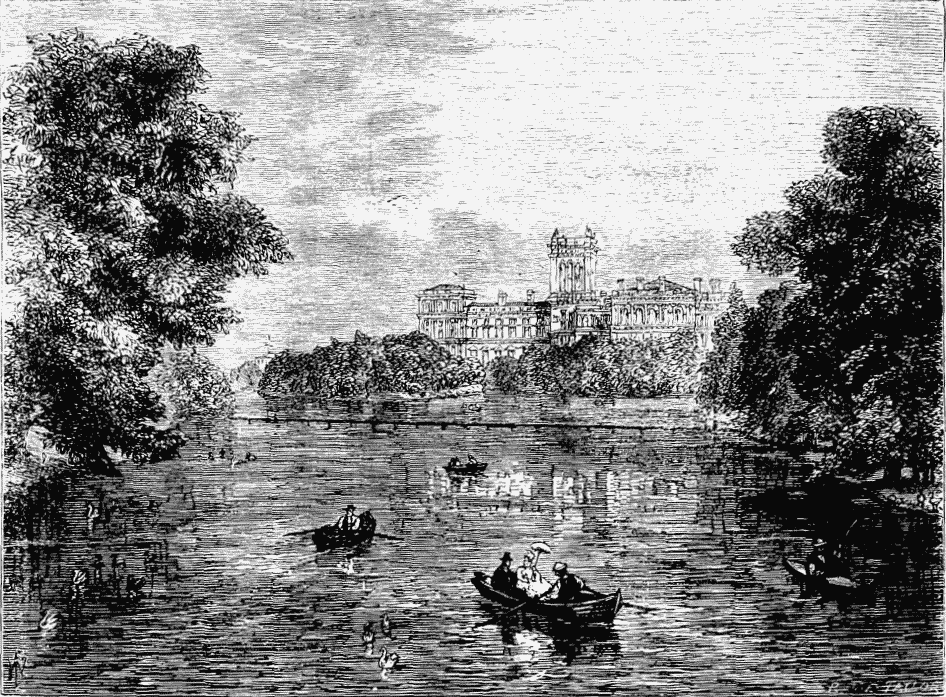
THE INDIA FOREIGN OFFICE, FROM ST. JAMES'S PARK.
Between the Treasury and the Horse Guards is seen the back of Dover House (already mentioned in a former chapter), where the late Lord Dover made a very choice gallery of paintings. His early death, which took place in July, 1833, was much regretted by society at large. He was the author of a "Life of Frederick the Great;" "The True History of the State Prisoner, the Man in the Iron Mask;" "Historical Enquiries respecting the Character of Edward Hyde, Earl of Clarendon." He also edited "Horace Walpole's Correspondence" and "The Ellis Correspondence."
In the reign of the two first Georges, and perhaps even more recently, the situation of Dover House was quite rural; so much so indeed that the author of "A New Critical Review of the Public Buildings," in 1736, thus expresses himself about it:—"We will now step into the park, where we shall see a house in the finest situation, with the whole canal and park in prospect, yet so ob scured with trees that, except in the garrets, it cannot have the advantage of either. Surely there can be no excuse for so egregious a mistake but that the house itself is in so wrong a taste that it was the owner's interest to hide it."