
Old and New London: Volume 4. Originally published by Cassell, Petter & Galpin, London, 1878.
This free content was digitised by double rekeying. All rights reserved.
'The Mall and Spring Gardens', in Old and New London: Volume 4, (London, 1878) pp. 74-85. British History Online https://www.british-history.ac.uk/old-new-london/vol4/pp74-85 [accessed 25 April 2024]
In this section
CHAPTER VII.
THE MALL AND SPRING GARDENS.
"The ladies gaily dress'd the Mall adorn
With various dyes and paint the sunny morn."—"Gay's Trivia."
The Game of Mall—Discovery of Mailes and Balls used in playing the Game—Formation of the Mall, and Mr. Pepys' Visits thither—The Mall a Powerful Rival to the Ring in Hyde Park—Charles II. and Dryden—Courtly Insignia worn in Public—Congreve, the Poet—A Capuchin Monastery—French Huguenot Refugees—The Duke of York's Column—"Milk Fair"—Spring Gardens—A Bowling-green established there—Duels of frequent occurrence there—The Spring Garden closed, and a Rival Establishment opened—A Part of the Royal Menagerie kept in Spring Gardens—Courtier Life in the Reign of Charles I.—Mistaken Notions as to the Origin of the Name of Spring Gardens—King Charles on his Way to Execution—Thomson, the Poet—The "Wilderness"—Berkeley House—The Metropolitan Board of Works—The Celebrated Mrs. Centlivre—"Locket's Ordinary"—Drummond's Bank—The Old Duchess of Brunswick—Sir Astley Cooper and other Noted Residents—Spring Gardens Chapel—Its Destruction by Fire—St. Matthew's Chapel-of-Ease—The Medical Club—The Tilt-yard Coffee House—Warwick Street and Warwick House—Escape of Princess Charlotte in a Hackney Coach—Her Return to Warwick House—Exhibitions and Entertainments in the Neighbourhood—The "Rummer" Tavern—Prior, the Poet—Dr. Isaac Barrow and the Earl of Rochester—Pepys in the Hands of the Modeller—Miscellaneous Exhibitions in Cockspur Street—Origin of the Name of Cockspur Street—The "British Coffee House."
On leaving Buckingham Palace, we walk through the Mall, on the north side of St. James's Park. This once fashionable lounge and promenade is described by Northouck as "a vista half a mile in length, at that time (Charles II.) formed with a hollow smooth walk skirted round with a wooden border, and with an iron hoop at the further end, for the purpose of playing a game with a ball called mall." The iron hoop was suspended from a bar of wood at the top of a pole, and the play consisted in striking a ball through this ring from a considerable distance.
In Timbs' "Curiosities of London" we read that in 1854 were found in the roof of the house of the late Mr. B. L. Vulliamy, No. 68, Pall Mall, a box containing four pairs of the mailes, or mallets, and one ball, such as were formerly used for playing the game of pall-mall upon the site of the above house, or in the Mall of St. James's Park. "Each maile was four feet in length, and made of lance-wood; the head was slightly curved, measuring outwardly 5½ inches, the inner curve being 4½ inches; the diameter of the maile-ends was 2½ inches, each shod with a thin iron hoop; the handle, which was very elastic, was bound with white leather to the breadth of two hands, and terminated by a collar of jagged leather. The ball was of box-wood, 2½ inches in diameter." These relics of a bygone, almost forgotten game were presented to the British Museum by Mr. George Vulliamy.
The "Mall" is the name now conventionally given to the wide gravel walk running under the windows of Carlton Terrace, from the Green Park as far as Spring Gardens. This was not the original "Mall" of the days of Charles II., which seems to have lain to the north, and to have been as nearly as possible identical with "the present street of Pall Mall." No doubt, when a new and broad thoroughfare like the old one, and so close to it, was opened in its place to the public, the name was transformed the more easily and obviously, as the former, like the present, was the northern boundary of the park, and indeed formed part of it.
Under date of April 2, 1661, there is an entry in Pepys' "Diary" which implies that the "Pell Mell" was then newly finished:—"To St. James's Park, where I saw the Duke of York playing at Pellmell, the first time that ever I saw the sport." And on the 15th of May, 1663, he tells us how that he "walked in the parke, discoursing with the keeper of the Pell Mell, who was sweeping it." It appears to have been covered with fine gravel, mixed with cockle-shells finely powdered and spread to keep it fast; which, "however," complains Mr. Samuel Pepys, "in dry weather turns to dust and deads the ball." In the following January the diarist is here again, and in his record of this visit, says it pleased him "mightily" to "hear a gallant, lately come from France, swear at one of his companions for suffering his man (a spruce blade) to be so saucy as to strike a ball while his master was playing on the Mall."
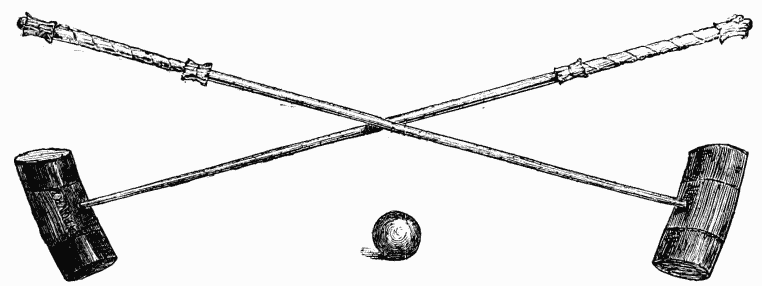
PALL MALL IMPLEMENTS. (From the British Museum.)
Since the reign of Charles II. the Mall had become a powerful rival to the Ring in Hyde Park. In Etheredge's "Man of Mode" (1676), a young lady observes that the Ring has a better reputation than the Mall; "but," says she, "I abominate the dull diversions there, the formal bows, the affected smiles, the silly bywords and amorous tweers in passing; here [in the Mall] one meets with a little conversation now and then." On the other hand, the Ring had this advantage, that it gave the opportunity for displaying a carriage, horses, and smart livery. Equipages at that time became more and more the fashion, and to be seen afoot in the Mall was by many considered the height of vulgarity. There appeared in 1709 a satire, entitled "The Circus, or the British Olympus," in the preface of which occurs the following remark:—"If gentlemen are never such dear companions now, they must have no conversation together but upon equal terms, lest some should say to the man of figure, 'Bless me, sir! what strange, filthy fellow was that you bow'd to parading in the Mall, as you were driving to the Ring?'"
The following story of the Mall, though told in "Spence's Anecdotes," will amuse many of our readers to whom it may be news:—"It was Charles II. who gave to Dryden the hint for writing his poem called 'The Medal.' One day, as the king was walking in the Mall and talking with Dryden, he said, 'If I were a poet … … I would write a poem on such a subject in the following manner, and then gave him the plan for it. Dryden took the hint, carried the poem as soon as it was written to the king, and had a present of a hundred broad pieces for it."
The Mall was a fashionable lounge, and is constantly alluded to in the anecdote literature and gossip of the Stuart and Hanoverian times. Thus Swift tells "Stella" that "when he passes the Mall in the evening, it is prodigious to see the number of ladies walking there;" and, speaking of St. John says, "His father is a man of pleasure that walks the Mall, and frequents St. James's Coffee House, and the Chocolate House."
In the time of the first and second Georges it was usual for noblemen of the highest rank to wear the insignia of their orders in public places. The writer of the "Town Spy" for instance, tells us, in 1725, how he was walking in the Mall with a gentleman whom he had met "at a coffee-house within the verge," when there passed before them "a nobleman vested with a blue Garter." His servants, he adds, "were worried about by the people to know what duke it was. It turned out, however, to be only an earl after all."
Congreve, the poet, was one of the gallants who were fond of displaying their fine dress in the haunts of fashion. Hence Thackeray's remark, that "Louis Quatorze in all his glory is hardly more splendid than our Phœbus Apollo of the Mall and the Spring Garden."
Close to St. James's Palace, nearly on the site where now stands the German chapel, was built, in the reign of Charles II., a monastery for the use of the Capuchin monks who attended Catherine of Braganza. It is thus described by Pepys in his "Diary," under date January 23, 1666–7:—"My Lord Brounkir and I walking into the park, I did observe the new buildings; and my lord seeing I had a desire to see them, they being the place for the priests and friers, he took me back to my Lord Almoner; and he took us quite through the whole house and chapel, and the new monastery, shewing me most excellent pieces in wax-worke; a crucifix given by a Pope to Mary Queene of Scotts, wherein is a piece of the Cross; two bits set in the manner of a cross in the foot of the crucifix; several fine pictures, but especially very good prints of holy pictures. I saw the dortoire and the cells of the priests, and we went into one; a very pretty little room, very clean, hung with pictures, set with books. The priest was in his cell, with his hairclothes to his skin, bare-legged with a sandall only on, and his little bed without sheets, and no feather bed; but yet, I thought, soft enough. His cord about his middle; but in so good company, living with ease, I thought it a very good life. A pretty library they have, and I was in the refectoire, where every man has his napkin, knife, cup of earth, and basin of the same; and a place for one to sit and read while the rest are at meals. And into the kitchen I went, where a good neck of mutton at the fire, and other victuals boiling. I do not think they fared very hard. Their windows all looking into a fine garden and the park; and mighty pretty rooms all. I wished myself one of the Capuchins."
In the reign of William III. we find a congregation of the French Huguenot refugees established in the "French Chapel Royal," St. James's.
On the site of what is now the basement or substructure of Carlton House Terrace, which nearly the whole distance eastward bounds the north side of the Mall, was once a row of fine old trees, which overhung the road by the park-wall. Half way along the Terrace is an opening from Waterloo Place, formed by command of William IV., as had been the Spring Garden Gate, more than a century earlier, by William III.
The column which crowns the steps leading up from the park into Waterloo Place was erected by public subscription in 1830–33, to the memory of the late Duke of York, many years Commander-inChief. The cost of it was £26,000. It consists of a plain circular shaft of Aberdeen granite about 120 feet high, from the designs of Mr. B. Wyatt. The statue of the duke which surmounts it is the work of the late Sir Richard Westmacott, R.A.
The column and statue, as might be expected,
was the subject of many witticisms. Take, for instance, the following lines in the New Monthly
Magazine:—
"Thou pillar, longitudinally great,
And also perpendicularly straight.
* * * * *
Thou art, I fear, but flattery's handiwork,
Being a tribute unto royal York.
Thy royal highness (ah! too like to His)
Prompts us somewhat to stare, somewhat to quiz.
Railing surrounds above thy lofty brow,
And passers-by do likewise rail below.
That mortal Prince whom thou to Cherubim
Wouldst raise, what record canst thou give of him?
Of his great deeds few words the Muse can dish up;
But, for his virtues, was he not a bishop?"
The allusion in the last line is to the fact that the duke enjoyed by courtesy the lay title of Prince-Bishop of Osnaburg.
At the end of the Mall, in the shade of the tall
trees, near the Spring Gardens entrance, is an
"institution"—if we may so call it—of considerable
date, and a proof of the former rural character of
the spot, which has flourished here perhaps almost
since the formation of the Mall. It is known as
"Milk Fair," and is held by a privilege granted
from royalty to the gatekeepers. In Tom Brown's
time (1700) the noisy milk-fools in the park cried,
"A can of milk, ladies! A can of red cow's milk,
sir!" If we may judge from a fashionable conceit
in Gay's "Trivia," we may conclude that not only
cows' but asses' milk was at one time sold here as
a restorative for bodily ailments—
"Before proud gates attending asses bray,
Or arrogate with solemn pace the way;
These grave physicians with their milky cheer,
The love-sick maid and dwindling beau repair."
It may be added, that the vendors of milk of the present day in Spring Gardens are almost, without exception, descendants from those who have had their stalls here for the last century or more.
Spring Gardens—more properly "The Spring Garden"—as late as the reign of Elizabeth, and possibly down to a still more recent date, was a rural garden. This spot bears its name from a fountain or "spring" of water, which in the days of Queen Bess was set in motion by the spectator treading on some secret machinery, which proved a novel puzzle for the good people of Westminster.
Hentzner, in his "Travels" (1598), thus describes the scene:—"In a garden belonging to this palace there is a jet d'eau, with a sun-dial, at which, while strangers are looking, a quantity of water forced by a wheel which the gardener turns at a distance, through a number of little pipes, plentifully sprinkles those that are standing around." Mr. P. Cunningham assures us that such watersprings as this were common in gardens in the days of Queen Bess, and that one of the same kind was to be seen at Chatsworth as late as 1847. Be this, however, as it may, Nares, in his "Glossary," tells us that the Spring Garden described by Plot was in existence at Enstone, in Oxfordshire, in 1822.
This place appears to have been a sort of adjunct to the Royal Palace of Whitehall, though "across the road," and to have been covered occasionally with scaffolds, in order to enable "the quality" to see the tilting in the Tilt-yard. It contained a pleasant yard, a pond for bathing, and some butts to practise shooting.
Charles I., by royal patent in 1630, made it a "bowling-green," but the patent was revoked, and the "bowling-green" brought to an untimely end. four years later. The reason of the withdrawal of its licence may be gathered from the following extract from a letter addressed by a Mr. Gerrard to Lord Strafford:—"There was kept in it an ordinary of six shillings a meal, when the king's proclamation allows but two elsewhere; continual bibbing and drinking wine all day under the trees; two or three quarrels every week. It was grown scandalous and insufferable; besides, my Lord Digby being reprehended for striking in the king's garden, he said he took it for a common bowling place, where all paid money for their coming in." It is clear from this that Lord Digby thought that if he only paid for admission, he had a right to "strike" where and whom he pleased; and if this was the general idea entertained by "persons of quality," it is not difficult to see how "two or three quarrels"—or, in other words, duels—would arise there every week.
One result of the shutting up of the "Spring Garden" was the opening of a rival, the "New Spring Garden," by one of the Lord Chamberlain's household, too. It appears, however, that the old place was re-opened ere long; for in June, 1649, John Evelyn paid it a visit, "treating divers ladies of his relations," as he tells us in his "Diary." Under date May 10, 1654, however, he writes:—"My Lady Gerrard treated us at Mulberry Garden, now the only place of refreshment about the towne for persons of the best quality to be exceedingly cheated at; Cromwell and his partisans having shut up and seized on the Spring Garden, which till now had been the usual rendezvous for the ladys and gallants at this season." In spite of the sour-visaged Puritans, however, its gates were again thrown open; for the writer of "A Character of England," published five years later, thus speaks of it, and in the present tense:—"The inclosure is not disagreeable, for the solemnness of the grove, and the warbling of the birds, and as it opens into the spacious walks at St. James's." He adds:—"It is not unusual to find some of the young company here till midnight; and the thickets of the garden seem to be contrived to all advantages of gallantry, after they have refreshed with collation, which is here seldom omitted, at a certain cabaret in the middle of this paradise, where the forbidden fruits are certain trifling tarts, neats' tongues, salacious meats, and bad Rhenish."
Soon after the Restoration, a part at least of the ground occupied by these rival places of amusement seems to have been built over, and distinguished as the "inner" and the "outer" Spring Garden respectively; a trace of which probably still remains in the present name of Spring Gardens. Prince Rupert occupied a house in Spring Gardens from 1674 until his death.
We have already in a previous chapter spoken of the "menagerie" which James I. established in St. James's Park; some of the animals, however, appear to have been located in Spring Gardens. "At all events," says Larwood, in his "Story of the London Parks," "they were there in the second year of the reign of Charles II. This appears from a document preserved among the State papers, being an order dated January 31, 1626, for £75 5s. 10d. a year to be paid for life to Philip, Earl of Montgomery, 'for keeping the Spring Gardens, and the beasts and fowls there.'"
The Parliament passed a decree in March, 1647, in the true spirit of Puritan intolerance, ordering "That the keeper of the Spring Garden be hereby required and enjoined to admit no person to come into or walk in the Spring Garden on the Lord's Day or any of the public fast days, and that no wine, beer, ale, cakes, or other things be sold there either upon the Lord's Day or public fast days."
Isaac D'Israeli, in his "Curiosities of Literature," tells us an amusing story illustrative of courtier life in Spring Gardens in the early days of Charles I. "The king and the Duke of Buckingham," he writes, "were in the Spring Garden looking at the bowlers; the duke put on his hat. One Wilson, a Scotchman, first seizing the duke's hand, snatched it off, saying, 'Off with your hat before the king!' Buckingham, not able to restrain his quick feelings, kicked the Scotchman; but the king interfering, said, 'Let him alone, George; he is either mad or a fool.' 'No, sir,' replied Wilson; 'I am a sober man; and if your Majesty would give me leave, I would tell you that of this man, which many know, and none dare speak.'"
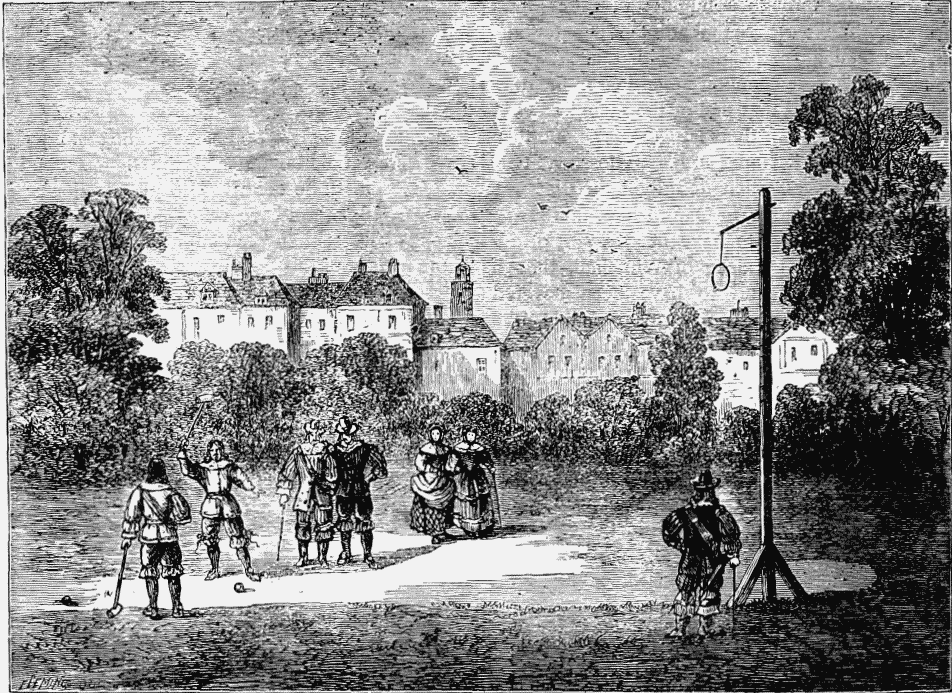
PLAYING AT PALL MALL. (From a Contemporary Print.)
Evelyn tells us in May, 1658, how he went to see the coach race in Hyde Park, and afterwards "collationed" in Spring Gardens; and it would seem from other sources that the latter formed an agreeable house of call on the way to and from the park.
Margaret, the learned Duchess of Newcastle, tells us that when young she and her sisters used to ride in their coaches about the streets to see the concourse and recourse of people, and in the spring time to visit the Spring Gardens, Hyde Park, and the like places. From this it is probable that her Grace mistook the origin of the name, as does apparently another writer, R. Brome, who asks his friend, "Shall we make a fling to London, and see how the spring appears there in the Spring Gardens?"
Mr. J. H. Jesse tells us that down to the present day every house in Spring Garden Terrace has its separate well. He also gives currency to a tradition to the effect that as he walked through the park from St. James's Palace to the scaffold at Whitehall, King Charles stopped, weary and faint, to drink a glass of water at one of the springs, at the same time, as we have before remarked, pointing out to Bishop Juxon and Herbert a tree close by as having been planted by the hands of his elder brother, Prince Henry.
Among the inhabitants of this place enumerated by Mr. Peter Cunningham are Sir Philip Warwick (after whom Warwick Street is named), Philip Earl of Chesterfield (1670), Prince Rupert, the "mad" Lord Crofts, Sir Edward Hungerford, Colley Cibber, and, last but not least, George Canning. An advertisement in the Daily Courant of January, 1703, gives us Cibber's locale as "near the 'Bull Head' Tavern, in Old Spring Garden." John Milton, too, during the Commonwealth, occupied lodgings at the house of a tradesman named Thomson, "next door to the 'Bull Head Tavern.'"
In a room over the shop of one Egerton, a bookseller, near this spot, where he resided on first coming to London, a raw Scottish lad, James Thomson wrote part of his "Seasons." We are told that at this time he was "gaping about the town listlessly, getting his pockets picked, and forced to wait on great persons with his poem of 'Winter,' in order to find a patron." Most luckily, fond as he was of freedom, he did not carry his love of freedom so far as to close against himself the doors of powerful patrons. "He obtained," writes Leigh Hunt, "an easy place, which required no compromise of his principles, and passed the latter part of his life in his own house at Richmond," where he died and is buried.
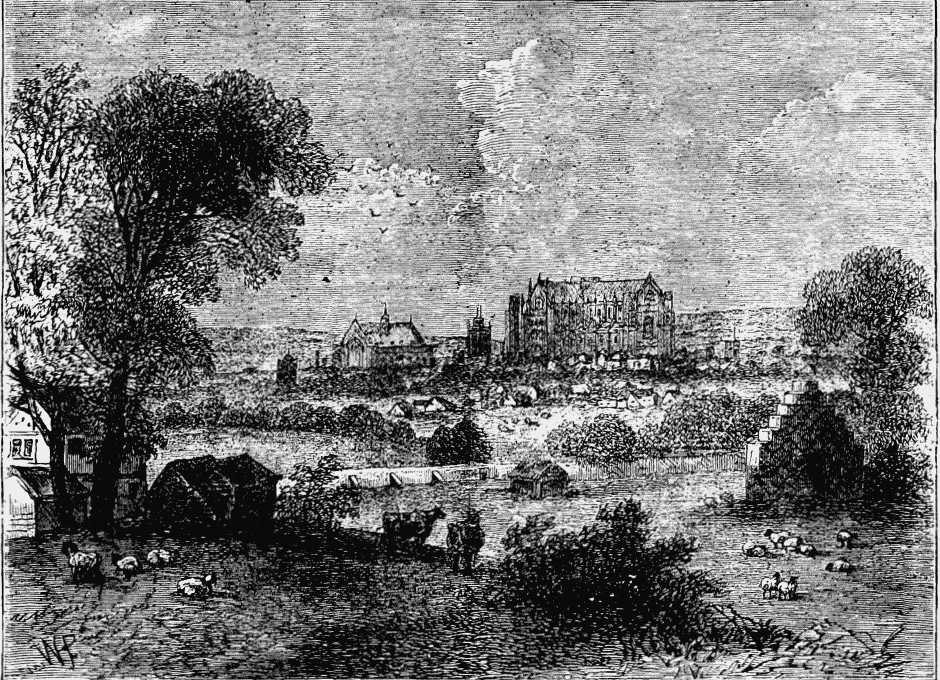
THE MALL IN 1450.
As late as the reign of George I., the Spring Gardens are laid down in maps as forming an enclosure limited by rows of houses in Warwick Lane and Charing Cross, and containing a house with a large flower-garden in front, situated in the midst of an orchard or a grove of trees. "It is this plantation, perhaps," says Mr. Jacob Larwood, in his "Story of the London Parks," "which was denominated the 'Wilderness' so lately as 1772, in which year Frederick Augustus, Earl of Berkeley, obtained leave to build messuages and gardens in a place called 'the Wilderness,' on the north-west side of the passage from Spring Gardens to St. James's Park. This grant, no doubt, occasioned the disappearance of the last vestige of the once famous place of amusement."
At the northern end of Spring Gardens, at the corner of the footway leading into the Mall of St. James's Park, stood formerly a dull and extremely unattractive mansion, known as Berkeley House, from having been the town residence of the Earls of Berkeley for the best part of a century. Here George Prince of Wales, and many of his boon companions, were frequent visitors. It was purchased by the Government in 1862, and pulled down. On its site were built the offices of the Metropolitan Board of Works. This edifice is spacious and lofty, and well adapted to the purposes for which it was erected. It is in the Italian style of architecture, and has at once a bold and striking appearance. The Metropolitan Board of Works was established in 1855. Under the Metropolitan Building Act, passed in the same year, it exercises a supervision over all buildings erected within the limits of its jurisdiction. The powers of the Board were extended in 1858, to enable it to effect the purification of the Thames by constructing a new system of main drainage on both sides of the river. The construction of the Thames Embankment was also carried on under its supervision. It is empowered by the Act under which it is constituted to raise loans for carrying out public works of this nature, the repayment and interest of which are guaranteed by Government, and secured by a tax of 3d. in the pound on property in the metropolis. The Metropolitan Board of Works can enter into a contract with any firm that chooses to tender for the execution of any proposed works to be carried out under its control.
In Buckingham Court, at the southern end of Spring Gardens, died, December 1, 1723, the celebrated Mrs. Centlivre, the witty and pretty dramatist, author of The Busybody, and The Bold Stroke for a Wife, and the wife of three husbands in succession. She is said to have been a great beauty, an accomplished linguist, and a good-natured, friendly woman. Pope immortalised her in his "Dunciad," it is said, for having written a ballad against his translation of Homer, when she was a child. "But," as Leigh Hunt suggests, "the probability is that she was too intimate with Steele, and other friends of Addison, while the irritable poet was at variance with them. It is not impossible, also, that some raillery of hers might have been applied to him—not very pleasant from a beautiful woman against a man of his personal infirmities, and who was actually jealous of not standing well with the fair sex." Mrs. Centlivre is said to have accompanied her first lover, Anthony Howard (the father of the author of "Love Elegies"), to Cambridge, in boy's clothes. This, however, did not hinder her from marrying a nephew of Sir Stephen Fox, who died a year afterwards, nor from having two other husbands in succession. Her second husband was an officer of the name of Carroll, who was killed in a duel. Her third husband, Mr. Centlivre, who had the formidable title of "Yeoman of the Mouth," being chief cook to Queen Anne, fell desperately in love with her when she was playing the part of Alexander the Great, at Windsor; for she appears to have acted on the stage in the provinces, though she did not appear on London boards. Leigh Hunt says of her plays that "they are not after the taste of Mrs. Hannah More, but the public seem very fond of them. They are still," he adds, in 1835, "acted as often as if they had just come out. The reason is that, careless as they are in dialogue, and not very scrupulous in manners and morals, they are full of action and good humour."
Her house must have stood near the spot where
now is Messrs. Drummond's bank; close by was a
house known as "Locket's," or "Locket's Ordinary," a house of entertainment much frequented
by the gentry and "persons of quality" in the reign
of Queen Anne, and partaking very much of the
old character of the gardens on which it rose.
Dr. King thus commemorates it, in his "Art of
Cookery," with a quaint and not very first-rate
pun:—
"For Locket's stands where Gardens once did spring."
The exact site of "Locket's Ordinary" is not known, though Leigh Hunt is inclined to identify it with the "Northumberland" Coffee House of a later date. "It is often mentioned," observes the writer of a MS. in Birch's "Collection," quoted in the Notes to the Tatler, "in the plays of Colley Cibber, Vanbrugh, &c., where the scene is sometimes laid. It was much frequented by Sir George Etheredge, as appears from the following anecdotes, picked up in the British Museum:—Sir George and his company, provoked by something amiss in the entertainment or the attendance, got into a violent passion, and abused the waiters. This brought in Mrs. Locket. 'We are so provoked,' said Sir George, 'that I could find it in my heart to pull that nosegay out of your bosom, and throw all the flowers into your face.' This turned all the anger of the guests into a loud fit of laughter. Sir George Etheredge, it appears, discontinued Mrs. Locket's ordinary, having run up a score which he could not conveniently discharge. Mrs. Locket sent a man to dun him, and to threaten him with a prosecution. He bade the messenger tell her that he would kiss her if she stirred a step further in the matter. When this answer was brought back to her, she called for her hood and scarf, and told her husband, who interposed, that 'she'd see if there was any fellow alive who had the impudence to do so.' 'Pry'thee, my dear,' replied her husband, 'don't be so rash; you don't know what folly a man may do in his passion.'"
The banking-house of Messrs. Drummond stands at the corner of Spring Gardens and Charing Cross. It was founded early in the eighteenth century, and is consequently one of the oldest West-end banks. At a day when it was customary for the younger sons of Scottish noblemen to seek their fortunes by commerce, Andrew Drummond, fifth son of Sir John Drummond, the third Laird of Machany, younger brother of the fourth Viscount Strathallan, came to London as an agent for some of the chief Jacobite houses about the year 1713, and founded this business on the opposite side of Charing Cross as a banker and a goldsmith. The business was removed to its present site a year or two afterwards. Mr. A. Drummond is represented by Malcolm, in his "Genealogical Memoirs of the House of Drummond," as a man of great integrity and ability. He married a Miss Strahan, daughter of a London banker, and bequeathed the business to his three sons. Messrs. Drummond have had, and still have, a large Scottish connection.
Mr. Peter Cunningham tells us that the founder of Drummond's bank obtained his great position by advancing money to the Pretender, and by the king's consequent withdrawal of his account. This step on the part of the king led to a rush of the Scottish nobility and gentry with their accounts to Charing Cross, and to the ultimate advancement of the bank to its present position.
There is a tradition in the house that Sir Robert Walpole, in his zeal for the House of Hanover, wished to inspect the books of Messrs. Drummond's bank, in order to keep his eye on the adherents of the Pretender. It is needless to add that his wish was not gratified, and Mr. Drummond, on meeting Sir Robert soon afterwards at Court, turned his back on the Minister, in order to mark his sense of the affront; and the King, so far from being offended with him, showed Mr. Drummond a special mark of his royal favour, either then or at a later date.
On one occasion, it is said, Messrs. Drummond refused to advance the sum of £500 to the Princess of Wales, when she was in pecuniary difficulties. Hence that lady writes to a friend:—"Messrs. Drummond certainly shall not be the banker to George IV.'s Queen; for any historian, who would write the biography of the ex-Princess of Wales, would not a little astonish the world, in relating that she could not procure the sum of £500, at the rate of paying £500 a year per annum for it!!" It is only fair to add that this statement, coming from an angry lady's pen, may very possibly be mere gossip and scandal after all.
There is a portrait of the founder of the bank, painted by Zoffany; an engraved copy of it hangs in the inner room of the bank. It is perhaps worthy of note that Pope had an account at this bank, since few poets of modern times are so fortunate as to enjoy the luxury of a banker.
In 1810, the old Duke and Duchess of Brunswick, the parents of Princess (afterwards Queen) Caroline, were living in a dingy and old-fashioned house in New Street. Neither the road nor the royal carriages would appear to have been of the best, for we find one of the ladies of the princess's suite at Kensington writing thus to a friend. "We rumbled in her (the princess's) old tub all the way to New Street, Spring Gardens, much to the discomfiture of my bones … We were ushered into the dirtiest room I ever beheld, nearly empty and devoid of comfort. A few filthy lamps stood on a sideboard, common chairs were placed around very dingy walls, and in the middle of this empty space sat the old duchess, a melancholy spectacle of decayed royalty."
In New Street lived Sir Astley Cooper, in the
height of his fame as a surgeon. Excellent as was
his surgical skill, he liked to display it, and was
often accused of a sort of anatomical sleight of
hand. "No one," writes the author of the "Family
Joe Miller," "will deny that the first requisite for
an operating surgeon is nerve, and that to a degree
which appears to spectators to amount to want of
feeling. Sir Astley Cooper possessed this quality
thoroughly. He always retained perfect selfpossession in the operating theatre; and his unrivalled manual dexterity was not more obvious
than his love of display during his most critical
and dangerous performances on the patient, whose
courage he tried to keep up by lively and facetious
remarks. When Sir Astley was in the zenith of
his fame, a satirical Sawbones sang thus:—
'Nor Drury Lane, nor Common Garden,
Are, to my fancy, worth a farden;
I hold them both small beer.
Give me the wonderful exploits,
And jolly jokes between the sleights,
Of Astley's Amphitheatre.'"
In 1815 Sir Astley Cooper settled in Spring Gardens, and a few years afterwards he was employed professionally by George IV. He long enjoyed a very large share of public patronage, and his reputation both at home and abroad was such as rarely falls to the lot of a professional man.
Lord Campbell—then "plain John Campbell"—was living in New Street, Spring Gardens, in his early Parliamentary days, 1830–35. In the same street, at the same time, lived Sir James Scarlett (afterwards Lord Abinger), whose daughter Campbell married, and whom he helped to raise to the peerage. Joseph Jekyll, the witty contemporary of Selwyn and friend of the Prince Regent, was also an inhabitant of New Street.
In the reign of William III. we find some of the
French Huguenot refugees established in Spring
Gardens Chapel. The chapel itself was set on fire
in the year 1726, when King George I. was in
Hanover; and his son, the Prince of Wales (afterwards George II.), happening to take an active
part in the work of extinguishing it, the following
epigram was written off-hand by Nicholas Rowe,
with a covert comparison or rather contrast of the
Prince of Wales with Nero, who "fiddled while
Rome burnt:"—
"Thy guardian, blest Britannia, scorns to sleep,
When the sad subjects of his father weep.
Weak princes by their fears increase distress:
He faces danger, and so makes it less.
Tyrants on blazing towns may smile with joy,
George knows to save is greater than destroy."
Great alarm was caused in the neighbourhood, as the chapel adjoined some depôts of gunpowder; but these were saved. The chapel, however, and an inn called the "Thatched House Tavern" adjoining, were destroyed.
In 1731, a new chapel was built by the Hon. Edward Southwell. A chapel subsequently erected by one of the De Clifford family still stands at the corner of New Street; it is dedicated to St. Matthew, and is a monument of the low architectural taste of the time; it was styled a chapel-ofease to St. Martin's parish, but it is to be feared that it proved in the event a frequent bone of clerical contention between Lord De Clifford and the Vicar of St. Martin's.
On the eastern side of Spring Gardens, about half way down, is the "Medical Club," whose professional character is sufficiently indicated by its name.
We have already spoken of the Tilt-yard, which formerly occupied part of the space now known as Spring Gardens. Close by it, in Stow's time, "were divers handsome houses lately built before the park." One of these "handsome houses" afterwards became Jenny Man's "Tilt-yard Coffee House," upon the site afterwards occupied by the Paymaster-General's office. It was the resort of military officers, until supplanted by "Slaughter's" in St. Martin's Lane, which more recently was, in its turn, ruined by the military clubs. The Spectator states that the mock military also frequented the Tilt-yard Coffee House—"fellows who figured in laced hats, black cockades, and scarlet suits; and who manfully pulled the noses of such quiet citizens as wore not swords." As Theodore Hook wrote in "Sayings and Doings," no doubt with a retrospect of his own youthful days: "When he fell really in love, Bond Street lounges and loungers became a bore to him; he sickened at the notion of a jollification under the piazza; and even the charms of the pretty pastry-cooks at Spring Gardens had lost their piquancy."
Warwick Street, built in 1681, was named after Sir Philip Warwick. Strype says that in his day it led to the back gate of the king's garden, "for the conveniency of her late Majesty's principal gardener."
At the western end of this street, which formed a cul de sac, stood Warwick House, adjoining Carlton House Gardens, for some time the residence of the Princess Charlotte, in her girlish years, when heiress to the throne. Here she was brought up by Lady De Clifford, as her governess, and hence in 1814 she "bolted off" in a hackney coach to her mother's house at Connaught Place, from which it required the united pressure of the Lord Chancellor Eldon and the Archbishop of Canterbury (Dr. Manners Sutton) to induce her to return; and even this was not accomplished without much difficulty and remonstrance from her friends, until an early hour next morning, when she was brought back in one of the royal carriages.
"On the 7th of July, 1814," to use Lady Brownlow's words in her "Reminiscences of a Septuagenarian," "all the London world was startled by hearing that the Princess Charlotte on the previous evening had left Warwick House unobserved, and gone off in a hackney coach to the Princess of Wales in Connaught Place. The cause of this sudden and unaccountable proceeding has never transpired to the world at large. That it was perfectly unexpected and unwishedfor by the Princess of Wales there seems no doubt. The Duke of York, the Duke of Sussex, Lord Eldon, and Mr. Brougham all repaired to Connaught Place, and after several hours of discussion the Princess Charlotte returned to Warwick House."
We learn accidentally that the Lord Chancellor (Clarendon) was living at Warwick House in 1660, for in that year Pepys records the fact of having carried a letter thither to him from Whitehall.
In this street, close to where stood old "Warwick House," is to be seen a small public-house, with the sign of "The Two Chairmen"—referring, of course, to the time when "sedan chairs," or as they were commonly called "chairs," were in vogue.
At a time when Regent Street was not built, and when Bond Street was too near to Marylebone to be central, Spring Gardens were the head-quarters of those exhibitions which abound in town in "the season," and disappear at its close. Here, towards the end of the last century, the Incorporated Society of Arts held its exhibitions; and "here in 1806," as Mr. Timbs reminds us, "at Wigley's Rooms, were shown Serre's Panorama of Boulogne, and other foreign cities, and sea pieces; also Maillardet's automatic figures, including a harpsichord-player, a rope-dancer, and a singing bird. Here also was exhibited Marshall's 'Peristrophic' Panorama of the Battle of Waterloo"—so called because the spectators themselves were turned round by machinery whilst they viewed it. A similar contrivance more recently was adopted at the Coliseum, when the Panorama of London was exhibited here.
In the reign of Queen Anne there was to be seen "over against the Mews' Gate, at Charing Cross, close to the 'Spring Gardens,' by Royal permission, a collection of strange and wonderful creatures from most parts of the world, all alive." It certainly was most miscellaneous, including a black man, a dwarf, a pony only two feet odd inches high, several panthers, leopards, and jackalls, and last not least, "a strange monstrous creature brought from the coast of Brazil, having a head like a child, legs and arms very wonderful, and a long tail like a serpent, wherewith he feeds himself as an elephant does with his trunk." Mr. Frost, in his "Old Showmen," conjectures that this last-named "monstrous creature" may have been, after all, only a spider-monkey, one variety of which is said by Humboldt to use its prehensile tail for the purpose of picking insects out of crevices.
Among the other objects of curiosity exhibited here from time to time, not the least attractive was the "Mechanical and Picturesque Theatre," which was, as the advertisements of the day tell us, "illustrative of the effect of art in imitation of nature, in views of the island of St. Helena, the city of Paris, the passage of Mount St. Barnard, Chinese artificial fireworks, and a storm at sea."
"Punch," if not a native of this locality, at all events first here made his appearance in England. Mr. Frost, in his "Old Showmen of London," says: "The earliest notices of the representation in London of 'Punch's moral drama,' as an old comic song calls it, occur in the overseers' books of St. Martin's-in-the-Fields, for 1666 and 1667, in which there are four entries of sums ranging from twentytwo shillings and sixpence to fifty-two shillings and sixpence, as 'Received of Punchinello, ye Italian popet player, for his booth at Charing Cross.'"
Somewhere on this side of Charing Cross, though its actual site is unknown, stood the tavern called the "Rummer," where Prior was found reading "Horace" when a boy. In 1685 it appears to have been kept by one Samuel Prior; and this would tally with what Dr. Johnson tells us in his "Lives of the Poets." Prior is supposed to have fallen, by his father's death, into the hands of his uncle, a vintner near Charing Cross, who sent him for some time to Dr. Busby, at Westminster School; but not intending to give him any education beyond that of the school, took him, when he was well educated in literature, to his own house, where the Earl of Dorset, celebrated for his patronage of genius, found him by chance (as Burnet relates) reading Horace, and was so well pleased with his proficiency that he undertook the care and cost of his academical education. It is well known that all through his life the poet showed a strong propensity for tavern life and pleasures; and Johnson probably is not far from the truth when he adds: "A survey of the life and writings of Prior may exemplify a sentence which he doubtless well understood when he read Horace at his uncle's house. 'The vessel long retains the scent which it first receives;' for in his private relaxation he revived the tavern."
In mean lodgings over a shop close by the entrance to Spring Gardens, which down to our own times was a saddler's, died the celebrated divine and preacher, Dr. Isaac Barrow, one of the most illustrious scholars and writers; and his wit has been spoken of by no less an authority than Dr. Johnson, as the "finest thing in the language." We quote an instance of the doctor's ready wit. In meeting the Earl of Rochester one day, the worthy peer exclaimed, "Doctor, I am yours to the shoe-tie;" to which the clergyman replied, "My lord, I am yours to the ground." The peer rejoined, "Doctor, I am yours to the centre." "My lord," retorted the doctor, "I am yours to the antipodes." Determined not to be outdone, his lordship blasphemously added, "Doctor, I am yours to the lowest pit of hell;" on which Barrow turned on his heel and said, "And there, my lord, I leave you."
There is a tradition mentioned by Pyne, that with the intention of painting the proclamation of George III., Hogarth stood at a window near Charing Cross, making sketches of the yeomen of the guard, the heralds, and the sergeant and trumpeter's band, who had their rendezvous hard by. So, at least, says Mr. Timbs, who accepts the statement as probably true.
This would appear to have been the neighbourhood in which ingenious devices of new arts and trades abounded even in the Stuart era. Pepys writes, under date February 10, 1668–9:—"To the plaisterer's at Charing Cross, that casts heads and bodies in plaister: and there I had my whole face done; but I was vexed first to be forced to daub all my face over with pomatum. Thus was the mould made; but when it came off there was little pleasure in it as it looks in the mould, nor any resemblance, whatever there will be in the figure when I come to see it cast off."
In 1748 a female dwarf, the "Corsican Fairy," was shown in Cockspur Street, at half-a-crown a head, drawing almost as large levees as "General Tom Thumb" in our own days. In the same year was exhibited, "in a commodious room facing Cragg's Court," a strange monstrosity, a "double cow." From the work of Mr. Frost, on "Old Showmen," we learn of yet another and still stranger sight exhibited in the same year at the "Heath Cock, at Charing Cross," namely, "a surprising young mermaid, taken on the coast of Aquapulca, which" (says the prospectus), "though the generality of mankind think there is no such thing, has been seen by the curious, who express their utmost satisfaction at so uncommon a creature, being half like a woman and half like a fish, and is allowed to be the greatest curiosity ever exposed to the public view." Here, too, was exhibited O'Bryen, the Irish giant, whom we have already mentioned; and here he died.
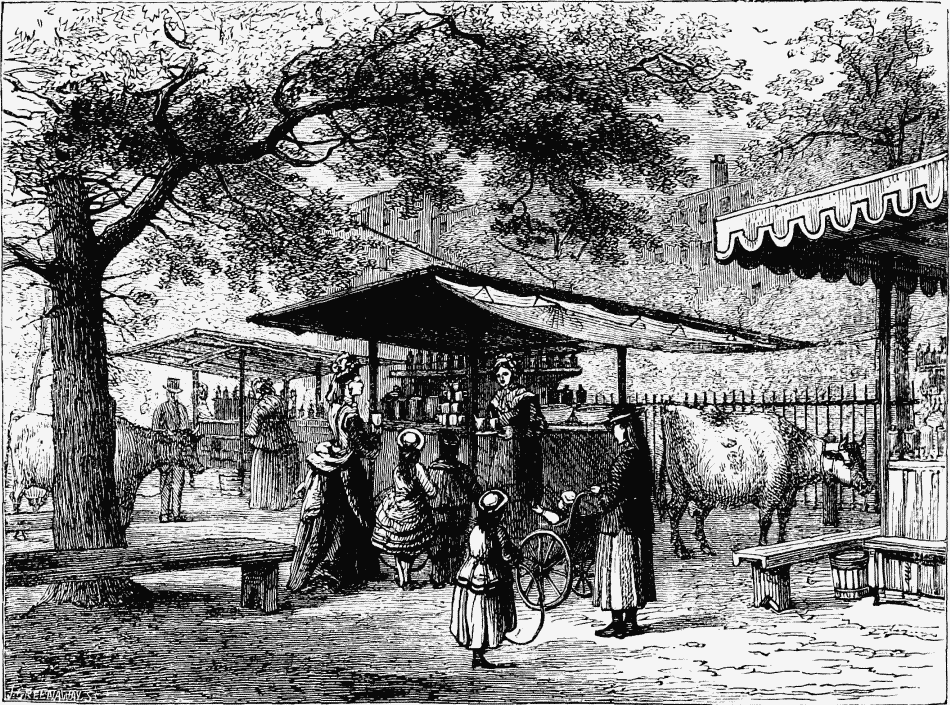
MILK FAIR, ST. JAMES'S PARK.
In 1772, and again in 1775 and in 1779, in a large room in Cockspur Street, appeared the conjuror Breslau, whose tricks of legerdemain were interspersed with a vocal and instrumental concert, and imitations by an Italian, named Gaietano, of the notes of the "blackbird, thrush, canary, linnet, bullfinch, skylark, and nightingale."
The origin of the name of Cockspur Street is uncertain; and Mr. Peter Cunningham can suggest no better derivation of it than a fancied connection with the "Mews" which adjoined it. It may have derived its name from some association with the Cock-pit at Whitehall, which we have already mentioned. As it now stands it is quite a modern street, having been built towards the close of the last or beginning of the present century.
As the tide of fashion gradually set westwards from Covent Garden, this street became more and more frequented by the wits and critics of bon ton; and among its most pleasant memories is the name of the "British Coffee House," which was largely frequented by gentlemen from "the north of the Tweed." Its northern connection, kept together by hosts and hostesses from Scotland, is incidentally to be gathered from a letter of Horace Walpole to his friend Sir H. Mann, in which, speaking of some Scottish question pending in the House of Lords, he writes:—"The Duke of Bedford … had writ to the sixteen [Scotch representative] peers to solicit their votes; but with so little difference, that he enclosed all their letters under one cover, directed to the 'British Coffee House.'"
Concerning a dinner at this coffee-house, Mr. Cyrus Redding tells a sad story in his "Fifty Years' Reminiscences:"—"While on this short visit to town, the proprietors of the 'Pilot' gave a dinner to some of the officers of the Horse Guards at the 'British Coffee House.' After a sumptuous repast, in the fashion of the time, we sat down to wine. There was present a bustling little man, a Scotch colonel, named Macleod, with his son, a fine young man, about twenty years old, who sat by me. He was an only son, with a number of sisters. The bottle was pushed hard. The youth partook too freely for one of his years. He was seized with fever and died. The estate entailed went by his death to distant relatives; and his mother and sisters, who would have had to depend on him, were left penniless on the father's demise."
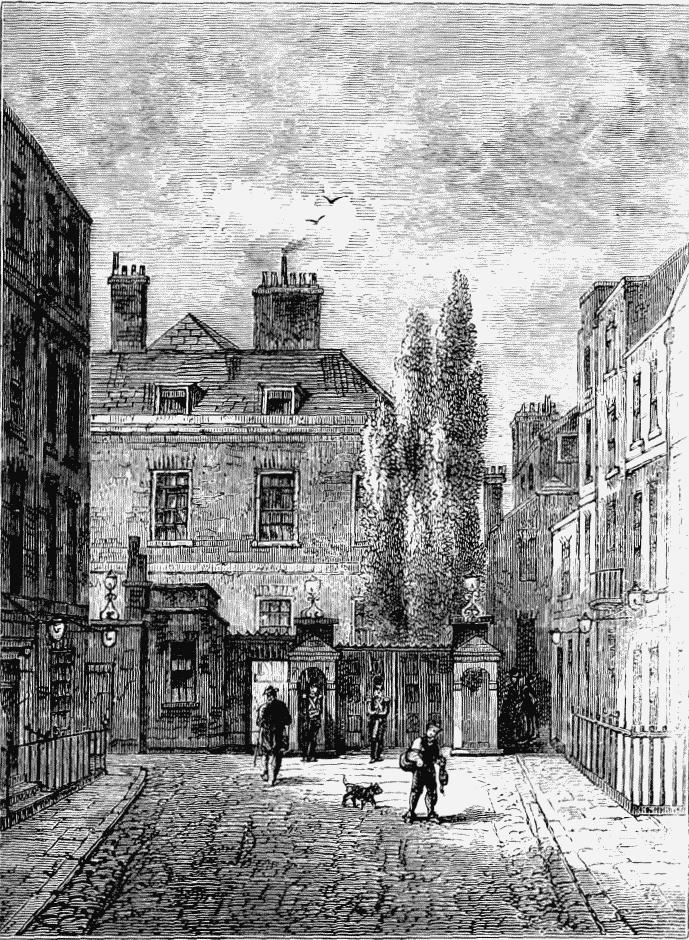
WARWICK HOUSE, ABOUT 1810.
At the junction of Cockspur Street with Pall Mall East stands an equestrian statue of King George III. It is of bronze, between ten and eleven feet high, and stands upon a granite pedestal about twelve feet high. It was executed by Mr. Matthew C. Wyatt, and the cost of its erection amounted to £4,000, the sum being defrayed by public subscription. It was set up about the year 1836. Although the likeness of the king is good, the statue is not generally admired, on account of its costume; and the pigtail at the back of the royal head has often been made the subject of waggish and uncomplimentary remarks. Altogether, it can hardly be said that this statue is calculated to raise the credit of English sculpture in the eyes of foreign visitors.