Old and New London: Volume 4. Originally published by Cassell, Petter & Galpin, London, 1878.
This free content was digitised by double rekeying. Public Domain.
Edward Walford, 'St James's Palace', in Old and New London: Volume 4(London, 1878), British History Online https://www.british-history.ac.uk/old-new-london/vol4/pp100-122 [accessed 30 April 2025].
Edward Walford, 'St James's Palace', in Old and New London: Volume 4(London, 1878), British History Online, accessed April 30, 2025, https://www.british-history.ac.uk/old-new-london/vol4/pp100-122.
Edward Walford. "St James's Palace". Old and New London: Volume 4. (London, 1878), British History Online. Web. 30 April 2025. https://www.british-history.ac.uk/old-new-london/vol4/pp100-122.
In this section
CHAPTER IX.
ST. JAMES'S PALACE.
"The home and haunt of kings."—Spenser.
A Hospital for Leprous Women—The Structure demolished by Henry VIII., and the Palace built—The Gate-house, and Vicissitudes of the Clock—The Colour Court, and Proclamation of Queen Victoria—The Chapel Royal—Perseverance of George III. in his attendance at Chapel—Doing the "Civil Thing"—Royal Marriages—The Gentlemen and Children of the Chapel Royal—"Spur-money"—The "Establishment" of the Chapel Royal—The Chair Court and the State Apartments—The Yeomen of the Guard—The Chapel of Queen Catharine of Braganza, and Pepys' Visit there—The Lutheran Chapel—The Ambassadors' Court—The Royal Library—Office of the Lord Chamberlain's Department—Clarence House—Charles Dartineuf and his Partiality for Ham-pie—Historical Reminiscences of St. James's Palace—Marie de Medicis and her Miniature Court—Charles I. and his last parting from his Children—King Charles II. and Dr. South—La Belle Stewart, afterwards Duchess of Richmond—Dissolute Hangers-on about the Court—Court Balls of the Time of Charles II.—Marriage of William Prince of Orange—Mary Beatrice of Modena and her Court—Morality of the Court under the Georges—Death-bed Scene of Queen Caroline—Strange Conduct of an Irish Nobleman—The Palace partially destroyed by Fire—The Duke of Cumberland and his Italian Valet.
Some quarter of a mile to the westward of Charing Cross, there stood, in very early times, a hospital for leprous women: it was a religious foundation, and was dedicated to St. James the Less, Bishop of Jerusalem.
St. James's Palace now occupies the site of the above-mentioned hospital, showing what changes a place may undergo by the operation of the whirligig of time. The endowment of the hospital was for women only, "maidens that were leprous" being the sole objects of the charity. Eight "brethren," however, were attached to the house, in order to solemnise the religious services, and to discharge the "cure of souls."
According to Stow, the house had appended to it "two hides of land," with the usual "appurtenances," in the parish of St. Margaret, Westminster; "it was founded," he goes on to say, "by the citizens of London, before the time of man's memory, for fourteen sisters, maidens, that were lepers, living chastely and honestly in divine service. Afterwards," Stow continues, "divers citizens of London gave six-and-fifty pounds rents thereto. . . . . After this, sundry devout men of London gave to the hospital four hides of land in the fields of Westminster, and in Hendon, Chalcote, and Hampstead, eight acres of land and wood."
King Edward I. confirmed these gifts to the hospital, granting to its inmates also the privilege and profits of a fair "to be kept on the eve of St. James, the day and the morrow, and four days following;" "and this," says Mr. Newton, "was the origin of the once famous 'May Fair,' held in the fields near Piccadilly."
Henry VIII., however, set his covetous eyes on the place; and seeing that it was fair to view, while the sisters were defenceless, he resolved to possess himself of it, much as Ahab resolved to become master of Naboth's vineyard. He pulled down the old structure, "and there," as Holinshed tells us, "made a faire parke for his greater comoditie and pleasure;" and also erected a stately mansion, or, as Stow denominates it, "a goodly manor." This was in the year of his marriage with Anne Boleyn, when he had every motive for wishing to break off with the ancient faith.
St. James's was at that time more of a country seat than would now be supposed; indeed, more than had been any of the other residences of our sovereigns near London, except Kennington. The latter was now abandoned; the sovereign came to dwell on the Middlesex instead of on the Surrey side of the Thames; and St. James's, no doubt, was intended by the fickle-minded monarch to take its place. It stood in the middle of fields, well shaded with trees; and these fields, now the park, were enclosed as the private demesne of the palace. Incredible as it may now seem, they were then well stocked with game. The king lost no time in surrounding himself here with all the appliances for amusement, and there were both a cock-pit and a tilt-yard in front of Whitehall, nearly on the site of the present Horse Guards, as we have stated in a previous chapter.
From the gates of St. James's Palace, Miss Benger tells us, in her "Life of Anne Boleyn," Henry VIII. delighted, on May morning, to ride forth at daybreak, having risen with the lark, and with a train of courtiers all gaily attired in white and silver, to make his way into the woods about Kensington and Hampstead, whence he brought back the fragrant May boughs in triumph.
"The gateway, a part of which now forms the Royal Chapel, and the chimney-piece of the old presence chamber," says Mr. A. Wood, "are all that remain of the palace erected by Henry. The last bears on its walls the initials of Henry and Anne," twined, as he might have added, in that love-knot of which he was then so fond, but which he severed by the axe in four short years afterwards.
Henry, even whilst residing here, held his court still at the old palace, first at Westminster, and then at Whitehall, after he had taken the latter from Wolsey, thus curiously anticipating the present day, when St. James's Palace is "our Court of St. James's," and contains the Throne Room and other state apartments, though it is no longer the residence of the sovereign.
Henry's gatehouse and turrets, built of red brick, face St. James's Street, and with the Chapel Royal, which adjoins them on the west side, cover the site of the ancient hospital, which, to judge from the many remains of stone mullions, labels, and other masonry found in 1838, on taking down some parts of the Chapel Royal, was of the Norman period. The lofty brick gatehouse bears upon its roof the bell of the great clock, dated A.D. 1731, and inscribed with the name of Clay, clockmaker to George II. The clock originally had but one hand. When the gatehouse was repaired, in 1831, the clock was removed, and was not put up again on account of the roof being reported unsafe to carry the weight. The inhabitants of the neighbourhood then memorialised the king (William IV. for the replacement of the time-keeper, when his Majesty, having ascertained its weight, "shrewdly inquired how, if the palace roof was not strong enough to carry the clock, it was safe for the number of persons occasionally seen upon it to witness processions, &c." The clock was forthwith replaced, and a minute-hand was added, with new dials; the original dial was of wainscot, "in a great number of very small pieces, curiously dovetailed together."
The archway of the gatehouse leads into the quadrangle, or "Colour Court," as it is usually called, from the colours of the military guard of honour being placed there. Here, according to ancient practice, a regiment of the sovereign's "foot-guards" parade daily at eleven a.m., accompanied by their band, for the purpose of exchanging the regimental standard, and handing over the keys of the palace to the incoming commandant. Here each new sovereign is formally proclaimed on his (or her) accession to the throne. It was on the 21st of June, 1837, that Her Majesty Queen Victoria was proclaimed "Queen of the United Kingdoms of Great Britain and Ireland, Defender of the Faith." Soon after nine in the morning a troop of the 1st Life Guards drew up in line across the quadrangle, and at ten the youthful sovereign made her appearance at the opened window of the Tapestry Room, where she was so overcome by the affecting scene—the exclamations of joy and clapping of hands, the waving of hats and handkerchiefs—in conjunction with the eventful occurrences of the preceding day, that she instantly burst into tears; and, says an eye-witness, "notwithstanding her earnest endeavours to restrain them, they continued to flow in torrents down her now pallid cheeks until she retired from the window; Her Majesty, nevertheless, curtsied many times in acknowledgment of her grateful sense of the devotion of her people." Meanwhile the heralds and pursuivants, dismounted and uncovered, had taken up their accustomed position immediately beneath the window at which the Queen was standing; and silence being obtained, Clarencieux King of Arms, Sir William Woods, in the absence of Garter King at Arms, read the Proclamation, which had been issued at Kensington Palace on the preceding day. At its conclusion, Sir William gave the signal by waving his sceptre, and loud and enthusiastic cheering followed, which Her Majesty graciously and frequently acknowledged. A flourish of trumpets was then blown, and the Park and Tower guns fired a salute in token that the ceremony of proclamation had been accomplished.
On the west side of the great gateway is the Chapel Royal. It is oblong in plan, and plain, and has nothing about it to call for particular mention, excepting, perhaps, the ceiling, which is divided into small painted squares, the design of which was executed by Hans Holbein. The Royal Gallery is at the west end, opposite the communiontable. In this chapel there is a choral service on Sundays, at twelve o'clock, which is largely attended by the aristocracy when in town for the London season. The Duke of Wellington, during the last twenty or thirty years of his life, was a constant attendant. Entrance is to be obtained, we fear it must be added, most effectively by aid of a silver key.
George III., when in town, used to attend the services in this chapel, a nobleman carrying the sword of state before him, and heralds, pursuivantsat-arms, and other officers walking in the procession. So persevering was his Majesty's attendance at prayers, that Madame d'Arblay, one of the robing-women, tells us "the Queen and family, dropping off one by one, used to leave the King, the parson, and his Majesty's equerry to freeze it out together."
It is to be feared that not all the frequenters of the Chapel Royal come to attend its services with very devout hearts, if the following story, amusingly told by Mr. Raikes, may be taken as a specimen of the body at large:—"One Sunday morning the Dowager Duchess of Richmond went with her daughter to the Chapel Royal at St. James's, but being late they could find no places. After looking about some time, and seeing the case was hopeless, she said to her daughter, 'Come away, Louisa; at any rate, we have done the civil thing.'" This was completely realising the idea of the card-leaving dowager of her day.
Here were married Prince George of Denmark and the Princess Anne; Frederick Prince of Wales and the daughter of the Duke of SaxeCoburg; George IV. and Queen Caroline; Queen Victoria and Prince Albert; and the Princess Royal and the Crown Prince of Germany. Before the building of the chapel at Buckingham Palace, Her Majesty and the Court used to attend the service here.
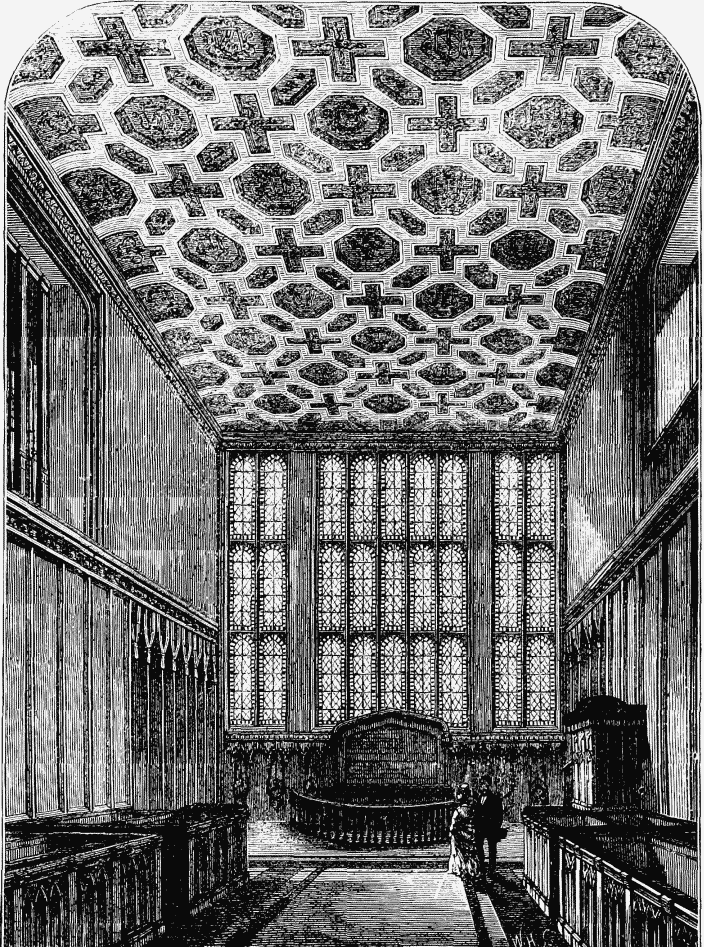
CHAPEL ROYAL, ST. JAMES'S.
Upon no occasion, perhaps, did the chapel present a gayer appearance than on the morning of the 10th of February, 1840, when was celebrated the marriage of Her Majesty Queen Victoria and Prince Albert. The ceremony was performed by the Archbishop of Canterbury, assisted by the Archbishop of York and the Bishop of London, the latter officiating as Dean of the Chapel Royal. The Duke of Sussex "gave away" his royal niece, and at that part of the service where the archbishop read the words, "I pronounce that they be man and wife together," the Park and Tower guns were fired. When the wedding ring was put by Prince Albert on the Queen's finger, we are told, Lord Uxbridge, as Lord Chamberlain, gave a signal, and the bells of Westminster rung a merry peal. The fittings of the chapel and palace on this occasion are stated to have cost upwards of £9,000.
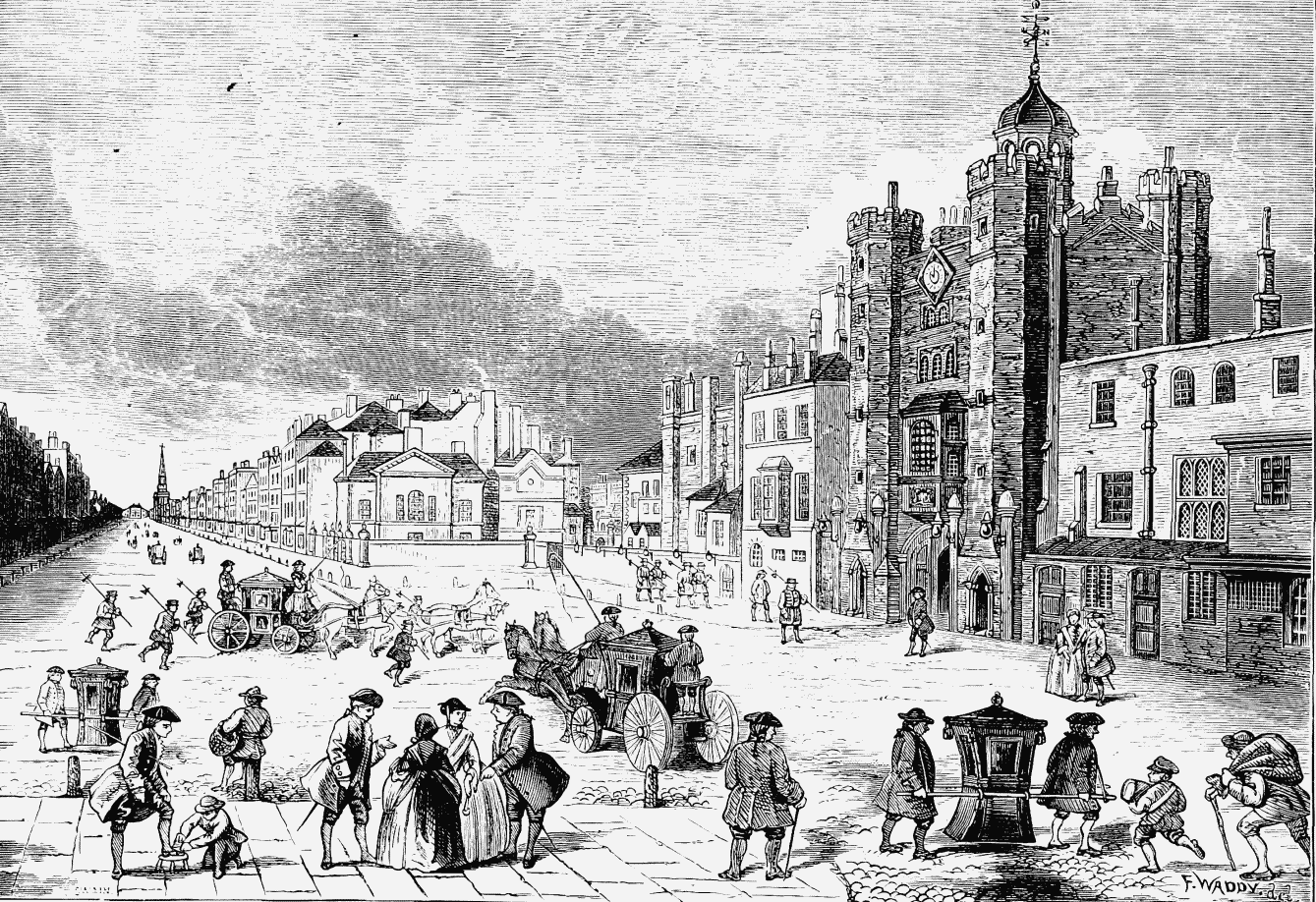
VIEW OF ST. JAMES'S PALACE, TIME OF QUEEN ANNE. (From an Old Engraving.)
The "Gentlemen and Children of the Chapel Royal," as the members of the choir are styled, were the principal performers in the religious drama, or "mysteries," when such performances were in fashion; and a "Master of the Children," and "singing children" occur in the chapel establishment of Cardinal Wolsey. In 1583 the "Children of the Chapel Royal," afterwards called the " Children of the Revels," were formed into a company of players, and thus were among the earliest performers of the regular drama. In 1731 they performed Handel's Esther, the first oratorio heard in England; "and they continued to assist at oratorios in Lent," says Mr. John Timbs, "as long as those performances maintained their ecclesiastical character entire."
In Notes and Queries, No. 30, we read that the "spur-money"—a fine upon all who entered the chapel with spurs on—"was formerly levied by the choristers, at the door, upon condition that the youngest of them could repeat his gamut; if he failed, the spur-bearer was exempt." In a tract dated 1598, the choristers are reproved for "hunting after spur-money;" and the ancient chequebook of the Chapel Royal, dated 1622, contains an order of the Dean, "decreeing" the observance of the custom. "Within my recollection," writes Dr. Rimbault, in 1850, "the Duke of Wellington (who, by the way, is an excellent musician) entered the Royal Chapel 'booted and spurred,' and was, of course, called upon for the fine. But his Grace calling upon the youngest chorister to repeat his gamut, and the 'little urchin' failing, the impost was not demanded." The Duke, it may be added, used to attend the service here regularly; and Mr. A. C. Coxe, an American clergyman, devotes half a chapter of his "Impressions of England" to a description of an early service here, at which he knelt side by side with the hero of Waterloo.
The establishment of the Chapel Royal consists of a Dean (usually the Bishop of London), a Sub-Dean, Lord High Almoner, Sub-Almoner, Clerk of the Queen's Closet, deputy-clerks, chaplains, priests, organists, and composer; besides "violist" and "lutanist" (now sinecures), and other officers; and, until 1833, there was also a "Confessor to the Royal Household." The forty-eight "Chaplains in Ordinary" to Her Majesty are appointed by the Lord Chamberlain. They receive no payment for their services, and their duties are confined to the work of preaching one sermon each in turn yearly; but the appointment is generally regarded as a stepping-stone to something better. The Dean of the Chapel Royal is nominated by the sovereign; he has a salary of £200 a year.
In spite of modern alterations this is substantially the same chapel as that in which Evelyn so often anxiously marked the conduct of King Charles, and of his brother the Duke of York, at the celebration of the sacrament. The gold plate and offertory basin are the same as those used in the days of our last Stuart sovereign.
Eastward of the Colour Court are the gates leading to the quadrangle formerly known as "the Chair Court." The State Apartments, in the south front of the Palace, face the garden and St. James's Park. The sovereign enters by the gate on this side; it was here, on the 2nd of August, 1786, that Margaret Nicholson made an attempt to assassinate George III. as he was alighting from his carriage.
The State Apartments are said by the guidebooks to be commodious and handsome, but they certainly are not very imposing, and indeed may, with truth, be pronounced mean, with reference to the dignity of English royalty. They are entered by a passage and staircase of great elegance. At the top of the latter is a gallery or guard-room converted into an armoury. The walls are tastefully decorated with daggers, muskets, and swords, arranged in various devices, such as stars, circles, diamonds, and Vandyke borders. This apartment is occupied by the Yeomen of the Guard on the occasion of a drawing-room. The Yeomen of the Guard are 140 in number; it is part of their duty to carry up the dishes to the royal table. They also take care of the baggage when the sovereign removes from one place to another. Their principal duty, however, consists in keeping the passages about the palace clear on state days. In former days the yeomen dined together, and kept a good table too. "Cannot one fancy," writes Thackeray, "Joseph Addison's calm smile and cold grey eyes following Dick Steele, as he struts down the Mall to dine with the Guard at St. James's, before he himself turns back, with his sober pace and threadbare suit, to walk back to his lodgings up the two pair of stairs in the Haymarket?"
The old Presence Chamber—or, as it is now called, the Tapestry Chamber—is the next room entered. The walls are covered with tapestry, which was made for Charles II., but was never actually hung until the marriage, in 1795, of the Prince of Wales, it having lain, by accident, in a chest undiscovered until within a short time of the event. In this room, over the fire-place, are some relics of the period of Henry VIII.; among which may be mentioned the initials "H. A." (Henry and Anne Boleyn) united, as stated above, by a true-lover's knot; the fleur-de-lis of France, formerly emblazoned with the arms of England; the portcullis of Westminster; and the rose of Lancaster.
When a drawing-room is held, a person attends here to receive the cards containing the names of the parties to be presented, a duplicate being handed to the lord in waiting, to prevent the presentation of persons not entitled to that privilege. From this room is obtained entrance to the state apartments, the first of which is very splendidly furnished; the sofas, ottomans, &c., being covered with crimson velvet, and trimmed with gold lace. The walls are covered with crimson damask, and the window curtains are of the same material; here is a portrait of George II., in his robes; paintings of Lisle and Tournay; and an immense mirror, reaching from the ceiling to the floor. The apartment is lighted by a chandelier, hanging from the centre of the ceiling, and by candelabra at each end.
The Great Council Chamber was the place where the accession and birthday odes of the Poet Laureate were performed and sung in the last century. During the present century, as far back, at least, as the memory of man runneth, these productions have been "taken as read."
The second room is called Queen Anne's Room; it is fitted up in the same splendid style, and contains a full-length portrait of George III., in his robes of the Order of the Garter; on each side of him hang paintings of the great naval victories of the First of June and Trafalgar. Here the remains of Frederick Duke of York lay in state, in January, 1827. From the centre of the ceiling hangs a richly-chased Grecian lustre, and on the walls are three magnificent pier-glasses, reaching the full height of the apartment.
The third room is called the Presence Chamber; in it Her Majesty holds levees and drawing-rooms; although similar in style of decoration, it is far more gorgeous than the two described above. The throne, which is on a raised dais, is of crimson velvet, covered with gold lace, surmounted by a canopy of the same material. The state chair is of exquisite workmanship. The window-curtains are of crimson satin trimmed with gold lace. Here are placed paintings of the battles of Vittoria and Waterloo, by Colonel Jones. The "Royal Closet" is the name conventionally given to the room in which the Queen gives audiences to ambassadors, and also receives an address annually on her birthday from the clergy of the Established Church.
On the east side of the Palace, close to where now stands Marlborough House, as already stated in our chapter on the Mall (see page 76 of the present volume), was in former times a friary, occupied by some Capuchin priests, who came into England with Catharine of Braganza, on her marriage with Charles II. The buildings included a refectory, dormitory, chapel, and library, with cells for the religious. Pepys, in his "Diary," gives us an account of a visit which he paid to the place, where he was shown a crucifix that had belonged to Mary Queen of Scots—which we may suppose he believed—and contained a portion of the true cross, which he probably did not believe.
The chapel, as prepared for the use of Queen Catharine of Braganza, is thus described by Pepys, in his "Diary," September 21st, 1662:—"To the parke; the Lord's Day. The Queen coming by in her coach going to her chapel at St. James's (the first time that it hath been ready for her), I crowded after her, and I got up to the room where her closet is, and there stood and saw the fine altar, ornaments, and the fryers in their habits, and the priests come in with their fine crosses, and many other fine things. I heard their musique, too, which may be good, but it did not appear so to me, neither as to their manner of singing, nor was it good concord to my ears, whatever the matter was. The Queen very devout; but what pleased me best was to see my dear Lady Castlemaine, who, tho' a Protestant, did wait upon the Queen to chapel. By and by, after masse was done, a fryer with his cowl did rise up and preach a sermon in Portuguese, which I not understanding, did go away, and to the King's Chapel, but that was done; and so up to the Queen's presence-chamber, where she and the King were expected to dine; but she staying at St. James's, they were forced to remove the things to the King's presence, and there he dined alone."
Pepys alludes to the Roman Catholic services in the Royal Chapel at Whitehall in terms which would seem to imply that he had a strong dislike for them. Thus he writes, 10th May, 1663: "Put on a black cloth suit, with white lynings under all, as the fashion is to wear, to appear under the breeches. I walked to St. James's, and was there at masse, and was forced in the crowd to kneel down"—no bad thing, by the way, for such a worldly and sceptical Christian.
When Charles I. married Henrietta Maria it had been stipulated that the Queen should be allowed the free practice of her religion in London, in spite of the severe laws in force against Roman Catholics in England; but the King found it convenient in this, as in other matters, to forget his promise, and ordered "the French," as he contemptuously called them, to be driven out of St. James's Palace. From thence they went in a body to Somerset House, where for some time they performed mass and heard confessions, until "Steenie," Duke of Buckingham, was ordered to dislodge them thence also, and to pack them off without ceremony to their own country. (fn. 1) On leaving St. James's, we are told, "the women howled and lamented as if they had been going to execution, but all in vain, for the Yeomen of the Guard, by Lord Conway's appointment, thrust them and all their country folk out of the Queen's lodging, and locked the doors after them." A contemporary account adds: "The Queen, when she understood the design, grew very impatient, and brake the glass windows with her fist; but since, I hear, her rage is appeased, and the King and she, since they went together to Nonsuch, have been very jocund together."
A community of the Benedictine order was established at St. James's in the reign of James II., but it was suppressed after the Revolution.
On the site of the chapel above mentioned now stands the Lutheran or German Chapel, which seems almost to intrude upon the grounds of Marlborough House. It was here that the late Queen Dowager Adelaide used to attend on Sundays, preferring the simplicity of its service to the Chapel Royal. In 1851, its use was granted, by permission of the Bishop of London, to the foreign Protestants who had flocked to see the Great Exhibition in Hyde Park.
Westward of the Colour Court is the Ambassadors' Court, where are the apartments of the exKing of Hanover, and of certain other branches of the Royal Family, and beyond it the Stable Yard, so named from covering the site of the ancient stable-yard of the Palace. Here are now Stafford House, the mansion of the Duke of Sutherland, and Clarence House, the residence of the Duke of Edinburgh; besides a few other mansions inhabited by the nobility.
Mr. Cunningham says that, in 1814, during the visit of the Allied Sovereigns, Marshal Blucher was lodged in the dingy brick house on the west side of the Ambassadors' Court, or West Quadrangle, where he would frequently sit at the drawing-room windows and smoke, and bow to the people, pleased with the notice that was taken of him. At this time the state apartments were fitted up for the Emperor of Russia and the King of Prussia.
In the reign of George II. the Royal Library stood nearly on the site of the present Stafford House, detached from the rest of the buildings of the Palace; there is no print of it in existence, and it is said to have possessed few architectural pretensions. In fact, literature was not one of the "hobbies" of the first two monarchs of our Hanoverian line.
Here, in the Ambassadors' Court, is the office of the Lord Chamberlain's Department. It is poor and mean enough, and gives but little idea of the importance of the work transacted within its walls. Persons to be "presented at Court," either at levees or drawing-rooms, (fn. 2) are required to send their cards to the Lord Chamberlain; and it is his duty to see that such persons are entitled, by station and character, to be presented to the sovereign. He also issues the invitations to the state balls, parties, &c. "The Lord Chamberlain," as we learn from Murray's "Official Handbook," "is an officer of the Household of great antiquity, honour, and trust. He has the supreme control over all the officers and servants of the royal chambers (except those of the bedchamber); also over the establishment of the Chapel Royal, and the physicians, surgeons, and apothecaries of the Household. He has the oversight of the Queen's band, and over all comedians, trumpeters, and messengers. All artificers retained in Her Majesty's service are under his directions. The ancient office of Keeper of the Great Wardrobe was abolished in 1782, and the duties, which consisted in providing the state robes of the royal family, the household, and the officers of state, were transferred to the Lord Chamberlain. The public performance of stage plays in the metropolis and at Windsor, and wherever there is a royal palace, is not legal unless in a house or place licensed by the Lord Chamberlain, who may suspend or revoke his licence. Nor is the performance of any new play, or part of a play, anywhere in Great Britain, legal until his licence has been obtained."
Clarence House was for many years the residence of the Duchess of Kent. In 1874 it was assigned as a residence for the Duke and Duchess of Edinburgh, and greatly enlarged, a storey being added to it in height, and its entrance being made to face the Park on the south instead of being in the narrow passage on the west. The entrance portico was formerly on the west side, facing Stafford House; but this has now been pulled down, and in its place, and also in the balcony above, have been substituted three large windows. Fronting St. James's Park, a new portico entrance, with a conservatory, supported on four columns, has been erected, and two gateways for ingress and egress, flanked by lodges and a stone sentry-box, have been constructed in Park Lane. In the rear, the old court-yard, and a number of old buildings extending to St. James's Palace, have been demolished, and the area thus obtained has been thrown into the basement, which is set apart for the general domestic offices and servants' apartments; and on the old court-yard site a one-storey building has been erected as a dormitory for the servants. On the west side of the building is the bijou "Greek Church," fitted up for the private devotions of the Duchess of Edinburgh; the altar, flooring, walls, &c., are inlaid with rich mosaic work. A portion of St. James's Palace has been thrown into the new premises, thus affording increased accommodation, while the gardens of the two establishments have been thrown into one, and laid out in uniform terraces and slopes.
In 1806, just before his death, Charles James Fox was residing at Godolphin House (the site of which is now covered by Stafford House), in the Stable Yard.
Among the now forgotten dwellers in the outquarters of the Palace was Charles Dartineuf, or Dartinave, said by some to have been a son of Charles II., by others a member of a refugee family. He was Paymaster of the Board of Works, and Surveyor of the Royal Gardens and Roads in 1736. He was, as Swift describes him, a "true epicure," and a man "that knows everything and everybody; where a knot of rabble are going on a holiday, and where they were last." His partiality for ham-pie has been confirmed by Warburton and Dodsley. Pope, he said, had done justice to his taste; if he had given him sweet pie, he never could have pardoned him. Lord Lyttelton, in his "Dialogues of the Dead," has introduced Dartineuf discoursing with Apicius on the subject of good eating, ancient and modern. His favourite dish, ham-pie, is there commemorated; but Dartineuf is made to lament his ill fortune in having lived before turtle-feasts were known in England.
In the "New View of London," published in 1708, St. James's Palace is said to be "pleasantly situated by the Park;" the writer adds, "Though little can be said of its regular design in appearance, yet it contains many noble, magnificent, and beautiful rooms and apartments."
This edifice was the London residence of our sovereigns from 1697, when Whitehall Palace was consumed by fire, until about the middle of the last century, when George III. made Buckingham Palace his home in London. Since 1809, when part of the south-eastern wing was destroyed by fire, a part only of the palace has been rebuilt, but it was put into ornamental repair on the accession of George IV., during the years 1821–23. In this palace died Queen Mary I.; Henry, Prince of Wales, eldest son of James I.; and Caroline, Queen of George II. Here also were born Charles II., James, "the young Pretender," son of James II., and George IV.
In 1638 this palace was given up by Charles I.
as a residence for Marie de Medici, the mother
of his consort, Henrietta Maria; but in this, as in
nearly all his other acts of imprudent generosity,
the King came in for a large share of unpopularity.
She was welcomed to London with a public reception and a procession through the streets, and a
copy of most courtly verses by the court poet,
Edmund Waller; as witness these lines:—
Great Queen of Europe! where thy offspring wears
All the chief crowns; where princes are thy heirs;
As welcome thou to sea-girt Briton's shore,
As erst Latone, who fair Cynthia bore
To Delos, was."
The miniature court, however, which she maintained here for three years, was never acceptable
to the nation, who regarded her as the symbol of
arbitrary power. In the end, the Parliament voted
to her a sum of £10,000 if she would only leave
the country; and she quitted England for the
free city of Cologne in August, 1641. Lilly thus
notices her departure:—"I saw the old Queenmother of France departing from London. A sad
spectacle it was, and produced tears in my eyes
and those of many other beholders, to see an aged,
lean, decrepit, poor queen, ready for her grave,
necessitated to depart hence, having no other
place of residence left her but where the courtesy
of her hard fate assigned. She had been the only
stately and magnificent woman of Europe, wife to
the greatest king that ever lived in France, mother
unto one king and two queens." She died at
Cologne in 1642, in a garret, and with scarcely
more than the bare necessaries of life!
It was at St. James's that Charles I., so soon about to earn the title of "the Martyr," took his farewell of his young children, who were brought from Sion House for that purpose—an affecting scene, which has been a favourite subject for pictorial representation; and here the King's last night on earth was spent. "He slept," as the historians tell us, "more than four hours; his attendant, Herbert, resting on a pallet by the royal bed. The room was dimly lighted by a great cake of wax, set in a silver basin. Before daybreak the king had aroused his attendant, saying, 'He had a great work to do that day.' Prayer, communion, and the announcement of the executioners waiting for their victim—the glass of claret and the morsel of bread, lest faintness on the scaffold might be felt, and be misinterpreted—the long procession to Whitehall—the silent and dejected faces of the soldiers—the mutual prayers, and the last inquiry, 'Does my hair trouble you?'—the outstretched hands for the signal—all these, and many more such gloomy sights, go to make up a mournful picture. As the cloak of the king falls from his shoulders, the faithful Juxon receives from the hand of his beloved master, with the single and mysterious word, 'Remember!' the 'George' which he had removed from his neck. So ended the domestic history of poor King Charles; and with him, in one sense, for a long time, the domestic happiness of his country."
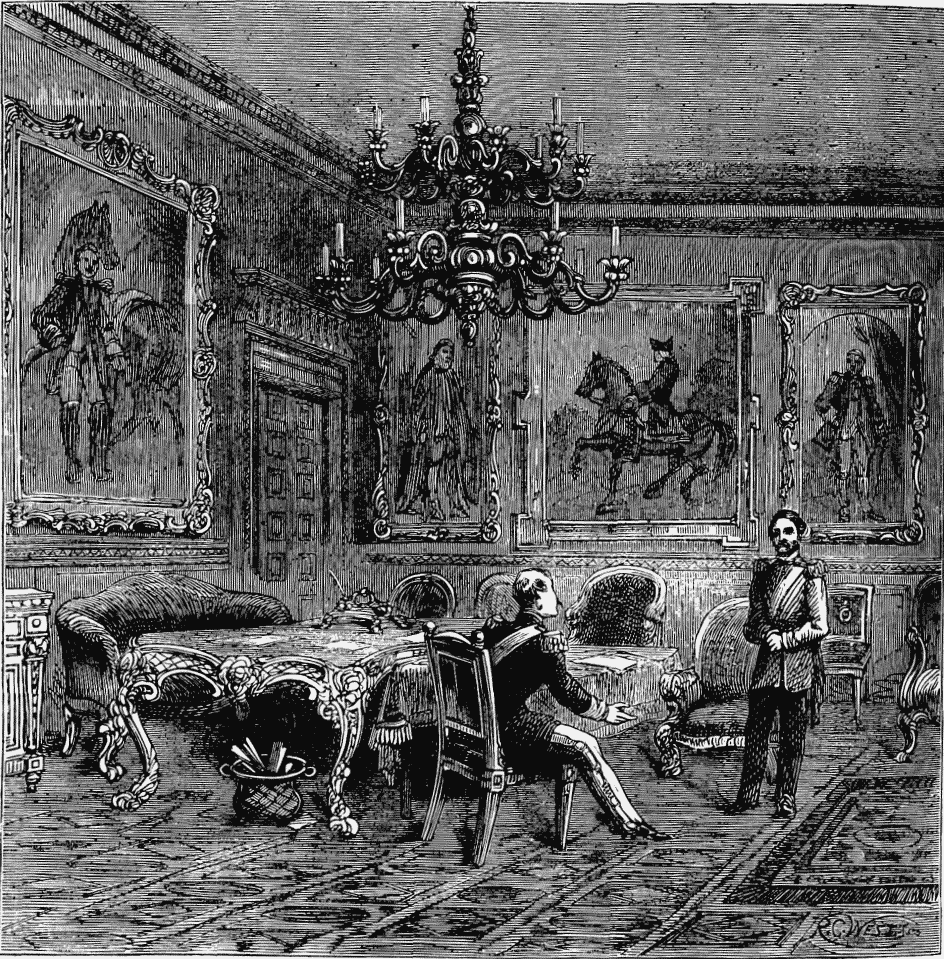
COUNCIL CHAMBER, ST. JAMES'S PALACE, 1840.
It must have been trying to the proud spirit of Queen Henrietta Maria in her widowhood, when she had seen the bodies of Cromwell, Ireton, and Bradshaw dragged on hurdles to Tyburn, and their heads set, as we have said, on the front of Westminster Hall, to have been compelled, in deference to the will of her son, the King, to salute publicly at court as Duchess of York, and consort of the presumptive heir to the throne, the offspring of Lord Chancellor Hyde and his low-born wife.
We learn from Whitelock that St. James's was temporarily occupied by Monk, Duke of Albemarle, before he had made up his mind that it was time to effect the Restoration.
In former times a dinner was laid regularly every day in the out-quarters of the Palace for the royal chaplains. A good story is told about this dinner and the witty Dr.South, who obtained a reprieve for it when there was a talk of its being discontinued. King Charles II. one day came in to dine with the reverend gentleman; and it was Dr. South's turn to say grace. Instead of using the regular form, "God save the King, and bless our dinner," he transposed the verbs, saying, "God bless the King, and save our dinner." "How say you, Dr. South?" said the King; "and it shall be saved, I promise, on the word of a king." It is to be hoped that on this occasion his Majesty did not break his word.
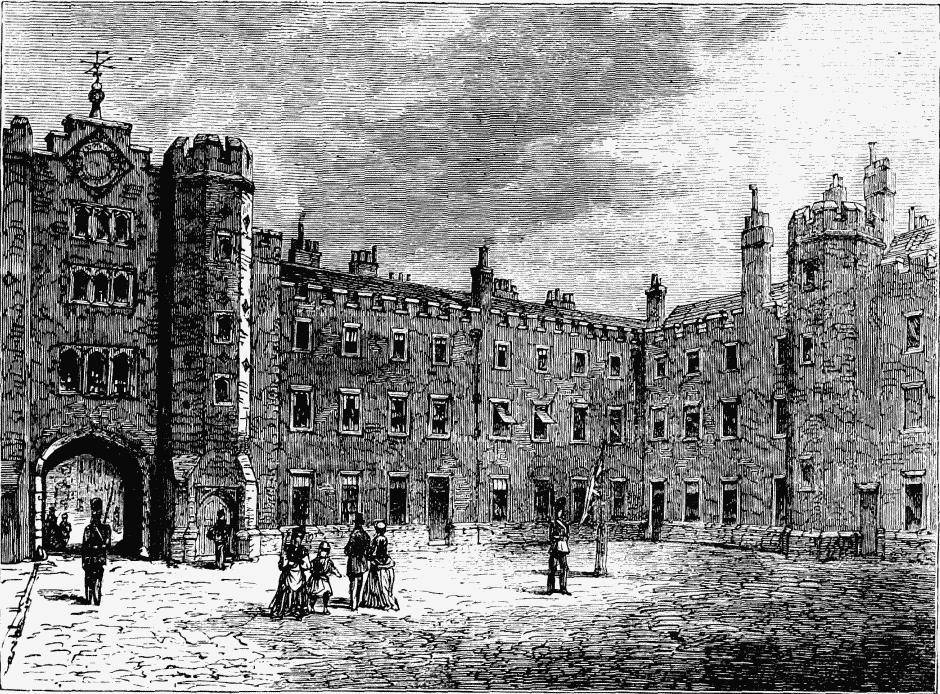
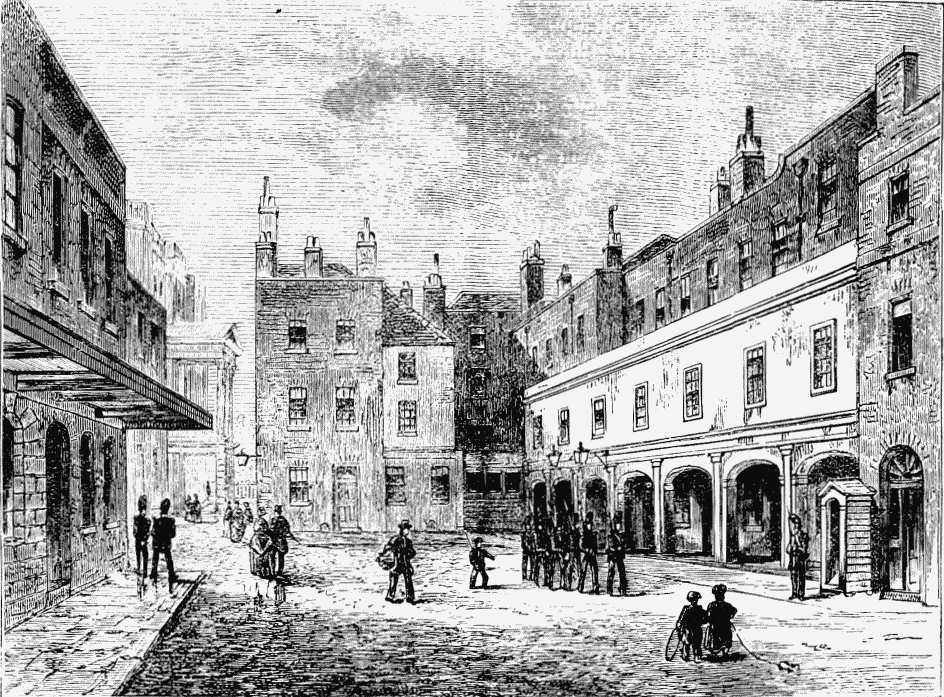
COURT-YARD OF ST. JAMES'S PALACE, 1875.
One of the chief ornaments of the Court of St.
James's in the reign of Charles II. was La Belle
Stewart, afterwards Duchess of Richmond, to whom
Pope has alluded as the "Duchess of R.," in the
well-known line—
"Die and endow a college or a cat."
She was Frances Stewart, grand-daughter of Lord
Blantyre, and as such she inspired Charles II. with
the purest and strongest passion he seemed capable
of entertaining. He would have divorced his
queen to marry her, and was half distracted when,
by her clandestine marriage with the Duke of
Richmond, she eluded his grasp. The personal
charms of La Belle Stewart have been commemorated by Grammont, Pepys, and others. The
secretary, indeed, was enraptured with her appearance—her "cocked hat and a red plume," her
"sweet eye," and "little Roman nose." Miss
Stewart had been so annoyed by the attentions of
Charles and the manners of his profligate court,
that she had already resolved to marry any gentleman of £1,500 a year, when, fortunately, the Duke
of Richmond solicited her hand. Her consent
was, according to Pepys, "as great an act of
honour as ever was done by woman!" In a few
years the duchess became a widow, and continued
so for thirty years, dying October 15, 1702. The
endowment satirised by Pope has been favourably
explained by Warton. She left annuities to certain
female friends, with the burden of maintaining
some of her cats: a delicate way of providing for
poor, and probably proud, gentlewomen, without
making them feel that they owed their livelihood
to her mere liberality. It would have been easy,
however, to have effected the same object in a way
less liable to ridicule. The "effigy" of the duchess
still exists, along with some others, in Westminster
Abbey. She left money by her will, desiring that
her image, as well done in wax as could be, and
dressed in coronation robes and coronet, should be
placed in a case, with clear crown glass before it,
and should be set up in Westminster Abbey. A
more lasting and popular "effigy" is the figure of
Britannia on our copper coins, which was originally
modelled from a medal struck by Charles II. in
honour of the fair Stewart.
In addition to the "sweet little Barbara," Countess of Castlemaine in esse, and Duchess of Cleveland in posse, there hung about the Court, here and at Whitehall, the Duke of Buckingham and the Earl of Rochester, the handsome Sidney, the pompous Earl of St. Albans, and his vain and giddy nephew, Harry Jermyn; the Earls of Arran and Ossory, and the dissolute Killigrew, who together governed the privacy of their master as readily and easily as Clarendon and Ormond controlled his public measures. King Charles II. being here, on one occasion, in company with Lord Rochester and others of the nobility, Killigrew, the jester, came in. "Now," said the king, "we shall hear of our faults." "No, faith," said Killigrew, "I don't care to trouble my head with that which all the town talks of."
Here, in the bedroom of the Princess, took
place, on the 4th of November, 1677, the marriage
of Mary, daughter of James Duke of York and of
his first wife, Anne Hyde, with William Prince of
Orange—a marriage so fatal afterwards to her
father and her step-mother, Mary of Modena, who
at the time was hourly expecting her confinement.
Three days afterwards the boy was born, but he
did not live to the end of the year, being carried
off by the smallpox. Waller, the Court poet, in
a graceful little poem on the death of this infant,
alludes to the extreme youth of the royal mother,
to which he ascribes the early deaths of her other
offspring, and from the same circumstance insinuates consoling hopes for the future:—
"The failing blossoms which a young plant bears
Engage our hopes for the succeeding years.
* * * * *
Heaven, as a first-fruit, claimed that lovely boy;
The next shall live to be the nation's joy."
When, in 1688, the Prince of Orange, with the forces at his command, was advancing towards London, King James sent him an invitation to take up his quarters here. The Prince accepted it, but at the same time hinted to the King, his father-in-law, that he must leave Whitehall. With respect to this event, Dalrymple, in his "Memoirs," tells the following story:—"It was customary to mount guard at both palaces. The old hero, Lord Craven, was on duty at the time when the Dutch guards came marching through the Park to relieve, by order of their master. From a point of honour he had determined not to quit his station, and was preparing to maintain his post; but, receiving the command of his sovereign, he reluctantly withdrew his party, and marched away in sullen dignity."
Here Mary Beatrice of Modena spent the first years of her wedded life with James Duke of York; and even after she became Queen Consort she always preferred its homely apartments to the gilded and gorgeous rooms of the great Palace at Whitehall. Here, too, when she found that she was once more about to become a mother, in the summer of 1688, she resolved that the child should be born, who, if a son, was destined thereafter to become the heir to the English throne. "Mary Beatrice," writes Miss Strickland, "never liked Whitehall, but always said of it that it was one of the largest and most uncomfortable houses in the world. But her heart always clung to her first English home, which had been endeared to her by those tender recollections that regal pomp had never been able to efface."
Here, too, the son of James II. and Mary Beatrice, afterwards so well known to history as "the Elder Pretender," was born on Sunday, the 10th of June, 1688, being Trinity Sunday, between nine and ten in the morning. This chamber is memorable as the scene of the alleged fraud by which the king and queen were said to have tried to foist upon the nation as its future sovereign a child brought into the palace in a warming-pan. Mr. Peter Cunningham tells us that there is extant "a contemporary plan of the palace, dotted with lines to show the way by which the child was said to have been conveyed to her Majesty's bed in the great bedchamber." Those who would wish to read in detail the narratives of this event cannot do better than study them in the "Life" of that queen by Miss Strickland, who states that nearly every member of the court was present on the occasion, to the number of sixty-seven persons, and all saw that a son was born to the queen.
"The Court of Mary Beatrice at St. James's Palace," writes Miss Strickland, "was always magnificent, and far more orderly than that at Whitehall." Like Whitehall, St. James's Palace, under the Stuart sovereigns, was constantly the scene of the ceremony of "touching for the King's evil." Many instances of its performance are on record. Thus we are told that on the 30th of March, 1712, some 200 persons were brought before Queen Anne at St. James's Palace to be healed by the "royal touch." Among this number was one whose name was destined to become great—Samuel Johnson, then a child about two years and a half old. His mother had brought him from Lichfield to London to be touched by the Queen on the advice of Sir John Floyer, a physician of fame in Lichfield; a proof of the high estimation in which the royal "healing" was generally held early in the last century. When asked, late in life, if he could remember Queen Anne, the doctor used to state that he had "a confused but somehow a sort of solemn recollection of a lady in diamonds and a long black hood."
The morals of the Court of Charles II. are matters of history; and even the court balls at St. James's, in his reign, in spite of the influence of his excellent queen, were not marked with any great propriety, if contemporary diaries may be trusted. But, if the Palace was the scene of much that was discreditable and immoral under the Stuarts, it did not gain much in morality under the first two Georges, who kept here their dull English and German mistresses, just as Charles and James had maintained their more attractive French ladies. In the court chronicles and scandalous memoirs of the time we may read plenty of anecdotes of such court ladies as the Duchess of Kendal and Miss Brett, the rival favourites of George I.; and of Mrs. Howard, afterwards Countess of Suffolk, who, in the reign of George II., had "apartments" within its walls, under the very nose and eyes of Queen Caroline, who apparently cared little about her existence. Those who are interested in such scandals may read in Mr. Peter Cunningham's "Handbook of London" an interesting account of a passage at arms between the above-mentioned Miss Brett and her "protector's" granddaughter, the Princess Anne, who ordered to be bricked up again a door which that lady had made to connect her apartments with the Palace garden. The strife was at its height when the sudden death of the King put an end to the reign of Miss Brett, and the Princess triumphed. And Horace Walpole tells us how the accident of Lord Chesterfield having won a heavy sum of money, and having deposited it late at night with Mrs. Howard, led the Queen to suspect him of too great intimacy in that quarter, and so almost forced him into opposition to the Ministry.
Cunningham adds further, as a separate bit of scandal, that Mrs. Howard's husband presented himself one night in the quadrangle of the Palace to claim his wife; but, after many noisy protestations, was induced to desist, "selling to the King," as Walpole had heard, "his noisy honour and the possession of his wife for a pension of twelve hundred a year!" While such scenes were transacted in the eighteenth century, it certainly cannot be allowed that either of the first two Georges had a right to throw the first stone at Charles II. or James II.
Lord Orford, in his "Reminiscences," tells an amusing story of one of the German ladies who came over with King George I. On being abused by the mob, she put her head out of the coach, and cried in bad English, "Good people, why you abuse us? We come for all your goods." "Yes," answered a fellow in the crowd, "and for our chattels too."
The death-bed scene of Queen Caroline has been told by Lord Hervey and other writers of the time. It was on the 9th of November, 1737, that the Queen was taken ill, and continued getting worse. On the 11th, the Prince of Wales—who, as our readers will have already seen, was then living at enmity with his parents—sent to request that he might see her; but the King said it was like one of the scoundrel's tricks, and he forbade the Prince to send messages, or even to approach St. James's. The Queen herself was no less decided. She was then dying from the effects of a rupture, which she had courageously concealed for fourteen years, and she would have died without declaring it, had not the King communicated the fact to her attendants. This delicacy was not, as Lord Hervey says, merely an ill-timed coquetry at fifty-four, that would hardly have been excusable at twenty-five. She feared to lose her power over the King, which she had held firmly in spite of all his mistresses, and was in constant apprehension of making herself distasteful to her husband. The Prince of Wales continued to send messages to the dying Queen, and the messengers got into the Palace; but the Queen wished to have the ravens (who, she said, were only there to watch her death, and would gladly tear her to pieces whilst she was alive) turned out of the house, and the old King was inexorable. About the seventh day of the Queen's illness, the Archbishop of Canterbury (Dr. Potter) was sent for. He continued to attend every morning and evening, but her Majesty did not receive the sacrament.
Some of Lord Hervey's revelations are curious enough. Her Majesty, it appears, advised the King, in case she died, to marry again. George sobbed and shed tears. "Whilst in the midst of this passion, wiping his eyes and sobbing between every word, with much ado he got out this answer: 'Non, j'aurai des maitresses;' to which the Queen made no other reply than 'Ah! mon Diêu! cela n'empêche pas.'
"When she had finished all she had to say on these subjects, she said she fancied she could sleep. The King said many kind things to her, and kissed her face and her hands a hundred times; but even at this time, on her asking for her watch, which hung by the chimney, in order to give it to him to take care of her seal, the natural brusquerie of his temper, even in these moments, broke out, which showed how addicted he was to snapping without being angry, and that he was often capable of using those worst whom he loved best; for, on this proposal of giving him the watch to take care of the seal with the Queen's arms, in the midst of sobs and tears, he raised and quickened his voice, and said, 'Ah, my God! let it alone: the Queen has always such strange fancies. Who should meddle with your seal? Is it not as safe there as in my pocket?'"
During their night watches, the King and Lord Hervey had many conversations, all which the Court Boswell reports fully. George wished to impress upon the Privy Seal that the Queen's affectionate behaviour was the natural effect of an amorous attachment to his person, and an adoration of his great genius! He narrated instances of his own intrepidity, during a severe illness and in a great storm; and one night while he was discoursing in this strain, the Princess Emily, who lay upon a couch in the room, pretended to fall asleep. Soon after, his Majesty went into the Queen's room. When his back was turned, Princess Emily started up, and said, 'Is he gone? How tiresome he is!' Lord Hervey replied only, "I thought your Royal Highness had been asleep. 'No,' said the Princess Emily, 'I only shut my eyes that I might not join in the ennuyant conversation, and wish I could have shut my ears too. In the first place, I am sick to death of hearing of his great courage every day of my life; in the next place, one thinks now of mamma, and not of him. Who cares for his old storm? I believe too, it is a great lie, and that he was as much afraid as I should have been, for all what he says now.'"
Other glimpses of the interior of this strange Court at this time are furnished by Lord Hervey. At length the last scene came. There had been about eleven days of suffering:—"On Sunday, the 20th of November, in the evening, she asked Dr. Tesier—with no seeming impatience under any article of her present circumstances but their duration—how long he thought it was possible for all this to last? to which he answered, 'Je crois que votre Majesté sera bientôt soulagée.' And she calmly replied, 'Tant mieux.' About ten o'clock on Sunday night, the King being in bed and asleep, on the floor, at the foot of the Queen's bed, and the Princess Emily in a couch bed in a corner of the room, the Queen began to rattle in the throat; and Mrs. Purcel giving the alarm that she was expiring, all in the room started up. Princess Caroline was sent for, and Lord Hervey, but before the last arrived the Queen was just dead. All she said before she died was, 'I have now got an asthma; open the window.' Then she said, 'Pray:' upon this the Princess Emily began to read some prayers, of which she scarce repeated ten words before the Queen expired. The Princess Caroline held a looking-glass to her lips, and finding there was not the least damp upon it, cried, ''Tis over.'"
George did not marry again, but contented himself with "des maîtresses." He survived nearly twenty-three years, dying suddenly on the 25th of October, 1760. He directed that his remains and those of the Queen should be mingled together; and accordingly, one side of each of the wooden coffins was withdrawn, and the two bodies placed together in a stone sarcophagus.
George III., at his accession, was not much more popular than his grandfather had been before him; and on several occasions the populace showed that he held the throne by a very precarious tenure. Sir N. W. Wraxall tells us, in his gossiping "Memoirs of his Own Time," that in one popular outbreak, in 1769, a hearse, followed by an excited mob, decorated with insignia of most unmistakable meaning, was driven into the court-yard of St. James's Palace, an Irish nobleman, Lord Mountnorris, personating an executioner, holding an axe in his hands, whilst his face was covered over by a veil of crape. "The king's firmness, however," adds Wraxall, "did not forsake him in the midst of this trying ebullition of democratic rage. He remained calm and unmoved in the drawing-room, whilst the streets surrounding his palace echoed with the shouts of an enraged multitude, who seemed disposed to proceed to those extremities to which, eleven years later, they actually went, in the 'Gordon' riots."
On the 22nd of January, 1809, as stated above, about half-past two in the morning, a fire was discovered in St. James's Palace, near the King's back stairs. The whole of the private apartments of the Queen, those of the Duke of Cambridge, the King's court, and the apartments of several persons belonging to the royal household, were destroyed; the most valuable part of the property was preserved. The Hon. Miss Amelia Murray tells us this fire was believed at the time to be the work of an incendiary.
About the year 1810 the Palace was the scene of a horrid tragedy, which, for a time at least, drew down great popular indignation on one member of the royal family. The Duke of Cumberland had an Italian servant named Sellis, who made his way into his master's bedroom and tried to assassinate him in the night. The duke awoke, and was able not only to defend himself, but to drive away the would-be assassin, who, when he found himself foiled in his dastardly attempt, crept back to his own room and cut his throat. A coroner's inquest being held on the body, a verdict of "felo-de-se" was returned. The affair, nevertheless, caused great excitement at the time, and many suspicions were entertained, and many cruel insinuations made against the duke, who was, from youth, the most unpopular member of the royal house; and even to the present day there is a sort of floating tradition to the effect that the duke—who, in 1837, left England on becoming King of Hanover, and scarcely ever afterwards came to this country—was the murderer of his valet.
A good story is told by Miss Murray, in her "Recollections," concerning the wife of the Duke of Cumberland, who in early life was more than suspected of levity of conduct. Old Queen Charlotte was resolved to keep her court pure, in the persons of its female part, at least; and when her eldest son, the Prince Regent, endeavoured to smooth over the Duchess's faults, and procure for her a public reception at Court, her Majesty replied, that "she would receive the Duchess of Cumberland as a daughter-in-law when she received the Princess of Wales also. But this arrangement did not suit the Prince Regent's book."
With regard to the kitchen of St. James's Palace in the time of George III., it need only be said that it was very similar in its appearance to the kitchens of other large establishments. Our illustration (page 120) shows the principal features of the place at the above period. It may be added here that the grass-plot which lies beneath the southern windows of the Palace, now enclosed with high walls, is substantially the same as it was in the reign of Charles II., who, on a summer evening, was often to be seen here, playing at bowls with the fair ladies of his court.
CHAPTER X.
ST. JAMES'S PALACE (continued).
"They say there is a Royal Court,
Maintained in noble state,
Where every able man and good
Is certain to be great."—Tom Hood.
A Drawing-room in the Reign of Queen Anne, and one of the Present Day—Court Wits—Sedan Chairs at St. James's—Influence of Monarchical Institutions on Social Etiquette—Sociality of Great Kings—Courtly Leaders of Fashion—Court Dresses—Costume in the Reign of George III.—Queen Elizabeth's Partiality for Black Silk Stockings—Killigrew and King Charles's Tailor—Hair-powder and Fullbottomed Wigs—Farthingales and Crinoline—The Poet-Laureate and his Butt of Sherry—Royal Patronage of Poetry and Literature—Stafford (formerly Cleveland) House—Appearance of St. James's at the Beginning of the Seventeenth Century.
For upwards of two hundred years—indeed, even before the burning of Whitehall—the name of St. James's has been identified in English literature with the English Court, and all that is refined and courtly. Mr. Harrison Ainsworth, therefore, has only given expression to a popular idea of long standing, when he names one of his works "St. James's and St. Giles's," as the very antipodes of each other; and it is almost superfluous to add, that in his historical romance of St. James's he has given us an insight into the inner life of the Court of Queen Anne, scarcely inferior in minuteness to the picturesque peeps of the same court which we find in the "Diaries" of Samuel Pepys and John Evelyn. Here, for instance, is a picture of St. James's Street en fête in February, 1707, on the occasion of a "drawing-room" held in celebration of the birthday of Queen Anne. It is worth giving entire, as a sketch taken from life:—"The weather was in unison with the general festivity, being unusually fine for the season. The sky was bright and sunny, and the air had all the delicious balminess and freshness of spring. Martial music resounded within the courts of the Palace, and the trampling of the guard was heard, accompanied by the clank of their accoutrements, as they took their station in St. James's Street, where a vast crowd was already collected.
"About an hour before noon the patience of those who had taken up their positions betimes promised to be rewarded, and the company began to appear, at first somewhat scantily, but speedily in great numbers. The science of the whip was not so well understood in those days as in our own times, or perhaps the gorgeous and convenient though somewhat cumbersome vehicles then in vogue were not so manageable; but from whichever cause, it is certain that many quarrels took place among the drivers, and frequent and loud oaths and ejaculations were poured forth. The footpath was invaded by the chairmen, who forcibly pushed the crowd aside, and seemed utterly regard less of the ribs and toes of those who did not make way for them. Some confusion necessarily ensued; but though the crowd were put to considerable inconvenience, jostled here, squeezed there, the utmost mirth and good-humour prevailed.
JAMES'S PALACE, 1875. (Showing the Room in which the Duke of Cumberland's Valet died.)
"Before long the tide of visitors had greatly increased, and coaches, chariots, and sedans were descending in four unbroken lines towards the Palace. The curtains of the chairs being for the most part drawn down, the attention of the spectators was chiefly directed to the coaches, in which sat resplendent beauties bedecked with jewels and lace, beaux in their costliest and most splendid attire, grave judges and reverend divines in their respective habiliments, military and naval commanders in their full accoutrements, foreign ambassadors, and every variety of character that a court can exhibit. The equipages were most of them new, and exceedingly sumptuous, as were the liveries of the servants clustering behind them.
"The dresses of the occupants of the coaches were varied in colour, as well as rich in material, and added to the gaiety and glitter of the scene. Silks and velvets of as many hues as the rainbow might be discovered, while there was every kind of peruke, from the courtly and modish Ramillies just introduced, to the somewhat antiquated but graceful and flowing French Campane. Neither was there any lack of feathered hats, point-lace cravats and ruffles, diamond snuff-boxes and buckles, clouded canes, and all the et cetera of beauish decoration."
Another writer in describing the scene witnessed at St. James's on the occasion of a Drawing-room of the present day, remarks that, "after all, magnificence is a tawdry thing, when viewed under the searching blaze of sunshine. Jewels lack lustre—gold appears mere tinsel—the circumstantialities of dress are too much seen to admit of any general effect; and even beauty's self becomes less beautiful. The complexion becomes moistened by the stifling atmosphere of the crowded rooms. As to ladies of a certain age," continues the writer, "let them, above all things, avoid the drawingroom: such a revelation of wrinkles, moles, beards, rouge, pearl-powder, pencilled eyebrows, false hair and false teeth, as were brought to light, I could scarcely have imagined. Many faces, which I had thought lovely at 'Almack's,' grew hideous when exposed to the tell-tale brightness of the meridian sun; the consciousness of which degeneration rendered them anxious, fretful, and doubly frightful. Two or three dowagers, with mouths full of gold wire, chinstays of blond to conceal their withered deficiencies, and tulle illusion tippets, were really horrific; painted sepulchres—ghastly satires upon the hollowness of human splendour.

OLD VIEW OF ST. JAMES'S PALACE, BEFORE THE GREAT FIRE OF LONDON.
"I have often heard it asserted that an English girl, with the early bloom of girlishness on her cheek, is the prettiest creature in the world; and have thence concluded that a drawing-room, where so many of these rosebuds are brought forward to exhibit their first expansion, must present a most interesting spectacle. This morning I particularly noticed the demoiselles to be presented; and the ghastliness of the ladies of a certain age was scarcely less repulsive than a niaiserie of several of these budding beauties. Nothing but a young calf is so awkward as a girl fresh from the schoolroom, with the exhortations of the governess against forwardness and conceit still echoing in her ears; knowing no one—understanding nothing—afraid to sit, to stand, to speak, to look—always in a nervous ague of self-misgiving. The blushing, terrified, clumsy girls I noticed yesterday will soon refine into elegant women; but what will then become of the delicacy of their complexion and the simplicity of their demeanour?"
A "Drawing-room," therefore, is an institution organised to fulfil the object of every fair young débutante's ambition, by enabling her to be "presented at court," the event which marks her entry into "fashionable life," and gives her an entrée and passport in every European capital.
A Levee or a Drawing-room has always formed the head-quarters of witty retort and polite badinage. Of all Court wits perhaps George Selwyn was the readiest and the happiest. Among other witticisms uttered by him within the precincts of the Court, was one related by Mr. W. C. Hazlitt in his "New London Jest Book." "Lord Galloway was an avowed enemy to the Bute administration. At the change of the Ministry consequent on Lord Bute's fall, he came to St. James's for the first time in George III.'s reign. He was dressed in plain black, and in a very uncourtly style. When he appeared at the Levee, the eyes of the company were turned on him, and inquiries were murmured as to who he could be. George Selwyn being asked, replied that he was not sure, but thought he was 'a Scotch undertaker, come up to London to bury the late administration.'"
There are extant many sketches of the front of
the Palace Gate on the day of a Levee or a
Drawing-room under the later Stuarts and the
Hanoverian sovereigns. The illustration on page
103 shows the king arriving in his coach with the
company in carriages and sedan-chairs. As they
look at it, some of our readers may possibly remember the lines ascribed to Pope:—
"Roxana, from the Court returning late,
Sighed her soft sorrow at St. James's Gate;
Such heavy thoughts lay brooding in her breast,
Not her own chairmen with more weight oppressed."
In 1626 sedan chairs were novelties confined to the upper classes and persons "of quality." They were introduced at the West-end by Sir Sanders Duncombe, who represented to the King that "in many parts beyond the seas people are much carried in chairs that are covered, whereby few coaches are used among them," and prayed for the privilege of bringing them into London. Duncombe was patronised by the royal favourite, Buckingham, through whose influence he obtained a concession of the privilege for fourteen years, and made, no doubt, a good round sum of money by the monopoly.
Sedan chairs, which once were as common at the West-end as hansom cabs, and as much used by men as well as ladies of "the quality," figure frequently in Hogarth's pictures of London life. In his day the sedan chair was the courtly vehicle, and in one of the plates of the "Modern Rake's Progress" we see the man of fashion using it in attending court. The chair continued to be in use all through the Georgian era, and even to a later date; and in some large houses, in the early part of Her Majesty's reign, a specimen of it was to be seen in the hall or lobby of large houses in the Westend, laid up like a ship in ordinary. It was used even to a later date occasionally at Bath, Cheltenham, and Edinburgh, where the chairmen were a very quaint and humorous body, mostly natives of the Highlands.
It is far from uninteresting to mark the introduction of such modes of conveyance, as they become curious in the retrospect, and give us a very fair insight into the habits and manners of past years.
The Sedan chair, though so called from the place where it was originally made, did not come to England from France, but from Spain, being introduced from Madrid by Charles I., when, as Prince of Wales, he went to that city to look for a wife. On his departure from Spain, as we learn from Mendoza's "Relation of what passed in the Royal Court of the Catholic King, our Lord, on the departure of the Prince of Wales," the Prime Minister of Spain, and favourite of Philip IV., Olivarez, gave the Prince "a few Italian pictures, some valuable pieces of furniture, and three sedan chairs of curious workmanship."Another contemporary writer tells us that on his return to England, Charles gave two of these chairs to his favourite, the Duke of Buckingham, who raised a great clamour against himself by using them in the streets of London. Bassompierre, the French Ambassador, in his "Memoirs of the English Court," states that "the popular outcry arose to the effect that the Duke was reducing freeborn Englishmen and Christians to the condition of beasts of burden." When, however, the populace found out that money was to be made out of them, and that to start a "sedan" was a good speculation, they swallowed their scruples, and, like shrewd and sensible persons, invested their savings in building and buying them, so that in a short time they came into common use, not only in London, but in the chief provincial towns. In the country they were never popular.
Amongst those who came to St. James's in "a chair" was John Duke of Marlborough, after his crowning victory of Ramillies, then at the summit of his popularity, and almost worshipped by the people, who measure everything by success. He tried to smuggle himself into the levee in a chair, but in spite of his attempt at privacy he was discovered, and in a few minutes was surrounded by thousands who rent the air with their acclamations.
A courtly and polished condition of society among the wealthier circles is a natural consequence of our monarchical institutions. Mr. N. P. Willis, the American writer, confesses as much when he writes, "The absence of a queen, a court, and orders of nobility, gives us in the States a freedom from trammel in such matters which would warrant quite a different school of polite usages and observances of ceremony. Yet up to the present time," he adds, "we have followed the English punctilios of etiquette with almost as close a fidelity as if we were a suburb of London." So deeply engrained in human nature is the observance of an orderly and regulated ceremonial, even in the minutiæ of daily life.
Johnson remarked that it had been suggested that kings must be unhappy, because they are deprived of the greatest of all satisfactions, easy and unreserved society. "That is an ill-founded notion. Being a king does not exclude a man from such society. Great kings have always been social. The King of Prussia, the only great king at present, is very social. Charles II., the last king of England who was a man of parts, was social; and our Henries and Edwards were all social."
It is one of the least observed but perhaps not among the least equivocal proofs of a great advancement in the ideas of freedom entertained by the British people, that their king and queen for the time being may be said to be the only sovereigns in Europe who have ceased to have the power of dictating the fashions to their people.
In days of old—nay, so late as the reign of George II.—it was with the English, as it is still with the other nations: the first personages in the kingdom (from being supposed to be the best informed) led the fashions. As the king and queen, so their whole court, and all the higher ranks of the public, were habited, from the celebrated ruff of the good Queen Bess to the elegant head-dress of the amiable Queen Caroline. But the reign of George III. introduced a new era. "Queen Charlotte, on her arrival in this country, evinced a desire to fall in with its national modes, and a chasteness in her own ideas of improvement in dress, which well entitled her to take the lead of her adopted countrywomen in this respect; but English ladies, it seemed, were not now to be led, even by their queen. Her Majesty's first endeavour was to reduce their toupee to a size more suited to the length and breadth of the face, than it had been usual to wear them; and next to introduce a cap neither so diminutive as to be nearly invisible, nor of such a magnitude as to bury the features of the wearer. But in vain were her efforts. Broad and towering head-dresses continued still the rage; and so continued till a love of novelty induced the ladies, of their own accord, to change to something less absurd. As for the gentlemen of those days, they seemed more inclined to follow the manners and dresses of the King's Guards than of the King himself. His Majesty's wig and large hat found as few imitators among his subjects as his domestic virtues. Nor at any time during the many years which George III. and his virtuous consort presided over society in this country, could their influence over the fashions be said to have much increased. The annual fashions among the ladies continued as usual to take date from the day on which her Majesty's birthday was celebrated; but the fashions themselves had little or no regard to what her Majesty wore on such occasions, but rather to what was the most admired among the very splendid varieties presented for general imitation."
This may not be literally true, for the dress of her present Majesty and her mode of arranging her hair on first ascending the throne, were most servilely followed by nearly all the young ladies of England.
The court dress of ladies has varied to a very great extent with the fashions of the age, and the sovereign from time to time has laid down very precise regulations as to what is, and what is not, allowable in the female costume on court occasions. The court dress of gentlemen, however, has undergone but very slight modification during the past century: though wigs and hair-powder are no longer worn, yet the plum-coloured suit of livery with light silk facings, worn till our own time at levees by men, would remind us of so many lacqueys, were it not for the sword which accompanies them. Some slight modifications in this dress were made a few years ago by the authority of the Lord Chamberlain, the most important being the admission of velvet as an optional substitute for the plum-coloured cloth above-mentioned, and the recognition of trousers instead of knee-breeches; but the court costume of the male sex is still somewhat of an anachronism.
At the commencement, and indeed to almost the middle of the reign of George III., a nobleman or a gentleman of "quality" was known by his dress, which he wore not only on "court" days and special occasions, but in the streets, and at evening parties or other gatherings, at home, or at the coffee-houses and clubs. "That costume," writes Sir N. W. Wraxall in 1814, "which is now confined to the levee or drawing-room, was forty years ago worn by persons of condition, with few exceptions, everywhere and every day. Mr. Fox and his friends, who might be said to dictate [social laws] to the town, affecting a style of neglect about their own persons, and manifesting a contempt of all the usages hitherto established, first threw a discredit on the court dress. From the House of Commons and the Clubs in St. James's Street, it spread through the private assemblies of London. But though gradually undermined, and insensibly perishing of an atrophy, dress never totally fell till the era of Jacobinism and equality, in 1793 and the following year. It was then that pantaloons, cropped hair, and shoe-strings, as well as the total abolition of buckles and ruffles, together with the disuse of hair-powder, characterised the dress of Englishmen." To the same influence he traces the decline of a distinctive dress among the ladies also; and expresses a hope, and indeed a prophecy, that "it will be necessary at no very distant period to revive the empire of dress."
The huge hoops worn by the ladies of a century or more ago have occasionally been of service. Sir Robert Strange, for instance, the eminent engraver, being "out in '45," as the phrase then went, being hard driven for shelter from the searchers of the victorious army, hid himself under the ample folds of the petticoats of a Miss Lumsden, whom he requited for the service by marrying her soon afterwards.
The first pair of silk stockings brought into England from Spain was presented to Henry VIII., who greatly prized them. In the third year of Elizabeth's reign, her "tiring" woman, Mrs. Montagu, presented her Majesty with a pair of black silk stockings as a new-year's present; whereupon her Majesty asked if she could have any more, in which case she would wear no more cloth stockings. Silk stockings were equally rare things in the Royal Court of Scotland, for it appears that before James VI. received the ambassadors sent to congratulate him on his accession to the English throne, he requested one of the lords of his court to lend him his pair of silk hose, that he "might not appear as a scrub before strangers."
Apropos of court dresses, we may be pardoned for extracting the following from "Joe Miller's Jestbook:"—"King Charles II. having ordered a new suit of clothes to be made, just at a time when addresses were coming up to him from all parts of the kingdom, Tom Killigrew went to the tailor, and ordered him to make a very large pocket on one side of the coat, and one so small on the other, that the king could hardly get his hand into it; which seeming very odd, when they were brought home, he asked the meaning of it. The tailor said, "Mr. Killigrew ordered it so." Killigrew being sent for and interrogated, said, "One pocket was for the addresses of his Majesty's subjects, and the other for the money they would give him."
Hair-powder was introduced into Europe in the year 1614. It is said that at the accession of George I., only two ladies wore powder. At the coronation of George II. there were but two hairdressers in London: in 1795, there were 50,000 in England.
The full-bottomed wigs which envelope and cloud some of the most distinguished portraits of the Stuart era were still in fashion during the reign of William and Mary. Lord Bolingbroke was one of the first to reduce them by tying them up. At this Queen Anne was much offended, and said to a bystander, that "he would soon come to court in a night-cap." Soon after this, tie-wigs, instead of being regarded as undress, became part and parcel of the high court dress at St. James's and Kensington.
Archbishop Tillotson, who was the first English prelate represented in a wig, says:—"I can well remember since the wearing the hair below the ears was looked upon as a sin of the first magnitude; and when ministers generally, whatever their text was, did either find or make occasion to reprove the great sin of long hair; and if they saw any one in the congregation guilty in that kind, they would point him out particularly, and let fly at him with great zeal." It is stated that as far as the women were concerned, there was nothing to blame in this innocent fashion of long locks let free from unnatural constraint; and the glossy ringlets of the young gentlewomen of 1640, confined only by a simple rose, jewel, or bandeau of pearls, was one of the most elegant head-dresses ever invented to please the eye of man: this, as is well known, is the style that has been transmitted to us in the bewitching portraits of the beauties of the court of Charles II. The decorations of the men's heads were not anything half so simple, for, after the frizzing up the hair from the forehead, and then suffering it to fall in the wild luxuriance that called forth the censures of the clergy, they next proceeded to ornament themselves with borrowed hair, and the odious invention of the peruke, or periwig, made in imitation of the long, waving curls of the "Grand Monarque," came next into fashion. Charles II., it is well known, adopted this fantastic fashion; and very soon not a gentleman's head or shoulders were considered to be complete without a French wig.
The farthingale of the sixteenth and beginning of the seventeenth centuries was—as our readers, no doubt, well know—the originator of the hooped petticoat of the eighteenth and of the crinoline of the nineteenth century; but in many respects the men offered a still broader mark for the satirist, the cavalier being adorned in silk, satin, or velvet of the richest colours, with loose, full sleeves, slashed in front; the collar, too, of this superb doublet was of the costliest point lace; his swordbelt, of the most magnificent kind, was crossed over one shoulder, whilst a rich scarf, encircling the waist, was tied in a large bow at the side.
Charles II. curtailed the doublet of its fair proportions, made it excessively short, and opened it in front to display a rich shirt, bulging out without any waistcoat, wearing at the same time Holland sleeves of extravagant size and fantastic contrivance. The ladies' dresses, however, and their drapery were not much affected by the example of royalty.
That the dress of the court fops in the Georgian era was a somewhat expensive commodity, we may infer from "Beau" Brummell's answer to a question once put to him. Being asked by a lady how much she ought to allow her son for dress, he replied, that it might be done for £800 a year, with strict economy!
Among the curious customs and ceremonies of the Court, which have been handed down to us from the Stuart times, is that of presenting the poetlaureate—who, by the way, is an "officer of the household of the sovereign"—with a butt of sherry from the royal cellars. Although the earliest mention of a poet-laureate in England occurs in the reign of Edward IV., it was not till 1630 that the first patent of the office seems to have been granted. Since 1670 the following poets have held the office of laureate:—Dryden, Tate, Rowe, Colley Cibber, William Whitehead, Warton, Pye, Southey, Wordsworth, and Alfred Tennyson.
Mention of the office of poet-laureate leads us naturally to speak of the success attending the poetical and literary efforts of such as have owed their rise in life to royal and courtly patronage. Most of the persons mentioned in the following extract from a modern periodical must have frequently crossed the threshold of St. James's Palace to worship the rising or risen sun of royalty:—"In the reigns of William III., of Anne, and of George I., even such men as Congreve and Addison would scarcely have been able to live like gentlemen by the mere sale of their writings. But the deficiency of the natural demand for literature was at the close of the seventeenth, and at the beginning of the eighteenth century, more than made up by artificial encouragement—by a vast system of bounties and premiums. There was, perhaps, never a time at which the rewards of literary merit were so splendid—at which men who could write well, found such easy admittance into the most distinguished society, and to the highest honours of the state. The chiefs of both the great parties into which the kingdom was divided, patronised literature with emulous munificence. Congreve, when he had scarcely attained his majority, was rewarded for his first comedy with places which made him independent for life. Smith, though his 'Hippolytus and Phædra' failed, would have been consoled with £300 a year but for his own folly. Rowe was not only poet-laureate, but land surveyor of the Customs in the port of London, Clerk of the Council to the Prince of Wales, and Secretary of the Presentations to the Lord Chancellor. Hughes was Secretary to the Commissions of the Peace. Ambrose Philips was Judge of the Prerogative Court in Ireland. Locke was Com missioner of Appeals, and of the Board of Trade. Newton was Master of the Mint. Stepney and Prior were employed in embassies of high dignity and importance. Gay, who commenced life as apprentice to a silk-mercer, became a Secretary of Legation at five-and-twenty. It was to a poem on the death of Charles II., and to the 'City and Country Mouse,' that Montague owed his introduction into public life, his Earldom, his Garter, and his Auditorship of the Exchequer. Swift, but for the unconquerable prejudice of the Queen, would have been a bishop. Oxford, with his white staff in his hand, passed through the crowd of suitors to welcome Parnell, when that ingenious writer deserted the Whigs. Steele was a Commissioner of Stamps and a Member of Parliament. Arthur Mainwaring was a Commissioner of the Customs, and Auditor of the Imprest. Tickell was Secretary to the Lords Justices of Ireland. Addison was Secretary of State."
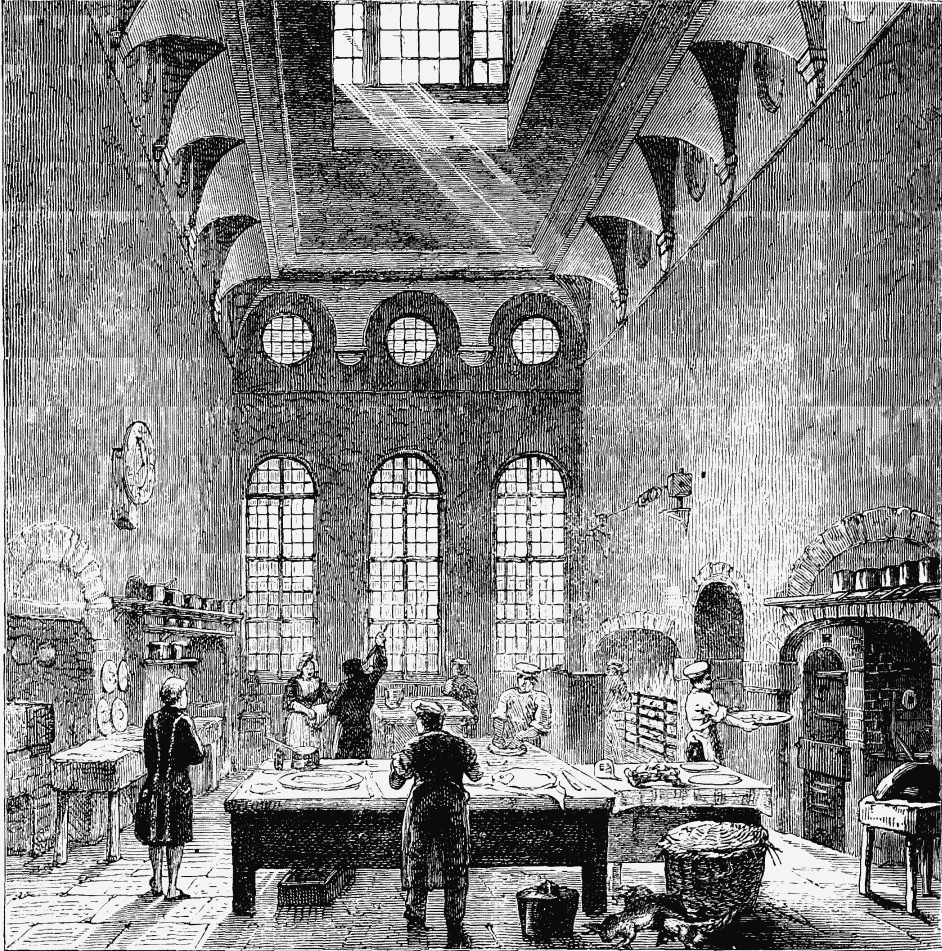
KITCHEN OF ST. JAMES'S PALACE, IN THE TIME OF GEORGE III.
On the western side, and within what we may style the precincts of St. James's Palace, commanding a view both of St. James's Park and the Green Park, stands Stafford House, or as it was called till recently, Cleveland House. The old house derived its name from Barbara, Duchess of Cleveland, one of the mistresses of Charles II. By birth she was a Villiers, the daughter and heiress of the Irish Viscount Grandison; and she was created Baroness of Nonsuch, Countess of Northampton, and Duchess of Cleveland, by her royal admirer, to whom she had borne two sons—Charles Fitz Roy, Earl of Southampton, and George Fitz Roy, Duke of Northumberland. This lady died at Chiswick in 1709. Seven years before that, apparently she had resigned her interest in this house, as in 1702 we find it granted by the Crown to Henry, Duke of Grafton: it was then called Berkshire House, from its former owner. The present house covers also very nearly the site of a smaller mansion, Godolphin House, which at the beginning of the present century was occupied by the Duke of Bedford. It is deserving of a passing note as having been the residence of Charles James Fox during his last illness. We learn from his biographer, Trotter, that during this anxious period "the garden of the house in the Stable Yard was daily filled with anxious inquirers; the foreign ambassadors and ministers, and private friends of Mr. Fox, walked there, eager to know his state of health, and catch at every hope of his amendment. As he grew worse he ceased to go out in his carriage, and was drawn in a garden chair, at times, round the walks. … His manner was as easy and his mind as penetrating and vigorous as ever; and he transacted business in this way, though heavily oppressed by his disorder, with perfect facility." After his death, at the Duke of Devonshire's villa at Chiswick, his body rested here for a night or two previous to his public funeral in Westminster Abbey. In the last century Godolphin House became the residence of the Duke of Bridgewater, who new-fronted the mansion with stone.

CLEVELAND HOUSE. (From a Print published in 1799.)
The present mansion was built about the year 1825 by the Duke of York. It is said by Mr. Chambers, in his "Handy Guide to London," that it was built with money lent to him by the Marquis of Stafford, whose grandson is the present owner. Be this as it may, the Stafford family became possessed of it, and have spent at least a quarter of a million upon it and its decorations. The mansion was built by the Duke of York on the site of a former residence, where he and the duchess gave pleasant dinners and receptions, devoting the evenings to whist, at which the duke was a first-rate player. Among his most constant guests were Lords Alvanley, Lauderdale, De Ros, and Hertford, "Beau" Brummell, and the Duke of Dorset. It is said that he planned and built the house from his own designs. The duke was very fond of collecting here curiosities of every description—jewels, bronzes, coins, and articles of vertu; he also spent large sums in purchasing old chased plate, with which his sideboards groaned; and on his walls he had a fine collection of portraits of officers in curious old uniforms. When he left the Stable Yard the duke took up his abode at Cambridge House, in South Audley Street. He died at Rutland House, at the north-western corner of Arlington Street, but his body was afterwards brought to St. James's Palace, where it lay in state, in January, 1827.
It may be mentioned here that Stafford House marks the extreme south-western limit of the parish of St. James's, Piccadilly.
The money received for the sale of Stafford House by the Crown was devoted in 1842 to the purchase of Victoria Park in the East-end of London as a recreation-ground for the people. The form of the mansion is quadrangular, and it has four perfect fronts, all of which are cased with stone. The north or principal front, which is the entrance, exhibits a portico of eight Corinthian columns. The south and west fronts are alike; they project slightly at each end, and in the centre are six Corinthian columns supporting a pediment. The east front differs a little from the preceding, as it has no projecting columns. The vestibule, which is of noble dimensions, leads to the grand staircase. The library is situated on the ground floor; and on the first, or principal floor, are the state apartments, consisting of dining-rooms, drawing-rooms, and a noble picture gallery, 130 feet in length, in which is placed the Stafford Gallery, one of the finest private collections of paintings in London; it is particularly rich in the works of Titian, Murillo, Rubens, and Vandyck. The private rooms contain many valuable art treasures.
The noble suite of drawing-rooms have been often lent by the late and the present Duchesses of Sutherland for the purposes of meetings of gentlemen and ladies who are interested in social reforms, so that the interior of the house is known to very many persons. One of the most novel exhibitions, perhaps, which have taken place here, or anywhere, was in the summer of 1875, when there was held in the garden a show of wicker coffins of all sorts, sizes, and patterns—apropos, of course, of the much-vexed question of "earth to earth," which at the time had been so frequently agitated in the newspapers.
Even so lately as 1660, St. James's Palace stood in somewhat open country, as shown by a drawing of that date in the Towneley Collection, which corresponds very closely to the description of the place given by Le Serre in his "Entrée Royale," &c., fol. 1639. "Near the avenues of the palace," says the latter, "is a large meadow, always green, in which the ladies walk in summer; its great gate has a long street in front, reaching nearly to the fields." A long low wall runs eastwards, along what is now the south side of Pall Mall, and a thick grove of trees covers what is now the site of Marlborough House. As nearly as possible, where now stands the Junior Carlton Club, on the north side of Pall Mall, is a small barn or shed and a haystack; and in the front of the print, not far from the centre of what is now St. James's Square, stands a handsome conduit, with ornamental brickwork and a lofty crenellated roof; and the meadow in which it stands, apparently, was not at that time surrounded even by a hedge.
We fear it must be owned to be as true in 1875 as it was half a century before, that the sovereign of England is still without a London residence becoming the head of so great an empire. Though Windsor Castle is unequalled as a mediæval stronghold, we have in London nothing that answers to what the Tuileries was; and Hampton Court is at best but a poor substitute for the Château of Versailles.
With reference to the mean appearance of St. James's Palace, the author of the "Beauties of England and Wales" writes, in 1815:—"Few ideas of superior grandeur or magnificence are excited by a partial view of the exterior of this royal palace. And when it is considered that, in fact, this is the only habitation which the monarch of a mighty empire like ours possesses in his capital, strangers are at a loss whether to attribute the circumstance to a penuriousness or meanness of our national character. It arises, in fact, from neither. It has been justly remarked that the disparity between the appearance of this palace, and the object to which it is—or rather has been—appropriated, has afforded a theme of wonder and pleasantry, especially to foreigners, who, forming their notions of royal splendour from piles erected by despotic sovereigns, with treasures wrung from a whole oppressed nation, cannot at once reduce their ideas to the more simple and economical standard which the head of a limited monarchy is compelled to adopt in its expenditure."