Old and New London: Volume 4. Originally published by Cassell, Petter & Galpin, London, 1878.
This free content was digitised by double rekeying. Public Domain.
Edward Walford, 'The Haymarket', in Old and New London: Volume 4(London, 1878), British History Online https://www.british-history.ac.uk/old-new-london/vol4/pp216-226 [accessed 3 May 2025].
Edward Walford, 'The Haymarket', in Old and New London: Volume 4(London, 1878), British History Online, accessed May 3, 2025, https://www.british-history.ac.uk/old-new-london/vol4/pp216-226.
Edward Walford. "The Haymarket". Old and New London: Volume 4. (London, 1878), British History Online. Web. 3 May 2025. https://www.british-history.ac.uk/old-new-london/vol4/pp216-226.
In this section
CHAPTER XVIII.
THE HAYMARKET.
"From the Haymarket canting rogues in grain."—"Rejected Addresses."
The Old Market for Hay and Straw—A Seller of "Sea Coal"—Foreign Ambassadors in Peril—Rogues "in Grain"—Addison in a Garret—Thackeray on Addison—Sir John Suckling's Heroine—Tiddydoll and his Gingerbread—Lord Eldon's Pint of Wine—Dr. Wolcott and Madame Mara—Michael Kelly's Wine Vaults—Assault on Sir John Coventry—Baretti: his Trial for Murder—Shows in the Haymarket—The Animal Comedians—The Cat's Opera—O'Brien, the Irish Giant—Weeks's Museum—The "Little Theatre in the Haymarket:" its History—Foote: his "Cat Music"—Ancedotes of Foote—"Romeo" Coates—The Theatre in Colman's Hands—A Sad Accident—Reconstruc tion of the Theatre by Nash—Liston's Appearance in Paul Pry—Subsequent Managers and Actors at the Haymarket: Mr. Benjamin Webster. Mr. Buckstone, Mr. Charles Mathews—"Lord Dundreary."
The broad street denominated the Haymarket, connecting Pall Mall East with the eastern end of Piccadilly, was a place for the sale of farm-produce as far back as the reign of Elizabeth; and in Aggas's plan it appears under its present name, It was then evidently a rural spot, as there were hedgerows on either side, and few indications of habitations nearer than the "village of Charing." At that time, as may be gathered from an inspection of the plan referred to, the air was so pure and clear, that the washerwomen dried their linen by spreading it upon the grass in the fields, as nearly as possible on the spot where now stands Her Majesty's Theatre. Down to the reign of William III. it was the public highway, in which carts loaded with hay and straw were allowed to stand for sale toll-free; but in 1692 the street was paved, and a tax levied on the carts according to their loads. But this was not the first market held here; for, as far back as the reign of Charles II., John Harvey and another person received a grant empowering them, and their heirs after them, to hold markets here for the sale of oxen and sheep on Mondays and Wednesdays; but the grant was found to violate a part of the Charter granted by Edward III. to the City of London, and was accordingly annulled. At the beginning of the eighteenth century we find the Crown, however, leasing the tolls of the Haymarket for ninety-nine years to one Derick Stork. The market for hay and straw, three times a week, continued to be held here as lately as the reign of George IV., when it was removed to Cumberland Market, near Regent's Park.
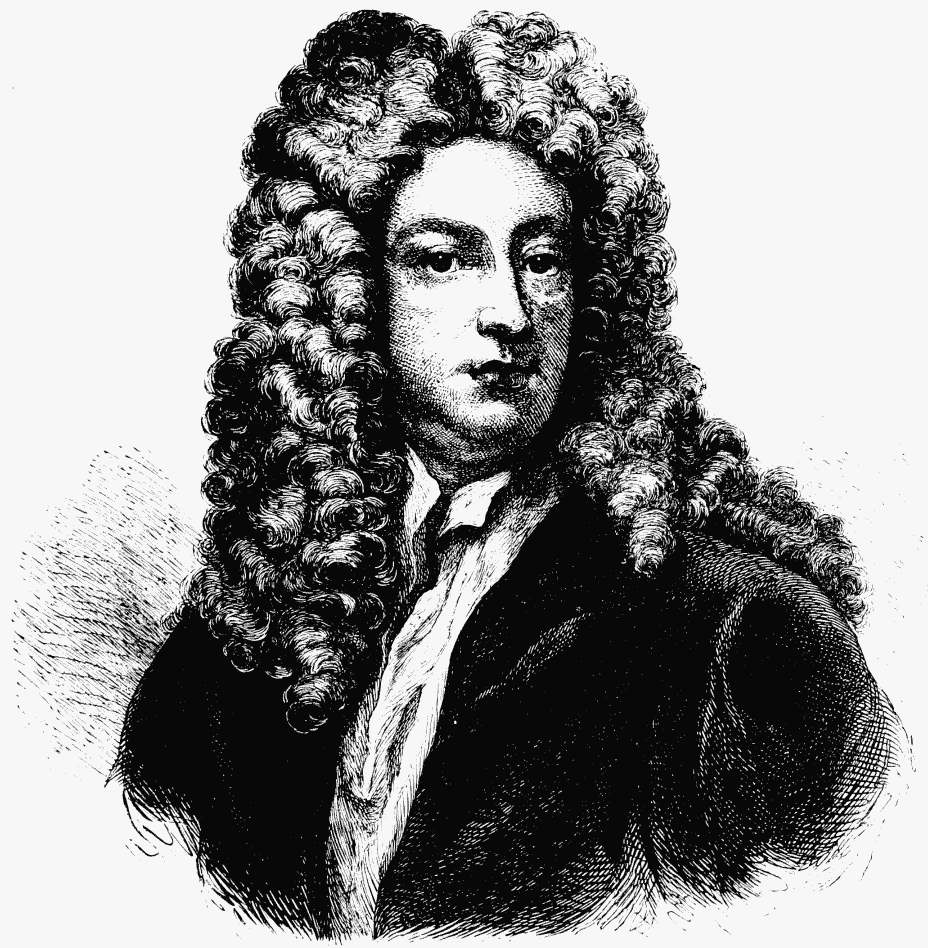
JOSEPH ADDISON. (From an authentic Portrait)
In 1708 Hatton speaks of the Haymarket as "a very spacious and public street, in length 340 yards, where is a great market for hay and straw;" and it is described by Malcolm in 1807 as "an excellent street, 1,020 feet in length, of considerable breadth, and remarkably dry, occasioned by the descent from Piccadilly."
Apart from the obstruction arising from the heavy-laden carts, which on certain days occupied the middle of the street, the Haymarket, and especially its eastern side, is described by Malcolm as a "pleasant promenade;" and he speaks of that side as being occupied by several eminent tradesmen's houses and the "Theatre Royal," of which we shall have to say more presently.
On the opposite, or western side, he adds, is the "King's Theatre for Italian operas," which he describes as "fronted by a stone basement in rustic work, with the commencement of a very superb building of the Doric order, consisting of three pillars, two windows, an entablature, pediment, and balustrade." "This," he adds, "if it had been continued, would have contributed considerably to the splendour of London; but the unlucky fragment is fated to stand as a foil to the vile and absurd edifice of brick pieced to it, which I have not patience to describe." How little could he anticipate the future glories of the Italian opera on this very spot!
One of the earliest tradesmen in the Haymarket appears to have been a coal-merchant, or, as he was then styled, a vendor of sea-coal. A "token" used by him is in the British Museum; it bears this inscription—"Nathanil Robins, at the Seacoale seller, 1666." Reverse—"Hay Markett, in Piccadilla, his half-penny." About half-way down, on the east side, at the south-west corner of James Street, and on the site of the building now known as Clarence Chambers, stood till very recently a large house which dated from the time of Charles II.; tradition says that it was frequented by that monarch and the Duke of York, who used to walk through it to the Tennis Court at the back.
During the riots which ensued on the accession of William and Mary to the throne vacated by James II., the house of the minister of the Duke of Florence, which was in this street, had a narrow escape of being burnt and sacked by the mob, as was also that of the Spanish ambassador. Sir Henry Ellis, in his second series of "Original Letters," quotes one from an eye-witness, dated December 13, 1688, who describes the scene, the "train-bands coming up only just in time to save the house from destruction, and that only after the officer at their head being shot through the back." The attack, however, was renewed a day or two afterwards, when Macaulay tells us that the house above mentioned was destroyed by the infuriated mob, who paraded the streets, almost unchecked, with oranges on the top of their drawn swords and naked pikes. "One precious box," he adds, "the Tuscan minister was able to save from the marauders. It contained some volumes of memoirs written in the hand of King James himself."
The authors of the "Rejected Addresses," in their imitation of Crabbe, as shown in the line quoted as a motto for this chapter, would seem to give a bad name to the Haymarket and its inhabitants, on the score of moral character, if we are to take literally the expression "rogues in grain." But if the meaning of the adjective "canting" as applied to them is to be understood in its ordinary sense, some explanation of it is certainly required; for we never heard of the Haymarket assuming even the appearance of rigid virtue.
In a garret in this street, literally up "three pair of stairs," was living Joseph Addison, when he was waited on by the Hon. H. Boyle, Chancellor of the Exchequer under Lord Godolphin, and requested to write a poem on the battle of Blenheim. The Whig hack jumped at the offer, and penned "The Campaign," which led to his immediate appointment as a Commissioner of Appeals, and to his subsequent advancement by the Whig party. Unfortunately, it is impossible, by the help of letters or of the parish rate-books, to identify the house in which Addison actually lived here; for though Pope visited the house for that purpose, and "made a note of it," saying to his companion, "In this garret Addison wrote his 'Campaign,'" yet he has forgotten to record its exact whereabouts. D'Israeli, in his "Curiosities of Literature," in noticing this incident, adds—"Nothing less than a strong feeling impelled the poet to ascend this garret—it was a consecrated spot to his eye; and certainly a curious instance of the power of genius contrasted with its miserable locality! Addison, whose mind had fought through 'a campaign' in a garret, could he have called about him 'the pleasures of imagination,' had probably planned a house of literary repose, where all parts would have been in harmony with his mind. Such residences of men of genius have been enjoyed by some; and the vivid descriptions which they have left us convey something of the delightfulness which charmed their studious repose."
Thackeray, in his own peculiar manner, thus
deals with this incident in Addison's career:—"At
thirty-three years of age that most distinguished
wit, scholar, and gentleman was without a profession and an income. His book of 'Travels' had
failed; his 'Dialogue on Medals' had no particular success; his Latin verses, even though
reported the best since Virgil, or Statius, at any
rate, had not brought him a Government place;
and Addison was living up two shabby pair of
stairs in the Haymarket, in a poverty over which
old Samuel Johnson rather chuckles, when in these
shabby rooms an emissary from Government and
fortune came and found him. A poem was wanted
about the Duke of Marlborough's victory of Blenheim. Would Mr. Addison write one? Mr.
Boyle, afterwards Lord Carleton, took back to
Lord Treasurer Godolphin the reply that Mr.
Addison would. When the poem had reached a
certain stage, it was carried to Godolphin; and the
last lines which he read were these:—
"'But oh, my muse! what numbers wilt thou find
To sing the furious troops in battle join'd?
Methinks I hear the drum's tumultuous sound
The victor's shouts and dying groans confound;
The dreadful burst of cannon rend the skies,
And all the thunders of the battle rise.
'Twas then great Marlborough's mighty soul was proved,
That in the shock of charging hosts unmov'd,
Amidst confusion, horror, and despair,
Examined all the dreadful scenes of war,
In peaceful thought the field of death surveyed,
To fainting squadrons lent the timely aid,
Inspired repulsed battalions to engage,
And taught the doubtful battle where to rage.
So when an angel by Divine command,
With rising tempests shakes a guilty land,
Such as of late o'er pale Britannia passed,
Calm and serene he drives the furious blast;
And, pleased th' Almighty's orders to perform,
Rides on the whirlwind and directs the storm.'
"Addison," continues Thackeray, "left off at a good moment. That simile was pronounced to be one of the greatest ever produced in poetry. That angel, that good angel, flew off with Mr. Addison, and landed him in the place of Commissioner of Appeals! . . . . In the following year Mr. Addison went to Hanover with Lord Halifax, and the year after was made Under-Secretary of State. Oh! angel-visits! you come 'few and far between' to literary gentlemen's lodgings! Your wings seldom quiver even at second-floor windows now!"
It is not generally known that this immediate
neighbourhood was the scene of the wedding of
the young lady so prettily celebrated in the cavalier
song of Sir John Suckling, in which occur the oftquoted lines:—
"Her feet beneath her petticoat
Like little mioe stole in and out
As if they fear'd the light;
But oh! she dances such a way!
No sun upon an Easter day
Is half so fine a sight."
The place is identified by the second verse,
which runs thus:—
"At Charing Cross, hard by the way,
Where we (thou know'st) do sell our hay,
There is a house," &c.
Among the eccentric characters who had their haunts in and about the Haymarket, was "Tiddydoll," the celebrated vendor of ginger-bread and the king of itinerant dealers in such wares, who figures in Hogarth's picture of the "Idle Apprentice" at Tyburn. His proper name was Ford; and Mr. Frost, in his "Old Showmen," records the fact that he was so well-known a character, that once, being missed from his usual stand in the Haymarket on the occasion of a visit which he paid to a country fair, a "catch-penny" (fn. 1) account of his alleged murder was printed, and sold in the streets by thousands.
But in spite of its alleged production of "rogues in grain," we find that, in the reigns of Anne and of George I., the Haymarket was inhabited by a few of "the quality." Thus, Lord Sackville was born in 1716 in the Haymarket, where his father, he is careful to tell us, then resided.
Cyrus Redding tells us that he well remembered Lord Eldon often stealing into the "George Coffee House" at the top of the Haymarket, to get a pint of wine, as Lady Eldon did not permit him to enjoy it in peace at home. Redding did not like Eldon, either as a Tory or as a man. "His words," he writes, "were no index of his real feelings. He had a sterile soul for all things earthly except money, doubts, and the art of drawing briefs."
The Haymarket is said to have been the scene of the meeting between Dr. Wolcott ("Peter Pindar") and Madame Mara, with reference to the sale of the manuscript of the song, "Hope told a Flattering Tale," which the doctor had written expressly for Madame Mara, and which she had sung for the first time at one of her own benefits. The next day she sold the manuscript. The doctor, it appears, had already done the same, and the two purchasers, after a long dispute, which neither had the power to settle, agreed to wait on Mara, and solicit her interference. She consented; and, as she was going in search of Dr. Wolcott, he happened here to cross her path. He had already heard of the circumstance, and, like the prima donna, was not disposed to refund the money he had received. "What is to be done?" said Mara. "Cannot you say you were intoxicated when you sold it?" "Cannot you say the same of yourself?" replied the satirist; "one story would be believed as soon as the other."
Dr. Wolcott, whose fondness for liquor of all kinds was notorious, might possibly at the time have been making his way to the house of Michael Kelly, the once popular singer and composer, who was in business in this street as a wine merchant. The singer had written over his door in conspicuous letters—"Michael Kelly, Composer of Music and Importer of Wine." Sheridan, it is said, suggested the following alteration—"'Michael Kelly, Importer of Music and Composer of Wine;' for," observed the wit, "none of his music is original, and all his wine is, since he makes it himself." Sheridan's favourite haunt at this time, it may be remarked, was the "One Tun Tavern" in Jermyn Street, close by.
Hard by was the scene of the famous assault on Sir John Coventry, which occasioned the passing of the "Coventry Act," Sir John being waylaid here on his way to or from his lodgings, and having his nose slit by some young men of high rank for an ill-timed, and perhaps ill-judged, reflection on the theatrical amours of his sovereign.
This episode of Sir John Coventry is mentioned by Sir Walter Scott, in his "Life of Dryden," as a parallel to the assault on that poet by hired ruffians in Rose Street, which we have already mentioned. He observes, that "in the age of the second Charles, a high and chivalrous sense of honour was esteemed Quixotic, and that the Civil War had left traces of ferocity in the manners and sentiments of the people. Encounters where the assailants took all advantages of number and weapons were as frequent, and were held as honourable, as regular duels." The assault on Sir John Coventry, he adds, "caused the famous statute against maiming and wounding, called the 'Coventry Act;' an act highly necessary, since so far did our ancestors' ideas of manly forbearance differ from ours, that Killigrew introduces the hero of one of his comedies, a cavalier and the fine gentleman of the piece, as lying in wait for and slashing the face of a poor courtesan who had cheated him."
On the 3rd of October, 1769, as we learn from Boswell's "Life of Johnson," another assault of a very similar nature to the above took place here. It appears that Mr. Baretti, the author of the wellknown "Italian Dictionary," was going hastily up the street, when he was accosted by a woman, who behaving with great rudeness, he was provoked to give her a blow on the hand; upon which three men immediately interfering and endeavouring to push him from the pavement, with a view to throw him into a puddle, he was alarmed for his safety, and rashly struck one of them with a knife (which he constantly wore for the purpose of cutting fruit and sweetmeats), and gave him a wound, of which he died the next day. Baretti was arraigned at the Old Bailey for murder, and among the numerous witnesses called to give evidence as to character, appeared Dr. Johnson himself. This, his biographer supposes, was the only time in his life that the doctor ever appeared as a witness in a court of justice. "Never," he adds, "did such a constellation of genius enlighten the awful Sessions-house, emphatically called Justice-hall; there were Mr. Burke, Mr. Garrick, Mr. Beauclerk, and Dr. Johnson: and undoubtedly their favourable testimony had due weight with the court and jury. Johnson gave his evidence in a slow, deliberate, and distinct manner, which was uncommonly impressive. It is well known that Mr. Baretti was acquitted."
Situated in the centre of the pleasure-going Westend population, the Haymarket is a great place for hotels, supper-houses, and foreign cafés; and it need hardly be added here, that so many of its taverns became the resort of the loosest characters, after the closing of the theatres, who turned night into day, and who were so constantly appearing before the sitting magistrates in consequence of drunken riots and street rows, that the Legislature interfered, and an Act of Parliament was passed, compelling the closing of such houses of refreshment at twelve o'clock.
The street and its neighbourhood have long been noted for places of amusement, and for those kinds of entertainment which are generally known as "popular." About the year 1750 a collection of performing dogs and monkeys from Italy, and exhibited under the name of the "Animal Comedians" at a place in the Haymarket known as "Mrs. Midnight's Oratory," became so famous that they were made the subject of a paper in the Adventurer. The writer discourses in a most learned style on the various animal prodigies and strange biped performers that had lately appeared "within the bills of mortality"—such as the "modern Colossus;" the "female Samson;" the "famous negro, who swings about his arms in every direction;" the "noted ox with six legs and two bellies;" the "beautiful panther-mare;" the "noted fire eater, smoking out of red-hot tobacco pipes, champing lighted brimstone, and swallowing his infernal mess of broth;" the "most amazing new English chien savant;" the "little woman that weighs no more than twenty-three pounds;" the "wonderful little Norfolk man;" the "wonderful Stentor;" the "wonderful man who talks in his belly;" the "wire-dancer;" the "five dancing bears;" and the "much-applauded stupendous ostrich."
In 1758, or the following year, Bisset, the famous animal-trainer, hired here a room, in which he announced a public performance of the "Cat's Opera," supplemented by tricks of a horse, a dog, and some monkeys. Mr. Frost, in his "Old Showman," tells us that, "besides the organ-grinding and rope-dancing performances, the monkeys took wine together, and rode on the horse, pirouetting and somersaulting with the skill of a practised acrobat. One of them also," he adds, "danced a minuet with the dog. The 'Cat's Opera' was attended by crowded houses, and Bisset cleared a thousand pounds by the exhibition in a few days. He afterwards taught a hare to walk on its hind legs and beat a drum; a feathered company of canaries, linnets, and sparrows to spell names, tell the time by the clock, &c.; half-a-dozen turkeys to execute a country dance; and a turtle (or more probably a tortoise) to write names on the floor, having its feet blackened for the purpose. After a successful season in London, he sold some of the animals, and made a provincial tour with the rest, rapidly accumulating a considerable fortune." "At the Opera Room in the Haymarket," in the reign of George II., were exhibited by Fawkes, the showman, some waxwork figures, which went through the comical tragedy of "Tom Thumb."
According to a placard immortalised by Mr. John Timbs in his "Romance of London," at No. 61 in this street, O'Brien, the Irish Giant, whose skeleton is to be seen in the Museum of the College of Surgeons, as already stated by us, (fn. 2) was exhibited in 1804. He is thus described:—"He is indisputably the tallest man ever shown; is a lineal descendant of Brian Boru, and resembles that great potentate. All the members of the family are distinguished by their immense size. The gentleman alluded to measures near nine feet high." Owing to his great height he was most unwieldy, and could scarcely walk up an incline, so that he had to rest his hands for support on the shoulders of two men in walking up Holborn Hill. When he wished to light his pipe, Mr. Timbs tells us, he used to take the top off a street-lamp. Once on a journey in his own carriage he was stopped by a robber; but when he looked out of the window, the thief rode off, frightened at his height. He exhibited himself for more than twenty years, and realised a large sum; and we are told that he was seldom absent from Bartlemy Fair. He died in 1806.
Another of the principal places of amusement in the Haymarket, in the early part of the present century, was Weeks's Museum. The grand room, which was upwards of one hundred feet in length, was hung entirely with blue satin, and contained a variety of figures, which exhibited the powers of mechanism.
At the top of the street, at the north-east corner, facing Weeks's Museum, stood a place of public amusement—in fact, a gaming-house, familiar to the readers of the comedies of the time as "Shaver's Hall;" its name being derived from the barber of Lord Pembroke, who built it out of his earnings. It occupied the whole of the southern side of Coventry Street from the Haymarket to Hedge Lane. It is described by Garrow in a letter to Lord Strafford, in 1635, as "a new Spring Garden, erected in the fields beyond the Mews." For the following minute description of it we are indebted to the industry and research of John Timbs:—From a survey of the premises made in 1650, we gather that Shaver's Hall was strongly built of brick, and covered with lead; its large cellar was divided into six rooms; above these were four rooms, and the same in the first storey, to which there was a balcony commanding a view of the bowling-alleys that sloped to the south. In the second storey were six rooms, and over the same a walk with leads, and enclosed with rails, "very curiously carved and wrought," as was also the staircase throughout the house. On the west were large kitchens and coal-house, with lofts over it. At the entrance-gate to the upper bowling-green was a "parlour-lodge," close to which a double flight of steps led down to the lower bowling-alley. There was still beyond this another bowling-alley, and an orchard well planted with choice fruit-trees, as also "one pleasant banqueting house, and one other fair and pleasant apartment called the Green Room, and one other Conduit House, and two turrets adjoining the walls." Beyond, to the south, was also "one fair Tennis Court, of brick, tiled, well accommodated with all things fitting for the same." This is the Tennis Court which till recently stood at the corner of James Street, the last building shown on Faithorne's plan in 1658.
On the east side of the upper part of the Haymarket, in the year 1720, if not still later, was living the widow of Colonel Thomas Panton, the successful gamester, who, having realised a sudden fortune as the keeper of a gaming-house in Piccadilly, had the good sense to invest his gains in a house and land, and abandon cards and the dicebox. His name is still kept up in that of Panton Street, and of Panton Square; but the bulk of his wealth was carried by his daughter on her marriage into the family of Lord Arundell of Wardour, who gave his name to Arundell Street adjoining, and also, as we have said, to Wardour Street, in Soho.
On the same side of the street, opposite Charles Street, stands the Haymarket Theatre. Its early history runs as follows:—
In the year 1720 an enterprising carpenter named John Potter built a small playhouse in the Haymarket, on the site of the "King's Head Inn." The cost of the building was £1,000, and Potter further expended £500 in decorations, scenery, and dresses. He leased the theatre, immediately after its completion, to a company of French actors, who were at that time much favoured by the English aristocracy, and who performed under a temporary licence from the Lord Chamberlain. This company styled themselves "The French Comedians of his Grace the Duke of Montague," that nobleman being their principal patron, and opened the new house on the 29th of December, 1720, with the comedy of La Fille à la Morte, ou le Badeaud de Paris. At this time, and for several years afterwards, Potter's speculation was known to the play-going world as "The New French Theatre." About ten years later, being then occupied by an English company, it began to be spoken of as "The Little Theatre in the Haymarket"—a title which it retained until the original edifice was pulled down in 1820, having just completed a century of existence. Its site is now occupied by the "Café de l'Europe." In 1734 it was in the occupation of Henry Fielding, the great novelist and dramatist, with a congenial band, styled in the play-bills. "The Great Mogul's Company, recently dropped from the clouds." His opening piece was entitled Pasquin, and, being a social satire of the most caustic nature, it achieved great popularity, and had a run of more than fifty nights. Elated by his success, Fielding produced a second piece, called The Historical Register, a political satire, which contained so audacious a caricature of Sir Robert Walpole, under the name of "Quidam," that the Prime Minister's resentment led to the passing of that Act which requires all dramatic pieces to be submitted to the approval of the Lord Chamberlain before they can be performed.
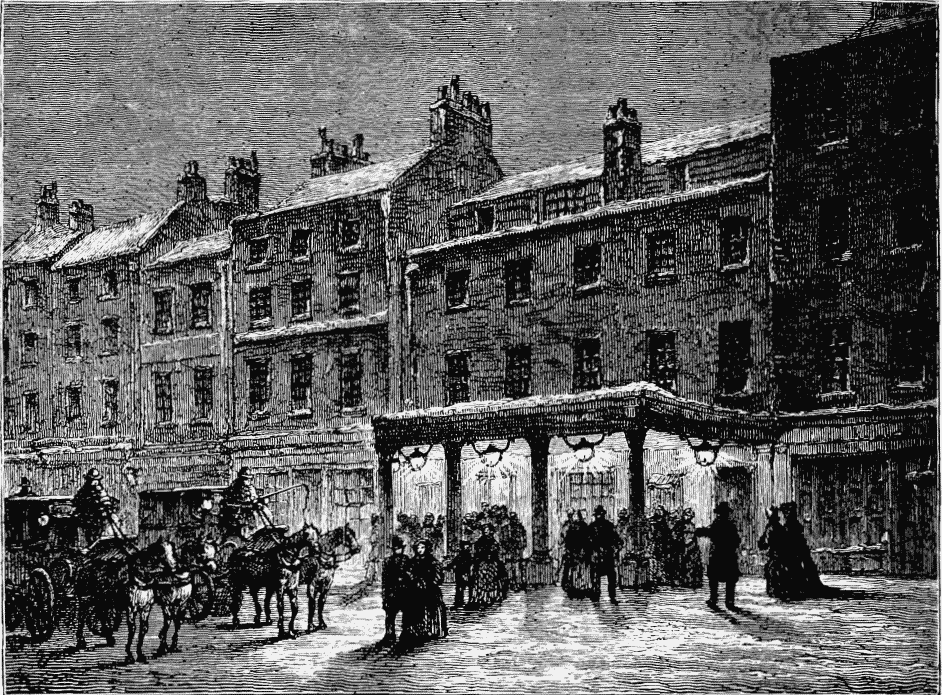
THE OLD HAYMARKET THEATRE.
We are told by Mr. Frost, in his "Old Showmen," already quoted, that "Punch's celebrated company of comical tragedians from the Haymarket performed the most comical and whimsical tragedy that ever was tragedised by any tragical company of comedians, called The Humours of Covent Garden, by Henry Fielding, Esq."
In 1745 the "Little Theatre," having passed through the hands of several managers, each of whom had only a temporary licence, was opened without the ceremony of a licence of any sort by Theophilus Cibber, who succeeded in evading the usual penalty by the manner in which his advertisements were worded. They ran thus:—"At Cibber's Academy, in the Haymarket, will be a concert; after which will be exhibited gratis a rehearsal in the form of a play, called Romeo and Juliet." It is probable, however, that in spite of this ingenious artifice, Mr. Cibber received an official hint which induced him to announce, in the autumn of the same year, that "Mr. Cibber's company, being busily employed in reviving several pieces, are obliged to defer playing until further notice."
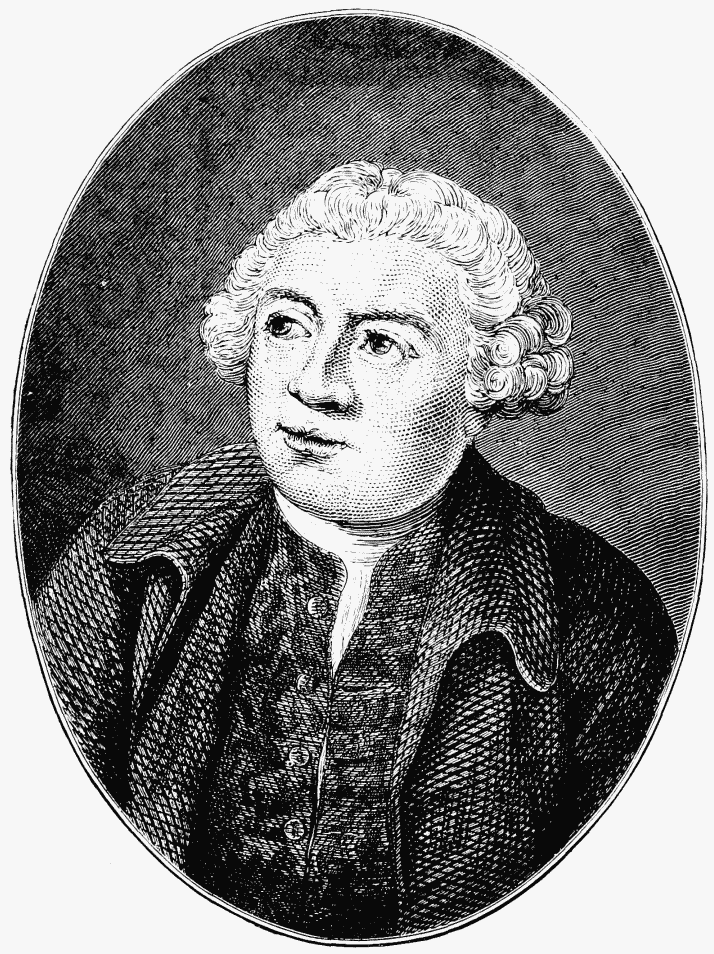
SAMUEL FOOTE.
In 1747 the house was daily crowded by fashionable audiences to witness Samuel Foote's humorous entertainments, entitled "Foote giving Tea," &c., which included life-like imitations of the most notable characters of the day.
Apropos of Foote's entertainment, a good story of the silly Duke of Cumberland is told by Mr. W. C. Hazlitt, in his "New London Jest Book." One night he was in the green-room here. "Well, here I am, Mr. Foote," said he, "ready to swallow all your good things." "Your royal highness," answered the witty actor, "must have the digestion of an ostrich, for I never knew you to throw up any again!"
When Foote first opened this theatre, amongst other projects, he proposed to entertain the public with an imitation of cat music. For this purpose he engaged a man famous for his skill in mimicking the mewing of cats. This person was called "Cat Harris." As he did not attend the rehearsal of this odd concert, Foote desired Shuter would endeavour to find him out and bring him with him. Shuter was directed to some court in the Minories where this extraordinary musician lived; but not being able to find the house, Shuter began a cat solo; upon this the other looked out of the window, and answered him with a cantata of the same sort. "Come along," said Shuter, "I want no better information that you are the man. Mr. Foote stays for us—we cannot begin the cat opera without you."
All sorts of stories are told of Foote, and some of them on very good authority. A few of them will bear repeating here.
Foote could not bear to see anybody or anything succeed in the Haymarket but himself and his own writings, and forgot that a failure of the new scheme might possibly endanger the regular payment of his annuity. His pique broke out sometimes in downright rudeness. One morning he came hopping upon the stage during the rehearsal of the Spanish Barber, then about to be produced; the performers were busy in that scene of the piece where one servant is under the influence of a sleeping draught, and another of a sneezing powder. "Well," said Foote, dryly, to the manager, "how do you go on?" "Pretty well," was the answer; "but I cannot teach one of these fellows to gape as he ought to do." "Can't you?" replied Foote; "then read him your last comedy of The Man of Business, and he'll yawn for a month."
On another occasion he was not less coarse, though more laughable, to an actor than he had been to the manager. This happened when Digges, of much celebrity out of London, and who had come to town from Edinburgh, covered with Scottish laurels, made his first appearance in the Haymarket. He had studied the antiquated style of acting; in short, he was a fine bit of old stagebuckram, and "Cato" was therefore selected for the first essay. He "discharged the character" in the same costume as it is to be supposed was adopted by Booth when the play was originally acted; that is, in a shape, as it was technically termed, of the stiffest order, decorated with gilt leather upon a black ground, with black stockings, black gloves, and a powdered periwig. Foote had planted himself in the pit, when Digges stalked on before the public thus formidably accoutred. The malicious wag waited till the customary round of applause had subsided, and then ejaculated, in a pretended under-tone, loud enough to be heard by all around him, "A Roman chimney-sweeper on May-day!" The laughter which this produced in the pit was enough to knock up a débutant, and it startled the old stager personating the Stoic of Utica; the sarcasm was irresistibly funny, but Foote deserved to be kicked out of the house for his cruelty and insolence too.
The theatre barely escaped being destroyed, in 1749, by an enraged mob, the victims of a hoax planned by the eccentric Duke of Montague, who had caused an advertisement to appear, stating that, "on the 16th of January, a conjurer would jump into a quart bottle at the Little Theatre." On the appointed day thousands of persons were assembled in and around the theatre to witness the exploit, and a furious riot was the result of their disappointment.
In 1766 the Duke of York, who was Foote's staunch patron, obtained for him a royal patent for his life, in virtue of which the "little" playhouse became a "Theatre Royal," and Foote, who had leased it as a summer theatre since 1762, now purchased the premises on which it was built, and greatly altered and enlarged the building. It is said that on one occasion, when out on a party of pleasure with the Duke of York and other illustrious personages, Foote met with an accident which in the end was overruled to his advantage. He was thrown from his horse, and his leg being broken, he was forced to submit to amputation. It was in consequence of this accident the duke obtained for him the patent above mentioned. "Strange as it may appear, with the aid of a cork leg he performed his former characters with no less agility and spirit than before, and continued by his laughable performances to draw together crowded houses."
Remarkable for his wit as well as for his marvellous power of mimicry, neither friend nor patron was sacred from Foote's merciless satire, provided the person were sufficiently well known to be worth the trouble. It must, however, be urged in his defence, that his friends were no more troubled with scruples of delicacy than himself, and seem to have considered gross personalities to be the soul of wit. Foote's uncle, Captain Goodere, having been executed for the murder of his brother, Sir John Goodere, Mr. Cooke, the translator of "Hesiod," once presented Foote to a select society, with the agreeable introductory remark, "This is the nephew of Captain Goodere, the gentleman who was lately hung in chains for murdering his brother."
Another little episode in the annals of the Haymarket Theatre is perhaps worth mentioning here. In the early days of the Regency—about the year 1810—there suddenly appeared at the West-end a wealthy gentleman, of middle age, and of West Indian extraction, named Robert Coates. He was of good-figured appearance, dressed well, and even showily, and always wore a quantity of fur. At evening parties, to which he gained an entrance, his buttons and knee-buckles were studded with diamonds. There was a great mystery about his antecedents, and the public curiosity was heightened by the announcement that he proposed to appear at the Haymarket Theatre in the character of "Romeo." By hook or by crook he contrived to arrange for this appearance, and on the night the house was crowded to suffocation, the play-bill having given out that an "amateur of fashion" had consented to perform "for one night only;" and it was generally whispered that the rehearsal gave unmistakable signs that the tragedy would be turned into a comedy. But his appearance outdid all expectations. Mr. Coates's dress was grotesque in the extreme. In a cloak of sky-blue silk, profusely spangled, red pantaloons, a vest of white muslin, and a wig of the style of Charles II., capped by an opera hat, he brought down the whole house with laughter before he opened his lips, and the laughter was increased by the fact that his nether garments, being far too tight, burst in seams which could not be concealed. But when his guttural voice was heard, and he showed his total misapprehension of every part of the play, especially in the vulgarity of his address to "Juliet," and in his equally absurd rendering of the balcony scene, the whole thing was so comic, that gallery and pit were equally convulsed with laughter, and the piece ended in an uproar. It is needless to add that, for the character of the theatre, "Romeo" Coates, as he was afterwards called, was not allowed to appear again upon the stage at the Haymarket, though he possibly amused his friends by amateur performances in private.
To this theatre belongs the somewhat eccentric and amusing story of Lady Caroline Petersham, told by Horace Walpole:—
"Your friend Lady C——P——has entertained the town with a new scene. She was t'other night at the play with her court—viz., Miss Ashe, Lord Barnard, M. St. Simon, and her favourite footman, Richard, whom, under pretence of keeping places, she always keeps in her box the whole time to see the play at his ease. Mr. Stanley, Colonel Vernon, and Mr. Vaughan arrived at the very end of the farce, and could find no room but a row and a half in Lady C——'s box. Richard denied their entrance very impertinently. Mr. Stanley took him by the hair of his head, dragged him into the passage, and thrashed him. The heroine was outrageous; the heroes not at all so. She sent Richard to (Sir John) Fielding for a warrant: he could not grant it; and so it ended." On this incident Lady Lepel Hervey remarks, "Come and hear a little of what is going on in town. . . . . You will hear of ladies of quality who uphold footmen in insulting gentlemen."
In 1770 the theatre was engaged by one Maddox, a performer on the slack wire; and it is said that his were the most prosperous entertainments ever carried on in this house. His profits in one season are stated to have amounted to £11,000, being £2,500 more than Garrick's a few years earlier.
In 1776 Foote sold his interest in the theatre to George Colman the elder for an annuity of £1,600, and Colman, on Foote's death, early in the following year, obtained the whole property for £800. And now, for a period of nearly fifty years, the Haymarket Theatre was the property of George Colman, passing, in 1794, on the death of George the elder, into the hands of George the younger, under whose management it was one of the most prosperous theatres in London.
On the 3rd of February, 1794, a dreadful accident happened here, through the pressure of the crowd, who had assembled in great numbers, in consequence of the play on that night having been commanded by their Majesties. On opening the pit door, the rush was so strong, that a number of persons were thrown down, and fifteen persons deprived of life, and upwards of twenty others materially injured by bruises and broken limbs. Most of the sufferers were respectable persons, and among the dead were two of the heralds.
An old lady named Wall, for whom Colman, from early associations, appears to have had a kind consideration, had been an actress in a subordinate situation for many seasons in this theatre. We must all pay the debt of nature; and, in due time, the old lady died. Somebody from the theatre went to break the intelligence to Colman, who, on hearing it, inquired "whether there had been any bills stuck up!" The messenger replied in the negative, and ventured to ask Mr. Colman why he had put that question. Colman answered, "They generally paste bills on a dead wall, don't they?"
In 1820, Colman having sold his entire interest in the theatre, the old edifice was pulled down, and the present building erected, on almost the same site, from a design by John Nash. The front is of stone, and is about sixty feet in length, and nearly fifty in height. The entrance is through a handsome portico, the entablature and pediment being supported by six columns of the Corinthian order; above are circular windows connected by sculpture of an ornamental character. Under the portico are five doors, leading respectively to the boxes, pit, galleries, and box-office. The shape of the interior differs from that of every other theatre in London, being nearly a square, with the side facing the stage very slightly curved. The expense of the new building was about £20,000. It is a remarkably neat and pretty house, having two tiers of boxes, besides other half-tiers parallel with the lower gallery, and will seat about 1,500 persons with comfort.
The first great success of the new theatre was Poole's comedy of Paul Pry, which was produced in 1825, with Liston in the principal character, supported by William Farren, Mrs. Waylett, Mrs. Glover, and Madame Vestris. With such a caste it cannot be a matter of surprise that the piece had a run of 114 nights, and that the price of a box was sometimes paid for a seat in the gallery.
In 1837 Mr. Benjamin Webster became the lessee, and collected around him a brilliant company. Messrs. Macready, Charles Kean, Tyrone Power, Sheridan Knowles, Charles Mathews the younger, Mrs. Glover, Mrs. Nisbet, Miss Ellen Tree, Madame Vestris, Miss Cushman, Miss Helen Faucit, and Mrs. Stirling, were the most notable stars which shone in the Haymarket Theatre during Mr. Webster's management. In 1843 the lessee made a spirited effort in behalf of the modern drama, by offering a competition prize of £500 for the best comedy. The piece selected was Quid pro Quo, by Mrs. Gore, which was performed in the year 1844, and turned out a dead failure, a result partly compensated by the enormous success of Charles Mathews in Used Up, which was produced here shortly afterwards. Mr. Webster relinquished his connection with the Haymarket in 1853, after having effected great improvements at his own expense. He widened the proscenium eleven feet, introduced gas at an expense of £500 per annum, and presented the central chandelier to the proprietors. The theatre then passed into the hands of Mr. Buckstone, under whose management it has run a career of uninterrupted prosperity. For several years it was the only house in London where the standard English comedies, such as The School for Scandal, The Rivals, &c., were regularly performed, the pièce de résistance being as regularly followed by a farce in which Mr. Buckstone sustained the principal part. For a quarter of a century since Mr. Buckstone became the lessee of the Haymarket he was the life and soul of his company; and just as in those days his "Tony Lumpkin" and "Bob Acres" seemed the chief features of the old comedies, so now the humours of "My Lord Dundreary" and the exquisite grace of Mr. Gilbert's fairy dramas would be accounted insipid, without the pinch of Attic salt with which the veteran actor flavours the dainty dish.
In a work published in 1808 it is made a subject of complaint that there were only two theatres, whereas London, in the reign of Elizabeth and James I., the golden age of the English drama, was not a tenth part of its then size, and yet nevertheless it contained seventeen theatres. "More theatres are therefore wanted," adds the writer; and he complains bitterly of the restrictions imposed on the dramatic muse by the exclusive privileges conferred on Drury Lane and Covent Garden. It is perhaps worthy of note that the first new theatre to break the ice of these restrictions was the Haymarket, as already related in this chapter.