Old and New London: Volume 4. Originally published by Cassell, Petter & Galpin, London, 1878.
This free content was digitised by double rekeying. Public Domain.
Edward Walford, 'Regent Street and Piccadilly', in Old and New London: Volume 4(London, 1878), British History Online https://www.british-history.ac.uk/old-new-london/vol4/pp246-262 [accessed 30 April 2025].
Edward Walford, 'Regent Street and Piccadilly', in Old and New London: Volume 4(London, 1878), British History Online, accessed April 30, 2025, https://www.british-history.ac.uk/old-new-london/vol4/pp246-262.
Edward Walford. "Regent Street and Piccadilly". Old and New London: Volume 4. (London, 1878), British History Online. Web. 30 April 2025. https://www.british-history.ac.uk/old-new-london/vol4/pp246-262.
In this section
CHAPTER XXI.
REGENT STREET AND PICCADILLY.
"Westward the tide of empire holds its way."
Westward Extension of the Metropolis—Albert Smith's and Horace Walpole's Remarks thereon—Origin of the Name of Piccadilly—Tradesmen's Tokens—Gradual Extension of Piccadilly—Appearance of the Site of Regent Street in the Last Century—The County Fire Office—The Quadrant—Regent Street—Archbishop Tenison's Chapel—Foubert's Riding Academy—Fraser's Magazine and its Early Contributors—A "Literary Duel"—Hanover Chapel—Anecdote of the Poet Campbell—Little Vine Street—The "Man in the Moon"—Swallow Street—Chapel of the Scotch Presbyterians—St. James's Hall—Piccadilly—Fore's Exhibition—M. Daguerre's Experiments—Lady Hamilton—Mr. Quaritch's Book-Store—The Genealogical and Historical Society—St. James's Church—Sir William Petty, the Political Economist—Eminent Publishers—Bullock's Museum—The Egyptian Hall—The Albany—"Dan" Lambert—Arlington Street—The Old "White Horse Cellar," and the Glories of Stage-coaching.
What the poet has said so pithily about the tide of empire may be said also of the tide of fashion in this great metropolis, which for these two centuries and more past has set steadily westward. As Mr. Albert Smith remarks, in his " Sketches of London Life:"—"Proceeding in two parallel directions, divided by Oxford Street, Hanover Square gradually declined before that of Grosvenor, and Portman rose above that of Manchester. Still fashion kept marching on—the former division tending towards May Fair, and the latter to the Edgware Road; until the first, turned aside in its course by Hyde Park, reached the site of Belgravia, and the second, heedless of the associations connected with the gallows, and the decaying foliage of the Bayswater tea-gardens, colonised Tyburnia for its territory."
That old prince of gossips, Horace Walpole, writes thus to Miss Berry, and her sister, in 1791:—"Though London increases every day, and Mr. Herschel (fn. 1) has just discovered a new square or circus somewhere by the New Road, in the 'Via Lactea,' where the cows used to be fed, I believe you will think the town cannot hold all its inhabitants, so prodigiously the population is augmented. I have twice been going to stop my coach in Piccadilly (and the same has happened to Lady Ailesbury), thinking there was a mob, and it was only nymphs and swains sauntering or trudging. T'other morning, i.e., at two o'clock, I went to see Mrs. Garrick and Miss Hannah More at the Adelphi, and was stopped five times before I reached Northumberland House; for the tides of coaches, chariots, curricles, phaetons, &c., are endless. Indeed, the town is so extended, that the breed of chairs is almost lost; for Hercules and Atlas could not carry anybody from one end of the enormous capital to the other. How magnified would be the error of the young woman at St. Helena, who some years ago said to the captain of an Indiaman, 'I suppose London is very empty when the India ships come out.'"
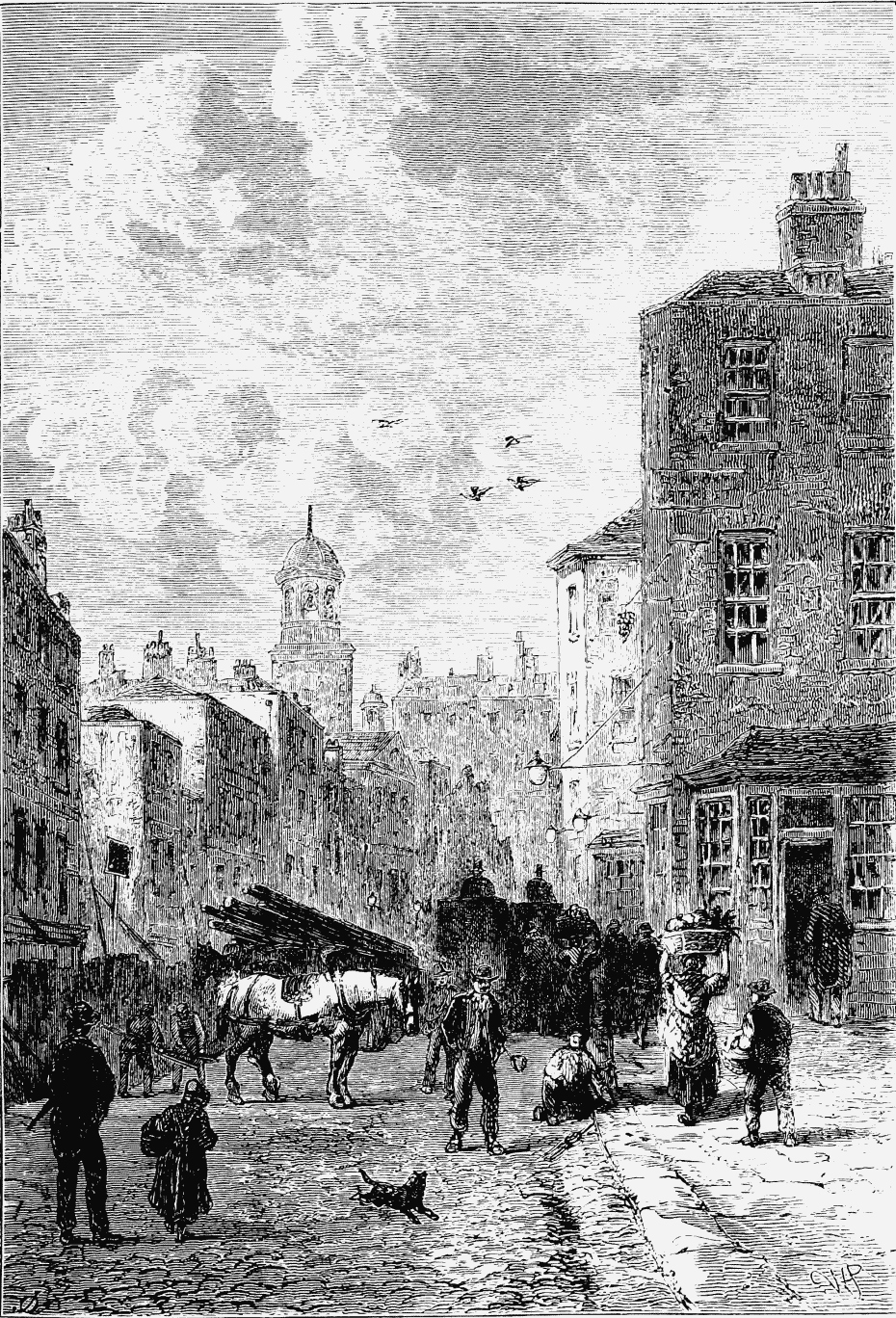
SWALLOW STREET DURING ITS DEMOLITION.
And again, in the same letter: "There will soon be one street from London to Brentford—aye, and from London to every village within ten miles round. . . . . London is, I am certain, much fuller than ever I saw it. I have twice this spring been going to stop my coach in Piccadilly, to inquire what was the matter, thinking there was a mob: not at all; it was only foot-passengers." He adds a few remarks, by way of consolation, to the effect that, in spite of the enormous increase of London, there was as yet no complaint that the country was coming to be depopulated, as Bath "shoots out into new crescents, circuses, and squares every year; while Birmingham, Manchester, Hull, and Liverpool would serve any king in England for a capital, and even make the Empress of Russia's mouth to water."
The origin of the name of Piccadilly is wrapped
in obscurity, and has frequently been discussed in
Notes and Queries, and in other quarters. Mr.
Peter Cunningham and Mr. John Timbs, among
modern antiquaries, have started the inquiry as
to its derivation rather than solved it; and we
must be content to believe, with them, that the
street gradually took its name from a place of
amusement, spoken of in the preceding chapter as
formerly standing at its eastern or town end, styled
Piccadilly Hall, which in its turn was so styled
after the ruffs, called "pickadils," or "peccadillos,"
worn by the gallants of the reign of James I., the
stiffened points of which, as Mr. Timbs observes,
resembled spear-heads, or "picardills," a diminutive of the Spanish and Italian word pica (Latin
spica) a spear. Ben Jonson writes, in his "Underwoods:"—
"And then leap mad on a neat pickardill."
To this line Mr. Robert Bell appends a note to the
effect that the latter word is the name of " a stiff
collar, or ruff, generally with sharp points, and
derived from 'picca,' a spear-head. The ruff came
into fashion, as we see by contemporary portraits,
early in the reign of James I.; and, according to
some authorities, gave its name to the street
of Piccadilly." But then, the further difficulty
arises, how to connect Piccadilly Hall with so
fanciful a word. Was it, as is sometimes said,
because the man who built it—one Higgins, a
draper—made his fortune by the sale of "pickadils"
when they were the height of fashion? or was
the Hall itself originally a way-side inn, so named
by chance or caprice? or does some subtle and
fanciful analogy underlie the name? and are we to
suppose that it was so styled by the Londoners,
as being "the utmost or skirt house of the suburbs
that way?" This supposition is too far-fetched,
and savours too much of poetry, we think, to be
ascribed to the ordinary and commonplace Londoners. Then, again, an old writer, Blount, in
his "Glossographia," interprets the word as denoting "the round hem about the edge or skirt of
a garment, or a stiff collar or band for the neck and
shoulders;" whence Butler, in his "Hudibras,"
styles the collars in the pillory "peccadilloes." If
so, may not the name have originated from the
pillory having been often set up here in the good
old Tudor times? Pennant, again, has another
derivation to offer, suggesting that it comes from
a sort of cakes or turnovers called "piccadillas,"
which were sold in the fields about here. Whatever the connecting link may be, however, it is
clear that the name, as applied to these parts,
dates from the sixteenth century; for Gerard, in
his "Herbal," published in 1596, speaks of the
small wild buglosse which grows upon the dry
ditch-banks about "Pickadilla." D'Israeli, in his
"Curiosities of Literature," tells us that Piccadilly
"was named after Piccadilla Hall, a place of
sale for piccadillies, or turnovers, a part of the
fashionable dress which appeared about the year
1814. It has preserved its name uncorrupted;
for Barnabe Rich, in his 'Honesty of the Age," has
this passage on ' the body-makers that do swarm
through all parts, both of London and about
London.' He says, 'The body is still pampered up
in the very dropsy of excess.' He that some forty
years sithence should have asked after a Pickadilly,
I wonder who should have understood him, or
could have told what a Pickadilly had been, either
fish or flesh." So we must be content to leave
the inquiry where we found it, and pass on.
The name Piccadilly is found written in a variety of ways. Mr. Akerman, in his work on "London Tradesmen's Tokens," enumerates eleven different specimens, in the shape of copper coins, which bear date, "Piccadily," between 1660 and 1670. Some of these are issued by grocers, some by "sea-coal" dealers, and others apparently by the keepers of forges. They do not agree in their orthography, for the name is spelt "Peckadille," "Pickedila," "Pickadilla," and other ways.
The first thoroughfare bearing the name of Piccadilly, says Mr. Peter Cunningham, was a very short line of road, running no further west than the foot of Sackville Street; and the name Piccadilly Street occurs, for the first time, in the rate-books of St. Martin's, under the year 1673. Between Sackville and Albemarle Streets, or, as some say, to Stratton Street, or even to Hyde Park, at different times, the thoroughfare was called Portugal Street, after Catherine of Braganza, Queen of Charles II.; all beyond that point being the great Bath Road, or, as it is called in Aggas's map (1560), "the way to Reding." The Queen, however, was never a favourite with the people, and gradually the name of Piccadilly displaced her memory altogether. "The north side," says Pennant in 1790, "consists of houses, most of them mean buildings; but it finishes handsomely with the magnificent new house of Lord Bathurst, at Hyde Park Corner." It is amusing to compare the state of the street at that date with what it is in the reign of Victoria. The Green Park, opposite, was shut in by a brick wall, in which, however, were inserted, here and there, some "benevolent" railings, to enable the passers-by to catch a glimpse of the trees inside.
The first mansion built along Piccadilly was Goring House, which stood on what is now Arlington Street; it was bought by Bennett, Lord Arlington, after whom both Bennett and Arlington Streets were named. Nearly opposite it, about 1688, rose Clarendon House, and Burlington House, built by Sir John Denham, and re-fronted by the celebrated amateur architect, Boyle, Earl of Burlington. This negatives the hackneyed story of Lord Burlington having chosen the site of his mansion so far out of town that no one could build beyond him. Immediately to the east were the house and garden of the Earl of Sunderland, the treacherous minister of James II.; the site is now occupied by the Albany.
"In 1711," according to Hunter's " History of London," "the town extended as far west as Devonshire House. Beyond Clifford Street was built Bond Street, which took its name from the family of a baronet, now extinct, who owned the ground. But New Bond Street was still an open field, called Conduit Mead, from one of the conduits which supplied that part of the town with water, and from which Conduit Street, adjoining, derived its name. All beyond was open ground, a receptacle for dunghills, and every kind of refuse . . . Oxford Street was then built on the south side, as far as Swallow Street (now absorbed in Regent Street), but almost unbuilt on the north side. It was a deep hollow road, full of sloughs, with here and there a ragged house, the lurking-place of cut-throats."
The head-quarters of the fashionable world, as lately as the beginning of the reign of George IV., lay between Piccadilly and Oxford Street. Hence, a witty personage, when giving advice to a rich country friend as to how to make a good show in London, says—"Hire a house in the purlieus of ton, and take care That it stands in a street near some smart-sounding square, Such as 'Hanover,' 'Grosvenor,' or 'Portman,' at least." A better incidental proof could not well have been given that Belgrave and Eaton Squares were not as yet erected. In fact, at that date Belgravia was a swamp, and its squares were cabbage-gardens.
Near the eastern extremity of Piccadilly the thoroughfare is intersected by Regent Street, which commences at Waterloo Place, and proceeds northward for nearly a mile. It crosses Piccadilly, by a circus, to the County Fire Office, whence it passes to the north-west by a curved road, called the Quadrant, and then again in a direct line northward, crossing Oxford Street to Langham Place. On the whole, this street—at all events, in its lower parts—follows the line of Swallow Street, which it superseded. To judge from its appearance, as preserved to us in the prints of the time, the latter was a long, ugly, and irregular thoroughfare. The tradition is that it bore a reputation by no means good, and contained, among its other houses, a certain livery-stable, which in the last century was a noted house-of-call for highwaymen.
Of the appearance of this district in the last year of the reign of Charles II., Lord Macaulay gives us the following picture:—"He who then rambled to what is now the gayest and most crowded part of Regent Street, found himself in a solitude, and was sometimes so fortunate as to have a shot at a woodcock. (fn. 2) On the north the Oxford road ran between hedges. Three or four hundred yards to the south were the garden-walls of a few great houses, which were considered as quite out of town. On the west was a meadow, renowned for a spring, from which, long afterwards, Conduit Street was named. On the east (near where now stands Golden Square) was a field not to be passed without a shudder by any Londoner of that age. There, as in a place far from the haunts of men, had been dug, twenty years before, when the great plague was raging, a pit into which the dead-carts had nightly shot corpses by scores. It was popularly believed that the earth was deeply tainted with infection, and could not be disturbed without imminent risk to human life. No foundations were laid there till two generations had passed without any return of the pestilence, and till the ghastly spot had long been surrounded by buildings. It may be added, that the 'pest-field' may still be seen marked in maps of London as late as the end of the reign of George I."
The County Fire Office, which stands at the commencement of the Quadrant, was built from the designs of Mr. Abraham. It is a stately pile, of the Composite order, with a rustic basement and arcade, above which rise six three-quarter columns, and pilasters at the angles, supporting the entablature; the latter is surmounted by a balustrade and parapet, on the centre of which is a colossal figure of Britannia, standing with her spear and shield, and at her side the British lion couchant.
The Quadrant had, originally, a Doric colonnade on either side, projecting over the foot-pavements. The columns—some 270 in number—were of castiron, sixteen feet high, exclusive of the granite plinth, and supported a balustraded roof. The effect of this novel piece of street architecture was generally considered as very fine and picturesque. The colonnades, however, in consequence of the darkness which they imparted to the shops, were removed in 1848, at which time a balcony was added to the principal floor. In the centre of the Quadrant, on the south-west side, is one of the entrances to the St. James's Hall. Cyrus Redding fixes the Quadrant as the scene of the following incident. He writes in his "Recollections:"—"Campbell and myself set off one morning to walk to Dulwich College, to see the pictures and dine. We were passing along the Quadrant, when we met Sir James Mackintosh, looking serious. 'What a melancholy affair this is,' was his remark, without a 'good morning.' 'What affair?' 'The death of Sir Thomas Lawrence.' Campbell, who had been with Sir Thomas the evening but one before, was thunderstricken. When Sir James had passed on, I could not help remarking I thought he would be the next to depart—he looked so ill. My surmise was confirmed. It was not long before I visited his resting-place, with his daughter, in Hampstead churchyard. Campbell became too disturbed in his mind to proceed to Dulwich, and a walk we had often talked about was never taken."
The long vista of Regent Street, as seen from the Quadrant, is very fine, exhibiting, as it does, a remarkable variety of architectural features. It was erected principally from the designs of Mr. John Nash, who deserves to be remembered as the author of this great metropolitan improvement; and it was named from the architect's patron, the Prince Regent. The expenditure of the Office of Woods and Forests in its construction was a little in excess of a million and a half. Of course, being a thoroughfare of so recent a date, having been commenced in 1813, Regent Street has scarcely a back history for us to record here, like Pall Mall and St. James's Street. It belongs to "new," and not to "old" London.
In his design for Regent Street, Nash adopted
the idea of uniting several dwellings into a façade,
so as to preserve a degree of continuity essential to
architectural importance; and it cannot be denied
that he has produced a varied succession of architectural scenery, the effect of which is picturesque
and imposing, superior to that of any other portion
of the then existing metropolis, and far preferable
to the naked brick walls at that time universally
forming the sides of our streets. The plaster fronts
of the houses have given rise to some severe criticism, and the perishable nature of the brick and
composition of which the houses in this street are
built, gave rise to the following epigram in the
Quarterly Review for June, 1826:—
"Augustus at Rome was for building renown'd,
And of marble he left what of brick he had found;
But is not our Nash, too, a very great master?
He finds us all brick, and he leaves us all plaster."
Regent Street is full of handsome shops, and during the afternoon, in the height of the London season, is the very centre of fashion, and with its show of fine carriages, horses, and gay company, forms one of the most striking sights of the metropolis. At the close of the London season " everybody who pretends to be anybody" goes away from town, and the West-end becomes comparatively a desert. As Mr. Albert Smith remarks, in his "Sketches of London Life and Character"—" The thousands who leave London make no difference to the stream of life that daily flows along its business thoroughfares; but Regent Street assimilates to Pompeii in its loneliness. There are no more lines of carriages at the kerb; no concert programmes at the music-shops; nor bouquets and lap-dogs on the pavements. Men run in and out of their clubs in a shy and nervous manner, as though they were burrows; not caring to be seen, and inventing lame reasons for their continuance in London. You may wander all round Eaton Square without finding a single window lighted up, or meeting one carriage rolling along, with its lamps like two bright eyes, to a party. All have departed—the handsome girls to recruit their somewhat jaded strength, and recover from the pallor induced by late hours and the thousand fretting emotions of society; the men to shoot, and ride, and sail; the heads of the families to retain their caste, because it is proper to do so; but all to get away as soon and as fast as they can, when Parliament is prorogued, and the grouse are reported to be ready for slaughter."
On the east side, about half way up, near Chapel Court, stood "Archbishop Tenison's Chapel," so called after its founder, who conveyed this chapel, or "tabernacle," to certain trustees (one of whom was the great Sir Isaac Newton), as a chapel of ease, or "oratory," for the parish of St. James's. The archbishop added to it an endowment for two "preachers," as also for a "reader" or chaplain, to say prayers in it twice daily, and for a schoolmaster to teach sundry poor boys of the parish to read, write, and cast accounts. The chapel was opened in 1702. It was re-fronted when Regent Street was built; but about the year 1860, its endowment not being adequate to its maintenance, the west end of the building was cut off and turned into shops.
Higher up, on the same side of the street, a certain M. Foubert had, in the reign of Charles II., a riding academy, and his name is still retained in Foubert's Passage. Evelyn writes in his "Diary," under date September 17, 1684, that M. Foubert had "lately come from Paris for his religion, and resolved to settle here." In the following December he was again here, and gives a list of the performances, and also the names of the principal of the nobility present. On the site of Foubert's academy had previously stood the mansion of the Countess of Bristol.
In this street was the publishing office of Mr. James Fraser, the starter and proprietor of Fraser's Magazine. In the January number of that magazine for 1835, we have, from the pencil of Maclise, a sketch of an editorial banquet at the residence of Mr. Fraser, at which some eminent men were present. Mr. Mahony, the "Father Prout" of the magazine, in his account of this banquet, written some years later, tells us that it was a reality, and not a fiction. In the chair appears Dr. Maginn in the act of making a speech; and around him are some of the contributors, including Bryan Waller Procter (better known then as "Barry Cornwall"), Robert Southey, William Harrison Ainsworth, Samuel Taylor Coleridge, James Hogg, John Galt, Fraser the publisher, having on his right Mr. J. G. Lockhart, Theodore Hook, Sir David Brewster, Thomas Carlyle, Sir Egerton Brydges, the Rev. G. R. Gleig, Edward Irving, and William Makepeace Thackeray, the last-named being easily recognised by his double eye-glass, for he was short-sighted even as a young man. Alas! of that pleasant and distinguished party, how few survive! Whilst speaking of Fraser's Magazine, we may add that in the zenith of its popularity, in the year 1837, its pages, or rather the connection of Dr. Maginn with it as editor, led to a duel, happily a bloodless one. As usual, there was "a lady in the case;" and the Hon. Grantley Berkeley, then M.P. for West Gloucestershire, came forward to espouse the cause of the lady, who conceived that she had been injured by Maginn. Mr. Berkeley was warned by Lady Blessington that Maginn would be sure to look out for some opportunity of revenge. The opportunity came very soon afterwards; for Mr. Grantley Berkeley wrote and published a novel, which Dr. Maginn reviewed in Fraser's Magazine, not, however, confining himself to fair criticism, but using malignant insinuations against Lady Euston, a cousin of the author. Accordingly, Mr. Grantley Berkeley, accompanied by his brother Craven, called at Mr. Fraser's shop to demand the name of the writer, and not obtaining it, administered to the publisher a severe chastisement. This was made, very naturally, the subject of a civil action; but, meantime, it leaked out incidentally that Dr. Maginn was the writer. The consequence was a duel, which was fought with pistols. Three shots were fired, but without effect, Major Fancourt being Mr. Berkeley's second, whilst Mr. Fraser acted in that capacity for Dr. Maginn. The ridiculous nature of this "literary duel" and its bloodless termination, literally "in smoke," helped to seal the doom of the once fashionable practice of duelling; and the publicity gained for the transaction, to use the words of the Times, "put a wholesome restraint upon the herd of libellers who, in the Age and Satirist newspapers, and in Fraser's Magazine, had for years been recklessly trading upon scandals affecting families of distinction." The Age and the Satirist are both happily defunct; and Fraser's Magazine has long since abandoned bad habits of this kind.
At the junction of Regent Street with Oxford Street is another circus. Of the portion of the street lying beyond this point we shall speak in a future chapter.
On the west side of the way, between Hanover and Princes Streets, stands Hanover Chapel, which was built, in 1823, from the designs of the late Mr. Cockerell, R.A.; it is of the Ionic order, and in its internal arrangement somewhat resembles St. Stephen's Church, Walbrook. The altar is enriched with carved work, and the fabric generally forms a fine architectural display, though utterly unsuited to a church.
Before resuming our account of Piccadilly, we may be pardoned for introducing the following anecdote of the poet Campbell, as narrated by Southey:—"Taking a walk with Campbell one day up Regent Street," he says, "we were accosted by a wretched-looking woman, with a sick infant in her arms, and another starved little thing at her mother's side. The woman begged for a copper. I had no change, and Campbell had nothing but a sovereign. The woman stuck fast to the poet, as if she read his heart in his face, and I could feel his arm beginning to tremble. At length, saying something about it being his duty to assist poor creatures, he told the woman to wait; and, hastening into a mercer's shop, asked, rather impatiently, for change. You know what an excitable person he was, and how he fancied all business must give way till the change was supplied. The shopman thought otherwise; the poet insisted; an altercation ensued; and in a minute or two the master jumped over the counter and collared him, telling us he would turn us both out; that he believed we came there to kick up a row for some dishonest purpose. So here was a pretty dilemma. We defied him, but said we would go out instantly, on his apologising for his gross insult. All was uproar. Campbell called out—'Thrash the fellow! thrash him!' 'You will not go out, then?' said the mercer. 'No, never, till you apologise.' 'Well, we shall soon see. John, go to Vine Street, and fetch the police.' In a few minutes two policemen appeared; one went close up to Mr. Campbell, the other to myself. The poet was now in such breathless indignation that he could not articulate a sentence. I told the policeman the object he had in asking change, and that the shopkeeper had most unwarrantably insulted us. 'This gentleman,' I added, by way of a climax, 'is Mr. Thomas Campbell, the distinguished poet, a man who would not hurt a fly, much less act with the dishonest intention that person has insinuated.' The moment I uttered the name the policeman backed away two or three paces, as if awe-struck, and said, 'Guidness, mon, is that Maister Cammell, the Lord Rector o'Glasgow?' 'Yes, my friend, he is, as this card may convince you,' handing it to him. 'All this commotion has been caused by a mistake.' By this time the mercer had cooled down to a moderate temperature, and in the end made every reparation in his power, saying he was very busy at the time, and had he but known the gentleman, he would have changed fifty sovereigns for him. 'My dear fellow,' said the poet, who had recovered his speech, 'I am not at all offended;' and it was really laughable to see them shaking hands long and vigorously, each with perfect sincerity and mutual forgiveness."
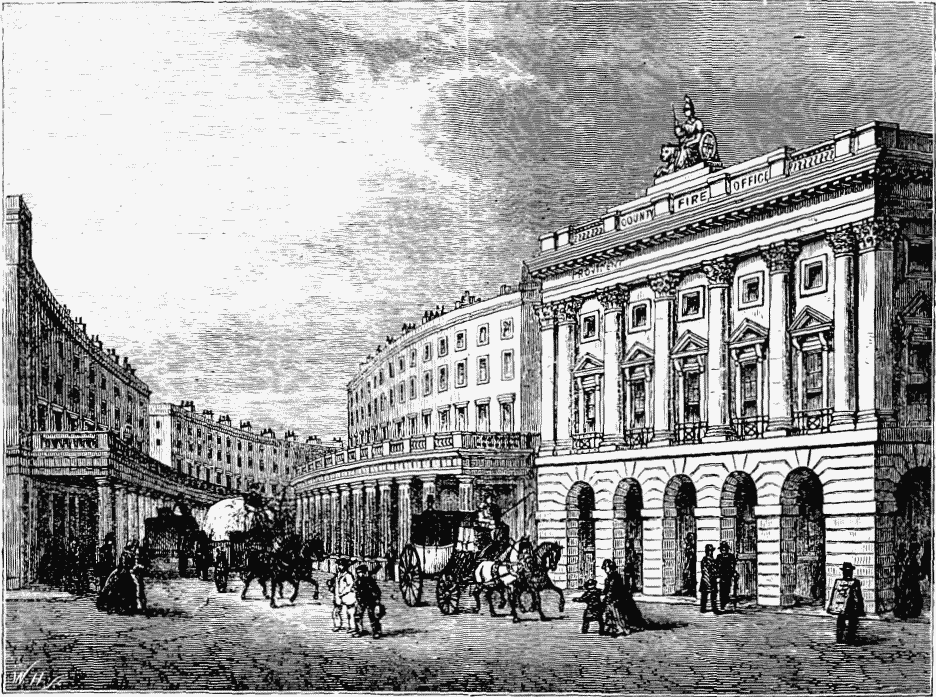
THE QUADRANT, REGENT STREET, BEFORE THE REMOVAL OF THE COLONNADE.
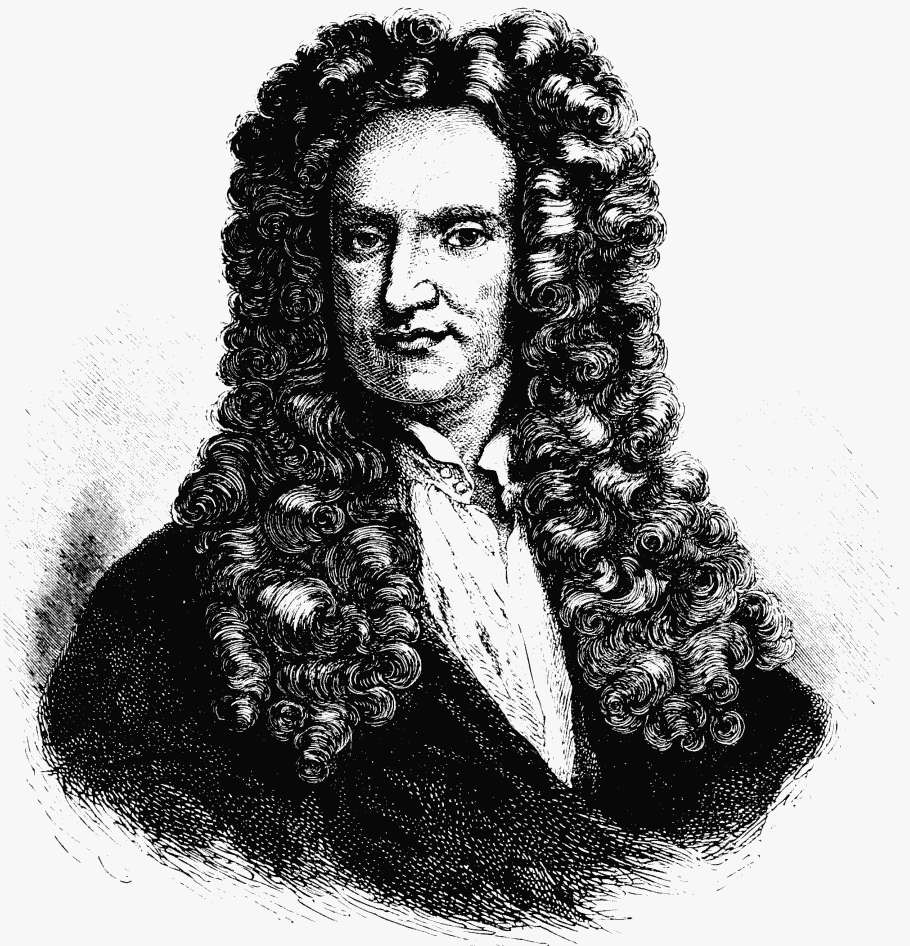
SIR ISAAC NEWTON.
But we must proceed. Between Regent's Quadrant and Piccadilly runs Little Vine Street, a thoroughfare remarkable now-a-days mainly for its police station; but carrying back our memories to the day when a vineyard, belonging to the Abbey of Westminster or to some wealthy lord, flourished and yielded the fruit of the grape on a sunny slope. Here, in 1805, was living, in comparative obscurity, a young artist, who afterwards became known as Sir Francis Chantrey, the eminent sculptor.
In this street there is to be seen the sign of the "Man in the Moon"—a sign representing, as antiquaries tell us, either Cain, or Jacob, or the man who was stoned for gathering sticks on the Jewish Sabbath (Numbers xv. 22, &c.), and so old as to be alluded to by Shakespeare and Dante. There were other houses bearing this sign in Cheapside and other parts of London.
We have already stated that a considerable part of Swallow Street was absorbed in the formation of Regent Street; a small portion, however, is still left between the Quadrant and Piccadilly, and into that we now pass. Here there has been a chapel belonging to the Scotch Presbyterians since 1710, when it was bought by a Dr. James Anderson from the French Huguenots, who had used it as one of the principal churches of their worship not long after their arrival in England after the revocation of the Edict of Nantes. Mr. Smiles, in his work on the Huguenots, tells us that "the congregation had originally worshipped in the French Ambassador's chapel in Monmouth House, Soho Square, from which they removed to Swallow Street in 1690." The records of their church, which are still preserved at Somerset House, show that it was the principal place for receiving back into church membership such refugees as had lapsed from their first fervour.
St. James's Hall, which covers a large space of ground between the Quadrant and Piccadilly, and is almost wholly concealed by houses and shopfronts, was built in 1857, from the designs of Mr. Owen Jones, in the Arabesque or Moorish Alhambra style. The building, which has entrances in both thoroughfares, consists of one large room and two smaller ones. The principal hall is beautifully decorated, and surrounded on three sides with a gallery; the western end is apsidally constructed, and is so arranged that concerts may be given on an extensive scale, a class of entertainment for which the Hall was originally intended. Among the principal concerts given here are those of the New Philharmonic Society, Mr. Henry Leslie's Choir, and what are called the "Monday Popular Concerts." The first public dinner held here was on June 2, 1858, under the presidency of Mr. Robert Stephenson, M.P., when a testimonial of the value of more than £2,500 was presented to Sir F. P. Smith, in recognition of services in the introduction of the screw-propeller into our steam fleet. Here Charles Dickens gave the second series of his "Readings," in the spring of 1861. In one of the smaller apartments entertainments on a humbler scale—such as panoramas, &c.—are given. In 1875, handsome and spacious dining-rooms, &c., were added to the building. Adjoining each room is a small kitchen, communicating, by means of a lift, with the general kitchen upstairs; the general fittings and furniture are handsome throughout, and in good keeping, marble and glazed tiling being largely employed in the panelling of the walls.
At Fore's Exhibition, which, towards the end of the last century, was in a house near the eastern end of Piccadilly, was to be seen the largest collection of caricatures by Gilray, Rowlandson, and the elder Cruickshank, including many political squibs and songs.
At No. 7, close to Regent Circus, in August, 1839, were made the first experiments in this country with the newly-discovered process of M. Daguerre, in the presence of a large body of scientific persons.
At a short distance westward from the circus, probably in the house now occupied by Mr. Quaritch, the eminent second-hand bookseller, but what was at the time No. 23, resided, in 1805, Emma Lyon, afterwards Lady Hamilton. She was born in Cheshire, and came to London, while a girl, in 1777, and lived in several families as a nursemaid. In 1791 she was married to Sir William Hamilton. She became acquainted with Lord Nelson at Naples, in 1799, and here the great naval hero used to visit her. By him she had a child, named Horatia, who afterwards married a clergyman. It has been remarked by a writer in Blackwood, that "of her virtues, unhappily, prudence was not one. After the death of Nelson, and the disgraceful disregard of her claims by the Government, her affairs became greatly embarrassed. Those who owed wealth and honour to Nelson, and who had sunned themselves in her prosperity, shrank away from her. In her distress she wrote a most touching letter to one who had courted her smiles in other days, the Duke of Queensberry, imploring him to buy the little estate at Merton, which had been left to her by Nelson, and thus to relieve her from the most pressing embarrassments. The cold-hearted old profligate turned a deaf ear to the request. In 1813 Emma Hamilton was a prisoner for debt in the King's Bench. Deserted by the great, the noble, and the wealthy, abandoned by the heir of his title and the recipient of his hardearned rewards, she, whom Nelson had left as a legacy to his country, might have died in a gaol. From this fate she was saved by one whose name is not to be found in the brilliant circle who surrounded her but a few short years before. Alderman Joshua Jonathan Smith (let all honour be paid to his most plebeian name) redeemed his share of his country's debt and obtained her release. She fled to Calais, where she died in destitution, and was buried by the hands of charitable strangers."
Mr. Quaritch's establishment is by far the most extensive of the kind in London, and probably in the world; and his catalogue, a most voluminous production, larger and more varied than even that of Mr. H. G. Bohn, is of itself of such interest in the literary world as to have merited a long and elaborate notice in the Times.
On the southern side of Piccadilly, nearly opposite the entrance to St. James's Hall, is the Museum of Practical Geology, of which we have spoken in a previous chapter.
At No. 208, on this side of the street, between the Circus and St. James's Church, are the Rooms of the Genealogical and Historical Society of Great Britain, an association which, though it has been in existence for twenty years, has hitherto published no "Transactions" or records of its proceedings, nor even the names of its president and council, or a list of its members!
St. James's Church, which is separated from the roadway by a paved court and brick wall, with handsome iron gates, owes its erection to the great increase in the parish of St. Martin-in-theFields. It was originally a chapel of ease only, and was built at an expense of about £8,500, chiefly by Henry Jermyn, Earl of St. Albans, and the neighbouring inhabitants.
It is well known that Sir Christopher Wren always regarded this as one of the best of his churches. He is said to have taxed his powers to the utmost here to provide "a room so capacious as with pews and galleries to hold 2,000 persons, and all to hear the service and see the preacher." It is divided in the interior into a nave and side aisles. The principal merit is in the formation of the roof, which is described by the late Professor Cockerell as "singularly ingenious and economical; its simplicity, strength, and beauty being a perfect study of construction and architectural economy." The writer of "A New Critical Review of the Public Buildings" draws attention to its beautiful and commanding situation, while he expresses his regret that the architect troubled himself but little about beauty in his design.
The walls of this church are of brick and stone, with rustic quoins, &c.; the roof is arched, and supported by Corinthian pillars. The interior of the roof is beautifully ornamented, and divided into panels of crotchet and fret-work. The galleries have very handsome fronts, and the door-cases are highly enriched; that fronting Jermyn Street (originally the principal one) has above it the arms of the Earl of St. Albans. The font was carved by Grinling Gibbons, and represents the Fall of Man, the Salvation of Noah, &c. In Brayley's "Londoniana" it is asserted that the cover of the font, which was held by a flying angel and a group of cherubim, was stolen about the beginning of the present century, and subsequently hung up as a sign at a spirit-shop in the neighbourhood. The great east window was filled with stained glass in 1846, the subjects represented being Christ's Agony in the Garden, Bearing the Cross, the Passion, the Burial, Resurrection, and the Ascension. Of the altar-piece, which is very spacious, and highly enriched with carved work, Evelyn, in his "Diary," under date December 16, 1684, gives us the following particulars:—"I went to see the new church of St. James's, elegantly built. The altar was especially adorned, the white marble inclosure curiously and richly carved, the flowers and garlands about the walls by Mr. Gibbons, in wood; a pelican, with her young at her breast, just over the altar in the carved compartment, and border environing the purple velvet fringed with (black) I.H.S. richly embroidered, and most noble plate, were given by Sir R. Greere, to the value (as was said) of £200. There was no altar anywhere in England, nor has there been any abroad, more handsomely adorned." The organ, which is considered very good, was built for James II., and intended for his Roman Catholic Oratory at Whitehall, but it was given to this parish by Queen Mary in 1691. At the north-west corner of the church is a tower and spire, rising to the height of about 150 feet. The spire, says Mr. Timbs, was a later addition, planned by a carpenter, whose design was preferred to that of Wren, from motives of economy. In 1850, the spire was coated with lead, when the exterior of the church was repaired throughout.
The church was consecrated in 1684, and many of its rectors have become bishops and high dignitaries in the Church. One of the earliest was Dr. Hoadly, afterwards Bishop of Winchester. Dr. Tenison, vicar of St. Martin's, and subsequently Archbishop of Canterbury, was appointed the first rector. The third rector, Dr. Wake, and the seventh, Dr. Secker, likewise at a later date became Archbishops of Canterbury. One of the rectors of St. James's in the last century was Dr. Samuel Clarke, the well-known latitudinarian divine, whose writings were so severely censured by the Lower House of Convocation as to cause a breach with the Upper House, and eventually to suspend the sittings of both Houses for nearly a century. He was a great favourite of Queen Anne (who placed his bust in her Hermitage) and of Queen Caroline, though disliked by Bolingbroke and Pope. On the death of Sir Isaac Newton he was offered the Mastership of the Mint, but refused it as "inconsistent with his profession," though in all probability he would have been better placed there than in a Trinitarian pulpit. Another of its rectors was Dr. Gerrard Andrewes, some time Dean of Canterbury, who refused the Bishopric of Chester, which was offered to him by Lord Liverpool in 1812. Another rector was Dr. Ward, Dean of Lincoln, who was succeeded by Dr. Jackson, since Bishop of London.
In 1762, a fire broke out most unaccountably in the vaults of this church, and destroyed two hundred coffins and their contents.
In this parish lived and died, at the age of eightyseven, the Hon. Frederick Byng, a well-known member of the world of fashion, both before and under the Regency. He was always known as "Poodle Byng," on account of his curly hair. Of late years he took an active interest in the parochial affairs of St. James's, having lived for sixty years in the region of the clubs and of St. James's Place, where he resided. He was the subject of sundry caricatures by Dighton, in 1817.
In St. James's Church is buried the learned anatomist, Mr. Joshua Brookes, F.R.S., whose lectures at his theatre in Blenheim Street are said to have been attended by seven thousand pupils. His museum was almost a rival of that belonging to John Hunter, of whom we have already spoken in our account of Leicester Square: its doors were always open to scientific men of this and other countries. It was, however, dispersed on his death, in 1833.
Here, too, is buried Sir John Malcolm, the distinguished Indian general, who died in 1833. James Dodsley, many years an eminent bookseller in Pall Mall, of whom we have already spoken, is likewise interred here. There is a monument to his memory near the communion-table. Here, too, lies Mary Delaney, niece of Granville, Lord Lansdowne. Benjamin Stillingfleet, the naturalist, Charles Cotton, the friend and companion of Izaak Walton, and Dr. Sydenham, are also buried here. The latter is commemorated by a marble tablet, erected by the College of Physicians. Among other notabilities interred in this church may be mentioned Hayman and Michael Dahl, the portrait painters; G. H. Harlow, the painter of "The Trial of Queen Katharine;" Dr. Akenside, the author of the "Pleasures of the Imagination," and also the two Vanderveldes, the marine painters.
Here, as at St. Giles's-in-the-Fields, unfortunately, the earlier volumes of the parish rate-books have disappeared; so that it is impossible to glean the same accurate information as to its inhabitants in the reigns of the earlier Stuarts, which meets us at every turn in those of St. Martin's-in-the-Fields and of St. Paul's, Covent Garden.
With reference to this parish, and to the line of roadway running westward, it may be stated that in an Act of Parliament, in the reign of James II., mention is made of the "mansion-house of the Earl of Burlington, fronting Portugal Street;" and a "toft of ground" in Piccadilly is assigned to the rector of St. James's parish.
In a house at the corner of Sackville Street, "over against St. James's Church," in the year 1687, died Sir William Petty, the eminent writer on political economy, and an ancestor of the Lansdowne family. The son of a clothier in humble circumstances, he was born at Romsey, in Hampshire, in 1623, and was educated at the grammar school of his native town. He afterwards determined to improve himself by study at the University of Caen, in Normandy. Whilst there, he contrived to support himself by carrying on a small pedlar's trade with a "little stock of merchandise." Wishing to return to England, he bound himself apprentice to a sea-captain, who beat him most unmercifully. Leaving the navy in disgust, he took to the study of medicine, and having studied at Leyden and Paris, he took his degree, and was subsequently made professor of anatomy. During this part of his life he was reduced to such poverty that he subsisted for two or three weeks entirely on walnuts. But again he began to trade in a small way, and, "turning an honest penny," returned to England with money in his pocket. Steadily applying himself to his profession, he then became a successful London physician, and was one of the first fellows of the Royal Society, to which he presented the model of a double-bottomed ship, to sail against wind and tide. In 1652 he was appointed physician to the army in Ireland, and secretary to Henry Cromwell, by whom he was employed in surveying the forfeited lands, for which charges were alleged against him in the House of Commons, and he was dismissed from his appointments. At the Restoration he was knighted, and made Surveyor-General of Ireland. Sir William suffered much by the Great Fire of London; but by marriage and various speculations he recovered his losses, and died very rich, in the year 1687. In his will, which is a curious document, singularly illustrative of his character, he writes, with a certain amount of self-pride, "At the full age of fifteen, I had obtained the Latin, Greek, and French tongues," and at twenty years of age "had gotten up threescore pounds, with as much mathematics as any of my age was known to have had." Sir William was buried in the fine old Norman church of Romsey. A plain slab, cut by an illiterate workman, with the inscription, "Here layes Sir William Petty," covers his tomb.
Next door but one to Sir William Petty, Verrio,
the Italian painter, was residing in the reign of
William and Mary; the reader will not have forgotten the often-quoted line which records his
decorations of the ceiling of Whitehall—
"Where sprawl the saints of Verrio and Laguerre."
In a shop opposite St. James's Church there was, in 1819, a curious collection of live animals, which had a run of popularity, but was unable to stand as a rival against Exeter 'Change.
Continuing our walk along Piccadilly, we pass on our left the publishing-houses of Messrs. Chapman and Hall, Messrs. Hatchard, and others. From the first-named shop were issued the successive numbers of "Pickwick" and "Nicholas Nickleby," which electrified and amazed the world in 1837–9, and made the name of "Boz" a "household word." Messrs. Chapman and Hall were the publishers of Charles Dickens's serial works down to and inclusive of "Martin Chuzzlewit" and the "Christmas Carol," which appeared in 1843–4; from that date, however, Messrs. Bradbury and Evans became his publishers, and those relations lasted until 1858, when he started All the Year Round on his own account. The publication of Charles Dickens's works is now again in the hands of the house in connection with which he first "made his mark" with "Pickwick." At the shop of Mr. Hardwicke, No. 192, have been published for some time the publications of the Ray Society. This society, which was formed in 1844, takes its name from John Ray, the celebrated naturalist.
The booksellers' shops here, at the close of the last century, had not ceased to be what those of Tonson, in the Strand, and Dodsley, in Pall Mall, had been—the resort of literary characters. At this time, Mr. D'Israeli tells us that Debrett's was the chief haunt of the Whigs, and Hatchard's that of the Tories. It was at Hatchard's that the elder D'Israeli was first introduced to Mr. Pye, the Poet Laureate, who was then busy on his translation of Aristotle's Poetics, and who, in passing Debrett's door, requested his new friend, who was then unknown, to go in and buy a pamphlet which he dared not be seen going in to purchase for himself.
The house No. 169 is remarkable as having been not only the shop where the Anti-Jacobin was published, but also the house in which its editor (William Gifford) and its writers used to meet in council; a fact worthy of note, when we add that among the contributors to its columns were the younger Pitt, George Canning, and John Hookham Frere. This shop, then kept by a Mr. Wright, was much frequented by the friends of Mr. Pitt's ministry. It was here that Dr. Wolcott was severely "castigated" by Gifford. No. 117 was the shop of William Pickering, the eminent publisher. The Aldine anchor, revived by the late Mr. Pickering on his title-pages, gave a celebrity to the books, mostly reprints of the poets and prose writers of the past, and works in curious paths of literature, which he issued from his shop.
The Egyptian Hall, the front of which forms one of the most noticeable features on the southern side of Piccadilly, nearly opposite to Bond Street, was erected in the year 1812, from the designs of Mr. G. F. Robinson, at a cost of £16,000, for a museum of natural history, the objects of which were in part collected by William Bullock, F.L.S., during his thirty years' travel in Central America. The edifice was so named from its being in the Egyptian style of architecture and ornament, the inclined pilasters and sides being covered with hieroglyphics; and the hall is now used principally for popular entertainments, lectures, and exhibitions. Bullock's Museum was at one time one of the most popular exhibitions in the metropolis. It comprised curiosities from the South Sea, Africa, and North and South America; works of art; armoury, and the travelling carriage of Bonaparte. The collection, which was made up to a very great extent out of the Lichfield Museum and that of Sir Ashton Lever, was sold off by auction, and dispersed in lots, in 1819.
Here, in 1825, was exhibited a curious phenomenon, known as "the Living Skeleton," or "the Anatomic Vivante," of whom a short account will be found in Hone's "Every-Day Book." His name was Claude Amboise Seurat, and he was born in Champagne, in April, 1798. His height was 5 feet 7½ inches, and as he consisted literally of nothing but skin and bone, he weighed only 77¾ lbs. He (or another living skeleton) was shown subsequently—in 1830, we believe—at "Bartlemy Fair," but died shortly afterwards. There is extant a portrait of M. Seurat, published by John Williams, of 13, Paternoster Row, which quite enables us to identify in him the perfect French native.
Of the various entertainments and exhibitions that have found a home here, it would, perhaps, be needless to attempt to give a complete catalogue; but we may, at least, mention a few of the most successful. In 1829, the Siamese Twins made their first appearance here, and were described at the time as "two youths of eighteen, natives of Siam, united by a short band at the pit of the stomach—two perfect bodies, bound together by an inseparable link." They died in America in the early part of the year 1874. The American dwarf, Charles S. Stratton, "Tom Thumb," was exhibited here in 1844; and subsequently, Mr. Albert Smith gave the narrative of his ascent of Mont Blanc, his lecture being illustrated by some cleverly-painted dioramic views of the perils and sublimities of the Alpine regions. Latterly, the Egyptian Hall has been almost continually used for the exhibition of feats of legerdemain, the most successful of these—if one may judge from the "run" which the entertainment has enjoyed—being the extraordinary performances of Messrs. Maskelyne and Cooke.
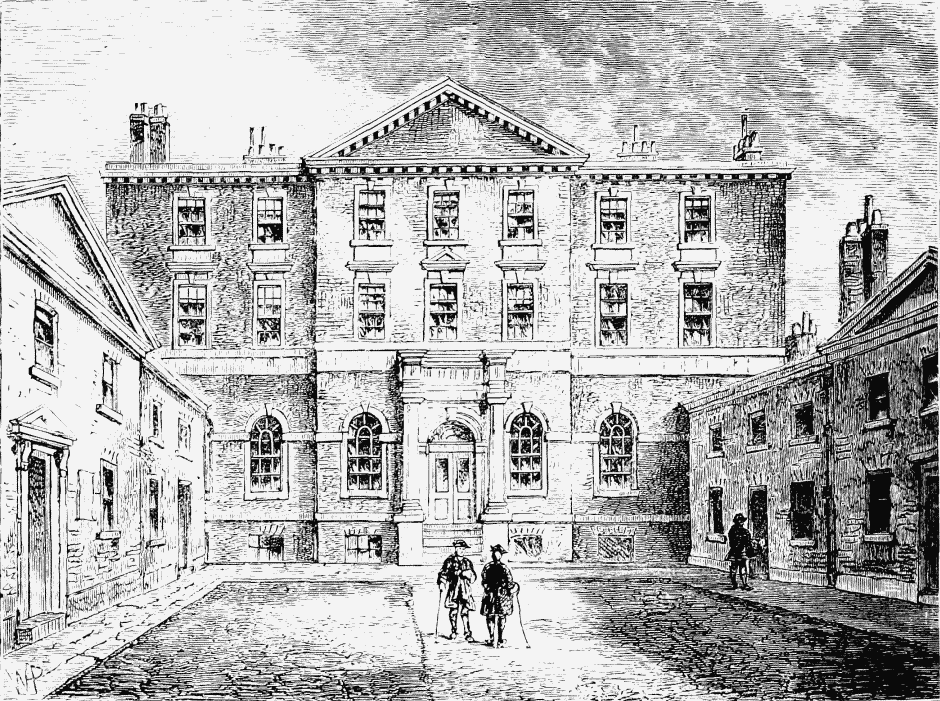
THE ALBANY, IN 1800.
In 1819, there was, adjoining Bullock's Museum, the Pantherion, a separate exhibition, "intended to display quadrupeds in such a manner as to convey a correct notion of their haunts and habits. In one orange-tree were disposed sixty species of the genus Simia, or monkeys. Besides animal nature, Mr. Bullock exhibited, in connection with it, many exotic trees."
Nearly opposite the Egyptian Hall is "The Albany." This building, which is separated from the main thoroughfare by a small paved courtyard, was known in the last century as Melbourne House. Lord Melbourne, however, the then owner, exchanged it with the Duke of York and Albany for his mansion in Whitehall, now Dover House. Near or on this site, says Pennant, stood the house of "that monster of treachery, that profligate minister, Charles Spencer, Earl of Sunderland, who, by his destructive advice, premeditatedly brought ruin on his unsuspecting master, James II. . . . . At the very time that he sold him to the Prince of Orange, he encouraged his Majesty in every step which was certain of involving him and his family in utter ruin."
The present central building, designed by Sir William Chambers, was sold by Lord Holland, in 1770, to the first Lord Melbourne. In 1804 the mansion was altered and enlarged, and first let in chambers, and named the Albany, after the second title of the Duke of York. It extends in the rear as far as Burlington Gardens, having a porter's lodge and entrance at either end. It is entirely occupied by bachelors (or widowers), and comprises sixty sets of apartments, each staircase being marked by one of the letters of the alphabet. Most of the occupants of these suites are members of one or other of the Houses of Parliament, or naval or military officers. Among those who have occupied chambers here in their day were Lord Byron, George Canning, Lord Macaulay (who here wrote the greater part of his "History of England"), Lord Lytton, Lord Glenelg, and Sir John C. Hobhouse. Here, too, as we learn from his Autobiography, Lord Brougham was living in bachelor chambers from 1806, when studying for the Bar, down to 1808, when he removed to chambers in the Middle Temple. It is said that no person who carries on a trade or commercial occupation is allowed to reside on the premises; and that, as a rule, "ladies are not admitted," excepting the mothers, sisters, grandmothers, and aunts of the occupants of the chambers; but this rule, we fancy, is not very strictly adhered to.
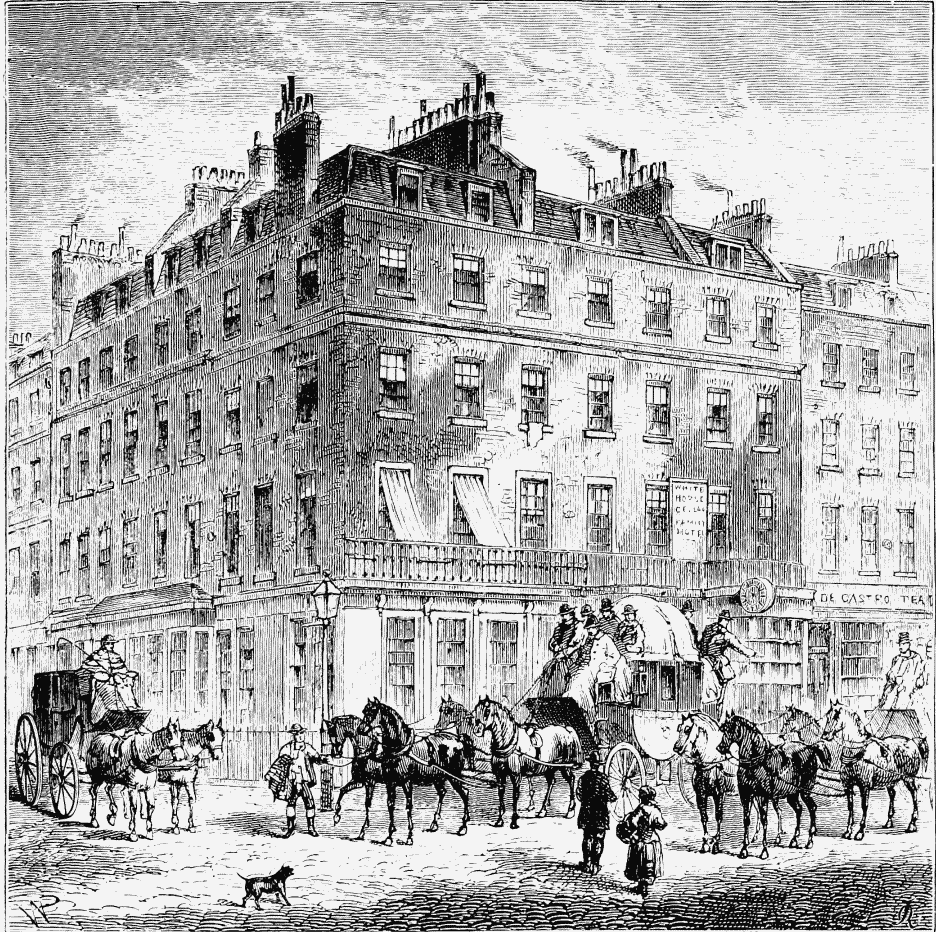
THE NEW "WHITE HORSE CELLAR."
The Albany adjoins the site of Sir Thomas Clarges house, which is described, in the year 1675, as being "near Burlington House, above Piccadilly."
In 1806, the house adjoining the Albany was occupied, for the purposes of exhibition, by Daniel Lambert, a Leicestershire man, who bore the reputation of being the "heaviest man that ever lived." His weight, at the age of thirty-six, was upwards of eighty-seven stone. It is stated that, although in most instances, when the body exceeds the usual proportions, the strength correspondingly diminishes, this was not the case with Lambert, for it is recorded that, notwithstanding his excessive corpulency, he tested his ability by carrying more than four hundredweight and a half—a feat that many a sinewy athlete would fail to accomplish. During his stay here, "Dan" Lambert was as fashionable a celebrity as Albert Smith or "General" Tom Thumb became in later years, at the Egyptian Hall opposite. Thousands went to see him daily, and from morning till night his reception-room was thronged with men in cocked hats and ladies in furbelows, coming alike from Kensington and Cheapside.
On the opposite side of the road, between St. James's Street and the Green Park, is Arlington Street, of which we have already spoken. (fn. 3) The exact date of building this street is not known, but it must have been between 1680 and 1690. The street stands partly on the site of Goring House. Evelyn, in his "Diary," under date of 29th March, 1665, tells us how that he "went to Goring House, now Mr. Secretary Bennet's; ill built, but the place capable of being made a pretty villa." The same diarist records its destruction by fire, November 21, 1674, when a fine collection of pictures, as well as much handsome plate, hangings, and furniture, perished; and he elsewhere describes the appointments of the house as "princely." From Pepys we learn that a sister of John Milton was married here in July, 1660.
We might add here, as one of the residents of this street in former times, the name of Lady Mary Wortley Montagu, who, before her marriage, was living here in the house of her father, the Marquis of Dorchester, afterwards Duke of Kingston. She was the author of those charming, lively, and witty letters, written at Constantinople, and addressed by Lady Mary to friends at home, descriptive of Turkish life and society, and in which, it has been said, she displays "the epistolary talents of a female Horace Walpole." She was very eccentric in her attire; indeed, Horace Walpole once described her dress as consisting of "a groundwork of dirt, with an embroidery of filthiness."
Horace Walpole himself resided in this street for many years, before removing further west into Berkeley Square (where he died); and from Arlington Street are dated many of his letters to Lady Ossory. At Horace Walpole's house, on one occasion, there was a large party present at dinner, when Bruce, the celebrated African traveller, was talking in his usual style of exaggeration. Some one asked him what musical instruments were used in Abyssinia. Bruce hesitated, not being prepared for the question, and at last said, "I think I saw a lyre there." George Selwyn, who was one of the party, whispered to his next man, "Yes, there is one less since he left the country." Admiral Lord Nelson, too, was living in this street when his wife separated from him, in 1801.
Close by Arlington Street was a well-known hostelry, the old "White Horse Cellar." In the "good old days," before the power of steam had been developed, or railways planned, even Londoners rejoiced, on summer evenings, to lounge about this noted house, and watch the mails drive down Piccadilly, en route for the West of England. On the king's birthday, especially, the scene was picturesque, and of special interest. The exterior of the "Cellar" was studded over with oil lights of many colours, arranged in tasty lines and capital letters. The sleek-coated horses stepped along as if they were proud of their new harness, and the bright brass ornaments on their trappings glittered in the light. The coachmen and guards, too, were dressed in unsullied scarlet coats, which they wore for the first time on that day—woe for them if it was wet—and there were gay rosettes of ribbons and bunches of bright flowers at each of the horses' heads, as well as in the coachman's button-hole. The coaches themselves were, if not newly painted, at all events, freshly "touched-up" with the brush, and the post-horn sounded pleasantly as the ostlers cried, "All right; off they go!" In the reign of George IV., many of the coaches which left London were driven by gentlemen, and in some cases the reins were handled by peers of the realm. Sir St. Vincent Cotton drove the Brighton "Age;" another coach on the same road was horsed and driven by the Marquis of Worcester, afterwards Duke of Beaufort; Sir Thomas Tyrrwhitt Jones drove the "Pearl;" and the Reading coach was driven by Captain Probyn.
Hazlitt has thus described, in his own graphic manner, the scene presented on the starting of the old mail-coaches:—"The finest sight in the metropolis," he writes, "is the setting off of the mailcoaches from Piccadilly. The horses paw the ground and are impatient to be gone, as if conscious of the precious burden they convey. There is a peculiar secrecy and dispatch, significant and full of meaning, in all the proceedings concerning them. Even the outside passengers have an erect and supercilious air, as if proof against the accidents of the journey; in fact, it seems indifferent whether they are to encounter the summer's heat or the winter's cold, since they are borne through the air on a winged chariot. The mail-carts drive up and the transfer of packages is made, and at a given signal off they start, bearing the irrevocable scrolls that give wings to thought, and that bind or sever hearts for ever. How we hate the Putney and Brentford stages that draw up when they are gone! Some persons think the sublimest object in nature is a ship launched on the bosom of the ocean; but give me for my private satisfaction the mail-coaches that pour down Piccadilly of an evening, tear up the pavement, and devour the way before them to the Land's End." Poor Hazlitt! in the fall of the mail-coach he sees a type of the rapid changes to which all mortal inventions and fashions are subject. In Cowper's day the mail-coach had scarcely superseded the post-boy and stage; and in Hazlitt's time they had entered on their decline and fall; and we have lived to see the Putney and Brentford stages superseded by omnibuses!
At the old "White Horse Cellar," when it served as the head-quarters of the departure of the passengers by the country coaches, there used to stand a small confraternity of Jews, who sold oranges, pencils, sponges, brushes, and other small wares; but these, of course, disappeared when the system of travelling was changed, and the old house came, in the end, to be converted into a railway bookingoffice for luggage.
A new house on the opposite side of the way, it is true, rejoices in the sign of the "White Horse Cellar;" and at Hatchett's Hotel, which adjoins it, an attempt has been made, within the last few years, to revive the taste for coaching, and, with this aim in view, stage-coaches have been run daily during the summer to Sevenoaks, Tunbridge Wells, Windsor, Brighton, Dorking, &c. The history of this movement is worth epitomising, in the words of a well-known writer on sporting subjects:—"The Brighton road was the last to give up the old-fashioned stage-coach, and the first selected by the amateurs who are the stage-coach owners of to-day. Up to about 1862, the 'Age,' the property of and driven by 'Old Clark,' ran during the summer, viâ Kingston and Dorking (where the 'coach' dined), to Brighton. In its latter days the Duke of Beaufort and Mr. Charles Lawrie, of Bexley, Kent, helped the proprietor in a substantial and practical manner, but the 'Age' was like any other business speculation, and soon after it ceased to pay it stopped. In the year 1866, and chiefly through the exertions of Mr. Lawrie, a little yellow coach, called the 'Old Times,' was subscribed for in shares of £10 each, and made its appearance on the 'Brighton' road, the Duke of Beaufort, Mr. Chandos Pole, Lord H. Thynne, and Mr. C. Lawrie being among the shareholders. The success was so considerable, that in the April of the following year the Brighton was 'doubled,' and two new coaches built especially for the work, and horsed by the Duke of Beaufort and his friends, ran during that summer. Alfred Tedder and Pratt were the coachmen, and the lunching-place (where the coaches met) was the 'Chequers,' at Horley, an inn now kept by Mr. Tedder (the driver of the Brighton coach of to-day). At the close of the season of 1867, Mr. Chandos Pole determined to carry on one coach by himself. This he did through the entire winter; and further, with his brother's (Mr. Pole-Gell's) aid (the latter found twelve of the horses), 'doubled' the coach in the succeeding summer. At the season's close, after the horses had been dispersed by the auctioneer's hammer at Aldridge's, a few lovers of the road gave 'the Squire' (Mr. Chandos Pole) a dinner at 'Hatchett's,' Piccadilly, and presented him with a handsome silver flagon (value £50) to commemorate his plucky behaviour, and in admiration of his wonderful ability as a 'whip.' At a later date there was presented to Tedder, the coachman, a smaller flagon (value £20), as a token of the appreciation of his friends of his ability on the 'bench' (i.e., the driving-seat). In 1869, Mr. A. G. Scott first took the position of honorary secretary to the Brighton coach, which then made the 'Ship' at Charing Cross its starting-place. This was the best year the coach has known, as it never once had a clean bill up or down. The proprietors were Lord Londesborough, Colonel Stracey-Clitheroe, Mr. Pole-Gell, and Mr. G. Meek, who each provided the horses for one stage; while Mr. Chandos Pole again took the largest responsibility by providing the horses for two stages. But the example of the Brighton coach was followed. Towards the end of the season of 1867, Mr. Charles Hoare started a coach between Beckenham and Sevenoaks. This developed the following year into the Sevenoaks coach, starting from Hatchett's, and this carried such good loads, that in 1868 its proprietor carried it on to Tunbridge Wells, to the delight of thousands who have since enjoyed the exquisite scenery it has introduced them to. Since 1868 the Brighton has continued a single coach, but several new candidates for public favour have appeared."
Apropos of the subject of coaching, we may add that Mr. Larwood tells us in his "History of Signboards," that there is still (1866) a sign of the "Coach and Six" to be seen in Westminster; but he does not specify the exact spot. It does not appear, however, in the "Post Office Directory" for 1876. The sign, however, speaks of the day when the roads even near London were so bad in the winter time that four horses were not enough to carry a coach safe out of the deep and miry ruts. Mr. Larwood also tells us, that in 1866 there were still no less than fifty-two public-houses, exclusive of beer-houses, coffee-houses, &c., which rejoiced in the sign of the "Coach and Horses," in spite of the progress made by railways.
While on the subject of sign-boards, we may state that Piccadilly was the place in which the "Cat and Fiddle" first appeared as a public-house sign. The story is that a Frenchwoman, a small shopkeeper at the eastern end, soon after it was first built, had a very faithful and favourite cat, and that, in lack of any other sign, she put up over her door the words, "Voici une Chat fidèle." From some cause or other the "Chat Fidèle" soon became a popular sign in France, and was speedily Anglicised into the "Cat and Fiddle," because the words form part of one of our most popular nursery rhymes. We do not pledge ourselves for the correctness of the derivation, but simply tell the story as told to us.
It has often been observed that while the fashionable world flitting westwards occupied the streets to the north and south of Piccadilly—its tributaries—the great thoroughfare itself was given up to tradesmen and shopkeepers, with the exception of two or three great mansions, which, though in it, were scarcely of it.