Old and New London: Volume 4. Originally published by Cassell, Petter & Galpin, London, 1878.
This free content was digitised by double rekeying. Public Domain.
Edward Walford, 'Hanover Square and neighbourhood', in Old and New London: Volume 4(London, 1878), British History Online https://www.british-history.ac.uk/old-new-london/vol4/pp314-326 [accessed 30 April 2025].
Edward Walford, 'Hanover Square and neighbourhood', in Old and New London: Volume 4(London, 1878), British History Online, accessed April 30, 2025, https://www.british-history.ac.uk/old-new-london/vol4/pp314-326.
Edward Walford. "Hanover Square and neighbourhood". Old and New London: Volume 4. (London, 1878), British History Online. Web. 30 April 2025. https://www.british-history.ac.uk/old-new-london/vol4/pp314-326.
In this section
CHAPTER XXV.
HANOVER SQUARE AND ITS NEIGHBOURHOOD.
"O could I as Harlequin frisk,
And thou be my Columbine fair,
My wand should, with one magic whisk,
Transport us to Hanover Square:
St. George's should lend us its aid."—"Rejected Addresses."
Statue of William Pitt—Description of the Square in the Last Century—Harewood House—"Beau" Lascelles—Lord Rodney, and his Daughter's Clandestine Marriage—Lord Palmerston's Residence—Sir William Fairfax and Mrs. Somerville, and other Distinguished Residents—Zoological Society—Royal Agricultural Society—Royal College of Chemistry—The Oriental Club—The Arts Club—Hanover Square Rooms, now the Hanover Club—The building of New Streets in the Neighbourhood—Tenterden Street—Royal Academy of Music—Brook Street—George Street—St. George's Church—Fashionable Weddings—Dr. Dodd's Desire to become Rector—The Parish Burial-groundsDistinguished Residents in George Street—Junior Travellers' Club—Maddox Street—Architectural Museum—The "Golden Star" Inn—Mill Street—Conduit Street—The Locality Three Hundred Years ago—Limmer's Hotel—The "Coach and Horses"—The "Prince of Wales" Coffee-house—A Batch of Architectural Societies—Trinity Chapel.
This square—perhaps in one way among the most popular in London, so closely connected as it is with the fashionable marriages solemnised in St. George's Church—was entirely unbuilt in 1716; but its name, which is mentioned in the plans of London of the year 1720, bears testimony to the loyalty of the Londoners who worshipped the "rising sun" in the person of George I. Both in the square itself, and in George Street adjoining, there are several specimens of the German style of building. The square covers about four acres of ground, and the centre is enclosed with a neat iron railing, within which, on the north side, is a colossal bronze statue of William Pitt, by Sir Francis Chantrey. This statue was not set up until 1831, when the statesman had been dead for more than a quarter of a century; it cost £7,000; and Mr. Peter Cunningham, who was present on the occasion, records the fact, that on the very day of its erection some advanced reformers endeavoured, though in vain, to pull it down with ropes. The figure is upright, in the act of speaking, and is one of the finest statues in London.
The Weekly Medley, in 1717, contains the following observations, which are interesting at the present time:—"Round about the new square, which is building near Oxford Road [now Oxford Street], there are so many other edifices that a whole magnificent city seems to be risen out of the ground, that one would wonder how it should find a new set of inhabitants. It is said it will be called by the name of Hanover Square. The chief persons that we hear of who are to inhabit that place when it is finished, having bought houses, are these following:—The Lord Cadogan, a general; also General Carpenter, General Wills, General Evans, General Pepper, the two General Stuarts, and several others whose names we have not been able to learn." It would appear, therefore, that its first tenants were mostly of the military order.
Strype tells us that the houses which in his time were in the process of creation were rapidly taken up; one of them he specifies by name, the mansion of "My Lord Cowper, late Lord High Chancellor of England;" and he adds that it was in contemplation to change the common place of execution from Tyburn to somewhere near Kingsland, in order to spare that square and the houses thereabouts—it must be supposed that he really means their inmates—the inconvenience and annoyance which might be caused by the execution of malefactors, which at that time went on rather by wholesale. But the square, though so aristocratic in its earlier inhabitants, does not appear to have been well looked after. At all events, we find plenty of complaints as to its condition half a century later. "As to Hanover Square," writes the author of "Critical Observations on the Buildings and Improvements of London," published in 1771, "I do not know what to make of it. It is neither open nor enclosed. Every convenience is railed out, and every nuisance railed in. Carriages have a narrow, ill-paved street to turn round in, and the middle has the air of a cow-yard, where blackguards assemble in the winter to play at hustle-cap, up to the ankles in dirt. This is the more to be regretted, as the square in question is susceptible of improvement at a small expense."
We gather from Dr. Hogg's work on "London as it is," published in 1837, that several, at all events, of the streets near Hanover Square, on the Grosvenor property, were not originally public thoroughfares. But the only gate now existing which bars the passage of carriages in this neighbourhood is that in Harewood Place, between the north side of this square and Oxford Street.
On the north side of the square, with its stables facing Oxford Street, is Harewood House, the residence of the Earl of Harewood. Of the interior of this mansion, Mr. T. Raikes gives us the following peep in his amusing "Journal:"—"The finest collection of old china in England will be found in the house of Lord Harewood, in Hanover Square, a nobleman whose agricultural pursuits and simple habits would give little reason to suppose that he was possessed of such an expensive article of luxury and taste. Fagg, the Chinaman, since the renewed rage in England for old valuables, has in vain offered Lord Harewood immense sums for this collection; but it was originally made by his elder brother, well known then as Beau Lascelles, who died unmarried, in 1814, and is always preserved in the family as a souvenir of him. The brothers were much attached to each other; but never was a greater contrast seen than in the refinement of the one and the simplicity of the other. Beau Lascelles was the essence of fashion of that day. He was a handsome man, rather inclined to be fat, which gave him a considerable resemblance to George Prince of Wales, whom he evidently imitated in his dress and manner. He was very high bred and amicable in society, and his taste in all that surrounded him was undeniable; his house, his carriages, horses, and servants, without any attempt at gaudy trappings, were the admiration of all the town, from the uniform neatness and beauty of their tenue. The ensemble of his equipage when he went to Court on a birthday might really be compared to a highly-finished toy. His house, though not large, was a museum of curiosities, selected with great taste and judgment, at a time when he had few competitors; and, had they all been preserved, they would now be of incalculable value. His life was luxurious but short, as he died at the age of fifty."
The gallant admiral, Lord Rodney, was living in this square in 1792. It is well known that his favourite daughter eloped to Gretna Green with Captain Chambers, a son of the eminent architect, Sir William Chambers. At first he was inclined to be angry, but he soon relented, and merely said, "Well, well! what is done can't be undone; but it's odd that my own family is the only crew that I never could manage, and I only hope that Jessy will never mutiny under her new commander!"
The large house in the south-western corner, towards the close of the last century, was the town residence of Lord and Lady Palmerston, the father and mother of the late Premier. The house, which was one of the great centres of political and social reunions, is noted by Lambert, in his "History of London," as "the best piece of brick-work in the metropolis."
In 1816 Mrs. Somerville was residing in this square along with her parents, Sir William and Lady Fairfax, and gratifying her new-born taste for astronomical and other science by attending the lectures at the Royal Institution. Here the Fairfaxes used to have little evening parties, and it was here that the late Sir Charles Lyell (as recorded in Mrs. Somerville's "Life") first met his future wife, the beautiful Miss Horner.
Among the other distinguished residents in the square have been Field-Marshal Lord Cobham, the owner of Stowe, and the friend of Pope; Sir James Clark, Physician to Her Majesty the Queen in 1841; and Ambrose Philips, the poet satirised by Pope, and author of the "Distressed Mother," who died in 1749. The mansion at the corner of Brook Street, now rebuilt and turned into the London and County Bank, was formerly called Downshire House. In 1826 it was inhabited by the Marquis of Salisbury. In 1835 it was held by another tenant, Prince Talleyrand, the ex-Minister of State in France, who used to gather round him the wits, literati, and diplomatists of the time. We shall meet him again at Kensington.
Of the houses which form the north-east side, one is occupied by the Zoological Society, whose offices have been located here since about 1846. The society was instituted in the year 1826, under the auspices of Sir Humphry Davy, Sir Stamford Raffles, and other eminent individuals, "for the advancement of zoology, and the introduction and exhibition of subjects of the animal kingdom, alive or in a state of preservation." In 1829 the society had a museum in Bruton Street, and subsequently in Leicester Square. This society took the place of the Zoological Club of the Linnæan Society, which had been broken up by internal differences. We shall have more to say about this society presently on reaching its gardens in the Regent's Park.
The Royal Agricultural Society of England has its offices at No. 12 (next door to the above). This society was established in 1838, for improving the general system of agriculture in this country, and engaging talented men in the investigation of such subjects as are of deep practical importance to the British farmer. Agricultural meetings are held annually in London and the country; the latter including a cattle-show, an exhibition of agricultural implements and inventions, and the awarding of prizes in either department. Its presidents, chosen annually, are almost always noblemen of high standing as practical farmers and breeders of stock.
At No. 15, on the north side of the square, and extending back into Oxford Street, is the Royal College of Chemistry. It was founded in 1845 "for the purpose of affording adequate opportunities for instruction in practical chemistry at a moderate expense, and for promoting the advancement of chemical science by means of a wellappointed laboratory and other appliances." The first stone of the laboratory, which has a handsome elevation on the south side of Oxford Street, was laid by the late Prince Consort in January, 1846. The fees for the students are in proportion to the number of days in each week that they attend.
At the north-west angle of the square, facing Tenterden Street, is the Oriental Club, founded about the year 1825, mainly through the influence and exertions of that accomplished writer and traveller, the late Sir John Malcolm. It was at first intended for gentlemen who have belonged to the civil or military services in India, or have been connected with the government of any of our Eastern dependencies. The building is constructed after the manner of club-houses in general, having only one tier of windows above the ground-floor. The interior received some fresh embellishment about the year 1850, some of the rooms and ceilings having been decorated in a superior style by Collman, and it contains some fine portraits of Indian and other celebrities, such as Lord Clive, Nott, Pottinger, Sir Eyre Coote, &c. This club is jocosely called by one of the critics of "Michael Angelo Titmarsh," the "horizontal jungle" off Hanover Square.
At No. 17 was established, about the year 1865, the Arts Club. It was instituted "for the purpose of facilitating the social intercourse of those who are connected, either professionally or as amateurs, with art, literature, or science." Charles Dickens belonged to this club, which numbers among its members very many of the Royal Academicians and others of the most rising artists of the day, with a goodly sprinkling of literary celebrities.
On the east side of the square, at the southeastern corner of Hanover Street, the large building now known as the Hanover Club, or Cercle des Etrangers, had for many years, down to the beginning of 1875, borne the name of the Queen's Concert Rooms, more popularly known as the Hanover Square Rooms. The site of the building was anciently called the Mill Field (from a mill which adjoined it, and which Mill Street, hard by, still commemorates), or Kirkham Close. It was originally in the parish of St. Martin's-in-the-Fields, though in 1778 it was joined on to that of St. George's, Hanover Square. It appears to have formed part of the premises in the occupation of Matthew, Lord Dillon, the ground landlord being the Earl of Plymouth, who sold it to Lord Denman, who re-sold it to Sir John Gallini, by whom the house and the original concert-room were erected, in the first half of the reign of George III. Gallini, an Italian by extraction, but a Swiss by birth, who, coming to England, was engaged to teach dancing to the then youthful royal family, realised a fortune at the West-end, received the honour of knighthood, and married Lady Betty Bertie, daughter of Lord Abingdon. In 1774 Gallini, joining with John Christian Bach and Charles F. Abel, converted the premises into an "Assembly Room," no doubt, in order to act as a counter attraction to the fashionable gatherings in Soho Square, under the auspices of Mrs. Cornelys, and other places where music went hand-in-glove with masked balls and other frivolous dissipations. Two years later we find Gallini buying up the shares of his partners and carrying on the rooms upon his own account. Supported by the musical talent of Bach, Abel, and Lord Abingdon, and also, in emergencies, by the purse of the last, Gallini carried on here, from 1785 to 1793, a series of concerts, for which he contrived to gain the patronage of the Court. George III. himself was accustomed frequently to attend these concerts, together with Queen Charlotte; and it is said that his Majesty showed such an active interest in the performances that he had a room added to the side, called the Queen's Tea Room: in this apartment, over the mantelpiece, was fixed a large gilt looking-glass, which he presented to the rooms for ever. In 1776 a committee of noblemen and gentlemen, consisting of Lord Sandwich, Lord Dudley and Ward, the Bishop of Durham, Sir Watkin Williams Wynn, Sir R. Jebb, and the Hon. Mr. Pelham, established the wellknown "Concerts of Ancient Music," to the directorship of which soon afterwards were added Lord Fitzwilliam and Lord Paget, afterwards the Earl of Uxbridge. These memorable performances, which commenced their first season at the Tottenham Street Rooms, near Tottenham Court Road (subsequently converted into a theatre), and which from 1794 to 1804 had their head-quarters at the King's Theatre in the Haymarket, were removed hither in the latter year, and continued to flourish under the patronage of royalty and the leaders of the aristocracy—including the late Prince Consort, the Duke of Wellington, Lord Westmoreland, and others—down to June, 1848, when they were discontinued. King George III. took the warmest interest in these concerts, and not only occupied the royal box with his Queen and family night after night, but would constantly write out the programmes of the performances with his own hand. It is said the directors of these concerts paid Sir John Gallini a rental of £1,000 a year for the use of the rooms. Mr. Greatorex was the conductor of these concerts from the commencement of the century down to his death in 1831, when he was succeeded by Mr. W. Knyvett. "The Concert of Ancient Music, at present more generally known by the appellation of the King's Concert," writes Sir Richard Phillips, in 1804, "is a branch that seceded from the Academy of Ancient Music. . . . It generally commences in February, and continues weekly on Wednesdays till the end of May. Six directors, chosen from among the nobility, select in turn the pieces for the night, and regulate all its principal concerns. The leading feature of its rules is the utter exclusion of all modern music. So rigid are its laws on this head, that no composition less than twenty-five years old can be performed here, without the forfeiture of a considerable sum from the director of the night." He adds, that two difficulties arise out of this stringent rule, a want of variety in the performances, and the "discouragement of living genius."
These rooms were also long used for the Philharmonic Concerts, established by Messrs. Cramer and Co., in 1813, under the auspices of the then Prince Regent. They were first held in the Argyll Rooms, at the corner of Argyll Place, and on those premises being burnt down in 1831, they were given at the concert-room of the Opera House; but they were transferred to Hanover Square in 1833. It may not, perhaps, be out of place to mention here that the annual performance of the Messiah for the benefit of the Royal Society of Musicians was given here from 1785 to 1848.
In Jesse's "Life of Beau Brummell," the incident which is said to have given rise to the estrangement between the Prince Regent and the "Beau" is stated to have occurred at these rooms, although other writers have fixed upon St. James's Street as the scene, as we have mentioned in our account of that street; nevertheless, the story told by Jesse will bear repeating:—" Lord Alvanley, Brummell, Henry Pierrepoint, and Sir Harry Mildmay, gave at the Hanover Square Rooms a fête, which was called the Dandies' Ball. Alvanley was a friend of the Duke of York; Harry Mildmay, young, and had never been introduced to the Prince Regent; Pierrepoint knew him slightly; and Brummell was at daggers-drawn with his Royal Highness. No invitation, however, was sent to the Prince; but the ball excited much interest and expectation, and to the surprise of the amphitryons, a communication was received from his Royal Highness, intimating his wish to be present. Nothing, therefore, was left but to send him an invitation, which was done in due form, and in the name of the four spirited givers of the ball. The next question was, how were they to receive their guest? which, after some discussion, was arranged thus:—When the approach of the Prince was announced, each of the four gentlemen took, in due form, a candle in his hand. Pierrepoint, as knowing the Prince, stood nearest the door with his wax-light, and Mildmay, as being young and void of offence, opposite. Alvanley, with Brummell opposite, stood immediately behind the other two. The Prince at length arrived, and, as was expected, spoke civilly and with recognition to Pierrepoint, and then turned and spoke a few words to Mildmay; advancing, he addressed several sentences to Lord Alvanley, and then turning towards Brummell, looked at him, but as if he did not know who he was or why he was there, and without bestowing on him the slightest symptom of recognition. It was then, at the very instant he passed on, that Brummell, seizing with infinite fun and readiness the notion that they were unknown to each other, said aloud, for the purpose of being heard, 'Alvanley, who's your fat friend?' Those who were in front, and saw the Prince's face, say that he was cut to the quick by the aptness of the satire."
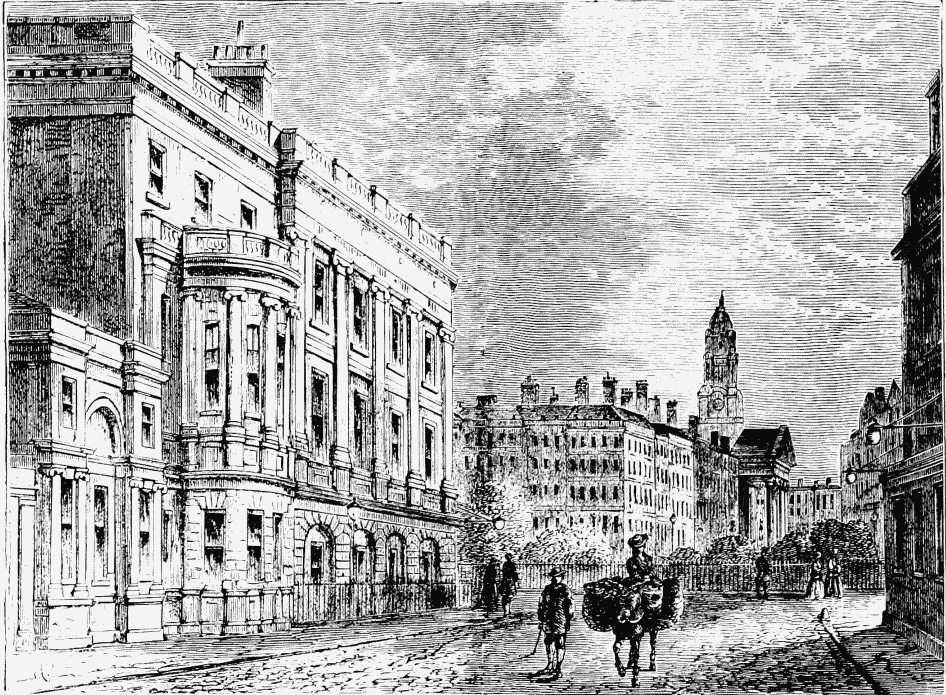
HAREWOOD HOUSE.
The entertainments provided in these rooms were not strictly confined to balls and concerts, for lectures, "readings," and public meetings innumerable have been held here; and in 1798 Miss Linwood here exhibited her "needlework pictures," prior to their final removal to Leicester Square. In 1838–9, Dr. Chalmers, the celebrated Scotch divine, here delivered a series of lectures on the Church of England.
In 1845, at the death of the Misses Gallini, Sir John's nieces (the founders of the Roman Catholic Church in Grove Road, St. John's Wood), their freehold interest in Hanover Square Rooms was bought by Mr. Robert Cocks, the eminent musical publisher, who subsequently let them on a lease of twenty-one years to the committee of the club above mentioned. It is not, however, only with the two ancient institutions named above that the history of these rooms was interwoven, but with that of Mr. Henry Leslie's choir, and with the concerts of the Royal Academy of Music in Tenterden Street close by, which renewed its performances here in 1862. The large room, in its original state, was dull and heavy, owing to the architectural style of the date at which it was built; at one end was the ponderous royal box, and almost the only tasteful decoration consisted of some paintings by the hand of Cipriani. In the winter of 1861–62, however, the rooms underwent a complete restoration and re-decoration, and they became the most comfortable concert-rooms in London, to say nothing of their great superiority to most large buildings in respect of acoustic properties. The large room had a slightly arched roof, richly gilt and ornamented with pictures; the walls on either side of the room were adorned with Corinthian columns with ornamental capitals, also gilt. The panels over the looking-glasses were filled with medallions, painted in bas relief, of the most celebrated composers—Handel, Beethoven, Bach, Rossini, Purcell, Weber, Haydn—accompanied by their names and dates; and the plinth round the room was decorated in imitation of marbles of various patterns and colours.
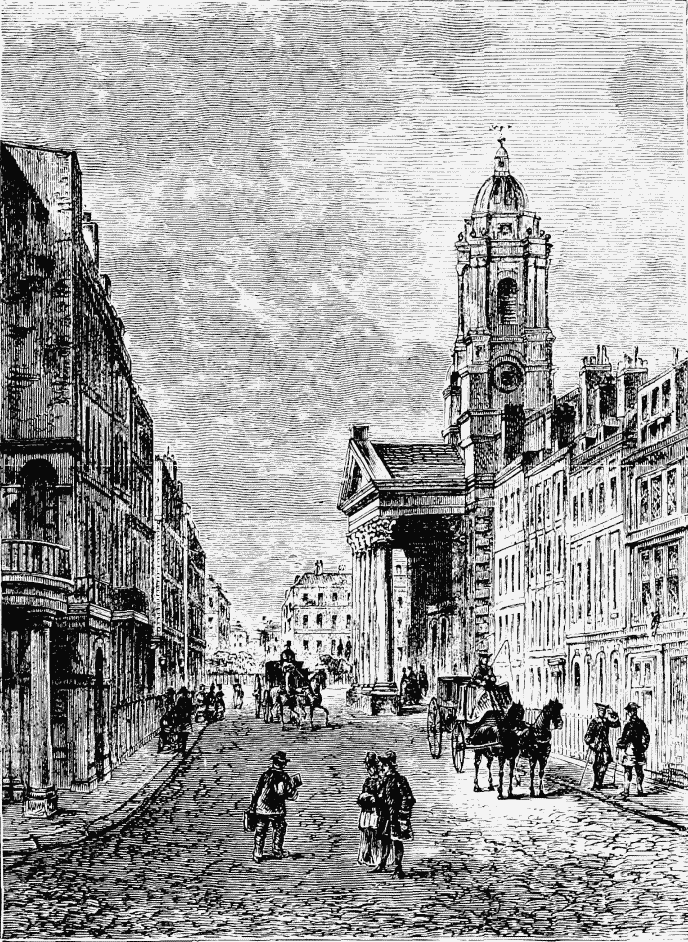
GEORGE STREET, HANOVER SQUARE, IN 1800.
On Saturday evening, December 19, 1874, took place the very last entertainment ever given in these time-honoured rooms. Mr. Cocks having placed them at the disposal of the Royal Academy of Music, a full orchestral and choral concert was given under the direction of Mr. Walter Macfarren. The work of altering the building to suit the requirements of a club was commenced immediately afterwards. The large room has been preserved unaltered, as far as possible; but in other respects the building has undergone a thorough transformation, and has been raised a couple of storeys in height; the additional floors being devoted to chambers for such members as may wish to make the club their home, either permanently or temporarily. On the ground-floor is the newspaper-room, which occupies the position of the old supper-room, to the left of the entrance in Hanover Street; the secretary's office, and also a writing-room. The principal lavatories, &c., are in the basement. The grand staircase, entirely of stone, is ornamented with statues holding jets of gas, and at the top is a large skylight, with an inner light of coloured glass. The first floor contains a smoking-room, card-room, wine-bar, and also the dining-hall. The last-named apartment has been formed out of the old concert-room, which has been somewhat contailed in length; the east end, where the royal box formerly stood, is new; the pictures in the ceiling, mentioned above, where practicable, have been restored, and new ones inserted where necessary. On the second floor is a billiard-room, and also the drawing-room, which overlooks Hanover Square. The Hanover Club, as now established—whose object is much the same as that of the Travellers', embracing the introduction of foreigners—is not the first of that name which has existed; and it is probable that some house in the neighbourhood, in the time of the first two Georges, formed the head-quarters of a political association of persons zealous for the Hanoverian succession, which bore the same name; but the exact house which it occupied is not known.
In 1736 the General Evening Post of September 23rd contains the following paragraph, which shows pretty clearly the condition of the immediate neighbourhood of Hanover Square at that time, so far as the building of streets is concerned:— "Two rows of fine houses are building from the end of Great Marlborough Street through the waste ground and his Grace the Duke of Argyll's gardens into Oxford Road, from the middle of which new building a fine street is to be made through his Grace's house, King Street, and Swallow Street [now covered by Regent Street], to the end of Hanover Square, Brook Street, and the north part of Grosvenor Square, the middle of his Grace's house being pulled down for that purpose; and the two wings lately added to his house are to be the corners of the street which is now building." The street here spoken of is now called Princes Street, which opens into the north-east corner of the square. This and Hanover Street, which connects the square with Regent Street at its south-east corner, were built about the same time, and bear testimony to the strong hold which the succession of the House of Brunswick had already taken on the feelings of the nation. Both streets are deficient in literary or personal associations; but it may be noted, that in the former Miss Emily Faithfull first started her "Victoria Press," through which she inaugurated her efforts to obtain remunerative employment for women.
In Tenterden Street, which connects the square at its north-west angle by a circuitous route with Oxford Street and the northern end of New Bond Street, is the Royal Academy of Music. It has been devoted to its present use almost since the formation of the Academy. The Academy itself was established in the year 1822, and a few years afterwards a charter was obtained from George IV. Here the Academy used to give its concerts until 1862, when the latter were transferred, as already stated, to the Hanover Square Rooms. The object of the Academy is the instruction of youth of either sex in every branch of musical education; and they are taught in classes by the first professors at a trifling charge. Since its foundation, it has supplied a large number of instrumental performers of no mean eminence to the various orchestras of London; and many of its pupils have become leaders and conductors of concerts, and also eminent musicians, whilst several have distinguished themselves as composers. Among the students here was Mr. Charles Dickens's sister Fanny, to fetch whom the future "Boz" would call at its doors every Sunday morning, and bring her back at night after spending the day in their wretched home in Upper Gower Street. The house, No. 4, on the north side, opposite the Oriental Club, was at one time the town residence of the Herberts, Earls of Carnarvon, who here used to entertain King George III. and his family with syllabub and tea in the terraced garden behind, which commanded a view of the Uxbridge or Tyburn Road. On the gardens of Lord Carnarvon's House, at the back, stands the carriage-factory of Messrs. Laurie and Marner, of which we shall have more to say when dealing with Oxford Street.
Brook Street, which connects the south-west angle of the square with New Bond Street and Grosvenor Square, will be more properly treated in a future chapter. Only a few of its houses stand to the east of Bond Street, and to these no literary interest attaches, unless it is worth while to mention the fact that one of them was the last abode of Messrs. Saunders and Otley, librarians and publishers to the Queen, before the break-up of that firm, about the year 1865.
George Street, which dates its erection from the building of the square itself, and which, as we have observed above, is similar to it in the character of its architecture, passes from the centre of the south side of the square into Conduit Street. Of this street the author of "A New Critical Review of the Public Buildings of London" remarks that there is an inconsistency and a departure from the true rule of taste in making it wider at the upper than at the lower end, as quite reversing the perspective; and yet he says that the view down George Street from the top of the square, with St. George's Church in the front, is fine, and indeed "the most entertaining in the whole city," though it ought properly to end in something more attractive to the eye than Trinity Chapel, in Conduit Street, of which we shall speak presently.
In a somewhat similar strain, but more rhapsodical style, Ralph remarks: "The sides of the square, the area in the middle, the breaks of building that form the entrance to the vista [of George Street], but above all the beautiful projection of the portico of St. George's Church, are all circumstances that unite in beauty and make the scene perfect." For ourselves, we prefer decidedly the view looking up the street towards the square, which throws the portico into bold relief against the sky. An ascending view of a church, too, is almost always preferable to what may be called a descending view.
The parish of St. George's was "carved" out of that of St. Martin's-in-the-Fields, and Mr. John Timbs says that the site of the church was given by a General Stewart. The fabric has been much admired by those who think that style of architecture appropriate for religious edifices. It was built in 1722–4; the designer and architect was named James. This was, to use Pennant's quaint expression, "one of the fifty [new churches] voted by Parliament, to give this part of the town the air of the capital of a Christian country." The writer of "A New Critical Review of the Public Buildings of the Metropolis," in 1736, mentions it as "one of the most elegant in London; the portico is stately and august, the steeple handsome and well-proportioned, and the north and east prospects very well worth a sincere approbation;" he complains, however, that its position is such as not to allow its beauties to be seen, for, "though situated in the very centre of the vista that leads to Grosvenor Square," it is so blocked up by houses as "only to be seen in profile." No doubt the beautiful proportions of its lofty Corinthian portico would form a fine object if there had been a broad street leading from Grosvenor Square to its western front; nevertheless, as it is, it is seen to great advantage from the junction of George Street and Conduit Street. The interior has been decorated in an ecclesiastical style, so far as possible, of late years. Over the altar is a fine painting of the Last Supper, ascribed to Sir James Thornhill; it is surmounted by a painted window, said to be of the sixteenth century; but the two ornaments do not harmonise. The window itself is said to have formerly belonged to a convent at Malines. The subject is "The Genealogy of Our Lord, according to His human nature, as derived from Jesse through the twelve kings of Judah, previous to the Babylonian captivity. In the centre of the lower part is the figure of Jesse seated; the roots of a vine are on his head; on his right are Aaron and Esaias; on his left, Moses and Elias."
Till within the last few years—or between the close of the last century and the year 1850, when Grosvenor Square was the centre of rank and fashion—St. George's enjoyed a monopoly of "fashionable" weddings, which has passed into a proverb. Here Sir William Hamilton was married on the 6th of September, 1791, to Emma Harte, afterwards so well known as "Emma Lady Hamilton," the friend of Nelson. Horace Walpole, in announcing the marriage to the Miss Berrys, tells them that "Sir William has just married his gallery of statues," alluding to the fact that his wife used to sit as a model to artists. Here, too, was married in the year 1839, the Marquis of Douro (now Duke of Wellington). The attesting witnesses, whose signatures may be seen in the marriage register, are his noble father, the great duke, and his three brothers—all peers of the realm—the Marquis Wellesley, Lord Maryborough, and Lord Cowley.
Mr. F. Locker, in one of his charming volumes
of "Vers de Société," "takes off" to perfection a
fashionable wedding at St. George's, and epigrammatically expresses all the good wishes which
usually attend the brides who are "led to the
altar" there:—
"She pass'd up the aisle on the arm of her sire,
A delicate lady in bridal attire,
Fair emblem of virgin simplicity.
Half London was there, and, my word! there were few
Who stood by the altar or hid in a pew,
But envied Lord Nigel's felicity.
"O beautiful bride! still so meek in thy splendour,
So frank in thy love and its trusting surrender,
Going hence you will leave us the town dim!
May happiness wing to thy bosom unbought,
And Nigel, esteeming his bliss as he ought,
Prove worthy thy worship, confound him!"
But "fashionable" as the marriages mostly were that were performed in this church, they had their rude accompaniments: for instance, there were fees to be paid to "his Majesty's Royal Peal of Marrowbones and Cleavers: instituted 1719." "The book of their receipts," says a writer in 1829, "it seems, they carefully preserve. By the proceedings against the St. George's 'Marrow-bone and Cleaver Club' at Marlborough Street Office, by the Dowager Lady Harland, in their attempting to extort from her newly-married daughter, to whom they presented their silver plate, ornamented with blue ribbon and a chaplet of flowers, it appears the constable presented before the magistrate the book belonging to them, containing the names of a great many persons of the first consequence, who had been married at St. George's, Hanover Square; all of whom had put down their names for a sovereign. In the course of a year, the sum gathered by these greasy fellows, as marriage-offerings, was £416!"
The rectors of St. George's, in spite of the fashionable situation of the church, have not been on the whole distinguished, nor have many of them attained high dignities in the Church. To obtain this rectory the notorious Dr. Dodd offered to Lady Apsley, wife of the then Lord Chancellor, a douceur of three thousand pounds.
There are two burying-grounds belonging to this parish—one in the rear of Mount Street, Grosvenor Square, and the other on the north side of the Bayswater Road, Uxbridge Road. In the latter burial-ground for nearly fifty years reposed the remains of the gallant general, Sir Thomas Picton, who fell at Waterloo; but in 1859 they were removed and deposited, with all due military honours, in St. Paul's Cathedral. There, too, lies poor Lawrence Sterne: we shall speak of him again when we reach Bayswater.
No. 25, about half way down on the eastern side, was the residence, for nearly a century, first of John Copley, the Royal Academician, and afterwards of his son, John Singleton Copley, Lord Lyndhurst, both of whom died here; the former in 1815, and the latter in 1863. The future Chancellor was born in America in 1772, and at an early age was brought over to England by his parents, who were staunch royalists. The father was presented at Court, obtained the favour of George III. and Queen Charlotte, and enjoyed a prosperous career. The son obtained the highest honours at Cambridge, was called to the bar in due course, entered Parliament in middle life, and soon rose to be Solicitor and Attorney-General, and Master of the Rolls, and in 1827 succeeded Eldon as Lord Chancellor. He enjoyed the confidence of the Duke of Wellington and Sir Robert Peel, and at one time was sent for by the King to form an administration. The Whig party for many years feared nothing so much as the withering sarcasm of his annual reviews of the Parliamentary session, delivered by him in his place in the House of Lords. He again held the Great Seal under Sir Robert Peel in 1834–5 and in 1841–6. The walls of his house in George Street were hung with his father's historical paintings, including the "Death of Wolfe," the "Death of Lord Chatham," &c. It is remarkable that the united ages of the painter, the ex-Chancellor, and a sister amounted to nearly 270 years. After Lord Lyndhurst's death his house and the adjoining one were pulled down, and on their site was built the magnificent mansion of Mr. Gore-Langton.
The house, No. 15, formerly the town residence of the late Sir George Wombwell, one of the leaders of fashion in his day, and a friend of Count D'Orsay and the Fitzclarences, is now the Junior Travellers' Club.
Maddox Street, which runs from Regent Street to the east end of St. George's Church, dates from about 1720, and is probably named after the enterprising person who built it. In this street is the Museum of Building Appliances, which is in direct communication with, and indeed forms a part of, the Architectural Societies' House in Conduit Street. This museum, which was established in 1866, and enlarged in 1873, is "devoted to the reception of drawings, prospectuses, models, and specimen manufactures of every kind pertaining to the building trades." It was founded chiefly as a means of affording to patentees and inventors an "opportunity for the introduction of their improvements to those most interested in their adoption." The museum is open free daily throughout the year.
In this street is an inn now called the "Golden Star," but formerly the "Coach and Horses." It is remarkable that the "Golden Star" does not figure in Mr. Larwood's "History of Sign-boards." Less than half a century ago there were more than fifty inns in London rejoicing in the sign of the "Coach and Horses;" but their number is much reduced now, having been superseded by railways and steam.
Close by Maddox Street, and also at the back of St. George's Church, is Mill Street, which perpetuates the fact of the mill standing hard by the site of Hanover Square, as mentioned above.
Conduit Street, which extends from Regent Street to Bond Street, across the south end of George Street, still preserves the memory of the conduit which stood in the centre of Conduit Mead—a large field—as lately as the year 1700, on which New Bond Street and its neighbouring streets have since been erected, but whereon Carew Mildmay told Pennant, in 1780, that he remembered shooting woodcocks when a boy. The same thing is said also of his contemporary, General Oglethorpe, who died in 1785, having lived to be upwards of ninety, and who, as Macaulay tells us, had "shot birds in this neighbourhood in Queen Anne's reign."
The Conduit Field in old days was a great "meet" for the Nimrods of the City. "On the 18th of September, 1562," writes Stow, "the Lord Mayor Harper, the aldermen, and divers other worshipful persons, rid to the Conduit-head before dinner. They hunted the hare, and killed her, and thence to dine at the Conduit-head. The Chamberlain gave them good cheer; and after dinner they hunted the fox. There was a great cry for a mile, then the hounds killed him at St. Giles's; great hallooing at his death and blowing of horns; and thence the Lord Mayor and all his company rode through London to his place in Lombard Street." It is amusing, after an interval of more than three hundred years, to read of a Lord Mayor going out from Cheapside and finding the hare and the fox in Marylebone, or possibly even nearer to the City, and thence making his return journey to his home in Lombard Street to the yelping of dogs and the lusty cheer of the huntsman's horn.
At the corner of Conduit Street and George Street is Limmer's Hotel, once an evening resort for the sporting world; in fact, it was a midnight "Tattersall's," where nothing was heard but the language of the turf, and where men with not very clean hands used to make up their books. "Limmer's," says a popular writer, "was the most dirty hotel in London; but in the gloomy, comfortless coffee-room might be seen many members of the rich squirearchy, who visited London during the sporting season. This hotel was frequently so crowded that a bed could not be had for any amount of money; but you could always get a good plain English dinner, an excellent bottle of port, and some famous gin-punch."
At the corner of this and Mill Street is the sign of the "Coach and Horses," serving as a sort of tap to "Limmer's," still bearing testimony to the sporting associations of the neighbourhood. Whilst the gentlemen Jehus put up at "Limmer's," their coachmen and grooms met here, and discussed all sorts of questions connected with horseflesh at a sociable "free and easy."
In this street was the "Prince of Wales" coffeehouse, in which the mad Lord Camelford picked up, most gratuitously, his last quarrel with his friend Mr. Best, about a lady named Simmons—a quarrel which led to the duel fought by them in the grounds of Holland House, and his lordship's tragic death.
At No. 9, on the north side, between George Street and Regent Street, is a house formerly the town residence of the Earl of Macclesfield, but now entirely devoted to the architectural and building interests, for it contains within its walls the offices and rooms of the Architectural Association, the Architectural Publication Society, the Architectural Union Company, the District Surveyors' Association, the Photographic Society, the Provident Institution of Builders' Foremen and Clerks of Works, the Royal Institute of British Architects, the Society of Biblical Archæology, the Society for the Encouragement of the Fine Arts, and also an entrance to the Museum of Building Appliances, mentioned above. The rooms and gallery of the Architectural Association are used constantly during the "season" for exhibitions of architectural designs and paintings. The Royal Institute of British Architects was established in 1835 for the purpose of "facilitating the acquirement of architectural knowledge, for the promotion of the different sciences connected with it, and for establishing a uniformity and respectability of practice in the profession." The society has here founded a library of works, manuscripts, and drawings, illustrative, practically and theoretically, of the art; the publication of curious and interesting communications; the collection of a museum of antiquities, models, casts, &c.; with provision for performing experiments on the nature and properties of building materials. Its president is Sir George Gilbert Scott, R.A.
On the south side of the street, nearly facing George Street, is Trinity Chapel, a curious and interesting relic of London in the days of the Stuarts. Although they did not form part of the original edifice, yet the walls of the chapel which now present themselves to our view stand on the site of a movable tabernacle, or chapel on wheels, which was built by order of James II., to accompany him in his royal progresses and on his visits to the camp at Hounslow, in order that mass might be celebrated in his presence by his chaplain. The camp was at Hounslow when in the autumn of 1688 the king withdrew and abdicated; and as soon as his abdication was known to be a fact, the chapel was brought up by road to London, and placed upon the site now occupied by its successor. Dr. Tenison—afterwards Archbishop of Canterbury, but at that time rector of St. Martin's-in-the-Fields—begged the new king and queen, William and Mary, to make over to him the structure, in order to turn it into a temporary church, or rather chapel of ease, for the use of the outlying portion of the inhabitants of his then wide and scattered parish. It was actually opened for service according to the rites of the Established Church in July, 1691, and among those who were present to hear the first Protestant sermon preached within its walls was John Evelyn, who thus writes in his diary:—"This church, being formerly built of timber on Hounslow Heath by King James for the mass priests, being begged by Dr. Tenison, was set up by that public-minded, charitable, and pious man." Pennant tells us that, "after having made as many journeys as the holy house of Loretto," it was altered into "a good building of brick, and has ever since rested on the same site." The houses on either side of the chapel were erected at the same time, forming part of the same insipid design, but such was the prevailing taste that they were then "considered by the public in general as highly ornamental to the street." It appears not to have been Dr. Tenison's fault that Trinity Chapel remained a mere "chapel of ease," without a district assigned to it; for the commissioners for church building in those days refused to allow a proposal which he made to that effect, on the ground that the site was not freehold. The latter, it appears, had been bestowed on the vicar and churchwardens of St. Martin's for the benefit of the poor of the parish, by whom it was turned into money, being purchased at the close of the last or very early in the present century for a "proprietary" chapel. The speculation would seem to have been successful, for a writer in the Gentleman's Magazine mentions it as one of the most fashionable places of worship at the West-end, "no pulpit being more frequently honoured by voluntary discourses from the most eminent dignitaries." Towards the commencement of the present century, the Rev. Dr. Beamish made it by his fervid and eloquent discourses, if not so fashionable, at all events so crowded, that it was impossible to accommodate the congregations which he drew together, without the erection of galleries. The chapel was plain and ugly enough before, but by this addition it was made fairly the most ugly of the then existing proprietary chapels. In the early part of the year 1875, it was decreed by the ground landlord that the site was required for secular building, and that the services in this chapel should be discontinued, and the fabric itself demolished.
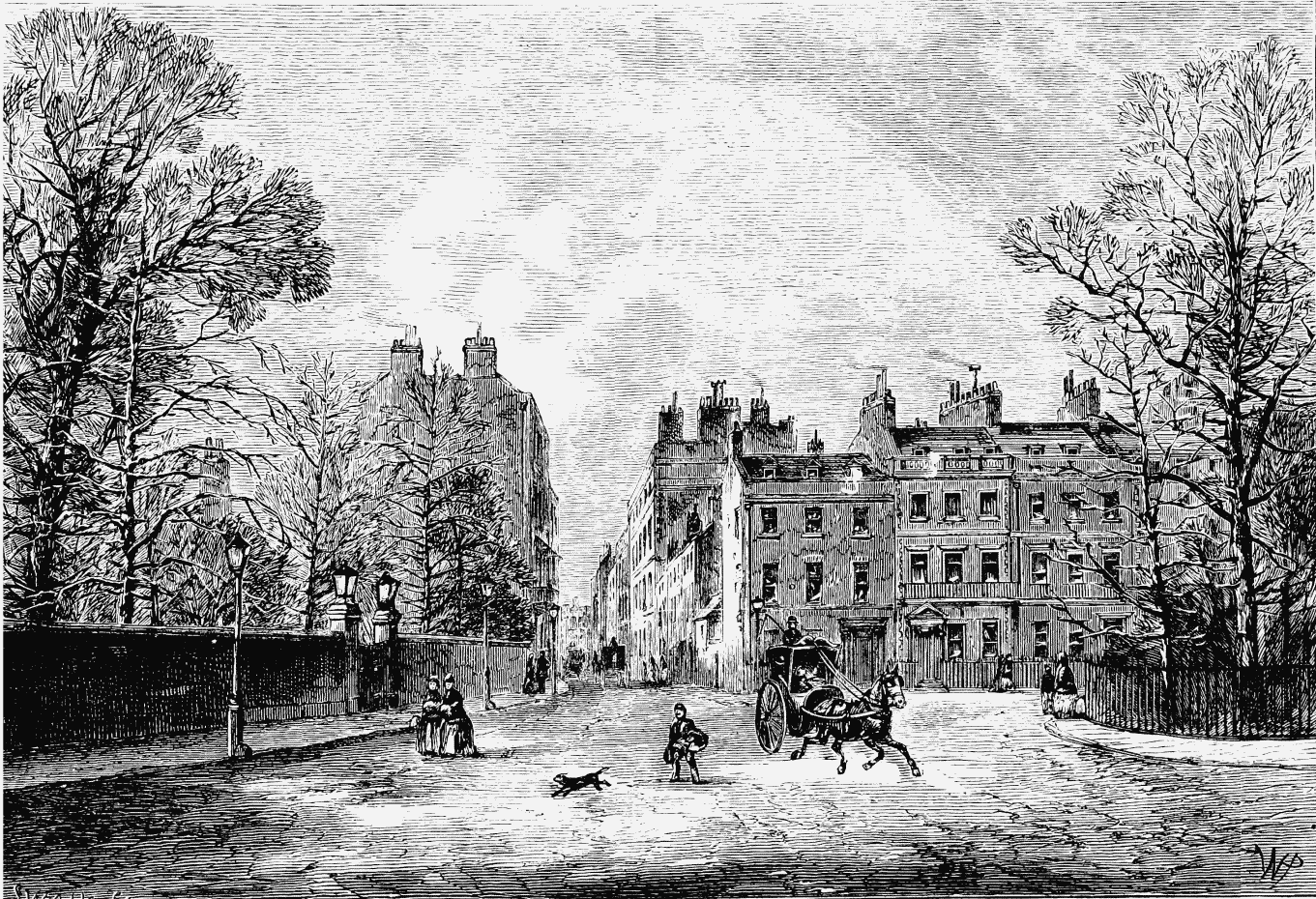
BERKELEY SQUARE.
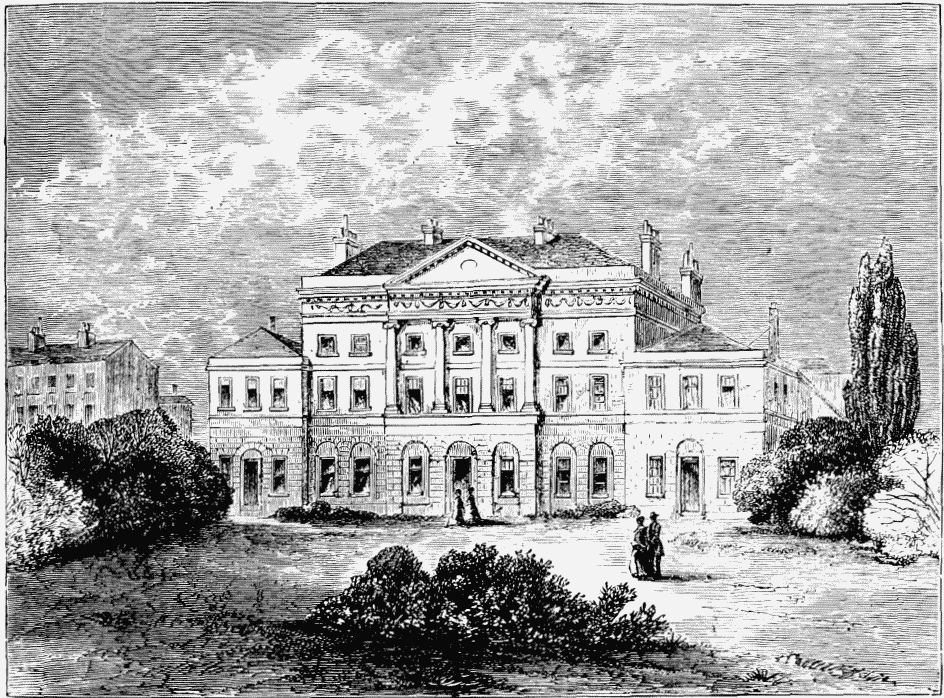
LANSDOWNE HOUSE, IN 1800.
George Canning lived for several years at No. 37, next door to the chapel, afterwards the residence of the excellent and benevolent Dr. Elliotson, to whom we are mainly indebted for the science of mesmerism, a study to which he devoted many years of his life, "and whose name," as Mr. John Forster observes, "was for nearly thirty years a synonym with all for unwearied, self-sacrificing, and beneficent service to every one in need." On the same side of the street was formerly, for very many years, before they removed into Brook Street, the shop of Messrs. Saunders and Otley, booksellers to the Queen, and for some time the publishers of "Lodge's Peerage." In this street died quite suddenly, in 1832, Mr. E. Delmé Radcliffe, Gentleman of the Horse to George IV., whose racing studs he superintended. In his youth he was the best gentleman jockey in England, and lived much in the sporting circles of Carlton House. Mr. Raikes says, in his "Diary," that "from the time that he left Eton he never changed the style of his dress, wearing a single-breasted coat, long breeches, and short white-topped boots." Michael William Balfe, the composer, also resided in this street.
The eminent surgeon, Sir Astley Cooper, whom we have already mentioned in our account of Spring Gardens, lived in this street towards the end of his most successful professional career, after the futile attempt he made to retire from practice, making the large income of £15,000 a year; and here he died "in harness" in 1841.