Old and New London: Volume 4. Originally published by Cassell, Petter & Galpin, London, 1878.
This free content was digitised by double rekeying. Public Domain.
Edward Walford, 'Berkeley Square and its neighbourhood', in Old and New London: Volume 4(London, 1878), British History Online https://www.british-history.ac.uk/old-new-london/vol4/pp326-338 [accessed 30 April 2025].
Edward Walford, 'Berkeley Square and its neighbourhood', in Old and New London: Volume 4(London, 1878), British History Online, accessed April 30, 2025, https://www.british-history.ac.uk/old-new-london/vol4/pp326-338.
Edward Walford. "Berkeley Square and its neighbourhood". Old and New London: Volume 4. (London, 1878), British History Online. Web. 30 April 2025. https://www.british-history.ac.uk/old-new-london/vol4/pp326-338.
In this section
CHAPTER XXVI.
BERKELEY SQUARE, AND ITS NEIGHBOURHOOD.
"Fountains and trees our wearied pride do please,
E'en in the midst of gilded palaces;
And in our town the prospect gives delight,
Which opens round the country to our sight."—Sprat.
Bruton Street—The "Great" Duke of Argyll—Anecdote of Sheridan—Museum of the Zoological Society—Berkeley Square—Lansdowne House and its Occupants—Horace Walpole—Lord Clive—Lady Jersey—Beau Brummell and his "Harbinger of Good Luck"—The Eccentric Sir John Barnard—Highwaymen and Footpads—Hay Hill—Bolton Row—"The Three Chairmen"—"The Running Footman"—Charles Street and its Noted Residents—Hill Street—The Blue-Stocking Club—Davies Street—Lord Byron and Joe Manton—Farm Street and the Roman Catholic Chapel—Mount Street—Martin Van Butchell, the Quack Doctor—The Coburg Hotel.
Undoubtedly there is a natural pleasure in a rus in urbe, which has no counterpart in any urbs in rure. It is this feeling to which must be ascribed the fact that in the most crowded parts of this great metropolis we leave open spaces, and plant them with trees, and rejoice to live in "squares" if our means will allow us. Still it was long before Nature asserted her sway. The majority of our squares, except those of Tyburnia and Belgravia, are the growth of the last century; and few of them existed before the accession of George III., their sites up to that time being mostly sheepwalks, paddocks, and kitchen-gardens.
Mr. Timbs tells us, what few of us remember or know, that it was at first attempted to call the squares by the strange and uncouth name of quadrantes; and Maitland, in his "History of London," retains the term, with only a slight alteration, when he mentions "the stately quadrant denominated King Square, vulgarly Soho Square." This name is probably known to few except very learned antiquaries, so wholly has it passed out of use.
We wish that we could endorse the words of Mr. John Timbs when he calls the garden spaces or planted squares the most "recreative" feature of our metropolis. At all events, to the multitude the recreation is that of the eyes alone; for, except Leicester Square, not one of them is accessible to the weary working man, the public being allowed only to stare at them through the iron railings selfishly set round them.
But to proceed. Again bending our steps towards
the west, we pass in a parallel line with Piccadilly,
but in a somewhat "higher latitude." Leaving
Conduit Street, which was our point of divergence
at the conclusion of our last chapter, we step across
Bond Street into Bruton Street, which leads direct
into Berkeley Square. Bruton Street derived its
name from Lord Berkeley of Stratton, whom we
have already mentioned in connection with Piccadilly, and whose ancestors were known as the
Berkeleys of Bruton. This street has had some
distinguished residents in its time; among others,
John, the second and "great" Duke of Argyll,
who in the reign of William III. was Ambassador
in Spain, and, after the Peace of Utrecht, Commander of the Forces in Scotland. He took part
in the suppression of the rebellion of 1715. This
duke is the same who is immortalised by Pope in
the following lines:—
Argyll, the state's whole thunder born to wield,
And shake alike the senate and the field."
It may be remembered also that Sir Charles
Hanbury Williams in his poems identifies the duke
with this street:—
"Yes! on the great Argyll I often wait
At charming Sudbrooke or in Bruton Street.
Sheridan also was living in this street in 1786. At this period his house was so beset with duns that, in spite of his seat in Parliament, even the provisions for his family had to be let down the area between the railings, as he was afraid to open the front door. Sir N. W. Wraxall tells a capital story apropos of this house and its occupant in that year:—"Sheridan," he writes, "entertained at dinner here a number of the (Whig) opposition leaders, though he laboured all the time under heavy pecuniary embarrassments. All his plate, as well as his books, were lodged in pawn. Having, nevertheless, procured from the pawnbroker an assurance of the liberation of his plate for the day, he applied to Beckett, the celebrated bookseller in Pall Mall, to fill his empty book-cases. Beckett not only agreed to the proposition, but promised to ornament the vacant shelves with some of the most expensive and splendid productions of the British press, provided that two men, expressly sent for the purpose by himself, should be present to superintend their immediate restoration. It was settled finally that these librarians of Beckett's appointment should put on liveries for the occasion, and wait at table. The company having arrived, were shewn into an apartment where, the bookcases being opened for the purpose, they had leisure, before dinner was served, to admire the elegance of Sheridan's literary taste, and the magnificence of his collection. But, as all machinery is liable to accidents, so in this instance a failure had nearly taken place, which must have proved fatal to the entertainment. When everything was ready for serving dinner, it happened that, either from the pawnbroker's distrust, or from some unforeseen delay on his part, the spoons and forks had not arrived. Repeated messages were dispatched to hasten them, and they at last made their appearance; but so critically, and so late, that there not being time left to clean them, they were thrown into hot water, wiped, and instantly laid on the table. The evening then passed in the most joyous and festive manner. Beckett himself related these circumstances to Sir John Macpherson."
In this street, for a time, resided Lord Brougham, when Lord Chancellor. No. 16 was the town house of the late and present Lord Granville, and at one time that of Lord Chancellor Cottenham. It passed afterwards into the hands of another well-known statesman, Lord Carnarvon. In 1841 No. 26 was the residence of Sir Matthew Tierney, the favourite physician of George IV.
In Bruton Street was formerly the Museum of the Zoological Society, before or about the time of the establishment of its gardens in Regent's Park. The studio of Mr. Mark Noble, the sculptor, is in this street.
Berkeley Square, which we now enter on its eastern side, was built in 1698, and named after John, Lord Berkeley, of Stratton, whose mansion and grounds we have already described as situated on the north side of Piccadilly. From the rear of Devonshire House they extended back to Hay Hill, in the south-east corner of the square. In the centre of the square, which contains about five acres of ground, are some fine, tall, and shady plane-trees, which impart an air of cheerfulness and picturesqueness to the spot. Within the enclosure there was formerly an equestrian statue of George III., erected by the Princess Amelia. The statue, which was executed by Wilton, stood on a clumsy pedestal, and represented the king in the character of Marcus Aurelius. At one time this square was the most fashionable locality in London. The houses are rather heavy and monotonous in appearance; and a few link-extinguishers may still be seen flanking the doorways, reminding us of the days of sedanchairs and cumbrous family coaches.
The magnificent mansion standing within its garden and gates, which occupies the southern side of the square, and has been for four generations the town-house of the Marquises of Lansdowne, was originally built by Robert Adam, the architect of the Adelphi, for John, Earl of Bute, the favourite Premier of George III. in his early days. It was scarcely finished when, in 1762, after an administration of about two years, during which he had brought the war with France and Spain to a close by the Treaty of Fontainebleau, Lord Bute suddenly threw up the reins of government, and retired into private life. The act was most unpopular. This magnificent residence, just completed and newly occupied, exposed his lordship to the most malignant comments; and his enemies asserted that he could not possibly have erected such a mansion by honest and fair means. They concluded, therefore, that he had either received large presents from the Court of France for signing the treaty, or had made large purchases in the public funds, previous to signing its preliminaries. The accusation was made publicly by others as well as by "Junius," who in the plainest terms accused the earl of selling his country. It is not a little singular that, when some twenty years later the house passed by purchase into the hands of Lord Shelburne, afterwards Marquis of Lansdowne, the same accusation was revived, the public again raising an outcry to the effect that it could not have been bought except by moneys paid to his lordship for concluding the peace of 1783. Lord Shelburne, however, took no notice of the cry, for, according to Jeremy Bentham, he "was the only minister who did not fear the people."
Lord Bute was known to be, or at all events to have been, a poor man until called to the post of Premier; and his enemies were not slow to draw attention to the fact, that he could never have afforded to build such a house either from his patrimony or from his marriage with the daughter of Lady Mary Wortley Montagu. The "scandal" is recorded in the gossiping pages of Sir N. W. Wraxall, who adds, "As little could he be supposed to have amassed during his very short administration enough to suffice for such a building. The only solution of the difficulty, therefore, lay in imagining, however unjustly, that he had either received presents from France, or had made large purchases in the public funds previous to the signature of the preliminaries of peace" with that country. Whatever may have been the real solution of the mystery, there can be no doubt that the mansion brought nearly as much of public odium on Lord Bute as the building of Clarendon House, as we have already seen, had entailed a century before upon Lord Chancellor Hyde.
The story of Lord Bute's first introduction to royal circles is told at considerable length by Sir N. W. Wraxall. The substance of it is that in 1747, whilst living, from motives of economy, at a villa on the banks of the Thames, he was at Egham races, and that a shower coming on, and the Prince of Wales, accidentally finding him without a conveyance, offered to give him a seat in his own carriage, and took him to Cliefden, near Maidenhead, where he stayed the night. He rendered himself extremely acceptable to their royal highnesses, and thus laid the foundation, under the succeeding reign, of his elevation to the premiership—a promotion which may be said to have been a consequence of this turn in the chapter of accidents. When young he had a very handsome person; and long after he became a constant visitor and almost an inmate of Leicester House and of Cliefden, he would frequently play the part of "Lothario" in the private theatricals exhibited by the Duchess of Queensberry for the amusement of those royal personages—a fact to which Wilkes alludes more than once with a sly inuendo in one of his publications. If this be really the true history of the rise of Lord Bute to place and power, it is but a modern instance of the Latin satirist's remark, "Voluit Fortuna jocari."
In 1762 Dr. Johnson waited here on Lord Bute to thank him for the literary pension which, at his recommendation, the King had settled on him. Lord Bute on this occasion said to him expressly that this mark of royal favour was "given him not for anything he was to do, but for what he had already done." As Boswell remarks, Lord Bute on this occasion behaved in a very handsome manner. "A minister of a more narrow and selfish disposition would have availed himself of such an opportunity to fix an implied obligation on a man of Johnson's powerful talents to give him his support."
Lord Bute does not appear to have long resided here, for very soon after the mansion was completed it was sold to the Earl of Shelburne, afterwards first Marquis of Lansdowne. John Timbs tells us that "the price was £22,000, being some £3,000 less than it cost." He also mentions the canard which was current in the last century with respect to the house, namely, that "it was built by one Peace, that made by Lord Bute, in 1762, and paid for by another."
In the spring of 1780, on the failure of his publisher, Mr. H. Payne, of Pall Mall, George Crabbe, poor and unknown, came to this house, in order to ask for temporary aid; but he was refused by Lord Shelburne once and again. Crabbe's son tells us in his "Life" that "often in latter times he would express the feelings with which he contrasted his reception at this nobleman's door in 1780, with the courteous welcome which he received at a subsequent period in that same mansion, now Lansdowne House." "Dined at Lansdowne House," writes the poet, in his "Diary," in 1817. "My visit to Lord Lansdowne's father in this house, now thirty-seven years since!" The only wonder that one feels in reading such an episode, even in a poet' slife, is that he could condescend, when his name was known as the author of "The Village," to enter the doors of that Mæcenas from which he was so rudely repulsed when he needed temporary assistance.
With respect to the history of this house and its noble owners, we may be pardoned for drawing largely here upon one of the literary articles of the Times:—"In 1805 died the first Marquis of Lansdowne, having by that time passed very much out of popular notice; and the principal cause of public regret for his demise was, that only a fortnight before his death he had declared his knowledge of the Junius secret, and yet among his papers was to be found no indication that could lead to its discovery. He was succeeded by his eldest son, the Earl of Wycombe, whose first act on coming into possession was to sell almost all the literary and artistic treasures which his father had accumulated with so much love and labour. The greater part of these were dispersed under the hammer of the auctioneer, many of the pictures going to enrich the National, the Grosvenor, and other galleries; only the Lansdowne MSS. were kept together, being purchased by the British Museum; while the Gallery of Antique Marbles was the sole portion of the collection for which the marquis showed any appreciation—his opinion being expressed in the fact that he purchased it from his father's executors for £6,000. If, however, this nobleman did not show much respect to his father's cultivated taste, he was not without a certain ancestral pride, for he tried to build a vessel on the principle of Sir William Petty's double-bottomed ship, that was to sail against wind and tide, a model of which was then, and is perhaps still, exhibited in the council-room of the Royal Society. Of nautical habits, he also erected, near the Southampton water, a marine villa, in which, from dininghall and private bower to kitchen and scullery, all was pure Gothic, while the gardens belonging to the castle were laid out at Romsey, some ten or twelve miles distant, on a site which formed the original estate of the Petty family. Here, if not in yachting voyages to Ireland or the Continent, he spent most of his time. In London he was a marked man—remarkable for his disregard of dress, and for the pride he took in appearing on the coldest days in winter without a great-coat and without gloves. He died in November, 1809, and was succeeded by his half-brother, the third Marquis, whose first care was to purchase the antique marbles from his sister-in-law; and there, at Lansdowne House, they may now be seen—some of them, as the youthful 'Hercules' and the 'Mercury,' justly considered the finest statues of the kind that have found their way to this country. As for the pictures, when the marquis succeeded to the title, in 1809, there was not one in this splendid mansion, with the exception of a few family portraits; but Lord Lansdowne set himself to the formation of a gallery, which now comprises nearly two hundred pictures of rare interest and value, but miscellaneous in their character, no school or master predominating, unless it be Sir Joshua Reynolds. Some of the portraits in this collection are of great interest. There is the celebrated portrait of Pope, by Jervas; Reynolds's wonderful portrait of Sterne; one of Franklin, by Gainsborough; a beautiful one of Peg Woffington, by Hogarth; Lady Hamilton appears twice—as a bacchante and a gipsy, from the pencil of Romney; Horner, the old college friend of Lord Lansdowne, is not forgotten; and, most interesting of all, there is the lovely portrait of Mrs. Sheridan, as St. Cecilia, painted by Reynolds."
It may recall with some vividness the fashion of those times if we record a little incident connected with this portrait. During the short-lived Ministry of "All the Talents" the Whig leaders celebrated their return to power by a continual round of festivities, in which Sheridan outvied all his colleagues. One Sunday (25th of May, 1806) he gave a grand dinner; on the Monday following a supper and ball, at which the dancing was prolonged to past eight o'clock next morning; on the Tuesday a christening, a masque, and another ball, the Prince being present on each occasion, and the Lord Chancellor Erskine, and the young Chancellor of the Exchequer, Henry Petty, being conspicuous among the dancers. On the occasion of this dinner, the portrait of Mrs. Sheridan was redeemed for one night only from the pawnbroker's, and exhibited in its place in the dining-room. When poor Sheridan died, it was still in possession of the pawnbroker; it then fell into the hands of Sheridan's solicitor, and from him it was purchased for £600 by Lord Lansdowne. In this little incident we get some glimpses of that conviviality for which the Whigs were distinguished. "Le Whig est la femme de votre Gouvernement," says Balzac; and the truth of the remark is especially illustrated in that social influence which the Whigs have always cultivated.
The name of Petty was assumed by the Hon.
John Fitzmaurice, second son of Thomas, twentyfirst Lord Kerry, and of Anne, only daughter of Sir
William Petty, on inheriting the Petty estates on
the death of his maternal uncle, Henry Petty, Esq.,
of Shelburne. He was created a peer of Ireland
as Viscount Fitzmaurice, and soon after promoted
to the Earldom of Shelburne. His son and successor, William the second earl, and the purchaser
of Lansdowne House, was advanced to the Marquisate of Lansdowne in 1784. The above Sir
William Petty, of whose talents and public services
we have spoken in a previous chapter (page 256), is
styled by Aubrey "a person of a great stupendous
invention, and of as great prudence and humanity."
Sir William was one of the members of the "Rota"
or Coffee Club, to which John Milton and Pepys
also belonged. The character of the club may be
inferred from the lines in "Hudibras:"—
"—as full of tricks
As 'Rota-men' of politics."
Continuing our account of the mansion, we may simply state that it is large and of somewhat heavy proportions, and that the front is of white stone, ornamented with Ionic pillars and a pediment; but it is almost shut out from view by the rich foliage by which the mansion is surrounded; upon the gate-piers is a beehive, one of the crests of the house of Lansdowne. The pictures mentioned above are, for the most part, hung in a gallery of fine proportions (being 100 feet long by 30 wide); and besides these there is in the ante-room a copy of Canova's "Venus." The house also contains some fine specimens of antique busts and statues collected by Gavin Hamilton. The "classic" diningroom served for many years, with Holland House and Devonshire House, to bring together the principal leaders of thought and action belonging to the old Whig coterie. Here the Russells and Greys, and Sir James Mackintosh, would often meet around the hospitable table of Henry, the third marquis, so long the venerated "Nestor" of the Liberal party, who divided his time between this house and his seat of Bowood, in Wiltshire, till his death in 1863. Mr. Rush, the American Minister, was a frequent guest here in the days of the Regency, and he speaks of the hospitality of its "classic" dining-room in most glowing terms. We learn from Brougham's "Life" that cabinet councils were occasionally held here.

THE SIGN OF "THE RUNNING FOOTMAN."
Among the most constant and most welcome guests here was "Tommy" Moore—"Anacreon Moore," as he was often called, in allusion to his light and sparkling verses.
Horace Walpole lived for the last fifteen years of his life at No. 11 on the east side of this square, and here he died on the 2nd of March, 1797, a few years after succeeding to the Earldom of Oxford, a title he scarcely ever cared to assume, preferring to be called plain "Horace Walpole" to the end. He thus writes to the Countess of Ossory, under date October, 1779, which fixes the date of his removal hither from Arlington Street, where we have already been introduced to him:—"I came to town this morning to take possession of [my house in] Berkeley Square, and am as well pleased with my new habitation as I can be with anything at present. Lady Shelburne's being queen of the palace over against me" (he is referring, of course, to Lansdowne House)" has improved the view since I bought the house, and I trust will make your ladyship not so shy as you were in Arlington Street."
Walpole was attacked at Strawberry Hill by the cold, about the close of November, 1796, and at the end of that month he removed to his house in Berkeley Square, which he never left again. On this cold supervened an attack of gout. He still amused himself with writing and dictating brief notes, instead of letters, and with the conversation of his friends; and, exhausted by weakness, sunk gradually and died painlessly, on the 2nd of the following March. On the death of Horace Walpole, the house passed to his niece, Lady Waldegrave, who was living here at the beginning of the present century.
It has been said of Horace Walpole, with some justice, by Mr. Charles Knight: "The chief value of his letters consists in his lively descriptions of those public events whose nicer details, without such a chronicler, would be altogether hid under the varnish of what we call history."
The house No. 13, two doors further to the north, was at one time occupied by the late Marquis of Hertford, who kept here the nucleus of the fine gallery of paintings now at Hertford House, Manchester Square.
No. 45, on the west side of the square, was the house of the great Lord Clive, the founder of our Indian Empire—"that second Kouli Khan," as Horace Walpole styles him. Sated with success and honours, his restless spirit seems to have enfeebled his nervous system, and there is too much reason to fear that he fell by his own hand, in November, 1774. Lord Clive in Dr. Johnson's opinion, was a man who, though loaded with wealth and what the world called honours, had yet "acquired his fortune by such crimes that his consciousness of this impelled him to cut his own throat, because he was weary of still life, little things being not sufficient to move his great mind." The house now belongs to his nearest representative, the Earl of Powis, who, though a Herbert by birth, bears the name of Clive.
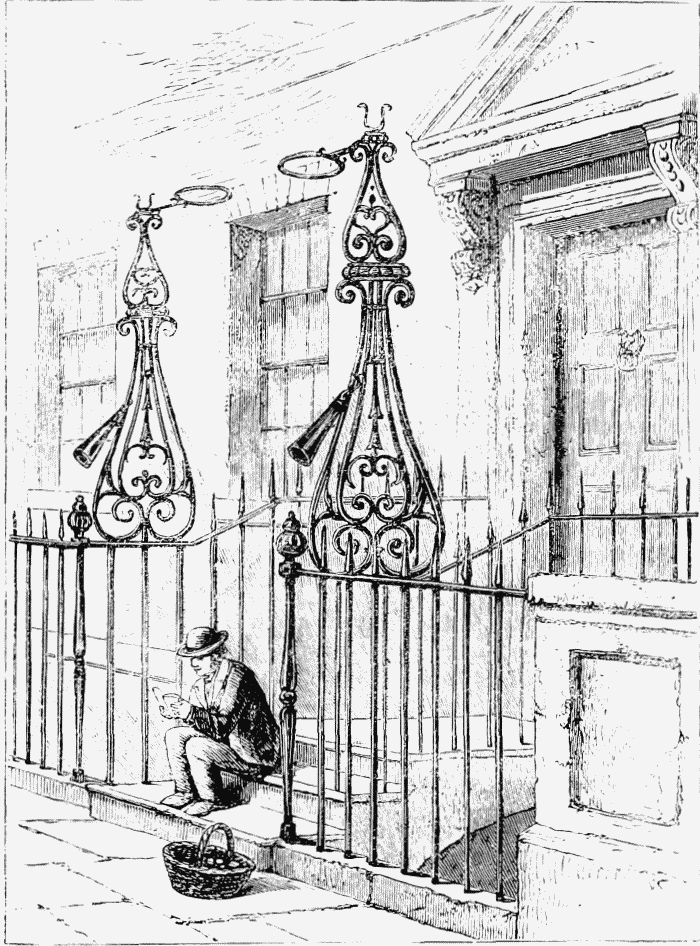
EXTINGUISHERS IN BERKELEY SQUARE.
An amusing story, showing how Lord Clive obtained his wife, is thus told by Sir Bernard Burke in his "Rise of Great Families:"—"Mr. Maskelyne (brother of Dr. Nevil Maskelyne, the Astronomer-Royal) went as a cadet to India, where he became acquainted with Mr. Clive (afterwards Lord Clive). The acquaintance ripened into intimate friendship, and led to constant association. There hung up in Mr. Maskelyne's room several portraits; among others a miniature, which attracted Clive's frequent attention. One day, after the English mail had arrived, Clive asked Maskelyne if he had received any English letters, adding, 'We have been very much misunderstood at home, and much censured in London circles.' Maskelyne replied that he had, and read to his friend a letter he then held in his hand. A day or two after, Clive came back to ask to have the letter read to him again. 'Who is the writer?' inquired Clive. 'My sister,' was the reply; 'my sister whose miniature hangs there.' 'Is it a faithful representation?' further asked Clive. 'It is,' rejoined Maskelyne, 'of her face and form; but it is unequal to represent the excellence of her mind and character.' 'Well, Maskelyne,' said Clive, taking him by the hand, 'you know me well, and can speak of me as I really am. Do you think that girl would be induced to come to India and marry me? In the present state of affairs, I dare not hope to be able to go to England.' Maskelyne wrote home, and so recommended Clive's suit, that the lady acquiesced, went to India, and, in 1753, was married at Madras to Clive, then rising to the highest distinction. Lord Clive returned to England in 1767, having done more to extend the English territory and consolidate the English power in India than any other commander. His name stands high on the roll of conquerors; but it is found in a better list—among those who have done and suffered much for mankind. He died at the age of forty-eight, in a fit of insanity, produced by the ingratitude and persecution of his country."
In another house in this square died, in 1762, Martha Blount, the friend and correspondent of Pope. At No. 48 resided Earl Grey for several years both before and after his premiership. In 1842 this square numbered among its residents Sydney Smirke, the architect, and Sir John Cam Hobhouse, afterwards Lord Broughton.
Another celebrated house in this square is No. 38, for half a century or more the residence of the Earl of Jersey. Here the celebrated Lady Jersey, the widow of the fifth earl—one of the female favourites of George IV., in the old days of Carlton House, and in after time one of the most omnipotent and imperious queens of "Almack's"—held her receptions. Half the fashionable world had the entrée to these, and the other half sought the privilege in vain, with watering lips. Lady Jersey was the daughter and heiress of Mr. Robert Child, the banker; and her large interest in the bank of Messrs. Child, at Temple Bar, and the income which she drew from it, threw a halo around her which blinded the upper ten thousand to the facts of her early married life.
A curious story which connects this square with a turn—though only a temporary turn—in the fortunes of "Beau" Brummell, of whom we have spoken in our chapter on Carlton House, (fn. 1) is told by Mr. Raikes in his "Journal:"—"At five o'clock on a fine summer's morning, in 1813, he was walking with me through Berkeley Square, and was bitterly lamenting his misfortunes at cards, when he suddenly stopped, seeing something glittering in the kennel. He stooped down and picked up a crooked sixpence, saying, 'Here is an harbinger of good luck.' He took it home, and before going to bed drilled a hole in it, and fastened it to his watchchain. The spell was good: during more than two years he was a constant winner at play and on the turf, and, I believe, realised nearly £30,000."
The blind god, or goddess, of gain, however, appears speedily to have deserted him, for in 1816 he was obliged to fly the country on account of debt, and to retire to Calais, between which place and Caen, where he ultimately became English Consul, he spent his latter days.
Brummell outlived most of the Carlton House set: he died in 1840. Mr. Raikes describes him as tall, well-made, and of a good figure, and a general favourite with ladies society. "Latterly," he writes, "he became bald, and continued to wear powder to the last of his stay in England, rather piquing himself on preserving this remnant of the veille cour amidst the inroads of the Crops and Roundheads who dated from the French Revolution. He was always studiously, and even remarkably, well-dressed; never at all outré; and though considerable time and attention were devoted by him to his toilette, when once accomplished, it never seemed to occupy his attention. His manners were easy, polished, and gentleman-like, stamped with what St. Simon would call l'usage du monde, et du plus grand, et du meilleur, and regulated by that same good taste which he displayed in most things. No one was a more keen observer of vulgarism in others, or more piquant in his criticisms, or more despotic as an arbiter elegantiarum; indeed, he could decide the fate of a young man just launched into the world by a single word. His dress was the general model; and when he had struck out a new idea, he would smile at observing its gradual progress downwards from the highest to the lowest classes. . . . He was not only good-natured, but thoroughly good-tempered. I never remember to have seen him out of humour. His conversation, without having the wit and humour of Lord Alvanley, was highly amusing and agreeable, replete with anecdotes not only of the present day, but of society several years back, which his early introduction to Carlton House and to many of the Prince's older associates had given him the opportunities of knowing correctly." "Beau" Brummell, indeed, has never been equalled or paralleled since, not even by Count D'Orsay, whom he in some respects resembled.
In this square died, towards the close of the last century, the eccentric son of Sir John Barnard, sometime alderman of and M.P. for London, and one of those few members whose "price" even Sir Robert Walpole could not find out. This was the more remarkable in his case, as he was extremely penurious. Lord Chatham called him "the Great Commoner," probably in jest; but it is recorded that more than one high Minister of State constantly consulted him on all measures of finance, and that once, at least, he was offered the Chancellorship of the Exchequer. His son inherited his penurious tastes. The circumstances of his death were singular. One Monday morning he woke, having dreamed that he should die in the course of the week. He used to have a cup of chocolate for breakfast daily, and every Monday morning he gave his housekeeper the money for the weekly supply. He was so impressed with his dream, however, that he told her on this occasion to get only half the quantity. Before the fourth morning came he was found dead.
In the days of the Regency Berkeley Square
probably vied with Grosvenor Square in being the
most fashionable spot in the West-end, and the
neighbourhood of both was constantly spoken of
in the last century as the very type of London
wealth, taste, hospitality, and luxury. Hence the
sarcastic remark of Cawthorne—
"Alas! no dinners did he eat
In Berkeley Square or Grosvenor Street."
Nevertheless, in spite of its wealth and luxury, the
locality seems to have had its drawbacks, for it
enjoyed the unenviable distinction of being infested
with highwaymen and footpads. According to Dr.
Doran, the district around the square, Hay Hill,
Hill Street, &c., continued to be a dangerous one
down to the middle of the reign of George III.
Lord Cathcart, in an unpublished letter to his son
William, dated December, 1774, affords an instance
of the peril which people ran on their way to the
houses of Mrs. Montagu, Lady Clermont, Lady
Brown, and other residents of that neighbourhood.
Lord Cathcart tells his son that as his sisters and
Mr. Graham (afterwards Lord Lynedoch) were
going to Lady Brown's in a coach, they were
attacked by footpads on Hay Hill. One opened
the door and demanded the company's money.
The future Lord Lynedoch showed the stuff of
which that gallant soldier was made. He upset
the robber who addressed them, then jumped out
and secured him. The confederate took to his
heels. We may add, on the authority of Walker's
"Original," that George IV. and the Duke of York,
when very young men, were stopped one night by
highwaymen on Hay Hill, whilst riding in a hackney
coach, and robbed of what valuables they had
about them.
Then, again, this neighbourhood has more than once been the scene of civil strife and bloodshed; and Mr. Planché tells us, in his agreeable "Recollections and Reflections," that he remembers seeing artillerymen standing with lighted matches by the side of their loaded field-pieces in Berkeley Square in the days of Lord Liverpool's ministry.
Hay Hill, which connects the south-east angle of the square with Grafton and Dover Streets, is a steep slope, and covers part of the site of the gardens belonging to Berkeley House. It is generally thought to derive its name, like Farm Street, on the other side of the square, from the rural manor of which it once formed a part. But Peter Cunningham considers it is a corruption of the "Eye" or "Aye," a brook which ran at its foot from Tyburn, which he supposes to be a corruption of "Eye-burn" or "Ay-burn."
Near this, in the reign of Queen Mary, as already mentioned, a skirmish took place between a party of insurgents, under Sir Thomas Wyatt, and a detachment of the royal army, in which the former were repulsed. After the subsequent defeat and capture of Sir Thomas Wyatt at Ludgate, he was executed, and, as Stow tells us, his head set up on a gallows at this very place.
According to the "Annual Register" for 1799, "Hay Hill was granted by Queen Anne to the then Speaker of the House of Commons; but much clamour being made about it as a bribe, . . . the Speaker sold it for £200, and gave the money to the poor. The Pomfret family afterwards purchased it, and it has lately been sold for £20,300."
At the foot of Hay Hill, in a lane leading towards Bruton Mews South, is a small publichouse called the "Three Chairmen," pointing back to the days when sedan chairs were in fashion.
A narrow passage between the gardens of Lansdowne and Devonshire Houses leads to Bolton Row and Curzon Street. It is sunk below the level of the ground, and at one end is a flight of steps, with an upright iron bar in the centre. It is said that this bar was put up because a highwayman who had done some deed of violence in May Fair rode his horse through the defile, much to the danger of the foot-passengers. In Bolton Row, in the early part of the present century, resided Mr. Henry Angelo, the noted teacher of the noble art of fencing, who lived all his life in the world of fashion, and whose "Reminiscences" occupy two large volumes.
Charles Street and Hill Street, both on the western side of the square, are handsome thoroughfares; and the houses in both have always been tenanted by the highest and noblest families. In Hayes Mews, running northwards between these two streets, there is a public-house bearing the sign of the "Running Footman," much frequented by the servants of the neighbouring gentry. Upon the sign-board is represented a tall, agile man in gay attire, and with a stick having a metal ball at top; he is engaged in running, and underneath are the words, "I am the only running footman." We have given a copy of this curious sign on page 330. It is obvious that the very word "footman," still in constant use for a man-servant, implies the original purpose for which such a servant was kept—namely, to run alongside his master's carriage.
Chambers tells us in his "Book of Days," that the custom of keeping running footmen survived to such recent times that Sir Walter Scott remembered seeing the state-coach of John, Earl of Hopetoun, attended by one of the fraternity, "clothed in white, and bearing a staff." It is believed that the Duke of Queensberry—the "Old Q." already mentioned—who died in 1810, kept up the practice longer than any other of the London grandees; and Mr. Thoms tells an amusing anecdote of a man who came to be hired for the duty by that ancient but far from venerable peer. The duke was in the habit of trying the pace of candidates for his service by seeing how they could run up and down Piccadilly, watching and timing them from his balcony. They put on a livery before the trial. On one occasion, a candidate presented himself, dressed, and ran. At the conclusion of his performance he stood before the balcony. "You will do very well for me," said the duke. "And your livery will do very well for me," replied the man, and gave the duke a last proof of his ability as a runner by then running away with it.
In Charles Street, at No. 22, lived the Duke and Duchess of Clarence, prior to the accession of the former to the throne as King William IV. In this street, too, have resided at one time or another, the Earl of Ellenborough, some time Governor-General of India; Mr. James R. Hope-Scott, of Abbotsford, who came into possession of that property through his marriage with the grand-daughter and heiress of Sir Walter Scott; Mr. Thomas Baring, M.P., the distinguished master of finance, whose house was noted for its fine gallery of paintings; Admiral Sir Edward Codrington, the victor of Navarino, and subsequently M.P. for Devonport; Lady Grenville, sister of Lord Camelford, and widow of the Premier of 1806-7, the head of the "ministry of all the talents:" she lived till 1864, and died at the age of upwards of ninety.
Of John Street, which connects the western end of Charles Street with Hill Street, there is little or nothing to say, beyond the fact that it bears the Christian name of Lord Berkeley of Stratton, whom we have already mentioned. At the junction of these two streets stands Berkeley Chapel, one of the many proprietary chapels in the parish of St. George's, Hanover Square, to which a conventional district out of that parish has been attached. It dates from about 1750. Sydney Smith, at one time, was its officiating minister. Externally, it has as little to recommend it as most West-end proprietary chapels; but in 1874–5 its interior was decorated in good ecclesiastical taste.
Hill Street, so called from some trifling ascent on the farm of Lord Berkeley already mentioned, was erected in the early part of the last century. It comprises none but fine and handsome houses, and has always been inhabited chiefly by titled families, or, at all events, those of high aristocratic connections. Amongst its former residents Mr. P. Cunningham enumerates the "good" Lord Lyttelton; Mrs. Montagu, before she became a widow and removed to her more celebrated house in Portman Square; the first Lord Malmesbury; and Lord Chief-Justice Camden, who died here in 1794. In this street the late Lord De Tabley, better known by his former name of Sir John Leicester, made his fine collection of paintings of the English school. In 1826, it counted among its residents Mr. Henry Brougham, M.P. for Winchelsea; he lived at No. 5, the same house where, in 1835, resided Lord Albert Conyngham, afterwards Lord Londesborough. At No. 19 lived Mr. N. Ridley Colborne, afterwards Lord Colborne; both the latter were known for their galleries of pictures. At No. 9, in 1841, resided Admiral Sir Philip Durham, the last survivor, it is supposed, of those who escaped from the Royal George, when she went down at Spithead, with Admiral Kempenfelt and "twice four hundred men."
Sir N. W. Wraxall, in his "Historical Memoirs in his own Time," gives us a most interesting picture of the gatherings of literary celebrities and fashionable ladies under the roof of Mrs. Montagu, which were nicknamed the Blue Stocking Club, and into which, he tells us, he was introduced by Sir William Pepys. He describes minutely her dinners, and her evening parties, and the good looks and esprit of the hostess as she was seen in the season of 1776, when verging on sixty. Here frequently came the ponderous and sententious Dr. Johnson, as a satellite attendant on Mr. and Mrs. Thrale; Edmund Burke, grave and reserved, his society being more coveted than enjoyed; Lord Erskine, then just beginning to be known to fame as an orator; Dr. Shipley, the Bishop of St. Asaph, and his daughter, afterwards married to Sir William Jones, the Orientalist; Mrs. Chapone, who concealed the most varied and superior attainments under the plainest of outward forms; Sir Joshua Reynolds, with his ear-trumpet, prevented by deafness from joining in the general conversation; Horace Walpole, full of anecdote, gathered partly by contact with the world and partly by tradition from his father, the great Sir Robert; the learned and grave Mrs. Carter, the "Madame Dacier of England;" Dr. Burney, and his daughter, afterwards Madame D'Arblay, the author of "Evelina" and "Cecilia;" David Garrick, whose presence shed a gaiety over the whole room; the Duchess Dowager of Portland, grand-daughter of the Lord Treasurer Harley, Earl of Oxford; and Georgina, Duchess of Devonshire, then in the first bloom of youth.
Davies Street, which runs from the north-west corner of Berkeley Square, across Grosvenor and Brook Streets into Oxford Street, is named after Miss Mary Davies, the rich heiress of Ebury Manor, who carried the estate at Pimlico by marriage into the house of Grosvenor; or else, as Mr. Peter Cunningham suggests, after Sir Thomas Davies, some time Lord Mayor of London, who inherited a large part of the fortune of "the great Mr. Audley," whose name is connected with North and South Audley Streets. In this street lived "Joe Manton," the gun-maker, before his removal to Dover Street. When in London Byron used to go to Manton's shooting-gallery, to try his hand, as he said, at a wafer. Captain Gronow, in his agreeable anecdotes and reminiscences, tells us that Wedderburn Webster was present one day when the poet, intensely delighted with his own skill, boasted to Joe Manton that he considered himself the best shot in London. "No, my lord," replied Manton, "not the best, but your shooting to-day was very respectable;" upon which Byron waxed wroth, and left the shop in a violent passion.
The top of Davies Street runs into Oxford Street, not at right angles, as most of the other thoroughfares, but diagonally, and appears to follow the course of an old and narrow thoroughfare called Shug Lane, which, in the "New View of London," published in 1708, is mentioned as in a line with Marylebone Lane. The very name of Shug Lane, however, has long since passed away.
Farm Street, for such is the name by which the mews at the rear of the north side of Hill Street is dignified, contains the Jesuit Church of the Immaculate Conception, a handsome and lofty Gothic structure of the Decorated style, designed by Mr. J. J. Scoles, and built in 1848–9.
The fabric is the first possessed by the Jesuits in London since the expulsion of the order from Somerset House and St. James's under the Stuart sovereigns. (fn. 2) The front, which looks south instead of west, is a miniature reproduction of that of the Cathedral of Beauvais. The high altar, designed by the late Mr. A. W. Pugin, was the gift of Miss Tempest, and cost £1,000. The church has two other altars, and dwarf side-aisles. Having houses built up against it on either side, it is lit from a clerestory above.
Mount Street, which was built gradually at various dates, between the commencement and the middle of the last century, commemorates in its name a fort or bastion in the line of fortification so hastily drawn round the western suburbs in 1643, by order of the Parliament, when an attack from the royal forces was expected. There was a mount at the west end of this street, on the eastern border of Hyde Park. The eastern entrance to this street is in the corner of Berkeley Square, at the south end of Davies Street. Most of the street consists of shops, irregular in plan and size, and by no means of the first calibre.
Peter Cunningham tells us that in later times there was in this street a celebrated coffee-house, called "The Mount." It was probably one which was frequented by the charming Lawrence Sterne, towards the end of his life, whilst occupying the lodgings in Bond Street, where he died. From this coffee-house, at all events, many of his love letters to Mrs. Draper and other ladies are dated.
In Mount Street was living, at the commencement of the present century, a singular character, one Martin Van Butchell, a quack doctor and dentist of celebrity, who claimed to be able to cure the king's evil, teeth, ruptures, fistula, and every kind of evil to which flesh is heir, and who, consequently, obtained from his patients fees suited rather to the extent of their credulity than to that of his own merits. He applied, through the Lord Chamberlain of the Household, for the post of dentist to George III.; but when the consent of his Majesty was obtained, he said that he did not care for the custom of royalty. His wife having died, he had her body embalmed and kept in his parlour; and he outdid even this act of eccentricity by allowing his beard to grow, which at that time was reckoned sheer madness. He is said to have sold the hairs out of his beard at a guinea each to ladies who wanted to become the mothers of fine children. He described himself in one of his printed circulars as "a British Christian man, with a comely beard full eight inches long." He used to ride about the West-end on a shaggy pony, always unclipped, of course, and painted with spots by the hand of its master. Its bridle was one of Van Butchell's contrivances, being really a blind, which could be let down over both the pony's eyes in case of the animal taking fright. He lived in the same house for nearly half a century, and never would go to visit a patient. "I go to none," he said and wrote, and he was true to his word, though as much as £500 was offered him to induce him to alter his resolution. And yet, when at home, he would sit and sell oranges, cakes, and gingerbread to the children at his doorstep. He used to make his wife and children dine by themselves, and to come when called by a whistle; he dressed his first wife in black, and his second in white, never allowing either a change of colour. He was also one of the earliest of teetotalers. He died in 1810.
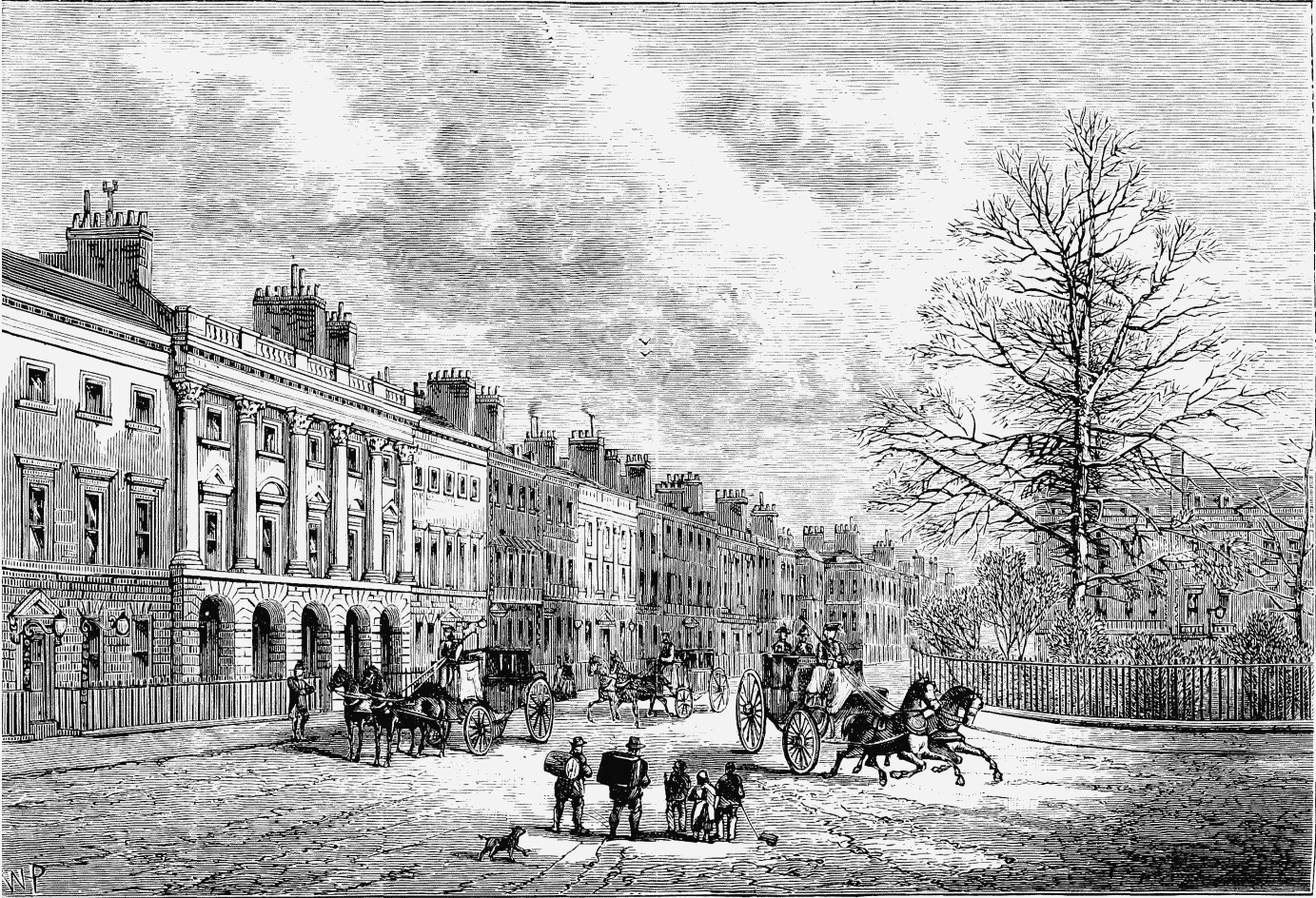
GROSVENOR SQUARE.
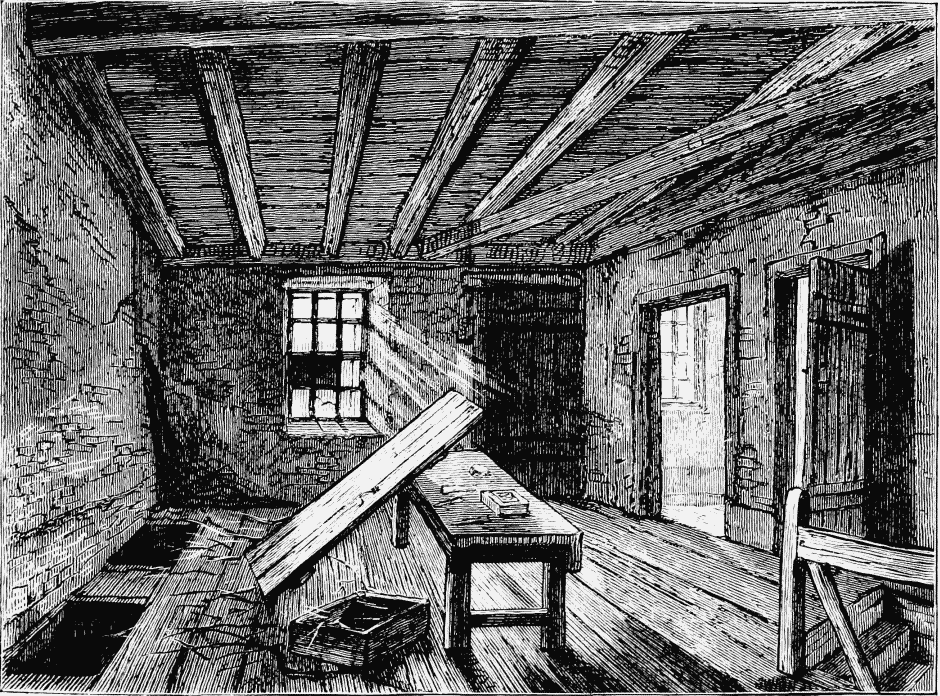
THE LOFT USED BY THE CATO STREET CONSPIRATORS, 1820.
No. 111, now occupied by a detachment of priests of the Order of Jesus, was at one time the manor house of an estate extending southwards to the borders of the property of the Berkeleys. In the garden behind it are some fine trees, which once stood, doubtless, in the open fields; and Farm Street in the rear still serves to keep up the tradition of its former rurality. A few doors west, on the southern side of the street, stands the Workhouse of St. George's, Hanover Square, a dingy and gloomy building externally. Nearly opposite to its gates, from the middle of Mount Street to Grosvenor Square, runs a short thoroughfare called Charles Street, of which there is little or nothing to say, beyond the fact that in it is the Coburg Hotel, kept by Francis Grillon, an offshoot of Grillon's Hotel, of Albemarle Street. In 1832, the Duchesse d'Angouleme, in her way from Edinburgh to France, held receptions at this hotel.
In this street, during the years 1767–68, when, as we have seen, he removed into the artistic neighbourhood of St. Martin's Lane, Josiah Wedgwood had his West-end show-rooms of pottery and porcelain, the royal arms over his door denoting—what at that time and in his case was no fiction—the patronage and custom of royalty which his firm enjoyed. Hither Queen Charlotte would drive from Buckingham House to see those arttreasures by the production of which Wedgwood was destined in a few short years to make the name of England famous in Continental courts. The fact is that the rooms here were small, and as the patronage of the wealthy classes poured in upon him in a stream, he soon found himself quite at a loss for room when large and handsome vases, as well as dishes and dinner-services, had to be displayed.
Charles Street was probably so called after one of the Stuart kings, from whose reign it dates. It may be interesting to record here that in the "Post Office Directory" for 1876 there are as many as forty Charles Streets mentioned as being within the limits of the metropolis, to say nothing of a Charles Square, three Charles Places, and a Charles Mews.