Old and New London: Volume 4. Originally published by Cassell, Petter & Galpin, London, 1878.
This free content was digitised by double rekeying. Public Domain.
Edward Walford, 'Hyde Park', in Old and New London: Volume 4(London, 1878), British History Online https://www.british-history.ac.uk/old-new-london/vol4/pp375-405 [accessed 30 April 2025].
Edward Walford, 'Hyde Park', in Old and New London: Volume 4(London, 1878), British History Online, accessed April 30, 2025, https://www.british-history.ac.uk/old-new-london/vol4/pp375-405.
Edward Walford. "Hyde Park". Old and New London: Volume 4. (London, 1878), British History Online. Web. 30 April 2025. https://www.british-history.ac.uk/old-new-london/vol4/pp375-405.
In this section
CHAPTER XXX.
HYDE PARK.
"The show shop of the metropolis, Hyde Park."—Pierce Egan.
The Site of the Park in Remote Ages—Its Boundaries—Division of the Manor of Eia—The Manor of Hyde appropriated by Henry VIII., and converted into a Royal Park—Lord Hunsdon appointed Ranger—Fees to the Keepers or Rangers—Entertainments for distinguished Foreign Visitors—Herons and other Water-fowl preserved here—Sir Edward Carey as Ranger—James I. as a hunter—Robert Cecil, Earl of Salisbury, Sir Walter Cope, and Henry Rich, Earl of Holland, as Rangers—The Water-supply for Western London—The City "Trained Bands" exercised in the Park—Sale of the Park by the Government—It again becomes Royal Property—The Duke of Gloucester appointed Keeper—James Hamilton as Keeper—Apples for Cider grown in the Park—Forts and Bastions erected in the Park—Extracts from the Diaries of Evelyn and Pepys referring to Hyde Park—Narrow Escape of Oliver Cromwell—The Park as a Fashionable Resort—Proposal to build a Palace in Hyde Park—The Ring—Reviews and Encampments held in Hyde Park—Duels fought in the Park—Peace Rejoicings in 1814 and 1815.
Having travelled to the northern end of Park Lane, and exhausted our store of information respecting the fashionable district which lies on our right hand, we must now retrace our steps as far as Apsley House and Hyde Park Corner, and ask our readers to accompany us into that most famous of recreation-grounds, and chief of the "lungs of London," which all the world, to this day, persists in calling "the Park," as if we had no other park in our metropolis—no doubt because, in the Stuart times, and even later, it was the only park really open to the people at large. We shall find that, in spite of the absence of houses and mansions, and, therefore, of actual inhabitants, it is almost as rich in historical recollections as any other part of London.
In the days of the Roman occupation of England, as Mr. Larwood remarks, in his "History of the London Parks," "the site of the future Hyde Park lay in the far west, in the midst of virgin forests, which for more than ten centuries after continued to surround London to the north and the west. Wild boars and bulls, wolves, deer, and smaller game, a few native hunters, swineherds, and charcoal-burners, were, in all probability, the only inhabitants of those vast wildernesses." If May Fair had any other inhabitants at that time, it is probable that they were painted savages.
In remote ages the tract of land now enclosed as the Park was bounded on the north by the Via Trinobantina—one of the great military roads—now identified with Oxford Street and the Uxbridge Road. On the east ran another Roman way, the old Watling Street, which crossed the other at Tyburn, and sloped off to the south-east, in the direction of Park Lane. On the west and south its limits were not equally well defined. Under the Saxon kings, it would appear that the Manor of Eia, of which it formed a part, belonged to the Master of the Horse; and Mr. Larwood most appropriately observes, "Could the shade of that old Saxon revisit the land which he held when in the flesh, no doubt he would be satisfied, for nowhere in the world could he now find finer horses and better riders than those we daily see in Rotten Row."
About the time of Domesday Book, the manor of Eia was divided into three smaller manors, called, respectively, Neyte, Eabury, and Hyde. The latter still lives and flourishes as a royal park, under its ancient name, no doubt of Saxon origin. The manor of Neyte became the property of the Abbey of Westminster, as did also that of Hyde, which remained in the hands of the monks until seized upon by King Henry, at the time of the Reformation. Of the manor of Hyde we know that its woods afforded to the monks both fire-wood and shelter for their game and water-fowl; and there is extant a document, in which William Boston, the abbot, and the rest of the Convent of Westminster, with their entire assent, consent, and agreement, handed over to his Majesty "the seyte, soyle, circuyte, and precincte of the manor of Hyde, with all the demayne lands, tenements, rentes, meadowes, and pastures of the said manor, with all other profytes and commodities to the same appertayning and belonging, which be now in the tenure and occupation of one John Arnold."
"Henry's main object in appropriating this estate," observes Mr. Larwood, "seems to have been to extend his hunting-grounds to the north and west of London. As we have already seen, the king had previously purchased that plot of ground which afterwards became St. James's Park. Marylebone Park (now the Regent's Park and surrounding districts) formed already part of the royal domain; and thus the manor of Hyde, connected with these, gave him an uninterrupted huntingground, which extended from his palace of Westminster to Hampstead Heath. That some such idea existed in the royal mind appears from a proclamation, for the preservation of his game, issued in July, 1536, in which it is stated that, 'As the King's most royal Majesty is desirous to have the games of hare, partridge, pheasant, and heron preserved, in and about the honour of his palace of Westminster, for his own disport and pastime, no person, on the pain of imprisonment of their bodies, and further punishment at his Majesty's will and pleasure, is to presume to hunt or hawk, from the palace of Westminster to St. Giles'-in-theFields, and from thence to Islington, to Our Lady of the Oak, to Highgate, to Hornsey Park, and to Hampstead Heath.' It was, probably, also about this period that the manor of Hyde was made into a park, that is, enclosed with a fence or paling, and thus became still better adapted for the rearing and preserving of game. And here it may be fit to observe, that its extent at that time, and for long after, was much greater than it is at present, reaching as far as Park Lane to the east, and almost up to the site of Kensington Palace to the west."
As soon as the church manor was thus turned into a royal park, it was a matter of course for the king to appoint a ranger. The first who held the post was George Roper—perhaps of the same family with William Roper, the worthy husband of good Sir Thomas More's daughter. On his death, two rangers or keepers were appointed, and a lodge assigned to each; the one lived not far from what now is Hamilton Place; and the other near the centre of the park, "in a building"—if Mr. Larwood's surmise is correct—"afterwards known as the Banqueting House, or the Old Lodge, and which was pulled down at the formation of the Serpentine." Queen Elizabeth gave one of the rangerships to her friend and favourite, Nicholas, Lord Hunsdon, with the handsome salary of "fourpence a day, together with herbage, pannage, and browsage for the deer." In Peck's "Desiderata Curiosa" is the following account, which may, perhaps, cause a smile, particularly if we notice that two men are paid for the same office, the one for holding it and the other for "exercising" it—in another word, for discharging its duties:—
Hyde Park, as in the time of Henry VIII., says the author above quoted, "was still used as a hunting-ground in the reigns of Edward VI., Queen Elizabeth, and King James." In 1550 we find the boy-king, Edward VI., hunting in it with the French ambassadors. In January, 1578, John Casimir, Count Palatine of the Rhine, Duke of Bavaria, and a general in the service of the Dutch, paid a visit to Queen Elizabeth, lodged in Somerset House, and was by her Majesty made Knight of the Garter. Amongst the entertainments given to this princely visitor was that of hunting at Hampton Court, and shooting in Hyde Park, on which last occasion the old chroniclers relate that the duke "killed a barren doe with his piece from amongst three hundred other deer." Again, an entry in the accounts of the Board of Works for the year 1582 contains a payment "for making of two new standings in Marybone and Hyde Park for the Queen's Majesty and the noblemen of France [i.e., the Duke of Anjou, Elizabeth's intended husband, and his court] to see the hunting." No doubt, these were the "princely standes" to which Norden alludes, in his mention of Hyde Park in 1596, in his "Survey of Middlesex and Hertfordshire." "Perhaps the queen herself, at times, here followed the pursuit of her patroness Diana, for we know that her Majesty took pleasure in hunting. On such occasions the sport would conclude, according to the established law of the chase, by one of the huntsmen offering a hunting-knife to the queen, as the first lady of the field, and her 'taking say' of the buck—i.e., plunging the knife in its throat with her own fair and royal hand. Again, the pools in the Park must have been a favourite haunt of the heron (which Henry VIII. includes among the game to be preserved in the neighbourhood of his palace), and other water-fowl, and there the queen may have 'cast her hawk' on summer afternoons. We can imagine her riding here on an 'ambling palfrey' through the forest glades, accompanied by the fiery Essex, the courtly Burleigh, the manly Raleigh, or that arch plotter and scheming villain, Leicester, whose name . . . ought to have been for ever connected with a certain spot north-east of the Park, where Tyburn gallows stood."
Before the end of Elizabeth's reign the second rangership was given to Lord Hunsdon's son, Sir Edward Carey. He was a brother of the Countess of Nottingham, whose name is so well known to history in connection with the romantic episode of Lord Essex and the ring. In his time, some forty acres of land on the southern side, not far from Knightsbridge, were added to the park, and fenced in with rails. "No cattle," writes Mr. Larwood, "were allowed to enter this enclosure, as it was reserved for the deer to graze in; and the grass growing within it was to be mown for hay, on which to feed the deer in winter. The exact locality of these forty acres," he adds, "is not stated; but it is not improbable that it was this very fence that was pulled down by the Londoners on their Lammas crusade in 1592."
Mr. Larwood writes: "King James I., as everybody knows, was a 'mighty hunter before the Lord.' Frequently, no doubt, the dryads and hamadryads of the Park must have witnessed his sacred Majesty in that famous costume which he wore when on his journey from Scotland to England to ascend the throne—'a doublet, green as the grass he stood on, with a feather in his cap and a horn by his side.' Then the clear echoes, nestling in the quiet nooks and corners of the ancient forest, were awakened by the merry blasts of the horn, the hallooing of the huntsmen cheering the dogs, and the 'yearning' of the pack, as they followed the hart to one of the pools where it 'took soil,' and was bravely dispatched by his Majesty. After that followed the noisy 'quarry,' in which, of course, 'Jowler' and 'Jewel,' the king's favourite hounds, obtained the lion's share. When the hunt was over, his Majesty would probably adjourn to the Banqueting House, which stood in the middle of the Park, and refresh himself with a deep draught of sack or canary; and in the cool of the evening, as, returning home to Whitehall, the king crossed over 'the way to Reading' (now Piccadilly), he might see, in the far blue distance, the little village of St. Giles' nestled among the trees, the square steeple of old St. Paul's, and the smoking chimneys of his good citizens of London, whilst the faint evening breeze wafted towards him the sweet silvery sound of Bow bells ringing the curfew."
The next keeper of whom we read, under James I., was Robert Cecil, Earl of Salisbury, with whom, three years later, we find associated Sir Walter Cope, the same person who built the centre and the turrets of Holland House. During their joint keepership various improvements were made in the Park; grants of money were made for planting trees and repairing lodges, fences, palings, pond-heads, &c.; which show that it was then quite a rural park. In 1612 Sir Walter Cope resigned his rangership in favour of his son-in-law, Henry Rich, subsequently created Earl of Holland. This nobleman, it may be remarked, cut but a poor figure in history. In early life he was employed abroad to negotiate the marriage of Charles I. with Henrietta Maria; but after the outbreak of the Civil War he fought at one time on the side of the Parliament, and then again for the King, and being taken prisoner by the Roundheads, was executed.
In the first year of Charles's reign a strange scene was witnessed in the Park. The young queen, Henrietta Maria, just wedded, went through it barefoot, and clad in sackcloth, to Tyburn gallows, an event of which we shall have to speak more fully in our account of Tyburnia.
In the reigns of our early Stuart kings there was in Hyde Park a large number of pools or ponds, all communicating with each other, and variously given as ten, eleven, and twelve. They were fed by a small stream, the West Bourne, which, rising on the western slope of Hampstead, passed through Kilburn and Bayswater, and then intersected the Park, which it quitted at Knightsbridge on its way to join the Thames at Millbank and Chelsea. These pools used to supply the western parts of London with water, until a complaint was made that they were drained so much that there was no water for the deer. This at least, was stoutly asserted by the keepers, and as stoutly denied by the citizens, who petitioned the king to allow the supply to continue. But Charles I. preferred the word of his keepers to the petition of his loyal and faithful subjects; he chose rather to see his subjects than his favourite deer lacking water, and so he rejected the petition—a step which much increased his unpopularity at the time.
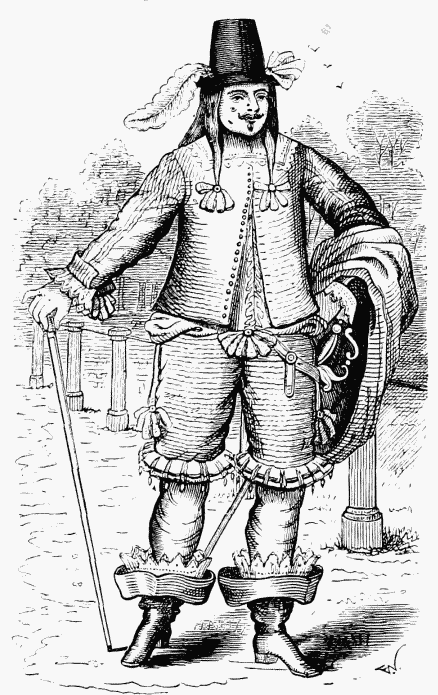
A LONDON DANDY OF 1646.
During the early part of the Civil Wars in the time of Charles I., Hyde Park was largely used for exercising the "trained bands," as the regular forces of the City were called. This body of men was first enrolled—or, as the phrase went, "drawn forth in arms"—on the side of the monarch; yet, subsequently, the citizens supported the popular cause, and it was principally by their aid that the House of Commons obtained its decided preponderancy. So early as November, 1642, within three months after Charles had set up his standard at Nottingham, the "trained bands" were marched out to join the Earl of Essex, on the heath near Brentford, "where," says Clarendon, "they had indeed a full army of horse and foot, fit to have decided the title of a crown with an equal adversary." In the further progress of the war, several auxiliary regiments, both of foot and horse, were raised by the City; and to a part of these forces, joined to two regiments of the "trained bands," "of whose inexperience of danger," remarks the historian just quoted, "or any kind of service beyond the easy practice of their postures in the Artillery Garden, men had till then too cheap an estimation," the Parliament army was indebted for its preservation in the first battle of Newbury, "for they stood as a bulwark and rampire to defend the rest, and, when their wings of horse were scattered and dispersed, kept their ground so steadily," that Prince Rupert himself, who charged them at the head of the choice royal horse, "could make no impression upon their stand of pikes, but was forced to wheel about." The same historian designates London as "the devoted city" of the Commons, and their "inexhaustible magazine of men."
"In April, 1660," says Mr. Allen, in his "History of London," "about six weeks before the restoration of Charles II., and when the artful management of General Monk had disposed the citizens to countenance the measures he was pursuing in favour of royalty, a muster of the City forces was held in Hyde Park: the number of men then assembled amounted to about 18,600—namely, six regiments of 'trained bands,' six auxiliary regiments, and one regiment of horse; the foot regiments were composed of eighty companies, of two hundred and fifty men each; and the regiments of cavalry of six troops, each of one hundred men. The assembling of this force was judged to have been highly instrumental to the success of the plan for restoring the monarchy. Within a few months afterwards the king granted a commission of lieutenancy for the City of London, which invested the commissioners with similar powers to those possessed by the lords-lieutenants of counties; and by them the 'trained bands' were new-modelled, and increased to 20,000 men; the cavalry was also increased to 800, and divided into two regiments of five troops, with eighty men in each. The whole of this force was, in the same year, reviewed by the king in Hyde Park." (fn. 1)
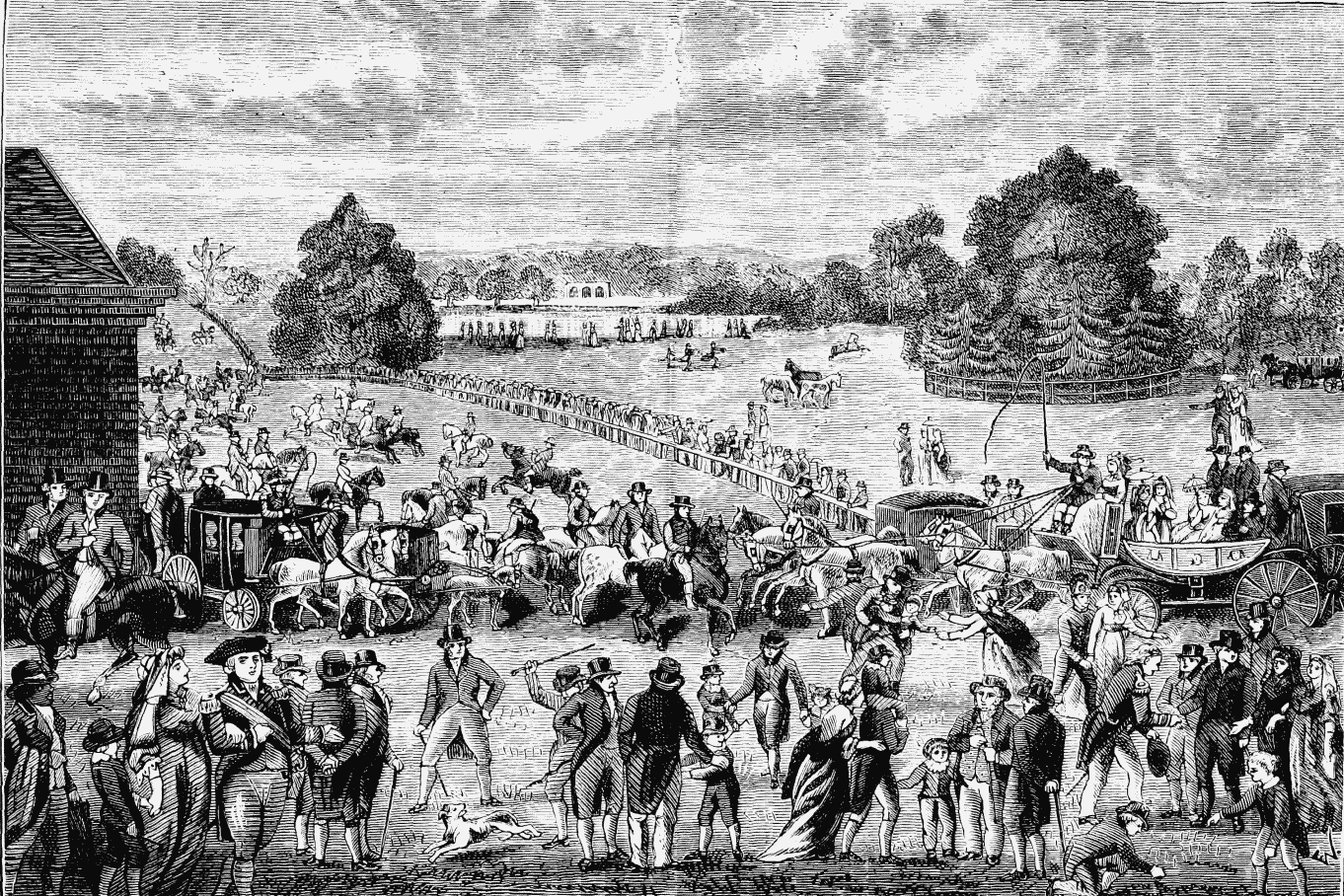
HYDE PARK ON SUNDAY. (From a Print published in 1804.)
The Act of Parliament which ordered the sale of the Crown lands, after the execution of Charles I., excepted Hyde Park from its provisions, and it became the subject of a special resolution of the 1st of December, 1652, "That Hyde Park be sold for ready money." The Park at that time contained about 621 acres, and the sale realised £17,068 2s. 8d. The purchasers of the three lots were Richard Wilson, John Lacey, and Anthony Deane.
As soon as the king was brought back to Whitehall, Hyde Park very naturally again became what it had been before the Puritan episode—the rendezvous of fashion and pleasure. The sales of the Park to individuals, which we have mentioned, were treated as null and void; Hyde Park became again royal property, and was open to the public once more. The king appointed his brother, the Duke of Gloucester, to the office of keeper; he, however, held it only two months, and after his death it was granted to James Hamilton, one of the Grooms of the Bedchamber, whose name, as we have already seen, survives in Hamilton Place. This place, and other houses about Hyde Park Corner, had been erected during the Protectorate by the then proprietors, and it is uncertain what compensation or tenant-right they obtained for the outlay. Mr. Hamilton was killed in battle, in 1673; and as Charles II. had thrown open St. James's Park to the public, and it was rightly judged that one Ranger could superintend both parks, it is scarcely a matter of surprise to find that his successor, Mr. Harbord, an ancestor of Lord Suffield, was styled Ranger of St. James's Park, the latter taking precedence, as being not only royal property, but the residence of the merry king and his court. It was by Mr. Hamilton's advice that the Park was first enclosed with a brick wall, and re-stocked with deer, the enclosure of the herd being on Buckdean Hill, on the side farthest from the City, and, therefore, the most quiet and retired. This wall stood till the reign of George II., when it was replaced by a more substantial one, six feet and a half high on the inside, and eight feet high on the outside. A horse belonging to a Mr. Bingham leaped this wall in 1792; this feat, it appears, was done for a wager. The wall was removed in the time of George IV., and an iron railing was substituted. Colonel Hamilton also made a speculation in the growth of apples for cider on an enclosure at the north-west corner, but with what result we are not informed.
But to return to the time of Charles II. The Park was then open ground, with the exception of such fences as were put up for the purposes of pasturage; but in 1664 the Surveyor-General observes in a report that "the king was very earnest with him for walling Hyde Park, as well for the honour of his palace and great city as for his own disport and recreation." Ten years after, a portion of it was so well fenced in as to be replenished with deer. In 1642, a large fort, with four bastions, had been erected at Hyde Park Corner, and another to the south, called Oliver's Mount, the memory of which remains in Mount Street. This latter work was erected by popular enthusiasm, the ladies of rank not only encouraging the men, but, as we have had occasion to remark in a previous chapter, carrying the materials with their own hands. In a note by Nash to the second canto of the second part of "Hudibras," Lady Middlesex, Lady Foster, Lady Anne Waller, and others, are celebrated for their patriotic exertions as serious volunteers in this emergency. Since that period, the military performances in Hyde Park have been of a mimetic character.
In Evelyn's "Diary," under date the 11th of April, 1653, we read:—"I went to take the aire in Hide Park, when every coach was made to pay a shilling, and horse sixpence, by the sordid fellow who had purchased it of the State, as they were called." And in the "Character of England in a Letter to a Nobleman in France," published in the year 1659, it is described as "a field near the town, which they call Hide Park; the place is not unpleasant, and which they use as our course, but with nothing of that order, equipage, and splendour; being such an assembly of wretched jades and hackney-coaches as, next a regiment of carrmen, there is nothing approaches the resemblance." The writer adds that "the Parke was used by the late king and nobility for the freshness of air, and the goodly prospect, but it is that which now (besides all other exercises) they pay for hire in England, though it be free for all the world besides; every coach and horse which enters buying his mouthful, and permission of the publican who has purchased it, for which the entrance is guarded with porters and long staves." It was, therefore, the Restoration which gave the people the free entrance to the Park, but with the entire reservation of the royal rights, as shown in several ways; not the least curious being the obligation of Mr. Hamilton, the Ranger, to deliver to the Lord Steward, or to the Treasurer of the Household, "one-half of the pippins or red streaks, either in apples or cider, as his Majesty may prefer, the produce of the trees he is authorised to plant in fifty-five acres of the north-west corner of the Park, on the Uxbridge Road."
Pepys' "Diary" is invaluable for the minuteness with which he describes London life during the first nine years of the reign of Charles II., and from him we learn much incidentally about the Park and its frequenters. "Gaiety, jollity, and merry life," it has been well observed, "beam through his pages, which rustle with silk and velvet, and sparkle with gold lace and jewellery." A crowd of gay dissolute people still move through them with the same restless flutter which animated them when in the flesh, two hundred years ago and more. By his help we get peep after peep into that bygone world, and obtain a full view of the manners, fashions, and pleasures of those past generations; and we cannot do better than follow him whenever he shows his merry face in the Park. Early in June, 1660, within a few days after the Restoration, Pepys hears from friends that the two royal Dukes of York and Gloucester "do haunt the Park much;" but he has not as yet seen them there with his own eyes. It is not until the 9th of the month that the little Clerk of the Admiralty has had the happiness of seeing his Majesty there face to face, a sight which, he tells us, was "gallantly great." Again, on the 3rd of July, Pepys records his sight of the king's presence there, to which Evelyn adds, "and abundance of gallantry."
Both Evelyn and Pepys, in their "Diaries," bear frequent witness to the gay appearance which the Park presented after the Restoration, especially on May Day. The former tells us that on the 1st of May, 1661, he went to the Park to take the air, and that "there was his Majesty and an innumerable appearance of gallants and rich coaches, being now a time of universal festivity and joy." Our friend Pepys, however, was not a spectator of these gay doings in the Park, he having been ordered away, on his official duties to Portsmouth; much to his personal regret, as he does not forget to tell us.
When Pepys and Evelyn speak thus of the Park, they must not be understood to mean its whole circumference, but simply an inner circle in the centre of its northern half, generally known as "the Ring," round which it was the fashion to ride and drive. It was on account of this circular movement that Lady Malapert, in the old comedy of The Maid's Last Prayer, calls the "Ring" a "dusty mill-horse drive."
Sometimes this "Ring" was called "the Tour;" and in this sense Pepys uses the word. Thus we have the following entry in his "Diary," under date of the 31st of March, 1668:—"Took up my wife and Deb, and to the Park, where being in a hackney (coach), and they undressed, was ashamed to go into the Tour, but went round the Park, and so with pleasure home."
In the above reign, it seems, horse and footraces were of frequent occurrence here. Evelyn, under date May 20, 1658, even tells us that he "went to see a coach-race in Hide Park;" and Pepys, in his "Diary," August 10, 1660, records how that he went "with Mr. Moor and Creed to Hyde Park, by coach, and saw a fine foot-race three times round the Park, between an Irishman and Crow, that was once my Lord Claypole's footman." This was followed by a horse-race, and in the interval which occurred between the two performances a milk-maid went about, crying "Milk of a red cow!" which the humbler spectators partook of—the "quality" meanwhile sipping "sillabub with sack in it." The ladies, we are further told, wagered scarlet stockings and Spanish scented gloves on their favourite studs.
"Hyde Park," says Pennant, "was celebrated by all our dramatic poets in the late century, and in the early part of the present (18th), for its large space railed off in form of a circle, round which the beau monde drove in their carriages, and in their rotation, exchanging, as they passed, smiles and nods, compliments or smart repartees." This large space was also, very suitably, the place in which coaches were displayed when first introduced by persons of fashion and "quality." Taylor, the water-poet, tells us that one William Boonen, a Dutchman, was the first who introduced the use of such vehicles into England. The said Boonen was Queen Elizabeth's coachman, and the date of their first appearance in London may be fixed at about 1564. Taylor quaintly observes, "Indeed, a coach was a strange monster in those days, and the sight of them put horse and man into amazement." The introduction of "glass-coaches" is fixed by the "Ultimum Vale of John Carleton," published in 1663. "I could wish her coach, which she said my Lord Taffe bought for her in England and sent it over to her, made of the new fashion, with glasses, very stately."
The railed-off space above mentioned was called
the "Ring," and is often spoken of by the poets of
the eighteenth century as the central resort of
fashion. It was probably on his way hither that
Cromwell once had a most narrow escape from
sudden death. He was, as the story has been
often told, driving his own coach in the Park; his
horses ran away and were uncontrollable; the stern
Protector, much to the delight of any Royalist who
might have been present on the occasion, was
thrown off the coach-box, and fell upon the pole
between the wheelers, and his feet becoming entangled in the harness, he was dragged along for
a considerable distance. He does not, however,
appear to have suffered much beyond the necessary
fright and a few bruises. On this accident the
following lines were written by the old rhyming
cavalier, Cleveland:—
"The whip again ! away ! 'tis too absurd
That thou shouldst lash with whip-cord now, but sword.
I'm pleased to fancy how the glad compact
Of hackney-coachmen sneer at the last act.
Hark how the scoffing concourse hence derives
The proverb, 'Needs must go when the devil drives.'
Yonder a whisper cries, ''Tis a plain case,
He turned us out to put himself i' the place;
But, God-a-mercy, horses once for aye
Stood to 't, and turn'd him out as well as we.'
Another, not behind with his mocks,
Cries out, 'Sir, faith you were in the wrong box.'
He did presume to rule because, forsooth,
He's been a horse commander from his youth:
But he must know there's a difference in the reins
Of horses fed with oats and fed with grains.
I wonder at his frolic, for be sure
Four hamper'd coach-horses can fling a brewer;
But 'Pride will have a fall,'such the world's course is,
He who can rule three realms can't guide four horses;
See him that trampled thousands in their gore,
Dismounted by a party but of four.
But we have done with't, and we may call
This driving Jehu, Phaeton in his fall.
I would to God, for these three kingdoms' sake,
His neck, and not the whip, had given the crack."
It would be interesting, as Mr. Thomas Miller remarks, in his "Picturesque Sketches of London," to know whether the Lord Protector remembered the uncomplimentary wish contained in the last couplet when the old royalist afterwards had to petition Cromwell for his release from Yarmouth Gaol. If he remembered it, and yet released the writer, he must have had, at all events, a forgiving disposition. Cromwell's fall from his coach-box is likewise commemorated in one of the poems of Sir John Birkenhead, entitled "The Jolt." Cromwell had received from the German Count of Oldenburg a present of six German horses, which he attempted to drive, with his own hands, in Hyde Park, when "the political Phaethon" met with the accident above mentioned. Sir John Birkenhead was not slow to perceive the benefit of such an event, and more than hints how unfortunate for the country it was that the fall was not a fatal one. During the dominion of Cromwell, Sir John was forced to "live by his wits," which meant nearly to starve. On the Restoration, he was made one of the Masters of Requests, with a handsome salary.
But to pass on to the Restoration and the times
of Charles II. "Hardly," writes Mr. Larwood,
"were the members of the royal family safely lodged
in the palaces of Whitehall and St. James's, when
they commenced their round of amusements, Hyde
Park forming part of the programme. Both Charles
and his brother James were of active habits, fond
of open air and exercise; both also found a still
more powerful attraction in the Park, for it was
the gathering place of all those matchless beauties
which still live on the canvas of Lely and Kneller.
All Grammont's equivocal heroines, and all their
more virtuous and not less beautiful sisters, were
daily there, fluttering in the sunshine, and dazzling
alike both king and subjects. There were Lady
Castlemaine, la belle Hamilton, la belle Stewart,
and la belle Jennings, the Countesses of Chesterfield
and Southesk, Lady Denham and Mrs. Lawson,
Mrs. Middleton, Mrs. Bagot, Miss Price—in a word,
that entire galaxy of ladies whose beauty, as Pope
says, was an excuse for the gallantries of Charles,
and an apology for his Asiatic court. These, in
fact, were
'Those days of ease, when now the weary sword
Was sheath'd, and luxury with Charles restor'd,
In every taste of foreign courts improv'd,
All by the king's example lived and lov'd.'
"There still remained some of the picturesque elegance of the Spanish costume which had been in vogue in the reign of Charles I., though it was gradually spoiled more and more by an invasion of exaggerated French fashions. But there was one great and charming novelty, the new riding garb—the Amazone, as it was called—the nondescript attire from which the present habit is descended. Till then ladies had worn the usual walking-dress on horseback; it was left for the beautiful flirts of Charles's reign to introduce the 'habit.' It was this novelty which puzzled good Pepys so much, when he, for the first time, saw the ladies 'with coats and doublets with deep skirts, just for all the world like men, and their doublets buttoned up the breasts, with periwigs and with hats, so that, only for a long petticoat dragging under their men's coats, nobody would take them for women in any point whatever.'"
The following description of Hyde Park is from the Memoirs of Count Grammont in the reign of Charles II.:—"Hyde Park, every one knows, is the promenade of London: nothing was so much in fashion, during the fine weather, as that promenade, which was the rendezvous of magnificence and beauty: every one, therefore, who had either sparkling eyes, or a splendid equipage, constantly repaired thither, and the king [Charles II.] seemed pleased with the place."
Our portrait of the "London dandy" (page 378) of the middle of the seventeenth century, the greater part of whose time probably was spent in the Park, shows the exact dress of the fashionable young men of the time; the long locks of hair, hanging down from the temples on either side the face, with tasty bows of ribbon tied at the ends, were called by the ladies "love-locks;" and Prynne, in his zeal, thought this so prominent folly that he wrote a quarto volume to prove "The Unloveliness of Love-locks." Prynne, however, himself did not kill the fashion, which died a natural death at the end of the reign of Charles I. The stars and halfmoons seen on the young man's face are ornamental patches of dark sticking plaster, a mode of embellishment which is in favour with the ladies occasionally, even in the reign of Victoria, as serving to show off a fair white skin. Among the absurdities of the age to which our illustration refers, it would be difficult to find one more ridiculous than that of gentlemen who are not riders wearing spurs on their boots, as part of their walking dress. The spur forms a conspicuous object in the dress of the dandy of 1646; and we learn that it was considered the very height of fashion to have the spurs made so as to rattle or jingle as the wearer walked along, like Apollo, with his rattling arrows, in the first book of Homer's "Iliad."
The "dandies" of that period, however, did not
have it all their own way, or assert an entire
monopoly to the Park, as a place intended only for
promenading and flirtations, for we read that during
the plague of August and September, 1665, a large
number of the poorer inhabitants of London, who
could not escape into the country, brought thither
their household goods, and setting up tents, formed
in the Park a sort of camp, which is described to
the life in a ballad or broadside of the day, preserved in a volume of London songs in the British
Museum. But in spite of all these precautions for
safety, the plague pursued them thither, and those
who died were buried as quickly as possible upon
the spot:—
"We pitch'd our tents on ridges and in furrows,
And there encamped, fearing th'Almighty's arrows.
But oh ! alas ! what did this all avail ?
Our men, ere long, began to droop and quail.
Our lodgings cold, and some not us'd thereto,
Fell sick and dy'd, and made no more adoe.
At length the plague amongst us 'gan to spread,
When every morning some were found stark dead.
Down to another field the sick were ta'en,
But few went down that ere came up again.
But that which most of all did grieve my soul,
To see poor Christians dragg'd into a hole."
It must have been with great satisfaction that the poor creatures thus encamped in Hyde Park learned that, by the end of October, the plague had disappeared, and that they were able to return to their homes in London.
The gay circle of "the Ring" being shorn of its old frequenters, in the year of the great plague, no doubt the grass grew where the horsemen and carriages had stirred the dust as often as spring and summer came round. During part of that fatal and fearful summer, however, a regiment of the Guards was quartered in the Park, under the command of Monk, Duke of Albemarle, who, like Lord Craven, refused wholly to quit the doomed city. Two years later, on St. George's Day, the Merry Monarch and the Knights of the Garter, we are told by Mr. Larwood, had the "ridiculous humour" of keeping on their robes all the day, and in the evening made their appearance in "the Ring," still wearing their insignia—cloaks, coronets, and all. The Duke of Monmouth and another noble lord indulged even in a further freak, for thus apparelled they drove about the Park in a hackney coach.
On the re-appearance of the company in the Park, after the plague and the "great fire," we soon come again across the lively figure of Pepys, who, on the 3rd of June, 1668, writes:—"To the Park, where much fine company and many fine ladies; and in so handsome a hackney I was that I believe Sir W. Coventry and others who looked on me did take me to be in one of my own, which I was a little troubled for; so to the Lodge and drank a cup of new milk, and so home." In the reign of Charles II. the Lodge here spoken of by Pepys stood in the middle of the Park, and was used for the sale of refreshments; it was sometimes called Price's Lodge, from the name of Gervase Price, the chief under-keeper.
"Like everything connected with the Park,"
writes Mr. Larwood, "it is frequently mentioned
by the dramatists of that reign. For instance, in
Howard's English Monsieur (1674):—'Nay, 'tis no
London female; she's a thing that never saw a
cheesecake, a tart, or a syllabub at the Lodge in
Hyde Park.' In Queen Anne's time it was more
generally called the Cake House, or Mince-pie
House; and, according to the fashion which still
continued to prevail, the beaux and belles used
to go there to refresh themselves. The dainties
which might be obtained there in the reign of
George II. are thus enumerated in a little descriptive poem of the period:—
"'Some petty collation
Of cheesecakes, and custards, and pigeon-pie puff,
With bottle-ale, cider, and such sort of stuff.'"
The Lodge was a timber and plaster building, and
was taken down in the early part of the present
century."
As far back as the reign of Elizabeth we find that cheesecakes were to be had at a house near the Serpentine, while branch establishments existed at Hackney and Holloway for the retail of these dainties, and, from the northern heights, persons were employed to cry them in the streets.
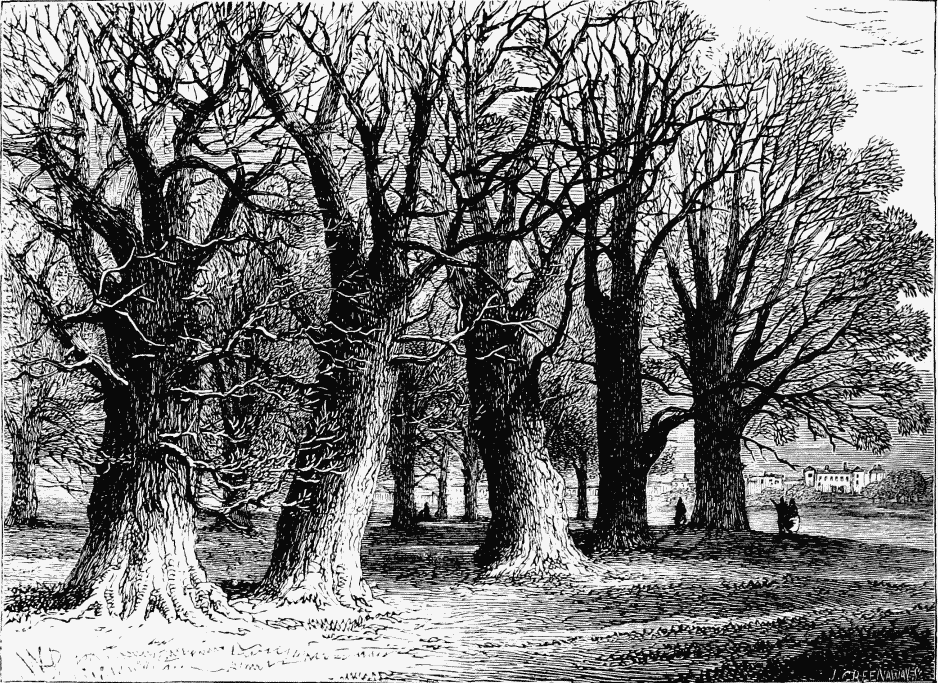
GROUP OF OLD TREES IN HYDE PARK.
Our friend Pepys, in his "Diary," under date May, 1669, describes a visit, with his wife and some friends, to the Park, where, doubtless, they ate cheesecakes before going "thence to the 'World's End,'" a noted drinking-house, which we shall have occasion to mention hereafter, when we reach the neighbourhood of Knightsbridge. The worthy diarist was a frequent stroller in the Park, and his pages, therefore, contain numerous indications of the doings of the fashionable world in his time; he not only brings before us, in brilliant colours, some of the most famous beauties and court gallants, but also gives us an account of the gentle flirtations of the king himself and his more favoured dames.
Mr. Harrison Ainsworth is but recording the actual state of things in the reign of Queen Anne, when he writes, in his historical romance of "St. James's:"—"Well may we be proud of Hyde Park, for no capital but our own can boast aught like it. The sylvan and sequestered character of the scene was wholly undisturbed, and, but for the actual knowledge of the fact, no one would have dreamed that the metropolis was within a mile's distance. Screened by the trees, the mighty city was completely hidden from view, while, on the Kensington road, visible through the glade which looked towards the south-west, not a house was to be seen. To add to the secluded character of the place, a herd of noble red deer were couching beneath an oak, that crowned a gentle acclivity on the right, and a flock of rooks were cawing loudly on the summits of the high trees near Kensington Gardens."
As far back as the year 1731, the author of the "Critical Review," chalking out a plan of London improvements, pointed to Hyde Park as "a place possessed of every beauty and convenience which might be required in the situation of the royal palace of the British king." In 1766, a Mr. John Gwynne proposed to build in the Park a palace with a circuit round it of one mile in circumference. In 1779, a correspondent of the St. James's Chronicle, writing under the nom de plume of "Possible," enumerates several large buildings which he considered ought to be erected in London; "amongst them," he observes, "a palace in Hyde Park is also much wanted." Towards the end of the last century, the subject was again broached by Sir John Soane, "who," writes Mr. Larwood, "in the gay morning of youthful fancy, full of the wonders he had seen in Italy, and inspired by the wild imagination of an enthusiastic mind, proposed, without regard to expense or limit, to erect a royal habitation in the Park. It was to consist of a palace, with a series of magnificent mansions, the sale of which was calculated to defray the entire cost of the erection. The whole of the building was to extend from Knightsbridge to Bayswater, and to be relieved by occasional breaks. This design was much approved by the notorious Lord Camelford, who was then at Rome, where he saw Soane's drawings, and who became a warm friend and patron of the young architect when subsequently he settled in London."
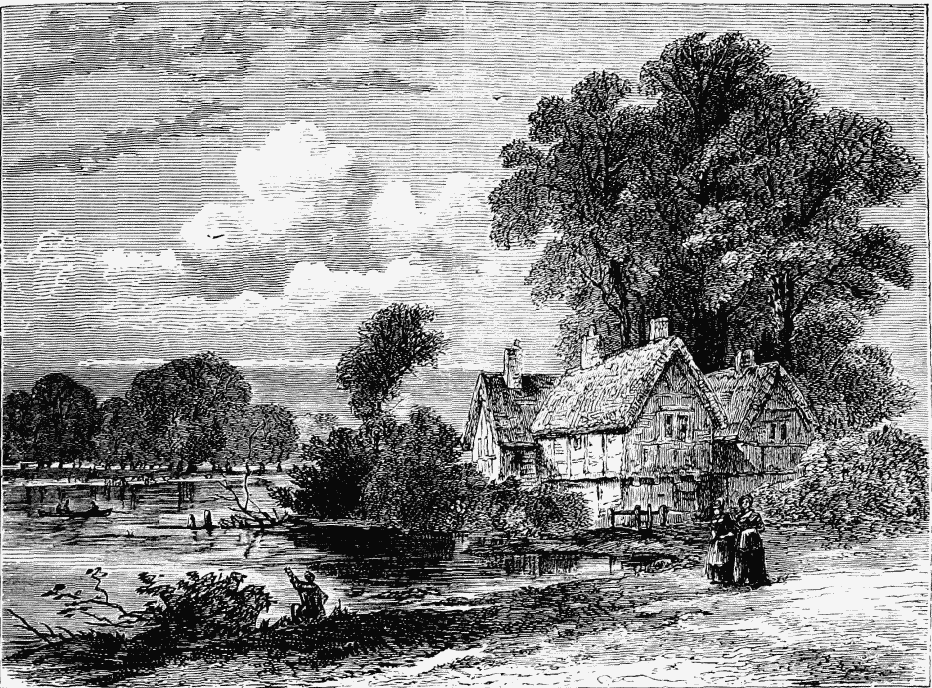
THE CAKE-HOUSE, HYDE PARK. (From a Drawing in Mr. Crace's Collection.)
Mr. Larwood also gives a map of Hyde Park, about the year 1736 or 1737. It shows the turnpike and gallows at Tyburn, and a double row of walnut-trees, with a wide gravel-walk between, runs from north to south, parallel to the Park Lane. In the centre of this avenue is a circular reservoir, belonging to the Chelsea Waterworks, and from which not only Kensington Palace and the suburb were supplied, but also "the new buildings about Oliver's Mount" (now Mount Street) "and the northern parts of Westminster." Mr. Larwood tells us that the machinery used for forcing the supply was at that time so primitive, that the water had to be conveyed to the houses on the high ground near Grosvenor Square by means of a mill turned by horses. It may interest our readers to learn that this avenue was standing till about the year 1810, when most of the trees, being much decayed, and in danger of being blown down whenever the wind was high, were cut down, their wood being destined to make stocks for the muskets of our infantry. In this map the "Ring" is marked with a large circle, apparently about 150 yards to the north of the east end of the Serpentine. Round the "Ring" stands a square of large trees, a few of which may, perhaps, still be standing. There is a small brook, which runs into the Serpentine, near the present boat-house, from the neighbourhood of the Uxbridge Road; and two small ponds of water are marked towards the southeast corner—one nearly where the statue of Achilles now stands, and the other nearer to the rear of Apsley House. The map shows also the two roads running parallel to the Serpentine on the south, marked respectively as "The King's Old Road, or Lamp Road," and "The King's New Road;" the former corresponding nearly with the Rotten Row of our time, and the latter running, as now, inside the Park, close to the Knightsbridge Road and Kensington Gore. On the north of the Serpentine there is, apparently, no regular road, except for about a hundred yards from the eastern end, where it bends to the north, away from the water, towards the "Ring."
The cutting down of trees needlessly, in the neighbourhood of London, is a sin. Evelyn, in his "Book of Forest Trees," as Dr. Johnson more than once reminds us in his "Letters," tells us of wicked men who cut down trees, and never prospered afterwards. It is to be hoped that a like fate awaited those persons who caused the destruction of the walnut-tree avenue mentioned in the preceding paragraph.
The "Ring," of which we have already spoken, was a place of fashionable resort down to the reign of George II., when it was partly destroyed in the formation of the Serpentine River. It is often alluded to in old plays and novels, and is described by a French traveller, in 1719, as being "two or three hundred paces in diameter, with a sorry kind of balustrade, or rather with poles placed upon stakes, but three feet from the ground, and the coaches drive round this. When they have turned for some time round one way, they face about and turn t'other. So rolls the world." (fn. 2) Another foreigner, who lived in England at the end of the seventeenth century, in speaking of the "Ring," says: "They take their rides in a coach in an open field where there is a circle, not very large, enclosed by rails. There the coaches drive slowly round, some in one direction, others the opposite way, which, seen from a distance, produces a rather pretty effect, and proves clearly that they only come there in order to see and to be seen. Hence it follows that this promenade, even in the midst of summer, is deserted the moment night begins to fall, that is to say, just at the time when there would be some real pleasure in enjoying the fresh air. Then everybody retires, because the principal attraction of the place is gone." (fn. 3)
Pepys, in his "Diary," under date of 4th April, 1663, writes how that he "saw the king in one coach and Lady Castlemaine in another, in the Ring in Hyde Park, they greeting one another at every turn."
The origin of this "Ring" is unknown; Mr. Larwood suggests that "it may have been a remnant of the garden attached to the Banqueting House, or it may simply have been made by the two speculating citizens who hired the ground from Anthony Dean, Esq., and levied toll on the gates." Remnants of it were still traceable at the beginning of this century, on the high ground directly behind the farm-house. A few very old trees are even now to be found on that spot. Some of these are indeed ancient enough to have formed part of the identical trees round which the wits and beauties drove in their carriages, and, as Pennant says, "in their rotation exchanged, as they passed, smiles and nods, compliments or smart repartees." Plain as it was, it must have been a pleasant spot on a summer's afternoon. Situated on an upland space of ground, one may imagine the pleasurable prospect from hence when all around was open country, and nothing intercepted the view from the Surrey hills to the high grounds of Hampstead and Highgate. One can easily imagine how delightful it must have been for the ladies who "came in their carriages from the hot play-house and the close confined streets of the City, to be fanned by soft winds which blew over broad acres of ripening corn, flowering clover, and newly-mown hay, or rustled through the reeds and willows on the banks of the pools."
Walker, in "The Original," in 1835, speaks of the "Ring" as being still traceable round a clump of trees near the foot-barracks, and inclosing an area of about ninety yards in diameter, and about forty-five yards wide. "Here," he adds, "used to assemble all the fashion of the day, now diffused round the whole park, besides what is taken off by the Regent's Park."
In the merry days of our later Stuart sovereigns
no equipage in the "Ring" was thought complete
unless drawn by six grey Flanders mares, and the
owner's coat-of-arms emblazoned conspicuously on
the panels. Thus we read in "The Circus, or the
British Olympus," professedly a satire on the
"Ring:"—
"Manlius through all the city doth proclaim
His arms, his equipage, and ancient name;
For search the Court of Honour, and you'll see
Manlius his name, but not his pedigree.
What then? This is the practice of the town;
For, should no man bear arms but what's his own,
Hundreds that make the 'Ring' would carry none;
And that would spoil the beauty of the place."
Mr. Larwood, who quotes these lines, adds his
own opinion that the "Manlius" here intended
was none other than "Beau Fielding," who pretended to be a cadet of the noble house of the
Earl of Denbigh, which is sprung, as every reader of
the "Peerage" knows, from the Hapsburgs, cousins
to the ancient Emperors of Germany. He gives
the following version of the story to which allusion
is made in the above verses:—"On the strength of
his name he ventured to have the arms of Lord
Denbigh painted on his coach, and to drive round
the 'Ring,' as proud as the jackdaw with the
purloined peacock's feathers. At the sight of the
immaculate coat-of-arms on the plebeian chariot
all the blood of all the Hapsburgs flew to the head
of Basil, fourth Earl of Denbigh; in a high state
of wrath and fury he at once procured a housepainter and ordered him to daub the coat-of-arms
completely over, and before all the company in
the 'Ring.' The beau seems to have thought
with Falstaff that 'the better part of valour is discretion;' and as the insult had not been offered
to his own arms, he judged it wise to bear it rather
than to resent it." From this same satire we may
glean a few other illustrations of the way in which
the frequenters of the Park, towards the end of the
seventeenth century, conducted themselves. For
instance, it appears that the beaux bought fruit in
the Park, and there, as in the theatres, amused
themselves with breaking coarse jests with the
orange and nosegay-women, and other female
hawkers. Thus we read in the same poem:
"With bouncing Bell a luscious chat they hold,
Squabble with Moll, or Orange Betty scold."
The same practice is also alluded to in another
satire, Mrs. Manley's "New Atlantis," where a
Mrs. Hammond is represented buying a basket of
cherries and receiving a billet-doux from the "orangewench." Again, in Southerne's play of the Maid's
Last Prayer (1693), Lady Malapert says, "There
are a thousand innocent diversions more wholesome and diverting than always the dusty millhorse driving in Hyde Park." But her airy husband
is of a different opinion: "O law !" says he, "don't
prophane Hyde Park: is there anything so pleasant
as to go there alone and find fault with the company? Why, there can't a horse or a livery 'scape
a man that has a mind to be witty; and then, I
sell bargains to [i.e. 'chaff'] the orange-women."
It was with such refined amusements, such a delicate way of displaying their wit, that the beaux of
that period, like Sir Harry Wildair, acquired the
reputation of being "the joy of the play-house, the
life of the Park."
During the reign of Queen Anne, the "Ring" held its place as the resort of all the fashion and nobility, even in winter. "No frost, snow, or east wind," writes the Spectator, in 1711, "can hinder a large set of people from going to the Park in February, no dust nor heat in June. And this is come to such an intrepid regularity, that those agreeable creatures that would shriek at a hind-wheel in a deep gutter, are not afraid in their proper sphere of the disorder and danger of seven crowded Rings." In the Tatlers, Spectators, and in the plays of the period, there are constant allusions to the brilliant crowds who frequented the "Ring," around which a full tide of gaudily dressed ladies were whirled day by day. As Mr. Larwood happily remarks:—"It was an endless stream of stout coachmen driving ponderous gilt chariots lined with scarlet, drawn by six heavy Flanders mares; and running footmen trotting in front, graced with conical caps, long silver-headed canes, and quaintly cut silk jackets loaded with gold lace, tassels, and spangles. In those coaches appeared all the beauty and elegance of the kingdom, outvieing each other in splendour and extravagance; for daughters of Eve were scarce who thought, like Lady Mary Wortley Montagu, that 'All the fine equipages that shine in the Ring never gave me another thought than either pity or contempt for the owners that could place happiness in attracting the eyes of strangers.'"
It was in the "Ring" that a curious incident occurred in the life of Wycherley, which Pope related to Spence. "Wycherley was a very handsome man. His acquaintance with the famous Duchess of Cleveland commenced oddly enough. One day as he passed that duchess's coach in the 'Ring,' she leaned out of the window, and cried out loud enough to be heard distinctly by him, 'Sir, you're a rascal; you're a villain.' Wycherley from that instant entertained hopes. He did not fail waiting on her the next morning; and, with a very melancholy tone, begged to know how it was possible for him to have so much disobliged her grace. They were very good friends from that time."
In the days of George II., the machinery used for watering the fashionable drive in Hyde Park was very primitive indeed. "On account of the numerous coaches which drive round in a small circle," observes a German writer, Z. Conrad von Uffenbach, in his "Remarkable Journey through Europe," "we are greatly troubled by the excessive dust. When the heat and dust are very great, however, a man drives round with a barrel of water in a cart; and the tap is taken out of the barrel, so that as he goes on the water runs out into the road, and moistens it, and so lays the dust."
From the time of Cromwell down to the present day the history of Hyde Park is little more than a record of five events, of which from time to time it has been the scene—reviews of the troops and volunteers, encampments, duels, highway robberies, and executions. For a full catalogue of these matters, equally minute and monotonous, we must be content to refer our readers to the pages of Mr. Jacob Larwood's "Story of the London Parks." It will be enough for our purpose to enumerate here a few of the principal occurrences.
The earliest occasion on which the Park was used for a review, so far as we can learn, was in March, 1569, when the Ranger, Lord Hunsdon, caused Elizabeth's pensioners to muster before the Virgin Queen, his men all "well appointed in armour, on horseback, and arrayed in green cloth and white," the Tudor livery, as may be learnt from sundry pictures in the galleries at Windsor Castle and Hampton Court Palace.
Commencing then with the first year of the reign of Charles II., Stow tells us how, only a few months after his accession, the king here reviewed his "trained bands," 20,000 strong and upwards, in the presence of "divers persons of quality, and innumerable other spectators," and how in the following March (1661) the Park witnessed a muster of archers shooting with the long bow. This exercise had always been a favourite with the English people; and a writer named Wood, in his "Bowman's Glory," especially mentions the fact, that so great was the delight, and so pleasing the exercise, that three regiments of foot soldiery laid down their arms to come and see it.
Again in 1662, Charles reviewed here his troops, including the handsome Life Guards, whom he had formed in Holland. Their array was picturesque, and their gallant appearance pleased the people, who were sick of the dull Puritanical troopers. The Kingdom's Intelligencer thus describes the scene: "It was a glorious sight, …and, with reverence be it spoken, worthy those royal spectators who came purposely to behold it; for his sacred Majesty, the Queen, the Queen-mother, the Duke and Duchess of York, with many of the nobility, were all present. The horse and foot were in such excellent order that it is not easy to imagine anything so exact; which is the more creditable if you consider that there were not a few of that great body who had formerly been commanders, and so more fit to be guard of the person of the most excellent king in the world."
Again, in July, 1664, we read in Pepys' "Diary" of another grand review of the Guards in the Park, the troops, horse and foot, being four thousand; but the diarist, in the honesty of his heart, speaks rather doubtfully of their real value as troops. In 1668 there was a similar display, in order to do honour to the Duke of Monmouth, who had been appointed Colonel of the Life Guards. Pepys was present on this occasion too, and gives us a picture of the duke in "mighty rich clothes;" but he saw no reason to change his former opinion of the men, though he owned, that he "indeed thought it mighty noble."
In January, 1682, there was another review of the Guards in the Park, in the presence of Charles, and of the ambassadors of the Sultan of Morocco. "The soldiers," says Mr. Larwood, "were gallantly, and the officers magnificently accoutred. After they had gone through their various exercises, to the great admiration of the ambassadors, the Moorish followers of their Excellencies would show what they could do; and though their performances were very different from the military exercises of Western nations, they proved themselves good and active horsemen. Whilst riding at full speed, with their lances they took off a ring, hung up for the purpose, and performed various other surprising feats."
An encampment, it would appear from one of Pope's letters, was formed in Hyde Park about the year 1714. At all events, he writes from the Westend to a lady friend, probably Martha Blount:—"You may soon have your wish to enjoy the gallant sights of armies, encampments, standards waving over your brother's corn-fields, and the pretty windings of the Thames stained with the blood of men. . . . .The female eyes will be infinitely delighted with the camp which is speedily to be formed in Hyde Park. The tents are carried there this morning, new regiments, with new cloaths and furniture, far exceeding the late cloth and linen designed by his Grace (the Duke of Marlborough) for the soldiery. The sight of so many gallant fellows, with all the pomp and glare of war yet undeformed by battles, those scenes which England has for many years beheld only on stages, may possibly invite your curiosity to this place."
In another letter to the Hon. Robert Digby, he thus describes the effect produced by the encampment on West-end society:—"The objects that attract this part of the world are quite of a different nature. Women of quality are all turned followers of the camp in Hyde Park this year, whither all the town resort to magnificent entertainments given by the officers, &c. The Scythian ladies that dwelt in the waggons of war were not more closely attached to the baggage. The matrons, like those of Sparta, attend their sons to the field, to be the witnesses of their glorious deeds; and the maidens, with all their charms displayed, provoke the spirit of the soldiers. Tea and coffee supply the place of Lacedæmonian black broth. This camp seems crowned with perpetual victory, for every sun that rises in the thunder of cannon, sets in the music of violins. Nothing is yet wanting but the constant presence of the princess to represent the mater exercitûs."
In June, 1799, King George III. here reviewed 12,000 volunteers. Of those reviewed on that day, at all events, two survived to take an active part, to the extent, at least, of shouldering a musket and attending drill, in the volunteer movement on its revival in 1858—the late Mr. C. T. Tower, of Weald Hall, Essex, and Mr. James Anderton, of Dulwich, Surrey.
At these reviews there was always a goodly concourse of spectators present, of whom the larger
half were ladies, true then, as now, to Ovid's wellknown line—
"They come to see, but also to be seen.
If we may believe Lord Lansdowne, there was
among these lady frequenters of the Park on such
occasions one whose name is now forgotten, though
she was doubtless the "belle of the season" in her
day. He calls her only Mira, and we have, alas!
no clue to the secret of Mira's parentage. Was
she the daughter of a duke or a marquis? or was
she one of the maids of honour who attended in
the train of royalty? Alas ! we cannot tell. But
we can quote Lord Lansdowne's lines entitled
"Mira at a Review of the Guards in Hyde Park,"
as certainly not out of place:—
"Let meaner beauties conquer singly still,
But haughty Mira will by thousands kill:
Through armed ranks triumphantly she drives,
And with one glance commands a thousand lives.
The trembling heroes nor resist nor fly,
But at the head of all their squadrons die."
The following anecdote is vouched for by Lady C. Davies, in her "Recollections of Society:"—Marshal Soult attended a review in Hyde Park in 1838, and his stirrups happening to break, a saddler, named Laurie—the same who became afterwards Alderman Sir Peter Laurie—being asked to supply others, sent the identical stirrups which had been used in the Waterloo campaign by Napoleon I."
On the 23rd of October, 1760, George II. held his last review. The king, we are told, "entered the grand pavilion, or tent, under the Kensington Garden wall," where were also present the Prince and Princess of Wales, the Duke of York, Princess Augusta, and some other of the young princesses, besides a host of noblemen. As soon as the review was over, says Read's Weekly Journal of October 25, 1760, "some pieces of a new construction, of a globular form, were set on fire, which occasioned such a smoke as to render all persons within a considerable distance entirely invisible, and thereby the better enabled in time of action to secure a retreat." The brave old king had been in bad health for some days previously, and within forty-eight hours after the review he was dead.
We must say a few words respecting some of the duels—many bloody and fatal ones—that have been fought in Hyde Park. The barbarous practice of duelling, no doubt, came down by tradition from the era of the Normans, if not from that of our Anglo-Saxon forefathers. From whatever race it came, it was a national stain and disgrace for centuries. In the reigns of Charles II. and James II. the mania for duelling was at its height, and, indeed, it could scarcely pass away as long as gentlemen wore their swords in every-day life as part of their costume. John Evelyn remarks, in 1686: "Many bloody and notorious duels were fought about this time. The Duke of Grafton killed Mr. Stanley, brother to the Earl of Derby, indeed upon an almost insufferable provocation. It is to be hoped," he adds, "that his Majesty will at last severely remedy this unchristian custom."
The story of the duel between Lord Mohun and the Duke of Hamilton, which was fought here on the 15th of November, 1712, is thus told by Sir Bernard Burke, in his "Anecdotes of the Aristocracy:"—
"This sanguinary duel, originating in a political intrigue, was fought early one morning at the Ring, in Hyde Park, then the usual spot for settling these so-called affairs of honour. The duke and his second, Colonel Hamilton, of the Foot Guards, were the first in the field. Soon after, came Lord Mohun and his second, Major Macartney. No sooner had the second party reached the ground, than the duke, unable to conceal his feelings, turned sharply round on Major Macartney, and remarked, 'I am well assured, sir, that all this is by your contrivance, and therefore you shall have your share in the dance; my friend here, Colonel Hamilton, will entertain you.' 'I wish for no better partner,' replied Macartney; 'the colonel may command me.' Little more passed between them, and the fight began with infinite fury, each being too intent upon doing mischief to his opponent to look sufficiently to his own defence. Macartney had the misfortune to be speedily disarmed, though not before he had wounded his adversary in the right leg; but, luckily for him, at this very moment the attention of the colonel was drawn off to the condition of his friend, and, flinging both the swords to a distance, he hastened to his assistance. The combat, indeed, had been carried on between the principals with uncommon ferocity, the loud and angry clashing of the steel having called to the spot the few stragglers that were abroad in the Park at so early an hour. In a very short time the duke was wounded in both legs, which he returned with interest, piercing his antagonist in the groin, through the arm, and in sundry other parts of his body. The blood flowed freely on both sides, their swords, their faces, and even the grass about them, being reddened with it; but rage lent them that almost supernatural strength which is so often seen in madmen. If they had thought little enough before of attending to their self-defence, they now seemed to have abandoned the idea altogether. Each at the same time made a desperate lunge at the other; the duke's weapon passed right through his adversary, up to the very hilt; and the latter, shortening his sword, plunged it into the upper part of the duke's left breast, the wound running downwards into his body, when his grace fell upon him. It was now that the colonel came to his aid, and raised him in his arms. Such a blow, it is probable, would have been fatal of itself; but Macartney had by this time picked up one of the swords, and stabbing the duke to the heart over Hamilton's shoulder, immediately fled, and made his escape to Holland. Such, at least, was the tale of the day, widely disseminated and generally believed by one party, although it was no less strenuously denied by the other. Proclamations were issued, and rewards offered, to an unusual amount, for the apprehension of the murderer, the affair assuming all the interest of a public question. Nay, it was roundly asserted by the Tories, that the Whig faction had gone so far as to place hired assassins about the Park to make sure of their victim, if he had escaped the open ferocity of Lord Mohun, or the yet more perilous treachery of Macartney.
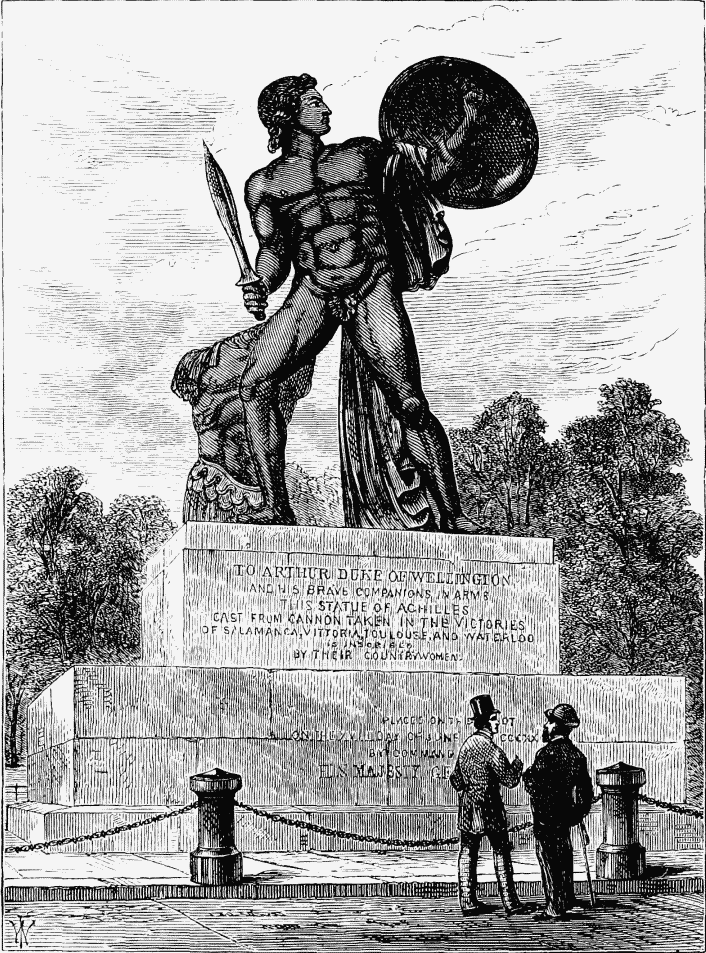
THE STATUE OF ACHILLES.
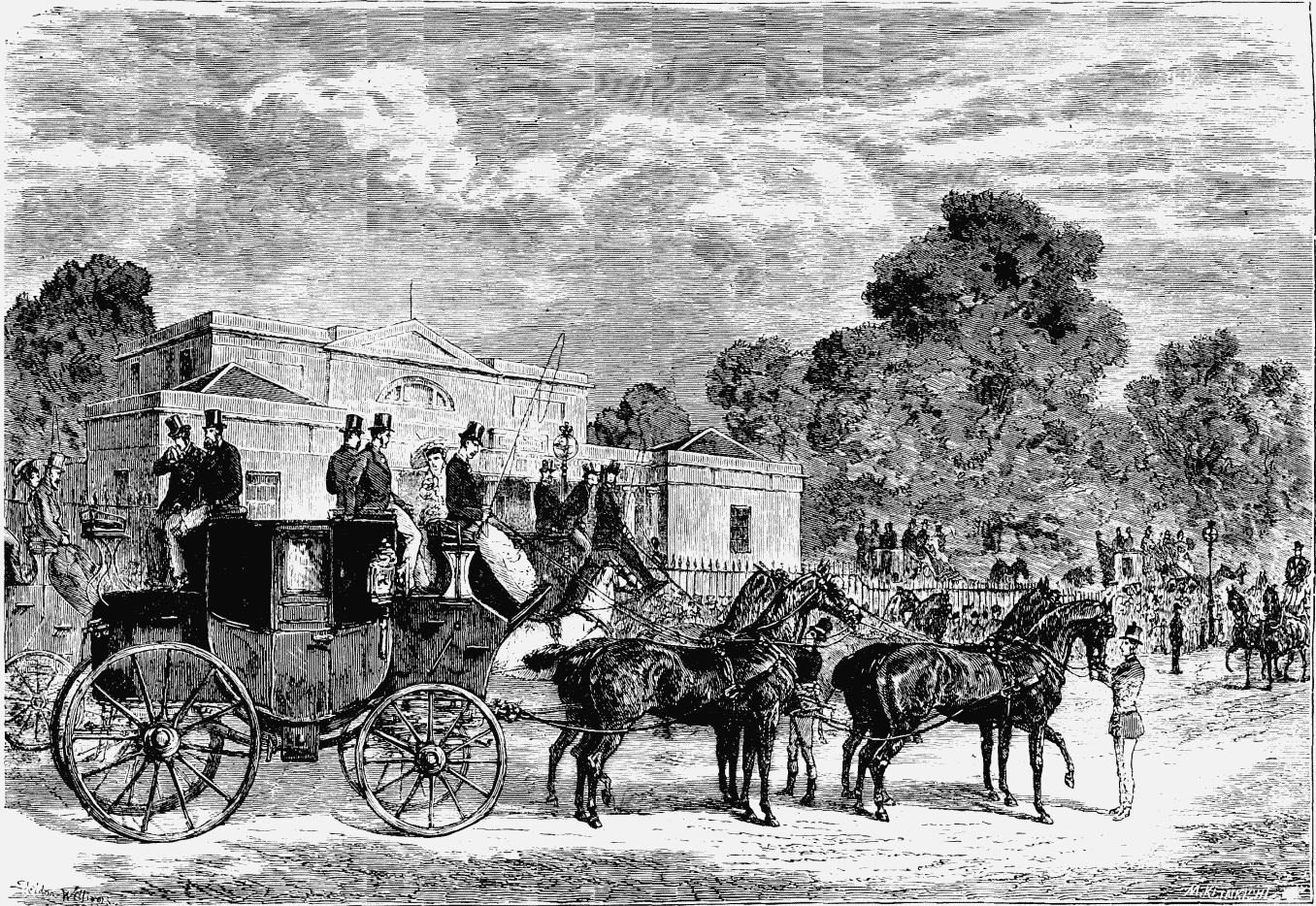
A MEET OF THE FOUR-IN-HAND CLUB.
"When the duke fell, the spectators of this bloody tragedy, who do not appear to have interfered in any shape, then came forward to bear him to the Cake-House, that a surgeon might be called in, and his wounds looked to; but the blow had been struck too home; before they could raise him from the grass, he expired. Such is one of the many accounts that have been given of this bloody affair, for the traditions of the day are anything but uniform or consistent. According to some, Lord Mohun shortened his sword, and stabbed the wounded man to the heart while leaning on his shoulder, and unable to stand without support; others said, that a servant of Lord Mohun's played the part that was attributed, by the more credible accounts, to Macartney. This intricate knot is by no means rendered easier of untying by the verdict of the jury, who, some years after, upon the trial of Macartney for this offence, in the King's Bench, found him only guilty of manslaughter.
"Lord Mohun himself died of his wounds upon the spot, and with him his title became extinct; but the estate of Gawsworth, in Cheshire, which he had inherited from the Gerards, vested by will in his widow, and eventually passed to her second daughter, Anne Griffith, wife of the Right Hon. William Stanhope, by whose representative, the Earl of Harrington, it is now enjoyed."
In "Crowle's Illustrated Pennant," now in the British Museum, there is a small drawing of the above duel; and there is also engraved in facsimile, in Smith's "Historical and Literary Curiosities," a letter of Dean Swift to Mrs. Dingley, describing it. The Dean thus writes concerning this duel:—
"Before this comes to your Hands, you will "have heard of the most terrible accident that "hath almost ever happened. This morning at 9 "my man brought me word that D. Hamilton had "fought with Ld. Mohun and killed him and "was brought home wounded. I immediately "sent him to the Duke's house in St. James' Square, "but the Porter could hardly answer him for tears, "and a great Rabble was about the House. In "short they fought at 7 this morning. The Dog "Mohun was killed on the spot, and well (when) "the Duke was over him, Mohun short'ning his "sword stabb'd him in at the shoulder to the heart. "The Duke was help'd towards the Cake-house "in the Ring in Hide Park (where they fought) "and dyed on the grass before he could reach the "House, and was brought home in his Coach by "8 while the poor Dutchess was asleep. Mac"kartney, and an Hamilton were seconds and "fought likewise, and are both fled. I am told, "that a footman of Ld. Mohun's stabb'd D. "Hamilton, and some say Mackartney did so too. "I am infinitely concerned for the poor Duke "who was an honest good natured man, I loved "him very well and I think he loved me better."
Lord Mohun was a notorious profligate; he had frequently been engaged in duels and midnight brawls, (fn. 4) and had been twice tried for murder. The only remark made by his widow, when his corpse was brought home, was an expression of high displeasure that the men had laid the body on her state-bed, thereby staining with blood the rich and costly furniture! The Duchess of Hamilton, who was a daughter of Digby, Lord Gerard of Bromley, continued a widow until her death, in 1744. We have some scanty notices of this lady in Swift's "Journal and Correspondence." The dean visited her on the morning of the fatal occurrence, and remained with her two hours. "I never saw so melancholy a scene," he says. Two months afterwards, he was again on a visit to the duchess, but the tables were turned. She never grieved, but raged, and stormed, and railed: "She is pretty quiet now, but has a diabolical temper."
A noteworthy duel took place in Hyde Park, in 1762, between John Wilkes, the witty agitator, and Samuel Martin, a rather truculent member of Parliament. Martin, in his place in the House of Commons, had alluded to Wilkes as a "stabber in the dark, a cowardly and malignant scoundrel." Wilkes prided himself as much upon his gallantry as upon his wit and disloyalty, and lost no time in calling Martin out. The challenge was given as soon as the House adjourned, and the parties repaired at once to a copse in Hyde Park with a brace of pistols. They fired four times, when Wilkes fell, wounded in the abdomen. His antagonist, relenting, hastened up and insisted on helping him off the ground; but Wilkes, with comparative courtesy, as strenuously urged Martin to hurry away, so as to escape arrest. It afterwards appeared that Martin had been practising in a shooting gallery for six months before making the obnoxious speech in the House; and soon after, instead of being arrested, he received a valuable appointment from the ministry.
Wilkes was the cause of another rather amusing than tragical duel in this park several years later. One Captain Douglas, discussing the great demagogue's merits and demerits in a coffee-house, spoke of him as a scoundrel and a coward; and, turning to the company, he added that these epithets equally applied to Wilkes's adherents. A Rev. Mr. Green took up Wilkes's cause, and pulled Captain Douglas's nose, saying he would back Wilkes against a Scot any day. They at once repaired to the Park, though it was late in the evening. The duel was fought with swords, and finally the parson militant ran the captain through the doublet, whereupon the honour of both gentlemen was asserted to be saved, and they left the field of combat, satisfied.
Richard Brinsley Sheridan, in 1772, repaired to Hyde Park with Captain Matthews to fight a duel; but finding the crowd too great, they went to the Castle Tavern, Covent Garden, instead, and there fought with swords. The quarrel was about the beautiful Miss Linley, the singer, to whom Sheridan was already secretly married. Both were severely cut, but neither was seriously wounded.
In 1780 a duel was fought here between the Earl of Shelburne and Colonel Fullarton; and three years later Lieutenant-Colonel Thomas and Colonel Gordon met here in deadly combat, when the former was killed. In 1797 Colonel King and Colonel Fitzgerald fought, the cause of dispute being a lady, a near relation of the former, who had been wronged by his antagonist; Fitzgerald was killed. It will scarcely be credited, that as recently as 1822 a duel was fought here between the Dukes of Bedford and Buckingham.
Mr. Harrison Ainsworth, in his historical romance of "St. James's," describes one of the duels which were fought in Hyde Park in the reign of Queen Anne. He pictures the parties as striking off in the direction of Kensington Gardens, and keeping on the higher ground till they reach a natural avenue of fine trees, chiefly elms, sweeping down to the edge of a sheet of water which has since been amplified into the Serpentine. He states that "about half way down the avenue were two springs celebrated for their virtues, to which, even in those days, when hydropathy was unknown as a practice, numbers used to resort to drink, and which were protected in wooden frames;" and that "at a later period the waters of the larger spring, known as St. Anne's well, were dispensed by an ancient dame who sat beside it with a small table and glasses. …A pump," he adds, "now occupies the spot, but the waters are supposed to have lost none of their efficacy." We shall have occasion to mention these springs again.
It is pleasant to pass from these records of bloodshed to the more enlivening accounts of the festivities and rejoicings that took place here in consequence of the Peace in 1814, and the visit of the Allied Sovereigns. Mr. Cyrus Redding describes, with the pen of an eye-witness, the review of the Scots Greys in Hyde Park in the presence of their Majesties. "It was amusing," he writes, "to see the activity of the other princes and of the Duke of Wellington in their movements, and the incapacity of the Prince Regent to keep up with them. Already grown unwieldly and bloated, he was generally left behind in the royal excursions, being too bulky and too Falstaff-like to move about as they did." He describes the Emperor Alexander of Russia as "affable, easy, and good-humoured;" the King of Prussia as being "as milk-and-water as his courtiers and his enemies could have desired;" and the King of Belgium (then simply aide-de-camp to one of their Majesties), as "lodging au deuxième in Marylebone Street."
Again, after the battle of Waterloo, the Park was made the centre of the rejoicings for the peace. Mr. Redding tells us how "a mock naval engagement on the Serpentine river in Hyde Park was presented on the occasion. Boats rigged as vessels of war were engaged in petty combat, and one or two filled with combustibles were set on fire in order to act as fire-ships. First a couple of frigates engaged. Then the battle of the Nile was imitated. Later at night the fireworks commenced. I was as close to them as any one could well be placed. There was a painted castle externally made of cloth. This mock fort gave out a pretended cannonade, amid the smoke of which, the scene shifting, changed the whole into a brilliant temple, with transparent paintings, to represent a temple of Peace, quite in a theatrical way. This elicited shouts of admiration from the people.
"The newspapers made merry with these proceedings, of which the Prince Regent was said to have been the designer. They were worthy of the Prince's taste, extravagant and puerile as it was. One of the papers said, that two watermen, each with a line-of-battle ship on his head proceeding up Constitution Hill to the Serpentine, had been met by their reporter that morning. Another stated that a corps of Laplanders, not to exceed three feet six in height, had been reviewed for the purpose of sending them to man the Prince Regent's fleet in Hyde Park, but that they were declared to be eleven inches five lines too tall."
We may conclude this chapter by remarking that the fresh air of the neighbourhood of Hyde Park a century ago was proverbial; for Boswell writes to thank one of his friends for the offer of the use of his apartments in London, but to decline them on the ground that "it is best to have lodgings in the more airy vicinity of Hyde Park."
CHAPTER XXXI.
HYDE PARK (continued).
"Now in Hyde Park she flaunts by day,
All night she flutters at the play."
Foundling Hospital for Wit, vol. i., 1771.
Rural Aspect of the Park, and Purity of the Air—Extent of the Park, and Names of the Principal Entrances—The Chelsea Waterworks, and the Duke of Gloucester's Riding-house—Mineral Waters—The Statue of Achilles—Rotten Row—The "Drive"—Anecdote of Lord Chesterfield—Horace Walpole attacked by Robbers in the Park—The Park as a Lounge for Effeminate Gallants—"Romeo" Coates and his Singular Equipage—The Park as a Place for the display of the "Newest Fashions"—Miss Burdett-Coutts and the "Irrepressible Stranger"—The "Four-in-hand" and the "Coaching" Clubs—The Serpentine—The Royal Humane Society—The Swimming Club—A Favourite Place for Suicides—Proposal for a World's Fair—The Apple-stall Keeper and the Government—The "Reformer's Tree"—The Marble Arch.
The entrance into Hyde Park from the west end of Piccadilly, at "the Corner," is, as we have already seen, imposing and magnificent in the extreme. "The park itself," writes Mr. James Grant, "is in a fine, open, and airy situation; and what with the trees in Kensington Gardens, and the handsome houses on the east, north, and south, presents a remarkably interesting and pleasant view. Its attractions, indeed, altogether are so great that no other place in the vicinity of London can bear a moment's comparison with it. I question if there be many such places in the world." At the beginning of the present century, however, it wore a different appearance from that of to-day. For instance, from a print of 1808, it is clear that on the left, inside the entrance at Hyde Park Corner, was the under-keeper's lodge, a wooden structure. At the bottom of an old view of Kensington Palace, among the topographical illustrations belonging to George III., is the following inscription:—"The avenue leading from St. James's through Hyde Park to Kensington Palace is very grand. On each side of it landthorns (sic) are placed at equal distances, which being lighted in the dark seasons for the conveniency of the courtiers, appear inconceivably magnificent."
Hyde Park far surpasses that of St. James's in pure rural scenery. Its trees may not be greener or leafier, but there is in its appearance less of art and more of nature, and this is evidenced by the beauty—artificial as it is—of the Serpentine river.
The air here, though not equal in purity to that on Epsom Downs, or even Hampstead Heath, is fresh enough, as compared with that of close-packed rooms in the centre of London. "Taking three of Dr. Smith's London tests," observes a writer in Once a Week, we find that while the air of the Court of Chancery shows .20 of carbonic acid, and that of the pit of the Strand Theatre .32, the air of Hyde Park shows only .03" The parks, therefore, may well be called the "lungs of London."
The Park reaches from Piccadilly as far westwards as Kensington Gardens, and it lies between the roads leading to Kensington and Bayswater, the former a continuation of Piccadilly, and the latter of Oxford Street. It originally contained a little over 620 acres; but by enclosing and taking part of it into Kensington Gardens, and by other grants of land for building between Park Lane and Hyde Park Corner, it has been reduced to a little under four hundred. It has eight principal entrances. The first (as already mentioned) is at Hyde Park Corner; it consists of a triple archway, combined with an iron screen, and was erected from the designs of Mr. Decimus Burton, in 1828. In Park Lane is Stanhope Gate, opened about 1750; and also Grosvenor Gate, which was erected by a public subscription among the neighbouring residents, and named after Sir Richard Grosvenor. At the north-east corner of the Park, at the western end of Oxford Street, is Cumberland Gate, now adorned with the "Marble Arch," of which we shall have more to say presently. In the Bayswater Road is the Victoria Gate, opposite Sussex Square. The entrances on the south side are the Albert Gate, Knightsbridge, nearly opposite the road leading into Lowndes Square; the Prince of Wales's Gate, near the site of the old "Half-way House," and close by the spot whereon stood the "Great Exhibition" of 1851; whilst further westward is the Kensington Gate.
At a very early period, the Park was fenced in with deer-palings. In the reign of Charles II. these were superseded by a brick wall, which again, in the reign of George IV., gave place to an open iron railing. As late as the year 1826 the south side was disfigured by two large erections—the one a riding-house, and the other an enginehouse belonging to the Chelsea Water-works Company. The former building, known as the Duke of Gloucester's Riding House, was built in 1768, but pulled down in 1820, having served as the head-quarters of the Westminster Volunteer Cavalry during the war against Napoleon. Its site was afterwards occupied for a time by an exhibition of a picture of the Battle of Waterloo, painted by a Dutch artist, which enjoyed a season's popularity as one of the sights for "country cousins" in London, and is now in the Royal Museum of the Pavilion, near Haarlem, in Holland. The licence of the Chelsea Water-works Company terminated towards the end of the reign of William IV., when the engine-house opposite Grosvenor Gate was taken down, and the circular space which it occupied was turned into a basin, with a fountain in the centre. This was filled up about the year 1860, and the place converted into a circular Dutch garden.
The enclosure at the north-west corner was well planted with trees, and stocked with cows and deer, and had a keeper's lodge. Sir Richard Phillips writes thus, in "Modern London," published by him in 1804:—"Beneath a row of trees, running parallel with the keeper's garden, are two springs, greatly resorted to: the one is a mineral, and is drunk; the other is used to bathe weak eyes with. At the former, in fine weather, sits a woman, with a table, and chairs, and glasses, for the accommodation of visitors. People of fashion often go in their carriages to the entrance of this enclosure, which is more than a hundred yards from the first spring, and send their servants with jugs for the water, or send their children to drink at the spring. The brim of the further spring is frequently surrounded by persons, chiefly of the lower orders, bathing their eyes. The water is constantly clear, from the vast quantity which the spring casts up, and is continually running off by an outlet from a small square reservoir."
Of the recent improvements in this park, Walker speaks thus, in his "Original," in 1835:—"The widened, extended, and well-kept rides and drives in Hyde Park, with the bridge, and the improvement of the Serpentine, form a most advantageous comparison with their former state."
We have already described Apsley House, the residence of the great Duke of Wellington. "No stranger," writes Mr. T. Miller, in his "Picturesque Sketches in London," "would ever think of entering Hyde Park without first casting a look at Apsley House, the abode of 'the Duke;' and if he did, the statue of Achilles, which seems stationed as if to point it out, would remind him where he was."
The statue here mentioned stands on a gently sloping mound in the Park, facing the entrance, about a hundred yards north of Apsley House. It was executed by Sir Richard Westmacott in 1822. The figure is said to have been copied from one of the antique statues on the Monte Cavallo at Rome. The statue appears as if in the act of striking. On the pedestal is this inscription:—"To Arthur, Duke of Wellington, and his brave companions in arms, this statue of Achilles, cast from cannon taken in the battles of Salamanca, Vittoria, Toulouse, and Waterloo, is inscribed by their countrywomen." This statue, which was erected by a subscription among the ladies of England as a monument in honour of the military successes of the Duke of Wellington, is open to grave objections, besides the fact that the figure is undraped. From the first it was made the subject of very uncomplimentary remarks in English circles of refinement and discrimination, and a rather sharp controversy was carried on as to its merits and demerits, both before and after it was set up.
The author of a "Tour of a Foreigner in England," published in the year 1825, remarks: "The important monuments of London seem to be chiefly consigned to Mr. Westmacott. This artist excels in grace and harmony of contour. He ought, perhaps, to devote himself wholly to the representation of nymphs. His 'Achilles,' which has been erected as a monument to the Duke of Wellington, is merely a colossal Adonis. Westmacott would have succeeded better in representing the youthful hero grouped with the daughters of King Lycomedes. Who would believe that this gladiator Achilles could ever have deceived Deidamia and her companions under the disguise of a female? This colossal statue, which is erected in Hyde Park, as a monument to the Duke of Wellington, represents Achilles raising his shield. The illusion is somewhat forced. The ladies who subscribed for the monument affirm that the artist did not consult them respecting this allegorical statue; and that it was completed before the subscription was set on foot. A great outcry has been raised against the undraped figure of Achilles."
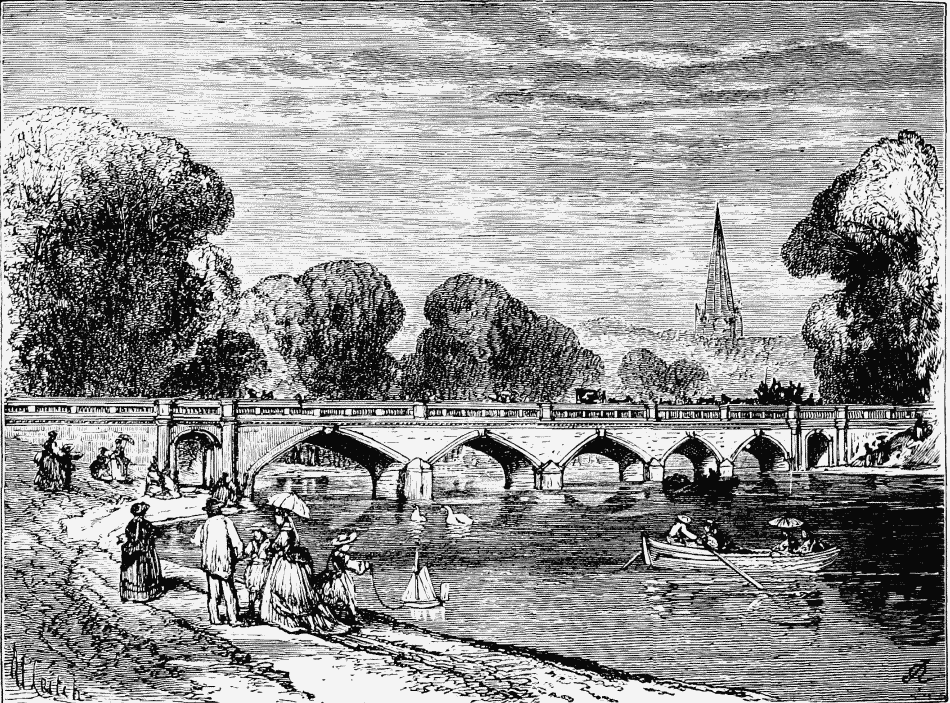
BRIDGE OVER THE SERPENTINE.
In a work entitled "Cities and Principal Towns," Westmacott's statue of "Achilles" is thus dealt with:—"The bronze colossus in Hyde Park, commonly called 'The Achilles,' was a novelty when set up, and excited at first something like wonder, then an ignorant or canting clamour, because it was undraped; but it has been from the first moment regarded by those who knew anything about art matters as a work of truly magnificent execution, and one of the noblest productions of modern art. With respect to its popular or vulgar name, it has no one distinctive trait of the Homeric Achilles, but that is immaterial; it is enough that we have before us a colossal representation of the human figure in the full play of muscle and energetic grandeur of outline. It is a copy, as everybody knows, from a figure forming part of one of two groups on the Quirinal Hill. There it is grouped with a horse against, it is supposed, the original intention. This may be; but still it is quite clear that its detachment has essentially weakened the effect. There is a want of object, and a vagueness. The English sculptor, Mr. Westmacott, to supply this want—this mancanza—has placed upon the left arm a shield, from the evidence and authority of shieldstraps on the arm of the original. The small dimensions of Mr. Westmacott's shield, so far short of the "orbicular" shields of Homer, which, turned behind, touched with their borders, in walking, the nape of the neck and the heels, negative the supposition of an Achilles in his mind; and it may be questioned whether, by introducing it at all, he has not rather disenchanted the spectator of the power to supply much more effectually the vagueness of attitude and action, by still grouping the figure, in his imagination, as it is grouped on the Quirinal. As to the straps on the arm, they are far from proving that a shield had ever before been placed upon them. The ancient sculptors addressed them selves by signs and suggestions of this kind to the imagination; and Mr. Westmacott had better, we think, have imitated them in this, as he has rivalled them in other graces. This grand production of English art is unfavourably placed; and as to its destination and inscription, they set language at defiance."
In a newspaper paragraph of January 29th, 1825, we read that public curiosity was excited by the preparations for erecting here a temple for the exhibition of the long-talked-of painting, "The Battle of Waterloo." The ground marked out was in advance of the statue of Achilles, viewing it from the Piccadilly Gate, and to the west of the figure; it adjoined the foot-path by the side of Rotten Row. Another object of attraction at that time was the turning of the road near Grosvenor Gate. The Gloucester riding-house was then rapidly disappearing; and that long useless pile would, it was asserted, make way for a plantation of young trees extending to the canal or basin. The esplanade on the south side of the Serpentine river was then nearly completed. "The gravel terrace," added the writer, "from its width, will no doubt become a fashionable promenade for the beaux and belles in the summer months."

THE MARBLE ARCH.
The part of the Park near the statue of Achilles,
between it and "The Row," is, during the London
season, what the "Ring" was in the old Stuart
times, the very maze and centre of fashion. "Here,"
writes Mr. Thomas Miller, "the pride and beauty
of England may be seen upon their own stage, and
on a fine day in 'the season' no other spot in the
world can outrival in rich display and chaste
grandeur the scene which is here presented." Out
of the "season," however, Hyde Park is a dull
place enough. Tom Hood the elder thus speaks
of it in the dull days of November:—
"No Park, no 'Ring,' no afternoon gentility,
No company, and no nobility,
No warmth, no cheerfulness, no healthful ease!"
Lord Byron, in "Don Juan," canto 13, if our
readers remember, says of Rotten Row, when out
of season, that it—
"Sleeps from the chivalry of this bright age."
And R. B. Sheridan, in his prologue to Pizarro,
talks of the horse seen cantering along its sand and
gravel in May or June as—
"The hack Bucephalus of Rotten Row."
It has been suggested that the name itself is a corruption of Route du roi (the king's road); but Mr. John Timbs says, "the name Rotten is traced to rotteran, to muster; a military origin which may refer to the Park during the Civil War." Mr. Peter Cunningham, in his "Handbook of London," contents himself with just mentioning this place, as the part of Hyde Park, on the south of the Serpentine, most crowded with equestrians in the height of the London season; but he is wholly silent as to the derivation of its name. The "Row" is about a mile and a half in length, and is laid down with a fine loose gravel, mixed with tan, so that the fair equestrians and their friends can gallop over it without much danger from a fall.
There is extant a most amusing ballad which
illustrates the character of the Park and its company shortly after the Restoration, entitled "News
from Hyde Park," from which we quote the following stanzas; it is printed at length in the
"History of the Parks:"—
"One evening, a little before it was dark,
Sing tantararara tantivee,
I call'd for my gelding and rid to Hide Parke,
On tantararara tantivee:
It was in the merry month of May,
When meadows and fields were gaudy and gay,
And flowers apparell'd bright as the day,
I got upon my tantivee.
"The Park shone brighter than the skyes,
Sing tantararara tantivee,
With jewels, and gold, and ladies' eyes
That sparkled and cry'd, Come see me:
Of all parts of England, Hide Park hath the name
For coaches and horses, and persons of fame:
It looked at first sight like a field full of flame,
Which made me ride up tantivee.
"There hath not been seen such a sight since Adam's,
For perriwig, ribbon, and feather.
Hide Park may be termed the market of Madams,
Or Lady-Fair, chuse you whether;
Their gowns were a yard too long for their legs,
They shew'd like the rainbow cut into rags,
A garden of flowers, or a navy of flags,
When they all did mingle together."
One of the most constant frequenters of the Park, or more especially of the "Drive," about the middle of the last century, was Lord Chesterfield, "the man of the graces," on whom we have already peeped in at Chesterfield House, in May Fair. (fn. 5) That nobleman late in life had a severe fall from his horse, which took fright whilst drinking at one of the little ponds in the Park.
A few days before his death, one of his friends expressed some astonishment at meeting his lordship again there, considering the precarious state of his health. "Why," replied Chesterfield, "I am rehearsing my funeral;" alluding to his own dark-coloured chariot drawn by four horses, and the string of fashionable carriages which followed behind. Thus Chesterfield remained to the last a seeker after the vanities of this world. His constant endeavour was to be more young and more frivolous than was becoming his age. His days were employed in parading in the Park among youth and fashion, his nights at "White's," gaming and pronouncing witticisms amongst "the boys of quality." The consequence was, as we find from his own letters, that his old age was one of fretfulness and disappointment. He was always attempting to keep up his former reputation, and found it constantly sinking under him.
Here Horace Walpole, as he tells us, was robbed,
in the winter of 1749, by the fashionable highwayman, Maclean. He writes: "One night, in the
beginning of November, as I was returning from
Holland House by moonlight, about ten o'clock, I
was attacked by two highwaymen in Hyde Park,
and the pistol of one of them going off accidentally,
razed the skin under my eye, left some marks of
shot on my face, and stunned me. The ball went
through the top of the chariot, and if I had sat an
inch nearer to the left side, must have gone through
my head." Such were the perils of the parks,
within half a mile of Piccadilly, in the reign of the
second George! Maclean was the son of an Irish
dean, and had once kept a grocer's shop in or near
Welbeck Street; but losing his only child, of whom
he was very fond, he sold off his business and
"took to the road," and lived in town lodgings in
St. James's Street, "over against White's Club," and
in country apartments at Chelsea, whilst carrying
on his depredations. He was hung at Tyburn
in the year following, when some of the brightest
eyes of ladies of high birth were in tears at his
loss. Thus Soame Jenyns writes, in his "Modern.
Fine Lady"—
"She weeps if but a handsome thief is hung."
It is clear that a hundred years ago "The Park" was the lounge of indolent and effeminate gallants; for a writer in the London Magazine for 1773 mentions, in terms of ill-disguised contempt, "our emaciated youth, who, shattered by green tea and claret, drag their delicate and enervated forms at noon through the Park where their ruddy forefathers were wont to exhibit their manly forms."
Among the eccentric characters who figured in "The Park" in the days of the Regency, was a certain Mr. Coates, a wealthy planter from the West Indies, who made a sudden appearance in London, performing "for one night only," at the Haymarket Theatre, in Romeo and Juliet. We have already informed our readers (fn. 6) how ludicrously he played "Romeo" on this occasion, so as to be called "Romeo Coates" ever afterwards. His love of notoriety did not end at the Haymarket. He had built for him a singular shell-shaped carriage, in which he drove two fine white horses about the Park almost daily. His harness and every available part of the vehicle was blazoned all over with his self-assumed heraldic device, a cock crowing; and wherever he went his appearance was heralded by half the gamins of London running by his side, and crying "Cock-a-doodle-doo!" Eventually, having been the fun and sport of the West-end for a season or two, "Romeo" Coates left London and settled at Boulogne, where he induced a fair lady to become the partner of his existence, in spite of the ridicule of the world.
Hyde Park has always been the chief ground for exhibiting the "newest fashions" among the upper ten thousand; and here, during "the season," a good opportunity is afforded to the stranger of seeing the aristocratic world en masse, and of noting the ever varying cut of fashionable attire. Our lady readers will doubtless be amused at the excess to which the belles of even the Georgian era went in the matter of adornment, when we tell them that we read in a newspaper of January, 1796, under the title of "The Height of Fashion," that Lady Caroline Campbell "displayed in Hyde Park the other day a feather four feet higher than her bonnet!"
From a poetic effusion printed in 1808, Sunday
would appear to have been the great day for the
beaux and belles of the middle classes, and the City
in general, to "do" the Park. Here we read:—
"Horsed in Cheapside, scarce yet the gayer spark
Achieves the Sunday triumphs of the Park;
Scarce yet you see him, dreading to be late,
Scour the New Road, and dash through Grosvenor Gate;
Anxious, yet timorous, too, his steed to show,
The bold Bucephalus of Rotten Row.
Careless he seems, yet, vigilantly shy,
Woos the stray glance of ladies passing by;
While his off-heel, insidiously aside,
Provokes the caper which he seems to chide."
Captain Gronow says of the Park that, as lately as 1815, it looked a part of the country. Under the trees grazed not only cows, but deer, and the paths across it were few and far between. As you gazed from an eminence, no rows of monotonous houses reminded you of the vicinity of a large city, and its atmosphere was then "much more like what God made it than the hazy, grey, coal-darkened halftwilight of the London of to-day. The company, which then congregated daily about five, was composed of dandies and women in the best society; the men mounted on such horses as England alone could then produce. The dandy's dress consisted of a blue coat with brass buttons, leather breeches, and top-boots; and it was the fashion to wear a deep, stiff white cravat, which prevented you from seeing your boots while standing. All the world watched Brummell to imitate him, and order their clothes of the tradesman who dressed that sublime dandy. One day a youthful beau approached Brummell, and said, 'Permit me to ask you where you get your blacking?' 'Ah!' replied Brummell, gazing complacently at his boots, 'my blacking positively ruins me. I will tell you in confidence; it is made with the finest champagne!'
"Many of the ladies used to drive into the Park in a carriage called a vis-à-vis, which held only two persons. The hammer-cloth rich in heraldic designs, the powdered footmen in smart liveries, and a coachman who assumed all the gravity and appearance of a wigged archbishop, were indispensable. The equipages were generally much more gorgeous than at a later period, when democracy invaded the Park and introduced what may be termed a 'brummagem society,' with shabbygenteel carriages and servants. The carriage company consisted of the most celebrated beauties, amongst whom were conspicuous the Duchesses of Rutland, Argyle, Gordon, and Bedford; Ladies Cowper, Foley, Heathcote, Louisa Lambton, Hertford, and Mountjoy. The most conspicuous horsemen were the Prince Regent, always accompanied by Sir Benjamin Bloomfield; the Duke of York, and his old friend, Warwick Lake; the Duke of Dorset on his white horse, the Marquis of Anglesey with his lovely daughters, Lord Harrowby and the Ladies Ryder, the Earl of Sefton and the Ladies Molyneux, and the eccentric Earl of Morton on his long-tailed grey. In those days 'pretty horsebreakers' would not have dared to show themselves in Hyde Park; nor did you see any of the lower or middle classes of London society intruding themselves into regions which, by a sort of tacit understanding, were then given up exclusively to persons of rank and fashion. Such was the Park and the 'Row' little more than half a century ago."
Some amusing sketches of scenes in Hyde Park during "the season," with an essay on its equipages and throng of loungers that pass idly along the "Row," from the pen of Mr. Cyrus Redding, appeared in the columns of the Pilot newspaper in the hey-day of its early prosperity.
In 1823 it was the fashion for the fops of the London season to take a morning stroll in Hyde Park, and then to re-appear there from about five to seven in the afternoon. At that time, however, it was the east side of the Park, parallel to Park Lane, between Cumberland Gate and Hyde Park Corner, Piccadilly, which formed the centre of attraction, the "Drive" and the "Row" at that date not extending westwards. So changeable is custom or fashion, however, that, some twelve or fourteen years later, to have put in an appearance in the Park before the afternoon would have been considered vulgar; now once more it is the custom of the most fashionable persons to take a morning ride in the "Row."
It is hinted by Mr. James Grant in his "Travels in Town," that it was in the "Drive" in Hyde Park that Miss (now Lady) Burdett Coutts first caught a glimpse of the irrepressible stranger who persecuted her life, and who interpreted an accidental smile as an encouragement to his attentions.
In spite of all rival attractions elsewhere, an afternoon's lounge in the Park during the summer months is still a delightful recreation to a country cousin, for there he will see a splendid assortment, not only of female beauty and lovely dresses, but also of equine symmetry and magnificent "turns out;" and it need hardly be said that the sight of the annual meets of the "Four-in-Hand Club," and "The Coaching Club," near the powder magazine at the north-west end of the Serpentine, is one well worth taking a little trouble to see. To such perfection has the coaching revival of late years been brought, that the present generation has fairly eclipsed not only that of its fathers, but that of its grandfathers. "Not in the most palmy days of the bygone coaching era," observes a writer in the John Bull, "when every country gentleman could keep a four-in-hand, and many drove their own coaches, were there to be seen such 'turns out' as now display themselves almost daily." Never were so many first-class animals put to such work, and never were "the ribbons" more artistically handled. Even the "butterfly" coaches which make country trips from London daily during the season are so horsed, so turned out, and so driven, as to be far in advance, in style and appearance, of the best stages of the olden time. And it must be owned that this revival of coaching skill is by no means an unhealthy symptom of the age.
The vehicles formerly used by the "Four-inHand Club" are described as of a hybrid class, "quite as elegant as private carriages, and lighter than even the mails." They were horsed with the finest animals that money could procure; and, in general, the whole four in each carriage were admirably matched—grey and chestnut being the favourite colours. "The master generally drove the team, often a nobleman of high rank, who commonly copied the dress of a mail-coachman. The company usually rode outside; but two footmen in rich liveries were indispensable on the back seat, nor was it at all uncommon to see some splendidly-attired female on the box." Mr. Timbs, in his "Club Life of London," mentions, perhaps, one of the finest specimens of good "coachmanship," as performed by Sir Felix Agar. He had made a bet, which he won, that he would drive his own four-horses-in-hand up Grosvenor Place, down the passage into Tattersall's Yard (which was formerly close by Hyde Park Corner), around the pillar which stood in the centre of it, and back again into Grosvenor Place, without either of his horses going at a slower pace than a trot. In our chapter on Piccadilly we have spoken at some length of the good old custom of stage-coaching, and also of its recent revival; so that nothing further need be said here.
Having thus described the general features of the Park, and given these few sketches from its historical annals, it is time that we said something about the lake—or river, as it is called—which forms its chief ornament.
The Park is deeply delved, and abundantly supplied with springs which have been renowned for ages. "Many persons," says a writer in the Lancet of October 21st, 1848, "every morning drink of these wells, or have the water brought home for their daily use. A part is conveyed by pipes to Buckingham Palace for drinking purposes, and to Westminster Abbey, the Dean of which still holds a spring, formally granted by one of our Edwards to the Abbots of Westminster. In 1663 Charles II. granted to Thomas Hawes of Westminster all the springs, waters, and conduits in the Park to hold for ninety-nine years, rendering to the Exchequer 6s. 8d. per annum."
It was in 1730 that Queen Caroline, the Consort of George II., being a woman of taste, and of great activity, took into her head the idea of improving and embellishing the Park by forming the several ponds and pools and the brook of Westbourne into one large sheet of water. She consulted the Surveyor-General of Woods and Forests, a gentleman of the name of Withers, who gave to the Serpentine its present shape, the slight bend which it makes in the centre being thought sufficient to justify the name at a time when no ornamental water was allowed in landscape gardening, except perfectly straight and square after the Dutch fashion. (fn. 7) The works were commenced in the October of the year mentioned above; and apparently the Serpentine was intended only as part of a larger plan, including the erection of a new royal palace in Hyde Park, of which we have already spoken. At all events, we read in the London Journal of September 26th, 1730: "Next Monday they begin the Serpentine River and Royal Mansion in Hyde Park. Mr. Ripley is to build the house, and Mr. Jepherson to make the river, under the direction of Charles Withers, Esq." The old Lodge in the centre of the Park had to be sacrificed. "Two hundred men," Mr. Larwood tells us, "were employed on the work. A dyke or dam was thrown across the valley of the Westbourne, and with the soil dug out of it was raised a mound at the south-east end of Kensington Gardens, on the summit of which was placed a small temple, revolving on a pivot, so as to afford shelter from the winds." The cost of the works was £6,000, including a sum of £2,500 paid to the Chelsea Waterworks Company to induce them to forego their right of carrying water-pipes through the Park. "The king believed that it was all paid out of the queen's own money, and good-humouredly refused to look at her plans, saying he did not care how much money she flung away of her own revenue. He little suspected the aid which Walpole furnished her from the royal treasury; and it was only at the queen's death that this little trick of Walpole's policy came to light, for then it appeared that £20,000 of the king's money had been expended by her Majesty upon these various improvements."
Considerable alterations and improvements have been effected in the Serpentine at different periods. It originally received the water of a stream which had its rise in the neighbourhood of Hampstead; but as this stream was for many years the Bayswater sewer, the result was that we had about fifty acres of stagnant water and other matters, the depth varying from one to thirty feet. To remedy this state of things the Bayswater sewer was cut from the Serpentine in 1834, and the loss of water, or rather of sewerage, which the river sustained in consequence was supplied from the Thames by the Chelsea Waterworks Company. The accumulation of putrid matter, nevertheless, still remained for many years in the bed of the river; but in the end it became absolutely necessary, in consequence of the effluvia arising from it during the hot weather, to remove the mud deposits, and to take means for ensuring a constant stream of pure water throughout.
It sounds absurd to our ears, but it is nevertheless true, that in the reign of George IV. Mr. John Martin suggested the following "plan for bringing to London a current of pure water, and, at the same time, materially beautifying the metropolis." He proposed that a stream should be brought from the Colne (the water of which is excellent), to be taken about three-quarters of a mile to the north-east of Denham, near Uxbridge, and to be conveyed, by a somewhat circuitous route, following on the whole the course of the Grand Junction Canal, to the reservoir at Paddington. He calculated that the elevation of the reservoir would ensure the distribution of the water, without the aid of a steam-engine, to all the western end of the metropolis, except the highest parts of Paddington and Marylebone. In order to combine other objects of utility, as well as ornament, with that of affording a supply of wholesome beverage, Mr. Martin proposed that a large bath should be formed, near the great reservoir, capable of containing one thousand persons, with boxes for the bathers; and he had marked out upon a map a route by which he proposed to carry the stream under Grand Junction Street and the Uxbridge Road into Kensington Gardens and the Serpentine, diversifying its course with occasional falls and pieces of ornamental water. From Hyde Park he would carry it underground to the gardens of Buckingham Palace, where "the stream might be made to burst out as from a natural cavern, and spread itself into an ornamental water." Passing under Constitution Hill into the Green Park, and "giving motion and wholesomeness to the water stagnant there," he proposed that the current should be conveyed under the Mall into the ornamental water then formed or forming in St. James's Park; at the two extremities of which he would place fountains. Finally, he suggested that the stream might flow into the Thames at Whitehall Stairs. Although Mr. Martin's plan does not appear to have received the attention it perhaps deserved, thanks to the Board of Works we have now something very nearly approaching what he had proposed.
This sheet of water—something belying its name, it must be owned—is almost straight, instead of being what a stranger might expect to find it—a meandering stream, wandering hither and thither in graceful curves "at its own sweet will."
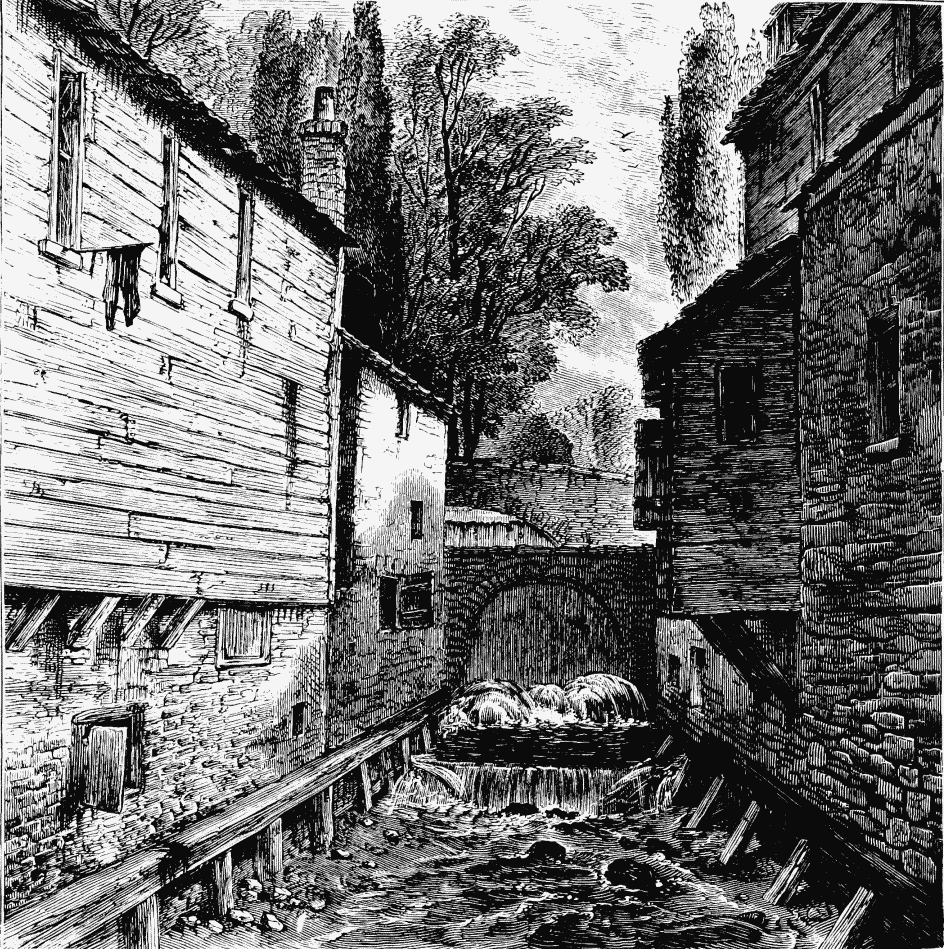
OLD OUTFALL OF THE SERPENTINE AT KNIGHTSBRIDGE, IN 1800. (From Mr. Crace's Collection.)
The Serpentine has been frequently frozen over
so strongly as to realise Virgil's description of a
real English frost in his days, when it might be said
of its water—
"Undaque ferratos a tergo sustinet orbes,
Puppibus illa prius, patulis nunc hospita plaustris."
In the winter of 1814 a fair was held on the ice; and in 1825 a Mr. Hunt for a wager drove a coach and four horses across the Serpentine during a severe frost. In severe winters this fine sheet of water is the favourite resort of the lovers of skating, for whose safety the Royal Humane Society has erected on the north side a neat classic edifice as a receiving-house. It is kept well supplied with boats, ladders, ropes, and everything necessary to the resuscitation and comfort of those who may be suddenly immersed. The building stands on the site of an older one, which had been erected in 1794 upon ground presented by George III. It was erected in 1834, from the designs of Mr. J. Bunning, the first stone being laid by the Duke of Wellington. Over the Ionic entrance is sculptured the obverse of the society's medal—a boy striving to rekindle an almost extinct torch by blowing it, together with the legend, "Lateat scintillula forsan" (Perchance a spark may be concealed). The Royal Humane Society, whose chief offices are in Trafalgar Square, was founded in 1774, by Drs. Goldsmith, Towers, Heberden, and others; and its receiving-houses in the parks cost about £3,000 a year. This society, which is supported by voluntary contributions, publishes accounts of the most approved and effectual methods for recovering persons apparently drowned or dead; and suggests and provides suitable apparatus for, and also bestows rewards on all who risk their lives in, the preservation or restoration of human life. Its records show that during the past twenty-seven years 5,557 persons have been granted the society's honorary rewards for exertions in saving life; and that 13,865,222 persons have bathed and skated in the royal parks and gardens of the metropolis under the care of the society's officers. In that large number there have been 5,357 accidents in which life was in danger, and nearly all were rescued by the society.
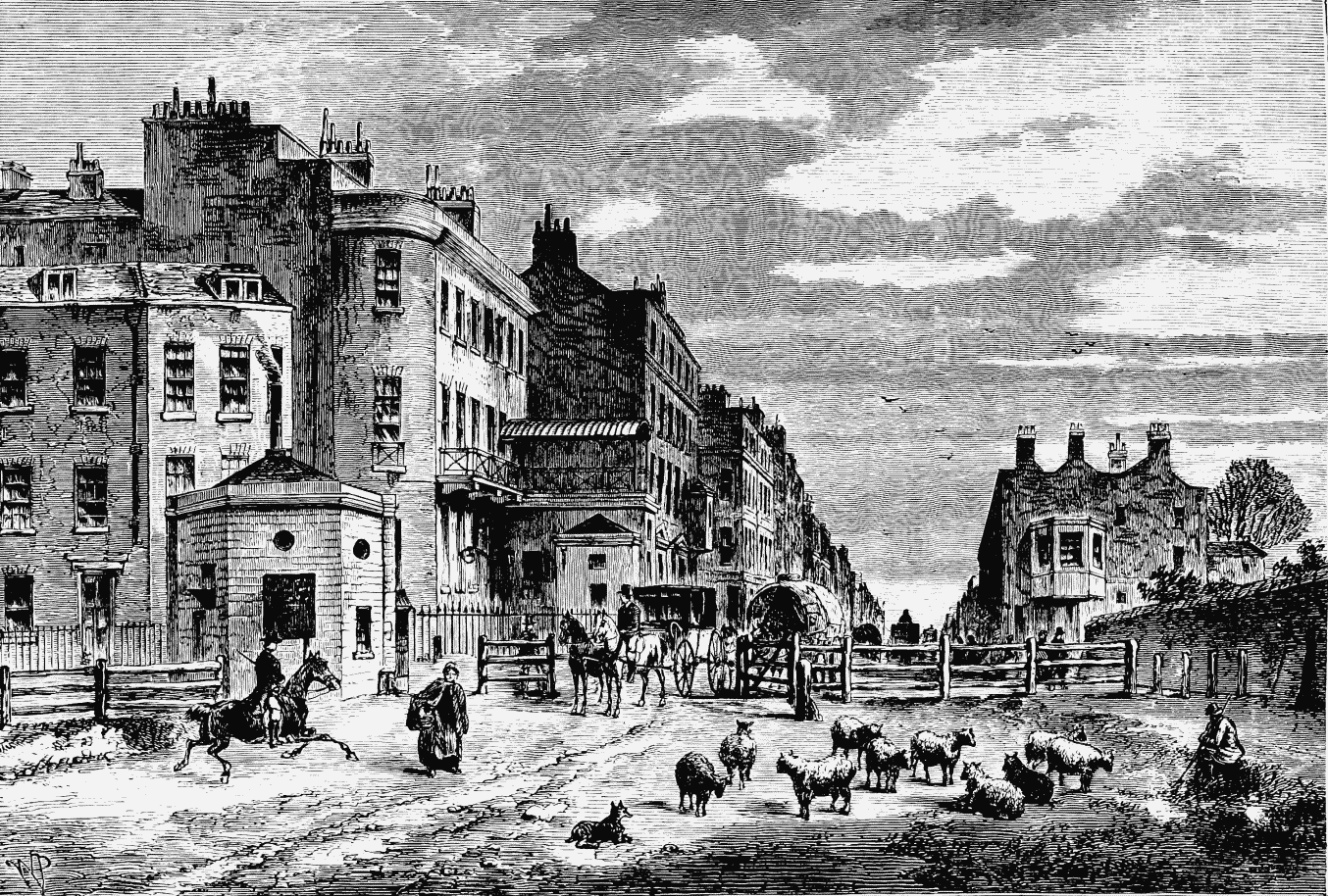
TYBURN TURNPIKE, 1820.
Early in the morning in the summer months the Serpentine is much frequented by bathers; and 12,000 have been known to indulge in the luxury of a bath in one summer day. This, as may be seen from the Report of the Royal Humane Society in 1849, was before the purification of its waters had been effected!
We must not omit to mention here the Serpentine Swimming Club, whose members have done much to ensure the safety of bathers in these waters. In connection with this club, a handsome silver challenge cup is contested for over a distance of 100 yards. The trophy has to be won three times in succession by the same swimmer before he can substantiate his claim to retain it as his absolute property, and is contested on the first Tuesday in each month "all the year round."
Close by the receiving-house are the boathouses where boats are let for hire; and the brightly-painted craft being extensively patronised during the summer, a pleasing and animated scene is presented on the water. The boats were introduced here in 1847, but that was not the first occasion on which a craft had scudded the waters of the Serpentine, for towards the close of the last century the ingenious and inventive Lord Stanhope here launched a model of a steamboat made by his own hands or under his own superintendence. How little did he expect at that time that his son would live to see the day when steam and a pair of paddle-wheels would carry a large ship across the broad Atlantic!
Like "Rosamond's Pond" in St. James's Park, of which we have already spoken in a former chapter, (fn. 8) the Serpentine is a favourite place for suicides, and frequently the spot selected by those unfortunate individuals who may have determined upon ending their existence. Here Harriet Westbrook, the unhappy first wife of the poet Shelley, drowned herself in December, 1816.
Somewhat oddly placed, in juxtaposition with the Royal Humane Society's house, is the great Government store of gunpowder. In this magazine it is stated that upwards of one million of ball and blank ammunition are kept ready for immediate use. Spanning the river near its western extremity, and at the point where it joins Kensington Gardens, is a handsome stone bridge of five arches, which was built from the designs of Sir John Rennie. The view of London from this point is much ad mired.
In 1840 it was proposed by Mr. T. S. Duncombe, then M.P. for Finsbury, that an annual fair should be held in Hyde Park; but the proposition was defeated in the House of Commons. Mr. Raikes, in mentioning the subject in his "Journal," remarks that it would have been "a source of endless riot and disorder among the lower classes, attended with much injury to the localities. It would," he adds, "indeed be preposterous, when all sober men are anxious to abolish Bartholomew Fair in the City, to institute another scene of the same description in the fairest part of the metropolis, and close to the palace." Little did Mr. Raikes or Mr. Duncombe anticipate that, in a few years later—namely, in 1851—the broad piece of ground south of the Serpentine would become the scene of one of the greatest "fairs" the world has ever seen. The Crystal Palace, or "temple of industry and the arts," was indeed frequently spoken of as the "World's Fair." Our notice of this exhibition, together with that of the Prince Consort's Memorial which now marks its site, we must reserve for a future chapter, when dealing with South Kensington and the various Industrial Exhibitions, of which the Great Exhibition of 1851 may be considered the parent.
Some little amusement and excitement, too, was caused in Parliament, in 1850–1, by an old woman named Anne Hicks, who, having been allowed to hold an apple-stall at the east end of the Serpentine, had by sheer importunity contrived to surround herself with a small hovel, and to convert that again into a cottage. When preparations were being made for holding the World's Fair in the Park, it became important to remove this cottage; but Anne Hicks refused to give up possession, and was turned out at last only by force. Her grievance was brought before Parliament, but it was explained that she had no legal rights as against the Crown, and the agitation died away, the poor old woman receiving a small compensation. "Many foreigners were in England at the time," writes Mr. Chambers in his "Book of Days," "and the matter afforded them rather a striking proof of the jealousy with which the nation regards any supposed infraction of the rights of private persons by the Government, even in so small a matter as an apple-stall."
In our time the walk by the "Lady's Mile"—as "Rotten Row" is sometimes called—is frequented by the leaders of fashion; but of late the centre of the Park has come to be looked upon by certain of the working classes as a privileged spot wherein to vent their grievances—real or imaginary—against "the powers that be," and much damage has at times been done by these unruly and disorderly assemblages. On one occasion, in the year 1866, during Mr. Walpole's career as Home Secretary, when the park gates were closed against them, and the right of holding a political meeting in the Park was refused, the mob even went so far as to break down the railings in Park Lane, at the same time doing considerable damage to the shrubs and flowers.
Many of our readers will remember Lord Byron's
description of the Park in one of the later cantos
of "Don Juan:"—
"Those vegetable puncheons
Call'd parks, where there is neither fruit nor flower
Enough to gratify a bee's slight munchings;
But, after all, they are the only 'bower,'
In Moore's phrase, where the fashionable fair
Can form a slight acquaintance with fresh air."
Thanks to various Chief Commissioners of Public Works and Buildings, it can no longer be said with truth that our parks are wholly destitute of flowers, at least; for all along the south, the east, and the north of the drives in Hyde Park there are beds of the gayest geraniums and roses in the summer, and in the spring there are brilliant displays of tulips and hyacinths to gladden the eyes of the Londoners.
Cumberland Gate, which, as we have said, stands at the north-eastern corner of the Park, at the western end of Oxford Street, was erected about 1744, at the expense of the inhabitants of Cumberland Place and its neighbourhood, and took its name after the "Butcher" Duke of Cumberland, the hero of Culloden. It was at first commonly called Tyburn Gate, from the gallows which stood close by. The original gateway was a mean brick building, comprising an arch with side entrances, and had wooden gates. Here took place, in August, 1821, a disgraceful conflict between the people and the soldiery at the funeral of Queen Caroline, when two persons were killed by shots from the Horse Guards on duty. In the following year the unsightly brick arch and wooden gates were removed, and in their place some handsome iron gates were set up, at a cost of nearly £2,000; but in 1851 these gates were removed in order to make room for the marble arch (see page 397) which now occupies the site, and the iron gates placed on each side of it.
The marble arch had, up to that time, stood in front of the chief entrance to Buckingham Palace, bearing the royal banner of England, and carrying the imagination back to that age of chivalry, the departure of which was lamented by Edmund Burke. The arch, which was adapted by Mr. Nash from the Arch of Constantine at Rome, was not included in the design for building the new front of Buckingham Palace. It cost £80,000; the metal gates alone cost £3,000. It was originally intended to have been surmounted by an equestrian statue of George IV., by Sir Francis Chantrey. The material is Carrara marble, and it consists of a centre gateway and two side openings. On each face are four Corinthian columns, the other sculpture being a keystone to the centre archway, and a pair of figures in the spandrils, a panel of figures over each side entrance, and wreaths at each end; these were executed by Flaxman, Westmeath, and Rossi. The centre gates are bronzed, and ornamented with a beautiful scroll-work, with six openings, two filled with St. George and the Dragon, two with "G. R.," and above, two lions passant gardant. They were designed and cast by Samuel Parker, of Argyll Street, and are said to be the largest and most superb in Europe, not excepting those of the Ducal Palace at Venice, or of the Louvre at Paris. The frieze and semicircle intended to fill up the archway—the most beautiful part of the design—were unfortunately mutilated in the removal, and could not be restored.
Of Tyburn toll-gate, which stood nearly opposite Cumberland Gate, and at the corner of the Edgware Road and Cumberland Place, and also of the old gallows which stood a little beyond, we shall have to speak in future chapters.