
Old and New London: Volume 4. Originally published by Cassell, Petter & Galpin, London, 1878.
This free content was digitised by double rekeying. All rights reserved.
'Oxford Street and its northern tributaries: Part 1 of 2', in Old and New London: Volume 4, (London, 1878) pp. 406-441. British History Online https://www.british-history.ac.uk/old-new-london/vol4/pp406-441 [accessed 26 April 2024]
In this section
CHAPTER XXXII.
OXFORD STREET, AND ITS NORTHERN TRIBUTARIES.
"Inter fœmineas catervas."—Horace.
Oxford Street in the Last Century—Figg's Theatre—Great Cumberland Place—Lady Buggin, afterwards Duchess of Inverness—Walpole's Musings on Popularity—Hyde Park Place—Charles Dickens' Last Residence in London—The Portman Family—Edgware Road—Bryanston Street—Spanish and Portuguese Jews' Synagogue—Upper Seymour Street and its Noted Residents—Old Quebec Street—Quebec Chapel—The Cripples' Nursery—Upper Berkeley Street—The West London Jewish Synagogue—St. Luke's Church, Nutford Place—The "Yorkshire Stingo"—The Christian Union Almshouses, John Street—Crawford Street—Homer Street—The Cato Street Conspiracy—St. Mary's Church, Bryanston Square—Montagu and Bryanston Squares—Gloucester Place—Portman Square and its Distinguished Residents—Montagu House and the "Blue-Stocking" Club—Mrs. Montagu and the Chimney-sweepers—Difference between Montagu Matthew and Matthew Montagu—Anecdote of Beau Brummell—John Elwes, the Miser—Baker Street—Madame Tussaud's Exhibition of Waxwork—The Baker Street Bazaar—Royal Smithfield Club—Portman Chapel—Roman Catholic Chapel of the Annunciation—York Place—Cardinal Wiseman—Orchard Street.
Having turned our backs on the fashionable part of London, and reached Tyburn, we may fairly ask for our readers' pardon if, startled and alarmed at the sights which meet us there, we now seek to travel eastwards, retracing our steps towards Bloomsbury by way of Oxford Street, and noting down, as we pass along, all that there is of interest to be told about its northern tributaries. We shall thus be able to look in upon Mrs. Montagu, in Portman Square, to find Lord and Lady Hertford dispensing the hospitalities of their great house in Manchester Square, and to see how the "princely" Duke of Chandos is getting on, not with bricks and mortar, but with marble and cement, in Cavendish Square, before we find ourselves once more in the dull regions which "fashion" has agreed to leave to artists and lawyers. With these few words by way of preface, we proceed along our way.
Oxford Street follows the line of the Via Trinobantina, one of the military roads of the Romans, which bounded the north side of what is now Hyde Park, and continued thence to Old Street (Eald Street), in the north of London. Oxford Street extends from the north-east corner of Hyde Park to the junction of Tottenham Court Road with High Street, St. Giles's, where, as we have already stated, the village pound of St. Giles's formerly stood. (fn. 1) The thoroughfare was formerly called the "Uxbridge Road," "Tyburn Road," and subsequently "Oxford Road," as being the highway to Oxford. Hatton, in 1708, describes it as lying between "St. Giles's pound east, and the lane leading to the gallows west." In a plan published in the above year, the "Lord Mayor's Banqueting House" is shown as standing at the north end of Mill Hill Field, and at the north-east corner of the bridge across Tyburn Brook, which is now covered over by part of Stratford Place. Pennant tells us how that "the Lord Mayor and his brethren of the City used to repair to a building called the City Banqueting House, on the north side of Oxford Street, on horseback, attended by their ladies in waggons, to inspect the conduits, and then to partake of their banquet." A view of the old house, as it appeared in 1750, is given on page 408.
In Ralph Aggas' map of London, published in 1560, it is almost needless to say, the space to the north of Oxford Street, then "the way to Uxbridge," was open country, with fields and hedges, and dotted irregularly with trees; and in Vertue's plan, about a century later, the only building seen between the village of St. Giles's and Primrose Hill is the little solitary church of Marylebone, and still further away in the fields is the little church of St. Pancras, "all alone, old, and weatherbeaten."
Mr. Peter Cunningham says it "is somewhat uncertain when the thoroughfare was first formed into a continuous line of street, and in what year it was first called Oxford Street." Mr. J. T. Smith, in his "Book for a Rainy Day," tells us that "on the front of the first house, No. 1, in Oxford Street, near the second-floor windows, is the following inscription cut in stone: 'Oxford Street, 1725.'" This, however, no longer exists. Lysons, in his "Environs of London," remarks that "the row of houses on the north side of Tybourn Road was completed in 1729, and it was then called Oxford Street. About the same time most of the streets leading to Cavendish Square and Oxford Market were built, and the ground was laid out for several others."There is, it appears, says Mr. Cunningham, "good reason to suppose that it received its present name at a still earlier date; for a stone let into the wall of the corner of Rathbone Place is inscribed: 'Rathbone Place, Oxford Street, 1718.'" In a "Tour through Great Britain, by a Gentleman," published in 1825, it is stated that "A new Bear Garden, called Figg's Theatre, being a stage for the gladiators or prize-fighters, is built on the Tyburn Road. N.B.—The gentlemen of the science taking offence at its being called Tyburn Road, though it really is so, will have it called the Oxford Road." Of Figg's theatre we shall have more to say in a subsequent chapter.
Facing us at the Marble Arch is Great Cumberland Place, formerly Great Cumberland Street, extending northward from Oxford Street to Bryanston Square. This thoroughfare was commenced about the year 1774, and, like the gate opposite leading into the Park, was named after the Duke of Cumberland, the hero of Culloden. On the east side the houses form a semicircle, the original design having been for a complete circus. Here, in 1826, at No. 5, was living Lady Buggin, the widow of Sir George Buggin, and afterwards the morganatic wife of the Duke of Sussex, when she was styled Lady Cecilia Underwood. In 1840 she was created Duchess of Inverness. She died at Kensington Palace, where she had resided for many years, in 1873.
At No. 3 lived for some time at the commencement of this century, Earl Cathcart, K.T., a distinguished general in the army, and colonel of the 2nd Life Guards. His lordship was Commanderin-Chief of the military forces in the expedition to Copenhagen, and died in 1843.
Here is a public-house bearing a portrait-sign of the Duke of Cumberland. Horace Walpole, in 1747, looking upon this sign, and remembering how such signs had everywhere superseded those of Admiral Vernon, the Duke of Ormonde, and other heroes, muses in his agreeable though cynical style on the fleeting nature of popularity, and compares glory itself to a sign-board!
At the western end of Oxford Road stood Tyburn Turnpike (see page 403), whose double gates commanded the Uxbridge and the Edgware Roads, which here branch off, divided by Connaught Terrace. Of the neighbourhood which lies beyond this point, and which is popularly known as "Tyburnia" (just as the district south of Hyde Park is "Belgravia" in common parlance), we shall have more to say hereafter. At present we shall keep ourselves entirely to the eastward of the Edgware Road, and treat it briefly and cursorily.
Hyde Park Place is the name given to a row of mansions overlooking the Park, and built on the right and left of the entrance to Great Cumberland Place. Here, at No. 5, the house of his friend Mr. Milner-Gibson, Charles Dickens, in the spring of 1870, became for a few months a resident, being obliged to stay in London in order to give his farewell readings at St. James's Hall, though his medical advisers in vain dissuaded him from the attempt. Here he wrote more than one number of "Edwin Drood." He left this house at the end of May for the rest and quiet of Gadshill, where he died suddenly on the 9th of the following month.
The moment that we pass to the north of Oxford Street, we find ourselves in far different latitudes from those in which we have lately been travelling. Owing to the comparatively modern period from which the streets and squares hereabouts date, we no longer have the friendly guidance of the honest old chroniclers, Stow and Strype, or even Pennant; and we no longer have before our eyes that embarras de richesse under which we laboured in selecting our materials in treating of the Strand and Whitehall, Pall Mall or Piccadilly. All to the north of Oxford Street was quite a terra incognita in the Stuart days, and there are no contemporary notices from the pens of Pepys and Evelyn to enliven our pages. We must, therefore, be grateful for even small mercies, and pick up with a thankful heart such scanty crumbs of information as may be found in stray magazines and books of anecdote biography. There is one advantage, however, and that is, that we shall move over the ground at a somewhat quicker pace.
We may remark, en passant, that the names of most of the streets and squares in this vicinity are synonymous with the names of the ground landlords, and, in some cases, of their county residences; such, for instance, as Wyndham Street and Place, Orchard Street, Berkeley Street, Portman Square, Bryanston Street and Square, and Blandford Street. These names, of course, were given with reference to the family and estates of the sole landowner of the district of which we are about to speak in this chapter—namely, Edward Berkeley Portman, Viscount Portman, of Bryanston, near Blandford, in Dorsetshire, who was for many years M.P. for Dorset, and for a short time M.P. for Marylebone. The Portmans were a family of distinction in Somerset in the reign of Edward I., but its most distinguished member was Sir William Portman, Lord Chief Justice of England, who died in 1555.
On turning round the corner into the Edgware Road, we notice that there are two houses on our right hand with balconies and verandas, nearly opposite to Connaught Square. These balconies were built in order to accommodate the sheriffs and other officials who were bound to be present at the executions of criminals, who, during the seventeenth and eighteenth centuries, were "turned off" on the gallows which stood about fifty yards on the other side of the road, occupying the site of one of the houses in Connaught Place, or, according to Mr. Peter Cunningham, of a house in Connaught Square. Of this gallows, and of those who suffered the extreme penalty of the law there, we shall have plenty to tell our readers hereafter.
In the early part of the present century the Edgware Road was void of any connected row of houses beyond those already mentioned; but there were one or two public-houses at the corners of rural cross-roads. At one of these, which stood near the corner of Oxford and Cambridge Terrace, it is said that a messenger of Charles I., who was travelling with dispatches incognito, had his saddle ripped open, and was robbed of its contents.
At the time of which we speak, Nutford Place and the other streets which connect Edgware Road with Bryanston Square did not exist; and a gentleman then residing still further north in Chapel Street well remembered that from his back drawing-room windows he could see the troops being reviewed in Hyde Park by George III.
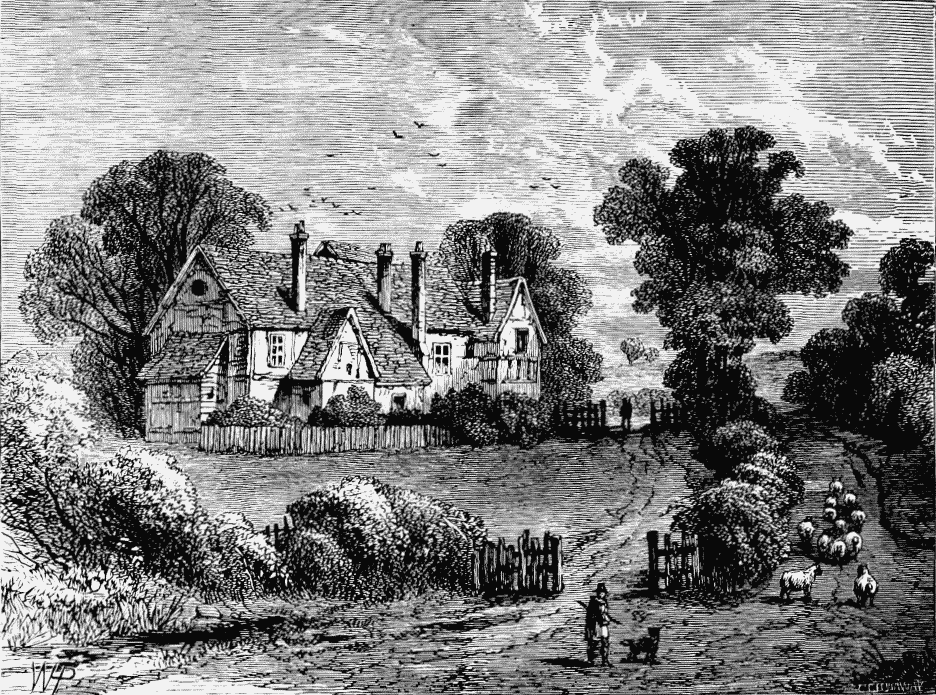
THE LORD MAYOR'S BANQUETING HOUSE, OXFORD ROAD, IN 1750. (From Mr. Crace's Collection.)
Bryanston Street, the first turning in Edgware Road, and extending eastward to Portman Street, was, like the square bearing the same name, so called, as we have shown above, from Bryanstone, in Dorsetshire, the seat of Lord Portman, the ground landlord. The street, which simply consists of some well-built private houses, has no history attached to it to require special mention.
In Upper Bryanston Street is a synagogue, erected for the use of the Spanish and Portuguese Jews residing at the West-end. It is Saracenic in its architecture. The vestibule leads to stone stairs on either side, leading up to the ladies' gallery; while the floor of the synagogue will accommodate about 150 male worshippers.
Upper Seymour Street, the next turning, leading across Great Cumberland Place into Portman Square, was so named after the family of the Seymours, from whom the Portmans descend. Among the distinguished residents of this street have been "Tom" Campbell, the author of the "Pleasures of Memory," who resided at No. 10 whilst editing the New Monthly Magazine, and who here lost his wife. The Corsican General, Paoli, who stood as sponsor to the first Emperor Napoleon, lived for some time at the first house, at the corner of Edgware Road. In Croker's "Boswell" appears a letter from Boswell to Lord Thurlow, dated from "General Paoli's, Upper Seymour Street, Portman Square, 24th June, 1784." According to Mr. Peter Cunningham, it was in the drawing-room of No. 45 in this street, in 1820, then the residence of Lady Floyd, that the late distinguished statesman, Sir Robert Peel, was married to Julia, youngest daughter of General Sir John Floyd, Bart.
Connecting the south side of Seymour Street with Oxford Street, and running parallel with Cumberland Place, is old Quebec Street, which commemorates the capture of Quebec by General Wolfe, in 1759, and probably dates its erection from about that time. Quebec Chapel, so named from the street in which it is situated, is a chapel of ease to Marylebone. It is a square, ugly edifice, dating from 1787, with no pretensions to ecclesiastical fitness, and has been described as nothing but a "large room with sash-windows." Among its ministers have been the amiable and accomplished Dean of Canterbury, Dr. Henry Alford; Dr. Goulburn, afterwards Dean of Norwich; and Dr. Magee, who here first acquired the popularity as a preacher which he carried to so great a height as Bishop of Peterborough.
At No. 14 in this street is a charitable institution bearing the name of the Cripples' Nursery. It was established in 1861, and consists of a home, with religious instruction and medical aid, for infant cripples. This charity has a branch establishment at Margate.
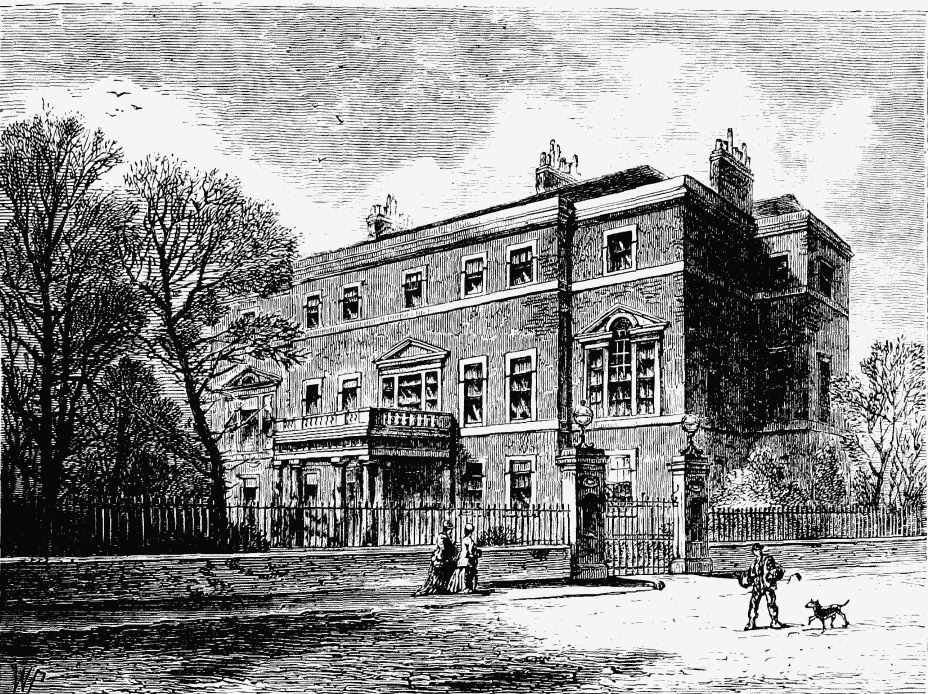
MRS. MONTAGU'S HOUSE, PORTMAN SQUARE.
Connecting Edgware Road with the north side of Portman Square is Upper Berkeley Street. In this street, close by the corner of Edgware Road, is the West London Synagogue, for the congregation of Jewish "dissenters." The building, though monumental in character, is erected on leasehold land belonging to the Portman estate, and was built in the year 1870. The main portion of the structure occupies back land, and the exterior is consequently unseen from the surrounding streets; but the stone entrance-front in Upper Berkeley Street forms a fitting entrance.
The synagogue is constructed of brick, and was erected from the designs of Messrs. Davis and Emanuel, at an expense of about £20,000. The edifice is a domical structure, Byzantine in character, and a square in plan. It has a wide gallery along the two sides and western end, the ceiling consisting of a large central dome, and four small domes in the angles, and four great arches covering the side spaces. This ceiling is supported by four piers of clustered columns of Devonshire marble with carved capitals. At the east end of the building is a domed semi-circular recess, or apse, in which is placed the organ and choir, and in the centre of this apse is placed the ark, which has been constructed of inlaid marble-work. A peculiar feature in this building is the placing of the choir at the east end of the building, facing the congregation, and concealing them from the view of the congregation by a screen of marble containing open-work grilles of gilded metal. The decoration is somewhat peculiar. The highest class of decorative art—namely, subject painting, or figure sculpture—is necessarily absent, the Jews, so far as their religious buildings are concerned, reading literally the Second Commandment.
Many special objects in the building were presented to the synagogue by the wealthier members of the congregation, the ark especially being the gift of the ladies of the Goldsmid family. It may be added that the founders of the congregation of Jewish dissenters, by whom this building was erected, left the orthodox Jewish body some thirty years ago, through just such a communal quarrel as caused old Isaac D'Israeli to leave the religion of his fathers. Starting with a small room in Burton Street, their numbers increased, until about twenty years ago they built for themselves a small synagogue in Margaret Street, and since that time the further increase of their congregation rendered necessary the erection of the building now under notice.
In this street Cyrus Redding occupied lodgings during the greater part of his career as sub-editor of the New Monthly. It was then on the very verge of the country, the town ending at Connaught Place, or thereabouts, as we have already stated.
Proceeding on our way along the Edgware Road, we pass Nutford Place and Queen Street, both of which terminate in Seymour Place. In Nutford Place is St. Luke's Church, a large Gothic edifice, with a tower ornamented with pinnacles, erected in gratitude for the exemption of this district from the visitation of the cholera in 1849.
The western end of Marylebone Road, between the bottom of Lisson Grove and the top of Oxford and Cambridge Terrace, forms of necessity what we may call our "north-west passage," in reference to this portion of our work. The chief object of interest in this neighbourhood, on the south side of the Marylebone Road, is the celebrated "Yorkshire Stingo" tavern. At the early part of the present century there were tea-gardens and a bowling-green attached to this rural inn, which was much crowded on Sundays, when an admission-fee of sixpence was demanded at its doors. For that a ticket was given, to be exchanged with the waiters for its value in refreshments—a plan very commonly adopted even then in such places of resort, in order to exclude the "roughs" and lower orders, and such as would be sure to stroll about without spending anything, because they had no money to spend. It was from this house that the London omnibuses commenced running, in 1829, when first introduced by Mr. Shillibeer.
In John Street, through which we commence our return towards Oxford Street, are the Christian Union Almshouses, for the relief of thirty-eight poor and aged persons, in "full communion with some Protestant church." The almshouses were erected in 1832, and are supported by voluntary contributions.
Extending from John Street to Queen Street is a short thoroughfare called Horace Street. This, it is said, was formerly known as Cato Street, a view of which, as it appeared in 1820, has already been given in this work. (fn. 2) A loft over a stable in this thoroughfare, in the early part of the year 1820, formed the head-quarters of Thistlewood and some other assassins, who designed to murder the leading members of the then Administration. This is known to history as the Cato Street Conspiracy. The building contained but two rooms, which could only be entered by a ladder. The conspirators having mustered to the number of twentyfour, they took the precaution of placing a sentinel below, whilst they prepared for their dreadful encounter. We have already given an account of this affair in treating of Grosvenor Square, the intended scene of the massacre. (fn. 3) Mr. R. Rush, who was residing in London at the time of its occurrence as Minister from the United States, speaks of the conspiracy in the following terms, in his "Court of London:"—
"The assassination plot has continued to be a prevailing topic in all circles since its discovery and suppression. It has caused great excitement, it may almost be said some dismay, so foul was its nature, and so near did it appear to have advanced to success. Thanks were offered up at the Royal Chapel, St. James's, for the escape of those whose lives were threatened. Different uses are made of the events, according to the different opinions and feelings of the people in a country where the press speaks what it thinks, and no tongue is tied. The supporters of Government say that it was the offspring of a profligate state of morals among the lower orders, produced by publications emanating from what they called the 'cheap press,' which the late measures of Parliament aimed at putting down; and added, that it vindicated the necessity and wisdom of those measures. The opponents of Government, who vehemently resisted the measures, insisted in reply, that it was wrong to suppress, or even attempt to interfere with, such publications, since, if every irritated feeling, however unjust might be deemed its causes, were not allowed vent in that way, it would find modes more dangerous."
We learn from Mr. Rush that the convicted prisoners confessed that it was their design, on getting to Lord Harrowby's house, that one of their number should knock at the door with a note in his hand, under pretence of desiring that it should be sent in to his lordship, doing this in such a manner as to cause no suspicion among the passers-by. The rest of the band, from twenty to thirty in number, were to be close at hand, but divided into small groups, so as to be better out of view. The servant who opened the door was to be knocked down by the bearer of the note, when the whole of the band were to rush forward, enter the house, and make for the dining-room, and there have massacred the whole of the ministers and guests, not sparing even the servants if they offered resistance. It is satisfactory to know that this daring gang stood convicted, out of their own lips, of a cool and deliberate murder in design and intention, and that they were not hung without richly deserving their sentence. The conspirators, as we have already mentioned, (fn. 4) were imprisoned in the Tower, and were the last State prisoners lodged there.
Thistlewood was a Lincolnshire man, by birth a gentleman, but reduced by gambling and bill transactions. Cyrus Redding, who met him at Paris, thus speaks of him in his "Recollections:"—"His countenance bespoke indomitable determination. I cannot forget it. He had been subjected to a long imprisonment by Lord Sidmouth, I forget on what account. His unscrupulous character, when driven to extremity, no doubt made him capable of the most revolting crimes." Mr. T. Raikes, in his "Journal," gives the following account of the execution of this villain and his associates:—"It was a fine morning, and the crowd in the Old Bailey was, perhaps, greater than ever was assembled on such an occasion; all the house-tops were covered with spectators; and when we first looked out of the window of the sheriffs' room, there was nothing to be seen but the scaffold, surrounded by an immense ocean of human heads, all gazing upon that one single object. At length the procession issued from the debtors' door, and the six culprits came on, one after the other, and were successively tied up to the gibbet. Thistlewood came first, looking as pale as death, but without moving a muscle of his features or attempting to utter a word, except that when the rope had been adjusted round the neck of him who was next to him, he said, in a low tone to him, 'We shall soon know the grand secret.' Ings, the butcher, appeared in a great state of excitement, almost as if under the influence of liquor; he gave several huzzas, and shouted out to the crowd, 'Liberty for ever!' twice or thrice; but it was evidently a feint to try to interest the bystanders. The last in this odd rank was a dirty-looking black man, who alone seemed to be impressed with a sense of his awful situation; his lips were in continual motion, and he was evidently occupied in silent prayer. At this moment one of the gentlemen of the press, who had posted himself in the small enclosure close to the foot of the scaffold, looked up to Thistlewood with a paper and pencil in his hand, and said, 'Mr. Thistlewood, if you have anything to say, I shall be happy to take it down and communicate it to the public.' The other made him no answer, but gave him a look. As they were about to be launched into eternity, a well-dressed man on the roof of one of the opposite houses got up from his seat, and looking at Thistlewood, exclaimed, in a very loud but agitated voice, 'God bless you! God Almighty bless you!' Thistlewood slowly turned his head to the quarter whence the voice came, without moving his body, and as slowly reverted to his former position, always with the same fixed impassible countenance. The caps were then pulled down, the drop fell, and after some struggles they all ceased to live. The law prescribed that their heads should be severed from their bodies, and held up to public view as the heads of traitors. The executioner had neglected to bring any instrument for the purpose, and we in the sheriffs' room were horrified at seeing one of the assistants enter, and take from a cupboard a large carving-knife, which was to be used instead of a more regular instrument. When we were able to leave the prison, which was not for some time on account of the immense crowd, I drove to Seymour Place, found——at breakfast, and gave him an account of the scene."
At the east end of John Street, and extending thence to Baker Street, is Crawford Street, out of which on either side branch a number of small courts and streets which we need not particularise, with one or two exceptions. The first turning on the left in this thoroughfare, running northward into Marylebone Road, is a small street called Homer Row. At the angle of this street and Marylebone Road stands a handsome Gothic edifice of red brick, with stone facings, and with a high-pitched roof and bell turret. This is a Roman Catholic church, dedicated to the Holy Rosary; the mission was commenced in 1855, and the church built in 1870. The ground floor of the edifice is used as a schoolroom.
Passing along Crawford Street, we cross Seymour Place, which forms a direct communication between Marylebone Road and Seymour Street, near its junction with the Edgware Road. Wyndham Place, the next turning eastward on the right, leads into Bryanston Square, on its north side; opposite, on the north side of Crawford Street, is St. Mary's Church, chiefly noticeable for its lofty semi-circular portico, supported by Corinthian columns, above which rises a graduating spire, surmounted by a cross. It was built in 1823, from the designs of Sir Robert Smirke. Here, in 1838, Miss Letitia E. Landon, the author of "Zenana," and other poetical works, and better known in literary circles by her initials, "L. E. L." was privately married, by her brother, to Mr. George Maclean, Governor of Cape Coast Castle, the scene of her early death. A former vicar of this church was the Rev. J. H. Gurney, celebrated for his zeal in education.
Upper Montagu Street, together with Old and New Quebec Streets, forms a direct line of communication, through Montagu Square, between the Marylebone Road and the western portion of Oxford Street. Montagu Square and also Bryanston Square, which is immediately contiguous to it on the west side, were, according to Mr. John Timbs, "built on Ward's Field, and the site of 'Apple Village,' by David Porter, who was once chimney-sweeper to the village of Marylebone." It has been the fashion to decry these two squares as scarcely deserving of the name. Thus, a writer in the Builder says, "They are mere oblong slips with houses built in dreary uniformity; they are fortunately out of the way, and few people see them." Bryanston Square, however, certainly does not deserve such criticism. In it resided for many years Mr. Joseph Hume, the economical M.P.; and also Sir Francis Freeling, many years Secretary of the General Post Office.
Gloucester Place, the next turning eastward of Montagu Street, extends from Marylebone Road to the north-west corner of Portman Square; it consists of well-built private houses. Making our way down Gloucester Place, we enter Portman Square, one of the most aristocratic of London neighbourhoods. It was formed, or rather commenced, about the year 1764, on land once belonging to the Knights of St. John of Jerusalem. According to Mr. Peter Cunningham, it is described in the last lease granted by the Prior of that Order as "Great Gibbet Field, Little Gibbet Field, Hawkfield, and Brock Stand; Tassel Croft, Boy's Croft, and twenty acres Furse Croft, and two closes called Shepcott Hawes, parcel of the manor of Lilestone, in the County of Middlesex." The north side of the square was first built, and it was nearly twenty years before the whole was finished. This square takes its name from that of the proprietor of the land upon which it is built—namely, William Henry Portman, of Orchard-Portman, in Somersetshire, who died in 1796, and was the ancestor of the present Lord Portman. According to Lambert, who wrote in the year 1806, it is "one of the largest and handsomest squares in the metropolis;" though he complains of the want of correspondence—i.e., of uniformity—in the houses which surround it.
Portman Square was built on high ground, with an open prospect to the north, which gave it a name as a peculiarly healthy part of London. Mrs. Montagu, whom we have already mentioned at Hill Street, Berkeley Square, but whose name is, more than any other, particularly associated with this square, called it the Montpelier of England, and said she "never enjoyed such health as since she came to live in it." It is one of the largest and handsomest squares in London for its general effect, but the houses have no architectural character; and the central enclosure is laid out as a shrubbery. They were, however, built with due consideration for the requirements of the wealthy, and were inhabited by a large number of the "quality" at their first building. In 1822 the following members of the nobility were living in the square:—Lord Clifford, Lord Teignmouth, Earl of Beverley, Lord Lovaine, Lord Kenyon, Lord Petre, Earl Manvers, Earl of Scarbrough, Duke of Newcastle, Countess of Pomfret, Lady Owen, Earl Nelson, Dowager Duchess of Roxburghe, Earl of Cardigan, Dowager Countess of Clonmell, and the Dowager Countess of Harcourt. In this same year lived, at No. 5, Mr. Thomas Assheton Smith, of Tedworth, who might truly be called the pattern and type of the old English sportsman.
No. 12 was the town-house of the late Duke of Hamilton, who married the daughter of William Beckford, the author of "Vathek," and who took a pride in showing on his walls some of the finest paintings in the collection of that connoisseur, which he inherited in right of his wife. At No. 6 lived General Sir John Byng, afterwards FieldMarshal the Earl of Strafford.
Early in the present century No. 40 was the residence of the Right Hon. Hugh Elliot; and Lord Garvagh, the possessor of the celebrated "Aldobrandini Madonna" of Raffaelle, now in the National Gallery, lived at No. 26 for many years.
Sir William Pepperell, the eminent loyalist and royalist, of Rhode Island, in North America, and formerly the richest subject of the Crown in that country, died at his house here, in December, 1816. He was created a baronet in recognition of his loyalty and losses, and a handsome pension was settled on his title. But his son dying before him, his title became extinct, and his pension was not continued to his daughters.
M. Otto, the French ambassador at the Court of St. James's, was living in Portman Square at the time of the short-lived Treaty of Amiens. Peace had long been wished for by the people, and the preliminaries were signed at Lord Hawkesbury's office in Downing Street, on the 1st of October, 1801. On the arrival in London of General Lauriston, first aide-de-camp to Napoleon, with the French ratifications, he was greeted with enthusiastic cheers by a vast concourse of people. Some of the men took the horses from his carriage, and drew him to M. Otto's house with tumultuous expressions of joy.
A very curious print is in existence showing the illumination of M. Otto's house in celebration of this event. On the front was a row of large oillamps forming the word "Concord," and on either side were the initials "G. R.," for "George III.," and "R. F.," "République Française"—the first time, no doubt, and probably the last, on which those two names stood united. This illumination was somewhat unfortunate, for a London mob, unwittingly, interpreted "Concord" into "Conquered." All the ambassador's windows were smashed in consequence. When the word "Concord" was removed, its place was supplied by "Amitié;" but the stupid mob read this as "Enmity," and insisted on its removal also. Mr. Planché, who was present, writes: "The storm again raged with redoubled fury. Ultimately, what ought to have been done at first was done: the word 'Peace' was displayed, and so peace was restored to Portman Square for the evening."
The chief interest of Portman Square, however, centres in the large house—lately rebuilt or re-cased with red brick—standing by itself in a garden at the north-west corner; this was originally built for the once celebrated Mrs. Montagu, of "Bluestocking" notoriety, whose memory has of late years been revived by Dr. Doran, by the publication of some of her letters in a volume entitled, "A Lady of the Last Century." As we have stated in a previous chapter, this distinguished lady removed hither from Hill Street, Berkeley Square, a few years after the death of her husband, Edward Montagu, of whose family Lord Rokeby is the head.
Elizabeth Robinson—for such was Mrs. Montagu's maiden name—was born at York, in 1720, and, as we learn from Dr. Doran's interesting book, she was a lively girl, loving fun and pursuing learning, so that the Duchess of Portland nicknamed her La petite Fidget. In 1742 she married Edward Montagu, M.P., a mathematician of eminence, and a coal-owner of great wealth, after which event she became more sober, and told her friend the duchess that her "fidgetations" were much spoiled. She became a power in the literary world, and was the founder, or, at all events, one of the chief leaders, of the celebrated "Blue-Stocking Club." Her house in Hill Street, as we have already shown, became a favourite resort of statesmen, poets, and wits; and the young aspirant for fame felt that he had his foot on the first rung of the ladder when he was invited to her table. Indeed, her name will be known to all our readers as emphatically "the Englishwoman of letters" of the eighteenth century, for in that respect she stood unrivalled. Let us look for a moment at her as portrayed in 1776, by the pen of Sir N. W. Wraxall. He writes: "At the time of which I speak, the 'Gens de Lettres,' or 'Blue Stockings' as they were commonly termed, formed a very numerous, powerful, and compact phalanx in the midst of London. … Mrs. Montagu was then the Madame du Deffand of the English capital; and her house constituted the central point of union for all those persons who were already known, or who sought to become known, by their talents and productions. Her supremacy, unlike that of Madame du Deffand, was indeed established on more solid foundations than those of intellect, and rested on more tangible materials than any which her 'Essay on Shakespeare' could furnish her. . . . Impressed, probably from the suggestions of her own deep knowledge of the world, with a deep conviction of that great truth laid down by Molière, which no man of letters ever disputed, that 'Le vrai Amphytrion est celui chez qui l'on dine,' Mrs. Montagu was accustomed to open her house to a large company of both sexes, whom she frequently entertained at dinner. A service of plate, and a table plentifully covered, disposed her guests to admire the splendour of her fortune, not less than the lustre of her talents. She had found the same results flowing from the same causes during the visit which she made to Paris, after the Peace of 1763, where she displayed to the astonished literati of that metropolis the extent of her pecuniary as well as of her mental resources. As this topic formed one of the subjects most gratifying to her, she was easily induced to launch out on it with much apparent complacency. The eulogiums lavished on her repasts, and the astonishment expressed at the magnitude of her income, which appeared prodigiously augmented by being transformed from pounds sterling into French livres, seemed to have afforded her as much gratification as the panegyrics bestowed upon the 'Essay on the Genius and Writings of Shakespeare.'
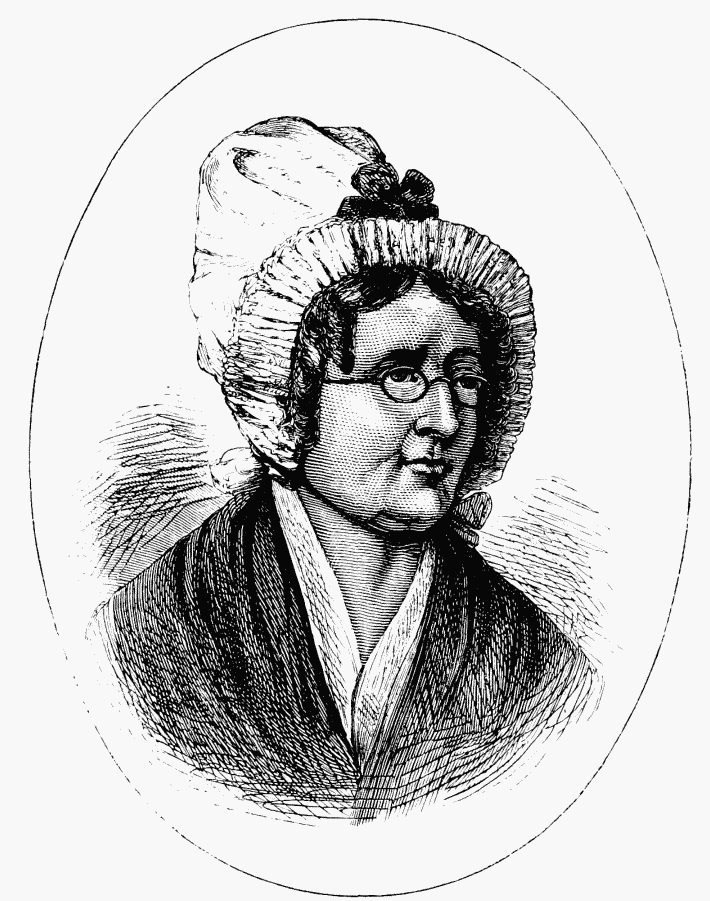
MADAME TUSSAUD.
"Mrs. Montagu, in 1776, verged towards her sixtieth year; but her person, which was thin, spare, and in good preservation, gave her an appearance of less antiquity. From the infirmities often attendant on advanced life she seemed to be almost wholly exempt. All the lines of her countenance bespoke intelligence, and her eyes were accommodated to her cast of features, which had in them something satirical and severe, rather than amiable and inviting. She possessed great natural cheerfulness, and a flow of animal spirits; loved to talk, and talked well on almost every subject; led the conversation, and was qualified to preside in her circle, whatever subject of discourse was started; but her manner was more dictatorial and sententious than conciliating or diffident. There was nothing feminine about her; and though her opinions were usually just, as well as delivered in language suited to give them force, yet the organ which conveyed them was not musical. Destitute of taste in disposing the ornaments of her dress, she nevertheless studied or affected those aids more than would seem to have become a woman professing a philosophic mind intent on higher pursuits than the toilet. Even when approaching to fourscore, this female weakness still accompanied her; nor could she relinquish her diamond necklace and bows, which, like Sir William Draper's 'blushing riband,' commemorated by 'Junius,' formed of evenings the perpetual ornament of her emaciated person. I used to think that these glittering appendages of opulence sometimes helped to dazzle the disputants whom her arguments might not always convince, or her literary reputation intimidate. That reputation had not as yet received the rude attack made on it by Dr. Johnson at a subsequent period, when he appears to have treated with much irreverence her 'Essay on Shakespeare,' if we may believe Boswell. Notwithstanding the defects and weaknesses that I have enumerated, she possessed a masculine understanding, enlightened, cultivated, and expanded by the acquaintance of men as well as of books. Many of the most illustrious persons in rank no less than in ability, under the reigns of George II. and III., had been her correspondents, friends, companions, and admirers. Pulteney, Earl of Bath, whose portrait hung over the chimney-piece in her drawing-room, and George, the first Lord Lyttelton, so eminent for his genius, were among the number. She was constantly surrounded by all that was distinguished for attainments or talents, male or female, English or foreign; and it would be almost ungrateful in me not to acknowledge the gratification derived from the conversation and intercourse of such a society."
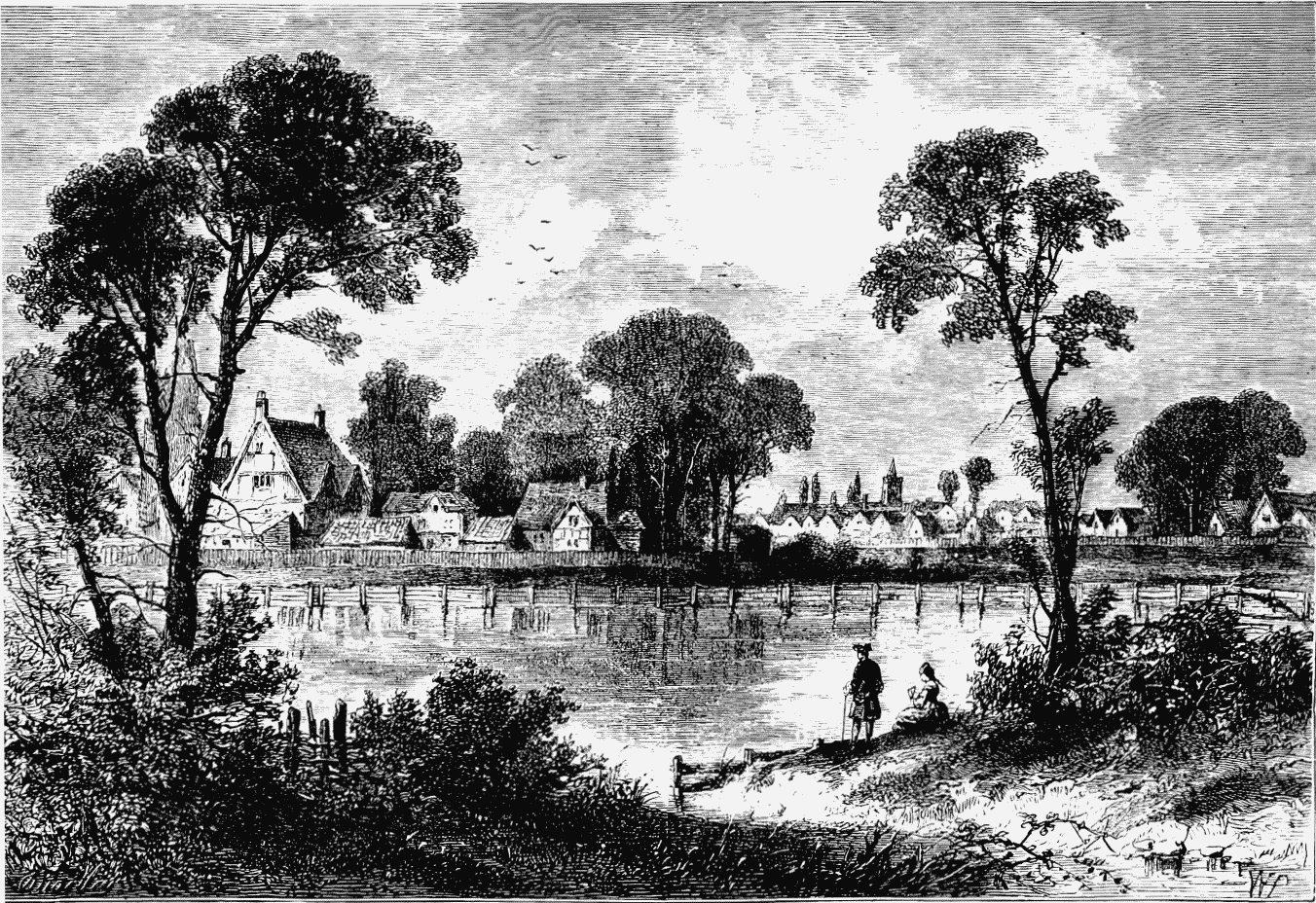
MARYLEBONE IN 1740. (From an Old Print.)
Lord Bath thought there never was a more perfect being than Mrs. Montagu, and Edmund Burke was inclined to agree with him. Hannah More describes her as combining "the sprightly vivacity of fifteen with the judgment and experience of a Nestor;" and Cowper, after he had read her "Essay on the Genius of Shakespeare," no longer wondered that she stood "at the head of all that is called learned."
Boswell tells us that when Reynolds, Garrick, Johnson, Goldsmith, and a knot of literary friends were dining with him in Old Bond Street in 1769, and mention was made of Mrs. Montagu's "Essay on Shakespeare" by Reynolds, who remarked that it "did her honour," Dr. Johnson replied, sharply, "Yes, sir, it does her honour, but it would do honour to nobody else. . . . I will venture to say that there is not one sentence of true criticism in her book." And yet the burly doctor was not above accepting the hospitality of the lady of whom he spoke thus lightly; but then it must be remembered that it was Mrs. Montagu who made the witty and most truthful remark, that "were an angel called upon to give the imprimatur to Dr. Johnson's works, they would not have to be curtailed by a single line."
On another occasion, as his biographer informs us, Johnson had formed one of a party one evening at Mrs. Montagu's, where a splendid company had assembled, consisting of the most eminent literary characters. "I thought," adds Boswell, "he seemed highly pleased with the respect and attention that were shown him; and asked him, on our return home, if he was not 'highly gratified by his visit.' 'No, sir,' said he, 'not highly gratified; yet I do not recollect to have passed many evenings with fewer objections.'"
The Blue-Stocking Club was the name given to a society of ladies who met at Mrs. Montagu's house, which had for its object the substitution of the pleasures of rational conversation for cards and other frivolities. The name, as Mr. Forbes tells us, in his "Life of Beattie," originated in this manner:—
"It is well known that Mrs. Montagu's house was at that time (1771) the chosen resort of many of those of both sexes most distinguished for rank, as well as classical taste and literary talent, in London. This society of eminent friends consisted, originally, of Mrs. Montagu, Mrs. Vesey, Miss Boscawen, and Mrs. Carter; Lord Lyttelton, Mr. Pulteney, Horace Walpole, and Mr. Stillingfleet. To the latter gentleman, a man of great piety and worth, and author of some works in natural history, &c., this constellation of talents owed that whimsical appellation of 'Bas Bleu.' Mr. Stillingfleet being somewhat of a humorist in his habits and manners, and a little negligent in his dress, literally wore grey stockings; from which circumstance Admiral Boscawen used, by way of pleasantry, to call them 'The Blue-Stocking Society,' as if to intimate that when these brilliant friends met, it was not for the purpose of forming a dressed assembly. A foreigner of distinction hearing the expression, translated it literally 'Bas Bleu,' by which these meetings came to be afterwards distinguished." This account is corroborated, we may here remark, by Forbes, in his "Life of Beattie," almost in the very words here used.
If we may rely on the statement of John Timbs, in his amusing sketches of "Clubs and Club Life," the earliest mention of a Blue Stocking, or Bas Bleu, coterie is to be found in "a Greek comedy entitled The Banquet of Plutarch," but which we rather imagine to be the "Symposium of Plato." He adds, "The term as applied to ladies of high literary tastes, has been traced by Mills, in his 'History of Chivalry,' to 'the Société de la Calza, formed at Venice in A.D. 1400, when consistently with the character of the Italians of marking academies and other intellectual associations by some external sign of folly, the members when they met in literary discussion were distinguished by the colour of their stockings. These colours were sometimes fantastically blended; and at other times a single colour, especially blue, prevailed.' The Société de la Calza lasted till 1590, when the foppery of Italy took some other symbol. The rejected title then crossed the Alps, and found a congenial soil in Parisian society, and particularly branded female pedantry. It then passed from France to England, and for a while marked the vanity of the small advances in literature in female coteries." So far Mr. John Timbs.
Boswell, who writes, in his "Life of Johnson," under date 1781, gives a very similar account of the matter to that of Mr. Forbes, already quoted, in the following terms:—"About this time it was much the fashion for several ladies to have evening assemblies, where the fair sex might participate in conversation with literary and ingenious men animated by a desire to please. One of the most eminent members of these societies was a Mr. Stillingfleet (a grandson of the bishop), whose dress was remarkably grave; and in particular it was observed that he wore blue stockings. Such was the excellence of his conversation, and his absence was felt so great a loss, that it used to be said, 'We can do nothing without the blue stockings!' and thus by degrees the title was established." Miss Hannah More has admirably described a Blue-Stocking Club in her "Bas Bleu," a poem in which many of the persons who were most conspicuous there are mentioned; and Horace Walpole speaks of this production as a "charming poetic familiarity, called 'the Blue-Stocking Club!'"
The circle at Mrs. Montagu's used to include nearly all the persons of her time who were celebrated in art, science, or literature, including not only Boswell and Johnson—the latter of whom, in the presence of ladies, forgot his rough and rude manners—but Miss Burney, the author of "Evelina," and also Dr. Monsey, of Chelsea College, the fashionable physician, who used to send to his lady-hostess the compliment of a poem as often as her birthday returned.
After thirty-three years of married life, Edward Montagu left his distinguished wife a widow well provided for, with an income of £7,000 a year. She soon afterwards entertained thoughts of leaving Hill Street for the more northern district of Marylebone, and decided on building for herself a mansion in Portman Square. During its erection, it is related, she watched its progress with much interest. In one of her letters, Mrs. Montagu says, "I will get the better of my passion for my new house, which is almost equal to that of a lover to a mistress whom he thinks very handsome and very good, and such as will make him enjoy the dignity of life with ease;" and in another she writes, "It is an excellent house, finely situated, and just such as I have always wished, but never hoped to have."
In the year 1781, just six years after the death
of her husband, the mansion was ready for her
occupation, and she at once proceeded to transfer
her household goods hither. Some three years
previously, as we learn from one of her letters, she
had "bought a large glass at the French ambassador's sale, and some other things for my new
house, pretty cheap." One of the rooms in the
new house was ornamented in a novel manner with
"feather hangings," and Mrs. Montagu begged all
sorts of birds' feathers from her friends. She tells
one correspondent that "the brown tails of partridges are very useful, though not so brilliant as
some others;" and another she asks for "the neck
and breast feathers of the stubble goose. Things
homely and vulgar are sometimes more useful than
the elegant, and the feathers of a goose may be
better adapted to some occasions than the plumes
of the phœnix." On this unique room, where Mrs.
Montagu held her court, Cowper wrote, in 1788,
some lines commencing as follows:—
"The birds put off their every hue
To dress a room for Montagu;
The peacock sends his heavenly dyes,
His rainbows and his starry eyes;
The pheasant, plumes which round infold
His mantling neck with downy gold;
The cock his arch'd tail's azure show;
And, river-blanched, the swan his snow;
All tribes beside of Indian name,
That glossy shine or vivid flame,
Where rises and where sets the day,
Whate'er they boast of rich and gay,
Contribute to the gorgeous plan,
Proud to advance it all they can.
This plumage neither dashing shower
Nor blasts that shake the dripping bower,
Shall drench again or discompose,
But screen'd from every storm that blows,
It boasts a splendour ever new,
Safe with protecting Montagu."
The excitement that seems to have pervaded the mind of Mrs. Montagu during the erection of her new house, and the satisfaction which she evinced on its completion, does not appear to have worn off after she took up her residence there, notwithstanding that she was then getting well advanced in years, for we find her afterwards writing:—"I am a great deal younger, I think, since I came into my new house; from its cheerfulness, and from its admirable conveniences, less afraid of growing old. My friends and acquaintances are much pleased with it." In this last particular she was quite correct, for Walpole, who was not over-prone to praise the hobbies of others, wrote as follows to Mason:—"On Tuesday, with the Harcourts, at Mrs. Montagu's new palace, and was much surprised. Instead of vagaries, it is a noble, simple edifice. Magnificent, yet no gilding. It is grand, not tawdry, not larded, embroidered, and pomponned with shreds and remnants, and clinquant like the harlequinades of Adam, which never let the eye repose an instant."
Mrs. Montagu, however, used to give here, not only splendid entertainments to the Blue-Stocking Club and to a large circle of literary friends and persons of the highest distinction, but also annually, on the 1st of May, a feast on the lawn before her doors to all the chimney-sweepers in London. A writer in Cassell's Magazine, for May 24, 1873, remarks: "It is not generally known that this celebration took its rise in a case of kidnapping which occurred—not to one of her children, for she never had any, but to some member of her own or of her husband's family. It is said that the boy whose restoration she thus commemorated was stolen by chimney-sweeps when only three or four years old, and was brought back unintentionally to the house by some members of the sooty confraternity, when sent for to sweep the chimneys of her town mansion. If so, the only wonder is that none of our modern versifiers have seized on the incident as the subject of a poem."
The Blue-Stocking gatherings, however, did not
thrive very long in the new house, for many of
their chief supporters had passed away. Mrs.
Montagu's breakfasts, however, were continued;
but they became more sumptuous, and her rooms
were often overcrowded. In 1788 Mrs. Montagu
adopted giving teas, a fashion introduced from
France by the Duke of Dorset. Three years
before Cumberland had written an essay in the
Observer on the assemblies at Montagu House, in
which he lightly satirises the hostess as "Vanessa,"
and her assembly as the "Feast of Reason."
Cowper afterwards more politely wrote:—
"There genius, learning, fancy, wit,
Their ruffled plumage calm refit."
In the year 1800 Mrs. Montagu died, when the mansion passed to her nephew, Mr. Matthew Montagu, who had taken that surname in lieu of his patronymic Robinson, on being made heir to her estate. In Sir N. W. Wraxall's "Memoirs of his Own Times," there is an amusing anecdote relating to the confusion as to this gentleman's name, after he entered the House of Commons. There appears to have been some difficulty in distinguishing between Matthew Montagu and Montagu Matthew, until "General Matthew himself thus defined the distinction: 'I wish it to be understood,' said he, 'that there is no more likeness between Montagu Matthew and Matthew Montagu than between a chestnut-horse and a horse-chestnut.'"
After Mrs. Montagu's death the house was for some time occupied by the Turkish ambassador, who erected in the garden a "kiosk," or movable temple, where he used to sit and smoke in state, surrounded by his Eastern friends. In the year 1835 Montagu House is given as the address of the Right Hon. Henry Goulburn, M.P., Chancellor of the Exchequer under Sir Robert Peel, who married a daughter of Lord Rokeby, one of the Montagus. The mansion, however, remained in the possession of the Montagu family down to the year 1874, when the lease having expired, it has reverted into the hands of the ground-landlord, Lord Portman, whose family have made it their London residence. The pleasant memory of Mrs. Montagu, however, still survives in the Square, Place, and Street named after her.
In connection with Portman Square, a laughable anecdote is told concerning Beau Brummell, which may bear repeating. It was first related in the New Monthly Magazine. It appears that Brummell was once at an evening party in the square. On the removal of the cloth, the snuff-boxes made their appearance, and Brummell's was particularly admired; it was handed round, and a gentleman, finding it somewhat difficult to open, incautiously applied a dessert-knife to the lid. Poor Brummell was on thorns; at last he could not contain himself any longer, and addressing the host, said, with his characteristic quaintness, "Will you be good enough to tell your friend that my snuff-box is not an oyster?"
"The neighbourhood," writes Malcolm, in 1807, is distinguished beyond all London for its regularity, the breadth of its streets, and the respectability of the inhabitants, the majority of whom are titled persons, and those of the most ancient families."
One of the largest builders of houses in this neighbourhood was John Elwes, the well-known miser and M.P., who is said to have made a very large addition to his fortune by building speculations, especially about Portman Street, which opens into Oxford Street from the south-west corner of the square. In this street Queen Caroline took up her residence, in 1820, in the house of Lady Anne Hamilton, one of her Ladies of the Bedchamber.
On the east side of Portman Square, extending north and south, are Baker Street and Orchard Street. The former street, which runs into the Marylebone Road, was named after Sir Edward Baker, of Ranston, a neighbour of the Portmans, in Dorsetshire, and who seems to have lent Mr. Portman a helping hand in developing the capacities of his London estate. It consisted, at the commencement of this century, chiefly of private houses, now, however, mostly turned to business purposes. At No. 64 in this street, in the year 1800, was living Lord Camelford, who, four years later, was killed in a duel with a Mr. Best, in the grounds behind Holland House. In the year 1820 the Right Hon. Henry Grattan, the distinguished Irish orator, died at his residence in this street.
In 1826 No. 3 was in the occupation of Lord William Lennox. Mr. Thomas Spring Rice, M.P., afterwards Lord Monteagle, was at that time living in this street; and No. 69 was the residence of John Braham, the singer, already mentioned by us in our account of St. James's Theatre. (fn. 5)
This street has at various times been the locale of exhibitions of a popular character, which have come and gone, and their memory soon perished. One, however, has at all events remained, and shown that it has in it the elements of permanence, and of this we will now proceed to speak. Madame Tussaud's exhibition of wax-work figures of the celebrities of the past and present age has been established in Baker Street for a period of forty years. In our account of Fleet Street we have noticed the wax-works of Mrs. Salmon, (fn. 6) which have passed away, while those of Madame Tussaud seem destined to survive the present era. They were originally commenced in Paris about the year 1780, and brought, in 1802, to London, where they formed for a time the chief attraction of what is now the Lyceum, in the Strand, and afterwards at the Hanover Square Rooms. Madame Tussaud subsequently travelled with her exhibition from town to town, and in the course of twelve years succeeded in forming a goodly collection and a small sum of money. She then resolved to visit Ireland; but in the transit the vessel in which she had embarked her all was wrecked, and with great difficulty the lives of the passengers were saved; so that when she landed at Cork with her boys she found herself penniless. She then began the world anew, and this time with still greater success; and thus she was, as it were, twice the architect of her own fortune. In 1833 she came again to London, and founded her "unrivalled" collection in Baker Street; and it has since gone on increasing, till it now includes upwards of 300 specimens, ranging from William the Conqueror down to the Duchess of Edinburgh and the impostor Arthur Orton. Of the founder of this collection, Madame Tussaud, who died in 1850, at the age of ninety, we know that she was a native of Berne, in Switzerland, and that when a child she was taught the art of modelling figures in wax by an uncle. Coming to Paris, she taught drawing and modelling to Madame Elizabeth, the daughter of Louis XVI. and of Marie Antoinette, and mixed in the best society of the French capital, where she became acquainted with Voltaire, Rousseau, La Fayette, Mirabeau, and the other heads of the party opposed to royalty. She found it convenient, however, to accept the hospitality of England, and accordingly settled here as a refugee.
The exhibition is approached through a small hall, and by a wide staircase, which leads to a saloon at its summit, richly adorned by a radiant combination of arabesques, artificial flowers, and mirrored embellishments. From the saloon the great room is at once entered. This is a gorgeous apartment—in fact, almost an "exhibition" in itself Its walls are panelled with plate-glass, and richly decorated with draperies, and burnished gilt ornaments in the Louis Quatorze style. The principal statues and groups are placed round the four sides of the room, and the larger scenic combinations of figures in the centre of the room. The objects exhibited here are constantly varied, according to the public interest which they excite. Some, however, are shown en permanence, being never out of date. Of these the most noteworthy are the recumbent effigies of Wellington and Napoleon; of Henry VIII. and his six wives; Queen Victoria, the Prince Consort, and the different members of the royal family; Voltaire (taken from life a few months before his death), and a coquette of the period; Lord Nelson, the cast taken from his face; and a series of the kings and queens of England, from William the Conqueror to Queen Victoria. The apartment called the "Hall of Kings" has a ceiling painted by Thornhill; and in the richlygilt chamber adjoining is George IV. in his coronation robes, which, with two other velvet robes, cost, it is said, £18,000; the chair is the "homagechair" used at the coronation. The "Napoleon" room contains an interesting collection of trophies and relics connected with the first emperor, besides a fine series of portraits of the Bonaparte family. The last apartment entered, which bears the not very pleasant-sounding name of the "Chamber of Horrors," contains, as may be inferred, an array of portrait-models of some of the greatest criminals of the age, including those of the Mannings, Greenacre, and Wainwright type. Here, too, are casts of the bleeding and dying heads of Robespierre, Marat, Fouquier, and various horrible relics and mementos, even to a model of the guillotine itself. Although to view this chamber an extra charge is made, such is the love of the marvellous, that but few persons decline to enter it, the ladies especially liking to "have their flesh made to creep."
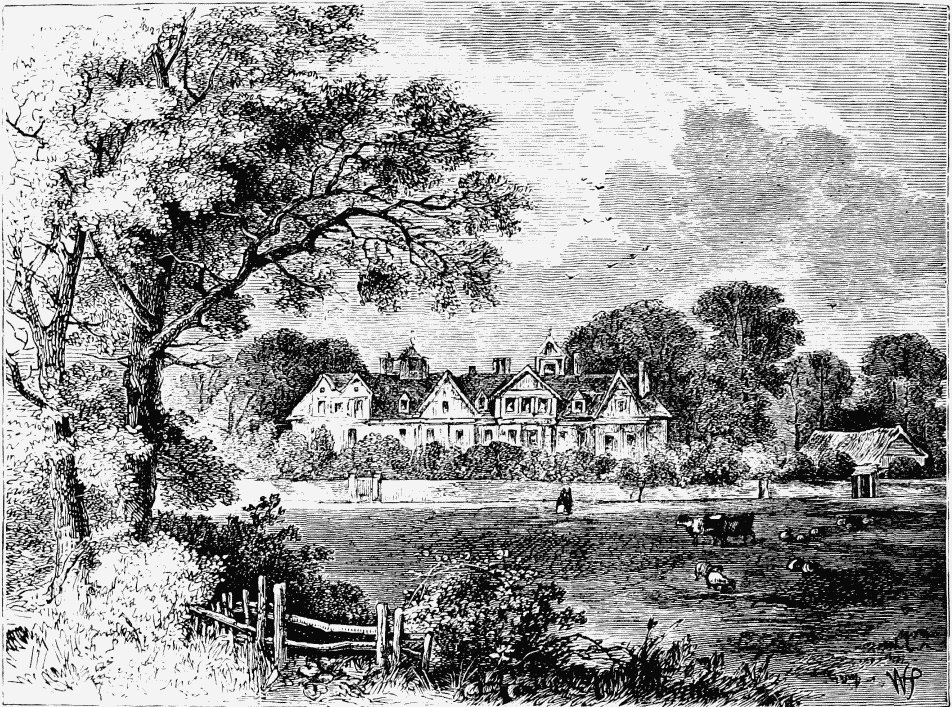
THE OLD MANOR HOUSE, MARY-LE-BONE, IN THE TIME OF QUEEN ELIZABETH. (From an Old Print.)
Ingenious as these wax-works were, they are but a proof of the old saying, that there is nothing new under the sun; for we have already been introduced (fn. 7) to the wax-work effigies of our sovereigns, &c., in Westminster Abbey; and we read in the first volume of the "Entertaining Correspondent," published in 1739, a long account of a group of wax-work figures to be seen in the Maze at Amsterdam, representing the scene of the Nativity of our Lord in the manger at Bethlehem; and the proverb is further confirmed by Mr. Isaac D'Israeli, in his "Curiosities of Literature," published in 1791. The author, after mentioning several attempts to produce exhibitions of wax-work in London, though not very successful ones, adds the following:—"There was a work of this kind which Menage has noticed, and which must have appeared a little miracle. In the year 1675 the Duke of Maine received a gilt cabinet, about the size of a moderate table. On the door was inscribed The Chamber of Wit. The inside displayed an alcove and a long gallery. In an arm-chair was seated the figure of the duke himself, composed of wax, the resemblance the most perfect imaginable. On one side stood the Duke de la Rochefoucault, to whom he presented a paper of verses for his examination. M. de Marcillac, and Bossuet, Bishop of Meaux, were standing near the arm-chair. In the alcove Madame de Thianges and Madame de la Fayette sat retired, reading a book. Boileau, the satirist, stood at the door of the gallery, hindering seven or eight bad poets from entering. Near Boileau stood Racine, who seemed to beckon to La Fontaine to come forward. All these figures were formed of wax, and this imitation must have been at once curious and interesting."
The basement-floor of the building is devoted to other purposes, and is known as the "Baker Street Bazaar." It was originally called the "Portman Bazaar," and had its chief entrance in King Street. It was at first established for the sale of horses; but carriages, harness, furniture, and other household goods are the only commodities now exhibited for sale. Here, in 1829, was given what the advertisements style a "magnificent exhibition of musical and mechanical automata, comprising nearly twenty different subjects, including the celebrated musical lady, juvenile artist, magician, ropedancer, and walking figure; also a magnificent classic vase, made by order of Napoleon; together with a serpent, birds, insects, and other subjects of natural history; the whole displaying, by their exact imitations of animated nature, the wonderful powers of mechanism." Here, about the year 1845, was started a field of artificial ice for skating, but it did not take with the public, and was soon given up. It is not a little singular, that the attempt to anticipate the pleasures of the skatingrinks, now so generally popular with the rising generation, should have been a failure. Here, too, the Royal Smithfield Club held its annual Cattle Show, from 1839 down to 1861, when it was removed to the Agricultural Hall at Islington. The late Prince Consort was an exhibitor on several occasions, and carried off several prizes here in 1844, and again in 1850.
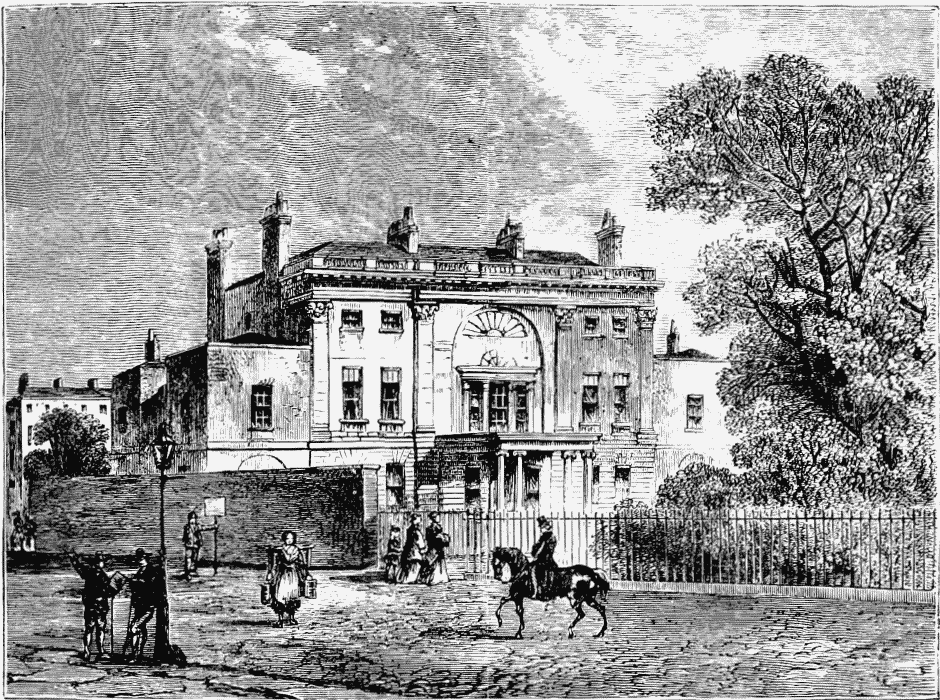
MANCHESTER HOUSE.
From Mr. Gibbs's "History of the Origin and Progress of the Smithfield Club," we learn that it was founded in 1798 by a party of noblemen and gentlemen, including the Duke of Bedford, Lords Somerville and Winchilsea, and Sir Joseph Banks. Its first exhibitions were held in Smithfield, then in Barbican, and in one or two other places in that neighbourhood; and it did not move westwards hither till 1839, when the receipts taken at the doors of the bazaar amounted to only £300. Her Majesty paid a visit to the cattle show here in 1844, and the Prince Consort, who had become a member of the Smithfield Club on his marriage, carried off several prizes at the annual exhibitions held here with his cattle bred at his model farm in Windsor Park. The members of the Smithfield Club made an award of prizes, in the shape of gold and silver medals, silver cups, &c., for the successful competitors with live stock, agricultural implements, &c.
On the east side of Baker Street, at the corner of Adam Street, is Portman Chapel, a chapel of ease to Marylebone Parish Church. Like most of its neighbours, it is a dull, heavy, unecclesiasticallooking structure, and offers little or no subject for remark.
The streets which run crosswise between Gloucester Place and Baker Street, on its western side, such as George, King, Dorset, Crawford, and York Streets, if they have about them little of personal or historic interest, and are even less remarkable in an architectural point of view, at all events bear testimony to the loyalty of the House of Portman, and their attachment to their native county of Dorset. Between King Street and George Street, in a sort of mews and side passage, "gracefully retreating" from the public view, as became a chapel of Roman Catholics, when they lay under penal laws, but nestling safely under the wing of the French ambassador's house, is the Chapel of the Annunciation. This chapel was built in the reign of George III., and has always been the place whither the sovereigns of France have resorted to hear mass when in this country, and where masses are said for the repose of the souls of French royalty after death; and though a small and poor edifice, and concealed in a back street which is little better than a mews, it has a history of its own which cannot be omitted here. It was founded by some of the emigrés who sought an asylum in England on the outbreak of the French Revolution in 1791, and who opened it in 1793, having previously celebrated the divine offices in a house in Paddington Street, not far off. It is said that many of the clergy, and even members of the French court, aided the workmen with their own hands in building the walls. It was solemnly blessed and dedicated on the 15th of March, 1799. Here most, if not all, of the Bourbon kings and princes who have come to England as exiles or as visitors—Louis XVIII., Charles X., Louis Philippe and Queen Amelie, the Duchesse d'Angoulême, &c.—have always heard mass; to say nothing of the Emperor Louis Napoleon, the Empress Eugenie, and their son. Here have been preached the oraisons funêbres of the Abbé Edgworth, of the Duc d'Enghien, and of very many royal and distinguished personages of foreign countries, such as the King of Portugal, Queen Mary Josephine of Savoy, Chateaubriand, Count de Montalembert, and others. In this chapel the body of the Duc de Montpensier lay in state, previous to its interment in Westminster Abbey. Here courses of sermons have been annually preached, and "Retreats" have been given, from time to time, by the most eloquent of French preachers, such as Père Ravignan, Père Gratry, and Père Lacordaire. Attached to the chapel are many religious and charitable confraternities, &c., including a branch of the Society of St. Vincent de Paul, for the benefit of the French poor of the metropolis.
York Place is the name given to the last twenty or thirty houses at the upper end of Baker Street, where it joins the Marylebone Road. The houses, which were built about the year 1800, are fine and commodious. At his residence here, in February, 1865, died his Eminence Cardinal Wiseman, at the age of sixty-two. The Cardinal removed his archiepiscopal residence hither from Golden Square, as we have stated in a previous chapter. Born at Seville, in Spain, in the year 1802, Nicholas Wiseman was the son of Irish parents, descended from the younger branch of the ancient Essex family of Sir William Wiseman, Bart. He entered the priesthood at the age of twenty-three; in the following year he was appointed Vice-Rector of the English College at Rome, and in the year 1827 he became Professor of Oriental Literature. In 1840 he was chosen Coadjutor-Bishop to Dr. Walsh, then the Vicar-Apostolic of the Central District in England. He afterwards for some years presided over St. Mary's College, Oscott; and on the transference of Dr. Walsh to the post of Pro-Vicar Apostolic of the London District, Dr. Wiseman was again the coadjutor. On the establishment of the Roman Catholic hierarchy in 1850, Dr. Walsh having died in the meanwhile, Dr. Wiseman was nominated Archbishop of Westminster, and at the same time elevated to the cardinalate. His eminence was acknowledged as one of the first scholars in Europe; he was also a great Biblical scholar, a judicious critic, and a proficient in almost every branch of science. His successor in the see of Westminster, Cardinal Manning, lived in the same house from 1865 down to 1872. The house is now the "Bedford College for Ladies."
In York Place lived for some time Mr. Edward Hodges Baily, R.A., the sculptor. He executed the bassi relievi surrounding the throne-room at Buckingham Palace, and also designed several of the figures on the Marble Arch. Among his principal works are "Eve Listening," the group of "The Graces," and "The Fatigued Huntsman;" and among his most recent works are statues of Mansfield and Fox, erected in St. Stephen's Hall, in the Houses of Parliament; and a statue of "Genius," from Milton's Arcades, for the Mansion House of London. His last work was a bust of Mr. Hepworth Dixon. Mr. Baily died in 1867.
Midway between Marylebone Road and Crawford Street, and extending from York Place westward into Seymour Place, is a broad thoroughfare called York Street; but, like the two or three small streets connecting it with Marylebone Road, its history is a blank. Seymour Place and Street took their designation from the original family name of Lord Portman's ancestor, who was not a Portman, or even a Berkeley by birth, but a Seymour, but took the name of Portman on inheriting the estate of Orchard-Portman.
Making our way back into Oxford Street, we pass through Orchard Street, which runs from the south-east corner of Portman Square, and is called after Orchard-Portman, in Somersetshire, one of the seats of Lord Portman. Here Sheridan, soon after his marriage with the beautiful Miss Linley, took his first town-house, and here he wrote The Rivals and The Duenna.
There used formerly to be some barracks between Portman Street and Orchard Street; they were removed about the year 1860, and Granville Place built on their site.
In Oxford Street, in the immediate neighbourhood of Orchard Street, was Fladong's Hotel, which in the days of the Regency acquired some celebrity. Captain Gronow, in his "Reminiscences," speaks of it as mostly frequented by "old salts," as at that time there was no club for sailors.
CHAPTER XXXIII.
OXFORD STREET.—NORTHERN TRIBUTARIES (continued).
"Oh ! who will repair
Unto Manchester Square?"—T. Moore.
Duke Street—Somerset and Lower Seymour Streets—The Samaritan Hospital—Manchester Square—The Prince Regent and the Marquis of Hertford—Theodore Hook on the Ladder of Fame—Talleyrand and other Distinguished Residents in Manchester Square—Hinde Street—Thayer Street—A "Fast-Living" Earl—Spanish Place and the Roman Catholic Chapel—Manchester Street—Joanna Southcote—Death of Lady Tichborne—Dorset Street—Charles Babbage and his Calculating Machines—Paddington Street—The Cemeteries—George Canning—Historical Remarks concerning the Parish of Marylebone—Marylebone Lane—Nancy Dawson—The Old Manor House—The Parish Church—Devonshire Terrace, and Charles Dickens' Residence—Nottingham Place—Colonel Martin Leake—The Workhouse—Marylebone Road—A Batch of Charitable Institutions—The Police-court—Marylebone Gardens—Dangerous State of the Neighbourhood—Gallantry of Dick Turpin—Demolition of the Gardens—Wimpole Street—Stratford Place—Archæological Discoveries in Oxford Street—The Deaf and Dumb Association—Laurie and Marner's Coachbuilding Establishment.
As in the previous chapter we have pointed out that most of the streets and squares through which we have passed have been named with direct reference to Lord Portman, his family, and his property, so we shall find in the locality we are about to enter the same with reference to the ducal house of Portland, and to that of Harley, Earl of Oxford.
Duke Street, through which we now pass on our way northward, leads direct into Manchester Square, and was so named in honour of the Duke of Manchester, to whom the square itself owes its origin. Of Somerset Street, the first thoroughfare crossing Duke Street, there is little or nothing to record. In Lower Seymour Street, which runs from Duke Street westward into Portman Square, a valuable freehold property, consisting of two houses, was purchased in 1875, through the influence of Lady Petre, for the purposes of establishing a night home for girls and unmarried women of good character. This charity is to be combined in management with a crèche, or infant nursery, in Bulstrode Street, on the east side of Manchester Square. Another charitable institution in this street is the Samaritan Hospital for Women and Children, which was established in 1847, and is supported entirely by voluntary contributions. The hospital provides for "the reception of poor women afflicted with diseases peculiar to their sex, where they have home comforts and hospital treatment without publicity." Attendance is also furnished to poor married women at their own homes in peculiar cases. Close by this hospital is the Quebec Institute, or, as it is sometimes called, Seymour Hall; it is a building where miscellaneous lectures, concerts, &c., are held. In 1835 the Right Hon. Sir John Sinclair, M.P., the eminent writer on agriculture, was a resident in this street. He was President of the Board of Agriculture for Scotland. In this capacity a good story is told of him. He was vain and ambitious enough to tell Pitt that the head of such a board ought to have a peerage. Pitt affected not to understand him, but treated his remark as equivalent to a resignation, and nominated Lord Somerville to the post.
"Manchester Square," observes a writer in the
Builder, "was erected soon after Portman Square,
on a site which had been previously proposed for
a square, with a church in the centre, to be called
Queen Anne's Square." Her Majesty's death,
however, threw a damp upon the suggestion. The
ground, after lying waste for a time, was taken by
the Duke of Manchester, who, in 1776, commenced the building of Manchester House (now
called Hertford House), which occupies nearly all
the northern side. Two years later, on the duke's
death, it was bought as the residence of the
Spanish ambassador. From him it passed into the
hands of the second Marquis of Hertford, one of
the friends of George, Prince Regent, who used
daily to call at the door in his chariot or pony
phaeton. To this habit Thomas Moore refers, in
his "Diary of a Politician:"—
"Through Manchester Square took a canter just now,
Met the old yellow chariot, and made a low bow."
The marchioness, of course, was the great attraction
of the Prince. Moore thus refers to her elsewhere
as the reigning beauty of the day:—
"Or who will repair unto Manchester Square,
And see if the lovely Marchesa be there?
And bid her to come, with her hair darkly flowing,
All gentle and juvenile, crispy and gay,
In the manner of Ackerman's dresses for May."
Some idea may be formed of the unpopularity under which royalty laboured in the interval between the commencement of the Regency and the accession of the "first gentleman in Europe" to the throne as George IV., from a facetious mock advertisement which was inserted in the Scourge for 1814:—"Lost between Pall Mall and Manchester Square, his Royal Highness the Prince Regent."
Besides serving as the Spanish embassy, it is said by a writer in the Builder that Manchester House was at one time occupied by the French ambassador, and that Talleyrand lived in it; but we have not been able to confirm the statement. The mansion was the property of the late Marquis of Hertford, who left it to Sir Richard Wallace, who remodelled and nearly rebuilt it in 1873–4. The house is built of staring red brick, with white stone dressings, in a very heavy, unattractive style; but it contains a splendid gallery of pictures. The ground on which it stands belongs to the Portman estate.
Manchester House is famous as having been one of those social stepping-stones which helped poor Theodore Hook in his introduction to the fashionable and West-end world. Through the good offices of Sheridan and his son, the gay Tom Sheridan, favourable mention of his talents was made to the Marchioness of Hertford, then one of the lights in the brilliant firmament of the Regency. She was so pleased with his musical and metrical facility that she sang his praises in every direction, and he was called on to minister to the amusement of the Prince Regent himself at a supper in Manchester Square. He used to describe his presentation to the Prince: his awe at first was something quite terrible, but good-humoured condescension and plenty of champagne by-and-by restored him to himself; and the young man so delighted his Royal Highness, that as he was leaving the room he laid his hand on his shoulder, and said, "Mr. Hook, I must see and hear you again." After a few more similar evenings at Lady Hertford's, and, we believe, a dinner or two elsewhere, the Regent made inquiry about his position, and finding that he was without profession or fixed income of any sort, signified his opinion that "something must be done for Hook."
In spite of his humble extraction, Hook's gaiety and brilliancy soon made him generally acceptable, especially with the ladies, and he speedily became a favourite throughout the regions of May Fair. He saw its boudoirs, too, as well as its salons, and "narrowly escaped various dangers incidental to such a career; among the rest, at all events, a duel with General Thornton, in which transaction, from first to last, he was allowed to show equal tact and temper."
The centre of Manchester Square is formed into a circular enclosure, laid out with grass, shrubs, and a few trees, and surrounded by an iron railing. The houses forming the remaining three sides of the square possess no particular interest, with the exception, perhaps, that between the years 1828 and 1830 No. 12 was the residence of William Beckford, the author of "Vathek," and the owner of the once magnificent mansion of Fonthill, between Salisbury and Shaftesbury.
Hinde Street, which runs out of the square on the eastern side, was called after one Mr. Jacob Hinde, whose name occurs as lessee of part of "Marylebone Park" in the middle of the last century.
In Thayer Street—the thoroughfare connecting
Hinde Street with Marylebone High Street—in
small lodgings, almost forgotten by the world,
died, in July, 1857, the fifth Earl of Mornington,
better known by his former name of Mr. W. LongPole-Tylney-Wellesley. In the early days of the
Regency he was a dandy about town, and distinguished himself by giving sumptuous dinners
at Wanstead Park, in Essex, where he owned one
of the finest mansions in England, in right of his
wife, Miss Tylney-Long, an heiress with £50,000
a year, whom he ruined, and broke her heart.
He used to ask his friends down to Wanstead to
dine after the opera at midnight, the drive from
London, through the dreary streets of Whitechapel
and Stratford, being deemed by him appétisant.
Every luxury that money could command he would
place upon his table at that unusual hour of the
night, and he often protracted the dessert into the
next day. Having had the enjoyment of such
wealth, although he was the head of the Wellesley
family, he died almost a beggar; "in fact," says
Captain Gronow, "he would have starved if it
had not been for the charity of his cousin, the
Duke of Wellington, who allowed him a pension
of £300 a year." The authors of the "Rejected
Addresses" wrote of him, in 1820—
"And long may Long-Pole-Tylney-Wellesley live."
They had their prayer granted; for his lordship
enjoyed for nearly forty years more the lease of
life.
The whole of the west side of Spanish Place, which bounds Manchester Square on the east, is formed by the somewhat sombre-looking walls of Manchester House; and the name of Spanish Place, we need hardly say, serves to keep in remembrance the occupancy of the mansion by the Spanish ambassador in the last century. As was the case in other parts of the town, so here the Roman Catholics were glad to be allowed to practise their religion under the shelter of a foreign embassy whilst the penal laws were still in force. The chapel on the eastern side was built from the designs of Bonomi, an Italian architect, in 1796; it is dedicated to St. James, the patron saint of Spain. It was enlarged in 1846, and further beautified and adorned internally under Cardinal Wiseman. The building is disproportionately broad for its length, and is Italian rather than ecclesiastical in its character.
In the north-west corner of the square—crossing George and Blandford Streets, and terminating in Dorset Street—is Manchester Street. Here, in 1814, died the arch-impostor, Joanna Southcote, who deluded hundreds and thousands of credulous persons in London and elsewhere that she was destined to become the mother of the future "Shiloh," and that he was soon to be born of her. Her imposture occupied the public attention for several months, and even well-informed and sensible medical men were victims of her assertions. She was buried at St. John's Wood Chapel, and we shall have more to say about her when we reach that place. Manchester Street is almost wholly occupied by private hotels or houses let out in furnished lodgings. At Howlett's Hotel, No. 36 in this street, died suddenly, in 1868, Lady Tichborne, the mother of Roger Tichborne, who was lost at sea in 1854, and whose title and estates were claimed by the impostor, Arthur Orton, who pretended to be her long-lost son.
Dorset Street, into which we now pass, was so named, as we have already shown, after the county in which is situated a large portion of the estates of Lord Portman, whose property extends thus far eastwards. At No. 1 in this street, now a branch establishment of the Samaritan Free Hospital for Women and Children, noticed above, formerly lived the celebrated Mr. Charles Babbage, the inventor of the machine for calculating and printing mathematical tables. From the "Percy Anecdotes" we learn that Mr. Babbage constructed several of these machines. One is capable of computing any table by the aid of differences, whether they are positive or negative, or of both kinds. One remarkable property of this machine is, that the greater the number of differences, the more the engine will outstrip the most rapid calculator. By the application of other parts of no great degree of complexity, this may be converted into a machine for extracting the roots of equations, and consequently the roots of numbers. Mr. Babbage likewise constructed another machine, which he says "will calculate tables governed by laws which have not been hitherto shown to be explicitly determinable, and it will solve equations for which analytical methods of solution have not yet been continued. Supposing," continues Mr. Babbage, "these engines executed, there would yet be wanting other means to ensure the accuracy of the printed tables to be produced by them. The errors of the persons employed to copy the figures presented by the engines would first interfere with their correctness. To remedy this evil, I have contrived measures by which the machines themselves shall take from several boxes containing type, the numbers which they calculate, and place them side by side, thus becoming, at the same time, a substitute for the compositor and the computer, by which means all error in copying, as well as printing, is removed." Mr. Babbage died here in 1871.
On the north side of Dorset Street, a thoroughfare called East Street will take us at once into Paddington Street, so called because it led in the direction of the then distant rural village of Paddington, and which forms the connecting link between Crawford Street and High Street, Marylebone. A great part of Paddington Street is taken up on either side with cemeteries for the use of the parish. They are not quite so tastily laid out as that of Père la Chaise, at Paris, nor is the list of their occupants a very interesting or illustrious one. In the cemetery on the south side of the street it is computed that near 100,000 persons have been interred. An inscription here records the deaths of several infants, children of J. F. Smyth Stuart, "great-grandson of Charles II." Among those who lie buried here are Baretti, the friend of Johnson, and the author of the "Italian Dictionary," already mentioned in our account of the Haymarket. For many years he lived at the hospitable table of the Thrales at Streatham, but eventually—like Dr. Johnson—he quarrelled with Mrs. Thrale, afterwards Mrs. Piozzi. An account of the quarrel between these irritable and touchy votaries of the Muses may be seen in the European Magazine. Baretti was foreign secretary to the Royal Academy, and some members of that learned body attended his funeral here.
Here, too, lie buried Mr. George Canning, the father of the Premier; and William Guthrie, the historian. The southern cemetery was consecrated in the reign of George I., the northern early in that of George III.
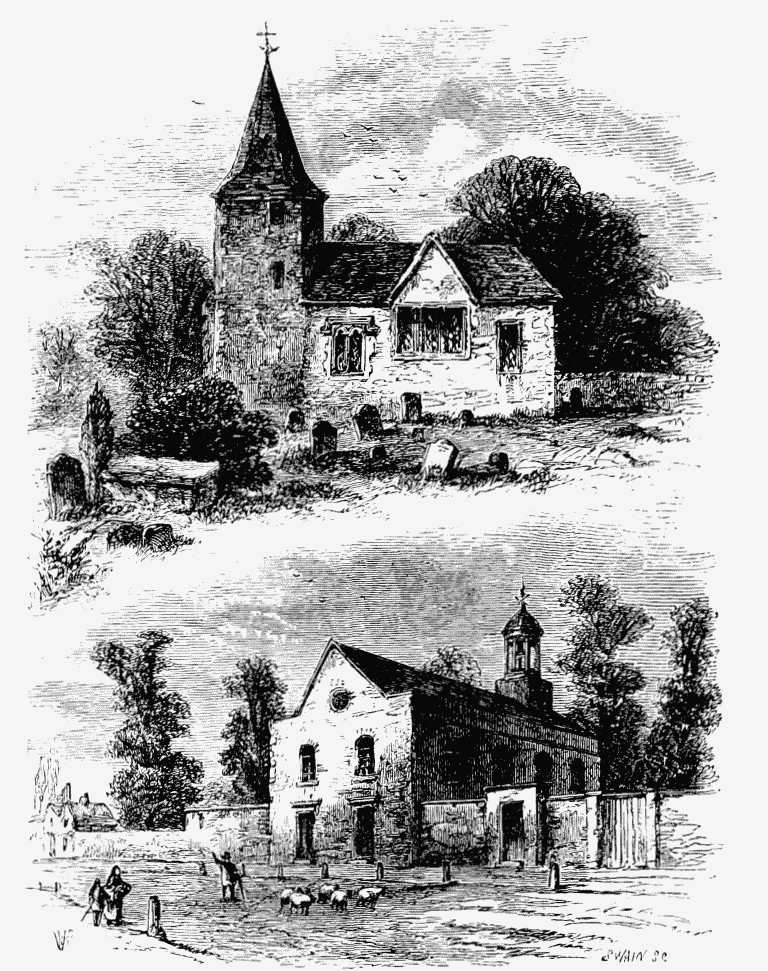
MARYLEBONE CHURCH IN THE SIXTEENTH CENTURY AND IN 1750.
In "Marylebone, near London," on the 11th of April, 1770, was born George Canning, the future Premier of England. His father, mentioned above, was a young gentleman of good family, whose father had cast him off for making a poor marriage; and while Canning was an infant, his father died of a broken heart, his mother being glad to support herself and her bairn by keeping a small school. Sent by an uncle to Eton, the boy so distinguished himself that he was entered at Christ Church, Oxford, where he showed himself one of the best scholars of his age, and soon afterwards entered upon that political career which led him ultimately to the premiership.
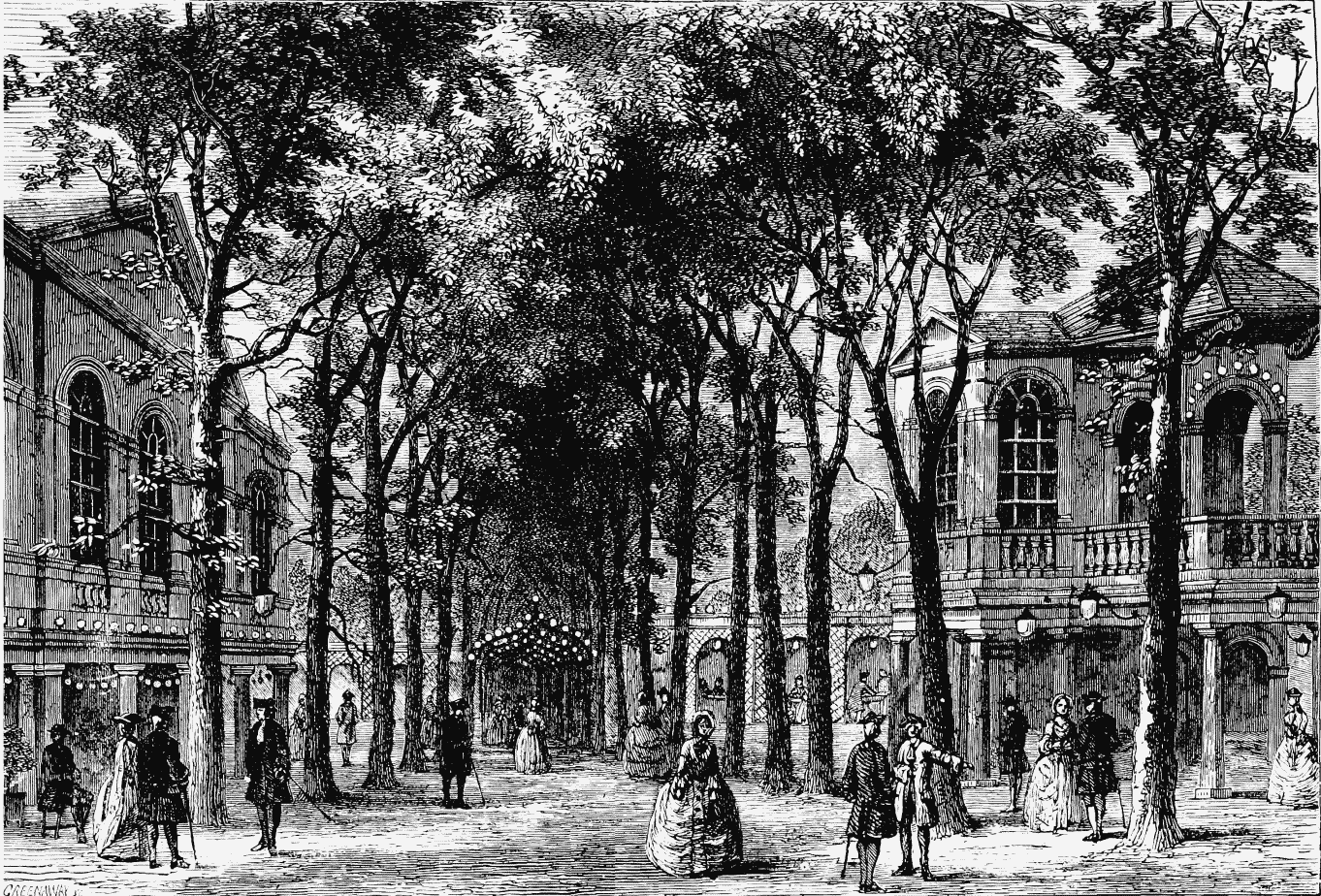
MARYLEBONE GARDENS. (From a Print of 1780.)
In Dorset Mews East, Paddington Street, a house served as the home of the French emigré clergy, in 1791–3, and here they said mass and celebrated the divine offices, till they could open their chapel in King Street.
Before proceeding with our perambulation of the streets and thoroughfares lying to the east and south-east of Paddington Street, and crossing the boundary-line which separates the property of Lord Portman from that of the Duke of Portland, we may be pardoned for introducing a few historical remarks concerning the parish of Marylebone. The name is said to be a corruption or an abridgment of "St. Mary-le-Bourne," or "St. Mary on the Brook," so called from a small chapel dedicated to the Blessed Virgin which stood on the banks of a small brook, or bourne, or burn, which still runs down from the slopes of Hampstead, passing under Allsop Buildings, where, of course, it is arched over. This is the derivation of the name as given by most writers, who compare with it the termination of Tyburn. Some writers have asserted that the parish was itself originally called Tybourne, or Tyburn, from the brook (bourne) of which we have just spoken, a name which gradually was exchanged for Marylebourne or Marylebone. If, however, we might hazard an opinion, we would suggest that it is possibly a corruption of "St. Mary la Bonne."
But whatever may be its derivation, two centuries ago it was still a rural spot, and Macaulay reminds us that at the end of the reign of Charles II. "cattle fed and sportsmen wandered with dogs and guns over the site of the borough of Marylebone." It was, in fact, nothing more than a small country village, separated from London by green fields. In one of the fields in the neighbourhood, as late as the year 1773, was fought a duel between Lord Townshend and Lord Bellamont, in which the latter was dangerously wounded, being shot through the groin.
Almost at the beginning of the last century, writes Lambert, in his "History of London," published in 1806, "Marylebone was a small village, almost a mile distant from the nearest part of the metropolis; indeed, it was formerly so distinct and separate from London, as not to be included in most histories and topographical works devoted to the metropolis. Its increase began between 1716 and 1720, by the erection of Cavendish Square." Maitland, in his "History of London," in 1739, gives the number of houses in "Marybone" as 577, and the persons who kept coaches—that is, carriages—as thirty-five. At the beginning of the nineteenth century, the houses had risen to 9,000, and the number of "coaches" is estimated at about 530. But even this is a sorry total in comparison of the Marylebone of to-day, which at the last census had a population of upwards of 477,000 souls, and no less than 32,000 electors, having increased no less than 11,000 since its erection into a Parliamentary borough in 1832. According to Malcolm, in 1807, there were over 7,000 houses, with a population of 27,000 males and 37,000 females.
The parish of Marylebone is now the largest in the metropolis, being more than twice the size of the actual City proper, and having also a larger population; indeed, its population is larger than that of London and Westminster combined, in the reign of Elizabeth. According to the last census returns, the population of this parish numbered 477,532, or nearly double what it was only a quarter of a century ago. Its present population (1876) is estimated at about 600,000.
The manor of Marylebone was granted by King James I. to Edward Forset, in 1611, and afterwards passed into the family of Austen, by the marriage of Arabella Forset to Thomas Austen. In 1710 John Holles, Duke of Newcastle, purchased the manor of John Austen, afterwards Sir John Austen; and his only daughter and heir, Lady Henrietta Cavendish Holles, marrying Edward Harley, second Earl of Oxford and Mortimer, it passed into that family. The only daughter and heir of the Earl and Countess of Oxford, Lady Margaret Cavendish Harley, marrying William, second Duke of Portland, took the property into the Portland family, with whom it still remains, the present duke being lord of the manor. The various names of these noble families are all represented in the streets of the neighbourhood. Lady Henrietta Cavendish Holles gave her names to Henrietta Street, Cavendish Square, and Holles Street; her husband to Harley Street, Oxford Street, and Mortimer Street; and their daughter, Lady Margaret, to Margaret Street. Bentinck, Duke, and Duchess Streets, as well as Portland Place, all take their names from the Duke and Duchess of Portland. One of the titles of the Earl of Oxford was Lord Harley of Wigmore, after which place Wigmore Street was named. Welbeck Abbey, an estate of the Duke of Portland, and Bulstrode, a former seat of the family, are represented by Welbeck and Bulstrode Streets.
In Marylebone was one of the many chapels or churches which the Huguenot refugees established on settling in London after the revocation of the Edict of Nantes, whose number is estimated by Mr. Smiles at thirty-five, and by Mr. Burn at forty. It was founded about the year 1656.
In a map published in 1742 we see the small village church of Marylebone, or "St. Mary-atthe-Bourne," standing quite alone in the fields. It is approached by two narrow zigzag lanes, one winding up from about the bottom of the east side of Stratford Place—then the western boundary of all continuous houses—following the line of what is still called Marylebone Lane; the other lane crosses the fields diagonally from Tottenham Court Road. This lane, the northern end of which is now called Marylebone High Street, was in olden times a footway through the fields from Brook Field, the site of which is now covered by Brook Street, to Marylebone Manor House. The lane exhibits proofs of its antiquity, by its winding and its narrowness. No doubt it was an old rural lane, along which the farm-horses went to the great city to market from the farmers of the outlying districts. It now terminates on the north side of Oxford Street; but it would seem to have formerly continued in a winding manner by Shug Lane and Marylebone Street to the east end of Piccadilly and the Haymarket, much in the same way that Drury Lane led from St. Giles's-in-the-Fields to St. Clement's Danes, and Tyburn Lane (now Park Lane) from Tyburn to Hyde Park Corner. The Marylebone Street above mentioned was built about the year 1680, and was so called because it led from "Hedge Lane" to Marylebone. It is described in the "New View of London," in 1708, as a "pretty straight street, between Glasshouse Street and Shug Lane, near Pickadilly."
Mr. Smith, in his "Book for a Rainy Day," tells us how that "at this time (1744) houses in High Street, Marylebone, particularly on the western side, continued to be inhabited by families who kept their coaches, and who considered themselves as living in the country, and perhaps their family affairs were as well known as they could have been had they resided at Kilburn. In Marylebone great and wealthy people of former days could hardly stir an inch without being noticed; indeed, so lately as the year 1728, The Daily Journal assured the public that 'many persons arrived in London from their country houses in Marylebone.'"
The "Rose of Normandy," a public-house in High Street, is said to be the oldest house in the parish. It is described in the Gentleman's Magazine, vol. lxxxiii., p. 524, as having had, in the year before the Restoration, "outside a square brick wall, set with fruit-trees, gravel walks 204 paces long, 7 broad; the circular wall 485 paces long, 6 broad; the centre square a bowling-green, 112 paces one way, 88 another; all, except the first, double set with quickset hedges, full-grown, and kept in excellent order, and indented like town walls." "The street having been raised," writes Mr. Larwood, "the entrance to the house is now (1866) some steps below the roadway. The original form of the exterior has been preserved, but the garden and large bowling-green have dwindled down into a miserable skittle-ground." It is currently reported that the celebrated Nancy Dawson, as a young girl, was employed in setting up the skittles at a bowling-alley in High Street, probably in these identical grounds.
The old Manor House, of which we have given a view on page 420, stood on the south side of what is now called the Marylebone Road, and its site is now occupied by Devonshire Mews. The house, as Mr. Smith tells us, in the work above quoted, consisted of a large body and two wings, a projecting porch in the front, and an enormously deep dormer roof, supported by numerous cantalivers, in the centre of which there was, within a very bold pediment, a shield surmounted by foliage, with labels below it. The back, or garden front, of the house had a flat face with a bay window at each end, glazed in quarries, and the wall of the back front terminated with five gables. The mansion was wholly of brick, and surmounted by a large turret containing a clock and bell. From the style of decorations of the interior, Mr. Smith considers it was probably of the Inigo Jones period: the hand-rails of the grand staircase were supported with richly-carved perforated foliage. The house was turned into a school, kept by a certain clergyman named Fountayne, who had here among his pupils the eccentric and wayward George Hanger, afterwards Lord Coleraine.
In connection with this old manor house, or rather with reference to Mr. Fountayne's academy, Mr. J. T. Smith tells us, that one Sunday morning his mother allowed him, before they entered the "little church in High Street, Marylebone, to stand to see the young gentlemen of Mr. Fountayne's boarding-school cross the road. I remember well," he adds, "a summer's sun shone with full refulgence at the time, and my youthful eyes were dazzled with the various colours of the dresses of the youths, who walked two and two, some in pea-green, others sky-blue, and several in the brightest scarlet; many of them wore goldlaced hats, while the flowing locks of others, at that time allowed to remain uncut at schools, fell over their shoulders. To the best of my recollection, the scholars amounted to about one hundred."
During the time that it was vested in the Crown, the manor house was occasionally used as a temporary royal residence, particularly by Queen Elizabeth, who appears by many accounts to have used her various palaces in rapid succession. The park attached to the manor stretched away northward, and its site is now the Regent's Park, of which we shall speak in a future chapter.
There was an old church in Marylebone which had come down from the times before the Reformation, but having fallen out of repair, it was pulled down in 1741, to make room for another structure, which served as the parish church, until the erection of a third structure in the New Road, some eighty years later, reduced it to the rank of a mere chapel of ease. Lambert, in his "History of London," places the old village of Tyburn on the site of the north-west part of Oxford Street, and supposes, from the number of bones dug up there, (fn. 8) that the old Marylebone Court House covered the site of the old church and churchyard of that village. "This church," he writes, "was dedicated to St. John the Evangelist, and being left alone by the highway side, in consequence of the decay of the village, was robbed of its books, vestments, bells, images, and other decorations;" therefore the parish ioners petitioned the Bishop of London for leave to build a new church on another site, and this being dedicated to St. Mary, and standing near the bourne, came to be called "St. Mary of the Bourne." This village of Tyborne appears in "Domesday Book" to have belonged to the abbess and sisters of Barking in Essex. The first church was the one selected by Hogarth for the plate in his "Harlot's Progress," where he has introduced his "Rake at the Altar with an Old Maid." As the print was published in 1735, the scene could not have taken place within the little dingy building now standing in the High Street: a part of the inscription in the picture, nevertheless, still remains to be seen in one of the pews in the gallery. In Smith's "History of Marylebone," it is stated that "the first two lines of this inscription are the originals; the last two were restored in 1816, at the expense of the Rev. Mr. Chapman, the minister."
Among those baptised in this ugly little structure were the poet Byron, in the year 1788; and "Horatia," the daughter of Lord Nelson, by Emma Lady Hamilton, in 1803. The list of those who are buried here is rather long, including John Wesley's brother Charles; Gibbs, the architect of St. Martin's-in-the-Fields; Hoyle, the author of "Whist" and a work on "Games;" Caroline Watson, the engraver; Bower, author of a "History of the Popes;" Allan Ramsay and Vanderbank, the portrait-painters; John Dominic Serres, the marine-painter; Rysbrack, the sculptor; Ferguson, the astronomer; and James Figg, the celebrated prize-fighter, whose portrait figures in one of the engravings of Hogarth, in the "Rake's Progress."
The present parish church is situated in the New (or, as it is now styled, the Marylebone) Road, opposite York Gate. It was originally intended to be only a chapel of ease; but it was so much admired, both externally and internally, that it was subsequently converted, under an Act of Parliament, to parochial uses. It was erected, under an Act of Parliament, in 1813–17, at a cost of about £60,000, its architect being Mr. Thomas Hardwick, a pupil of Sir William Chambers, and one of a family of architects, his son Philip being the designer of Lincoln's Inn Hall and Library; and his grandson, Mr. Philip C. Hardwick, of the new buildings of the Charter House, on the Surrey Hills. A double gallery forms a feature of its interior; and a peculiarity in its construction is that the portico faces the north, an arrangement necessitated by the nature of the ground whereon it is erected. The altar-piece, by Benjamin West, President of the Royal Academy, was a present from that celebrated painter to the church: it represents the Nativity of our Lord.
Here lie buried James Northcote, R.A., the pupil and biographer of Sir Joshua Reynolds, and also another Royal Academician, Richard Cosway, who died in 1821, at his residence in Edgware Road.
In the Marylebone Road, near the east end of the parish church, and close by the High Street, is Devonshire Terrace. Here, in 1839, Charles Dickens took up his abode, when newly married, and in the first flush of his fame as the author of "Pickwick," "Nicholas Nickleby," and "Oliver Twist." His residence is described by Mr. J. Forster as "a handsome house, with a garden of considerable size, shut out from the New Road by a high brick wall, facing the York Gate into the Regent's Park." Here he used to gather round his friends, Macready, Stanfield, Landseer, Harrison Ainsworth, Talfourd, and Bulwer; and here he composed the principal portion of "Master Humphrey's Clock," the "Old Curiosity Shop," and "David Copperfield." How fond Dickens was of his residence here may be gathered from his remark, later on in life, "I seem as if I had plucked myself out of my proper soil when I left Devonshire Terrace, and could take root no more until I return to it." A sketch of the house, by Maclise, will be found in Mr. Forster's "Life of Dickens."
Nottingham Place is the name given to the thoroughfare at the west end of the church, running from the Marylebone Road into Paddington Street. Its designation is probably derived from the county in which the chief landed property of the Duke of Portland is situated. Here, at No. 26, lived for many years Colonel William Martin Leake, the accomplished traveller, and author of so many topographical and antiquarian works on Ancient Greece and Asia Minor, &c. Nottingham Place is crossed by a short street bearing the same name.
Marylebone Road, owing to its great breadth, and the houses standing so far back from the road, has always been a favourite place for hospitals, charitable institutions, &c. Within a short distance of the church is the parish workhouse, which stands partly on the Portman estate, and partly on that of the Duke of Portland. It was originally built in 1775, but was greatly altered and enlarged in 1875. The house is conveniently fitted up with workshops, washhouse, laundry, wards, kitchen, bakehouse, chapel, infirmary, and officers' rooms, all of which are well adapted to their different purposes. Close to the workhouse, at the corner of Northumberland Street, is the Home for Crippled Girls, which was established in 1851, and was formerly in Hill Street, Dorset Square. The building, which is known as Northumberland House, was built about the year 1800; no reason can be found for the name. The poor afflicted inmates of this institution occupy their time, so far as their ability serves them, in the manufacture of fancy articles in straw and other material suitable for presents; and there is also a public laundry in connection with the Home.
The New Hospital for Women, at No. 222, was founded in 1866, for the purpose of affording to poor women and children medical and surgical treatment from legally qualified women. This institution was originally established in Seymour Street, but was removed hither in 1875.
In 1830 was established in this road the Western General Dispensary, for the relief of the sick poor in the north-west parts of Marylebone and the parish of Paddington. The number of patients relieved during the year amounts, on an average, to about 15,000. Between York Place and Gloucester Place are the offices of the Marylebone Association for Improving the Dwellings of the Industrious Classes. Judging from the description of some wretched tenements in this parish, as given by the Medical Officer of Health, it would almost seem that there is still work to be done by the above association in this neighbourhood. The dwellings referred to are described as consisting of twenty cottages placed in four parallel rows, which are reached by an avenue twenty-five feet wide, with a narrow, wretchedly-paved footway. "In some of the forecourts of these cottages," says Dr. Whitmore, "there is an attempt to cultivate the soil, while in others rubbish is strewn about, and puddles of filthy stagnant water lie there long after a fall of rain. None of the cottages have rooms above the ground floor; the front rooms have an average of 850 feet of cubic space each, while the backs have only 750 feet. The ceilings are seven feet from the floor, but the flooring is six feet below the level of the forecourt; consequently the eaves of the roof are but little above the level of the ground." An inhabitant of one of these hovels, nevertheless, declared that if she were forced to leave she would soon die.
At the corner of Marylebone Road and Seymour Place are the police-court buildings of the parish. The building, which was erected in 1874–5—the old police-court in the High Street having become unsuited for its purposes—consists of a large and commodious court-room, private rooms for the magistrates, and the requisite offices for other officials. The basement of the edifice is of rusticated Portland stone, and the upper part is built of white Suffolk brick with stone dressings; and the central portion of the front elevation is surmounted by a pediment enclosing a sculptured representation of the royal arms.
A little northward of Manchester and Cavendish Squares, and on the east side of Marylebone Lane, towards the close of the last century, was the place of fashionable amusements so well known to fame as "Marylebone Gardens." These gardens were formed towards the end of the seventeenth century, by throwing together the place of public resort called "The Rose" and an adjoining bowling-green, mentioned above. The chief entrance was in the High Street; and there was also an entrance at the back, from the fields, through a narrow passage, flanked with a small enclosure, known as "The French Gardens," from their having been cultivated by refugees who had settled in London after the passing of the Edict of Nantes. At first, and for many years, the gardens were entered gratis by all ranks of the people; but the company resorting to them becoming more respectable, a shilling was charged as entrance-money; for which the party paying was to receive an equivalent in viands. They afterwards met with such success as to induce the proprietor to form them into a regular place of musical and scenic entertainment; and Charles Bannister, Dibdin (who both made their first public appearance here when youths), and other eminent vocalists, contributed to enliven them with their talents. Chatterton wrote a burlesque burletta, after the fashion of Midas, called the Revenge, which was performed here in 1770. Splendid fêtes, balls, and concerts, during the run of the season, were given here, as at Vauxhall; and their details are to be found advertised in the papers of the day. In one of these fêtes, given on the King's birthday, June 4, 1772, after the usual concert and songs, was shown a representation of Mount Etna, with the Cyclops at work, and a grand firework, consisting of vertical wheels, suns, stars, globes, &c., which was afterwards copied at Ranelagh. On another occasion a great part of the garden was laid out in imitation of the Boulevards at Paris, with numerous shops and other attractions.
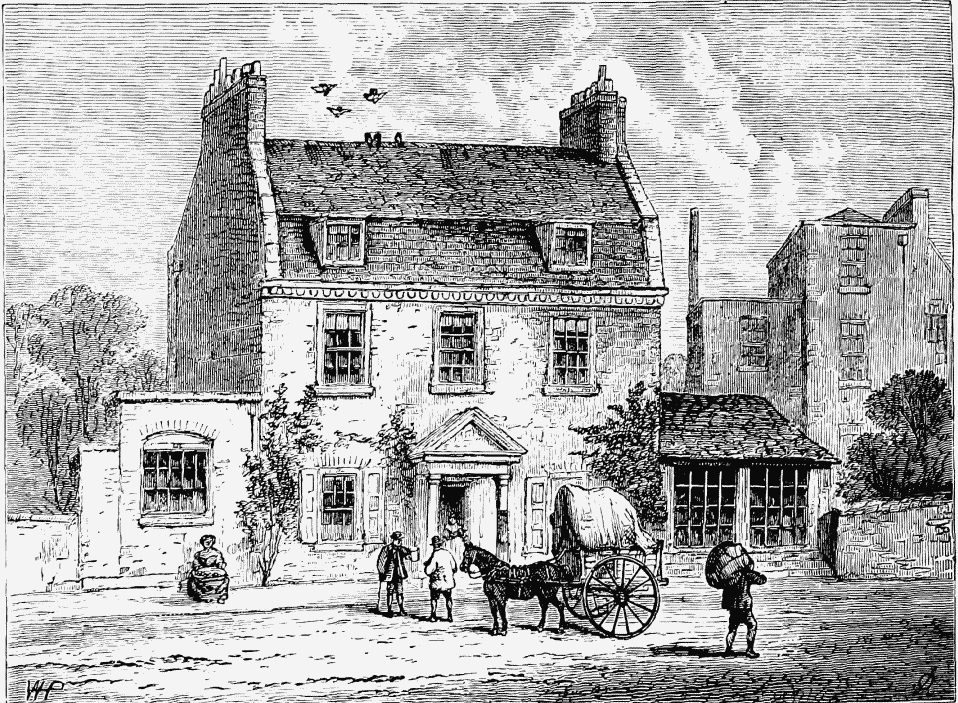
THE "FARTHING PIE HOUSE." (From a Drawing, 1820.)
In the old time London was surrounded with
places of amusement—its Vauxhall, Ranelagh, &c.;
but none were more popular than these gardens,
the very name of which seems now to have almost
passed away. Chambers writes, in his "Book of
Days:" "Of these places of amusement in the
north-west suburbs, the most important was that
known as Marylebone Gardens. It was situated
opposite the old parish church, on ground now
covered by Beaumont Street and Devonshire
Street." It is mentioned by Pepys, two years
after the great "fire of London," in his own quaint
manner, in these words: "Then we abroad to
Marrowbone, and there walked in the garden; the
first time I ever was there, and a pretty place it
is." Its bowling-alleys were famous in the days of
Pope and Gay, and the latter writer alludes to this
place more than once in the Beggar's Opera, as a
rendezvous for the dissipated, putting it on a level
with one of bad repute already mentioned. In one
of his "Fables" he thus alludes to the dog-fights
allowed here:—
"Both Hockley-hole and Mary bone
The combats of my dog have known."
The gardens and the adjoining bowling-green seem
to have been frequented by the rank and fashion of
the town. Lady Mary Wortley Montagu alludes
to the fondness of Sheffield, Duke of Buckingham,
for this place of amusement; she writes—
"Some dukes at Marybone bowl time away."
Here, at the end of each season, as the actor Quin
told the antiquary Pennant, the Duke of Buckingham used to give a dinner to the guests who
frequented the place, when he always proposed
as a particular standing toast, "May as many of
us rogues as remain 'unhanged' next spring meet
here again!" An anecdote book, in recording
this toast, amusingly prints the word in italics
"unchanged."
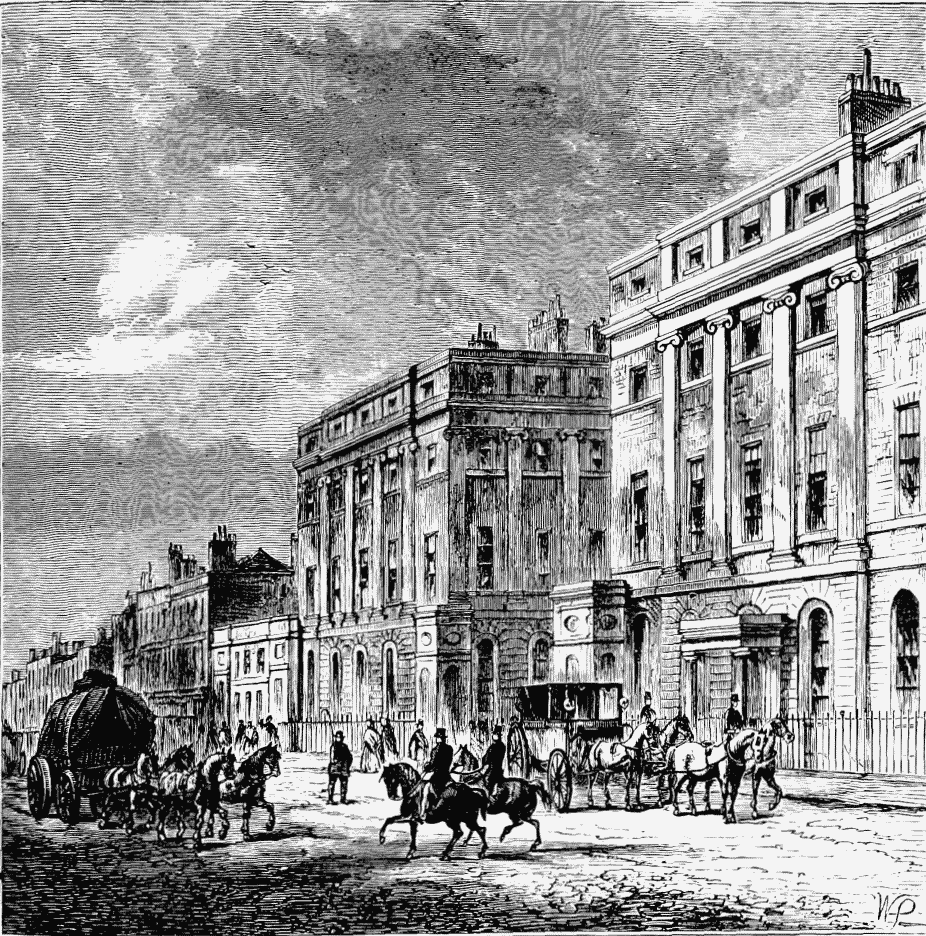
STRATFORD PLACE.
Although the memory of Marylebone Gardens has perished to a very great extent, we fortunately have, in Mr. J. T. Smith's "Book for a Rainy Day," a quantity of curious information respecting them and the pleasant sights and sounds which there amused the ladies of the western suburbs, whilst the City dames were showing off their finery at such places of amusement as Bagnigge Wells, and the Mulberry Garden in Clerkenwell. The houses of the north end of Newman Street, at the time Mr. Smith was a lad, commanded a view of the fields, over hillocks of ground, now occupied by Norfolk Street; and the north and east outer sides of Middlesex Hospital garden wall were entirely exposed. Mr. John Timbs, in his "Romance of London," completes the picture by telling us that at that time a cottage with a garden and a ropewalk were here; and that "under two magnificent rows of elms Richard Wilson, the landscape painter, and Baretti might often be seen walking." To the right of the rope-walk was a pathway on a bank, which extended northward to the "Farthing Pie House," now the sign of the "Green Man;" it was kept by Price, the famous player on the saltbox, of whom there is an excellent mezzotinto portrait. It commanded fine views of the distant heights of Highgate, Hampstead, Primrose Hill, and Harrow; and Mr. Smith tells us that, as a boy of eight years old, he frequently played at trap-bat beneath the elms. The south and east ends of Queen Anne and Marylebone Streets were then unbuilt: the space consisted of fields to the west corner of Tottenham Court Road, thence to the extreme end of High Street, Marylebone Gardens, Marylebone Basin, and another pond then called "Cockney Ladle," which were the terror of many a mother. Upon the site of the "Ladle" now stands Portland Chapel.
In the London Gazette, January 11, 1691, mention is made of "Long's Bowling-green, at the 'Rose,' at Marylebone, half a mile distant from London." The distance here mentioned doubtless refers to the utmost limits of bricks and mortar in the neighbourhood of Oxford Street.
The Daily Courant, for Thursday, May 29, 1718, contains the following announcement:—"This is to give notice to all persons of quality, ladies and gentlemen, that there having been illuminations in Marylebone Bowling-green on his Majesty's birthday every year since his happy accession to the throne, the same is (for this time) put off till Monday next, and will be performed with a consort (sic) of musick in the middle green, by reason there is a ball in the gardens at Kensington with illuminations, and at Richmond also."
The gardens, as we have observed, were at first opened gratuitously; but in 1738–9 they were enlarged, and an orchestra built. Silver tickets were at first issued, at 12s. each for the season, each ticket admitting two persons. From every one without a ticket 6d. was demanded for the evening; but afterwards, as the season advanced, the admission was 1s. for a lady and gentleman.
About this time, when these gardens were in a flourishing state, selections from Handel's music were often played here, under the direction of Dr. Arne. Concerning one of these performances, Mr. Smith tells an amusing anecdote, which will bear repeating. "One evening," he says, "as my grandfather and Handel were walking together and alone, a new piece was struck up by the band. 'Come, Mr. Fountayne,' said Handel, 'let us sit down and listen to this piece; I want to know your opinion of it.' Down they sat, and after some time Mr. Fountayne, the old parson, turning to his companion, said, 'It is not worth listening to; it is very poor stuff.' 'You are right, Mr. Fountayne,' said Handel, 'it is very poor stuff; I thought so myself, when I had finished it.' The old gentleman, being taken by surprise, was beginning to apologise, but Handel assured him there was no necessity; that the music was really bad, having been composed hastily, and his time for the production being limited; and that the opinion was as correct as it was honest."
In 1741 a "grand martial composition of music" was performed here by Mr. Lampe, in honour of Admiral Vernon, for taking Carthagena.
The proprietor of the Mulberry Garden, Clerkenwell, apparently stirred up by feelings of envy or jealousy at the success of his brother caterers in the same line of business, indulged in some sarcastic remarks upon five places of similar amusement, in which he described this suburban retreat as "Mary le Bon Gardens down on their marrowbones."
About the year 1746 robberies accompanied by violence were of so frequent occurrence in this neighbourhood that "the proprietor of the gardens was obliged to have a guard of soldiers to protect the company to and from London."
In 1753 the Public Advertiser announced that the gardens had been "made much more extensive by taking in the bowling-green, and considerably improved by several additional walks; that lights had been erected in the coach-way from Oxford Road, and also on the footpath from Cavendish Square to the entrance to the gardens; and that the fireworks were splendid beyond conception." A large sun was exhibited at the top of a picture; a cascade, and shower of fire, and grand air-balloons were also most magnificently displayed; and likewise "red fire was introduced." This has been considered as probably the first occasion of air-balloons and "red fire" being exhibited in England.
Towards the end of the reign of George II. the gardens appear to have risen somewhat in popularity, and to have had rather more of the aristocratic element in its visitors; for we learn that in 1758 "no persons were admitted to the ball-rooms without five-shilling tickets, and only twenty-six tickets were delivered for each night." In the following year we are told that the gardens were opened for breakfasting; nor is it forgotten to be added that "Miss Trusler made the cakes." The father of this young lady was the proprietor of the gardens, and being a cook, gave dinners and breakfasts. In the following year the gardens, having been greatly improved, were opened in May "with the usual musical entertainments." They were opened also every Sunday evening, when "genteel company were admitted to walk gratis, and were accommodated with coffee, tea, cakes, &c." Miss Trusler, it would seem, was an adept in the art of cake-making, for in the Daily Advertiser of May 6, 1759, appears the following announcement:—"Mr. Trusler's daughter begs leave to inform the nobility and gentry, that she intends to make fruit-tarts during the fruit season; and hopes to give equal satisfaction as with the rich cakes and almond cheesecakes. The fruit will always be fresh gathered, having great quantities in the garden; and none but loaf sugar used, and the finest Epping butter. Tarts of a twelvepenny size will be made every day from one to three o'clock. New and rich seed and plum cakes," too, we are reminded, "are sent to any part of the town."
In 1761 there was published an engraving, after a drawing made by J. Donowell, representing these gardens, probably in their fullest splendour. "The centre of this view exhibits the longest walk, with regular rows of young trees on either side, the stems of which received the irons for the lamps at about the height of seven feet from the ground. On either side of this walk were latticed alcoves; on the right hand of the walk, according to this view, stood the bow-fronted orchestra, with balustrades supported by columns. The roof was extended considerably over the erection, to keep the musicians and singers free from rain. On the left hand of the walk was a room, possibly for balls and suppers. The figures in this view are well drawn and characteristic of the period."
In 1762 the gardens were visited by the Cherokee Kings; and in the following year the celebrated Tommy Lowe became the proprietor. Among the singers here at that time was Nan Cattley.
Notwithstanding the patronage bestowed upon these gardens by many of the nobility, the place seems in the end to have fallen into bad repute; for in Dodsley's "London and its Environs" we find mention of it as "the noted gaming-house at Marylebone, the place of assemblage of all the infamous sharpers of the time." The security of the outlying districts, too, does not seem to have improved, for we are told that in 1764 Mr. Lowe, the then proprietor, offered "a reward of ten guineas for the apprehension of any highwayman found on the road to the gardens." An attempt, nevertheless, seems to have been made by the Sabbatarian party to render this place of amusement less attractive for visitors on the people's only holy day; for we read that in "this year a stop was put to tea-drinking in the gardens on Sunday evenings."
Well may Sir John Fielding console the public by writing as follows, just a century ago:—"Robberies on the highway in the neighbourhood of London are not very uncommon; these are usually committed early in the morning, or in the dusk of the evening, and as the times are known, the danger may be for the most part avoided. But the highwaymen here are civil, as compared with other countries; do not often use you with ill-manners; have been frequently known to return papers and curiosities with much politeness; and never commit murder, unless they are hotly pursued and find it difficult to escape." That highway robberies here, in Sir John Fielding's time, were no new thing, may be learnt from the Evening Post of March 16, 1715–16:—"On Wednesday last four gentlemen were robbed and stripped in the fields between London and Marylebone."
Amongst other distinguished personages whose names are connected by tradition with this place is Dick Turpin, the prince of highwaymen. He was a gay and gallant fellow, and very polite to the ladies. A celebrated beauty of her day, the wife or sister-in-law of a dean of the Established Church, Mrs. Fountayne, was one day "taking the air" in the gardens, when she was saluted by Dick Turpin, who boldly kissed her before the company and all "the quality." The lady started back in surprise and offended. "Be not alarmed, madam," said the highwayman; "you can now boast that you have been kissed by Dick Turpin. Good morning!" and the hero of the road walked off unmolested. Turpin was hanged at York in 1739.
In 1768 Mr. Lowe gave up the gardens, at the same time declaring that his loss in the concern had been considerable. He conveyed his property in the gardens to trustees for the benefit of his creditors; and in the deed of conveyance, Mr. John Timbs tells us, it is recorded that the premises of Rysbrack the sculptor were formerly part of the gardens. The grounds, however, were not finally closed; for in 1770 there was a concert of vocal and instrumental music, in which James Hook, the father of Theodore Hook, is announced as having taken part; and in that same year various alterations were made in the grounds for the better accommodation of the visitors. Two years later, as Mr. Smith informs us, "for the convenience of the visitors, coaches were allowed to stand in the field before the back entrance. Mr. Arnold was indicted at Bow Street for the fireworks. Torre, the fire-worker, divided the receipts at the door with the proprietor."
In 1773, proposals "were issued for a subscription evening to be held every Thursday during the summer, for which tickets were delivered to admit two persons. The gardens were now opened for general admission on three evenings in the week only. On Thursday, May 27th, Acis and Galatea was performed, in which Mr. Bannister, Mr. Reinholdt, Mr. Phillips, and Miss Wilde were singers. Signor Torre, the fire-worker, was assisted by Monsieur Caillot, of Ranelagh Gardens. On Friday, September 15th, Dr. Arne here conducted his celebrated catches and glees."
In the following year (1774) the gardens were again opened for promenading, sixpence being charged for admission; and Dr. Kenrick delivered a series of lectures on Shakespeare in the gardens in this year.
The newspaper advertisements of these gardens
in 1775 are curious. As a specimen, we quote one
which appeared in the Morning Chronicle and
London Advertiser of May 29th:—
AT MARYBONE GARDENS,
To-morrow, the 30th instant, will be presented
THE MODERN MAGIC LANTERN.
In three Parts, being an attempt at a sketch of the Times in a variety of Caricatures, accompanied with a whimsical and satirical Dissertation on each Character. By R. Baddeley, Comedian.
BILL OF FARE.
Exordium.
PART THE FIRST.
| Serjeant at Law. | A Modern Patriot. |
| Andrew Marvel, Lady Fribble. | A Duelling Apothecary, and |
| A Modern Widow. | A Foreign Quack. |
PART THE SECOND.
| Man of Consequence. | Lady Tit for Tat. |
| A Hackney Parson. | An Italian Tooth-drawer. |
| A Macaroni Parson. | High Life in St. Giles's. |
| A Hair-dresser. | A Jockey, and |
| A Robin Hood Orator. | A Jew's Catechism. |
And Part the Third will consist of a short Magic Sketch called
PUNCH'S ELECTION.
Admittance 2s. 6d. each, Coffee or Tea included. The doors to be opened at seven, and the Exordium to be spoken at eight o'clock.
Vivant Rex et Regina.
At the foot of Mr. Baddeley's subsequent bills the gardens are announced as being still open on a Sunday evening for company to walk in. Some of the papers of this year declare, under Mr. Baddeley's advertisements, that "no person going into the gardens with subscription tickets will be entitled to tea or coffee."
Subsequently, George Saville Carey here gave his Lecture on Mimicry. In 1776 the gardens opened in May, "by authority," when the "Forge of Vulcan" was represented, followed a few days later by some feats of sleight of hand, &c.
After existing for upwards of a century, and undergoing many vicissitudes, the gardens were closed about the year 1778, and the site soon afterwards turned to building purposes. The grounds were, however, opened again for a short time in 1794, as a sort of last expiring flicker. Some of the trees under which the company promenaded and listened to the sweet strains of music are still standing behind the houses in Upper Wimpole Street.
A Prussian writer, D'Archenholz, at the end of the last century, remarks with great truth of the English people, and especially of the Londoners, that "they take a great delight in public gardens near the metropolis, where they assemble and drink tea together in the open air. The number of these gardens," the writer continues, "in the neighbourhood of the capital is amazing, and the order, regularity, neatness, and even elegance of them is truly admirable. They are, however, rarely frequented by people of fashion; but the middle and lower classes go there often, and seem much delighted with the music of an organ which is usually played in an adjoining building." When he wrote thus it is difficult to persuade oneself that the foreign author had any other place more entirely before his mind's eye than Marylebone Gardens.
These gardens were commemorated by the great London magistrate, Sir John Fielding, in his judgment on Mrs. Cornelys, when he condemned her operas in Soho as "illegal and unnecessary," on the ground that, besides other places such as the three patent theatres, "there was Ranelagh with its music and fireworks, and Marylebone Gardens with music, wine, and plum-cake."
Northouck calls the gardens "small," and contrasts them with those of Vauxhall, with a note of admiration which indicates a sneer. "Marylebone," he says, "may now (1772) be esteemed a part of this vast town (though it is not yet included in the bills of mortality), as the connection by new buildings is forming very fast."
The entire parish of Marylebone, in the last century, appears to have been devoted to the Muses; for Dr. Arne, and Samuel and Charles Wesley, then stars of the first magnitude in the musical firmament, lived in the neighbourhood; and since that time Marylebone has given a home to many painters and sculptors.
The principal thoroughfares now occupying the site of Marylebone Gardens as well as the adjoining bowling-greens, are Devonshire Place, Upper Harley, Weymouth, Upper Wimpole, Marylebone, and Devonshire Streets.
Wimpole Street, down which we now proceed on our return to Oxford Street, was so named after Wimpole, on the borders of Hertfordshire and Cambridgeshire, formerly the country seat of the Harleys, Earls of Oxford, and subsequently that of Lord Chancellor Hardwicke, whose family became possessed of it by purchase in the last century. The street was, at all events, begun before the complete demolition of the gardens, for we find that Edmund Burke took up his residence here in 1757, soon after his marriage with the daughter of an Irish physician at Bath, a Dr. Nugent. He was happy in his wife and his home, and his house became a centre of attraction to his friends. The expenses of housekeeping on a larger scale than that to which he had been accustomed, spurred him on to increased exertions in the field of literature, and the author of the "Essay on the Sublime and Beautiful" here wrote some of those other political and philosophical works which speedily raised him to a high post as an author, including the early volumes of the "Annual Register."
At No. 21 was living, in 1826, Mrs. Cipriani, the widow of the eminent painter, and friend of Wedgwood. At her father's house (No. 50) in this street, lived for some time between 1840 and 1845, Miss Elizabeth Barrett, then known as the author of a volume of poems, and who afterwards was better known to fame as Mrs. E. Browning. Most of her married life was spent, on account of delicate health, at Florence, where she died in 1861. In this street, too, lived the Duchess of Wellington during the Peninsular War.
From the year 1826 to 1841, and probably longer, No. 67 was the residence of Henry Hallam, the historian; here he wrote his "History of the Middle Ages" and his "Constitutional History of England." He died in 1858. In 1841 No. 10 was in the occupation of the fashionable portraitpainter of his time, Mr. Alfred E. Chalon, and of his brother, John James Chalon, both Royal Academicians. These two brothers appear to have been inseparable, for a few years previously they were living together in Great Marlborough Street. At No. 12 in this street lived for some time the gallant Admiral Lord Hood. No 17 was for many years the home of the late Mr. Joseph Parkes, and of his daughter, Miss Bessie R. Parkes.
Of Weymouth Street we have nothing to record beyond the fact that it forms a connecting link between High Street, Marylebone, and Harley Street and Portland Place; that in it Bryan W. Procter ("Barry Cornwall") lived and died; and that it was so called after Lord Weymouth, a sonin-law of the second Duke of Portland.
Great Marylebone Street, as we have said, crosses Wimpole Street about midway, connecting High Street on the west with Harley Street on the east. In this street was lodging Prince Leopold, afterwards King of the Belgians, when he came to England in 1814, at the time of the Peace Rejoicings, as aide-de-camp to one of the Allied Sovereigns, as we have already stated in our chapter on Hyde Park.
In Edward Street—as that part of Wigmore Street lying between Marylebone Lane and Duke Street was formerly called—at No. 21, the remains of General Sir Thomas Picton lay in state, on their arrival here after the battle of Waterloo, prior to their interment in the burial-ground in the Uxbridge Road, Bayswater.
In Marylebone Lane, near the Oxford Street end, was for many years the Court-house for the parish. It was erected in 1825, adjoining an older courthouse and watch-house, on ground on which was formerly situated a pound. The building, however, having become unsuited for its present requirements, a new court-house has been erected at the corner of Marylebone Road and Seymour Place, as we have already stated.
On the west side of Marylebone Lane, and abutting upon Oxford Street, is Stratford Place. This group of buildings comprises two rows of mansions facing each other, with a square courtyard at the northern end, forming a cul de sac. On each side of the entrance is a small house for a watchman, on the top of which is the figure of a lion carved in stone. The buildings were erected about the year 1775 by Edward Stratford, second Lord Aldborough, on land which had been leased from the Corporation of London. The place was formerly decorated with a column supporting a statue of George III., commemorative of the naval victories of Great Britain. It was erected by General Strode, and taken down in 1805, in consequence of the foundation giving way. The house in the centre of the northern side, and facing Oxford Street, is that in which Lord Aldborough himself lived for many years. The house has been occupied at various periods by the Duke of St. Albans, Prince Esterhazy, and other persons of distinction. One of these mansions at the commencement of this century was the residence of Richard Cosway, R.A. Shortly before his death, he disposed of a great part of his collection of ancient pictures and other property, and removed to a house in the Edgware Road, where he died in 1821. Two other Royal Academicians have likewise occupied houses here—namely, Sir Robert Smirke, who was living here in 1826, and Mr. H. W. Pickersgill, who died here in 1875, aged upwards of ninety.
The house at the south-east corner, fronting Oxford Street, has been for many years the home of the Portland Club, which is understood to be one of the leading clubs where high play at cards prevails, but is honourably and honestly conducted A code of rules for the game of whist is extant, the preparation of which was the work of a committee of gentlemen from many of the West-end clubs, among whom the Portland was largely represented. Of the inner life and history of the Portland Club little is known, and few anecdotes about it are published.
As we have already stated, here in former times stood a building known as the Lord Mayor's Banqueting-house, from the fact that the chief magistrate and Corporation of London used to dine here annually for many generations, after officially visiting the springs and reservoirs in this neighbourhood whence the great conduit in Cheapside was supplied with water. The supply came from the gravelly subsoil of Marylebone, where no less than nine springs oozed out of the ground at various places, and trickled down the grassy slopes into the watercourse called the Tye-bourne, of which we have spoken above. As far back as the year 1216 the Mayor and Corporation of London collected these springs into some reservoirs, which they constructed near Stratford Place, and laid a six-inch lead pipe from thence to Charing Cross, along the Strand and Fleet Street, over the bridge which then spanned the River Fleet and up Ludgate Hill to the conduit at the west end of Cheapside. The head of water in the reservoirs was about thirty feet above the conduit mouth. The King used his influence with the owner of the lands whence the springs issued to grant the water to the Corporation; and certain merchants of Ghent, Bruges, and Antwerp provided the lead pipe, or gave the money to purchase it, in consideration of the goods they imported into London being exempt from river dues or tolls for a term of years. For the King's service in the matter the Corporation permitted him to lay a pipe "of the size of a goose-quill" from the main pipe into his stables, which were situated where the northeast part of Trafalgar Square now stands. On the occasion of the Mayor's official visits to these springs, the company used to hunt a hare or a fox in the neighbourhood, and afterwards they dined together with much ceremony near the reservoirs. In course of time the reservoirs were arched over, and a large banqueting-house was erected upon the arches.
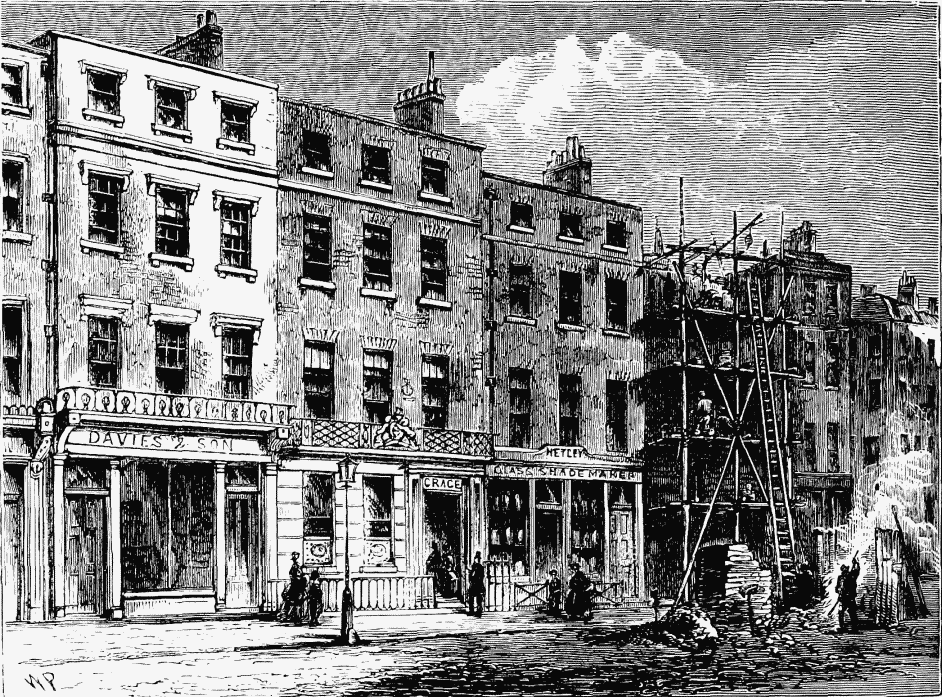
WIGMORE STREET IN 1820. (From a Drawing by Shepherd in Mr. Crace's Collection.)
In August, 1875, while making some repairs or alterations in the roadway of Oxford Street at this point, the workmen came upon these reservoirs and arches, which had remained in a fair state of preservation. Shortly afterwards, another interesting archaeological discovery was made a short distance westward, at the corner of North Audley Street. Here, close to the curb, two much-worn iron flaps were discovered. The workmen's curiosity being aroused as to where the opening might lead, they applied their pickaxes, and after some difficulty, succeeded in raising the flaps, when they discovered a flight of brick steps, sixteen in number, leading to a subterranean chamber. On descending, they entered a room of considerable size, measuring about 11 feet long by 9 feet wide, and nearly 9 feet high. The roof, which is arched, is of stone, and, with a few exceptions, is in fair repair. The walls to the height of about five feet are built of small red brick, such as was used by the Romans, in which are eight chamfered Gothic arches, with stone panels, as though originally used as windows for obtaining light. The upper part of the wall is of more recent date. In the four corners of the chamber there is a recess with an arched roof, extending with a bend as far as the arm can reach. In the middle of the chamber is a sort of pool or bath, built of stone, measuring about five feet by seven feet. It is about six feet deep, and was about half filled with water, tolerably clear and fresh. A spring of water could be seen bubbling up, and provision was made for an overflow in the sides of the bath. From all appearances the place was originally a baptistery.
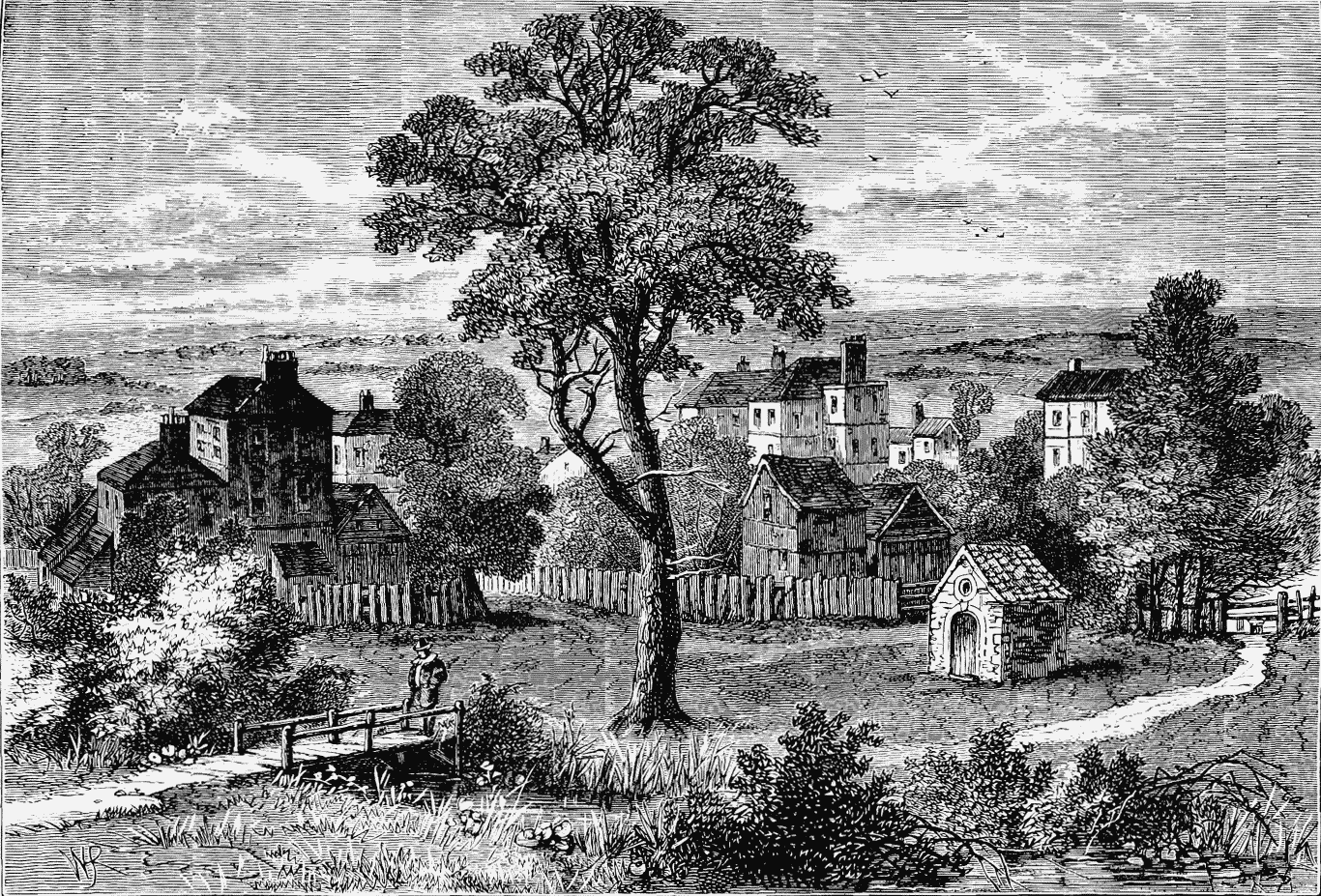
MARYLEBONE, FROM THE SITE OF THE PRESENT WIGMORE STREET. (From a Print of 1750.)
In the beginning of the reign of George III. there was only a dreary and monotonous waste between the then new region of Cavendish Square and the village of Marylebone, sometimes called Harley Fields; and even as lately as 1772, the now thickly-peopled district between Duke Street and Marylebone Lane was unbuilt. Within the last century Oxford Road, as it was then called, had houses only on one (the southern) side between the top of New Bond Street and Tyburn Turnpike; the lower parts of many of these, too, were occupied by dustmen, chimney-sweepers, and "purveyors of asses' milk." At the end of South Molton Street there projected into the road a garden, at one corner of which was a wretched mud hovel, rather a contrast to the fine buildings lately erected not far from that very spot by the Duke of Westminster. Even for some years after it was built and inhabited, "Oxford Road" remained a kind of private street, and the few shops which it contained made but little show. It was a solitude indeed compared with its present activity, its silence being principally broken by the tinkling of the bells of long lines of packhorses proceeding to and returning from the country westwards every day at stated hours. Along this western road, we need hardly remark, the Oxford scholars and the agents of the Bristol merchants travelled, first on packhorses, and then in the long stage-wagons, which in their turn gave place to the stage-coaches of the eighteenth century.
Even down to a very late period of the seventeenth century, or possibly to the beginning of the eighteenth, the high roads in the neighbourhood of London were sadly neglected, and very frequently were in a state almost impassable for vehicles of any and every description. Anthony a Wood, in his "Diary," first mentions a stage-coach under the year 1661; and six years afterwards he informs us that he travelled from London to Oxford by such a conveyance. How much would we give to see him start along the Oxford Road, and nearing Tyburn turnpike in spite of the ruts! The journey occupied, as he tells us, two days. An improved conveyance called the "Flying Coach" was afterwards instituted; it completed the whole distance, about sixty miles, in thirteen hours, and the event was regarded as a wonder; but it was found necessary to abandon the effort during the winter months. It has been well remarked that the days of slow coaches were the Augustan era of highwaymen. Many of the last generation well remember the time when gentlemen desiring to return to town late in the evening would stop for other companions to collect on the road for mutual protection, while the more timid would stay the night at an inn at Acton or Bayswater.
Oxford Street is now the longest thoroughfare in London, being upwards of 2,300 yards in length. Towards the western extremity of the street, on the southern side, the dull monotony of its houses and shops has in some instances been relieved by the erection of spacious edifices of a more ornate character. An instance of this is afforded in the group of buildings erected in connection with the Association in Aid of the Deaf and Dumb, between Queen Street and Duke Street, nearly opposite the thoroughfare leading into Manchester Square. The buildings, which are of red brick with stone dressings, stand on ground leased from the Duke of Westminster, and were erected in 1870 from the designs of Mr. A. Blomfield, son of the late Bishop of London, and the first stone was laid by the Prince of Wales. The chief feature of this block of buildings is the Deaf and Dumb Chapel, dedicated to St. Saviour, which is subordinate to the parent church of St. Mark in North Audley Street. Although the site is somewhat limited, it has been admirably utilised. The lower floor is devoted to a lecture-hall, the upper floor being the church. The ground-plan and the upper floor exhibit nearly the form of a Maltese cross; but in the chapel an apse containing the communiontable is corbelled out over the projecting arm of the cross towards Oxford Street. About twenty feet from the floor-level the angles of the square are cut off with arches and buttressed by the walls of the projecting arms, and the square becomes an octagon. The cruciform projections are arched off, and the simple octagon is left. This has a groined ceiling, pierced with a circular opening in the centre, where there is a sunlight. The four sides of the octagon above the angles of the square are pierced with large three-light windows, and the apse is lighted with five lancets, and groined with stone ribs and brick filling-in. Externally, the main building is covered with a high-pitched octagonal roof, with a circle of small lucarnes or dormer windows near the apex. The other roofs are of a high pitch, and abut on the main building at various levels. The style of the building is Early Pointed, but it is rather French than English in the character of its details. The church affords accommodation for 250 worshippers, and is so planned that, while meeting the requirements of the deaf and dumb, it is equally available for a "hearing" congregation.
A little to the east of this part of Oxford Street, nearly opposite to Cavendish Square, is the carriage manufactory of Messrs. Laurie and Marner, at No. 313, between the top of New Bond Street and the gates of Hanover Square. It stands on a site which formerly was the garden of the town-house of Lord Carnarvon in Tenterden Street (now the Royal Academy of Music), and it still belongs to the Herberts. The garden was bounded on the north by a wall, with a terrace and summer-house inside, where George III. and his family would come and sit under shady trees and look down upon the carriers' wagons and newly-invented "fly coaches" as they made their way along the Tyburn Road. The garden extended nearly as far eastward as Hanover Gates. The premises now used as a carriage manufactory occupy nearly an acre and a half in extent, having a side entrance in Shepherd Street; underneath are vaults which once held Lord Carnarvon's store of port wine. The business of Messrs. Laurie was first established, some 300 or 400 yards further west in Oxford Street, about the year 1820; its founder was the late amiable and eccentric alderman, Sir Peter Laurie, who in 1832–3 occupied the civic chair. The carriage manufactory of Messrs. Laurie and Marner grew gradually into its present large dimensions out of a humble saddle-maker's business.