Old and New London: Volume 4. Originally published by Cassell, Petter & Galpin, London, 1878.
This free content was digitised by double rekeying. Public Domain.
Edward Walford, 'Oxford Street and its northern tributaries: Part 2 of 2', in Old and New London: Volume 4(London, 1878), British History Online https://www.british-history.ac.uk/old-new-london/vol4/pp441-467 [accessed 1 May 2025].
Edward Walford, 'Oxford Street and its northern tributaries: Part 2 of 2', in Old and New London: Volume 4(London, 1878), British History Online, accessed May 1, 2025, https://www.british-history.ac.uk/old-new-london/vol4/pp441-467.
Edward Walford. "Oxford Street and its northern tributaries: Part 2 of 2". Old and New London: Volume 4. (London, 1878), British History Online. Web. 1 May 2025. https://www.british-history.ac.uk/old-new-london/vol4/pp441-467.
In this section
CHAPTER XXXIV.
OXFORD STREET, AND ITS NORTHERN TRIBUTARIES (continued).
"And business compelled them to go by the way
Which led them through Cavendish Square."—Old Song.
Progress of Building in Last Century—Number of Houses and Population of Marylebone—Harley Fields—The Harleys, Earls of Oxford—Vere Street—Rysbrack, the Sculptor—St. Peter's Chapel—Henrietta Street—The Old Countess of Mornington—Welbeck, Bentinck, and Wigmore Streets—Cavendish Square—The "Princely" Duke of Chandos, and his proposed Palace—Mr. George Watson–Taylor, M.P.—The Statue of the Duke of Cumberland—Harcourt House—Holles Street—The Birthplace of Lord Byron—Queen Anne Street—Turner's "Den"—Mansfield Street—Duchess Street—The Residence of Mr. Thomas Hope—Harley Street, and its Distinguished Residents—Park Crescent—Portland Place—The Langham Hotel—Langham Place—The Portland Bazaar, or German Gallery—A Skating Rink—The Royal Polytechnic Institution—Cavendish Club—Civil and United Service Club.
At the beginning of the last century, if we may believe contemporary accounts, Marylebone was a small village, "nearly a mile distant from any part of the metropolis." In the year 1715 the plan for building Cavendish Square and several new streets on the north side of Oxford Street, then, as we have already shown, called indiscriminately by that name and Tyburn Road, was first suggested. About two years afterwards the ground was laid out, and the circular plantation in the centre enclosed, planted, and surrounded by a parapet wall and wooden railings. The buildings, however, seem to have been proceeded with very slowly; for several years elapsed before either the square or the surrounding streets were actually completed. It was the building of this square that originally gave an impetus to the increase of Marylebone, and Maitland, in his "History of London," published in 1739, gives the number of houses in Marylebone as 577, and the persons who kept coaches (carriages) as thirtyfive. "At present," writes Lambert in the year 1806, "the number of houses is near upon 9,000, and the number of coaches must have increased in a proportionate if not even a greater ratio." The present population (1876) is estimated at about 600,000 souls.
The South Sea Bubble, in the year 1720, put a stop for a time to the building of the square, which for many years later remained in an unfinished state. In the view of Hanover Square by Sutton Nicholls, which bears the date of 1754, this square is shown as standing almost alone to the north of Oxford Road, and surrounded by fields, with an uninterrupted view of Hampstead and Highgate. At this particular time Harley Street extended very little way to the north, and Harley Fields were resorted to by thousands who went to hear George Whitefield preach there.
The site of Cavendish Square is said to have been intersected by a shady lane called "Lover's Walk," leading from Margaret Street to where now stands Cavendish Square.
Cavendish Square and the adjoining streets were named after the various relatives of Robert Harley, first Earl of Oxford, K.G., and of his son, Lord Harley, afterwards second Earl. The family titles as they stood in the pages of Lodge and Burke till the extinction of the peerage, were "Earl of Oxford and Mortimer, and Baron Harley of Wigmore Castle." The second earl married the Lady Henrietta Cavendish Holles, only daughter and heiress of John, Duke of Newcastle, who carried all this property by marriage into the family of the Duke of Portland. It is necessary to state these facts in order to account for the names of Cavendish Square, Portland Place, and Henrietta, Harley, Wigmore, Mortimer, and Holles Streets, in the immediate neighbourhood.
The approaches to Cavendish Square from Oxford Street are by Old Cavendish, Holles, and Princes Streets. Another short thoroughfare, called Vere Street, leads into Henrietta Street, which opens into the south-western corner of the square. By Vere Street we now again proceed to make our way northward. The street was so called after the De Veres, who for many centuries previous to the Harleys had held the Earldom of Oxford. In this street resided Rysbrack, the sculptor, and here he died in 1770. Gibbs, the architect, in a letter to Pope, says: "Mr. Rysbrack's house is in the further end of Bond Street, and up across Tyburne Rode (sic), in Lord Oxford's grownd, upon the right hand going to his chaple." The chapel here spoken of stands at the corner of Vere Street and Henrietta Street. It is dedicated to St. Peter, and is a nondescript edifice of the reign of George I., built from the designs of Gibbs about the year 1724, and is said in the prints of the day to have been erected at Lord Harley's cost, "to accommodate the inhabitants of his manor." It may cause a smile to add that once it was thought one of the most beautiful structures of its kind in London. In his "Guide to the London Churches" Mr. C. Mackeson thus remarks: "This is a Government church: the Government collects and reserves the pew-rents, and pays £450 to the incumbent." It has no district assigned to it; consequently it is not burdened with any poor, and cannot require any free seats! The chief interest of the chapel lies in the fact that the late Rev. F. D. Maurice was its minister for nine years before his death in 1870. This chapel was called, down to a date within the present century, "Oxford Chapel," and is described by Lambert, in 1806, as surmounted by a steeple springing from the centre of the roof, and consisting of three stages. Here, on the 11th of July, 1734, William, second Duke of Portland, was married to the Lady Margaret Harley, the heiress of Lord Oxford, the same lady whom Prior has celebrated as "my noble, lovely, little Peggy."
Henrietta Street, which we now cross, runs from Marylebone Lane into the south-west corner of Cavendish Square. At No. 3 in this street resided for some time the venerable Countess of Mornington, mother of the Duke of Wellington, who, after living to witness the multiplied honours of her children, died in 1831, at the age of ninety. In this street is the studio of Mr. William Theed, the sculptor, to whose chisel we owe the group of "Asia," on the Albert Memorial at Kensington. Mr. Theed numbered among his pupils Count Gleichen, formerly known as Prince Victor of Hohenlohe, and maternally a cousin of Queen Victoria.
Extending from the western end of Henrietta Street to Marylebone Street is Welbeck Street, so named after Welbeck Priory, near Ollerton, Nottinghamshire, the seat of the Duke of Portland. Here, at No. 59, lived the Right Hon. Henry Ellis, the diplomatist. He died in 1855. At No. 30, in 1826, lived Count Woronzow, of Russia, some time ambassador, and father-in-law of the eleventh Earl of Pembroke. Edmund Hoyle, of whist celebrity, who died here at the age of ninetyseven; Mrs. Piozzi, and Martha Blount, were also residents in this street at various dates. This street, says Mr. J. P. Malcolm, "will long be famous in the annals of our time as the residence of that mad and honourable (?) imitator of the Wat Tylers and Jack Straws of old times, Lord George Gordon." In this street, too, resided for a short time before his death the eccentric John Elwes.
Bentinck Street, between Welbeck Street and Manchester Square, was so named after the family surname of the Duke of Portland. In this street Charles Dickens lived for some time with his father, whilst acting as a newspaper reporter at Doctors' Commons, and in the "gallery" of the House of Commons, spending his spare time amongst the books in the library of the British Museum. Here, too, Gibbon, the historian, lived for some time at No. 7, while member for Liskeard, and here he wrote a large portion of his "Decline and Fall of the Roman Empire," and the whole of his "Defence." In a letter to Lord Sheffield, dated 17th January, 1783, Gibbon writes: "For my own part, my late journey has only convinced me in the opinion that No. 7, Bentinck Street is the best house in the world."
Wigmore Street, which extends from Duke Street, Manchester Square, to the north-west corner of Cavendish Square, derives its name from Wigmore, in Herefordshire, whence Robert Harley took his title as Earl of Oxford, Earl Mortimer, and Lord Harley of Wigmore Castle. All these names are perpetuated in the streets in this immediate neighbourhood. In Wigmore Street at one time lived the friend of Alfieri, Ugo Foscolo; and here, at his humble lodgings, he used to entertain at breakfast Samuel Rogers, Tom Campbell, Roscoe the historian, Cyrus Redding, and other celebrities. Whilst residing here he showed in his studies that ardour which marks the man of genius. "I once found him there," writes Cyrus Redding, "at noonday in summer, with his room still shut up, and studying by candlelight, forgetful that it was day. He had prolonged his sitting from the previous night, whilst composing an article for the forthcoming Quarterly." We shall have more to say about his eccentric and wayward career when we come to stand by what was once his grave in Chiswick Churchyard.
From Wigmore Street we pass into Cavendish Square, at its north-western corner. In the reign of George II. the building of this square had been commenced, but had not been carried through, and the site lay desolate and incomplete. The writer of the "New Critical Review of the Public Buildings of London," in 1736, is uncertain whether he ought to call it "Oxford" or "Cavendish" Square; but whichever name we choose, he says, "here we shall see the folly of attempting great things before we are sure that we can accomplish little ones. Here it is the modern plague of building was first stayed; and I think the rude, unfinished figure of this project should deter others from a like infatuation. . . . . I am morally assured that more people are displeased at seeing this square lie in its present neglected condition than are entertained with what was meant for elegance or ornament in it. . . . . It is said the imperfect side (the north) of this square was laid out for a certain nobleman's palace, which was to have extended its whole length, and that the two detached houses which now stand at each end of the line were to have been the wings. I am apt, however, to believe that this is a vulgar mistake; for these structures, though exactly alike, could have been in no way of a piece with any regular or stately building; and it is to be presumed this nobleman would have as little attempted any other, as he would have left any attempt unfinished." The "certain nobleman" to whom allusion is here made, is none other than the "princely" Duke of Chandos, who had succeeded in amassing a splendid fortune as paymaster to the army in Queen Anne's reign. It is said that he proposed building here a palatial residence, and to have purchased all the property between Cavendish Square and his palace of Canons at Edgware, "so that he might ride from town to the country through his own estate."
Dodsley writes, in his "Environs of London," 1761: "In the centre of the north side is a space left for a house intended to be erected by the late Duke of Chandos, the wings only being built; there is, however, a handsome wall and gates before this space, which serve to preserve the uniformity of the square." An elevation of the grand house or palace which the duke intended to erect may be seen in the Royal Collection of Maps and Drawings in the British Museum. It bears the inscription, "Designed by John Price, architect, 1720." It is obvious to remark that the connection of the "princely" duke with this square is still commemorated by Chandos Street, which joins its north-eastern corner with the east end of Queen Anne Street.
We shall have more to say about "princely
Canons," the duke's seat near Edgware, when we
come to treat of the suburban districts. Meanwhile,
we may be pardoned for reminding the reader that
this duke is the person who figures in Pope's
"Epistles" as Timon, the man who builds on a
magnificent scale, but with false taste, and the
downfall of whose projects the poet prophesied;
and had he lived but three years longer, would
actually have seen. It is to his palace at Edgware,
and not to that in Marylebone, that Pope alludes
when he writes—
"Another age shall see the golden ear
Imbrow the slope and nod on the parterre;
Deep harvest bury all his pride has planned,
And laughing Ceres re-assume the land."
At all events, it is not the fair goddess of corn,
but the demon of bricks and mortar, who has "reassumed" the lordship of the vicinity of Cavendish
Square. Of the duke's magnificent conceptions in
building here, the satirist says that—
"Greatness with Timon dwells in such a draught
As brings all Brobdingnag before your thought;
To compass this his building is a town,
His pond an ocean, his parterre a down."
The duke's scheme, we need hardly say, was never carried out, for he died of a broken heart, caused by the death of his infant heir while being christened in the midst of the greatest pomp and magnificence. Of the two wings of the duke's mansion, which we have mentioned above, one is the large house standing at the corner of Harley Street, which has numbered among its distinguished occupants, at different periods, the Princess Amelia, aunt to George III.; the Earl of Hopetoun, and the Hopes of Amsterdam; and also the late Mr. George Watson-Taylor, M.P., who, as John Timbs informs us, "assembled here a very valuable collection of paintings." Mr. Watson-Taylor, in 1832, was declared a bankrupt. At the outset of life he had a private income of £1,500 a year, on which he lived comfortably. At forty-five he came into an income of £60,000 a year, and by extravagant living, and by squandering sums of money on articles of vertu, he was quite ruined within ten or twelve years. It was of him that Sir Robert Peel said, that "no man ever bought ridicule at so high price."
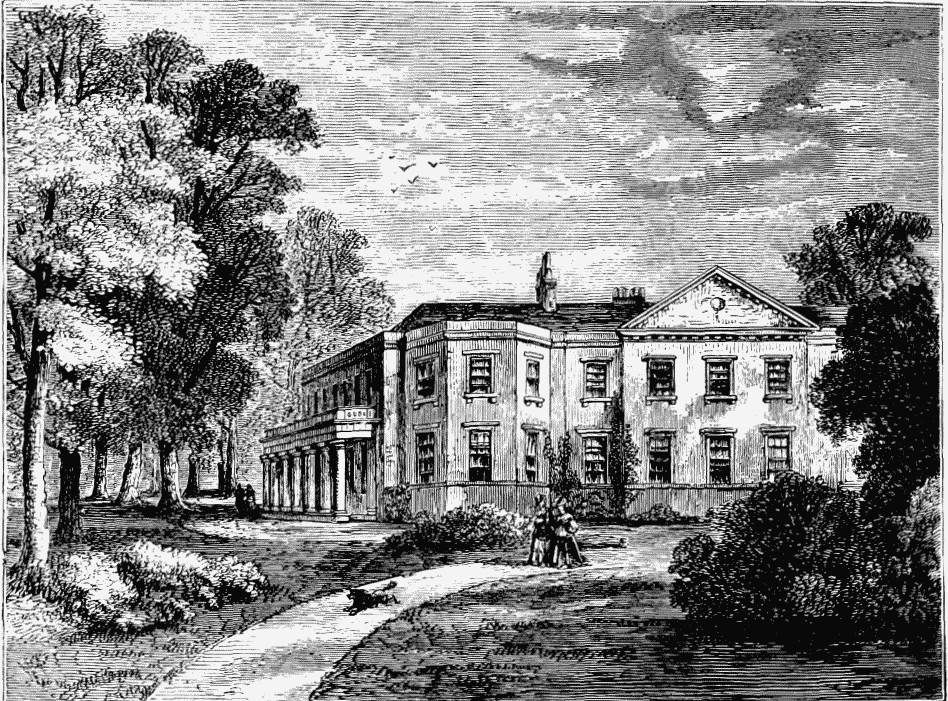
LANGHAM HOUSE IN 1820. (From a Print in Mr. Crace's Collection.)
The other wing of the duke's plan is the corresponding mansion at the corner of Chandos Street. It has been for many years the town residence of the Earls of Gainsborough. The central part is now principally occupied by two splendid mansions, the fronts of which are ornamented with Corinthian columns, said to have been designed by James, of Greenwich, who was architect to the duke at Canons.
It was at first intended to place a statue of Queen Anne in the centre of the enclosure, and in the plan above referred to the statue is marked; the idea, however, was never realised, and the site remained vacant till 1770, when Lieutenant-General William Strode erected an equestrian statue of William, Duke of Cumberland, "the butcher of Culloden," as the inscription sets forth, "in gratitude for private kindness, and in honour of public worth." The statue, which was of lead, gilt, represented the "hero" in the full military costume of his day; it has recently been removed. On the south side, facing Holles Street, is a colossal standing bronze statue of Lord George Bentinck, some time leader of the Conservative party in the House of Commons; this was set up soon after his death, in 1848. The heavy wooden railings which originally surmounted the dwarf brick wall forming the enclosure were allowed to fall into a sad state of decay, so that in 1761 we are told that they made "but an indifferent appearance;" but the unsightly rails have long since given way to substantial iron railings. In this square, as also in Manchester Square and in Queen Anne Street, there remain, or remained till only a year or two since, some good specimens of the flambeaux-extinguisher which a century ago formed an almost necessary adjunct to the front door of a house belonging to "the quality." These extinguishers sometimes formed a part of the ornamental iron scroll-work with which the front entrances of town mansions were adorned. One or two good specimens of them are given in Robert Chambers' "Book of Days."
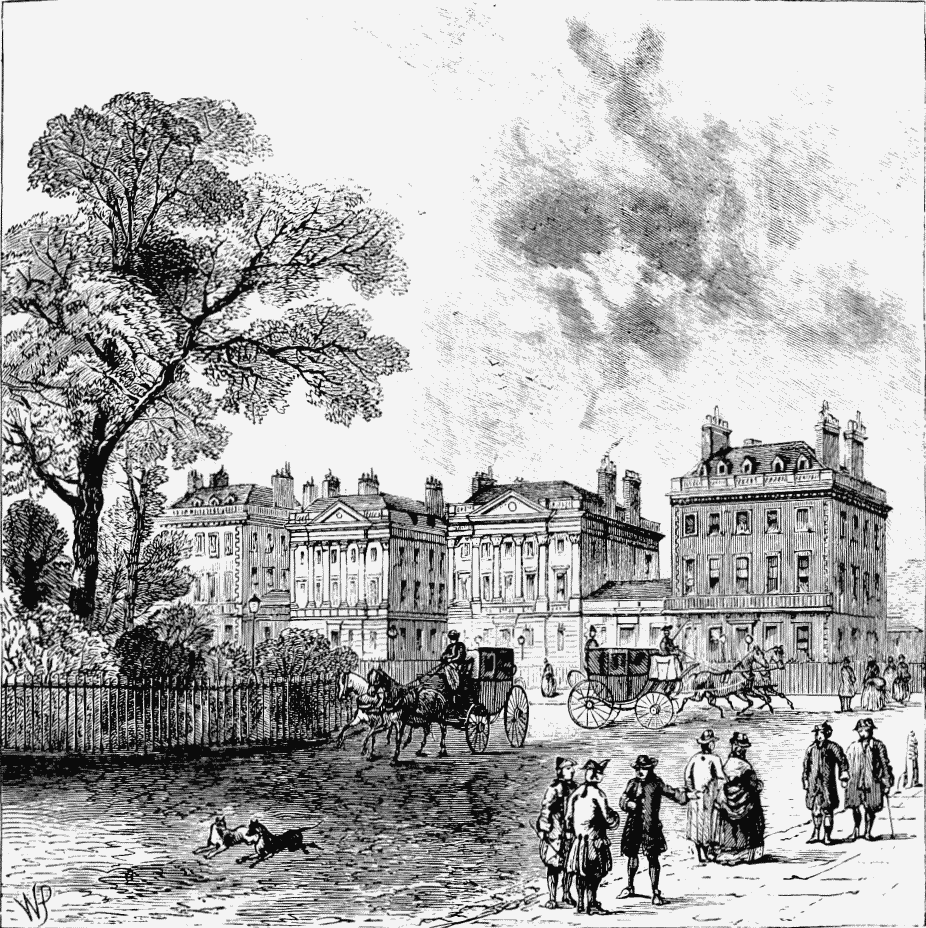
CAVENDISH SQUARE, 1820.
The large and heavy mansion called Harcourt House, which occupies the centre of the west side of the square, and which has long been the town residence of the Dukes of Portland, was built by Lord Bingley, in 1722–3. It was purchased after his death by the Earl of Harcourt, who had previously built a house on the east side of the square. This mansion is mentioned by the author of the "New Critical Review," already quoted, as "one of the most singular pieces of architecture about the town," and "rather like a convent than the residence of a man of quality; in fact," he adds, "it seems more like a copy of one of Poussin's landscape ornaments than a design to imitate any of the genuine beauties of building." After an interval of a century and a half, the verdict of any man of architectural taste who sees it will be very much the same. It is a dull, heavy, drowsylooking house, and it has about it an air of seclusion and privacy almost monastic. Its seclusion of late has been increased by three high walls, which have been raised behind the house, the chief object of which appears to be to screen the duke's stables from the vulgar gaze.
This square was the scene of one of the mad freaks of Lord Camelford, who fell in a duel fought near Holland House, at Kensington. On one occasion he and a boon companion, Captain Barry, returning home at a very late, or, more probably, very early hour, found the "Charlies asleep at their posts, and woke them up and thrashed them, an offence for which the assailants were brought up next morning at the Marlborough Street police station, and fined.
Among the celebrated inhabitants of Cavendish Square may be mentioned Lady Mary Wortley Montagu, who was living here, at all events, from 1723 to 1730, during which period she was satirised with great grossness by Pope.
At No. 24 lived for some time George Romney, the painter. He produced such exquisite portraits as to become a dangerous rival to Sir Joshua Reynolds, and by whom Romney was always referred to as "the man of Cavendish Square." Romney forsook his lawful wife, and became entangled with Emma, Lady Hamilton, whom he admitted as a model to his studio, and whom he portrayed in no less than fourteen of his most beautiful paintings; all of them are, however, more or less of the type of the Phrynes and Lesbias of Horace and Catullus. The house had been previously inhabited by Mr. F. Cotes, R.A., another distinguished portrait painter, who built it; it has been a home of arts and artists in its day, for it was subsequently tenanted by Sir Martin Archer Shee, R.A., afterwards President of the Royal Academy, who died in 1850.
The mansion No. 15 was for many years the scene of the fashionable "receptions" of the Dowager Countess of Charleville, the chief rival of Lady Blessington in her day, as a "queen of society." At No. 16 resided Field-Marshal Viscount Beresford, one of the "great Duke's" chief companions-in-arms.
In this square lived, and here died in August, 1769, aged ninety-seven, Edmund Hoyle, registrar of the Prerogative Court, but better known to the world at large as the author of "Hoyle's Games." Here, too, lived Mr. Thomas Hope, F.R.S., F.S.A., the accomplished author of "Anastasius;" and also Matthew Baillie, the fashionable physician. At No. 5, behind the premises of the Polytechnic, was played, in 1851, the great "International Chess Tournament," players from all quarters of the world taking part in the competition. In this square, in 1747, the newly-formed Dilettanti Society purchased ground on which they intended to build a house for their accommodation, but they afterwards abandoned the idea.
As a proof of the once rural character of the neighbourhood of Cavendish Square, we may here mention that Mr. Fox told Samuel Rogers that when Dr. Sydenham was sitting at his window in Pall Mall, with his pipe and a silver tankard on the sill, a fellow made a snatch at the tankard and ran off with it, and that he was not overtaken, for his pursuers could not keep him in sight further than the bushes at the top of Bond Street, where they lost him.
In Old Cavendish Street, close by Oxford Street, was the shop of Mr. Marsh, the publisher, in 1825, of the Star Chamber, the first literary venture of Mr. Benjamin Disraeli, subsequently Premier of England. He was already the editor of this periodical, of which the public took but little notice, when he gave to the world his first novel, "Vivian Grey;" and Mr. Cyrus Redding tells us in his "Recollections," that "D'Israeli reviewed and extolled his own book in his own columns." The Star Chamber was strongly personal. "I have heard," adds Redding, "that the author suppressed it, but not till it had attacked most of the literary men of the day." It appears that Marsh meantime published "A Key to Vivian Grey," professing to be a complete exposition of the royal, noble, and fashionable characters who figure in that most extraordinary work.
Holles Street, which runs from the south side of the square into Oxford Street, was so named after Henrietta Holles, already mentioned as the daughter and heiress of John Holles, Duke of Newcastle. The street, which was originally composed of private houses, at present consists almost entirely of shops and private hotels. At No. 24 in this street Lord Byron was born on the 22nd of January, 1788; and a tablet has been placed on the front of the house by the Society of Arts, in order to record the fact for the benefit of posterity. Lord Byron was baptised in the old parish church of Marylebone.
In May, 1831, Queen Hortense and her son Prince (afterwards Emperor) Louis Napoleon, took up their abode in Holles Street; and "assuming their own proper name and dignity, speedily found themselves the centre of a brilliant circle of sympathising friends."
At No. 10, in Chandos Street, which runs out of the square at its north-east angle, lived, for many years, the Right Hon. Joseph Planta, M.P., Chief Librarian of the British Museum—an office, the duties of which he discharged by deputy, whilst mixing in political and official circles.
Queen Anne Street, which unites the northern end of Chandos Street with Welbeck Street, has numbered among its residents, at different periods, men famous both in literature and the fine arts. Here, in 1770, Richard Cumberland was living when he wrote his play of the West Indian; and at the beginning of this century, No. 58 was in the occupation of Malone, the commentator on Shakespeare.
At No. 47 was living, in the year 1836, J. M. W. Turner, the prince of modern English landscape painters; and here he kept for many years the greater part of his stores of pictures, patiently biding his time till they should be worth thousands. He was right in his calculations, as well as in the estimate which he had formed of himself. Indeed, his one hundred and more paintings in the National Gallery, not to mention his drawings on the basement-floor, and at South Kensington, show a versatility and an infinite variety, endless as Nature herself. It has been, perhaps justly, observed, that "after all allowance and deduction, Turner remains the fullest exponent of nature, the man above all others who was able to reflect the glory and the grandeur, the sunshine and the shade, the gladness and the gloom which in the outward landscape respond to the desires and the wants of the human heart."
He was just commencing to climb the hill of fame when he first settled here. As a young man he was slovenly and untidy, and now he gave way to his penchant for dirt and disorder. The house was "subsequently known," writes Dr. W. Russell, "as 'Turner's Den.' And truly it was a den. The windows were never cleaned, and had in them breaches patched with paper; the door was black and blistered; the iron palisades were rusty for lack of paint. If a would-be visitor knocked or rang, it was long before the summons was replied to by a wizened, meagre old man, who would unfasten the chain sufficiently to see who knocked or rang, and the almost invariable answer was, 'You can't come in.' After the old man's death, an elderly woman, with a diseased face, supplied his place."
The same writer records a visit which Turner received at this "Den" from Mr. Gillat, a wealthy Birmingham manufacturer, who called in order to purchase one of Turner's pictures. "He was met at the door by a refusal of admission, and was obliged to make an almost forcible entry. He had hardly gained the hall when Turner, hearing a strange footstep, rushed out of his own particular compartment, and angrily confronted the intruder, 'What do you want here?' 'I have come to purchase some of your pictures.' 'I have none to sell.' 'But you won't mind exchanging them for some of these?' and he took out of his pocket a roll of bank-notes, to the amount of five thousand pounds. The Birmingham gentleman was successful, and carried off his five thousand pounds worth—now, perhaps, worth five times that sum—of the great artist's creations."
A wealthy merchant of Liverpool, at a later date, was less fortunate in his visit to the "Den." He offered a hundred thousand pounds for the art treasures rolled up in dark closets, or hanging from the damp walls, in Queen Anne Street. "Give me the key of the house, Mr. Turner," said the would-be purchaser. "No, I thank you," replied Turner; "I have refused a better offer." And so he had. He could not bear to sell a favourite painting—it was a portion of his being; to part with it was a blotting out of that part of his life which had been spent in its creation. He was always dejected and melancholy after such a transaction; and he would say, with tears in his eyes, "I have lost one of my children."
Mr. C. Redding, in his "Fifty Years' Recollections," claims Turner as a native, not of Maiden Lane, as usually supposed, but of the west country. He writes, "We were sailing on the St. German's River—Turner, Collier, and myself—when I remarked what a number of artists the West of England had produced from Reynolds to Prout. 'You may add my name to the list,' said Turner; 'I am a Devonshire man.' I asked from what part of the county, and he replied, 'From Barnstaple.' I have several times mentioned this statement to persons who insisted that Turner was a native of Maiden Lane, London, where, it is true, he appears to have resided in very early life, whither he must have come from the country. His father was a barber. When Turner had a cottage near Twickenham, the father resided with his son, and used to walk into town to open the gallery in Queen Anne Street, where I well remember seeing him, a little plain, but not ill-made old man—not reserved and austere as his son, in whom the worth lay between a coarse soil."
Some years before his death, Turner abruptly and secretly quitted his "Den" and walked to Chelsea, where he took lodgings next door to a ginger-beer shop close to Cremorne Pier; here, after some days, he was discovered by his faithful housekeeper, Miss Danby; but the hand of death was upon him. He died in December, 1851, and was buried in the crypt of St. Paul's Cathedral, near the grave of Reynolds.
Between 1788 and 1793 the house No. 72 in
this street was in the occupation of Fuseli, the
painter; he afterwards removed to No. 75. In
1826 No. 48 was the residence of Mr. Charles
C. Pepys, while practising at the Bar; he became
afterwards Lord Chancellor Cottenham. At that
time No. 7 was in the occupation of Prince Nicholas
Esterhazy, the Austrian Ambassador, who was still
living there in 1836. The prince, it will be remembered by some, at least, of our readers, was
noted for the splendour of his attire when taking
part in any public state ceremonial; and he is
thus commemorated by Ingoldsby in "Mr. Barney
Maguire's Account of the Coronation of Queen
Victoria:"—
"'Twould have made you crazy to see Esterhazy,
All jewels from jasey to his di'mond boots."
In this street Edmund Burke took up his residence in 1764–5, on his return from his first public employment at Dublin, in order to resume his literary labours. Whilst living here he used to frequent the "Turk's Head," in Greek Street, and other debating societies of the metropolis; and on spare evenings was to be seen in the Strangers' Gallery in the House of Commons, studying the art of oratory in the best school, from the lips of living orators.
Mr. Serjeant Burke tells us in his life of his kinsman, that the future statesman and orator, when he first came to London to study for the Bar, found in the Strangers' Gallery a powerful attraction, which drew him away even from the tables of his friends. "It was his favourite custom to go alone to the House of Commons, there to ensconce himself in the gallery, and to sit for hours, his attention absorbed and his mind enwrapped in the scene beneath him. 'Some of the men,' he remarked to a friend, 'talk like Demosthenes and Cicero, and I feel, when listening to them, as if I were in Athens or Rome.' Soon these nightly visits became his passion; a strange fascination drew him again to the same place. No doubt the magic of his own master spirit was upon him, and the spell was working. He might be compared to the young eagle accustoming its eyes to the sun before it soars aloft. . . . . . The House of Commons was but his recreation; literature continued to be his chief employment." Burke was still living in Queen Anne Street when he entered Parliament, by Lord Verney's influence, as one of the members for Wendover. It may be added that if Burke really wrote the "Letters of Junius," it is most probable that those letters were composed in this street.
In Queen Anne Street, at the end of Mansfield Street, and looking directly down it, is a spacious mansion, formerly called Chandos House, but now divided into two, built by the "princely" Duke of Chandos as a town residence. The side, or rather back front, of the mansion in Queen Anne Street opens into a garden on the western side adjoining Langham House.
Mansfield Street, a continuation of Chandos Street on the north side of Queen Anne Street, was built by the brothers Adam, of the Adelphi, about the year 1770, on a plot of ground which had previously been a basin or reservoir of water. Some of the houses in this neighbourhood exhibit many good architectural details, especially in the rooms and staircases.
In this street, in 1836, were living the Princess De la Beiza and the Prince of Asturias. This street appears to have been a great rallying-point for the Roman Catholic aristocracy. At various times the families of Lord Clifford, Lord Stourton, Lord Petre, the Howards of Corby, &c., have resided here. Count Woronzow, the Russian diplomatist, died at his residence in this street, in 1832, at the age of eighty-seven.
Duchess Street is a short thoroughfare connecting Mansfield Street with Portland Place. Here was the town mansion of Mr. Thomas Hope, F.R.S., the author of "Anastatius," "The Costumes of the Ancients," &c. Mr. Hope had here formed a valuable collection of works of art altogether unrivalled, and comprising paintings, antique statues, busts, vases, and other relics of antiquity, arranged in apartments, the furniture and decorations of which were in general designed after classic models, by the ingenious possessor himself. Among the specimens of sculpture was the exquisite group representing "Venus rising from the Bath," by Canova. The whole of these valuables were open to the public, under certain restrictions, during "the season."
Mr. John Timbs says that, in the decoration of his mansion in this street, Mr. Hope "exemplified the classic principles illustrated in his large work on 'Household Furniture and Internal Decorations.' Thus, the suite of apartments included the Egyptian, or Black Room, with ornaments from scrolls of papyrus and mummy-cases; the furniture and ornaments were pale yellow and bluishgreen, relieved by masses of black and gold. The Blue, or Indian Room, in costly Oriental style. The Star Room: emblems of Night below; and above, 'Aurora visiting Cephalus on Mount Ida,' by Flaxman; furniture, wreathed figures of the Hours. The Closet, or Boudoir, hung with tent-like drapery; the mantelpiece, an Egyptian portico; Egyptian, Hindoo, and Chinese idols and curiosities. Picture Gallery, Ionic columns, entablature and pediment from the Temple of Erectheus at Athens, car of Apollo, classic tables, pedestals, &c. The New Gallery, for one hundred pictures of the Flemish school, antique bronzes and vases; furniture of elegant Grecian design." Mr. Hope was one of the earliest patrons of Chantrey, Flaxman, Canova, Thorwaldsen, and George Dawe; and he died here in 1831.
Harley Street dates from the same period as
Mansfield Street, with which it runs parallel on
its western side. It was called after the Harleys,
Earls of Oxford, to one of whom Pope pays a
well-deserved compliment in his "Moral Essays," in
which he writes:—
"And, showing Harley, teach the golden mean."
A happy and graceful allusion to the second earl of
that line, of whose marriage with the daughter and
heiress of the noble house of Holles we have
already spoken. Harley died in 1741, regretted
by all men of taste and letters, great numbers of
whom had experienced the benefits of his munificence. He left behind him one of the most noble
libraries in Europe. The collection was formed by
himself and his son, and was purchased for the
British Museum in 1753. His name is perpetuated
in the Harleian MSS. in the Museum, and in the
Harleian Miscellany.
In this street Lord and Lady Walsingham were accidentally burnt to death in bed in April, 1831. At No. 18 lived Sir William Beechey, the celebrated painter, during the latter years of his life. He was born at Burford, in Oxfordshire, in 1753, and in early life was articled in a solicitor's office, but at nineteen found admission as a student to the Royal Academy, where he became a pupil and close imitator of the great Sir Joshua. Having attracted public notice by his portraits of the Duke and Duchess of Cumberland, he was appointed portrait-painter to Queen Charlotte. In 1793 he was elected an Associate of the Royal Academy, and attained the full honours of R.A. four years later. He died at Hampstead in January, 1839, in his eighty-sixth year. The house No. 45 was built and occupied by Mr. John Stuart, the author of "Athenian Antiquities," published under the auspices of the Dilettanti Society; it was afterwards the town-house of Admiral Viscount Keith.
At No. 73 lived for many years Sir Charles Lyell, the eminent geologist. Born at Kinnordy, in Fifeshire, in 1797, he graduated at Exeter College, Oxford, and received the honorary degree of D.C.L. from his University in 1855. He was twice President of the Royal Geological Society, and was the author of a volume of "Travels in North America," "The Antiquity of Man," of treatises on the Elements and Principles of Geology, and of many papers in scientific journals. He was created a baronet late in life, and died here at the beginning of 1875. His house, in 1876, became the residence of Mr. W. E. Gladstone. In this street, too, lived Sir John Herschel, the son of Sir William Herschel, the astronomer. The father, who was of Hanoverian extraction, coming to England in the reign of George II., held for some time the post of organist at Halifax, and also at Bath. Whilst at the latter place he turned his attention to astronomy. He began to contribute to the "Philosophical Transactions" in 1780, and in the following year announced to the world his discovery of a supposed comet, which soon turned out to be the new planet now called Uranus. This announcement drew him immediately into the "full blaze of fame," and he was at once appointed astronomer to King George III. It was the discovery of this planet which gave the impetus to further additions to the solar system by others in more recent times. In the stellar field Herschel also achieved great results. Late in life he was elected President of the Royal Astronomical Society, and he died at Slough, near Windsor, in 1822. Sir John Herschel, who was little inferior to his father, either as an astronomer or as a mathematician, received the honour of a baronetcy at the Queen's coronation, and was for some time Master of the Mint. He died in 1871.
Allan Ramsay, the painter, who lived at No. 67, was appointed "principal painter to George III.," and died in 1784. "Allan Ramsay's house," says Mr. Peter Cunningham, "was in 1800 the residence of Colonel John Ramsay, his son." In 1826 No. 49 was in the occupation of Mr. William Horne, afterwards Sir William Horne, Solicitor-General in 1832–4, and M.P. for Marylebone. In this street, too, lived Viscount Strangford, the diplomatist and poet; and also Lady Nelson, the relict of the hero of the Nile and Trafalgar.
Dean Swift appears to have been at one time a resident here; at all events, he dates from Harley Street one of his letters to "Stella," in which he alludes with feelings of disgust to the nightly outrages then being perpetrated in London by the "Mohawks," whose street outrages we have already mentioned. (fn. 1) This street is now principally inhabited by physicians and surgeons. On the west side, between Queen Anne Street and Great Mary lebone Street, are the Queen's College for Ladies and the Governesses' Benevolent Institution. The former was incorporated by Royal Charter in 1853, for the general education of ladies, and for granting certificates of knowledge. Individual instruction is given here in vocal and instrumental music, and there is a Cambridge Scholarship, open to the daughters or granddaughters of a graduate of Cambridge.
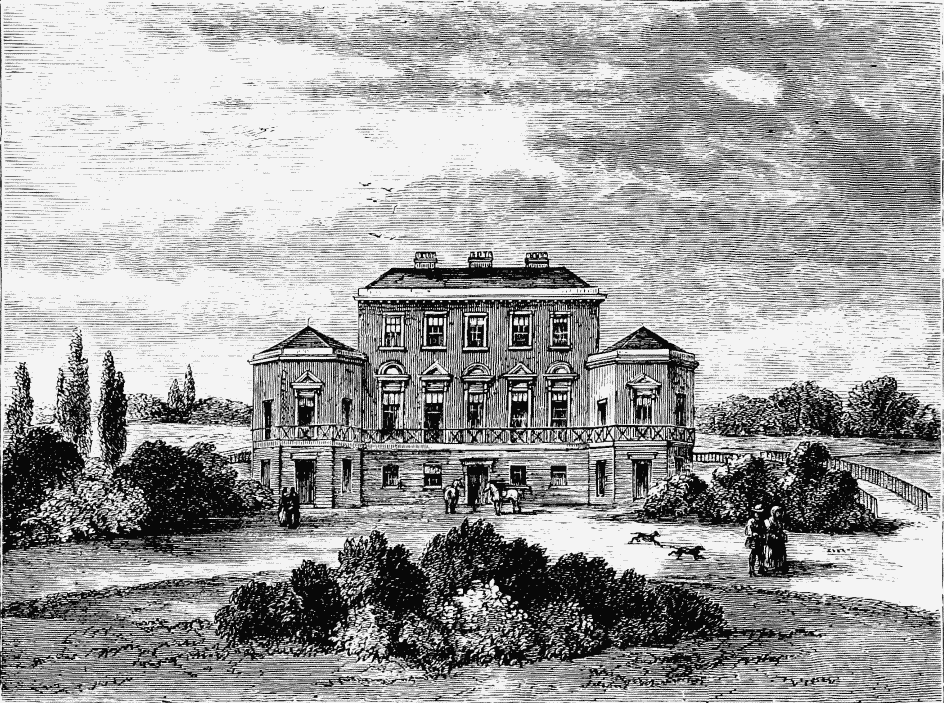
FOLEY HOUSE, IN 1800.
The readers of Charles Dickens will hardly need to be reminded that it was in this street that "Mr. Merdle," the gigantic swindler in "Little Dorrit," resided.
Eastward of Harley Street and running parallel with it, is Portland Place, a thoroughfare remarkable for its width, being upwards of 100 feet wide, in respect of which it contrasts most agreeably with the narrow thoroughfares which prevail in most quarters of London, reminding us of the broad boulevards of Paris and other foreign cities, though falling short of them in beauty because it has no trees. In 1875, however, it was resolved by the parochial and municipal authorities that trees should be planted on either side, but as yet the suggestion has not been carried into effect. The two rows of stately houses which form Portland Place were constructed from the designs of Mr. Robert Adam in 1778, and named after the ground landlord. The north end was originally intended to have been terminated by a circus, but only one half was built; and that, now designated Park Crescent, was called, in 1816, by Nash, the architect, "the key to Marylebone Park." Had this design been carried out, it would have been the largest circle of buildings in Europe. The foundations of the western quadrant of it were even laid, and the arches for the coal-cellars turned. For some reasons, however, this plan was abandoned, and the entire chord of the semicircle left open to the Park, instead of being closed in by the intended half circus. This alteration is a manifest improvement of the entire design, and is productive of great benefit to the houses in the crescent and in Portland Place. Of Park Square, which was erected in its stead, we shall have to speak in a future chapter. In Park Crescent, facing Portland Place, is a bronze statue of the Duke of Kent, the father of Queen Victoria; it was designed and cast by Gahagan.
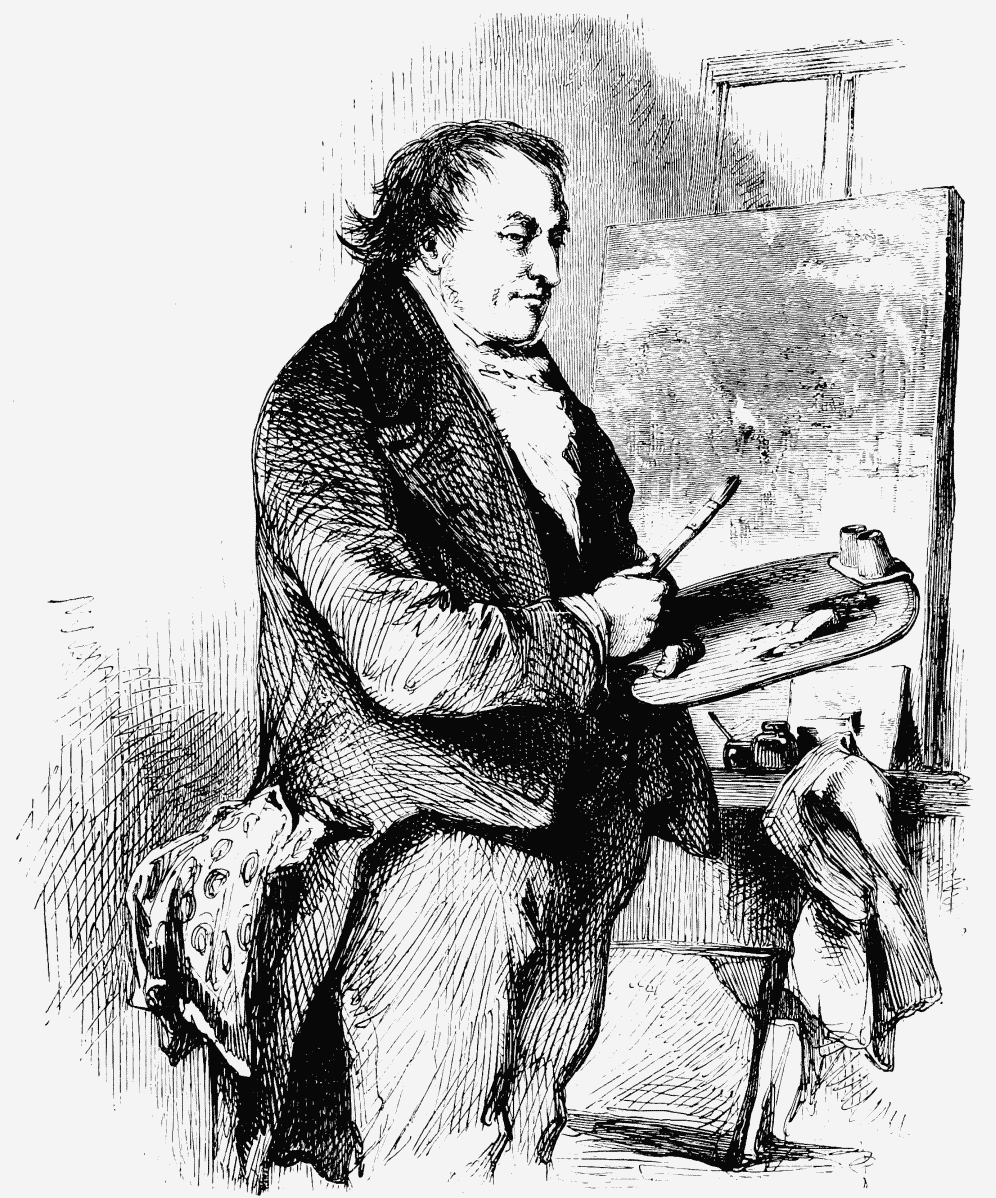
J. M. W. TURNER, R.A.
Among the residents in Park Crescent have been Mr. Ralph Bernal, who lived at No. 11, before settling in Eaton Square; Joseph Buonaparte; the late Sir John Taylor Coleridge and his son Sir John Duke (afterwards Lord Chief Justice) Coleridge; and also Sir Charles Wheatstone, the inventor of the electric telegraph, and the man who, in conjunction with Sir William Fothergill Cooke, placed that discovery at the service of the nation, and, in fact, of the world. He died at Paris in 1875, but his remains were brought over to England, and buried at Kensal Green.
Although less fashionably inhabited than when first built, Portland Place still numbers among its occupants several members of "the upper ten thousand," including peers, baronets, judges, and ambassadors. In the year 1836 No. 38 was the residence of Lord Denman, Chief Justice of the Court of Queen's Bench; No. 58 was that of Count Batthyani; and at No. 61 lived Sir William Curtis, the eccentric alderman, the advocate of "the three R's"—reading, 'riting, and rithmetic. No. 24 at that time was occupied by Mr. J. B. Sawrey Morritt, of Rokeby, the friend and correspondent of Sir Walter Scott. Lord Selborne has lived in Portland Place for the last twenty years.
Here, in 1819, was the Spanish Embassy; and here the ambassador gave a splendid entertainment on the 16th of December in that year in honour of the marriage of his master, the King of Spain; the Prince Regent, all the royal dukes, and members of the Cabinet, the Duke of Wellington, &c., were present; the house was brilliantly illuminated, and a squadron of the Royal Horse Guards was on duty in the street in case of any disturbance arising.
In the year 1772, according to a plan and detailed account given in Northouck's "History of London," a new square was intended on the site of Portland Place, to be called Queen Square; it was to be bounded by Foley House and gardens on the south; by houses abutting on Portland Street on the east; by Harley Street on the west; and by an island of mansions on the north; with two grand streets, one on the east, called Highgate Place; and the other, on the west, designated Hampstead Place. Westward, towards the south, is Great Queen Anne Street, and opposite to it, on the east, Little Queen Anne Street. This design, however, was abandoned, and Portland Place built as above described.
It was part of Nash's design, in building Regent Street, that the great thoroughfare should lead through and beyond Portland Place to a magnificent palace to be built for George IV. in the centre of the Regent's Park. This design, also, was abandoned.
Foley House, at the southern end of Portland Place, was the town residence of Lord Foley; it was a large mansion, and with its surrounding grounds occupied a considerable amount of space, stretching away to the north-east corner of Cavendish Square. The house was of the same width as Portland Place, and had a somewhat dwarfed elevation; and the garden in front was separated from Portland Place by a brick wall. The building was pulled down about the year 1820, for the formation of Langham Place, so called after the adjoining mansion, belonging to Sir James Langham. Foley House is still kept in remembrance by the name being given to one of the mansions (No. 6) on the east side of Portland Place, and also by Foley Street, which is immediately contiguous. In Foley Place (now called Langham Street), which also occupied part of the grounds surrounding Foley House, lived John Hayter, the artist. Close by old Foley House, on part of the site now occupied by the Langham Hotel, stood till about 1860 Mansfield House, the town mansion of the Earl of Mansfield. The first Lord Mansfield, it is said, owed his first steps in professional success to the kindness of his friend and neighbour, Lord Foley, who allowed him £200 a year out of his own not very large income, to "keep up appearances" till he could achieve an income for himself.
Lord Mansfield in his early life was a great friend of Pope, who addresses him in his "Moral Essays" as "Dear Murray;" and, in his later days, of Dr. Johnson, who, however, stoutly refused to give Scotland any very great share of the credit arising from his lordship's career, as he was educated in England. "Much may be done with a Scotchman," the prejudiced old doctor would say, good-humouredly, "if he is only caught young!"
Close to Foley House stood also the mansion of Sir James Langham, after whom the adjoining Place was named. On its site, about the year 1862, was erected a monster hotel called the "Langham," one of the most spacious and complete establishments of the kind in London. Here families can live, being boarded by contract, escaping all the domestic worries of servants, and petty household expenses.
English inns have not lost their reputation for comfort and the attention paid to guests; but the almost entire alteration in the methods of travelling by the introduction of railways has left them considerably behind the requirements of the age. Except in the smaller towns and villages, they have been superseded by hotels—houses of a more pretentious kind, which contain suites of apartments for families or individuals who choose to be alone, also a larger apartment for travellers generally. About the year 1861 projects were set on foot for the purpose of building several hotels in London worthy of the place, and corresponding to the vastness of modern demands, and the "Langham" was not only one of the first erected, but has ever since remained one of the most important.
The Langham Hotel was originally designed by a company about the year 1858, but the project proved abortive. The design, however, was subsequently taken in hand by another set of shareholders, who employed Messrs. Giles and Murray as the architects, and the foundations were laid in 1863. The hotel, which cost upwards of £300,000, is one of the largest buildings in London, and comprises no less than six hundred apartments. It measures upwards of 200 feet in the facade looking up Portland Place, and is upwards of 120 feet in height, the rooms rising to a sixth storey, and overtops by some forty or fifty feet all the mansions in Portland Place and Cavendish Square. The style of architecture would be called Italian; it is, however, plain, simple, and substantial, and singularly free from meretricious ornament. It includes large drawing-rooms, a dining-room, or coffee-room, 100 feet in length, smoking-rooms, billiard-rooms, post-office, telegraph-office, parcels-office, &c., thus uniting all the comforts of a club with those of a private home, each set of apartments forming a "flat" complete in itself. Below are spacious kitchen, laundry, &c., and water is laid over all the house, being raised by an engine in the basement. Some idea of the extensive nature of this establishment may be formed when we add that its staff of servants numbers about two hundred and fifty persons, from the head steward and matron down to the junior kitchenmaid and smallest "tiger." The "Langham," on an emergency, can make up as many as 400 beds. The floors are connected with each other by means of a "lift" which goes up and down at intervals. It is as nearly fire-proof as art can render it.
The hotel, which may be called, not a monster, but a leviathan of its kind, was opened in June, 1865, with a luncheon at which the Prince of Wales was present; and not long after its opening a dinner was given here, as an experiment towards utilising horse-flesh by the "hippophagists" of this country and of Paris. These monster hotels are no novelties in America; indeed, the Langham is far outstripped in size by the Palace Hotel at St. Francisco; but as this is the first experiment of the kind which has been made in London, it may be as well to add that it has paid a dividend of 20 per cent upon the outlay.
Langham Place has had, at different times, some noted men among its residents. At No. 15 lived, and here also died, May 30th, 1832, the accomplished lawyer, philosopher, and historian, Sir James Mackintosh. His death was occasioned by a small bone of a fowl which accidentally lodged in his throat. He was buried in the churchyard at Hampstead. No. 6 was formerly the house of Sir Anthony Carlisle, the fashionable surgeon; and during the parliamentary season of 1836, No. 10 was the town residence of Daniel O'Connell, the well-known member for Dublin.
In the north-east corner of Langham Place, at the point where the road sweeps boldly round to enter Portland Place, stands All Souls' Church. It was built from the designs of Nash, in 1824, and forms a pleasing termination of the view from the junction of Regent Street and Oxford Street. It has a circular tower surrounded with Ionic columns, and Corinthian peristyle above; the "extinguisher" spire is circular and tapering. The interior arrangement is after the Italian style, being divided into a nave and aisles by colonnades. The altar-piece is a painting of "Christ crowned with Thorns," by Westall. Among the previous incumbents of this church have been Dr. Thomson, Archbishop of York, and Dr. Baring, Bishop of Durham.
On the east side of Langham Place, about half way between the church and the north end of Upper Regent Street, is St. George's Hall. The building contains a spacious room which is occasionally used for balls, concerts, and other entertainments; and likewise for public meetings and lectures both on week days and Sundays. Here are the offices of the London Academy of Music, which was established in 1861. The academy is open to amateur as well as to professional students, and the instruction in the various branches of musical education is given by some of the first professors of the day.
The Portland Bazaar in Langham Place, better known as the "German Fair," was erected as far back as the year 1835, and was opened as a bazaar in 1839. Fourteen years afterwards it was burnt down and rebuilt with great improvements. The management of this establishment was in one respect unlike that of rival undertakings, as every young person employed had a direct interest in the profits, and was not in any way responsible for stall rents, or the purchase of stock; consequently there was no fear of her losing her little all. From November to the end of January the German Fair was literally crammed with customers, the whole stock being imported direct from Germany, France, and other foreign countries. When the bazaar was rebuilt after the fire above mentioned, the southern portion of the premises, up to that time used as a furniture warehouse, was converted into the large building known as St. George's Hall, of which we have spoken above. In the winter of 1875–6 the premises were taken for the purpose of forming a large first-class "skating-rink," and the necessary alterations were at once effected in the building. The project was started by a company, and the rink is called the "Langham." It includes the conveniences of a club, a restaurant, &c., on the grandest possible scale. The rink comprises a hall fitted up for musical performances, fancy-dress fêtes, &c., and is surrounded by galleries which can be used as promenades. The decorations, illuminations, statuary, and lighting are of a most appropriate and novel character.
The upper part of Regent Street was made by demolishing two narrow and ill-built thoroughfares, called Edward and Bolsover Streets, which formed a continuous line from the east side of Foley House into Oxford Street, nearly opposite to Great Swallow Street, which, as we have shown in a previous chapter, was amplified into Regent Street. On the west side of Upper Regent Street is an institution perhaps as well known to country visitors to London as to Londoners themselves—the Royal Polytechnic. It was founded in 1838, for the exhibition of novelties in "the Arts and Practical Science, especially in connection with Agriculture, Manufactures, and other branches of Industry." The buildings were enlarged in 1848. The premises of this institution are capacious and wellappointed, and extend from the east entrance in Regent Street 320 feet in depth, including the mansion, No. 5, Cavendish Square. The exhibition consists, for the most part, of mechanical and other models, distributed through various apartments; a hall devoted to manufacturing processes; a theatre, or lecture-room; a very spacious hall; and other apartments.
The "Great Hall" is lighted from the roof, and about midway around the apartment extends a roomy gallery. The latter contains models and designs. The floor of the hall was principally occupied by two canals, containing a surface of 700 feet of water; attached to which were the appurtenances of a dockyard, locks, water-wheels, steam-boat models, &c. But these have been removed as occupying too much space. At the west end is a reservoir, or tank, fourteen feet deep; this, with the canals, holds nearly 5,000 gallons of water, and can, if requisite, be emptied in less than one minute. Beneath the west-end gallery hangs the diving-bell, which has, from the commencement, been the chief and standing attraction of the Polytechnic, especially with the young folks and country cousins.
Courses of lectures are delivered on the principal topics of the day, and indeed upon almost every subject connected with human interest, accompanied with dioramic illustrations, and various optical illusions; not the least interesting of these was the so-called "Ghost" illusion, which is associated with the name of Professor Pepper, and has obtained great popularity in all the various shapes, dramatic and other, which it has assumed from season to season. The manufacture of spunglass also has been carried on in the large room almost from the commencement with great success. Whilst its rival, the Adelaide Gallery, in West Strand, has been converted to other purposes, the Polytechnic remains one of the most popular and attractive exhibitions in London.
The Royal Polytechnic Institution, we may add, is under the management of a council. Besides the rooms mentioned above, there is an excellent laboratory, where chemical experiments are carried out. Public classes are likewise held, in which instruction is given in the various branches of science, in music, history, geography, in Latin, and also in French, German, and other modern languages. These classes are open to ladies as well as to gentlemen, and they render the institution a most valuable assistant to the cause of adult education. Prizes are given annually to the pupils who pass the best examinations.
In the house over the entrance of the Polytechnic Institution was opened, in January, 1855, the Cavendish Club; its founder and proprietor was Mr. Lionel Booth. The club died a natural death at the end of 1872, but was revived at the beginning of 1874, under new management, and with increased resources, especially in the culinary department.
On the opposite side of the street is another house which has been at different times the home of divers clubs, some of which have had but a transient existence. At one time it was the "Corinthian," and opened professedly with the view of affording the luxury and comforts of a club to the north-west of London; but this proved a failure. In 1873 it was opened as the "Civil and Military," a title which was subsequently altered to the "Civil and United Service."
Passing on a few yards further to the south, we find ourselves at Regent Circus, Oxford Street, of which we have already spoken in a previous chapter.
CHAPTER XXXV.
OXFORD STREET EAST.—NORTHERN TRIBUTARIES.
"Miratur portas strepitumque, et strata viarum."—Virgil, "Æn." i.
Condition of Oxford Street in the Beginning of the Last Century—The "Adam and Eve" Tavern—Figg, the Prize-Fighter—Selwyn and the Earl of March stopped by a Highwayman—The London Crystal Palace—Mark Lemon's Birthplace—Great Portland Street—"Homes" and Charitable Institutions—St. Paul's Church—The Central Jewish Synagogue—Sir George Smart and Von Weber—David Wilkie and Dr. Waagen—The Woodbury Permanent Photographic Printing Company—The "Girls' Home," Charlotte Street—George Jones, R.A.—Unitarian Chapel, Little Portland Street, and Charles Dickens—Riding House Street—Mortimer Street—Nollekens, the Sculptor—St. Elizabeth's Home for Incurable Women—Margaret Street—David Williams, Founder of the Royal Literary Fund—"Tom" Campbell and Belzoni—Sir Walter Scott—All Saints' Church—All Saints' Sisterhood—Great Titchfield Street—Castle Street—Oxford Market—The Princess's Theatre—Charles Kean's Shakespearian Revivals—Blenheim Street—A Strange Occurrence—Poland Street—The "North Pole" Tavern—Wells Street—St. Andrew's Church—Berners Street—The Hoax played by Theodore Hook—A Batch of Medical Societies—The Middlesex Hospital—Nassau Street—Cleveland Street—Newman Street—A Modern Worker of Miracles—Mr. Heatherley's School of Art—An Eccentric Vow.
The region upon which we are about to enter dates
its existence from the earlier years of the reign of
Queen Anne. John Timbs writes thus in his
"Curiosities of London:"—"In a map of 1707,
on the south side, King Street, near Golden Square,
is perfect to Oxford Road, between which and
Berwick Street are fields; thence to St. Giles's is
covered with buildings, but westward not a house
is to be seen; the northern side of Oxford Road
contains a few scattered buildings, but no semblance of streets westward of Tottenham Court
Road." This would appear to have been literally
the case, for a plan of 1708, which he also mentions, shows the "Adam and Eve" as "a detached
road-side public-house." It stood, according to
this plan, in the "Dung-field," near the present
Adam and Eve Court, almost opposite Poland
Street; in an adjoining field is represented "the
boarded house of Figg, the prize-fighter," standing
quite isolated from other buildings. Figg appears
to have been a noted character in his time.
Hogarth has preserved his face in one of his engravings; and local gossips still quote the lines, by
an unknown author—
"Long live the great Figg, by the prize-fighting swains
Sole monarch acknowledged of Marybone plains."
It appears that the amusements at "Figg's" were
more varied than select, for we find that even
women here could have "sets-to" in a manner
marvellous to behold. One advertisement of the
time announces that "Mrs. Stokes, the City Championess, is ready to meet the Hibernian Heroine at
Figg's." Other advertisements of a more disgusting character we omit to quote, in mercy to our
female readers.
That the street in its early days must have been anything but a pleasant or safe thoroughfare for travellers is pretty clear from Pennant's remark that he remembered it "a deep hollow road, and full of sloughs, with here and there a ragged house, the lurking-place of cut-throats; insomuch," he adds, "that I never was taken that way by night in my hackney-coach to a worthy uncle's, who gave me lodgings in his house in George Street, but I went in dread the whole way." It was this part of Oxford Street that was probably the scene of a highway robbery, recorded in Lloyd's Evening Post, about the year 1760:—"Jan. 30.—Saturday last, about ten in the evening, as a post-chaise was coming to town, between the turnpike and Tottenham Court Road, . . . . with the Earl of March and George Augustus Selwyn, Esq., a highwayman stopped the postilion, and swore he would blow his brains out if he did not stop; on which the Earl of March jumped out of the chaise and fired a pistol, and the highwayman immediately rode off."
But we are now concerned mainly with the northern tributaries of Oxford Street which lie between Regent Street and Tottenham Court Road. We will begin, therefore, with the Circus, and work our way gradually eastwards, very leisurely, for we shall have a good deal to say before we find ourselves at Bloomsbury again.
Near the Regent Circus is the chief entrance to the London Crystal Palace, one of the most elegant bazaars in the metropolis. This building, which has also an entrance in Great Portland Street, was erected in 1858, from the designs of Mr. Owen Jones, the plan of the structure being somewhat similar to that of the Floral Hall, in Covent Garden. It is constructed chiefly of iron and glass, after the manner of its great prototype at Sydenham. The roof, which is of coloured glass, of mosaic appearance, is supported by iron columns. The nave of the building, from the Great Portland Street entrance to the western extremity, is 180 feet in length; from it there is a transept extending southwards to the Oxford Street entrance, which internally has a length of 90 feet, giving, with the entrance-hall on that side, a total length, from north to south, of about 140 feet. On the ground floor is a spacious hall, divided by iron columns on each side into a nave and aisles, the floor being occupied by counters for the exhibition and sale of fancy goods of all descriptions; there is on each side a gallery above, and in and under these galleries there are also convenient and welllighted stalls. The building was advertised for sale while this sheet was in the printer's hands. In a house on this site was born, in November, 1809, Mark Lemon, the genial editor of Punch during the first quarter of a century of its existence.
Great Portland Street is a broad and respectable thoroughfare, at present almost entirely consisting of shops, largely occupied by picture-dealers and music-sellers, &c. It extends, in a direct line from Oxford Street to the Marylebone Road, close by the eastern end of Park Crescent. The houses on each side, towards the northern end, stood back from the roadway, with gardens in front; but of late years shops have been thrown out on both sides of the way.
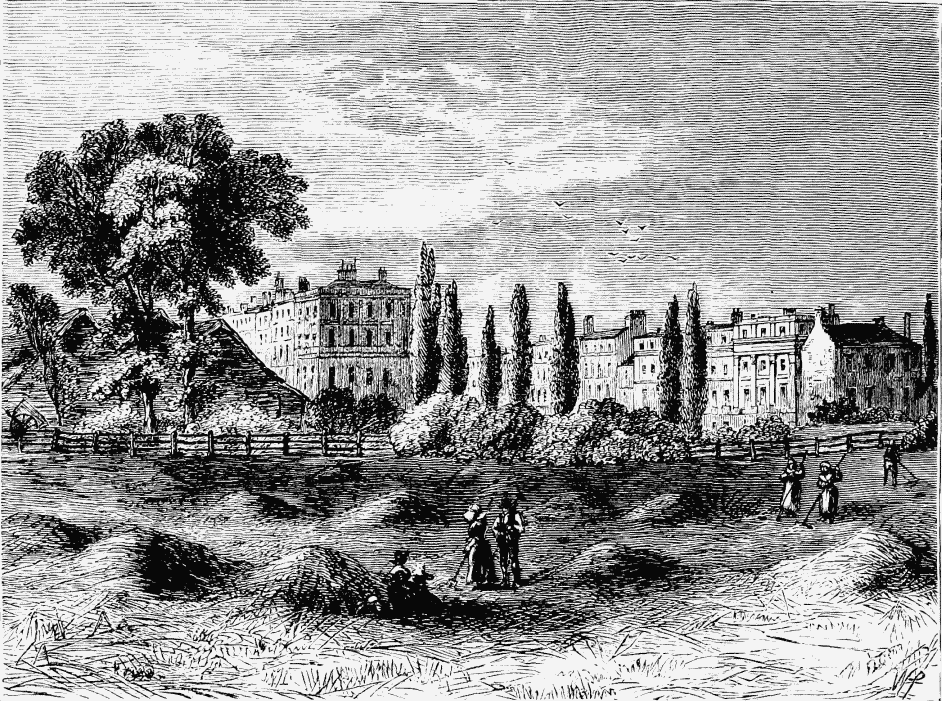
THE ENTRANCE TO PORTLAND PLACE, 1815.
At this end of the street are various charitable institutions, or "homes." Amongst others are the National Dental Hospital, the National Orthopædic Hospital, and Miss Gladstone's Female Servants' Home.
On the west side of the street, near Little Portland Street, are the offices of the Association for the Sale of Work by Ladies of Limited Means; and close by is a building called the Lyric Hall, which, as its name implies, is used for concerts and other entertainments of a similar character.
On the same side of the way, about half-way up, stands St. Paul's Church, for many years known as Portland Chapel. It was erected in 1775–6, and stands on a site which formed part of a basin of the Marylebone Waterworks. John Timbs tells us that there is a view, by Chatelain, of this basin, which was the scene of several fatal accidents and suicides. The chapel was first consecrated in 1831, when it was dedicated to St. Paul.
Near the above church is another religious edifice, which forms a conspicuous architectural feature in the street. It is the central Jewish Synagogue, which was completed and opened in 1870. The building is a fine specimen of Moorish design, its thoroughly Oriental style being especially exemplified in the interior, with its tiers of columns decorated with Saracenic capitals, supporting the gallery, clerestory, and lofty vaulted roof. The ark, in which are placed the sacred scrolls of the law, is situated at the south-east end of the building. looking towards Jerusalem, and is covered by a heavy curtain, embroidered with gold. Immediately over it are the two tables of stone inscribed with the Ten Commandments; and above them, through a small circular window, shines the "per petual light" which is never extinguished. The ark rests on a platform of white marble, raised several steps above the floor. The almemar, a large raised pew, where the readers, choristers, and harmonium are placed, stands conspicuously in the centre of the synagogue, and is richly ornamented with gilt stanchions.
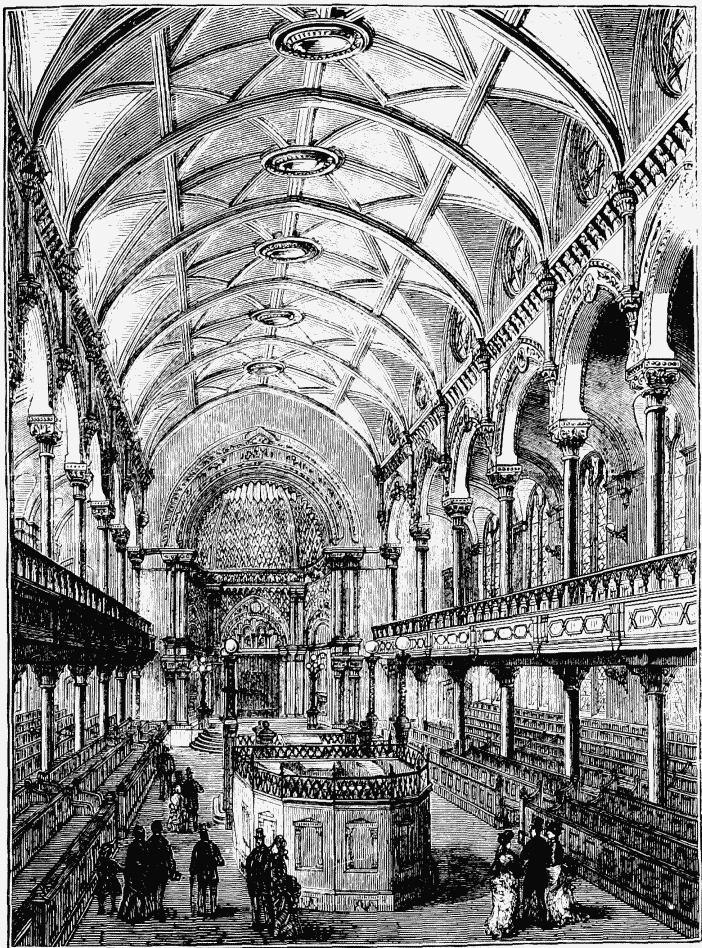
INTERIOR OF THE JEWISH SYNAGOGUE, GREAT PORTLAND STREET.
The Rothschild family showed much interest in, and subscribed largely to, the building fund of this new tabernacle.
At No. 204 is the West London School of Art, with classes in architectural drawing, in drawing from life and the antique, and in design, as applied to mural, textile, and other kinds of decoration. This institution is in connection with the Government Department of Science and Art at South Kensington.
Among the eminent residents in this street mentioned by Mr. Peter Cunningham, were William
Seward, author of the "Anecdotes" which bear
his name; Dr. William Guthrie, author of a wellknown grammar; James Boswell, Dr. Johnson's
biographer; and Carl Maria von Weber. The
two last-mentioned persons died here; the latter
very suddenly, on the 5th of June, 1826, at No. 91,
for many years the house of the late eminent
composer, Sir George Smart. Sir George, we may
here remark, is thus celebrated by "Ingoldsby," in
"Mr. Barney Maguire's Account of the Coronation
of Her Majesty:"—
"That same Sir George Smart, O!
Who played the consarto,
With his four-and-twenty fiddlers all of a row."
Weber was buried at the Roman Catholic Church
of St. Mary's, Moorfields, whence his body was
afterwards taken to Germany. On his death Mr.
J. R. Planché, who knew him well, penned the
following exquisite lines, which were set to music,
and sung by Braham:—
"Weep, for the word is spoken!
Mourn, for the knell hath tolled!
The master-chord is broken,
And the master-hand is cold.
Romance hath lost her minstrel;
No more his magic strain
Shall throw a sweeter spell around
The legends of Almaine.
"His fame had flown before him
To many a foreign land;
His lays were sung by every tongue.
And harped by every hand.
He came to seek fresh laurels,
But Fate was in their breath,
And turned his march of triumph
Into a dirge of death."
In this street, in a hackney-coach, which was conveying her home from the Seven Dials, his mother, in 1766, gave birth to Mr. J. T. Smith, afterwards the superintendent of the print-room at the British Museum, and the author of "Nollekens and his Times," and of "A Book for a Rainy Day," from which we have quoted very largely in these pages.
In this street lodged Wilkie in the early part of his career in London, as we learn from Cyrus Redding's "Fifty Years' Recollections." In 1835 he was in the very height of his fame and popularity. Dr. Waagen tells us that on one occasion he met Callcott, Eastlake, and Etty the painter at dinner. "Wilkie," he adds, "is now unhappily so overwhelmed with orders for portraits that he has hardly a moment for his good-natured humorous subjects." At No. 157 are the offices of the Woodbury Permanent Photographic Printing Company.
Charlotte Street, between Great Portland Street and Portland Place, and running parallel to both, at one time bore a very bad character for its residents. A clearance, however, was made by the parochial authorities about the year 1860, and now it is largely occupied by public institutions, among which may be mentioned the "Girls' Home," which was instituted in 1867 for the purpose of lodging, clothing, and educating destitute girls, who may not have been convicted of crime—a sister institution to the "Boys' Home" in Regent's Park Road, which we shall describe hereafter. Here also are the offices of the Central Synagogue and of the United Synagogue.
At No. 10, New Cavendish Street, George Jones, R.A., was living in 1806. He was a well-known painter of battle-pieces, and some time Librarian and afterwards Keeper of the Royal Academy. He died in 1869.
In Little Portland Street is the leading West-end Chapel of the Unitarian body. Its minister was for many years Mr. James Martineau, a brother of Harriet Martineau. In this chapel Mr. Charles Dickens for a time held sittings, though in later years he frequented a parish church. Mr. Forster tells us that he was led to frequent the Unitarian worship on account of his "impatience of differences with the clergymen of the Established Church on the subject of creeds and formularies."
The neighbourhood of Great Portland Street, towards the upper end, is largely the home of artists and sculptors' studios; and on the southern side of the Euston Road the marble-yards are not unlike the Piccadilly of a century ago. Clipstone Street and Carburton Street, in this neighbourhood, are both named after villages belonging to the ducal estate; the former in Nottinghamshire, and the latter in Northamptonshire.
Facing the New Road, in the garden of the top house on the east side of what was formerly known as Norton Street, but is now styled Bolsover Street, a few yards east of the top of Great Portland Street, were two fine elm-trees, standing as lately as the year 1853. It was said by the late Mr. Robert Cole, to whom the house then belonged, that Lord Byron had once spent an evening under their shade.
Riding House Street, which connects the top of Regent Street with Great Portland Street, bears witness in its name to an establishment long since forgotten, one of the Riding Academies so popular in the days of our great-grandfathers.
At No. 30, Foley Place (now called Langham Street), Campbell was living in 1822, and here he wrote some of his shorter poems.
Mortimer Street, which crosses Great Portland Street, extending from the north-east corner of Cavendish Square to Charles Street, was so called after the earldom of Mortimer, which was borne by the Harleys, conjointly with that of Oxford. At No. 9 in this street was the studio of the sculptor Nollekens, almost as remarkable for his parsimony as for the artistic power of his chisel. Here Dr. Johnson came to sit to him for his bust, and Mr. J. T. Smith, who was then a boy working at art under Nollekens, was busy drawing in the studio at the time. He thus describes Dr. Johnson to the life:—"The doctor, after looking at my drawing, then at the bust I was copying, put his hand heavily upon my head, pronouncing 'Very well, very well.' Here I frequently saw him, and recollect his figure and dress with tolerable correctness. He was tall, and must have been, when young, a powerful man: he stooped, with his head inclined to the right shoulder: heavy brows, sleepy eyes, nose very narrow between the eye-brows, but broad at the bottom; lips enormously thick; chin wide and double. He wore a stock and wristbands; his wig was what is called a Busby, but often wanted powder. His hat, a three-cornered one; coats, one a dark mulberry, the other brown, inclining to the colour of Scotch snuff; large brass or gilt buttons; black waistcoat, and small clothes—sometimes the latter were corduroy; black stockings; large easy shoes, with buckles; latterly he used a hooked walking-stick; his gait was wide and awkwardly sprawling." The late Mr. C. Towneley, the collector of the Towneley Marbles in the British Museum, was also a frequenter of Nollekens' studio, and on one visit he tipped or "pouched" young Smith half-a-guinea to buy a store of paper and chalk. Though an exquisite sculptor, Nollekens was utterly uneducated, and could not even spell his own language. His wife, a daughter of Mr. Justice Welch, was as niggardly as himself. It is said that he attended the Royal Academy Club dinners, at the cost of a guinea a year, because he could carry off in his pockets enough nutmegs to make that difference in his housekeeping. He died in April, 1823, very rich; and eccentric to the last, left a very long drawn will, with no less than fourteen codicils to it.
At No. 67 in this street is a charitable institution in connection with All Saints' Home, in Margaret Street. It is called St. Elizabeth's Home, and its object is to relieve women whom the present London hospitals reject as incurable. The persons received here are chiefly those who have "seen better days," and are unable to support themselves without assistance. In each case it is required that the applicant should be able herself, or through her friends, to guarantee a small annual payment.
Running parallel with Mortimer Street, and extending from the south-east corner of Cavendish Square to Wells Street, is Margaret Street, which keeps in remembrance the name of Lady Margaret Cavendish, the daughter and heiress of the second and last Duke of Newcastle of that line, and wife of John Holles, Marquis of Clare and Duke of Newcastle. The duke died without male issue, and his daughter married Edward Harley, second Earl of Oxford and Mortimer, whose daughter and heiress became, in her turn, as we have already seen, the wife of the second Duke of Portland. The name of the duke's second title, Marquis of Titchfield, is given to the street running parallel with Great Portland Street, on its eastern side, and reaching from Oxford Street to the Marylebone Road; whilst Bolsover Street, close by, is named after the duke's estate in Derbyshire.
In Margaret Street was the chapel of the Rev. David Williams, the founder of the Royal Literary Fund. For the facts contained in the following account of him we are indebted to Dr. Robert Chambers' "Book of Days:"—Born in a humble sphere of life, near Cardigan, in 1738, he was originally a minister of the Unitarian body, and settled at Highgate. He next set up a very liberal form of worship in Margaret Street, where he preached mainly on social subjects, such as the bad effects of gaming. We next catch a glimpse of him at Chelsea, where he kept a school, and had Benjamin Franklin for a guest at the time when the American philosopher was subjected to the abuse of Wedderburn before the Privy Council. He wrote works on education, politics, public worship, economy, &c., in all of which he showed a spirit of philanthropy; but soon after the outbreak of the French Revolution we find him joining the Girondists, whom he helped to frame a constitution. When, however, the rabble at Paris began to thirst for blood, he returned to England, and set to work on the more sensible task of founding a society for the aid of men of letters. In this he succeeded, after many years of persevering labour, in which he collected £6,000. He had the satisfaction of seeing the society regularly constituted and founded in May, 1790. The society distributes between £1,000 and £2,000 a year regularly in aiding poor authors in their struggles. David Williams died in 1816, and was buried in St. Anne's Church, Soho.
In Margaret Street Campbell occupied chambers during the day, whilst editing the New Monthly Magazine, though he lived at Sydenham, and went home every night by the stage-coach. Mr. Cyrus Redding writes thus of him in his "Fifty Years' Recollections:"—"When Belzoni returned from Egypt I went to see his exhibition of the Egyptian tombs. He appeared little altered, and as I was going to take coffee with Campbell, I asked him if he would like to be acquainted with the poet, Campbell being curious about everything relating to the East. He said he should like to go at that moment, and I took him. The king, the queen, and Bergami then occupied the attention of the public. Belzoni and I passing through Bond Street, his remarkable stature and foreign appearance attracted attention. Somebody gave out that it was Bergami. People stopped to stare at us, and a crowd rapidly collected. Belzoni proposed we should get out of the larger thoroughfares, which we did, he moving his Herculean form rapidly onwards. We crossed into Hanover Square, still followed by some of the mob; then crossing Oxford Street, we were soon in Margaret Street, and ensconced in the poet's lodgings. When Belzoni stood by Campbell, I thought of 'Ajax the Less and Ajax the son of Telamon.' I never saw Belzoni but once after this, before he started on the African expedition in which he died. He was an unassuming, quiet man, on whose merit I am convinced there were wrongful attempts made to cast a cloud. His knowledge was strictly practical; indeed, he pretended to nothing more."
On another occasion Cyrus Redding paid a
visit to the poet in his apartments here, which he
thus records:—"Walter Scott was in town soon
after the New Monthly Magazine commenced. He
was too much engaged, and too 'anti-Whig' to be
enrolled at any price in our pages. One day Scott
called in Margaret Street; he was going away as I
went in. When he was gone, Campbell tried at an
impromptu. 'Don't speak for a moment,' said the
poet, 'I have it.'
"Quoth the South to the North, 'In your comfortless sky
Not a nightingale sings.' 'True,' the North made reply;
'But your nightingale's warblings, I envy them not,
When I think of the strains of my Burns and my Scott!'"
Cyrus Redding, like a "Fidus Achates," took the
lines down on a letter-cover at the moment, and so
saved them from perishing. Let us be grateful for
the boon.
In this street, between Great Portland and Regent Streets, was formerly the West London Jewish Synagogue. It was built in 1850, from the designs of Mr. Mocatta, and consisted of a square building, surrounded on three sides with Ionic columns supporting the ladies' gallery, whence rose other columns, receiving semi-circular arches, crowned by a bold cornice and lantern light. The ark, which completed the fourth side, was surmounted by a decorated entablature, above which were placed the tablets of the Ten Commandments. This edifice has been superseded by the new building in Great Portland Street, above described.
In Margaret Street stands All Saints' Church, a handsome modern building of red brick, in the simplest and severest style externally, though its interior is more richly decorated than any other church of the Anglican communion in London. Until about 1850 there stood here a poor, meagre, and gloomy little structure, built in the year 1788, and known as "Margaret Street Chapel." It had been originally a meeting-house belonging to Lady Huntingdon's connection. On the publication of the "Tracts for the Times," this chapel, then under the Rev. W. Dodsworth, became a focus of extreme Tractarian views, and its incumbent and his colleague, the Rev. F. Oakeley, both became Roman Catholics. The new church, of which the architect was Mr. W. Butterfield, was built in 1850–9. The first stone was laid by Dr. Pusey, its first minister being the late Rev. W. Upton Richards. The spire rises to the height of 230 feet. The interior is richly decorated with carving, and with frescoes of the Birth and Crucifixion of our Lord, and the Court of Heaven, showing the saints with our Lord in the centre, by Mr. W. Dyce, R.A. The painted windows are by O'Connor. At the entrance of the church is a baptistery, and adjoining it is a residence for its clergy, who are mostly celibates. The music of this church is of a very ornate and elaborate character; and its ritualistic services attract large congregations, especially of the upper classes, the majority being ladies. There are separate seats provided for the male and female worshippers.
The following jeu d'esprit, said to be from the
pen of a clerical wit of our day, in all probability
contains an allusion to this sacred edifice:—
"In a church that is furnished with mullion and gable,
With altar and reredos, with gurgoyle and groin,
The penitents' dresses are seal-skin and sable,
The odour of sanctity 's Eau de Cologne.
"But if only could Lucifer flying from Hades
Gaze down on this crowd with its panniers and paints,
He could say, as he looked at the lords and the ladies,
Oh! where is 'All Sinners,' if this is 'All Saints?'"
At the corner of Margaret and Wells Street, opposite the church, and more or less dependent on it and its clergy, are various religious houses and homes, in which the work of Christian charity is conducted by ladies, who style themselves the "All Saints' Sisterhood;" they work under the sanction of the Bishop of London. The works in which they are engaged are various. They teach in the nightschool of the district, and visit and nurse the poor and sick at their own houses; and they take charge of orphan girls, and receive aged and infirm women, incurable sick women, and young serving girls into the Home. These latter, as well as the orphans, are trained up for service, and are instructed in the various kinds of household work; and if any show an aptitude for teaching, they are trained to be schoolmistresses. The Sisters have also an industrial school, in which all kinds of plain needlework are done. The building once used as the temporary church in Margaret Street has been fitted up as an orphanage. Attached to the Home is a pharmacy, where medicines are dispensed by the Sisters to the sick and needy, under the supervision of able and experienced physicians, who regularly visit the institution, and give their services gratuitously. The buildings are of red brick, in the severest style of Gothic architecture, and serve the double purpose of a home and national schools.
Great Titchfield Street has had in its time, among its residents, a few men of note in the world of art. Mr. Cunningham mentions the names of Richard Wilson, the landscape painter, who, in 1779, lived at No. 85. Again, Loutherbourg, the landscape painter, resided for some years at No. 45; and No. 76 was the residence of Mr. Bonomi, R.A.
In this street was formerly a place of worship for the "Independents;" it was known as "Providence Chapel," and was under the ministry of the eccentric preacher, William Huntington. (fn. 2) The fabric was burnt down in 1810, and on the minister being spoken to respecting its rebuilding, he is said to have observed that "Providence having allowed the chapel to be destroyed, Providence might rebuild it, for he would not," and in consequence the site was afterwards occupied as a timber-yard.
Cirencester Place, the former name of the north end of Great Titchfield Street, recorded one of the inferior titles of the Duke of Portland, who is also Baron of Cirencester. Like Norton Street, it was formerly tenanted by an unsatisfactory population; but these were cleared out a few years ago; and, the houses being numbered as part of Titchfield Street, the name disappeared.
Castle Street, a thoroughfare extending from Upper Regent Street to Wells Street, and passing across the north of Oxford Market, is probably named after an inn which bore that sign, and it has a history of its own. At No. 36, James Barry, the Royal Academician, resided in 1773, when in the height of his professional reputation and engagements. Here Edmund Burke gave him sittings for a portrait painted at the request of their mutual friend, Dr. Brocklesby. The painter here entertained Burke at a homely dinner, cooking the beefsteak on the fire in his parlour, and availing himself of the great orator's aid in the operation. Barry died in 1806, at the house of his friend and neighbour, Mr. Bonomi.
At No. 6, Dr. Johnson and his wife were living, as we learn from Boswell, in 1738, on his second visit to London; and it was in this street, at the house of some Miss Cotterells, his opposite neighbours, that the great lexicographer first met and was introduced to Sir Joshua Reynolds. It was also whilst living here that he made the acquaintance of Edmund Cave, to whom he addressed several letters, printed in Boswell's "Life," and dated from this house.
Oxford Market was so called either from the Oxford Road, to which it was adjacent, or, more probably, after Harley, Earl of Oxford, the original ground landlord. It was erected in 1721, as shown by the date in the brass vane which surmounts its centre. The vane bears upon it the initials "H. E. H.," which are probably those of Edward Lord Harley and his wife, Henrietta (the heiress of the house of Holles, Duke of Newcastle), who gave the site. It is called by the painter Barry "the most classic of London markets;" but it is certainly difficult to see in what its "classic" nature consists. It was originally a plain hexagonal structure, mostly of wood; this was pulled down, either entirely or to a great extent, about the year 1815, when it was rebuilt, small dwelling-rooms above being added to the shops below. It was the only daughter of the above-named Lord Harley who carried this and other adjoining property by marriage into the family of the Duke of Portland. In February, 1876, the site of the market was disposed of by public auction, the property being purchased for £27,500 by Messrs. Louise and Co.
The Princess's Theatre stands on the north side of Oxford Street, about four hundred yards east of the Circus; it stretches backwards as far as Castle Street. It occupies the site of a building formerly known as the Queen's Bazaar, which had existed for some years, but never gained popularity. It was destroyed by fire in 1829, but rebuilt. In 1833 were exhibited here Mr. Roberts's great picture of the "Departure of the Israelites out of Egypt," and also the "Physiorama," comprising twelve views arranged in a gallery 200 feet long. The edifice, like its successor, had a back entrance in Castle Street.
The building of the theatre was a costly and unsuccessful speculation, and it nearly ruined Hamlet, the great silversmith of Leicester Square. In 1841 it was entirely remodelled, from the designs of Nelson, and decorated by Mr. Crace; and it was opened in the September of that year with a series of promenade concerts. It is a chaste, elegant, and commodious house, having three tiers of boxes, besides another row just below the ceiling.
The history of the theatre is chiefly remarkable for its having been the scene of Mr. Charles Kean's Shakespearian revivals, which were commenced in 1849, and continued for ten years. In putting these plays on the stage Mr. Kean spared no expense, and shirked no amount of study and trouble; and the theatrical world and the public at large are largely indebted to his liberality and erudition for the admirably correct costumes and mise en scène which were in his time characteristic of the plays at the Princess's. In all this he was ably seconded by Mrs. Kean (formerly known as Miss Ellen Tree), who entered warmly into the spirit of his work of revival. In the first year he adapted and produced Byron's play of Sardanapalus, and varied his Shakesperian revivals by putting on the boards at various times Sheridan's Pisarro, Louis XI., and other standard dramas. In the year 1860, on his resigning the management of the theatre, Mr. Kean was invited to a dinner in St. James's Hall, where a large company, with the Duke of Newcastle in the chair, assembled to do honour to the famous tragedian and spirited manager. Shortly afterwards, in recognition of his efforts to raise the dramatic profession and elevate the English stage, Mr. Kean was presented with a handsome service of plate.
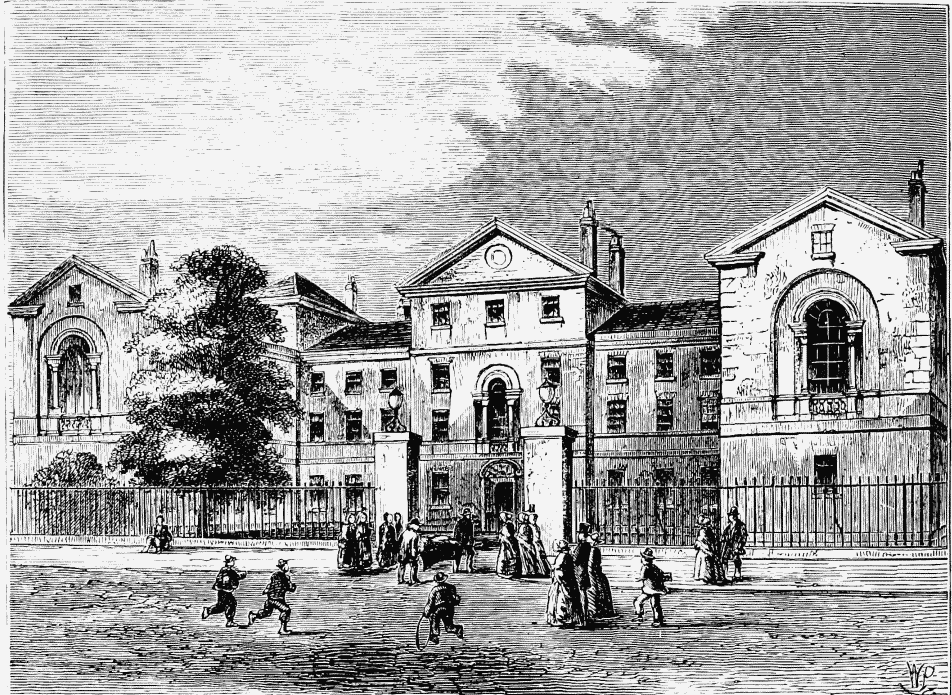
THE MIDDLESEX HOSPITAL.
The theatre subsequently passed into the hands of Messrs. Webster and Chatterton, of the Adelphi, and Mr. Dion Boucicault for some time figured as the leading actor. In 1864 a drama entitled the Streets of London was performed here to overflowing houses. The play, however, like many others of a similar character which have been since produced, appears to have aimed more at "sensationalism" than to have rested on its literary merits, and, therefore, as stated in Charles Dickens's "Life," may be put down as "but an inferior style of theatrical taste." In May, 1866, after a three years' absence from England, Mr. and Mrs. Kean again appeared on the boards of this theatre for one night, in the play of King Henry VIII. Mr. Charles Kean died in London, in January, 1868.
We must here cross for a few minutes to the south side of Oxford Street, in order to speak of one or two matters which escaped us in our wanderings westward. Nearly opposite the Princess's Theatre, in Blenheim Street, was at one time the residence of Ugo Foscolo, of whom we shall have more to say hereafter.
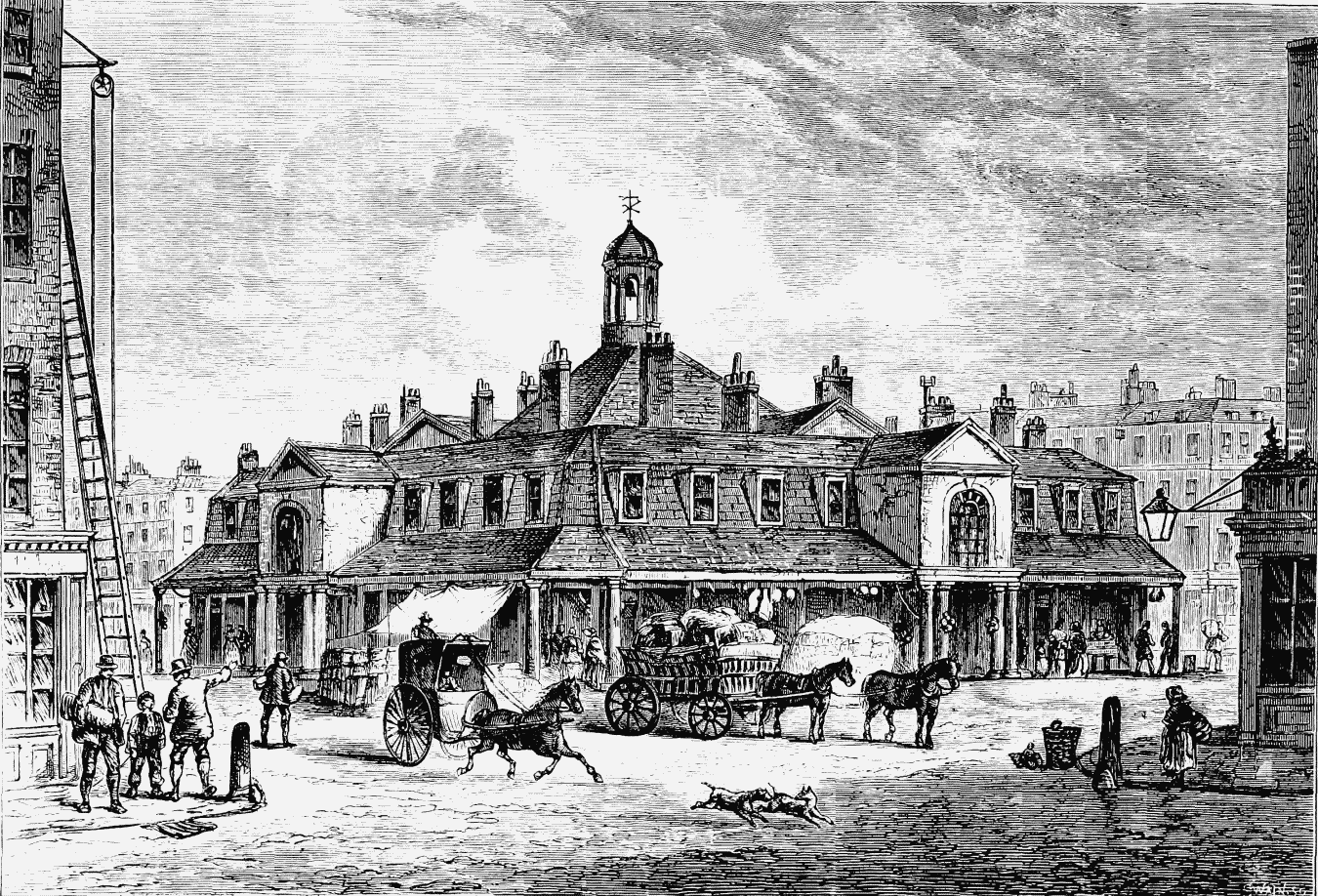
OXFORD MARKET.
A strange occurrence is related by tradition as having happened in Blenheim Street about the time that Dr. Johnson lodged in it. A coach drew up late one evening at the door of a surgeon, Mr. Brooks, who was in the habit of buying "subjects" for dissection. A heavy sack was taken out and deposited in the hall, and the servants were about to carry it down the back stairs into the dissecting-room, when a living "subject" thrust his head and neck out of one end, and begged for his life. The servants in alarm ran to fetch pistols, but the "subject" continued to implore for mercy in such tones as to assure them that there was no ground for alarm, for he had been drunk, and did not know how he had got into the sack. Dr. Brooks coming in, ordered the fellow to have the sack tied up again loosely round his chin, and sent him off in a coach to the watch-house, where it is to be hoped that he recovered his senses.
In Poland Street, the next turning eastward on the same side of Oxford Street, was living, in 1765, Mr. Burney, the friend and correspondent of Dr. Johnson, so often mentioned by Boswell. This street has also numbered among its residents Dr. Macaulay, the husband of the authoress, Mrs. Macaulay; Dr. Burney, the author of the "History of Music;" and the old Earl of Cromartie, who was pardoned by George II. for his share in the Scottish rising of 1745.
In Oxford Street, on the same side, not far from Wardour Street, is an inn called the "North Pole," so named, no doubt, to commemorate one of those many arctic expeditions which from time to time have left our shores, and those of adjoining countries, in search of the spot "where there is no north beyond it."
Re-crossing Oxford Street, we now leave the Portland property on our left, and pass into that belonging to Lord Berners' family. Wells Street, which crosses the eastern end of Castle Street, is narrow and crooked, and therefore more ancient than its neighbours. Its name is probably a corruption of Well Street, and so called after Well, in Yorkshire, the seat of the family of Strangeways, from whom Lady Berners descends. Here Dr. Beattie, the author of "The Minstrel," and of the essay on "Truth," &c., was living during his stay in London, in 1771. He was one of the last of Dr. Johnson's contemporaries, surviving till 1803.
In this street is the handsome district church of St. Andrew's, erected in 1846 from the designs of Mr. Dankes. It is in the Early Perpendicular Gothic style, and has a tower and spire upwards of 150 feet high. At the east end is a large painted glass window, by Hardman. The services are intoned, but "plain-song and anthems are used instead of Gregorian compositions;" and the church has been always remarkable for the excellence of its choir.
Berners Street, so called after the family title of its ground-landlord, runs northward a little to the east of Wells Street. It was built about the middle of the last century, and has always been celebrated as the "home and haunt" of artists, painters, and sculptors. Among its former residents are to be reckoned Opie, Fuseli, and Sir William Chambers, the latter of whom we have already mentioned in connection with Somerset House. Opie was buried in St. Paul's Cathedral. His second wife, Amelia, the learned Quakeress, was well known by her writings, "Tales of Real Life," "Poems," "Simple Tales," &c. In this street was the bank in which Fauntleroy, the forger, was a partner.
As we saunter up Berners Street we are irresistibly reminded of one of Theodore Hook's earliest pranks, when his life was already a succession of boisterous buffooneries. This was in the year 1809; and the lady on whom it was practised, says Mr. Peter Cunningham, was a Mrs. Tottingham, living at No. 54. Hook, it appears, had laid a wager that "in one week that nice quiet dwelling should be the most famous in all London." The bet was taken; and in the course of four or five days he had written and dispatched several hundred letters, conveying orders to tradesmen of every sort "within the bills of mortality," all to be executed on one particular day, and as nearly as possible at one fixed hour. From "wagons of coal and potatoes, to books, prints, feathers, ices, jellies, and cranberry tarts," nothing in any way whatever available to any human being but was commanded from scores of rival dealers scattered all over the metropolis. At that time the Oxford Road (as it was then called) was not approachable either from Westminster or from the City otherwise than through a complicated series of lanes. It may be feebly guessed, therefore, what was the crush, and jam, and tumult of that day. We are told that "Hook had provided himself with a lodging nearly opposite the fated house; and there, with a couple of trusty allies, he watched the development of his midday melodrame. But some of the dramatis persome were seldom, if ever, alluded to in later times. He had no objection to bodying forth the arrival of the Lord Mayor and his chaplain, invited to take the death-bed confession of a peculating commoncouncilman; but he would have buried in oblivion that no less liberty was taken with the Governor of the Bank, the Chairman of the East India Company, a Lord Chief Justice, a Cabinet Minister—above all, with the Archbishop of Canterbury, and his Royal Highness the Commander-in-Chief. They all obeyed the summons—every pious and patriotic feeling had been most movingly appealed to. We are not sure that they all reached Berners Street; but the Duke of York's military punctuality and crimson liveries brought him to the point of attack before the poor widow's astonishment had risen to terror and despair. Perhaps no assassination, no conspiracy, no royal demise or ministerial revolution of recent times was a greater godsend to the newspapers than this audacious piece of mischief. In Hook's own theatrical world he was instantly suspected, but no sign escaped either him or his confidants. The affair was beyond that circle a serious one. Fierce were the growlings of the doctors and surgeons, scores of whom had been cheated of valuable hours. Attorneys, teachers of all kinds, male and female, hair-dressers, tailors, popular preachers, parliamentary philanthropists, had been alike victimised, and were in their various notes alike vociferous. But the tangible material damage done was itself no joking matter. There had been an awful smashing of glass, china, harpsichords, and coach-panels. Many a horse fell, never to rise again. Beer-barrels and wine-barrels had been overturned and exhausted with impunity amidst the press of countless multitudes. It had been a fine field-day for the pickpockets. There arose a fervent hue and cry for the detection of the wholesale deceiver and destroyer."
Hook, after this escapade, found it convenient to have a severe fit of illness, and then to recruit his health by a prolonged country tour. The affair, however, having been a nine days' (or, possibly, a nine weeks') wonder, blew over, and the unknown author of the hoax re-appeared with his usual coolness in the green-room of the theatre.
Berners Street forms the head-quarters of several foreign and charitable institutions, some of which have been established ever since the last century. In 1788 was founded the Society for the Relief of Widows and Orphans of Medical Men. The Medical and Chirurgical Society was established in 1805, and incorporated in 1834, for the cultivation and promotion of medicine and surgery. The society possesses a good library, numbering some 25,000 volumes. Here, too, are the Obstetrical Society of London, instituted in 1858; and the Pathological Society, founded in 1846. The lastnamed society was instituted for the exhibition and examination of specimens, drawings, microscopic preparations, casts or models of morbid parts, with accompanying written or oral descriptions, illustrative of pathological science. All the above-mentioned medical societies, together with another styled the Clinical Society of London, are accommodated in the same house (No. 53).
Adjoining this building (No. 54) is St. Peter's Hospital for Stone. This charitable institution was established in 1860, and its object is to benefit as large a number as possible of suffering poor by affording them, without a letter of recommendation, the advantages of hospital accommodation; to improve medical and surgical knowledge on the subjects specially treated of here, by bringing together a large number of patients suffering from those diseases, and thus affording opportunities for observation and classification; and, in the cases of patients suffering from stone, to investigate the best means of accomplishing its removal with the least possible danger to the life of the patient, and, whenever practicable, to substitute lithotrity for lithotomy. The practice of the hospital is open to all students and members of the profession.
At No. 22 are the offices of the Ladies' Sanitary Association, and also the Society for Promoting the Employment of Women. At No. 9 is the Berners Women's Club—one of the first experiments in this direction. In the same house are the offices of the Central Committee of the National Society for Women's Suffrage. The London Association for the Protection of Trade has its office at No. 16.
In Charles Street, at the top of Berners Street, the view down which it commands, is the Middlesex Hospital. The building, which is of brick, and very extensive, comprises a centre and wings; it is fitted up with baths, laboratory works, ventilating shaft, and, indeed, all the necessary appliances for comfort, &c. The hospital dates from about ten or twenty years after the splendid bequest of Thomas Guy, the penurious bookseller of Lombard Street. It was first established, in 1745, in Windmill Street, Tottenham Court Road, for sick and lame persons, and for lying-in married women. It was removed, in 1755, to its present site, when it stood among green fields and lanes. Since 1807 the midwifery patients, to the number of nearly a thousand yearly, instead of being received as inmates, are attended at their own homes by the medical officers of the hospital. The cancer wards were founded by a gift of £4,000 from Mr. Samuel Whitbread, in 1807, to which other gifts and legacies were added. A remarkable incident in the history of the hospital is that in 1793 it became a refuge for many of the French royalist emigrants driven from France by the Jacobin Reign of Terror. The buildings were enlarged by new wings constructed in 1775, and again in 1834. Lord Robert Seymour, a zealous and munificent friend of this institution, obtained for it the royal patronage of George IV., which is continued by her present Majesty. The medical school, established in 1835, enjoys a high reputation; it is furnished with a museum of valuable collections.
The hospital contains beds for upwards of three hundred patients. Of these twenty-six are devoted to the cancer establishment, instituted in the year 1791, where the patient is allowed to remain "until relieved by art or released by death;" eight are appropriated to women suffering from diseases peculiar to their sex; the remainder of the beds being set apart for general miscellaneous cases. Upwards of nine hundred lying-in married women are attended at their own habitations, and eighteen thousand out-door patients are relieved every year. The hospital is unendowed. The annual subscriptions amount to not more than £2,355, while of late years the expenditure has been increased by some necessary works of improvement.
This hospital has numbered among its surgeons and physicians men of the highest eminence in the medical profession; besides which it has been the cradle of many eminent careers in surgery.
In 1812 Sir Charles Bell was appointed surgeon to this hospital, an important step in his early professional progress. We have spoken of him somewhat later in life, in our account of the Windmill Street School of Surgery (page 236). It was he to whom is ascribed the saying that "London is a place to live in, not to die in;" and his remarks, perhaps, may explain the reason which led him, in the midst of a successful career in the metropolis, to retire to his native city of Edinburgh—a step which few Scotchmen take, if successful on the south of the Tweed.
The southern side of Charles Street, which is continued by Goodge Street into Tottenham Court Road, presents a busy appearance, especially on Friday and Saturday evenings; and as one of the few street markets remaining at the West-end, and probably destined at no long interval to disappear, may claim a short notice. To the long row of stallkeepers on its southern side, who display their stores of fish, fruit, and vegetables in hand-barrows and baskets, and on movable slabs, we may apply the words of Henry Mayhew:—"The scene in these parts has more of the character of a fair than of a market. There are hundreds of stalls, and every stall has its one or two lights; either it is illuminated by the intense white light of the new self-generating gas-lamp, or else it is brightened up by the red smoking flame of the old-fashioned grease lamps. One man shows off his yellow haddock with a candle stuck in a bundle of firewood; his neighbour makes his candlestick of a huge turnip, and the tallow gutters over its sides; while the boy shouting 'Eight a penny pears!' has rolled his dip in a thick coat of brown paper, that flares away with the candle. Some stalls are crimson with a fire shining through the holes beneath the baked chestnut stove. Others have handsome octohedral lamps; while a few have a candle shining through a sieve. These, with the sparkling ground-glass of the tea-dealers' shops, and the butchers' gas-lights streaming and fluttering in the wind like flags of flame, pour forth such a flood of light, that at a distance the atmosphere immediately above the spot is as lurid as if the street was on fire."
Nassau Street, which runs north and south, a little to the west of the Middlesex Hospital, was so named in compliment to the royal house from which King William III. was sprung.
Cleveland Street, which severs the Portland from the Southampton estate, is a good broad street, extending from Euston Road in a south-easterly direction to the corner of Charles Street, close by Middlesex Hospital, and, together with Newman Street, affords a direct communication into Oxford Street. On the eastern side of Cleveland Street is a dull, heavy building, formerly the Strand Union Workhouse, but which was taken, in 1874, as the Central London Sick Asylum Infirmary, by the joint action of the several parishes of Westminster, St. Pancras, the Strand, and St. Giles's.
Newman Street was built between the years 1750 and 1770, and was, from the first, inhabited by artists of celebrity, and its shops at the present time still having among them several devoted to art studies. Banks and Bacon, the sculptors, both lived in this street; as also did Benjamin West, the president of the Royal Academy. Cyrus Redding, in his "Fifty Years' Recollections," speaks of him as "a man of few words, grave, and I imagine," he adds, "not possessed of much acquired information beyond his art. I remember there were numerous sketches in his gallery, but that of 'Death on the Pale Horse' struck me most as a composition. It was, indeed, of a high character." West's gallery was in the year 1832 converted into a chapel by the Rev. Edward Irving, on his expulsion from the National Scottish Church in Regent Square, Gray's Inn Road.
In 1826, No. 28 was in the occupation of Thomas Stothard, R.A., the designer of the Waterloo shield at Apsley House; and four other royal academicians of lesser note figure in the Royal Blue Book of that year as residents here. In 1836, three of these five R.A.'s have disappeared; but the name of Copley Fielding, as yet without those mystic letters appended to it, is entered as part occupant of No. 26.
At No. 73 is the London Artisans' Club and Institute, and No. 85 is the National Hospital for Diseases of the Heart.
In this street is a large public room called Cambridge Hall, where lectures on secular and religious subjects are delivered. In 1870 some temporary celebrity was given to it by a man named Newton, who professed to be able to work miraculous cures on all who came to him with a sufficient stock of faith. Numbers of persons responded to his call, most of them being females, of course; and in some of them faith, or mind, had so great a command over the body and the nervous system, that they went away feeling or regarding themselves as cured. But this strange "popular delusion" soon passed away, and Mr. Newton was forgotten.
At No. 79 is Mr. Heatherley's School of Art, where many, if not most, of the rising artists of the time have made their commencement in artistic practice. It was formerly kept by a Mr. Leigh, who succeeded William Etty, the Royal Academician. Though the artists are "flown to another retreat," yet their aroma still remains in Newman Street, for half the shops are devoted to the sale of articles subservient to artistic purposes.
Some of the shop-fronts on the north side of Oxford Street about this point are very fanciful and picturesque. At the corner of Berners Street, No. 54, the shop of Messrs. Battam and Co., decorators, has a Rénaissance or Elizabethan front, "a picturesque composition of pedestals, consoles, or semi-caryatid figures."
Amid all its bustle and business, Oxford Street has nevertheless had a touch of "the romantic," if a peculiar eccentricity, brought about by disappointment in love affairs, can be called a romance. At all events, we read how a certain Miss Mary Lucrine, a maiden of small fortune, who resided in this street, and who died in 1778, having met with a disappointment in matrimony in early life, vowed that she would "never see the light of the sun!" Accordingly the windows of her apartments were closely shut up for years, and she kept her resolution to her dying day. It would, of course, be impossible at this distant date to fix with accuracy upon the exact house in which this singular whim of turning day into night was carried out, for, as the lady was merely occupying "apartments," it is probable that her name does not appear on the parish register of ratepayers, and a further search would be profitless.